Clemson University
TigerPrints
All Dissertations Dissertations
12-2016
The Intentionality of Coaching Responses:
Connecting Stances to Practices
Leigh Martin
Clemson University, [email protected]
Follow this and additional works at:https://tigerprints.clemson.edu/all_dissertations
This Dissertation is brought to you for free and open access by the Dissertations at TigerPrints. It has been accepted for inclusion in All Dissertations by an authorized administrator of TigerPrints. For more information, please [email protected].
Recommended Citation
Martin, Leigh, "The Intentionality of Coaching Responses: Connecting Stances to Practices" (2016).All Dissertations. 1830.
THE INTENTIONALITY OF COACHING RESPONSES: CONNECTING STANCES TO PRACTICES
A Dissertation Presented to the Graduate School of
Clemson University
In Partial Fulfillment
of the Requirements for the Degree Doctor of Philosophy Curriculum and Instruction
by Leigh Martin December 2016
Accepted by:
Dr. Nicole Bannister, Committee Chair Dr. Lisa C. Benson
Dr. Bob Horton Dr. Cassie F. Quigley Dr. Phillip M. Wilder
ii
ABSTRACT
Limited research exists that highlights instructional coaching practices associated with teacher learning, practice, and student learning (McGatha, Davis, & Stokes, 2015; Gibbons & Cobb, 2011). This study investigates coaching as a high-leverage strategy for mathematics teacher learning as a way to contribute to this research base. My study examines one coach’s practices with two different teachers in order to respond to
questions in the field about the decision-making processes of coaches. More specifically, this study examines how one coach determined which practices to use and the ways in which one coach adapted her practices with teachers. This dissertation seeks to answer the following two research questions: 1) How do instructional coaches interpret and respond to the learning needs of teachers? and 2) In what ways do instructional coaches adapt their practices to the differing learning needs of teachers? A conceptual framework that parallels the Professional Noticing frame set forth by Jacobs, Lamb, and Philipps (2010) served as the lens for this multiple case study. Interview and observational data were collected and explored for the case and discussed in a case analysis. Overall, this study revealed the coach’s practices (ways of responding) were directly related to her noticing; the coach noticed what she perceived to be a teacher need (advice relating to content knowledge, classroom management; an understanding of students’ point of view), assumed a particular stance, and selected practices believed to encourage teacher growth in those areas. Furthermore, empirical evidence revealed the coach’s responses, coaching practices selected, were differentiated between two teachers. In this particular study, the
iii
coach offered direct advice more often to the less experienced teacher and while asking the more experienced teacher open-ended questions.
iv
DEDICATION
My family and friends live “behind the scenes” of this dissertation; when I tell them for the hundredth time that I cannot spend time with them over the weekend because I am dissertating, they understand and support my decision. And throughout it all, they faithfully remained by my side, encouraging me to finish. I especially want to thank my husband, Matt Martin, for pushing me to complete this dissertation. And I would like to give my mom, Pam Carroll, a special “shout out.” To all of my family and friends, I dedicate this work to you.
v
ACKNOWLEDGMENTS
About twelve years ago, I read for the first time the following quote: “Individually we are smart; collectively we are brilliant” (source unknown). Since then, this quote has struck me in a variety of capacities, especially as I have worked on this dissertation. While the words in this dissertation are mine, they have been shaped and guided by those who have helped me make this work more than it could ever be if I had worked alone. For challenging what I thought I knew and helping me push on boundaries I did not know existed, I would like to thank my committee chair, Dr. Nicole Bannister. Even though I often became frustrated, it was in this frustration that I grew. Dr. Bob Horton, now “retired and relaxed,” helped me recognize my much needed areas of growth; without his insight, I would not be aware of these ways I could improve. Dr. Phil Wilder served as a sounding board for all things related to coaching. He honored and respected my thinking and helped me synthesize my ideas in ways I could not do alone. Dr. Cassie Quigley supported and stretched my thinking related to my methodological choices and decisions. Dr. Lisa Benson helped me think about and appreciate this study from an alternative perspective.
Without the flexibility and commitment of the participants in this study, this dissertation would not have been written. Eleanor constantly made herself available, shared her coaching world with me, and was willing to be a vulnerable learner throughout this process. Tanner and Belinda opened their classroom doors and let me in without hesitation or question. All three of these participants demonstrated courage and dedication.
vi
Without the constant help and support of my committee and the willingness of the participants, I would not have arrived at this place. You have each played a critical yet distinctive role as I’ve moved through this study. I will be eternally grateful for your undying help, support, and guidance. Thank you.
vii TABLE OF CONTENTS Page TITLE PAGE ... i ABSTRACT ... ii DEDICATION ... iii ACKNOWLEDGMENTS ... iv
LIST OF TABLES ... viii
LIST OF FIGURES ... ix
CHAPTER I. INTRODUCTION ...1
Introduction ...1
Background ...2
Purpose of the Study ...4
Instructional Coaching and Coaching Practices ...5
Instructional Coaching: Defined ...5
Coaching Stances: Defined ...6
Coaching Practices: Defined ...7
Research Questions ...9
Conceptual Framework ...10
Significance...17
Organization of the Dissertation ...18
II. REVIEW OF RELATED LITERATURE ...19
Instructional Coaching ...19
Definitions of Instructional Coaching ...23
Coaching Defined ...25
Coaching Stances vs. Coaching Practices ...26
The Effect of Coaching on Teacher Practices and Student Learning ...28
Coaching Models ...30
Cognitive Coaching ...30
Coach-Teacher Relationships ...32
viii
Table of Contents (continued)
Dimensions of Trust ...33
Beliefs ...35
Practices ...37
Knowledge Needed for Coaching Mathematics ...40
Mathematics Content Knowledge ...42
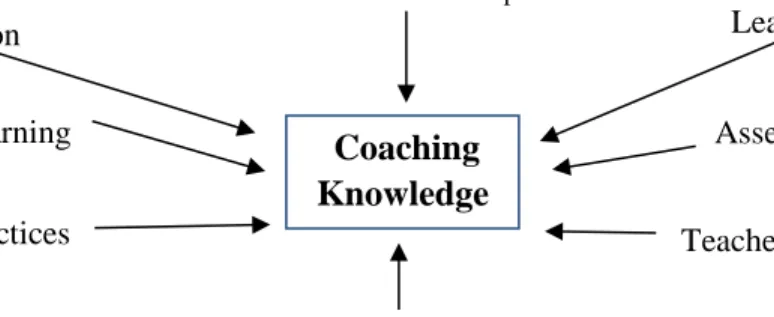
Coaching Knowledge ...43
Knowledge of Student Learning ...43
Knowledge of Teacher Learning ...43
Decision Making ...46
Introduction and Overview ...46
Professional Noticing ...48
Concluding Literature Remarks ...50
III. METHODOLOGY ...53
Study Design ...53
Overview ...53
Purposeful Selection ...54
Unit of Analysis ...54
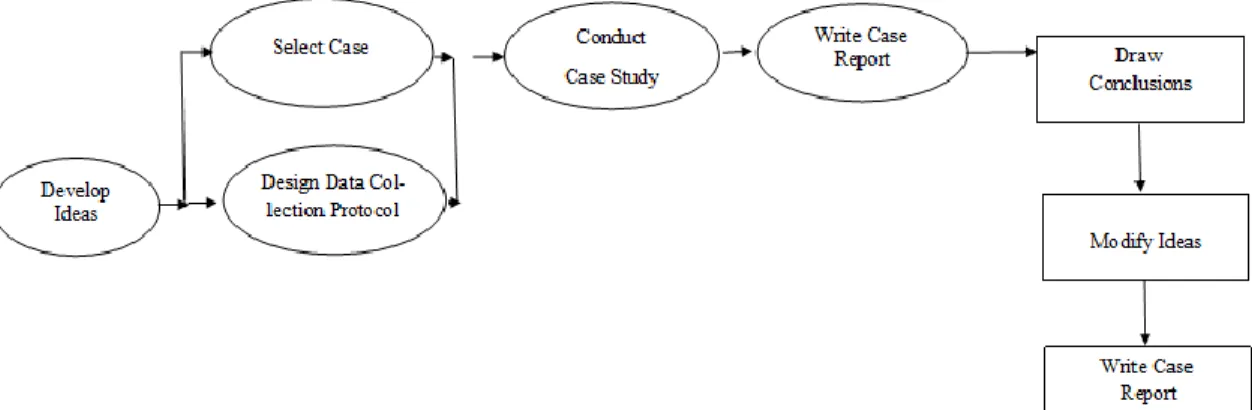
Case Study Design ...55
Researcher Subjectivities ...57
Context ...60
School and Community ...61
Participant Selection ...63
Eleanor: The Coach ...63
Tanner: 8th Grade Math Teacher ...68
Belinda: 8th Grade Math Teacher ...69
Data Sources ...69
Case Study Questions ...71
Interviews ...73
Coach-Teacher Observations ...75
Researcher Journal ...77
Classroom Observations ...78
Surveys ...79
Data Collection and Analysis...80
Data Analysis and Coding Methods ...80
Overarching Method ...82
Organizing the Data ...83
Data Analysis and Conceptual Framework...84
Data Reduction Strategy ...85
ix
Table of Contents (Continued)
Ethical Issues ...90
Boundaries and Strengths ...92
IV. ELEANOR AND TANNER ...94
Introduction and Overview ...94
Decision-Making is Often Guided by the Administration: “The noise” ...95
Coaching Context...98
Tanner’s Classroom Culture ...98
Eleanor and Tanner ...99
Findings...102
Attending ...102
Responding ...106
Summary of Findings: Eleanor and Tanner ...116
Connections to Literature ...118
Coaching Tensions ...119
Summary ...120
V. ELEANOR AND BELINDA ...122
Introduction and Overview ...122
Coaching Context...123
Belinda’s Classroom Culture ...123
Eleanor and Belinda ...124
Findings...127
Attending ...127
Responding ...130
Summary of Findings: Eleanor and Belinda ...137
Connections to the Literature ...138
Coaching Tensions ...139
Summary ...140
VI. CASE ANALYSIS...142
Introduction ...142
Eleanor’s Stances and Practices: An Overview ...142
Findings: Overall Analysis of the Case ...146
Summary of Findings ...152
VII. DISCUSSION ...154
x
Table of Contents (Continued)
Discussion of Findings ...154
Conclusions ...161
Research Question One ...161
Research Question Two ...163
Contributions...164
Questions Raised and Future Research ...164
Developing Common Understandings ...164
Teacher Agency ...165
Sustained Investigation and Inquiry ...166
Multiple Cases ...167
Refined Analysis ...167
Meta-coaching ...168
Conclusion ...171
APPENDICES ...175
A: IRB Approved Consent Forms ... 176-179 B: Coach Semi-Structured Interview Protocol ...180
C: Instructional Coach Survey ... 181-182 D: Teacher Semi-Structured Interview Protocol... 183-184 E: Audit Trail ... 185-191 F: Participants and Those Associated with Coach’s Role ...192 G: Codebook ... 193-195 H: Round Four of Coding ... 196-208 I: Eleanor’s Coaching Stances and Practices ... 209-211
xi
LIST OF TABLES
Table Page
3.1 School Population ...61 3.2 Math Teachers per Grade Level ...62 3.3 Student Demographics ... 62-63 3.4 Instructional Coach’s Professional Experiences ...67 3.5 Data Sources, Data Collection, and Data Analysis ... 70-71 3.6 Case Study Questions ...72 3.7 Monthly Timeline of Study ... 81-82 4.1 Overview of Eleanor’s Interpretations and Responses with Tanner ...102
4.2 Eleanor’s Interpretations and Responses When Working with Tanner . 116-117
5.1 Overview of Eleanor’s Interpretations and Responses with Belinda ... 126-127
5.2 Eleanor’s Interpretations and Responses When Working with Belinda 137-138
xii
LIST OF FIGURES
Figure Page
1.1 The Relationship between Coaching Stances and Responses ...9
1.2 Competence as a Continuum ...11
1.3 Conceptual Framework ...13
2.1 Knowledge and Skills Needed for Mathematics Instructional Coaches ...42
2.2 Knowledge Base of Mathematics Instructional Coaches ...44
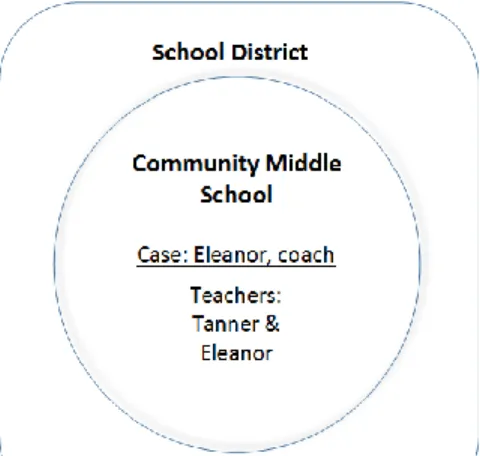
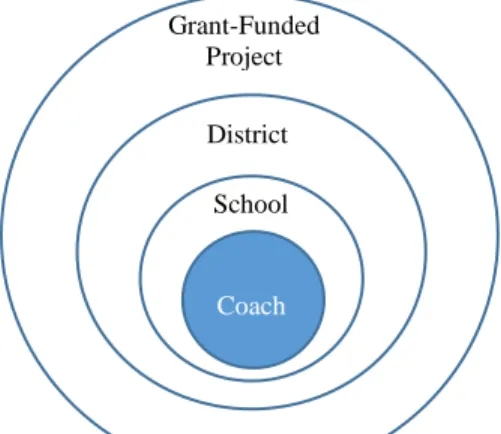
3.1 Embedded Case Study Design ...55
3.2 Case Study Method ...56
3.3 Overview of Coding Scheme ...85
1
CHAPTER ONE INTRODUCTION
…there can be neither a first nor a last meaning; anything that can be understood always exists among other meanings as a link in the chain of meaning, which in its totality is the only thing that can be real. In historical life this chain continues infinitely, and therefore each individual link in it is renewed again and again, as though it were being reborn.
-Bakhtin, from notes made in 1970-1971
Introduction
Eleanor is nervous as we begin our meeting; she is worried it is taking her too long to build relationships with teachers in the school and this, in turn, will delay her coaching efforts. Eleanor was assigned to be the mathematics instructional coach (hereafter referred to using the vernacular “coach”) at Community Middle School two weeks before the 2015-2016 school year started. Because of the short time frame, she was not formally introduced to the faculty. She appreciates the teachers are cordial and
pleasant when talking with her but she is quick to point out the lack of a formal
introduction could be contributing to teachers’ lack of trust for her and her position. She is eager to engage teachers in coaching, to help them feel at ease so she can have
meaningful conversations with them. She knows coaching conversations can lead to increased teacher efficacy and increased student learning. Specifically, Eleanor knows her questioning techniques “build their efficacy” and helps teachers believe that “[they] can make decisions” to best meet the needs of their students (Interview, September 30, 2016).
When teachers work with instructional coaches like Eleanor, what effect does this have on their work with students? How might Eleanor’s coaching practices be viewed
2
and interpreted? In what ways do Eleanor’s beliefs about teacher learning affect teachers’ classroom practices and student learning? How does Eleanor make decisions about how to interact with different teachers (e.g., beginning teachers vs. veteran teachers)? These questions, asked by the research community, have guided the work of instructional coaches for decades and have helped shape the research questions for this study.
Background
Research of the effectiveness of instructional coaching as a method of professional learning for teachers begun in full when a seminal study by Joyce and
Showers was published Educational Leadership in 1980. The findings from their work
suggested when teachers’ professional learning was coupled with peer coaching, changes in instructional practices were significantly more likely to occur (Joyce & Showers, 1980). Since that publication, however, limited research has investigated the knowledge instructional coaches need to be considered effective (Sutton, Burroughs, & Yopp, 2011) and the coaching practices that are associated with teacher learning, practice, and student learning (McGatha, Davis, & Stokes, 2015; Gibbons & Cobb, 2011). The 2015 National
Council of Teachers of Mathematics (NCTM) Research Brief, The Impact of
Mathematics Coaching on Teachers and Students, points out additional studies are needed to examine the complexity of the effects of instructional coaching: the ways in which instructional coaches work with individual and groups of teachers, the ways in which instructional coaches operate within a school system, the supports and challenges teachers require, the ways in which instructional coaches navigate their leadership role,
3
and the specific aspects of “coach-teacher interactions that are most productive in supporting teachers’ growth” (McGatha, Davis, & Stokes, 2015, p. 3). This study explores the extent to which a mathematics instructional coach intentionally determines which coaching practices to use and the ways she differentiates her coaching practices as she works with two different teachers. This research addresses an area has been identified to be a gap in the literature.
In her coaching role, Eleanor is providing on-site, on-going, in-the-moment, professional learning for teachers. This type of teacher professional learning, learning facilitated by an instructional coach, is still emerging from the field and from research. Teachers’ professional development has made dramatic shifts over the past decades from “one shot” offerings that may be disconnected to teachers’ actual needs to tailored
experiences that directly meet teachers where they are. Neufeld and Roper (2003) suggest teachers’ professional learning experiences should be grounded in inquiry, reflection, and experimentation; collaborative; ongoing and supported by modeling; connected to
teachers’ current work with students; and supported by the schools’ current
organizational structures. Furthermore, Killion and Harrison (2006) point out there are several roles that professional developers may assume and one of those roles is that of an instructional coach. Instructional coaches act as mentors, models, consultants, and collaborators. While several models of coaching exist, in general, coaches work one-on-one with individual teachers or with small groups of teachers to improve teacher practice as a way to improve student learning. In this way, each coaching encounter is unique and situated; instructional coaches can vary their practices and roles and, in turn, create a
4
tailor-made professional learning experience that is designed to meet the learning needs of individual teachers.
When teachers work directly with an instructional coach, they may be more effective in adopting new practices (Showers, 1982; Edwards, 2010), can have higher rates of implementation and continued use of those practices over time (Baker, 1983; Edwards), and can have an increased sense of efficacy (Edwards, 2010). (Campbell & Malkus, 2011; Mudzimiri, Burrougs, Luebeck, Sutton & Yopp, 2014). Furthermore, coaching can have a positive impact on teacher attitudes, lead to an increase in skill transfer, help increase teachers’ efficacy, and improve student achievement (Cornett & Knight, 2009). However, linking the practices of an instructional coach to teachers’ instructional practices and to student learning can be a difficult and treacherous path; numerous variables affect student learning. This study investigates coaching as a high-leverage strategy for mathematics teacher learning as an attempt to help build the
foundation that will bridge the research gap between mathematics instructional coaching and teacher learning.
Purpose of the Study
In this study, I examined one coach’s practices with two different teachers in order to respond to questions in the field about the decision making strategies of the coach. More specifically, this study examined how a coach interpreted and responded to the learning needs of teachers and ways in which this coach adapted her practices with teachers. This was be done by closely examining the particular context of each situation. After providing a review of the pertinent literature and research in Chapter 2, Chapter 3
5
of this dissertation sets the stage for this study by considering relevant context. In
Chapters 4 and 5, each individual case is considered in-depth. I compare and contrast the coach’s responses to the two teachers in Chapter 6 by conducting an overall analysis of the case. Chapter 7 presents the study’s overall findings.
Instructional Coaching andCoaching Practices Instructional Coaching: Defined
“Instructional coach” and “coaching practices” are defined and discussed in detail in Chapter 2. However, for the purposes of ensuring a consistency of understanding throughout this dissertation, I frame the phrases “instructional coach” and “coaching practices” in this section. Treemant, Wink, and Tyra (2010) offer a definition of coaching that is not model specific: “coaching is job-embedded, teacher directed, school based, collaborative, ongoing, information rich professional development that focuses on student learning” (p. 685). The specific topics of discussion and ideas instructional coaches and teachers examine vary and this can make it somewhat difficult to clearly pinpoint exactly what instructional coaches do; in turn, this can muddy the waters a bit when trying to nail down a definition of an instructional coach. Nevertheless, instructional coaches engage teachers in a variety of ways: paraphrasing, attending fully and listening to understand as a way to determine the teacher’s current state of mind; using the pronoun “you” instead of “I;” pausing and allowing wait-time; following a coaching cycle (planning, observing, reflecting); asking open-ended questions to broaden or to focus thinking; and noting nonverbal and verbal cues teachers offer (Costa & Garmston, 2007). Instructional
6
intention and purpose: coaching, collaborating, consulting, and evaluating (Costa & Garmston, 2007). These stances are defined and discussed in detail in Chapter 2. While some coaching models suggest instructional coaches can serve as evaluators, for the purposes of this study, this role will not be considered. Coaching is also considered by some coaching models as a stance the coach can take; in other words, because the coach may act in other ways, namely collaborating, consulting, and evaluating, coaching is also considered a specific stance the coach can assume.
The crux of the definition of an instructional coach that Treemant, Wink, and Tyra (2010) provided is that the instructional coach follows the direction of the teacher. In other words, when an instructional coach is assuming the role of a “coach,” she listens to the teacher with the intent to help him or her move in a direction determined solely by the teacher; the instructional coach does not enter the conversation with a predetermined agenda. (For convenience, throughout this dissertation, I use gendered pronouns “she” and “her” when referring to an instructional coach.) Also, while the primary goal of the instructional coach is to focus on student learning, the coach recognizes the learning of the teacher is an indirect, yet essential, step toward student learning. So, for example, an instructional coach may assume the stance of a consultant for the purposes of increasing a teacher’s pedagogical and content knowledge and skills in order to positively affect student learning.
Coaching Stances: Defined
Before considering the ways in which a mathematics instructional coach responds to a teacher, we first think about the stance she assumes. A “stance may be viewed as ‘the
7
way in which an agent during interaction positions him/herself toward the other and the topic of interaction’” (Poggie, D’Errico, & Leone, 2010, p. 3233, as cited in Wilder, 2013, p. 5). In other words, when working with a math teacher, before a coach determines how she will respond to a teacher, she first decides on the way in which she will position herself. For the purposes of this study, three types of stances will be considered:
consulting, collaborating, and coaching (Lipton & Wellman, 2010; Costa & Garmston, 2002). (These stances will be described in more detail in Chapter 2). To illustrate this point, when a coach positions herself as a consultant, she may offer the teacher direct advice; when collaborating, the coach may act as a co-learner; and, acting as a coach, the coach, according to some coaching models, will focus on asking questions intentionally phrased to mediate the thinking of the teacher and focus on the teacher’s states of mind (Costa & Garmston, 2002). Because the stance a coach assumes is highly contextual, this study will examine the specific events the coach attends to, the stances she assumes, and the ways in which that influences her responses to the teacher.
Coaching Practices: Defined
In service of unpacking the study’s research questions, the phrase “coaching practices” must be defined. While the phrase “teacher practices” has been theorized for years in the literature (Noddings, 2003; Ball, 2002; Pajares, 1992), “coaching practices,” as referenced in the literature, is not as refined or distinct. Defining coaching practices is a complex task that will be discussed in more detail in Chapter 2 but for the purposes of establishing the need for this study, they will be briefly examined here. In its purest essence, a coach’s practices are a manifestation of her stances. In other words, the ways
8
the coach responds to the learning needs of a teacher, the practices she uses, are a direct result of the stance she assumes when working with that teacher.
Costa and Garmston’s Cognitive CoachingSM model (2002) posits that
instructional coaches mediate teachers’ thought processes by: pausing (providing wait-time so teachers can clearly form and articulate their thoughts, ideas, and responses), paraphrasing (summarizing teachers’ thoughts to ensure they completely understand the nature of teachers’ ideas), probing (supporting teachers in gaining clarity of thought by asking probing questions), and by attending to teachers completely with their mind and body (when appropriate, mirroring body language to engage in rapport-building). Additionally, coaches can ask mediating questions that intentionally draw upon and extend teachers’ states of mind (efficacy, flexibility, consciousness, craftsmanship, and interdependence). These types of questions can broaden or focus teachers’ thinking, depending on what the coach interprets as appropriate in terms of mediating teachers’ thought processes. While the Cognitive Coaching model labels these as “tools,” I will continue to use the language of “practices” throughout this dissertation, thereby signaling what a coach does (verbal exchanges, actions, nonverbal communication) in an attempt to influence the teachers’ states of mind. Taken together, I define coaching practices as the ways in which the instructional coach responds to teachers’ actions, language, and attitudes.
For this study, it was important I remain somewhat open when looking for coaching practices; I didn’t want to miss any particular way that a coach would respond because of a limited view on my part. Chapters 4 and 5 of this dissertation will highlight
9
specific coaching practices I observed. At the onset of the study, however, I felt strongly that when looking for coaching practices, I should be cognizant of any way the coach responded to the teacher.
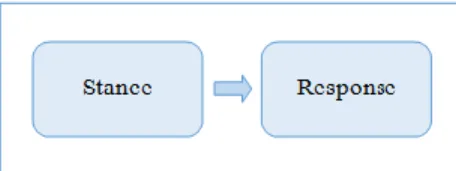
The relationship of the coach’s stances to her practices can be considered visually as displayed in Figure 1.1. Overall, the coach selects her specific practices based on the way she positions herself towards the teacher, the stance she assumes. Again, we can consider the coach’s practices, her responses, as a direct manifestation of her stance; the coach’s stance is the foundation upon which her practices are selected.
Figure 1.1. The relationship between coaching stances and coaching responses
Research Questions
There is limited research available that investigates the knowledge that
mathematics instructional coaches need to be considered effective (Sutton, Burroughs, & Yopp, 2011) and the coaching practices that are associated with teacher learning,
practice, and student learning (McGatha, Davis, & Stokes, 2015; Gibbons & Cobb, 2011). This study investigates coaching as a high-leverage strategy for mathematics teacher learning and examines one coach’s practices with two different teachers in order to respond to questions in the field about how an instructional coach interprets and responds to the learning needs of teachers. More specifically, this study examines how one coach determines which practices to use and the ways in which a coach adapts her
10
practices with teachers.This study focuses intensely on the interactions of one coach with two teachers to addresses the following questions:
1. How do instructional coaches interpret and respond to the learning needs of teachers?
2. In what ways do instructional coaches adapt their practices to the differing
learning needs of teachers?
Conceptual Framework
There can be no such thing as an isolated utterance. -McGee, 1986, xix
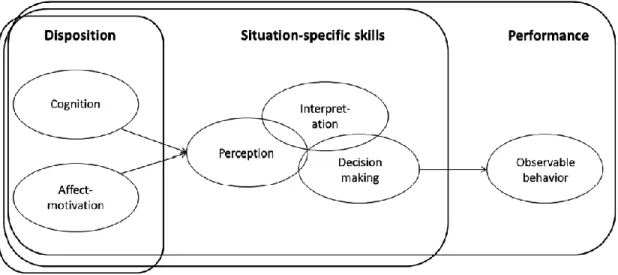
To help me frame my research, I read literature about teacher decision-making. Since this study’s research questions focus on the ways in which an instructional coach interprets and responds to the learning needs of teachers and since this study address a gap in the research base, I focused my search on the decision-making practices of teachers. I extrapolated my readings and understandings to incorporate and include parallels that exist between instructional coaches and teachers as they make decisions about which coaching or teaching practices to use. I found a manuscript on teachers’ competence framed as a continuum (Blomeke, et. al, 2015), and upon my initial reading, I was struck with how part of this decision-making framework seemed to be somewhat parallel with current mathematics education literature on teachers’ professional noticing (Sherin, Jacobs, & Philipp, Eds., 2011). What most attracted me to this model was the focus on the “performance” or the “observable behavior” of the teacher and the interplay of the situation specific skills. Figure 1.2
11
Figure 1.2. Blomeke, et al. (2015), Competence as a Continuum
In its purest sense, the competence model created by Bloemke, et al. (2015) (see Figure 1.1), provides researchers with a way to understand the ways in which teachers’ practices (their “observable behaviors”) are connected to their dispositions via their perception, interpretation, and decision-making. The Blomeke, et al. model a teacher’s competence by drawing attention to the teacher’s dispositions and the ways in which those lead to the teacher’s performance/observable behavior. Teacher competence,
according to these authors, is “performance in complex, messy, real-life situations” (p. 9). Because I operate from a situative perspective, I understand the critical role that context plays in shaping learning and decision-making. Specifically, these authors point out that “processes such as the perception and interpretation of a specific job situation together with decision-making may mediate between disposition and performance” (Blomeke, et al., 2015, p. 7). Primarily, Blomeke et al. (2015) attempt to bring together two
12
perspectives on knowledge serve as the foundation for teachers’ situation-specific skills (perception, interpretation, and decision making) and then “mediate between [teachers’] disposition and performance” (p. 7). This then helps us conceptually view a teacher’s competence as a continuum; “…competence should be regarded as a process, a continuum with many steps in between” (Bloemke, et al., 2015, p. 7). I argue that an instructional coach’s competence or her selected practices can also be viewed in a similar fashion, as a continuum. There exist at least three steps (perception, interpretation, and decision making) that stem from one’s dispositions and then lead to the practices that she selects and uses. Furthermore, this continuum is contextual; the specific context
surrounding the coaching/teacher relationship also affects the practices that are selected and used by the coach.
While reading this manuscript, I was struck by its parallel nature to the current research of mathematics teachers’ professional noticing (Jacobs, Lamb, & Philipp, 2010). Upon making this connection, I knew that the professional noticing framework (Sherin, Jacobs, & Philipp, Eds., 2011) could serve as the foundation for the conceptual
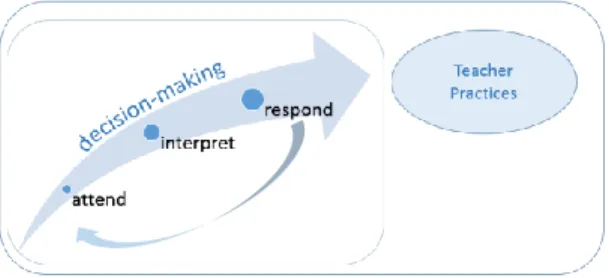
framework for this study; that the components of professional noticing had the potential to shape my data analysis and my findings. Although these ideas are discussed in more detail below, simply put, they help frame and conceptualize a coach’s decision-making process. In essence, the way that an instructional coach attends to a particular situation shapes her interpretation of events. Decision-making about how to engage teachers occurs after the instructional coach has interpreted the events around her. Therefore, the
13
instructional coach’s attention to events and her interpretation of those events lead to specific coaching practices (see Figure 1.3).
Figure 1.3 Conceptual Framework
Figure 1.3 connects the professional noticing framework of Jacobs, Lamb, & Philipps (2010) with part of the competence modeled as a continuum by Blomeke, Gustafsson, & Shavelson (2015). (Note for Figure 1.2: “attend,” “interpret,” and
“respond” are from Professional Noticing Framework; “perceive” and “decision-making” are from Competence as a Continuum frame.) While other researchers have pointed out the “clear parallelism between attending and perception, [elaboration] and interpretation, and proposing improvements and decision making” (Santagata and Yeh, 2016, p. 155), to my knowledge, this is the first study to capitalize on this parallelism as a framework for examining the practices of a mathematics instructional coach. Although Blomeke et al.’s (2015) competence model and Sherin, Jacobs, and Phillip’s (2011) framework for
professional noticing both have direct implications for mathematics instructional coaches and for mathematics teachers in terms of their decision-making, I posit that, when
combined, these structures can specifically frame the practices of mathematics instructional coaches. To be clear, Jacobs, Lamb, and Philipp’s (2010) professional noticing framework provides a guide for how mathematics teachers make sense of and
14
respond to students’ mathematical thinking. For this study, I use this adapted frame to help understand what a mathematics instructional coach attends to, how she interprets those events, and how she responds to math teachers based on what she has noticed and how she has made sense of what she has noticed.
Drawing our attention to the interplay of the “situation-specific skills,” the perception, interpretation, and decision-making, it becomes clear that the interaction of these skills leads to the teacher’s performance and behaviors. These “situation-specific skills” are very similar to components of the professional noticing framework set forth by Sherin, Jacobs, & Philipp (2011): attend, interpret, and respond. Particularly, Sherin, Jacobs, & Philipp, in their 2010 book, Mathematics Teacher Noticing, solicit research from numerous authors to more clearly define what teacher noticing means and how it should be understood. As they point out, “the word noticing names a process rather than a static category of knowledge” (Sherin, Jacobs, & Philipp, 2011, p. 5). “The focus is on how, at a fine-grained level, the teacher interacts with [their] world rather than solely on a [his] reasoning” (Sherin, Jacobs, & Philipp, 2011, p. 5). The construct of professional noticing is defined as “how, and the extent to which, teachers notice children’s
mathematical thinking” (Jacobs et al., 2010, p. 171). More specifically, this framework is used as a tool to help researchers determine the ways in which mathematics teachers make sense of and understand their students’ mathematical thinking. This three-part framework is composed of the following interrelated skills that can be seen as similar to Blomeke, et al.’s (2015) situation-specific skills: (a) attending to students’ solution
15
strategies, (b) interpreting students’ mathematical understanding, and (c) deciding how to respond to students’ understanding.
The professional noticing framework, merged with the competence as a
continuum model, was used to structure this study on mathematics instructional coaches. Instead of focusing solely on the ways in which teachers notice students’ mathematical thinking and their observable behaviors, attention is focused on what guides the decision-making process of a mathematics instructional coach’s in-the-moment. In this way, the interrelated skills of the mathematics instructional coach are highlighted: a) what teacher behaviors an instructional coach attends to in the moment (teacher’s language, nonverbal communication, etc.), b) how an instructional coach makes sense of a teacher’s
behaviors, and c) how an instructional coach decides to respond to the teacher’s behavior. For example, if a coach notices that a teacher uses deficit language about his students, the researcher might be interested in asking the coach about her interpretation of the
teacher’s language and how this interpretation guided her decisions about which practices to use with that teacher.
The three components of this framework are not entirely distinct. For the purposes of this study, the attending and interpreting components have not been separated. These components have proven to be difficult to tease apart and for the purposes of this study, the focus is more on connecting what the coach notices to her specific responses. Therefore, during data analysis, these two components were considered as one by focusing on what the coach attended to and noticed and how she made sense of what she noticed. The “respond” component of the framework was then used as a way to
16
determine the specific coaching practices that the coach selected and used as a result of what she noticed and her interpretation of what she noticed.
Furthermore, when thinking about what the instructional coach attends to, her interpretation of events, and the ways in which she responds, we must also recognize that it is sometimes the case that the coach enters into coaching conversations with a
predetermined idea of what she will attend to based on her previous responses. For instance, if during their last conversation, the coach focused on the teacher’s use of warm-up activities at the beginning of each class period and made a recommendation that the teacher use more warm-up based activities with the students, then during the next conversation the coach has with the teacher, the initial attention may be given to the extent to which the teacher is utilizing warm-up based strategies. To account for this, the conceptual framework graphic (Figure 1.3) includes a bottom arrow that returns the “response” to the “attend.” In this way, this study’s conceptual framework recognizes that sometimes what the coach initially attends to is related to how she last responded to the teacher.
The stances and practices that a coach uses can also be seen in this conceptual framework (Figure 1.3). Once a coach attends to, or notices, a particular instance of the coach-teacher interaction, the coach interprets the event and determines the ways that she wants to position herself, the stance she wants to assume. Once the coach has selected a stance (consultant, collaborator, or coach), she determines specifically how to respond to the teacher and which coaching practices to use. In this way, her coaching practices (language choice, nonverbal actions, asking a question vs. making a statement) are a
17
direct manifestation of the stance that she assumes. In other words, if Figure 1.1 and Figure 1.3 are overlaid, it becomes apparent that what the coach attends to leads to her interpretation of events and the stance she selects and then to the practices she employs. In other words, during the “interpretation” component of the framework, the coach determines which stance she will assume; during the “respond” component of the
framework, the coach determines which practices she will use. The relationship between the coach’s stances and practices and what she attends to will be explored in-depth with each case.
Significance
“The available empirical evidence suggests that coaching is a promising
professional development practice that can lead to improved teaching and learning. While the number of research studies on mathematics coaching is increasing, there is still much work to be done” (McGatha, Davis, & Stokes, 2015, p. 3). More specifically, studies are needed that draw attention to the intentionality of coaches’ practices. Because the research and literature on instructional coaching has not focused on this relationship to date, this study has the potential to contribute to the national (and possibly international) conversation on the intentionality of instructional coaching practices. My time spent searching and reading the literature and, more interestingly, my time spent in
conversations with several of the authors of this literature (Baldinger, Campbell, Fennell, Gibbons, Jilk, McGatha, West, and Yopp) during the 2015 Association of Mathematics Teacher Educators Elementary Mathematics Specialists Research Conference and during the 2015 and 2016 Mathematics Specialists Research Conferences further strengthened
18
my resolve towards the importance of this study and the contribution that it can make to the current literature base. During this conference, no studies highlighted the
intentionality of instructional coaches’ practices; furthermore, no researchers discussed planning to make this a focus of their research. Additionally, during the 2016
Mathematics Specialists Research Conference, attendees and researchers showed interest in the conceptual framework that guided this study. In addition to this study’s research findings, the ways in which the study’s data have been analyzed and understood has implications for the field of mathematics instructional coaching research.
Organization of the Dissertation
This dissertation is organized into seven chapters. In Chapter 2, I outline a review of the relevant instructional coaching and teacher decision-making literature and provide more detail regarding the study’s conceptual framework. In Chapter 3, the study’s
methodological choices are explained and the context for the study’s cases is provided. In Chapters 4 and 5, the two cases are presented, the analysis of the data for that case is outlined, and the findings for each case are provided. Chapter 6 presents the data from the coach’s interactions with both teachers as a way to provide an overall analysis of the case. A discussion of the study’s findings, contribution, and potential future research options are provided in Chapter 7.
19
CHAPTER TWO
REVIEW OF RELATED LITERATURE
In this chapter, I examine and critique the literature and research related to mathematics instructional coaching and decision-making. In doing this, I attempt to situate my study in the existing body of literature and highlight the ways in which this study will address a gap in the research. Specifically, in terms of instructional coaching, various definitions and models of instructional coaching, coaching roles and
responsibilities exist; definitions of instructional coaching practices and stances, the knowledge needed for coaching mathematics, coach-teacher relationships must be examined in-depth. Literature related to teacher decision-making is also explored as a way to situate both of this study’s research questions in the current and relevant literature. To begin, literature related to defining mathematics instructional coaching, various
coaching models, coach-teacher relationships, the knowledge that coaches need to coach, and the effect that coaching can have on teacher practices and student learning are examined. Decision-making practices and the ways in which coaches make
in-the-moment decisions about how to respond and which coaching practices to employ are also considered.
In addition, a description about this study’s conceptual framework is provided; how it was conceived, the literature and research related to the framework, and the ways in which this framework serve to guide the study’s data collection and data analysis.
20
Studies have revealed that teachers’ professional development is a critical factor in predicting teachers’ instructional practices and student achievement (Borko, 2009; Wenglinsky, 2000) and as early as the 1980’s, the state of professional development began expanding to encompass coaching as a form of teacher professional learning (Joyce & Showers, 1980; Costa & Garmston, 2002). Therefore, it is important that research examine the ways in which specific coaching practices influence teachers’ instructional practices in the classroom, because changes in instructional practices can lead to increases in student achievement. To do this, we consider coaching as a form of professional learning. Since its inception, the meaning of the term coach has evolved and shifted.
Coaching as a form of professional learning for teachers is not new; teachers who are coached are more likely to implement new practices and to continue to use those new practices over sustained periods of time (Joyce & Showers, 1980). In their 1980 study, Joyce and Showers found that “the most effective training activities [are] those that combine theory, modeling, practice, feedback, and coaching to application” (p. 384-385). When compared to other types of professional development (e.g. presentation of theory, modeling or demonstration, and practice under simulated conditions), Joyce and Showers (1980) found that when teachers were provided structured feedback, they were more likely to implement new teaching practices. However, when this structured feedback was combined with “coaching for application,” the impact was considerable. “Coaching for application involves helping teachers analyze the content to be taught and the approach to be taken and making very specific plans to help the student adapt to the new approach”
21
(p. 384). In other words, when a coach worked directly with a teacher in an attempt to meet his individual needs, the teacher was much more likely to implement and sustain new teaching approaches.
Edward’s (2010) synthesis of coaching research highlighted numerous benefits to coaching: increased student test scores, increased teacher reflection and efficacy,
increased teacher job satisfaction, and increased teacher collaboration (Edwards, 2010). In her 2010 synthesis of the Cognitive Coaching research, Edwards noted that teachers who received Cognitive Coaching transformed their teaching practices (e.g. increased use of inquiry methods), created an atmosphere of trust and non-judgment in their
classrooms, had students who performed better on end-of-year exams, and had dramatic increases in student-led questions during class discussions. Specifically, after the passage of one school year, “85% of students increased the quantity of questions asked, 91% of students increased the quality of questions they asked, and they decreased 46% in irrelevant responses” (Ushiima, 1996). Furthermore, teachers who received Cognitive Coachinggrew in teaching efficacy on the Teacher Efficacy Scale (Gibson & Dembo, 1984) and more confidently and intentionally used paraphrasing, questioning, and
coaching techniques with their students. Additionally, Cornett and Knight (2009) argued that coaching research demonstrates improved student achievement, improved teacher efficacy, improved implementation transfer, and a positive effect on teacher attitudes. Despite these positive findings, there is still much work to be done in order to fully elucidate the role and effects of mathematics instructional coaches. In 2009, the National Council of Teachers of Mathematics (NCTM) published a Research Brief titled
22
Mathematics Specialists and Mathematics Coaches: What Does the Research Say? In this
publication, NCTM cites only thirteen sources, three of which are not related directly to coaching research. Furthermore, in their opening paragraph under the heading “Research on Mathematics Coaching,” it becomes clear there is little research related to coaching; the author states “the research on mathematics coaching is more abundant [than that of Elementary Mathematics Specialists] but includes just seven studies that provide
preliminary insights” (p. 1). In conclusion, McGatha states “The available empirical and anecdotal evidence suggests coaching is a promising professional development practice that can lead to improved teaching and learning. However, we need to continue to pursue research that can support these initial findings” (p. 2). In February of 2015, NCTM released an updated research report on the current state of mathematics instructional coaching research. According to McGatha (AMTE presentation, 2015), this new report rests upon only twenty-four studies; just eleven more studies are referenced. In the seven years that have passed, the research on coaching has not drastically increased; there is still a need to directly study the complexities and outcomes associated with instructional coaching.
This is of primary concern for anyone currently engaged in research related to instructional coaching: when searching for literature related to instructional coaching, citations abound. However, of these, the citations for practitioner-based pieces far outnumber those that are research-based. For example, one can easily find numerous books describing coaching methods and techniques with no research to support the types of practices espoused. Of those research-based pieces, one might question the quality of
23
the reporting of the research; often, in some of the earlier pieces, some critical details seem to be missing (number of participants, length of study, etc.). As an example, Joyce
and Showers’ (1982) seminal piece entitled Improving In-service Training: The Messages
of Research (a study, I might add, which is cited repeatedly in the coaching literature), was published in Educational Leadership, the primary journal for Association for Supervision and Curriculum Development (ASCD). According to their website, “ASCD is a partner in educator professional development, providing materials, resources, and experts to ensure student success” (http://www.ascd.org/about-ascd.aspx). To my understanding, the primary objective of ASCD is to provide literature to practitioners. This does not mean each published piece is as detailed as a research-based piece published by a research-focused organization. Returning to Joyce and Showers’ 1982 publication on coaching, we notice that the more than 200 studies they report to have analyzed the effects of different types of professional development on teachers’ changed instructional practices are not referenced specifically. This becomes problematic for those who wish to build on this research.
Definitions of Instructional Coaching
What, though, are the components of coaching and how is instructional coaching defined? What stances and responsibilities does an instructional coach assume? What knowledge must a coach possess in order to “effectively” coach teachers? What is most notable is, in the review of the scant research related to coaching, no one clear definition of coaching exists. Even when extending the search to a review of related coaching literature, it is apparent multiple definitions of coaching exist. Treemant, Wink, and Tyra
24
(2010) offer a definition of coaching that is not model specific: “coaching is job-embedded, teacher directed, school based, collaborative, ongoing, information rich professional development that focuses on student learning” (p. 685). This definition can help us begin to consider how coaching, regardless of the model, can be a unique type of professional learning for teachers. Coaches are able to work individually with teachers, assess teachers’ specific needs, and then find ways to work with teachers in a variety of ways so their needs are addressed. Instructional coaches can assume a variety of roles, depending on teachers’ needs: collaborator, coordinator, consultant, and mentor.
Currently, numerous coaching models exist and the term “coach” has several definitions. Cornett and Knight (2009) point out that while several coaching models exist, four approaches are most frequently mentioned in the literature: Peer Coaching,
Cognitive Coaching, Literacy Coaching, and Instructional Coaching. While these approaches vary, similarities exist: respect for the professionalism of teachers, a
partnership orientation, a focus on listening before talking, dialogical conversation, and recognition of the primacy of student learning (Garet, Porter, Drsimone, Birman, & Yoon, 2001; Hawley & Valli, 1999; Zepeda, 2008).
In the recent publication, Principles to Actions: Ensuring Mathematical Success
for All (2014), the National Council of Teachers of Mathematics (NCTM) references
coaching support as a method for teachers’ continued professional growth. In this document, a coach is defined as “‘an individual who is well versed in mathematics content and pedagogy and who works directly with classroom teachers to improve student learning in mathematics’” (Hull, Balka, and Harbin Miles, 2009, p. 3). Returning
25
again to the description of instructional coaching referred to in Chapter 1, we are
reminded that Treemant, Wink, and Tyra (2010) offer a definition of coaching that is not model specific: “coaching is job-embedded, teacher directed, school based, collaborative, ongoing, information rich professional development that focuses on student learning” (p. 685). With these definitions (Garet, Porter, Drsimone, Birman, & Yoon, 2001; Hawley & Valli, 1999; Zepeda, 2008; NCTM, 2014; Treemant, Wink, & Tyra, 2010) we can
identify similarities and overlaps that help us clearly define “coaching” for the purposes of this study: a mathematics instructional coach is one who is well versed in mathematics content and pedagogy, works directly with mathematics classroom teachers to improve students’ mathematics learning, and who offers on-going, individual, job-embedded learning for teachers. Although this definition has been constructed and is not verbatim from the literature, it encompasses aspects of the definition as outlined in relevant literature.
Coaching Defined
A review of prevalent coaching models, coaching practices, and coaching stances helps to solidify our understanding of what “counts” as an instructional coach. Although the purpose of this literature review is not to formally define coaching, researchers in this field must possess firm understanding of coaching models. And for the sake of
consistency, throughout this study, I use the overarching definition referenced above (Garet, Porter, Drsimone, Birman, & Yoon, 2001; Hawley & Valli, 1999; Zepeda, 2008; NCTM, 2014; Treemant, Wink, & Tyra, 2010 ): a mathematics instructional coach is one who is well versed in mathematics content and pedagogy, works directly with
26
mathematics classroom teachers to improve students’ mathematics learning, and who offers on-going, individual, job-embedded learning for teachers. A thorough review of current instructional coaching models and of the associated research and literature helps continue to situate this study.
Coaching Stances vs. Coaching Practices
Coaching stances. For the purposes of this study, it is necessary to differentiate between coaching practices and coaching stances. As discussed briefly in Chapter 1, a “stance may be viewed as ‘the way in which an agent during interaction positions him/herself toward the other and the topic of interaction’” (Poggie, D’Errico, & Leone, 2010, p. 3233, as cited in Wilder, 2013, p. 5). In other words, when working with a math teacher, before a coach determines how she will respond to a teacher, she first decides on the way in which she will position herself. Costa and Garmston (2002) define what this study refers to as “coaching stances” as the support services that coaches use to assist teachers in becoming more self-directed. “We distinguish four categories of functions intended to support teacher development: evaluating, collaborating, consulting, and [coaching]” (Costa & Garmston, 2002, p. 9). The authors of this coaching model,
Cognitive Coaching, state when an instructional coach coaches, consults, or collaborates, she is changing support functions, shifting her stance, and ways of interacting with a teacher to improve the teacher’s instructional practice. For example, an instructional coach may find it necessary to consult a novice teacher more than a veteran teacher; an instructional coach may find one veteran teacher appreciates coaching while another may need to see the coach as a collaborator before allowing the instructional coach to assume
27
the stance of a coach. What is necessary to understand, though, is each of these three stances “plays a significantly different role, with very different mechanisms and
intentions” (Costa & Garmston, 2002, p. 9). Of critical note: the creators of this coaching model use the language “support function;” I use the language of “stance.” A coach’s stance, the ways in which she interprets the teacher’s needs, is closely aligned with this study’s conceptual framework. A coach’s stance is what serves as the foundation for her practices (since her practices are a manifestation of her stance).
The three stances, consulting, collaborating, and coaching, are outlined by the authors of Cognitive Coaching as we might assume. When an instructional coach acts as a consultant, she offers her expertise to a teacher. As an example, an instructional coach might recognize a teacher does not fully comprehend the meaning of a standard and how to teach the standard. As a result, the coach can share her content knowledge or
pedagogical knowledge with the teacher. When an instructional coach collaborates with a teacher, she acts as a co-learner; the instructional coach and the teacher work together to achieve a common goal. When an instructional coach assumes the stance of a coach, she, according to this coaching model, acts in ways that help mediate the thinking of the teacher, helping him become more efficacious and self-directed. An instructional coach can take any one of these three stances (consultant, collaborator, or coach) at any given time depending on what she believes the teacher needs. In this way, the coach is
providing “individualized, job embedded learning” for the teacher; the coach acts in ways she feels are in-line with the teacher’s needs.
28
Coaching practices. When an instructional coach takes a particular stance (coach, collaborator, consultant), she engages in practices that allow her to act in these ways. In other words, the practices that a coach uses with a teacher is reliant upon the stance she believes will best facilitate the teacher’s learning; her practices are a manifestation of her stance. For this reason, we can consider a coach’s practices, her ways of respond to the learning needs of teachers, are an indicator of her stance. For instance, if a coach is working with a novice teacher she believes needs help interpreting the content standards, she may decide to use language that elucidates the teacher’s need to increase his content knowledge. In this way, the coach acts as a consultant. As another example, if a coach working with a veteran teacher realizes the teacher is resistant to working with an instructional coach, she may decide to paraphrase the teacher in ways that helps the teacher feel heard and understood. The instructional coach may also ask the teacher questions that help build and strengthen their relationship. In this way, the
instructional coach is acting from the stance of a coach. (Again, this study considers three distinct stances: collaborator, consultant, and coach. The stance of “coach” is not be confused with the person who is a “coach.”)
Thinking about the differences in “coaching practices” and “coaching stances” in this way can help us better understand these terms in relationship to this study. For the context of this study, I investigated an instructional coach’s practices. In order to
understand and classify the instructional coach’s practices, I first investigated her stances and then linked particular practices to her stances.
29
The context situating this study contains the ways in which coach-teacher relationships develop, a coach’s beliefs about teacher learning, and how those beliefs relate to the coaching practices a coach selects. For this reason, findings are shared from the 2010 Final Evaluation Report on the coaching initiative examined in this study. (Again, this dissertation does not attempt to report findings from one particular coaching model or one particular coaching initiative; rather, I note the mathematics instructional coach in this study operates from a particular coaching model and within a specific coaching initiative. In an attempt to be transparent and up-front about the coach’s background and my researcher subjectivities, I continue to mention this actual initiative and the Cognitive Coaching model.) The 2010 Final Evaluation Report from the agency that funds the mathematics instructional coach I studied, “summarizes three years of data collection and analysis between 2007 and 2010 in the evaluation of [project name] (the organization who employees the instructional coach who is part of this study), a joint project between the two state organizations and the State Department of Education” (Larson, Stuhlsatz, & Shaw, 2010, p. i). Findings from three years of this initiative point out that as teachers worked with instructional coaches, they increased their repertoire of instructional techniques and became “more effective planners, teachers, and assessors of their students’ understanding of the content” (p. 22). Furthermore, this initiative also reveals increased student achievement on state achievement tests, as contrasted to comparison schools. Unlike some initiatives, this model selected and prepared
30
student assessment, knowledge of facilitating professional learning communities, and their knowledge of coaching (using the Cognitive Coaching) model.
Campbell & Mulkus (2011) have also reported increases in student achievement based on the implementation of an instructional coach in the school. While this study connects the effects of an instructional coach to changed teacher practices and increased student achievement, at the same time, researchers clearly state numerous limitations: a lack of attention to coaching practices, coach knowledge and skills, teachers’ existing
instructional practices, and coaches’ roles (perceived and actual), (Campbell & Malkus, 2011; Edwards, 2010; Sutton, Burroughs, & Yopp, 2011; Treemant, Wink, & Tyra, 2011). In other words, these same studies that claim links between instructional coaching and increased student achievement also point out there may be other contributing factors to the changes in teaching and learning: teachers’ time teaching in the district and students’ socio-economic status. Furthermore, these studies do not pinpoint specific coaching practices that led to the reported changes in teaching and learning and utilize relatively small sample sizes (Edwards, 2010).
Coaching Models
The specific roles and responsibilities of a mathematics instructional coach varies depending on her background, training, and the coaching model she uses as her guide and framework. Cornett and Knight (2009) point out although numerous coaching models exist, four are most referenced in the literature: Peer Coaching, Literacy Coaching, Instructional Coaching, and Cognitive Coaching. The characteristics and qualities of these models of coaching are not mutually exclusive; they overlap in ways that can help
31
us again return to the definition created from merging the components of coaching outlined in the literature: a mathematics instructional coach is one who is well versed in mathematics content and pedagogy, works directly with mathematics classroom teachers to improve students’ mathematics learning, and who offers on-going, individual, job-embedded learning for teachers. Since a discussion of these coaching models is not needed and does not contribute to answering this study’s research questions, the models will not be discussed; we only need an awareness that multiple models exist. However, since the mathematics instructional coach in this study was well versed in the Cognitive Coaching model, a brief discussion of that specific model is included.
Cognitive Coaching
Cognitive Coaching was first developed by Art Costa and Bob Garmston in 1984. In 1999, the Center for Cognitive Coaching was established and today this Center is run by Jane Ellison and Carolee Hayes. This coaching model rests upon the idea that the coach acts as a mediator of the teacher’s thinking; the coach listens to understand,
paraphrases to seek clarity, and questions the teacher in ways that help her move forward in her thinking. Coaches who operate from this model seek to help teachers become self-directed and purposeful in their thoughts and actions. As with other coaching models, these coaches may assume a variety of stances: coach, collaborator, consultant, or coordinator. Research has been conducted on Cognitive Coaching for over 20 years and reveals that this type of coaching has been linked to increased student test scores, increased teacher efficacy, and increased teacher collaboration (Edwards, 2010).
32
For the purposes of this study, I primarily use Cognitive Coaching as a framework to guide my observations, although other models were considered to more firmly ground my understanding of Cognitive Coaching. The coach I worked with has been engaged in Cognitive Coaching since 2005. “Cognitive Coaching is a model that supports
individuals and organizations in becoming directed, and in turn, become
self-managing, self-monitoring, and self-modifying” (Costa and Garmston, 2002). While I do not advocate for one coaching model over the other, it is necessary to provide the details of the coaching framework before embarking on this research.
Coach-Teacher Relationships Trust
Research conducted in the Chicago Public Schools from 1994-1997 indicated
relational trust is a key resource for school improvement (Bryk & Schneider, 2002). Bryk and Schneider (2002) contrasted relational trust with two other kinds of social trust: organictrust, which is the unquestioning belief that an individual or organization will do what is right (for example the trust of parents in private or religious schools to educate their children), and contractual trust, the kind of trust used in which individuals or organizations spell out the scope of work to be undertaken and the product that will be delivered. They suggest neither of these forms of trust is appropriate for our schools today. A third form of trust, relational trust is an intermediate case between the other two types of trust. It is founded on both beliefs and observed behavior and requires
expectations are validated through behavior. In relational trust, judgments are drawn from behavior, how people feel and beliefs about others’ intentions.
33
The lenses through which teachers observe and interpret the behaviors of others are called by researchers “criteria for discernment” (Bryk & Schneider, 2002). Essentially, teachers use these criteria in a school setting to determine whether or not a person
(including an instructional coach) is trustworthy. The criteria for discernment are: respect, competence, personal regard and integrity. So, for example, teachers either intentionally or unintentionally use these criteria to determine the extent to which they can trust a coach. And, the development of this trust is vital to the development of the coach-teacher relationship (Tschannen-Moran, 2004).
Relational trust is also based on social exchanges organized around a set of role relationships in the school. These role relationships are school professional to community member, teacher to principal, teacher to teacher, and teacher to student. Particular
expectations, obligations and dependencies characterize each of these relationships. For example, teachers depend on parents to bring their children to school and parents depend on teachers to effectively support the learning of their child. In general, the power base held by an individual directly affects the relational trust in any given role set. Although power distributions vary from school to school, no one person holds absolute power in a school. Even the school principal is dependent on both parents and teachers. As a
consequence, all parties remain vulnerable to each other. Decreasing this sense of vulnerability is a key ingredient in the development of relational trust. In the coach-teacher relationship, this implies the relationship will be strengthened when the coach helps the teacher feel less vulnerable.
34
A summary of the research on trust in schools (Tschannen-Moran, 2004) revealed common dimensions across definitions of trust: willingness to risk vulnerability (a sense of interdependence, e.g., when a principal shares decision-making with staff), confidence (e.g., when a parent leaves her child with a child-care provider), benevolence (a mutual attitude of good will, resulting in, for example, experimentation with new teaching strategies), reliability (consistency, knowing what to expect), competence (skill in fulfilling expectations), honesty and openness. This overview of the research suggested there are five behaviors leaders can engage in to cultivate trust. They are: 1) acting in consistent ways, 2) acting with integrity, 3) having concern for others, 4) communicating, and 5) sharing control of situations with others. It is the leader’s (and coach’s)
responsibility to initiate trusting relationships through trustworthy behavior. These behaviors mirror the facets of trust described by Bryk and Schneider (2002).
This research indicated consistency in personal beliefs, organizational goals and work performance are important, as are competence and even-handedness, all of which promote strong and healthy coach-teacher relationships. Integrity, resulting from telling the truth and keeping promises, is essential. Researchers found integrity also involved authenticity: accepting responsibility for one’s actions and not distorting the truth to shift blame to another. Coaches can promote trust by showing consideration and sensitivity for a teacher’s needs and interests, by acting in ways that protects his rights and, by
refraining from exploiting him for the benefit of personal interests.
Some aspects of trust are more important to teachers than others (Bryk & Schneider, 2002). The qualities cited are benevolence/caring (e.g., covering classes for