STUDENT CENTERED LEARNING IN ENGLISH STUDY
Winarsih UNISBA Indonesia [email protected] YatnoSTKIP PGRI Tulungagung [email protected]
Abstract
A highlight of the Indonesian National Curriculum 2014 is the proposed shift in emphasis in teaching methods to a Student Centered Learning ‗SCL‘ of communicative approach. It has major pedagogical benefits, which are particularly relevant to language learning. This is to identify and to know how the responsibility of SCL puts on learners, for their own learning by using variety of English language actively as medium of instruction during class. It involves students in more decision-making processes, and learn English by doing rather than just by listening and performing meaningless tasks which are often not in context, and therefore ‗unreal‘ to them. They are 90% doing participating and the real thing while students practicing English for real-world skills. Learning becomes more active and memorable: because it is personalized, relevant to the students‘ own lives and experiences, it brings English use alive, and makes it relevant to the real world. The more actively involved students are in their own learning, the more they are likely to remember what they learn. By using communicative activity, English again becomes more ‗real‘ and part of the students‘ lives.
Keywords: student centered learning; variety of English; communicative approach
Introduction
SCL environment provides a space for students to develop the strength of English skills. Such as SCL will encourage students to practice English actively, especially to the students of teacher trainees in English institutions. They read many English
textbooks especially for their class
subjects‘ presentation and discussion. This paper tries to describe at how students will be able to overcome their long term problem through the practice of English in SCL environment. The method leads students using variety of language to the class subjects based on communicative approach. Meanwhile, learning activity in SCL approach turns students more active than usual . This activity may give contribution to students communicating English alive. Therefore, the more students are dominant in SCL environment, the better they are mastery English, because
“Practice makes permanent.” Setback of Teacher Center Learning
Almost all educations in Indonesia conduct their teaching using conservative and TCL approach traditionally. Students learn English ‗in straight lines‘ starting from no
knowledge, through highly restricted
sentence-based utterances and on to immediate production. And, Harmer cited from Woodward (2005: 82), by breaking language down into small pieces to learn them, it may be cheating the students of a language ‗interlocking variables and systems‘. He added that human learning is more random and convoluted. The teachers and lecturers tend to be more dominant. It gives a setback that students are not active during class; especially they are not given English environment to communicate English using variety of language without teacher intervention.
Communicative Approach
The ‗what to teach‘ aspect of
Communicative approach, according to
Harmer (2005: 82), stressed the
significance of language function rather than focusing solely on grammar and vocabulary. The guiding principle was to train students to use these language forms appropriately in a variety of contexts and for a variety of purposes. As Routledge cited from Crystal (2010: 80), a variety of language is a system of expression whose use is governed by situation factors … varieties are, in principle, systematic and predictable. The ‗how to teach aspect‘, in Harmer, it is closely related to the idea that ‗language learning will take care of itself‘, and that plentiful exposure to language in use and plenty of opportunities to use it are
vitally important for a student‘s
development of knowledge and skill. Activities in communicative language teaching typically involve students in real or realistic communication where the accuracy of the language they use is less important than successful achievement of
the communicative task they are
performing. As the results, students have a desire and purpose to communicate with no materials control. They concentrate to the content not form, besides using variety of language without teacher intervention.
Students Center Learning
SCL puts more responsibility on the learners for their own learning. It involves
students in more decision-making
processes, and they learn by doing, rather than just by listening and performing meaningless tasks which are often not in context and therefore ‗unreal‘ to them. The more actively involved students are in their own learning of class subject, the more they are likely to remember what they learn (refer; diagram 1.1 SCL class & 1.2
Forgetting Curve. Because learning
becomes more active (rather than passively listening to the teacher), it becomes more memorable: because it is personalized, and relevant to the students‘ own lives and experiences, it brings variety of language ‗alive‘, and makes it relevant to the real world.
Diagram 1. SCL class
Note: Cs: Class subject; Ss: Students; VEL: Variety of English Language
Features of Students Center Learning
When planning more student center lessons it is useful to remember the followings:
a) The more they contribute, the more they are likely to remember.
b) If, however, teachers use the textbook as a base for then moving on to practice activities relating to the students' class subjects and areas of topic discussion, the students are more likely to become involved in the lesson, thereby remembering more. c) The main reason for students learning a
language is to be able to communicate with other speakers of that language. In reality they will probably speak English with more non-native speakers from the region than with native speakers, and the ultimate goal is to be able to understand and respond to each
other. Students therefore need
opportunities to practice
communicating in English without the constant fear of making mistakes hanging over them. If you feel the need to correct their mistakes, don't interrupt their conversations, make notes and give feedback later.
d) Students have choices and make
decisions about learning. Group work requires negotiation and decision making – working together towards a common goal.
e) Focus on confidence building for real
world skill. By developing
communicative competence, language again becomes more ‗real‘ and part of the students‘ lives.
Cs
VEL Ss
f) Encourage interest in English used in the real world. By using authentic materials familiar to the students (class subject articles, PowerPoint, question/ answer sheets) students are constantly in touch with the language in an absorbing way.
g) Open-ended tasks are wider in their focus and involve a variety of language skills.
h) High exposure to English through the use of authentic materials again: students may set homework involving research undertaken using the internet or other English language reference sources.
i) Students learn more than language. They are also encouraged to think critically and develop problem-solving skills through more creative tasks and group work.
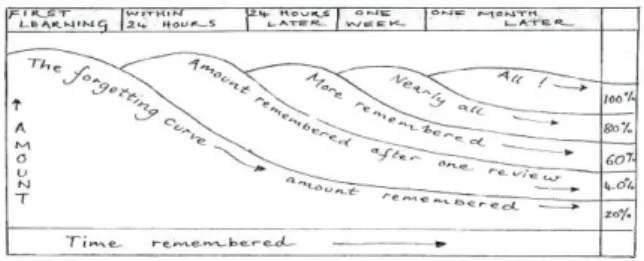
Review and a „Forgetting Curve‟
“Practice makes permanent.”
The key process that bridges the gap between learning and acquisition is review. Review is a process of practising what has been presented to master the knowledge (to become permanent). Learners with learning
difficulties would be given enough
opportunities and even time to repeat through a variety of language and activities. The ‗from learning to acquisition‘ process can be seen on the ‗forgetting curve‘ that shows the process from first learning to acquisition.
Diagram 2. Forgetting Curve
There is a time line that illustrates the time of mastering (acquiring) a certain amount of knowledge. The curves show
how review is effective and leads towards the acquisition of knowledge.
Discussion
Writer describes what and how the responsibility SCL puts on learners for their own learning, fifth semester students majoring English education in Universitas Islam Balitar. The students use English side-by-side in class subjects such like literature, linguistics, English skills, research, cross-culture understanding, and the rests. Writer obtains data through
observation, survey, video recorder,
worksheets, and RPS. From observation and video recorder involve the students‘ activity in more decision-making processes, and they learn by doing, rather than just by listening and performing meaningless tasks which are often not in context and therefore ‗unreal‘ to them. Writer will analyze data analysis of learners‘ responsibility and categorize them into spoken and written activity. The rests are supportive data to the analysis.
During teaching learning of the class subjects, students have more decision-making processes, and they use variety of English alive simultaneously by the language as a tool of communication among themselves. Bloomfield (1933) states language plays a great part in our life. Meanwhile Harmer (2005: 84), the
‗what to teach‘ aspect of the
Communicative approach stressed the significance of language functions rather than focusing solely on grammar and vocabulary...to train students to use these language form appropriately in a variety of contexts and for variety of purposes. Therefore, English spoken language is actively used in the class for the
introductory in greeting, opening
conversation, giving instruction, discussion, and argumentation, asking and answering questions, closing, parting, and other general things.
All the class activities are taken place actively by students who should have at least Basic English, and they will set and
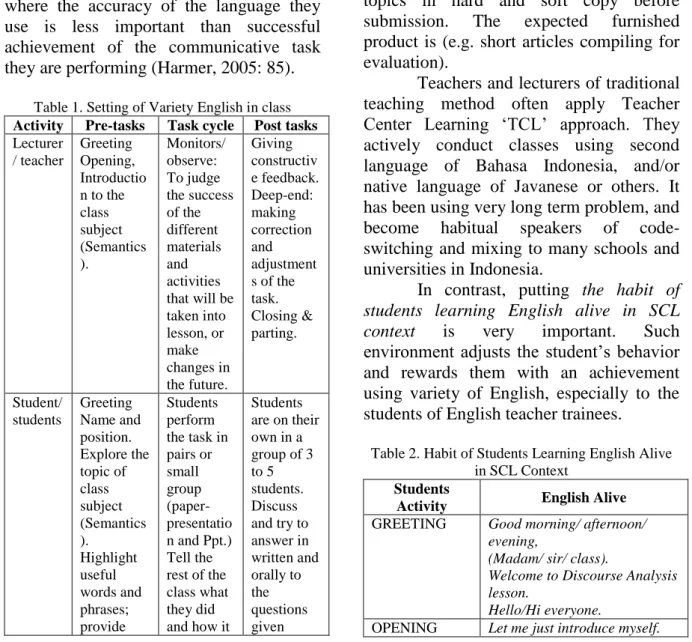
present their English as medium of instruction during study. The approach of SCL puts students as actors while lecturer stands as supervisor, moderator, and observer in the particular subject, (refer; diagram 2.1). Thorough out this process students learn by doing the language variety they are been learning. The language is used in real-world in long time learning to the specific subject they are learning, such like a subject writing or novel. It becomes more memorable: because it is personalised, and relevant to the students‘ own lives and experiences, it brings language ‗alive‘, and makes it relevant to the real world. The teaching English alive has a relevant activities in Communicative approach, typically involve students in real or realistic communication, where the accuracy of the language they use is less important than successful achievement of the communicative task they are performing (Harmer, 2005: 85).
Table 1. Setting of Variety English in class
Activity Pre-tasks Task cycle Post tasks
Lecturer / teacher Greeting Opening, Introductio n to the class subject (Semantics ). Monitors/ observe: To judge the success of the different materials and activities that will be taken into lesson, or make changes in the future. Giving constructiv e feedback. Deep-end: making correction and adjustment s of the task. Closing & parting. Student/ students Greeting Name and position. Explore the topic of class subject (Semantics ). Highlight useful words and phrases; provide Students perform the task in pairs or small group (paper-presentatio n and Ppt.) Tell the rest of the class what they did and how it Students are on their own in a group of 3 to 5 students. Discuss and try to answer in written and orally to the questions given questions in related topic To understand task instructions went. Report on the task either orally or in writing. And/or compared notes on what has happened. during pre-tasks. Students manipulate , comprehen d and interact with the task. Deliver informatio n. Making closing. The learning sources of class subject above are textbooks, e-books, journals, objects, field notes, and website. The topics of discussion present in the form of articles, PowerPoint, and illustration.
By the end of SCL class activity, students have to furnish their discussed topics in hard and soft copy before
submission. The expected furnished
product is (e.g. short articles compiling for evaluation).
Teachers and lecturers of traditional teaching method often apply Teacher Center Learning ‗TCL‘ approach. They actively conduct classes using second language of Bahasa Indonesia, and/or native language of Javanese or others. It has been using very long term problem, and
become habitual speakers of
code-switching and mixing to many schools and universities in Indonesia.
In contrast, putting the habit of students learning English alive in SCL context is very important. Such environment adjusts the student‘s behavior and rewards them with an achievement using variety of English, especially to the students of English teacher trainees.
Table 2. Habit of Students Learning English Alive in SCL Context
Students
Activity English Alive
GREETING Good morning/ afternoon/ evening,
(Madam/ sir/ class).
Welcome to Discourse Analysis lesson.
Hello/Hi everyone.
OPENING Let me just introduce myself.
Name and position:
My name is Susan.
As some/most of you already know, I am Susan.
I‟m in charge of/responsible for presenting the topic of Text & Context in Discourse Analysis subject.
I‟m the first turn presenter for this lesson.
Presentation (articles & questions)
The tittles/ subject/ topic of today‟s presentation talk is Text & Context.
Today I‟d like to speak about Text & Context.
What I‟d like to talk about is Text & Context.
DISCUSSION Objective: Main parts/outline: Visual: Timing: Questions: Audience: Link to start:
The objective of this discussion is to answer the questions related to Text & Context. The aim today is giving some background about Text & Context.
I‟ve divided/ split my talk into four main parts/ discussion. Firstly, what I want to do is give you some background from Text & Context.
Secondly/Thirdly we will look at/move on to Text & Context. Then/Next/After that/Finally, I will speak about/examine of Text & Context.
I will be using whiteboard and LCD.
The presentation will take/last about 15 minutes.
I will speak for about 15 minutes.
I plan to be brief. About 15 minutes.
If you any questions please feel free to interrupt.
Please interrupt me as we go along if you have any questions.
I‟d be glad to take any questions at the end of my presentation.
I know you have all read the topic.
I‟m very grateful that you could come today.
It‟s nice to see all of you. I look forward to your comments on this.
Ok. Let‟s start with the first point which is explaining the background of Text & Context. Right. We can begin by looking at the background of Text & Context first. END Signaling the end: Summarizing: Concluding: Final recommendation : Support: Closing: Inviting questions:
Ok. That brings me to the end of my presentation.
Right. That covers everything I wanted to say about…. So, that‟s all I have to say. To sum up…
In brief…
Before I finish, let me just go over…
If I can briefly summarize… To conclude, I would like to say that…
I‟d like to finish by saying… In conclusion…
It seems to me, then, that we should…
I would therefore recommend/advise that… I have prepared some questions which I will pass round. I‟ll give you my e-mail address in case you want to follow up something I said.
Thank you for listening so attentively.
Thank you for your attention. I hope that this has been useful. I‟d be glad to answer any questions.
So, do you have any questions? Are there any questions? Ok. I think that brings me to the end of the presentation. Are there any questions?
Yes, the guy/ our mate sitting there (points).
GROUP DISCUSSION Result:
Ok, let‟s start with group discussion about the question given
Herewith, the answer to the first question is …, second… The answer from our group discussion is…
Sources: English for presentation (Dignen, B: 1999).
The aspect of communicative approach in this study trains students to use English language forms appropriately in a variety of contexts and purposes. As the results, students have a desire and purpose to communicate with no materials control. They concentrate to the content not form, besides using variety of language without teacher intervention. In review and a
‗forgetting curve‘ Practice makes
permanent, learners with learning
difficulties would be given enough
opportunities and even time to repeat through a variety of language and activities during SCL in classroom.
Conclusion
There is a gap of teaching English as a foreign language today in Indonesia. It is based on course books, and yet students are unable to communicate English actively.
For eight semesters studying in
undergraduate course, students‘ ability still not achieving to the stage of competency,
although teaching has been using
curriculum, schedule & lesson plan accordingly. However, through 'Learning English in SCL Approach', has made students explore aloud using variety of English during class subjects. This situation rewards students to the environment where they get encourage communicating in English during classroom activity.
References
Bigge, M. L. (1892). Learning Theories for Teachers, 4th ed. USA: Harper & Row, Publisher, Inc.
Bloomfield, L. (1979). Language. London: Grorge Allen & Unwin Ltd.
Brown, H. D. (1994). Principles of
Language Learning and Teaching. USA: Prentice Hall Regents.
Brown, H. D. (2001). Teaching by
Principles: An interactive Approach to language Pedagogy, 2nd ed. NY: Addison Wasley Longman, Inc. Buku Kurikulum Pendidikan Tinggi, Thn
2014, Tim Kurikulum dan
Pembelajaran Direktorat
Pembelajaran dan Kemahasiswaan
Direktorat Jenderal Pendidikan
Tinggi Kementerian Pendidikan dan Kebudayaa
Dahar, W. R. (1988). Teori-teori Belajar. Malang: Universitas Islam Malang
Dignen, B. (1999). English for
presentation. England: York Associate.
Guse, J. (2011). Communicative Activities
for EAP. United Kingdom:
Cambrigde University Press.
Grethe, H. October 23rd 2006. Guidelines for Preparing a Seminar Paper or Thesis. Department of International
Agricultural Trade and
Development.
Harmer, J. (2005). The Practice of English Language Teaching, 3rd ed. Malaysia: Seventh impression. Lightbown, Patsy M., and Spada, Nina.
(1999). How Language are learned,
2nd ed. Oxford: University Press.
Richards, J. C. (2002). Curriculum
Development in Language
Teaching, 2nd ed. USA: Cambrigde University Press.
Routledge. (2010). The Routledge
Handbook of Corpus Linguistics, edited by Anne O'Keeffe, Michael Mc Carthy, 1st ed. USA: Routledge.