Concept Maps: Theory, Methodology, Technology Proc. of the First Int. Conference on Concept Mapping Pamplona, Spain 2004
CONCEPT MAPPING FOR SUSTAINABLE DEVELOPMENT
Mauri Åhlberg, University of Helsinki, Finland
Email: [email protected], http://savonlinnakampus.joensuu.fi/ahlberg/index_cv.htm
Abstract. Concept mapping has been used as a tool to monitor and promote meaningful learning, thinking, and acting in courses taught by Professor Mauri Åhlberg since 1989 at the University of Joensuu, Finland. In this paper the use of concept mapping is described in an advanced course that focused on teacher as researcher and developer of her/his own work and its preconditions. During the course university students completing their field practice made observations and collected data. They researched their chosen field school, its curriculum, their own teaching, and their pupils’ learning. In this paper we describe one aspect of the data in depth. That is, how sustainable development is promoted in the students’ field practice schools according to university students’ observations, interviews, and other data they collected. The main points were condensed into concept maps, which comprise the data presented in this report. Students have also performed Vee heuristics on each aspect of their study, but we do not present results of those analyses in this paper. The results seem clear that, at least according to university students’ observations, schools in rural Finland use more time and energy to promote sustainable development now than they did previously. This is a good sign for the upcoming United Nation’s Decade of Education for Sustainable Development (EfS). The issue is important and there is empirical evidence from concept maps that sustainable development is more important than once thought in rural schools of Finland. We suggest the broader use of concept mapping to promote Education for Sustainable Development. Theoretical reasons based partly on empirical research are provided for this suggestion
1 Introduction
The United Nation's World Summit on Sustainable Development took place in Johannesburg, South Africa (August 26 - September 4, 2002). Twelve years has elapsed since the first Summit in Rio de Janeiro in 1992. According to the United Nations (1992, 36th Chapter of Agenda 21), “Education is critical for promoting sustainable development and improving the capacity of people to address environment and development issues.” If education is critical, then teacher education is even more critical. Many questions are raised, including: How have schools promoted sustainable development from 1992 to 2004? How should sustainable development be fostered from 2005 to 2014? Education for Sustainable Development has been an important issue in the Savonlinna Department of Teacher Education at the University of Joensuu, Finland, since 1992. In 1989, Professor Mauri Åhlberg began researching, developing, and instructing teacher education students in the use of concept mapping and Vee heuristics. Åhlberg (1990 – 2004) describes this development in detail. In 1992, concept mapping began to be applied to both monitor and promote Education for Sustainable Development.
The concept mapping tool presented in this paper can be used both by pupils and teachers to evaluate, monitor, and promote their learning, thinking, and acting. In high quality learning there is continual integration of thinking, feeling, and acting. When the learner is operating in this way s/he can create more energy, become more empowered, and become better able to solve individual problems and, possibly, some of the problems of her/his society. If we conceptualize research as an integrated learning process that constructs new knowledge and includes testing and reconstruction, then we may better understand Zeichner (1994; p. 66) who writes that "[m]any people are realizing the tremendous power of teacher research and have joined the teacher research community." This paper draws upon the data collected by pre-service teacher education students as they were trying to learn some of the elements of teacher research while collecting useful data about their field practice schools. Zeichner and Noffke (2001) present further evidence for practitioner research.
The pre-service teacher education students we report on in this paper have been trained to use concept maps and Vee heuristics as tools for investigating their own understanding. Concept maps and Vee heuristics were developed in the 1980s as a powerful form of self-analysis (Novak, 1998; Novak & Gowin 1984). Concept maps and Vee heuristics are not commonly used at any level of education. However, they have withstood both theoretical and empirical testing from 1984 to 2002 (Åhlberg & Ahoranta, 2002). One or both of these metacognitive tools have been applied to EE in Finland (e.g., in the doctoral dissertations of Kaivola, 2000, Pitkänen, 2001, and Äänismaa, 2002). From 1993 to 2002 Åhlberg improved these tools by testing them both theoretically and empirically with his university students and with their pupils (Åhlberg & Ahoranta, 2002). Åhlberg (2001) provided a full account of the value of these research tools.
If we want pupils to learn meaningfully and reflectively, then their teachers ought to first learn how to learn meaningfully and reflectively. That is why it may be important to teach pre-service teacher education students to use such tools in their university studies. In this way, pre-service teacher education students can begin to
understand how any teacher can research and develop their own work by collecting reports on their students. Furthermore, the tools we are reporting on here can be used to feed back directly into the process of course review and development. In this paper we describe how student reports, and in particular their concept maps, can be used as data to answer research questions. Although we do not analyze them in detail in this paper, one valuable observation of the Vee heuristic is worth noting: One female teacher education student remarked in the value claims of her Vee heuristic: “The knowledge I have constructed is valuable, but even confusing. Can a teacher really be responsible in these large-scale issues?” According to international agreements and theoretical and practical research results, the answer is yes. Teachers, as well other citizens, have the responsibility to promote sustainable development. Åhlberg’s (2004) first tentative theory of Education for Sustainable Development and some of the main tools needed to promote it are presented in Figure 1. The improved version of the theory of Education for Sustainable Development (Åhlberg, 2004) highlights the increased importance of culturally sustainable development. It highlights ability, competence, expertise, intelligence, creativity, and wisdom for all aspects of sustainable development. It is the educational core of sustainable development.
Figure 1. Åhlberg’s (2004) first tentative theory of what is central in Education for Sustainable Development. The most central concept in this concept map is ‘integrating different aspects of sustainable development in thinking and acting,’
because it has more links (7 links) with other concepts than any other concept.
Research question:
What kinds of activities have occurred to promote sustainable development in small rural schools from 1992 – 2003?
Environmental
Education Education for Sustainable Development
supports, but is much narrower than
integrating different aspects of Sustainable development in
thinking and acting requires concept mapping Vee heuristics is promoted by ecologically sustainable development economically sustainable development culturally sustainable development socially sustainable development provides necessary resources to take care of e.g.
2 Methods
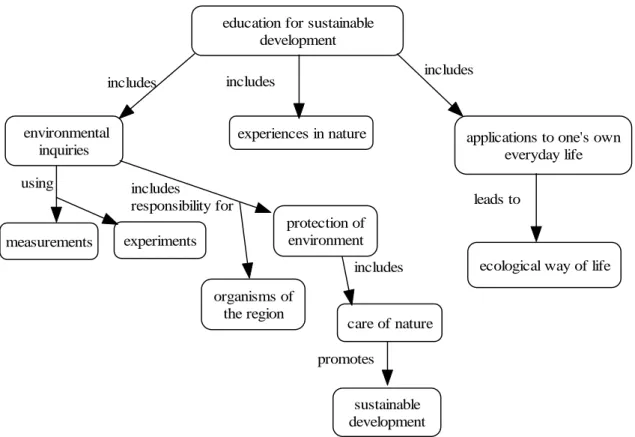
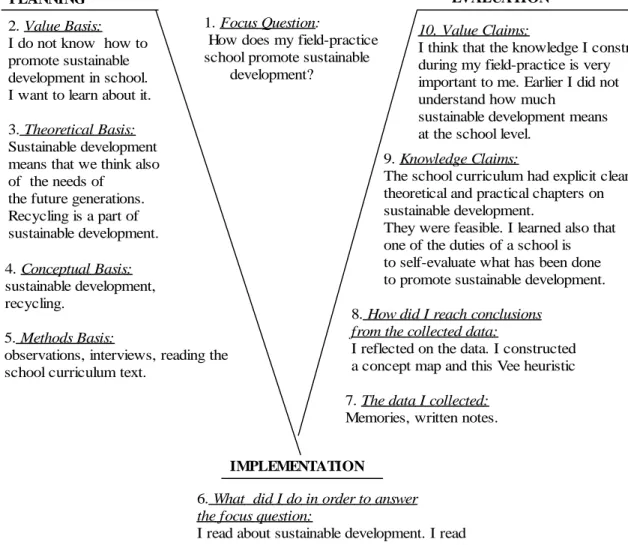
Data for this research include university student-constructed concept maps showing how sustainable development was promoted in their field practice school. This report describes a qualitative content analysis of those concept maps. An example of a concept map used as data is shown in Figure 2. There is also an example of a Vee heuristic in Figure 3, but the Vee heuristic data are not discussed in this report. Figure 3 is presented only to show that the Vee heuristic is also a good research method for collecting valuable data. The student teachers’ own data is from small country schools. In this paper tentative conclusions are drawn in relation to both the state of sustainable development in small country schools and the student teachers’ thinking and learning about sustainable development during their field practice.
The pre-service teacher education students who completed the reports were all over 20 years of age, most of them females. They were in their third year at the University. In the Savonlinna Department of Teacher Education (University of Joensuu, Finland), third year pre-service teacher education students spend a month practicing mainly in small multigrade and multiage schools. During the field practice they gather data about their field practice school, and their own professional development in the school. Small primary schools suitable for field practice are geographically situated all over Finland. They are often rural schools, because multigrade and multiage schools are often located in the countryside. The students themselves suggest the school in which they wish to undertake their field practice and negotiate the required permission to undertake their field practice in that particular school.
Figure 2. An example of a student-constructed concept map to show how sustainable development was promoted in her field practice school. This concept map is at a very general level. There are much bigger and more detailed ones, but they
are harder to translate. education for sustainable
development
environmental inquiries
experiences in nature applications to one's own everyday life
includes includes includes
ecological way of life leads to measurements experiments protection of environment organisms of the region using includes responsibility for care of nature includes sustainable development promotes
Figure 3. An example of a student-constructed Vee heuristic that shows how these two metacognitive tools are complementary.
3 Results
The small schools in our sample displayed many educational principles. Two of them were equally common: sustainable development as a part of everyday life and nature conservation and protection. The first one is an integrated approach whereas the second one is traditional, not sufficient for EfS, but necessary and important in itself. Respecting/appreciating nature is closely connected to the educational principle of nature conservation and protection. These are examples of promoting ecological sustainability. There are also examples of educational principles fostering social sustainability: good social climate, respecting traditions, good customs and manners, and tolerance, respect of others. These principles probably promote socially sustainable development. Respecting traditions is tricky as a universal principle because some traditional habits may be a barrier to sustainable development. Think, for instance, of eating migrating song birds or of whaling, which are done to preserve old traditions in some countries. Practical activities in the studied schools can be classified into four main types: recycling, sorting, saving, and composting. These are important but relatively easy to learn habits.
PLANNING EVALUATION
IMPLEMENTATION
1.Focus Question:
How does my field-practice school promote sustainable
development? 2.Value Basis:
I do not know how to promote sustainable development in school. I want to learn about it. 3.Theoretical Basis:
Sustainable development means that we think also of the needs of
the future generations. Recycling is a part of sustainable development. 4.Conceptual Basis: sustainable development, recycling. 5.Methods Basis:
observations, interviews, reading the school curriculum text.
6.What did I do in order to answer
the focus question:
I read about sustainable development. I read
the local school curriculum text, school self-evaluation reports, teachers work plans. I discussed this with the principal Then I observed how plans for sustainable development were implemented in my field practice school.
7.The data I collected:
Memories, written notes.
8.How did I reach conclusions
from the collected data:
I reflected on the data. I constructed a concept map and this Vee heuristic
10. Value Claims:
I think that the knowledge I constructed during my field-practice is very
important to me. Earlier I did not understand how much
sustainable development means at the school level.
9.Knowledge Claims:
The school curriculum had explicit clear theoretical and practical chapters on sustainable development.
They were feasible. I learned also that one of the duties of a school is to self-evaluate what has been done to promote sustainable development.
There were 30 different reasons mentioned in the reports as to why schools do not promote sustainable development. At first sight the barrier to this most important educational principle was unexpected by us. That the ‘curriculum does not include anything about sustainable development’ is presented as a barrier to EfS, however, teachers in each school have a responsibility to follow national general curriculum guidelines for Finland. According to these guidelines they should write their own local curriculum document. In the general national curriculum guidelines (Opetushallitus, 1994), it is clearly stated that sustainable development must be integrated into the curriculum. In 1997 the National Board of Education (1997, Opetushallitus, 1997) sent a general letter, in which this theme was raised again: All schools must promote sustainable development. However, the fact that this barrier appears in relation to this most important principle may indicate something about the espoused values of the curriculum as promulgated by central authorities and the actuality of the curriculum as practiced by teachers.
In the concept maps one of the most common barriers of EfS was claimed to be a lack of money. However, Wilska-Pekonen (2001, pp. 248, 287) found that this reason was not reported by the teachers who had undertaken a course of three years in-service environmental education (an EU funded BEENET-project). Prior to the in-service program six out of ten teachers complained about the lack of money, but by the end of the program all reported that lack of money no longer prevented them from delivering EE/EfS. Wilska-Pekonen (2001) reported that the teachers had learned that ordinary everyday life is full of unused possibilities for environmental education and Education for Sustainable Development.
Also, ‘threat of closing of the school’ was sometimes mentioned on concept maps as a barrier to promoting sustainable development. After discussing this with the student teachers we understand that this threat somehow makes everything new an extra burden to be avoided. Teachers are so stressed about the possibility of the school closing that they do not want to do anything “extra.” In their minds promoting EfS is not part of the basic elements of teachers’ work. They get their salary without doing it. This is an example of when concept maps alone were not enough. Sometimes you have to ask for more information, however, the concept map was a useful starting point for further inquiries.
4 Summary
This preliminary paper is part of a larger report in progress. It is shown here that concept mapping can provide plenty of important ideas and data for further analysis. In the upcoming United Nation’s Decade of Education for Sustainable Development (2005 – 2014) concept mapping is an important metacognitive tool that should be taught broadly to all people. There are good theoretical and empirical reasons why concept maps should be used more widely. With concept mapping it is easy to monitor and promote quality of learning, thinking, and acting. It is a method by which an overview of complex issues such as sustainable development and its main elements can be created.
5 References
Äänismaa, P. (2002). Ympäristökasvatusta kehittämässä kotitalousopettajien koulutuksessa. [Promoting environmental education in home-economics teacher education.] University of Joensuu. Publications of Education, No. 74.
Åhlberg, M. (1990). Kasvattajille sopivien tutkimusmenetelmien ja –instrumenttien teoreettiset perusteet, tutkiminen ja kehittäminen elinikäisen kasvatuksen ja oppimisen näkökulmasta: KST-projektin tutkimussuunnitelma. [Research methods and instruments, which are suitable for teachers, their theoretical foundations, research on them and development of them from the viewpoint of life-long education and learning. The theoretical framework and the research plan for KTS-project.] University of Joensuu. Research Reports of the Faculty of Education, No. 31.
Åhlberg, M. (1993, August). Concept maps, Vee diagrams and Rhetorical Argumentation (RA) Analysis: Three educational theory-based tools to facilitate meaningful learning. Paper presented at The Third International Seminar on Misconceptions in Science and Mathematics. Cornell University. Published electronically in the Proceedings of the Seminar http://www.mlrg.org/proc3abstracts.html
Åhlberg, M. (1998). Ecopedagogy and Ecodidactics: Education for Sustainable Development, Good Environment and Good Life. University of Joensuu. Bulletins of the Faculty of Education, No. 69.
Åhlberg, M. (2004). Education for Sustainable Development: Theoretical underpinnings and practical methods. (Manuscript)
Åhlberg, M. & Ahoranta, V. (2002). Two improved educational theory based tools to monitor and promote quality of geographical education and learning. International Research in Geographical and Environmental Education 11(2), 119 – 137.
Kaivola, T. (2000). GLOBE-ohjelma ympäristökasvatuksen innovaationa Suomessa. [GLOBE-program as an innovation of Environmental Education in Finland.] University of Helsinki. Department of Teacher Education. Research Reports No. 218.
National Board of Education. (1997). Kestävän kehityksen kehittämisohjelma vuosille 1998 – 2000 [Agenda for Sustainable Development 1998 – 2000]. Helsinki: National Board of Education.
Novak, J. D. (1998). Learning, creating, and using knowledge: Concept maps as facilitative tools in schools and corporations. Mahwah, NJ: Lawrence Erlbaum Associates.
Novak, J. D., & Gowin, D. B. (1984). Learning how to learn. New York: Cambridge University Press.
Opetushallitus (1994). Peruskoulun opetussuunnitelman perusteet. [General guidelines for local curricula.] Helsinki: National Board of Education.
Opetushallitus (1997). Kestävän kehityksen edistämisohjelma vuosille 1998 – 2000. [Agenda to promote sustainable development for the years 1998 – 2000.] Helsinki: National Board of Education.
Pitkänen, R. (2001). Lyhytkestoiset tehtävät luokan ulkopuolisessa ympäristökasvatuksessa. [Short tasks in environmental outdoor education. ] University of Joensuu. Publications of Education No. 68.
United Nations (1992). Agenda 21: The United Nations programme of action for sustainable development. Rio Declaration on Environment and Development. New York: United Nations.
Wilska-Pekonen, I. (2001). Opettajien ammatillinen kehittyminen ympäristökasvattajina kokemuksellisen oppimisen näkökulmasta. [Teachers’ professional development as environmental educators from the viewpoint of experiential learning]. Doctoral Dissertation Thesis. University of Joensuu. Publications of Education No. 65.
Zeichner, K. (1994). Personal renewal and social construction through teacher research. In Hollingsworth, S. & Sockett, H. (Eds.), Teacher research and educational reform (pp. 66 – 84) Chicago: University of Chicago Press,.
Zeichner, K., & Noffke, S. (2001). Practitioner research. In Richardson, V. (Ed.), Handbook of Research on Teaching. (4th ed., pp. 298 – 330). Washington, DC: American Educational Research Association.