The Effect of Overconfidence and
Underconfidence on Consumer Value
Kamran RazmdoostCranfield University and University College London Radu Dimitriu
Cranfield University and Buskerud and Vestfold University College Emma K. Macdonald
Cranfield University and University of South Australia
ABSTRACT
Although the effect of knowledge miscalibration (i.e., the inaccuracy in subjective knowledge relative to objective knowledge) on consumer purchase decisions has been investigated, its effect in the usage stage of consumption is little understood. This paper examines the effect of knowledge
miscalibration in terms of both overconfidence (i.e., when subjective knowledge is inflated) and underconfidence (i.e., when subjective knowledge is deflated) on the dimensions of consumer value (i.e., efficiency, excellence, play, and aesthetics). The paper makes the case that overconfidence and underconfidence should be treated separately as they trigger different consumption consequences. Several hypotheses are tested through two studies: a covariance-based study (Study 1) and an experimental study (Study 2). In Study 1, overconfidence and underconfidence are measured, while in Study 2 they are experimentally manipulated. Findings of both studies show that underconfidence negatively influences efficiency, excellence, and aesthetics, and overconfidence negatively influences play. Also, Study 1 finds a negative effect of underconfidence on play and Study 2 finds a negative effect of overconfidence on excellence and aesthetics. Findings reveal that knowledge miscalibration negatively impacts consumers’ usage experiences. This implies that in designing product or service experiences suppliers benefit from ensuring that consumers achieve a reduced level of knowledge miscalibration.©2015 The Authors Psychology & Marketing Published by Wiley Periodicals, Inc.
An individual’s self-perceived level of knowledge is fre-quently inaccurate, which means that in many situa-tions the individual does not know how much she knows (Alba & Hutchinson, 2000; Lichtenstein & Fischhoff, 1977). In a consumption context, a clear distinction can be made between objective and subjective knowledge (Alba & Hutchinson, 2000; Brucks, 1985). Objective knowledge is the product or service information retriev-able from long-term memory that can be validated for accuracy; subjective knowledge is the consumers’ self-assessment of the validity of product or service infor-mation they retain in memory (Brucks, 1985; Carlson, Vincent, Hardesty, & Bearden, 2009; Park, Mothers-baugh, & Feick, 1994).
Knowledge calibration is the agreement between subjective and objective knowledge about a product or service that a consumer can apply to a consump-tion task (Alba & Hutchinson, 2000). Knowledge miscalibration represents the disagreement between subjective and objective knowledge. The extent of dis-agreement between subjective and objective knowledge
shows how inaccurate subjective knowledge is, and therefore knowledge miscalibration is the inaccuracy in subjective knowledge. Knowledge miscalibration can take one of two forms: overconfidence or underconfi-dence. A consumer is overconfident when her subjective knowledge is inflated (Alba & Hutchinson, 2000) and underconfident when her subjective knowledge is deflated. In fact, some consumers have product or service knowledge (i.e., objective knowledge) that they are not aware of (i.e., deflated subjective knowledge or underconfidence), while others have less knowledge about a product or service (i.e., objective knowledge) than they think they have (i.e., inflated subjective knowledge or overconfidence).
Individuals may incur costs as the consequence of overconfidence and underconfidence. For instance, an underconfident individual may not apply for a good col-lege or university based on the inaccurate assessment of her knowledge (Dunning, Heath, & Suls, 2004) or an overconfident individual may purchase a high-end dig-ital camera that she thinks is matched with her own
knowledge of camera usage where it is not (Burson, 2007).
To date, investigations of overconfidence and under-confidence have focused on purchase decisions. These studies have shown that lower levels of knowledge mis-calibration result in better purchase decisions (Alba & Hutchinson, 2000; Burson, 2007; Kidwell, Hardesty, & Childers, 2008). However, it is less clear how overcon-fidence and underconovercon-fidence impact theusagestage of consumption, and the related perceived value of prod-ucts or services. For instance, in the case of the overcon-fident consumer with the high-end camera, the question is how does her knowledge miscalibration impact the value she attributes to the usage of the camera?
The aim of this research is to investigate the effect of knowledge miscalibration on the value consumers derive from product or service usage. Although the extant studies have tended to look at knowledge mis-calibration holistically without distinguishing between overconfidence and underconfidence (Gershoff & Johar, 2006; Kidwell, Hardesty, & Childers, 2008; Pillai & Kumar, 2012), this study argues that they should be treated separately as they trigger different consump-tion consequences (Moore & Healy, 2008; Pillai & Hofacker, 2007). Moreover, unlike previous studies that measure knowledge miscalibration (e.g., Gershoff & Johar, 2006; Pillai & Hofacker, 2007; Pillai & Kumar, 2012), this study manipulates knowledge miscalibration in addition to measuring it.
This paper first reviews literature on objective knowledge, subjective knowledge, and knowledge mis-calibration and then develops a hypothetical model of the impact of overconfidence and underconfidence on consumer perceived value. It then investigates this model using two empirical studies, and discusses the implications for theory and practice.
OBJECTIVE KNOWLEDGE, SUBJECTIVE KNOWLEDGE, AND KNOWLEDGE
MISCALIBRATION
Previous marketing research has investigated the effect of consumer knowledge on consumer behavior by inves-tigating objective or subjective knowledge. It has been found that objective knowledge impacts a consumer’s capability and motivation for searching (Brucks, 1985), processing (Cowley & Mitchell, 2003; Hong & Stern-thal, 2010; Lee & Lee, 2011), and evaluating (de Bont & Schoormans, 1995; Herr, 1989; Roy & Cornwell, 2004) relevant information. Subjective knowledge af-fects choice confidence (Park & Lessig, 2003), decision time (Park & Lessing, 2003), service quality evalua-tion (Andaleeb & Basu, 1994), product search strat-egy (Moorman, Diehl, Brinberg, & Kidwell, 2004), and perceived value (Barrutia & Gilsanz, 2012). In these studies, objective knowledge is typically mea-sured by an objective test, and subjective knowledge is gauged through a self-assessment test of consumers’ self-perception of knowledge (Cordell, 1997).
Although both objective and subjective knowledge reflect the level of consumer knowledge, they can have different effects on the same consumption outcome. For instance, subjective knowledge has a stronger ef-fect than objective knowledge on perceived decision outcomes, such as confusion in decision and perceived goodness of decision (Raju, Lonial, & Mangold, 1995). The amount of information search is directly correlated with subjective knowledge, whereas it has an inverted-U-shaped relationship with objective knowledge (Raju, Lonial, & Mangold, 1995). Objective knowledge is a bet-ter predictor than subjective knowledge of consumers’ willingness to pay in the context of product categories with a strong price–quality relationship (Cordell, 1997). There are product contexts where subjective and ob-jective knowledge are more closely aligned, for instance, products rather than services, and hedonic products rather than utilitarian products (Carlson et al., 2009). More often than not, subjective knowledge is inaccu-rate and does not match objective knowledge (Alba & Hutchinson, 2000). The reasons for this lack of accuracy include failure to remember the validity of evidence for objective knowledge, misinterpretation of evidence, and motivational biases (Alba & Hutchinson, 2000).
CONSEQUENCES OF KNOWLEDGE MISCALIBRATION
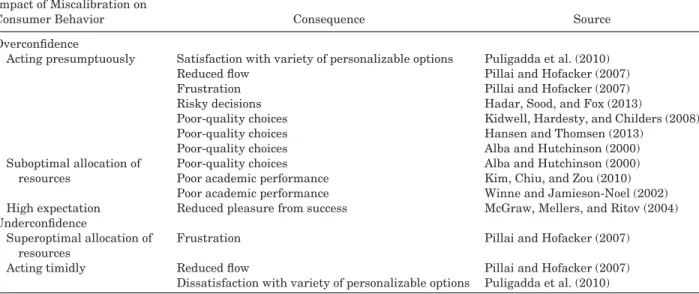
Although the antecedents of knowledge miscalibration have been researched (e.g., Coupey & Narayanan, 1996; Frankenberger & Albaum, 1997; Pillai & Hofacker, 2007; Poynor & Wood, 2010), the consequences have had less attention (Puligadda, Grewal, Rangaswamy, & Kardes, 2010). The paper identifies three broad cat-egories of consequences of overconfidence and under-confidence (Table 1): (1) allocation of resources to con-sumption, (2) the approach to act in concon-sumption, and (3) consumption outcome expectations.
First, knowledge miscalibration influences the allo-cation of resources (e.g., effort, time, and energy) to consumption. Overconfidence leads to the suboptimal allocation of resources to the consumption task. For in-stance, overconfidence leads to less optimal effort in an information search (Alba & Hutchinson, 2000), as overconfident consumers think they already hold the information required and are not motivated to search further (Radecki & Jaccard, 1995). Likewise, overcon-fidence negatively influences the educational perfor-mance of students due to a failure to allocate optimal re-sources to their studies (Kim, Chiu, & Zou, 2010; Winne & Jamieson-Noel, 2002). On the other hand, undercon-fidence is associated with the superoptimal allocation of resources (i.e., allocating more resources than required) to consumption. Underconfident consumers think their knowledge is insufficient to perform the consumption task and exert more effort (i.e., use more resources) to overcome this perceived lack of knowledge. Superopti-mal allocation of resources may lead to negative conse-quences such as frustration (Pillai & Hofacker, 2007).
Table 1. Consequences of Knowledge Miscalibration.
Impact of Miscalibration on
Consumer Behavior Consequence Source
Overconfidence
Acting presumptuously Satisfaction with variety of personalizable options Puligadda et al. (2010)
Reduced flow Pillai and Hofacker (2007)
Frustration Pillai and Hofacker (2007)
Risky decisions Hadar, Sood, and Fox (2013)
Poor-quality choices Kidwell, Hardesty, and Childers (2008)
Poor-quality choices Hansen and Thomsen (2013)
Poor-quality choices Alba and Hutchinson (2000)
Suboptimal allocation of resources
Poor-quality choices Alba and Hutchinson (2000)
Poor academic performance Kim, Chiu, and Zou (2010)
Poor academic performance Winne and Jamieson-Noel (2002)
High expectation Reduced pleasure from success McGraw, Mellers, and Ritov (2004)
Underconfidence
Superoptimal allocation of resources
Frustration Pillai and Hofacker (2007)
Acting timidly Reduced flow Pillai and Hofacker (2007)
Dissatisfaction with variety of personalizable options Puligadda et al. (2010)
Second, knowledge miscalibration influences the way to act in consumption. On the one hand, over-confident consumers “act presumptuously” (Pillai & Hofacker, 2007, p. 263; i.e., engage in actions that are too difficult to perform), as they think they have enough knowledge to handle these actions. Acting presumptu-ously might lead to inappropriate purchase decisions (Alba & Hutchinson, 2000; Hansen & Thomsen, 2013; Kidwell, Hardesty, & Childers, 2008), risky investment decisions (Hadar, Sood, & Fox, 2013), a lack of flow state of mind (i.e., an optimal state of mind where there is a deep engagement with a consumption task [Csik-szentmihalyi, 1990]; Pillai & Hofacker, 2007), frustra-tion (Pillai & Hofacker, 2007), and satisfacfrustra-tion with the variety of personalizable product-attribute options (i.e., those attribute options that are evaluated based on personal preferences, such as mobile phone color; Puligadda et al., 2010). On the other hand, this pa-per suggests that underconfident consumers act timidly (i.e., engage in actions that are too easy to perform) due to the fact that they think they do not have enough knowledge to engage with challenging actions. As a con-sequence of underconfidence, acting timidly decreases the flow state of mind (Pillai & Hofacker, 2007) and also reduces satisfaction as the number of personal-izable product-attribute options increases (Puligadda et al., 2010).
Third, knowledge miscalibration impacts the ex-pectations of consumption outcome. Overconfident consumers set their expectations high, based on the inaccurate perception that they have enough objective knowledge to achieve a higher level of consumption outcome. For instance, overconfidence leads to a high expectation of the consumption outcome, which de-creases the feeling of pleasure from actually achieving success when shooting a ball through a basketball hoop (McGraw, Mellers, & Ritov, 2004). Even though
the impact of knowledge miscalibration on outcome expectation has not been investigated for undercon-fident consumers, it is reasonable to assume that underconfident consumers, based on their low assess-ment of objective knowledge, set low expectations of consumption outcomes.
The impact of these three consequences of knowledge miscalibration on consumer value forms the basis of the hypothetical model in the paper. Furthermore, the paper argues that overconfidence and underconfidence generate different consequences, leading to different impacts on consumption. Therefore, in the conceptu-alization and empirical investigation, this study con-siders overconfidence and underconfidence separately rather than dealing with them holistically as knowl-edge miscalibration.
CONSUMER VALUE
The term consumer value is used with different mean-ings and applications in the marketing literature (Graf & Maas, 2008; Woodruff, 1997). This paper investigates consumers’ valuation of product or service usage, and not the processes of value creation by a company. As the aim of this research is to examine the role of over-confidence and underover-confidence in the usage stage of consumption, the paper specifically considers value-in-use. Value-in-use is the value perceived by a consumer experiencing a product/service in a specific usage situ-ation (Woodruff & Flint, 2006).
Focusing on the experiential aspects of consump-tion, Holbrook (1996, p. 138) defines consumer value as “an interactive, relativistic preference experience.” Experiential consumption has more recently been as-sociated with the notion of value-in-use (Gr¨onroos & Voima, 2013).
The main thesis of this research is that knowl-edge miscalibration (overconfidence and underconfi-dence) influences value derived from consumption, as reflected in value-in-use. Specially, this research adopts Holbrook’s (1996) conceptualization of consumer value to look at value in usage situations.
Researchers have conceptually and empirically investigated consumer value as a multidimensional phenomenon (e.g., Mattsson, 1992; Sheth, Newman, & Gross, 1991). Holbrook (1999) conceptualizes eight dimensions of value along a self-oriented versus others-oriented continuum, corresponding to whether a product is valued because of its benefit to the self or be-cause of its effect on others (e.g., friends, environment, etc.). The self- versus others-oriented continuum is closely related to whether a context involves private or public consumption. As the context of this research in-volves categories that are more likely to be individually and privately, as opposed to publicly, consumed (i.e., online shopping and software use), this paper limits its focus to Holbrook’s four self-oriented value dimensions: efficiency, excellence, play, and aesthetics. Several previous studies have set a precedent for focusing only on the self-oriented dimensions of consumer value (e.g., Bourdeau, Chebat, & Couturier, 2001; Mathwick, Malhotra, & Rigdon, 2001; Munnukka and Jarvi, 2012; Overby & Lee, 2006; Steenkamp & Geyskens, 2006).
Earlier empirical applications of Holbrook’s (1999) multidimensional consumer-value framework (e.g., Sanchez-Fernandez, Iniesta-Bonillo, & Holbrook, 2009; Mathwick, Malhotra, & Rigdon, 2001; Munnukka & Jarvi, 2012) have demonstrated its superiority as a measurement framework for value in terms of its pre-dictability, psychometric properties, and actionability (Leroi-Werelds, Streukens, Brady, & Swinnen, 2014).
HYPOTHETICAL MODEL
The hypothetical model builds on the outlined conse-quences of overconfidence and underconfidence to hy-pothesize how the two forms of knowledge miscalibra-tion impact Holbrook’s (1999) self-oriented value di-mensions of efficiency, excellence, play, and aesthetics.
Efficiency Value
Efficiency value relates the ratio of perceived output to perceived input (Holbrook, 1996). Output is eval-uated based on the consumer’s performance in the consumption task, and consumer resources such as knowledge and money are input. Overconfidence de-creases a consumer’s efforts (input) into the usage of a product or a service through lack of resource allocation, while also keeping the consumer unaware of this input shortage. This lack of input may lead to decreased actual output as a result of engaging consumption tasks that are too difficult for the consumer (because
overconfident consumers tend to act presumptuously). This decreased output is detected by overconfident consumers in comparison with their high level of ex-pectations. Therefore, the decreased output may result in a low ratio of perceived output to perceived input for overconfident consumers leading to a reduced percep-tion of efficiency. It is therefore hypothesized that:
H1a: Overconfidence negatively influences per-ceived efficiency value.
On the other hand, underconfidence is associated with a low expectation of outcomes and with a tendency to act timidly in consumption. As a consequence of low expectations and timid actions, underconfident con-sumers are less likely to undertake challenging tasks. This might reduce their likelihood of achieving supe-rior outcomes. In addition, underconfident consumers allocate more resources than required in usage. There-fore, their perceived input for the consumption task is high. This high resource investment does not lead to a better outcome, as it is an overinvestment for the easy actions they are undertaking. Therefore, the low ratio of perceived output to perceived input (due to a high perception of input and a low outcome realization) by underconfident consumers leads to a reduced percep-tion of efficiency. It is hypothesized that:
H1b: Underconfidence negatively influences per-ceived efficiency value.
Excellence Value
Perceived excellence is associated with the capacity of a product or service in functioning well, which may or may not be exploited entirely in the consumption task (Holbrook, 1999). Therefore, those who have a better ability to identify and positively evaluate the potential benefits of a product or service, relative to its potential risks, have a higher perception of excellence value.
As previously stated, overconfident consumers act presumptuously, meaning that they take on consump-tion tasks that are too ambitious. Due to the lack of appropriate resource allocation, these too-ambitious ac-tions lead to errors in usage. Therefore, it is likely that overconfident consumers perceive more risks and think that the product or service has low capacity to func-tion well, which leads to a low percepfunc-tion of excellence. Therefore, it is hypothesized that:
H2a: Overconfidence negatively influences per-ceived excellence value.
By involving themselves in less-challenging, rather than more-challenging, consumption tasks, undercon-fident consumers are unlikely to identify many risks and benefits in products and services. Therefore, their perceived quality is shaped based on factors other than actual benefits and risks of the product or service, such as emotional states in consumption. Furthermore, un-derconfident consumers’ overallocation of resources to
consumption tasks generates negative emotions such as frustration (Pillai & Hofacker, 2007), which are likely to negatively impact the excellence value of a product or service (e.g., Murry & Dacin, 1996; Romani, Grappi, & Dalli, 2012; White, 2010). In conclusion, it is hypoth-esized that:
H2b: Underconfidence negatively influences per-ceived excellence value.
Play Value
Play consists of having fun in a self-oriented ex-perience. Feeling of enjoyment usually reflects the perception of play in a product or service consumption. Play is a type of value that consumers perceive from actively performing the consumption task (not from the outcome of the consumption task), by creating fun, happiness, or enjoyment (Grayson, 1999). Therefore, optimum engagement with the consumption task positively increases play value. One of the mechanisms generating perceived play is flow (Mathwick & Rigdon, 2004). Flow is an optimal state of mind where there is a deep engagement with a consumption task, and it depends on a close match between task challenges and consumer skills (Csikszentmihalyi, 1990).
Overconfident consumers act presumptuously and select more-challenging tasks. Furthermore, they al-locate inadequate resources to those tasks. Therefore, consumption tasks may become too difficult for over-confident consumers, leading them to face unexpected issues. In other words, the consumption task may be-come too challenging for overconfident consumers’ skill sets and decreases the flow state of mind.
Other consequences of overconfidence, such as the level of outcome expectations, are less likely to affect overconfident consumers’ state of mind. On the one hand, perceived play is associated with the intrinsic motivation for a task (Grayson, 1999). On the other hand, overconfident consumers’ high outcome expecta-tions are likely to lead to acexpecta-tions supporting outcome realization, which is equivalent to overconfident con-sumers looking for an extrinsic motivation rather than an intrinsic motivation (i.e., being motivated by the task itself rather than by its consequences). Overall, it is hypothesized that:
H3a: Overconfidence negatively influences per-ceived play value.
Underconfident consumers may limit themselves to engaging in tasks that are too easy for them. Indeed, they engage with less-challenging tasks, but allocate more resources to those tasks. Therefore, the consump-tion task may not match the underconfident consumers’ skills, thus diminishing the flow state of mind (Pillai & Hofacker, 2007). Therefore, it is hypothesized that:
H3b: Underconfidence negatively influences per-ceived play value.
Aesthetics Value
Aesthetics value is an “immediate, dynamic, unified, meaningful, pleasant, and vividly felt” experience, emerging from the perception of an aesthetic object (Wagner, 1999, p. 128). As an intrinsic value, aesthet-ics are concerned with the interaction between the con-sumer and the product or service (Holbrook, 1999).
Aesthetics have been found to be associated with how fluently a stimulus is processed by observers (Re-ber, Schwarz, & Winkielman, 2004), where fluency is the ease with which information is brought to mind or new information is processed (Schwarz, 2004). For ex-ample, a consumer appreciates symmetry in design, as it creates fluency (Reber, 2002). The effect of fluency on aesthetics is established in the consumer-behavior literature as well (Cho & Schwarz, 2010). This paper applies the concept of fluency in order to explain the ef-fect of knowledge miscalibration on perceived aesthet-ics value.
Overconfident consumers may become engaged with tasks that are too challenging for them, as they act presumptuously and do not allocate enough resources to their actions. Therefore, they spend their cognitive capability dealing with the issues they encounter, and are less able to fluently process aesthetic cues resulting from consumption. Moreover, as a result of high out-come expectation, overconfident consumers are moti-vated to deal with extrinsic-related stimuli, rather than intrinsic aesthetic information. Therefore, not only does overconfidence decrease fluency, but it also reduces the opportunity to process aesthetic information. There-fore, it is hypothesized that:
H4a: Overconfidence negatively influences per-ceived aesthetics value.
Although underconfident consumers pursue tasks that are too easy, they allocate extra resources to per-form those consumption tasks. Therefore, they have a low level of cognitive capacity to process aesthetic stim-uli in the consumption task. In other words, undercon-fident consumers process aesthetic stimuli with a low level of fluency. It is hypothesized that:
H4b: Underconfidence negatively influences per-ceived aesthetics value.
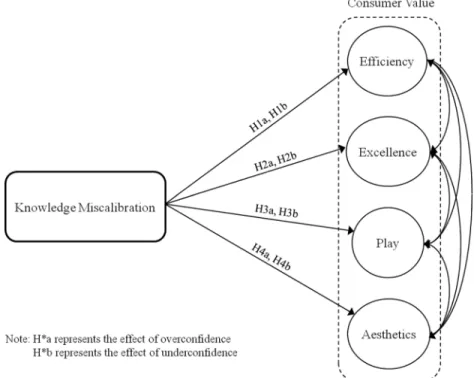
Based on these hypotheses, the hypothetical model for the effects of overconfidence and underconfidence on consumer value dimensions is represented in Figure 1.
METHOD
In the consumer-behavior literature, knowledge miscalibration is predominantly studied through covariance-based studies (Alba & Hutchinson, 2000; Kidwell, Hardesty, & Childers, 2008; Pearson & Liu-Thompkins, 2012; Pillai & Hofacker, 2007; Pillai & Kumar, 2012). In the majority of these studies, the
Figure 1. The hypothetical models for the effect of overconfidence and underconfidence on consumer value dimensions.
subjective probability paradigm—where knowledge miscalibration is measured by the difference between subjective and objective knowledge—is the dominant approach for capturing knowledge miscalibration (Alba & Hutchinson, 2000). The main assumption behind this paradigm is that consumers are naturally miscalibrated and, in order to examine the effect of overconfidence and underconfidence on their behavior, the researcher simply needs to observe this natural knowledge miscalibration (Carlson, Bearden, & Hard-esty, 2007; Park, Mothersbaugh, and Feick, 1994; Pillai & Hofacker, 2007). The first study reported in this paper follows the subjective probability paradigm to investigate the existence of hypothesized relationships. Although covariance-based studies are extensively used in the social sciences, the validity of inferring causal relationships through such studies is of concern (Freedman, 1991). Indeed, a causal relationship hap-pens when the cause precedes the effect, the cause is related to the effect and there is no other explanation for this relationship (Shadish, Cook, & Campbell, 2001), while in a covariance-based study the order of the oc-currence of the investigated variables is not identified. The subjective probability paradigm has similar validity issues. Indeed, knowledge miscalibration and consumer value dimensions might both be the outcome of other personal or environmental factors. For instance, consumer involvement in a consumption task might be the cause of both a lower knowledge miscalibration (Pillai & Hofacker, 2007) and higher perceived play (Mittal & Lee, 1989). Therefore, the relationship between knowledge miscalibration and consumer value dimensions might be due to another
factor influencing both (i.e., consumer involvement in the example above). Furthermore, in examining the relationship between knowledge miscalibration and consumer value, it is hard to distinguish whether knowledge miscalibration impacts consumer value or the consumer value derived from previous consumption episodes impacts knowledge miscalibration.
However, although consumer research has not inves-tigated knowledge miscalibration experimentally, such endeavors do exist in decision sciences. Specifically, Sieck and Arkes (2005) experimentally investigate overconfidence. After a set of three experiments, they were successful in manipulating knowledge miscal-ibration and testing the effect of overconfidence on people’s usage of actuarial guides in their decision making. Other researchers in decision sciences and psychology have also manipulated overconfidence (Gonzalez-Vallejo & Bonham, 2007; Ryvkin, Krajc, & Ortmann, 2012). To overcome the internal validity issues of Study 1, Study 2 investigates the effects of knowledge miscalibration on different types of con-sumer value experimentally. This study manipulates not only overconfidence but also underconfidence.
As a covariance-based study, Study 1 aims to identify the hypothesized relationships between overconfidence/underconfidence and the dimensions of consumer value. Once Study 1 confirms the existence of significant relationships, Study 2 is run in order to establish the temporal ordering of the independent and dependent variables, and to rule out alternative explanations by means of experimental and statistical control (Study 2 also controls statistically for subjec-tive and objecsubjec-tive knowledge levels). Furthermore, the
multimethod approach to investigating knowledge miscalibration provides an opportunity to compare the experimental method with the more-conventional covariance-based approach.
In order to both account for the validity of the measurement of consumer value dimensions and to test the hypothesized causal relationships, this study used structural equation modeling (SEM; Bagozzi & Yi, 1989). In investigating the effect of overconfidence and underconfidence separately, the study follows a piecewise linear model data analysis (Harring, 2014). Piecewise models are used when the behavior of a model is expected to change at a change-point(s) (cf., Do, Wang, & Elliot, 2013; Gale, Allerhand, & Deary, 2012). In this research, the change-point is the point where subjective knowledge matches objective knowledge and divides knowledge miscalibration into two pieces: underconfidence and overconfidence. The hypothetical model distinguishes overconfidence from underconfidence and piecewise modeling provides the means to investigate each piece separately.
In order to analyze a piecewise linear model one can either set a dummy variable (e.g., 0 for underconfidence and 1 for overconfidence) and use it in the analysis, or run a multigroup analysis (e.g., one group of undercon-fident, the other of overconundercon-fident, consumers; Riverra & Satorra, 2002). The study runs multigroup analysis of the effects of overconfidence and underconfidence on consumer value, as it does not require the assumption of homogeneity in groups (Bagozzi & Yi, 1989). There-fore, in each study multigroup analysis was used, with one group being underconfident, and the other overcon-fident, consumers.
In these models, factor loadings, factor covariances, and structural paths (except the paths between knowl-edge miscalibration and the value dimensions) are con-strained as equal across groups. The goodness of fit was evaluated using Hair, Black, Babin, and Anderson’s (2010) proposed metrics. They suggest that a model with a comparative fit index (CFI) of equal or greater than 0.95 and a root mean square error of approxima-tion (RMSEA) of equal or lower than 0.08 fits the data well. The minimum sample size for an SEM analysis in this research is 200 to provide sufficient power to detect the effect and in order to be appropriate for the model structure (Westland, 2010).
Study 1: Covariance-based Study
The covariance-based investigation was conducted in the context of online shopping, as this context provides a high level of interactivity (Haubl & Trifts, 2000) where consumer knowledge plays an important role. Furthermore, online shopping involves both he-donic and utilitarian aspects of consumption (Childers, Carr, Peck, & Carson, 2001), and therefore different dimensions of consumer value can be investigated in this context (Mathwick, Malhotra, & Rigdon, 2001). The study was designed in the online shopping context of Amazon.com, as the focal consumer experience.
The data were collected using Amazon Mechanical Turk where 260 participants completed the study. A total of 51% of participants were female, 56% of them had a higher education degree, 44% spent less than 25 hours a week on the internet, and 52% usually shopped online more than three times a month. The age of par-ticipants ranged from 18 to 71 years old with an average of 31.6 years and an SD of 11.3.
Study 1: Measurement
Knowledge Miscalibration, Overconfidence, and Underconfidence. Knowledge miscalibration was measured using the subjective probability method (Alba & Hutchinson, 2000). In line with this method, in order to measure objective knowledge, a set of true/false questions was developed about the service usage of Amazon.com and the objective knowledge score was calculated by summing the number of correct answers. These true/false items were developed based on com-pany materials and were refined through three sets of interviews with expert users of Amazon.com (Ap-pendix A). Subjective knowledge was measured by us-ing subjective probability ratus-ings (Alba & Hutchinson, 2000). Respondents identified the confidence in their answers on a 50–100% scale (Hansen & Thomsen, 2013; Pillai & Hofacker, 2007): 100% reflected that they were completely sure their answer was correct, 50% meant they had no idea about the question and picked the answer at random with a 50/50 chance of it being cor-rect. Subjective knowledge items were converted to a 0.5–1.0 scale and a total score was calculated by sum-ming the confidence ratings of all the items. Finally, knowledge miscalibration was calculated by subtract-ing the objective knowledge score from the subjective knowledge score (Alba & Hutchinson, 2000). Partici-pants with a knowledge miscalibration score greater than 0 were classified as overconfident and those with a knowledge miscalibration score lower than 0 were classified as underconfident. Based on knowledge mis-calibration scores in Study 1, 75% of participants were classified as overconfident consumers and 25% of par-ticipants were classified as underconfident consumers. Consumer Value. In the marketing literature, dif-ferent scales have been developed for measuring the consumer value of durable goods (Sweeney & Soutar, 2001), tourism products (Sanchez, Callar-isa, Rodriguez, & Moliner, 2006), online shopping (Mathwick, Malhotra, & Rigdon, 2001), shopping (Babin, Barden, & Griffin, 1994), banking services (Roig, Garcia, Tena, & Monzonis, 2006), health care services (Chahal & Kumari, 2011), and electronic products (Munnukka & Jarvi, 2012).
Due to its comprehensiveness and applicability to the context, this paper adopted the consumer value scale developed by Munnukka and Jarvi (2012). The advantage of applying this scale over others in online or digital contexts is that three items are used to measure
each of four dimensions of consumer value, therefore achieving a high level of measurement validity and par-simony (Hinkin, 1995). Perceived play was measured using the intrinsic enjoyment items only from the orig-inal scale, as the escapism items can be associated with consumer engagement in the task and might bias the result of measuring perceived play (see Appendix B for the measurement items).
Study 1: Results
The study first ran a confirmatory factor analysis (CFA) of consumer value dimensions. It compared the mea-surement model (i.e., the model with factor loadings constrained as equal across groups) and the struc-tural model (i.e., the model with factor covariances con-strained as equal across groups) with the unrestricted model to investigate multiple-group invariance (i.e., equality) (Byrne, 2010). The unrestricted model fitted the data well (χ2=126, df=96,p=0.02; CFI=0.979;
RMSEA=0.035). The measurement model also fitted the data well (χ2 = 131, df = 104, p = 0.04; CFI =
0.982; RMSEA=0.031). The measurement model in-variance was supported asχ2change was insignificant
(χ2=5, df=8) and the difference in CFI was small
(CFI=0.003<0.01; Cheung & Rensvold, 2002). The structural model also fitted the data well (χ2=138, df
= 110,p=0.04; CFI= 0.981; RMSEA=0.031). The structural model invariance was also supported given an insignificant χ2 change (χ2=12, df=14) and
a small difference in CFI (CFI=0.002<0.01; Che-ung & Rensvold, 2002). For all dimensions in the three models, composite reliability (CR) was greater than 0.7 and average variance extracted (AVE) was greater than 0.5, supporting the convergent validity of the consumer value scale (Fornell & Larker, 1981). The discriminant validity of the scale also received support as maximum and average shared squared variances (MSV and ASV) were lower than AVE for all dimensions (Fornell & Larker, 1981). Furthermore, with a Cronbach alpha greater than 0.7 for all dimensions, the scale displayed internal consistency reliability (Nunnally & Berstein, 1994).
The study analyzed the hypotheses through piece-wise linear SEM (Harring, 2014). In this model, knowl-edge miscalibration was an observed exogenous cause variable. Therefore, there was no need to assign it a latent variable or to fix an error term (Mulaik, 2009).
The model of the hypothesized relationships be-tween knowledge miscalibration and consumer value dimensions fitted the data very well (χ2 = 151, df =
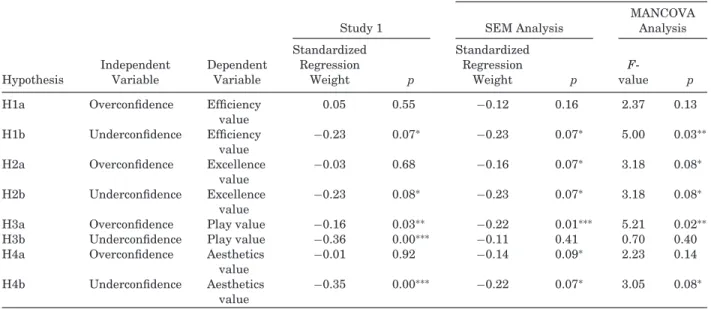
126,p=0.06; CFI=0.983; RMSEA=0.028). As sum-marized in Table 2, H3b and H4b were significantly supported at a 0.01 significance level, H3a was signif-icantly supported at a 0.05 significance level, and H1b and H2b were significantly supported at a 0.1 signifi-cance level. Moreover, the paths corresponding to H1a, H2a, and H4a were not significant. Overall, the effect of underconfidence on all four dimensions of consumer
value was supported whereas the effect of overconfi-dence was only supported for perceived play value.
Study 2: Experimental Study
The second study is a 2 (overconfidence vs. underconfi-dence)×2 (lowered knowledge miscalibration vs. nat-ural knowledge miscalibration) quasi-experiment. In this quasi-experiment, participants’ level of knowledge miscalibration is measured first to divide them into two groups of overconfident and underconfident consumers. In the second stage, participants are randomly assigned into two groups where the level of knowledge miscali-bration is reduced in the experimental group and it is not changed in the control group.
In addition to the interactivity of the context, the novelty of the usage context was a criterion for the selection of the context in the second study. In other words, in order to manipulate knowledge miscali-bration before consumers derived any perception of the value of product or service usage, the consump-tion task needed to be novel to consumers. Had a study manipulated knowledge miscalibration in a consumption task that participants are familiar with, any measurement of consumer value might have also reflected participants’ perceived value, as derived from previous experiences. This paper chose to use the Prezi online software as the context for the second study, as it provided a consumption experience characterized by both user interaction and consumption newness. Prezi (www.prezi.com) is a relatively recently devel-oped online software, which enables users to create presentation slides and move between them during the presentation. Those already familiar with Prezi were excluded from the study, before randomly assigning participants to the experimental groups.
Two hundred fifteen participants were recruited via Amazon Mechanical Turk. A total of 59% of partici-pants were female, 59% of them had a degree education, 45% spent less than 25 hours a week on the internet, and 51% created Power Point presentations more than three times a year. The age of participants ranged from 18 to 66 years old with an average of 31.9 years old and an SD of 11.3.
Participants watched two tutorial videos describing how they can create and share a Prezi (i.e., an on-line dynamic presentation). Then, their knowledge mis-calibration level was measured (i.e., using the subjec-tive probability paradigm) and participants were ran-domly allocated to either the control group (i.e., natural knowledge miscalibration) or the experimental group (i.e., lowered knowledge miscalibration). The partic-ipants in the experimental group were manipulated by providing them with enhanced calibration feedback (Sieck & Arkes, 2005), and thus reducing their level of miscalibration. All participants were asked to create and share a Prezi online presentation (thus using the Prezi software). The perceived consumer value dimen-sions were then measured as dependent variables.
Table 2. Summary of Hypothesis Tests.
Study 2
MANCOVA
Study 1 SEM Analysis Analysis
Standardized Standardized
Independent Dependent Regression Regression F
-Hypothesis Variable Variable Weight p Weight p value p
H1a Overconfidence Efficiency
value
0.05 0.55 −0.12 0.16 2.37 0.13
H1b Underconfidence Efficiency
value
−0.23 0.07∗ −0.23 0.07∗ 5.00 0.03∗∗
H2a Overconfidence Excellence
value
−0.03 0.68 −0.16 0.07∗ 3.18 0.08∗
H2b Underconfidence Excellence
value
−0.23 0.08∗ −0.23 0.07∗ 3.18 0.08∗
H3a Overconfidence Play value −0.16 0.03∗∗ −0.22 0.01∗∗∗ 5.21 0.02∗∗
H3b Underconfidence Play value −0.36 0.00∗∗∗ −0.11 0.41 0.70 0.40
H4a Overconfidence Aesthetics
value
−0.01 0.92 −0.14 0.09∗ 2.23 0.14
H4b Underconfidence Aesthetics
value
−0.35 0.00∗∗∗ −0.22 0.07∗ 3.05 0.08∗
∗0.1 significance level,∗∗0.05 significance level,∗∗∗0.01 significance level.
Study 2: Measurement and Manipulation
The Manipulation of Knowledge Miscalibration. As suggested by Sieck and Arkes (2005), knowledge miscalibration was manipulated through enhanced cal-ibration feedback. Enhanced calcal-ibration feedback in-volves informing participants about their objective knowledge score, subjective knowledge score, and the direction in which they can calibrate their knowledge. The enhanced calibration feedback method achieves manipulation by making people aware of how far away their subjective knowledge is from their objective knowledge, and therefore prompting the experimen-tal group to bring their assessment of their subjective knowledge closer to their actual level of objective edge (while keeping each participant’s objective knowl-edge the same). The manipulation does not intend to contrast miscalibrated consumers (i.e., overconfident or underconfident consumers) with calibrated ones, but rather different degrees of miscalibration (i.e., overcon-fident consumers vs. manipulated less-overconovercon-fident consumers, and respectively underconfident consumers vs. manipulated less-underconfident consumers). Fur-ther, as consumers are naturally miscalibrated with dif-ferent levels of knowledge miscalibration ranging from highly underconfident to highly overconfident, the ma-nipulation needs to be performed after measuring the knowledge miscalibration level. Manipulating knowl-edge miscalibration through enhanced calibration feed-back has been successfully applied in other studies (Gonzalez-Vallejo & Bonham, 2007; Ryvkin, Krajc, & Ortmann, 2012).
Knowledge miscalibration was first measured us-ing the same subjective probability method applied in Study 1. A set of true/false questions was developed to assess objective knowledge about using Prezi.com.
These items were refined through three sets of inter-views with expert users (Appendix C). Based on knowl-edge miscalibration scores using these items, 70% of participants were classified as overconfident consumers and 30% of participants were classified as underconfi-dent consumers in Study 2. After subjects’ knowledge miscalibration was measured, subjects were randomly divided into experimental and control groups, providing enhanced calibration information to the experimental group (see Appendix D for the examples of knowledge miscalibration manipulations). For instance, if a sub-ject answers 5 of 10 questions correctly and she thinks she has answered 7 of 10 questions correctly, she is informed that (1) she answered 50% of questions cor-rectly, (2) she thinks she answered 70% of questions correctly, and (3) she actually has 20% less Prezi knowl-edge than she thinks she has.
Consumer Value. Consumer value was measured with the same scale used in Study 1, and based on the study of Munnukka and Jarvi (2012, Appendix B).
Manipulation Check. Two items were used to test the effectiveness of manipulations: “I think I have a pretty good knowledge of Prezi” and “I think I have a lot of Prezi knowledge” (Cronbach alpha=0.78). These items measure consumers’ subjective knowledge. The manipulation needed to change the average subjective knowledge for the experimental group, as this study tried to decrease subjective knowledge (in the case of overconfidence) or increase subjective knowledge (in the case of underconfidence). Meanwhile, participants’ objective knowledge stayed the same. Therefore, in order to test the effectiveness of the manipulation, the study compared control and experimental groups’
subjective knowledge measured by using the manipu-lation check items indicated above.
Study 2: Results
It was first checked if the manipulation of knowl-edge miscalibration performed as intended. The manipulation check items’ score was converted on a 50–100% scale and the knowledge miscalibration score was recalculated. For overconfident consumers, an independent t-test showed that the manipulation effectively decreased subjective knowledge and the knowledge miscalibration level of participants in the experimental group compared to the control group (Mexperimental=3.8 vs.Mcontrol=4.5;t=4.04, df=149,p =0.000). The study also ran a one-samplet-test on the experimental group to make sure that manipulation did not turn participants into the underconfidence zone. The result showed that knowledge miscalibration level in the experimental group was significantly higher than 0 (t=5.58, df=78,p<0.001). Therefore, the manipulation decreased the knowledge miscalibra-tion level of overconfident participants, while it did not change them into underconfident consumers.
Similarly, for underconfident consumers, the inde-pendent t-test showed that the manipulation effec-tively increased subjective knowledge and decreased the level of knowledge miscalibration of participants in the experimental group compared to the control group (Mexperimental=4.7 vs.Mcontrol=4.0;t=3.26, df=62,p= 0.002). Furthermore, a one-samplet-test on the exper-imental group showed that knowledge miscalibration level was significantly lower than 0 (t=4.08,df=63,
p< .001). Therefore, the manipulation decreased the knowledge miscalibration level of underconfident par-ticipants, while it did not change them into overconfi-dent consumers.
The CFA unrestricted model fitted the data well (χ2
=168, df=96,p=0.00; CFI=0.964; RMSEA=0.059). The measurement model also fitted the data well (χ2=
172, df=104,p=0.00; CFI=0.966; RMSEA=0.056). The measurement model invariance was supported through a nonsignificantχ2change (χ2=4.2, df=
8) and a small difference in CFI (CFI=0.002<0.01; Cheung & Rensvold, 2002). The structural model also fitted the data well (χ2=183, df=110,p=0.00; CFI
= 0.964; RMSEA= 0.056). The structural model in-variance was supported through a nonsignificant χ2
change (χ2=15, df =14) and small difference in CFI (CFI=0.000<0.01; Cheung & Rensvold, 2002). For all dimensions in the three models, CR was greater than 0.7 and AVE was greater than 0.5, which sup-ported the convergent validity of the scale (Fornell & Larker, 1981). The discriminant validity of the scale was also supported as MSV and ASV were lower than AVE for all dimensions (Fornell & Larker, 1981). Fur-thermore, with a Cronbach alpha greater than 0.7 for all dimensions, the scale displayed internal consistency reliability (Nunnally & Berstein, 1994).
Unlike the first study, the independent factor was coded as a categorical variable rather than as a con-tinuous variable. Thus, for the overconfidence sample “1” represented the unchanged overconfidence (i.e., con-trol) condition and “0” the reduced overconfidence (i.e., experimental) condition, while for the underconfidence sample “1” represented the unchanged underconfidence (i.e., control) condition and “0” the reduced underconfi-dence (i.e., experimental) condition.
In Study 2, objective knowledge and subjective knowledge were included in the analysis as control vari-ables to remove any effect of objective and subjective knowledge differences between the control and experi-mental groups. This was not the case for Study 1, where knowledge miscalibration was the subtraction of the objective knowledge score from the subjective knowl-edge score. Therefore, adding any of these two types of knowledge in the model would have removed the vari-ation in knowledge miscalibrvari-ation (cf., Parker & Stone, 2014).
Similar to Study 1, the hypotheses were analyzed through multigroup SEM. The model with the hypoth-esized relationships between knowledge miscalibration and consumer value dimensions fitted with the data well (χ2 =257, df=171,p=0.00; CFI=0.959;
RM-SEA=0.049). As it is summarized in Table 2, H3a was significantly supported at a 0.01 significance level and H1b, H2b, H4b, H2a, and H4a were significantly sup-ported at a 0.1 significance level. Moreover, the paths corresponding to H1a and H3b were insignificant. In all, the negative effect of underconfidence on efficiency, ex-cellence, and aesthetics and the negative effect of over-confidence on excellence, play, and aesthetics received support.
In addition to these, it is also found that subjective knowledge (as a covariate) has a significant effect on efficiency (γ=0.16,p<0.05), play (γ=0.16,p<0.05), and aesthetics (γ = 0.17, p < 0.05) in the overconfi-dent group. There was no significant effect of objective knowledge or subjective knowledge on consumer value dimensions in the underconfident group.
The hypotheses were also analyzed through MAN-COVA to compare the results with those of the SEM analysis. The overconfident and the underconfident conditions did not differ significantly in terms of their value dimension scores (i.e., no main effect of the over-confidence vs. underover-confidence factor). Furthermore, participants with lowered knowledge miscalibration had a significantly higher efficiency (F(1, 209)= 6.46,
p<0.05), excellence (F(1, 209)=5.56,p<0.05), play (F(1, 209)= 3.72,p< 0.1), and aesthetics (F(1, 209) = 5.05,p< 0.05) than those with natural knowledge miscalibration, implying that knowledge miscalibra-tion had a negative effect on efficiency, excellence, play, and aesthetics.
In order to test the hypothetical model, planned contrasts were performed separately for the undercon-fident and overconundercon-fident groups in order to analyze the effect of the reduction in knowledge miscalibration on the dependent variable scores (calculated here as
averages of the items for each construct). Similar to the SEM analysis, H1b (Mexperimental =14.7 vs. Mcontrol = 12.9; F(1, 209)= 5.00, p< 0.05), H2a (Mexperimental = 17.5 vs. Mcontrol = 16.7; F(1, 209) = 3.18, p< 0.1), H2b (Mexperimental = 16.3 vs. Mcontrol = 15.2; F(1, 209) =3.18,p<0.1), H3a (Mexperimental=15.5 vs.Mcontrol= 14.0; F(1, 209)=5.21,p<0.05), and H4b (Mexperimental = 18.1 vs. Mcontrol = 16.9; F(1, 209) = 3.05, p< 0.1) were significantly supported; and H1a (Mexperimental = 15.9 vs.Mcontrol=15.0; F(1, 209)=2.37,p=0.13) and H3b (Mexperimental=14.4 vs.Mcontrol=13.7; F(1, 209)= 0.7,p=0.4) were insignificant. Contrary to the results of the SEM analysis, the results failed to support H4a (Mexperimental = 18.5 vs. Mcontrol = 17.8; F(1, 209) = 2.23,p=0.14). However, unlike SEM, MANCOVA does not account for the measurement errors in the model. Since each of the four dependent variables (i.e., the four value dimensions) were measured using a 3-item scale, the paper relies on the results of the SEM analysis in the Discussion section.
DISCUSSION
As seen in Table 2, hypotheses H1b, H2b, H4b, and H3a are supported in both studies. Specifically, both studies find that underconfidence negatively influences perceived efficiency, perceived excellence, and per-ceived aesthetics. Furthermore, studies find overcon-fidence to negatively impact perceived play. Overall, these studies show that overconfidence and undercon-fidence lead to a lower perception of some aspects of value.
Hypotheses H2a (i.e., the effect of overconfidence on excellence value) and H4a (i.e. the effect of overconfi-dence on aesthetics value) are only supported in the second study. The lack of significant results, in Study 1, may be due to its covariance-based nature. The paper posits that the impact of overconfidence and undercon-fidence on consumer value dimensions, in the context of Study 1, where consumers have a high degree of famil-iarity with the context, may be influenced by consumer value derived from previous consumption experiences. In particular, value of a reactive nature (i.e., value of those attributes and consequences that need no physical or mental action by the consumer, such as ex-cellence and aesthetics [Holbrook, 1999]) can increase subjective knowledge. As discussed before, knowledge miscalibration is a product of misinterpretation of external cues (Alba & Hutchinson, 2000). If the exter-nal cues do not carry any information about objective knowledge, they can create an inaccuracy in subjective knowledge. For instance, Frankenberger and Albaum (1997) show that consumers use the level of consump-tion task difficulty as a cue for their self-assessment of knowledge and those involved in more difficult tasks are underconfident whereas those engaged in easy tasks are overconfident. In Frankenberger and Al-baum’s (1997) research, as the cue (i.e., task difficulty) does not have any information about consumers’
objec-tive knowledge, it leads to knowledge miscalibration. The paper suggests that consumers’ perception of reac-tive value dimensions (i.e., excellence and aesthetics) can lead to further knowledge miscalibration, particu-larly because they do not carry any information about the consumer and her performance. In other words, consumers use their higher perception of aesthetics or excellence as a cue to assess their objective knowledge, which leads to overconfidence. Consistent with the pa-per’s argument, Burrati and Allwood (2012) show that fluency predicts subjective knowledge, as people use fluency as a cue to judge their level of objective knowl-edge (i.e., which is reflected in subjective knowlknowl-edge ratings). Therefore, the lack of support for H2a and H4a in Study 1 can be explained by the fact that consumers who experience higher excellence or aesthetics have a higher overconfidence, which neutralizes the subse-quent negative effect of overconfidence on excellence or aesthetics (i.e., as per the hypotheses). Conversely, in Study 1 this effect is not likely to neutralize the negative effect of underconfidence; rather, it should increase the negative effect size of underconfidence on aesthetics and excellence. Overall, these findings support the appropriateness of experimental methods for investigating the effect of knowledge miscalibration on consumer value dimensions.
Hypothesis H1a (i.e., the effect of overconfidence on efficiency value) is not supported in either of the stud-ies. The paper proposed that although overconfident consumers expect to perform well they would actually perform poorly as a result of acting presumptuously and allocating suboptimal resources to consumption, which would lead to a lowered perceived efficiency. However, the findings from both studies failed to confirm this hypothesis. This result might be investigated in later studies by reconsidering the definition of perceived ef-ficiency. In addition to the perceived input and out-put of the task, consumers’ perception of efficiency may also be the result of motivational biases. People tend to draw conclusions when a result is desirable or comfort-ing (Windschitl, Scherer, Smith, & Rose, 2013). The pa-per suggests that although the actual pa-performance (i.e., output) of overconfident consumers is low they perceive it to be higher in order to enhance their self. In par-ticular, this is a case for efficiency value that depends on how well a consumer can perform the consumption task (i.e., self), in addition to how well the product can help the consumer.
Hypothesis H3b (i.e., the effect of underconfidence on play value) is only supported in Study 1. The paper proposed this hypothesis on the basis that underconfi-dent consumers choose consumption tasks that are too simple for them, due to underestimation of their higher actual knowledge. As a consequence they do not fall into a flow state of mind, which means they achieve a lower level of perceived play. In Study 2, the consumption task was new to consumers. In a novel context, even a simple task could be challenging enough for the un-derconfident consumers to derive perceptions of play. Indeed, although the paper found evidence in Study
1 that underconfidence is related to a lower perceived play Study 2 did not obtain the same finding. This is most likely due to the effect of the consumption new-ness on the perception of play. The case is different for the overconfident consumers who already suffer from a lack of flow resulting from their suboptimal resource allocation and tendency to act presumptuously.
The findings and the discussion above support the argument that overconfidence and underconfidence are distinct phenomena and need to be separately investigated. In Study 2, overconfidence significantly influences play while the effect of underconfidence on play is not significant, as the context (i.e., the new consumption task) removes the negative consequence of underconfident consumers acting timidly. In Study 1, underconfidence affects excellence and aesthetics whereas the effect of overconfidence on these dimen-sions of value is not significant. As debated above, this is likely to occur as a result of the counterbal-ancing effect of accumulated previous consumption experiences of aesthetics and excellence, resulting in overconfidence. In both studies, underconfidence is negatively associated with efficiency while this effect is not significant for overconfidence; it is likely to be because overconfident consumers attach motivational biases to their evaluation of efficiency.
In addition to the findings above, Study 2 accounted for the effect of subjective knowledge and objective knowledge when testing the effect of knowledge mis-calibration. The findings show that, for overconfident consumers, the initial subjective knowledge (i.e., subjective knowledge before knowledge miscalibration manipulation) has a significant and positive relation-ship with efficiency, play, and aesthetics values. This means that although the manipulation decreases the level of subjective knowledge it does not remove the positive effects of motivational biases attached to the initial degree of subjective knowledge. In other words, when consumers receive enhanced calibration feed-back, they adjust their subjective knowledge without changing their motivation. Interestingly, this is not the case for underconfident consumers. Presumably, the reason behind this is that enhanced calibration feedback increases both the subjective knowledge and motivation of underconfident consumers. Over-all, the paper concludes that making consumer’s subjective knowledge more accurate decreases un-derconfident consumers’ lack of motivation, while it maintains the high level of motivation of overconfident consumers.
The main contribution of this research is to demon-strate the effect of knowledge miscalibration on the dimensions of consumer value as derived from usage. This study extends the understanding of knowledge miscalibration through an experimental study and compares the results with the findings of an initial covariance-based study. To the best of knowledge, this work is the first in consumer research to experimen-tally document the consequences of underconfidence and overconfidence. Furthermore, the small amount of
empirical research in psychology and decision sciences that experimentally investigates knowledge miscal-ibration has tended to focus only on overconfidence (Gonzalez-Vallejo & Bonham, 2007; Ryvkin, Krajc, & Ortmann, 2012; Sieck & Arkes, 2005). This paper manipulates both overconfidence and underconfidence. Previous research has shown that providing con-sumer training helps them to have a better experi-ence of a product by utilizing more benefits, which, in many cases, leads to greater satisfaction and pos-itive postpurchase intentions (Hennig-Thurau, 2000). This paper suggests that companies also benefit from investing in consumer learning because of its effect on overconfidence and underconfidence and eventually on experiences in usage. Study 2 demonstrates that pro-viding consumers with simple textual information (i.e., enhanced calibration feedback) has a significant impact on consumer value. The findings suggest that advanced consumer learning initiatives such as the experiential learning provided in an Apple store might potentially create a better consumer value due to reduction in the amount of knowledge miscalibration.
Many promotional strategies are designed to per-suade consumers to purchase a product or a service. Some of these strategies impact knowledge miscali-bration, for instance, exaggerated advertising claims lead to knowledge miscalibration (Cowley, 2006). As demonstrated here, such strategies can indirectly in-fluence consumption experiences through the impact that knowledge miscalibration subsequently has on consumer value. For instance, an advertisement en-hancing overconfidence in order to increase sales can indirectly lead to a lack of perceived consumer value in the stage of product or service usage. Therefore, an important implication is that companies with an in-terest in the consumer journey beyond the purchase step should avoid creating miscalibration through their sales claims in order to minimize the risk of miscalibra-tion resulting from the usage of the product.
Further research needs to look at constructs medi-ating and modermedi-ating the effect of overconfidence and underconfidence on consumer value dimensions. The authors of this paper have based the conceptualization on three main consequences of knowledge miscali-bration including the level of resources allocated to consumption, the way to act in the consumption, and the extent of setting outcome expectations. These consequences along with other constructs including consumers’ performance in the consumption tasks, perceived potential benefits and risks, flow and flu-ency have all been used in this study to theorize the effect of overconfidence and underconfidence on consumer value and need to be further empirically investigated.
Further research is also needed to investigate the emotional consequences of overconfidence and under-confidence, in order to have a better understanding of the role of knowledge miscalibration in usage. Pil-lai and Hofacker (2007) theorized that calibration de-creases frustration with Web sites. Other positive and
negative emotions such as anger, fear, sadness, shame, contentment, and happiness (Laros & Steenkamp, 2005) can be examined in future studies as the con-sequences of overconfidence and underconfidence in usage.
This research has mainly examined the effect of overconfidence and underconfidence on the perception of consumer value. Particularly, in Study 2, consumers were faced with a new context (i.e., a new consumption task) and the results show how overconfident and un-derconfident consumers initially shape their perception of consumer value. Further studies could experimen-tally probe the potential effect of knowledge miscali-bration on changing the perception of consumer value. A relevant question would thus be the following: Even if a consumer has already used a product or service and has an established perception of its value, could this perception of value be changed due to further reducing knowledge miscalibration?
Many previous studies have not made the distinction between overconfidence and underconfidence, and have measured rather than manipulated knowledge miscal-ibration to demonstrate its effect on outcomes such as the quality of purchase decisions (e.g., Alba & Hutchin-son, 2000; Kidwell, Hardesty, & Childers, 2008). As demonstrated here, there is merit in assessing such re-sults by experimentally manipulating knowledge mis-calibration and distinguishing between overconfidence and underconfidence.
REFERENCES
Alba, J. W., & Hutchinson, J. W. (2000). Knowledge cali-bration: What consumers know and what they think they know. Journal of Consumer Research, 27, 123–156. Andaleeb, S. S., & Basu, A. K. (1994). Technical complexity
and consumer knowledge as moderators of service quality evaluation in the automobile service industry. Journal of Retailing, 70, 367–381.
Babin, B. J., Barden, W. R., & Griffin, M. (1994). Work and/or fun: Measuring hedonic and utilitarian shopping value. Journal of Consumer Research, 20, 644–656.
Bagozzi, R. P., & Yi, Y. (1989). On the use of structural equa-tion models in experimental designs. Journal of Marketing Research, 26, 271–284.
Barrutia, J. M., & Gilsanz, A. (2012). Electronic service qual-ity and value: Do consumer knowledge-related resources matter? Journal of Service Research, 16, 231–246. Bourdeau, L., Chebat, J. C., & Couturier, C. (2001).
Inter-net consumer value of university students: E-mail vs.web users. Journal of Retailing and Consumer Services, 9, 61– 69.
Brucks, M. (1985). The effects of product class knowledge on in-formation search behavior. Journal of Consumer Research, 12, 1–16.
Burrati, S., & Allwood, C. M. (2012). Improved realism of con-fidence for an episodic memory event. Judgment and Deci-sion Making, 7, 590–601.
Burson, K. A. (2007). Consumer-product skill matching: The effects of difficulty on relative self-assessment and choice. Journal of Consumer Research, 34, 104–110.
Byrne, B. M. (2010). Structural Equation Modeling with AMOS: Basic Concepts, Applications, and Programming (2nd ed.). New York: Routledge.
Carlson, J. P., Bearden, W. O., & Hardesty, D. M. (2007). In-fluences on what consumers know and what they think they know regarding marketer pricing tactics. Psychology & Marketing, 24, 117–142.
Carlson, J. P., Vincent, L. H., Hardesty, D. M., & Bearden, W. O. (2009). Objective and subjective knowledge relation-ships: A quantitative analysis of consumer research find-ings. Journal of Consumer Research, 35, 864–876. Chahal, H., & Kumari, N. (2011). Consumer perceived value
and consumer loyalty in the healthcare sector. Journal of Relationship Marketing, 10, 88–112.
Cheung, G. W., & Rensvold, R. B. (2002). Evaluating goodness-of-fit indexes for testing measurement invariance. Struc-tural Equation Modeling, 9, 233–255.
Childers, T. L., Carr, C. L., Peck, J., & Carson, S. (2001). He-donic and utilitarian motivations for online retail shopping behavior. Journal of Retailing, 77, 511–535.
Cho, H., & Schwarz, N. (2010). I like those glasses on you, but not in the mirror: Fluency, preference, and virtual mirrors. Journal of Consumer Psychology, 20, 471–475.
Cordell, V. V. (1997). Consumer knowledge measures as pre-dictors in product evaluation. Psychology & Marketing, 14, 241–260.
Coupey, E., & Narayanan, S. (1996). Effects of knowledge types on choice quality and perceptions of choice perfor-mance. Psychology & Marketing, 13, 715–738.
Cowley, E. (2006). Processing exaggerated advertising claims. Journal of Business Research, 59, 728–734.
Cowley, E., & Mitchell, A. A. (2003). The moderating effect of product knowledge on the learning and organization of product information. Journal of Consumer Research, 30, 443–454.
Csikszentmihalyi, M. (1990). Flow: The psychology of optimal experience. New York: Harper and Row.
de Bont, C. J. P. M., & Schoormans, J. P. L. (1995). The ef-fects of product expertise on consumer evaluations of new-product concepts. Journal of Economic Psychology, 16, 599– 615.
Do, D. P., Wang, L., & Elliot, M. R. (2013). Investigating the relationship between neighborhood poverty and mortality risk: a marginal structural modeling approach. Social Sci-ence and Medicine, 91, 58–66.
Dunning, D., Heath, C., & Suls, J. M. (2004). Flawed self-assessment: Implications for health, education, and the workplace. Psychological Science in the Public Interest, 5, 69–106.
Frankenberger, K. D., & Albaum, G. S. (1997). Using behav-ioral decision theory to assess advertisement recognition tasks by level of difficulty. Psychology & Marketing, 14, 145–162.
Freedman, D. A. (1991). Statistical models and shoe leather. Sociological Methodology, 21, 291–313.
Fornell, C., & Larker, D. F. (1981). Evaluating structural equa-tion models with unobservable variables and measurement error. Journal of Marketing Research, 18, 39–50.
Gale, C. R., Allerhand, M., & Deary, I. J. (2012). Is there a bidi-rectional relationship between depressive symptoms and cognitive ability in older people? A prospective study us-ing the English longitudinal study of ageus-ing. Psychological Medicine, 42, 2057–2069.
Gershoff, A. D., & Johar, G. V. (2006). Do you know me? sumer calibration of friends’ knowledge. Journal of Con-sumer Research, 32, 496–503.