City, University of London Institutional Repository
Citation
: Guizzo, E., Weyde, T. ORCID: 0000-0001-8028-9905 and Leveson, J. B. (2020).
Multi-Time-Scale Convolution for Emotion Recognition from Speech Audio Signals. ICASSP
2020 - 2020 IEEE International Conference on Acoustics, Speech and Signal Processing
(ICASSP), doi: 10.1109/icassp40776.2020.9053727 ISSN 2379-190X
This is the accepted version of the paper.
This version of the publication may differ from the final published
version.
Permanent repository link:
https://openaccess.city.ac.uk/id/eprint/24239/
Link to published version
: http://dx.doi.org/10.1109/icassp40776.2020.9053727
Copyright and reuse:
City Research Online aims to make research
outputs of City, University of London available to a wider audience.
Copyright and Moral Rights remain with the author(s) and/or copyright
holders. URLs from City Research Online may be freely distributed and
linked to.
City Research Online:
http://openaccess.city.ac.uk/
[email protected]
MULTI-TIME-SCALE CONVOLUTION FOR EMOTION RECOGNITION
FROM SPEECH AUDIO SIGNALS
Eric Guizzo, Tillman Weyde, Jack Barnett Leveson
Department of Computer Science
City, University of London
{
eric.guizzo,t.e.weyde,jack.barnett-leveson
}
@city.ac.uk
ABSTRACT
Robustness against temporal variations is important for emo-tion recogniemo-tion from speech audio, since emoemo-tion is ex-pressed through complex spectral patterns that can exhibit significant local dilation and compression on the time axis depending on speaker and context. To address this and poten-tially other tasks, we introduce the multi-time-scale (MTS) method to create flexibility towards temporal variations when analyzing time-frequency representations of audio data. MTS extends convolutional neural networks with convolution ker-nels that are scaled and re-sampled along the time axis, to increase temporal flexibility without increasing the number of trainable parameters compared to standard convolutional layers. We evaluate MTS and standard convolutional layers in different architectures for emotion recognition from speech audio, using 4 datasets of different sizes. The results show that the use of MTS layers consistently improves the general-ization of networks of different capacity and depth, compared to standard convolution, especially on smaller datasets.
Index Terms— Convolutional Neural Network, Scale
In-variance, Speech Emotion Recognition
1. INTRODUCTION
Convolutional Neural Networks (CNNs) have been extremely successful in recent years in a number of audio processing tasks, such as source separation, audio denoising, speech en-hancement, speech and music transcription [1, 2, 3, 4]. CNNs have also been extensively adopted for speech emotion recog-nition (SER) [5, 6, 7].
Convolutional networks benefit from translation invari-ance of the processing on the time and frequency axis of a spectrogram or other time-frequency representations. How-ever, in speech there are also variations in the speed of ar-ticulation between speakers and even of the same speaker in different situations. Therefore, allowing for matching the same kernel in multiple versions that are scaled differently on the time axis is the main idea in this work. We implement this in a self-contained layer architecture, the multi-time-scale (MTS) convolution layer, which does not increase the number
of parameters and increases the temporal flexibility in our net-works compared to standard CNNs. Separate treatment of di-mensions is useful for speech processing with time-frequency representations, as opposed to image processing, where scal-ing is normally applied to both dimensions.
The contributions of our work are specifically:
• a convolution layer design for audio emotion recogni-tion that learns locally-scale-invariant features in the time dimension
• an evaluation of our approach to 4 emotion-labelled speech datasets with 4 different network architectures
• an analysis of the experimental results, confirming the effectiveness of the MTS approach.
The remainder of the paper is organized as follows: Sec-tion 2 contains a brief review of relevant background litera-ture, Section 3 introduces the architecture of multi-time-scale convolution layer, Section 4 presents the experimental results we obtained and Section 5 provides the conclusion of this pa-per.
2. RELATED WORK
Scale-invariance in convolutional neural networks has been addressed in a number of ways. The most common approach for audio by far is data augmentation [8, 9], which is fre-quently done by generating time-stretched variants of the training data. This procedure is usually part of a pipeline of different transformations, as in [10], which has proven effec-tive in various tasks. However, in this approach the different scales in the data need to be learned by different filters in the network. Therefore, greater network capacity is required and there is no guarantee that scale-invariance is consistently achieved .
Another strategy for scale-invariance in neural networks is to design it into the training and inference methods, so that it is applied consistently and without the need for additional training examples. There are many existing approaches to
achieve this. The majority of them use a pyramidal struc-ture, in which the scale is progressively narrowed along the network. [11] use parallel models trained with images at de-scending resolutions and then combine the obtained predic-tions as an ensemble model. [12] achieve scale invariance with multiple loss functions, separately computed in layers with different resolutions within the network. Inception net-works [12] use parallel convolution layers with different filter sizes, matching features at different scales, but also increasing the number of variables in the network. [13] propose a con-volutional architecture, in which a scaling factor is learned by the network for every layer.
The majority of studies of scale-invariance in neural net-works is focused on computer vision tasks. In the acoustic domain, in addition to data augmentation techniques, scale-invariance can also be addressed through specific hard-coded transforms [14] that are robust to some extent to scale varia-tions. Nevertheless, since they are hard-coded, these methods need manual intervention and are usually highly task-specific, while embedding scale-invariance in the models provides a more generic solution that can be applied to multiple domains. The work of [15] is an exception to this trend. They show that a network withnidentically-sized filters performs worse than a network with the same number of filters, but split in3 differ-ent sizes. Nevertheless, their models learn independdiffer-ent filters at different scales, increasing the number of free parameters.
Locally scale-invariant convolutional neural networks, as introduced for image recognition in [16], are similar to our approach. This method consists of performing feature-extraction through multiple parallel convolution layers, whose outputs are locally merged through max-pooling. This pro-duces a self-contained structure that can substitute a canonical convolution layer. The key feature of their approach is the possibility of matching a feature at multiple scales without increasing the number of free variables in the network. It permits introducing several re-scaled parallel branches at dif-ferent points in the network, providing higher flexibility then pyramidal architectures.
3. METHOD
Our approach is similar to [16], but specifically adapted to the audio domain, where we analyse 2D magnitude spectrograms of speech audio. Since the time and frequency dimensions are of different nature in this representation, we treat them independently. Here, we focus on SER and address only time-scaling, while image processing techniques apply re-scaling to both dimensions with the same factor.
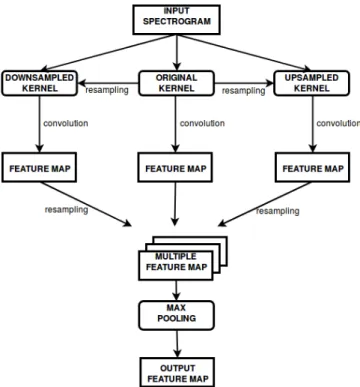
The core of our architecture is the multi-time-scale con-volution layer (MTS), a custom 2D-concon-volution layer that can replace a standard convolution layer in a CNN design. The main feature of MTS is that it uses multiple versions of the learned kernel that are re-sampled on the time axis and per-forms parallel convolutions with them. This method enables
Fig. 1. Example architecture of a Multi-Time-Scale convolu-tion layer with 3 scale factors.
the network to detect patterns at multiple time scales. Figure 1 shows the architecture of one MTS layer with 3 parallel branches. In this example, the 2D spectrogram in-put, is convolved in parallel with the original kernel (in the center) and 2 time-stretched versions of the kernel (on both sides). The latter are generated by re-sampling the origi-nal kernel, applying linear interpolation. It is possible to in-dependently apply different scaling factors for the 2 dimen-sions. These parallel convolutions produce 3 different feature maps, matching the feature of the original kernel at 3 differ-ent time scales. After this stage, the scaled feature maps are re-sampled again (applying linear interpolation) to match the shape of the original feature map. Then, a 3D max-pooling function is applied to merge the feature maps, selecting the scale with the maximal result in every time-frequency point. Therefore, the pooled feature map maintains the same dimen-sion of the feature map generated by the original kernel. Dur-ing the trainDur-ing we average the weights of the original ker-nel and its scaled versions after each update. There is no constraint by design on the number of parallel branches that can be added to a MTS layer and MTS layers with different numbers of branches can be placed at various positions in the network. It is possible to fine-tune the scaling factors layer-by-layer. This approach provides a high degree of flexibility in the network design and enables scale invariance without increasing the number of free parameters. We have imple-mented this method in PyTorch as open source1.
Our method is different from [16] in that it re-scales only one dimension and that we re-sample the kernels. Although re-sampling the data or kernel is equivalent up to numerical variations, our method is somewhat more efficient. Moreover, [16] augment test data by re-scaling. At least for SER tasks, we believe that this practice would not give a good estimate of the generalization capabilities of the models and thus we test without augmentation.
4. EVALUATION
We have evaluated the performance of MTS on 4 benchmark datasets for speech emotion recognition:
1. EMODB, a database of German emotional speech [17]. 10 speakers, German language, 535 utterances, 25 min of audio, 7 emotion labels: angry, bored, disgusted, anxious/fearful, happy, sad. Actors pronounce 10 dif-ferent sentences which could be used in everyday com-munication.
2. RAVDESS, the Ryerson Audio Visual Database of Emotional Speech and Song [18]. 24 speakers, En-glish language, 2542 utterances, 2:47 hours of audio, 8 emotion labels: happy, sad, angry, fearful, surprised, disgusted, calm, neutral. Actors pronounce 2 sen-tences: “Kids are talking by the door” and “Dogs are sitting by the door”.
3. TESS, the Toronto Emotional Speech Set [19]. 2 speak-ers, English language, 2800 utterances, 1:36 hours of audio, 7 emotion labels: happy, sad, angry, disgusted, neutral, pleasant surprise, fearful. Actors say “Say the word ...” followed by 200 different words.
4. IEMOCAP, the Interactive Emotional Dyadic Motion Capture Database [20]. 5 speakers, English language, 7529 utterances, 9:32 hours of audio, 10 emotion la-bels: neutral, angry, happy, excited, sad, frustrated, fearful, surprised, disgusted, other. Actors perform improvisations or scripted scenarios on defined topics. For each dataset we keep only the audio information and the emotion labels, discarding any other types of data. We also discard the “song” data from RAVDESS. IEMOCAP is the only highly inbalanced dataset, therefore we removed the rarest labels from it, keeping only neutral, angry, happy and sad samples. Every sound file is pre-processed in 3 consecu-tive stages: re-sampling to 16 kHz, Short-Time Fourier Trans-form and normalization. For EMODB, RAVDESS and TESS datasets every file is zero-padded to obtain equally-sized data. Since the IEMOCAP dataset contains longer recordings we segmented them into 4-second frames with 2-second overlap. The STFT is computed using 20 ms sliding windows with 10 ms overlap. Then, we normalize the magnitude spectra to zero mean and unit standard deviation.
We divide every dataset using approximately 70% of the data as training, 20% for validation and 10% as test set. Fur-thermore, we perform every experiment with 4-fold cross-validation. We make sure that samples from the same speaker appear only in the same set, in order to get a meaningful mea-sure of the models’ capability to generalize to new speak-ers, because new speakers are likely to produce patterns at different speeds. For this and other reasons, our results are not directly comparable to most published results. Many re-sults are computed with randomly-split training, validation and test sets, without separating speakers, as in [21]. Many rely on different preprocessing [22, 23], on different archi-tectures [22] or use multi-modal features rather than only au-dio [23]. Rather than aiming at a state-of-art classification accuracy for these datasets, we focus on evaluating the per-formance of MTS layers compared to standard convolution with the same number of channels, i.e. without increasing the number of trainable variables. Therefore, we arranged our ex-periments in order to obtain consistent results within our set-up, with the same conditions for all datasets. We perform this comparison for 4 different CNN architectures with different capacity:
A1: Convolution (1 channel, [10,5] kernel) - fully con-nected (200 neurons) - fully concon-nected output layer.
A2: Convolution (10 channels, [10,5] kernel) - fully con-nected (200 neurons) - fully concon-nected output layer.
A3: Convolution (10 channels, [10,5] kernel) - max pooling ([2,2] kernel) - convolution (10 channels, [10,5] kernel - fully connected (200 neurons) - fully connected output layer.
A4: AlexNet: 5 convolutions and max pooling, 2 fully con-nected layers. See [24] for a detailed description. The kernel dimensions above are in the form [time,frequency]. The activation function is ReLU for hidden and softmax for output units. In all experiments we use the ADAM optimizer with L2 regularization and Cross Entropy loss. We perform a grid search to find the best regularization parameter. We train for a maximum of 500 epochs, applying early stopping with 10 epochs patience for validation loss improvement. In archi-tectures A1, A2 and A3, MTS is applied to all convolutional layers, while in A4 only the first 2 layers are augmented with MTS. We tested MTS with 3, 5 and 7 parallel branches, using logarithmically spaced scale factors in these combinations: (0.25, 1, 4), (0.5, 1, 2), (0.7, 1, 1.428), (0.8, 1, 1.25), (0.9, 1, 1.111), (0.95, 1, 1.053), (0.25, 0.5, 1, 2, 4), (0.5, 0.7, 1, 1.428, 2), (0.8, 0.9, 1, 1.111, 1.25), (0.25, 0.5, 0.7, 1, 1.428, 2, 4), (0.7, 0.8, 0.9, 1, 1.111, 1.25, 1.428). In each experi-ment, we apply the same combination of stretch factors to all MTS-enabled layers.
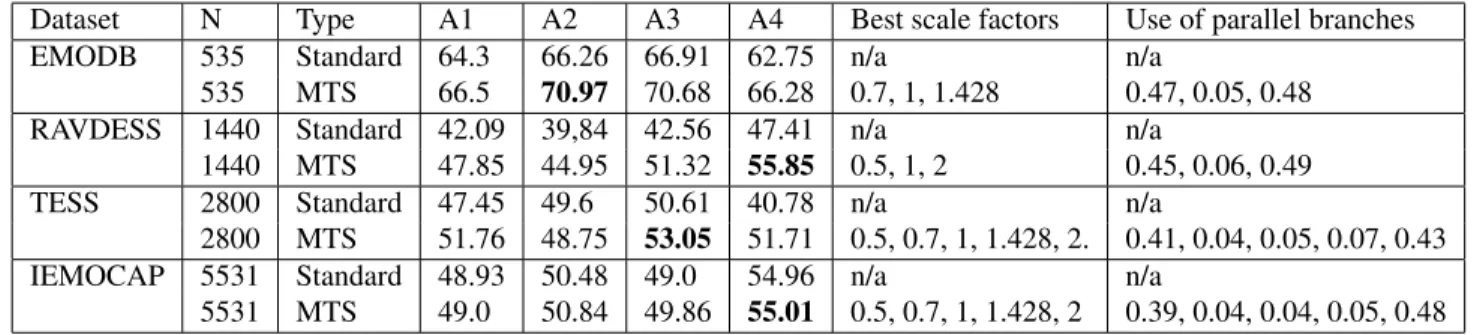
Table 1 shows the results we obtained for all datasets and all architectures. The first 3 columns show the dataset, total
Table 1. Accuracy results for all datasets. N ist the number of audio recordings per dataset. A1-4 are the network architectures. The usage factors relate to scaling factors in the same row. The best results per dataset are highlighted in bold font.
Dataset N Type A1 A2 A3 A4 Best scale factors Use of parallel branches EMODB 535 Standard 64.3 66.26 66.91 62.75 n/a n/a
535 MTS 66.5 70.97 70.68 66.28 0.7, 1, 1.428 0.47, 0.05, 0.48 RAVDESS 1440 Standard 42.09 39,84 42.56 47.41 n/a n/a
1440 MTS 47.85 44.95 51.32 55.85 0.5, 1, 2 0.45, 0.06, 0.49 TESS 2800 Standard 47.45 49.6 50.61 40.78 n/a n/a
2800 MTS 51.76 48.75 53.05 51.71 0.5, 0.7, 1, 1.428, 2. 0.41, 0.04, 0.05, 0.07, 0.43 IEMOCAP 5531 Standard 48.93 50.48 49.0 54.96 n/a n/a
5531 MTS 49.0 50.84 49.86 55.01 0.5, 0.7, 1, 1.428, 2 0.39, 0.04, 0.04, 0.05, 0.48 number of data points and the type of convolution layer(s).
Columns A1-A4 show the mean test accuracy across folds obtained with each architecture (as listed above). The last 2 columns refer to the MTS model with the best accuracy in a row and show the scaling factors applied to each parallel branch of MTS and their average percentage of use.
The results clearly show that MTS consistently improves the generalization for all datasets. We reach a maximum im-provement of 8.04 percentage points (RAVDESS) and with an average of 3.78 with a standard deviation of 3.45 across all datasets and architectures. For all model/architecture combinations except one (A2 with TESS), MTS outperforms standard convolution. We performed a two-sided Wilcoxon signed-rank test comparing the standard and MTS results, which shows statistical significance withp < 0.001. The mean improvement is higher for the smaller datasets, which confirms that enabling pattern recognition at different time scales with MTS improves generalisation. Considering the general scarcity of emotion-labelled speech data, this is a desirable feature for SER applications.
The best performing models on different datasets used dif-ferent combinations of scaling factors. In particular, for the smaller datasets applying only 3 factors gives the best results. Architectures with 5 parallel branches perform better for the larger datasets. MTS models tend to use mostly 2 scale fac-tors (see last column of table 1). In every case, at least 2 par-allel branches give a high contribution, confirming that MTS is actually matching patterns at multiple time-scales.
We found that MTS is more effective at larger kernel sizes. In an experiment with an MTS version of ResNet18, where most kernels are very small (3x3), we achieved no improvement with MTS.
Training a MTS-enabled network generally takes longer than a standard CNN. In a test with architecture A2, it took on average 1.3 times longer per epoch to train MTS models with 3 branches and 1.52 times longer for MTS models 5 branches. Moreover, MTS networks need on average more epochs to converge (27.85 vs 32.26 epochs for CNN vs MTS average overall).
We also tested modified variants of MTS:
• Applying a penalty to the re-sampled feature maps, to give the model a preference for the unscaled kernel.
• Performing the training using standard convolution lay-ers and substitute them with MTS laylay-ers with shared weights only at inference time.
• Concatenating the used scaling factor for each time-frequency point to the output feature map of an MTS layer.
Each of these modifications reduced the performance of MTS models. Therefore, we kept the simplest variant described above.
5. CONCLUSIONS
In this paper, we propose a multi-time-scale convolution layer (MTS) for CNNs applied to audio analysis, specifically emo-tion recogniemo-tion from speech. The MTS performs parallel 2D-convolutions using a standard kernel and its re-sampled ver-sions to match patterns at different time scales. This method enables the network to learn to some extent time-invariant fea-tures without increasing its number of trainable parameters or the number of training examples. We evaluated our approach on speech emotion recognition with unknown speakers, using 4 different datasets and applying it to networks of different size and structure. We found a consistent and statistically sig-nificant improvement in test accuracy across all datasets and models, up to 8.04 percentage points for RAVDESS and on average 3.78 across all datasets and architectures. MTS is particularly effective on smaller datasets, which makes MTS well suited for Speech Emotion Recognition where labelled data is scarce.
As future developments we intend to test more exten-sively the effectiveness of MTS with larger datasets and ex-plore more architectures and different resampling techniques. Furthermore, we are going to apply the concept of MTS in the context of convolution-based generative models, extending our multi-branch approach also to transposed convolutions.
6. REFERENCES
[1] Andreas Jansson, Eric J. Humphrey, Nicola Montecchio, Rachel M. Bittner, Aparna Kumar, and Tillman Weyde, “Singing voice separation with deep u-net convolutional networks,” inISMIR, 2017, pp. 745–751.
[2] Szu-Wei Fu, Yu Tsao, and Xugang Lu, “Snr-aware con-volutional neural network modeling for speech enhance-ment,” inInterspeech, 2016, pp. 3768–3772.
[3] Dimitri Palaz, Ronan Collobert, et al., “Analysis of cnn-based speech recognition system using raw speech as input,” Tech. Rep., Idiap, 2015.
[4] Rachel M Bittner, Brian McFee, Justin Salamon, Peter Li, and Juan Pablo Bello, “Deep salience representa-tions for f0 estimation in polyphonic music,” inISMIR, 2017, pp. 63–70.
[5] Abdul Malik Badshah, Jamil Ahmad, Nasir Rahim, and Sung Wook Baik, “Speech emotion recognition from spectrograms with deep convolutional neural network,” inPlatCon, 2017, pp. 1–5.
[6] Qirong Mao, Ming Dong, Zhengwei Huang, and Yongzhao Zhan, “Learning salient features for speech emotion recognition using convolutional neural net-works,” IEEE Multimedia, vol. 16, no. 8, pp. 2203– 2213, 2014.
[7] George Trigeorgis, Fabien Ringeval, Raymond Brueck-ner, Erik Marchi, Mihalis A Nicolaou, Bj¨orn Schuller, and Stefanos Zafeiriou, “Adieu features? end-to-end speech emotion recognition using a deep convolutional recurrent network,” inICASSP, 2016, pp. 5200–5204. [8] Justin Salamon and Juan Pablo Bello, “Deep
convolu-tional neural networks and data augmentation for envi-ronmental sound classification,” IEEE Signal Process-ing Letters, vol. 24, no. 3, pp. 279–283, 2017.
[9] Brian McFee, Eric J Humphrey, and Juan Pablo Bello, “A software framework for musical data augmentation,” inISMIR, 2015, pp. 248–254.
[10] Jan Schl¨uter and Thomas Grill, “Exploring data aug-mentation for improved singing voice detection with neural networks,” inISMIR, 2015, pp. 121–126. [11] Pedro F Felzenszwalb, Ross B Girshick, David
McAllester, and Deva Ramanan, “Object detection with discriminatively trained part-based models,” IEEE PAMI, vol. 32, no. 9, pp. 1627–1645, 2009.
[12] Christian Szegedy, Wei Liu, Yangqing Jia, Pierre Ser-manet, Scott Reed, Dragomir Anguelov, Dumitru Erhan, Vincent Vanhoucke, and Andrew Rabinovich, “Going deeper with convolutions,” inCVPR, 2015, pp. 1–9.
[13] Huiyu Wang, Aniruddha Kembhavi, Ali Farhadi, Alan L Yuille, and Mohammad Rastegari, “Elastic: Improving cnns with dynamic scaling policies,” inCVPR, 2019, pp. 2258–2267.
[14] Ugo Marchand and Geoffroy Peeters, “Scale and shift invariant time/frequency representation using auditory statistics: Application to rhythm description,” inIEEE MLSP, 2016, pp. 1–6.
[15] Zhenyao Zhu, Jesse H Engel, and Awni Hannun, “Learning multiscale features directly from waveforms,”
arXiv:1603.09509, 2016.
[16] Angjoo Kanazawa, Abhishek Sharma, and David Ja-cobs, “Locally scale-invariant convolutional neural net-works,” in NIPS Deep Learning and Representation Learning Workshop, 12 2014.
[17] Felix Burkhardt, Astrid Paeschke, Miriam Rolfes, Wal-ter F Sendlmeier, and Benjamin Weiss, “A database of german emotional speech,” inEurospeech, 2005. [18] Steven R Livingstone and Frank A Russo, “The
ryer-son audio-visual database of emotional speech and ryer-song (ravdess): A dynamic, multimodal set of facial and vo-cal expressions in north american english,” PloS one, vol. 13, no. 5, pp. e0196391, 2018.
[19] Kate Dupuis and M Kathleen Pichora-Fuller, Toronto Emotional Speech Set (TESS), University of Toronto, Psychology Department, 2010.
[20] Carlos Busso, Murtaza Bulut, Chi-Chun Lee, Abe Kazemzadeh, Emily Mower, Samuel Kim, Jeannette N Chang, Sungbok Lee, and Shrikanth S Narayanan, “Iemocap: Interactive emotional dyadic motion capture database,” Language resources and evaluation, vol. 42, no. 4, pp. 335, 2008.
[21] Yuni Zeng, Hua Mao, Dezhong Peng, and Zhang Yi, “Spectrogram based multi-task audio classification,”
Multimedia Tools and Applications, vol. 78, no. 3, pp. 3705–3722, 2019.
[22] Pankaj Shegokar and Pradip Sircar, “Continuous wavelet transform based speech emotion recognition,” inIEEE ICSPCS, 2016, pp. 1–8.
[23] Bj¨orn Schuller, Ronald M¨uller, Manfred Lang, and Ger-hard Rigoll, “Speaker independent emotion recognition by early fusion of acoustic and linguistic features within ensembles,” inEurospeech, 2005.
[24] Alex Krizhevsky, Ilya Sutskever, and Geoffrey E Hin-ton, “Imagenet classification with deep convolutional neural networks,” inNIPS, 2012, pp. 1097–1105.