Computer Engineering and Applications Vol. 8, No. 3, October 2019
Drowsing Driver Alert System for Commercial Vehicles
Benjamin Kommey1*, Seth Djanie Kotey1 and Andrew Selasi Agbemenu2
1Department of Computer Engineering, Faculty of Electrical and Computer Engineering, Kwame
2Nkrumah University of Science and Technology, KNUST-Kumasi, Ghana
ABSTRACT
A number of accidents on our roads are caused by driver fatigue or drowsiness. Human fatalities as a result of driver drowsiness has been a major challenge for road safety bodies worldwide. Various road safety campaign messages have been put out to discourage drivers from driving whilst tired, but the problem still persists. Different technologies have been proposed over the years, but most seem to be too expensive to implement on a large scale. We present an inexpensive drowsing driver alert system in this paper. The system, known as Drowsing Driver Alert System (DDAS) is a smart system intended to effectively keep commercial drivers alert when driving. The system is able to detect when a driver is drowsy and alert him/her in real-time to prevent a potential accident. Using a camera, the eyes of the driver are monitored continuously whiles driving and analyzed to determine if they are shut or the blink rate is not normal. Two stages of alerts are given if the driver is determined to be drowsy. Log files of activities performed by the system are also saved to an external storage device to enable further analysis later.
Keywords: Accident, Alert, Drowsing Driver, Face detection.
1. INTRODUCTION
In Ghana, vehicular accidents have become one of the growing concerns in recent times. Accidents have tremendous effect on the people, property and the environment, regardless of how minute they are [1]. Driving is an everyday task where the driver must be conscious of the road and also be aware of the dangers that may lurk. The driver must always be ready to make a split-second decision based on whatever may come his/her way. A driver must be vigilant and in the right frame of mind to effectively respond to external conditions while driving. Drowsy driving is the operation of a vehicle while being cognitively impaired due to lack of sleep. Many researchers believe that vehicular accidents are caused by drowsiness when driving tired, drunk or after taking some form of medication [2].
National Road Safety Commission of Ghana has estimated that 6 people are killed every day and 2000 people die annually due to road crashes in Ghana [3]. Among these accidents, some were caused by drowsing drivers at the steering wheel. It is against this background problem that Drowsing Driver Alert System is being proposed. Driving with drowsiness is one of the main causes of traffic accidents. The development of technologies for detecting or preventing drowsiness at the wheel is a major challenge in the field of accident avoidance systems. Due to the hazard that drowsiness presents on the road, methods need to be developed for counteracting its affects. In this paper, we propose a drowsy driver alert system known as Drowsing Driver Alert System (DDAS). The system is designed to keep
Benjamin Kommey, Seth Djanie Kotey and Andrew Selasi Agbemenu Drowsing Driver Alert System for Commercial Vehicles
drivers alert while driving on the road and to reduce the number of road accidents. The rest of the paper is organised as follows: Section 2 presents a literature review, section 3 presents the proposed model, section 4 presents the operation of the system, section 5 presents the testing and evaluation and section 6 concludes the paper.
2. RELATED WORKS
Many different technologies have been proposed to manage the problem of drowsing driving. Boke et al. [4] proposed a system based on pulse oximetry. A pulse monitor, placed on the wrist of the driver monitors the pulse rate of the driver. If the pulse rate of the driver differs from the rate of an active person, it shows the driver is asleep. The pulse monitor uses a light emitting diode (LED) and a photodiode to measure pulse rate. When the light from the LED hits the blood tissues, some of it is absorbed and the rest is reflected. The amount of light absorbed by the blood determines the volume of flood in the tissues. This information is converted into an electrical signal and compared with the normal rate. When the driver is found to be sleeping, a buzzer sounds to alert him/her and an alert message is displayed on an LCD screen. The entire system is designed as a wrist band.
Khan and Aadil [5] proposed an algorithm to capture the eye closure periods of the driver and analyse to determine if the driver is drowsy. A camera captures images from a video feed and detects the face of the driver. The eye status of the driver is then detected for analyses. The eye status of the driver is detected using a plot of average intensities of each eye detected. Larger distances between intensity changes show that the driver’s eyes are closed. Rajasekar et al. [6] proposed a system to measure blinking of the eyes using an infrared (IR) sensor. The IR transmitter transmits the infrared ray to the eye and receiver receives the reflected rays. If the output of the receiver is high, then it means the driver’s eye is closed, and if the output is low, it means the eye is open. The eye blink sensor measures the blink count and transmits the information to a microcontroller to compare with the normal eye blink rate. If there is a variation, a buzzer sounds to alert the driver and alert information is displayed on an LCD screen.
The system proposed by Boke et al. [4] may be inaccurate due to differences in thickness of skin of different people. The system proposed by Khan and Aadil [5] does not have an effective warning system for the driver when he/she is drowsing. All the systems reviewed do not have very effective warning systems capable of ensuring the driver becomes alert when drowsing. Passengers of the vehicle are also not informed of the driver drowsing for them to also take the necessary steps to prevent themselves from being involved in an accident. Also, they do not incorporate a storage device to store activities of the system for analyses later.
3. PROPOSED SYSTEM DESIGN
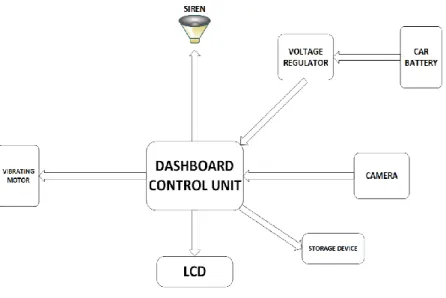
The DDAS system contains a camera, dashboard control unit (DCU), a vibrating motor, and LCD screen, a siren and a storage device. The webcam is mounted in a suitable position to capture the face of the driver. The dashboard control unit processes the input from the camera to determine whether the driver is sleeping or
Computer Engineering and Applications Vol. 8, No. 3, October 2019
not. The vibrating motor is activated as the first stage of alert to the driver when sleeping. The LCD displays a message to notify passengers in the vehicle before the second stage of alert. The siren blows as the second stage of the alert when the driver continues to sleep. The storage device logs activities of the system. Figure 1 shows a block diagram of the system.
The dashboard control unit contains a microcontroller which serves as the brain and coordinator of the system. It takes the input from the camera and processes the data to check if the driver is sleeping or not. The eye region of the driver is analysed and the percentage of closure (PERCLOS) of the driver’s eye is compared with the standard threshold value. The camera serves as the sensory unit of the system. It takes a continuous live feed of the driver’s eye region for the dashboard control unit to process and analyse. The vibrating motor is a low powered device which alerts the driver when he falls asleep the first time behind the wheels. The vibrating power of the motor is not so powerful to startle the driver, but is set at an optimal power, enough to awaken the driver without startling him and is placed under the driver’s seat. The LCD screen displays a message to notify the passengers about the next stage of alert, which is the siren. The message displayed on the screen ensures passengers do not panic when the siren blows. The siren is a sound system and is the second stage of the alert. The siren sounds after the driver has dozed off behind the wheels a second time to draw the attention of all occupants of the vehicle for necessary measures to be taken to prevent an accident. Power is supplied to the system by the car battery, via a voltage regulator, to supply the right amount of power to the system.
3.1 DDAS SYSTEM OPERATION
The DDAS is designed to automatically detect and alert a driver dozing off behind the wheels. The system begins operation when the vehicle is started. The camera of the DDAS takes a live feed of the driver’s eye region to be processed by
Benjamin Kommey, Seth Djanie Kotey and Andrew Selasi Agbemenu Drowsing Driver Alert System for Commercial Vehicles
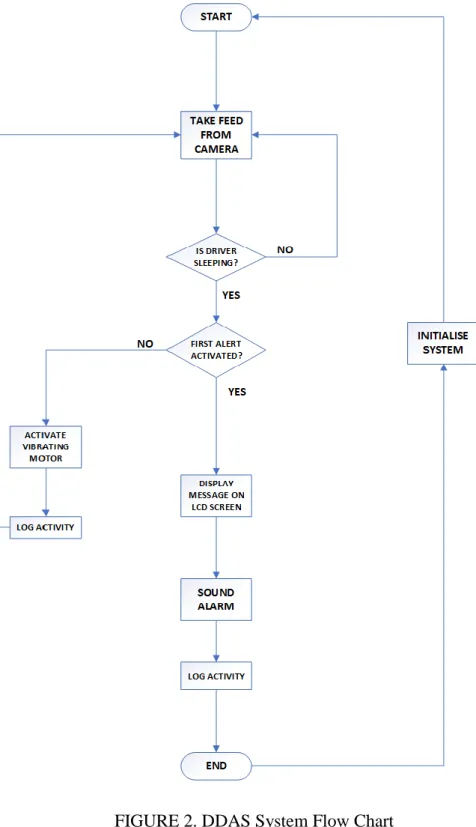
the dashboard control unit. The live feed and processing are done in real-time to ensure a near-instant alert to the driver as soon as he dozes off behind the wheels. The camera takes the live feed and the system monitors the driver’s eye region continually till the driver is seen to be falling asleep. As soon as it is determined that the driver is falling asleep, the system checks from the current activity log if the first alert has been activated already. If it has not been activated, the vibrating motor is activated to alert the driver. The vibration of the motor increases gradually till the driver is seen to be awake. The activity is logged for reference by the system later and is also saved to the storage device. The camera keeps taking the live feed of the driver’s eye region. If the driver is seen to be falling asleep again, the system checks from the activity log if the first alert has been activated. If the first alert has been activated, a message is displayed on the LCD screen to make the passengers aware that the siren will sound soon, to prevent them from panicking when it sounds. After a short period, the alarm sounds to alert the driver and passengers of the driver falling asleep behind the wheels. The activity is logged and saved to the storage device. The system is then reset. A still image of the driver asleep is stored along with the activity log on the storage device. Each time a new trip is made, the system resets.
3.2 DDAS DROWSING DRIVER DETECTION
The DDAS system uses a camera as its sensor to detect a drowsing driver. The system uses image processing technology to process and analyse images captured by the camera and is able to accommodate individual driver differences. The camera takes a live feed of the face and eye regions and sends it to the dashboard control unit to process continuously to check the current state of the driver. The camera is mounted and positioned in front of the driver, approximately 30cm away from the face so that accurate live feed of the eye region can be sent to the microcontroller for processing. The camera must be positioned in a way such that the driver’s face takes up majority of the image and is approximately centred in the image. Feature extraction and analyses from the image is done using two algorithms; the Haar Cascade Classifiers Algorithm (HCCA) [7] and the Facial Landmark Algorithm (FLA) [8], based on the algorithm proposed by Viola and Jones [9].
The HCCA detects the driver’s face and eyes for processing. The face is first detected before searching for the eyes to reduce the search time as well as false detection. Eyes are searched inside the face region once the face region is detected. The FLA determines the level of driver alertness based on the eye blinking rate. The eye blink speed is the time between opening and closing of the eyelids during one blink event. Researchers have proposed that the average time it takes for a complete human blink is about 300 to 400 milliseconds or 0.3 to 0.4 seconds. This average can differ from person to person. As a result of the average time for a blink, scientists also have shown that the average person blinks 15-20 times per minute. When the speed of the blinking is larger than a given threshold of about 0.3 to 0.4 seconds, then the driver drowsiness is detected. The number of blinking event in a certain period of time is termed as Eye Blink Rate. Each and every individual have a different rate of eyes blinking. If eye blink rate is compared to a normal state and is much less than it, then it shows a distraction. If higher than the normal rate, then it shows driver drowsiness. Figure 2 shows the flow of the system processes.
Computer Engineering and Applications Vol. 8, No. 3, October 2019
4. TEST AND EVALUATION
A prototype of the system was built and tested. A web camera was used as the sensing unit, a TI CC3200 microcontroller as the dashboard control unit, a low power electric mini vibrating motor, an LCD unit and a buzzer were used for alerting. Embedded C language was used to program the entire logic of the DDAS.
Benjamin Kommey, Seth Djanie Kotey and Andrew Selasi Agbemenu Drowsing Driver Alert System for Commercial Vehicles
MATLAB software was also used to write the program to enable the camera capture the driver’s face for processing. The camera was placed 60cm from the face, approximately the same distance between the dashboard where the camera will be mounted and the driver’s face. Various scenarios were tested to determine the performance of the system.
In well-lit conditions, the face was detected without issues. In mid to low light conditions, the face was not detected easily. This was as a result of the fact that the web camera is unable to capture images clearly in low-light conditions. Using a camera which performs well in low-light conditions or having an artificial light source to improve lighting on the driver’s face will solve this issue.
The different states of the eyes were also tested. The system was able to detect opened eyes, shut eyes and differentiated between shut eyes and blinking of the eyes effectively. The vibrating motor began vibrating as soon as the eyes were determined to be shut. The second time the eyes were determined to be shut, the LCD displayed a message and the buzzer sounded. Logging of activities and saving to an external storage device was done without errors. The overall performance of the system was as expected. However, there was some little delay in activating the alerts. This was as a result of the limited processing power of the microcontroller used in the prototyping.
5. CONCLUSION
Vehicular accidents as a result of drowsy drivers has been a persistent problem on our roads. Accidents caused by drowsy drivers have caused a lot of lives to be lost and left many injured. Many solutions have been proposed previously to prevent drowsing driving. However, the problem still persists. In this paper, we have presented an inexpensive drowsing driver alert system to alert drivers when they are dozing off behind the wheels. The system, known as Drowsing Driver Alert System (DDAS), alerts the driver in two stages, first with a vibrating motor and then with a siren. A camera takes a continuous feed of the driver’s eye region and the feed is processed in real-time using the Haar Cascade Classifier and Facial Landmark algorithms to determine if the driver is drowsing. An added advantage of this system is that a log file of actions taken by the system, including the times alerts were given to the driver when found to be drowsing, are saved to an external storage device for future reference. A prototype of the system was built and tested and performed effectively. The next step of the research will be to run a trial with a vehicle in a controlled environment to determine its performance in a real-world situation.
REFERENCES
[1] Graphic Online. Menace of road traffic accidents [Internet]. Available from:
https://www.graphic.com.gh/features/opinion/menace-of-road-traffic-accidents.html [Last Accessed: 2018-08-22]
[2] Centers for Disease Control and Prevention. Drowsy Driving: Asleep at the
Wheel [Internet]. Available from:
https://www.cdc.gov/features/dsdrowsydriving/index.html [Last Accessed: 2018-08-26]
Computer Engineering and Applications Vol. 8, No. 3, October 2019
[3] Modern Ghana. Road Accidents: A Major Public Safety Concern [Internet].
Available from:
https://www.modernghana.com/news/771341/road-accidents-a-major-public-safety-concern.html [Last Accessed: 2018-08-20] [4] Chirag Boke, Akshita Shetty, Asawari Kadam, Shraddha Jadhav, Sonali
Pakhmode, Sachin Barahate, “Smart Band for Drowsiness Detection to Prevent Accidents”, in International Journal of Innovative Research in Science, Engineering and Technology (ISSN: 2319 – 8753) Vol. 5, Issue 1, January 2016. DOI:10.15680/IJIRSET.2015.0501070
[5] Muhammad Fahad Khan and Farhan Aadil, “Efficient Car Alarming System for Fatigue Detection during Driving”, in International Journal of Innovation, Management and Technology, Vol. 3, No. 4, August 2012
[6] Rajasekar R., Vivek Bharat Pattni, S. Vanangamudi, “Drowsy Driver Sleeping Device and Driver Alert System”, in International Journal of Science and Research (IJSR) (ISSN: 2319-7064), Volume 03 – Issue 4, April 2014. Paper ID: 020131564
[7] Will Berger. Deep Learning Haar Cascade Explained [Internet]. Available from: http://www.willberger.org/cascade-haar-explained [Last Accessed: 2018-08-22]
[8] Learn OPenCV. Facial Landmark Detection [Internet]. Available from: https://www.learnopencv.com/facial-landmark-detection [Last Accessed: 2018-08-22]
[9] Paul Viola, Michael Jones, “Rapid Object Detection using a Boosted Cascade of Simple Features”, Conference on Computer Vision and Pattern Recognition, 2001.