DEVELOPMENT OF A STATIC ANALYSIS
TOOL TO FIND SECURITY VULNERABILITIES
IN JAVA APPLICATIONS
A Thesis Submitted to
the Graduate School of Engineering and Sciences of
İ
zmir Institute of Technology
in Partial Fulfillment of the Requirements for the Degree of
MASTER OF SCIENCE
in Computer Engineering
by
Bertan TOPUZ
March 2010
İ
ZM
İ
R
We approve the thesis of Bertan TOPUZ
_____________________________ Assist. Prof. Dr. Tuğkan TUĞLULAR Supervisor
_____________________________ Prof. Dr. Sıtkı AYTAÇ
Committee Member
____________________________ Prof. Dr. Şaban EREN
Committee Member
12 March 2010
______________________________ __________________________ Prof. Dr. Sıtkı AYTAÇ Assoc. Prof. Dr. Talat YALÇIN Head of the Depertment of Dean of the Graduate School of Computer Engineering Engineering and Sciences
ACKNOWLEDGEMENTS
I would like to express my profound appreciation and gratitude to my advisor, Assist. Prof. Dr. Tuğkan TUĞLULAR, his valuable guidance, ideas and encouragement in the preparation of this manuscript.
I am very grateful to my committee member, Prof. Dr. Sıtkı AYTAÇ and Prof. Dr. Şaban EREN for their valuable contributions and recommendations.
I would like to thank to my company, Solify-TURKEY for their support.
I would like to express my gratitude to my family for their invaluable patience, understanding, support and encouragements all throughout my life.
ABSTRACT
DEVELOPMENT OF A STATIC ANALYSIS TOOL TO FIND
SECURITY VULNERABILITIES IN JAVA APPLICATIONS
The scope of this thesis is to enhance a static analysis tool in order to find security limitations in java applications. This will contribute to the removal of some of the existing limitations related with the lack of java source codes.
The generally used tools for a static analysis are FindBugs, Jlint, PMD, ESC/Java2, Checkstyle. In this study, it is aimed to utilize PMD static analysis tool which already has been developed to find defects Possible bugs (empty try/catch/finally/switch statements), Dead code (unused local variables, parameters and private methods), Suboptimal code (wasteful String/StringBuffer usage), Overcomplicated expressions (unnecessary if statements for loops that could be while loops), Duplicate code (copied/pasted code means copied/pasted bugs). On the other hand, faults possible unexpected exception, length may be less than zero, division by zero, stream not closed on all paths and should be a static inner class cases were not implemented by PMD static analysis tool.
PMD performs syntactic checks and dataflow analysis on program source code. In addition to some detection of clearly erroneous code, many of the “bugs” PMD looks for are stylistic conventions whose violation might be suspicious under some circumstances. For example, having a try statement with an empty catch block might indicate that the caught error is incorrectly discarded. Because PMD includes many detectors for bugs that depend on programming style, PMD includes support for selecting which detectors or groups of detectors should be run. While PMD’s main structure was conserved, boundary overflow vulnerability rules have been implemented to PMD.
ÖZET
JAVA UYGULAMALARINDA GÜVENL
İĞ
E
İ
L
İŞ
K
İ
N
ZAYIFLIKLARIN BULUNMASINA YÖNEL
İ
K B
İ
R STAT
İ
K
ANAL
İ
Z
İ
N
İ
N GEL
İŞ
T
İ
R
İ
LMES
İ
Bu tez java uygulamalarinda bulunan güvenlik sınırlamaları saptanmasına yönelik statik analiz araçlarını geliştirmeyi amaçlamaktadır. Bu amaçla, java kaynaklı kodlarla ilgili varolan açıkların ortadan kaldırılmasına katkıda bulunacaktır.
FindBugs, Jlint, PMD, Checkstyle ve ESC/Java2 yaygın olarak kullanılan statik analiz araçlarıdır. Bu çalışmada, Possible bugs (olası hatalar), Dead code (kullanılmayan kod), Suboptimal code (yetersiz kod), Overcomplicated expressions (karmaşık ifadeler) ve Duplicate code (ikinci kod) gibi hataların saptanmasına yönelik geliştirilmiş olan PMD statik analiz aracının kullanımı amaçlanmaktadır. Buna karşılık PMD’nin faults possible unexpected exception (olası beklenmeyen kural dışı durum), length may be less than zero(yapı boyutu sıfırdan küçük olabilir), division by zero (sıfıra bölünme), stream not closed on all paths (I/O için açılan katarın kapatılmaması) gibi açıkları bulamadığı saptanmıştır.
Bazı hatalı kodları saptamasının yanında PMD’nin bulmaya çalıştığı hataların çoğu, biçimsel hatalara dayanmaktadır. Örnek olarak, try catch yapısındaki boş catch bloğunu gösterebilmektedir. PMD, programlama stiline bağlı olarak birçok algılayıcı kural içermektedir ve bu kuralları isteğe göre seçebilme özelliğine sahiptir. PMD’nin ana yapısı korunarak taşma zayıflıkları için yeni kurallar geliştirilmiştir.
TABLE OF CONTENTS
LIST OF TABLES... viii
LIST OF FIGURES ... ix
CHAPTER 1. INTRODUCTION ... 1
CHAPTER 2. STATIC ANALYSIS ... 3
2.1. Principles of Static Analysis ... 3
2.2. Types of Static Analysis ... 4
2.2.1. Secure Information Flow ... 4
2.2.1.1.Type-Based Analysis ... 5
2.2.2. Data Flow Analysis... 8
2.2.2.1. Fixed Point Algorithm ... 9
2.2.2.2. Forwards-Backwards-May-Must ... 10
2.2.3. Mutability Analysis ... 11
2.2.4. Points to Analysis ... 12
2.2.5. Dependence Analysis... 13
2.2.6. Escape Analysis ... 15
2.2.7. Alias Control and Confinement ... 16
2.3. Static Analysis Tools ... 18
2.3.1. How Static Analysis Tools Find Flaws ... 21
2.3.2. Limitations of Static Analysis ... 23
2.3.2.1. Path Limitations ... 24
2.3.2.2. Abstract Domain ... 25
2.3.2.3. Missing Source Code ...26
2.3.2.4. Out of Scope... 27
2.3.3. Open Source Tools ... 27
2.3.4. Commercial Tools ... 28
CHAPTER 3. PMD... 31
3.1. Overview of PMD... 31
3.2. Rulesets of PMD ... 32
3.3. Writing Rules ... 32
3.3.1. Writing XPath Rules... 33
3.3.2. Writing Java Rules... 36
CHAPTER 4. PMD RULES FOR SECURITY VULNERABILITIES ... 40
4.1. Overview of Security Vulnerabilities ... 40
4.2. PMD Rules for Security Vulnerabilities ... 42
4.3. Boundary Overflow Vulnerabilities... 44
CHAPTER 5. TOOL SUPPORT AND CASE STUDY... 45
5.1. Boundary Overflow Vulnerability Checker Tool ... 45
5.1.1. Design and Implementation... 45
5.1.2. Usage of the Tool... 46
5.2. Case Study ... 47
5.2.1. JMAP Java Port Scanner ... 50
5.2.2. Faltron Java Port Scanner ... 51
5.2.3. A Java Port Scanner... 52
CHAPTER 6. CONCLUSIONS ... 56
REFERENCES ... 57
APPENDICES APPENDIX A. OPEN SOURCE TOOLS... 61
APPENDIX B. COMMERCIAL TOOLS ... 65
LIST OF TABLES
Table
Page
Table 2.1. The classic data flow analyses ... 10
Table 2.2. Comparison of static analysis tools. ... 29
Table 4.1. Properties of vulnerabilities ... 41
Table 4.2. Types of vulnerabilities for each tool finds ... 42
Table 5.1. JMAP Local Variables and Method/Constructor Parameters... 50
Table 5.2. JMAP Input Contracts... 50
Table 5.3. JMAP Output ... 51
Table 5.4. Faltron Local Variables and Method/Constructor Parameters... 51
Table 5.5. Faltron Input Contracts ... 52
Table 5.6. Faltron Output... 52
Table 5.7. A Java Port Scanner Local Variables and Method/Constructor Parameters ... 52
Table 5.8. A Java Port Scanner Input Contracts ... 53
Table 5.9. A Java Port Scanner Output... 53
Table 5.10. Comparison of the three test runs ... 53
LIST OF FIGURES
Figure
Page
Figure 2.1. The abstract operation of addition ... 4
Figure 2.2. CFGs for assignments, output, return statements, and declarations ... 7
Figure 2.3. Sequence of S1 S2. ... 7
Figure 2.4. Inductive graph constructions. ... 7
Figure 2.5. CFG of the iterative factorial function. ... 8
Figure 2.6. A graphical comparison of number of true positives for each tool ... 30
Figure 3.1. PMD Rule Designer... 34
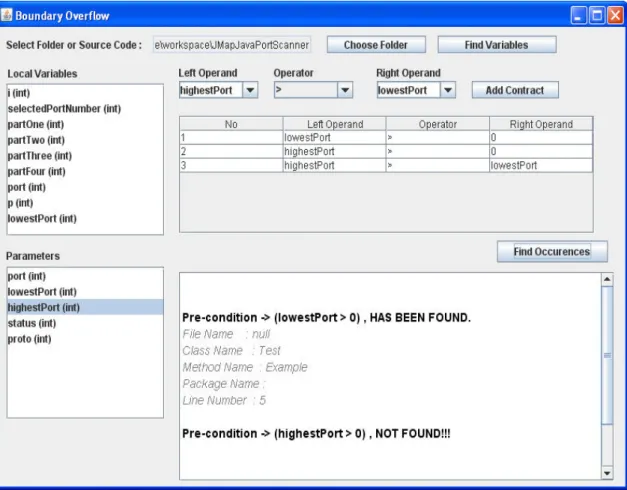
Figure 5.1. Boundary overflow vulnerability checker tool ... 47
Figure 5.2. JMAP Java Port Scanner... 48
Figure 5.3. Faltron Java Port Scanner ... 49
CHAPTER 1
INTRODUCTION
Static analysis is the automatic method to reason about runtime properties of program code without actually executing it. Properties that will be considered include those which lead to premature termination or ill-defined results of the program, but preclude for instance purely syntactic properties such as syntax errors or simple type errors. Nor does static analysis address errors involving the functional correctness of the software. Hence, static analysis can be used to check that the program execution is not prematurely aborted due to unexpected runtime events, but it does not guarantee that the program computes the correct result. While static analysis can be used to check for e.g. deadlock, timeliness or non-termination there are other, more specialized, techniques for checking such properties; although relying on similar principles.
Static analysis should be contrasted with dynamic analysis which concerns analysis of programs based on their execution, and includes e.g. testing, performance monitoring, fault isolation and debugging.
Static analysis is useful in several respects. It can be used to detect certain types of software runtime errors e.g. division by zero, arithmetic overflows, array indices out of bounds, buffer overflows etc without actually executing the code. However, static analysis does not in general guarantee the absence of runtime errors. While static analysis can reduce the need for testing or even detect errors that in practice cannot be found by testing, it is not meant to replace testing.
In addition to finding errors, static analysis can also be used to produce more efficient code; in particular for safe languages like Java, where efficiency was not the primary goal of the language designers. Many runtime tests carried out in Java programs can in practice be avoided given certain information about the runtime behavior. For instance, tests that array indices are not out-of-bounds can be omitted if it is known that the value of the indices is limited to values in-bounds. Static analysis can provide such information.
Static analysis can also be used for type inference in untyped or weakly typed languages or type checking in languages with non-static type systems. Finally static
analysis can be used for debugging purposes, automatic test case generation, impact analysis, and intrusion detection and for software metrics.
In this thesis, we will focus on to find security vulnerabilities in java applications.
CHAPTER 2
STATIC ANALYSIS
2.1. Principles of Static Analysis
Some properties checked by static analysis tools can be carried out by relatively straightforward pattern matching techniques. However, most properties are more challenging and require much more sophisticated analysis techniques. It is often claimed that static analysis is done without executing the program, but for nontrivial properties this is only partially true. Static analysis usually implies executing the program not in a standard way, but on an abstract machine and with a set of abstract non-standard values replacing the standard ones. The underlying concept is that of a state; a state is a collection of program variables and the association of values to those variables. State information is crucial to determine if a statement such as x=x/y may result in division by zero (it may do so if y may have the value zero at the time when the division is made). In the case of an intra-procedural analysis the state takes account only of local variables while a context-sensitive analysis must take account also of global variables plus the contents of the stack and the heap. The program statements are state transformers and the aim of static analysis is to associate the set of all possible states with all program points. Such sets of states are typically infinite or at least very large and the analysis must therefore resort to some simplified description of the sets representing only some of the relationships between the program variables, e.g. tracking an interval from which a variable may take its value.
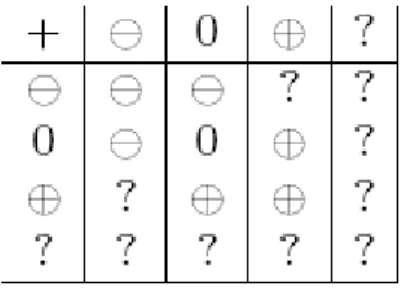
For instance, instead of computing with the integers it may be computed with values that describe some property of the integers; may as a simple example replace the domain of integers with the finite domain {Ө, 0,⊕ ,?} where Ө designates a negative integer (i.e. the interval ]-∞ ,-1]), 0 designates the integer 0 (the interval[0, 0]), ⊕ designates a positive integer (the interval [1,∞ [) and ? designates any integer (the interval ]- ∞, ∞ [). Operations, such as addition, which normally operate on the integers, must be redefined over the new domain and in such a way that the abstract
operation mimics the concrete one in a faithful way. The abstract operation of addition can be defined as in Figure 2.1 (Emanuelsson and Nilsson, 2008).
Figure 2.1. The abstract operation of addition (Source: Emanuelsson and Nilsson, 2008)
Such abstractions leads to loss of information which influences the precision of the analysis; if it is known that x = 4 and y = -3 then x + y is positive, but if it is only known that x = ⊕ and y = Ө then it is inferred that x + y is an integer.
2.2. Types of Static Analysis
2.2.1. Secure Information Flow
Conventional security mechanisms such as access control and encryption do not directly address the enforcement of information-flow policies. Recently, a promising new approach has been developed: the use of programming-language techniques for specifying and enforcing information-flow policies (Sabelfelt and Myers, 2003). Security mechanisms of most computer systems make no attempt to guarantee secure information flow. "Secure information flow," or simply "security," means here that no unauthorized flow of information is possible. In the common example of a government or military system, security requires that processes be unable to transfer data from files of higher security classifications to files (or users) of lower ones: not only must a user be prevented from directly reading a file whose security classification exceeds his own, but he must be inhibited from indirectly accessing such information by collaborating in arbitrarily ingenious ways with other users who have authority to access the information Most access control mechanisms are designed to control immediate access to objects without taking into account information flow
paths implied by given, outstanding collection of access rights. Contemporary access control mechanisms, have demonstrated their abilities to enforce the isolation of processes essential to the success of a multitask system. These systems rely primarily on assumptions of "trustworthiness" of processes for secure information flow among cooperating processes (Denning, 1976).
The most important objectives of information security systems are to protect confidentiality, integrity, and availability. It is obvious that compromises in integrity are the main causes of compromises in confidentiality and availability. Therefore, mechanism that specifies and enforces secure information flow policies is needed within application programs (Huang et al., 2004).
Information flow is a way of modelling data flow within a program usually meaning that values can flow in one direction (in security this is from safe to unsafe). This is usually looked at regarding security policies (England, 2008).
Type systems have proven useful for specifying and checking program safety properties and also used to verify program security. By means of programmer-supplied annotations, both proof-carrying codes (PCC) (Necula, 1997) and typed assembly languages (TAL) (Morrisett et al., 1999) are designed to provide safety proofs for low-level compiler-generated programs.
Many security verification efforts have focused on temporal safety properties related to control flow.
2.2.1.1. Type-Based Analysis
Since vulnerabilities in Web applications are primarily associated with insecure information flow, the use of proper information flow rather than control flow is generally accepted. The first widely accepted model for secure information flow was given by Bell and La Padula (McLeen, 1990). They stated two axioms: a) a subject cannot access information classified above its clearance, and b) a subject cannot write to objects classified below its clearance. Their original model only dealt with confidentiality. Denning (1976) established a lattice model for analyzing secure information flow in imperative programming languages based on a program abstraction derived from an instrumented semantics of a language. Orbaek (1995) proposed a similar treatment, but addressed the secure information flow problem in
terms of data integrity instead of confidentiality. To base directly on standard language semantics, Volpano et al. showed that Denning’s axioms can be enforced using a type system in which program variables are associated with security classes that allow inter-variable information flow to be statically checked for correctness. Soundness was proven by showing that well-typed programs ensure confidentiality in terms of non-interference. Recently, fully functional type systems designed to ensure secure information flow have been offered for high-level, strong-typed languages such as ML (Pottier and Simonet, 2003) and Java (Myers, 1999).
Type-based approaches to static program analysis are attractive because they prove program correctness without unreasonable computation efforts. Their main drawback is their high false positive rate, which often makes them impractical for real-world use. Regardless of whether security classes are assigned through manual annotations or through inference rules, they are statically bound to program variables in conventional type systems. It is important to keep in mind that the security class of a variable is a property of its state, and therefore varies at different points or call sites in a program. In JIF and similar type-based systems, variable labels become increasingly restrictive during computation, resulting in high false positive rates. JIF addresses this problem by giving programmers the power to declassify variables—that is, to explicitly relax variable labels.
Type analysis started with the syntax tree of a program and defined constraints over variables assigned to nodes. Analyses that work in this manner are flow insensitive, in the sense that the results remain the same if a statement sequence S1S2 is
permuted into S2S1. Analyses that are flow sensitive use a control flow graph, which is
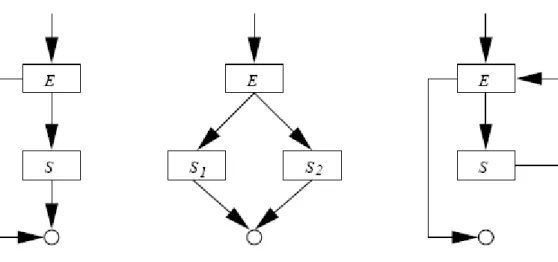
a different representation of the program source. A control flow graph (CFG) is a directed graph, in which nodes correspond to program points and edges represent possible flow of control. A CFG always has a single point of entry, denoted entry, and a single point of exit, denoted exit. If v is a node in a CFG then pred(v) denotes the set of predecessor nodes and succ(v) the set of successor nodes. The CFGs for assignments, output, return statements, and declarations are given in Figure 2.2.
Figure 2.2. CFGs for assignments, output, return statements, and declarations.
For the sequence S1 S2, the exit node of S1 and the entry node of S2 are eliminated and
combined the statements together as shown in Figure 2.3.
Figure 2.3. Sequence of S1 S2.
Similarly, the other control structures are modelled by inductive graph constructions as given in Figure 2.4.
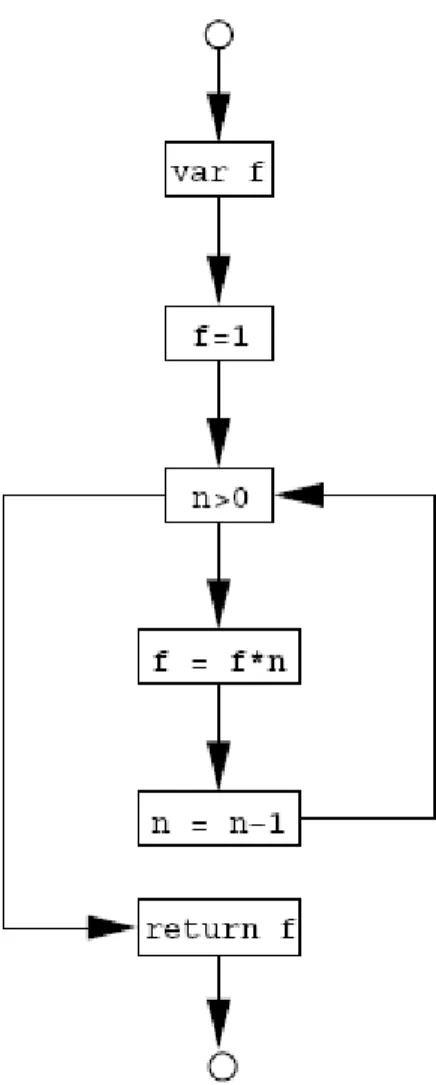
Using this systematic approach, CFG of the iterative factorial function is given in Figure 2.5.
Figure 2.5. CFG of the iterative factorial function.
2.2.2. Data Flow Analysis
The purpose of data flow analysis is to statically compute certain information for every single program point (or for coarser units such as functions). For instance, the classical constant analysis computes, for each program point, the literal values that variables may hold. Classical dataflow analysis, also called the monotone framework, starts with a Control Flow Graph (CFG) and a lattice L with finite height. The lattice may be fixed for all programs, or it may be parameterized with the given program. To every node v in the CFG, it can be assigned a variable [v] ranging over the elements of L. For each construction in the programming language, a dataflow constraint that relates the value of the variable of the corresponding node to those of other nodes
(typically the neighbours) is defined. As for type inference, it will be ambiguously used the notation [S] for [v] if S is the syntax associated with v.
For a complete CFG, a collection of constraints can be systematically extracted over the variables. If all the constraints happen to be equations or inequations with monotone right-hand sides, then it can be used the fixed-point algorithm to compute the unique least solution. The dataflow constraints are sound if all solutions correspond to correct information about the program. The analysis is conservative since the solutions may be more or less imprecise, but computing the least solution will give the highest degree of precision.
2.2.2.1 Fixed Point Algorithm
If the CFG has nodes V = {v1, v2, . . . , vn}, with lattice Ln. Assuming that node
vi generates the dataflow equation [vi] = Fi([v1], . . . , [vn]), and combined function F :
Ln→ Ln described as:
F(x1, . . . , xn) = (F1(x1, . . . , xn), . . . , Fn(x1, . . . , xn))
The naive algorithm is then to proceed as follows: x = (⊥, . . . , ⊥);
do { t = x; x = F(x); } while (x ≠ t);
to compute the fixed-point x. A better algorithm, called chaotic iteration, exploits the fact that lattice has the structure Ln:
x1 = ⊥; . . . xn = ⊥; do { t1 = x1; . . . tn = xn; x1 = F1(x1, . . . , xn); . . . xn = Fn(x1, . . . , xn); } while (x1≠t1 V . . . V xn≠ tn);
2.2.2.2. Forwards-Backwards-May-Must
Four classical analyses can be compared in various ways. They are all just instances of general monotone framework, but their constraints have a particular structure. A forwards analysis is one that for each program point computes information about the past behaviour. Examples of this are available expressions and reaching definitions. They can be characterized by the right-hand sides of constraints only depending on predecessors of the CFG node. Thus, the analysis starts at the entry node and moves forwards in the CFG.
A backwards analysis is one that for each program point computes information about the future behaviour. Liveness and very busy expressions are the examples. They can be characterized by the right-hand sides of constraints only depending on successors of the CFG node. Thus, the analysis starts at the exit node and moves backwards in the CFG.
A may analysis is one that describes information that may possibly be true and, thus, computes an upper approximation. Examples of this are liveness and reaching definitions. They can be characterized by the right-hand sides of constraints using a union operator to combine information.
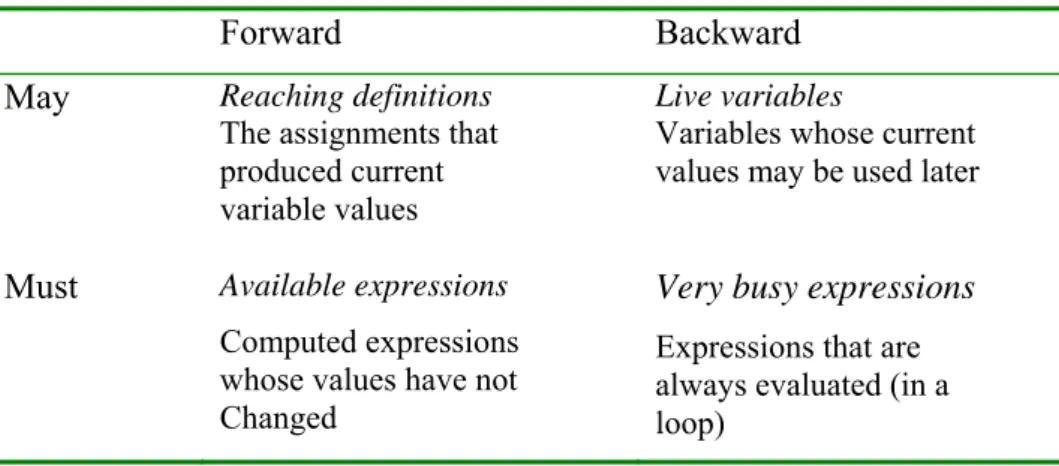
A must analysis is one that describes information that must definitely be true and, thus, computes a lower approximation. Examples of this are available expressions and very busy expressions. They can be characterized by the right-hand sides of constraints using an intersection operator to combine information. All possible combination is given in Table 2.1.
Table 2.1. The classic data flow analyses.
Forward Backward
May Reaching definitions
The assignments that produced current variable values
Live variables
Variables whose current values may be used later
Must Available expressions
Computed expressions whose values have not Changed
Very busy expressions
Expressions that are always evaluated (in a loop)
2.2.3. Mutability Analysis
A mutability analysis determines which fields and objects are mutable, and which methods may mutate them. Knowing which method parameters may be mutated during a method’s execution is useful for many software engineering tasks such as modelling, verification, compiler optimizations, and program transformations such as refactoring, test input generation, and regression oracle creation as well as specification mining. Both static and dynamic analysis techniques have been employed to detect immutable parameters (Artzi et al., 2007). Computing accurate static analysis approximations threatens scalability, and imprecise approximations can lead to weak results. Dynamic analyses offer an attractive complement to static approaches, both in not using approximations and in detecting mutable parameters.
The goal of parameter mutability analysis is the classification of each method parameter (including the receiver) as either reference mutable or reference-immutable. Informally, reference immutability guarantees that a given reference is not used to modify its referent. Parameter p of method m is reference-mutable if there exists an execution of m in which p is used to mutate the state of the object pointed to by p. Parameter p is said to be used in a mutation, if the left hand side of the mutating assignment was obtained during the given execution via a series of field accesses and copy operations from p. If no such execution exists, the parameter p is reference-immutable.
Static mutability analysis consists of two phases: S, an intraprocedural analysis that classifies as (im)mutable parameters (never) affected by field writes within the procedure itself, and P, an interprocedural analysis that propagates mutability information between method parameters. P may be executed at any point in an analysis pipeline after S has been run, and may be run multiple times (interleaving with other analyses). S and P both rely on an intraprocedural pointer analysis that calculates the parameters pointed to by each local variable.
An intraprocedural, context-insensitive, flow-insensitive, 1-level field-sensitive, and points-to analysis are used to determine which parameters can be pointed to by each expression. As a special case, the analysis is flow-sensitive on the code from the beginning of a method through the first backwards jump target, which includes the entire body of methods without loops. The points-to analysis calculates,
for each local variable l, a set P0(l) of parameters whose state l can point to directly
and a set P(l) of parameters whose state l can point to directly or transitively. The points-to analysis has “overestimate” and “underestimate” varieties; they differ in how method calls are treated.
The static analysis S works in four steps.
(1) S performs the “overestimate” points-to analysis.
(2) The analysis marks as mutable some parameters that are currently marked as unknown: For each mutation l1. f = l2, the analysis marks all elements of P0(l1) as
mutable.
(3) The analysis computes a “leaked set” L of locals, consisting of all arguments (including receivers) in all method invocations and any local assigned to a static field (in a statement of the form Global.field = local).
(4) The analysis marks as immutable all unknown parameters that are not in the set ∪l∈LP(l) only if all method’s parameters can be marked immutable.
S is i-sound and m-unsound. To avoid over-conservatism, S assumes that on the entry to the analyzed method all parameters are fully un-aliased, i.e., point to disjoint parts of the heap. This assumption may cause S to miss possible mutations due to aliased parameters; to maintain i-soundness, S never classifies a parameter as immutable unless all other parameters to the method can be classified as immutable. The m-unsoundness of S is due to infeasible paths (e.g., unreachable code), flow-insensitivity, and the overestimation of the points-to analysis.
The interprocedural propagation phase P refines the current parameter classification by propagating both mutability and immutability information through the call graph. Given an i-sound input classification, propagation is i-sound and m-unsound.
Because propagation ignores the bodies of methods, the P phase is i-sound only if the method bodies have already been analyzed.
2.2.4. Points to Analysis
The most important information that must be obtained is the set of possible targets of pointers. There are infinitely many possible targets during execution, so it must be selected some finite representatives. The canonical choice is to introduce a
target &id for every variable named id and a target malloc-i, where i is a unique index, for each different allocation site (program point that performs a malloc operation). Targets are used to denote the set of pointer targets for a given program.
Points-to analysis takes place on the syntax tree, since it will happen before or simultaneously with the control flow analysis. The end result of points-to analysis is a function pt that for each (pointer) variable p returns the set pt (p) of possible pointer targets to which it may evaluate. A conservative analysis could be performed, so these sets will in general be too large. Given this information, many other facts can be approximated. If it is determined whether pointer variables p and q may be aliases, then a safe answer is obtained by checking whether pt(p)∩pt(q) is non-empty. The simplest analysis possible, called address taken, is to use all possible targets, except that &id is only included if this construction occurs in the given program. This only works for very simple applications, so more ambitious approaches are usually preferred. If there is any restriction in typable programs, then any points-to analysis could be improved by removing those targets whose types are not equal to that of the pointer variable.
2.2.5. Dependence Analysis
Fundamental analysis step in an advanced optimizing compiler (as well as many other software tools) is data dependence analysis for arrays. This means deciding if two references to an array can refer to the same element and if so, under what conditions. This information is used to determine allowable program transformations and optimizations.
Dependence analysis is a very important part of any vectorizing or concurrentizing compiler. Data dependence analysis has great importance for the automatic detection and exploitation of implicit parallelism. Therefore, experimental evaluation to determine the accuracy of dependence analysis techniques is very important. Such evaluation is necessary to guide research and to help compiler writers in the selection of a dependence analysis strategy. Constant test, the GCD (Greatest Common Divisor) test, three variants of Banerjee’s inequalities, and integer-programming based tests such as the Omega test are the techniques that included in dependence analysis.
Dependence analyses generally focus on statements with array references and assume that the two statements to be analyzed are both inside the same, possibly multiply-nested, DO loop. The generic loop test can be summarized as (Petersen and Padua, 1993); DO I1=L1,U1 . . . DO Id = Ld,Ud Sv ; X(f1 (Il,...,Id),………. fn (Il,...,Id)) = Sw ; ….= X(g1 (Il,...,Id),………. gn (Il,...,Id)) = END DO . . . END DO
Where X is an n-dimensional array and fi and gi are the functions from Zd to Z.
The constant test is the only approximate method that not only can break dependence but can also conclusively prove dependence. If all the subscripts in the two array references are loop invariant and have the same value, then there will be data dependence for all potential direction vectors. If any pair of corresponding subscripts is constant and different, then there is no data dependence regardless of the values of any other subscript. Loop invariant expressions that are common to both subscripts in the potential dependence are cancelled before the comparison is made.
The greatest common divisor (GCD) test establishes an existence criterion for the solution to the equation Fi(I’) = gi(I”). This test is based on the fact that when both
fi and gi are linear, a solution to the equation exists if the greatest common divisor of
the coefficients of I’ and I“ also divides the constant term. Conversely, if it does not divide the constant term, then no solution can exist. When the GCD method breaks a potential dependence, it breaks all the direction vectors simultaneously. The GCD method cannot prove dependence because it does not take into account the value of the loop limits.
The Omega test combines new methods for eliminating equality constraints with an extension of Fourier-Motzkin variable elimination to integer programming. The Omega test determines whether there is an integer solution to an arbitrary set of linear equalities and inequalities, referred to as a problem. In addition to supporting the full capabilities of integer-programming, the Omega test also permits the systematic
handling of unknown additive terms. Consider the subscripts X(l+N) and X(I’ ) where 1 ≤ I , I’≤ N ( N is the loop upper limit ). The Omega test is capable of analyzing such expressions involving unknown additive constrained variables. After the addition of the loop limit, it can be found that the system of equations is inconsistent since I + N ≠ I’ for all I’ in [1... N]. Pugh (1992) found that the time required by the Omega test to analyze a problem is rarely more than twice the time required to scan the array subscripts and loop bounds. This would indicate that the Omega test is suitable for use in production compilers.
2.2.6. Escape Analysis
Escape analysis is a static analysis that determines whether the lifetime of data may exceed its static scope. The main originality of escape analysis is that it determines precisely the effect of assignments, which is necessary to apply it to object oriented languages with promising results.
Object-oriented languages such as C++ and Java often use a garbage collector (GC) to make memory management easier for the programmer. A GC is even necessary for the Java programming language, since Java has been designed to be safe, so it cannot rely on the programmer to deallocate objects when they are useless. However, garbage collecting data is time consuming, especially with a mark and sweep collector as in the JDK (Java Development Kid). Therefore stack allocation may be an interesting alternative. However, it is only possible to stack allocate data if its lifetime does not exceed its static scope. The goal of escape analysis is precisely to determine which objects can be stack allocated.
Escape analysis is an abstract interpretation-based analysis which has been already applied to functional languages. However, object-oriented languages have specific features, which make the analysis completely different from the functional version:
• Object-oriented languages use dynamic calls, so before analyzing the code, it must be first determined which methods may actually be called at each call point;
• Object-oriented languages make an intensive use of assignments, which must therefore be precisely analyzed, which much complicates our task;
• Object-oriented languages use sub-typing, which must be taken into account for the representation of escape information, since it is computed from the types.
Escape analysis has two applications: an object o that does not escape from method m (whose lifetime is limited to the execution of m) can be stack allocated in m. Moreover, when analysis claims that o does not escape from m, o is also local to the current thread, so it did not needed do synchronizations when calling a synchronized method on object o. This second optimization is important, because synchronization is a costly operation in the JDK. Moreover, there is much synchronization even in single-threaded programs since libraries use synchronization to ensure thread-safety in all cases. Synchronization elimination could also be applied to other multithreaded languages.
2.2.7. Alias Control and Confinement
Confinement properties impose a structure on object graphs which can be used to enforce encapsulation properties. From a practical point of view, encapsulation is essential for building secure object-oriented systems as security requires that the interface between trusted and untrusted components of a system be clearly delineated and restricted to the smallest possible set of operations and data structures. One of the main benefits of object-oriented programming is information hiding and encapsulation: classes and visibility controls offer encapsulation without sacrificing extensibility and flexibility. But it is well known that the unfettered use of shared references to mutable objects is error-prone and can violate intended encapsulation. Quite a few proposals have been made for confinement (alias control).
One useful confinement property is unique (unshared, references). These have strong properties but for many purposes sharing is needed. Sharing can often be confined to the scope of a module (a sealed or closed package). This facilitates a coarse form of encapsulation that is quite useful, e.g., in debugging and security. Stronger and more fine-grained confinement is needed for reasoning about specifications using “modified clauses” and for justifying program transformations.
Banerji et al., defined the confinement as a property of program syntax that is a static analysis of instance-based confinement. The definition was syntax-directed and did not require any code annotations or flow analysis.
The syntax is based on that of Java, with some restrictions for ease of formalization; for example, “return” statements appear only at the end of a method,
and heap effects (new and field update) occur in commands rather than expressions. There are a couple of minor deviations from Java, e.g., the keyword var marks local variable declarations. A program consists of a collection of class declarations like the following one.
class Boolean extends Object { bool f;
unit set(bool x){ this.f := x; return unit } bool get() { skip; return this.f } }
Instances of class Boolean has a private field f with the primitive type bool. There is no constructor; fields of new objects are given their Java defaults (null, false). Fields are considered to be private to their class and methods public: fields are only visible to methods declared in this class, but methods are visible to all classes. Fields are accessed in expressions of the form this.f, using “this” to refer to the current object. The unit value; the singleton type, unit, corresponds to Java's “void". Object types are implicitly references: assignment creates aliases and == compares references.
The primary challenge in building and evolving large object-oriented systems is understanding aliasing between objects. Unexpected aliasing can lead to broken invariants, mistaken assumptions, security holes, and surprising side effects, all of which may lead to software defects and complicate software evolution (Aldrich et al., 2002). Aldrich defined three major challenges in order to bring alias control into practice (Clark et al., 2008);
1. The community has to identify applications where the benefit of making program structure explicit has a significant and immediate benefit. Two promising candidates are concurrency and verification. For both applications it will be necessary to improve the expressiveness in order to common program styles and idioms.
2. The community has to increase the adoptability of alias control by reducing the annotation burden through inference and by providing support for existing languages and programs.
3. The community has to increase the applicability of alias control to be able to handle more programs. He mainly stated that the community has focused too much on restricting aliasing rather that documenting the aliasing programs and using information for reasoning.
Understanding and evolving large software systems is one of the most pressing challenges confronting software engineers today. When evolving a complex system in the face of changing requirements, developers need to understand how the system is organized in order to work effectively. For example, to avoid introducing program defects, programmers need to be able to predict the effect of making a software change. Also, while fixing defects, programmers need to be able to track value flow within a program in order to understand how an erroneous value was produced. In an object-oriented program, all of these tasks require understanding the data sharing relationships within the program. These relationships may be very complex at worst, a reference could point to any object of compatible type and current languages do not provide much help in understanding them.
Data sharing problems can also compromise the security of a system. For example, in version 1.1 of the Java standard library, the security system function Class.getSigners() returned a pointer to an internal array, rather than a copy. Clients could then modify the array, compromising the security of the “sandbox” that isolates Java applets and potentially allowing malicious applets to pose as trusted code. Existing languages provide poor support for preventing security problems that arise from improper data sharing. Aldrich et al., described the AliasJava annotation system to understand the data sharing patterns in Java programs. The annotations bound aliasing on the heap structurally: unique describes an unshared reference, owned objects are assigned an owner that controls who may access that object, and shared indicates the worst case of a globally-aliased reference. It is also provided a lent annotation expressing sharing that is temporally bounded by the length of a method call.
2.3. Static Analysis Tools
Static analyzers are used to discover difficult to find programming errors before run time when they may be more difficult or impossible to find. This class of tool can discover many logical and security errors in an application without executing the compiled application. Unlike dynamic analysis tools which look at the application state while it is being executed, static analysis tools do not require the application to be compiled or executed; bugs can be found by analyzing the source code directly.
Moreover, static techniques can explore abstractions of all possible program behaviours, and thus are not limited by the quality of test cases in order to be effective. Using static analysis to find bugs has some advantages over the traditional quality assurance techniques of testing and manual code inspections. Unlike testing, static analysis can easily check hard-to-execute code paths such as error-handling code. Compared to manual code inspection, static analysis is less easily confused by what code appears to do, and is relatively inexpensive to apply. For these reasons, static analysis to find bugs is a very active research area, and increasingly is becoming a standard part of the quality assurance toolbox in development of projects.
Static techniques range in their complexity and their ability to identify or eliminate bugs. The most effective (and complex) static technique for eliminating bugs is a formal proof of correctness. While the existence of a correctness proof is perhaps the best guarantee that the program does not contain bugs, the difficulty in constructing such a proof is prohibitive for most programs. Partial verification techniques have been proposed. These techniques prove that some desired property of a program holds for all possible executions. Such techniques may be complete or incomplete; if incomplete, then the analysis may be unable to prove that the desired property holds for some correct programs. Finally, unsound techniques can identify “probable” bugs, but may miss some real bugs and also may emit some inaccurate warnings (Hovemeyer and Pugh, 2004).
Static analysis tools have been used in a rudimentary form for the majority of the history of modern programming languages. Early versions of simple pattern matching static analysis tools have been used to enforce coding styles within a company, or to discover simple programming errors. As more research in the subject was completed, developers of static analysis tools found more programmatic errors that could be discovered. Today tools can scan C, C++ and Java code for many common coding problems within many different categories (Ware and Fox, 2008).
Static analysis tools have gone through many stages of sophistication. In their infancy the tools were little more than a pattern matching command such as grep. The programmer could search for a list of functions that were known to be dangerous and which should be avoided. In this early stage the tools were difficult to use, tedious, and limited in their ability to find real bugs (Hovemeyer and Pugh, 2004).
The next attempt at finding bugs using static analysis techniques came by looking at code metrics, such as lines of code, ratio of lines of code to lines of comments, cyclomatic complexity and others. Using these techniques the developer could gain a greater understanding of the complexity of the code. Complexity metrics such as lines of code per function could help a developer break the code into smaller parts for greater readability or lesser complexity. Cyclomatic complexity is one of the more widely used software quality metrics. It allows a developer or tester to measure the potential for bugs in a program, by mapping the number of independent paths through each module. The more paths that can be taken, the more complex the code is, and the more likely that there will be bugs waiting to be found (McCabe, 1976; Shepperd, 1988).
The next step in the evolution of static code analysis was to use more sophisticated searching algorithms. By adding some context to the search it became possible to find bugs that required interaction between multiple function calls, such as usage of alloc without a matching free, failing to close an open network connection and many others. Tables could be employed to ensure each memory allocation was being properly de-allocated and that it was the same memory reference allocated in the beginning.
Static analysis tools then began adding Semantic Analysis techniques (Barbuti et al., 1993) that enabled discovery of the basic structure and relation of each function within the application. This additional contextual information helps the analyzer understand and report bugs that require knowledge of specific code paths through the application. The most advanced static analyzers use abstract syntax trees to provide the best possible bug finding capabilities. Crew (1997) describes a language for specifying patterns to match the abstract syntax trees of C and C++ programs (ASTLOG). ASTLOG has been used successfully to find bugs and performance problems, and is the basis of the PREfast tool used extensively within Microsoft to find bugs. ASTLOG is an interesting data point in the space of static analysis techniques to find bugs, because it shows that simple pattern-matching approaches can be very effective at finding interesting program features, such as probable bugs. Unlike dataflow analysis and abstract interpretation, this kind of analysis does not directly model the semantics of program operations, focusing entirely on syntactic structures. Even given this limitation, ASTLOG has been used successfully to find bugs. Using the knowledge
gained by building an abstract syntax tree, a static analysis tool can run detailed simulations of suspicious code fragments to better predict how the code will react at runtime.
Some static analysis tools allow developers to mark their code with special comments or some other form of metadata to describe rules and inter-function dependencies. This additional information allows the analyzer to understand under what conditions a bug may occur as well as expectations each function has for parameters passed in and values returned. The use of metadata keeps the number of false positives down and helps the analyzer follow code paths more closely.
Recently static analysis tools have allowed developers or testers to create their own rules or modify existing rules or plug-ins. These customizations can help tailor the static analyzer specifically to the target application. This customization enables a developer to look for bugs specific to their operating environment, application needs, and coding standards.
2.3.1. How Static Analysis Tools Find Flaws
The first thing a static analysis tool must do is identify the code to be analyzed. The source files that must be compiled to create a program may be scattered across many directories, and may be mixed in with other source code that is not used for that program. Static analysis tools operate much like compilers so they must be able to identify exactly which source files contribute and should ignore those that do not. The scripts or build system that builds the executable obviously know which files to use, so the best static analysis tools can extract this information by reading those scripts directly or by observing the build system in action. This way the tool gets to see not only the source files but also which compiler is being used and any command-line flags that were passed in. The parser that the static analysis tool uses must interpret the source code in the same way that the real compiler does. It does this by modeling how the real compile works as closely as possible. The command-line flags are an essential input to that.
As the build system progresses, each invocation of the compiler is used to create a whole program model of the program. This model consists of a set of abstract representations of the source, and is similar to what a compiler might generate as an
intermediate representation. It includes the control-flow graph, the call graph, and information about symbols such as variables and type names.
Once the model has been created, the analysis performs a symbolic execution on it. This can be thought of as a simulation of a real execution. Whereas a real execution would use concrete values in variables, the symbolic execution uses abstract values instead. This execution explores paths and, as it proceeds, if any anomalies are observed, they are reported as warnings. This approach is based on abstract interpretation (Cousot and Cousot, 1977) and model checking (Cousot and Cousot 1999; Clarke et al., 2002). Abstract interpretation, introduced was developed to provide a firmer theoretical foundation for dataflow analysis. An abstraction function maps the infinite domain of program objects into a finite domain of abstract objects. The effects of program operations are modeled using the abstract domain. A concretization function maps the abstract objects back into the program domain (with some loss of precision). Dataflow analysis can be considered a special case of abstract interpretation. Model checking is a technique for exploring reachable states in a concurrent system for errors. It was initially developed for verification of hardware systems; recent research has applied it to software systems. The SLAM project (Ball and Rajamani, 2002) applies model checking to boolean abstractions of programs. For predicates in a C program, boolean predicates are abstracted such that if a property is true of the Boolean program, it will also be true of the original C program. The boolean abstraction of the original program is done incrementally; if the desired property cannot be proved, new predicates are added and the boolean program checked again.
The analysis is path-sensitive, which means that it can compute properties of individual paths through the program. This is important because it means that when a warning is reported, the tool can tell the user the path along which execution must proceed in order for the flaw to be manifest. Tools also usually indicate the points along that path where relevant transformations occur and conditions on the data values that must hold. These help users understand the result and how to correct the problem should it be confirmed.
Once a set of warnings have been issued, these tools offer features to help the user manage the results, including allowing the user to manually label individual warnings. Warnings that correspond to real flaws can be labeled as true positives.
Warnings that are false alarms can be labeled as false positives. Warnings that are technically true positives but which are benign can be labeled asdon’t care. Most tools offer features that allow the user to suppress reporting of such warnings in subsequent analyses.
2.3.2. Limitations of Static Analysis
The obvious limitation of static analysis is that most nontrivial program properties are undecidable. As a result, any static analysis technique must approximate the behaviour of the input program. For this reason, no static analysis technique can be both complete and sound. In the literature on using program analysis to find bugs, sound generally means “finds every real bug”, and complete generally means “reports only real bugs.”
Deciding how to approximate in a static analysis has important consequences. Both soundness and completeness are desirable properties. In theory, a sound analysis is able to find every real instance of the kind of bugs the analysis is designed to detect. However, it might do this by reporting 1,000 false positives for every accurate warning, making use of the analysis unproductive. Similarly, a complete analysis would only report definite bugs. However, it might find only a very small number of bugs, leaving a large number of false negatives. For these reasons, tools which are neither complete nor sound can serve a valuable role in the software quality assurance process as long as they find a significant number of real bugs without emitting too many false positives.
In order to understand the limitations of the techniques that these tools use, it is important to understand the metrics used to assess their performance. The first metric, recall, is a measure of the ability of the tool to find real problems. Recall is measured as the number of flaws found divided by all flaws present. The second metric is precision, which measures the ability of the tool to exclude false positives. It is the ratio of true positives to all warnings reported. The third metric is performance. Although not formally defined, this is a measure of the computing resources needed to generate the results.
These three metrics usually operate in opposition to each other. It is easy to create a tool that has perfect precision and excellent performance, one that reports no
lines contain flaws will satisfy because it reports no false positives. Similarly, it is easy to create a tool with perfect recall and excellent performance, one that reports that all lines have errors will answer because it reports no false negatives. Clearly, however, neither tool is of any use whatsoever.
Finally, it is at least theoretically possible to write an analyzer that would have excellent precision and excellent recall given enough time and access to enough processing power. Whether such a tool would be as useless as the previous two example tools is debatable and would depend on just how much time it would take. What is clear is that no such tools currently exist and to create them would be very difficult.
As a result, all tools occupy a middle ground around a sweet spot that developers find most useful. Developers expect analyses to complete in time roughly proportional to the size of their code base and within hours rather than days. Tools that take longer simply do not get used because they take too long. Low precision means more false positives, which has an insidious effect on users. As precision goes down, even true positive warnings are more likely to be erroneously judged as false positives because the users lose trust in the tool.
For most classes of flaws, precision less than 80 percent is unacceptable. For more serious flaws however, precision as low as five percent may be acceptable if the code is to be deployed in very risky environments. It is difficult to quantify acceptable values for recall as it is impossible to measure accurately in practice, but clearly users would not bother using these tools at all if they did not find serious flaws that escape detection by other means.
Each of these constraints introduces its own set of limitations, however they are all interrelated. The reasons that lead to low recall are explained in more detail in the following sections.
2.3.2.1. Path Limitations
These analyses are path sensitive and this improves both recall and precision and is probably the key aspect of these products that makes them most useful. A full exploration of all paths through the program would be very expensive. If there are n branch points in a procedure, and there are no loops in that procedure, then the number
of intraprocedural paths through that procedure can be as many as 2 n. In practice, this is fewer because some branches are correlated, but the asymptotic behavior remains. If procedure calls and returns are taken into account, the number of paths is doubly exponential, and if loops are taken into account then the number of paths is unbounded. Clearly it is not possible for a tool to explore all of these paths. The tools restrict their exploration in two ways. First, loops are handled by exploring a small fixed number of iterations: often, the first time around the loop is singled out as special, and all other iterations are considered en masse and represented by an approximation. Second, not all paths are explored. It is typical for an analysis to place an upper bound on the number of paths explored in a particular procedure or on the amount of time available, and a selection of those remaining paths are explored.
If asynchronous paths occur (such as those caused by interrupts or exceptions) or if the program uses concurrency, then the number of possible paths to consider can increase further. Many tools simply ignore these possibilities. Finally, most tools also ignore recursive function calls, and function calls that are made through function pointers (or make very coarse approximations) as considering these also contributes to poor performance and poor precision.
2.3.2.2. Abstract Domain
As previously mentioned, these tools work by exploring paths and looking for anomalies in the abstract state of the program. The appeal of the symbolic execution is that each abstract state represents potentially many possible concrete states. For example, given an 8-bit variable x, there are 28 possible concrete values: 0, 1, …, 255. The symbolic execution, however, might represent the value as two abstract states: x=0, and x>0. So where a concrete execution has 256 states to explore, the symbolic execution has only two.
As such, the expressivity of this abstract domain is an important factor that determines the effectiveness of the analysis. Again, there is a trade-off here: better precision and recall can be achieved by more sophisticated abstract domains, but more resources will then be required to complete an analysis. Values in the abstract domain are equations that represent constraints on values, i.e., x=0, or y>10. As the analysis progresses, a constraint solver is used to combine and simplify these equations. A key
characteristic of these abstract domains is that there is a special value, usually named bottom, which indicates that the analysis knows no useful information about the actual value. Bottom is the abstract value that corresponds to all possible concrete values. Reaching bottom is impossible to avoid for any non-trivial abstraction in general as this would require solving the halting problem. Once bottom is reached, the analysis has a choice of treating it as a potentially dangerous value, which would increase recall, or as a probably safe value, which would increase precision. Most tools opt for the latter as the former also has the effect of decreasing precision enormously.
If there are program constructs that step outside the bounds of what can be expressed in the abstract domain, this causes the analysis to lose track of variables and their relationships. For example, an abstract domain that allows the expression of affine relationships between no more than two variables admits expressions such as x=2y. However, something such as x=y+z is out of bounds because it involves three variables and the analysis would be forced to conclude x=bottom instead.
The consequence of this is the abstract domain that a tool uses determine a great deal about the kind of flaws that it is capable of detecting. For example, if the tool uses an abstract domain of affine relations between two variables, then it may fail to find flaws that depend on three variables. Similarly, most tools choose a domain that allows them to reason about the values of integers and addresses but not floating-point values, so they will fail to find flaws in floating-point arithmetic (such as divide by zero).
2.3.2.3. Missing Source Code
If the source code to a part of a program is not available, as is almost always the case because of operating system and third-party libraries, or if the code is written in a language not recognized by the analysis tool, then the analysis must make some assumptions about how that missing code operates. Take, for example, a call to a function in a third-party library that takes a single pointer-typed parameter and returns an integer. In the absence of any other information, most analyses will assume that the function does nothing and returns an unknown value. This clearly is not realistic, but it is not practical to do better in general. The function may de-reference its pointer parameter, it may read or write any global variable that is in scope, it may return an
integer from a particular range, or it may even abort execution. If the analysis knew this, it would have better precision and recall but it is forced to make the simple assumption unless told otherwise.
There are two approaches around this. First, if source is not available but object code is, then the analysis could be extended into the object code. This is a highly attractive solution but no products are available yet. The technological basis for such a tool exists, however (Balakrihnan et al., 2005), and it is expected that products capable of analyzing object code as well as C/C++ will appear.
A second approach to the problem is to specify stubs, or models, that summarize key aspects of the missing source code. The popular analysis tools provide models for commonly used libraries such as the C library. These models only have to approximate the behavior of the code. Users can write these themselves for their own libraries but it can be a tricky and time-consuming effort.
2.3.2.4. Out of Scope
There are entire classes of flaws that static analysis is unlikely ever to be able to detect. Static analysis excels at finding places where the fundamental rules of the language are being violated such as buffer overruns, or where commonly used libraries are being used incorrectly, or where there are inconsistencies in the code that indicate misunderstanding. If the code does the wrong thing for some other reason, but does not then terminate abnormally, then static analysis is unlikely to be able to help because it is unable to divine the intent of the author. For example, if a function is intended to sort in ascending order, but perfectly sorts in descending order instead, then static analysis will not help much. This kind of functionality testing is what traditional dynamic testing is good for.
2.3.3. Open Source Tools
Open source software development is based on a relatively simple idea: the core of the system is developed locally by a single programmer or a team of programmers. A prototype system is released on the Internet, which other
programmers can freely read, modify and redistribute the system’s source code. The evolution of the system happens in an extremely rapid way; much faster than the typical rate of a ‘closed’ project. It appears that open source is presenting the traditional software development industry with an important challenge (Stamelos et al., 2002). SourceForge.net, the world’s largest open source development website, hosts over 70,000 open-source projects for more than 700,000 registered developers (Huang et al., 2004).
It is often claimed that open source software is intrinsically more secure than closed source or commercial software. Others argue that it is not, and it is expected this debate will continue for some time to come. The availability of source code provides both attackers and defenders opportunities to study code in detail and identify software vulnerabilities. On the other hand, closed source software forces users to accept only the level of security diligence that the vendor chooses to provide (Covan, 2003). According to the Open Source Initiative (opensource.org, 2010), the terms for the distribution of open source software must also comply with 10 criteria specified in the Open Source Definition (opensource.org, 2010). The top 3 items out of the 10 criteria include:
1. software should be freely redistributable,
2. software must allow for distribution as source code as well as in a compiled form,
3. licences must allow modifications and for derivatives generated from the source code.
In Appendix B, several open source static analysis tools included in Multi-language, NET (C#, VB.NET and all .NET compatible languages), Java, C, C++, Objective-C, Perl and ActionScript are explained.
2.3.4. Commercial Tools
One distinct difference between open source and commercial software is the availability of source code for review. Commercial software is mostly closed source where the source code is not publicly available. Because the source code is not available, there is a barrier against access to the code that attackers have to cross, resulting in less likelihood of vulnerabilities in the source code being exploited even
though vulnerabilities do exist (Covan, 2003). In Appendix C, commercial static analysis tools are summarized.
2.3.5. Comparison of Static Analysis Tools for Java
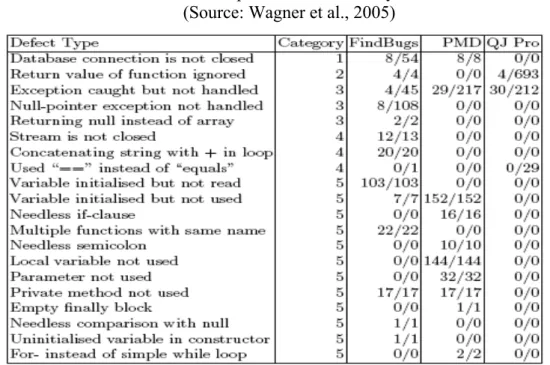
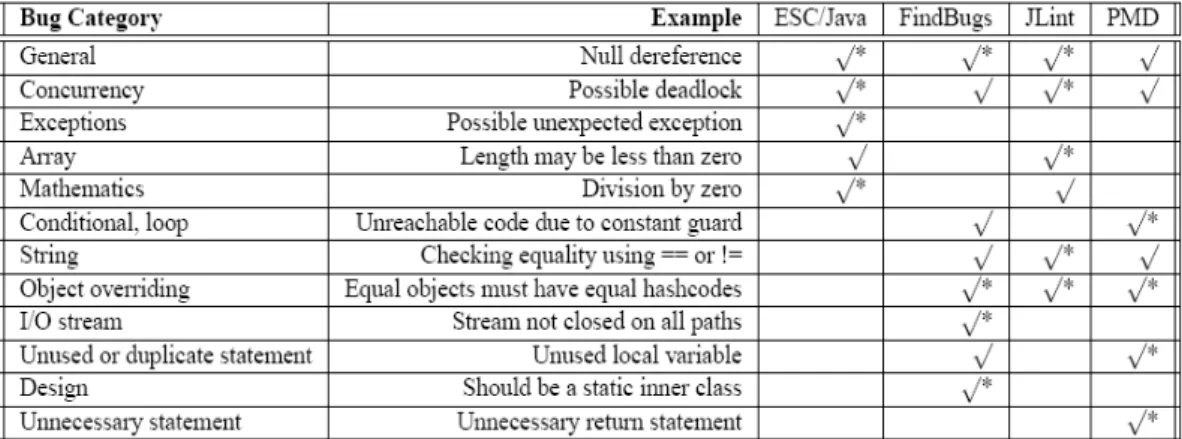
Static analysis tools for Java analysis code are compared in Table 2.2. Table 2.2 indicates the defect types with their categories and the corresponding positives found by each tool. The number before the slash denotes the number of true positives, the number after the slash the number of all positives.
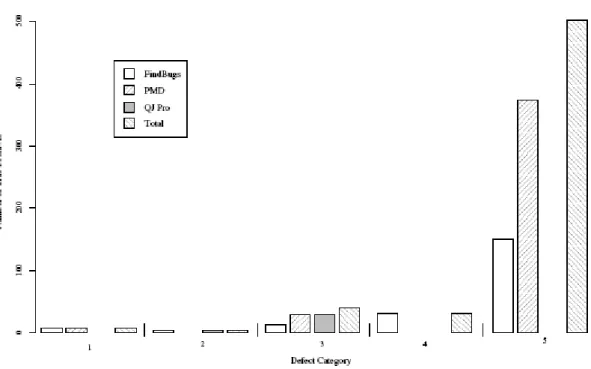
Most of the true positives can be assigned to the category (maintainability of the code). It is noticeable that the different tools predominantly find different positives. Only a single defect type was found from all tools, four types from two tools each. Considering the categories, FindBugs finds in the different systems positives from all categories and PMD only from the categories Failure of the application, Insufficient error handling, and Maintainability of the code. QJ Pro only reveals positives from the categories Logical failure of the application, Insufficient errorhandling, and Violation of structured programming. The number of faults found in each category from each tool is graphically illustrated in Figure 2.6. Also the number of types of defects varies from tool to tool. FindBugs detects defects of 13 different types, PMD of 10 types, and QJ Pro only of 4 types.
Table 2.2. Comparison of static analysis tools (Source: Wagner et al., 2005)
Figure 2.6. A graphical comparison of number of true positives for each tool (Source: Wagner et al., 2005)
The accuracy of the tools is also diverse. Using the defect type “Exception is caught but not handled” that can be found by all three tools as an example. While FindBugs only finds 4 true positives, PMD reveals 29 and QJ Pro even 30. For this, the result from QJ Pro contains the true positives from PMD which in turn contain the ones from FindBugs. A reason for this is that QJ Pro is also able to recognize a single semicolon as a non-existent error handling, whereas the other two interpret that as a proper handling. This defect type is also representative in the way that FindBugs finds the least true positives. This may be the case because it uses the compiled class-files while PMD and QJ Pro analyse the source code.
CHAPTER 3
PMD
3.1. Overview of PMD
PMD is an open-source, rule based, static source code analyzer that analyzes Java source code based on the evaluative rules that have been enabled during a given execution. It finds potential problems in Java source code, unused variables, empty catch blocks, wasteful object creation. Unlike a runtime analysis tool such as a memory profiler, a “static” code analysis tool such as PMD finds problems without actually executing code. PMD comes with more than 140 built-in rules to check source code. It also contains a framework that allows writing rules, so it can be checked project’s source code for problems specific to environment (Copeland, 2005). The tool comes with a default set of rules which can be used to unearth common development mistakes such as having empty try-catch blocks, variables that are never used, objects that are unnecessary etc. Additionally, PMD also allows users to execute custom analyses by allowing them to develop new evaluative rules in a convenient manner. The tool comes with a relatively easy to user command line interface and at the same time, can also be integrated with popular development environments such as Eclipse. It is also a fact that PMD is quite popular in the Java development community and has also achieved substantial industry acceptance. Currently it only supports Java and as can be ascertained from the second section of this document, while there is room for improvement, the tool is generally quite effective and has proven itself as a useful static analysis tool for both large and small code bases.
PMD operates in a manner that is very similar to conventional static analysis tools. This naturally means that the tool involves the generation and traversal of an abstract syntax tree. In summary, based on the information obtained from PMD project’s official website at sourceforge.com, PMD’s internal operation can be summarized as follows (Hsu et al., 2007):
(1) User supplies the location of the source code that has to be analyzed along with the rule or rules that it would be to execute;