International Journal of Medical and Clinical Sciences: Vol. 1(3): pp 018-029, July, 2014. Copyright © 2014 Spring Journals
Full Length Research Paper
Challenges Clinical Assessors Face when
Assessing Competencies in Nursing Students
during Clinical Placements: a case study of
some hospitals within the University of Buea
environ, SW Region, Cameroon
Atanga MBS, Ndong EB, and Titanji P
Department Nursing Studies, Faculty of Health Science, University of Bamenda, North West Region, Cameroon
Corresponding Author’s E-mail:[email protected] Accepted 19th July, 2014
Challenges are often disturbing elements in the life of a profession but there are always in existence due to the changing nature and growth of that profession. Nursing is not an exception and area of the challenge is the assessment of students during clinical placement to ascertain the extent of uptake of skills and competencies. The survey on challenges clinical assessors face when assessing competencies and skills in students placed under their care sought to elicit information on difficulties often encountered which may hamper the assessment process of student nurses. The objectives were to identify challenges, elucidate coping strategies and present suggestions by the study population. The results have shown a lot of challenges face, coping strategies used to resolve some the challenges and long lasting solutions to most of the challenges with collaboration between the clinical site and training institution being highly needed. The results can remind practicing nurses on the assessment of skills and competencies in students, upgrade the skills need to overcome challenges and awaken training institutions on their role in assisting in overcoming the challenges.
Keywords: Assessing skills and competencies, student nurses, clinical mentors, challenges, coping strategies
INTRODUCTION
Nursing education refers to formal learning and training in the science of nursing. This includes the functions and duties in the physical care of patients, and a combination of different disciplines that both accelerate the patient’s return to health and helps maintain it. Nursing education is that (teaching and learning process) which leads to the development of skills to
adequately use clinical judgement in the provision of care to enable people to improve, maintain or recover health, to cope with health problems, and to achieve the best possible quality of life, whatever their disease or disability, until death (Aranda, 2007). As a strategy for ‘Health for all’, the WHO principle 13b (WHO, 2001) makes it very clear that curriculum in nursing should be
competency-based and research-based/evidence based. Competency- based education means that required performances are specified and agreed in advance to instruction. Such programmes specify in behavioral terms, the goals and objectives to be met, learning experiences to be engaged in, and the methods of assessment to be used to demonstrate achievement of predetermined goals. Successful completion of such a program of study ensures that the nurses of the future are fit for practice and purpose. Fit for purpose means that they can function effectively in practice and fit for practice means they can fulfill the needs of registration in to accrediting bodies in nursing. It is recommended that curricula in nursing be 50% theory and 50% practice (NMC 2006a) to ensure skills and competencies which can be assessed without challenges
As noted by the University of Sheffield, UK (2009), clinical placement may be seen or described as an environment where students spend a definite period of time for practical experience of care working with clients. Clinical placement is a planned period of learning in a clinical area away from the institution where theoretical learning takes place. Students are expected to integrate all forms of skills as nursing is essentially a practice-based profession (Chan, 1999) and clinical experience is an integral part and a key feature of nursing education (Sharif and Sara, 2005). It helps in preparing nursing students for practice, given that skills are best learned in practice. Nursing education has clinical placement experience as one of the components that makes up the curriculum. These are situations where students have the opportunity of practicing what was learnt in the classroom theoretically, in the real world of practice. The students are in direct contact with clients/patients, family members, nursing staff and other hospital staff and hospital equipment. With the current move towards competency and research-based education clinical placements are very essential for contemporary nursing as has always been the case. McCabe in Chan (1999) described clinical learning experience as the “heart” of professional education as it provides students with an opportunity for consolidating knowledge, socializing into the professional role and acquiring professional values. It prepares student nurses to be able to be “doing” as well as “knowing” the
19 Atanga et al.,
clinical principles in practice (Sharif and Sara, 2005).
Assessment of competence of student nurses has been identified as crucially important in maintaining professional standards (McMullan et al, 2003).Identifying areas for professional development and educational needs and ensuring that nurse competencies are developed and put to the best possible use in patient care is very important (Merotoja, and Leino-Kipli, 2001). A range of indicators and tools has been developed for competence assessment but empirical evidence regarding their effectiveness in measuring competence is lacking, posing as a key challenge for competence assessment to be objective.
Competence for Benner (1984), consists of conscious deliberate planning where the nurse sets priorities, and is efficient and effective in routine situations. Assessment is the ongoing process of gathering, analyzing and reflecting on evidence to make informed and consistent judgments to determine the students’ level of achievement and to improve student learning (Department of Education and training, Victoria 2005). If competence is concerned with the ability to coordinate cognitive, affective and psychomotor skills, in the carrying out of nursing activities, then all three elements of learning need to be addressed in the process of assessment. Assessment has to address the level of performance indicating competence and at what level individuals should be judged as incompetent, (Manley and Garbert, 2000). Unfortunately, making this judgment is often disturbed by challenges. These among others may be outlined: inadequate funding during clinical practice, lack of time to meet and work, no compensation for extra time, lack of basic equipment and other resource inputs, lack of commitment by all stakeholders, time conflicts or conflicts in schedules, lack of leadership support, and inadequate appreciation
Statement of problem
Assessment refers to an evaluation or appraisal meaning making judgments, identifying strengths and weaknesses, the good and the bad and the right and the wrong in some cases. In it there is , analyzing and reflecting on evidence to make
20. Int. J. Med. Clin. Sci.
Table 1: Distribution of respondents by place of placement of students
Health institutions Number of mentors Number of mentors that
participated in the study
C.D.C Cottage Hospital Tiko 4 2
Mount Mary Health Center,Buea 6 5
Regional Hospital Annex ,Buea 6 4
Regional Hospital Limbe 7 5
Muea Health Center 2 1
Buea Town Health Center 4 2
Bokova Health Center 2 2
Total 31 22
informed and consistent judgments to improve on student’s learning. In the process proper, there is assessing, evaluating and giving constructive feedback facilitating reflection on practice, performance and experiences. With the fore going challenges are abound requiring investigation and possible solutions to overcome them. Practicing nurses often act as assessors but may be suffering under some challenges that increase their work pressures. Extra energy may be used to cope with challenges meanwhile investigating the challenges may provide and easier way out. Based on these, the study was conceived to expose specific challenges of a certain region that may differ from the general difficulties face in other settings.
Objectives
i) To identify the challenges practicing nurses face in the assessment of competence in nursing students.
ii) To identify the coping strategies the practicing nurses use to handle these challenges.
METHOD AND MATERIALS
The qualitative research method was used in the study borrowing one design of the quantitative method of research which was specifically, the cross-sectional descriptive study. Hence there was the use of both qualitative and quantitative research approaches. In the qualitative approach, themes emerged from discussions and were said to be grounded. The participants were coded and analysed as ‘data’. The quantitative design was
used to obtain the data that required statistical analysis. The target population consisted of all the ward charges\assistants and the general supervisors/assistants who assess the nursing students of the University of Buea, when they are on placement in the identified hospitals/health centers around Fako Division. There were 31 respondents altogether that were targeted. The study employed the purposive and the convenience sampling techniques and an actual number of 22 participated in the study as shown in Table 1 below.
The questionnaire was the instrument that was used for the collection of data and for validity, a pilot study was conducted. To arrive at the statements that were judged valid the inter-judge coefficient of validity was computed using the following formula:
CVI = (No of judges declared item valid)/ (total No of judges)
2/2 = 1
Conventionally a value of at least 0.70 is acceptable in research (ibid).
Data Processing and Analysis
For the quantitative design, the data was entered using the Epi-Info 6.04d entry template (CDC, 2007). The data entry template was designed based on the study questionnaire and the code list developed during the pre-coding exercise. The template includes check command to minimize data entry error. The template was tested by a panel of three persons.
The qualitative analysis and specifically open ended questions was done using Atlas.ti version 5.2. A coding flexibility was introduced; hence,
21. Atanga et al.,
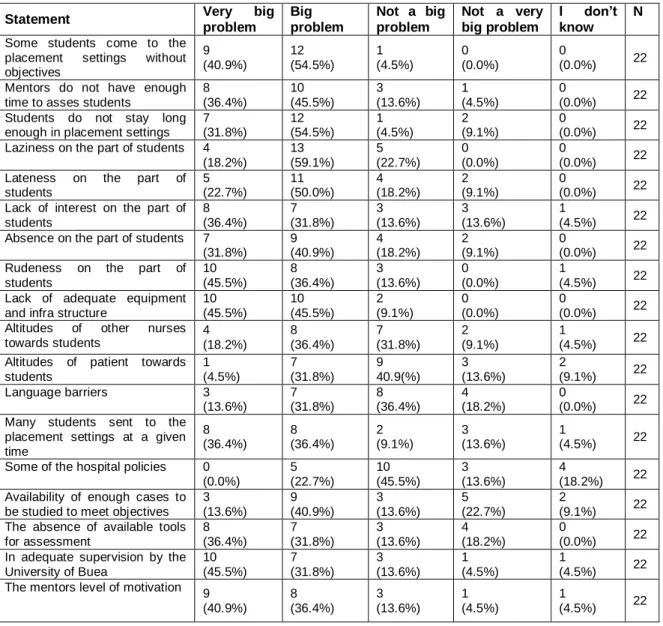
Table 2: Problems that affect assessment in placement settings as indicated by practicing nurses
during the coding it was assumed that that any idea that emerged at least ones was relevant. The existences of ideas were therefore considered more important than frequency. However, the frequency also reflected how many times a concept emerged and was a major indicator of emphasis.
RESULTS
Males and females made up 50% each of the population with their qualifications ranging from diploma through bachelors and master degree holders. For longevity of service, they participants had worked from 5-20 and above years, with age ranges from 25 to 50 and above.
Challenges Mentors face in the assessment of competencies in nursing students in placement settings
To achieve this objective, mentors were asked to react to a number of items. Data was analysed under the question “what problems do you face when assessing nursing students in placements?” a. Do you face any problems as you seek to assess nursing students in the placement setting?
Responses to this question are presented on table 2 in which 17 (77.3%) indicated that
Statement Very big
problem Big problem Not a big problem Not a very big problem I don’t know N
Some students come to the
placement settings without
objectives 9 (40.9%) 12 (54.5%) 1 (4.5%) 0 (0.0%) 0 (0.0%) 22
Mentors do not have enough time to asses students
8 (36.4%) 10 (45.5%) 3 (13.6%) 1 (4.5%) 0 (0.0%) 22
Students do not stay long enough in placement settings
7 (31.8%) 12 (54.5%) 1 (4.5%) 2 (9.1%) 0 (0.0%) 22
Laziness on the part of students 4
(18.2%) 13 (59.1%) 5 (22.7%) 0 (0.0%) 0 (0.0%) 22
Lateness on the part of
students 5 (22.7%) 11 (50.0%) 4 (18.2%) 2 (9.1%) 0 (0.0%) 22
Lack of interest on the part of students 8 (36.4%) 7 (31.8%) 3 (13.6%) 3 (13.6%) 1 (4.5%) 22
Absence on the part of students 7
(31.8%) 9 (40.9%) 4 (18.2%) 2 (9.1%) 0 (0.0%) 22
Rudeness on the part of
students 10 (45.5%) 8 (36.4%) 3 (13.6%) 0 (0.0%) 1 (4.5%) 22
Lack of adequate equipment and infra structure
10 (45.5%) 10 (45.5%) 2 (9.1%) 0 (0.0%) 0 (0.0%) 22
Altitudes of other nurses
towards students 4 (18.2%) 8 (36.4%) 7 (31.8%) 2 (9.1%) 1 (4.5%) 22
Altitudes of patient towards students 1 (4.5%) 7 (31.8%) 9 40.9(%) 3 (13.6%) 2 (9.1%) 22 Language barriers 3 (13.6%) 7 (31.8%) 8 (36.4%) 4 (18.2%) 0 (0.0%) 22
Many students sent to the placement settings at a given time 8 (36.4%) 8 (36.4%) 2 (9.1%) 3 (13.6%) 1 (4.5%) 22
Some of the hospital policies 0
(0.0%) 5 (22.7%) 10 (45.5%) 3 (13.6%) 4 (18.2%) 22
Availability of enough cases to be studied to meet objectives
3 (13.6%) 9 (40.9%) 3 (13.6%) 5 (22.7%) 2 (9.1%) 22
The absence of available tools for assessment 8 (36.4%) 7 (31.8%) 3 (13.6%) 4 (18.2%) 0 (0.0%) 22
In adequate supervision by the University of Buea 10 (45.5%) 7 (31.8%) 3 (13.6%) 1 (4.5%) 1 (4.5%) 22
The mentors level of motivation 9
(40.9%) 8 (36.4%) 3 (13.6%) 1 (4.5%) 1 (4.5%) 22
22. Int. J. Med. Clin. Sci.
challenges were faced, while 5 (22.7%) had no challenges
Table 2 clearly shows what problems practicing nurses (mentors) indicated that they had. Seventy seven point three percent (77.3%) of the mentors indicated that the level of the mentors’ motivation is a problem. Seventy seven point three percent (77.3%) of the mentors indicated that inadequate supervision by the University of Buea is another problem. Sixty eight point two percent (68.2%) indicated the absence of available tools for assessment as a problem. Fifty four point five percent (54.5%) of the mentors think that some cases are not available to be studied hence it is difficult for the study objectives to be met. Twenty two point two percent (22.2%) of the mentors indicated that some of the hospital policies are a problem. Seventy two point seven percent (72.7%) of the mentors indicated that many students were sent to the placement setting at a given time and this constitutes a problem. Forty five point five percent (45.5%) of the mentors indicated language barrier as a problem. The attitude of patients towards students was indicated as a problem by 36.4% of the mentors. The attitudes of other nurses toward students was indicated by 54.5% of the mentors as a problem. Lack of adequate equipment and infrastructure was indicated by 90.9% of the mentors to constitute a problem. Eighty one point eight percent (81.8%) of the mentors indicated that rudeness’ on the part of students is a problem. Absences on the part of students are also a problem as indicated by 68.2 % of the mentors. Some students lack interest and this constitutes a problem to up to 72.7% of the mentors. Lateness on the part of students constitutes a problem to 72.7 % of the mentors. Some mentors (77.3%) indicated that laziness on the part of students is a problem. Students do not stay long enough in placement settings. This constitutes a problem to 86.4%of the mentors. Eighty one point eight percent (81.8%) of the mentors indicated the lack of time as a problem. Some students coming to the placement settings without objectives constitute a problem to 95.8% of the mentors.
b. List other problems you face that are likely to affect the assessment process of students.
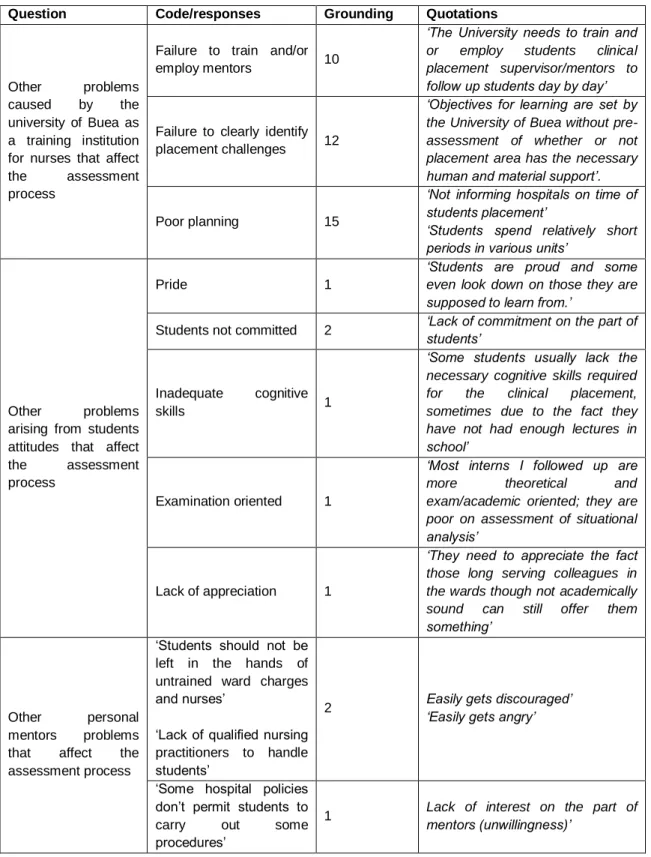
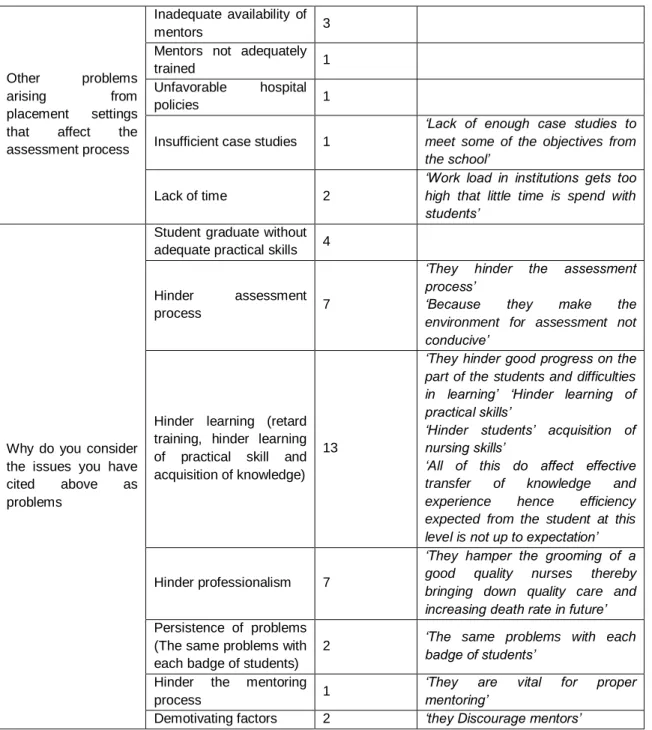
Table 3 presents other problems mentors face
apart from those listed in Table 2.These problems include: failure on the part of the University to train and/or employ mentors, clearly identify placement challenges and plan properly. Pride, lack of commitment, lack of needed cognitive skills for placements, lack of appreciation, disobedience on the part of students and the fact that some of them are examination oriented were also identified as problems. Some mentors on their part lack patience, time and interest which therefore constitute a problem. Some unfavorable hospital policies, unavailable and inadequately trained mentors in placement settings and insufficient cases to meet placement objectives also act as problems.
Some quotations from which these responses were coded include;
‘The University needs to train and or employ students’ clinical placement supervisor/mentors to follow up students day by day’ (Data 24)
‘Objectives for learning are set by the University of Buea without pre-assessment of whether or not placement area has the necessary human and material support’. (Data 25)
‘Not informing hospitals on time of students placement’ (Data 26)
‘Students spend relatively short periods in various units’ (Data 27)
‘Students are proud and some even look down on those they are supposed to learn from.’ (Data 28). ‘Lack of commitment on the part of students’ (Data 29).
Coping strategies mentors use to handle these challenges
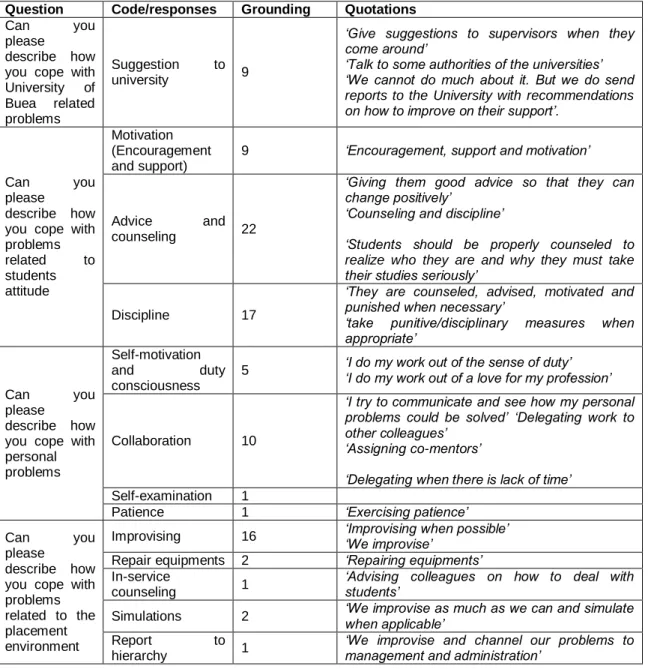
The third objective of this study was to identify the coping strategies that mentors use to deal with the problems they encounter. To achieve this aim the researcher asked mentors to react to some open ended questions. Data was analyzed under the question ‘How do you cope with the problems you encounter’ the results of the analyzed data are presented on Table 3.
Table 4 presents the coping strategies mentors use to cope with challenges in placements. The responses they gave include: suggestions to the University, the motivation, encouragement, support, counseling and advice to students and possibly disciplinary measures, self motivation, duty consciousness, self examination collaboration and patience on the part of mentors,
23. Atanga et al.,
Table 3: Other problems faced
Question Code/responses Grounding Quotations
Other problems caused by the university of Buea as a training institution for nurses that affect the assessment process
Failure to train and/or employ mentors 10
‘The University needs to train and
or employ students clinical
placement supervisor/mentors to follow up students day by day’
Failure to clearly identify placement challenges 12
‘Objectives for learning are set by the University of Buea without pre-assessment of whether or not placement area has the necessary human and material support’.
Poor planning 15
‘Not informing hospitals on time of students placement’
‘Students spend relatively short periods in various units’
Other problems arising from students attitudes that affect the assessment process
Pride 1
‘Students are proud and some even look down on those they are supposed to learn from.’
Students not committed 2 ‘Lack of commitment on the part of students’
Inadequate cognitive
skills 1
‘Some students usually lack the necessary cognitive skills required
for the clinical placement,
sometimes due to the fact they have not had enough lectures in school’
Examination oriented 1
‘Most interns I followed up are
more theoretical and
exam/academic oriented; they are poor on assessment of situational analysis’
Lack of appreciation 1
‘They need to appreciate the fact those long serving colleagues in the wards though not academically
sound can still offer them
something’
Other personal mentors problems that affect the assessment process
‘Students should not be left in the hands of untrained ward charges and nurses’
‘Lack of qualified nursing practitioners to handle students’
2 Easily gets discouraged’
‘Easily gets angry’
‘Some hospital policies don’t permit students to carry out some procedures’
24. Int. J. Med. Clin. Sci.
Table 3 Contd.
Other problems arising from placement settings that affect the assessment process
Inadequate availability of
mentors 3
Mentors not adequately
trained 1
Unfavorable hospital
policies 1
Insufficient case studies 1
‘Lack of enough case studies to meet some of the objectives from the school’
Lack of time 2
‘Work load in institutions gets too high that little time is spend with students’
Why do you consider the issues you have cited above as problems
Student graduate without adequate practical skills 4
Hinder assessment
process 7
‘They hinder the assessment process’
‘Because they make the
environment for assessment not conducive’
Hinder learning (retard training, hinder learning of practical skill and acquisition of knowledge)
13
‘They hinder good progress on the part of the students and difficulties in learning’ ‘Hinder learning of practical skills’
‘Hinder students’ acquisition of nursing skills’
‘All of this do affect effective
transfer of knowledge and
experience hence efficiency
expected from the student at this level is not up to expectation’
Hinder professionalism 7
‘They hamper the grooming of a
good quality nurses thereby
bringing down quality care and increasing death rate in future’
Persistence of problems (The same problems with each badge of students)
2 ‘The same problems with each badge of students’
Hinder the mentoring
process 1
‘They are vital for proper
mentoring’
Demotivating factors 2 ‘they Discourage mentors’
improvising where equipment is inadequate, in-service counseling, simulations, reports to hierarchy.
Some quotations from which these responses were coded include;
Give suggestions to supervisors when they
‘come around’ (Data 30)
‘Talk to some authorities of the universities’ (Data 31)
We cannot do much about it. But we do send ‘reports to the University with recommendations on how to improve on their support’ (Data 32)
25. Atanga et al.,
Table 4: Coping strategies used by mentors to handle the challenges they face
Question Code/responses Grounding Quotations
Can you
please
describe how you cope with University of Buea related problems
Suggestion to university 9
‘Give suggestions to supervisors when they come around’
‘Talk to some authorities of the universities’ ‘We cannot do much about it. But we do send reports to the University with recommendations on how to improve on their support’.
Can you
please
describe how you cope with problems related to students attitude Motivation (Encouragement and support)
9 ‘Encouragement, support and motivation’
Advice and counseling 22
‘Giving them good advice so that they can change positively’
‘Counseling and discipline’
‘Students should be properly counseled to realize who they are and why they must take their studies seriously’
Discipline 17
‘They are counseled, advised, motivated and punished when necessary’
‘take punitive/disciplinary measures when appropriate’
Can you
please
describe how you cope with personal problems
Self-motivation
and duty
consciousness
5 ‘I do my work out of the sense of duty’ ‘I do my work out of a love for my profession’
Collaboration 10
‘I try to communicate and see how my personal problems could be solved’ ‘Delegating work to other colleagues’
‘Assigning co-mentors’
‘Delegating when there is lack of time’
Self-examination 1
Patience 1 ‘Exercising patience’
Can you
please
describe how you cope with problems related to the placement environment
Improvising 16 ‘Improvising when possible’ ‘We improvise’ Repair equipments 2 ‘Repairing equipments’ In-service
counseling 1
‘Advising colleagues on how to deal with students’
Simulations 2 ‘We improvise as much as we can and simulate when applicable’
Report to
hierarchy 1
‘We improvise and channel our problems to management and administration’
‘Exercising patience’ (Data 33) ‘Improvising when possible’ (Data 34) ‘Repairing equipments’ (Data 35)
‘Advising colleagues on how to deal with students’ (Data 36)
‘We improvise as much as we can and simulate when applicable’ (Data 37)
‘We improvise and channel our problems to management and administration’ (Data 38)
Suggestions on how those problems mentors cannot solve at their level can be ameliorated.
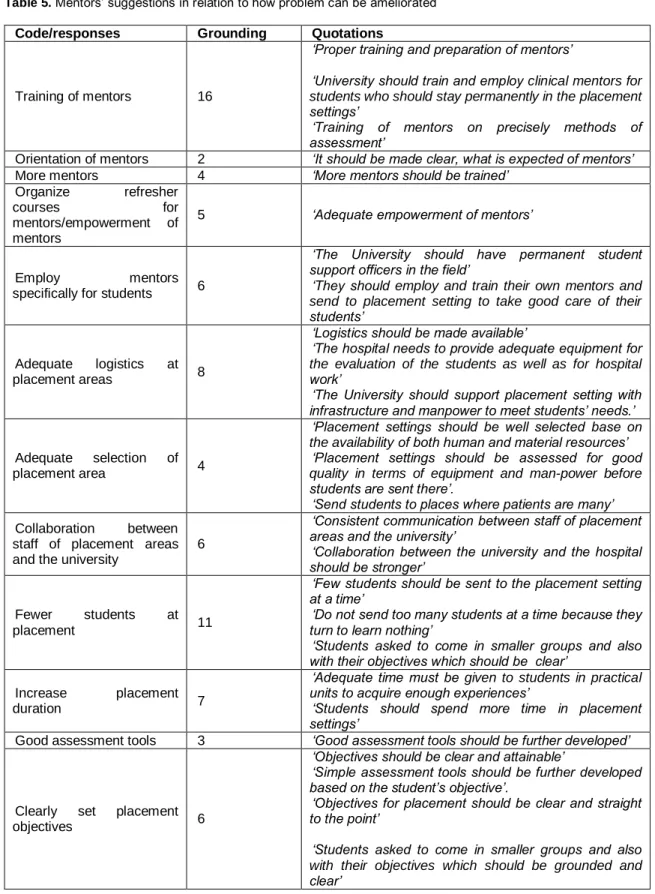
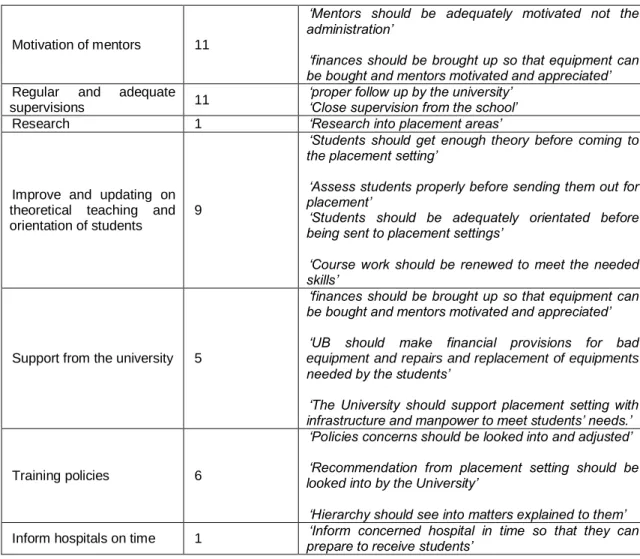
In a bit to suggest how mentors could be helped, mentors were asked to give suggestions. Their responses are presented on Table 5
Table 5 presents suggestions mentors give to ameliorate those problems they cannot solve at their level. These were that: the University should
26. Int. J. Med. Clin. Sci.
Table 5. Mentors’ suggestions in relation to how problem can be ameliorated
Code/responses Grounding Quotations
Training of mentors 16
‘Proper training and preparation of mentors’
‘University should train and employ clinical mentors for students who should stay permanently in the placement settings’
‘Training of mentors on precisely methods of assessment’
Orientation of mentors 2 ‘It should be made clear, what is expected of mentors’
More mentors 4 ‘More mentors should be trained’ Organize refresher
courses for
mentors/empowerment of mentors
5 ‘Adequate empowerment of mentors’
Employ mentors
specifically for students 6
‘The University should have permanent student support officers in the field’
‘They should employ and train their own mentors and send to placement setting to take good care of their students’
Adequate logistics at placement areas 8
‘Logistics should be made available’
‘The hospital needs to provide adequate equipment for the evaluation of the students as well as for hospital work’
‘The University should support placement setting with infrastructure and manpower to meet students’ needs.’
Adequate selection of
placement area 4
‘Placement settings should be well selected base on the availability of both human and material resources’
‘Placement settings should be assessed for good quality in terms of equipment and man-power before students are sent there’.
‘Send students to places where patients are many’
Collaboration between staff of placement areas and the university
6
‘Consistent communication between staff of placement areas and the university’
‘Collaboration between the university and the hospital should be stronger’
Fewer students at
placement 11
‘Few students should be sent to the placement setting at a time’
‘Do not send too many students at a time because they turn to learn nothing’
‘Students asked to come in smaller groups and also with their objectives which should be clear’
Increase placement
duration 7
‘Adequate time must be given to students in practical units to acquire enough experiences’
‘Students should spend more time in placement settings’
Good assessment tools 3 ‘Good assessment tools should be further developed’
Clearly set placement
objectives 6
‘Objectives should be clear and attainable’
‘Simple assessment tools should be further developed based on the student’s objective’.
‘Objectives for placement should be clear and straight to the point’
‘Students asked to come in smaller groups and also with their objectives which should be grounded and clear’
27. Atanga et al.,
Table 5. Contd
Motivation of mentors 11
‘Mentors should be adequately motivated not the administration’
‘finances should be brought up so that equipment can be bought and mentors motivated and appreciated’
Regular and adequate
supervisions 11
‘proper follow up by the university’ ‘Close supervision from the school’
Research 1 ‘Research into placement areas’
Improve and updating on theoretical teaching and orientation of students
9
‘Students should get enough theory before coming to the placement setting’
‘Assess students properly before sending them out for placement’
‘Students should be adequately orientated before being sent to placement settings’
‘Course work should be renewed to meet the needed skills’
Support from the university 5
‘finances should be brought up so that equipment can be bought and mentors motivated and appreciated’
‘UB should make financial provisions for bad equipment and repairs and replacement of equipments needed by the students’
‘The University should support placement setting with infrastructure and manpower to meet students’ needs.’
Training policies 6
‘Policies concerns should be looked into and adjusted’ ‘Recommendation from placement setting should be looked into by the University’
‘Hierarchy should see into matters explained to them’
Inform hospitals on time 1 prepare to receive students’ ‘Inform concerned hospital in time so that they can
train and employ more mentors, orientate existing mentors, and organize refresher courses for mentors, they should provide adequate logistics at placement settings, they should adequately select placement settings and ensure closer collaboration between staff of placement settings and those in the field, fewer students should be sent to the placement setting at a time, placement duration should be increased, good assessment tools should be developed, clear objectives should be set, mentors should be motivated, there should be regular and adequate supervision, research, improve and update theoretical knowledge on teaching and orientation
of students, support from the university, better planning, review training policies.
Some quotations from which these responses are coded were stated below
‘Students should get enough theory before coming to the placement setting’ (Data 39) ‘Assess students properly before sending them out for placement’ (Data 40)
‘Students should be adequately orientated before been sent to placement settings’ (Data 41) ‘Course work should be renewed to meet the needed skills’ (Data 42)
‘Few students should be sent to the placement setting at a time’ (Data 43)
28. Int. J. Med. Clin. Sci.
‘Do not send too many students at a time because they turn to learn nothing’ (Data 45) ‘Students ask to come in smaller groups and also with their objectives which should be clear’ (Data 46)‘Adequate time must be given to students in practical units to acquire enough experiences’ (Data 47)‘Students should spend more time in placement settings’ (Data 49)
‘Good assessment tools should be further developed’ (Data 50)
‘Objectives should be clear and attainable’ (Data 51)
‘Simple assessment tools should be further developed based on the student’s objective’. (Data 52)
‘Objectives for placement should be clear and straight to the point’ (Data 53)
‘Students ask to come in smaller groups and also with their objectives which should be grounded in the clear’ (Data 54).
DISCUSSION
The practicing nurses (mentors) identified four categories of problems that they face in relation to the assessment process among which the absence of refresher courses for practicing nurses’ skills in assessment is one as also documented by Wheller and Fanning (1989). Others were found to be challenging like: no objectives of the placement, no time to assess students by practicing nurses, and the students’ short stay at placement. The challenge on lack of objective should not exist as placements are supposed to be planned at the start of the academic year with objectives and rotation schemes prepared far ahead of time. Where the mentors do not have time to assess the students, the problem could be due to workload or shortage of staff. This kind of a problem can only be resolved by employment of more staff nurses to reduce the workload and give room for assessment of students. The very thing about the lack of time in the assessment of students is that the students may not award their rightful scores or ratings. It can be devastating for a weak student to be over-rated and graduated when he/she is yet to learn. The problem of no supervision by faculty staff is a chronic problem mainly because the faculty staff strength is very bad. The ideal is that there is one staff called the
placement officer whose main function is to plan the placements in collaboration with other staff and the clinical placement sites. In the absence of this person and in the midst of shortage of staff the required followed up of students at placements sites is difficult. It is however clear from this study that efforts must be made to follow up students while on placements at various practice sites. The fortunately thing from this research is that, there are various strategies that could be put in place to ameliorate the state of affairs as has been suggested by the study participants. These include: training of the mentors at practice sites. This will assist the students’ stay particularly when faculty staff is not able. The other suggestion of orientation of practice nurses and refresher courses will go a long way to resolve some the problems. This is because they will be informed trained nurses at the practice sites for better mentoring and assessment of student nurses. The coping strategies used by the assessors to overcome most of the challenges probably in the short or in the long term. These coping strategies that included suggestions to the University authorities, motivation of mentors, advice and counseling of students among others have been identified in other studies, many of which are in the African continent.
CONCLUSION
The challenges practicing nurses face when assessing students’ earned skills and competencies and numerous but the training institution has been found to have a great role to play in overcoming some of the challenges. Portner, (2005) identifies collaboration between the school and the placement setting as a key factor in the assessment of students. We therefore conclude that there are challenges, there are strategies to overcome the challenges and there are also coping mechanisms that mentors use while awaiting collaboration from the training institution to completely overcome the challenges.
RECOMMENDATIONS
1. Practicing nurses be reminded on the possible ways of assessing the uptake of clinical skills by students placed under their supervision in order to overcome some challenges and difficulties. 2. Practicing nurses who act as mentors should take it upon themselves to upgrade their skills in supporting students in placements by so doing be able to overcome any forms of challenges in assessment.
3. Students be more discipline to reduce time spent on assisting them earn clinical skills.
REFERENCES
Andrysyszyn MA (1989). Clinical Evaluation of the Affective Domain Nurse Education Today 9:75–81. Aranda N (2007). A Brief History of Nursing
Education.Retrieved 02/06/2011. http:ezinearticles.com/? A- Brief-History –of-Nursing Education id=476012.
Benner P (1984). From Novice to Expert: Excellence and Power in Clinical Nursing Practice. Addison Wesley, Mento Park.
Chan DS (1999). Assessment nursing students’ perceptions of the hospital learning environment. Thesis presented as part of the requirements for the award of the degree of doctor of philosophy of the Curtin University. Retrieved on, 06/06/09 fromhttp://dlibrary.acu.edu.au/digitaltheses/public/adt -acuvp169.24072008/02whole.pdf.
29. Atanga et al.,
Manley K, Garbert R (2000). Paying Peter and Paul; reconciling concepts of expertise with competency for a clinical career structure. Journal of clinical Nursing 9: 347 – 359.
Merotoja R, Leino–Kipli H (2001). Instruments for evaluating nurse competence. J. Nurs. Administrat. 31:346–352
McMullan M, Endacott R, Gray M (2003). Portfolios and assessment of competence: a review of the literature. J. Advanc. Nurs. 41:283 – 294
Portner C (2005). The Economic Value of Nursing. Nursing Economics,10:3, 193-204.
Sharif F, Sara M (2005). A qualitative study of nursing student experiences of clinical Practice. BMC Nursing.http:www.biomedcentral.com/info/about/ope naccess.Retrieved 06/06/2011.
The University of Sheffield and Sheffield Hollam University (2009). Interprofessional learning practice placement audit guidance notes. Retrieved on 15/06/11,fromhttp://www.cuilu.group.shef.ac.uk/IPL_ environment_guidance_notes.pdf
Wheller AH, Fanning J (1989). Developing Successful Partnerships through Collaboration. San Antonio: Sage Publication.
World Health Organization (Euro) (2001). European Strategy for Nursing and Midwifery Education; guidelines for member states on the implementation of the strategy. Copenhagen: WHO Regional Office ForEurope.EUR/01/5019304