POUR L'OBTENTION DU GRADE DE DOCTEUR ÈS SCIENCES
PAR
M.Sc. in computer science, State University of Campinas, Campinas, Brésil et de nationalité brésilienne
acceptée sur proposition du jury: Prof. C. Petitpierre, président du jury
Prof. W. Zwaenepoel, Prof. F. Pedone, directeurs de thèse Dr M. Aguilera, rapporteur
Prof. B. Garbinato, rapporteur Prof. A. Schiper, rapporteur
theory anD algorithms
Rodrigo MALTA SChMIDT
ThÈSE N
O4022 (2008)
ÉCOLE POLYTEChNIQUE FÉDÉRALE DE LAUSANNE
PRÉSENTÉE LE 7 MARS 2008À LA FACULTÉ INFORMATIQUE ET COMMUNICATIONS LABORATOIRE DE SYSTÈMES D'EXPLOITATION
PROGRAMME DOCTORAL EN INFORMATIQUE, COMMUNICATIONS ET INFORMATION
Suisse 2008
Abstract
This thesis is about the design of high-performance fault-tolerant computer systems. More specifically, it focuses on how to develop database systems that behave correctly and with good performance even in the event of failures. Both performance and dependability can be improved by means of the same technique, namely replication. If several database replicas are available, performance can be improved by distributing the load among them. Moreover, if one of the replicas cannot be accessed due to failures, users can still rely on the other ones. However, providing the interface of a single database system out of several replicas is not an easy task since one has to ensure they are always consistent with each other. Allowing replicas to diverge would easily break the illusion of having a single high-performance fault-tolerant database system.
Although we would like to have replicas as independent of each other as possible for performance and dependability reasons, we must keep them synchronized if we want to provide a consistent interface to users. In this work, we study how we can balance this trade-off to provide good performance and fault-tolerance without compromising consistency. Our basis is a widely used technique for database replication known as the deferred update technique. In this technique, transactions are initially executed in a single replica. Passive transactions, which do not change the state of the database, can commit locally to the replica they execute. Active transactions, which change the database state, must be synchronized with the transactions running on other replicas.
This thesis makes four major contributions. First, we introduce an abstract specification that generalizes the deferred update technique. This specification provides a strong model to prove lower bounds on replication algorithms, design new correct-by-construction proto-cols tailor-made for specific settings, and prove existing protoproto-cols correct more easily, in a standard way. Using this model, we show that the problem of termination of active transac-tions in deferred-update protocols is highly related to the problem of sequence agreement among a set of processes. In this context, we study the problem of implementing latency-optimal fault-tolerant solutions to sequence agreement and present a novel, highly-dynamic, algorithm that can quickly adapt to system changes in order to preserve its optimal latency. Our algorithm is based on a new agreement problem we introduce that seems to be more suitable to solve problems like sequence agreement than previously used abstractions.
Our last two contributions are in the context of specific deferred-update algorithms, where we present two new fault-tolerant protocols derived from our general abstraction. The first algorithm uses no extra assumptions about database replicas. Yet, it has very little overhead associated with the termination of active transactions, propagating only strictly necessary information to replicas. Our second protocol uses strong assumptions about the concurrency control mechanism used by database replicas to reduce even more the latency and the burden associated with transaction termination. These algorithms are good exam-ples of how our general abstraction can be extended to create new protocols and prove them correct.
Keywords: distributed systems, fault tolerance, crash-recovery, deferred-update repli-cation, serializability, sequence agreement, consensus, Paxos, collision-fast, in-memory databases, transaction termination.
R´esum´e
Cette th`ese aborde le projet de syst`emes tol´erants aux pannes de hautes performances. Plus pr´ecis´ement, elle se concentre sur le d´eveloppement de bases des donn´ees qui se com-portent correctement et avec bonne performance mˆeme en cas de d´efaillance. Tant la per-formance comme la fiabilit´e peut ˆetre am´elior´ees par la mˆeme technique, c’est-`a-dire la r´eplication. Si plusieurs r´epliques de base de donn´ees sont disponibles, la performance peut ˆetre am´elior´ee en r´epartissant la charge entre eux. De plus, si l’une des r´epliques n’est pas accessible en raison des d´efaillances, les utilisateurs peuvent toujours compter sur les autres. Toutefois, fournir l’interface d’un seul syst`eme de base de donn´ees sur plusieurs r´epliques n’est pas une tˆache facile car il faut assurer qu’ils soient toujours consistent les uns avec les autres. La permission de divergence des r´epliques peut facilement briser l’illusion d’avoir un simple syst`eme tol´erant aux pannes de haute performance.
Bien que nous aimerions avoir des r´epliques comme ind´ependantes les uns des autres pour des raisons de fiabilit´e et de performance, nous devons garder les r´epliques synchro-nis´ees si nous voulons fournir une interface coh´erente pour les utilisateurs. Dans ce tra-vail, nous ´etudions comment nous pouvons ´equilibrer cet ´echange pour fournir de bonne performance et tol´erants aux pannes sans compromettre la coh´esion. Notre base est une technique largement utilis´ee pour r´eplication de base de donn´ees connue sous le nom de technique de mise `a jour diff´er´ee (deferred update technique). Dans cette technique, les transactions sont d’abord ex´ecut´ees en une seule r´eplique. Les transactions passives, qui ne modifient pas l’´etat de la base de donn´ees, peuvent ˆetre valid´ees (committed) locale-ment `a la r´eplique qu’elles ex´ecutent. Les transactions actives, qui changent l’´etat de la base de donn´ees, doivent ˆetre synchronis´ees avec les transactions en ex´ecution sur les autres r´epliques.
Cette th`ese comporte quatre contributions majeures. Tout d’abord, nous pr´esentons une sp´ecification abstraite qui g´en´eralise la technique de mise `a jour diff´er´ee. Cette sp´ecification fournit un mod`ele fort pour prouver bornes inf´erieures (lower bounds) sur les algorithmes de r´eplication, projeter des nouveaux protocoles corrects pour construction sp´ecifiques pour des contextes particuliers, et prouver protocoles existants corrects plus facilement, et de fac¸on standard. Par l’utilisation de ce mod`ele, nous montrons que le probl`eme de la ter-minaison des transactions actives en protocoles de mise `a jour diff´er´ees est fortement li´e
au probl`eme d’accord de s´equence (sequence agreement) entre un ensemble de processus. Dans ce contexte, nous ´etudions le probl`eme d’impl´ementation des solutions tol´erantes aux pannes de latence optimal pour l’accord de s´equence et pr´esentons un algorithme origi-nal et tr`es dynamique, qui peut rapidement s’adapter aux modifications du syst`eme afin de pr´eserver sa latence optimale. Notre algorithme est bas´e sur un nouveau probl`eme d’accord qui semble ˆetre plus appropri´e pour r´esoudre des probl`emes comme l’accord de s´equence que les abstractions utilis´ees pr´ec´edemment.
Nos deux derni`eres contributions sont dans le contexte des algorithmes sp´ecifiques de mise `a jour diff´er´es, o`u nous pr´esentons deux nouveaux protocoles tol´erants aux pannes d´eriv´es de notre abstraction g´en´eral. Le premier algorithme ne utilise pas de suppositions suppl´ementaires concernant les r´epliques de base de donn´ees. Cependant, il a tr`es peu d’ove-rhead associ´e `a la terminaison des transactions actives, propageant seulement des informa-tions strictement n´ecessaires aux r´epliques. Notre deuxi`eme protocole utilise des fortes hy-poth`eses sur le m´ecanisme de contrˆole de concurrence utilis´e par les r´epliques de la base de donn´ees pour r´eduire encore plus la latence et la charge associ´ee `a la terminaison de tran-sactions. Ces algorithmes sont de bons exemples de la fac¸on dont notre abstraction g´en´erale peut ˆetre ´etendu pour cr´eer de nouveaux protocoles et les prouver correctement.
Mots-cl´es : syst`emes distribu´es, tol´erance aux fautes, technique de mise `a jour diff´er´ee, consistance, accord de s´equence, consensus, Paxos, collision, base des donn´ees en m´emoire, terminaison de transactions.
To Bianca,
for her love and support
Acknowledgments
I am very grateful to many people who helped in one way or another for this work. First of all, I would like to thank Fernando Pedone and Willy Zwaenepoel for their confidence in me, for accepting me in their research groups and for supervising me in this work.
I wish to thank all my lab colleagues at EPFL and USI for the important scientific discussions, collaborations, and friendship: L´asaro Camargos, Emmanuel Cecchet, Olivier Crameri, Steven Dropsho, Dan Dumitriu, Sameh Elnikety, Ming-Yee Iu, Aravind Menon, Nicolas Schiper, Marija Stamenkovic, Duy VO Duc, Marcin Wieloch, and Vaide Zuikevi-ciute.
I am thankful to Prof. Claude Petitpierre for accepting to preside the exam, and to the members of the jury, Dr. Marcos Aguilera, Prof. Benoˆıt Garbinato, and Prof. Andr´e Schiper for the time they spent examining this thesis and for their valuable comments.
Several other people played important roles in my doctorate. Among them, my warm thanks to Suzanne Eichenberger and Madeleine Robert for their crucial help whenever it was necessary.
Preface
This thesis concerns the Ph.D. work I did under the supervision of Prof. Fernando Pedone and Prof. Willy Zwaenepoel at the School of Computer and Communication Sciences, EPFL, from 2004 to 2007. During this period, I also worked on (1) message diffusion in unreliable environments [GPS04a, AGPSS07, GPS04b], (2) checkpointing and rollback-recovery [SGPB05, SM06], (3) rollback-recovery of in-memory database federations [SP05], and (4) partial database replication [SSP06]. More recently, I have also worked on the use of multicoordination on Paxos [CSP07].
This thesis focuses on deferred-update database replication and its relation to the problem of distributed sequence agreement. Part of the results presented in it appear in three previous papers: [SP07, SCP07, CPS06].
[SP07] R. Schmidt and F. Pedone. A Formal Analysis of the Deferred Update Technique. InProceedings of the 11th International Conference on Principles of Distributed Sys-tems (OPODIS-2007), Guadeloupe, French West Indies, December 2007.
Brief Announcement inProceedings of the 21st International Symposium on Dis-tributed Computing (DISC-2007), Cyprus, September 2007.
[SCP07] R. Schmidt, L. Camargos, and F. Pedone. On Collision-fast Atomic Broadcast. EPFL Technical Report, Switzerland, 2007.
[CSP07] L. Camargos, R. Schmidt, and F. Pedone. Multicoordinated Paxos. EPFL Techni-cal Report, Switzerland, December 2007.
Brief Announcement inProceedings of the 26th Annual ACM Symposium on Princi-ples of Distributed Computing (PODC-2007), Portland, USA, August 2007.
[AGPSS07] M. Alani, B. Garbinato, F. Pedone, R. Schmidt, and M. Stamenkovi´c. Local-Knowledge Algorithms for Structured Message Diffusion in Unreliable Environments. In2nd Workshop on Locality Preserving Distributed Computing Methods (LOCAL-ITY 2007), Portland, USA, August 2007.
[SSP06] N. Schiper, R. Schmidt, and F. Pedone. Optimistic Algorithms for Partial Database Replication. InProceedings of the 10th International Conference on Principles of
Distributed Systems (OPODIS-2006), Bordeaux, France, December 2006.
Brief Announcement in Proceedings of the 20th International Symposium on Dis-tributed Computing (DISC-2006), Stockholm, Sweden, 2006.
[CPS06] L. Camargos, F. Pedone, and R. Schmidt. A Primary-Backup Protocol for In-Memory Database Replication. InProceedings of the 5th IEEE International Sympo-sium on Network Computing and Applications (NCA-2006), Cambridge, USA, July 2006.
[SM06] R. Schmidt and P. Murray. Woodfrog: A Persistence Library for Smartfrog Com-ponents. Technical Report HPL-2006-37, HP Labs, Bristol, UK, March 2006.
[SP05] R. Schmidt and F. Pedone. Consistent Main-Memory Database Federations un-der Deferred Disk Writes. InProceedings of the 24th IEEE Symposium on Reliable Distributed Systems (SRDS-2005), Orlando, USA, October 2005.
[SGPB05] R. Schmidt, I. C. Garcia, F. Pedone, and L. E. Buzato. Asynchronous Garbage Collection for RDT Checkpointing Protocols. In Proceedings of the 25th Inter-national Conference on Distributed Computing Systems (ICDCS-2005), Columbus, USA, June 2005.
Brief Announcement inProceedings of the 23rd Annual ACM Symposium on Princi-ples of Distributed Computing (PODC-2004), St. John’s, Canada, July 2004.
[GPS04a] B. Garbinato, F. Pedone, and R. Schmidt. An Adaptive Algorithm for Efficient Message Diffusion in Unreliable Environments. InProceedings of the 2004 Inter-national Conference on Dependable Systems and Networks (DSN-2004), Florence, Italy, July 2004.
[GPS04b] B. Garbinato, F. Pedone, and R. Schmidt. A Modular Approach to Optimizing Highly-Dynamic Distributed Systems. Fast Abstract inProceedings of the 2004 In-ternational Conference on Dependable Systems and Networks (DSN-2004), Florence, Italy, 2004.
Contents
1 Introduction 1
1.1 Database Replication . . . 1
1.1.1 Distributed Locking Approach . . . 2
1.1.2 Deferred-Update Replication . . . 2
1.1.3 Consensus and Paxos . . . 3
1.2 Research Contributions . . . 3
1.3 Methodology . . . 5
1.3.1 Refinement Mappings . . . 5
1.3.2 Formal Specifications . . . 5
1.4 Thesis Organization . . . 7
2 Formal Analysis of the Deferred Update Technique 9 2.1 Serializability . . . 10
2.2 The Deferred Update Technique . . . 13
2.2.1 Preliminaries . . . 13
2.2.2 Abstract Algorithm . . . 15
2.2.3 Termination Protocol . . . 19 2.3 A Simple Implementation . . . 23 2.4 Theorem Proofs . . . 25 2.4.1 Proof of Theorem 2.1 . . . 25 2.4.2 Proof of Theorem 2.3 . . . 39 2.4.3 Proof of Theorem 2.4 . . . 40 2.5 TLA+Specifications . . . 40 2.5.1 ModuleDatabaseConstants . . . 40 2.5.2 ModuleSerializableDB . . . 43 2.5.3 ModuleOPSerializableDB . . . 45 2.5.4 ModuleAOPSerializableDB . . . 46 2.5.5 ModuleGeneralDeferredUpdate . . . 47 2.5.6 ModuleGeneralTermination . . . 52
2.6 Related Work and Final Remarks . . . 54
3 Collision-fast Sequence Agreement and Paxos 57 3.1 Sequence Agreement and Consensus . . . 58
3.2 Model and Definitions . . . 59
3.2.1 Model . . . 59
3.2.2 Sequence Agreement . . . 60
3.2.3 Algorithms . . . 61
3.3 M-Consensus . . . 63
3.3.2 Problem Definition . . . 65
3.4 Collision-fast Paxos . . . 66
3.4.1 Basic Algorithm . . . 66
3.4.2 Ensuring Liveness . . . 72
3.4.3 Runtime Reconfiguration . . . 74
3.5 Solving Sequence Agreement . . . 74
3.5.1 General Approach . . . 74
3.5.2 Collision-fast Paxos Approach . . . 75
3.6 Correctness of Collision-fast Paxos . . . 76
3.6.1 Preliminaries . . . 76
3.6.2 Abstract Collision-fast Paxos . . . 83
3.6.3 Distributed Abstract Collision-fast Paxos . . . 88
3.6.4 Collision-fast Paxos . . . 91
3.6.5 The Liveness of Collision-fast Paxos . . . 98
3.7 Correctness of the Sequence Agreement Algorithm . . . 102
3.7.1 Complete Algorithm Specification . . . 102
3.7.2 Safety . . . 104 3.7.3 Liveness . . . 106 3.8 TLA+Specifications . . . 107 3.8.1 ModuleSAgreement . . . 107 3.8.2 ModuleVMapping . . . 108 3.8.3 ModuleMConsensus . . . 110
3.8.4 ModulePaxosConstants . . . 111
3.8.5 ModuleAbstractCFPaxos . . . 115
3.8.6 ModuleDistAbsCFPaxos . . . 117
3.8.7 ModuleDistCFPaxosLiv . . . 121
3.8.8 ModuleCFPaxosSAgreement . . . 131
3.9 Related Work and Final Remarks . . . 138
4 Optimized Algorithms 141 4.1 Certification-based Algorithm . . . 142
4.1.1 Model and Definitions . . . 142
4.1.2 General Idea and Data Structures . . . 143
4.1.3 Atomic Actions . . . 146
4.1.4 Correctness and Optimizations . . . 151
4.2 In-memory Primary-Backup Replication . . . 155
4.2.1 Motivation . . . 155
4.2.2 Concurrency Control Mechanism . . . 157
4.2.3 The Algorithm . . . 158
4.2.4 Correctness and Optimizations . . . 166
4.3 TLA+Specifications . . . 169
4.3.1 ModuleCertificationBased . . . 169
4.3.2 ModuleSOPSerializable . . . 182
4.3.3 ModulePrimaryBackup. . . 183
5 Conclusion 199
5.1 Research Assessment . . . 199
Introduction
The beginning is the most important part of the work.
Plato
The focus of this thesis is on the design of high-performance fault-tolerant database systems that behave correctly and with good performance even in the event of failures. In this context, replication can be used to provide both performance and dependability. If several database replicas are available, performance can be improved by distributing the load among them. Moreover, if one of the replicas cannot be accessed due to failures, resource users can still rely on the other ones. However, providing the interface of a single database system out of several replicas is not an easy task since one has to ensure they are always consistent with each other. Allowing replicas to diverge would easily break the illusion of having a single high-performance fault-tolerant database system.
1.1
Database Replication
The problem of database replication is not recent and has been an active area of research for the last 30 years [Gif79,Sto79,Tho79]. Yet, the trade-off between the synchronization required to provide strong consistency and the performance overhead it generates is still very strong, even with recent technologies, leaving space for new contributions in the field.
1.1.1 Distributed Locking Approach
Early methods to handle database replication used distributed locks to synchronize repli-cas. The idea was basically to extend distributed locking protocols used for partitioned databases to handle replication as well. In this scenario, each data replica is considered as a different data item in the system. Read operations can acquire a single read lock from any of the replicas, but write transactions must acquire write locks on all data replicas in order to execute. Gray et al. have shown that this approach performs poorly as the number of replicated database sites increase, with a rapid growth on the number distributed deadlocks in the system [GHOS96].
Later works on database replication started to consider using group communication primitives with some ordering guarantees in order to avoid the problem of distributed dead-locks [AAAS97,PGS97,HAA99,PMJPKA00,RMA+02,KA00a,WPS+00a,WPS+00b]. Submitting operations to all replicas in total order helps to avoid deadlocks but adds a new overhead to the system since ensuring total order is expensive. This favored a class of opti-mistic protocols that executed transactions initially at a single replica and only synchronized replicas during transaction termination. Since updates are only propagated after the trans-action has executed all its operations, this approach receives the name ofdeferred update technique.
More recently, research has also been pursued on mixing ordering guarantees with dis-tributed locking to tolerate byzantine failures at the same time that disdis-tributed deadlocks are avoided [VBLM07].
1.1.2 Deferred-Update Replication
The main idea of this technique consists in executing all operations of a transaction initially on a single database. Transactions that do not change the database state can commit locally to the replica they executed, but other transactions must be globally certified and, if com-mitted, have their update operations (those that change the database state) submitted to all database replicas. This technique is adopted by a number of database replication protocols in different contexts (e.g., [AT02,KA00b,PMJPKA00,PF00,PGS03,SSP06]) for its good performance in practical scenarios. Since most practical workloads have a vast majority of read-only transactions, it allows for a good balance of the load amongst the replicas, which execute such transactions completely independent of each other.
Replicas still have to synchronize to commit transactions that change the database state. However, the technique usually packs all the transaction operations in a single message, reducing the overhead as compared to techniques that propagate updates operation by oper-ation.
1.1.3 Consensus and Paxos
Most deferred update algorithms rely directly on some sort of agreement abstraction to ter-minate update transactions. Consensus is one of the most basic agreement problems in distributed computing. In this problem, processes must agree on a single value, out of a set of proposed ones. Despite its simplicity, it is a powerful abstraction. State-machine replica-tion [Lam78] is probably the most important application of consensus. In this approach, a reliable service is implemented by replicating it in several failure-independent processors, where replicas consistently change their states by applying deterministic commands from an agreed sequence. A consensus instance is used to decide on each command in the sequence.
Paxos is a very efficient and fault-tolerant consensus protocol originally intended for state-machine replication [Lam98]. It allows efficient implementations and is very resilient to failures, which favors its use in practical systems. For this reason, we use Paxos as the basis of most algorithms in this work. During normal execution of Paxos, a set of pro-poser processes (e.g., clients) send their proposed commands to an elected leader. Upon the receipt of a commandC, the leader selects the next consensus instance to which no command has been proposed and forwardsC, under the selected consensus instance, to a set of acceptor processes. Acceptors “accept”C and send a notification to a set of learner processes (e.g., replicas). Learners learn the decision of a consensus instance when they re-ceive a notification coming from a quorum of acceptors. To tolerate the failure of the leader, each instance of consensus is further subdivided into rounds, explained later. Instances and rounds are similar in definition but completely different in purpose and the reader must be careful not to confuse them.
1.2
Research Contributions
This thesis provides the following four major contributions
Abstraction of the Deferred Update Technique. We present a formal abstraction of the deferred update technique for database replication. Despite its wide use, there was no for-malization of it up to now, forcing the design, analysis, and correctness proof of this type of protocols to be done by non-standard mechanisms. Our abstraction allows one to come up with general results concerning this family of protocols (lower and upper bounds), prove their correctness, and easily design novel correct-by-construction protocols. Based on this model, we show that, contrary to the assumptions made by previous works on deferred-update replication, the technique can cope with a concurrency control mechanism weaker than strict order-preserving serializability on database replicas. In fact, this motivated us to introduce the concept of active order-preserving serializability, which generalizes the
be-havior of some optimistic concurrency control algorithms and can be safely employed on general deferred-update algorithms. Using this model, we show that the problem of termi-nation of active transactions in deferred-update protocols is highly related to the problem of sequence agreement among a set of process.
M-Consensus and Collision-fast Paxos. Collision-fast Paxos a very efficient fault-tolerant solution to the problem of sequence agreement, a sequence-based specification of the atomic broadcast problem[HT93]. Our latency-optimal algorithm, derived from the celebrated Paxos consensus protocol [Lam98], is very dynamic and can quickly reconfigure and adapt to failures, which distinguishes it from previous approaches achieving similar bounds. Our algorithm is based on a variant of the consensus problem we call M-Consensus. M-Consensus is more general than the original consensus problem, being much more suitable as a building block for efficient sequence agreement implementations. We have extensively proved safety and liveness of our solutions to both M-Consensus and sequence agreement and we believe that some of the techniques we used are general enough to be applied to other agreement problems.
Certification-based Deferred-Update Algorithm. This is a general deferred-update al-gorithm that requires no extra assumptions about the database engines and, yet, has very lit-tle overhead associated with the termination of active transactions, propagating only strictly necessary information to replicas. We use the knowledge obtained from working with the Paxos protocol to implement termination very efficiently, with the same latency and degree of fault tolerance as the original algorithm. It can certify and propagate active transactions to replicas within three communication steps as seen from the client. We know of no pre-vious protocol that can ensure this latency propagating the same amount of information we do.
In-memory Primary-Backup Replication Algorithm. In this algorithm, we use strong assumptions about the concurrency control mechanism used by database replicas to reduce even more the latency and the burden associated with transaction termination, requiring only two communication steps and no extra certification procedure to commit proposed transactions. This algorithm can be nicely coupled with in-memory databases to provide very good performance in practice. Besides its practical relevance, it also shows how our deferred-update abstraction can help the design and analysis of protocols even if termination depends on stronger assumptions about the consistency guarantees of database replicas.
1.3
Methodology
Our methodology for this work is to use correctness proofs based on refinement mappings from complex algorithms to simpler, easily-proven, abstractions, and write our algorithms and abstractions in terms of formal specifications.
1.3.1 Refinement Mappings
There are basically two ways of proving correctness of algorithms: behavioral and asser-tional reasoning. In behavioral reasoning, proofs are based on the possible behaviors of the algorithm and the actions whose execution led to one or another state. In assertional rea-soning, proofs are based on invariants kept by the actions performed by the specification. Complex distributed algorithms can be very hard to reason about in terms of behaviors. The huge number of possible execution paths and corner cases can make it very easy to forget checking one or another possibility. For this reason, due to the complexity of our algorithms, we decided to use assertional reasoning to prove their correctness.
We use Lamport’s transition axiom method [Lam89] to specify and reason about prob-lems and algorithms. In this assertional method, correctness is proved by finding a correct refinement mapping from an algorithm to an abstract specification [AL91]. These refine-ment mappings are proved with the help of invariants and assertional reasoning about the algorithm. The advantage of this method is that it breaks correctness proofs in multiple independent parts and allows for very precise proofs.
To increase our confidence in the results we present, we wrote our proofs very carefully. Nevertheless, some steps can become very complicated and must be divided into sub-steps to avoid mistakes. The best method we found to structure our proofs without risking making mistakes is the one explained in [Lam95]. This is a very simple method that uses itemization to break a proof into multiple steps and help their presentation.
1.3.2 Formal Specifications
Practical systems and algorithms are usually complex and difficult to analyze and prove correct. Experience has shown that the “social process” of mathematics does not operate the same way in the world of system design [MLP79]. We will hardly see engineers discussing about correctness proofs of complicated systems, specially if they did not participate in their design. Correctness of complex systems depend mainly, if not uniquely, on how careful their designers were when developing their ideas. Careless design can lead to problems much more complicated than simple programming bugs since incorrect algorithms may force a
system to be completely redesigned.
In this work, we wanted to make our algorithms as practical as possible and, in order to cope with the problem above, we used formal specifications to reason about abstractions and algorithms in this thesis. This forced us to care about many important details and helped us find many mistakes in the original design of our ideas. More specifically, we used the TLA+specification language [Lam02] for its power and simplicity with respect to the specification of distributed systems. Moreover, the existing tools for TLA+allowed us to find and correct many mistakes and the possibility of model checking our specifications increased the confidence in our results.
In the chapters that follow, we use natural language and simple pseudo-code to describe our specifications of abstractions and algorithms. However, at the end of each chapter, we also present our unambiguous TLA+specifications. We have put them there to break any ambiguity or doubt that our higher-level description might create. We tried to put as many comments as possible in our specifications to make them more easily readable in case of necessity.
TLA+ specifications are not very different from the pseudo-code based on atomic ac-tions usually used to describe distributed algorithms. The most important part of any speci-fication is the description of the atomic actions it allows, so we can concentrate on that for this brief introduction. In TLA+, each action is specified as a logical expression on old and new variable values, where operator0refers to the state a variable has after the action takes place. As an example, an action that simply assigns to variablex its previous value plus 3 is represented by the logic expressionx0 =x+ 3.
Some aspects about its syntax might make expressions that define actions look more complicated than they actually are. One of these aspects is the use of indentation to avoid using parentheses. In TLA+, we can write expression(((a ∨b)∧(c∨d))∨e)as shown in Figure 1.1. In fact, this visual representation of expressions makes it much easier to understand the complicated enabling conditions found in distributed algorithms.
∨ ∧ ∨a
∨b
∧ ∨c
∨d
∨e
Figure 1.1: TLA+Example
To allow the composition of specifications, each action must specify the state change of every variable in the system. Leaving a variable unspecified means that it can assume any value if the action is executed. Operator UNCHANGED is used to simplify the task
for the list of variables that are not changed by an action. Another useful operator worth mentioning here is the operator EXCEPT. The expression[q EXCEPT ![x] = y], where
qis a vector, returns a vector almost equal toq except for entryx, which is set to valuey. This operator is extremely helpful when dealing with vectors.
In summary, TLA+ specifications are given by a disjunction of action expressions. These actions are specified as the conjunction of their pre- and post-conditions, in a very in-tuitive way. As an example, to define an actionChangeState(v)that sets entryxof vector
vectov when variableyequalsvec[x], we write the following TLA+expression.
ChangeState(v) =∆ ∧vec[x] =y pre-condition ∧vec0 = [vecEXCEPT![x] =v] ∧UNCHANGEDhy,xi
1.4
Thesis Organization
The thesis is organized as follows. Chapter 2 introduces our deferred-update abstraction. It explains the database models we assume and proves some lower and upper bounds con-cerning termination of active transactions, including the necessity of solving the sequence agreement problem. This chapter also gives a simple example of how our abstract algorithm can be extended into a distributed implementation. Chapter 3 presents our latency-optimal and very dynamic solution to the sequence agreement problem, based on the Paxos consen-sus protocol. It also introduces an abstraction different from consenconsen-sus, more suitable for fast sequence agreement implementations. Chapter 4 shows how the abstraction presented in Chapter 2 can be used to design new correct-by-construction deferred-update protocols. It introduces a general algorithm with very good latency and low overhead and a more spe-cific algorithm that depends on special consistency guarantees given by the replicas to offer even lower latency and overhead. In Chapter 5, we summarize the major results of this work and outline future research directions.
Formal Analysis of the Deferred
Update Technique
If people do not believe that mathematics is simple, it is only because they do not realize how complicated life is.
John Louis von Neumann
In the deferred update technique, a number of database replicas are used to imple-ment a single serializable database interface. This technique is adopted by a number of database replication protocols in different contexts (e.g., [PGS97, KA00b, PMJPKA00,
PF00, PGS03, SSP06]) for its good performance in general scenarios. The class of de-ferred update protocols is very heterogeneous, including algorithms that can optimistically apply updates of uncertified transactions [PMJPKA00], certify transactions locally to the database that executed them [KA00b], execute all concurrent update transactions at the same database [PF00], reorder transactions during certification [PGS97,PGS03], and even cope with partial database replication [SSP06]. However, all of them share the same basic structure, giving them some common characteristics and constraints.
Despite its wide use, we are not aware of any work that explored more deeply the the-oretical aspects of deferred-update database replication. Ours seems to be the first attempt in this direction. In this chapter, we specify a general abstract deferred update algorithm that embraces all the protocols we know of. This general specification allows us to for-mally characterize the deferred update technique and rigorously prove its properties. As an example, we isolated the building block responsible for committing and propagating up-date transactions and showed its specific relation with distributed agreement problems. Our abstraction also eases the task of proving protocols correct, since it suffices to show a cor-rect refinement mapping. Moreover, being a generalization of the technique, the abstract algorithm can also be used to derive new correct-by-construction protocols from it.
2.1
Serializability
The consistency criterion for transactional systems in general is Serializability, which is defined in terms of the equivalence between the system’s actual execution and a serial ex-ecution of the submitted transactions [BHG87]. Traditional definitions of equivalence be-tween two executions of transactions referred to the internal scheduling performed by the algorithms and their ordering of conflicting operations. This approach has led to differ-ent notions of equivalence and, therefore, differdiffer-ent subclasses of Serializability [Pap79]. In a distributed scenario, however, defining equivalence in terms of the internal execution of the scheduler is not straightforward since there is usually no central scheduler respon-sible for ordering transaction operations. To compare a serial centralized schedule with a general distributed one (e.g., in a replicated database), one has to create mappings be-tween the operations performed in both schedules and extend the notion of conflicting op-erations to deal with sets of opop-erations, since a single operation in the serial centralized schedule may be mapped to a set of operations executed on different sites in the distributed one [BHG87]. This approach is highly dependent on the implemented protocol and, as explained in [LMWF94], does not generalize well.
Differently, we specify a general serializable database system, which responds to re-quests according to some internal serial execution of the submitted transactions. A database protocol satisfies serializability if it implements the general serializable database specifica-tion, that is, if its interface changes could be generated by the general serializable database. This sort of analysis is very common in distributed systems for its compromise between abstraction and rigorousness [Lam02,Lyn96,LMWF94].
In our specification of serializability, we first define all valid state transitions for normal interactions between the clients and the database, without caring about the values returned as responses to issued operations, but rather storing them internally as part of the transaction state. The database is free to abort a transaction at any time during the execution of its operations. However, a transaction t can only be committed if its commit request was issued and there exists a sequential execution order for all committed transactions andt that corresponds to the results these transactions provided. We say the transaction isdecidedif the database has aborted or committed it. Operations issued for decided transactions get the final decision as its result.
We assume each transaction has a unique identifier and let Tid be the set of all identifiers. We call Op the set of all possible transaction operations, which execute over a database state in set DBState and generate a result in set Result and a new database state. We abstract the correct execution of an operation by the predicate
CorrectOp(op,res,dbst,newdbst), which is true iff operation op, when executed over database state dbst, may generate res as the operation result and newdbst as the new database state. This makes our specification completely independent of the set of allowed operations, coping with predicate-based or nondeterministic ones. As a simple example, one
could define a database with two integer variablesx andy with read and write operations for each variable. In this case,DBstatecorresponds to all possible combinations of values forx andy,Opis the combination of an identifier forx ory with a read tag or an integer (in case of a write), andResult is the set of integers. CorrectOp(op,res,dbst,newdbst) is satisfied iffnewdbstandres correspond to the results for the read or write operationop
applied todbst.
Two special requests,CommitandAbort, both not present inOp, are used to terminate a transaction, that is, to force a decision to be taken. Two special responses,Committed
andAborted, not present inResult, are used to tell the database user if the transaction has been committed or aborted. We also define some auxiliary sets to help us deal more easily with these special requests and responses. Specifically, we defineDecided to equal the set {Committed,Aborted}, Request to equalOp ∪ {Commit,Abort}, and Reply to equal
Result∪Decided.
During a transaction’s execution, operations are issued and responses are given until the client issues aCommit orAbort request or the transaction is aborted by the database for some internal reason. We represent the history of a transaction execution by a sequence of elements inOp×Result, corresponding to the sequence of operations executed on the transaction’s behalf and their respective results. We say that a transaction historyhis atom-ically correct with respect to initial database state initst and final database state finalst
iff it satisfies the recursive predicate defined below, whereTHist is the set of all possible transaction histories andHead andTail are the usual operators for sequences. Moreover, for notation simplicity, we identify the first and second elements of a tuplet inOp×Result
byt.opandt.res, respectively.
CorrectAtomicHist(h ∈THist,initst,finalst ∈DBState) =∆
if h=hi then initst=finalst
else ∃ist ∈DBState: CorrectOp(Head(h).op,Head(h).res,initst,ist)∧ CorrectAtomicHist(Tail(h),ist,finalst)
Intuitively, a transaction history is atomically correct with respect toinitst andfinalst iff there are intermediate database states so that all operations in the history can be executed in their correct order and generate their correct results.
During the system’s execution, many transactions are started and terminated (possibly concurrently). We represent the current history of all transactions by a data structure calledhistory vectorthat maps each transaction to its current history. We abstract this data structure by the setTHistVector, containing all the possible history vectors. A sequence
seq of transactions and a history vector thist correspond to a correct serialization with respect to initial state initst and final state finalst iff the recursive predicate below is satisfied, whereSeq(S)represents the set of all finite sequences of elements in setS.
CorrectSerialization(seq ∈Seq(Tid),thist ∈THistVector,initst,finalst ∈DBState) =∆
if seq =hi then initst=finalst
else ∃ist ∈DBState: CorrectAtomicHist(thist(Head(seq)),initst,ist)∧ CorrectSerialization(Tail(seq),thist,ist,finalst)
Intuitively, this predicate is satisfied iff there are intermediate database states so that all transactions in the sequence can be atomically executed in their correct or-der generating the correct results for their operations. We can now easily define a predicate IsSerializable(S,thist,initst) for a finite set of transaction id’s S, history vector thist, and database state initst, satisfied iff there is a sequence seq containing exactly one copy of each element in S and a final database state finalst such that
CorrectSerialization(seq,thist,initst,finalst) is satisfied. Predicate IsSerializable
indicates when a set of transactions can be serialized in some order, according to their execution history, so that every operation returns its correct result when the execution is started in a given database state.
We abstract the interface of our specification by the primitives DBRequest(t,req), which represents the reception of a request req on behalf of transaction t, and
DBResponse(t,rep), which represents the database response to the last request on behalf oft with replyrep. The only restriction we make with respect to the database interface is that an operation cannot be submitted on behalf of transactiont if the last operation sub-mitted for t has not been replied yet, which releases us from the burden of using unique identifiers for operations in order to match them with their results. Notice that the system still allows a high degree of concurrency since operations from different transactions can be submitted concurrently.
Our specification is based on the following internal variables:
thist: A history vector, initially mapping each transaction to an empty history.
tdec: A mapping from each transaction to its current decision status: Unknown,
Committed, orAborted. Initially, it maps each transaction toUnknown.
q: A mapping from each transaction to its current request orNoReq if no request is being executed on behalf of that transaction. Initially, it maps each transaction toNoReq.
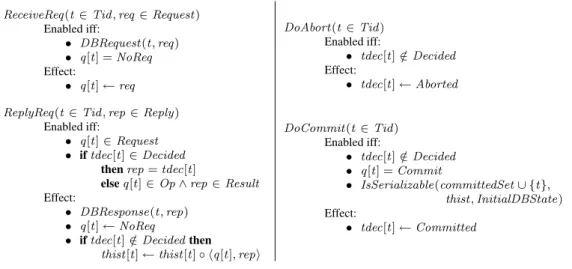
Figure 2.1 presents the pseudo-code for the atomic actions of our specification. Action
ReceiveReq(t,req)is responsible for receiving a request on behalf of transactiont. Action
ReplyRep(t,rep)replies to a received request. It is enabled only if the transaction has been decided and the reply is the final decision or the transaction has not been decided but the current request is an operation (neitherCommitnorAbort) and the reply is inResult. This means that responses given after the transaction has been decided carry the final decision and requests to commit or abort a transaction are only replied after the transaction has
ReceiveReq(t ∈Tid,req∈Request) Enabled iff: • DBRequest(t,req) • q[t] =NoReq Effect: • q[t]←req
ReplyReq(t ∈Tid,rep∈Reply) Enabled iff:
• q[t]∈Request • iftdec[t]∈Decided
thenrep=tdec[t]
elseq[t]∈Op∧rep∈Result Effect:
• DBResponse(t,rep) • q[t]←NoReq
• iftdec[t]∈/Decidedthen
thist[t]←thist[t]◦ hq[t],repi
DoAbort(t∈Tid) Enabled iff: • tdec[t]∈/ Decided Effect: • tdec[t]←Aborted DoCommit(t ∈Tid) Enabled iff: • tdec[t]∈/ Decided • q[t] =Commit • IsSerializable(committedSet∪ {t}, thist,InitialDBState) Effect: • tdec[t]←Committed
Figure 2.1: The atomic actions allowed in our specification of a serializable database.
been decided. ActionReplyReq is responsible for updating the transaction history if the transaction has not been decided. It does that by appending the pairhq[t],repi tothist[t] (we use◦to represent the standardappendoperation for sequences). ActionDoAbort(t) simply aborts a transaction if it has not been decided yet. ActionDoCommit(t)commitst
only if at’s commit request was issued and the set of all committed transactions (represented bycommittedSet) together with t is serializable with respect to the initial database state, denoted by the constantInitialDBState.
2.2
The Deferred Update Technique
2.2.1 Preliminaries
As mentioned before, deferred update algorithms initially execute transactions on a single replica. Transactions that do not change the database state (hereinafter calledpassive) may commit locally only, butactivetransactions (as opposed to passive ones) must be globally certified and, if committed, have their updates propagated to all replicas (i.e., operations that make them active). In order to correctly characterize the technique, we need to formalize the concepts of active and passive operations and transactions. An operationopis passive iff its execution never changes the database state, that is, iff the following condition is satisfied.
∀st1,st2 ∈DBState,rep ∈Result :CorrectOp(op,rep,st1,st2)⇒st1 =st2 (2.1) An operation that is not passive is called active. Similarly, we define a transaction historyh
to be passive iff the condition below is satisfied.
Notice that a transaction history composed of passive operations is obviously passive, but the converse is not true. A transaction that adds and subtracts1to a variable is passive even though its operations are active.
The deferred update technique requires some extra assumptions about the system. Oper-ations, for example, cannot generate new database states nondeterministically for this could lead different replicas to inconsistent states. The following assumption makes sure that operations do not change the database state nondeterministically but still allows nondeter-ministic results to be provided to the database user.
Assumption 2.1 (State-deterministic operations) For every operationop, and database statesst andst1, if there is a resultres1such thatCorrectOp(op,res1,st,st1), then there is no resultres2and database statest2such thatst16=st2∧CorrectOp(op,res2,st,st2).
As for the database replicas, one may wrongly think that simply assuming that they are serializable is enough to ensure global serializability. However, two replicas might serialize their transactions (local and global) differently, making the distributed execution non-serializable. Consider, for example, an execution with two active transactionst1 and
t2, operating in a database whose state is composed of two integer variables,x andy, both initially0. Assumet1 writes1tox,t2 writes1toy, and all databases receive both trans-actions and commit them. Notice that any ordering of these two transtrans-actions is serializable. Now, assume that a single replicar1 executes a passive transaction t3 that reads the state hx = 0,y = 1i. Since the sequenceht2,t3,t1i represents a correct execution,t3 is free to commit. Assume that a second replicar2, which will never be notified oft3 for it is a passive transaction, executes a passive transactiont4 that reads the statehx = 1,y = 0i. The sequenceht1,t4,t2irepresents a correct serial execution of the transactions submitted to replicar2andt4 is also free to commit. However, no sequential execution containing all four transactions can generate their correct results, making it impossible for a serializable interface to commit all of them.
For this reason, previous works on deferred update protocols assumed the notion of order-preserving serializability, originally introduced by Beeri et al. in the context of nested transactions [BBG89]. In our model, order-preserving serializability ensures that the trans-actions’ commit order represents a correct execution sequence, a condition satisfied by two-phase locking, for example. We show that this assumption can be relaxed since deferred update protocols can work with the weaker notion ofactive order-preserving serializabil-itywe introduce. Active order-preserving serializability ensures that there is an execution sequence of the committed transactions that generates their correct outputs and respects the commit order of allactive transactions only. This notion is weaker than strict order-preserving serializability in that passive transactions do not have to provide results based on the latest committed state. Some multiversion concurrency control mechanisms [BHG87] are active order-preserving but not strict order-preserving.
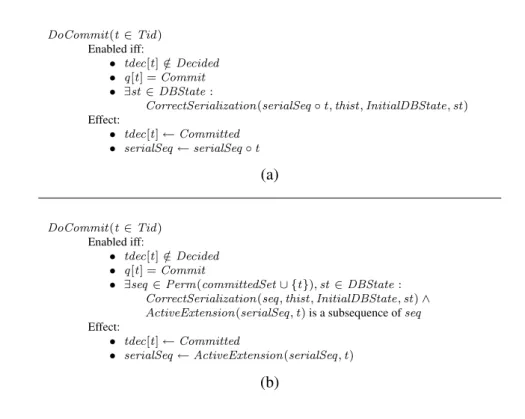
DoCommit(t ∈Tid) Enabled iff:
• tdec[t]∈/Decided • q[t] =Commit • ∃st∈DBState:
CorrectSerialization(serialSeq◦t,thist,InitialDBState,st) Effect: • tdec[t]←Committed • serialSeq←serialSeq◦t (a) DoCommit(t ∈Tid) Enabled iff: • tdec[t]∈/Decided • q[t] =Commit
• ∃seq ∈Perm(committedSet∪ {t}),st∈DBState: CorrectSerialization(seq,thist,InitialDBState,st)∧ ActiveExtension(serialSeq,t)is a subsequence ofseq Effect:
• tdec[t]←Committed
• serialSeq←ActiveExtension(serialSeq,t)
(b)
Figure 2.2:DoCommitaction for (a) strict and (b) active order-preserving serializability.
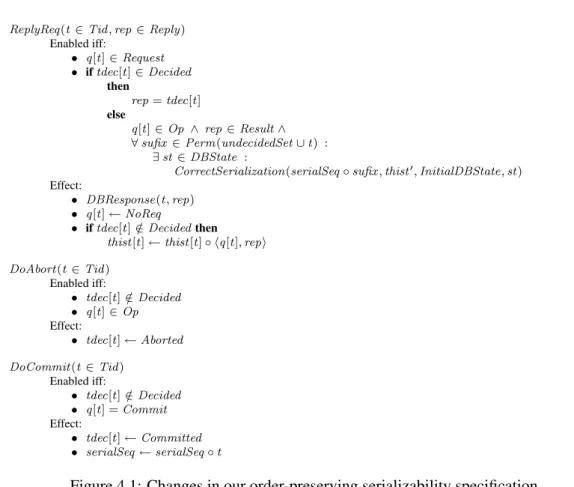
Specifications of order-preserving and active order-preserving serializability can be de-rived from our specification in Figure 2.1 by just adding a variableserialSeq, initially equal to the empty sequence, and changing theDoCommitaction. We show the required changes in Figure 2.2 below. The strict case (a) is simple and only requires thatserialSeq◦tbe a cor-rect sequential execution of all committed transactions. The action automatically extends
serialSeq with t. The active case (b) is a little more complicated to explain and requires some extra notation. LetPerm(S) be the set of all permutations of elements in finite set
S (all the possible orderings of elements inS), and letActiveExtension(seq,t)be seq if
thist[t]is a passive history orseq◦t otherwise. The action is enabled only if there exists a sequence containing all committed transactions such that it represents a correct sequential execution andActiveExtension(seq,t)is a subsequence of it.1 In this action,serialSeq is extended witht only ift is an active transaction.
2.2.2 Abstract Algorithm
Our abstract deferred update algorithm generalizes the ideas of a handful of deferred update protocols and makes it easy to think about sufficient and necessary requirements for them
1
to work correctly. Our specification assumes a setDatabaseof active order-preserving seri-alizable databases, and we use the notationDB(d)!Primitive( )to represent the execution of interface primitivePrimitive (eitherDBRequest orDBResponse) of databased. Since transactions must initially execute on a single replica only, we letDBof(t) represent the database responsible for the initial execution of transactiont. One important remark is that these internal databases receive transactions whose id set isTid×N, whereNis the set of natural numbers. This is done so because a single transaction in the system might have to be submitted multiple times to a database replica in order to ensure that it commits locally. Recall that our definition of active order-preserving serializability does not force transac-tions to commit. Therefore, transactransac-tions that have been committed by the algorithm and submitted to the database replicas are not guaranteed to commit unless further assumptions are made. The only way around this is to submit these transactions multiple times (with different versions) until they commit. Besides the set of databases, we assume a concurrent termination protocol, fully explained in the next section, responsible for committing active transactions and propagating their active operations to all databases.
The algorithm we present in the following orchestrates the interactions between the global database interface and the individual internal databases. It is mainly based on the following internal variables:
thist,q: Essentially the same variables as in the specification of a serializable database.
dreq: A mapping from each transactiont to the operation that is currently being submitted for execution onDBof(t), orNoReqif no operation is being submitted. This variable is used to implement the asynchronous communication that tellsDBof(t)to execute an operation oft. Initially all transactions are mapped toNoReq.
dreply: Similar to dreq, but mapping each transaction t to the last response given by
DBof(t).
dcnt: A mapping from each database d and transaction t to an integer representing the number of operations that executed on d for t. It counts the number of operations
DBof(t)has executed fort duringt’s initial execution and, ift is active, the number of active operations the other databases (orDBof(t) if it does not manage to com-mitt directly after it is globally committed) have executed for t after it is globally committed. It is initially 0 for all databases and transactions.
pdec: A mapping like tdec in the specification of a serializable database, used to tell whether the transaction was decided without being proposed for global termination either because it was prematurely aborted during its initial execution or because it was a passive transaction that committed on its execution database.
vers: A mapping from each database d and transaction t to an integer representing the current version oft being submitted tod. It is initially 0 for all databases and trans-actions.
dcom: A mapping from each database d and transactiont to a boolean telling whether t
has been committed ond. It is initially false for all databases and transactions.
When aCommit request is issued for a transaction whose history has been active, a decision must be taken on whether to commit or abort this transaction with respect to active transactions executed on other databases. In our specification, this is done separately by a termination protocol. The reason why we isolated this part of the specification is twofold. First, the nature of the rest of the algorithm is essentially local to the database that is exe-cuting a given transaction and it seems interesting to separate it from the part of the spec-ification responsible for synchronizing active transactions executed on different databases. Second, the properties of the termination protocol, when isolated, can be related to prop-erties of other agreement problems in distributed computing, which helps understand and solve it. The interface variables of the termination protocol used in our general specification are the following:
proposed: This is an input variable that keeps the set of all proposed transactions. It is initially empty.
gdec: An output variable that keeps a mapping likepdecabove, but managed by the termi-nation protocol only. It tells whether a proposed transaction has already been decided or not.
learnedSeq: Another output variable mapping each databased to a sequence of globally committed active transactions. This sequence tells database d the order in which these active transactions must be committed to make the whole execution serializable. Initially, it maps each database to the empty sequence.
Our specification implements a serializable database, which can be proved by a refine-ment mapping from its internal variables to those of a general serializable database. Ac-tually, the only internal variable of our specification of a serializable database not directly implemented in our abstract algorithm istdec, given by joining the values ofpdecandgdec
in the following way:
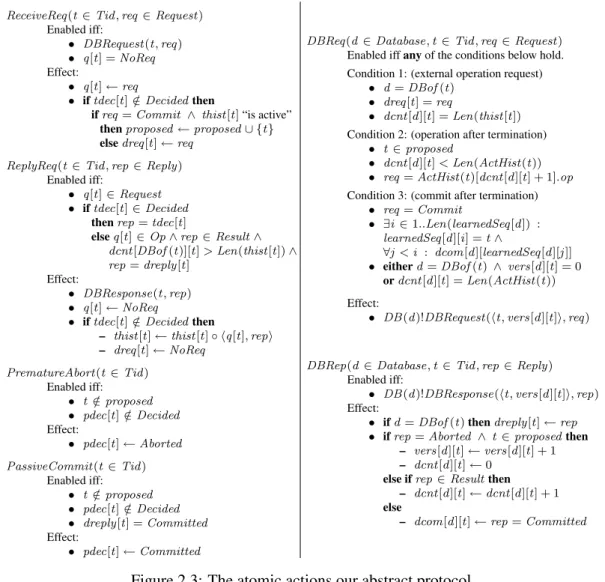
tdec[t] =∆ if t ∈proposed thengdec[t]elsepdec[t] (2.3) For simplicity, we use this definition oftdec in some parts of our specification. Another extra definition used in our algorithm is theActHist(t)operator that returns a subsequence ofthist[t]containing all its active operations. The atomic actions of our abstract algorithm, without the internal actions of the individual databases and the termination protocol, are shown in Figure 2.3.
ActionReceiveReq treats the receipt of a transaction request. If the transaction respon-sible for the operation has been decided (either forpdecorgdecaccording to the definition
ReceiveReq(t∈Tid,req ∈Request) Enabled iff: • DBRequest(t,req) • q[t] =NoReq Effect: • q[t]←req
• iftdec[t]∈/Decidedthen
ifreq=Commit ∧ thist[t]“is active”
thenproposed ←proposed∪ {t} elsedreq[t]←req
ReplyReq(t∈Tid,rep ∈Reply) Enabled iff:
• q[t]∈Request • iftdec[t]∈Decided
thenrep=tdec[t]
elseq[t]∈Op∧rep∈Result∧ dcnt[DBof(t)][t]>Len(thist[t])∧ rep=dreply[t]
Effect:
• DBResponse(t,rep) • q[t]←NoReq
• iftdec[t]∈/Decidedthen
– thist[t]←thist[t]◦ hq[t],repi – dreq[t]←NoReq PrematureAbort(t ∈Tid) Enabled iff: • t ∈/proposed • pdec[t]∈/ Decided Effect: • pdec[t]←Aborted PassiveCommit(t ∈Tid) Enabled iff: • t ∈/proposed • pdec[t]∈/ Decided • dreply[t] =Committed Effect: • pdec[t]←Committed
DBReq(d∈Database,t∈Tid,req ∈Request) Enabled iffanyof the conditions below hold. Condition 1: (external operation request)
• d=DBof(t) • dreq[t] =req
• dcnt[d][t] =Len(thist[t]) Condition 2: (operation after termination)
• t∈proposed
• dcnt[d][t]<Len(ActHist(t)) • req=ActHist(t)[dcnt[d][t] + 1].op Condition 3: (commit after termination)
• req=Commit
• ∃i∈1..Len(learnedSeq[d]) : learnedSeq[d][i] =t∧
∀j<i : dcom[d][learnedSeq[d][j]] • eitherd=DBof(t) ∧ vers[d][t] = 0
ordcnt[d][t] =Len(ActHist(t)) Effect:
• DB(d)!DBRequest(ht,vers[d][t]i,req)
DBRep(d∈Database,t∈Tid,rep ∈Reply) Enabled iff:
• DB(d)!DBResponse(ht,vers[d][t]i,rep) Effect:
• ifd=DBof(t)thendreply[t]←rep • ifrep=Aborted ∧ t∈proposedthen
– vers[d][t]←vers[d][t] + 1
– dcnt[d][t]←0
else ifrep∈Resultthen – dcnt[d][t]←dcnt[d][t] + 1
else
– dcom[d][t]←rep=Committed
Figure 2.3: The atomic actions our abstract protocol.
of tdec given above), then it only changes q[t]. Otherwise, it either proposes t for the termination protocol or sends the request toDBof(t)through variabledreq[t]. Our com-plete specification allows passive transactions to be submitted for the termination protocol too and this is why we wrote “is active” between quotation marks. We allow that because sometimes it might not be possible to identify all passive transactions. Therefore, our spec-ification also embraces algorithms that identify only a subset of the passive transactions as passive and conservatively propose the others for global termination.
Action ReplyReq replies a transaction request. It is very similar to the original
ReplyReqaction of our serializable database specification. The small differences only make sure that the value replied for a normal operation comes fromDBof(t)and, in this case,
PassiveCommit abort or commit a transaction that has not been proposed for global ter-mination. It can only be committed if a commit request was correctly replied byDBof(t), which can only happen ift has a passive history.
ActionDBReq submits a request to a database. There are three conditions that enable this action. The first one represents a normal request during the transaction’s initial execu-tion or a commit request for a passive transacexecu-tion. The second one represents an operaexecu-tion request for an active transaction that has been proposed to the termination protocol. Notice that operations of proposed transactions can be optimistically submitted to the database be-fore they commit or appear in somelearnedSeq. Some algorithms do that to save processing time after the transaction is committed, reducing the latency for propagating transactions to the replicas. The third condition that enables this action represents a commit request for a transaction that has been committed by the termination protocol. For that to happen, the transaction must be present inlearnedSeq[d]and all transactions previous to it in the se-quence must have been committed on that database. Moreover, all active operations of that transaction must have been applied to the database already, which is true if the database is the one originally responsible for the transaction and it has not changed the transaction version or the operations counterdcnt[d][t]equals the number of active operations in the transaction history. Recall that, by the definition of a serializable database, a request can only be submitted if there is no pending request for the same transaction. This is actually an implicit pre-condition forDBReqgiven by the specification of a serializable database.
ActionDBReptreats the receipt of a response coming from a database. If the database is the one responsible for initially executing the transaction, it setsdrepy[t]to the value returned. If the transaction is aborted but it has been proposed for global termination, it changes the version of that transaction on that database and sets the operation counter to zero so that the transaction’s operations can be resubmitted for its new version; otherwise, it just increments the operation counter and setsdcomaccordingly.
2.2.3 Termination Protocol
The termination protocol gives a final decision to proposed transactions and, if they are com-mitted, forwards them to the database replicas. It “reads” from variablesproposedandthist
(it relies on the transaction history to decide on whether to commit or abort it), and changes variablesgdec andlearnedSeq. As explained before, variablegdec simply assigns the final decision to a transaction;learnedSeq, however, represents the order in which each database should submit the active transactions committed by the termination protocol. These are the three safety properties that define the termination protocol:
Nontriviality For any transactiont, t is decided (gdec[t]∈Decided) only if it was pro-posed.
Stability For any transactiont, iftis decided at any time, then its decision does not change at any later time; and, for any databased, the value oflearnedSeq[d]at any time is a prefix of its value at all later times.
Consistency There exists a sequence seq containing exactly one copy of every committed transaction (according to gdec) and a database state st such that
CorrectSerialization(seq,thist,InitialDBState,st)is true and, for every database
d,learnedSeq[d]is a prefix ofseq.
The following theorem asserts that our complete abstract specification of a deferred update protocol is serializable. This result shows that every protocol that implements our specification automatically satisfies serializability. The proofs of our theorems are given in Section 2.4.
Theorem 2.1 Our abstract deferred update algorithm implements the specification of a serializable database given in Section 2.1.
This theorem results in an interesting corollary, stated below. It shows that indeed databases are not required to be strict order-preserving serializable, an assumption that can be relaxed to our weaker definition of active order-preserving serializability.
Corollary 2.2 Serializability is guaranteed by our specification if databases are active order-preserving serializable instead of strict order-preserving serializable.
The three aforementioned safety properties are not strictly necessary to ensure serial-izability. Nontriviality can be relaxed so that non-proposed transactions may be aborted before they are proposed and Serializability is still guaranteed. However, we see no practi-cal use of this since our algorithm already allows a transaction to be aborted at any point of the execution before it is proposed. Committing a transaction before proposing depends on making sure that the history of the transaction will not change and, in case it is active, on whether there are alternative sequences that ensure the Consistency properties if the trans-action is committed or not, a rather complicated condition to be used in practice. Stability can be relaxed by allowing changes on suffixes of learnedSeq[d]that have not been sub-mitted to the database yet. However, keeping knowledge of what part of the sequence has already been submitted to the database and possibly changing the rest of it is equivalent to implementing our abstract algorithm withlearnedSeq[d]being the exact sequence locally submitted to the database. As a result, we see no practical advantage in relaxing Stability.
Consistency can be relaxed in a more complicated way. In fact, the different sequences
learnedSeq[d] can differ, as long as the set of intermediate states they generate (states in between transactions) are a subset of the intermediate states generated by a sequence
seq corresponding to a permutation of all globally committed transactions that satisfies
CorrrectSerialization(seq,thist,InitialDBState,st)for some statest. Ensuring this prop-erty without forcing thelearnedSeq sequences to prefix a common sequence is hard and may lead to situations in which committed transactions cannot be added to a sequence
learnedSeq[d]for they would generate states that are not present in any sequence that could satisfy our consistency criterion.
One might think, for example, that the consistency property can be relaxed to allow commuting transactions that are not related (i.e., operate on disjunct parts of the database state) in the sequenceslearnedSeq[d]. For that, however, we have to make some assump-tions about the database state in order to define what we mean by disjunct parts of the database state. For simplicity, let us assume our database state is a mapping from objects in a setObject to values in a setValueand operations can read or write a single object value. We define the objects of a transaction historyh, represented byObj(h), to be the set of ob-jects the operations inh read or write. A consistency property based on the commutativity of transactions that have no intersecting object sets can be intuitively defined as follows:
Alternative Consistency There exists a sequenceseq containing exactly one copy of ev-ery committed transaction (according to gdec) and a database state st such that
CorrectSerialization(seq,thist,InitialDBState,st)is true and, for every database
d,learnedSeq[d]contains exactly one copy of some committed transactions (accord-ing togdec) and, for every transactiont inlearnedSeq[d], the following conditions are satisfied:
• Every transactiont0 that precedest inseq and shares some objects witht also precedest inlearnedSeq[d], and
• Every transactiont0that precedestinlearnedSeq[d]either precedestinseqor shares no objects witht.
Although this new consistency condition seems a little complicated, it is weaker than our original property for it allows the sequenceslearnedSeq[d]differ in their order for trans-actions that operate on different objects. The following theorem shows that this property is not enough to ensure Serializability in our abstract algorithm.
Theorem 2.3 Our abstract deferred update algorithm with the Consistency property for termination changed for the Alternative Consistency property defined above does not im-plement the specification of a serializable database given in Section 2.1.
This result basically means that one cannot profit much from using Generic Broadcast [PS02] algorithms to propagate committed transactions. Our properties as originally defined seem to be the weakest practical conditions for ensuring Serializability in deferred update proto-cols. In fact, we are not aware of any deferred update replication algorithm whose termina-tion protocol does not satisfy the three properties above.
So far, we have not defined any liveness property for the termination protocol. Although we do not want to force protocols to commit transactions in any situation (since this might rule out some deferred update algorithms that conservatively abort transactions), we think that a termination protocol that does not update the sequenceslearnedSeq[d]eventually, af-ter having committed a transaction, is completely useless. Therefore, we add the following liveness property to our specification of the termination protocol:
Liveness Ift is committed at a given time, thenlearnedSeq[d]eventually containst.
As it happens with agreement problems like Consensus, this property must be revisited in failure-prone scenarios, since it cannot be guaranteed for databases that have crashed. Independently of that, one can easily spot some similarities between the properties we have defined and those of Sequence Agreement as explained in [Lam04]. Briefly, in the sequence agreement problem, a set of processes agree on an ever-growing sequence of values, built out of proposed ones. The problem is specified in terms of proposer processes that pro-pose values to be learned by learner processes, wherelearned[l]represents the sequence of values learned by learnerl. Sequence Agreement is defined by the following properties:
Nontriviality For any learnerl, the value oflearned[l]is always a sequence of proposed values.
Stability For any learnerl, the value oflearned[l]at any time is a prefix of its value at any later time.
Consistency For any learners l1 and l2, it is always the case that one of the sequences
learned[l1]andlearned[l2]is a prefix of the other.
Liveness If valueV has been proposed, then eventually the sequencelearned[l]will con-tainV as an element.
This problem is a sequence-based specification of the celebrated atomic broadcast prob-lem [HT93]. The exact relation between the termination protocol and Sequence Agreement is given by the following theorem.
Theorem 2.4 The four properties Nontriviality, Stability, Consistency, and Liveness above satisfy the safety and liveness properties of Sequence Agreement for transactions that com-mit.
One possible way of reading this theorem is that any implementation of the termination protocol is free to abort transactions, but it must implement Sequence Agreement for the transactions it commits. As a consequence, any lower bound or impossibility result for atomic broadcast and consensus applies to the termination protocol.
2.3
A Simple Implementation
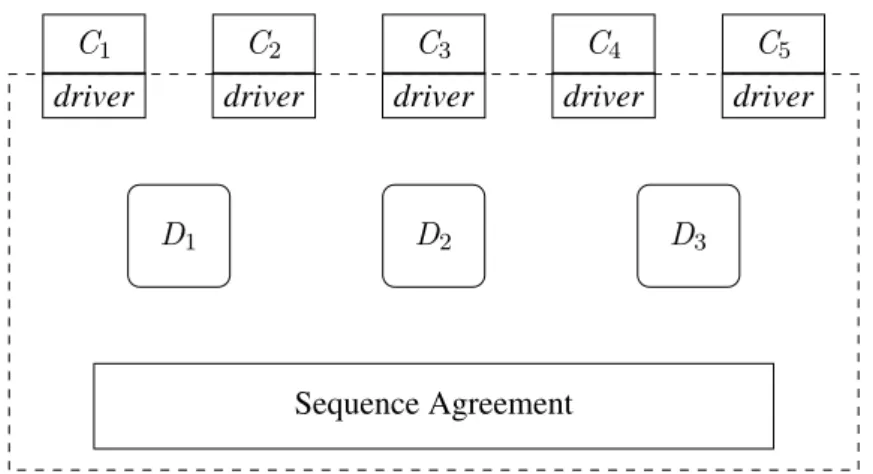
It is not very difficult to extend the previous algorithm to more specific distributed imple-mentations. In this section, we give the main idea of how it can be done with a simple example. The system is composed of clients, databases and a Sequence Agreement imple-mentation where clients propose and databases learn, as shown in Figure 2.4 below. Clients access the replicated serializable interface through a local driver. For the execution of oper-ations, these drivers contact the databases directly. Passive transactions can commit locally at the database they are executed but active transactions have their histories broadcast to all databases through the Sequence Agreement primitive. Databases certify these transactions based on the order they are delivered and apply their updates in case they are committed.
More specifically, when a client starts a new transactiont, its local driver connects to
DBof(t)(chosen randomly or given by some load balancing mechanism not depicted here). The local driver keeps variablesq[t],dreq[t],thist[t], andpdec[t], for all transactionstthat can have requests issued by that client (we tacitly assume that a single transaction cannot have requests issued by different clients). The driver also keeps the subset of proposed
containing all proposed transactions coming from that client.
Sequence Agreement C1 driver C2 driver C3 driver C4 driver C5 driver D1 D2 D3
Figure 2.4: Structure of our architecture.
When a client issues an operation request (neitherCommit norAbort), the driver ex-ecutes actionReceiveReq locally and forwards the requests to the database responsible for that transaction through unreliable numbered messages. The number in each message