
Sketch-based 3D Shape Retrieval using Convolutional Neural Networks
Fang Wang
1Le Kang
2Yi Li
11
NICTA and ANU
2ECE, University of Maryland at College Park
1
{fang.wang, yi.li}@nicta.com.au,
2[email protected]
Abstract
Retrieving 3D models from 2D human sketches has re-ceived considerable attention in the areas of graphics, im-age retrieval, and computer vision. Almost always in state of the art approaches a large amount of “best views” are computed for 3D models, with the hope that the query sketch matches one of these 2D projections of 3D models using predefined features.
We argue that this two stage approach (view selection – matching) is pragmatic but also problematic because the “best views” are subjective and ambiguous, which makes
the matching inputs obscure. This imprecise nature of
matching further makes it challenging to choose features manually. Instead of relying on the elusive concept of “best views” and the hand-crafted features, we propose to define our views using a minimalism approach and learn features for both sketches and views. Specifically, we drastically reduce the number of views to only two predefined direc-tions for the whole dataset. Then, we learn two Siamese Convolutional Neural Networks (CNNs), one for the views and one for the sketches. The loss function is defined on the within-domain as well as the cross-domain similarities. Our experiments on three benchmark datasets demonstrate that our method is significantly better than state of the art approaches, and outperforms them in all conventional met-rics.
1. Introduction
Retrieving 3D models from 2D sketches has impor-tant applications in computer graphics, information re-trieval, and computer vision [9, 13, 18]. Compared to the early attempts where keywords or 3D shapes are used as queries [23], the sketch-based idea is very attractive because sketches by hand provide an easy way to input, yet they are rich enough to specify shapes.
Directly matching 2D sketches to 3D models suffers from significant differences between the 2D and 3D repre-sentations. Thus, in many state of the art methods 3D
mod-Figure 1. Examples of sketch based 3D shape retrieval.
els are projected to multiple 2D views, and a sketch matches a 3D model if it matches one of its views. Fig. 1 shows a few examples of 2D sketches and their corresponding 3D models. One can immediately see the variations in both the sketch styles and 3D models.
In almost all state of the art approaches, sketch based 3D shape retrieval amounts to finding the “best views” for 3D models and hand-crafting the right features for match-ing sketches and views. First, an automatic procedure is used to select the most representative views of a 3D model. Ideally, one of the viewpoints is similar to that of the query sketches. Then, 3D models are projected to 2D planes using a variety of line rendering algorithms. Subsequently, many 2D matching methods can be used for computing the sim-ilarity scores, where features are always manually defined (e.g., Gabor, dense SIFT, and GALIF [9]).
This stage-wise methodology appears pragmatic, but it also brings a number of puzzling issues. To begin with, there is no guarantee that the best views have similar view-points with the sketches. The inherent issue is that identify-ing the best views is an unsolved problem on its own, par-tially because the general definition of best views is elusive. In fact, many best view methods require manually selected viewpoints for training, which makes the view selection by finding “best views” a chicken-egg problem.
Further, this viewpoint uncertainty makes it dubious to match samples from two different domains without learn-ing their metrics. Take Fig. 1 for example, even when the
viewpoints are similar the variations in sketches as well as the different characteristics between sketches and views are beyond the assumptions of many 2D matching methods.
Considering all the above issues arise when we strug-gle to seek the viewpoints for matching, can we bypass the stage of view selection? In this paper we demonstrate that by learning cross domain similarities, we no longer require the seemingly indispensable view similarity assumption.
Instead of relying on the elusive concept of “best views” and hand-crafted features, we propose to define our views and learn features for views and sketches. Assuming that the majority of the models are upright, we drastically reduce the number of views to two per object for the whole dataset. We also make no selections of these two directions as long as they are significantly different. Therefore, we consider this as the minimalism approach as opposed to multiple best views.
This upright assumption appears to be strong, but it turns out to be sensible for 3D datasets. Many 3D models are nat-urally generated upright (e.g., [23]). We choose two view-points because it is very unlikely to get degenerated views for two significantly different viewpoints. An immediate advantage is that our matching is more efficient without the need of comparing to more views than necessary.
This seemingly radical approach triumphs only when the features are learned properly. In principle, this can be re-garded as learning representations between sketches and views by specifying similarities, which gives us a seman-tic level matching. To achieve this, we need comprehensive shape representations rather than the combination of shal-low features that only capture shal-low level visual information. We learn the shape representations using Convolutional Neural Network (CNN). Our model is based on the Siamese network [5]. Since the two input sources have distinctive intrinsic properties, we use two different CNN models, one for handling the sketches and the other for the views. This two model strategy can give us more power to capture dif-ferent properties in difdif-ferent domains.
Most importantly, we define a loss function to “align” the results of the two CNN models. This loss function cou-ples the two input sources into the same target space, which allows us to compare the features directly using a simple distance function.
Our experiments on three large datasets show that our method significantly outperforms state of the art approaches in a number of metrics, including precision-recall and the nearest neighbor. We further demonstrate the retrievals in each domain are effective. Since our network is based on filtering, the computation is fast.
Our contributions include
• We propose to learn feature representations for sketch based shape retrieval, which bypasses the dilemma of best view selection;
• We adopt two Siamese Convolutional Neural Net-works to successfully learn similarities in both the within-domain and the cross domain;
• We outperform all the state of the art methods on three large datasets significantly.
2. Related work
Sketch based shape retrieval has received many interests for years [10]. In this section we review three key com-ponents in sketch based shape retrieval: public available datasets, features, and similarity learning.
Datasets The effort of building 3D datasets can be traced back to decades ago. The Princeton Shape Benchmark (PSB) is probably one of the best known sources for 3D models [23]. There are some recent advancements for gen-eral and special objects, such as the SHREC’14 Benchmark [20] and the Bonn Architecture Benchmark [27].
2D sketches have been adopted as input in many systems [6]. However, the large scale collections are available only recently. Eitzet al.[9] collected sketches based on the PSB dataset. Liet al. [18] organized the sketches collected by [8] in their SBSR challenge.
Features Global shape descriptors, such as statistics of shapes [21] and distance functions [15], have been used for 3D shape retrieval [25]. Recently, local features is proposed for partial matching [11] or used in the bag-of-words model for 3D shape retrieval [3].
Boundary information together with internal structures are used for matching sketches against 2D projections. Therefore, a good representation of line drawing images is a key component for sketch based shape retrieval. Sketch representation such as shape context [1] was proposed for image based shape retrieval. Furuya et al. proposed BF-DSIFT feature, which is an extended SIFT feature with Bag-of-word method, to represent sketch images [12]. One recent method is the Gabor local line based feature (GALIF) by Mathiaset al., which builds on a bank of Gabor filters followed by a Bag-of-word method [9].
In addition to 2D shape features, some methods also ex-plored geometry features as well as graph-based features to facilitate the 3D shape retrieval [19]. Semantic labeling is also used to bridge the gaps between different domains [14]. In this paper, we focus on view based method and only use 2D shape features.
CNN and Siamese network Recently deep learning has achieved great success on many computer vision tasks. Specifically, CNN has set records on standard object recog-nition benchmarks [16]. With a deep structure, the CNN can effectively learn complicated mappings from raw images to
the target, which requires less domain knowledge compared to handcrafted features and shallow learning frameworks.
A Siamese network [5] is a particular neural network ar-chitecture consisting of two identical sub-convolutional net-works, which is used in a weakly supervised metric learn-ing settlearn-ing. The goal of the network is to make the out-put vectors similar if inout-put pairs are labeled as similar, and dissimilar for the input pairs that are labeled as dissimilar. Recently, the Siamese network has been applied to text clas-sification [28] and speech feature clasclas-sification [4].
3. Learning feature representations for sketch
based 3D shape retrieval
We first briefly introduce basic concepts in CNNs and Siamese network. Then, we present our network architec-ture for cross domain matching, based on the Siamese net-work. Given a set of view and sketch pairs, we propose to use two different Siamese networks, one for each domain. Finally, we revisit the view selection problem, and describe our minimalism approach of viewpoint definition and the line drawing rendering procedure.
3.1. CNN and Siamese network
CNN is a multilayer learning framework, which consists of an input layer, a few convolutional layers and fully con-nected layers, as well as an output layer on which the loss function is defined. The goal of CNN is to learn a hierarchy of feature representations. Signals in each layer are con-volved with a number of filters and further downsampled by pooling operations, which aggregate values in a small region by functions including max, min, and average. The learning of CNN is based on Stochastic Gradient Descent (SGD). Please refer to [17] for details.
Siamese Convolutional Neural Network has been used successfully for dimension reduction in weakly supervised metric learning. Instead of taking single sample as input, the network typically takes a pair of samples, and the loss func-tions are usually defined over pairs. A typical loss function of a pair has the following form:
L(s1, s2, y) = (1−y)αD2w+yβe
γDw, (1)
wheres1ands2are two samples,yis the binary similarity
label,Dw=kf(s1;w1)−f(s2;w2)k1is the distance.
Fol-lowing [5], we setα= C1
p,β=Cn, andγ= −2.77
Cn , where
Cp= 0.2andCn= 10are two constants.
This can be regarded as a metric learning approach. Un-like methods that assign binary similarity labels to pairs, the network aims at bring the output feature vectors closer for input pairs that are labeled as similar, or push the feature vectors away if the input pairs are labeled as dissimilar.
The Siamese network is frequently illustrated as two identical networks for two different samples. In each SGD
iteration, pairs of samples are processed using two iden-tical networks, and the error computed by Eq. 1 is then back-propagated and the gradients are computed individu-ally base on the two sample sets. The Siamese network is updated by the average of these two gradients.
3.2. Cross-domain matching using Siamese network
In this section, we propose a method to match samples from two domains without the heavy assumption of view similarity. We first provide our motivation using an illus-trated sample. Then, we propose our extension of the basic Siamese network. Specifically, we use two different net-works to handle sources from different domains.3.2.1 An illustrated example
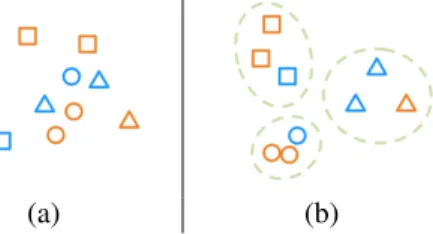
The matching problem in sketch based shape retrieval can be seen as a metric learning paradigm. In each domain, the samples are mapped to some feature vectors. The cross domain matching is successful if the features from each do-main are “aligned” correctly.
(a) (b)
Figure 2. An illustrated example, a) the shapes in the original do-main may be mixed, and b) after cross-dodo-main metric learning, similar shapes in both domains are grouped together.
This idea is illustrated in Fig. 2. Blue denotes samples in the sketch domain, and the orange denotes the ones in the view domain. Different shapes denote different classes. Be-fore learning, the feature points from two different domains are initially mixed together (Fig. 2a). If we learn the correct mapping using pair similarities in each domain as well as their cross-domain relations jointly, the two point sets may be correctly aligned in the feature space (Fig. 2b). After this cross domain metric learning, matching can be performed in both the same domain (sketch-sketch and view-view) and cross domain (sketch-view).
Note that, there are no explicit requirements about viewpoint similarity in this perspective (i.e., whether the matched pairs are from the same viewpoints is less impor-tant). Instead, the focus is the metric between the two do-mains and the mapping within the same domain.
3.2.2 Two networks, one loss
The basic Siamese network is commonly used for samples from the same domain. In the cross domain setting, we
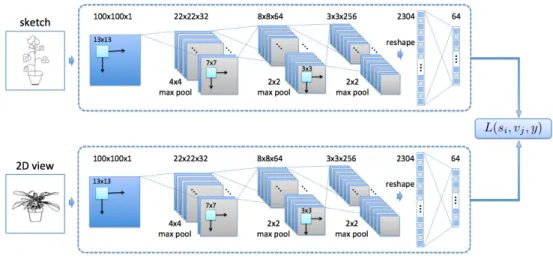
pro-Figure 3. Dimension reduction using Siamese network.
pose to extend the basic version to two Siamese networks, one for the view domain and the other for the sketch do-main. Then, we define the within-domain loss and the cross domain loss. This hypothesis is supported in the Sec. 4.
Assuming we have two inputs from each domain,i.e.,s1
ands2 are two sketches andv1andv2are two views. For
simplicity, we assumes1andv1are from the same class and
s2andv2are from the same class as well. Therefore, one
labelyis enough to specify their relationships.
As a result, our loss function is composed by three terms: the similarity of sketches, the similarity of views, and the cross domain similarity.
L(s1,s2, v1, v2, y)
=L(s1, s2, y) +L(v1, v2, y) +L(s1, v1, y), (2)
whereL(·,·,·)is defined by Eq. 1. Please note that, while the category information available in the dataset can be ex-ploited to improve the performance, we do not use the cate-gory labels in the above framework.
3.3. Network architecture
Fig. 3 shows the architecture of our network for the in-puts being views and sketches, respectively.
We use the same network design for both networks, but they are learned separately. Our input patch size is100×100 for both sources. The structure of the single CNN has three convolutional layers, each with a max pooling, one fully connected layer to generate the features, and one output layer to compute the loss (Eq. 2).
The first convolutional layer followed by a4×4pooling generates 32 response maps, each of size22×22. The sec-ond layer and pooling outputs 64 maps of size8×8. The third layer layer has 256 response maps, each pooled to a size of3×3. The 2304 features generated by the final
pool-ing operation are linearly transformed to64×1features in the last layer. Rectified linear units are used in all layers.
3.4. View definitions and line drawing rendering
We present our procedure of generating viewpoints and rendering 3D models. As opposed to multiple views, we find it sufficient to use two views to characterize a 3D model because the chance that both views are degenerated is little. Following this observation, we impose the minimal assump-tions on choosing views for the whole dataset:
1. Most of the 3D models in the dataset are up-right; 2. Two viewpoints are randomly generated for the whole
dataset, provided that the difference in their angles is larger than45degrees.
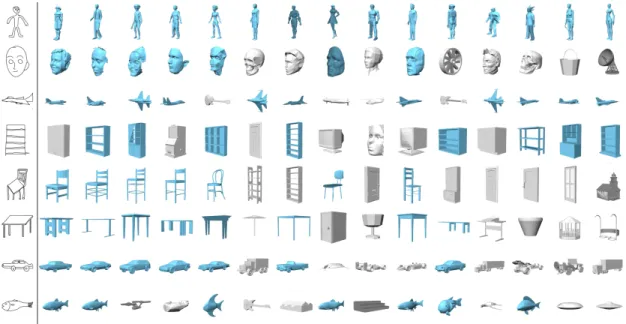
Fig. 4 shows some of our views in the PSB dataset. The first row shows that the upright assumption does not require strict alignments of 3D models, because some models may not have well defined orientation. Further, while the models are upright, they can still has different rotations.
Figure 4. 3D models viewed from predefined viewpoints. We want to stress that our approach does not eliminate the possibility of selecting more (best) views as input, but the comparisons among view selection methods are beyond the scope of this paper.
Once the viewpoints are chosen, we render the 3D mod-els and generate 2D line drawings. Rendering line draw-ings that include strong abstraction and stylization effects is a very useful topic in computer graphics, computer vision, and psychology. Outer edges and internal edges both play an important role in this rendering process. Therefore, we use the following descriptors: 1) closed boundaries and 2) Suggestive Contours [7] (Fig. 5).
(a) Shaded (b) SC (c) Final Figure 5. Rendering 3D models.
4. Experiments
We present our experiments on three recent large datasets in this section. In all experiments our method outperforms the state of the arts in a number of well recognized metrics. In additional to the cross-domain retrieval, we also present our within-domain retrieval results, which have not been reported in any other comparison methods. These experi-ments demonstrate that our Siamese network successfully learns the feature representations for both domains. The data and the code is available athttp://users.cecs. anu.edu.au/˜yili/cnnsbsr/.
4.1. Datasets
PSB / SBSR dataset The Princeton Shape Benchmark (PSB) [23] is widely used for 3D shape retrieval system evaluation, which contains 1814 3D models and is equally divided into training set and testing set.
In [9], the Shape Based Shape Retrieval (SBSR) dataset is collected based on the PSB dataset. The 1814 hand drawn sketches are collected using Amazon Mechanical Turk. In the collection process, participants are asked to draw sketches given only the name of the categories with-out any visual clue from the 3D models.
SHREC’13 & ’14 dataset Although the PSB dataset is widely used in shape retrieval evaluation, there is a con-cern that the number of sketches for each class in the SBSR dataset is not enough. Some classes have only very few instances (27 of 90 training classes have no more than 5 instances), while some classes have dominating number of instances,e.g., the “fighter jet” class and the “human” class have as many as 50 instances.
To remove the possible bias when evaluating the re-trieval algorithms, Liet al.[18] reorganized the PSB/SBSR dataset, and proposed a SHREC’13 dataset where a subset
of PSB with 1258 models is used and the sketches in each classes has 80 instances. These sketch instances are split in two sets: 50 for training and 30 for testing. Please note, the number of models in each class still varies. For example, the largest class has 184 instances but there are 23 classes containing no more than 5 models
Recently, SHREC’14 is proposed to address some above concerns [20], which greatly enlarges the number of 3D models to 8987, and the number of classes is doubled. The large variation of this dataset makes it much more challeng-ing, and the overall performance of all reported methods are very low (e.g., the accuracy for the best algorithm is only 0.16 for the top 1 candidate). This is probably due to the fact that the models are from various sources and are arbi-trarily oriented. While our performance is still superior (see Fig. 9b and Table. 3), we choose to present our results using the SHREC’13 dataset.
Evaluation criteria In our experiment, we use the above datasets and measure the performance using the following criteria: 1) Precision-recall curve is calculated for each query and linear interpolated, then the final curve is reported by averaging all precision values for fixed recall rates; 2)
Average precision (mAP) is the area under the
precision-recall curve; 3)Nearest neighbor (NN)is used to measure the top 1 retrieval accuracy; 4)E-Measure (E) is the har-monic mean of the precision and recall for the top 32 re-trieval results; 5)First/second tier (FT/ST)andDiscounted
cumulated gain (DCG)as defined in the PSB statistics.
4.2. Experimental settings
Stopping criteria All three of the datasets had been split into training and testing sets, but no validation set was specified. Therefore, we terminated our algorithm after50 epochs for PSB/SBSR and 20 for SHREC’13 dataset (or until convergence). Multiple runs were performed and the mean values were reported.
Generating pairs for Siamese network To make sure we generate reasonable proportion of similar and dissimilar pairs, we use the following approach to generate pair sets. For each training sketch, we random select kp view pairs in the same category (matched pairs) andkn view samples from other categories (unmatched pairs). Usually, our dis-similar pairs are ten times more than the dis-similar pairs for successful training. In our experiment, we use kp = 2, kn = 20. We perform this random pairing for each train-ing epoch. To increase the number of traintrain-ing samples, we also used data augmentation for the sketch set. To be spe-cific, we randomly perform affine transformations on each sketch sample with small scales and angles to generate more variations. We generate two augmentations for each sketch sample in the dataset.
Figure 6. Retrieval examples of PSB/SBSR dataset. Cyan denotes the correct retrievals.
Computational cost The implementation of the proposed Siamese CNN is based on the Theano [2] library. We mea-sure the processing time on on a PC with 2.8GHz CPU and GTX 780 GPU. With preprocessed view features, the re-trieval time for each query is approximately 0.002 sec on average on SHREC’13 dataset.
The training time is proportional to the total num-ber of pairs and the numnum-ber of epochs. Overall training takes approximately 2.5 hours for PSB/SBSR, 6 hours for SHREC’13, respectively. Considering the total number of pairs is large, the training time is sensible.
We test various number of views in our experiments. We find that there was no significant performance gain when we vary the view from two to ten. However, it increased the computational cost significantly when more views are used, and more importantly, the GPU memory. This motivates us to select only two views in the experiments.
4.3. Shape retrieval on PSB/SBSR dataset
4.3.1 Examples
In this section, we test our method using the PSB/SBSR dataset. First, we show some retrieval examples in Fig. 6. The first column shows 8 queries from different classes, and each row shows the top 15 retrieval results. Cyan denotes the correct retrievals, and gray denotes incorrect ones.
Our method performs exceptionally well in popular classes such as human, face, and plane. We also find that some fine grained categorizations are difficult to distin-guish. For instance, the shelf and the box differ only in a small part of the model. However, we also want to note that some of the classes only differ in semantics (e.g., barn
and house only differ in function). Certainly, this semantic ambiguity is beyond the scope of this paper.
Finally, we want to stress that the importance of view-point is significantly decreased in our metric learning ap-proach. Some classes may exhibit a high degree of freedom such as the plane, but the retrieval results are also excellent (as shown in Fig. 6).
4.3.2 Analysis
We further show some statistics on this dataset. First, we provide the precision-recall values at fixed points in Table 1. Compared to Fig. 9 in [9], our results are approximately 10%higher. We then show six standard evaluation metrics in Table 2. Since other methods did not report the results on this dataset, we leave the comprehensive comparison to the next section. Instead, in this analysis we focus on the effectiveness of metric learning for shape retrieval.
PSB/SBSR is a very imbalanced dataset, where train-ing and testtrain-ing only partially overlap. Namely, there are 21 classes appear in both training and testing sets, while 71 classes are used solely for testing. This makes it an excel-lent dataset for investigating similarity learning, because the “unseen” classes verify the learning is not biased.
We show some examples for these unseen classes in Fig. 7 (more statistical curves are available on project website due to the space limitation). It is interesting to see that our proposed method works well even on failure cases (e.g.,the flower), where the retrieval returns similar shapes (“potting plant”). This demonstrates that our method learns the simi-larity effectively.
Table 1. Precision-recall on fixed points.
5% 20% 40% 60% 80% 100%
0.616 0.286 0.221 0.180 0.138 0.072
Table 2. Standard metrics on the PSB/SBSR dataset.
NN FT ST E DCG mAP
0.223 0.177 0.271 0.173 0.451 0.218
Figure 7. Retrieval examples of unseen samples in PSB/SBSR dataset. The cyan denotes the correct retrievals.
4.4. Shape retrieval on SHREC’13 dataset
In this section, we use the SHREC’13 benchmark to evaluate our method. We also show the retrieval results within the same domain.
4.4.1 A visualization of the learned features
First, we present a visualization of our learned features in Fig. 8. We perform PCA on the learned features and re-duce the dimension to two for visualization. The green dots denote the sketches, and the yellow ones denote views. For simplicity, we only overlay the views over the point cloud. Please visithttp://users.cecs.anu.edu. au/˜yili/cnnsbsr/for an interactive demo.
While this is a coarse visualization, we can already see some interesting properties of our method. First, we can see that classes with similar shapes are grouped together auto-matically. On the top right, different animals are mapped to neighboring positions. On the left, various types of vehicles are grouped autonomously. Other examples include house and church, which are very similar. Note that this is an weakly supervised method. This localization suggests that the learned features are very useful for both within-domain and cross domain retrievals.
4.4.2 Statistical results
We present the statistical results on SHREC’13 in this sec-tion. First, we compare the precision-recall curve against the state of the art methods reported in [18].
From the Fig. 9 we can see that our method significantly outperforms other comparison methods. On SHREC’13
Figure 8. Visualization of feature space on SHREC’13. Sketch and view feature points are shown by green & yellow, respectively.
benchmark, the performance gain of our method is already 10% when recall is small. More importantly, the whole curve decreases much slower than other methods when the recall increases, which is desirable because it shows the method is more stable. Our method has a higher perfor-mance gain (30%) when recall reaches1.
We note that there is a noticeable overfitting in the train-ing when a stopptrain-ing criterion is reached. It suggests the performance can be even better, if one can fine tune and explore the network structure and training procedure.
We further show the standard metrics for comparison. These metrics examine the retrieval from different perspec-tives. For simplicity, we only select the best method from each research group in [18]. As shown in Table 3, our method performs better in every metric on both bench-marks. This further demonstrates our method is superior.
We also compare to the case where both networks are identical, i.e., both views and sketches use the same Siamese network. Fig. 9a suggests that this configura-tion is inferior than our proposed version, but still it is bet-ter than all other methods. This supports our hypothesis that the variations in two domains are different. This also sends a message that using the same features (hand-crafted or learned) for both domains may not be ideal.
4.4.3 Within-domain retrieval
Finally, we show the retrievals in the same domain. This interesting experiment shall be straightforward to report be-cause the data is readily available, but was not shown before
0 0.2 0.4 0.6 0.8 1 0 0.1 0.2 0.3 0.4 0.5 0.6 Recall Precision
Ours Siamese Model Ours Identic Model
Furuya (CDMR−BF−fGALIF+CDMR−BF−fDSIFT) Furuya (CDMR−BF−fGALIF) Furuya (BF−fGALIF+BF−fDSIFT) Furuya (UMR−BF−fGALIF+UMR−BF−fDSIFT) Furuya (CDMR−BF−fDSIFT) Furuya (BF−fGALIF) Furuya (UMR−BF−fDSIFT) Li (SBR VC−NUM−100) Furuya (UMR−BF−fGALIF) Furuya (BF−fDSIFT) Li (SBR 2D−3D−NUM−50) Saavedra (HOG−SIL) Li (SBR VC−NUM−50) Saavedra (HELO−SIL) Saavedra (FDC−CVIU version) Saavedra (FDC) Pascoal (HTD) Aono (EFSD) 0 0.2 0.4 0.6 0.8 1 0 0.1 0.2 0.3 0.4 0.5 0.6 Recall Precision Ours Tatsuma (SCMR−OPHOG) Tatsuma (OPHOG)
Furuya (CDMR (sigma_SM=0.05, alpha=0.3)) Furuya (CDMR (sigma_SM=0.1, alpha=0.3)) Furuya (BF−fGALIF)
Li (SBR−VC (alpha=1)) Furuya (CDMR (sigma_SM=0.05, alpha=0.6)) Li (SBR−VC (alpha=0.5)) Furuya (CDMR (sigma_SM=0.1, alpha=0.6)) Zou (BOF−JESC (Words800_VQ)) Zou (BOF−JESC (FV_PCA32_Words128)) Zou (BOF−JESC (Words1000_VQ))
(a) SHREC’13 comparison (b) SHREC’14 comparison
Figure 9. Performance comparison on SHREC’13 & ’14. Please refer to [18] and [20] for the descriptions of the compared methods.
Table 3. Comparison on SHREC’13 & ’14 dataset. The best results are shown in red, and the second best results are shown in blue.
SHREC’13 NN FT ST E DCG mAP Ours 0.405 0.403 0.548 0.287 0.607 0.469 Identic 0.389 0.364 0.516 0.272 0.588 0.434 [13] 0.279 0.203 0.296 0.166 0.458 0.250 [18] 0.164 0.097 0.149 0.085 0.348 0.116 [24] 0.017 0.016 0.031 0.018 0.240 0.026 [22] 0.110 0.069 0.107 0.061 0.307 0.086 SHREC’14 NN FT ST E DCG mAP Ours 0.239 0.212 0.316 0.140 0.496 0.228 [26] 0.160 0.115 0.170 0.079 0.376 0.131 [13] 0.109 0.057 0.089 0.041 0.328 0.054 [18] 0.095 0.050 0.081 0.037 0.319 0.050
in any literature. Since this is a “by-product” of our method, we do not tune up any parameter or re-train the system.
Figs. 10 and 11 visualize some retrieval results in each domain, respectively. Table 4 further reports the statistics. The retrieval results demonstrate our method is powerful in learning the features for both within-domain and cross-domain. From these figures, one can see that the view domain is much more consistent than the sketch domain. Comparing Table 4 to Table 3, we conclude that the incon-sistency in sketch is the most challenging issue in the sketch based 3D shape retrieval.
5. Conclusion
In this paper we propose to learn feature presentations for sketch based 3D shape retrieval. Instead of
comput-Figure 10. Sketch-sketch retrieval for SHREC’13. The incorrect retrievals are marked as light gray.
Figure 11. View-view retrieval for SHREC’13. The cyan denotes the correct retrievals.
Table 4. Standard metrics for the within-domain retrieval on SHREC’13.
NN FT ST E DCG mAP
view 0.965 0.877 0.982 0.536 0.971 0.909 sketch 0.431 0.352 0.514 0.298 0.679 0.373
ing “best views” and match them against queries, we use predefined viewpoints for the whole dataset and adopt two Siamese CNNs, one for views and one for sketches. Our experiments on three large datasets demonstrated that our method is superior.
6. Acknowledgement
NICTA is funded by the Australian Government as rep-resented by the Department of Broadband, Communica-tions and the Digital Economy and the Australian Research Council through the ICT Centre of Excellence program.
References
[1] S. Belongie, J. Malik, and J. Puzicha. Shape matching and object recognition using shape contexts.IEEE Trans. Pattern Anal. Mach. Intell., 24(4):509–522, Apr. 2002.
[2] J. Bergstra, O. Breuleux, F. Bastien, P. Lamblin, R. Pascanu, G. Desjardins, J. Turian, D. Warde-Farley, and Y. Bengio. Theano: a CPU and GPU math expression compiler. In Pro-ceedings of the Python for Scientific Computing Conference (SciPy), Jun. 2010.
[3] A. M. Bronstein, M. M. Bronstein, L. J. Guibas, and M. Ovs-janikov. Shape google: Geometric words and expressions for invariant shape retrieval.ACM Trans. Graph., 30(1):1:1– 1:20, Feb. 2011.
[4] K. Chen and A. Salman. Extracting speaker-specific in-formation with a regularized siamese deep network. In J. Shawe-Taylor, R. Zemel, P. Bartlett, F. Pereira, and K. Weinberger, editors,NIPS 2011, pages 298–306. 2011. [5] S. Chopra, R. Hadsell, and Y. LeCun. Learning a similarity
metric discriminatively, with application to face verification. InCVPR 2005, volume 1, pages 539–546. IEEE, 2005. [6] P. Daras and A. Axenopoulos. A 3d shape retrieval
frame-work supporting multimodal queries. International Journal of Computer Vision, 89(2-3):229–247, 2010.
[7] D. DeCarlo, A. Finkelstein, S. Rusinkiewicz, and A. San-tella. Suggestive contours for conveying shape.ACM Trans on Graphics, 22(3):848–855, July 2003.
[8] M. Eitz, J. Hays, and M. Alexa. How do humans sketch objects? ACM Trans. on Graphics, 31(4):44:1–44:10, 2012. [9] M. Eitz, R. Richter, T. Boubekeur, K. Hildebrand, and M. Alexa. Sketch-based shape retrieval.ACM Trans. Graph-ics, 31(4):31:1–31:10, 2012.
[10] T. Funkhouser, P. Min, M. Kazhdan, J. Chen, A. Halderman, D. Dobkin, and D. Jacobs. A search engine for 3D models.
ACM Transactions on Graphics, 22(1):83–105, Jan. 2003. [11] T. Funkhouser and P. Shilane. Partial matching of 3d shapes
with priority-driven search. InProceedings of the Fourth Eu-rographics Symposium on Geometry Processing, pages 131– 142. Eurographics Association, 2006.
[12] T. Furuya and R. Ohbuchi. Dense sampling and fast encod-ing for 3d model retrieval usencod-ing bag-of-visual features. In
Proceedings of the ACM international conference on image and video retrieval, page 26. ACM, 2009.
[13] T. Furuya and R. Ohbuchi. Ranking on cross-domain man-ifold for sketch-based 3d model retrieval. InInternational Conference on Cyberworlds 2013, pages 274–281. IEEE, 2013.
[14] B. Gong, J. Liu, X. Wang, and X. Tang. Learning semantic signatures for 3d object retrieval. Multimedia, IEEE Trans-actions on, 15(2):369–377, 2013.
[15] M. M. Kazhdan, B. Chazelle, D. P. Dobkin, A. Finkel-stein, and T. A. Funkhouser. A reflective symmetry descrip-tor. ECCV ’02, pages 642–656, London, UK, UK, 2002. Springer-Verlag.
[16] A. Krizhevsky, I. Sutskever, and G. Hinton. Imagenet clas-sification with deep convolutional neural networks. InNIPS, 2012.
[17] Y. LeCun and Y. Bengio. The handbook of brain theory and neural networks. chapter Convolutional networks for images, speech, and time series, pages 255–258. MIT Press, Cam-bridge, MA, USA, 1998.
[18] B. Li, Y. Lu, A. Godil, T. Schreck, B. Bustos, A. Ferreira, T. Furuya, M. J. Fonseca, H. Johan, T. Matsuda, et al. A com-parison of methods for sketch-based 3d shape retrieval. Com-puter Vision and Image Understanding, 119:57–80, 2014. [19] B. Li, Y. Lu, C. Li, A. Godil, T. Schreck, M. Aono,
M. Burtscher, Q. Chen, N. K. Chowdhury, B. Fang, et al. A comparison of 3d shape retrieval methods based on a large-scale benchmark supporting multimodal queries. Computer Vision and Image Understanding, 131:1–27, 2015.
[20] B. Li, Y. Lu, C. Li, A. Godil, T. Schreck, M. Aono, Q. Chen, N. Chowdhury, B. Fang, T. Furuya, H. Johan, R. Kosaka, H. Koyanagi, R. Ohbuchi, and A. Tatsuma. SHREC14 track: Comprehensive 3d shape retrieval. InProc. EG Workshop on 3D Object Retrieval, 2014.
[21] R. Osada, T. Funkhouser, B. Chazelle, and D. Dobkin. Shape distributions. ACM Transactions on Graphics, 21(4):807– 832, Oct. 2002.
[22] J. M. Saavedra, B. Bustos, T. Schreck, S. Yoon, and M. Scherer. Sketch-based 3d model retrieval using keyshapes for global and local representation. InEG 3DOR’12, pages 47–50. Eurographics Association, 2012.
[23] P. Shilane, P. Min, M. Kazhdan, and T. Funkhouser. The princeton shape benchmark. InShape modeling applications, 2004. Proceedings, pages 167–178. IEEE, 2004.
[24] P. M. A. Sousa and M. J. Fonseca. Sketch-based retrieval of drawings using spatial proximity. J. Vis. Lang. Comput., 21(2):69–80, 2010.
[25] J. W. Tangelder and R. C. Veltkamp. A survey of content based 3d shape retrieval methods. Multimedia Tools Appl., 39(3):441–471, Sept. 2008.
[26] A. Tatsuma, H. Koyanagi, and M. Aono. A large-scale shape benchmark for 3d object retrieval: Toyohashi shape bench-mark.Signal and Information Processing Association, pages 3–6, 2012.
[27] R. Wessel, I. Bl¨umel, and R. Klein. A 3d shape bench-mark for retrieval and automatic classification of architec-tural data. In3DOR ’09, pages 53–56. Eurographics Associ-ation, 2009.
[28] W. Yih, K. Toutanova, J. C. Platt, and C. Meek. Learning discriminative projections for text similarity measures. In
Proceedings of the Fifteenth Conference on Computational Natural Language Learning, CoNLL ’11, pages 247–256, 2011.


![Figure 9. Performance comparison on SHREC’13 & ’14. Please refer to [18] and [20] for the descriptions of the compared methods.](https://thumb-us.123doks.com/thumbv2/123dok_us/10247103.2929664/8.918.175.716.114.346/figure-performance-comparison-shrec-refer-descriptions-compared-methods.webp)
