The Impacts of Asynchronous Video Reflection on Perceived Learner Social Presence
A DISSERTATION
SUBMITTED TO THE FACULTY OF UNIVERSITY OF MINNESOTA
BY
Matti Koivula
IN PARTIAL FULFILLMENT OF THE REQUIREMENTS FOR THE DEGREE OF
DOCTOR OF PHILOSOPHY
Charles D. Miller, Adviser
Acknowledgements
I want to thank my advisor Dr. Charles Miller, for your engaging and exciting scholarly ideas; for pushing me to do better work; and for inspiring me to see design differently. I would like to thank Dr. Aaron Doering, for so many things but especially for that one time, many years ago, when you took the time out of your day to show me around campus; your unparalleled enthusiasm towards learning technologies that day made me want to become part of this program. I want to thank Dr. Cassie Scharber, for guiding me to right direction when I felt lost; and for asking the tough questions that made me work harder. I would also like to express my deepest appreciation to my
committee member, Dr. Angel Pazurek, for always having time and patience to listen my rambling ideas; for explaining things far better than any textbook ever could; and for your exceptional guidance and support with this dissertation.
Special thank you to my friend Mika Rauhala, for periodically calling me to make sure I was making progress; and for dropping everything at a moments notice and flying over 4000 miles to cheer me up when I needed it the most.
Finally, there are no words to describe the gratitude I owe to my family in
Finland, for always listening me and encouraging me with their best wishes; I know it has not been easy to have your son and brother be so far away but I hope you know that without your support this would not have been possible.
Dedication
Omistan tämän työn vanhemmilleni Ritvalle ja Tapanille sekä veljilleni Pekalle ja Antille. He kaikki tukivat minua maailman toiselta puolelta ja uskoivat aina minuun -
omankin uskoni horjuessa.
This dissertation is dedicated to my parents, Ritva and Tapani, and to my brothers, Pekka and Antti, who supported me from halfway across the world and always believed in me,
Abstract
This dissertation examined how an asynchronous video reflection tool impacted learners’ perception of social presence and their feeling of community in an online learning environment. More than ever before learning in postsecondary education takes place online through computer mediated communication, as almost all colleges and universities offer some of their courses online (Moore & Kearsley, 2012). There are many benefits of online learning (Graham, 2006; Griffiths & Graham, 2009b; Rourke, Anderson, Garrison, & Archer, 2001), but there are problems as well. One of the problems students can have while learning online is the feeling of isolation and the lack social presence with others (Ali & Leeds, 2009; Borup, West, & Graham, 2012; Rovai, 2002). To help mediate this problem, instructors use different online technologies that encourage learners to communicate in a variety of ways, including through video and visual media. There are many video-based tools available and many are newly in development; this study examines one in particular called Flipgrid that can be used by instructors and students to create and share video-based reflections on course content.
The purpose of this study is to help online instructors, instructional designers and educational app developers find new ways of enhancing or increasing social presence for their target audience by exploring the following research questions: (1) How does an asynchronous video reflection tool impact students’ perception of social presence in an online class? (2) How does seeing classmates’ video recordings influence students’ feeling of community in an online class? And (3) How does creating video recordings influence students’ feeling of community in an online class?
This interpretive case study (Stake, 1995) was informed by the Community of Inquiry framework (Garrison, Anderson, & Archer, 2000) and utilized qualitative
methods for data collection and inductive data analysis to understand the phenomenon of social presence and how learners experienced it while using an asynchronous video reflection tool. Data was collected from students from five separate undergraduate courses that took place fully online. Analysis of qualitative surveys, focus group, and individual interviews revealed three themes from the data: familiarization, authenticity, and distractions. Participants expressed that getting to know classmates by seeing and hearing them in an online course was important to them, and authentic videos in which students shared personal stories to support their points of views were highly valued. There were also distracting elements, like privacy concerns and the feeling of being rushed while doing recording, that negatively impacted the experience of recording and watching video reflections. Based on the findings of this study, a refined definition of social presence is proposed.
Table of Contents
ACKNOWLEDGEMENTS ... i
DEDICATION ... ii
ABSTRACT ... iii
LIST OF TABLES ... vii
LIST OF FIGURES ... viii
CHAPTERS 1 INTRODUCTION ... 1
Studying a Community-Based Tool for Asynchronous Video Reflection . 3 Overview of the Research Study ... 5
Research Questions ... 5
Definition of Key Terms ... 5
Overview of the Dissertation ... 7
2 LITERATURE REVIEW ... 8
Research on Social Presence ... 8
Online Course Delivery Methods ... 10
Defining Social Presence ... 13
Measuring Social Presence ... 23
Research Questions ... 33
Community-Based Tool for Asynchronous Video ... 33
Case Selection & Participant Selection ... 34
Data Collection ... 36
Data Analysis ... 39
4 ANALYSIS OF DATA ... 44
Data Analysis Methods ... 45
From Codes and Categories to Themes ... 55
Theme #1: Familiarization ... 56
Theme #2: Authenticity ... 64
Theme #3: Distractions ... 71
5 DISCUSSION ... 80
Summary of the Research Study ... 80
Conclusions ... 81
Practical Implications ... 89
Refining the Definition of Social Presence ... 102
Limitations and Future Directions ... 103
References ... 105
List of Tables
Table 2.1: Evolution of Social Presence Definitions ... 18
Table 2.2: Categories and Indicators of Social Presence According to The Community of Inquiry Model ... 21
Table 3.1: Overview of Data Collection Methods ... 37
Table 4.1: First Two Survey Questions to Illustrate How Codes Were Determined During Initial Coding ... 49
Table 4.2: Two Focus Group Questions to Illustrate How Codes Were Determined During Initial Coding ... 51
Table 4.3: Example of Individual Interview Questions With Codes Determined During Initial Coding Based on The Excerpted Response ... 52
Table 4.4: Theme #1 With Categories and Sub-Categories ... 56
Table 4.5: Theme #2 With Categories and Sub-Categories ... 65
List of Figures
Figure 1.1: Screenshot of Flipgrid’s user interface ... 4 Figure 2.1: Elements of the Community of Inquiry framework ... 19 Figure 4.1: Flipgrid interface showing grid of avatars of those who have recorded their video ... 61
CHAPTER 1 INTRODUCTION
More than ever before learning in postsecondary education happens in an online learning environment through computer mediated communication (CMC), and almost all colleges and universities offer some of their courses online (Moore & Kearsley, 2012). There are great benefits for learners in online courses like time flexibility, lower cost, and absence of required physical learning location (Graham, 2006; Griffiths & Graham, 2009b; Rourke, Anderson, Garrison, & Archer, 2001); but it is not without its problems (Perry & Pilati, 2011). One problem that learners can have in an online learning
environment is a feeling of isolation and a lack of social connection with others (Ali & Leeds, 2009; Borup, West, & Graham, 2012; Rovai, 2002). This social connection has also been referred to in the literature as social presence.
Social presence has been defined multiple ways, including the ability of learners “to project themselves socially and emotionally, as ‘real’ people (i.e., their full
personality), through the medium of communication being used” (Garrison, Anderson, & Archer, 2000, p. 94), and to “feel affectively connected one to another” (Swan & Shih, 2005, p. 115). The overall goal for establishing social presence in an online learning environment is to form a level of comfort in which participants feel comfortable around the instructor and each other (Aragon, 2003). Research has suggested that lack of social presence impacts student engagement, interaction, and participation (Richardson & Swan, 2003; Tu, 2000b; Tu & McIsaac, 2002), and it has a direct negative effect on the most important goal of any learning environment, the learning itself (Kear, 2010). Establishing
strong social presence in an online environment is challenging compared to a face-to-face setting because of the absence of learners’ physical presence and the use of limited and impersonal CMC such as asynchronous chat, discussion forum, and email which lack verbal and non-verbal cues (Griffiths & Graham, 2009b; Walther & Parks, 2002). Given the advances that CMC technology has made in the past decade, like the implementation of asynchronous video components, researchers must continue to explore ways to help establish stronger social presence in online learning environments.
Many influential social presence studies have collected their data from students whose courses were held in environments that used asynchronous text-based CMC methods and naturally their data collection instruments, like self-report surveys and questionnaires, were designed with that type of environment in mind (Gunawardena, 1995; Gunawardena & Zittle, 1997; Richardson & Swan, 2003). Today contemporary technologies are available that are capable of providing more advanced tools to be used online that go beyond asynchronous text-based communication. For example, an
asynchronous video element may have the potential to affect social presence by enabling learners to literally see who is with them in their online course. Griffiths and Graham (2009b) point out that more research is needed in asynchronous online settings to study the potential of asynchronous video.
This study’s unique contribution to the field of educational technology is to address that need by using an interpretive case study methodology and multiple
qualitative research methods to examine students’ perception of social presence in online learning environments that use asynchronous video communication. While many
previous studies have solely relied on surveys designed exclusively for text-based online environments, this study used a qualitative survey, focus group, and individual semi-structured interviews with students to explore how an asynchronous video reflection tool impacts students’ perception of social presence and their feeling of community in an online learning environment.
Social presence research has grown as schools are offering more classes online (Sung & Mayer, 2012). But this progress does not come without new problems and unique challenges, as prior research has shown. Contemporary technology is capable of connecting students with each other better than ever before, but these technologies need to be tested and researched in depth to understand their implications and determine how they can help to improve students’ experiences and their perception of social presence in an online learning environment (Borup et al., 2012). This study seeks to address these very issues.
Studying a Community-Based Tool for Asynchronous Video Reflection
It is important to note that the use of asynchronous video and its connection to social presence in online learning environments has been studied before (Borup et al., 2012; Borup, West & Graham, 2013; Griffiths & Graham, 2009a; 2010). In previous research, the methods of how students and instructors record and distribute their video clips has varied from emailing files to each other (Griffiths & Graham, 2009b) to uploading them to video hosting websites like Youtube (Borup et al., 2012). However, this research study is unique in that the video tool in this study works much differently. With the community-based tool for asynchronous video reflection that provided the
context for this study, the students do not have to send video files through email or upload them to hosting websites, nor do they have to install any software on their
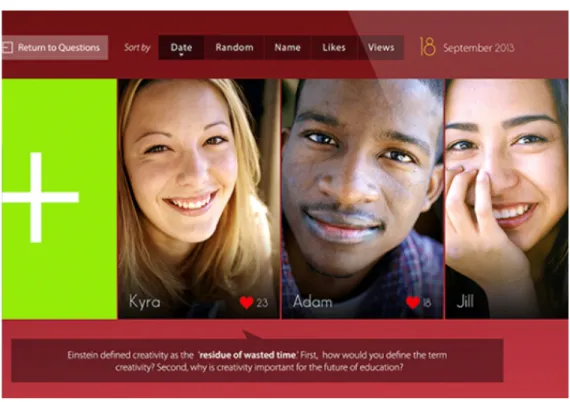
computers. The videos from the whole class are all in one place and accessible through a web browser or smartphone app. The particular tool used in this study has the unique feature of a 90-second recording time limit, which is designed to help the recorder stay on topic and keep students’ attention on the video. The user interface is minimalistic and it has been designed to quickly show students the reflection questions presented by their instructor and the grid of recorded reflections made by their peers (see Figure 1.1). The interface allows students to quickly record their reflection and watch their peers’ reflections without ever leaving the web page on which the grid is hosted or embedded.
Overview of the Research Study
This dissertation presents an interpretive case study (Stake, 1995) that examined how an asynchronous video reflection tool impacts learners’ perception of social
presence and their feeling of community in an online learning environment. This study was informed by the Community of Inquiry framework (Garrison et al., 2000) and utilized qualitative methods for data collection and inductive data analysis to understand the phenomenon of social presence. Research participants included students from five separate undergraduate courses that took place fully online. The purpose of this study is to help online instructors, instructional designers and educational app developers find new ways of enhancing or increasing social presence for their target audience through the use of an asynchronous video reflection tool.
Research Questions
The following research questions guided this study:
I. How does an asynchronous video reflection tool impact students’ perception of social presence in an online class?
II. How does seeing classmates’ video recordings influence students’ feeling of community in an online class?
III. How does creating video recordings influence students’ feeling of community in an online class?
Definition of Key Terms
Online class. This study examines students’ experiences during their participation in an online class or while they are enrolled in a completely online course. An online
class can mean different things, and it most often references the mode of delivery of the course. In this case, it also refers to all interactions among instructor, students, and content as they are situated in an online learning environment. Some online courses may include electronically delivered components with some in-person elements embedded into them. However, in the context of this study an online class refers to a course that takes place fully online without any in-person elements, and the five courses included in this study were fully online classes. All course related activities, such as weekly
discussions, assignments, and other communications, occurred online and students only saw and interacted with their instructor, fellow students, and the course content through online technology tools.
Video reflection. The research questions guiding this study refer to the process of video reflection. Reflection generally refers to the act of metacognition during the
learning process, as students are encouraged to think deeply about the content being explored and then articulate their informed thoughts or perspectives (Boud, Keogh, & Walker, 1985). The expression of such thoughts and perspectives can take multiple forms depending upon the medium being used, and online classes afford opportunities to
leverage a variety of communication media for students to use to express their ideas and understanding in unique ways. In this study, video reflection refers to the use of a video-based communication tool to respond to a reflection question or prompt posed by the instructor of the course. These reflection prompts are worded in a way that require students to give more than just yes or no answers in their video reflection. Each student created or recorded a video reflection at least once per week and these video recordings
were accessible to the rest of the class and could be viewed asynchronously by classmates.
Overview of the Dissertation
In order to conceptually and theoretically frame this research, chapter 2 provides a literature review on how social presence has developed, how its definition has been in constant flux the past few decades, and how social presence has been studied so far. Chapter 3 then presents the methodology and the research design of this qualitative case study, including the qualitative data collection and inductive analysis methods that were used to probe students’ perception of social presence in an online learning environment and the ways in which an asynchronous video reflection tool impacted that perception. Chapter 4 presents the analysis of the data through initial coding and focused coding methods, as well as the three themes that were revealed in the findings. The codes and categories that shaped these themes are described and direct quotes from the research participants are included to illustrate how they experienced the use of an asynchronous video reflection tool in these online courses and how it influenced their perception of social presence as well as their feeling of community in myriad ways. Finally, chapter 5 synthesizes the key findings and discusses the conclusions and how they relate to the research questions that guided the inquiry. Practical implications for the findings are also proposed in chapter 5, as well as the limitations of this study and future directions.
CHAPTER 2 LITERATURE REVIEW
As more postsecondary education takes place online through CMC, there is the potential for learners to feel isolated in these environments and lack social connection or, as it is referred to in the literature, social presence with others (Borup et al., 2012; Song, Singleton, Hill, & Koh, 2004). The purpose of this study is to help online instructors, instructional designers and educational app developers find new ways of enhancing or increasing such social presence for their target audience by exploring how an
asynchronous video reflection tool impacts learners’ perception of social presence and their feeling of community in an online learning environment. To understand what social presence is and how it has formerly been studied in online environments, this chapter will provide a review of the literature. Variations in online course delivery methods will be described as well as how definitions of social presence have emerged and how it has been measured over the past four decades.
Research on Social Presence
Technology used in online learning environments has improved drastically over the past decade, but studies suggest students still lack social presence and feel isolated and disconnected from their fellow students and instructors in mainly text-based
environments (Ali & Leeds, 2009; Borup et al., 2012; Kear, 2010). Social presence in an online environment, or lack thereof, has been studied extensively over the past two decades (Gunawardena, 1995; Gunawardena & Zittle, 1997; Richardson & Swan, 2003; Rourke et al, 2001; Tu, 2001). Almost all studies to date have used similar data collection
instruments and data analysis techniques, and the most popular have been self-reported questionnaires (Caspi & Blau, 2008; Gunawardena, 1995; Gunawardena & Zittle, 1997; Harms & Biocca, 2004; Richardson & Swan, 2003; Sung & Mayer, 2012) and content analysis of conferencing transcripts (Rourke et al., 2001; Shea et al., 2010; So, 2005; Swan & Shih, 2005). The reason for the similarity in data collection tools is because two of the most cited social presence publications (Gunawardena, 1995; Short, Williams, & Christie, 1976) used questionnaires to collect data, and questionnaires are also easy to administer, analyze and interpret (Cui, 2013).
Modern technology and faster Internet connections have made it possible for instructors and students to use more advanced tools in online classrooms such as asynchronous audio and video tools accessible to students in low-bandwidth
environments compared to a decade ago when video files, especially, would take several minutes to load (Giesbers, Rienties, Tempelaar & Gijselaers, 2014; Hrastinski, 2008a; Perry & Pilati, 2011). These tools and their impact on social presence must be researched in greater detail by using qualitative methods to question and carefully listen to the target audience, the students, to learn more about their experience. According to Merriam (2009) and Patton (2002), qualitative data collection methods like focus groups and interviews allow the researcher to probe for meaning and rich understanding about the phenomena under investigation. The ways in which these qualitative methods informed the methodology of this study will be presented in chapter 3 of this dissertation. Chapter 2 will first frame the research by describing different styles of online learning
ever changing definitions of social presence from the mid-1970s to the current day. The ways in which social presence has been studied thus far will also be discussed, including the types of data collection instruments and methods that were used in those studies. Online Course Delivery Methods
Delivery methods used in post-secondary online courses fall into three categories: synchronous, asynchronous, and a combination of asynchronous and synchronous
methods (Hrastinski, 2008c). In synchronous methods both teacher and student are in the online space at the same time, just like in a traditional face-to-face classroom.
Communication happens through text-based chat sessions or through audio and/or video conferencing software. Benefits of this method include the ability of the instructor and learners to see and/or hear or, at the very least, text-chat with each other in real-time (Hrastinski, 2008b; Johnson, 2006). This real-time communication allows for instant feedback, troubleshooting technical issues, having virtual office hours, quickly getting to know each other, and more social interaction (Branon & Essex, 2001; Hrastinski, 2008a). However, a synchronous environment does not come without limitations as it ties both parties into same schedule, which can be an inconvenience. Other limitations include the aforementioned trouble of getting all participants into the same virtual space at the same time, the challenge of moderating large-scale conversations, short reflection time for students, and if the synchronous communication method is limited to typing, then poor typists can have hard time keeping up (Branon & Essex, 2001; Paige, Pauli, Sturm & Fierstein, 2011).
The opposite of the synchronous learning method is asynchronous e-learning, where teacher and students are not in the same virtual space at the same time (Skylar, 2009). Communication in an asynchronous learning environment between instructor and students and among students happens through text-based chats, threaded discussion forums, email, and even through recorded audio and video clips. Asynchronous online courses are sometimes popular because of the freedom of time given to instructors and students, “[i]n fact, many people take online courses because of their asynchronous nature, combining education with work, family, and other commitments” (Hrastinski, 2008a, p. 52). Advantages of asynchronous learning environments include the possibility for learning activities to take place whenever the learner has time. This is convenient, but it also requires self-determination and time management skills from the learner (Chen & Jang, 2010; Giesbers et al., 2013; Michinov, Brunot, Le Bohec, Juhel, & Delaval, 2011). Other advantages for the learner include more time to process information and write messages, and almost all student postings are content-related (Hrastinski, 2008a; Martin, Parker & Oyarzun, 2013). Asynchronous online learning, like synchronous online learning, does not come without disadvantages, however, including an unpredictable schedule for students postings, the increased amount of time it can take the discussions to mature, small group discussion can be hard to get going, and lack of immediate feedback and social interaction (Branon & Essex, 2001; Hrastinski, 2008a; Martin, Parker & Oyarzun, 2013).
The debate over which style of online learning to use, synchronous or asynchronous, has been ongoing, but studies have generally revealed no significant
differences between the two (Gunawardena & McIsaac, 2004; Skylar, 2009). It can be argued that both synchronous and asynchronous methods have their advantages and disadvantages. Therefore, it has been suggested that to get the best of both methods and to limit their disadvantages, they should be integrated into one environment that supports students’ needs most effectively (Er, Özden & Arifoglu, 2009). This integrated approach gives way to a third type of delivery, often referred to as a blended method (Graham, 2006; Guzer & Caner, 2013). This style of online delivery includes a mix of
asynchronous and synchronous methods. For example, student and instructor or students among themselves can have some instances where they are in synchronous contact in real-time through audio, video, or text-chat. These could be occasions when it’s preferred to get a point across in an instant, like brainstorming sessions for group assignments, instructor-led monthly wrap-up sessions, or troubleshooting technical difficulties. Then other activities happen asynchronously, like discussions that run through the whole week or students giving feedback on fellow students’ assignments. More research is needed on the ways of using asynchronous and synchronous methods in the same course, as
currently studies that provide useful insight into blended online delivery methods are scarce (Giesbers et al., 2014; Johnson, 2006).
Regardless of delivery method, social presence can be strong or weak in any of these environments, and research has shown that lack of social presence can lead to less effective learning (Kear, 2010). To know how to have strong social presence in a
synchronous, asynchronous, or blended environment, it must first be defined. Many have done so in the literature, and the definition of social presence is evolving.
Defining Social Presence
Social presence has been defined multiple ways in the literature, and there does not seem to be one accepted definition for all to use (Biocca, Harms, & Burgoon, 2003; Tu, 2002b). These varying definitions are presented in Table 2.1 and indicate an
evolution of understanding of this complex phenomenon over time. It is also important to note that social presence has not always been studied in the same context. The
development of educational technology has been tremendous from the mid-1970s to the current day and that has certainly impacted how social presence has historically been defined.
Social presence as an attribute of the medium. Social presence theory was first introduced by Short et al. (1976) “to explain the effect that telecommunications media have on communication” (Lowenthal, 2012, p. 3). Short and colleagues defined social presence as “the salience of the other in a mediated communication and the consequent salience of their interpersonal interactions” (p. 65). They argued that communication media has a direct impact on social presence because people perceive media like video as having higher social presence compared to audio or text where there are no visual cues for them to see. They added that the medium’s ability to transmit information about the communicator’s facial expression and non-verbal cues particularly impact the social presence of a communication medium.
This early theory of social presence was heavily influenced by Argyle and Dean’s (1965) concept of intimacy in that it is established in communication by proximity, eye contact, smiling, and personal topics of conversation. The theory was further informed by
Wiener and Mehrabian’s (1968) concept of immediacy, which refers to the psychological distance that communicators place between themselves and the person with whom they are communicating. Short et al.’s (1976) definition of social presence is commonly cited by educational researchers when they track the history of social presence, and, thus, may be considered seminal work in this area (Cobb, 2009; Gunawardena, 1995; Lin, 2004; Lowenthal, 2012; Rourke et al., 2001; Tu, 2002b).
Perception of others in an online space. During the mid- and late 1990s researchers (Gunawardena, 1995; Gunawardena & Zittle, 1997) revealed how CMC can be very social and interpersonal, challenging Short et al.’s (1976) view that computer-mediated communication is impersonal because it is nonverbal and lacks visual cues seen in face-to-face interaction. From this point on there has been a steady stream of research studying online learning environments and the role that social presence has within them (Garrison et al., 2000; Picciano, 2002; Richardson & Swan, 2003; Rourke et al., 2001; Swan & Shih, 2005; Tu, 2002a). Each of these published studies has defined social presence differently, and both the differences and similarities should be noted.
Gunawardena (1995; Gunawardena & Zittle, 1997), conducted quantitative studies that explored social presence and student satisfaction in text-based computer conferences. She defined social presence as “the degree to which a person is perceived as a ‘real person’ in mediated communication” (Gunawardena, 1995, p. 151). Until the mid-1990s no researcher had measured the effects of social presence on learner satisfaction in the CMC environment, nor was there an instrument developed to do so. First developed by Gunawardena (1995) and later by Gunawardena and Zittle (1997), a questionnaire was
used as an instrument to measure social presence and quantitatively explore its
relationship to student satisfaction in a text-based computer conference. The results of research by Gunawardena and Zittle (1997) indicated that social presence is a strong predictor of student satisfaction in a text-based computer conference. According to Cobb (2009), the most cited social presence researcher to date is Gunawardena and many social presence studies that followed have based their data collection instruments on the one developed by her (1995; Gunawardena & Zittle, 1997).
Evolving definitions and theories of social presence. In the early 2000s Biocca, Burgoon, Harms, and Stoner (2001) acknowledged the need for a more sophisticated theory of social presence to reflect the growth of the telecommunication structure resulting in a substantial increase in the variety of communication forms that take place online. They also discussed the difficulty in defining social presence so that it would accurately address the range of phenomenon that supports it. Biocca, Burgoon et al. (2001) argued that current definitions were too vague or too broad to provide guidance for research on social presence. Early on they defined social presence fairly vaguely as “being together with another in the virtual environment” (Biocca, Burgoon et al., 2001, p. 2), which even they considered to be only a tentative definition.
Further evidence of the evolving nature of social presence definitions is that the same research groups have redefined it several times in subsequent years. For example, Biocca, Harms, and Gregg (2001) redefined social presence as the “moment-by-moment awareness of the co-presence of another sentient being accompanied by a sense of
to “moment-by-moment awareness of the co-presence of a mediated body and the sense of accessibility of the other being’s psychological, emotional, and intentional states” (Biocca & Harms, 2002, p.10). Biocca and Harms (2002) argued that social presence is composed of three underlying dimensions and progressive levels: co-presence,
psychological involvement, and behavioral engagement. The lowest level of social presence is the sense of spatial co-presence where the observer believes he/she is not alone, is aware of others, and is cognizant that others are aware of them. Psychological involvement is a higher level of social presence than co-presence. In this state, the observer has a deeper connection to others where he/she can empathically sense or respond to the emotional states of others and has awareness of others’ intentions, motivation, and thoughts. According to Biocca et al. (2001), the highest level of social presence, then, is behavioral engagement in which the observers’ actions are connected to, reactive, and dependent upon each other. Based on this conceptualization, Biocca et al. (2001) developed a measure of social presence called the Networked Minds measure that “seeks to provide a metric to measure the degree to which individuals feel
interconnected to each other through networked telecommunication interfaces” (p. 2). Picciano (2002) also pointed out how the definition of social presence is ever-evolving due to the emergence of multiple presences like telepresence, cognitive
presence, and teaching presence, among others. Because of the different ways presence is discussed in the literature, researchers keep refining the definition of social presence and distinguishing it from the others. Picciano (2002) defines social presence as “a student’s sense of being in and belonging in a course” (p. 22), and he goes on to emphasize that
interaction and presence are not the same thing. For example, a student posting on a discussion forum may indicate presence but it does not mean that automatically because she may not necessarily feel she is part of the group. The interaction must also include a deeper sense of belonging as Tu and McIsaac (2002) contend that frequency of
participation is not enough to result in higher social presence; rather, it is the quality of interaction that matters.
To further distinguish social presence, Tu (2001) also argued that social presence is comprised of three dimensions: (1) social context, which includes task types,
perception of privacy, topics, and social relationships; (2) online communication, which refers to the language students use online; and (3) interactivity, which consists of group activities, timely responses, and communication styles. Tu and McIsaac (2002) later conducted a study that supported the argument that these three dimensions positively impact social presence. Tu (2002b) stated that “[t]he level of social presence is not only determined by the attributes of media (online communication) and users’ perceptions (social context), but also the activities in which the users are engaged (interactivity)” (p. 43). He also added that the level of privacy the students feel while communicating in an online environment impacts social presence as well; thus, less private CMC methods result in a decreased sense of social presence. Tu and McIsaac (2002) went on to refine the definition of social presence as “the degree of feeling, perception, and reaction of being connected by CMC to another intellectual entity through a text-based encounter” (p. 140).
Table 2.1
Evolution of Social Presence Definitions
Year Author(s) Definition of Social Presence
1976 Short et al. The salience of the other in a mediated communication and the consequent salience of their interpersonal interactions. 1995 Gunawardena The degree to which a person is perceived as a ‘real person’
in mediated communication.
2000 Garrison et al. The ability of participants in a community of inquiry to project themselves, socially and emotionally, as ‘real’ people (i.e., their full personality) through the medium of
communication being used.
2001 Biocca Burgoon et al. Being together with another in the virtual environment. 2001 Biocca et al Moment-by-moment awareness of the co-presence of
another sentient being accompanied by a sense of
engagement with the other (i.e., human, animate, or artificial being).
2001 Rourke et al. The ability of learners to project themselves socially and emotionally in a community of inquiry.
2002 Picciano A student’s sense of being in and belonging in a course. 2002 Biocca & Harms Moment-by-moment awareness of the co-presence of a
mediated body and the sense of accessibility of the other being’s psychological, emotional, and intentional states. 2002 Tu & McIsaac The degree of feeling, perception, and reaction of being
connected by CMC to another intellectual entity through a text-based encounter.
2009 Garrison The ability of participants to identify with the community (e.g., course of study), communicate purposefully in a trusting environment, and develop inter-personal relationships by the way of projecting their individual personalities.
2012 Sung & Mayer The subjective feeling of being connected and together with others during computer mediated communication.
Social presence theory as a component of the Community of Inquiry
framework. Social presence also emerged in the literature as part of the Community of Inquiry (CoI) framework, which was developed in the late 1990s by Garrison et al. (2000) and whose goal was to define, describe and measure the elements of a
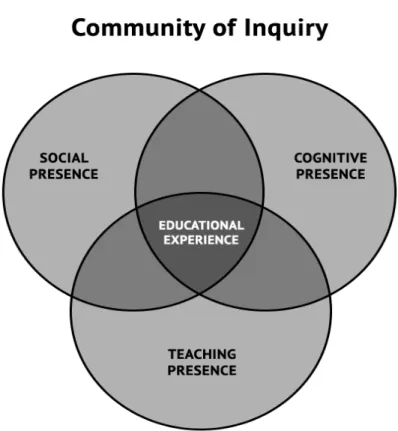
collaborative and worthwhile educational experience. The CoI framework consists of three overlapping domains: cognitive presence, social presence, and teaching presence (see Figure 2.1).
Figure 2.1. Elements of the Community of Inquiry framework. Adapted from “Critical Inquiry in a Text-based Environment: Computer Conferencing In Higher Education,” by D.R. Garrison, T. Anderson and W. Archer, 2000, in The Internet and Higher Education, 2(2-3), 87-105.
Garrison and colleagues contend that these three overlapping elements are necessary for an effective educational experience and that deep and meaningful learning happens at the intersection of these domains. This framework has been adopted and implemented by educators and scholars all over the world, and Garrison et al.’s (2000) seminal paper has been cited almost a thousand times in scholarly articles since its publication a decade and a half ago (Garrison et al., 2010).
Arbaugh et al. (2008) speculated that the reason for the CoI framework’s success was that it provided methodological guidelines for measuring each of the three presences in the model. Similar to Gunawardena and Zittle (1997), but with a bit more detail, Garrison et al. (2000) defined social presence in their seminal paper as “the ability of participants in a community of inquiry to project themselves, socially and emotionally, as ‘real’ people (i.e., their full personality), through the medium of communication being used” (p. 94). They studied text-based computer conferences by looking at postings for indicators of social presence and then grouping those indicators into three categories: emotional expression, open communication, and group cohesion.
Rourke et al. (2001) were the first from the original CoI research group to study the social presence element separately from the CoI framework, and they defined it as “the ability of learners to project themselves socially and emotionally in a community of inquiry” (p. 3). They also redefined the Garrison et al.’s (2000) original social presence categories to better reflect the indicators that emerged from their study (see Table 2.2).
Table 2.2
Categories and Indicators of Social Presence According to the Community of Inquiry Model
Category Indicators Definition of Indicators
Affective Expression of emotions Conventional expressions of emotion, or unconventional expressions of emotion, includes repetitious punctuation, conspicuous capitalization, emoticons.
Use of humor Teasing, cajoling, irony, understatements, sarcasm. Self-disclosure Presents details of life outside of class, or expresses
vulnerability.
Interactive Continuing a thread Using reply feature of software, rather than starting a new thread.
Quoting from others’ messages
Using software features to quote others entire message or cutting and pasting selections of others’ messages.
Referring explicitly to others’ messages
Direct references to contents of others’ posts. Asking questions Students ask questions of other students or the
moderator. Complimenting, expressing
appreciation
Complimenting others or contents of others’ messages.
Expressing agreement Expressing agreement with others or content of others’ messages.
Cohesive Vocatives Addressing referring to participants by name. Addresses or refers to the
group using inclusive pronouns
Addresses the group as we, us, our, group.
Phatics, salutations Communication that serves a purely social function; greetings, closures.
Note. From “Assessing Social Presence in Asynchronous Text-based Computer Conferencing” by L. Rourke, T. Anderson, D. R. Garrison, and W. Archer, 2001, in Journal of Distance Education, 14.
The emotional expression category was relabeled to ‘affective responses’, which in computer conferencing is expressed in many ways, including the use of emoticons, humor, and self-disclosure. Open communication became ‘interactive responses’, which in CMC are instances like replying to someone’s messages and quoting directly or
referring to someone else’s post. Garrison et al.’s (2000) third category of group cohesion was refined by Rourke et al. (2001) to ‘cohesive responses’, which include phatics and salutations, vocatives, and addressing the group as “we” or “us” reflecting the
collaborative nature of the group. Even in subsequent literature published by the original members of CoI research group the definition of social presence has not stayed constant through the years. For example, Garrison (2009) later redefined it as “the ability of participants to identify with the community (e.g., course of study), communicate purposefully in a trusting environment, and develop inter-personal relationship by the way of projecting their individual personalities” (p. 352). Again, all of these examples illustrate how definitions have continued to evolve and how the dynamics that have been argued to comprise the phenomenon of social presence have been refined over time.
One of the most current social presence definitions comes from Sung and Mayer (2012) who contend that the degree of online social presence is based on two factors: characteristics of the medium and student’s perception. They (2012) defined social presence as “the subjective feeling of being connected and together with others during computer mediated communication” (p. 1739). In Sung and Mayer’s definition, a
participant’s feeling of being a ”real” person or seeing others as “real” people while using CMC is a perceived view and a subjective view. This is the definition that will be used to define social presence in this research study that will probe students’ perception of social presence. The subjective nature of perception must be recognized and acknowledged, as what one learner feels or perceives in the online environment is not necessarily the same as what another person perceives. For example, one online learner could feel that her
social presence is strong but the person with whom she is communicating might not see it the same way.
Variations in definitions of social presence mirror variations in the way social presence has been studied. Research on social presence has been conducted in different fields and different contexts. Educational researchers have published most of the research on social presence, but they study it from different points of view, in different situational contexts, and the data is collected from different course settings. Short et al. (1976) developed early social presence theory to explain the impact telecommunications media have on communication by comparing face-to-face interactions with different
communication media. Naturally educational researchers have been interested in social presence ever since learning started to happen online where the medium might not have the capability to transmit facial expressions, intonation, or other non-verbal
communication cues (Caspi & Blau, 2008). Through the years the focus of social presence researchers has shifted from telecommunications to computer mediated
conferencing to online learning and so on, and for all of these contexts researchers have most often explored ways to measure social presence quantitatively.
Measuring Social Presence
Just as the definition of social presence has been ever evolving with no real consensus, the same goes for measuring it. Biocca, Burgoon et al. (2001) state that “[w]hile various measures have been proposed, there is as yet no widely accepted measure of social presence” (p.7). There is no one instrument for measuring social presence because researchers seem to want to revise instruments that have already been
developed (Lin, 2004; Lowenthal & Dunlap, 2014). This is necessary because situations and environments differ from study to study, and some (e.g. Rourke et al., 2001) have even encouraged others to build upon and tweak the social presence indicators they have developed. This has led to a variety of influential ways that social presence has been measured over the past four decades and a great deal of debate about appropriate measurement techniques.
Bi-polar scale questionnaire: initial instrument to measure social presence. Not only was Short et al.’s (1976) definition of social presence the first to appear in the literature, they also developed the first questionnaire to measure it using the semantic differential technique. This initial questionnaire was developed based on communication literature, and it looked into communicators’ perception of a medium’s impact on social presence using a seven-point bi-polar scale, e.g. warm-cold, personal-impersonal, sensitive-insensitive, and sociable-unsociable. Short and colleagues contend that when a communicator perceived the medium they were using to be warm, personal, sociable, and sensitive, they also perceived it to be higher in social presence. The results supported their hypothesis that social presence would vary between different media and that the face-to-face communication would be more sociable than closed-circuit television and an audio system. However, it has been argued that the questionnaire items Short et al. (1976) used in their study are too general to measure the research participants’ perception of social presence and that the semantic differential technique may not be a proper method to conduct a study because participants might understand keywords differently than others (Tu, 2002b).
Social presence scale. Gunawardena (1995) also developed a survey based on the literature to measure students’ perceptions of the medium. She referred to her survey as the GlobalEd Survey for social presence, which was later referenced as Social Presence Scale v. 1, and it used 17 bi-polar scales asking students to rate a range of items if they were sociable or unsociable, or warm or cold. Gunawardena conducted two similar studies and participants rated CMC as a highly interactive and social medium in both. Interestingly, these studies suggested that the instructor plays a very important role in enhancing social presence in an online environment. Gunawardena and Zittle (1997) refined Gunawardena’s (1995) original survey and created an instrument called the Social Presence Scale referred to by others as the Social Presence Scale v. 2, and it included 14 questions on a 1-5 Likert scale to measure how well social presence predicted learner satisfaction in a text-based medium. Results revealed that “social presence is a strong predictor of satisfaction in a computer conference” (Gunawardena & Zittle, 1997, p. 23). Tu (2000; 2002b) criticized the Social Presence Scale questionnaire, stating that it was missing several important variables like privacy, recipients, and topics needed to thoroughly capture students’ perception of social presence and that the questions were created for a group of students that was too specific. Nevertheless, Gunawardena and Zittle’s Social Presence Scale questionnaires have been widely adopted by other
researchers as a tool to measure social presence (Boston et al., 2009; Richardson & Swan, 2003; Swan & Shih, 2005).
Richardson and Swan (2003) studied social presence and its relationship to
developed was based on the Social Presence Scale created by Gunawardena (1995; Gunawardena & Zittle, 1997) but was modified in several ways and renamed Social Presence Survey. The language used in this questionnaire was changed to fit the study environment but the key refinements changed the independent variables to focus on students’ perceived learning. The majority of the items in the questionnaire were Likert-type items with a six-point response scale, but they also included two open-ended
questions, which ultimately provided support for the findings revealed in the quantitative data. Richardson and Swan’s study found that students who reported a high perception of social presence scored high in perceived learning and were more satisfied with the instructor than students who reported low social presence.
The Networked Minds Questionnaire. Biocca, Burgoon et al. (2001) suggested that the field needed a more robust and detailed theory and measure of social presence that would better help to understand this phenomenon in mediated environments. Biocca et al. (2001) developed a conceptualization of social presence called the Networked Minds Social Presence that was comprised of three dimensions: co-presence,
psychological involvement, and behavioral engagement. Based on this conceptualization, they designed the Networked Minds Questionnaire to measure “the degree to which individuals feel interconnected to each other through networked telecommunication interfaces” (p. 2). This questionnaire initially included 69 items measuring the three dimensions on a seven-point Likert scale. It was finally trimmed down to 38 questions based on an analysis of face validity, content validity, and factor analysis of internal consistency. A pilot study of the questionnaire showed concurrent validity displaying a
consistent pattern of results in distinguishing between social presence experienced in face-to-face and mediated interaction (Biocca et al, 2001). The Networked Minds Questionnaire has been further developed and refined resulting in variations of the original appearing in more recent literature (Harms & Biocca, 2004).
Social Presence and Privacy Questionnaire. Tu (2002b) criticized the social presence measurement instruments developed by both Short et al. (1976) and
Gunawardena (1995), citing their inability to capture the complex dynamics of social presence and lacking several important variables like privacy, recipients, and topics. He went on to design the Social Presence and Privacy Questionnaire (SPPQ) based on two existing instruments, the CMC Attitude Instrument (Steinfield, 1986) and an instrument to measure perceived privacy (Witmer, 1997). Several items from the two instruments that the SSPQ was based on were removed because they were originally designed for a different audience and the rest of the questions Tu (2002b) developed were based on the social presence literature. A final version of Tu’s SSPQ consisted of a demographics section followed by 17 social presence questions and 13 privacy questions that used a five-point Likert scale. Three dimensions – social context, online communication, and interactivity – emerged from the study, and Tu (2002b) stated that those three plus online privacy are important factors in impacting the level of social presence. He also argued that social presence is influenced by the medium’s characteristics and the user’s perceptions (Tu, 2002b).
Tu and McIsaac (2002) used the refined version of the SSPQ in their mixed-methods study and found that social presence positively influences online interaction.
Findings also confirmed the three dimensions that emerged in Tu’s (2002b) original study and as a result, they defined social presence as “the degree of feeling, perception, and reaction of being connected by CMC to another intellectual entity through a text-based encounter” (Tu & McIsaac, 2002, p. 140). They also added that the study indicated social presence is even more complicated than previously believed and recommended that the SSPQ needs to be revised further to include the variables that emerged from the
qualitative data.
Picciano (2002) studied students’ perceived social presence, interactivity, and performance in an online course. He designed a questionnaire based on the Inventory of Presence Questionnaire created by the Presence Research Working Group and on the questionnaire developed by Tu (2001). In Picciano’s study he collected three types of data: (1) student participation in online discussions, (2) a summative questionnaire at the end of the course asking students about their perception of the course experience,
learning and interaction, and (3) performance measures based on examination scores and written assignment scores (Picciano, 2002). Picciano (2002) found a strong relationship between students’ perception of their interaction and their perceived performance, but a comparison of the actual student interaction to actual performance scores were not consistent. Also, there was no evidence of a statistically significant relationship between students’ perception of social presence and performance on the examination. However, findings did reveal a statistically significant relationship between students’ perception of social presence and performance on the written assignment (Picciano, 2002).
Content analysis with indicators of social presence. The content analysis method has been used in several studies of social presence. One such study was conducted by Rourke et al. (2001) who were a part of the original research group that developed the Community of Inquiry theoretical framework that includes social presence as one of three presences that support learning (Garrison et al., 2000). As described previously, Garrison et al.’s (2000) social presence categories were emotional expression, group cohesion, and open communication, but Rourke and colleagues later refined them to affective responses, cohesive responses, and interactive responses to better reflect the twelve indicators they used to analyze text-based CMC transcripts. The research protocol that they developed shifted the way social presence could be measured. Instead of using questionnaires, they coded text-based CMC transcripts and then analyzed them using content analysis method to measure social presence (Lobry de Bruyn, 2004; Na Ubon & Kimble, 2004).
Swan and Shih (2005) also used content analysis in a mixed method study to investigate the nature of social presence and how it develops in a text-based CMC environment. Quantitative data was collected using a questionnaire they designed based on Richardson and Swan’s (2003) Social Presence Survey. Additionally, qualitative data was collected using interviews and analyzed using content analysis and social presence indicators developed by Rourke et al. (2001) and Swan (2002; 2003). Based on the quantitative data and qualitative data supporting it, Swan and Shih (2005) found a
significant correlation between perceived social presence and satisfaction with the online discussions.
In summary, early social presence research utilized quantitative methods and participants were asked to rate their perception of the medium using bi-polar scales. This in turn evolved into more detailed quantitative questionnaires in which bi-polar scales gave way to Likert scales, and the focus shifted from the quality of the medium to the participant and how the interactions between participants impacted their perception of social presence. Analysis methods like content analysis of participants’ online
discussions gained traction with the introduction of the Community of Inquiry
framework. Eventually, quantitative methods were mixed with a qualitative approach, and data analysis methods started to include variations like word counts, constant comparison, and content analysis, to name a few.
Four decades of evolving definitions and measurement tools. This chapter first discussed three different online course delivery methods, including synchronous,
asynchronous, and a combination of both methods. It then illustrated how the definition of social presence has not been stable over the past four decades by presenting the ways in which many researchers have re-defined and re-conceptualized it throughout those years. Definitions of social presence first appeared in the literature with Short et al.’s (1976) version, which may be considered seminal work in this area, and it is a phenomenon that continues to be defined and redefined in various ways.
Indeed, defining social presence has been a challenge and it appears that
measuring it has been even more difficult. Social presence questionnaires and indicators to research this rich and complex phenomenon continue to evolve over time, as illustrated
by the use of quantitative survey instruments with bi-polar scales or Likert scales as well as mixed-methods studies combining quantitative surveys with in-depth interviews.
New directions for inquiry into social presence. This study seeks to examine and understand social presence in deeper ways than measurement and quantitative data can provide. Interpretive case study methodology and qualitative data collection and analysis methods are used to address the following research questions in order to reveal rich information about participants’ perceptions of social presence as they share
narratives about their experiences in online courses: (1) How does an asynchronous video reflection tool impact students’ perception of social presence in an online class? (2) How does seeing classmates’ video recordings influence students’ feeling of community in an online class? And (3) How does creating video recordings influence students’ feeling of community in an online class? This inquiry into learner perceptions about social presence will be framed by Sung and Mayer’s (2012) definition of social presence as “the
subjective feeling of being connected and together with others during computer mediated communication” (p. 1739). This definition was chosen for this study as it recognizes that the participants’ feeling of being connected and together with others is a subjective view where one participant’s perception of being connected is not necessarily the same as what another person perceives. Next, chapter 3 presents the methodology and research design used in this interpretive case study to uniquely explore how an asynchronous video reflection tool impacts learners’ perception of social presence and their feeling of community in an online learning environment.
CHAPTER 3 METHODOLOGY
For this dissertation, a case study (Stake, 1995) was conducted that utilized qualitative methods to explore how an asynchronous video reflection tool impacted learners’ perception of social presence and their feeling of community in an online
learning environment. The focus of the study was on learners in an online course and how they experienced the phenomenon of social presence in the class. Qualitative methods provided the optimal way of collecting the data in this particular case to understand this phenomenon in deeper ways than mere measurement could provide. Interpretive case study methodology and qualitative data collection and analysis methods were used in the study to examine and seek to understand perceptions of social presence while learning online. The social presence element from Garrison, et al. (2000) and Rourke et al.’s (2001) Community of Inquiry Framework as well as Sung and Mayer’s (2012) social presence definition as “the subjective feeling of being connected and together with others during computer mediated communication” (p. 1739) served as the conceptual
framework for the study.
The most cited researchers on social presence have studied students’ perceptions of presence quantitatively, collecting self-reported survey data (Gunawardena, 1995; Gunawardena & Zittle, 1997; Richardson & Swan, 2003) and used content analysis to analyze text-based CMC transcripts (Rourke et al., 2001). In contrast, this study also relied on students’ perception but was unique in that it sought to hear from the students’ themselves in deeper ways by using a combination of three different qualitative methods.
An initial qualitative survey was followed by a focus group with five students, and then individual semi-structured interviews were conducted with five selected participants who were able to best provide data that explained perception of social presence in rich detail. Data from all three of these methods were included in data analysis. These methods were intentionally chosen to get the researcher into direct interaction with participants and, therefore, allow clarification of meanings and deeper probing into the research questions with each subsequent data collection method (Finch & Lewis, 2003).
Research Questions
The purpose of this study is to help online instructors, instructional designers and educational app developers find new ways of enhancing or increasing social presence for their target audience by exploring the following research questions:
I. How does an asynchronous video reflection tool impact students’ perception of social presence in an online class?
II. How does seeing classmates’ video recordings influence students’ feeling of community in an online class?
III. How does creating video recordings influence students’ feeling of community in an online class?
Community-Based Tool for Asynchronous Video
The particular asynchronous video reflection tool used in this study is called Flipgrid, developed at the University of Minnesota. In Flipgrid, the teacher creates a short text or video question and students respond through recorded videos. Flipgrid works on a web browser. To record a video response or watch classmates’ recordings, students
simply go to the web address their instructor gives them, or it can be easily accessed by embedding on any web page. Flipgrid’s unique feature is the 90-second recording time limit, which forces students to stay on topic when recording their answers. This time limit is also designed to help maintain students’ attention as they watch their peers’ recordings; for example, they don’t have to watch a 10-minute long recording of each of their fellow classmates. As Picciano (2002) quoted nobel prize laureate Herbert Simon, “a wealth of information can create a poverty of attention” (p. 23).
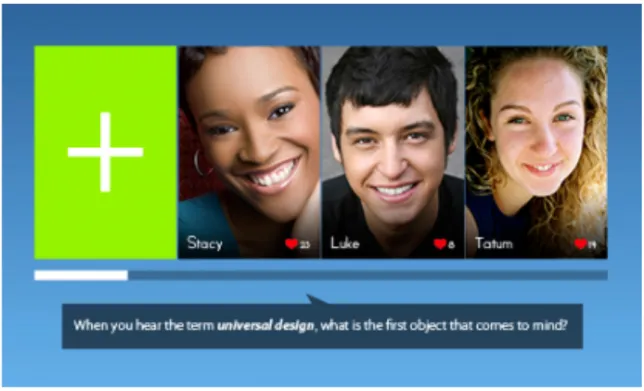
Flipgrid was designed with simplicity in mind and, therefore, the user interface is a minimalistic grid of recorded reflections (see Figure 1.1) presented as accumulated images of the authors rather than lists of files or user names. This aesthetic visual
representation of recorded videos is designed to give the user instant feedback of who has recorded their reflection, and to allow the user to quickly browse the video reflections by clicking the side-by-side images. Users can also share their recorded reflections through different social media sites or send links to video reflections using email or Twitter. Case Selection & Participant Selection
This bounded case included five undergraduate-level online courses in which students used an asynchronous video reflection tool throughout the semester over 14 weeks. According to Stake (1995), the researcher’s main obligation is to understand the case that is being studied, so purposeful sampling was chosen as the sampling strategy because it focuses on selecting information rich cases. Patton (2002) further contends that “[s]tudying information rich cases yields insights and in-depth understanding rather than empirical generalizations” (p. 230). Purposeful sampling is often used when the case is an
intact group, “such as school classes, making random assignment of individual subjects impossible” (Singleton & Straits, 2005, p. 207).
To be selected for this study, the case had to meet the following criteria: (1) the course had to be offered fully online, and (2) the students in the course had to use
asynchronous video reflection tool at least three times a month throughout the duration of the course. Course selection was also based on the researcher’s access to a specific group of courses at a large Midwestern university in the U.S. and his knowledge about the instructors’ use of a common asynchronous video reflection tool to avoid discrepancies in functionality and usability. The courses were selected in which the instructors had
integrated the asynchronous video reflection tool extensively in their curriculum. The population for the study consisted of undergraduate students enrolled in the five courses selected for this study.
Data was collected during the spring semester of 2015. Once an agreement was established with the instructors to conduct research in their courses, all enrolled students were sent a survey to determine which students had (A) the interest to share their
experiences and (B) something interesting and substantive to say (i.e., something more than just “it’s great” or “I don’t like it”). The data collection process was accompanied by ongoing data analysis as an iterative process rather than a linear series of events (Saldaña, 2013). Based on the richness of survey findings, participants were chosen for a focus group interview, and then based on the analysis of focus group data, the data collection process funneled down to intentionally select five students to interview individually based upon those who provided the most insight and detailed descriptions of their
experience with the tool and their perceptions of social presence or/and the feeling of connection or community. Data collection instruments used in the focus group and in the individual interviews were based on the previous instruments but were modified based on what was discovered from the survey data. These discoveries were helpful in determining the focus group interview questions as well as the individual interview questions. This funneling down process was a characteristic of criterion sampling, which is a purposeful sampling strategy that can be used to select participants that can provide the most meaningful data to help understand the phenomenon under investigation (Patton, 2002). This sampling strategy was an effective approach to identify participants that could provide the richest data for this case study.
Data Collection
The three qualitative methods used in this study to collect data for analysis were designed to provide responses that explained perception of social presence in the most rich detail, as described in Table 3.1. The survey was originally intended to provide base information on participants and their use of asynchronous video reflection tool, and also be used as supporting and guiding material for the focus group and the interview
sessions. However, the qualitative survey responses were surprisingly descriptive and rich in detail. Participants for the focus group and interviews were selected based on the survey data.
Table 3.1
Overview of Data Collection Methods Data collection
method
Approach Type of data Purpose
Survey Qualitative Open ended
questions
Base data, survey all participants
Focus group interview
Qualitative Focus group transcripts
Further explore data revealed in survey responses Semi-structured individual interviews Qualitative Interview transcripts
Probe deeper into specific experiences and data revealed in survey and focus group
responses
Survey. All students in five participating online courses were asked to participate in this study, representing a total of 98 students. The survey instrument was based on the social presence section of Community of Inquiry Questionnaire (CoIQ), developed by a multi-institutional research group (Arbaugh et al., 2008; Swan et al., 2008) and later revised by Lowenthal and Dunlap (2014). The survey questions were modified from their original form for this study to better fit the context of the asynchronous video reflection tool. Additional modifications were necessary because both the original CoIQ and the version reflecting Lowenthal and Dunlap’s recommendations assumed that the studied participants were in two-way communication using a text based CMC (i.e., discussion forums or email). However, this study examined a different type of communication medium. Further, the answers for the survey questions in this study were open ended and qualitative in nature, whereas former versions of the CoIQ used a quantitative Likert
scale. Surveys with open-ended questions are exploratory in nature and the goal of these types of questions is to get more detailed responses about the topic of study (Patton, 2002).
Focus group interview. Krueger and Casey (2009) define a focus group as “a carefully planned series of discussions designed to obtain perceptions on a defined area of interest in a permissive, non-threatening environment” (p. 2), and focus groups are often used to support other data collection methods like surveys and interviews (Morgan, 1997). According to Krueger and Casey, focus groups have the ability to produce
discussions and debates that give the researcher an opportunity to observe viewpoints that could be missed with surveys, and interactions among participants often produce in-depth data. For this case study, one focus group interview was conducted with five participants (Krueger & Casey, 2009; Patton, 2002) two weeks following the survey data collection to allow enough time for appropriate analysis of survey findings. Participants for the focus group were partially selected based on the survey results. The survey inquired about students’ willingness to participate in a focus group, and eight out of 31 students responded yes. Based on the descriptiveness and insightfulness of their answers, five of those students were invited to the focus group, and all those invited were able to attend. The researcher facilitated the focus group interview, which was audio recorded and later transcribed.
Individual interviews. Following the analysis of focus group data, five individual, semi-structured interviews were conducted with participants who were strategically selected for their ability to provide deep analytical explanations in their