(will be inserted by the editor)
Polynomially solvable formulations for a class of
nurse rostering problems
Pieter Smet · Peter Brucker ? · Patrick De Causmaecker · Greet Vanden Berghe
Received: date / Accepted: date
Abstract Identifying underlying structures in combinatorial optimisation prob-lems leads to a better understanding of a problem and, consequently, to ef-ficient solution methodologies. The present paper introduces a new network flow formulation for a large class of nurse rostering problems. By solving an integer minimum cost flow problem in a carefully constructed network, nurses’ shift schedules can be constructed in polynomial time. The performance of the new formulation is compared with a state of the art algorithm on a benchmark dataset. Computational experiments show that the new formulation performs best both in terms of solution quality and computation time. By identifying inherent combinatorial structures which can be efficiently exploited, insight is gained into the problem’s complexity, thereby laying the foundations for a theory of nurse rostering.
Keywords Network flows·Nurse rostering·Mathematical programming
? Peter Brucker sadly passed away on July 24, 2013. His coauthors dedicate their
contribution in this paper to his memory. P. Smet and G. Vanden Berghe
KU Leuven, Department of Computer Science, CODeS & iMinds - ITEC Gebroeders De Smetstraat 1, 9000 Gent, Belgium
Tel.: +32 92658704
E-mail:{pieter.smet, greet.vandenberghe}@cs.kuleuven.be P. De Causmaecker
KU Leuven, Department of Computer Science, CODeS & iMinds - ITEC Etienne Sabbelaan 53, 8500 Kortrijk, Belgium
Tel.: +32 92658704
1 Introduction
Scheduling nurses is a critical process in health care due to the high costs associated with these scarce resources. Nearly sixty years of research has been devoted to solving different variants of this problem, resulting in an equally large variety of solution techniques (Burke et al, 2004; Van den Bergh et al, 2013). Many nurse rostering problems addressed in the literature are complex in nature, dealing with a large variety of organisational and legal constraints (Brucker et al, 2010; Smet et al, 2013). Complex search algorithms have been proposed for dealing with such problems (Burke and Curtois, 2014; Valouxis et al, 2012). However, attention has also been paid to more straightforward, simplified variants of the problem which make abstraction of a large part of the operational complexity arising in practice. Studying the underlying structure of such problems can lead to valuable insights, resulting in improved method-ologies for both simplified and complex nurse rostering problems. We revisit problems presented in the literature, and investigate whether they exhibit a combinatorial structure that can be efficiently exploited.
An example of such a combinatorial structure which has been given at-tention in personnel scheduling research is the use of network flow techniques (Ahuja et al, 1993). A common application of network flows is found in col-umn generation approaches for personnel rostering, where the pricing problem is often modeled as a resource constrained shortest path problem (Jaumard et al, 1998). Networks have also been described to address more general prob-lems: to calculate the size of a workforce (Koop, 1988), to reconstruct nurse rosters from a schedule with disruptions (Moz and Pato, 2004) or to allocate shift types to a fixed days-on roster (Dowsland and Thompson, 2000). Brucker et al (2011) discuss networks for various (sub)problems related to personnel scheduling. Millar and Kiragu (1998) present a mathematical model with an underlying network structure to represent both a cyclic and non-cyclic nurse scheduling problem. Constraints regarding staffing demands and weekends are modelled as side constraints external to the network.
These network flow formulations make a strong abstraction of reality by e.g. assuming equal staffing requirements on all days or full staff availability, considering single shift scenarios and ignoring skill requirements. Furthermore, the number of contractual workforce constraints included in these formulations is typically limited to e.g. only restricting certain shift successions or only limiting the maximum number of consecutive assignments. The present paper fills the existing void by presenting a network flow model incorporating various practical and important nurse rostering constraints. Since there are no side constraints, the underlying structure of network flow problems is kept intact. Thereby, a solution methodology is established for efficiently solving a large class of nurse rostering problems.
The paper is organised as follows. Section 2 presents a detailed classification scheme for nurse rostering problems. Section 3 introduces a new network flow formulation for nurse rostering, along with several extensions. A computational
evaluation of the new formulation is presented in Section 4. Finally, Section 5 concludes the paper and identifies areas for future research.
2 A classification scheme for nurse rostering problems
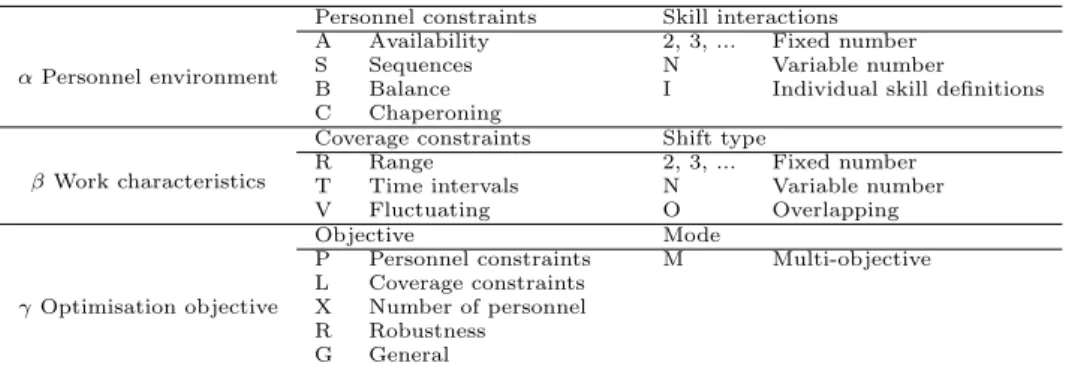
De Causmaecker and Vanden Berghe (2011) present an α|β|γ classification scheme for practical nurse rostering problems (Table 1). The presented nota-tion allows a wide variety of problem characteristics to be described. In this section, we introduce an extension to this classification scheme which allows detailed elements of nurse rostering problems to be described.
Personnel constraints Skill interactions
αPersonnel environment
A Availability 2, 3, ... Fixed number S Sequences N Variable number B Balance I Individual skill definitions C Chaperoning
Coverage constraints Shift type
βWork characteristics
R Range 2, 3, ... Fixed number T Time intervals N Variable number V Fluctuating O Overlapping
Objective Mode
γOptimisation objective
P Personnel constraints M Multi-objective L Coverage constraints
X Number of personnel R Robustness G General
Table 1 Classification of nurse rostering problems (De Causmaecker and Vanden Berghe, 2011).
α: Personnel environment
The scheme of De Causmaecker and Vanden Berghe (2011) describes time-related (horizontal) constraints by α : A and α : S for counters and series, respectively. We present the following extensions to these constraint categories:
– A ∈ {a, a, a, a, s, s, s, s} Type of counter constraint. When A = a there is a constraint on the number of days worked, and when A=s there is a constraint on the number of assignments of a particular shift type. The lines above and under each entry indicate the type of threshold. For example, a means that an exact number of days needs to be worked,a means that only an upper bound is specified, arefers to only a lower bound, finally,a means that a range is defined.
– S ∈ {as, as, as, as, cs, cs, cs, cs, ss}Type of series constraint. WhenS=as there is a constraint on the number of consecutive days worked, when S = ss there is a constraint on particular shift successions, and when S =cs there is constraint on the number of consecutive assignments of a particular shift type. The threshold for this type of constraint is defined as in categoryα:A.
β: Work characteristics
To detail the type of coverage constraint in a nurse rostering problem, the categoryβ :Ris extended with the following elements:
– R∈
d, d, d, d Type of coverage constraint. The threshold for this type of constraint corresponds to the threshold definition in category α:A.
γ: Optimisation objective
Several objectives can be described in theγcategory. We present an extension to the category γ : P to differentiate between different types of personnel related objectives:
– P ∈ {P
wc,P
px}Objective function.P=P
wcdenotes a weighted sum of soft constraint violations. When P = P
px, the employee preferences are optimised.
While most common time-related constraints for nurse rostering are presented in the extended classification scheme, the use of theα|β|γ notation presents a flexible framework allowing for future extensions.
3 Network flow models for nurse rostering
3.1 Problem description
The scheduling periodT is a set oftdaysT ={1, ..., t}. There is a setS ofs shift typesS ={1, ..., s}. On each dayj and for each shift typek, arbitrary minimum and maximum staffing demands 0 ≤ dljk ≤ dujk are specified. The workforce N is a heterogeneous set of n nurses N ={1, ..., n}. Each nurse i has to work exactly ai days in T. Finally, each nurse i has a preference for
working shift typekon dayj, expressed as an inversely proportional costcijk.
LetPdenote the problem of assigning shifts to nurses such that the staffing requirements are satisfied. Each nurse must work exactly the number of spec-ified days and can be assigned to at most one shift per day. The objective is to minimise the costscijk.
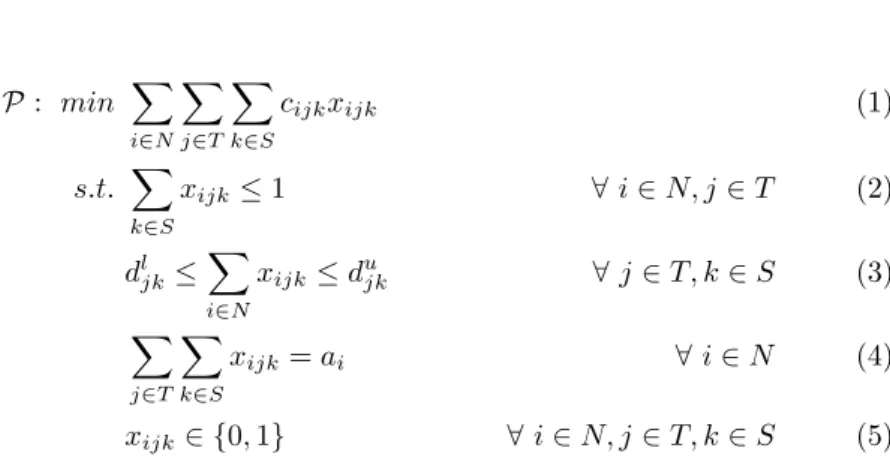
P can be formulated as an integer linear program (ILP) with one set of decision variables
xijk=
1 if nurse iworks shiftkon dayj 0 otherwise
P : min X i∈N X j∈T X k∈S cijkxijk (1) s.t. X k∈S xijk ≤1 ∀i∈N, j∈T (2) dljk≤X i∈N xijk≤dujk ∀ j∈T, k∈S (3) X j∈T X k∈S xijk=ai ∀i∈N (4) xijk∈ {0,1} ∀i∈N, j∈T, k∈S (5)
The objective function 1 minimises the sum of costs incurred by the shift assignments. Constraints 2 ensure that at most one shift is assigned per day, per nurse. Constraints 3 model the minimum and maximum staffing demands. Constraints 4 restrict the number of days each nurse should work in the plan-ning period. Finally, constraints 5 bound the decision variables.
Following the extended α|β|γnotation presented in Section 2, the class of problems we address is inA(a)NI|R(d)VN|P( Ppx).
3.2 Network flow formulation
Problem P can be reformulated as an integer minimum cost network flow problem in a directed networkG= (V, E), withV the set of nodes andEthe set of arcs. The setV consists of four subsets of nodes.
Shift nodes For each dayj∈T and each shift typek∈S, a node is created representing the demand on dayj for shift typek.
Time nodes For each nurse i ∈ N and each day j ∈ T, a node is created representing a day on which a nurse can work.
Nurse nodes For each nursei∈N, one node is created.
Other nodes There is one source nodesand one sink nodef.
Figure 1 shows the structure of the network G. Each shift node has one incoming arc from the source node. Its outgoing arcs are directed towards the time nodes corresponding to the day for which the shift node is defined. Each nurse node only has incoming arcs from time nodes associated with the nurse. Finally, each nurse node has one outgoing arc to the sink node.
Lemma 1 The number of nodes inGis equal to t(s+n) +n+ 2.
Proof The network contains tsshift nodes,nttime nodes,nnurse nodes and
two other nodes. ut
s f Shift nodes Time nodes
<j,k> <i,j> i j = 1,...,t k = 1,...,s i = 1,...,n j = 1,...,t i = 1,...,n Nurse nodes
..
..
..
..
..
..
0 ≤ x ≤ 1 x = ai cijk dl jk ≤ x ≤ dujk 0 ≤ x ≤ 1Fig. 1 NetworkGfor problemP.xdenotes the flow through an arc.
Proof There are ts arcs going from the source node to the shift nodes. Each
shift node has narcs to time nodes. There arets shift nodes, so in total tsn arcs go from shift nodes to time nodes. Each time node has one outgoing arc to a nurse node. With nt time nodes, nt arcs exist between the time nodes and the nurse nodes. Finally, there are n arcs between the nurse nodes and
the sink node. ut
Flow costs are only defined on the arcs between the shift nodes and the time nodes, representing the costcijk of assigning a nurseito shift typekon
dayj. All nodes, except the source and sink nodes, are transshipment nodes. The supply in the source node isP
i∈Nai, corresponding to the total number
of days the nurses can work according to their contracts. The supply in the sink node is equal toP
i∈N−ai.
Lower and upper bounds on the capacity of the arcs are appropriately de-fined to correctly represent problemP. The arcs between the source node and the shift nodes have a lower (upper) bound equal to the minimum (maximum) staffing demand. Arcs between the nurse nodes and sink node have a lower and upper bound equal to the required number of days worked. All other arcs require a flow of either 0 or 1.
Theorem 1 An optimal integer minimum cost flow in the network G
corre-sponds to an optimal solution for problem P.
Proof Due to the construction of networkG, a minimum cost solution
respect-ing the capacity and demand constraints can be converted to a solution for problem P. A flow on an arc between a time node defined for nurse i, dayj and a nurse node defined for nursei, corresponds to a working day for nursei. By forcing a flow ofai in the arc between the nurse nodeiand the sink node,
nursei will work exactlyai days. Shift assignments are determined by flows
in the arcs between the shift nodes and the time nodes. A flow from the shift node associated with day j, shift k to the time node associated with day j, nursei, corresponds to nurseiworking shiftkon dayj, thereby incurring cost cijk. The flow conservation constraints ensure that at least dljk, and at most
du
jk units of flow will be divided among the arcs leaving the associated shift
node, thereby fulfilling the staffing demands. Since there is an upper bound of one on the arcs between the shift nodes and time nodes, a nurse cannot be
3.3 Extensions
Several elements can be added to the definition of problemP, which can also be included in the network formulation.
3.3.1 Unavailabilities
Ashift unavailability prevents the assignment of shift typek on dayj. A set
of shift unavailabilities ¯Sij ⊆S can be defined, containing the shifts for which
nursei is unavailable on dayj. This is enforced by adding constraints (6) in the ILP model.
X
k∈S¯ij
xijk= 0,∀ i∈N, j∈T (6)
Shift unavailabilities can be modeled in networkGby setting the capacity upper bound to zero on the arcs going from the shift node associated with each shift in ¯Sij to the corresponding time nodes.
This type of unavailability can also be used to include qualification re-quirements for particular shifts. For example, when one head nurse is required during the day shift, a dedicatedhead nurse-day shift can be created. The ca-pacity upper bound on the arcs going from the associated shift nodes should be zero, except for the arcs to the time nodes defined for the actual head nurses.
Aday unavailability forbids the assignment of any shift on dayj. Again, for
each nursei, a set of day unavailabilities ¯Ti ⊆T can be defined. Constraints
(7) model these unavailabilities in the ILP model.
X
k∈S
xijk= 0,∀ i∈N, j∈T¯i (7)
In the networkG, day unavailabilities are enforced by changing the capacity upper bound to zero on the arcs going from the relevant time nodes to the corresponding nurse nodes.
3.3.2 Hard preferences
Hard preferences, either for working days or for particular shifts, can be mod-eled in a similar way as the unavailabilities. An assignment of shiftk on day j for nursei can be fixed by adding constraint (8) to the ILP model.
xijk= 1 (8)
For a fixed day-on assignment on day j to nursei, constraint (9) should be added to the ILP model.
X
k∈S
In networkG, instead of setting the capacity upper bound on selected arcs to zero, the capacity lower bound is set to one, thereby forcing a flow through the arcs and consequently ensuring a working day or shift.
3.3.3 Daily employment cost
There exist cases in which a costci is incurred for each day nursei works in
the planning period. The objective function in the ILP includes an additional term to represent these costs (expression (10)).
X i∈N X j∈T X k∈S cijkxijk+ X i∈N X j∈T ci X k∈S xijk (10)
This extension can be modeled in network Gby adding a flow cost equal to ci on the arcs from the nurse nodes to the sink node. Since each unit of
flow through these arcs represents one day of labour, a flow cost corresponds to the costci.
3.3.4 Ranged constraint
Problem P requires nursei to work exactly ai days. This constraint can be
relaxed such that nurseiworks betweenal
iandaui days. In the ILP, constraints
(4) are replaced by constraints (11).
ali≤X
j∈T
X
k∈S
xijk ≤aui,∀i∈N (11)
This relaxation is included in the network flow model by transforming the networkGto a circulation network G0 by adding one arc from the sink node to the source node. There is no cost associated with this arc, and the capacity is only bounded below by zero. All nodes become transshipment nodes. Ac-cording to Theorem 1, an integer minimum flow inG0again corresponds to an optimal solution for problemP with constraints (11).
3.3.5 Weighted constraint
Consider the modification of problem P such that for each nursei∈N only an upper bound ai on the number of days worked is imposed, which can be
violated at the cost of a penaltywiper additional day worked. This is modelled
by replacing constraints (4) with constraints (12) in the ILP.
X
j∈T
X
k∈S
xijk≤ai+pi,∀ i∈N (12)
The variablepirepresents the number of days nurseiworks over the allowed
maximum. Violations of this constraint are minimised by optimising objective function (13).
X i∈N X j∈T X k∈S cijkxijk+ X i∈N wipi (13)
In the network flow formulation, one additional transshipment node is cre-ated for each nurse: a constraint node. Each of these new nodes is connected with the nurse node of the corresponding nurse, and the sink node. Both arcs have positive infinite capacity. By adding a flow cost equal towi on the arcs
between the nurse nodes and the constraint nodes, the penalty for additional days worked is counted. Figure 2 shows the modified network.
s f
Shift nodes Time nodes
<j,k> <i,j> i j = 1,...,t k = 1,...,s i = 1,...,n j = 1,...,t i = 1,...,n Nurse nodes .. .. .. .. .. .. 0 ≤ x ≤ 1 x ≤ ai cijk 0 ≤ x ≤ 1 Constraint nodes i i = 1,...,n x ≥ 0 x ≥ 0 wi .. .. dl jk ≤ x ≤ dujk
Fig. 2 NetworkGfor problemP with weighted constraint violation.x denotes the flow through an arc.
To construct a solution for this extended problem description, the network Gdepicted in Figure 2 is first transformed to a circulation network G0, such that all nodes become transshipment nodes. According to Theorem 1, an inte-ger minimum flow inG0again corresponds to an optimal solution for problem P with the weighted constraint.
4 Computational analysis
4.1 Applying the network flow model
The effectiveness of the new network flow formulation is evaluated by analysing a series of computational experiments on the NSPLib benchmark dataset (Van-houcke and Maenhout, 2007). The dataset consists of different constraint sets that can be combined with any of the 29,160 problem instances. By omitting the constraint on forbidden shift sequences from the NPSLib problem de-scription, a subset of instances (case 1 constraint set for the 7-day instances) corresponds to problemP.
As in problem P, an assignment cost cijk is defined for each nurse, shift,
day combination. Furthermore, NSPLib uses a dummy shiftk0 to represent a day-off. Let cijk0 be the preference cost of nursei for a day-off on day j. To
correctly incorporate the use of the dummy shift in the networkG, the original costscijk were transformed to modified costsc0ijk by applying equation 14.
It is clear that a problem instance with costs c0ijk has the same optimal assignments as a problem with costscijk since the relative differences in
pref-erence remain the same. The only diffpref-erence is thatc0ijk can be less than zero, which in general does not influence (optimal) choices made by algorithms. Since after applying equation 14, the costs associated with days-off are zero, their assignment can be omitted from any shift assignment model. The costs associated with the other shifts will determine whether a particular shift type assignment is preferable to a day-off.
4.2 Performance evaluation
We first present a comparison in terms of size for both the ILP formulation and the network flow formulation (NF). Table 2 shows, for the different instances in NSPLib, the number of variables and constraints in the ILP model and the number of nodes and arcs in the networkG.
ILP NF
Days Nurses Variables Constraints Nodes Arcs
7
25 700 228 230 928
50 1400 428 430 1828
75 2100 628 630 2728
100 2800 828 830 3628
Table 2 Size comparison of ILP and network flow models.
We performed a series of experiments with the ILP formulation and net-work flow formulation to solve instances from NSPLib. The experiments were carried out on an Intel Core i5 CPU at 2.5GHz with 4GB RAM operating on Windows 7, using a single thread. All algorithms were coded in C++. IBM ILOG CPLEX 12.5 was used to solve the ILP formulation. The network flow formulation was solved with the network simplex algorithm in LEMON 1.3.
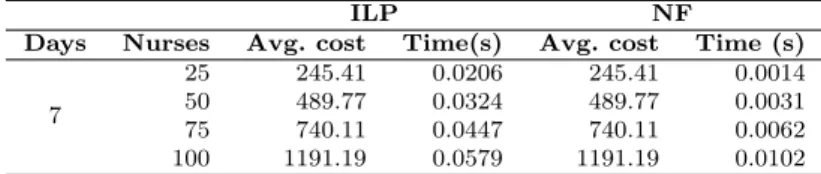
Table 3 compares the solution costs and computation times in seconds for the ILP formulation (ILP) and the network flow formulation (NF). These values are averages over all instances, grouped per number of days and number of nurses.
ILP NF
Days Nurses Avg. cost Time(s) Avg. cost Time (s)
7
25 245.41 0.0206 245.41 0.0014 50 489.77 0.0324 489.77 0.0031 75 740.11 0.0447 740.11 0.0062 100 1191.19 0.0579 1191.19 0.0102
Both the ILP and network flow formulations obtain optimal solutions for all instances, while requiring very little computation time. The reported cal-culation times are plotted in Figure 3 as functions of problem size, determined by the number of days and nurses. For both approaches, the trend shows that an increasing problem size, and thus an increasing number of variables, con-straints or network dimensions, leads to longer calculation times. However, for the network flow formulation, the required calculation time is up to a magnitude lower than for the ILP formulation, thereby demonstrating the ad-vantage of exploiting the problem’s underlying combinatorial structure with well known efficient algorithms.
0.001 0.010 0.100 1.000 7x25 7x50 7x75 7x100 Calcu lation tim e (s)
Number of days x number of nurses
ILP NF
Fig. 3 Required calculation times in function of problem size.
5 Conclusions and future work
By reformulating nurse rostering problems as integer minimum cost flow prob-lems, we identified a class of problems inA(a)NI|R(d)VN|P(P
px)that can be solved in polynomial time. Within this problem class, several variants are introduced which can be modeled by making minor modifications to the pre-sented flow network, while still preserving its combinatorial structure. The contribution lies in this new formulation by which a large class of problems can be solved in polynomial time.
Computational experiments demonstrated the effectiveness of the new for-mulation on a benchmark dataset from the literature. Compared to solving an ILP formulation with a state of the art mathematical solver, a network simplex algorithm required almost ten times less computation time for solving the integer minimum cost flow problem in the presented flow network.
The challenge of identifying efficiently exploitable combinatorial structures for more complex problems, incorporating other practical constraints, remains an important research area. Such results lead to establishing a theory of per-sonnel scheduling which is severely lacking in the academic community. Un-derstanding various problems’ structure and complexity supports the study of more complex nurse rostering problems arising in practice.
References
Ahuja RK, Magnanti TL, Orlin JB (1993) Network Flows: Theory, Algorithms, and Applications. Prentice Hall
Brucker P, Burke EK, Curtois T, Qu R, Vanden Berghe G (2010) Adaptive construction of nurse schedules: A shift sequence based approach. Journal of Heuristics 16(4):559–573
Brucker P, Qu R, Burke EK (2011) Personnel scheduling: Models and com-plexity. European Journal of Operational Research 210(3):467 – 473 Burke EK, Curtois T (2014) New approaches to nurse rostering benchmark
instances. European Journal of Operational Research 237(1):71 – 81 Burke EK, De Causmaecker P, Vanden Berghe G, Van Landeghem H (2004)
The state of the art of nurse rostering. Journal of Scheduling 7(6):441–499 De Causmaecker P, Vanden Berghe G (2011) A categorisation of nurse
roster-ing problems. Journal of Schedulroster-ing 14(1):3–16
Dowsland K, Thompson J (2000) Solving a nurse scheduling problem with knapsacks, networks and tabu search. Journal of the Operational Research Society pp 825–833
Jaumard B, Semet F, Vovor T (1998) A generalized linear programming model for nurse scheduling. European Journal of Operational Research 107(1):1 – 18
Koop GJ (1988) Multiple shift workforce lower bounds. Management Science 34(10):1221–1230
Millar HH, Kiragu M (1998) Cyclic and non-cyclic scheduling of 12 h shift nurses by network programming. European Journal of Operational Research 104(3):582 – 592
Moz M, Pato M (2004) Solving the problem of rerostering nurse schedules with hard constraints: New multicommodity flow models. Annals of Operations Research 128:179–197
Smet P, De Causmaecker P, Bilgin B, Vanden Berghe G (2013) Nurse rostering: A complex example of personnel scheduling with perspectives. In: Uyar AS, Ozcan E, Urquhart N (eds) Automated Scheduling and Planning, Studies in Computational Intelligence, vol 505, Springer Berlin Heidelberg, pp 129–153 Valouxis C, Gogos C, Goulas G, Alefragis P, Housos E (2012) A systematic two phase approach for the nurse rostering problem. European Journal of Operational Research 219(2):425 – 433
Van den Bergh J, Beli¨en J, De Bruecker P, Demeulemeester E, De Boeck L (2013) Personnel scheduling: A literature review. European Journal of Operational Research 226(3):367 – 385
Vanhoucke M, Maenhout B (2007) NSPLib - a tool to evaluate (meta-) heuris-tic procedures. In: Brailsford S, Harper P (eds) Operational research for health policy: making better decisions, proceedings of the 31st meeting of the European working group on operational research applied to health ser-vices, pp 151–165