UNITY OF COMMAND FOR HOMELAND SECURITY: TITLE 32, TITLE 10, OR A COMBINATION
A thesis presented to the Faculty of the U.S. Army Command and General Staff College in partial
fulfillment of the requirements for the degree
MASTER OF MILITARY ART AND SCIENCE General Studies
by
John H. Ebbighausen, MAJ, ARNG-FA B.S., University of Vermont, 1992
Fort Leavenworth, Kansas 2006
Report Documentation Page OMB No. 0704-0188Form Approved
Public reporting burden for the collection of information is estimated to average 1 hour per response, including the time for reviewing instructions, searching existing data sources, gathering and maintaining the data needed, and completing and reviewing the collection of information. Send comments regarding this burden estimate or any other aspect of this collection of information, including suggestions for reducing this burden, to Washington Headquarters Services, Directorate for Information Operations and Reports, 1215 Jefferson Davis Highway, Suite 1204, Arlington VA 22202-4302. Respondents should be aware that notwithstanding any other provision of law, no person shall be subject to a penalty for failing to comply with a collection of information if it does not display a currently valid OMB control number.
1. REPORT DATE
16 JUN 2006 2. REPORT TYPE
3. DATES COVERED
4. TITLE AND SUBTITLE
Unity of command for homeland security: Title 32, Title 10, or a combination.
5a. CONTRACT NUMBER 5b. GRANT NUMBER
5c. PROGRAM ELEMENT NUMBER 6. AUTHOR(S)
John Ebbighausen
5d. PROJECT NUMBER 5e. TASK NUMBER 5f. WORK UNIT NUMBER 7. PERFORMING ORGANIZATION NAME(S) AND ADDRESS(ES)
US Army Command and General Staff College,1 Reynolds Ave.,Fort Leavenworth,KS,66027-1352
8. PERFORMING ORGANIZATION REPORT NUMBER
ATZL-SWD-GD
9. SPONSORING/MONITORING AGENCY NAME(S) AND ADDRESS(ES) 10. SPONSOR/MONITOR’S ACRONYM(S)
11. SPONSOR/MONITOR’S REPORT NUMBER(S)
12. DISTRIBUTION/AVAILABILITY STATEMENT
Approved for public release; distribution unlimited. 13. SUPPLEMENTARY NOTES
The original document contains color images. 14. ABSTRACT
Unit of command becomes a major issue when both federal and state militaries simultaneously provide Defense Support to Civil Authorities (DSCA) within the same area of operations as seen during Hurricane Katrina. Both federal and state militaries look alike and have similar equipment, but may respond to different authorities. Federal and state laws and policies regulate the missions each may perform based on the activated status (Title 10, Title 32, or State Active Duty) of the unit. This study examines laws and policies, such as the Posse Comitatus Act, the Stafford Act, the Insurrection Act, the National Response Plan, the National Defense Authorization Act of 2004, and the Emergency Management Assistance Compact that govern the permissive or restrictive measures of each status. It applies these as well as
additional measures in examining the Los Angeles Riots and Hurricane Katrina to determine the feasibility of using National Guard versus federal military assets to establish unity of command. The study finds that the National Guard is truly the Army?s first responder for DSCA missions, is well integrated with local and state emergency management authorities, and should command and control all military assets allocated to its area of responsibility.
15. SUBJECT TERMS
16. SECURITY CLASSIFICATION OF: 17. LIMITATION OF
ABSTRACT 1 18. NUMBER OF PAGES 111 19a. NAME OF RESPONSIBLE PERSON a. REPORT unclassified b. ABSTRACT unclassified c. THIS PAGE unclassified
MASTER OF MILITARY ART AND SCIENCE THESIS APPROVAL PAGE
Name of Candidate: MAJ John H. Ebbighausen
Thesis Title: Unity of Command for Homeland Security: Title 32, Title 10, or a Combination
Approved by:
, Thesis Committee Chair LTC Mark W. Holzer, J.D.
, Member COL J. Marc Williams, M.S.S.
, Member Mr. Richard E. Berkebile, M.S.
Accepted this 16th day of June 2006 by:
, Director, Graduate Degree Programs Robert F. Baumann, Ph.D.
The opinions and conclusions expressed herein are those of the student author and do not necessarily represent the views of the U.S. Army Command and General Staff College or any other governmental agency. (References to this study should include the foregoing statement.)
ABSTRACT
UNITY OF COMMAND FOR HOMELAND SECURITY: TITLE 32, TITLE 10, OR A COMBINATION, by MAJ John H. Ebbighausen, 111 pages
Unit of command becomes a major issue when both federal and state militaries
simultaneously provide Defense Support to Civil Authorities (DSCA) within the same area of operations as seen during Hurricane Katrina. Both federal and state militaries look alike and have similar equipment, but may respond to different authorities. Federal and state laws and policies regulate the missions each may perform based on the activated status (Title 10, Title 32, or State Active Duty) of the unit. This study examines laws and policies, such as the Posse Comitatus Act, the Stafford Act, the Insurrection Act, the National Response Plan, the National Defense Authorization Act of 2004, and the Emergency Management Assistance Compact that govern the permissive or restrictive measures of each status. It applies these as well as additional measures in examining the Los Angeles Riots and Hurricane Katrina to determine the feasibility of using National Guard versus federal military assets to establish unity of command. The study finds that the National Guard is truly the Army’s first responder for DSCA missions, is well integrated with local and state emergency management authorities, and should command and control all military assets allocated to its area of responsibility.
ACKNOWLEDGMENTS
I would like to take the time to thank my wife Jane for supporting this effort as she took care of me, our children Daniel and Ethan, and the home while I spent additional Sundays and evenings in the library completing this thesis. I would also like to thank my committee members who guided me in the proper direction and prevented procrastination through continuous enforcement of a well planned timeline. Lastly, I would like to thank Helen Davis whose attention to detail and expertise in thesis formatting made this project successful.
I must also extend a thank you to COL Todd Boyd, Chief of Staff for the North Carolina Army National Guard, and those who gave me the opportunity to attend the Command and General Staff College.
TABLE OF CONTENTS
Page
MASTER OF MILITARY ART AND SCIENCE THESIS APPROVAL PAGE ... ii
ABSTRACT... iii ACKNOWLEDGMENTS ... iv ACRONYMS... vii ILLUSTRATIONS ... ix TABLES ...x CHAPTER 1 INTRODUCTION ...1
CHAPTER 2 LITERATURE REVIEW ...12
Introduction...12
Review ...12
CHAPTER 3 RESEARCH METHODOLOGY ...19
Introduction...19
Methodology ...19
Summary ...22
CHAPTER 4 ANALYSIS...23
National Response Plan ...23
Title 10 - Active Duty ...25
Title 32 – National Guard ...26
State Joint Forces Headquarters...31
Emergency Management Assistance Compact ...33
National Defense Authorization Act (2004) ...38
Posse Comitatus Act ...40
The Insurrection Act ...43
The Stafford Act ...46
LOS ANGELES Riots ...49
Hurricane Katrina...59
CHAPTER 5 CONCLUSION AND RECOMMENDATIONS ...74
Recommendations...77
APPENDIX A CHRONOLOGY OF THE 1992 LOS ANGELES RIOTS...88
APPENDIX B EXCEPTIONS TO THE POSSE COMITATUS ACT ...90
BIBLIOGRAPHY...92
INITIAL DISTRIBUTION LIST ...99
ACRONYMS
AO Administrative Officer
AOR Area of Responsibility
AT Annual Training
CAP Crisis Action Planning CONUS Continental United States
DHS US Department of Homeland Security
DOD Department of Defense
EMAC Emergency Management Assistance Compact FEMA Federal Emergency Management Agency
HF High Frequency
IDT Inactive Duty for Training JFHQs Joint Forces Headquarters
JFHQ-State Joint Forces Headquarters - -State
JOC Joint Operations Center
JTF Joint Task Force
MACOM Major Command
M-Day Mobilization Day
NEMA National Emergency Management Association NIPR Nonsecure Internet Protocol Router
NORTHCOM US Northern Command
NRP National Response Plan
STARC State Area Commands
PACOM US Pacific Command
PCA Posse Comitatus Act
POTUS President of the United States
PSRC Presidential Selected Reserve Call-up
ROE Rules of Engagement
RUF Rules for use of Force
SAD State Active Duty
SINCGARS Single Channel Ground and Airborne Radio System SIPR Secure Internet Protocol Router
SOI Signal Operating Instructions
TAG The Adjutant General
Title 10 Federal Military Forces Title 32 State National Guard Forces
ILLUSTRATIONS
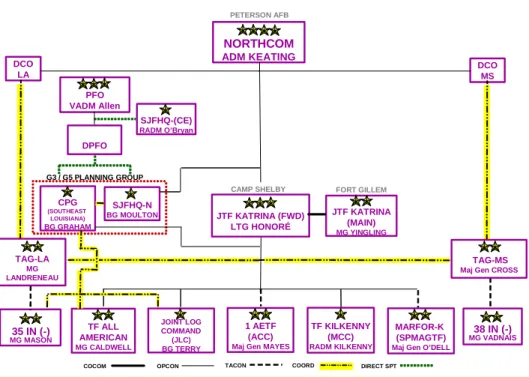
Page Figure 1. How EMAC works ...35 Figure 2. JTF Katrina Command and Control Relationships...66
TABLES
Page Table 1. National Guard Duty Status Matrix ...32 Table 2. Activated National Guard Personnel Serving in Louisiana and Mississippi ...63
CHAPTER 1 INTRODUCTION
Many of the men and women of the Coast Guard, the Federal Emergency Management Agency, the United States military, the National Guard, Homeland Security, and state and local governments performed skillfully under the worst conditions. Yet the system, at every level of government, was not well
coordinated and was overwhelmed in the first few days.
President George W. Bush This is a quotation from POTUS George W. Bush in a press conference on 16 September 2005 following Hurricane Katrina. The POTUS recognizes the chaos and confusion when agencies fail to establish unity of command. This thesis will attempt to answer whether the Department of Defense (DOD) should use the National Guard to establish unity of command for missions involving Defense Support to Civil Authorities (DSCA) and if so make a recommendation on a chain of command.
The purpose of this study is to determine if the DOD should use National Guard assets to establish unity of command for missions involving DSCA. It will define unity of command, examine federal laws and policies that govern the use of military forces, and examine several different case studies where DOD established or failed to establish unity of command.
The issues with establishing unity of command center on response plans for homeland security missions. The National Response Plan requires city, county, and tribal governments to respond to disasters within their locality using organic assets. When city and county governments become overwhelmed with disaster response, they request state assets. The largest single asset at the state governor’s disposal is the state’s military asset
known as the National Guard. As mission requirements increase and the state’s military assets become overwhelmed, the governor has two options, request additional assets from other cooperating states or request federal military or active duty assets. Once state and federal military assets work together, the issue of unity of command arises. Since the Governor is the Commander in Chief (CINC) for state military assets and the President of the United States (POTUS) is the CINC for federal assets, employment priorities may vary. Both are military assets of the One Army concept and the question of which component will command and control all military efforts in the area of operations surfaces.
Historically states have followed the guidance and procedures of Federal Response Plan (FRP) primarily seeking federal funds, but rarely requested the aid of federal soldiers. States generally employed organic National Guard assets in response to internal disasters until 11 September 2001. State governors employed the state’s National Guard as state employees in response to manmade and natural disasters. States requested volunteers for service, placed them on the state’s payroll, incorporated them under command of the Governor, and delegated control to the Adjutant General. If the disaster were of sufficient size, the Governor would declare the area a state disaster and request federal assistance and resources. Occasionally, the federal government has employed Active Duty (Title 10) soldiers to aid in its relief mission. These were standing operational procedures prior to 11 September 2001.
The terror act of 11 September 2001 focused the country on defending the homeland and President Bush requested a Presidential Selected Reserve Call-up (PSRC) of the National Guard for conducting airport security. States sought out volunteers for
this operation and employed its soldiers with federal funds in a Title 32 status titled Operation Noble Eagle. The soldiers performing this mission worked for independent state Governors in support of the Federal Aviation Administration (FAA). The Adjutant General and his staff, known as the State Area Command (STARC) were responsible for command, control, and training. This headquarters is now referred to as the State’s Joint Forces Headquarters (JFHQ-State).
Post 11 September 2001, the POTUS directed the formation of a new Department of Homeland Security and the active military formed the U.S Northern Command
(NORTHCOM) hereafter referred to as NORTHCOM. NORTHCOM is a military command that focuses on operations within the United States. When events such as natural and manmade disasters occur within the United States, NORTHCOM forms a Joint Task Force (JTF) and assigns troops as necessary to address the event.
NORTHCOM may form several JTFs if there are disasters located in multiple regions of the country.
The latest disaster, Hurricane Katrina brought assistance from several government agencies to the Gulf Coast area. The US Coast Guard (Title 14) is now part of the
Department of Homeland Security (DHS) and worked with FEMA conducting search and rescue operations, opening channels, and securing ports. The Coast Guard is a unique asset as neither the active component military nor National Guard posses the resources or training to accomplish port security or channel maintenance operations. The active component military (Title 10) established JTF-Katrina and employed about seven thousand soldiers who performed search, rescue, and humanitarian aid operations. The National Guard (Title 32) under the direction of the governors of Mississippi and
Louisiana employed their JFHQ-State and almost six thousand soldiers prior to the disaster. Following the storm, both state governors requested assistance and the Mississippi and Louisiana JFHQ-State soon employed two division headquarters and almost fifty thousand soldiers. They conducted a wide range of missions including command and control, search and rescue, law enforcement, and humanitarian aid.
History has shown that a major problem with disaster response is that unity of command becomes complicated when several government agencies respond to the same disaster without coordination. Each agency has its own command structure and no one agency is in charge of coordinating efforts. Vital pieces of information important to all tend to remain within each different agency. The information becomes stove-piped within a single agency and is not shared with others. President Bush stood up the Department of Homeland Security to combat this problem. A disaster may require all the agencies discussed above to protect and save lives, but there tends to be duplication of effort, loss of efficiency, and hording of critical information. All agencies need to unite under one command to alleviate these problems.
There are laws in effect that allow for unity of command when state and federal military agencies respond to a homeland security mission. These laws allow a Title 32 or Title 10 commander to command and control both state and federal military forces simultaneously, but they must request and report their actions to both the POTUS and the appropriate governor. This gives the appearance of unity of command for subordinate forces executing missions, but leaves command divided at senior levels where
The basis of this thesis is the primary research question which asks: Should the Department of Defense use National Guard assets to establish unity of command for missions involving DSCA? This question has a simple yes or no answer, but its analysis is far more complex, generating several secondary and tertiary questions.
Answering this basic question requires addressing several secondary questions. Secondary questions are: What is unity of command? What is meant by Title 10, Title 32, and State Active Duty (SAD) status? What laws and policies govern how state and
federal military forces respond to homeland security missions? What is a JFHQ-State? Are there successful or unsuccessful examples of operations that achieved unity of command? Finally, to remain unbiased, are there other options?
To answer the primary question, it is important to assume that the federal government will employ both active component and National Guard forces in future DSCA missions. If the federal government employs only National Guard or active component assets individually, there is not an issue with unity of command. If National Guard units from neighboring states respond, they are under the tactical control of the assisted state governor and JFHQ-State. This relationship implies that a JFHQ-State provides command and control and unity of command is not an issue.
The thesis also assumes that the military will employ joint doctrine to facilitate relationships. Since federal and state military forces are under control of two different CINCs, they are really two separate components. Joint doctrine stresses the terms supporting commands and supported commands to demonstrate command relationships between different military components such as Army, Air Force, and Navy. When Governor employs the National Guard either in a full-time federally paid (Title 32) or
full-time state paid (SAD) duty status, it acts as a different component since it is a state rather than federal agency. The relationship is not necessarily rank structured, but mission dependant. An example of this is NORTHCOM, a four star active component command may support the JFHQ-State which is a two star command working for the governor. The JFHQ-State becomes the supported command and receives assistance through equipment, personnel, and information from NORTHCOM, but is still under the state governor’s command. NORTHCOM becomes the supporting command by providing all assets available to support the JFHQ-State.
In answering the main thesis question it is also essential to assume that state governors will always employ their National Guard resources for homeland security missions within their states. Just as the large availability of manpower and equipment make the US Army the action arm of the POTUS, the National Guard is the action arm of the governor. The thesis must assume for both practical and political reasons, the
governor will elect to employ his or her National Guard resources as the primary response force, even if active component resources are available or better equipped to perform the mission.
Understanding the thesis topic requires defining some basic terms. Title 32 refers to United States Code, Title 32 National Guard, which was enacted 10 August 1956 and outlines the organization, personnel, training, service, supply, and procurement for the United States Army and Air National Guard.1 State governors employ Title 32 soldiers but the federal government, through the Department of Defense, provides the funding. The thesis refers to Title 32 assets as National Guard and state military forces or assets.
State Active Duty (SAD) refers to a duty status for soldiers in the National Guard who have been ordered to state duty by a governor. This duty status is funded by the state and National Guard soldiers are paid based on state law or policy. The state governor provides command and control.
Title 10 refers to the United States Code, Title 10 Armed Forces, enacted 10 August 1956, which outlines General Military Law and organizations for the Army, Navy, and Air Force.2 The thesis will later address the Marine Corps, which is a component of the US Navy. Congress amended Title 10 in 1994 to add the Reserve Component which includes the Army, Navy, Air Force, and Marine Reserve. The POTUS employs Title 10 assets and the thesis refers to these as Active Component or federal military forces or assets.
JFHQs-State is a joint operations capable command and control entity in each state. Up until around the year 2004 these headquarters were known at the State Area Commands or STARCs. Since most states maintain, command, and control both an Air National Guard, a component of the Air Force, and an Army National Guard, these headquarters draw upon both components for manning. This makes the headquarters a joint headquarters as Army soldiers and Air Force airmen work side by side for the good of each state.
JP 3.0, Operations,3 defines unity of command as a single commander who directs and coordinates the actions of all forces toward a common objective. This structure prevents duplications of effort and aids in promoting efficiency. During joint and multi-agency operations, commanders will coordinate to achieve unity of effort, but never achieve unity of command. At the state level and with permission from congress,
the Adjutant General with the JFHQ-State has the ability to achieve unity of command by combining active component and National Guard forces under one commander.
The Department of Defense separates homeland security into two sub categories, Homeland Defense and Civil Support. The military’s role in Homeland Defense focuses the Untied States military against direct military and terrorist attacks from outside the nation’s borders. It also may focus on attacks that originate outside of the nation, but are executed within the nation’s borders. The military role in Civil Support, known as DSCA is simply military activities in support of local, state, and federal agencies. Lately, many operations have been conducted under the title “homeland security” which is actually DSCA missions.
Delimitations are areas that this thesis will not address. There are several factors which vary and make answering the primary question impossible. The delimitations fix these factors by preventing their discussion. This thesis examines the feasibility of using Title 32 forces to command and control of homeland security missions. It will look at federal laws and policies that permit or restrict this model and several case studies which depict success or failure in this endeavor.
The thesis will not examine which force (Title 10 or Title 32) is best trained, equipped, or available to perform DSCA missions, but hold to the assumption that the missions require both. There are several studies available online by the General
Accounting Office (GAO) and Rand Corporation that discuss the training or equipping issues.4 The focus of this study is on command relationships between the Title 10 and Title 32 forces and the ability or desirability to establish Unity of Command.
The thesis will not discuss military equipment readiness and availability, soldier readiness and availability, or mobilization impact issues for either component. As stated above, the thesis assumes that the state governor will employ their National Guard assets for emergencies within their states. If there are insufficient soldiers or equipment,
agreements such as the Emergency Management Assistance Compact (EMAC) allow the states to lend and borrow soldiers and equipment from other states. If there is still
insufficient personnel or equipment, the state governor has the ability to request federal assets.
The importance of this topic is evident, as the lawmakers will soon debate changes to current laws and policies that limit or promote the DOD’s role in homeland security missions. Previous missions, such as Hurricane Katrina, demonstrate
NORTHCOM’s desire to establish and fund a Joint Task Force including an integrated response force. The DOD already funds a resource to accomplish this mission through the state Joint Forces Headquarters and National Guard. Policies, procedures, and laws need to be in place that allow for integration of the active component and National Guard forces under one command. This will result in both time and cost savings with a quicker response and less duplication of effort.
There will always be DSCA missions in this country that require various levels of responses. The National Guard will remain a first responder at the local and state level executing the response plans developed by the state Joint Forces Headquarters and Emergency Management personnel. Various missions will often require the use of small and large contingents of federal forces to augment state forces. These missions require standardized state and national response plans to establish rapid integrations of forces,
unity of effort, and unity of command. To expedite response times and preserve life, these response plans need to be complete and rehearsed prior to a mission, not created during the mission. Disasters requiring a military presence are usually emergencies where time is a critical resource. Making response plans during or after the disaster may cost civilian lives.
This thesis is organized into five sections. Section one is the introduction and presents the topic of the research: Should the Department of Defense use National Guard assets to establish unity of command for DSCA missions. A yes answer introduces section two which reviews literature suggesting that future DSCA missions will require responses from both federal and state military forces. It also presents two historical homeland security missions involving both state and federal forces. Section three presents key aspects of both federal and state command and control abilities that section four examines. Section four analyzes the command and control capabilities and limitations, and guiding laws and policies for establishing unity of command between National Guard and active duty forces. Section five summarizes the thesis, but more importantly provides a course of action to the DOD which can begin the development of a response doctrine.
1
United States Code Annotated (St. Louis, MO: West Publishing Co., 2005), Title 32, USC, secs. 101-716.
United States Code Annotated (St. Louis, MO: West Publishing Co., 2005), Title 10, USC, secs. 101-106.
3
Department of the Army, Joint Publication 3.0, Operations (Washington: Headquarters, Department of the Army, September 2004), 1-138.
4
Lynn E. Davis et al., Army Forces for Homeland Security, 1st ed. (Pittsburgh, PA: Rand Arroyo Center, 2004), 1-77; General Accounting Office, Reserve Forces, Plans Needed to Improve Army National Guard Equipment Readiness and Better
Integrate Guard into Army force Transformation Initiatives (Washington, DC: General Accounting Office, 2005), 1-33.
CHAPTER 2 LITERATURE REVIEW
Introduction
The purpose of this study is to determine if the DOD should use National Guard assets to establish unity of command for DSCA missions. It will define unity of
command, examine federal laws and policies that govern the use of Federal and State forces, and examine several different case studies where DOD established or failed to establish unity of command.
The organization of chapter 2 focuses on secondary questions. Initially, it will examine military and civilian literature defining unity of command, unity of effort, and unified command. The chapter then examines literature which describes federal laws and various interpretations of those laws that prescribe or restrict the use of either state or federal military forces within the United States. It examines multiple civilian books and military references for several scenarios where military forces succeeded or failed to establish unity of command. Finally, it examines some references that offer additional opinions on how the federal government should accomplish unity of command.
Review
There are several Army manuals that provide definitions for and give examples of unity of command and unity of effort. FM 3.0, Operations (2001),1and FM 6.0, Mission Command: Command and Control of Army Forces (2003),2 articulate these well. These references refer to unity of command within army organizations. The JP 3-0, Doctrine for Joint Operations (2001),3 defines unity of command in a joint environment that involves
other Department of Defense organizations, other governmental agencies, and
nongovernmental agencies. This study reflects the establishment of unity of command between two or more military departments or federal (Title 10) and state (Title 32 or SAD) forces. These manuals articulate this definition as a unified command. Since DSCA missions require the effort of multiple agencies or are inherently joint, further research may change the terminology used in the basic research question from unity of command to unified command.
The three primary status for employment of military forces in DSCA missions are state active duty, Title 32, and Title 10. Title 104 and Title 325 of the United States Code
provide definitions, permissions, and limitations for employment of federal and state military forces. The National Guard Bureau White Paper6 provides similar descriptions for State Active Duty forces.
There are three major permissive or restrictive laws (The Posse Comitatus Act, The Stafford Act, and the Insurrection Act) that can be found in the Codes of Federal Regulations and one policy (The National Response Plan) that govern the employment of state and federal military forces.7 The Department of Homeland Security’s National Response Plan8 is an all encompassing federal plan that describes how tribes, towns, cities, states, and the federal government will conduct homeland security missions. This plan prescribes the use of military forces after a detailed examination of Posse Comitatus, the Stafford Act, and the Insurrection Act. Although mentioned and obviously examined, the response plan does not give detailed descriptions of each of the laws listed above, but it provides examples of when federal and state governments may employ military forces.
Since the National Response Plan governs the use of federal agencies, it is invaluable to this study.
The RAND Corporation published a monograph in June of 2004 titled “Army Forces for Homeland Security.”9 This is a leading reference which interprets the National Response Plan, examines laws permitting or restricting the use of military forces for homeland security missions, and makes recommendations on a force capable of
accomplishing these missions. The study is significant as it was prepared for the United States Army and suggests employing a combination of federal and state military forces in response to future homeland security missions. There are several papers generated by US Army officers at the US Army War College that have similar conclusions.10 As major studies suggest combining federal and state military forces, it becomes more important to address the unity of command issue.
The thesis first examines the Los Angeles Riots. There are three prominent
figures that wrote books or reports about the incident. The first is Lieutenant General (ret) Harrison, who wrote a report to the Honorable Pete Wilson in 1992 titled “The Harrison Report.”11 General Harrison was an active duty officer and his report demonstrates a bias in favor of the use of federal forces. The report focused more on the perceived failures of the California Army National Guard and how these failures led local and state officials to push for federal military assets and federalization of the National Guard Assets. The federalization of mobilized National Guard assets under the command of federal leadership quickly established unity of command. Harrison believed this federalization was necessary to provide adequate leadership to the quality and disciplined California National Guard soldiers, who were ill prepared due to the incompetence of the state’s
National Guard leadership. His report loses some relevance for this thesis, as it appeared bias and did not discuss the value of the federalization process to achieve unity of command.
The second figure is General James Delk, who was the Deputy Adjutant General of the California Army National Guard (CANG) during the riots. He produced an in-depth accounting of the Los Angeles Riots in 1995 titled Fires and Furies: The L.A. Riots.12 His writings are largely defending the National Guard and demonstrating the failure of other agencies. At the same time, he accepts responsibility for National Guard failures which adds significant credibility to his writings. He provides a detailed
background of the riots and military actions during the riots and discusses the
federalization of National Guard forces. His writings are significant as he discusses the need for unity of command to increase efficiency of operations, discusses the architecture federal forces used to establish unity of command, and stresses the loss of efficiency due to the centralization of the decision process at the highest command level.
The third figure is Lieutenant Colonel Christopher M. Schnaubelt, who published an article in Parameters, summer 1997, titled the “1992 Los Angeles Riots; Lessons in Command and Control from the Los Angeles Riots”13 that supports General Delk’s findings. Schnaubelt also discusses the need for unity of command to eliminate
redundancy and improve efficiency while demonstrating the benefits of decentralization command in DSCA missions. Lieutenant Colonel Schnaubelt is a member of the
California Army National Guard, but his article does not appear biased to his unit or state.
The next major homeland security response mission the thesis examines is Hurricane Katrina, August 2005. Like the LOS ANGELES Riots and most other events where the government did not perform its best, authors waste large amounts of paper blaming others for mistakes and praising their agency for all it did well. Fortunately, the Center for Army Lessons Learned (CALL) compiled in-depth After-Action Reviews (AAR) from many of the divisions involved in the response.14
The CALL report with all attachments and after action reviews (AARs) provide a detailed breakdown of the command structure and soldier accounts of the confusion of having multiple Army and National Guard headquarters operating in a single area. Soldiers and commanders had sufficient difficulties conducting Defense Support to Civil Authority (DSCA) missions, working with nongovernmental agencies, and dealing with the environmental aspects of the hurricane. This was further complicated and confused by the lack of unity of command.
The significance of the report is that it demonstrates the issues that arose due to a lack of unity of command. The media reported and hence most people believed that a federal Joint Task Force was in command of the incident. In reality, the federal task force commanded about 6,000 active duty and the state task force commanded about 27,000 National Guard soldiers. The confusion or distractions caused by separate state and federal task forces slowed response times as civil authorities were unclear about where to send requests and which military agency or component was in command.
Two major DSCA missions, the LOS ANGELES Riots and Hurricane Katrina demonstrate the need for unity of command to prevent redundant efforts and increase the efficiency of operations. Current literature suggests that both federal and state forces will
continue to respond to homeland security missions. With this understanding for the future, it is imperative that the DOD develop a standard response procedure for employment of federal and state military forces. The following chapters analyze the advantages of using the state’s National Guard Joint Forces Headquarters to accomplish this mission.
1
Department of the Army, Field Manual 3.0, Operations (Washington, DC: Headquarters, Department of the Army, September 2004), 1-104.
2
Department of the Army, Field Manual 6.0, Mission Command: Command and Control of the Army Forces (Washington, DC: Headquarters, Department of the Army, September 2004), 1-333.
3
Joint Chiefs of Staff, Joint Publication 3.0, Joint Operations (Washington, DC: Headquarters, Department of the Army, September 2004), 1-182.
4
United States Code Annotated (St. Louis, MO: West Publishing Co., 2005), Title 10, USC, sections 101-104.
5
Ibid., USC Title 32, secs. 101-716. 6
COL John D. Renaud, National Guard Homeland Defense White Paper: September 11, 2001, Hurricane Katrina, and Beyond (Alexandria, VA: Army National Guard, G5, Chief, Strategic Plans and Policy, September 2005), 1-17.
7
United States Code Annotated (St. Louis, MO: West Publishing Co., 2005), Title 10, USC, sections 330-335; Title 18, USC, section 1385; and Title 42, USC, section 5121
8
The Department of Homeland Security, National Response Plan, 2004
[document on-line]; available from the Department of Homeland Security at http://www.dhs.gov/interweb/assetlibrary/NRP-FullText.pdf; Internet; accessed 27 October 2005, 1-12.
9
Lynn E. Davis et al., Army Forces for Homeland Security, 1st ed. (Pittsburgh, PA: Rand Arroyo Center, 2004), 1-77; General Accounting Office, Reserve Forces, Plans Needed to Improve Army National Guard Equipment Readiness and Better Integrate Guard into Army force Transformation Initiatives (Washington, DC: General Accounting Office, 2005), 1-33.
10
Colonel Dick Dillon, James Kievit, and Lieutenant Colonel Thomas Murray, Portraying The Army Reserve Components in Army War Games and Exercises,
United States Army War College, 2002), [Issue Paper 11-02 on-line]; available from http://www.ausa.org/PDFdocs/LWPapers/LPE_03-3.pdf; Internet; accessed 20 October 2005; and Professor Michael Pasquarett, Wargaming Homeland Security and Army Reserve Component Issues, May 2003, volume 04-03(Carlisle, PA: Center for Strategic Leadership, United States Army War College, 2003), [Issue Paper on-line]; available from CSL Publications at http://www.carlisle.army.mil/usacs/indes.asp; Internet; accessed 20 October 2005.
11
LTG (retired) William H Harrison, Report to the Honorable Pete Wilson, Governor, State of California: Assessment of the Performance of the California National Guard During the Civil Disturbance in Los Angeles, April and May 1992 “The Harrison Report” (Sacramento, CA: 2 October 1992), 1-30.
12
James D. Delk, Fires and Furies: The L.A. Riots (Palm Springs, CA: ETC Publications, 1995), 1-367.
13
Christopher M. Schnaubelt, “1992 Los Angeles Riots: Lessons in Command and Control from the Los Angeles Riots,” Parameters (summer 1997): 88-109 [journal on-line]; available from http://www.au.af.mil/au/awc/awcgate/army-usawc/param_ schnau97sum.htm; Internet; accessed 24 October 2005
14
Headquarters, 35th Infantry Division, After Action Report of HHC, 35th Infantry Division (JTF Santa Fe for Operations Santa Fe) (Ft. Leavenworth, KS: Center for Army Lessons Learned, 2005), [review on-line] available from http://call.army.mil/; Internet; accessed 12 December 2005; Headquarters, 38th Infantry Division, Operation Vigilant Relief After Action Review, for SGS HQ 38th Infantry Division (Ft.
Leavenworth, KS: Center for Army Lessons Learned, 2005) [review on-line] available from http://call.army.mil/; Internet; accessed 12 December 2005; Headquarters, 82nd Airborne Division, After Action Brief (Ft. Leavenworth, KS: Center for Army Lessons Learned, 2005) [review on-line] available from http://call.army.mil/; Internet; accessed 12 December 2005; and Headquarters, 1st Cavalry Division, After Action Brief (Ft. Leavenworth, KS: Center for Army Lessons Learned, 2005) [review on-line] available from http://call.army.mil/; Internet; accessed 12 December 2005.
CHAPTER 3
RESEARCH METHODOLOGY
Introduction
The purpose of this study is to determine if the Department of Defense (DOD) should use National Guard Assets to establish unity of command for missions involving DSCA. It defines unity of command, examines federal laws and policies that govern the use of Federal and State forces, and examines two different case studies where DOD established or failed to establish unity of command.
The organization of chapter 3 presents the methodology the thesis follows to answer the research question discussed above. The chapter reviews the purpose of this thesis and discusses the methodology used to present research and analysis in chapter 4.
Methodology
The analysis of the research question builds upon definitions presented in chapter 1. It begins with some additional definitions, such as State Active Duty (SAD) and Joint Forces Headquarters State (JFHQ-State) and addresses some earlier definitions with more depth. The analysis is then divided into two sections, a review of law and policy that permit or restrict the use of military assets in DSCA missions and the application of this law and policy through three historical case studies. This design provides answers to the secondary questions and formulates the answer to the primary research question.
The policy and law review first examines the National Response Plan (NRP), which is a federal policy prescribing the government’s response to hazards. The NRP is the corner stone of the federal response plan that describes the levels of response from
local, state, and federal governments. It directs federal agencies when to employ assets and assigns responsibilities for lead and support agency roles. The NRP directs how the federal government responds to homeland security missions within the United States. Since the NRP is the leading document that provides criteria and dictates levels of responses from local to national, it will also lead the analysis in chapter 4.
In order to understand the different duty status of military forces outlined throughout the NRP, the thesis defines and prescribes the use of Title 10, Title 32, and State Active Duty military forces. It also presents a description of the standing State Joint Forces Headquarters. The thesis describes how the National Defense Authorization Act of 2004 altered Title 32 of the USC. to allow both active duty and National Guard commanders to command and control soldiers performing in any of the duty statuses mentioned above.
The thesis then examines five primary laws, policies, or agreements that govern the employment of federal and state military forces. Each either permits or restricts actions by either federal or state military forces. The thesis examines the Posse Comitatus Act, Stafford Act, Insurrection Act, The National Defense Authorization Act, and
Emergency Management Assistance Compact (EMAC) in detail.
The Posse Comitatus Act prohibits or governs the use or employment of federal and state forces within the United States. The thesis examines the Posse Comitatus Act, its application on federal and state military forces, and enforcement. The thesis examines its restrictions and how, when, and to whom they apply.
The Stafford Act, Insurrection Act, and Emergency Management Assistance Compact (EMAC) permit the use of federal and state forces within the United States. The
Stafford Act allows the federal government to employ federal military assets at the state governor’s request. The Insurrection Act allows the federal government to employ active duty military forces to enforce federal law. The previous acts permit the use of federal forces during specific hazards, but have no bearing on the governor’s use of the National Guard. EMAC permits the use of state military forces and equipment from other states in response to hazards.
The final law the thesis examines is a subsection of Title 32 that deals with Joint Task Force (JTF) command authority. The authority was made public law with the passing of the National Defense Authorization Act of 2004. It allows either state or federal leadership to command a joint task force consisting of both Title 10 and Title 32 military forces. The thesis examines these provisions, their applications, and restrictions by both federal and state authorities. This ends the review section and answers the
secondary question dealing with laws and policies that permit or restrict the use of federal and state military forces. This should provide sufficient knowledge and understanding to objectively examine the case studies.
The case study section examines two specific homeland security missions. Both Hurricane Katrina and the LOS ANGELES Riots are missions where DOD employed both federal and state military assets. The thesis examines each case study and the success or failure to achieve unity of command in each. It also examines the benefits for establishing and ramifications for failing to achieve unity of command.
Topics chosen for the case studies were not random, but limited to two of the three major employments of both federal and state military forces for DSCA missions over the last fourteen years. Normally, state’s react to homeland security missions
employing only its own assets and do not require federal assistance. The case studies were the leading events which required both. Examining the case studies answers the last secondary question presenting operations which were successful or unsuccessful in achieving unity of command. After presenting the case studies, the thesis will examine commonalities between them.
It is difficult to compare the case studies since there are few similarities, yet a host of differences for each. The major similarity for each is the ability to either achieve or fail to achieve unity of command. In examining the reasons for the successes or failures, the thesis also examines several commonalities between the two cases studies. The thesis examines response times, levels of response, interagency functionality, standard operational procedures, communications, and preparedness. There may also be more criteria found in each case study that will emerge upon deeper analysis.
Summary
Chapter 3 presents the methodology the thesis follows to answer the primary research question, Should the DOD use National Guard Assets to establish unity of command for missions involving DSCA? It lays out the methodology which chapter 4 follows to analyze the research. The chapter also outlines how the thesis answers the secondary research questions and identifies commonalities to compare the case studies and make recommendations for future homeland security missions addressed in chapter 5, “Conclusions and Recommendations.”
CHAPTER 4 ANALYSIS
National Response Plan
Pursuant to HSPD-51, as the principal Federal official for domestic incident management, the Secretary of Homeland
Security declares Incidents of National Significance…and provides coordination for Federal operations and / or resources, establishes reporting requirements, and conducts ongoing communications with Federal, State, local, tribal, private-sector, and
nongovernmental organizations to maintain situational awareness, analyze threats, assess national implications of threat and
operational response activities, and coordinate threat or incident response activates.2
National Response Plan, December 2004 The National Response Plan (NRP) implemented in December 2004 incorporates the former Federal Response Plan (FRP), U.S. Government Domestic Terrorism Concept of Operations Plan (CONPLAN), and the Federal Radiological Emergency Response Plan (FRERP). It is a one-source document that details responses to natural and man-made hazards. The term hazard covers true national hazards and disasters. Hazards include forest and urban fires, floods, oil spills, hazardous materials releases,
transportation accidents, earthquakes, hurricanes, tornadoes, pandemics, and disruptions to the Nation’s energy and information technology infrastructure.
The NRP does not alleviate the need for local and state response plans. Local and state resources, such as police, fire, medical, and public works, are generally titled first responders, as they are the first to arrive and last to leave an incident site. State response plans allow governors to commit resources at the request of local officials when local response resources become exhausted. The federal response plan allows it to render
assistance upon request from a governor when it becomes clear that state capabilities will be insufficient or have been exceeded or exhausted.3
For most states, the largest response asset available to the governor is the state’s National Guard, which often becomes part of the pool of first responders. The NRP recognizes that the governor is the Commander-in-Chief (CINC) for state National Guard assets in a Title 32 or SAD status. Governors of states, such as North Carolina, South Carolina, Georgia, and Florida, frequently employ National Guard assets for incidents, such a snow or ice storms and hurricanes. There are many incidents every year where states employ the National Guard and other available assets without requesting federal assistance. If needed, the Governor may mobilize National Guard soldiers who normally serve one weekend a month and two weeks a year in response to a hazard. This part-time force is generally the only such force that can be ordered to full-time SAD by the
governor.
Regularly occurring hazards in many states cause Governors to employ the National Guard on a frequent basis, exercising unit Standard Operating Procedures (SOPs) and building interagency relationships. Counter drug operations frequent responses to ice storms and hurricanes form habitual interagency relationships, standardize communications, and exercise state response plans on an annual basis. National Guard assets conduct missions frequently enough to refine and update their plans based on lessons learned or when states make changes to their response procedures. On the contrary, the active component does not routinely exercise its portion of the National Response plan. Some of the past active component responses were the LOS ANGELES Riots in 1992, Hurricane Andrew 1992, Hurricane Floyd in 1999, and
Hurricane Katrina in 2005. In each case the infrequency of response caused the active component to actually exercise its plan only every six or seven years with different units and headquarters elements responded to each hazard. This seldom employment causes a lack of continuity that makes SOP development and forming interagency relationships extremely difficult.
Title 10 - Active Duty
Federal military forces (Army, Navy, Air Force, and Marine Corps) serve based on Title 10 USC, and the President of the United States (POTUS) is the CINC. Since Title 10 of the USC authorizes and regulates active military forces, the thesis refers to those forces as Title 10 or active duty forces.
The President of the United States (POTUS) may also mobilize the National Guard in a federal or Title 10 status. There are six primary subsections of Title 10 USC that allow the POTUS to order National Guard soldiers or units to active duty. Three of these subsections are subject to Posse Comitatus and will be examined in this section while the remaining three fall under the Insurrection Act umbrella which the thesis discusses later.
Title 10 USC subsections 12301(d), 12302, and 12304 authorities allow the POTUS to order the National Guard to an active duty status. This is a federal status as mentioned above, and makes National Guard soldiers subject to Posse Comitatus, restricting their ability to conduct law enforcement. The first section, Title 10,
USC,subsection12301(d) is a Voluntary Order to Active Duty. This allows members of
consent of the governor. Current examples of this authority are soldiers who volunteered for duty in Operations Iraqi Freedom or Enduring Freedom. The second two authorities are POTUS directed and mandatory calls to active duty. Governors and National Guard soldiers cannot refuse this call.
Title 10, USC, subsection 12302 (Partial Mobilization), and 12304 (Presidential Reserve Call Up) give the POTUS or the secretary concerned the authority to order the National Guard units and soldiers to active duty without the consent of the individual or governor. The Partial Mobilization authority states that in the time of a national
emergency declared by the POTUS, the secretary concerned may order any unit and any member to active duty for not more than 24 consecutive months. This authority limits the call up to one million soldiers at any given time, but with the National Guard authorized strength of three hundred and fifty thousand, this should not be an issue. The Presidential Reserve Call Up authority states that when the POTUS determines it necessary to
augment the active forces for any operational mission, he may authorize the Secretary of Defense to order any unit and any member to active duty for not more than two hundred and seventy days. This authority limits the call up to two hundred thousand soldiers at any given time.
Title 32 – National Guard
I (state your name) do solemnly swear (or affirm) that I will support and defend the Constitution of the United States and Constitution of the State of North Carolina against all enemies, foreign and domestic; that I will bear true faith and allegiance to the same; that I will obey the orders of the President of the United States and the Governor of the state of North Carolina, and that I make this obligation freely, without any mental reservation or purpose of evasion, and that I will well and faithfully discharge the duties of the office of second lieutenant, in the Army National
Guard of the State of North Carolina upon which I am about to enter, So help me God.4
National Guard Oath of Office The US Constitution authorizes a militia, now known as the National Guard (Army and Air) to serve based on Title 32 USC. The state governor is the primary CINC, but soldiers also swear an allegiance to the POTUS as seen above in an oath of office from the North Carolina Army National Guard. The “State of North Carolina” may be substituted for any state in the union.
National Guard soldiers may perform duty in a number of different pay status. Inactive Duty for Training (IDT) refers to a training status funded by the federal
government that units use for individual and collective training. This is commonly known as the “one weekend a month” and a soldier receives a day of pay for each Unit Training Assembly (UTA) or four-hour block of training, not to exceed two UTAs per day. Regulations limit this duty status to training only, thus prohibiting the performance of either state or federal missions. Soldiers who are on Active Duty for Training (ADT), Active Duty for Special Work (ADSW), or are full-time employees of the National Guard are said to be in a Title 32 status where the soldier receives one day of pay for each calendar day employed. The ADT pay status is often referred to as “Annual Training,” but also includes most schools, such as Initial Entry Training (IET), Advanced Individual Training (AIT), or the Officer Basic Course (OBC). A soldier may also perform duty in a State Active Duty (SAD) status that will be discussed below or the Title 10 status already discussed.
The National Guard is the only United States military force that operates across both state and federal responses, leveraging SAD, Full Time National Guard Duty (Title
32), and Active Duty (Title 10).5 Again, National Guard soldiers are prohibited from performing duty other than training in an IDT status. The status soldiers may serve in are nearly as diverse as the roles they may perform.
State governors may activate National Guard personnel to a SAD status for homeland security missions. Those personnel activated become state employees while in this status, are governed by state statute and policy, and are paid using state funds. Each state has its own means of determining the soldier’s pay while in a SAD status and the financial incentives vary widely. Most states adopt policy similar to the Uniform Code of Military Justice (UCMJ) to govern soldier actions while in this status. Additionally states, such as North Carolina, South Carolina and Georgia have adopted state statutes similar to the Soldiers and Sailors Civil Relief Act and the Uniformed Services Employment and Reemployment Rights Act. These acts protect the soldier’s rights for reemployment as well as many other civil and financial protections offered by the federal statutes.
The most important aspect of SAD is the exemption from the Posse Comitatus Act described in detail later. Since SAD is state and not federal status the Posse
Comitatus Act does not apply and soldiers are able to perform law enforcement duties. Soldiers may be sworn as deputy sheriffs or state troopers, rendered the ability to enforce law, and have the power to arrest criminals. In North Carolina, most soldiers are not sufficiently trained in law enforcement to perform arrests, but have instructions to detain criminals until local law enforcement can execute the process properly. Some National Guard units contain soldiers who work for other city, county, or state law enforcement agencies. These soldiers enhance the unit’s ability to perform law enforcement missions.
SAD may be an excellent status for states to respond to internal homeland
security missions, but appears to be a poor status for providing mutual aid to neighboring states. As mentioned above, each state determines its own pay scale for soldiers
performing SAD. Some states may have a fixed rate of pay, such as eighty dollars a day where other states may pay soldiers based on the federal pay charts. Under the
Emergency Management Assistance Compact (EMAC), described later in this chapter, when State A provides mutual support to State B, State A’s soldiers are paid based on State A’s policies. State B then reimburses State A for its expenses.6 Soldiers of equal rank and time in grade may be working side by side performing the same task for different levels of compensation. Some may interpret this or this may create the
perception that one soldier or one state’s soldiers are better or more valuable than another which may lead to animosity between individuals or states. State A may only seek mutual support from states that pay the least as a cost-savings initiative. Likewise, the state that pays the least may be reluctant to ask for assistance, as it may not be affordable.
State governors may activate National Guard personnel to a Full-Time National Guard Duty status for homeland security missions under the authority of Title 32, USC, subsection 502(f). One important aspect of this authority is that federal law provides the governor with the ability to place a soldier in a full time duty status under the command and control of the state, but the federal government provides the soldier’s pay and allowances. Full-Time National Guard Duty means training or other duty, other than inactive duty for training or annual training, performed by a member of the National Guard with consent from the POTUS or Secretary of Defense.7 Specifically Title 32, USC, subsection 502(f), states: “A member of the National Guard may…without his
consent, but with the pay and allowances provided by law…be ordered to perform
training or other duty in addition to [inactive duty for training or annual training].”8 Some of the other duties this clause refers to include those operations that encompass homeland defense or homeland security.
Another important aspect of this authority is its exemption from the Posse Comitatus Act. As mentioned above, this authority is a federal law, the duty status is federally funded, and the Secretary of Defense may direct action; however, the National Guard forces remain under state, not federal, command and control. This is further described later under the Posse Comitatus Act.
Provisions of Title 32 authority allow the Secretary of Defense to direct homeland security actions. Title 32, USC, subsections 901 and 902 allow the Secretary of Defense to determine critical infrastructure or other assets important to national security. They then authorize the Secretary of Defense to provide funds to state governors to employ the National Guard to protect these assets. This gives the federal government a means to employ the military within the United States for the purposes of carrying out federal directives, but bypass the restrictions of Posse Comitatus Act. The Secretary of Defense used this authority after 11 September 2001 for airport security and for response to Hurricanes Katrina and Rita in August and September 2005.
Analysis of the Title 32 authority demonstrates its effectiveness as a method of mobilizing National Guard units. The advantages to using this authority over SAD is that soldiers from all states are paid based on the federal military pay tables. Since this is a universal pay chart for all active duty and Title 32 soldiers, the discrepancies in pay rates based on state law or statute no longer apply. This duty status also provides maximum
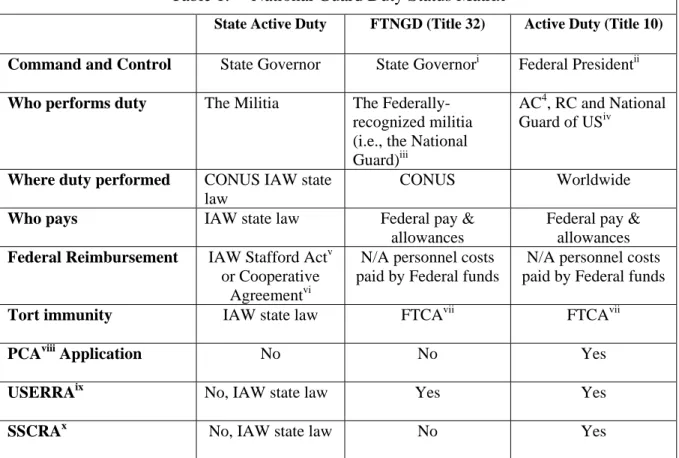
federal protections for the soldiers involved under the Soldiers and Sailors Civil Relief Act and the Uniformed Services Employment and Reemployment Rights Act.9 Of course the greatest advantage is to the state budget office as the federal government provides pay, allowances, and death benefits for all National Guard soldiers while in a Title 32 status. (See the table 1 for more details).
State Joint Forces Headquarters
National Guard forces in each state maintain a standing Joint Forces Headquarters (JFHQs). JFHQs-State is a joint operations capable command and control entity in each state. Up until around the year 2004 these headquarters were known at the State Area Command or STARCs. Since most states maintain, command, and control both an Air National Guard, a component of the Air Force and an Army National Guard, these headquarters draw upon both components for manning. This makes the headquarters a joint headquarters as Army soldiers and Air Force airmen work side by side for the good of each state. The senior military official who commands the JFHQs all National Guard forces in a state is the Adjutant General or TAG for short. The TAG can be either an Army National Guard or Air National Guard Major General and is either appointed by the Governor or elected by the people based on each state’s law.
The JFHQs are integrated into national consequence management and
contingency planning structures.10 At a state level, they are a supporting headquarters to key state emergency or consequence management authorities and provide a bulk of the manpower and equipment for state level incidents. For national emergencies or natural disasters, the headquarters may provide command and control as a subordinate
Table 1. National Guard Duty Status Matrix
State Active Duty FTNGD (Title 32) Active Duty (Title 10)
Command and Control State Governor State Governori Federal Presidentii
Who performs duty The Militia The
Federally-recognized militia (i.e., the National Guard)iii
AC4, RC and National
Guard of USiv
Where duty performed CONUS IAW state
law
CONUS Worldwide
Who pays IAW state law Federal pay &
allowances
Federal pay & allowances
Federal Reimbursement IAW Stafford Actv or Cooperative
Agreementvi
N/A personnel costs paid by Federal funds
N/A personnel costs paid by Federal funds
Tort immunity IAW state law FTCAvii FTCAvii
PCAviii Application No No Yes
USERRAix No, IAW state law Yes Yes
SSCRAx No, IAW state law No Yes
i
32 USC subsection 502(f)(1) ii
Under Presidential Reserve Call-up (10 USC subsection 12304), partial mobilization (10 USC subsection 12302), or full mobilization (10 USC subsection 12301 (a))
iii
10 USC subsections 3062(c) and 8062(c) iv
Active Component v
Stafford Act (42 USC subsection 5121) for disaster-related activities vi
Cooperative agreement if to perform an authorized National Guard function vii
Federal Tort Claims Act (28 USC subsections 2671-2680) [US represents and pays judgments if any]
viii
Posse Comitatus Act (18 USC subsection 1385) [SAD & Title 32 not considered part of active military]
ix
Uniformed Services Employment and Reemployment Rights Act (38 USC subsections 4301-4333)
x
Soldiers and Sailors Civil Relief Act (50 USC App. subsections 500-548, 560-591)
Source: Col John C. Renaud, National Guard Homeland Defense White Paper: September 11, 2001, Hurricane Katrina, and Beyond (Alexandria, VA: National Guard Bureau, 2005), 14-15.
headquarters to a federal organization such as US Northern Command (NORTHCOM). In this event, the JFHQs provides situational awareness information to a national level headquarters before and during any contingency operation and Joint Reception, Staging, and Onward Movement / Integration (JRSOI) for all inbound military forces.11
The National Guard Bureau, states, territories, and the District of Columbia JFHQs maintain Joint Operations Centers (JOCs). The JOC is a standing operations center performing continuous operations twenty-four hours a day and three hundred and sixty-five days a year. The JOC serves as the primary entity for coordinating, facilitating, and synchronizing efforts in support of its state, and information requirements of
National Guard Bureau (NGB) and customers at the federal level for natural disasters, National Special Security Events (NSSE), exercises, and domestic activities.
Additionally, it may operate as a crisis action planning cell (CAP) at night and on weekends in conjunction with the state staff. It provides early warning and initial command and control through phone and e-mail alert rosters for all National Guard company and higher chains of command, battalion and higher full time administrative officers, and JFHQ-State primary staff.
Emergency Management Assistance Compact
The Emergency Management Assistance Compact (EMAC) became Public Law 104-321 on 19 October 1996 and is administered by The National Emergency
Management Association (NEMA). Article 1 is the purpose and authorities of the Emergency Management Assistance Compact (EMAC). The stated purpose:
The purpose of this compact is to provide for mutual assistance between the states entering into this compact in managing any emergency disaster that is duly declared by the Governor of the affected state, whether arising from natural
disaster, technological hazard, man-made disaster, civil emergency aspects of resources shortages, community disorders, insurgency, or enemy attack.
This compact shall also provide for mutual cooperation in emergency-related exercises, testing, or other training activities using equipment and
personnel simulating performance of any aspect of the giving and receiving of aid by party states or subdivisions of party states during emergencies, such actions occurring outside actual declared emergency periods. Mutual assistance in this compact my include the use of the states’ National Guard forces, either in accordance with the National Guard Mutual Assistance Compact or by mutual agreement between states.12
Three key principles in the purpose of the EMAC are that it provides for mutual
assistance between states in managing any Governor declared emergencies or disasters; it provides for mutual cooperation in emergency exercises, testing, and training; and it provides for use of the National Guard for humanitarian purposes. The requesting state’s Governor must declare a state of emergency to initiate the compact.
Of the eight key players in EMAC operations, this thesis focuses on the
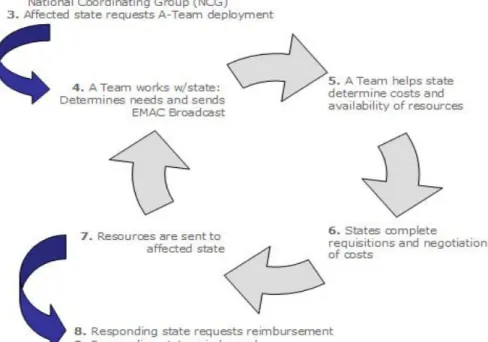
requesting and responding states.13 The requesting state is defined as any EMAC member state that is asking for interstate assistance under the compact.14 Forty-nine states and the territories of Washington DC, Puerto Rico, and the US Virgin islands are all EMAC members. Their governors must declare a state of emergency to begin the process. A responding or assisting state is any EMAC member state providing personnel or equipment resources to another EMAC member state through the compact.15 In basic terms, the EMAC process works as shown in figure 1.
There are several benefits and limitations of the EMAC. The greatest benefit of EMAC is it allows for speed of action. The act was signed into law in 1996 and since Hurricane Katrina all fifty-four states and territories are participants. Once a Governor declares the emergency, EMAC allows for a rapid flow of National Guard forces and equipment into an affected state in response. This covers most soldiers who provide
labor, transportation, or command and control, but also accounts for specialized skill sets such as combat lifesavers, doctors, and nurses. Article V of the EMAC stipulates that licenses, certifications, and permits recognized by the Assisting State will be recognized by the receiving State, subject to limitations and conditions prescribed by the governor’s executive order.16 It also has provisions such that those rendering aid are considered agents of the Requesting state for tort liability and immunity purposes. Specifically it states, “No Assisting State or its officers or employees rendering aid are liable on account of any act or omission in good faith.”17 This allows medical professionals to provide attention and treatment to soldiers and civilians without fear of personal liability when acting reasonably and in good faith.
Figure 1. How EMAC works
Source: EMAC, NEMA, How Does EMAC Work [EMAC web page];
available from http://www.emacweb.org; Internet; accessed on 27 January 2006.