RISK ASSESSMENT FOR HUMANS CLEANING THE OIL SPILLAGE AND
CLEAN-ING THE BIRDS ON THE COAST OF BRITTANY (FRANCE) FOLLOWCLEAN-ING THE
WRECKAGE OF THE MALTESE OIL TANKER "ERIKA" IN DECEMBER 1999.
March 8, 2000 1. INTRODUCTIONOn Sunday December 12, 1999, the 30.000 ton Maltese oil tanker 'Erika' wrecked on the Atlantic Ocean about 50 km south of Penmarch (Brittany, France), causing a spillage of approximately 10.000 tons of oil, contaminating the French coast from Southern Brittany to the Vendée over about 400-500 km.
Cleaning of this coast has to be done by hand due to the rough and rocky nature of the coast; in addi-tion numerous oil-contaminated birds were cleaned.
2. JUSTIFICATION
On February 1, 2000, the French Ministry of the Environment asked RIVM for an independent risk assessment for humans involved in the cleaning operations (e-mail of Dr. Laurence Musset, Ministère de l'Aménagement du Territoire et de l'Environnement, Direction de la Prévention et des Risques, Paris, to Dr. G. de Mik). After RIVM expressed its readiness to do so on February 3, the matter was followed up on February 11 by an e-mail from Dr. André Cicolella, Institut National de l'Environne-ment Industriel et des Risques (INERIS), F-60550 Verneuil-en-Halate, informing RIVM that he was in charge of further dealing with the issue. By e-mail of February 17, RIVM was informed that locally some measurements to estimate the exposure levels were going to be performed. The (preliminary) request was confirmed by a letter of Dr. Jacques Repussard, deputy director-general of INERIS to Dr. W.H. Könemann, head of the Centre for Substances and Risk Assessment of the RIVM (DIR/JCr/FT-00041 dated February 17, 2000; Appendix 1).
A number of issues, including the results of some exposure measurements and the preliminary conclu-sions of RIVM, were discussed at a meeting in Paris on March 1 with representatives of the French Ministry of the Environment and a delegation of INERIS.
3. OIL SPILLAGE DATA 3.1. Introduction
A number of analyses performed by independent institutes identified the spilled oil as 'fuel oil #6' (CAS no. 68553-00-4), also known as 'bunker oil C' [Boudet et al. 2000]. This is a type of the so-called "heavy fuel oils" which constitute part of the "residual oils".
3.2. General information 1)
Heavy fuel oils are composed of a mixture of petroleum distillate hydrocarbons (HCs). Fuel oil #6 is the highest boiling fraction of the heavy distillates from petroleum, its boiling point is > 200 °C (and generally < 400 °C). Fuel oils #4, #5, and #6 are known as 'residual oils', because they are produced from distillation residues from refinery processing. To produce fuels that can be conveniently handled and stored, the high viscosity residue components are normally blended with gas oils or similar low viscosity fractions; also catalytically cracked cycle oils are common fuel oil diluents. As a result the composition of residual fuel oils can vary widely. The most viscous residual fuel oils, #5 and #6, usu-ally must be preheated before being burned.
Heavy fuel oils are complex and variable mixtures of relatively high molecular weight compounds, and difficult to characterise in any detail. Generally these oils include asphaltenes (highly polar
1) The introductory information in this paragraph is summarised from ATSDR 1995a, ATSDR 1998, IARC 1989, Irwin et al. 1997, and CONCAWE 1998. To increase readability, references in the text are limited to the absolute minimum.
matic compounds with molecular weight 2000-5000), aromatics (including polar and naphthalene aromatics), saturated HCs, and heteromolecules containing sulfur, oxygen, nitrogen and metals. Fuel oil #6 contains about 15% paraffins 2), 45% naphtenes 3), 25% aromatics (most residual fuel oils are likely to contain ≥ 5% four- to six-ring condensed aromatic HCs), and 15% non-HC compounds; the HC compounds typically having carbon numbers from C20 to C50. Di- and trimethylnaphthalenes are
important components of fuel oil #6. It also contains organo-metallic compounds from their presence in the original crude oil; the most important of these are vanadium, aluminium and nickel. Oil-soluble compounds of calcium, cerium, iron or manganese may be added to residual fuel oils to improve com-bustion; concentrations vary, but typically range between 50 - 300 mg of the active ingredient per kg oil. According to the literature, the log Kow of fuel oil #6 (octanol/water partition coefficient) varies
between 2,7-6.0 [CONCAWE 1998] and/or 3.3-7.1 [Irwin et al. 1997], indicating a high bioaccumula-tion potential of part of its components.
Fuel oil #6 has a low evaporation or dissolution potential. As such it may be highly persistent, with the potential for long-term sediment and coastal rocks contamination, generally in the order of magnitude of several years. This was illustrated in an experiment in which the loss of fuel oil was determined af-ter 40 h in a bubbler apparatus: 2 % was evaporated, and 0.005 % was dissolved.
The density of fuel oil #6 is generally slightly less than 1 (a typical fuel oil #6 has a density of 971 kg/m3 at 22 ± 2 °C), which may increase to values ≥ 1 upon weathering, causing risk of sinking
(freshwater density is approx. 1000, and seawater density is approx. 1024 kg/m3), thereby impacting
benthic and sessile organisms.
During a spill, the high viscosity of fuel oil #6 often leads to the formation of 'pancake'-like tar globs when the temperature of the water is lower than the pour point of the oil. These semi-solid, tar-like oils have low penetrating ability, and are difficult to remove from contaminated surfaces. Values of the pour point of fuel oils #6 in the literature vary from -4 to +15 °C.
Emulsions formed by fuel oil #6 are very stable.
Weathering is very slow. In 28-day laboratory studies with crude and refined oils, Bunker C (= fuel oil #6) was the least degraded: 11% compared to 51-82% for crudes, due to its higher proportion of high molecular weight aromatics.
Some other fate characteristics include: (1) water-soluble fraction likely to be < 10 mg/kg, (2) heavy contamination of intertidal areas likely, (3) dispersion is seldom effective, (4) shoreline cleanup diffi-cult under all conditions, and (5) prone to severe impacts to waterfowl and fur-bearing mammals (coating and ingestion).
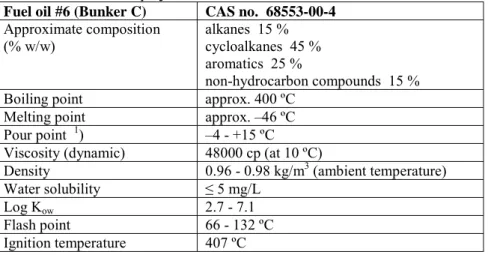
Some general physical-chemical parameters of fuel oil #6 are summarised in Table 1.
Table 1 General physical-chemical data of fuel oil #6
Fuel oil #6 (Bunker C) CAS no. 68553-00-4
Approximate composition
(% w/w) alkanes 15 %cycloalkanes 45 % aromatics 25 %
non-hydrocarbon compounds 15 % Boiling point approx. 400 ºC
Melting point approx. –46 ºC Pour point 1) –4 - +15 ºC Viscosity (dynamic) 48000 cp (at 10 ºC)
Density 0.96 - 0.98 kg/m3 (ambient temperature) Water solubility ≤ 5 mg/L
Log Kow 2.7 - 7.1
Flash point 66 - 132 ºC
Ignition temperature 407 ºC
All data are at 0% weathering, i.e., fresh fuel oil #6.
1) The 'pour point' is the lowest temperature at which an oil sample is observed to flow when cooled under prescribed conditions.
2) n-alkanes and branched alkanes.
3.3. Actual situation
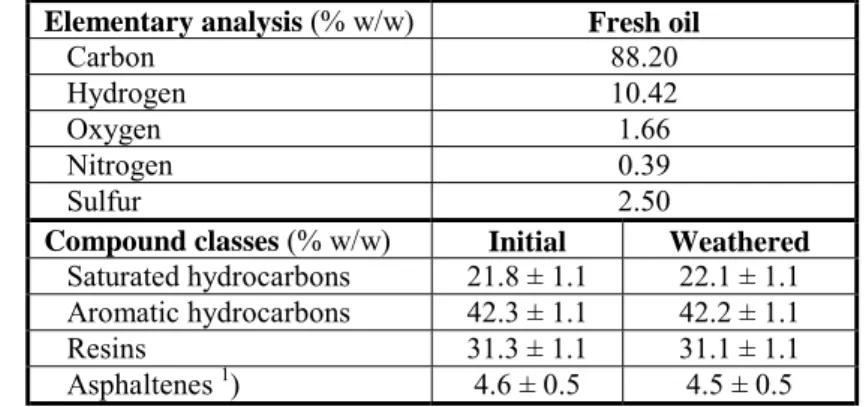
In the last week of December 1999 the Centre de Documentation de Recherche et d'Experimentations sur les Pollutions Accidentelles des Eaux (Brest) analysed the oil and characterised it as fuel oil #6 (according to US, UK and international nomenclature); the results of these analyses are summarised in Table 2. In addition, the polycyclic aromatic hydrocarbons present in this oil were analysed (limited to the so-called "EPA-16 PAHs") [Boudet et al. 2000], the result of this analysis are listed in Table 3.
Table 2. Chemical analysis of the fuel oil #6 cargo of the Erika
Elementary analysis (% w/w) Fresh oil
Carbon 88.20
Hydrogen 10.42
Oxygen 1.66
Nitrogen 0.39
Sulfur 2.50
Compound classes (% w/w) Initial Weathered
Saturated hydrocarbons 21.8 ± 1.1 22.1 ± 1.1 Aromatic hydrocarbons 42.3 ± 1.1 42.2 ± 1.1
Resins 31.3 ± 1.1 31.1 ± 1.1
Asphaltenes 1) 4.6 ± 0.5 4.5 ± 0.5 1) highly polar aromatics with molecular weights 2000-5000
Table 3. Analysis of some aromates and polycyclic aromates (16 EPA-PAHs) present in the oil spill
Compound (mg/kg) Fresh oil 1) Beach sample 1 2) Beach sample 2 2)
Naphthalene 534 96 21 Acenaphtylene 1 5 5 Acenaphtene 126 27 29 Fluorene 141 33 38 Phenanthrene 535 136 169 Anthracene 94 20 22 Fluoranthene 49 11 12 Pyrene 279 91 115 Benzo[a]anthracene 298 72 105 Chrysene 508 159 231 Benzo[b]fluoranthene 39 Benzo[k]fluoranthene 19 22 31 Benzo[a]pyrene 153 36 70 Dibenzo[a,h]anthracene 21 12 18 Benzo[g,h,i]perylene 42 17 20 Indeno[c,d]pyrene 11 10 18 Total 2850 747 904 Benzo[a]pyrene equivalents 3) 217 60 107 Benzene - < 0.2 0.5 Toluene - 0.7 1.8 Xylenes - 2.7 9.5
1) Oil sample of TOTALFINA, taken from oil freshly arrived on the beach in week 4 (2000), ref. DA589/No1749 [Boudet et al. 2000].
2) Results according to Boudet et al. [2000], analysed week 7 (sample 1 taken from oil that arrived on the beach Febr. 15 and was sampled the same day (ref. 00CS17), sample 2 taken from oil that arrived some days earlier and was also sampled Febr. 15 (ref. 00CS18)).
With respect to the operations aiming at cleaning the polluted coastal areas and cleaning oil-contaminated birds, the following aspects need to be considered [Boudet et al. 2000]:
Due to the rough nature of the contaminated area, cleaning has to be done by hand, wearing protective clothing, boots, gloves, facial protection, etc. The exposure during this type of work is considered "situation 1". The polluted clothes are cleaned on a daily basis using high-pressure water devices; the exposure during this type of work is considered "situation 2". Birds were cleaned bare-handed, using several detergents. The exposure during this type of work is evaluated as "situation 3".
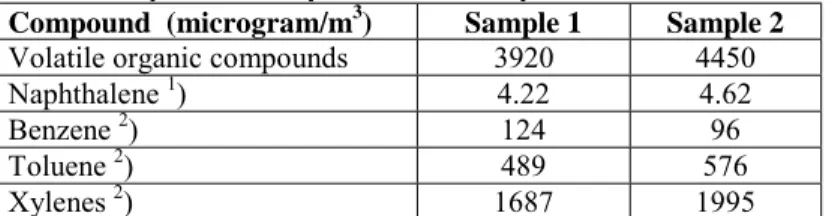
In week 7 (2000) some actual exposure measurements were performed in the contaminated area, distinghuishing the above three situations [Boudet et al. 2000]. Atmospheric analyses performed on February 15 indicated the presence of 5.2 and 5.9 ppm (v/v) of volatile organic compounds; assuming an oil density of 0.97 (Table 1) this equals 3920 and 4450 μg/m3, respectively. In laboratory
simula-tion tests this vapour was shown to contain benzene, toluene, xylenes and naphtalene: see Table 4. Other analyses were not performed.
In "situation 2" (i.e., applying high-pressure water devices) PAHs were analysed on February 16 and 17. Benzo[a]pyrene equivalents (based on the 16 EPA-PAHs) were found in concentrations of 23 and 33 ng/m3, naphthalene was found in concentrations of 620 and 680 ng/m3: see Table 5. Other analyses
were not performed.
Birds were cleaned by people wearing protective clothing, but no gloves. Actual exposure levels are not known.
In view of the above, the three situations can be characterised as follows:
1. Exposure of people cleaning the beaches. Since they wear full protective clothing, the only expo-sure of interest is the inhalation route.
2. Exposure of people cleaning the contaminated clothing. Also in this situation protective clothing is worn, and thus the inhalation route is the only exposure of interest.
3. Exposure of people cleaning contaminated birds. Although they wore protective clothing, the work was done with bare hands, and thus the exposures of concern are the inhalation route (as in situation 1), and the dermal route.
Table 4. Atmospheric samples on the oil-polluted beach
Compound (microgram/m3) Sample 1 Sample 2
Volatile organic compounds 3920 4450
Naphthalene 1) 4.22 4.62
Benzene 2) 124 96
Toluene 2) 489 576
Xylenes 2) 1687 1995
1) Data obtained in a laboratory simulation (dynamic test chamber), and used as such for risk estimation 2) Data obtained in a laboratory simulation (static test chamber), and used as such for risk estimation
Table 5. Atmospheric samples during cleaning of clothes (using high pressure water)
Compound (microgram/m3) Sample 1 Sample 2
Benzo[a]pyrene equivalents 0.023 0.033
Naphthalene 0.62 0.68
4. TOXICOLOGY 4) 4.1. Introduction
Residual fuel oils are less acutely toxic relative to other oil types. The carcinogenicity of petroleum products including fuel oils, however, is a major cause for concern. It is generally accepted that poly-cyclic aromatic hydrocarbons (PAHs), which are present in a number of fuel oils, are responsible for the carcinogenic effects following exposure to these oils.
General toxic risks can be evaluated applying the threshold approach (because toxicity becomes only manifest above the so-called No Observed Adverse Effect Level (NOAEL)); for carcinogenicity with
4) The information in this paragraph is summarised from ATSDR 1995a, b, 1998, IARC 1987, 1989, IPCS 1982, 1998, TPHCWG 1997a, b, CONCAWE 1998, Baars and Janssen 1999, and Baars 2000. To
in-a genotoxic mode of in-action, however, such in-a threshold is in-assumed not to exist, in-and consequently for evaluating carcinogenic effects the non-threshold linear extrapolation approach is applied [Janssen & Speijers 1997].
Exposure to the oil in cases of oil spillage is predominantly of concern through a number of possible routes including dermal contact, inhalation, and ingestion.
The toxicology and carcinogenicity of some mixtures such as diesel fuel, fuel oils and gasoline, and a number of individual constituents has been evaluated by regulatory and governmental agencies and institutes, including the US Agency for Toxic Substances and Disease Registry [ATSDR, 1995a, 1995b, 1998], the International Agency for Research on Cancer [IARC, 1987, 1989], the International Programme on Chemical Safety [IPCS, 1982, 1998]. The toxicological information of many constitu-ents is limited. In 1997 the US Total Petroleum Hydrocarbon Criteria Working Group (TPHCWG), examining information on 254 chemicals in the C3-C26 range, identified approximately 65 compounds
for which at least some useful toxicological information was available [TPHCWG, 1997a, 1997b], which was essentially confirmed and adopted by the ATSDR [1998]. In addition the Oil Companies’ European Organisation for Environment, Health and Safety (CONCAWE) has started to publish some 11 reports summarising the available information on toxicity etc. of a number of principal oil products; the 1998 report deals with heavy fuel oils [CONCAWE, 1998]. RIVM evaluated Total Petroleum Hy-drocarbons in 1999, estimating TDIs (tolerable daily intake) and TCAs (tolerable concentration in air) for the various compound classes [Baars & Janssen 1999]; the toxicity and carcinogenicity of PAHs was evaluated by RIVM in 2000 [Baars 2000].
4.2. Acute/subacute/subchronic exposure
In general, petroleum distillates are rather poorly absorbed from the gastrointestinal tract and do not cause appreciable systemic toxicity by ingestion unless inhalation occurs, in which case primary ef-fects include pulmonary damage and transient CNS depression or excitation. Inhalation exposure to volatile petroleum HCs may result in cardiac arrhythmias and CNS depression. Case reports of renal and haematological effects have also been recorded from acute high exposure. Long-term exposure of humans living up to 17 years nearby an oil processing plant in a heavily contaminated area was re-ported to have resulted in neurophysiological and neurological impairment.
Heavy fuel oils containing relatively high amounts of sulfur compounds may release H2S, which is
highly toxic, causing effects such as eye irritation, nervousness, nausea, headache, insomnia and, in severe cases, unconsciousness and death.
Dermal effects from short-term exposure to heavy fuel oils include irritant and defatting effects, re-sulting in primary irritation, dryness, cracking, oil acne, dermatitits, hyperkeratosis and photosensitiv-ity.
Testing the acute oral toxicity of selected fuel oils in rats resulted in LD50 values from 4700 mg/kg bw
(body weight) to 17500 mg/kg bw.
Exposure to heavy fuel oils may lead to severe eye irritation, in contrast to fuel oils with lower boiling points which are more dermally irritating. Fuel oil #6 demonstrated dermal sensitising potential with mild reactions being produced.
The category of heavy fuel oils was shown to have a dermal LD50 in the rabbit of >2000 to >5000
mg/kg bw.
The scarce data available on effects upon subacute/subchronic exposure are restricted to inhalation studies with experimental animals and indicate mainly nephrotoxic and pulmonary effects, but also liver effects have been reported. It must be noted, however, that the toxic effects in male rat kidney observed with various HCs are the result of a complex accumulation process that starts with the inter-action of HC metabolites and alpha-2u-globulin. The accumulation causes tubular cell damage and increased cellular proliferation, which enhances the probability of tumour development. When alpha-2u-globulin is not produced in substantial amounts (such as in female rats, mice, or other animal spe-cies including man), neither the nephrotoxicity nor the subsequent carcinogenesis occurs.
4.3. Developmental and reproductive toxicity
Heavy fuel oils showed maternal and foetal toxic effects in rats (19 days dermal exposure starting at day 0 of gestation) at doses of 8 and 30 mg oil per kg bw per day, respectively (Lowest Observed Ad-verse Effect Levels; LOAELs).
In a study to evaluate adverse reproductive effects, dermal application of residual fuel oil to rats showed non-reproductive toxic effects in males and females with NOAELs of 1 and 10 mg/kg bw/day, respectively, while the reproductive NOAEL rats was >250 mg/kg bw/day (both sexes).
4.4. Carcinogenicity
Human epidemiological studies have demonstrated the association of petroleum HC exposures with various adverse health outcomes. Of these, carcinogenicity is of particular importance; in general this is mainly attributed to the presence of PAHs in the various petroleum HCs. Inhalation and/or dermal exposure to mineral oils that have been used in a variety of occupations, including mulespinning, metal machining and jute processing, has been associated strongly and consistently with the occur-rence of squamous-cell cancers of the skin, and especially of the scrotum. Oil and gas field work was reported in the past to be associated with acute myelogenous leukaemia, but this was not found in more recent studies. An increased risk of renal adenocarcinomas was seen for refinery and petro-chemical workers and from occupational exposures to gasoline.
Environmental exposures have been reported to increase bone, brain and bladder cancer deaths of children and adolescents living in a residential area near three large petroleum and petrochemical complexes. Dermal carcinogenic potential of petroleum HCs was demonstrated by an increased inci-dence of squamous cell carcinomas and fibrocarcinomas in male mice treated with heavy paraffin dis-tillate in lifetime skin painting studies.
IARC classified the carcinogenic risk of residual fuel oils in category 2B: possibly carcinogenic to humans, based on sufficient evidence for its carcinogenicity in experimental animals and inadequate evidence for its carcinogenicity in humans [IARC 1987].
PAHs are considered important contributors to the carcinogenic properties of heavy fuel oils, and have been extensively investigated with respect to their carcinogenicity. For evaluating the carcinogenic potency of PAH mixtures, the potency of the PAH relative to that of benzo[a]pyrene is estimated, which results in a benzo[a]pyrene equivalent. The key assumption is that the relative potency of two PAHs in an animal model is similar to that of the same components in humans. Furthermore the approach is based on the assumption of additivity, i.e., in the final risk estimation the individual PAH concentrations are multiplied with their respective potency factors, and the resulting benzo[a]pyrene equivalents are summed. A number of estimations for such carcinogenic potency factors have been made and have been evaluated recently by IPCS [1998]. On the basis of this IPCS evaluation RIVM concluded to potency factors as listed by Baars [2000], expressed as the relative potency compared to the potency of benzo[a]pyrene, which is defined as 1.00 (see Appendix 2).
5. LIMIT VALUES 5.1. Inhalation exposure
Regarding PAHs, ATSDR [1995b] lists a number of values for occupational exposure limits (TWA -time weight average) for mineral oil mists as established in a number of countries varying from 3 to 5 mg/m3 (Australia, Belgium, former German Democratic Republic, Italy, Netherlands, Switzerland, Japan, Finland, Sweden, USA) 5).
Regarding naphthalene, ATSDR [1995c] estimated a chronic inhalation MRL (minimal risk level ≈ tolerable concentration in air) of 0.002 ppm = 10.5 μg/m3; US-EPA estimated in 1998 a chronic inha-lation RfC (reference concentration ≈ tolerable concentration in air) of 3 μg/m3 [IRIS 2000].
Regarding benzo[a]pyrene, the RIVM evaluation of PAHs [Baars 2000] estimated a lifetime excess oral cancer risk of 1:104 at an oral exposure of 0.5 μg benzo(a)pyrene per kg body weight per day.
Ap-plying route-to-route extrapolation from oral to inhalation exposure (average adult body weight of 70 kg, daily breathing volume of 20 m3) this equals 1.75 μg/m3. (
remark: route-to-route extrapolation is generally a rather unreliable procedure, and the results should be used with great care).
Regarding benzene, RIVM [Hesse & Janssen 1999] estimated the inhalation 10-4 lifetime excess
can-cer risk to be 20 μg/m3. Regarding toluene, RIVM [Janssen 1999a] estimated a TCA of 400 μg/m3; for
xylenes, RIVM [Janssen 1999b] estimated a TCA of 870 μg/m3.
5.2. Dermal exposure
A limit value for dermal exposure to PAHs was derived by RIVM in 1989 [Brinkman et al. 1989], re-sulting in a 1:104 excess lifetime skin cancer risk at dermal exposure to 2 ng benzo[a]pyrene
equiva-lents per cm2 skin.
6. EXPOSURE EVALUATION
6.1. General
In an oil spillage situation the exposure routes of consideration are the inhalation and the dermal route, because safety measures and strict orders to avoid oral exposure (ingestion) are very obvious.
Estimation of the potential inhalation exposure in cases of oil spillage is extremely difficult due to the general lack of data and the highly varying composition of heavy fuel oils in general. However, due to the low volatility of fuel oils, human exposure to vapour concentrations of toxicological significance is unlikely [ATSDR 1995a]. On the other hand, in exceptional situations higher exposures seem possible, particularly if circumstances facilitate aerosol formation [IARC 1989, ATSDR 1995a].
Data regarding dermal exposure of humans are extremely scarce. Data summarised by ATSDR [1995a] indicate that light types of fuel oil (in particular diesel fuel) are absorbed via the skin of hu-mans, but quantitative data are not available. There are no data for other fuel oils.
The carcinogenic effects resulting from dermal exposure to fuel oils are generally attributed to the polycyclic aromatic HCs (PAHs) that are present in these oils (paragraph 4.4). The limited data avail-able on dermal absorption of PAHs do suggest that these compounds are rather well absorbed via the skin of humans as well as experimental animals [ATSDR 1995b]; absorption is facilitated if PAHs are present in a solvent, or in an oily or fatty vehicle. Data for uptake by human skin vary between 10 and 20% after exposure to 10 μg/cm2 (occupational exposure to pyrene and benzo[a]pyrene), animal data
indicate an uptake of 50-80% within 24 h upon exposure to 2-125 μg benzo[a]pyrene per cm2.
Ac-cording to McKone & Howd [1992] absorption of organic chemicals through the skin is dependant of its lipophilicity, and decreases with increasing amounts applied on the skin. In addition, the actual ab-sorption is also dependant of the matrix.
6.2. Actual situation
Due to the rough nature of the contaminated area, cleaning has to be done by hand, wearing protective clothing, boots, gloves, facial protection, etc. These clothes are cleaned on a daily basis using high-pressure water devices.
Birds were cleaned by people wearing protective clothing, but no gloves. In the cleaning process sev-eral detergents were used. Actual exposure levels are not known.
Referring to the three situations defined in paragraph 3.3, the following exposure scenarios for esti-mating the risks with respect to both general toxicity and carcinogenicity can be distinghuished: 1. In cleaning the beaches the risk of concern is inhalation exposure. People involved are exposed
during 8 h per day, 5 days per week, to an atmosphere summarised in Table 4
2. Likewise in cleaning contaminated clothes the risk of concern is inhalation exposure; people
in-volved are exposed to oil vapours and/or aerosols presented in Table 5, during a period of ap-proximately 1 hour per day.
3. In cleaning birds the risk of primary concern is dermal exposure. Data on dermal exposure of
humans, however, are extremely scarce. In this particular situation of cleaning oil-contaminated birds it is assumed that dermal exposure of oil occurs on the palms of two hands, 8 h per day, 5 days per week. In the current oil spillage situation a deposition of 10 mg oil per cm2 unprotected
skin is assumed. Thus, taking beach sample 1 as listed in Table 2 as representative for the oil to which people cleaning birds are dermally exposed, this results in a total dermal exposure of 10 mg oil per cm2 per day, containing 1070 ng benzo[a]pyrene equivalents per cm2 per day.
7. CONCLUSION
7.1. Situation 1: people cleaning beaches
Compound Risk Inhalation exposure
(8h/d, 5 d/wk) (microgram/m3) Corrected exposure (continuously, 24 h/d, 7 d/wk) (microgram/m3) Limit value (microgram per m3) Volatile organic
compounds General toxicity 4450 1060 3000-5000
Benzene Carcinogenicity 1) 124 30 20
Toluene General toxicity 576 137 400
Xylenes General toxicity 1995 475 870
Naphthalene General toxicity 4.6 1.1 3.0
1) 1:104 excess lifetime cancer risk from inhalation.
In the situation of people cleaning beaches the risks for general toxic effects are limited. Regarding exposure to the toxic compounds listed the actual inhalation after correction for continuous exposure time is well below the limit values. For benzene (which is carcinogenic), however, the corrected inha-lation exposure is slightly higher than the limit value, but taken into account that the period during which these people are exposed is very short (generally in the order of magnitude of some weeks to some months at most) compared to the limit value which is based on continuous exposure during full lifetime (assumption: 4 months versus 70 × 12 months), the risk can also be considered negligible. 7.2. Situation 2: people cleaning clothes
Compound Risk Inhalation exposure
(1 hr/day) (nanogram/m3) Corrected exposure (continuously, 24 h/d, 7 d/wk) (nanogram/m3) Limit value (nanogram per m3) Benzo[a]pyrene equivalents Carcinogenicity 1) 33 0.98 1750
Naphthalene General toxicity 680 20 3000
1) 1:104 excess lifetime cancer risk from inhalation.
In the situation of people cleaning clothes the risk is negligible. 7.3. Situation 3: people cleaning birds
Compound Risk Dermal exposure
(8 h/d, 5 d/wk)
Corrected exposure (continuously, 24 h/d, 7 d/wk)
Limit value
Oil General toxicity 10 milligram per cm2 - n.v.
Benzo[a]pyrene equivalents Carcinogenicity 1) 1070 nanogram per cm2 255 nanogram per cm 2 2 nanogram per cm2 n.v.: no value available.
1) 1:104 excess lifetime cancer risk from dermal exposure.
The situation of people cleaning birds presents a serious risk of rather acutely developing eye irritation and skin disorders like irritant and defatting effects, resulting in primary irritation, dryness, cracking, oil acne, dermatitits and/or hyperkeratosis. In addition the dermal exposure to this oil may give rise to sensitisation. These risks, however, are very difficult to quantify. Generally the effects are reversible, although proper medical treatment might be required.
The calculated risk for developing skin tumours at some time in the future is considerable, but also here it must be considered that the actual exposure period is at most in the order of magnitude of one month, compared to the limit value which is based on continuous exposure during full lifetime (in other words, one month versus 70 x 12 months). In conclusion, and given the actual situation, the risk may well considered to be acceptable.
7.4. Remark
It must be noted that in the above evaluation the normal background exposure, to which the average human is exposed in normal daily life, is not taken into account. In general, however, the background exposure to the compounds of interest in this particular oil spillage is low.
8. REFERENCES
ATSDR (Agency for Toxic Substances and Disease Registry) (1995a): Toxicological profile for fuel oils.
US Department of Health and Human Services, Public Health Service, Agency for Toxic Substances and Disease Registry, Atlanta (Georgia), USA.
ATSDR (Agency for Toxic Substances and Disease Registry) (1995b): Toxicological profile for polycyclic aromatic hydrocarbons (update).
US Department of Health and Human Services, Public Health Service, Agency for Toxic Substances and Disease Registry, Atlanta (Georgia), USA.
ATSDR (Agency for Toxic Substances and Disease Registry) (1995c): Toxicological profile for naphthalene (update).
US Department of Health and Human Services, Public Health Service, Agency for Toxic Substances and Disease Registry, Atlanta (Georgia), USA.
ATSDR (Agency for Toxic Substances and Disease Registry) (1998): Draft toxicological profile for total petroleum hydrocarbons.
US Department of Health and Human Services, Public Health Service, Agency for Toxic Substances and Disease Registry, Atlanta (Georgia), USA.
Baars AJ (2000):
Update of the human health-based Maximum Permissible Risk (MPR) for polycyclic aromatic hydrocarbons. RIVM-CSR advisory report 7059A00, January 2000.
National Institute of Public Health and the Environment, Bilthoven, The Netherlands. Baars & Janssen (1999):
Update of the human health-based Maximum Permissible Risk (MPR) for total petroleum hydrocarbons. RIVM-CSR advisory report 6319A00, April 1999.
National Institute of Public Health and the Environment, Bilthoven, The Netherlands.
Brinkman FJJ, Knaap AGAC, Kramers PGN, Aalbers ThG, Jekel AA, Keijzer J, Kliest JJG, Michel FJ, Monti-zaan GK, Savelkoul TJF, Vaessen HAMG, Wammes JIJ & Wilbers AAMM (1989):
Onderzoek naar de gehalten aan polycyclische aromaten in binnen het voormalige Laura-terrein te Kerkrade ver-zamelde monsters. Uitloogbaarheidsproeven. Risico-evaluatie met betrekking tot de volksgezondheid.
(Concentrations of polycyclic aromatic hydrocarbons in samples collected at the former Laura coal-mine area at Kerkrade. Leaching experiments. Risk evaluation with respect to public health. Report in Dutch).
National Institute of Public Health and the Environment, RIVM report no. 748704018, April 1989; Bilthoven, The Netherlands.
CONCAWE (the Oil Companies’ Organisation for Environmental and Health Protection) (1998): Heavy fuel oils.
Product Dossier No. 98/109; CONCAWE, Brussels, Belgium. Hesse JM & Janssen PJCM (1999):
Update of the human health-based Maximum Permissible Risk (MPR) for benzene. RIVM-CSR advisory report 6326A00, June 1999.
National Institute of Public Health and the Environment, Bilthoven, The Netherlands. IARC (International Agency for Research on Cancer) (1987):
Overall evaluations of carcinogenicity - an updating of IARC monographs volumes 1 to 42.
IARC Monographs on the Evaluation of Carcinogenic Risks to Humans, Suppl. 7; IARC, Lyon, France. IARC (International Agency for Research on Cancer) (1989):
Occupational exposures in petroleum refining; crude oil and major petroleum fuels.
IARC Monographs on the Evaluation of Carcinogenic Risks to Humans, Vol. 45; IARC, Lyon, France. Boudet C, Chemin F & Bois F (2000):
Evaluation du risque sanitaire de la marée noire consécutive au naufrage de l'Erika. Partie 6.
Institut National de l'Environnement Industriel et des Risques (INERIS), report CBoFChFBo-25627 dated Feb-ruary 29, 2000; Verneuil-en-Halatte, France.
IPCS (International Programme on Chemical Safety) (1982): Selected petroleum products.
Environmental Health Criteria 20; WHO/IPCS, Geneva, Switzerland. IPCS (International Programme on Chemical Safety) (1998):
Selected non-heterocyclic polycyclic aromatic hydrocarbons.
Environmental Health Criteria 202; WHO/IPCS, Geneva, Switzerland. IRIS (Integrated Risk Information System) (2000):
Summary for naphthalene (dated September 1998).
US Environmental Protection Agency, Washington DC, USA. Irwin RJ, VanMourik M, Stevens L, Seese MD & Basham W (1997): Environmental Contaminants Encyclopaedia - Entry on Fuel Oil No. 6.
National Park Service, Water Resources Division, Fort Collins (Colorado), USA.
Distributed on the Internet via the US National Park Service Home Page: http://www.aqd.nps.gov/toxic/ Janssen PJCM (1999a):
Update of the human health-based Maximum Permissible Risk (MPR) for toluene. RIVM-CSR advisory report 6755A00, December 1999.
National Institute of Public Health and the Environment, Bilthoven, The Netherlands. Janssen PJCM (1999b):
Update of the human health-based Maximum Permissible Risk (MPR) for xylenes. RIVM-CSR advisory report 6756A00, December 1999.
National Institute of Public Health and the Environment, Bilthoven, The Netherlands. Janssen PJCM & Speijers GJA (1997):
Guidance on the derivation of maximum permissible risk levels for human intake of soil contaminants.
National Institute of Public Health and the Environment, RIVM report no. 711701006, January 1997; Bilthoven, The Netherlands.
McKone TE & Howd RA (1992):
Estimating dermal uptake of non-ionic organic chemicals from water and soil. I. Unified fugacity-based models for risk assessments.
Risk Analysis 21: 407-419.
TPHCWG (Total Petroleum Hydrocarbons Criteria Working Group, Toxicology Technical Action Group) (1997a):
Selection of representative TPH fractions based on fate and transport considerations. TPHCWG Series Volume 3; Amherst Scientific Publishers, Amherst (MA), USA.
TPHCWG (Total Petroleum Hydrocarbons Criteria Working Group, Toxicology Technical Action Group) (1997b):
Development of fraction specific reference doses (RfDs) and reference concentrations (RfCs) for total petroleum hydrocarbons.
TPHCWG Series Volume 4; Amherst Scientific Publishers, Amherst (MA), USA.
-0-0-0-0-0-0-0-0-0-0-March 8, 2000
RIVM, Centre for Substances and Risk Assessment P.O. Box 1, NL3720BA Bilthoven, The Netherlands Author: Dr. A.J. Baars