Transactional Memory
Walther Maldonado, Patrick Marlier, Pascal Felber, Julia Lawall, Gilles Muller
To cite this version:
Walther Maldonado, Patrick Marlier, Pascal Felber, Julia Lawall, Gilles Muller. Transaction
Activation scheduling Support for Transactional Memory. [Research Report] RR-6807, INRIA.
2009, 28 p.
<inria-00363376>
HAL Id: inria-00363376
https://hal.inria.fr/inria-00363376
Submitted on 23 Feb 2009
HAL
is a multi-disciplinary open access
archive for the deposit and dissemination of
sci-entific research documents, whether they are
pub-lished or not.
The documents may come from
teaching and research institutions in France or
abroad, or from public or private research centers.
L’archive ouverte pluridisciplinaire
HAL, est
destin´
ee au d´
epˆ
ot et `
a la diffusion de documents
scientifiques de niveau recherche, publi´
es ou non,
´
emanant des ´
etablissements d’enseignement et de
recherche fran¸cais ou ´
etrangers, des laboratoires
publics ou priv´
es.
a p p o r t
d e r e c h e r c h e
0 2 4 9 -6 3 9 9 IS R N IN R IA /R R --6 8 0 7 --F R + E N G Thème COMTransaction Activation
Scheduling Support for TransactionalMemory
Walther Maldonado —
Patrick Marlier —
Pascal Felber — Julia Lawall — Gilles Muller
N° 6807
Centre de recherche INRIA Paris – Rocquencourt
Scheduling Support for TransactionalMemory
Walther Maldonado
∗,
Patrick Marlier
∗,
Pascal Felber
∗, Julia Lawall
†, Gilles Muller
‡Th`eme COM — Syst`emes communicants ´
Equipe-Projet Regal
Rapport de recherche n°6807 — Janvier 2009 —25pages
Abstract: Transactional Memory (TM) is considered as one of the most promising paradigms for developing concurrent applications. TM has been shown to scale well on multiple cores when the data access pattern behaves “well,” i.e., when few conflicts are induced. In contrast, data patterns with fre-quent write sharing, with long transactions, or when many threads contend for a smaller number of cores, produce numerous aborts. These problems are tra-ditionally addressed by application-level contention managers, but they suffer from a lack of precision and provide unpredictable benefits on many workloads. In this paper, we propose a system approach where the scheduler tries to avoid aborts by preventing conflicting transactions from running simultaneously. We use a combination of several techniques to help reduce the odds of conflicts, by (1) avoiding preempting threads running a transaction until the transaction completes, (2) keeping track of conflicts and delaying the restart of a transaction until conflicting transactions have committed, and (3) keeping track of conflicts and only allowing a thread with conflicts to run at low priority.
Our approach has been implemented in Linux for Software Transactional Memory (STM) using a shared memory segment to allow fast communication between the STM library and the scheduler. It only requires small and contained modifications to the operating system. Experimental evaluation demonstrates that our approach significantly reduces the number of aborts while improving transaction throughput on various workloads.
Key-words: Software transactional memory, TinySTM, thread scheduling
A previous version of this document appeared as research report UniNE-8/11/2008
∗University of Neuchˆatel, Switzerland †DIKU, University of Copenhagen, Denmark ‡EMN–INRIA/Regal
R´esum´e : La m´emoire transactionelle (TM) est actuellement consid´er´ee comme l’un des paradigmes les plus prometteurs pour le d´eveloppement d’applications concurrentes. Les ´etudes dans ce domaine ont montr´ees que la performance ´etait proportionnelle au nombre de cœurs lorsque le canevas des acc`es m´emoire poss`ede un bon profil, c.`a.d que peu de conflits sont engendr´es entre les transac-tions. En revanche, lorsque les acc`es aux donn´ees induisent du partage fr´equent en ´ecriture, de longues transactions ou lorsque de nombreux fils de contrˆole sont en comp´etition pour s’ex´ecuter sur un nombre de cœurs inf´erieurs, il en r´esulte de nombreux avortements. Ces probl`emes sont traditionellement trait´es par des gestionnaires de contention au niveau applicatif. Toutefois, les solutions exis-tantes souffrent d’un manque de pr´ecision et entraˆınent des gains non pr´evisibles sur de nombreuses charges applicatives.
Dans cet article, nous proposons une approche syst`eme o`u l’ordonnanceur essaie de pr´evenir les avortements en ´evitant de faire s’ex´ecuter simultan´ement des transactions conflictuelles. Plus pr´ecis´ement, nous utilisons une combinaison des techniques suivantes : (i) ´eviter de suspendre une thread tournant une transaction jusqu’au commit de celle-ci, (ii) m´emoriser les conflits et retarder le red´emarrage d’une transaction jusqu’`a ce que les transactions conflictuelles aient commit´ees, (iii) m´emoriser les conflits et permettre aux fils tournant des transactions en conflit de s’ex´ecuter avec une priorit´e basse.
Notre approche a ´et´e mise en œuvre dans le contexte d’une m´emoire tran-sactionelle logicielle (STM) sur Linux en utilisant un segment de m´emoire par-tag´eee pour permettre des communications rapide entre l’ordonnanceur et la STM. Cette approche requiert peu de modifications dans le noyau de Linux. Nos ´evaluations montrent que cette approche r´eduit de mani`ere significative le nombre d’avortements et qu’elle am´eliore le d´ebit en transactions sur des charges applicatives vari´ees.
Mots-cl´es : M´emoire transactionelle logicielle, TinySTM, ordonnancement noyau
1
Introduction
Transactional Memory (TM) is considered as one of the most promising paradigms for developing concurrent applications by exploiting in a simple and efficient manner the power of new multi-core processors [1,9]. The basic idea is to pro-tect, using lightweight transactions, blocks of instructions that access shared data. These transactions execute optimistically on the assumption that there is no concurrent operation on the same data; upon conflict, a transaction might implicitly abort and restart its execution. TM thus provides a simple and safe abstraction for using speculative execution in multi-threaded applications.
TM has been shown to scale well on multiple cores when the data access pattern behaves “well,” i.e., when few conflicts are induced [1,9]. In contrast, a data pattern with frequent write sharing will induce numerous aborts. This means that a long running transaction has little chance to make progress and commit successfully unless specific—often ad-hoc—measures are taken.
In the context of Software Transactional Memory (STM), the traditional approach to solve this problem is to use an application-levelcontention manager. The role of the contention manager is to react when a conflict is detected, by aborting one of the conflicting transactions or by waiting (using a sleep) for the conflict to be possibly resolved. Additionally, exponentially increasing delays can be inserted after an abort so as to reduce the probability of a further conflict. There are several problems with these approaches: (i) too many aborts, e.g., when a long running transaction conflicts with shorter transactions; (ii) lack of precision, since an aborted thread may wait too long after the commit of the conflicting transaction to restart its own transaction; (iii) unpredictable bene-fits, as delaying the restart of a long transaction does not necessarily increase its chance of success, unless all other conflicting transactions are also delayed. Therefore, “blind” conflict resolution techniques usually provide poor perfor-mance with many workloads commonly used to evaluate STMs [12,13].
In this paper, we consider word-based STMs that use revokable locks, such as McRT-STM [11], TL2 [4] andTinySTM[7], because of their flexibility (they allows transactional accesses to arbitrary memory addresses) and their high ef-ficiency [6]. We propose an approach where the scheduler tries to avoid conflicts by preventing conflicting transactions from running simultaneously. We use a combination of three strategies to help reduce the odds of conflicts: First, strategy S1 tries to avoid suspending threads running a transaction until the transaction completes (commits or aborts), thus reducing the “window of vulner-ability.” Second, strategy S2 keeps track of recent conflicts and marks threads that have just aborted so that the scheduler will not elect them until the con-flicting transactions have committed. Finally, strategy S3 considers a variant of the previous strategy where a thread that has detected a conflict is allowed to run, but at low priority. While strategies S2 and S3 address problems that occur at the level of a single multithread application, S1 tackles an issue that arises as soon as two threads run on the same core, even if they belong to in-dependent applications. This advocates for an implementation within the OS kernel because it is aware of and thus can adjust all scheduling decisions.
The potential problem with such a kernel approach is that transactions must communicate with the operating system to signal transactional events (start, commit, abort). For transactions, which are intended to be lightweight, the use of specialized system calls to implement this communication would induce
an unacceptable overhead. We propose a new solution based on the use of a memory segment shared between the STM library and the scheduler. The STM writes information into the shared memory segment, which is then used at scheduling time to take appropriate decisions.
The contributions of the paper are as follows:
We propose novel approaches for improving the performance of software
transactional memory by modifying the OS scheduler policies. We demon-strate that an OS implementation reduces the window of vulnerability even when multiple applications share the same core. To our knowledge, the impact of running multiple applications is a critical issue that has been overlooked until now.
We have implemented our approach in the Linux kernel. Our modifications
to the kernel are small and contained.
We have evaluated our approach on both micro- and macro-benchmarks.
Results show that our approach is effective in situations where an application-level contention manager cannot provide satisfactory performance.
The rest of this paper is organized as follows. Section 2 further describes software transactional memory and the problem of contention management. In Section 3, we propose three system-level contention management strategies at an intuitive level, while Section4discusses the details of their implementation. Section5 evaluates these strategies on a range of benchmarks. Finally Section
6presents related work and Section7concludes.
2
Background
In this section, we briefly describe the main principles of software transactional memory and highlight the difficulties that application-level contention managers have in accurately dealing with conflicts.
2.1
Software Transactional Memory
Software transactional memory (STM) [14] is a lightweight alternative to locks for synchronizing threads in concurrent applications. STM allows developers to combine sequences of concurrent operations into atomic transactions that execute optimistically and, upon conflict, automatically roll back and restart their execution. This approach promises a great reduction in the complexity of both programming and verification, by making parts of the code appear to be sequential without the need to program fine-grained locks.
A typical API exported by an STM contains functions to start a transac-tion, access shared data for reading or writing, try to commit the transaction or force it to roll-back. InTinySTM [7], for instance, these functions are re-spectively calledstm start,stm load,stm store,stm commit, andstm abort. Additional hooks are provided to react when particular events happen, such as commit, abort, conflict, or restart. A transaction is bound to a single thread, and each thread can execute a sequence of transactions.
There exist several types of STM designs [9], which mainly differ in their liveness properties (e.g., blocking, obstruction-free, lock-free) and the granu-larity of conflict detection (e.g., memory word, object), as well as the various implementation choices they follow. In this paper, we consider a popular class of STMs, widely considered to be among the most efficient and general purpose, which follow a word-based and lock-based design (i.e., conflict detection is per-formed at the level of individual machine words, and the implementation uses revokable locks to protect memory from conflicting accesses). This class notably includes Ennals’ STM [6], McRT-STM [11], TL2 [4], andTinySTM[7].
A key to the performance of lock-based STM designs is the limited synchro-nization between the thread and the indirection-free access to shared data. In contrast, obstruction-free designs typically require extra indirections for every access and are often significantly slower than their lock-based counterparts (e.g., see [6]).
2.2
Contention Management
STM relies on the hypothesis that conflicts are unlikely and thus, in most cases, transactions can commit. Therefore, the ability of STM to scale directly depends on the workload considered. Two scenarios can negatively affect performance. First, transactions that conflict frequently will trigger many aborts, sometimes even creating a livelock situation. This is particularly the case with long running transactions. Second, when the number of threads exceeds the number of cores, threads can be preempted while executing transactions. This leads to longer transaction execution times and a higher risk of conflicts. In both situations, transaction throughput (i.e., commit rate) will decrease.
An important challenge is to be able to handle such scenarios gracefully. This task is traditionally addressed by the contention manager (CM), a STM component responsible for resolving conflicts between a pair of transactions at runtime. The CM determines based on various policies whether conflicting transactions should abort, wait, or proceed. Comparative studies of contention managers [12,13] show that different strategies work better for different bench-mark applications, but no single manager performs best on all workloads.
In lock-based STM, the typical strategy is to abort the thread that discovers the conflict. If a transaction aborts multiple times, it may wait for a random, exponentially increasing, delay before restarting, to give conflicting transactions a chance to complete. Thisexponential backoff strategy practically avoids live-locks, but often does not give good performance.
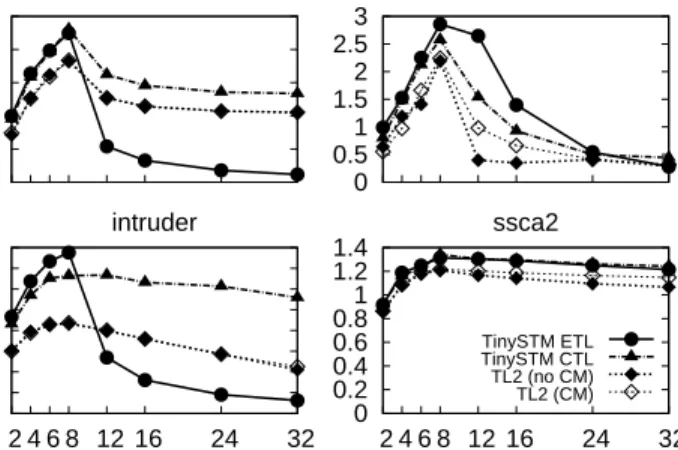
To evaluate the impact of conflicts with many concurrent transactions and the effectiveness of application-level contention management, we have run a set of benchmarks from the STAMP suite [3] on an 8-core machine with two STM implementations (see Section 5 for details on our experimental setup): TL2 (with and without exponential backoff CM), and TinySTM. The latter implementation can either use encouter-time locking (ETL), or commit-time locking (CTL), depending on whether a write is visible to other transactions immediately or only at commit time, respectively.1
In the graphs in Figure2.2, we observe that: (i) performance degrades sig-nificantly on most STAMP benchmarks once there are more threads than cores,
1
CTL typically reduces the risk of conflicts during transaction execution but increases the likelihood of an abort at validation time [7].
0 0.5 1 1.5 2 2.5 vacation STAMP benchmarks Number of threads Scaling 0 0.5 1 1.5 2 2.5 3 kmeans 0 0.2 0.4 0.6 0.8 1 1.2 1.4 1.6 2 4 6 8 12 16 24 32 intruder 0 0.2 0.4 0.6 0.8 1 1.2 1.4 2 4 6 8 12 16 24 32 ssca2 TinySTM ETL TinySTM CTL TL2 (no CM) TL2 (CM)
Figure 1: Performance of TinySTM (ETL and CTL) and TL2 on STAMP benchmarks.
except forssca2that has short transactions and very few conflicts (see Table VI in [3]); (ii) degradation is generally less important using commit-time locking (TL2 and TinySTM-CTL), except for kmeans where we observe the opposite trend; and (iii) the backoff contention manager does not help.
There are several reasons why the application-level contention manager is inadequate. First, it typically lacks precision when delaying the restart: if the delay is too short the same conflict might be encountered again, if it is too long cycles might be wasted. Second, it takes local actions after a pairwise conflict has been detected and cannot easily make informed decisions based on current and past conflicts, when restarting a transaction. Third, it does not control when threads are preempted: if preemption occurs in the middle of an active transaction, the risk of conflict with concurrent transactions increases.
3
A System Approach to Contention
Manage-ment
In this section, we present a new approach to contention management that relies on cooperation between the STM library and the OS scheduler. The basic idea is to enable the scheduler to take appropriate decisions in thread election by keeping it aware of transaction progress and conflicts. Our goal is to prevent wasting CPU resources by reducing the number of transaction aborts. We provide a high-level description of three scheduling strategies that explore variations around this idea. The presentation of these strategies is intended to be as clear as possible, so implementation issues are deferred to the next section. We have developed three scheduling strategies (S1–S3) that fall into two
complementary categories: (i) S1 gives priority to threads currently running
transaction that is likely to abort in the future. We now describe these strategies in detail.
3.1
Strategy S
1— Avoiding transaction suspension
In an operating system such as Linux with a priority-based round-robin sched-uler, a thread is suspended when its time slice has expired or when a thread with a higher priority is unblocked. If the thread is currently running a transaction, being suspended in this manner dramatically increases the probability for an-other transaction to create a conflict. StrategyS1 minimizes this phenomenon
by deferring the preemption of a thread that is running a transaction. In order to prevent a busy transactional thread from monopolizing a processor, a counter is associated to the thread, meaning it only gets a maximum numberN of such “extensions” before it is actually suspended. Finally, if a thread has benefited from an extension, it yields after the next commit.
Algorithm 1: StrategyS1 // Start transaction tx uponStart(tx) 1 tx.thr←CurrentThread() 2 tx.thr.tx←tx 3 tx.thr.extensions←0 4 // Commit transactiontx uponCommit(tx) 5 tx.thr.tx←null 6 iftx.thr.extensions >0then 7 Yield() 8
// Thread election,Qis the OS ordered ready queue uponSchedule(Q)
9
t←CurrentThread() 10
ift.tx6=null∧t.extensions≤N then 11
t.extensions←t.extensions+ 1
12
return // The current thread keeps running
13
Elect(First(Q)) 14
3.2
Strategy S
2— Preventing restart of an aborted
trans-action while a conflicting transtrans-action is active
A transactiontxsupported by a threadtx.thrmay abort due to a conflict with a transaction tx′ supported by a threadtx′.thr. In this case, we assume that the application is deterministic, so a restart of txwill likely lead to an abort as long as tx′ is active. Therefore, StrategyS
2 blocks the thread; it removes the
thread from the scheduler’s ready queue and moves it to a wait queue associated with the thread with which there is a conflict. When a transaction commits, all of the threads on the wait queue of the supporting thread are returned to the scheduler’s ready queue, and thus become re-eligible for election.
Algorithm 2: StrategyS2 // Start transaction tx uponStart(tx) 1 tx.thr←CurrentThread() 2
// Conflict betweentxand tx′ uponConflict(tx,tx′) 3 MoveToWaitQueue(tx.thr,tx′.thr.wait) 4 Abort(tx) 5 Yield(tx.thr) 6 // Commit transactiontx uponCommit(tx) 7
fortintx.thr.waitdo // Remove conflicts
8
MoveToReadyQueue(t) 9
// Thread election,Qis the OS ordered ready queue uponSchedule(Q)
10
Elect(First(Q)) 11
3.3
Strategy S
3— Allowing restart of an aborted
trans-action at a low priority while a conflicting transtrans-action
is active
StrategyS3is a variation ofS2for applications with nondeterministic behavior.
In that case, a restarted transaction may not always reproduce past conflicts. Therefore, S3 allows electing a thread supporting a restarted transaction at a
low priority until the conflicting transaction commits. With a scheduler such as that of Linux, such an election will occur only if the OS lacks ready threads and thus processors can be used to potentially waste cycles.
InS3, a thread in conflict must remain at low priority until all of the threads
with which it conflicts have committed the conflicting transactions. Because a thread in conflict remains able to run while in a conflict state, it may encounter a conflict with a given thread multiple times or it may encounter conflicts with multiple threads. To be able to efficiently manage information about multiple conflicts,S3uses a two-dimensional boolean arrayC, whereC[i][j] is true if and
only if threadihas detected a conflict with threadj. An element of this array is set to true inConflict. In Commit, the column C[t][∗] for the thread t
performing the commit is cleared, to indicate that other threads are no longer in conflict with the current one, and the rowC[∗][t] is cleared as well, since the
thread is no longer in a transaction. When a thread is no longer in conflict with any transaction, its priority should be returned to normal. This is indicated by all of the elements in the row associated with the thread being false.
4
Implementation
The naive descriptions of the contention management strategies do not specify how to implement synchronization between multiple processes or communica-tion between the STM and the scheduler. The tasks performed by the trans-action operationsStart,Conflict andCommit require updating the kernel structures that implement threads. Thus, these tasks must be performed at the kernel level. The transaction operations for strategies S2 and S3 furthermore
Algorithm 3: StrategyS3
C[∗][∗]←false // Conflict matrix, initialized to false 1 // Start transaction tx uponStart(tx) 2 tx.thr←CurrentThread() 3
// Conflict betweentxand tx′ uponConflict(tx,tx′) 4 C[tx.thr][tx′.thr]←true 5 tx.thr.priority←low 6 Abort(tx) 7 Yield(tx.thr) 8 // Commit transactiontx uponCommit(tx) 9
foreach threadtdo // Clear column
10 ifC[t][tx.thr]then 11 C[t][tx.thr]←false 12 if∀t′:¬C[t][t′]then 13
// Reset priority if no more conflicts t.priority←normal
14
C[tx.thr][t]←false // Clear row
15
tx.thr.priority←normal // Reset priority
16
uponSchedule(Q) 17
Elect(First(Q)) 18
potentially require manipulating structures such as the wait queues that may be accessed concurrently by multiple threads, and thus require mutual exclusion.
A possible strategy for shifting work from the user level to the kernel level is to introduce specialized system calls. BecauseStartandCommitoccur fre-quently, however, using specialized system calls to implement communication between the STM at user level and the kernel to access the thread structures would induce an excessive overhead for these operations. Furthermore, as intro-ducing a new system call is complex, we prefer to avoid it even forconflict. To enable communication between the transaction operations and the kernel with-out resorting to system calls, we instead propose a novel architecture based on a memory region shared between the STM library and the scheduler, as shown in Figure2. The shared memory region contains a table of MaxThreads ele-ments, each being a structure describing STM information for a given thread. The OS thread structure is enriched with a pointer into the shared memory thread structure.
The initial setup and communication between the application and the kernel is done via a special device file /dev/stm, through which, via I/O control and memory mapping calls, the table of elements is allocated by the main application thread. Child threads subsequently request to be linked to the next available entry in the array, as part of their STM initialization process. As the execution of the program progresses, the application fills in data in the shared structure, and the scheduler processes this information accordingly.
It must be remarked that in this layout, it is not possible to avoid simulta-neous access from the kernel and processes, which places a certain risk on data access coherency and limits the amount of information that can be placed and updated within the structure. Assignments and decisions taken by reads must for example take into account the effects of interleaving instructions between the kernel and user-space, and be careful with their ordering to avoid undesired
side-effects. Our use of the shared memory segment is structured such that any initializations at the user level that trigger behavior in the scheduler are pre-ceded by initialization of the shared memory segment with all other information required for this behavior, and thus race conditions are not possible.
User space STM Kernel space Scheduler Kernel extension Task structure Memory STM thread structure
Figure 2: Layout of the interaction between the Kernel and application. STM operations are then implemented as follows: (i) operations that must defer tasks to the kernel to obtain mutual exclusion are implemented by logging information into the shared memory thread structure, (ii) logged operations are applied by the kernel before electing a new thread.
4.1
Implementing strategy S
1The implementation ofS1is quite similar to the naive version described in
Algo-rithm1. The changes are related to the usage of the shared structurestm thread
containing the transaction id and time extension information. At the STM level, theStartoperation now initializes the thrfield of the transaction to point to the shared memory structure associated with the current thread, rather than to the current thread itself. At the kernel level, the schedule function checks that the current thread uses the STM before accessing the shared structure. If the current thread is using the STM, the schedulefunction then accesses information in the shared structure to determine whether it is in a transaction and has any remaining extensions.
4.2
Implementing strategies S
2and S
3The changes for the implementations ofS2 andS3 are more elaborate than for
S1due to the need to defer treatments to the kernel functionSchedule. Both
implementations use the same shared memory segment structure and definitions of the STM functionsStart,ConflictandCommit, as shown in Algorithm5. The STM functions now only serve to store information in the shared memory
Algorithm 4: Implementation of strategyS1
// Thread structure in shared memory structstm thread 1 tx: transaction id 2 extensions: int 3
// Init of the thread before using the STM uponKernelSTMInit(t) 4 t.sh stm←GetNextFreeSTMStruct() 5 // Start transaction tx uponStart(tx) 6 tx.thr←STMSharedStructPtr() 7 tx.thr.tx←tx 8 tx.thr.extensions←0 9 // Commit transactiontx uponCommit(tx) 10 tx.thr.tx←null 11 iftx.thr.extensions >0then 12 Yield(tx.thr) 13
// Extension of OS thread structure structthread extension
14
sh shm:structstm thread 15
// Thread election,Qis the OS ordered ready queue uponSchedule(Q)
16
t←CurrentThread() 17
// Check that the thread uses the STM and is in a transaction ift.sh stm6=null∧t.sh stm.tx6=null then
18
ift.sh stm.extensions≤N then 19
t.sh stm.extensions←t.sh stm.extensions+ 1
20
return // The current thread keeps running
21
Elect(First(Q)) 22
segment that will be needed byScheduleto perform the corresponding oper-ation. Start extracts the element of the shared memory segment associated with the thread and initializes the txfield in this element to the current trans-action id. Conflict logs the transaction with which there is a conflict and its supporting thread, and then aborts the current transaction and yields the processor. Finally, Commit sets the tx field of the shared memory segment element to null, indicating that the transaction has ended, and thecommitfield to true.
We next present the specific kernel level code used to implementS2andS3.
S2 implementation
The implementation of S2 adds to the kernel’s thread structure a fieldsh stm
holding the thread’s element of the shared memory segment and the fieldwait
implementing the thread’s wait queue for aborted threads. The function Ker-nelSTMInit, which is called by a thread during the STM initialization process, initializes these fields.
The Schedule function handles any commit or conflict for the current thread. If the current thread is using the STM (line 11) and has itscommitflag set (line 12), then thecommitflag is cleared (line 13) and all of the processes on its wait queue are returned to the OS’s ready queue (lines 14-16). It can, how-ever, occur that a thread will commit one transaction and start another within a single time slice. TheSchedulefunction thus tests on line 15 that the stored
Algorithm 5: STM-level code common to the implementations of strate-giesS2 andS3 structstm thread 1 tx: transaction id 2
conf lict thr: thread
3
conf lict tx: transaction id
4 commit: bool 5 // Start transaction tx uponStart(tx) 6 tx.thr←STMSharedStructPtr() 7 tx.thr.tx←tx 8
// Conflict betweentxand tx′ uponConflict(tx,tx′) 9 tx.thr.conf lict tx←tx′ 10 tx.thr.conf lict thr←tx′.thr 11 Abort(tx) 12 Yield(tx.thr) 13 // Commit transactiontx uponCommit(tx) 14 tx.thr.tx←null 15 tx.thr.commit←true 16
conflict transaction is different from the current transaction of the committing thread, if any, so that threads in conflict with the current transaction remain in the wait queue. Next, if the thread is in conflict (lines 17-18), it is moved to the wait queue of the conflicting thread (line 21). This is only done if the latter thread is still in the OS’s ready queue (line 20), to avoid introducing cycles that could cause deadlock. Of these operations, only the accesses to the various wait and ready queues require locks, as these queues can be accessed by multiple concurrent threads.
S3 implementation
The implementation ofS3 adds to the kernel’s thread structure a field sh stm
holding the thread’s element of the shared memory segment and the field con-flict count recording how many threads the current thread conflicts with. As forS2, the functionKernelSTMInitinitializes these fields.
TheSchedule function again handles any commit or conflict for the cur-rent thread. In the case of a commit,Scheduleclears the row and column of
Cassociated with the current thread. As forS2, it checks that a conflict is with
a transaction other than the current one of the thread before clearing the corre-sponding entry ofC(line 16). When an entry is newly cleared, theconflict count
of the associated thread is decremented (line 18). Ifconflict count reaches 0, the thread has no more conflicts and it is returned to normal priority (lines 19-20). Except for the adjustment ofconflict count and the thread priority all of these operations can be performed without locks, as they only concern loca-tions associated with the current thread. Finally, the priority andconflict count
of the committing thread are reset to normal and 0, respectively (lines 22-23). Next, if the thread is in conflict (lines 24-25), and it has not previously been in conflict within this transaction (line 27), then conflict countis incremented and the priority of the thread is set to low. In any case, the identifier of the conflicting transaction is stored inC.
Algorithm 6: Kernel-level code used in the implementation of strategy
S2
structthread extension 1
sh shm:structstm thread 2
wait: waitqueue
3
// Kernel initialization of shared data structures uponKernelSTMInit(t)
4
t.sh stm←GetNextFreeSTMStruct() 5
tx.sh stm.thr.conf lict thr←null 6
tx.sh stm.thr.commit←false 7
t.wait←InitQueue() 8
// Thread election,Qis the OS ordered ready queue uponSchedule(Q) 9 t←CurrentThread() 10 ift.sh stmthen 11 // Commit ift.sh stm.committhen 12 t.sh stm.commit←false 13
foreach threadt′int.waitdo 14
// Unblock previously conflicting threads ift′.sh stm.conf lict tx6=t.sh stm.txthen 15 MoveToReadyQueue(t′) 16 // Conflict t′←t.sh stm.conf lict thr 17 ift′6=null then 18
t.sh stm.conf lict thr←null 19 ifOnReadyQueue(t’)then 20 MoveToWaitQueue(t, t′.wait) 21 Elect(First(Q)) 22
5
Evaluation
To evaluate our scheduling strategies, we use a collection of micro-benchmarks, as well as a set of realistic applications. The first micro-benchmark, linked-list, commonly used to evaluate STM implementations, is an integer set implemented via a sorted linked list. Each execution consists of read transactions, which determine whether an element is in the list, and update transactions, which either add or remove an element. The list is initially populated with a given number of elements and its size is maintained constant by alternating insertions and removals.
The second micro-benchmark simulates a mix of short and long transactions. It models a simple bank application with two transaction types: (1) transfer, i.e., a withdrawal from one account followed by a deposit to another account; and (2)balance, i.e., a computation of the aggregate balance of all accounts. The transfer transaction type is short and contains two read and two write accesses. The balance transaction type is long and contains only read accesses (one per account). We experiment with workloads containing only transfers, and with a mix of transfer and balance transactions.
The realistic applications are taken from the STAMP [3] benchmark suite, which is together with STMbench7 [8] the most widely used STM benchmark. The reasons for choosing STAMP over STMbench7 are twofold. First, STM-bench7 was designed for object-based STMs and the reference implementation is written in Java (although there also exist a C++ version now), while STAMP
Algorithm 7: Kernel-level code used in the implementation of strategy
S3
C[∗][∗]←null // Conflict matrix
1
structthread extension 2
sh shm: structstm thread 3
conf lict count: int
4
// Kernel initialization of shared data structures uponKernelSTMInit(t)
5
t.sh stm←GetNextFreeSTMStruct() 6
tx.sh stm.thr.conf lict thr←null 7
tx.sh stm.thr.commit←false 8
t.conf lict count←0
9 uponSchedule(Q) 10 t←CurrentThread() 11 ift.sh stmthen 12 // Commit ift.sh stm.committhen 13 t.sh stm.commit←false 14
foreach threadt′ such thatt′.sh stm6=null do 15 // Clear column ifC[t′][t]6=null∧ C[t′][t]6=t.sh stm.txthen 16 C[t′][t]←null 17
t′.conf lict count←t′.conf lict count−1 18
ift′.conf lict count= 0then 19
// Reset priority if no more conflicts t′.priority←normal
20
C[t][t′]←null // Clear row
21
// Reset priority t.priority←normal 22
t.sh shm.conf lict count←0
23 // Conflict t′←t.sh stm.conf lict thr 24 ift′6=null then 25
t.sh stm.conf lict thr←null 26
ifC[t][t′] =null then 27
t.conf lict count←t.conf lict count+ 1
28 t.priority←low 29 C[t][t′]←t.sh stm.conf lict tx 30 Elect(First(Q)) 31
is written in C and uses word-based STMs. Second, STAMP provides a larger variety of applications and real-world workloads than STMbench7, which only considers a specific type of data structures and accesses, albeit quite versatile.
We use six of the eight STAMP applications:2 genome takes a large
num-ber of DNA segments and matches them to reconstruct the original source genome;intruderemulates a signature-based network intrusion detection sys-tem; kmeans is an application that partitions objects in a multi-dimensional space into a given number of clusters; labyrinth executes a parallel routing algorithm in a three-dimensional grid; ssca2 constructs a graph data struc-ture using adjacency arrays and auxiliary arrays; andvacationimplements an online travel reservation system. Additionally, two sets of parameters are recom-mended by the developers of STAMP forvacationand kmeans, for producing executions with low and high contention. The single-threaded execution time
2
The remaining two (bayesandyada) have bugs, which have been reported to the developer but were not fixed by the time we made our experiments.
of STAMP applications takes from a few seconds to several minutes depending on the benchmark and parameters. Table 1 summarizes the characteristics of the transactional workloads produced by these applications.
0 200 400 600 800 1000 1200 5% updates
Linked list, 1024 elements
Number of threads Throughput ( × 10 3 txs/s) Normal Strategy 1 Strategy 2 Strategy 3 0 100 200 300 400 500 600 20% updates 0 50 100 150 200 250 1 4 8 12 16 24 32 50% updates 0 20 40 60 80 100 120 140 1 4 8 12 16 24 32 100% updates 0 200 400 600 800 1000 5% updates
Linked list, 1024 elements
Number of threads Aborts ( × 10 3 txs/s) Normal Strategy 1 Strategy 2 Strategy 3 0 200 400 600 800 1000 20% updates 0 200 400 600 800 1000 1 4 8 12 16 24 32 50% updates 0 200 400 600 800 1000 1 4 8 12 16 24 32 100% updates
Figure 3: Performance of strategies S1, S2, and S3 for the linked list
micro-benchmark. The graphs show the commit rate (top) and abort rate (bottom) for executions with 5%, 20%, 50%, and 100% update transactions.
All benchmarks were run on a machine with two quad-core 3 GHz Intel Xeon processors (X5365) and 5 GB of main memory running Linux 2.6.25 SMP (64-bit). Up to 8 threads can execute concurrently. Benchmarks were compiled using gcc version 4.2.3 with the -O3 optimization option. For strategy S1,
we used the value 255 for parameter N, which in practice corresponds to an unlimited number of extensions for our benchmarks.
The main metrics observed in our tests are the commit rate (throughput) and abort rate. For the STAMP applications, we also consider the scaling, i.e.,
Application Tx length R/W set Tx time Contention
genome medium medium high low
intruder short medium medium high
kmeans short small low low
labyrinth long large high high
ssca2 short small low low
vacation medium medium high low/medium
Table 1: Characteristics of the transactional workloads of the STAMP bench-marks: length of transactions in terms of instructions, number of read/write accesses, time spent in transactions, and amount of contention (data from [3]).
the improvement factor as compared to an execution of the application with a single thread and no STM. Our general goal is to improve the behavior of STM when the number of threads is greater than the number of cores. Still, we do not want our strategies to induce an overhead when the number of cores is greater than the number of threads.
5.1
Linked List Micro-Benchmark
Figure 3 show the performance of the different strategies with the linked list micro-benchmark and four workloads corresponding to different update rates (and hence contention levels). Without any scheduling strategy (i.e., the normal case), the performance (in transaction throughput) drops when there are more threads than cores. At the same time, the number of aborts grows significantly. The intensity of this performance degradation increases with the rate of updates. With respect to our goals, we notice that strategy S1 induces almost no
overhead when there are enough cores to accommodate all threads. The main benefit ofS1 is that that throughput remains flat once the number of threads
exceeds the number of cores. The benefits of theS1 are more noticeable when
there is more contention, i.e., when there are more update transactions. The number of aborts follows a similar trend: it remains flat when usingS1
while it grows without. This increased abort rate explains the degradation in throughput for the normal case.
StrategyS2is remarkably successful in limiting aborts, especially when there
is high contention. Still, it is not that successful in term of throughput, except at high update rates where it performs better than the other strategies. The reason is thatS2restrains too much the potential parallelism by assuming that
if a transaction that has just aborted restarts, it will abort again. The poor per-formance ofS2for even such a simple application suggests that the determinism
assumption does not always hold.
Finally,S3releases the determinism assumption and allows restarted
trans-actions to run at a low priority. It improves significantly onS2 and performs
similarly toS1 on this benchmark.
5.2
Bank Micro-Benchmark
Figure4 evaluates our strategies on the bank micro-benchmark and two work-loads. One can observe that, with only short update transactions and little
contention (Figure4 (top)), the improvements of all three strategiesS1-S3 are
remarkable both in terms of throughput and number of aborts when there are more threads than cores. The dramatic increase in number of aborts with the normal case is due to some transactions being preempted in the middle of a transfer and the conflicting transaction repeatedly aborting.
0 1 2 3 4 5 6 7 1 4 8 12 16 20 24 28 32 Commits
Bank, 10000 accounts, 100% transfers
Number of threads Txs/s ( × 10 6 ) 0 50 100 150 1 4 8 12 16 20 24 28 32 Aborts Normal Strategy 1 Strategy 2 Strategy 3 0 0.1 0.2 0.3 0.4 0.5 0.6 0.7 1 4 8 12 16 20 24 28 32 Commits
Bank, 10000 accounts, 90% transfers, 10% balance
Number of threads Txs/s ( × 10 6 ) 0 0.2 0.4 0.6 0.8 1 1 4 8 12 16 20 24 28 32 Aborts Normal Strategy 1 Strategy 2 Strategy 3
Figure 4: Performance of strategies S1, S2, and S3 for the bank
micro-benchmark with only transfer transactions (top) and with a mix of 90% transfer and 10% balance transactions (bottom). The graphs show the commit rate (left) and abort rate (right).
We observe an initial drop between single-threaded and multi-threaded exe-cution. This due to the extreme nature of the workload, which only consists of short update transactions that rarely conflict. Upon commit, update transac-tions have to acquire a unique timestamp and thus generate much contention on TinySTM’s shared clock. There are known techniques to address this problem (e.g., [4] and [16]) but we did not apply them here to allow for a fair comparison with the other benchmarks. One can observe thatS2suffers much less from this
problem since it limits the amount of parallelism.
Because the bank benchmark has very short transactions and little con-tention when there are fewer threads than cores, the communication overhead between the STM and the kernel makes up a larger part of the transaction time, thus leading to a slight observable overhead between the normal case and both
S1 andS3.
With the second workload containing 10% long read-only transactions (Fig-ure4(bottom)), we observe behavior comparable to linked list, with the excep-tion ofS2 that does not scale. The reason is thatS2may unnecessarily prevent
ac-tive. We also observe thatS1 is noticeably better in terms of throughput than
S3, but not in terms of aborts.
5.3
STAMP Macro-Benchmarks
0 1 2 3 4 5 6 genomeSTAMP benchmarks (part 1)
Number of threads
Speedup w.r.t. sequential execution
Normal Strategy 1 Strategy 2 Strategy 3 0 0.5 1 1.5 2 intruder 0 0.5 1 1.5 2 2.5 2 4 6 8 12 16 24 32 vacation (low) 0 0.5 1 1.5 2 2.5 2 4 6 8 12 16 24 32 vacation (high) 0 1 2 genome
STAMP benchmarks (part 1)
Number of threads Aborts ( × 10 6 txs/s) 0 25 50 75 100 125 150 intruder Normal Strategy 1 Strategy 2 Strategy 3 0 2 4 6 8 10 2 4 6 8 12 16 24 32 vacation (low) 0 2 4 6 8 10 2 4 6 8 12 16 24 32 vacation (high)
Figure 5: Performance of strategiesS1,S2, andS3with the STAMP benchmarks
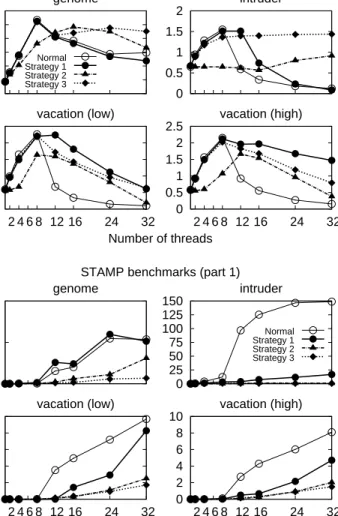
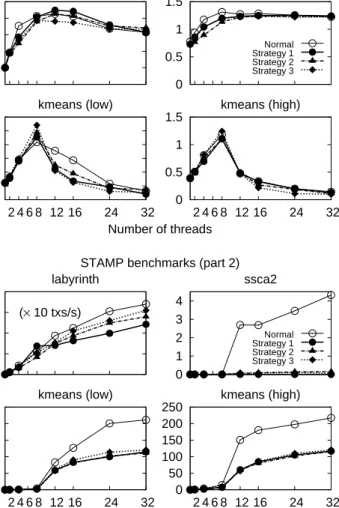
(part 1). The graphs show the commit rate (top) and abort rate (bottom). For the STAMP benchmarks (Figures5 and6), we can make several inter-esting observations. First, most benchmarks, with the exception of labyrinth
andssca2, suffer when there are more threads than cores. For labyrinthand
ssca2, we observe that the number of aborts grows without penalizing through-put. This can be explained by the fact that the number of aborts remains very low compared to the number of commits.
Second, for benchmarks where throughput degrades with more threads than cores,S3 provides the most steady throughput and abort rate of all strategies.
This is remarkably clear ingenomeandintruder.
Third, the scheduling strategies do not help much in terms of throughput for
kmeans, although they reduce the number of aborts. This is likely due to the short length of the transactions, which means that aborts are not costly and do not have much influence on the throughput.
0 1 2 3 4 5 labyrinth
STAMP benchmarks (part 2)
Number of threads
Speedup w.r.t. sequential execution
0 0.5 1 1.5 ssca2 Normal Strategy 1 Strategy 2 Strategy 3 0 0.5 1 1.5 2 2.5 3 2 4 6 8 12 16 24 32 kmeans (low) 0 0.5 1 1.5 2 4 6 8 12 16 24 32 kmeans (high) 0 0.5 1 1.5 2 labyrinth
STAMP benchmarks (part 2)
Number of threads Aborts ( × 10 6 txs/s) (× 10 txs/s) 0 1 2 3 4 ssca2 Normal Strategy 1 Strategy 2 Strategy 3 0 50 100 150 200 250 2 4 6 8 12 16 24 32 kmeans (low) 0 50 100 150 200 250 2 4 6 8 12 16 24 32 kmeans (high)
Figure 6: Performance of strategiesS1,S2, andS3with the STAMP benchmarks
(part 2). The graphs show the commit rate (top) and abort rate (bottom). Fourth, S1 is the most efficient strategy when there are no more threads
than cores, and it systematically outperforms the normal case with additional threads.
Finally, we observe that S2 is the most effective strategy overall in terms
strategy with few threads. The same conclusion as for the linked list benchmark applies here;S2restrains too much the potential parallelism by assuming that if
a transaction that has just aborted restarts, it will abort again. On the STAMP benchmarks that scale well, the determinism assumption does not hold.
5.4
In-depth evaluation of S
1 0 10 20 30 40 50 60 70 80 90 100 0 1 2 3 4 5 6 7 8 9 10 Frequency Number of extensions Linked list, 8192 elements, 20% update90% of transactions complete with 1 extension
Figure 7: Number of extensions with strategy S1 for the linked list
micro-benchmark.
We have first evaluated the maximum number of extensions that are used in practice to execute completely a transaction. Results of Figure7 show that 90% of the transactions that need an extension complete with only 1 extension. A limit of 10 is never reached in practice and could be used as maximum value forN.
We have also evaluated the effectiveness ofS1in limiting the effects of other
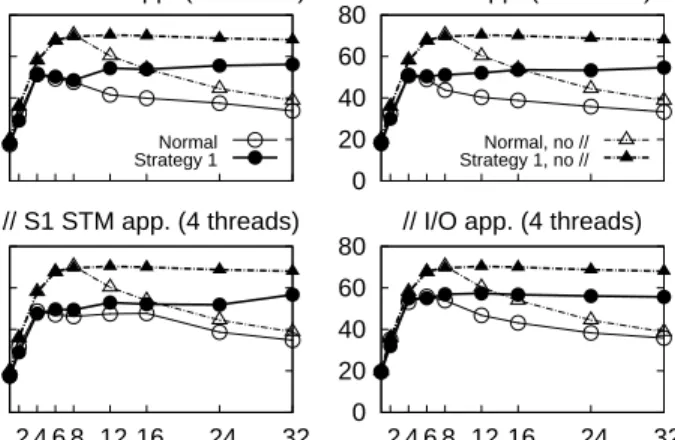
programs running on the same cores as the STM applications. For this, we have run the linked list benchmark simultaneously with another multithreaded application running on four cores. Four situations have been studied by varying the other application and the potential impact on the scheduler: a computation intensive application, another STM application (linked list) using the standard Linux scheduler, another STM application using S1, and an I/O intensive ap-plication. The results are presented in Figure8. In the 4 cases, the linked list benchmark running alone (with and without S1) is shown as baseline.
The main result of these benchmarks is that when S1 is used, there is no degradation of performance due to the parallel application. The performance increases with the number of cores until the number of threads is greater than 4. Subsequently, there is a slight increase in performance as the number of threads increases, since more of the CPU time is devoted to threads that are running transactions. Without S1, the performance of linked list is always lower than the baseline curve (i.e., no parallel application) due to the increase in aborts when the application is suspended.
5.5
Overhead of Transaction Activation
To better understand whether our approach introduces overhead, we have mea-sured how many times schedule is called during the execution of the linked
0 20 40 60 80
// non-STM app. (4 threads)
Linked list, 8192 elements, 20% update
Number of threads Txs/s ( × 10 3 ) Normal Strategy 1 0 20 40 60 80 // STM app. (4 threads) Normal, no // Strategy 1, no // 0 20 40 60 80 2 4 6 8 12 16 24 32 // S1 STM app. (4 threads) 0 20 40 60 80 2 4 6 8 12 16 24 32 // I/O app. (4 threads)
Figure 8: Performance of strategyS1 for the linked list micro-benchmark with
competition from a parallel application running on 4 threads: a computation intensive application, a second instance of the linked list benchmark with and without S1, and an application that performs many I/Os.
list benchmark (see Figure9 (left)), and the overhead induced by the strategy within schedule (see Figure9(right)). The results are for the strategyS3which
is the most expensive because it loops over all threads.
Figure 9 (left) shows that the number of calls to schedule depends on the number of cores used by the application, since there is no increase when the number of threads is greater than the number of cores.
0 50 100 150 200 250 300 350 1 4 8 12 16 20 24 28 32 Number of calls
Overhead of scheduler modifications (S3)
Number of threads Calls/s ( × 10 3 ) 0 0.5 1 1.5 2 2.5 3 1 4 8 12 16 20 24 28 32 Number of cycles Cycles/call ( × 10 3 )
Figure 9: Schedule overhead
Figure9 (right) demonstrates that the additional cost of schedule depends on the number of threads. Even though the increased cost is linear in the number of threads, the slope is quite low and the overhead has no impact on the application execution duration.
6
Related Work
This work was inspired in part byscheduling activations that allows a flexible mapping of user threads to processors [2] and by progress-based scheduling that permit the monitoring of application progress to take scheduling decisions [15]. In STM, contention managers [12, 13] are the standard approach to deter-mine, when a conflict occurs, which transaction may proceed and which must wait or abort. Their main objective is to guarantee progress of the applicaton and prevent livelocks. As discussed in Section2, application-level contention managers have several limitations, notably they lack precision and have no (or limited) control on the scheduling of threads. Contention managers also take a reactive approach, by only acting once a conflict has been detected. In contrast, our approach can also prevent conflicts from happening by controlling when a thread can execute or be preempted.
Yoo and Lee [17] have proposed to introduce a simple scheduler in the STM that essentially serializes transactions once a high level of contention is detected. This basic approach is effective in specific settings where parallelism actually degrades perfomance.
TL2’s implementation on Solaris [4] uses theschedctl mechanism3to request
short-term preemption deferral during the commit phase. Like our strategyS1,
this reduces the risk that a transaction holding locks is preempted and prevents the progress of others. It does not, however, control the scheduling of an active transaction that has already accessed shared data, and for which preemption would increase the chances of an abort.
CAR-STM also takes a scheduling-based approach to approving STM con-tention management [5]. It proposes a strategy very similar to that ofS2, but
implemented at the user level. In our work, we have instead chosen to implement our approach at the OS kernel level, to take advantage of its existing scheduling capabilities. The strategyS1 furthermore cannot be implemented at the user
level, because it relies on limiting the time extension to a fixed number of time slices, and the expiration of a time slice is not visible at the user level.
TxLinux [10] is a variant of Linux that exploits hardware transactional mem-ory (HTM) and integrates transactions with the operating system scheduler. It follows different goals and a different approach than our work, by focusing on HTM and experimenting with new ways of achieving synchronization in the kernel for future processors with TM hardware support. We instead support STM on commodity hardware and we target user applications. Our approach requires only localized changes to the operating system.
7
Conclusion
In this paper, we have presented a system approach to STM contention man-agement. For this, we have presented three strategies that adapt the scheduling behavior of the system to try to reduce conflicts between transactions. These strategies either try to prevent a transaction from being interrupted, to re-duce the chance that conflicting transactions will execute concurrently, or delay threads that encounter a conflict, until the transaction causing the conflict has
3
This strategy is not used in TL2’s x86 implementation on Linux as theschedctlmechanism is not supported.
committed. Our approach is implemented in the scheduling function of the operating system, to take advantage of existing mechanisms for electing, paus-ing, and restarting processes. These changes require adding a total of less than 1000 lines of code at the beginning of the kernel schedule function for all three strategies. The changes do not have any impact on the existing scheduling logic.
S1 and S3 are clearly the winning strategies, but neither of these two
per-forms better than the other. SinceS1targets primarily inter-application issues,
while S3 targets intra-application ones, we plan to investigate the possibility
of combining these two strategies, perhaps choosing dynamically between S1
andS3. Because a thread may execute the same transaction code many times,
e.g., in a loop, another line of possible future work is to maintain a history of conflicts over multiple transactions. Such a history could be used to identify threads that are likely to conflict and prevent them from running concurrently.
References
[1] Ali-Reza Adl-Tabatabai, Christos Kozyrakis, and Bratin Saha. Unlocking concurrency. Queue, 4(10):24–33, 2007.
[2] Tom Anderson, Brian Bershad, Ed Lazowska, and Hank Levy. Scheduler activations: Effective kernel support for the user-level management of par-allelism. InProceedings of SOSP, October 1991.
[3] Chi Cao Minh, JaeWoong Chung, Christos Kozyrakis, and Kunle Oluko-tun. Stamp: Stanford transactional applications for multi-processing. In
Proceedings of IISWC, September 2008.
[4] Dave Dice, Ori Shalev, and Nir Shavit. Transactional Locking II. In20th In-ternational Symposium on Distributed Computing (DISC), September 2006. [5] Shlomi Dolev, Danny Hendler, and Adi Suissa. CAR-STM: Scheduling-based collision avoidance and resolution for software transactional memory. InProceedings of PODC, August 2008.
[6] Robert Ennals. Software Transactional Memory Should Not Be Obstruction-Free. Technical report, Intel Research Cambridge, 2006. IRC-TR-06-052.
[7] P. Felber, T. Riegel, and C. Fetzer. Dynamic performance tuning of word-based software transactional memory. InProceedings of PPoPP, February 2008.
[8] Rachid Guerraoui, Micha l Kapa lka, and Jan Vitek. STMBench7: A bench-mark for software transactional memory. InProceedings of the Second Eu-ropean Systems Conference EuroSys 2007, pages 315–324. ACM, March 2007.
[9] James Larus and Christos Kozyrakis. Transactional memory. Communica-tion of the ACM, 51(7):80–88, July 2008.
[10] Christopher J. Rossbach, Owen S. Hofmann, Donald E. Porter, Hany E. Ramadan, Aditya Bhandari, and Emmett Witchel. Txlinux: Using and
managing hardware transactional memory in an operating system. In Pro-ceedings of SOSP, October 2007.
[11] Bratin Saha, Ali-Reza Adl-Tabatabai, Richard L. Hudson, Chi Cao Minh, and Benjamin Hertzberg. McRT-STM: a high performance software trans-actional memory system for a multi-core runtime. InProceedings of PPoPP, 2006.
[12] W. N. Scherer III and M. L. Scott. Contention management in dynamic software transactional memory. InProceedings of the PODC Workshop on Concurrency and Synchronization in Java Programs, Jul 2004.
[13] W.N. Scherer III and M.L. Scott. Advanced contention management for dynamic software transactional memory. InProceedings of PODC, Jul 2005. [14] Nir Shavit and Dan Touitou. Software transactional memory. In
Proceed-ings of PODC, Aug 1995.
[15] David C. Steere, Ashvin Goel, Joshua Gruenberg, Dylan McNamee, Calton Pu, and Jonathan Walpole. A feedback-driven proportion allocator for real-rate scheduling. InOSDI ’99, 1999.
[16] Torvald Riegel, Christof Fetzer, and Pascal Felber. Time-based Transac-tional Memory with Scalable Time Bases. In 19th ACM Symposium on Parallelism in Algorithms and Architectures (SPAA), June 2007.
[17] R. M. Yoo and H. S. Lee. Adaptive transaction scheduling for transactional memory systems. InProceedings of SPAA, 2008.
Contents
1 Introduction 3
2 Background 4
2.1 Software Transactional Memory. . . 4
2.2 Contention Management . . . 5
3 A System Approach to Contention Management 6 3.1 Strategy S1 . . . 7
3.2 Strategy S2 . . . 7
3.3 Strategy S2 . . . 8
4 Implementation 8 4.1 Implementing strategy S1 . . . 10
4.2 Implementing strategies S2 and S3 . . . 10
5 Evaluation 13 5.1 Linked List Micro-Benchmark . . . 16
5.2 Bank Micro-Benchmark . . . 16
5.3 STAMP Macro-Benchmarks . . . 18
5.4 In-depth evaluation of S1 . . . 20
5.5 Overhead of Transaction Activation . . . 20
6 Related Work 22
Centre de recherche INRIA Bordeaux – Sud Ouest : Domaine Universitaire - 351, cours de la Libération - 33405 Talence Cedex Centre de recherche INRIA Grenoble – Rhône-Alpes : 655, avenue de l’Europe - 38334 Montbonnot Saint-Ismier Centre de recherche INRIA Lille – Nord Europe : Parc Scientifique de la Haute Borne - 40, avenue Halley - 59650 Villeneuve d’Ascq
Centre de recherche INRIA Nancy – Grand Est : LORIA, Technopôle de Nancy-Brabois - Campus scientifique 615, rue du Jardin Botanique - BP 101 - 54602 Villers-lès-Nancy Cedex
Centre de recherche INRIA Rennes – Bretagne Atlantique : IRISA, Campus universitaire de Beaulieu - 35042 Rennes Cedex Centre de recherche INRIA Saclay – Île-de-France : Parc Orsay Université - ZAC des Vignes : 4, rue Jacques Monod - 91893 Orsay Cedex
Centre de recherche INRIA Sophia Antipolis – Méditerranée : 2004, route des Lucioles - BP 93 - 06902 Sophia Antipolis Cedex
Éditeur
INRIA - Domaine de Voluceau - Rocquencourt, BP 105 - 78153 Le Chesnay Cedex (France)


![Table 1: Characteristics of the transactional workloads of the STAMP bench- bench-marks: length of transactions in terms of instructions, number of read/write accesses, time spent in transactions, and amount of contention (data from [3]).](https://thumb-us.123doks.com/thumbv2/123dok_us/9306451.2809314/19.918.262.639.154.261/characteristics-transactional-workloads-transactions-instructions-accesses-transactions-contention.webp)