CHAPTER 1
INTRODUCTION
1.1 Introduction
Swarm intelligence (SI) originated from the study of colonies, or swarms of social organisms. Studies of the social behavior of organisms (individuals) in swarms prompted the design of very efficient optimization and clustering algorithms. With the latest research in soft computing, Swarm Intelligence (SI) technique was introduced in 1995 by James Kennedy, a social psychologist and Russell C. Eberhart, Associate Dean for Research, Purdue School of Engineering and Technology. SI is a bio-inspired technique and the latest Artificial Intelligence technique based on the study of collective behavior in decentralized and self organized systems. SI is defined as any attempt to design algorithms or distributed problem-solving devices inspired by the collective behavior of the social insect colonies and other animal societies [1]. SI systems are typically made up from a population of agents interacting locally with one another and with their environment and local interactions
between such nodes often lead to the emergence of global behavior. There are two major techniques in SI: Ant Colony Optimization (ACO) and Particle Swarm Optimization (PSO). The ACO algorithm is a probabilistic technique for solving computational problems which can be reduced to search for good paths through graphs. They are inspired by the behavior of ants in finding paths from the colony to food. While PSO is a technique where several particles (solutions) interacting between each other to find the best solutions.
Particle swarm optimization (PSO) is a population based stochastic optimization technique developed by Dr. Eberhart and Dr. Kennedy in 1995, inspired by social behavior of bird flocking or fish schooling. PSO shares many similarities with evolutionary computation techniques such as Genetic Algorithms (GA). PSO algorithm is an optimization tool based on population, and the system is initialized with a population of random solutions and can search for optima by the updating of generations. However, unlike GA, PSO has no evolution operators such as crossover and mutation [2]. In the PSO algorithm, the potential solutions, called as particles, are obtained by ‘‘flowing’’ through the problem space by following the current optimum particles [3]. Generally speaking, the PSO algorithm has a strong ability to find the most optimistic result, but it has a disadvantage of easily getting into a local optimum [4, 5, 6, 7]. PSO has been successfully applied in many areas such as function optimization, artificial neural network training, fuzzy system control, and other areas [8].
Particle Swarm Optimization (PSO) is an optimization technique in the area of Swarm Intelligence that presents several advantages:
(i) It is easy to describe (ii) It is simple to implement
(iii) There are few parameters to adjust (iv) It uses a relatively small population
(v) It needs a relatively small number of function evaluations to converge (vi) It is fast
The importance components in PSO are the Social Network Structure. The social structure for PSO is determined by the formation of overlapping neighborhoods, where particle within a neighborhood influence one another. Within the PSO, particle in the same neighborhood communicate with one another by exchanging information about the success of each particle in that neighborhood. The performance of the PSO depends strongly on the structure of the social network. The flow of information through a social network depends on (1) the degree of connectivity among nodes of the network, (2) the amount of clustering and (3) the average shortest distance from one node to another [9]. Researchers have investigated how deferent topologies for such a network affect performance [10, 11, 12, 13, 14, 15, 16]. For example, it has been reported that with unimodal problems a highly connected network (like the one available in a gbest-type of PSO) provides better performance, while the lbest PSO topology performs well on multimodal functions [7]. With these studies, it has become clear that, in the standard PSO, there are three features that bias the particle to look in a better place (the particle remembers its best position, it identifies its best neighbour, and it knows that neighbour’s best position so far).
The popularity of PSO in the field of numeric optimization has been increasing since it was created in 1995. It can be applied in the areas of system design, classification, pattern recognition, system modeling, scheduling, planning, signal processing, robotic applications, decision making, simulation and identification. However, to investigate the efficiency of PSO in optimization problems, a classifier must be incorporated particularly for classification problems. The most common classifier that is normally integrated with PSO is Artificial Neural Network (ANN).
Neural Network (NN), or artificial neural network (ANN) to be more precise, is an information processing paradigm that is inspired by the way biological nervous systems process information, such as the brain. The computation is highly complex, nonlinear and parallel. Many applications have been developed using NN algorithm and most of the applications are on predicting future events based on historical data. Processing power in ANN allows the network to learn and adapt, in addition to making it particularly well suited to tasks such as classification, pattern recognition, memory recall, prediction, optimization, and noise filtering [17].
An artificial neural network (NN) is a layered network of artificial neuron (AN). An NN may consist of an input layer, hidden layers and an output layer. ANs in one layer are connected, fully or partially, to the ANs in the next layer. Feedback connections to previous layers are also possible.
Several different NN types have been developed, for example (the reader should note that the list below is by no means complete):
• Single-layer NNs, such as the Hopfield network;
• Multilayer feedforward NNs, including, for example, standard backpropagation, functional link and product unit networks;
• Temporal NNs, such as the Elman and Jordan simple recurrent networks as well as time-delay neural networks;
• Self-organizing NNs, such as the Kohonen self-organizing feature maps and the learning vector quantizer;
• Combined supervised and unsupervised NNs, e.g. some radial basis function networks.
These NN types have been used for a wide range of applications, including diagnosis of diseases, speech recognition, data mining, composing music, image processing, forecasting, robot control, credit approval, classification, pattern recognition, planning game strategies, compression, and many others. Besides this, the primary significance for a NN is the ability of the network to learn from its environment and to improve its performance through learning [18]. Learning is a process of modifying the weights and biases to the neurons and continued until a preset condition is met such as defined error function. Learning process is usually referred as training process in NN. The objective of training process is to classify certain input data patterns to certain outputs before testing with another group of related data.
Hence, the main contribution of this thesis is an investigation of social interaction between the individuals in the particle swarm algorithm. It presents a detailed study of the social structure between the individuals and how it influences the behavior of the algorithm. PSO with difference social network structures is integrated in ANN classifier to validate the effectiveness of incorporating different social network structure.
1.2 Problem Background
In this section, two terms related to the issue are explained: First, Particle Swarm Optimization and Genetic algorithm, and Second is a social network structure in Particle Swarm Optimization learning.
Genetic algorithms (GA) have been popular because of the parallel nature of their search and essentially because of their ability to effectively solve non-linear,
multi-modal problems. They can handle both discrete and continuous variables without requiring gradient information. In comparison, PSO is well-known for its easy implementation, its computational inexpensiveness and its fast convergence to optimal areas of the solution space. Although it yields its best performance on continuous-valued problems, it can also handle discrete variables after slight modifications.
The convenience of realization and promising optimization ability in various problems, PSO algorithm has been paid more and more attention to by researchers [34]. PSO and GA for excess return evaluation in stock market [35]. Based on their experiment, it is proven that PSO algorithm is better compared to GA. PSO can reach the global optimum value with less iteration, keep equilibrium versus GA and shows the possibility to solve the complicated problem using only basic equation without crossover, mutation and other manipulation as in GA. The application for stock trading using PSO done and it shows good profit accumulation results [36].
Besides that, many researchers have compared both optimization techniques over the last years. [16] had compared these algorithms by applying to the atomic cluster optimization problem. The task consists of minimizing a highly multi-modal energy function of clusters of atoms. The results illustrated that PSO was noticeably superior to both a generic GA and a purpose-built problem-specific GA. [17] had found both techniques by training ANN to control virtual racecars. Due to the continuity of the neural weights being optimized, PSO turned out to be superior to GA for all accomplished tests - yielding a higher and much faster growing mean fitness and has disclosed that both techniques with a set of eight well-known optimization benchmark test problems were equally effective and more efficient in general [18]. Nevertheless, the superiority of PSO turned out to be problem-dependent. The difference in computational efficiency was found to be greater when the search strategies were used to solve unconstrained problems with continuous variables and less when they were applied to constrain continuous or discrete variables. Furthermore,
[19] implemented both approaches by identifying two mathematical model parameters. Although he noted that both approaches were equally effective, but he concluded that GA outperformed PSO with regard to efficiency. However, attention should be paid to Jones’ PSO variant, as it used the same random variables for all dimensions during one velocity update - which turned out to perform worse than using different variables for each dimension as proposed originally. This could be the reason for the poor results for PSO presented by Jones. [20] has analyzed the abilities of PSO and GA to optimize dual-band planar antennas for mobile communication applications. They found that PSO was able to obtain slightly better results than GA, but that PSO took more CPU-time.
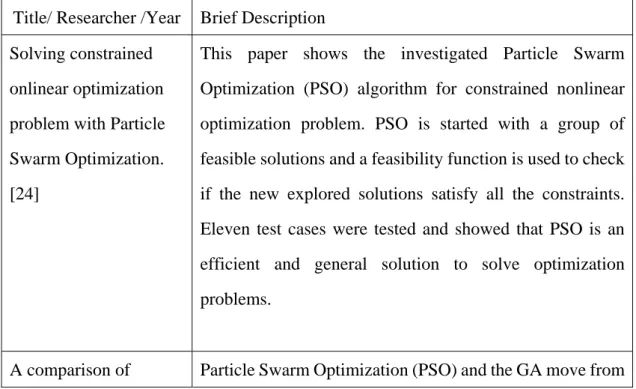
Table 1 briefly described from several researchers of the higher efficiency generally ascribed to PSO comparison with GA.
Table 1: higher efficiency generally ascribed to PSO comparison with GA.
Title/ Researcher /Year Brief Description Solving constrained
onlinear optimization problem with Particle Swarm Optimization. [24]
This paper shows the investigated Particle Swarm Optimization (PSO) algorithm for constrained nonlinear optimization problem. PSO is started with a group of feasible solutions and a feasibility function is used to check if the new explored solutions satisfy all the constraints. Eleven test cases were tested and showed that PSO is an efficient and general solution to solve optimization problems.
Particle Swarm Optimization and the Genetic Algorithm. [25]
a set of points (population) to another set of points in a single iteration with likely improvement using a combination of deterministic and probabilistic rules. The drawback of the GA is its expensive computational cost. It appears that PSO outperforms the GA with a larger differential in computational efficiency when used to solve unconstrained nonlinear problems with continuous design variables and less efficiency differential when applied to constrained nonlinear problems with continuous or discrete design variables.
Improvement of Genetic Algorithm Using PSO
and Euclidean Data Distance.
[28]
This paper introduces improvement of Genetic Algorithm using PSO and Euclidean Data Distance. When obtain an optimal solution using GA (Genetic Algorithm), operation such as crossover, reproduction, and mutation procedures is using to generate for the next generations. In this case, it is possible to obtain local solution because chromosomes or individuals which have only a close affinity can convergent. The result show applies PSO (Particle Swarm Optimization) to have a faster convergence.
Applying Particle Swarm Optimization to Software Testing. [26]
A research is conducted by Andreas Windisch of evolutionary structural testing is an approach to automatically generating test cases that achieve high structural code coverage. It typically uses genetic algorithms (GAs) to search for relevant test cases. In recent investigations particle swarm optimization (PSO), an alternative search technique, often outperformed GAs when applied to various problems. The results show that PSO outperforms GAs for most code elements to be covered in
terms of effectiveness and efficiency.
Dynamic Model
Updating Using Particle Swarm Optimization Method. [27]
This paper proposes the use of particle swarm optimization method (PSO) for finite element (FE) model updating. The PSO method is compared to the existing methods that use simulated annealing (SA) or genetic algorithms (GA) for FE model for model updating. The proposed method is tested on an unsymmetrical H-shaped structure. As the result, PSO achieves that accuracy at a computational speed that is faster than that by the GA and a full FE model which is faster than the SA and a full FE model.
In addition, [29] had shown that the structure of the social network can assist the behavior of particle swarms. Those created and test a general model of communication and consensus which puts the details of the dynamics and the optimum seeking behavior of PSOs into the background. The model includes the forms of communication currently implemented in PSOs, but it is significantly more general. [30] had investigated the effects of various population topologies on the particle swarm algorithm systematically. Random graphs were generated to specifications, and their performance on several criteria was compared. The particle swarm algorithm can be described generally as a population of vectors whose trajectories oscillate around a region which is defined by each individual’s previous best success and the success of some other particle. [31] proposed the canonical particle swarm algorithm is a new approach to optimization, drawing inspiration from group behavior and the establishment of social norms. It is gaining popularity, especially because of the speed of convergence and the fact that it is easy to use. As well, advocated Particle Swarm Optimization as a novel algorithm where a population of candidate problem solution vectors evolves “social” norm by influencing their
topological neighbors [32]. An individual was influenced by its best performance acquired in the past and the best experience observed in its neighborhood. The experimental results show that the topologies influenced in these two variants are important. [33] Modified the mechanism of PSO individual interacts with its neighbors. The performance of an individual depends on population topology as well as algorithm version. It appears that a fully informed particle swarm is more susceptible to alterations in the topology, but with a good topology, it can outperform the canonical version. In the next section, a brief comparison of GA and PSO is given to further discerning their differences.
1.2.1 Comparisons between Genetic Algorithm and PSO
Most of evolutionary techniques have the following procedure:
1. Random generation of an initial population 2. Reckoning of a fitness value for each subject.
3. Reproduction of the population based on fitness values. 4. If requirements are met, then stop. Otherwise go back to 2.
From the procedure, we can learn that PSO shares many common points with GA. Both algorithms start with a group of randomly generated populations, both have fitness values to evaluate the populations. Both update the population and search for the optimum with random techniques. Both systems do not guarantee success. However, PSO does not use genetic operators like crossover and mutation. Particles update themselves with the internal velocity. They also have memory, which is important to the algorithm.
Compared with GAs, the information sharing mechanism in PSO is significantly different. In GAs, chromosomes share information with each other.
So the whole population moves like a single group towards an optimal area. In PSO, only gBest (or lBest) gives out the information to others. It is a one-way information sharing mechanism. The evolution looks only for the best solution. Compared with the GA, all the particles tend to converge to the best solution quickly even in the local version in most cases.
According to the previous works, PSO is relatively recent optimization technique that can yield higher effectiveness.
1.3 Problems Statement
Swarm Intelligence technique called Particle Swarm Optimization is employed to probe the convergence rate and the classification accuracy of social network structure. However, in this study, the investigation of PSO Social Network Structures integrated with Artificial Neural Network will be conducted to attest its effectiveness in classification problem. Hence, the hypothesis of this study can be stated as:
PSO algorithm can enhance the classifications rate by optimizing different Social Network Structure
1.4 Purpose of Study
The purpose of the project is to explore the effectiveness of the integration of PSO with Artificial Neural Network using different social network structures for comparison convergence rate and classification problems. A multilayer ANN architecture with learning parameters will be used for training. Furthermore, the performance is also compared with PSO star structure (gbest) and PSO ring structure (lbest) for learning parameter on ANN with MSE will also be investigated, i.e., star and ring topologies. The three real classification problems are used to examine the performance of learning parameters for various size of data set.
1.5 Objectives
The purpose of the study is to explore the effectiveness of PSO social network structure in enhancing ANN learning. To achieve this objective, the following tasks must be conducted:-
i. To develop PSO network structure for Artificial Neural Network.
ii. To analyze the implicit association of these social network structure topologies with the ANN performance.
iii. To evaluate the efficiency of these social network structures.
iv. To compare and validate the effectiveness of each PSO social network structure.
1.6 Project Scope
The scope of this project is limited to the following areas:-
i. Three dataset are used: Iris, Breast Cancer Wisconsin and Herberman’s Survival.
ii. The investigate comparison program is developed using Microsoft Visual C++ 6.0.
iii. Social network structures of star and ring topologies are used to compare the effectiveness for ANN learning.
iv. Statistical t-test is used to validate the significant of the social network structures in assisting the convergence rate of ANN.
1.7 Significance of Project
The study investigates the performance of PSO based ANN learning, in terms of accuracy and convergence rate, for classification problems. The improved-PSONN that utilizes the improved error function with learning parameters of particle gbest and lbest are developed and its performance is examined. The performance is compared among different PSO social network structure approaches to see which approach can give better and faster convergence for the training and classification accuracy. Furthermore, the result of this study is contributed to identify the effectiveness of these PSO social network structure as alternative optimization procedure for tuning of learning parameters on ANN training for different set of classification data. The
findings of this study reveal that PSO social network structure for ANN learning enhancement is better.
1.8 Report Organization
This report consists of five chapters. Chapter 1 presents the introduction of the study, problems background, hypothesis, objectives and project scope. Chapter 2 provides literature reviews on the PSO, different types of social network structure topologies and time series of standard datasets. Chapter 3 discusses the Project Methodology and Chapter 4 discusses the experimental results. The conclusion and suggestions for future work are explained in Chapter 5.