Conscious, preconscious, and
subliminal processing: a testable
taxonomy
Stanislas Dehaene
1,2, Jean-Pierre Changeux
2,3, Lionel Naccache
1, Je´roˆme Sackur
1and Claire Sergent
11
INSERM-CEA Cognitive Neuroimaging Unit, Service Hospitalier Fre´de´ric Joliot, Orsay, France
2Colle`ge de France, Paris, France 3
CNRS Unit, Receptors and Cognition, Institut Pasteur, Paris, France
Of the many brain events evoked by a visual stimulus, which are specifically associated with conscious percep-tion, and which merely reflect non-conscious processing? Several recent neuroimaging studies have contrasted conscious and non-conscious visual processing, but their results appear inconsistent. Some support a correlation of conscious perception with early occipital events, others with late parieto-frontal activity. Here we attempt to make sense of these dissenting results. On the basis of the global neuronal workspace hypothesis, we propose a taxonomy that distinguishes between vigilance and access to conscious report, as well as between sub-liminal, preconscious and conscious processing. We suggest that these distinctions map onto different neural mechanisms, and that conscious perception is system-atically associated with surges of parieto-frontal activity causing top-down amplification.
Introduction
Understanding the neuronal mechanisms of conscious-ness is a major challenge for cognitive neuroscience. Recently, great progress has been achieved by contrasting brain activation images obtained during minimally different experimental conditions, one of which leads to conscious perception while the other does not. Surpris-ingly, however no coherent picture has emerged from those experiments. On the contrary, a controversy has arisen, as some studies suggest that consciousness depends mostly on the thalamus and brain stem [1], others on early visual areas[2,3], and yet others on higher prefrontal and parietal association areas[4–9].
Here, we propose that those apparent contradictions can be resolved by a relevant theorizing of the physiologi-cal conditions for conscious processing of sensory stimuli. Based on the recent proposal of a large-scale thalamo-cortical formal network and its simulations [4,5], we tentatively propose a plausible and testable taxonomy of brain activity states associated with conscious and non-conscious processing. In particular, within non-non-conscious
processing, we distinguish a transient ‘preconscious’ state of activity in which information is potentially accessible, yet not accessed.
An enabling condition: vigilance
The term ‘consciousness’ has multiple meanings, one of them intransitive (e.g. ‘the patient regained conscious-ness’), and the other transitive (e.g. ‘consciousness of color’). To avoid further confusion, we abandon the term and use ‘states of vigilance’ to refer to the non-transitive meaning, i.e. a continuum of states which encompasses wakefulness, sleep, coma, anesthesia, etc.
Being in an appropriate state of vigilance (e.g. awake rather than asleep) is an obvious enabling condition for conscious processing of sensory stimuli. Empirically, awakening into the vigilant state correlates with a progressive increase in regional cerebral blood flow, first in the brainstem and thalamus, then in the cortex with a particularly important increase in prefrontal-cingulate activation and functional connectivity [10]. Anesthesia, sleep, vegetative state and coma [1,11]are all associated with modulations of the activity of this large-scale thalamocortical network which also shows high baseline activity during vigilant rest [12] and encompasses prefrontal, cingulate and inferior parietal nodes.
These observations may be captured by a recent implementation of the neural workspace model [4] in which ascending brain stem nuclei (e.g. cholinergic among others) send globally depolarizing neuromodulatory sig-nals to a thalamic and cortical hierarchy. Simulations show a progressive increase in spontaneous firing as a function of neuromodulator release, which evolves into what is known in dynamical systems theory as a Hopf bifurcation: spontaneous firing increases continuously in intensity, but high-frequency oscillations appear suddenly in the gamma band (20–80 Hz). By increasing spon-taneous activity, and thus bringing a broad thalamo-cortical network closer to firing threshold, vigilance lowers the threshold for external sensory inputs.
In summary, vigilance is a graded variable, and a minimum level is essential for placing thalamo-cortical systems into a receptive state.
Early visual activation is not sufficient for conscious report
We now consider the neural bases of the second, transitive meaning of consciousness, which we term ‘access to conscious report’. How do we consciously perceive a visual stimulus? Many neuroimaging experiments have demon-strated a tight correlation between the conscious visual perception and the activation of striate and extrastriate visual areas[13–18]. For instance, unmasking of a visual stimulus increases activity in extrastriate areas in tight correlation with subjective reports of stimulus visibility [18]. Furthermore, extrastriate regions clearly play a causal role in conscious visual perception, because their selective lesioning eliminates the corresponding contents from experience – for instance a lesion of area V4 can
destroy color perception in the contralateral
hemifield[19].
On the basis of such data, Zeki[2]has proposed that the conscious perception of a given visual attribute resides in the extrastriate area specialized for that attribute (e.g. area MT/V5 for motion, or area V4 for color). A ‘micro-consciousness’ would be involved whenever that area receives a sufficient amount of activation.
We argue, however, that early sensory activation is necessary but not sufficient for conscious access, because activity in extrastriate visual areas is frequently observed while participants deny having seen any stimulus[14,20– 23]. When invisibility is caused by masking [20] or by dichoptic stimulation [14] this stimulus-evoked activity remains weak, and one might argue that its small amplitude alone could explain the absence of conscious perception[2,14]. However, the visual activation evoked by invisible stimuli can also be very strong, for instance when invisibility is caused by neglect[21]or inattention [22,23]. In a recent study of the attentional blink, we observed that up to about 180 ms after stimulus presen-tation, the occipito-temporal event-related potentials evoked by a invisible word were large and essentially indistinguishable from those evoked by a visible word[23]. Yet on invisible trials, the participants’ visibility ratings did not deviate from the lowest value, used when no word was physically present. Thus, intense occipito-temporal activation can be accompanied by a complete lack of conscious report.
Top-down amplification, long-distance reverberation, and reportability
We [4–6] and others [7,8,24] have suggested that, in addition to vigilance and bottom-up activation, a third factor underlying conscious access is the extension of brain activation to higher association cortices intercon-nected by long-distance connections and forming a reverberating neuronal assembly with distant perceptual areas. Why would this brain state correspond to conscious access? Neurocomputational simulations show that once stimulus-evoked activation has reached highly intercon-nected associative areas, two important changes occur: (1) The activation can reverberate, thus holding information on-line for a long duration essentially unrelated to the initial stimulus duration; (2) Stimulus information can be rapidly propagated to many brain systems. We argue that
both properties are characteristic of conscious information processing which in our view is associated with a distinct internal space, buffered from fast fluctuations in sensory inputs, where information can be shared across a broad variety of processes including evaluation, verbal report, planning and long-term memory[25].
Empirically, access of sensory stimuli to conscious report correlates with the activation of higher associative cortices, particularly parietal, prefrontal and anterior cingulate areas. In fMRI, the activation of those regions systematically separates masked versus unmasked pre-sentations of words[20]or images[26]; undetected versus detected changes during change blindness[27,28]; extin-guished versus seen visual stimuli in neglect patients[29]; or missed versus reported stimuli during the attentional blink [9,22,23,30–32]. In many of these paradigms, anterior activation is accompanied by an amplification and an increase in functional correlation with posterior stimulus-specific areas[20,26,30]. Sudden parieto-frontal activation and top-down amplification are two frequent signatures of conscious perception.
Is attention a confound or a necessity for conscious access?
Some have argued that many of the above neuroimaging paradigms are inappropriately controlled because con-scious perception is confounded with increased attention and more extended stimulus processing. For instance, a conscious word can be attended, repeated or memorized while a non-conscious word cannot. Such confounds would suffice to explain the greater parieto-prefrontal activity to unmasked words[20]. For this reason, Tseet al.[18]have argued that one should prefer experimental designs in which attention is drawn away from the stimulus. They show that, in such a situation, correlates of stimulus visibility are found solely in occipital areas, not in higher associative regions, and therefore argue that the
mech-anisms of conscious visual perception lie in
extrastriate cortex.
We obviously agree on one point: it is important to design paradigms in which conscious perception is not confounded with massive changes in overt or covert behaviour. However, this goal has been achieved in several studies. In our recent study of the attentional blink[23], for instance, subjects viewed a fixed stimulus and made similar motor gestures on seen and not-seen trials, yet those were still distinguished by strong parieto-frontal activation.
We question, however, the proposal that inattention is an appropriate control. Under conditions of diverted attention, such as those studied by Tse et al. [18], even an unmasked stimulus is not guaranteed to be consciously perceived. On the contrary, considerable evidence indi-cates that without attention, conscious perception cannot occur. In the inattentional blindness paradigm, even a 700-ms stimulus presented in the fovea, when unat-tended, might fail to be seen[33]. During the attentional blink, a mildly masked stimulus, normally quite visible, becomes invisible when attention is diverted to another task[23,34].
The relations between stimulus strength, attention, and conscious perception are complex because attention mechanisms can also be activated automatically in a bottom-up manner. When the stimuli have strong energy, sharp onsets or strong emotional content, they might trigger an activation of frontal eye fields or amygdala pathways, thus causing an amplification that can lower their threshold for conscious perception[35]. Thus, both bottom-up stimulus strength and top-down attentional amplification (whether triggered voluntarily or by auto-matic attraction) are jointly needed for conscious percep-tion, but they might not always be sufficient for a stimulus to cross the threshold for conscious perception. Conscious perception must therefore be evaluated by subjective report, preferably on a trial-by-trial basis. Verifying that the stimuli can be consciously perceived in a separate experimental block where they are attended, as done by Tse et al. [18], does not suffice to guarantee conscious perception in a different block where attention is diverted. One cannot simply assume that, by
unmasking stimuli, one is studying the neural correlates of conscious processing.
Distinguishing accessibility from access
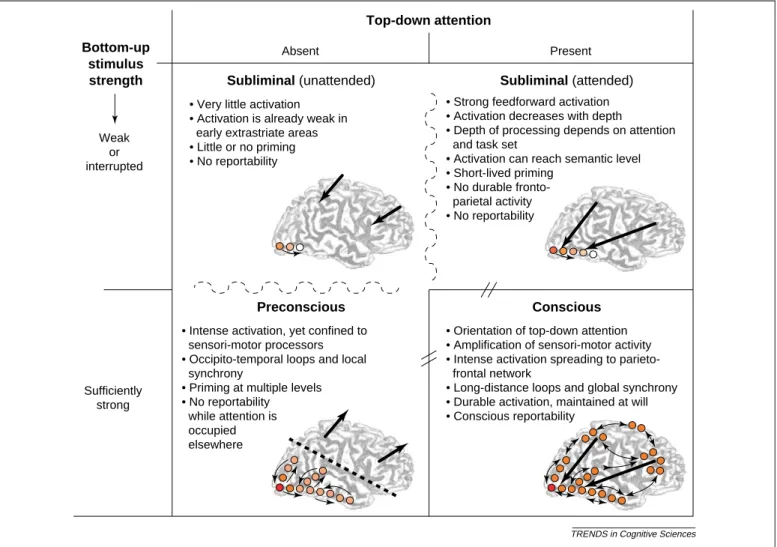
The above distinctions lead us to proposal a formal definition of two types of non-conscious processes (Figure 1):
(1) Subliminal processing. We define subliminal
proces-sing (etymologically ‘below the threshold’) as a condition of information inaccessibility where bot-tom-up activation is insufficient to trigger a large-scale reverberating state in a global network of neurons with long range axons. Simulations of a minimal thalamo-cortical network[4]indicates that such a non-linear self-amplifying system possesses a well-defined dynamical threshold. A processing stream that exceeds a minimal activation level quickly grows until a full-scale ignition is seen, while a slightly
TRENDS in Cognitive Sciences
Top-down attention Absent Present Bottom-up stimulus strength Weak or interrupted Sufficiently strong
Subliminal (unattended) Subliminal (attended)
Preconscious Conscious
• Very little activation • Activation is already weak in early extrastriate areas • Little or no priming • No reportability
• Strong feedforward activation • Activation decreases with depth
• Depth of processing depends on attention and task set
• Activation can reach semantic level • Short-lived priming
• No durable parietal activity • No reportability
• Orientation of top-down attention • Amplification of sensori-motor activity • Intense activation spreading to frontal network
• Long-distance loops and global synchrony • Durable activation, maintained at will • Conscious reportability
• Intense activation, yet confined to sensori-motor processors • Occipito-temporal loops and local synchrony
• Priming at multiple levels • No reportability
while attention is occupied elsewhere
Figure 1.Proposed distinction between subliminal, preconscious, and conscious processing. Three types of brain states are schematically shown, jointly defined by bottom-up stimulus strength (on the vertical axis at left) and top-down attention (on the horizontal axis). Shades of color illustrate the amount of activation in local areas, and small arrows the interactions among them. Large arrows schematically illustrate the orientation of top-down attention to the stimulus, or away from it (‘task-unrelated attention’). Dashed curves indicate a continuum of states, and thick lines with separators indicate a sharp transition between states. Duringsubliminal processing, activation propagates but remains weak and quickly dissipating (decaying to zero after 1–2 seconds). A continuum of subliminal states can exist, depending on masking strength, top-down attention, and instructions (seeBox 1). Duringpreconscious processing, activation can be strong, durable, and can spread to multiple specialized sensori-motor areas (e.g. frontal eye fields). However, when attention is oriented away from the stimulus (large black arrows), activation is blocked from accessing higher parieto-frontal areas and establishing long-distance synchrony. Duringconscious processing, activation invades a parieto-frontal system, can be maintained ad libidum in working memory, and becomes capable of guiding intentional actions including verbal reports. The transition between preconscious and conscious is sharp, as expected from the dynamics of a self-amplified non-linear system[4].
weaker activation quickly dies out. Subliminal proces-sing corresponds to the latter type.
Note that, under our hypothesis, subliminal processing is not confined to a passive spreading of activation, independent of the subject’s attention and strategies, as previously envisaged. On the contrary, whichever task and attentional set are prepared consciously can orient and amplify the processing of a subliminal stimulus, even if its bottom-up strength remains insufficient for global ignition. In agreement with this analysis, many top-down influences on subliminal processing have now been experimentally observed (Box 1).
(2) Preconscious processing. Freud[36] noted that ‘some
processes [.] may cease to be conscious, but can become conscious once more without any trouble’, and he proposed that ‘everything unconscious that behaves in this way, that can easily exchange the unconscious condition for the conscious one, is therefore better described as “capable of entering consciousness” or as preconscious.’
Here we further specify the latter term. We propose to callpreconscious(or potentially conscious, or P-conscious)
a neural process that potentially carries enough activation for conscious access, but is temporarily buffered in a non-conscious store because of a lack of top-down attentional amplification (for example, owing to transient occupancy of the central workspace system). As shown by the attentional blink and inattentional blindness paradigms, even strong visual stimuli can remain temporarily preconscious. They are potentially accessible (they could quickly gain access to conscious report if they were attended), but they are not consciously accessed at the moment.
At the neurocomputational level, preconscious proces-sing is proposed to involve resonant loops within medium range connections which maintain the representation of the stimulus temporarily active in a sensory buffer for a few hundred milliseconds. A preconscious stimulus might ultimately achieve conscious access once the central workspace is freed (as exemplified by the psychological refractory period paradigm [37,38], in which one task is put on hold while another task is being processed). It might never gain access to conscious processing if the preconscious buffer is erased before the orienting of top-down attention (as achieved by masking in the attentional blink paradigm).
Accounting for conflicting neuroimaging data
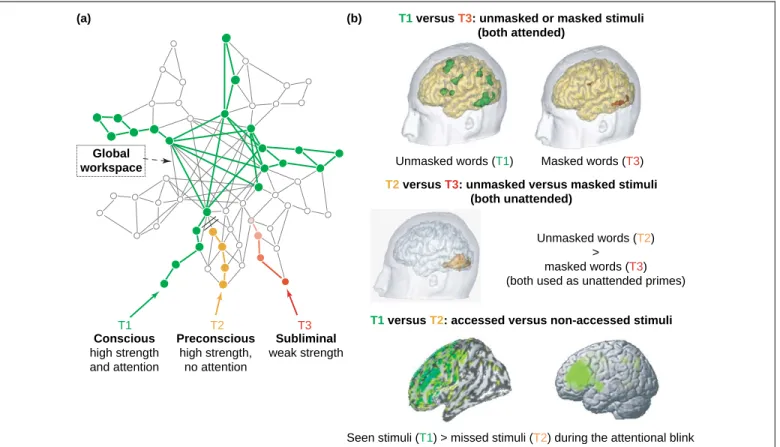
In experimental studies of conscious perception, precon-scious processing, as an intermediate category, has some-times been confounded with subliminal processing, and sometimes with conscious processing. We now show how this distinction can provide a simple account of conflicting neuroimaging results (Figure 2).
(1) Masking when stimuli are attended. Some exper-iments require participants to attend to masked stimuli which are made visible or invisible by changing the masking strength. In our taxonomy, those experiments contrast subliminal versus con-scious stimuli – a major contrast which should reveal both early stimulus processing regions and a dis-tributed parieto-frontal workspace system. Indeed, empirically, both early extrastriate and late parietal and prefrontal differences have been observed[20,26]. (2) Stimuli presented at threshold. Even when attended, stimuli presented at sensory threshold may or may not be perceived. In our theory this is again a contrast between subliminal and conscious stimuli. As pre-dicted, neuroimaging experiments relying on this contrast have yielded both early (e.g. P100) and late (e.g. P300) correlates of conscious perception [15,16,39]. The theory can also explain why conscious access fluctuates even though the stimulus remains constant. Simulations show that the threshold for global ignition can vary both with vigilance and with the amount of spontaneous activity before stimulus presentation[4]. Several experiments confirm that the perception of near-threshold stimuli can be predicted by the prestimulus state, in both humans and monkeys[40,41].
(3) Masking when stimuli are not attended. If stimuli are not attended, then the comparison of masked and Box 1. Why attention and consciousness are different:
top-down influences on subliminal processing
Subliminal processing is frequently thought to be automatic and independent of attention. However, the present framework implies that top-down attention and task set can have an effect on subliminal processing (seeFigure 1in main text, top row). This prediction has been verified in several recent reports.
Modulation of subliminal priming by temporal attention In a numerical masked priming paradigm, Naccacheet al.[43]first showed that subliminal priming was present when subjects could allocate attention to the prime-target pair, but vanished when stimuli could not be temporally attended. Kiefer and Brendel[44] observed a similar effect in an experiment investigating the N400 potential elicited by masked words. Unseen masked words elicited a much larger N400 when they were temporally attended than when they were not.
Modulation by spatial attention
Kentridgeet al.[45,46]first reported that blindsight patient GY could use consciously perceived cues to enhance unconscious processing of visual targets. When a target was presented in his blind visual field, GY responded faster and more accurately when it was validly cued by a consciously perceptible arrow pointing to it, than when it was invalidly cued. In both cases, he still claimed that he could not see the target. Modulation of subliminal priming by spatial attention was also observed in normal subjects[47].
Modulation by strategies
Task instructions also alter the fate of subliminal stimuli. For instance, masked primes can elicit instruction-dependent activation in motor cortex[48,49], suggesting that arbitrary stimulus–response mappings conveyed by conscious instructions can also apply to non-conscious stimuli. The influence is always unidirectional: once a strategy or response mapping is consciously adopted, it extends to non-conscious primes[50,51]. Kundeet al.[51]studied the ‘Gratton effect’, a strategic increase in executive control that follows Stroop interference trials. They observed this effect following conscious conflict trials, but not following subliminal conflict trials. Once established, however, the increase in control applied to both subliminal and supraliminal trials – another instance of a top-down effect on subliminal processing.
unmasked stimuli becomes a contrast between sub-liminal and preconscious processing. As predicted, only the early components of occipito-temporal acti-vation are seen [18]. According to our terminology, these are the correlates of preconscious visual proces-sing (potential visibility, yet no conscious access). (4) Stimuli made invisible by inattention. Some
exper-iments have contrasted consciously perceived stimuli with stimuli made invisible by diverting top-down attention (attentional blink, change blindness, inat-tentional blindness). This is a contrast between preconscious and conscious processing. As expected, the difference appears late (200–300 ms after the stimulus) and involves parieto-prefrontal activation as well as late amplification of posterior activity [22,23,26–30,32].
Conclusion
Instead of the classical binary separation between non-conscious and non-conscious processing, we introduce here a tripartite distinction between subliminal, preconscious, and conscious processing. The key idea is that, within non-conscious states, it makes a major difference whether stimuli invisibility is achieved by a limitation in bottom-up stimulus strength, or by the temporary withdrawal of
top-down attention. The first case corresponds to sub-liminal processing, the second to preconscious processing. We have shown how this distinction is theoretically motivated and helps make sense of neuroimaging data.
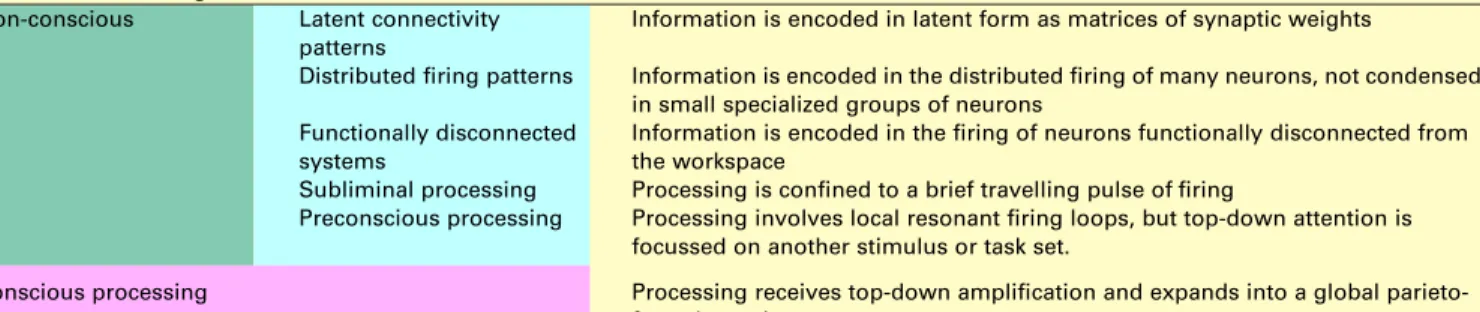
Is our taxonomy complete?Box 2briefly discusses three other types of non-conscious knowledge in the nervous system: latent connectivity patterns, distributed firing patterns, and functionally disconnected brain systems. Altogether, these distinctions might suffice to capture the known experimental conditions in which information escapes conscious reportability. The proposed taxonomy is testable, not only with neuroimaging tools, but also using electrophysiological techniques in the awake monkey, provided that tasks similar to the attentional blink and psychological refractory period can be developed in these species (seeBox 3).
Our proposal could also lead to a reconciliation of several major theories of conscious perception. The distinction between preconscious and conscious processing is consist-ent with Lamme’s proposal of a progressive build-up of recurrent interactions, first locally within the visual system, and second more globally into parieto-frontal regions[3]. It is also consistent with Zeki’s hypothesis of an asynchronous construction of visual perception in multiple distributed sites before binding into a
Global workspace (a) (b) T1 Conscious high strength and attention
T1 versus T3: unmasked or masked stimuli (both attended)
T1 versus T2: accessed versus non-accessed stimuli Unmasked words (T1) T2 Preconscious high strength, no attention T3 Subliminal weak strength Masked words (T3) Unmasked words (T2) > masked words (T3) (both used as unattended primes)
Seen stimuli (T1) > missed stimuli (T2) during the attentional blink T2 versus T3: unmasked versus masked stimuli
(both unattended)
Figure 2.Resolving contradictions in neuroimaging studies.(a)Schematic representation of the global neuronal workspace model. A visual target T1 (in green) is consciously accessed when it activates, in a synchronized, reciprocal and long-lasting manner, a set of ‘central workspace’ neurons particularly dense in parietal, prefrontal and cingulate cortices, and whose long-distance connections enable broadcasting to many distant areas. A stimulus can fail to become conscious for two reasons: (1) it might not have enough bottom-up strength, for example, owing to low-level masking or presentation close to threshold (subliminal stimulus T3, in red); or (2) it might have enough strength to bevisible, but still fail to beseenby losing the competition for central access relative to other concurrent stimuli or task sets (preconscious stimulus T2, in orange).
(b)Reinterpretation of neuroimaging experiments in this framework. When masked and unmasked stimuli are contrasted while subjects are attending (top right), a major difference in brain activation is seen, with both early sensory and late parieto-frontal enhancements for seen stimuli (illustration reproduced with permission from[20]; see also[16,26,39]). When masked and unmasked stimuli are contrasted while attention is drawn elsewhere (middle right), the effect of masking is confined to early occipito-temporal cortices (fMRI data by Kouider and Dehaene; see also[18]). When stimuli are above the masking threshold, and conscious access is manipulated by drawing attention to or away from the stimuli (bottom right), the difference in activation is late and confined to higher association cortices, particular parietal and prefrontal regions (illustrations from the attentional blink paradigm reproduced with permission from[23]– left image, and[30]– right image); see also[21,22,31].
‘macro-consciousness’[2]. Our only source of disagreement – but an important one – resides in their attribution of ‘phenomenal consciousness’ or ‘micro-consciousness’ to what we have termed pre-conscious processing. Remember that, in such a state, only a few hundreds of milliseconds after a stimulus was presented and yielding strong visual activity, participants deny perceiving anything [34]. Whether they actually had a conscious phenomenal experience but no possibility of reporting it, does not seem to be, at this stage, a scientifically addressable question. The only rationale for attributing phenomenal conscious-ness to preconscious processing seems to be the intuition that visual experience involves a richness of content that goes beyond what we can report [42]. However, this intuition itself can be explained as a kind of illusion – we think that we see more than we actually do (Box 4).
To further explore these difficult issues in the future, it will be crucial to develop better methods for the formal collection and quantification of introspective reports [23,34], as well as for the study of the spontaneous flow of conscious processes [4,12]. Meanwhile, the proposed distinction between subliminal, preconscious and con-scious processing, and the identification of concon-scious
Box 2. Why does some knowledge remain permanently inaccessible? A hypothetical taxonomy This article discusses a model of how visual processing can remain
non-conscious for dynamical reasons of insufficient strength or concurrent attentional load. A complete taxonomy such as that proposed inTable I, however, should also capture the many types of permanentlynon-conscious knowledge stored in the nervous system. The global neuronal workspace hypothesis stipulates that infor-mation is consciously accessible if it is explicitly coded in the firing of groups of excitatory neurons with bidirectional links to a distributed network of workspace neurons. Accordingly, information might remain permanently non-conscious for at least three reasons[6]: (i) Information is not encoded in neuronal firing
Knowledge stored in a latent form as synaptic efficacies remains inaccessible until it is used to recreate evoked patterns of neural firing. This constraint may explain instances of implicit learning, and why we do not have conscious access to most of our mental algorithms. In the few cases where we do (e.g. when we describe the steps needed for long division), the model predicts that each step should be explicitly coded in the firing of workspace neurons. Indeed, experimentally, prefrontal neurons coding for intentions, plans, ordinal steps, evaluations, intermediate decisions, and errors have been identified. (ii) Information is not represented in explicit firing form[52]
For an aspect of the visual scene to be consciously accessible, the
workspace hypothesis states that it must be represented by small groups of neurons whose firing provides an unambiguous index of the relevant attribute, and which would be amplified by top-down attention. For instance, although the collective firing of V1 neurons encodes all aspects of the visual scene, including the presence of faces or color, those attributes would not be consciously seen unless the extrastriate areas involved in their extraction are intact. At a higher cognitive level, when we gain conscious access to a previously subliminal distinction (e.g. development of ‘phonemic awareness’ in children), neuronal populations selective for this learned distinction should be found.
(iii) Information is coded by neurons functionally discon-nected from the workspace
Even information in explicit firing form can remain non-conscious if the relevant neurons lack the bidirectional projections appropriate to establish a reverberant assembly with parietal and prefrontal cortices. This functional disconnection hypothesis might explain why we have no conscious access to the state of activity of subcortical systems sustaining basic maintenance processes (res-piration, ingestion, posture, etc). Patients with white matter lesions, including callosal lesions, can also lose conscious access to word, color or object information that is still extracted, yet functionally disconnected.
Box 3. Questions for further research
†Can one design attentional blink, psychological refractory period, and partial report paradigms for non-human primates? Can they be used to dissect the neural mechanisms of the ‘preconscious buffer’? Does this preconscious state engage solely local occipito-temporal loops?
†Do all demonstrations of non-conscious information processing in humans fall into one of the categories of the proposed taxonomy? In particular, can one identify model cases where the non-conscious information is demonstrably encoded in synaptic weights, or in neural systems functionally disconnected from parieto-frontal areas?
†Can transcranial magnetic stimulation (TMS) be used to disrupt parieto-frontal circuits and probe their causal involvement in conscious visual perception? Would occipito-temporal TMS simi-larly disrupt the preconscious buffer during the psychological refractory period?
†Can one find experimental means of testing whether any subjective content is associated with preconscious states? Or is the existence of non-reportable conscious states untestable by definition?
†Can better non-verbal methods be developed for the quantification of introspective reports, both in humans and in non-human primates?
†What type of neural activity patterns underlies introspective reports, as opposed to other more direct sensory-motor decisions? Table I. A theoretical taxonomy of conscious and non-conscious information encoding in the brain
Information encoding Main features
Non-conscious Latent connectivity
patterns
Information is encoded in latent form as matrices of synaptic weights
Distributed firing patterns Information is encoded in the distributed firing of many neurons, not condensed in small specialized groups of neurons
Functionally disconnected systems
Information is encoded in the firing of neurons functionally disconnected from the workspace
Subliminal processing Processing is confined to a brief travelling pulse of firing
Preconscious processing Processing involves local resonant firing loops, but top-down attention is focussed on another stimulus or task set.
Conscious processing Processing receives top-down amplification and expands into a global
parieto-frontal reverberant state.
contents with globally accessible ones, appear to be productive avenues for scientific research.
References
1 Paus, T. (2000) Functional anatomy of arousal and attention systems in the human brain.Prog. Brain Res.126, 65–77
2 Zeki, S. (2003) The disunity of consciousness.Trends Cogn. Sci.7, 214–218
3 Lamme, V.A. (2003) Why visual attention and awareness are different.
Trends Cogn. Sci.7, 12–18
4 Dehaene, S. and Changeux, J.P. (2005) Ongoing spontaneous activity controls access to consciousness: a neuronal model for inattentional blindness.PLoS Biol.3, e141
5 Dehaene, S.et al. (2003) A neuronal network model linking subjective reports and objective physiological data during conscious perception.
Proc. Natl. Acad. Sci. U. S. A.100, 8520–8525
6 Dehaene, S. and Naccache, L. (2001) Towards a cognitive neuroscience of consciousness: basic evidence and a workspace framework.
Cognition79, 1–37
7 Rees, G.et al. (2002) Neural correlates of consciousness in humans.
Nat. Rev. Neurosci.3, 261–270
8 Crick, F. and Koch, C. (1995) Are we aware of neural activity in primary visual cortex?Nature375, 121–123
9 Marois, R. and Ivanoff, J. (2005) Capacity limits of information processing in the brain.Trends Cogn. Sci.9, 296–305
10 Balkin, T.J.et al. (2002) The process of awakening: a PET study of regional brain activity patterns mediating the re-establishment of alertness and consciousness.Brain125, 2308–2319
11 Laureys, S. (2005) The neural correlate of (un)awareness: lessons from the vegetative state.Trends Cogn. Sci.9, 556–559
12 Gusnard, D.A. and Raichle, M.E. (2001) Searching for a baseline: functional imaging and the resting human brain.Nat. Rev. Neurosci.
2, 685–694
13 Bar, M. and Biederman, I. (1999) Localizing the cortical region mediating visual awareness of object identity.Proc. Natl. Acad. Sci. U. S. A.96, 1790–1793
14 Moutoussis, K. and Zeki, S. (2002) The relationship between cortical activation and perception investigated with invisible stimuli.Proc. Natl. Acad. Sci. U. S. A.99, 9527–9532
15 Ress, D. and Heeger, D.J. (2003) Neuronal correlates of perception in early visual cortex.Nat. Neurosci.6, 414–420
16 Pins, D. and Ffytche, D. (2003) The neural correlates of conscious vision.Cereb. Cortex13, 461–474
17 Grill-Spector, K. et al. (2000) The dynamics of object-selective activation correlate with recognition performance in humans.Nat. Neurosci.3, 837–843
18 Tse, P.U.et al. (2005) Visibility, visual awareness, and visual masking of simple unattended targets are confined to areas in the occipital cortex beyond human V1/V2.Proc. Natl. Acad. Sci. U. S. A.102, 17178–17183
19 Zeki, S. (1993)A Vision of the Brain, Blackwell
20 Dehaene, S.et al. (2001) Cerebral mechanisms of word masking and unconscious repetition priming.Nat. Neurosci.4, 752–758
21 Vuilleumier, P.et al. (2001) Neural fate of seen and unseen faces in visuospatial neglect: a combined event-related functional MRI and event-related potential study. Proc. Natl. Acad. Sci. U. S. A. 98, 3495–3500
22 Marois, R.et al. (2004) The neural fate of consciously perceived and missed events in the attentional blink.Neuron41, 465–472 23 Sergent, C.et al. (2005) Timing of the brain events underlying access
to consciousness during the attentional blink. Nat. Neurosci. 8, 1391–1400
24 Lamme, V.A. and Roelfsema, P.R. (2000) The distinct modes of vision offered by feedforward and recurrent processing.Trends Neurosci.23, 571–579
25 Baars, B.J. (1989)A Cognitive Theory of Consciousness, Cambridge University Press
26 Haynes, J.D. et al. (2005) Visibility reflects dynamic changes of effective connectivity between V1 and fusiform cortex.Neuron 46, 811–821
27 Beck, D.M. et al. (2001) Neural correlates of change detection and change blindness.Nat. Neurosci.4, 645–650
28 Pessoa, L. and Ungerleider, L.G. (2004) Neural correlates of change detection and change blindness in a working memory task.Cereb. Cortex14, 511–520
29 Rees, G.et al. (2002) Neural correlates of conscious and unconscious vision in parietal extinction.Neurocase8, 387–393
30 Gross, J. et al. (2004) Modulation of long-range neural synchrony reflects temporal limitations of visual attention in humans.Proc. Natl. Acad. Sci. U. S. A.101, 13050–13055
31 Kranczioch, C.et al. (2005) Neural correlates of conscious perception in the attentional blink.Neuroimage24, 704–714
32 Vogel, E.K. et al. (1998) Electrophysiological evidence for a post-perceptual locus of suppression during the attentional blink.J. Exp. Psychol. Hum. Percept. Perform.24, 1656–1674
33 Mack, A. and Rock, I. (1998)Inattentional Blindness, MIT Press 34 Sergent, C. and Dehaene, S. (2004) Is consciousness a gradual
phenomenon? Evidence for an all-or-none bifurcation during the attentional blink.Psychol. Sci.15, 720–728
35 Anderson, A.K. and Phelps, E.A. (2001) Lesions of the human amygdala impair enhanced perception of emotionally salient events.
Nature411, 305–309
36 Freud, S. (1940)An Outline of Psychoanalysis, W.W. Norton 37 Sigman, M. and Dehaene, S. (2005) Parsing a cognitive task: a
characterization of the mind’s bottleneck.PLoS Biol.3, e37 38 Pashler, H. (1984) Processing stages in overlapping tasks: evidence for
a central bottleneck. J. Exp. Psychol. Hum. Percept. Perform.10, 358–377
39 Palva, S.et al. (2005) Early neural correlates of conscious somatosen-sory perception.J. Neurosci.25, 5248–5258
40 Super, H. et al. (2003) Internal state of monkey primary visual cortex (V1) predicts figure–ground perception. J. Neurosci. 23, 3407–3414
41 Linkenkaer-Hansen, K.et al. (2004) Prestimulus oscillations enhance psychophysical performance in humans.J. Neurosci.24, 10186–10190
Box 4. ‘Phenomenal consciousness’ without reportability? Following Weiskrantz[53], we consider that subjective reports are the primary criterion that can establish whether a percept is conscious or not. Such reports need not be verbal. Many neuroimaging exper-iments rely on manual reports of conscious perception, which can be made more precise by the use of a continuous visibility measure [23,34].
The philosopher Ned Block, however, has suggested that the reportability criterion underestimates conscious contents[42]. When we view a complex visual scene, we experience a richness of content that seems to go beyond what we can report. This intuition led Block to propose a distinct state of ‘phenomenal consciousness’ prior to global access. This proposal receives an apparent confirmation in Sperling’s iconic memory paradigm. When an array of letters is flashed, viewers claim to see the whole array, although they can later report only one subsequently cued row or column. One might conclude that the initial processing of the array, before attentional selection of a row or column, is already phenomenally conscious [3,42].
However, these intuitions are questionable, because viewers are known to be over-confident and to suffer from an ‘illusion of seeing’ [54]. The change-blindness paradigm demonstrates this ‘discre-pancy between what we see and what we think we see’[55]. In this paradigm, viewers who claim to perceive an entire visual scene fail to notice when an important element of the scene changes. This suggests that, at any given moment, very little of the scene is actually consciously processed. Interestingly, changes that attract attention or occur at an attended location are immediately detected. Thus, the illusion of seeing might arise because viewers know that they can, at will, orient attention to any location and obtain conscious information from it.
In summary, according to the present terminology, the whole visual scene is processed preconsciously. Subjects report (correctly) that all of its details arevisible– but the change-blindness paradigm reveals that they are not necessarily consciouslyseen.
42 Block, N. (2005) Two neural correlates of consciousness.Trends Cogn. Sci.9, 46–52
43 Naccache, L.et al. (2002) Unconscious masked priming depends on temporal attention.Psychol. Sci.13, 416–424
44 Kiefer, M. and Brendel, D. Attentional modulation of unconscious ‘automatic’ processes: evidence from event-related potentials in a masked priming paradigm.J. Cogn. Neurosci.(in press)
45 Kentridge, R.W.et al. (1999) Attention without awareness in blind-sight.Proc. Biol. Sci.266, 1805–1811
46 Kentridge, R.W. et al. (2004) Spatial attention speeds discrimi-nation without awareness in blindsight. Neuropsychologia 42, 831–835
47 Lachter, J.et al. (2004) Forty-five years after Broadbent (1958): still no identification without attention.Psychol. Rev.111, 880–913 48 Dehaene, S. et al. (1998) Imaging unconscious semantic priming.
Nature395, 597–600
49 Eimer, M. and Schlaghecken, F. (1998) Effects of masked stimuli on motor activation: behavioral and electrophysiological evidence.
J. Exp. Psychol. Hum. Percept. Perform.24, 1737–1747
50 Greenwald, A.G.et al. (2003) Long-term semantic memory versus contextual memory in unconscious number processing. J. Exp. Psychol. Learn. Mem. Cogn.29, 235–247
51 Kunde, W. et al. (2003) Conscious control over the content of unconscious cognition.Cognition88, 223–242
52 Crick, F. and Koch, C. (2003) A framework for consciousness.Nat. Neurosci.6, 119–126
53 Weiskrantz, L. (1997)Consciousness Lost and Found: A Neuropsycho-logical Exploration, Oxford University Press
54 O’Regan, J.K. and Noe, A. (2001) A sensorimotor account of vision and visual consciousness.Behav. Brain Sci.24, 939–973
55 Simons, D.J. and Ambinder, M.S. (2005) Change blindness: theory and consequences.Curr. Dir. Psychol. Sci.14, 44–48