ELECTRICAL ENGINEERING
Optimal design and tuning of novel fractional order
PID power system stabilizer using a new
metaheuristic Bat algorithm
Lakhdar Chaib
*, Abdelghani Choucha
1, Salem Arif
2LACoSERE Laboratory, Electrical Engineering Department, Amar Telidji University of Laghouat, BP 37G, Laghouat 03000, Algeria
Received 15 March 2015; revised 9 June 2015; accepted 17 August 2015
KEYWORDS
Fractional-order-PID-PSS; PID-PSS;
Power system stabilizer (PSS);
Bat algorithm (BA); FireFly algorithm (FFA); Single Machine Infinite Bus (SMIB) power system
Abstract This paper proposes a novel robust power system stabilizer (PSS), based on hybridiza-tion of frachybridiza-tional order PID controller (PIkDl) and PSS for optimal stabilizer (FOPID-PSS) for
the first time, using a new metaheuristic optimization Bat algorithm (BA) inspired by the echoloca-tion behavior to improve power system stability. The problem of FOPID-PSS design is transformed as an optimization problem based on performance indices (PI), including Integral Absolute Error (IAE), Integral Squared Error (ISE), Integral of the Time-Weighted Absolute Error (ITAE) and Integral of Time multiplied by the Squared Error (ITSE), where, BA is employed to obtain the opti-mal stabilizer parameters. In order to examine the robustness of FOPID-PSS, it has been tested on a Single Machine Infinite Bus (SMIB) power system under different disturbances and operating con-ditions. The performance of the system with FOPID-PSS controller is compared with a PID-PSS and PSS. Further, the simulation results obtained with the proposed BA based FOPID-PSS are compared with those obtained with FireFly algorithm (FFA) based FOPID-PSS. Simulation results show the effectiveness of BA for FOPID-PSS design, and superior robust performance for enhance-ment power system stability compared to other with different cases.
Ó2015 Faculty of Engineering, Ain Shams University. Production and hosting by Elsevier B.V. This is an open access article under the CC BY-NC-ND license (http://creativecommons.org/licenses/by-nc-nd/4.0/).
1. Introduction
Under environmental and economic pressures, power system quite becomes more heavily loaded and poorly damping [1]. Therefore, power system stability may be mostly defined as the property of a power system that allows it to remain in a condition of operating stability under normal operating condi-tions and to regain an adequate state of equilibrium after dis-turbance[2].
* Corresponding author. Tel.: +213 07 76 45 97 81.
E-mail addresses: [email protected] (L. Chaib), [email protected] (A. Choucha), [email protected] (S. Arif).
1
Tel.: +213 06 61 64 10 99.
2 Tel.: +213 06 62 16 25 88.
Peer review under responsibility of Ain Shams University.
Production and hosting by Elsevier
Ain Shams Engineering Journal (2015)xxx, xxx–xxx
Ain Shams University
Ain Shams Engineering Journal
www.elsevier.com/locate/asej www.sciencedirect.com
Power system stabilizers (PSSs) must be able to supply suit-able stabilization signals over a wide range of operating condi-tions and perturbacondi-tions. With the increase in electric power demand and need to command the system at a faster and great flexible way in the competitive situation, current power sys-tems can reach stressed conditions less difficult than the last years. The sudden disturbance causes the unstable system or weakly damped oscillations that have been noticed more often in electrical power systems around the world.
In recent years, due to the rapid development of computer technology, the use of optimization tools becomes feasible to help in the implementation of power system stabilization con-trol. Several advanced control designs based on artificial intel-ligence have been introduced to design lag-lead PSS structures [3–13]. These methods can design a robust PSS by including parameter uncertainty and non-linearity of the electrical power system and provide the best stabilization for a wide range of operating conditions. The authors in[14]intend to suggest a stable fuzzy wavelet neural-based adaptive PSS (SFW-NAPSS) for improving the power system stability. A self-recurrent Wavelet Neural Network (SRWNN) is used in the proposed approach with the purpose of constructing a self-recurrent consequent part of a Takagi–Sugeno–Kang (TSK) fuzzy model for each fuzzy rule.
On the other hand, several novel metaheuristic algorithms have been proposed in the literature for PSS robust setting. Such algorithms can augment the computational effectiveness, such as Genetic algorithm (GA)[15,16], Particle Swarm Opti-mization (PSO)[17,18]and Bat algorithm (BA)[19,20]. In[21], a new Sparse Recursive Least Square (SPARLS) algorithm is proposed to adjust the PSS parameters to meet the operating conditions. Additionally, the proposed work has been per-formed on SMIB different perturbations.
During these years, the control processes have given better advances in the industry[22]. Fractional-order proportional-i ntegral-derivative (FOPID) controllers have received a great attention in the previous years, from both an industrial and an academic point of view [23–25]. However, simple tuning rules and no effectiveness still exist for these controllers like those specified for the integer PID controllers [26,27]. The PID controller, for the reason of its functional simplicity is mostly used in industrial applications. Conversely, their parameters are often adjusted using test or experiences and error methods. Unluckily, it is absolutely hard to properly adjust gains’ PID, because many industrial systems are often burdened with problems such as structural complexity, uncer-tainties and nonlinearities.
In[28], a robust PID-based PSS is suggested to appropri-ately function over a wide range of operating conditions. Doubts in plant parameters, due to deviation in load patterns and generation, are expressed in the form of a polytopic struc-ture. The problem of PID control is initially decreased to a generalized static output feedback synthesis. In [29], the authors suggested a simple analytical method for computing the set of three terms of robust stabilizing PSSs. Therefore, stabilization of the proposed interval plant by a PID controller and a phase lead compensator based PSS is dealt with using generalized Kharitonov’s theorem. Furthermore, necessary and sufficient constraints for characterizing the robust stabilizing three term controllers are derived by applying the Routh–Hurwitz criterion to a set of segment/vertex plants.
Therefore, PSO algorithm is one of the robust optimiza-tion methodologies in the procedure of solving the best PID controller parameters problem. As in [30], an optimal PSO based PID PSS is proposed, which utilizes the speed deviation as the input. In[31], a design method for the stabil-ity improvement of a SMIB power system using PID-PSS has been developed, in which its parameters are optimized by
Hybrid Particle Swarm-Bacteria Forging Optimization
(PSBFO) technique. A real coded GA based PID is produced in [32] to enhance power system dynamic, in which the proposed stabilizer’s parameters are adjusted by using real coded GA.
The power generation control devices have become impor-tant in the real-time control and operation of power systems and management in broadly changing power system control environments. In[33], it has been suggested a dynamic simula-tor is utilized to simulate a synchronous power plant in real time. To examine the control devices in virtual environments using Real Time Interface, the SMIB model is executed in Dig-ital Signal Processor of dSPACE hardware, a platform for real time simulation.
Yang developed a new capable metaheuristic BA. Prelimi-nary studies suggest that the BA can have superior perfor-mance over PSO and GA [34]. A robust design stabilizer based on the combination of PSS and fractional order PID is investigated in this work. The combination has been done by multiplying the output of PSS to the FOPID output with optimal parameters of this later. The main purpose of FOPID-PSS is to produce an appropriate torque on the mechanical part of the generator and to supply the better damping of power system. Moreover, the authors suggest the employment of Bat algorithm to ensure the best coordination between PSS and FOPID and avoid the bad overlap of the sig-nals as well as to obtain optimal parameters. The FOPID-PSS design has formulated an optimization problem based on var-ious performance indices. To prove the applicability of this design, it has been validated on a SMIB power system under different cases. The advantage of this process work is that the system excitation will be powerful to insert effective signal whatever nature of the disturbance.
This article is organized as follows. Section2presents the description of a (SMIB) power system. Three diverse proposed stabilizers are described in Section3. We addressed in Section4 the different objective functions, which are the performance indices based tuning. Section5presents a review on the pro-posed algorithms. In Section 6, the effectiveness of the pro-posed stabilizer FOPID-PSS based BA is tested on a SMIB under different objective functions and compared with PID-PSS and PID-PSS based BA. Also, comparison extended between FOPID-PSS based BA and FOPID-PSS based FFA, to prove the effectiveness of this new algorithm.
2. Power system
In this paper, the power system under study composes of the single machine connected to an infinite bus (SMIB) through a transmission line as shown inFig. 1, whereas,Fig. 2shows the well-known Phillips–Heffron block diagram of the lin-earized model of the SMIB power system. Here, a fourth order model has modeled the synchronous machine. A power system can be formulated as follows:
_
X¼fðX;UÞ ð1Þ
whereXis the vector of the state variables andUis the vector of input variable. The state vector of the generator is given as [x,d,Eq0,Efd]TandUis the PSS output signal. This model is
commonly used for the analysis of parameter values tuning of PSS[35]. x¼ðPmPeDxÞ M d¼x0ðx1Þ E0q¼ðEqþEfdÞ T0do Efd¼ EfdþKaðVrefVtÞ Ta 8 > > > > > > > > > < > > > > > > > > > : ð2Þ
The state equations of power system can be written as follows:
_
X¼AXþBU ð3Þ
whereAis a 44 matrix and is given by@f=@X, whileBis the input matrix with order 41 and is given by @f=@U. TheA
andBare calculated with each operating point. The state vec-torXis a 41 and the input vectorUis a 11.
3. Proposed stabilizers
3.1. Power system stabilizer
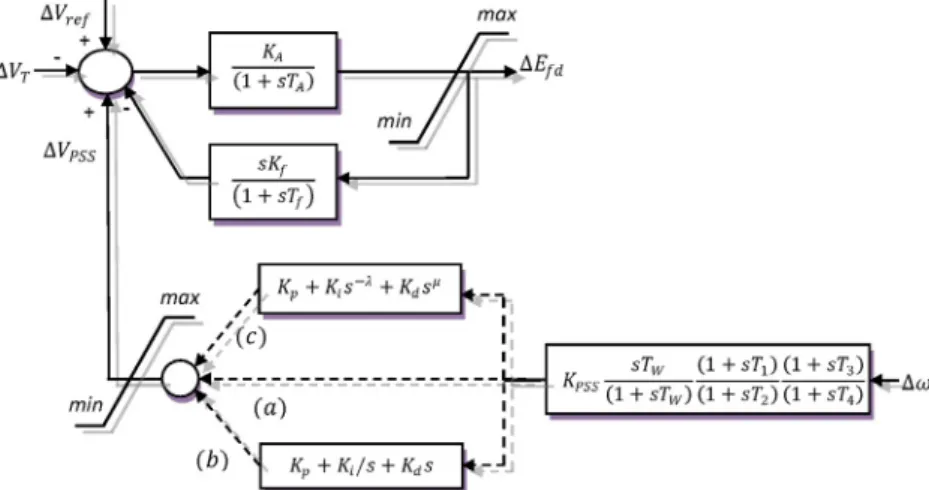
The conventional structure of the PSS is used in this study as shown inFig. 3(a), and its transfer function is given by the rela-tionship (4)[2]. It comprises of a block ofKPSSgain followed by a
high-pass filter of time constantTW and lead-lag structured
phase compensation blocks with time constantsT1,T2,T3and
T4. It is important to mention that the suggested stabilizers are
designed to reduce the power system oscillations after a wide per-turbation so as to enhance the power system stability. The out-put stabilizerVPSS is a voltage signal that adds to the input
voltage signal of the exciter system. The input signal of such a structure is usually the deviation of the synchronous speedDx. UðsÞ ¼KPSS sTw 1þsTw 1þsT1 1þsT2 1þsT3 1þsT4 DxðsÞ ð4Þ 3.2. PID based PSS
The operating function of a PID based PSS is to create a proper torque on the rotor of the generator involved in such a manner that the phase lag between the machine electrical tor-que and the exciter input is compensated, as given inFig. 3(b). The additional stabilizing signal is the one proportional to speed. A broadly speed input signal is considered during all the study as in[36]. The transfer function of the PID-PSS is given by UðsÞ ¼ KPSS sTw 1þsTw 1þsT1 1þsT2 1þsT3 1þsT4 ½Kp þKi=sþKdsDxðsÞ ð5Þ 3.3. FOPID based PSS
To improve the robustness and performance of PID control systems, Podlubny has proposed an extension to the PID con-trollers, which can be called PIkDl(FOPID) controller because of involving a differentiator of orderland integrator of order
k. This controller is described in more detail in[23]. The Rie-mann–Liouville (RL) definition is a commonly used concept of the fractional differintegral. The RL expression for the fractional-order derivative has the following form:
aDatFðtÞ ¼ 1 CðnaÞ d dt nZ t a fðsÞ ðtsÞ1ðnaÞds ð6Þ
CðÞis Euler’s Gamma function that specifies the factorial, and allocates operator, to get non-integer values. A substitute description, based on the notion of fractional differentiation, which is the Grunwald–Letnikov definition is displayed by
aDatFðtÞ ¼lim g!0 1 CðaÞga X ðtaÞ=g d¼0 CðaþdÞ Cðgþ1ÞfðtdgÞ ð7Þ
By introducing the concept of fractional order operator
aDa
tFðtÞ, one can note that the integrator can be unified.
Figure 1 Schematic line diagram of single-machine-infinite-bus power system.
Figure 2 Heffron–Phillips block diagram for SMIB power system.
The transfer function of FOPID is obtained through Laplace transform and is written as follows:
GcðsÞ ¼KpþKiskþKdsl ð8Þ
The differential equation of a FOPID controller can be given as
uðtÞ ¼KpeðtÞ þKiDkt eðtÞ þKdDlteðtÞ ð9Þ
Design of FOPID controller involves the design of follow-ing parameters:Ki,Kd,Kp, andl,k, which are the integral,
dif-ferential, proportional constants, fractional order derivative and integral elements respectively. PIkDl controller is great flexible and gives the possibility of tuning more carefully the dynamical proprieties of a robust control system (seeFig. 4).
In this work, a novel robust hybrid stabilizer based on the combination of a conventional PSS and PIkDl controller is considered to design the optimal PSS (FOPID-PSS), by pro-viding greater damping of power system. The transfer function of the FOPID-PSS to modulate the excitation voltage is given by Eq.(10)and is displayed inFig. 3(c).
UðsÞ ¼ KPSS sTw 1þsTw 1þsT1 1þsT2 1þsT3 1þsT4 ½Kp þKiskþKdslDxðsÞ ð10Þ 4. Objective function
In this article, we used performance indices including Integral Absolute Error (IAE), Integral Squared Error (ISE), Integral of the Time-Weighted Absolute Error (ITAE), Integral of Time multiplied by the Squared Error (ITSE), to minimize the error signal; in other terms minimize the overshoots and settling time in power system oscillations, and compare them to find the best suitable one, where, BA has been applied to minimize the values provided by the objective functions of the system that is given by
ISE¼ Z tsim 0 eðtÞ2dt ð11Þ IAE¼ Z tsim 0 jeðtÞjdt ð12Þ ITAE¼ Z tsim 0 tjeðtÞjdt ð13Þ ITSE¼ Z tsim 0 tðeðtÞÞ2dt ð14Þ
where tsim is total simulation time. Typical ranges of the opti-mized parameters are shown inTable 1. In this study, the time constantTwis considered as 10.0 s.
5. Proposed algorithms
5.1. Bat algorithm
The bat-inspired metaheuristic algorithm, called the Bat algo-rithm (BA), was newly implemented by Yang[34], inspired by the echolocation of microbats[37]. In the nature, echolocation can have just a few thousandths of a second (up to about 8– 10 ms) with a changing frequency in the area of 25–150 kHz, matching to the wavelengths of 2–14 mm in the air[38].
Microbats usually utilize echolocation for searching for prey. During roaming, microbats produce short pulses, but, their emitted pulse rates augment and the frequency is tuned up, when a potential prey is nearby. The augment of the fre-quency, called frequency-tuning, together with the acceleration of pulse emission will shorten the wavelength of echolocations and therefore augment precision of the detection [38]. The echolocation characteristics of microbats can be idealized as the following rules:
Figure 3 Various of proposed stabilizers with an excitation system.
(a) All bats utilize echolocation to sense distance, as well as they also recognize the difference between prey/food and background barriers in a few magical manner;
(b) Bats fly randomly with velocityvjat positionxjwith an unchanging frequency fmin, varying loudness A0 and
wavelengthkto look for prey. They can routinely tune the rate of pulse emissionr2 ½0;1and adjust the wave-length (or frequency) of their emitted pulses, depending on the proximity of their aim; and
(c) While the loudness can change in many manners, we suppose that the loudness varies from a great (positive)
A0 to a least constant valueAmin.
One must identify for every bat (j), its velocityvj and
posi-tion xj in a d-dimensional search space, the novel solutions
velocitiesvt
j andxtj at time steptcan be written as follows:
fj¼fminþ ðfmaxfminÞa ð15Þ
vt j¼v t1 j þ ðx t1 j xÞfj ð16Þ xt j ¼x t1 j þv t j ð17Þ
whereain the range of [0, 1] is a random vector drawn from a uniform distribution and is the current global best location, after comparing all the solutions among all thenbats at the current iterationxis located. As the productkjfjis the
veloc-ity increment, one can utilize eitherfj (orkj) while fixing the
other factor, to tune the velocity change. For implementation, every bat is randomly assigned a frequency which is drawn uni-formly from (fmin,fmax). The local search is principally a
ran-dom walk around the current best solutions, and a novel solution for every bat can be generated locally by
xnew¼xoldþeAt ð18Þ
where e2 ½0;1 is a random number, while At¼ hAtji is the average loudness of all the bats at this time step. As the loud-ness generally reduces once a bat has found its prey, the rate of pulse emission augments, as any value of convenience; the loudness can be selected. The loudness is typically chosen from
½A0;Amin ¼ ½1;0. Supposing Amin¼0 means that a bath has
just found the prey for the moment stop emitting any noise. The rate of pulse emission and the loudness is given by rtþ1 j ¼r 0 j½1expðctÞ; A tþ1 j ¼bA t j ð19Þ
wherebandcare constants. In the simulated annealing,bis like to the cooling factor of a cooling schedule. For any
c>0 and 0<b<1 Atj!0; rt
j!r 0
j; ast! 1 ð20Þ
In the easiest case, we can selectb¼c. In the standard BA, we can chooseb¼c0.9–0.975 in most cases.
Pseudo code of Bat algorithm based FOPID-PSS is given as follows:
Identify Objective function fðxÞ; x¼ ðx1;x2;. . .;x10ÞT;
where xð1Þ ¼K;xð2Þ ¼T1;xð3Þ ¼T2;xð4Þ ¼T3;xð5Þ ¼T4,
xð6Þ ¼KP;xð7Þ ¼Ki;xð8Þ ¼Kd;xð9Þ ¼l;xð10Þ ¼k;
–Initialize the bat population:
xjðj¼1;2;. . .;10Þandviðnpop¼20Þ
–Define pulse frequency:
fjatxj; whichðfmin¼0;fmax¼1Þ
–Initialize pulse rates and the loudness:
ðr¼0:5;A¼0:5Þ
–Define the boundaries of the parameter:
ðLb;UbÞ; seeTable 1
whileðt<ðtmax¼50ÞÞ;tmax:Max number of iterations
Tuning frequency generate novel solutions,
and updating velocities and locations/solutions(Eqs.(16)–(18)),
ifðrand>rÞ
Choose a solution between the best solutions.
Generate a local solution around the selected best solution,
(Eqs.(19) and (20)), end if
Generate a new solution by flying randomly,
ifðrand<A&fðxjÞ<fðxÞÞ
Admit the new solutions,
Augment rjand decrease Aj,
end if
Class the bats and searching the current best x,
end while
Display result of final iteration (minimum function value) and best (optimized parameter value)
5.2. FireFly algorithm
The FireFly Algorithm (FFA) is a new metaheuristic given in [39], nature inspired, which is based on the social flashing behavior of fireflies. Hence, Fireflies flash in order to allure a mating partner as well as for protection against predators.
There are three specific idealized laws in the FFA, which are based on several of the major flashing characteristics of real fireflies:
– all fireflies are unisex,
– their attractiveness is commensurate to their brightness, and – the brightness of a firefly is changed or resolved by the
land-scape of the objective function.
The shape of attractiveness function of a firefly in the FFA is calculated by the following equation:
bðrÞ ¼b0expðcrkÞ; withkP1; ð21Þ
Table 1 Typical ranges of the optimized parameters.
K T1 T2 T3 T4 KP Ki Kd l k
Min 0.1 0.01 0.01 0.01 0.01 0.001 0.001 0.001 0.1 0.1
whereb0 atr¼0 is the initial attractiveness,ris the distance
between two fireflies andcis a fixed light absorption coefficient which controls the reduction of the light intensity.
The distancerijbetween any two fireflies at positionxi and
xj is defined as Cartesian distance:
rij¼ kxixjk ¼ ffiffiffiffiffiffiffiffiffiffiffiffiffiffiffiffiffiffiffiffiffiffiffiffiffiffiffiffiffiffiffiffiffiffiffiffiffiffi Xd k¼1ðxi;kxj;kÞ 2; r ð22Þ wherexi;kis thekth element of the spatial coordinate position
xi ofith firefly whileddenotes the number of dimensions.
In the movement of a firefly, each fireflyimoves to another more attractive fireflyjas follows:
xi¼xiþb0expðcr 2 ijÞ ðxjxiÞ þb rand 1 2 ð23Þ
where b means a step size scaling factor. Eq. (23) has three terms. The first term represents the position of theith firefly while the second term offers a social element of moving the fireflyitoward the more attractive fireflyj, and the last term is utilized for the random movement of the ith firefly within the search space.
6. Results and discussions
In this section, we have used BA as an effective algorithm, to tune the proposed FOPID-PSS parameters and improve the performance of the power system, by supplying the excellent damping under disturbances. A SMIB has been chosen in this work. To confirm the effectiveness of the proposed
FOPID-Table 2 Optimal BA based proposed stabilizer parameters for case II.
Bat algorithm FireFly algorithm
Number of iteration = 50 Number of iteration = 50
Number of population = 20 Number of population = 20
Loudness = 0.5 Variation of attractiveness = 0.5
Pulse rate = 0.5 Randomization = 0.8
Pulse frequency (fmin¼0; fmax¼1) Absorption coefficient = 1
Figure 5 Evolution of objective function of FOPID-PSS with different algorithms for ITAE based tuning under case II.
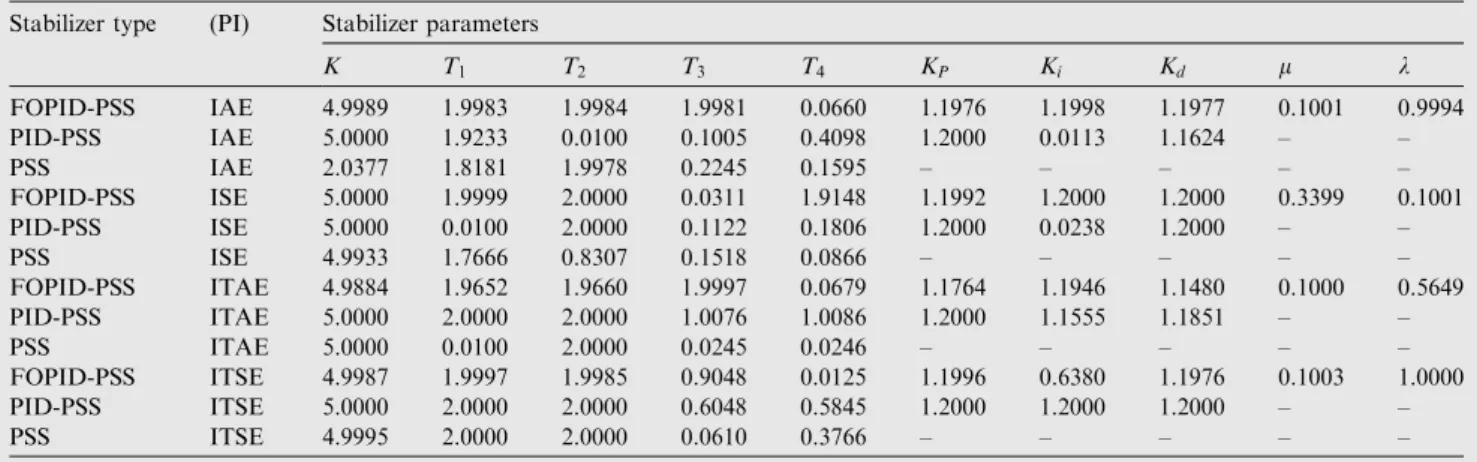
Table 3 Optimal BA based proposed stabilizer parameters for case II. Stabilizer type (PI) Stabilizer parameters
K T1 T2 T3 T4 KP Ki Kd l k FOPID-PSS IAE 4.9989 1.9983 1.9984 1.9981 0.0660 1.1976 1.1998 1.1977 0.1001 0.9994 PID-PSS IAE 5.0000 1.9233 0.0100 0.1005 0.4098 1.2000 0.0113 1.1624 – – PSS IAE 2.0377 1.8181 1.9978 0.2245 0.1595 – – – – – FOPID-PSS ISE 5.0000 1.9999 2.0000 0.0311 1.9148 1.1992 1.2000 1.2000 0.3399 0.1001 PID-PSS ISE 5.0000 0.0100 2.0000 0.1122 0.1806 1.2000 0.0238 1.2000 – – PSS ISE 4.9933 1.7666 0.8307 0.1518 0.0866 – – – – – FOPID-PSS ITAE 4.9884 1.9652 1.9660 1.9997 0.0679 1.1764 1.1946 1.1480 0.1000 0.5649 PID-PSS ITAE 5.0000 2.0000 2.0000 1.0076 1.0086 1.2000 1.1555 1.1851 – – PSS ITAE 5.0000 0.0100 2.0000 0.0245 0.0246 – – – – – FOPID-PSS ITSE 4.9987 1.9997 1.9985 0.9048 0.0125 1.1996 0.6380 1.1976 0.1003 1.0000 PID-PSS ITSE 5.0000 2.0000 2.0000 0.6048 0.5845 1.2000 1.2000 1.2000 – – PSS ITSE 4.9995 2.0000 2.0000 0.0610 0.3766 – – – – –
PSS, a classical lead-lag structure PSS and PID-PSS are con-sidered for comparison purposes.
We also performed same simulation by implementing BA and FFA algorithms. Before carrying out the optimization process, some parameters must be set in the BA and FFA, to acquire good performance. The specification of each algo-rithm is shown inTable 2.
In order to demonstrate the robustness performance of the proposed method, we used performance indices (PI) including IAE, ISE, ITAE and ITSE. The performance indices values are calculated with three cases, which are considered as follows:
Case I: 5% step change in the reference mechanical torque.
Case II: 10% step change in the reference mechanical torque.
Case III: 10% step change in the reference mechanical tor-que, the active power of the generator is decreased by 15% and the reactive power is increased by 15%.
The evolution of the objective function ITAE with FOPID-PSS depending on the number of generations for case II is given inFig. 5, and shows that the final value of the objective function is 1.6767104for BA and 2.4580104for FFA.
Table 4 Optimal FFA based FOPID-PSS parameters for case II. Stabilizer (PI) Stabilizer parameters
K T1 T2 T3 T4 KP Ki Kd l k
FOPID-PSS IAE 3.4971 1.6710 1.6153 0.0935 0.9538 1.1499 0.7232 0.7590 0.3285 0.3967 ISE 4.9945 1.7068 1.2429 0.1151 0.4971 0.8346 0.5260 0.8809 0.4839 0.4608 ITAE 3.7037 1.9563 1.8030 0.4602 0.7015 0.7865 0.2939 0.8634 0.7045 0.7629 ITSE 4.9690 1.8401 1.7832 0.3957 0.2180 0.5018 0.7321 1.0859 0.3991 0.9869
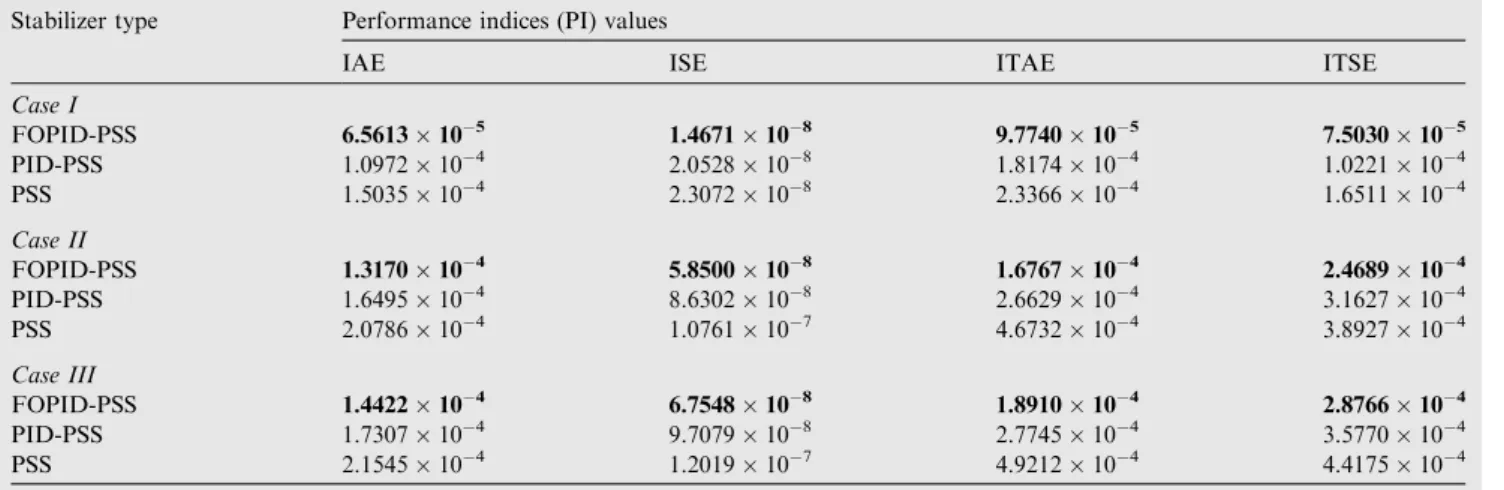
Table 5 Optimal objective function values of various stabilizers using BA. Stabilizer type Performance indices (PI) values
IAE ISE ITAE ITSE
Case I FOPID-PSS 6.5613105 1.4671108 9.7740105 7.5030105 PID-PSS 1.0972104 2.0528108 1.8174104 1.0221104 PSS 1.5035104 2.3072108 2.3366104 1.6511104 Case II FOPID-PSS 1.3170104 5.8500108 1.6767104 2.4689104 PID-PSS 1.6495104 8.6302108 2.6629104 3.1627104 PSS 2.0786104 1.0761 107 4.6732 104 3.8927 104 Case III FOPID-PSS 1.4422104 6.7548108 1.8910104 2.8766104 PID-PSS 1.7307104 9.7079108 2.7745104 3.5770104 PSS 2.1545104 1.2019107 4.9212104 4.4175104
Table 6 Comparison of objective function values between BA and FFA based FOPID-PSS. Stabilizer type Performance indices (PI) values
IAE ISE ITAE ITSE
Case I
BA based FOPID-PSS 6.5613105 1.4671108 9.7740105 7.5030105
FFA based FOPID-PSS 8.5074e005 1.7755e008 1.0727e004 1.0252e004
Case II
BA based FOPID-PSS 1.3170104 5.8500108 1.6767104 2.4689104
FFA based FOPID-PSS 1.5090104 6.9023108 2.4580104 3.0836104
Case III
BA based FOPID-PSS 1.4422104 6.7548108 1.8910104 2.8766104
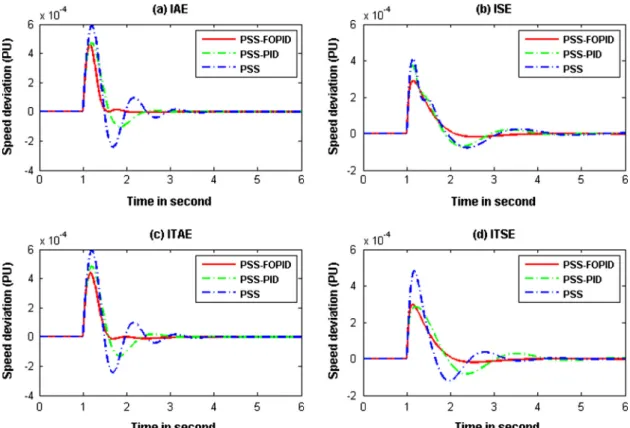
Figure 6 Speed deviation of BA based proposed stabilizers for case I with (a) IAE, (b) ISE, (c) ITAE and (d) ITSE based tuning.
Figure 8 Speed deviation of BA based proposed stabilizers for case III with (a) IAE, (b) ISE, (c) ITAE and (d) ITSE based tuning.
Figure 10 Speed deviation of BA and FFA based FOPID-PSS for case I with (a) IAE, (b) ISE, (c) ITAE and (d) ITSE based tuning.
The convergence rate of BA is clearly the best, compared to the FFA.
Tables 3 and 4 show the ending values of the optimized parameters using BA for each stabilizer and FFA for FOPID-PSS respectively under case II. It should be noted that the proposed algorithms BA and FFA are run several times and the best parameters of different stabilizers are selected.
Optimal objective function values of BA based FOPID-PSS, PID-PSS and PSS stabilizers for all cases are shown in Table 5. It can be observed that the performance indices value obtained with the proposed BA based FOPID-PSS stabilizer is less than PID-PSS and PSS stabilizers for all operating conditions. In addition, the optimal set of values of fractional integral order ðkÞ and fractional derivative order ðlÞ for FOPID-PSS provides superior result for each objective func-tion, which proves that FOPID-PSS is much better than two other stabilizers in minimizing error criteria with different operating conditions.
Table 6presents a comparison of the objective function val-ues between BA and FFA based FOPID-PSS for three cases. The simulation results obtained clearly indicate that the pro-posed BA based FOPID-PSS supplies much better values. Thus, all four objectives (IAE, ISE, ITAE and ITSE) have the minimum value with BA based FOPID-PSS due to the robustness of BA. Also, these results validate the performance of the proposed BA based FOPID-PSS comparatively with FFA based FOPID-PSS stabilizer, which confirm the optimal
selection of the parameter settings of the proposed BA under all operating conditions.
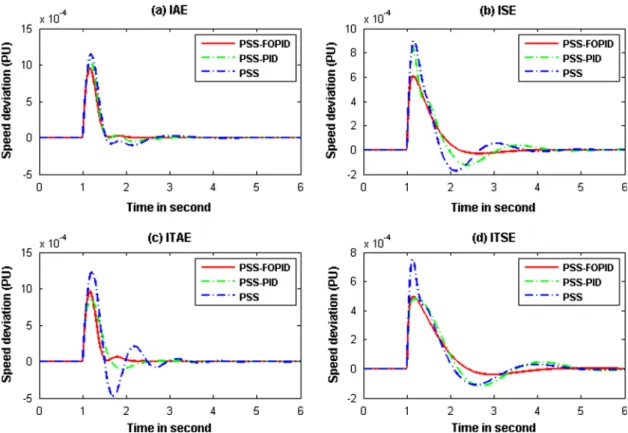
The comparison of speed responses of BA based FOPID-PSS, PID-PSS and PSS stabilizers for each objective function with different cases is recorded in Figs. 6–8, and obviously demonstrates that the proposed BA based FOPID-PSS has a better response than the others. Moreover, all four figures above confidently confirm that BA gives the minimum values of all performance indices analyzed for proposed FOPID-PSS stabilizer. On the other hand, the proposed stabilizer shows that the stability of the system is improved; the system reaches to the steady state with FOPID-PSS stabilizer faster than others for each objective function and the oscillation is quickly damped. It is also observed that the BA based FOPID-PSS can successfully decrease the settling time and overshoot compared to the other stabilizers with different operating conditions, which demonstrate the superiority of the proposed FOPID-PSS using BA.
Fig. 9shows a comparison of speed response for BA based FOPID-PSS with all objective functions under different distur-bances. This figure greatly illustrates that the proposed FOPID-PSS with ITSE and ISE tuning has more oscillations, but it has smaller overshoot compared to that obtained with IAE and ITAE based tuning, whereas, the system overshoot with IAE and ITAE based tuning is bigger than the ITSE and ISE based tuning. However, settling time is improved in case of FOPID-PSS with ITSE and ISE tuning. Thus, these
results indicate the advantage and disadvantage of each objec-tive function in terms of settling time and overshoot of the power system.
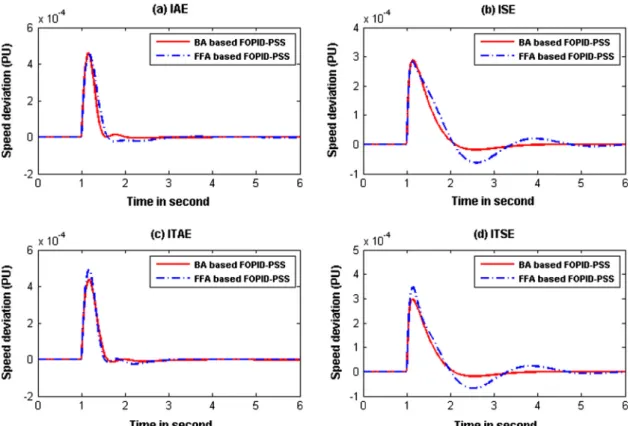
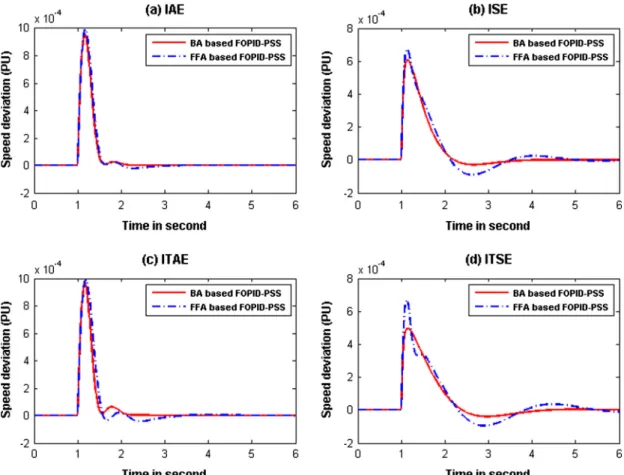
The speed response of BA and FFA based FOPID-PSS with IAE, ISE, ITAE and ITSE based tuning for three cases is given in Figs. 10–12. From the results, the designed FOPID-PSS stabilizer using BA shows superior performance over stabilizers, in terms of settling time and the system over-shoot. Hence we can conclude that the system with the pro-posed stabilizer achieves excellent robust performance of system stability and provides better damping in comparison with the other algorithms. Also, this result confirms the supe-riority of the proposed BA in tuning FOPID-PSS compared with FFA for all cases.
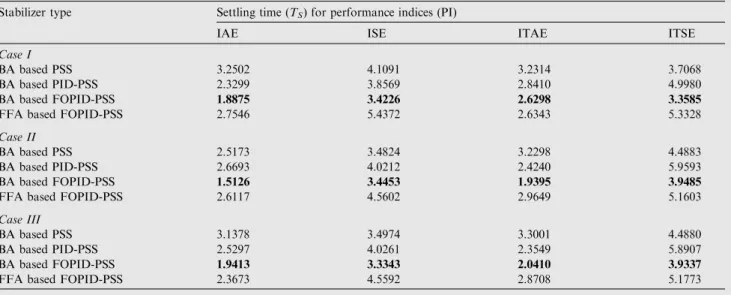
In order to show a better comparison and evaluate the per-formance of each proposed stabilizer design, the settling time
ðTSÞ characteristic of the output of the system is used and
shown inTable 7for each stabilizer.
The simulation results inTable 7 show that the proposed FOPID-PSS stabilizer using the BA achieves minimum settling time for each objective function and with different cases, when compared to other stabilizers due to a higher penalty on both error and time in the minimization criterion, which proved the effectiveness of proposed stabilizer. Also, these results obvi-ously confirm that BA outperforms FFA in stabilizing the power system under these severe disturbances.
7. Conclusion
In this article, we have applied a recent metaheuristic optimiza-tion BA, to determine a novel robust hybrid stabilizer FOPID-PSS parameters based on performance indices (PI) including IAE, ISE, ITAE and ITSE for the first time. The simulation result illustrates that the proposed FOPID-PSS design can pro-vide better results as compared to PID-PSS and PSS, and it has better control performance. Also, we have shown that BA based FOPID-PSS is a suitable way for robust power system stabilizer to improve power system under disturbances
compared to FFA-FOPID for three cases. The proposed Bat algorithm has been proved as an efficient method for the optimal design of a fractional order PID-PSS stabilizer and provided a fast time domain response and well damped oscil-lation, which demonstrated the advantage of the proposed BA to obtain the best parameters of PSS under different disturbances.
Hence, we review our work to propose a new PSS based on a novel Fractional Order Fuzzy Proportional Integral Deriva-tive (FOFPID) controller, using Bat algorithm based on multi-objective function (MOBA), where, MOBA will be suggested to search the best novel PSS parameters.
References
[1] Bian XY, Tse CT, Zhang JF, Wang KW. Coordinated design of probabilistic PSS and SVC damping controllers. Electr Power Energy Syst 2011;33:445–52.
[2] Kundur P. Power system stability and control. USA: McGraw-Hill; 1994.
[3] Zhang Y, Malik OP, Hope GS, Chen GP. Application of an inverse input/output mapped ANN as a power system stabilizer. IEEE Trans Energy Convers 1994;9:433–40.
[4] He J, Malik OP. An adaptive power system stabilizer based on recurrent neural networks. IEEE Trans Energy Convers 1997;12:413–8.
[5] Shamsollahi P, Malik OP. An adaptive power system stabilizer using online trained neural networks. IEEE Trans Energy Convers 1997;12:382–7.
[6] Al-Duwaish HN, Al-Hamouz ZM. A neural network based adaptive sliding mode controller: application to a power system stabilizer. Energy Convers Manage 2011;52:1533–8.
[7] El-Zonkoly AM, Khalil AA, Ahmied NM. Optimal tuning of lead-lag and fuzzy logic power system stabilizers using particle swarm optimization. Expert Syst Appl 2009;36:2097–106. [8] Bouchama Z, Harmas MN. Optimal robust adaptive fuzzy
synergetic power system stabilizer design. Electr Power Syst Res 2012;83:170–5.
[9] Saoudi K, Harmas MN. Enhanced design of an indirect adaptive fuzzy sliding mode power system stabilizer for multi-machine power systems. Electr Power Energy Syst 2014;54:425–31. Table 7 Settling timeðTSÞfor speed response with BA based proposed stabilizers and FFA based FOPID.
Stabilizer type Settling time (TS) for performance indices (PI)
IAE ISE ITAE ITSE
Case I
BA based PSS 3.2502 4.1091 3.2314 3.7068
BA based PID-PSS 2.3299 3.8569 2.8410 4.9980
BA based FOPID-PSS 1.8875 3.4226 2.6298 3.3585
FFA based FOPID-PSS 2.7546 5.4372 2.6343 5.3328
Case II
BA based PSS 2.5173 3.4824 3.2298 4.4883
BA based PID-PSS 2.6693 4.0212 2.4240 5.9593
BA based FOPID-PSS 1.5126 3.4453 1.9395 3.9485
FFA based FOPID-PSS 2.6117 4.5602 2.9649 5.1603
Case III
BA based PSS 3.1378 3.4974 3.3001 4.4880
BA based PID-PSS 2.5297 4.0261 2.3549 5.8907
BA based FOPID-PSS 1.9413 3.3343 2.0410 3.9337
[10]Hussein T, Saad MS, Elshafei AL, Bahgat A. Damping inter-area modes of oscillation using an adaptive fuzzy power system stabilizer. Electr Power Syst Res 2010;80:1428–36.
[11]Nechadi E, Harmas MN, Hamzaoui A, Essounbouli N. A new robust adaptive fuzzy sliding mode power system stabilizer. Electr Power Energy Syst 2012;42:1–7.
[12]Chaturvedi DK, Malik OP. Neurofuzzy power system stabilizer. IEEE Trans Energy Convers 2008;23:887–94.
[13]Peric VS, Saric AT, Grabez DI. Coordinated tuning of power system stabilizers based on Fourier Transform and neural networks. Electr Power Syst Res 2012;88:78–88.
[14]Tofighi M, Alizadeh M, Ganjefar S, Alizadeh M. Direct adaptive power system stabilizer design using fuzzy wavelet neural network with self-recurrent consequent part. Appl Soft Comput 2015;28:514–26.
[15]Abdel-Magid YL, Abido MA. Optimal multiobjective design of robust power system stabilizers using genetic algorithms. IEEE Trans Power Syst 2003;18:1125–32.
[16]Sebaa K, Boudour M. Optimal locations and tuning of robust power system stabilizer using genetic algorithms. Electr Power Syst Res 2009;79:406–16.
[17]Shayeghi H, Shayanfar HA, Safari A, Aghmasheh R. Robust PSSs design using PSO in a multi-machine environment. Energy Convers Manage 2010;51:696–702.
[18]Jalilvand A, Aghmasheh R, Khalkhali E. Optimal design of PID power system stabilizer in multimachine power system using PSO and genetic algorithm. Int Rev Electr Eng 2011;6:907–12.
[19]Sambariya DK, Prasad R. Robust tuning of power system stabilizer for small signal stability enhancement using metaheuristic bat algorithm. Electr Power Energy Syst 2014;61:229–38.
[20]Ali ES. Optimization of power system stabilizers using BAT search algorithm. Electr Power Energy Syst 2014;61:683–90. [21]Ragavendiran A, Gnanadass R, Ramakrishnan K. A new
SPARLS algorithm for tuning power system stabilizer. Electr Power Energy Syst 2015;68:327–35.
[22]Gaing ZL. A particle swarm optimization approach for optimum design of PID controller in AVR system. IEEE Trans Energy Convers 2004;19:384–91.
[23]Podlubny I. Fractional-order systems and PID-controllers. IEEE Trans Autom Control 1999;44:208–14.
[24]Vinagre BM, Monje CA, Calderon AJ, Suarez JI. Fractional PID controllers for industry application. A brief introduction. J VIB Control 2007;13:1419–29.
[25]Moradi M. A genetic-multivariable fractional order PID control to multi-input multi-output processes. J Process Control 2014;24:336–43.
[26]Shabib G. Implementation of a discrete fuzzy PID excitation controller for power system damping. Ain Shams Eng J 2012;3:123–31.
[27]Astrom KJ, Hagglund T. PID controllers: theory, design, and tuning. 2nd ed. Research Triangle Park, NC, USA: Instrument Society of America; 1995.
[28]Soliman M, Elshafei AL, Bendarya F, Mansour W. Robust decentralized PID-based power system stabilizer design using an ILMI approach. Electr Power Syst Res 2010;80:1488–97. [29]Soliman M. Parameterization of robust three-term power system
stabilizers. Electr Power Syst Res 2014;117:172–84.
[30] Yanwei C, Hui Y, Huidang Z. PID controller parameters tuning in servo system based on chaotic particle swarm optimization. In: IT in Medicine & Education. ITIME ‘09. IEEE International Symposium on, vol. 1; 2009. p. 276–80.
[31]Abdul-Ghaffar H, Ebrahim EA, Azzam M. Design of PID controller for power system stabilization using hybrid particle swarm-bacteria foraging optimization. WSEAS Trans Power Syst 2013;8:12–23.
[32]Duman S, Ozturk A. Robust design of PID controller for power system stabilization by using real coded genetic algorithm. Int Rev Electr Eng 2010;5:925–31.
[33]Ramya R, Selvi K. Real time simulation of single machine infinite bus system using dSPACE controller board. Power electronics and renewable energy systems. India: Springer; 2015. p. 783–92. [34] Yang XS. A new metaheuristic bat-inspired algorithm. Nature
Inspired Cooperative Strategies for Optimization (NISCO 2010). In: Gonzalez JR, et al., editors. Studies in computational intelligence, vol. 284; 2010. p. 65–74.
[35]Sauer P, Pai M. Power system dynamics and stability. Upper Saddle River, NJ: Prentice-Hall; 1998.
[36] Padiyar KR. Power system dynamics, stability and control, second ed.; 2008.
[37] Richardson P. Bats, natural history museum. London; 2008. [38]Gandomi AH, Yang XS. Chaotic bat algorithm. J Comput Sci
2014;5:224–32.
[39]Yang Xin-She. Firefly algorithms for multimodal optimization. In: Stochastic algorithms: foundations and applications. Springer; 2009. p. 169–78.
Lakhdar Chaibwas born in Laghouat, Alge-ria, on October 03, 1989. He received license and master degrees in Electrotechnic and Electrical Power System in 2010 and 2012 respectively from Laghouat university. He is currently a Ph.D. student at the Department of Electrical Engineering and Member in LACoSERE Laboratory, University of Laghouat, Algeria. His areas of research include power system dynamic stability, con-trol systems, Artificial intelligence and optimization techniques.
Abdelghani Choucha was born on April 28, 1963 in Laghouat (Algeria). He received his Electrical Engineering degree in 1987 at University of Science and Technology Oran (USTO), his Magister diploma in 1991 at Ibn Khaldoun University Tiaret and his Ph.D. in Electrical Power System in 2013 at Polytech-nic National School of Algiers, Algeria. Since 1987, he is a Researcher Teacher at the Elec-trical Engineering Department, Amar Telidji University of Laghouat. Since 2014, he is head of LACoSERE. His research interests are especially dynamic stability, Power system sta-bilizer and optimization problems in Electrical power systems, new optimization techniques as metaheuristic techniques and Artificial Intelligence.
Salem Arif was born in Taibat, Ouargla, Algeria, in 1968. He received his Electrical Engineering diploma in 1992, and his Magis-ter and Ph.D. degrees in Electrical Power System at Polytechnic National School of Algiers, Algeria in 1995 and 2008 respectively. In 1998, he joined the Electrical Engineering Department, Laghouat University, Algeria, as an Assistant Lecturer. Since March 2010, Dr. ARIF is an Assistant Professor at the same Department. He is also a Team Leader of ‘‘Power System Optimiza-tion and Control” research group of LACoSERE Laboratory, Laghouat University, Algeria. His research interests include, planning and optimization problems in Electrical power systems, reactive power static compensators, and Optimization techniques.