Typogenetic Design - Aesthetic Decision Support for Architectural Shape Generation
A project submitted in fulfilment of the requirements for the degree of Doctor of Philosophy
Manuel Muehlbauer
Dipl.-Ing. Architecture - Technical University of Munich
School of Architecture and Urban Design College of Design and Social Context
RMIT University
March 2018
A thesis submitted for the degree of Doctor of Philosophy
Manuel Muehlbauer Dipl.-Ing. Univ. Architecture, School of Architecture and Urban Design,
College of Design and Social Context, RMIT University,
Melbourne, Victoria, Australia.
Supervisors: PD Marcelo Stamm
Prof. Jane Burry Dr. Andy Song
author alone; the work has not been submitted previously, in whole or in part, to qualify for any other academic award; the content of the project is the result of work which has been carried out since the official commencement date of the approved research program; any editorial work, paid or unpaid, carried out by a third party is acknowledged; and, ethics procedures and guidelines have been followed.
I acknowledge the support I have received for my research through the provision of a RMIT PhD International Scholarship.
This PhD project is supported by RMIT School of Architecture & Design through the SRC funds.
Manuel Muehlbauer, 23 March 2018
School of Architecture and Urban Design RMIT University
supervisors Marcelo Stamm, Jane Burry and Andy Song.
Many thanks for the patient support of my wonderful wife Dorothea Muehlbauer and our lovely daughter Marita Muehlbauer. I also want to give thanks to family and friends, who were a great blessing for me.
During the project work, I experienced great collaborative spirit from Nancy Cheng, Mehrnoush Latifi Khorasgani, Jesse Mc Carthy, Nicholas Williams, Kristof Krolla, Matthias Haeusler, Sascha Bohnenberger, Tim McGinley, Julie Collins, Quenten Schwarz, Petra Gruber, Zemin Yang and Dindul Dadi.
I enjoyed great company and interesting conversations with my colleagues at Spatial Information Architecture Lab (SIAL) Rafael Moya Castro, Daniel Prohasky, Lawrence Harvey, Ross Mcleod, Malte Wagenfeld, Charles Anderson, Jordan Lacey, Sarah Pink, Alexia Maddox, Greg More, Andrew Miller and Canhui Chen
International colleagues Hugo Mulder and Andre Araujo visited our lab and left us with fabulous memories.
The quality of this research was greatly enhanced by the invaluable feedback of the panel members Paul Minifie, Roland Snooks, Nicholas Boyarsky, Sambit Datta, Jules Moloney, Jeff Malpas, Simon Watkins and Guillermo Aranda-Mena during the Practice Research Symposia (PRS).
During the time of compiling my thesis, I received support from a number of people that I would like to gratefully recognise in this context. Zemin Yang supported me by
integrating my graphical work into the dissertation document. Many thanks to Tim Johannessen for editing and proof-reading of my dissertation. S.d.g.
tions:
• T. McGinley, J. Collins, Q. Schwarz, and M. Muehlbauer. Surburban mutations: towards the multi-dimensional appropriation of science in architecture. In J. Zuo, L. Daniel, and V. Soebarto, editors,2016 Proceedings of the 50th International Con-ference of the Architectural Science Association, 2016
• K. Crolla, N. Williams, M. Muehlbauer, and J. Burry. Smartnodes pavilion - to-wards custom-optimized nodes applications in construction. In P. Janssen, P. Loh, A. Raonic, and M. Schnabel, editors, Protocols, Flows, and Glitches - Proceedings of the 22nd CAADRIA Conference, 2017
• M. H. Haeusler, M. Muehlbauer, S. Bohnenberger, and J. Burry. Furniture de-sign using custom-optimised structural nodes. In P. Janssen, P. Loh, A. Raonic, and M. Schnabel, editors, Protocols, Flows, and Glitches - Proceedings of the 22nd CAADRIA Conference, 2017
• M. Muehlbauer, J. Burry, and A. Song. Automated shape design by grammatical evolution. In J. Correia, V. Ciesielski, and A. Liapis, editors, Computational In-telligence in Music, Sound, Art and Design. EvoMUSART 2017. Lecture Notes in Computer Science, vol 10198, 2017a
• M. Muehlbauer, A. Song, and J. Burry. Towards intelligent control in generative design. In G. Cagdas, M. Ozkar, L. F. Gul, and E. Gurer, editors,Future Trajectories of Computation in Design, Proceedings of CAADFutures 2017, 2017b
• P. Gruber, T. McGinley, and M. Muehlbauer. Towards an agile biodigital architec-ture - supporting a dynamic evolutionary and developmental view of architecarchitec-ture. In A. Estvez, editor, 3rd Biodigital Architecture and Genetics, 2017
Acknowledgements . . . iii
Credits . . . v
Abstract . . . xvi
1 Introduction 1 1.1 Defining the Problem. . . 1
1.2 Limitations of the Study . . . 3
1.3 Aims of Research . . . 11
1.4 Research Objectives . . . 11
1.5 Research Questions . . . 11
1.6 Research Contributions . . . 12
1.7 Structuring the Work . . . 12
2 Literature Review 15 2.1 Computer-Aided Architectural Design (CAAD) . . . 16
2.1.1 Computer systems . . . 16
2.1.2 Human-computer interaction . . . 17
2.1.3 Machine Intelligence . . . 18
2.1.4 CAD Systems . . . 18
2.1.5 Generative Design . . . 20
2.2 Decision Making in Computational Design . . . 22
2.2.1 Architectural Optimisation . . . 25
2.2.2 Performance Simulation . . . 26
2.2.3 Representing Design Problems for Optimisation. . . 28
2.2.4 Multi-Criteria Optimisation . . . 30
2.2.5 Interactive Optimisation . . . 33
2.3 Community of Practice. . . 34
2.3.1 Generative Design Practice . . . 34
2.3.2 Evolutionary Architecture . . . 36
2.3.3 Shape Grammar . . . 37
3.1.2 Epistemology . . . 43
3.1.3 Ontology . . . 44
3.2 Research Methods . . . 45
3.2.1 Community of Practice Review . . . 45
3.2.2 Critical Literature Review . . . 46
3.2.3 Hybrid Research Methodology . . . 47
3.3 Case studies . . . 47
3.4 Participant Experiments . . . 51
3.5 Reflective Practice . . . 52
4 Theoretical Framework 57 4.1 Interfacing with CAD . . . 61
4.2 Perception - Two Mechanisms for Guidance . . . 66
4.2.1 Shape Comparison . . . 67
4.2.2 Online Classification . . . 68
4.3 Intelligence - Building Knowledge . . . 69
4.4 Selection - Exercising Choice . . . 70
4.5 Control - Structuring the Process . . . 72
4.6 Typogenetic Design - Application Potential . . . 72
5 Project Work 77 5.1 Smart Nodes Project . . . 78
5.2 Sydney Opera Bar . . . 84
5.3 Shooting Star . . . 89
5.4 Typogenetic Design. . . 94
5.5 Anguinum Project . . . 98
5.6 Smart Structures Project . . . 101
6 Reflections 109 6.1 Self-Organisation and Autopoiesis . . . 109
6.2 Dichotomy of Technology . . . 111 6.3 Poietic Action. . . 113 6.4 Technological Hermeneutics . . . 114 6.5 Human-In-The-Loop Systems . . . 116 6.5.1 Design Augmentation . . . 119 6.5.2 Cognitive Augmentation . . . 120 6.5.3 Perceptual Augmentation . . . 121
7.2 Multi-Scale Optimisation . . . 127
7.3 Interactive Generative Design . . . 128
7.4 Interactive Mass Customisation . . . 131
7.5 Integrated Decision Support . . . 133
7.6 Value of Typogenetic Design . . . 134
8 Conclusions 137 8.1 Contributions to Architectural Practice . . . 137
8.2 Typogenetic Design. . . 139
8.3 Interactive Mass-Customisation . . . 141
8.4 Summary of Main Contribution . . . 142
9 Recommendations and Future Work 143 Bibliography 147 A Glossary 167 B Software Requirements of parametric Typogenetic Design 179 B.1 Purpose . . . 179 B.2 Scope . . . 179 B.3 Product Perspective . . . 180 B.3.1 User interfaces . . . 181 B.3.2 Software Interfaces . . . 183 B.3.3 Product Functions . . . 184 B.4 User Characteristics . . . 185 B.4.1 Apportioning of Requirements . . . 185 B.4.2 Specific Requirements . . . 186
C Supporting Information for Software Requirements Specification 189 C.1 Unfolding the Software Pattern for Typogenetic Design . . . 190
C.2 Conceptual ideas and considerations behind the software pattern . . . 193
C.2.1 Initial Solutions. . . 193 C.2.2 Designer Interactivity . . . 194 C.2.3 Representations. . . 201 C.2.4 Evolutionary Computation . . . 208 C.2.5 Multi-Criteria Optimisation . . . 213 C.2.6 Design Translation . . . 216
F Evolutionary House Design 233
G Typogenetic Design Software Prototype 237
G.1 Main Code . . . 237
G.2 Online Classification . . . 256
1.1 Negotiating control and automation in human-in-the-loop systems . . . 4
1.2 Scope of my PhD study . . . 9
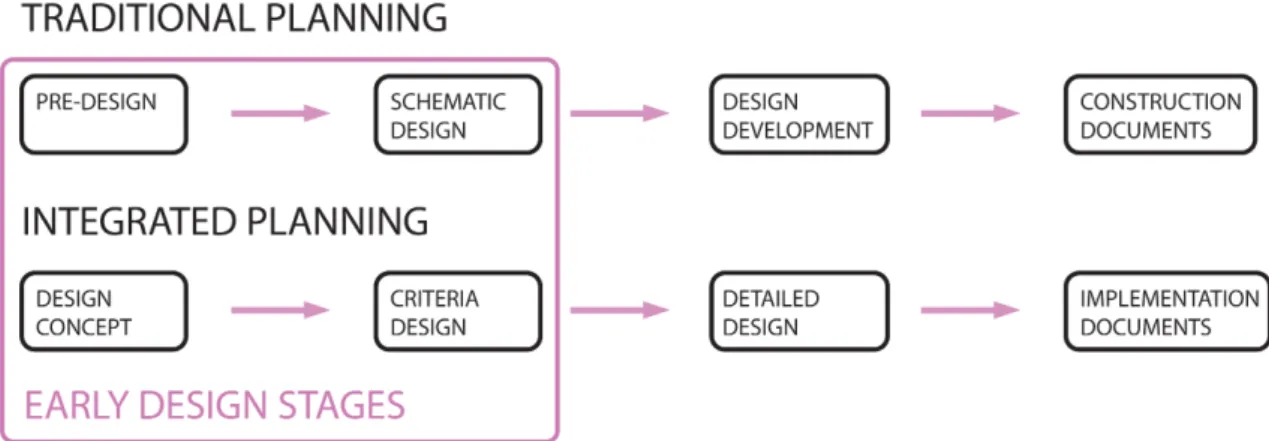
2.1 Early design stages in traditional and integrated planning . . . 15
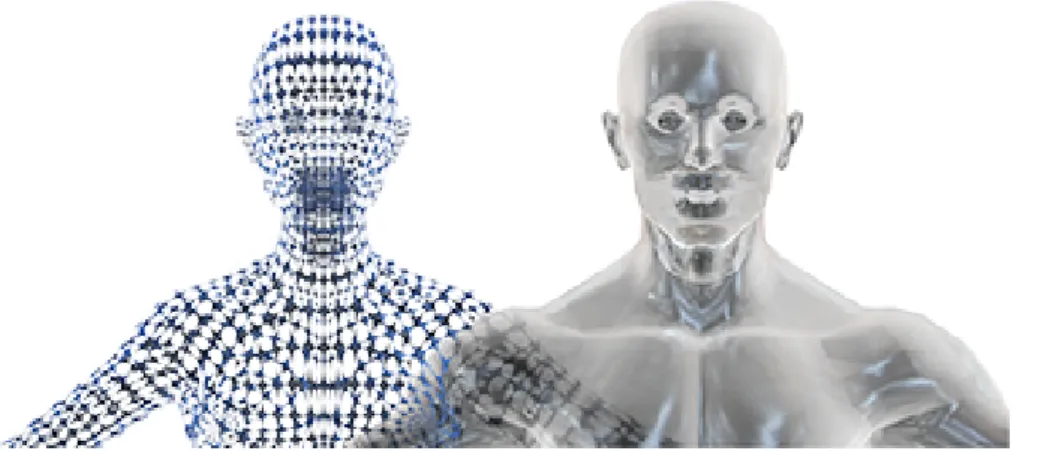
2.2 Symbiosis in human-computer interaction . . . 17
2.3 Cantilever and arch bridges adopted from Sutherland[1963, p. 131] . . . 19
2.4 Pioneering use of 3D CAD for architectural design . . . 19
2.5 Design processes in computational design . . . 24
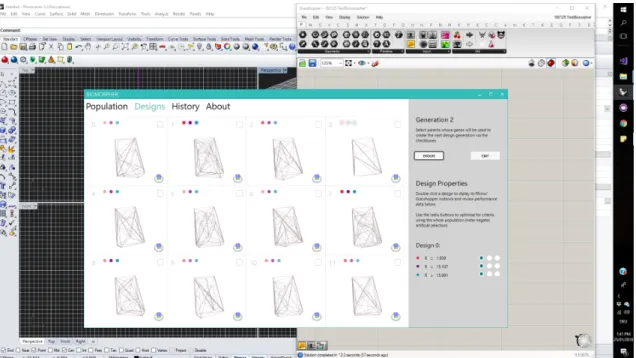
2.6 Screenshot Biomorpher interface . . . 33
2.7 Community of practice mapping . . . 35
2.8 Examples of highly complex designs using generative design . . . 36
3.1 Iterative positioning of PhD study . . . 46
3.2 Habermas Triangle adopted from [Svanaes 1999] . . . 48
3.3 Action Research Cycle adapted from [Kemmis and McTaggart 2008] . . . 50
3.4 Systems Practice Diagram adapted from [Hofkirchner 2013] . . . 51
3.5 The hybrid research process in application . . . 54
4.1 Adaptable and adaptive user interfaces adopted from [Stephanidis et al. 1998] . 58 4.2 The Dialog-Data-Models DSS Framework adopted from [Ford 1985] . . . 60
4.3 Generic representation and intermediate structure . . . 63
4.4 Parametric interface of Grasshopper3D for Rhinoceros CAD . . . 63
4.5 Conceptual framework for human-computer-interaction in computer graphics adopted from [Van Dam 1983]. . . 65
4.6 Interactive decision support mechanisms . . . 67
4.7 Conceptual model for Online Classification . . . 68
4.8 Decoding aesthetic experience adapted from [Redies 2015] . . . 69
4.9 An Aesthetic Support System . . . 70
4.10 Adaptive mechanism using a perceptual system adapted from [Pask 1963] . . . 71
4.11 Typogenetic Design conceptual model . . . 73
4.12 Perceptual Cognitive System adopted fromAtmar [1976, P. 86] . . . 74
5.4 Local treatment of complex structural nodes . . . 80
5.5 Different structural nodes of the Smart Nodes Pavilion . . . 81
5.6 Variants of custom-optimised nodes of different levels of complexity . . . 82
5.7 Sydney Opera Bar as feature during the Opera the Eighth Wonder . . . 85
5.8 Two stages of the optimisation process . . . 86
5.9 Parametric explorations of design space . . . 88
5.10 Software pattern for Shape Generation . . . 90
5.11 Shape explorations in Grasshopper . . . 90
5.12 Shape schema grammar representation . . . 91
5.13 Generative facade design study . . . 91
5.14 Application in Hoverport competition entry . . . 92
5.15 Shooting Star competition entry . . . 93
5.16 Changes in Software pattern for Typogenetic Design . . . 95
5.17 Shape grammar representation in Backus-Naur Form . . . 96
5.18 Framework for development of integrated decision support system adopted from [Erbas et al. 2010] . . . 96
5.19 Architectural tectonic expression using structural trajectories . . . 97
5.20 Scenario map of Typogenetic Design application for Anguinum Project. . . 99
5.21 Refinement Anguinum Project design after morphological search . . . 100
5.22 Final render of Anguinum Project . . . 101
5.23 Facade structure as parametric truss as design scenario . . . 102
5.24 Multi-staged model for interactive node design . . . 103
5.25 Scenario map of Typogenetic Design application for node shape generation . . 103
5.26 Refinement Smart Structures node after morphological search . . . 104
5.27 BESO and member-sizing of fixed topology . . . 105
5.28 Node design exploration using principal stress lines . . . 106
5.29 Smart Structures node design . . . 106
6.1 Shape progression during Typogenetic Design application for Anguinum Project110 6.2 Conceptual transition from optimisation to evolutionary design . . . 118
6.3 Encoding of modular geometries in architectural body plans . . . 119
6.4 Progression of design system properties . . . 122
7.1 Project position in overall research . . . 126
7.2 Creative systems diagram for Typogenetic Design application . . . 130
7.3 Interactive mass-customisation . . . 132
B.4 Exploratory search interface. . . 182
B.5 Shape display in Rhinoceros viewports . . . 183
C.1 Software pattern for Typogenetic Design . . . 189
C.2 Unfolded Software pattern for Typogenetic Design . . . 191
C.3 First interactive experiment using commmandline interface . . . 194
C.4 Three interactive approaches . . . 195
C.5 Position of Aesthetic Support System in Typogenetic Design . . . 196
C.6 Classification process . . . 197
C.7 An aesthetic support system . . . 199
C.8 Early concept of an aesthetic support system . . . 200
C.9 Mapping modelling approaches to describe geometric flexibility . . . 202
C.10 Recombination in evolutionary search . . . 210
C.11 Genetic programming representations . . . 211
C.12 Genetic programming system . . . 212
C.13 Paretofront in multi-objective optimisation . . . 215
C.14 Post-processing in CAD . . . 217
D.1 Image set provided for the reference input . . . 220
D.2 Designer engagement . . . 221
D.3 Creative decision support . . . 221
D.4 Preferred sets of shapes . . . 222
D.5 Summary plot scenario comparison . . . 222
D.6 Likeliness of use of semi-automated design . . . 223
D.7 Overall metrics for usability . . . 224
D.8 Summary plot overall metrics for usability . . . 224
D.9 Decision support metrics. . . 225
D.10 Summary plot decision support metrics . . . 225
D.11 Nodes summary of coding qualitative data. . . 227
D.12 Useful practice for the future . . . 228
E.1 Prototypical shape explorations based on typology . . . 230
E.2 From typology to space planning . . . 230
F.1 Prototypical design output of design tool . . . 233
F.2 Morphogenetic Prototyping tool . . . 234
2.1 Capabilities of and premises for a decision support system . . . 31
design, evolutionary search and architectural optimisation technology. The active tool for supporting design decisions during architectural shape generation uses an aesthetic system to guide the search process. This aesthetic system directs the search process toward preferences expressed interactively by the designer. An image input as design reference is integrated by means of shape comparison to provide direction to the exploratory search. During the shape generation process, the designer can choose solutions interactively in a graphical user interface. Those choices are then used to support the selection process as part of the fitness function by online classification.
Enhancing human decision making capabilities in human-in-the-loop design systems addresses the complexity of architecture in respect to aesthetic requirements. On the strength of machine learning, the integral performance trade-off during multi-criteria op-timisation was extended to address aesthetic preferences. The tacit knowledge and sub-jective understanding of designers can be used in the shape generation process based on interactive mechanisms. As a result, an integrated support system for performance-based design was developed and tested.
Closing the loop from design to construction using design optimisation of structural nodes in a set of case studies confirmed the need for intuitive design systems, interfaces and mechanisms to make architectural optimisation more accessible and intuitive to han-dle. This dissertation investigated Typogenetic Design as a tool for initial morphological search. Novel instruments for human interaction with design systems were developed using mixed-method research. The present investigation consists of an in-depth technological enquiry into the use of interactive generative design for exploratory search as an integrated support system for performance-based design. Associated project-based research on the design potential of Typogenetic Design showcases the application of the design system for architecture.
Generative design as an expressive tool to produce architectural geometries was inves-tigated in regard to its ability to drive initial morphological search of complex geometries. The reinterpretation of processes and boosting of productivity by artificial intelligence was instrumental in exploring a holistic approach combining quantitative and qualitative criteria in a human-in-the-loop system. The shift in focus from an objective to a subjec-tive understanding of computational design processes indicates a perspecsubjec-tive change from optimisation to learning as a computational paradigm.
Integrating learning capabilities in architectural optimisation enhances the capability of architects to explore large design spaces of emergent representations using evolutionary search. The shift from design automation to interactive generative design introduces the possibility for designers to evaluate shape solutions based on their knowledge and expertise to the computational system. At the same time, the aesthetic system is trained
comparison using a similarity measure provides additional guidance to the architectural shape generation using grammar evolution.
Finally, a software prototype was built and tested by means of user-experience eval-uation. These participant experiments led to the specification of custom software re-quirements for the software implementation of a parametric Typogenetic tool. I explored semi-automated design in application to different design cases using the software proto-type of Typogenetic Design. Interactive mass-customisation is a promising application of Typogenetic Design to interactively specify product structure and component compo-sition. The semi-automated design paradigm is one step on the way to moderating the balance between automation and control of computational design systems.
CHAPTER
1
Introduction
“We know very little, and yet it is astonishing that we know so much, and still more astonishing that so little knowledge can give us so much power.”
–Bertrand Russell
1.1
Defining the Problem
The use of digital tools to generate novel design solutions and support decision making are frequently discussed in architectural design 1. How can we integrate digital tools to build performance-based computational systems for interactive design of architectural geometries? My investigation of this question draws on a variety of fields, domains and techniques. It brings together scattered knowledge in the areas of Generative Design (GD), architectural optimisation and evolutionary search to build the argument of this dissertation. Adaptive digital tools that allow one to explore the design potential of Multi-Criteria Optimisation (MCO) to shape generation interactively are showcased in the project work that supports this dissertation.
Typogenetic Design refers metaphorically to the emergence of life from the primordial soup 2. Similarly, the application of artificial genetic systems in architectural design facilitates the emergence of solutions for a design task out of the ocean of opportunities that exists in regard to emergent representation 3. Human-Computer-Interaction (HCI) is a 1At CAAD Futures 2017 in Istanbul two conference sessions dealt with the topics ‘Decision Support
Systems and Human Computer Interaction’.
2Typogenetics is a formal system introduced by Douglas Hofstadter in [Hofstadter 1979] to study an
artificial genetic system for typography [Varetto 1993]. The idea was adopted in an architectural context for shape generation.
3
Computational representation, design criteria and evolutionary mechanisms contribute to the gener-ation of suitable, feasible and desired design solutions.
key consideration in interactive optimisation, especially in understanding the conversation between the human designer and the machine as a responsive and adaptive counterpart.
In the early design stages, performance measures are frequently more focused on heuristics dealing with cost, value and sustainability. Most architects who use optimisa-tion technologies are interested in using daylight studies and structural optimisaoptimisa-tion in architectural design [Cichocka et al. 2017b]. Those measures can be abstracted to basic geometric measures for performance approximation in shape design. As design heuris-tics, these performance measures can be calculated with moderate computational costs for use in an exploratory search tool. Additionally, performance simulation can be inte-grated into architectural optimisation for crucial applications, for example to ensure the structural integrity of design solutions.
In reference to the recent discussions around design automation, performance simula-tion and MCO, I investigated Typogenetic Design as an adaptive framework for performance-based4 architectural design5 to provide insights and knowledge as a foundation to build adaptive tools for creative decision support. Because of the significance of Typogenetic Design to the fields of shape grammar, GD and decision support systems, I selected these areas as the main areas of contribution for my PhD study. I base my argument on a theoretical framework, case studies, the collection of a software pattern for Typogenetic Design and the testing of a prototypical implementation as proof-of-concept. After the user experience evaluation, a custom software requirements specification for a parametric Typogenetic tool was compiled. The case studies that I explored on the journey of this PhD study were:
• Smart Nodes Project
• Sydney Opera Bar
• Shooting Star
• Typogenetic Design 4
The notion of ‘performance’ used in the context of this dissertation is strictly limited to the quan-titative evaluation of performance criteria. Hence, the understanding of performance as an artistic act, an activity of the nature of a task or a performed function, or as co-generating meaning in place-making [Roudavski 2009] are not relevant to this PhD study. Again, reference to the word ‘performative’ needs to be understood in the same category of meaning as the word ‘performance’ in the context of this study. As a consequence, the term ‘performative’ does not point toward characteristics or qualities of artistic performances, nor the social or cultural role of the architect in the context of the society, nor the concept of performative utterances described inAustin[1962, p. 4]
5Optimisation as an approach to decision making in design is frequently restricted to the definition
of key features of design solutions in an automated process. Decision support for architectural design, in my view, needs to integrate both interactive design space exploration and the potential to add design references as a focal point for design solutions. Whether design systems support users in creative decision making or the capabilities of the system are deemed to be creative themselves is completely up to the understanding of the user. Measures for the degree of creativity artificial intelligence may exhibit are not yet developed.
• Anguinum Project
• Smart Structures Project
The knowledge I complied around the use of GD, evolutionary search, shape grammar and Human-In-The-Loop (HITL) technology for architectural design purposes is encap-sulated in the software pattern of Typogenetic Design. The cutting-edge Artificial Intelli-gence (AI) methodology used in this project is also part of this description of technology used in Typogenetic Design. Quantitative and qualitative data were collected during the user experience evaluation and analysed as the basis for the custom software requirement specification. Those participant experiments revealed new insights about the need for semi-automated tools and the level of expertise needed for a designer to use Typogenetic Design. A comparative study of an automated and semi-automated scenario involving shape generation showed that the users felt more engaged using Typogenetic Design. The user feedback about the valuation and use of the digital tools was collected using ques-tionnaires. The knowledge acquired from reflections that I frequently pursued during my PhD journey led to a deeper understanding of the philosophical background and the implications of the use of technology in architectural design.
Now that I have discussed the scope of the present study, I want to spend some time framing my research questions and discussing the limitations of this PhD dissertation.
1.2
Limitations of the Study
At the core of this PhD dissertation sits the project work incorporating Typogenetic Design as a semi-automated shape design system that aims to enhance designer engagement and increase user satisfaction with the achieved designs than those generated by automated shape design. However, this study is not concerned with the discussions around decision theory in general (though a brief summary of the author’s understanding of its relationship to the design process is given in the critical literature review). On the same note, it should be mentioned that the transition from an optimisation to a learning system [Checkland 1985] is crucial for the thinking behind my project. Nevertheless, this PhD study does not give an account of the associated literature on learning theory and creativity research, even if the relevance of the developed digital tool for these discourses is recognised and acknowledged 6.
The Aesthetic Support System for early stages of architectural design is built on a custom GD implementation 7 in a state-of-the-art Computer-Aided-Design (CAD) soft-ware package8. Typogenetic Design provides access to optimisation technology for a large
6
This relevance lies in the potential use of Typogenetic Design in future applications to extract knowl-edge about the creative decision-making process during GD.
7
The prototype of Typogenetic Design was tested using genetic programming with shape grammar representation in RhinoPython.
group of computational designers based on its interactive handling. Moreover, the multi-disciplinary nature of the research process supported the acquisition of knowledge from the fields of computer science9 and engineering10. This PhD study contributed to those fields, though its main contribution is to the field of architectural design. Combining both findings from control theory11 and automata theory 12 led to the emergence of Typoge-netic Design. One of the most obvious pragmatic applications of these theories is shown in Figure1.1a, which frames the main problem that my PhD study is pointing to. In this diagram, the trade-off between control and automation in design is made the subject of discussion. It shows the increasing effort of the designer on one axis versus the degree of misalignment with the design intent proportional to the degree of automation on the other axis. I identified HITL technology as capable of negotiating those aspects. HITL technology allows the designer to interact with Typogenetic Design13 collaboratively.
(a) Automation versus control, adopted from [Oulasvirta 2017]
(b) Model for human-computer-interaction in generative design
Figure 1.1: Negotiating control and automation in human-in-the-loop systems My understanding of HCI in GD builds on the metaphor of a chess game, where both players interact with each other strategically without dominating the other player. This image, though, should not be interpreted as implying the superiority of the self (designer) or an-other (intelligent agent), but rather, as an invitation to investigate the dynamics that exist between the two participants to gain an understanding of the contributions that each party makes to an exciting game. Therefore, my PhD study seeks not to increase computational efficiency or reduce run-time in MCO, even if the developed aesthetic guid-ance mechanism might very well facilitate improvements of those qualities. In the context of this dissertation, the contribution of the computational system involves the provision of 9The focal research dealt with evolutionary search, machine learning and HITL from a computational
perspective.
10Expertise from engineering used in this research orbited around structural optimisation and additive
manufacturing.
11
My reflection on the research project from a design cybernetics perspective informed Chapter6.
12Automata theory plays a vital part in understanding the computational implications and the aspects
of HCI that deal with the features and characteristics of the machine.
13In the absence of a dictionary definition of the term ‘design system’, I want to quote a circulating
definition from an online discussion on user experience (UX in the following): “A design system is an evolving rule set governing the composition of a product.” [Tuite 2017]
a variety of solutions and an evaluation of the associated information related to the per-formance of those solutions in respect to predefined perper-formance criteria. The designer contributes to the system by using his or her capacity to interpret and evaluate those solutions aesthetically as shown in Figure1.1b.
In fact, the designer expresses design preferences by introducing image input at the beginning of the design process and exercises educated choice over the emerging solutions during run time of the GD. This initial image input is understood as a design reference used in a guidance process to give the search direction by Shape Comparison. Conse-quently, the strategic convergence and divergence between design alternatives is enhanced by the learning system using Online Classification, which allows the designer to focus on an area of interest. As a result, the initial morphological search process explores the design space in a structured way. This mode of interactivity allows the designer to make decisions intuitively using the capacity of the computer to calculate complex performance trade-offs. Combining the machine’s power to facilitate analytic thought and objectivity on one hand with the imagination and artistic ability of the designer on the other in-creases the efficiency of both partners in the HITL system. The designer’s creative and synthesis competences are effectively used in the creative system to increase the potential of architectural optimisation for incorporating human agency.
The increased control of GD using the Aesthetic Support System allows designers to rethink the application of mass-customisation in an architectural context. In this pro-cess, architectural products are adjusted to user preferences based on a core concept that describes the architectural product. Individual taste and individuality are expressed by adding a set of distinctive features to the geometric description of the architectural prod-uct. The project work explores both a structural (Chapter 5, Smart Structures Project) and a typological application using mass-customisation (Appendix E and F building on [McGinley et al. 2016]). In the context of design optimisation of architectural structures, the notion of mass-customisation is strategically extended to a custom-optimisation of structural nodes using multi-scale optimisation.
Mass-customisation could be easily managed using Typogenetic Design as part of this PhD study. Even if this application is an exciting and interesting one, an in-depth exploration of the design potential for mass-customisation is beyond the scope of this PhD study. A morphological study is reported as a result of a participant study testing the Typogenetic Design prototype. An overview of the range of shapes generated by this process is supplied in Appendix C. If linked to a parametric system, a variety of representations could be used by designers to easily describe architectural geometries for Typogenetic Design. The interactive way of optimisation developed during this PhD study provides intuitive access to relevant parameters, variables and constraints from a design perspective, addressing the need for accessibility of MCO and GD to a larger group of computational designers.
A wider use of MCO and GD in architectural application as an approach to performance-based design allows designers to increase the efficiency and sustainability of architectural geometries by basing design decisions on a variety of design criteria evaluated during the exploratory process of Typogenetic Design. In order to generate a liveable future for our society and environment, we need to innovate in unprecedented ways and at a greater speed. This also includes the built environment, which in the present situation consists largely of profit-driven developments that lack design quality. Typogenetic Design may contribute to the sort of innovation in architectural shape generation that is needed to capture additional optimisation potential in architectural design.
Especially in the early design stages, performance considerations are often not taken into account. To some degree, this is because of the lack of design software that is intuitive enough to allow the designer to explore a variety of different design solutions. As a result, conceptual massing is often already fixed when the use of optimisation tools is introduced into the design process. It is obvious that such fine tuning using optimisation tools is quite different to strategic decision-making that uses performance criteria as means to understand the implications of changes in architectural geometry.
The use of AI to make strategic design decisions about our built environment of-fers the opportunity to accelerate the innovation process in architecture and architectural technology. Based on performance considerations, costs could be decreased as a second order effect of architectural optimisation without additional encoding of economic criteria in the representation. For instance, the integration of structural criteria in the computa-tional representation that describes the problem space reduces not only the weight of the primary structure, but also the cost for foundations and excavations14. Indeed, a detailed encoding of the monetary benefits of design decisions would be possible and feasible.
The use of heuristics to gain an initial understanding of the performance of building solutions in a variety of performance categories is appropriate in the early design stages. The use of heuristics reduces the computational costs of architectural optimisation. A variety of metrics can be extracted from geometric measures without the need for ex-pensive performance simulation. At this point, I want to call attention to the discourse on architectural simulation, which has a history dating back more than fifty years in the Architectural Science Association. The community of practice working on architectural technologies developed a variety of heuristics and tools to reduce the need for perfor-mance simulation. A detailed account of those procedures is beyond the scope of this PhD research.
As this PhD study focuses on the early design stages, I want to take some time to 14In contrast to the argument advanced by Jonathan Byrne [Byrne 2012] that structural criteria do
not support architectural form-finding, I express the view that structural performance simulation is able to provide boundaries of feasibility to the explorative search. I see this way of integrating structural optimisation as a kind of semantic checking mechanism which could be used to penalise solutions expressing low structural performance. Another study would be necessary to test the effectiveness of an integration of structural simulation in the fitness measure in comparison to an explicit checking mechanism.
elaborate on the term ‘early design’ and the opportunities and threats associated with the use of computational tools for decision support during those early stages. Since the geometry of buildings can still be easily changed, and the design process is flexible in conceptual and schematic design, I consider those phases as early design stages. During these stages, all major design decisions are taken. In many cases, decision making takes place without the knowledge needed to adequately reflect the changes in building perfor-mance arising from design decisions. Therefore, one major opportunity afforded by using computational tools in this context is the exploration of the possibilities to design archi-tectural shapes offered by a particular site, programme and budget. Now, the challenge for the computational designer is to find an adequate description of the solution space in a computational representation suitable to expressing her or his design ideas. The neces-sary flexibility of the representation can not be provided by parametric design or explicit formulation of building features in a Building Information Model (BIM) 15. While both approaches of computational tools could be used for the computational implementation of GD, the metaphor of the chess game leads to a simple understanding of the benefits GD offers as a design method.
In chess, simple rules describe the behaviour of the different figures, which we could translate as sub-solutions in an architectural design context for the sake of argument. Facades, structures and spatial layouts can be generated in bottom-up design processes that build larger entities from simple shapes using simple rules. Those shapes and rules are easy to describe, and there are a variety of approaches currently used in architecture, such as multi-agent systems, l-systems and shape grammar, to name a few. I applied grammar evolution using shape grammar in this PhD study and excluded all other approaches, because I understand shape grammar to be the most formal and explicit GD approach. Furthermore, shape grammar is most suitable for the scientific exploration of interactive mechanisms because the underlying rules can be easily assessed and understood. The question emerges as to how interactivity could be instrumental in making better informed aesthetic decisions during GD tasks. The goal-driven nature of performance-based design could lead to streamlined design processes exploiting the generative capacity of GD more efficiently.
The introduction of a process accumulating knowledge during the iterative process in GD was starting point for strategic introduction of learning capacities into design sys-tems. Traditionally, these capacities are located at the stage of fitness evaluation of MCO, where a set of criteria is evaluated to understand the system performance. Therefore, the Aesthetic Support System introduces learning capacities at the level of user interaction, 15The link to BIM is made clear here. At the same time, I want to exclude the use of BIM for
the computational implementation of Typogenetic Design from this study. While a translation into a parametric BIM environment like Autodesk’s Dynamo is feasible, the computational hurdles that need to be taken exceed the scope of this PhD study. Another way to address BIM is through the use of IFC files to write a geometric description of design geometry that can be easily imported into BIM software. The necessary information can be found at the IFC standards [BuildingSMART 2017].
as discussed by [Kamalian et al. 2007], and for a non-solution reference input at the start of the GD process as part of the fitness evaluation 16 For the sake of this PhD study, I chose to limit my explorations to the use of image input.
Modifying and assessing the variety of combinatorial options based on the rule set defining the shape grammar represents another possible way of exercising control over the set of design solutions. During bottom-up design processes, the use of a variety of rules or behaviours drives the generative process. Limiting the search space by defining a particular set of rules is a commonly used principle. In the context of this research, GD is necessary to increase the range of solutions in a design space by using emergent representations 17. Consequently, a larger variety of solutions is expressed in a richer combinatorial space used for architectural design exploration.
I considered the issue of site and context-specificity by enforcing constraints through syntactic and semantic checking of the design solutions. 18 In this context, syntactic checking refers to the correcting modification of the part-to-whole relationship between architectural elements and the architectural shape, while semantic checking refers to the feasibility of particular solutions in terms of fabrication and construction constraints19. All of those aspects need to be considered in the representation to provide meaningful results during the evaluation of design solutions.
One instrument for the evaluation of design solutions that I want to discuss is per-formance simulation. As perper-formance simulation is computationally expensive, the use of this tool at the early design stages needs to be considered carefully. Usually, the use of heuristics is more appropriate for the exploration of a large solution space, but in some cases performance simulation offers additional benefits by increasing reliability. Above all, it is difficult to express structural criteria using heuristics, and structural simulation is accessible in a variety of implementations. Even the capability to evaluate complex structures using structural simulation is available at low computational cost. Still, when using GD to explore complex geometrical solutions, design decisions are frequently made 16Non-solution input is a term that is opposed to solution input. Therefore, the term refers to any input
by the designer that is not a potential design solution. The range of input includes language, images, videos and 3D models without solution expression. Hence, non-solution input in this context could be any kind of geometrical or graphical representation.
17
The use of GD in computational architecture can be equalled with the divergence in design processes. In contrast, morphogenetic design is used to facilitate the convergence of design alternatives to a specific set of solutions. Typogenetic Design integrates both aspects in an exploratory search that facilitates both divergent and convergent behaviour of the design system.
18
The identification of architectural shapes using computer vision was simplified by excluding an explicit reference to site context from the study.
19The reference to the term of semantics at this point does not incorporate any capacity of the AI
to generate meaning. This aspect of the cognitive function is clearly attributed to the human designer in HITL. Instead, the term ’semantic checking’ refers to a previously defined set of rules that is used to check the model. The way this checking takes place clearly extends beyond the syntactic checking of the grammar, articulating its checking function on the level of the phenotype. The term ’phenotype’ in this situation means the expressed geometry after the grammatical translation of the genotype as symbolic representation of the design solution.
without simulation of structural performance. 20 One factor here might be the psycho-logical barriers around the use of the associated digital tools. They are often seen as a limiting factor in design space exploration.
A discussion of the psychological implications of the use of computational design tools is beyond the scope of this study. Besides some considerations about the interface design that I draw from the field of HCI, in this study I shall ignore the findings of behavioural science that are frequently discussed in contextualising fields of this research. Even if the insights generated through a reflection on issues raised by behavioural science would be fruitful for this research, the extent of considerations necessary would be deserving of a separate study. Even during the implementation of the HITL systems conducted as part of this PhD study, behavioural scientists were not consulted, so that the definition of a more refined predictive model in the aesthetic guidance mechanisms as shown in Figure
1.2a is yet another area of exploration left for future studies.
(a) Human-in-the-loop system design, adopted from [Oulasvirta 2017]
(b) Triangulating the research context
Figure 1.2: Scope of my PhD study
On the subject of behavioural science, I want to briefly point to a current discussion in that which is directed toward understanding the role of creativity during computa-tional design processes. The use of design intuition and the capacity of solution spaces to constantly diverge and converge during the search for a feasible design solution are characteristics of architectural design processes. One could argue that emerging represen-tations diverge the design space to provide the variation needed for interactive convergence in HITL systems. Therefore, an inversion of the principle can be established by letting designers explore vast solution spaces in GD while tracking their behaviour during the 20Even if the use of structural simulation is available in parametric design, an implementation of those
capabilities in RhinoPython is not yet developed. Therefore, structural simulation is only addressed in case studies using parametric tools. Structural simulation is not integrated in the software prototype of Typogenetic Design. The implementation of a parametric Typogenetic Design tool could address this limitation in the future.
decision-making process [McComb et al. 2017]. As a result, conclusions could be drawn in regard to the way designers interact with computational systems. Those conclusions might lead, at long last, to a better understanding of creativity. Typogenetic Design could be used to contribute to a better understanding of the ways architects make decisions. The application of the HITL system to capture a designer’s decision-making processes by tracking his or her decision-making behaviour is excluded from this PhD study. This is the final exclusion that I want to mention in relation to the scope and limitations of this PhD study.
But to reiterate the scope and limitations of this dissertation, I want to summarise my research approach one more time. Through this research, I aim to generate authentic and integrated knowledge in presenting Typogenetic Design along with the associated case studies. Another contribution of this research to architectural practice involves the reflections on the implications of using this technology for architectural design in this dissertation. A set of digital tools for the different design cases explored during the project work extends the body of knowledge in the field of computational architecture and applied engineering. Finally, I report on a participant experiment that involved testing a prototypical implementation of Typogenetic Design as a semi-automated design tool. 21 Therefore, my PhD research is located at the intersection of architectural design, computer science and engineering, as represented in Figure1.2b.
Currently, technological transformations based on recent innovations in AI are chang-ing the way we think about architectural design. This research contributes to the readiness of architects to unfold future digital practice by establishing a framework for the use of intelligent interfaces in GD. This framework provides a way of meeting the changing re-quirements for advanced architectural design in the dynamic environment of societal and technological transformation in the augmented age [Conti 2014]. As a digital tool for cognitive augmentation of design tasks during early design stages, Typogenetic Design is a gateway into the interactive exploration of the design potential of GD based on HCI in MCO. This dissertation provides the humble means to explore this research trajectory in future studies by applying the knowledge, methods and tools discovered during this investigation.
The results of this PhD research are manifested in publications, digital tools and an accompanying dissertation, which explores the research question:
How can intelligent interfaces support creative design in architecture? 21
The whole process is supported by systematic reflection, extending my understanding of the phenom-ena encountered during this research project. Comprehension of the relationships between phenomphenom-ena in the context of this PhD study led to my emerging practice as as a conceptual and methodological approach. Before I introduce my research aims, objectives and contributions, however, I want to first look more closely at the significance of this study for the discourse of architectural design.
1.3
Aims of Research
The main aim of this PhD research is to investigate aesthetic decision support for creative systems. Therefore, this PhD study successively set out to achieve the following sub-aims:
• Identify and integrate relevant aspects of artificial intelligence technology
• Inquire on interactive mechanisms for creative input
1.4
Research Objectives
This PhD thesis’ main objective is to provide a theoretical framework for investi-gating the use of human-in-the-loop systems in architecture. Consequently, a set of sub-objectives was put in place to direct the PhD study. Those sub-objectives were as follows:
• Design, prototype and test Typogenetic Design using genetic programming
• Explore the application potential of Typogenetic Design in architecture using case studies
1.5
Research Questions
In order to understand the range of technological, conceptual and theoretical ideas en-countered during the project work, framework development and reflections conducted as part of this PhD study, and to investigate the nature, characteristics and relationships between those aspects, I asked the following research questions:
PRS 1
• What is the theoretical and conceptual background of architectural optimisation?
PRS 2
• How can performance-based evolutionary search contribute to generative design?
PRS 3
• How can intelligent interfaces assist aesthetic decision-making in generative design?
PRS 4
• What are the key technologies needed to build an interactive exploratory search tool?
PRS 5
• How can human-computer-interaction support exploratory search in architectural design?
PRS 6
• How is the functionality of an exploratory search tool called Typogenetic Design experienced by potential users?
PRS 7
• How can Typogenetic Design be applied to design explorations in the early stages of architectural design?
1.6
Research Contributions
• To develop a human-in-the-loop system for creative design for aesthetic support in early design stages (Architecture)
• Development and testing of a software prototype as a proof-of-concept for Typoge-netic Design (Architecture/Computer Science)
• Interactive evolution of building shapes using genetic programming (Computer Sci-ence)
1.7
Structuring the Work
Before commencing the main discussion, I shall first present an overview of the chapter structure and an outline of the contents of this dissertation. By design, this section describing the chapter structure does not include a detailed summary of the content of each chapter.
Introduction The first section of my dissertation (above) focused on the reasons for undertaking this research, and situated my work within the general context of current societal and technological developments. Additionally, the introduction described the limitations and scope of this PhD research more precisely. As a result, the reader gained an understanding of the potential impact and value of my research and the insights it aims to generate in various fields, as well as the trajectories for future research. The introduction concluded by stating the research aims, objectives and contributions to the field.
Literature Review In the context of architectural discourse, a literature review is commonly used to identify a community of practice associated with the research area, within and through which knowledge and experiences related to the object of research are exchanged. In this tradition, as part of this research I developed a critical literature review integrating different perspectives of researchers and architects concerned with, or related to, the fields of generative design, shape grammar, HCI, evolutionary search and MCO. I map the relevant schools of thought contributing to the theoretical knowledge relevant to this research project. By selecting my position at the multi-disciplinary intersection of architecture, engineering and computer science, as shown in Figure 1.2b, the overlap of these areas of scientific research were of special interest to me in identifying my community of practice. I focused my critical literature review on the intersection between these lines of research. During the process of conducting the literature review, I identified the main sub-fields relevant to the discussion of Typogenetic Design and described their logical topology. An account of this theoretical process is provided in the Chapter 2 containing the critical literature review.
Methodology In Chapter3 of my dissertation, I describe the methodology used in the PhD research. This account provides the reader with an understanding of the activities conducted during my research. Research strategies show the path to reaching my re-search goals during the period of my PhD. I undertook project-based rere-search through the development and testing of Typogenetic Design. This study used a mode of research integrating theory and practice, as well as quantitative and qualitative research using mixed methods approach. Leaning on a constructivist epistemology and ontology, I built my understanding of the research matter from phenomenological observations.
Theoretical Framework In Chapter 4, the key ideas for constructing a shared un-derstanding of Typogenetic Design are described. The theoretical framework introduces decision support systems and the interactive features used to support designer interac-tion. The main purpose of this chapter is to prepare the ground for understanding the technological and application potential of Typogenetic Design. This computational ap-proach administers active decision support by providing means of guidance for GD. In line with the concept of initial morphological search, a theoretical framework that com-piles and discusses the relevant qualities, characteristics and features of this technology is presented.
Project Work The local context of the unique case studies shows the application of different digital tools. Later case studies integrate the use of experimental stages and software prototypes of Typogenetic Design. Chapter 5 describes and encompasses the pragmatic considerations of design optimisation and in using Typogenetic Design for ar-chitecture. Throughout this chapter, different application cases for Typogenetic Design
as architectural shape generation approach are discussed in sequence to reveal some of the facets of this research on both a descriptive and topological level.
Reflections Chapter 6 provides an account of the reflections undertaken during the research process. This chapter contributes to my emerging understanding and practice by integrating Typogenetic Design in the larger context of technology philosophy and the use of Typogenetic Design for augmentation of design processes. Finally, a consideration of design system properties through different lenses and on different scales wraps up the reflections on my research project.
Discussion In the final phase of my PhD research, I developed a detailed argument about semi-automated design based on the results generated during this PhD study. Chap-ter7discusses the project work, framework and reflections in the context of a conversation on the use of performance-based, HITL methodologies in architectural design by distill-ing the relevance and meandistill-ing of my research in a comprehensive critical review. The discussion chapter is designed to allow the reader to understand the relevance of this dis-sertation to architectural discourses and view the work from different angles and in the light of current developments in computational design.
Conclusions The critical discussion of the implications of this PhD study and its results is aimed at strategically expanding the state of knowledge in this area of architectural design. The resulting findings are compiled in the Chapter8to provide easy access to the main contributions of this PhD study.
Recommendations and Future Work Finally, I provide my thoughts and reflections on the latest advances in performance-based computational design, and present my final thoughts about the future development of performance-based systems for architectural design in Chapter9.
To conclude this chapter, in summary, I have sought in this introduction to focus the reader’s attention on the field of research that I approached during the period of my PhD study. A full account of the literature explored for this research and my position with respect to the methods, theories and concepts employed in the community of practice of computational design are presented in the following literature review.
CHAPTER
2
Literature Review
“A well-aimed spear is worth three.”
–Tad Williams
My PhD research is focused on the early stages of architectural design, as shown in Figure 2.1, and specifically on the introduction of human-in-the-loop (HITL) technology to Generative Design (GD) as a means of providing additional control. This application was facilitated through the introduction of an Aesthetic Support System designed to increase the efficiency of designer interaction and increase the autonomy of the designer in the handling of GD. In order to more clearly situate the present research within the field of architecture, I first reviewed the relevant literature in the field of computational architecture and then pinpointed the relationship between the latter and the specific aims of my PhD study. After identifying gaps in the literature which the present research aims to fill, I set about re-framing this critical literature review in order to highlight the facets most relevant to my study.
This critical literature review sought to reveal the gaps in the existing body of knowl-edge in the field of architectural optimisation, thus situating this PhD research and its contributions to the field within the wider context of computational design research. Here, I identified the relevant trajectories of the discourses that I drew upon through my re-search, and developed an argument by weighing the different contributions of authors in this field of research by analysing their theories, concepts and explorations, and their rele-vance to my research trajectory. The following critical discussion aims to guide the reader through the general framing of my research in relationship to the architectural discourse. After contextualising the discussion, the literature review progresses toward decision mak-ing in design and architectural optimisation as a special case of decision makmak-ing.
At the end of this chapter, the community of practice in my field of research and the associated architectural practice is described. This community of practice exhibits a three-fold nature. The project work conducted during this PhD study contributed to architectural optimisation. As the main are of contribution of this research, Typogenetic Design was situated at the intersection between evolutionary search, GD and Human-Computer-Interaction (HCI).
2.1
Computer-Aided Architectural Design (CAAD)
2.1.1 Computer systems
The early development of computer systems in the 1940s mainly served military applica-tionsMitchell [1977, p. 9], but they soon found applications in a wider range of activities including numerical calculations, data processing and analysis to applications in process control and computer graphics. Soon after, the interaction of the user with the computer1 and the augmentation of human capabilities started to emerge as research topics that still drive the development of applied computational systems. In order to review and frame the contribution of HCI in an architectural context, I shall first refer to [Dade-Robertson 2013], before analysing the understanding of the term ’HCI’ as it is used in this PhD study. I critique the taxonomy of the relationship between architecture and HCI presented by Martyn Dande-Robertson which is exclusively focused on the physical medium of interac-tion between user and computer. Dande-Robertson justifies this by introducing the term ‘architectural user interfaces’ as isolated from design computation [Dade-Robertson 2013]. This rather intellectual distinction breaks the connection between the HCI and computer science as a fruitful field of research, development and innovation. My PhD study, in contrast to Martyn Dande-Robertson’s understanding, is situated precisely at this inter-section of computational design in architecture and HCI, using graphical user interfaces
1
First interactive applications were explored in early teaching machines by Pressey and Skinner. [ Skin-ner 1958]
Figure 2.2: Symbiosis in human-computer interaction
as intermediate layer between the physical interface and the computational design system as a means to design architectural geometries.
2.1.2 Human-computer interaction
Scholarly discussions about HCI go back to [Licklider 1960], who himself refers to [North 1954] 2. The concept of “man-computer symbiosis” (an inspirational artistic illustration is shown in Figure 2.2) 3, as it is referred to in [Licklider 1960], describes collaboration between humans and machines and points toward applications in control and decision making. Here, routine tasks executed by the computer prepare information as a basis for human decision-making which is framed by goal setting and other criteria defined by the user [Licklider 1960]. In later reflections, Joseph Carl Robnett Licklider emphasises the predictive capacity of computers to suggest directions as part of decision-making processes, as well as the human capacity to make subjective judgements based on intuition [Licklider 1988].
Another concept relevant to this PhD study is HITL technology4that uses the human as an integral part of the computational system. A HITL Decision Support System (DSS)
2
In the context of North’s term “Mechanical extension” [Licklider 1960] Joseph Carl Robnett Licklider mentions the term “semi-automated design”, which I used in my research. According to the argument put forward in [Licklider 1960], semi-automated design represents a revert to human evaluation due to a lack of success in automation. In the absence of a better signifier, the term ‘semi-automated design’ is used as a descriptive term in the context of this study. Therefore, the negative connotations present in [Licklider 1960] is perceived as an expression of a sentiment held at the time of the writing of the text.
3Mitchell refers to the concept with the term “Person-machine systems” in his seminal work on
computer-aided architectural design [Mitchell 1977]. The term ran out of fashion quickly, as there are not many publications using it.
4HITL needs to be differentiated from a couple of other terms. Firstly, “humanistic computing”, leading
to “humanistic intelligence”, takes the HITL ideas one step further to an actual mutual enhancement of sensory and cognitive capacities for both the human and computer [Mann 2014]. A similar sounding term that is used in contrast to the others just mentioned, and referring to humanism, is “humanistic HCI”. [Bardzell and Bardzell 2011] describe this concept in terms of “any HCI research or practice that deploys humanistic etymologies [...] and methodologies [...].”
employs a DSS to suggest decisions, while the human expert decides on the final course of action [Subramania and Khare 2011]. Some HITL DSS use Artificial Intelligence (AI) to synthesise decisions as options for the user. Therefore, it is important to discuss the associated terminology that is used in this dissertation.
2.1.3 Machine Intelligence
Currently, machine intelligence is used for a wide range of applications in various indus-tries. Considering the list of potential applications of AI in [Firschein et al. 1973], most of the application cases described in the paper (i.e. concerning how to use this set of technologies) are already implemented. Control of technical systems and technological devices changes the ways that systems are organised. The technological development of intelligent systems has progressed significantly since their humble beginnings in the 1950s. The idea of programming intelligence in digital computers goes back to the examina-tion of the initial quesexamina-tion: “Can machines think?” [Turing 1950]. Since then, a variety of algorithms have been developed to integrate intelligent capabilities into computer software. Machine learning [Michie and Chambers 1968], [Carbonell et al. 1983] and evolutionary search [Rechenberg 1973], [Holland 1973], [Koza 1990] are the algorithmic paradigms used in this PhD study, and each of them is explained in greater detail in the supporting in-formation of the software requirements specification for parametric Typogenetic Design in the Appendix. An overview of the field of machine intelligence can be found in [Nilson 1974]. I shall return to this topic after introducing some key ideas about computer-aided design (CAD), which are essential to understand the application case and potential of Typogenetic Design.
2.1.4 CAD Systems
From the mid-sixties onward, the first CAD systems were developed to increase efficiency in engineering design Weisberg [2008, p. 2-8]. Soon after the development of Sketchpad by Ivan E. Sutherland [Sutherland 1964] , a 2D graphical user interface (GUI) designed to facilitate communication between the user and the computer via line drawings (a screen shot of a structural application is displayed in Figure 2.3), a 3D GUI was developed by Timothy E. Johnson [Johnson 1963]. While most of the CAD systems on the market still work as black boxesCross [1977, p. 107], the development of parametric design, starting in the 1960s, allowed designers to build associative geometrical models as a means to access the functionality of CAD software, and were first commercially implemented in 1987. In 1992, Frank Gehry started using CATIA, an engineering software based on Bezier Splines, to design the Barcelona Fish for the 1992 Olympics (Figure 2.4a) and moved on to introduce the use of 3D CAD into large architecture projects like the Walt Disney Concert Hall (Figure2.4b).
Figure 2.3: Cantilever and arch bridges adopted from Sutherland[1963, p. 131]
(a) Barcelona Fish designed by Frank Gehry (b) Walt Disney Concert Hall designed by Frank Gehry
Figure 2.4: Pioneering use of 3D CAD for architectural design
The groundbreaking work of Ivan E. Sutherland on interactive design computation during the development of Sketchpad also integrated the possibility of incorporating geo-metric constraints into the generic program structure Sutherland[1963, p. 52] and there-fore the ability to define parametric relationships. The introduction of Bentley’s ‘Genera-tive Components’ in 2003, McNeel’s ‘Grasshopper 3D’ in 2007 and Autodesk’s ‘Dynamo’ from 2011 with a 1.0 release in 2016 (2.0 release in 2018) increased the degree of automa-tion possible in the process of generating architectural drawings. Those developments affected the way that architects perceive the design process, because the functionality of parametric tools allowed for flexible changes to be made to geometric models. After the
invention of parametric design, the potential for changes in geometry has been exploited in design experimentation, leading to a practice of algorithmic sketching that embraces the geometric expressions possible by means of parametric models by pushing them to their limits.
Changes in design practice that occurred as a result of developments in CAD were already predicted by Nigel Cross (Cross [1977, p. 107]). This cultural change can also be framed in light of Mark Burry’s work on ‘Scripting Cultures’ [Burry 2011], Patrik Schumacher’s description of a new style of Parametricism [Schumacher 2011-2012] and the successive re-framing of the Parametricist agenda. Recent progress in parametric thinking focused on adaptivity toward social and cultural aspects [Schumacher 2016]. Still, the adaptivity of parametric design models is restricted to the geometries described in the explicit, hierarchical logic of the algorithm.
John Frazer, one of the pioneers in working with design systems, and whose impact in proposing ‘An Evolutionary Architecture’ [Frazer 1995] will be discussed at a later section, recently compiled his thoughts on parametric design [Frazer 2016]. In this article, John Frazer also states the need for “a generative engine, selection procedure, learning algorithm and a complete design system from inception to development, optimisation and resolution” to integrate morphogenetic capabilities into CAD systems. These design systems are also called “GD”, which refers to iterative systems that apply simple rules to modeling of complex geometries.
2.1.5 Generative Design
GD is frequently used in architectural design to explore a variety of design options. There are various generative engines which have been reviewed in other places [Muehlbauer et al. 2017b], [Singh and Gu 2012] and examined in their historical context in Kitchley [2006, p. 24-51]. The use of grammar evolution for architectural design is one example of a GD technique that allows for the integration of performance criteria in the computational process [Muehlbauer et al. 2017a]. For the sake of this critical literature review, I want to focus on various conceptual considerations about GD before discussing the application of GD in decision support for architectural design.
The concept of GD can be tracked back to Aristotle, who put forward a metaphor in which nature is said to often combine sets of parts that together form a coherent whole (Mitchell[1977, p. 29]). 5 Building on ideas found in the architectural discourse of
5
In his book titled ‘The parts of Animals’, Aristotle describes the combination of “homogeneous” and “heterogeneous parts” in material systems to achieve different functions and characteristics necessary to the movement of the body (Aristotle[-350, s. 10]).
![Figure 2.3: Cantilever and arch bridges adopted from Sutherland [1963, p. 131]](https://thumb-us.123doks.com/thumbv2/123dok_us/10980261.2985938/40.892.220.726.199.525/figure-cantilever-arch-bridges-adopted-sutherland-p.webp)

![Figure 3.2: Habermas Triangle adopted from [Svanaes 1999]](https://thumb-us.123doks.com/thumbv2/123dok_us/10980261.2985938/69.892.213.633.173.525/figure-habermas-triangle-adopted-from-svanaes.webp)
![Figure 3.3: Action Research Cycle adapted from [Kemmis and McTaggart 2008]](https://thumb-us.123doks.com/thumbv2/123dok_us/10980261.2985938/71.892.274.580.169.618/figure-action-research-cycle-adapted-kemmis-mctaggart.webp)
![Figure 3.4: Systems Practice Diagram adapted from [Hofkirchner 2013]](https://thumb-us.123doks.com/thumbv2/123dok_us/10980261.2985938/72.892.210.724.209.563/figure-systems-practice-diagram-adapted-hofkirchner.webp)
![Figure 4.5: Conceptual framework for human-computer-interaction in computer graphics adopted from [Van Dam 1983]](https://thumb-us.123doks.com/thumbv2/123dok_us/10980261.2985938/86.892.229.701.185.438/figure-conceptual-framework-computer-interaction-computer-graphics-adopted.webp)