Procedia - Social and Behavioral Sciences 116 ( 2014 ) 815 – 819
1877-0428 © 2013 The Authors. Published by Elsevier Ltd. Open access under CC BY-NC-ND license.
Selection and/or peer-review under responsibility of Academic World Education and Research Center. doi: 10.1016/j.sbspro.2014.01.303
ScienceDirect
5
thWorld Conference on Educational Sciences - WCES 2013
A Personalized E-Learning Environment to Promote Students’
Conceptual Learning on Basic Computer Programming
Sasithorn Chookaew
a, Patcharin Panjaburee
a*, Dechawut Wanichsan
b,
Parames Laosinchai
aa Institute for Innovative Learning, Mahidol University, Thailand
b Faculty of Computer Science and Information Technology, Rambhai Barni Rajabhat University, Thailand
Abstract
Basic computer programming is one of the fundamental subjects that students in the departments of computer engineering, computer science, software engineering, information technology, and computer business need to learn. In this subject, students are asked to write a programming code step by step following the textbook without understanding the relationship among concepts, for example, variables and data types are fundamental concepts of array. Due to these reasons, many students who cannot grasp the most fundamental concepts of programming are unable to produce basic programs and also unable to learn and understand more complicated concepts in the future. It might be better if we could find an appropriate way to improve their conceptual learning ability in the topic. Therefore, in this study, a personalized e-learning environment is proposed by basing upon multiple sources of personalized information of students, namely, learning problems, a learning styles, and performance levels. To diagnose the students’ learning problems, the test answers are analysed. In addition, a learning styles questionnaire is employed for adjusting the presentation styles of the subject material based on the personalized learning style of the students. The performance levels, classified into high, middle, or low, are used to arrange the learning material for individual students as well. By analyzing the data, the students who learned with the developed e-learning environment could develop understanding of basic computer programming; moreover, they had positive attitude toward the developed e-learning environment which fit with their personalized learning.
Selection and peer review under the responsibility of Prof. Dr. Servet Bayram
Keywords: computer education, e-learning, personalized learning, adaptive learning;
© 2013 The Authors. Published by Elsevier Ltd. Open access under CC BY-NC-ND license.
Selection and/or peer-review under responsibility of Academic World Education and Research Center.
1. Introduction
With the rapid growth of information technology for modern human life, departments in several universities such as computer science, computer engineering, software engineering, information technology, and computer business have been in demand. Generally, teaching and learning in thesedepartments, the topic “Basic Computer
Programming” is one of the fundamental topics that students need to learn in order to develop ideas and logic of
* Corresponding name:Patcharin Panjaburee.Tel.: + 66(0) 86 7317415
computer programming through four standard tasks of the system development life cycle including analysis, design, implementation and maintenance. The first step, analysis, involves studying a given problem statement. In the design step, the programmer uses pseudo code or a flowchart to solve such problem statement. Implementation means translating ideas from the previous steps into the programming code of a certain programming language. The last step, maintenance, consists of testing and improving the program until the requirements are met. In topic “Basic Computer Programming”, the implementation step is emphasized meaning that students have to write a programming code using a computer programming language. It has been considered a difficult task because they have to remember the syntax of the computer language and they have to apply them while writing a code to solve a problem statement. In practice, the students often lack of the ability to combine single statements from different concepts in order to construct a whole program (Eckerdal, 2009; Soloway & Spohrer, 1989; Winslow, 1996). Importantly, they write a programming code step by step following the textbook without understanding the relationship among concepts, for example, variables and data types are fundamental concepts of array. Due to these reasons, many students who cannot grasp the most fundamental concepts of computer programming are unable to produce basic programs and also unable to learn and understand more complicated concepts in the future(Eckerdal, 2009). Their weaknesses in fundamental concepts of computer programming needed to be remedied before learning advanced related concepts. Consequently, it might be better if we could find an appropriate way to improve their conceptual learning ability in the topic.
In recent years, e-learning environment isan additional way to supplement or even replace traditional learning environment. Many studies have attempted to develop personalized e-learning environment based on learning behaviour of students (Casamayor, Amandi, & Campo, 2009; Hwang, Tsai, Tsai, & Tseng, 2008; Manning & Dix, 2008). The common purpose of these studies is to assist students in obtaining an optimal learning process or material according to their learning status. To that end, in the personalized e-learning environment, the teaching and learning environment should accommodate a dynamic learning process and the learning content should be adapted for individual students (Wang & Huang, 2008). It results in enhanced learning ability for individual student. Therefore, to remedy weaknesses in fundamental concepts of computer programming for each student, in this study, a personalized e-learning environment is proposed by basing upon multiple sources of personalized information of the student, namely, the learning problems, the learning style, and the performance level. To diagnose the student’s learning problems, the test answers are analysed. In addition, Felder & Soloman’s (1988) Index of Learning Style (ILS) questionnaire is employed for adjusting the presentation style of the subject material based on the personalized learning style of the student. The learning achievement, classified in to a high, middle, or low level, is used to arrange the learning material for individual student as well.
2. The development of the personalized e-learning environment
During the learning activities in the personalized e-learning environment, the sources of personalized information can be recorded and used to determine adaptive subject materials for individual students. In this study, three sources of personalized information, including personalized learning problems, personalized learning styles, and personalized learning achievements, are used to determine the personalized subject materials to promote students’ conceptual learning on the topic Basic Computer Programming in the developed personalized e-learning environment. The details for each source follow.
2.1 Personalized learning problems
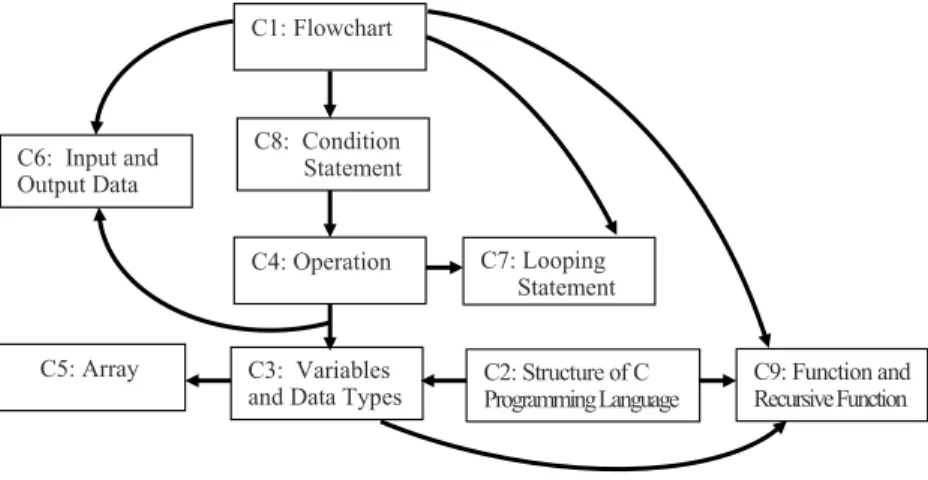
To diagnose the students’ learning problems on the topic Basic Computer Programming, the enhanced concept-effect relationship model (Panjaburee, Hwang, Triampo, & Shih, 2010) is used. Figure 1 presents the concept-concept-effect relationships on the topic, which show that to learn more complex and higher-level concepts effectively requires knowledge of some prerequisite concepts. For example, the concept “Variables and Data Types” should be learned before “Array”. Likewise, the concept “Structure of C Programming Language” must be learned before “Variables and Data Types” and “Function and Recursive Function”. These concept-effect relationships are important in diagnosing student learning problems; for example, if a student fails to answer most of the test items concerning “Array”, it is likely that the student has not thoroughly learned “Variables and Data Types”. Therefore, the student has to remedy the concept “Variables and Data Types” before learning “Array”.
Figure 1. The concept-effect relationships on the topic Basic Computer Programming concepts
Following the constructed concept-effect relationships, a multiple-choice test sheet needs to be developed by covering all concepts. When developing the test items, the weight of association concepts between each and each test item needs to be determined by multiple experts (3-5 experts are recommended) to gain high quality weighting values resulting in accurate learning problems. The weight values range from 0 to 5, with 0 indicating no relationship and 5 indicating that the test item highly relates to the concept. Once the weight values have been determined, the diagnosing process can work effectively. The students are required to log on via the internetworking interface. The personalized e-learning environment will present the test sheet for the students according to the constructed concept-effect relationships. After the students submit their answers, the personalized e-learning system will analyze the answers and provide personalized learning guidance based on the concept-effect relationships.
In the constructed concept-effect relationships, All the possible learning paths will be taken into consideration to find the poorly-learned learning paths. In the concept-effect relationships given in Figure 1, for example, the possible learning paths are as follows:
PATH1: C2C3C4C8and PATH2: C2C3C5
.
Assuming that the percentages of incorrect answers (PIA) for the test items concerning C2, C3, C4, C5, and C8 are 0%, 60%, 0%, 70% and 80%, respectively, we have
PATH1: C2(0%)C3(60%)C4(0%)C8(80%) and
PATH2: C2(0%)C3(60%)C5(70%).
A threshold θ is used to determine the acceptable failure ratio. If PIA (Cj) ≥θ, the student has to relearn concept Cj;
otherwise, the student has failed to learn the concept, such that the concept Cj is selected as a node of the
poorly-learned paths. In the developed e-learning environment, we have defined θ to be 51%, the poorly-learned paths are as follows:
PATH1: C3(60%)C8(80%) and
PATH2: C3(60%)C5(70%).
Therefore, the learning problems of the student could be the incomplete learning of concepts C3 meaning that concept C3 is the cause of learning failure. Thus, the student should learn C3 before learning C5 and C8. PATH1 has maximum PIA (80%); therefore, the learning path PATH1 is served as the learning sequence according to the student’s learning problems.
2.2 Personalized learning achievement
In the personalized e-learning environment, the percentage of incorrect answers (PIA) of each concept of each student is shown. This value could be used to categorized a student’s learning achievement into three groups namely, high-, middle-, and low-level. If PIA (Cj) is between 0.00 to 0.50 the student’s achievement in concept Cj
will be considered“low-level”, if PIA (Cj) is between 0.51 to 0.75 the student’s achievement in concept Cj will be
C1: Flowchart
C8: Condition Statement C4: Operation
C3: Variables and Data Types
C7: Looping Statement
C2: Structure of C
Programming Language C9: Function and Recursive Function C5: Array
C6: Input and Output Data
considered “middle-level” in concept Cj”. Otherwise, the student does not fail the concept and the student has no
learning problem in that concept. Therefore, the personalized e-learning environment will adapt supplementary material for individual learning achievement. We will develop supplementary materials by applying principles of instruction design (Gagne, Briggs, & Wager, 1992) as follows: (1) gaining attention of students with stimuli, (2) telling students about the learning objectives, (3) stimulating recall of prior knowledge and existing relevant knowledge, (4) presenting the content, (5) eliciting learning performance by asking students to respond and demonstrate learning, (6) providing feedback to reinforce learning, and (7) enhancing retention and transfer to other contexts by providing varied practice.
2.3 Personalized learning style
Among the various information sources and various ways of presenting learning content in the e-learning environment, the Index of Learning Style (ILS) (Felder & Solomon, 1988) questionnaire might be the most suitable model for an e-learning or web-based environment. Especially, the sequential/global dimension plays an important role in determining how a student receives and processes information. In the developed personalized e-learning environment, we used the sequential/global dimension to gain the information on the learning style of each student. A student with the sequential learning style learns in small incremental steps and therefore has linear learning progress that student will be asked to learn concept by concept based on the learning path. In contrast, A student with global learning style uses a holistic thinking process and learns in large leaps. He/She tends to absorb learning material almost randomly without seeing connections, but after having learned enough material, he/she suddenly gets the whole picture. Then he/she is able to solve complex problems and puts things together in novel ways but he/she has difficulties in explaining how he/she did it.
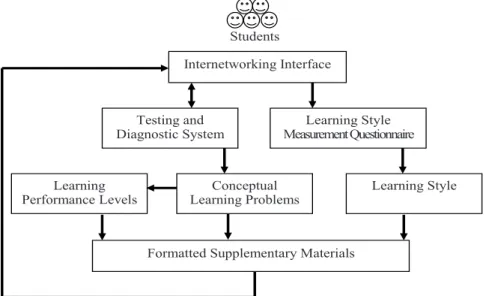
In conclusion, we constructed the concept-effect relationships and asked multiple experts to weight the association between concept each and each test item so that diagnosing the students’ learning problems could work effectively by analysing students’ test answers. In addition, Felder & Soloman’s (1988) Index of Learning Style (ILS) questionnaire was employed to adjust the presentation styles of subject material based on the personalized learning styles of the students. Learning achievements classified into high, middle, and low levels, used to arrange learning material for individual students as well. The developed e-learning environment workflow is shown in Figure 2.
Figure 2. The personalized e-learning environment workflow
Internetworking Interface
Testing and
Diagnostic System Measurement Questionnaire Learning Style
Learning Style Conceptual Learning Problems Learning Performance Levels
Formatted Supplementary Materials Students
3. Results and Discussion
To answer the research questions how the students gained knowledge after experiencing the developed e-learning environment and what the students’ attitudes about the developed e-e-learning environment are, pre- and post- conceptual tests and semi-structured interview were used to collect data, respectively. 23 undergraduate students were recruited to participate in this pilot study. As shown in Table 1, the normalized gain was 0.70 indicating that the students gained better conceptual knowledge after participating in the developed the developed e-learning environment, and the progression of their conceptual knowledge was reasonably high.
Table 1 Pre- and post- conceptual test results
n Mean % Normalized gain
Pre-test 23 7.78 25.94 <g> = 0.70
Post-test 23 16.96 56.52
Moreover, when we asked the participating students to report their own attitudes about the developed e-learning environment, we found that they had positive attitude toward the developed e-learning environment which fit with their personalized learning as follows:
StudentA: “I know my strength and weaknessandI canimprovement on the topic Basic Computer Programming”
StudentB: “It enhances myunderstandingand suggests suitableconcepts”
StudentC: “I think, using the developed e-learning can improve students' enthusiasm in learning interesting media and helpthen I can gainbetter knowledge.”
StudentD: “The personalized e-learning environment easy evaluates myself and can supplement media if defective to learn”
4. Conclusions
This paper presents an innovative personalized e-learning environment to promoting students’ learning on the topic Basic Computer Programming for undergraduate students. Three sources of personalized information including personalized learning problems, personalized learning styles, and personalized learning achievement were used to determine the personalized subject materials on the topic. The developed e-learning environment can be used to work with an online learning system by giving personal guidance and appropriate learning material to each student based on their online learning performance.
To evaluate the performance of this developed e-learning environment 23 undergraduate students were recruited to participate in this study. We found that the developed e-learning environment could help students gain more conceptual knowledge on the topic and they had positive attitude toward learning in this e-learning environment. The success of this study plays an important role in enhancing the effectiveness of the entire e-learning environment.
References
Casamayor, A., Amandi, A., & Campo, M. R. (2009). Intelligent assistance for teachers in collaborative e-learning environments. Computers & Education, 53(4), 1147-1154.
Eckerdel, A. (2009). Novice programming students’ learning of concepts and practise. Upsalla University: Sweden.
Felder, R. M., & Solomon, B. A. (1988). learning and teaching styles in engineering education. Journal of Engineering Education, 78(7), 674-681.
Gagne, R. M., Briggs, L. J., & Wager, W. W. (1992). Principles of Instructional Design. New York.
Hwang, G. J., Tsai, P.-S., Tsai, C. C., & Tseng, J. C. R. (2008). A novel approach for assisting teachers in analyzing student web-searching behaviors. Computers & Education, 51(2), 926-938.
Manning, S., & Dix, A. J. (2008). Identifying students' mathematical skills from a multiple-choice diagnostic test using an iterative technique to minimise false positives. Computers & Education, 51(3), 1154–1171.
Panjaburee, P., Hwang, G. J., Triampo, W., & Shih, B. Y. (2010). A multi-expert approach for developing testing and diagnostic systems based on the concept-effect model. Computers & Education, 55(2), 527-540
Soloway, E., & Spohrer, J. C. (1989). Studying the novice programmer. Hillside, NJ: Erlbaum. Winslow, L. E. (1996). Programming pedagogy. ACM SIGCSE Bulletin, 28(3), 17-22.