PROPOSED FRAMEWORK FOR IMPROVING
PERFORMANCE OF FAMILIAL CLASSIFICATION IN
ANDROID MALWARE
Fahad Abdulaziz O. Alswaina
Under the Supervision of Dr. Khaled Elleithy
DISSERTATION
SUBMITTED IN PARTIAL FULFILMENT OF THE REQUIREMENTS
FOR THE DEGREE OF DOCTOR OF PHILOSOPHY IN COMPUTER SCIENCE AND ENGINEERING THE SCHOOL OF ENGINEERING
UNIVERSITY OF BRIDGEPORT CONNECTICUT
352326(')5$0(:25.)25,03529,1*3(5)250$1&(2)
)$0,/,$/&/$66,),&$7,21,1$1'52,'0$/:$5(
)DKDG$EGXOD]L]2$OVZDLQD
8QGHUWKH6XSHUYLVLRQRI'U.KDOHG(OOHLWK\
$SSURYDOV
&RPPLWWHH0HPEHUV
1DPH 6LJQDWXUH 'DWH 'U.KDOHG(OOHLWK\ BBBBBBBBBBBBBBBBBB BBBBBBBBBBBBBBBBB 'U$XVLI0DKPRRG BBBBBBBBBBBBBBBBBB BBBBBBBBBBBBBBBBB 'U0LDG)DH]LSRXU BBBBBBBBBBBBBBBBBB BBBBBBBBBBBBBBBBB 'U6DURVK3DWHO BBBBBBBBBBBBBBBBBB BBBBBBBBBBBBBBBBB 'U6DPLU+DPDGD BBBBBBBBBBBBBBBBBB BBBBBBBBBBBBBBBBB3K'3URJUDP&RRUGLQDWRU
'U.KDOHG(OOHLWK\ BBBBBBBBBBBBBBBBBB BBBBBBBBBBBBBBBBB&KDLUPDQ&RPSXWHU6FLHQFHDQG(QJLQHHULQJ'HSDUWPHQW
'U$XVLI0DKPRRG BBBBBBBBBBBBBBBBBB BBBBBBBBBBBBBBBBB'HDQ6FKRRORI(QJLQHHULQJ
'U.KDOHG(OOHLWK\ BBBBBBBBBBBBBBBBBB BBBBBBBBBBBBBBBBB 6LJQDWXUH BBBBBBBBBBBBBBBBBBBBBBBBBBBBBBBBBBBBBBBBBB 10/26/2020RU
10/26/2020 BBBBBBBBBBBBBBBBBBBBBBBBBBBBBBB 10/26/2020HULQJ
J
J
J
J
J
J
J
J
J
10/26/2020 BBBBBBBBBBBBBBB BBBBBBBBBBBBBBBBBBBBBBBBBBBBBBBBBBBBBBBBBBBBBBBBBBBBBBBBBBBBBBBB BBBBBBBBBBB 10/26/2020 10/26/2020PROPOSED FRAMEWORK FOR IMPROVING PERFORMANCE OF
FAMILIAL CLASSIFICATION IN ANDROID MALWARE
PROPOSED FRAMEWORK FOR IMPROVING PERFORMANCE OF
FAMILIAL CLASSIFICATION IN ANDROID MALWARE
ABSTRACT
Because of the recent developments in hardware and software technologies for mobile phones, people depend on their smartphones more than ever before. Today, people conduct a variety of business, health, and financial transactions on their mobile devices. This trend has caused an influx of mobile applications that require users' sensitive information. As these applications increase so too have the number of malicious applications increased, which may compromise users' sensitive information. Between all smartphone, Android receives major attention from security practitioners and researchers due to the large number of malicious applications. For the past twelve years, Android malicious applications have been clustered into groups for better identification. Characterizing the malware families can improve the detection process and understand the malware patterns. However, in the research community, detecting new malware families is a challenge. In this research, a framework is proposed to improve the performance of familial classification in Android malware. The framework is named a Reverse Engineering Framework (RevEng). Within RevEng, applications' permissions were selected and then fed into machine learning algorithms. Through our research, we created a reduced set of permissions using Extremely Randomized Trees algorithm that achieved high accuracy and a
shorter execution time. Furthermore, we conducted two approaches based on the extracted information. The first approach used a binary value representation of the permissions. The second approach used the features' importance. We represented each selected permission in latter approach by its weight value instead of its binary value in the former approach. We conducted a comparison between the results of our two approaches and other relevant works. Our approaches achieved better results in both accuracy and time performance with a reduced number of permissions.
ACKNOWLEDGEMENTS
My thanks are wholly devoted to God who has helped me all the way to complete this work successfully. I owe a debt of gratitude to Prof. Elleithy for his guidance, patience, motivation, and immense knowledge during this research. To my parents for their prayers and patience. To my good wife for her encouragement and support throughout the academic journey; you and our little man, Abdulaziz, are my best friends and blessings in my life. Furthermore, to my teacher, Prof. Ausif Mahmood for being there for mentoring. Without them, this research would not have been possible.
I would also thank my respectful committee members: Prof. Ausif Mahmood, Dr. Miad Faezipour, Dr. Sarosh Patel, and Dr. Samir Hamada for their great feedbacks and constructive criticism. I am honored that my work has been supervised by Prof. Khaled Elleithy.
TABLE OF CONTENTS
ABSTRACT ... iv ACKNOWLEDGEMENTS ... vi LIST OF TABLES ... ix LIST OF FIGURES ... x CHAPTER 1: INTRODUCTION ... 11.2 Research Problem and Scope ... 2
1.3 Motivation behind the Research ... 3
1.4 Contributions of the Proposed Research ... 4
CHAPTER 2: LITERATURE REVIEW ... 5
2.1. Android and Malware ... 5
2.1.1 Android Operating System ... 5
2.1.2. Android Application ... 6
2.1.3. Android Malware ... 10
2.2. Android Malware Related Work ... 13
2.3 Analysis ... 15 2.3.1. Static Analysis ... 15 2.3.2. Dynamic Analysis ... 15 2.3.3. Hybrid Analysis ... 16 2.4. Techniques ... 16 2.4.1. Model-Based ... 16 2.4.2. Analysis-Based ... 22 2.5. Features ... 24 2.5.1. Static Features ... 24
2.5.2. Dynamic Features ... 25 2.6. Discussion ... 26 2.6.1. Experimental Datasets ... 26 2.6.2. Limitations ... 28 2.6.3. Challenges ... 28 2.6.4. Directions ... 29
CHAPTER 3: RESEARCH PLAN ... 31
3.1 Proposed Framework ... 31
3.2 Framework Components ... 33
3.3 Application’s Features ... 34
3.4 Data Preprocessing ... 36
CHAPTER 4: EXPERIMENTAL SETUP ... 41
4.1 Dataset ... 41
4.2 Implementation ... 41
4.3 Evaluation ... 42
CHAPTER 5: RESULTS AND DISCUSSIONS ... 44
5.1 Experiment 1: Familial Classification without Oversampling ... 44
5.2 Experiment 2: Familial Classification with Oversampling ... 48
CHAPTER 6: CONCLUSIONS ... 52
REFERENCES ... 53
APPENDIX A ... 70
LIST OF TABLES
Table 2.1 Taxonomy table of the literature 18
Table 2.2 Dataset, number of publications, and publication details 27
Table 2.3 Commonly used datasets and their details. 28
Table 2.4 Genome dataset’s families with one sample 29
Table 4.1 List of malware families with their samples in the dataset Genome used in RevEng
42 Table 5.1 Detailed performance (prediction accuracy and time) for each classifier
(without oversampling)
44 Table 5.2 Average of the classifiers’ accuracies and time performance for our 100
experiments (without oversampling)
45 Table 5.3 Comparison between classifiers in terms of the best accuracy and best time
performance (without oversampling)
46 Table 5.4 Average of the classifiers’ accuracies and time performance for our 100
experiments (with oversampling)
48 Table 5.5 Comparison between classifiers in terms of the best accuracy and best time
performance (with oversampling)
48 Table 5.6 List of SFCand with their importance (ω >0) 50
LIST OF FIGURES
Figure 2.1 Android platform architecture 7
Figure 2.2 Dexing Java classes into classes.dex 9
Figure 2.3 Android malware families’ taxonomy 17
Figure 2.4 Dataset reported by publications, where the x-axis represents the number of publications
27 Figure 3.1 Demonstrates the contents of components and the relation between them 34 Figure 3.2 Extraction of the important features from SF and generating SFCand 36
Figure 3.3 Top 10 permissions based on their importance 36
Figure 3.4 Pseudo-code of the Dataset, Family, and App components shows the main parts of the code
37 Figure 3.5 Multi-threading processes of the list of tasks in queue 38 Figure 3.6 Preparation of MBcand and MWcan matrices for processing 39
Figure 3.7 RevEng framework 40
Figure 5.1 Comparison between StormDroid and our approach based on classifiers’ accuracies (without oversampling)
46 Figure 5.2 Comparison between StormDroid and our approach based on time
performance (without oversampling)
47 Figure 5.3 Comparison between StormDroid and our approach based on classifiers’
accuracies (with oversampling)
49 Figure 5.4 Comparison between StormDroid and our approach based on time
performance (with oversampling)
49
Figure 5.5 Confusion matrix of one RF execution 51
CHAPTER 1: INTRODUCTION
Due to the recent developments in hardware and software technologies for mobile phones, people depend on their smartphones more than ever before. As of 2017, more than 407 million mobile devices were sold as reported by Gartner; devices that operate on Android recorded 86% of the total market [1]. Although this popularity is beneficial to Google’s operating system, Android, this popularity has propelled malicious developers to target Android users. F-Secure, a known corporation on cybersecurity, has reported that more than 99% of total malware attacks on mobile devices have targeted Android devices [2]. The attacks include software with malicious code, called a payload, that performs harmful activities and compromises the confidentiality, integrity, or availability of the victims’ data or resources [3]–[5].
Google, as well as a large group of researchers in academia and the industry, has devoted significant attention to security issues in Android’s software stack’s components, especially at the application level, such as in licensing and application verification, security vulnerability, and intrusion detection. Nevertheless, with smartphones’ ever-increasing advanced features, such as high-resolution cameras and sensors, as well as online services such as banking and GPS, so too increase the number of malicious applications (or malware apps); users’ data and resources are always at risk. As defined by Google, there are 17 categories of malware like spyware and backdoors categorized based on the malware’s behavior [6].
1.2 Research Problem and Scope
Classifying malware families is an important approach for anti-virus companies (AVs). AVs, as well as other researchers, try to find new malware that does not correlate to previously found malware. Nevertheless, malicious developers try to find ways to bypass the AVs’ detection by both closely studying the behavior of AVs and by applying various techniques to get around their detection techniques, such as code obfuscation.
AVs have been using the signature-based technique to detect any malware. Signatures (i.e. the hash value of the file) of a malware are a single or a group of blueprint data that is generated and associated with the malware. Every company has its own signature for the same malware. However, since malicious developers always attempt to bypass the detection and hide their code, they change the content and create variants of the malware. Any changes made to the malware will have a direct effect on the hash of the file and will impact the other signatures created for the malware.
With today’s continues increasing number of applications, there is a need for a proper identification of malware features that would characterize both malware and its variants. Those features are used as inputs to machine learning algorithms for classifications. Such algorithms or classifiers are trained to create a model that would identify the finger-like of the malware and the malware’s variants.
Although extracting features helps in studying the malware, the size of the features set affects the overall complexity of the learning process. In this case, researchers should focus on identifying the smallest set of features that give the highest and most accurate classification result.
1.3 Motivation behind the Research
Cybersecurity is an essential defense line to preserve the privacy of users. Users can be targeted such as a governmental employee in a military department or a head of a financial company. The information leakage has a tremendous impact on their own life or on the place they work for. Beside targeted users, an ordinary individual can be randomly hunted and the leakage of of data would impact them and their surroundings as well. Malicious developers utilize the information for their own evil benefits or can be used by other spying agencies.
Especially with the applications when the malicious developers get control of a device and are granted the trust from the user, they will last for long period and less likely to be removed unless their control was detected. By keeping the malware installed, information will be streamed without prior knowledge of the user.
With the advancement in data science and machine learning, classifiers can be trained on all sort of malware to come up with models. Models are used afterward for evaluation. When models are ready, they are deployed for testing and start classifying the application. The machine learning field, nowadays, is supported by many research efforts, academic, and industrial organizations for different problem domain: classification or regression problems.
With this track of research, AVs will be able to match any variant of the malware quickly to their families by applying the same detected malware signatures. Thus, AVs can easily adopt patches they developed for the previously identified malware. Moreover, this research will support malware researchers to complement their efforts to study undiscovered malware families.
1.4 Contributions of the Proposed Research
This research has proposed a novel framework, i.e., RevEng, that classifies 1,233 samples of malware. Our framework identifies an optimal set of permissions, a set that gives high accuracy, out of all the permissions provided by an Android operating system. We used the feature’s ranking algorithm used in Extremely Randomized Trees. The set of permissions is tested on six classifiers to assign malware into its family. RevEng also achieves a higher prediction accuracy rate than other related work. To evaluate our approach, we list a detailed comparison with StomDroid’s framework results [7]. The list of abbreviations used in the dissertation is provided in Table A.1. In summary, the proposed contributions in this research are summarized as follows:
▪ We introduce a novel taxonomy that categorizes all the related work in familial classification in terms of the type of analyses, features, and techniques that has been used.
▪ We design and implement RevEng that reverse-engineers malware datasets based on their families and extracts the permissions from apps.
▪ We are targeting a multi-class classification problem to assign a detected malware sample to previously studied and dissected malware families.
▪ The proposed approach can identify a minimal subset of features with higher accuracy and a minimum execution time compared to other related work.
CHAPTER 2: LITERATURE REVIEW
The chapter discusses the Android operating system, application, and Android malware with their attack and activation techniques. Also, we discuss in detail the related work in three dimensions: type of analysis, techniques used, and features. We identified the datasets are used and show the limitation and challenges in the literature. At the end we conclude with the future directions of the research. This chapter is published in [8].
2.1. Android and Malware
In this section, we discuss Android operating system and application. We address the main components inside them and define some technologies and fundamentals. Then, we discuss Android malware and the attacks they use to harm the user.
2.1.1 Android Operating System
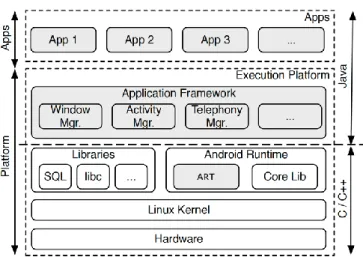
Android is one of Google products that is designed for smartphones and mostly written in Java language. Android uses a Linux kernel to communicate with the hardware. The platform architecture [9] consists of: system apps, Java API, C/C++ libraries, HAL, and Linux kernel. The updated overall architecture of the Android in [10] is shown in Figure 2.1.
System Apps. System apps (also called core apps) are applications that come pre-installed on the Android system for email communication, SMS messaging, or calling service. Third-party
applications are native apps that do not come preinstalled on the system and can be downloaded from the Android application store (Google Play) or other unofficial markets. Google Play is a place that indexes all Google trusted applications.
Java API Framework. A set of Application Programming Interface (API) written in Java to communicate with system components and services. Applications utilize APIs such as view system (i.e. button and text boxes), the resource manager (i.e. graphics and layouts), notification manager (i.e. alerts on the status bar), activity manager (i.e. managing back stack for activities), and content provider (i.e. share data).
Native C/C++ Libraries. Many of the kernel core components are built from libraries that are written on C and C++ languages. Libraries such as Webkit, Libc, and OpenGL ES are some of those libraries.
Hardware Abstraction Layer (HAL). HAL provides the hardware capabilities to Java API Framework.
Linux Kernel. Linux kernel is modified and updated especially for Android. The kernel does not include GNU C compiler, GNU libraries, or X server like in known Linux kernel. Some of the included features to this kernel are Low-memory Killer, Wakelocks, Anonymous Shared Memory, Paranoid Network, and Binder.
2.1.2. Android Application
Android applications are written on Java language and compiled to special bytecode called Dalvik bytecode. Dalvik bytecode is interpreted using Dalvik Virtual Machine (DVM). DVM is a register-based VM that uses CPU registers to store the data in the instruction.
In 2017, Google announced Kotlin to be another official Android development language. Android contains four main components that form the building blocks of the application [11]: Activities, Services, Broadcast receiver, and Content providers. Activity is a Java class (a single screen) and entry point that the user interacts with. For example, in a phone app, contacts screen is an instance of an activity that shows a list of contacts. Services are background processes that process long-running jobs. An example of a service is running some updates for the application.
Broadcast receiver is a component that responds to system announcements or delivers broadcasts to another or within the same app. An example of this component is when the user notified that the battery is low. Finally, Content provider manages data stored in a database, i.e., SQLite, or in the file system. It allows other apps to query such data if they have the permissions. For instance, the content provider responses to the user click on the contacts list and show the list in the phone app. Moreover, it is important to mention an important message event called Intent. Intent is a message object that is used to perform some operations such as starting an activity or a service or delivering a broadcast message to broadcast receivers. The intent object contains a set of
information such as component name, action to be performed, data type, category type, extras, and flag.
Android applications, either system or third-party app, communicate with the Android platform via defined Application Programming Interfaces (APIs). Android framework provides a list of APIs that a developer can call to extend the functionality of the hardware without direct use of lower layers of the architecture. Such functionalities are managing user interface (UI) elements, accessing shared data storage, and passing messages between application components. As in Linux, the Android app is assigned a unique user id (UID) and group id (GID). Each app runs in a separate process to identify and isolate each app’s resources from each other. Using UID, Android creates kernel-level application sandbox to enforce kernel security.
Android application is compressed in an archive format file, like any other known formats such as ZIP and JAR, called Android Application Package (APK). APK contains seven files: asset, lib, meta-info, res, androidmanifest.xml, classes.dex, and resources.arsc. In this section, we limit our discussion on two main files: the manifest file (Androidmanifest.xml) and the code file (classes.dex).
Android manifest. The manifest file is an XML format file that provides beforehand a set of information about the app and declaration of the app components. Information such as the app’s package name and version number, permissions required by the application, app entry points, and registered intents.
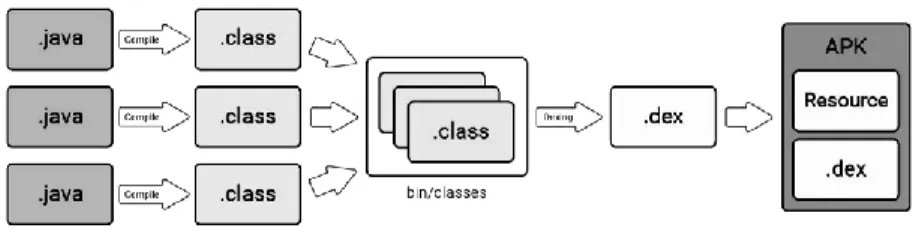
Dalvik executable (DEx). The file classes.dex contains a set of files (bytecodes). Those files are a special type of bytecode called Dalvik Bytecode that are compiled from normal Java
classes. In Figure 2.2, we show the steps of converting Java classes and the generation of a DEx file [12].
Android Access Control
To protect the system’s resources, Android, like in Linux, uses an forced access control mechanism to remove the malware and render it harmless. Android requires application to request permissions prior to utilizing the resource [13]. In the application level, permissions must be declared inside the AndroidManifest where essential information on the app and its components are located. Prior to Android version 6, the user was required to grant access to all what app requests at the time of the installation. The risk of this, besides the user’s weak knowledge of the requested permissions and what they mean, is that an app can deceive the user by requesting permissions unrelated to the app’s main functionality. Malware app can leverage some permissions to gain access to the resources and perform its malicious acts [14]–[16]. In Android, there are more than 300 permissions, each of which has a level of protection considered either normal or dangerous [17]. A designation of normal implies low risk to the isolated resources. All permissions with normal level are automatically granted to the app by the system without the user’s consent (i.e., SET_WALLPAPER). Permissions categorized as dangerous, however, have a higher risk on the user’s data and the device (i.e., ANSWER_PHONE_CALLS). For this reason, dangerous
permissions require the user’s consent prior to the installation in order for access to be granted application [17]. This research examines the permissions that malware families request as features for our static analysis.
2.1.3. Android Malware
In this section, we discuss the most recognized type of malware attacks in the literature such as: repackaged, update attack, and drive-by download as listed in [18]. Furthermore, we discuss the way that malicious payload is executed. Finally, we conclude the section by discussing malware families and characteristics.
A malware could secretly be embedded in a set of deceptive applications and can be identified by detecting the malware’s files or similar malware characteristics (i.e. signature or requested permissions), on the set. This set containing the malware’s files is identified as a family of the malware [19].
Malware families. A family of malware is a group of malware that shares common characteristics and behavior. Adopting an attack or malicious behavior by inserting a payload (or more than one payload) requires using the same package names used for the attack. By frequent use of package names (or other common characteristics), this becomes one identity (signature) of a group of malware (family). For example, AnserverBot family, a popular malware family, uses com.sec.android.provider.drm the package name in the code. Another example is that malware in DroidKungFu family contain a package named com.google.ssearch [18]. The family is identified by a unique name. Some of malware families are show in Table 4.1. Another family is
Google-Play. DroidDream family is a Trojan that collects the mobile device’s I.D. or serial number
and other related information by requesting administrator access control on the device. This Trojan can be detected by locating the two code files rageagainstthecage and exploid in the family members [18], [20]–[22]. DroidDream is one of the advanced and sophisticated types of malware. Other common malware families are listed in [23].
Attack techniques. One of the most common techniques is to piggyback a known app with a malicious payload. This technique is known as repackaging as the malicious disassemble an app, insert the malicious code (payload), and repack the app. Examples of such malware families are ADRD, AnserverBot, and BgServ [18]. An alternative way of the same technique is update attack. This is in order to repackage the application when performing updates. A victim installs the modified app, without the payload, to avoid detection. When it is time for the update, a payload will be installed with the new version. Families such as BaseBridge, DroidKungFuUpdate, and Plankton are some examples of families adopting this technique.
Another technique is called drive-by download. In this technique, the victim installs an app that advertises another app that is either standalone or repackaged malware. In addition, instead of advertising, the download request can happen without user notification. This could happen when the user grants certain permissions to the app to download when the user first installs the main application. GGTracker, Jifake, Spitmo, and ZitMo are some of the families using this type of attack.
Obfuscation techniques. Obfuscation is a way to make code unclear. Malware (or commercial apps) use this technique to hide their actual code. Some of the obfuscation techniques are: Renaming method and variable. When it comes to naming a method and variable, the name
should reflect the behavior of the method or variable. In the case of malware and when malware is identified by some methods or variables names as signatures, changing the names helps the malicious developer to bypass the AV.
▪ String Encryption. One technique that AV uses to quickly scan an application is to look for a link, a form of URL or IP address, to a remote server. The server is also called command and control (C&C) from which the application receives commands and run them on the victim’s device. For the malware to hide this link, it needs to be encrypted. The encrypted link will be decrypted at the usage moment. The obfuscated strings are hard to reverse engineer and then hard to read. In general, encryption can make the application heavy and very slow to execute. But the technique has been used to encrypt part of the code to avoid detection.
▪ Control Flow Obfuscation. Even when the code is obfuscated, experience developer and malware analyst can draw an understanding of the behavior of the obfuscated code from matching the control flow of the program. To make the code unpredictable, developers obfuscate the control statements as well.
▪ Dummy code insertion. Last technique is to insert codes that do not relate to the actual behavior of the malware. This code is called dummy since it is not used, but to mislead the scanner from reading and understanding the code.
Finally, there are tools used for obfuscation. Common Java obfuscators are ProGuard [24] and DexGuard [25], which are widely used.
Activation techniques. This technique associated with Android events. BOOT_COMPLETED event, for example, is triggered when the device finishes the booting
process. Malware uses this event to be notified when the device is up and running to activate the malicious process. Other events such as SMS_RECEIVED that is triggered when an SMS is received is utilized by zSone family. Another example is a ACTION_MAIN event that is triggered when an app’s icon that is clicked is adopted by a DroidDream family.
There are many papers contributed to detecting such techniques such as [26]–[30]. For example, Tian et al. [30] designed a repackaged detection technique. Their technique based on partitioning the code into two levels, class-levels dependency graph (regions), and method-level call graphs. They utilize machine-learning to recognize internal behavior using three types of features: permissions, sensitive API calls, and user interaction.
How anti-virus works. Malware signatures, as they have been manually analyzed or detected, are saved in an AV database to be compared against files under scanning. When a match is found in the file, the file (or app) is considered malicious, and it will be quarantined.
2.2. Android Malware Related Work
In this section, we review the survey papers on Android malware. Most of the surveys focus on malware detection, including [31]–[39]. The most recent survey has reviewed papers on malware detection while focusing on their approaches; they discussed the advantages and disadvantages of each detection approaches and methods [32].
The following survey has proposed a taxonomy to categorize Android malware detection techniques; they highlighted the trends and the challenges [34]. The following two survey papers have provided an outline of the methodologies used in classifying malware based on work surveyed [33], [38]. The authors in [35] have focused on the state-of-the-art papers in identifying
malware behaviors based on a diverse set of features; they highlighted the effective features in detecting malware. Yan and Yan have surveyed the related work in dynamic malware detection; they focused on the performance evaluation criteria on malware detection [36].
Souri and Hosseini have conducted a systematic survey on the state-of-the-art papers in utilizing data mining techniques in malware detection; they categorize the techniques into signature-based and behavioral-based. Furthermore, they discuss the importance of data mining techniques in malware detection [37]. Riasat et al. have provided a comprehensive survey on the tools and methods used on malware detection; they highlighted the various types of tools used in the research field [39]. Arshad et al. categorize the antimalware and penetration techniques proposed by state-of-the-art research to protect the Android system; they highlighted their limitation and benefits [31].
The previous surveys on malware detection have focused on malware detection. In this survey, our focus is on malware familial classification, detection, and analysis, which will introduce a baseline for future work in this domain.
To conduct our review, we followed an exploratory research approach. We investigated more than a thousand papers published in journals and conferences. To filter out the selected papers, we considered keywords. The following respectable scientific databases are explored: IEEE Xplore [40], ACM Digital Library [41], MDPI [42], ScienceDirect [43], Hindawi [44], Springer [45], and arXiv [46], and we also used reputable literature search engines such as Microsoft Academic [47], Semantic Scholar [48], and Google Scholar [49]. Keyword criteria for selecting a literature contain main and optional keywords. Main keywords are Android malware and malware family. Optional keywords are malware detection, familial classification, malware
family identification, and malware family categorization. We have classified the related work according to their type of analysis, techniques, and features.
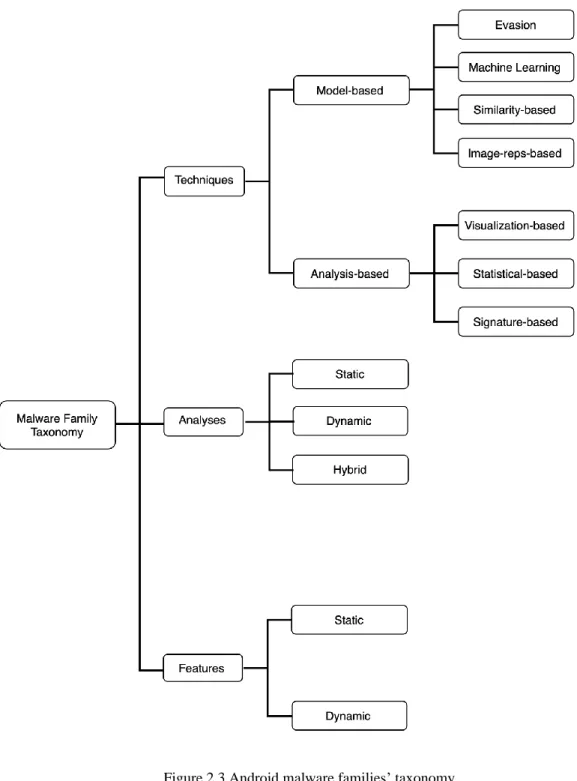
Our complete taxonomy is shown in Figure 2.3. and Table 2.1. The taxonomy categorizes all the related work in familial classification in terms of the type of analyses, features, and techniques that has been used.
2.3 Analysis
In this section, we discuss the type of analysis followed by the state-of-the-art. They are static, dynamic, and hybrid analysis.
2.3.1. Static Analysis
Static analysis is applied while the app is in a static state. It basically collects information about the app such as the app’s name, size, permissions, code, and programing pattern. Some of the information requires reverse engineering the app from machine code to a readable format to analyze the code. The advantage of performing such analysis is that it is fastest and cheapest since it doesn’t require executing the application nor does it require monitoring activities. A drawback of the analysis is that many malware launch their attack at runtime. In addition, other malware use an obfuscation technique or encrypted methods which cannot be read or decrypted unless the app is executed. A set of papers [50]–[77] used static analysis. Details on the static features used by the papers were discussed in Section 2.5, Features.
2.3.2. Dynamic Analysis
of an app. It monitors the inside and outside action, connections, calls, and clicks that happen while the app is being executed. Such analysis has the advantage of detecting wide-range and sophisticated malware. Malware families that are bound to an event that were mentioned earlier can only be detected while the app is running. The disadvantage of such analysis is that it is time-consuming. In addition, it requires a priori knowledge of the malware technique to monitor. Several papers have applied dynamic analysis such as [78]–[83]. Details on the dynamic features used by the papers were discussed in Section 2.5, Features.
2.3.3. Hybrid Analysis
Hybrid analysis is a combination of both static and dynamic analysis. Although hybrid analysis has the advantage of covering both analyses, it has a major drawback. Such analysis is a time-consuming process considering the huge number of malware samples to be detected and analyzed. Papers such as [84]–[88] have used hybrid analysis and the details on the features used were discussed in Section 2.5, Features.
2.4. Techniques
In this section, we discuss the techniques used by the state of the art to address the familial malware problem. There are two main techniques used: model-based and analysis-based.
2.4.1. Model-Based
In a model-based technique, a model is created to classify malware into families. There are four main categories of techniques used, which are machine learning, similarity analysis and image
processing, and evasion.
Machine learning. The literature use machine learning to classify malware samples into families.
Index Year Reference Analysis Features Technique
1 2020 Fang et al. [50] Static Static Image-reps-based 2 2019 Qiu et al. [51] Static Static Similarity-based and
Machine Learning 3 2019 Zhang et al. [52] Static Static Signature-based and
Machine Learning 4 2019 Zhiwu et al. [53] Static Static Visualization-based and
Machine Learning 5 2019 Mirzaei et al. [54] Static Static Visualization-based 6 2019 Vega et al. [55] Static Static Visualization-based 7 2019 Vega et al. [56] Static Static Visualization-based 8 2019 Jiang et al. [57] Static Static Machine Learning 9 2019 Fasano et al. [58] Static Static Machine Learning 10 2019 Blanc et al. [84] Static Static Machine Learning 11 2019 Xie et al. [60] Static Static Statistical-based and
Machine Learning 12 2019 Turker et al. [61] Static Static Statistical-based and
Machine Learning 13 2018 Atzeni et al. [84] Hybrid Dynamic and Static Signature-based 14 2018 Kim et al. [85] Hybrid Dynamic and Static Visualization-based and
Machine Learning 15 2018 Fan et al. [62] Static Static Visualization-based and
Machine Learning 16 2018 Sun et al. [78] Dynamic Dynamic Visualization-based 17 2018 Martin et al. [79] Dynamic Dynamic Machine Learning and
Statistical-based 18 2018 Aktas et al. [86] Hybrid Dynamic and Static Machine Learning 19 2018 Garcia et al. [63] Static Static Machine Learning
Index Year Reference Analysis Features Technique
20 2018 Calleja et al. [64] Static Static Evasion and Machine Learning 21 2018 Alswaina et al. [65] Static Static Machine Learning 22 2017 Massarelli et al. [80] Dynamic Dynamic Signature-based and
Machine Learning 23 2017 Zhou et al. [66] Static Static Visualization-based and
Similarity-based 24 2017 Chakraborty et al. [87] Hybrid Dynamic and Static Machine Learning 25 2017 Sedano et al. [67] Static Static Statistical-based 26 2016 Battista et al. [71] Static Static Signature-based 27 2016 Hsiao et al. [81] Dynamic Dynamic Visualization-based 28 2016 Gonzale et al. [68] Static Static Visualization-based 29 2016 Fan et al. [69] Static Static Visualization-based and
Machine Learning 30 2016 Kang et al. [70] Static Static Similarity-based 31 2016 Malik et al. [82] Dynamic Dynamic Statistical-based 32 2016 Sedano et al. [72] Static Static Statistical-based 33 2016 Feng et al. [88] Hybrid Dynamic and Static Visualization-based, Machine
Learning, and Signature-base 34 2015 Aresu et al. [83] Dynamic Dynamic Signature-based and
Similarity-based 35 2015 Lee et al. [73] Static Static Signature-based and
Similarity-based 36 2015 Li et al. [74] Static Static Visualization-based and
Machine Learning 37 2015 Garcia et al. [89] Static Static Machine Learning 38 2014 Deshotels et al. [75] Static Static Visualization-based and
Similarity-based 39 2014 Suarez et al. [76] Static Static Statistical-based and
Index Year Reference Analysis Features Technique
40 2013 Kang et al. [77] Static Static Statistical-based and Machine Learning
In [53], the authors classify the malware using Deep Learning (DL) techniques. In [79], the authors classify malware into families using classical machine learning such as Support Vector Machine (SVM) and DL algorithms such as CNN and RNN. In [76], the authors use a Nearest Neighbor classifier (NN) to classify malware into families. In [57], the authors preprocess the data and extract the sensitive opcode sequence. For the minor families, they use the oversampling technique to overcome this issue. To represent the semantic features of the sensitive opcode sequence, they use text mining (i.e., Doc2Vec algorithm [90]). Finally, they train their model using nine machine learning algorithms such as SVM and Randomforest. In [80], the authors feed the fingerprint to an SVM algorithm to classify malware into families. In [74], the authors construct the feature vector and feed it to several machine learning algorithms such as Randomforest. In [60], the authors used SVM to classify the samples into families. In [77], the authors feed the features to several machine learning classifiers such as Decision Tree and Association rules. In [64], the authors build a framework to train the classifier algorithm with a set of samples to drive the heuristic search using a Genetic algorithm. In [62], [69], the authors use frequency graphs (FreGraph) as their features to be fed into several machine learning algorithms such as SVM, Decision Tree, and Randomforest to classify the malware into families. In [59], the authors feed the Android-oriented matrices to several machine learning algorithms such as SVM, KNN, and Decision Tree. In [63], the authors apply machine learning algorithms to extract complex features and used them to classify malware into families. In [61], the authors use three machine learning
techniques: standard classifier such as SVM, ensemble classifier, and Neural Network to classify malware into families. In [65], Alswaina et al. use two models to perform familial classification. The authors use the binary representation of the features and weighted importance. Then, they use six machine learning algorithms to predict malware families. In [86], the authors apply three filters to filter the features. The dynamic and static features are combined and fed to machine learning algorithms, such as Randomforest and KNN for classification. In [51], the authors apply Linear SVM, DT, and DL algorithms. Fene et al. [88] utilize the SVM algorithm.
In [87], the authors use supervised algorithms such as Randomforest. Moreover, the authors use unsupervised learning such as K-means and mean-shift due to unbalanced samples in each family. They also propose ensemble clustering and classification techniques, which integrate the results generated from the supervised and unsupervised algorithms. In [85], the authors optimize the weight of features using community detection algorithms. They further classify the malware into families using machine learning. In [52], the authors use the fingerprints to classify malware into families using online passive-aggressive (PA) classifiers. Further details of PA can be found in [91]. In [58], the authors extract features from the apps and create code metrics. Then, they binary classify (coarse-grain) the samples. The malware is further classified into families (fine-grain).
Evading detection. In this technique, the goal is to evade detection or elude classifiers into misclassification. In [64], the authors build a framework to alter the malware to perform an attack and misclassify the results.
In [83], the authors use the token-subsequence algorithm to extract and generate signatures from each family based on network traffic analysis. In [70], the authors represent opcode as a vector of binary and frequency to compute the similarity between the malware and families. In [66], the authors evaluate their approach by performing similarity analysis. In [75], the authors perform two tests. The first test is used to binary classify malware. In the second test, they apply the agglomerative clustering algorithm to cluster the apps into families. To evaluate their model, they compute the distance between the malware and the clusters’ centroids to validate which family the sample belongs to. In [73], the authors cluster the families based on the most frequent key terms used by each family. Then, they use the dictionary search method for classification. In [51], the authors use TF-IDF to represent the frequency of the features.
Image representation. Some literature classifies the malware to malware families based on image representation. In [50], the authors convert the DEX file into an image and plain text. Then, they extract the color and the texture feature from the image. For the three features: color, texture, and text, they feed them into the feature Fusion algorithm to classify malware into families.
2.4.2. Analysis-Based
In the analysis-based technique, an analysis is carried to analyze and construct features to observe families’ characteristics. There are three sub techniques under this approach, which are signature-based, statistical analysis, and visualization analysis.
Signature-based. They construct a signature for each family to identify the families. In [83], the authors use a multi-step clustering approach: First, they apply coarse-grained clustering and then apply fine-grained clustering. In [52], the authors construct the fingerprint of the malware
families using n-grams analysis and features hashing. In [80], the authors generate a fingerprint for each family. In [73], the authors construct a signature of each malware family based on the collected features. Feng et al. [88] propose an approximate signature matching algorithm to generate signature for malware families.
Statistical analysis. They applied statistical tools to analyze and identify the family’s characteristics and the important features. In [76], the authors use statistical analysis and text mining to extract the features. In [79], the authors use Markov chain to represent the features. In [60], the authors eliminate unimportant features using the frequency-based approach. In [77], the authors compute the bytecode frequency. In [61], the authors apply a feature ranking algorithm to identify the most important features.
Visualization analysis. They visualize the characteristics of families using graph mining and PCA. In [53], the authors extract DFG and CFG. Then, they encode the graphs into a matrix. In [85], the authors represent the features using a network graph. In [66], the authors collect the sensitive API calls and then construct graphs based on sensitive API calls. Then, they characterize malware families based on the subgraph isomorphism. In [74], the authors construct a short and long APIs dependency path to perform context and constant analysis. In [75], the authors disassemble the app into Smali files. Then, they create class dependency graph (CDG) to group the classes into modules to identify which module contains malicious code. In [62], [69], the authors use community detection, subgraph matching, and subgraph clustering to generate the FreGraph. Feng et al. [88] utilize an inter-component call graph (ICCG) to represent the
2.5. Features
In this section, we discuss the types of features used by works of literature to classify malware into families. They are classified into static and dynamic features.
2.5.1. Static Features
Static features are any features that can be recognized or utilized without the execution of the application. Some examples of static features are package name, application size, permissions, and list of APIs.
A set of papers [55], [56], [65], [67], [68] uses features that are related to malware installation such as repackage and update, payload activation such as on booting and receiving calls, and privilege escalation attack such as asroot and exploid families [18]. Moreover, in [55], [56], [67], they include other features related to financial charges such as SMS and phone calls. Vega et al. in [55], [56], also include features related to personal information stealing such as phone number.
In [51], [54], [57], [60]–[64], [66], [69], [72], [74], [75], [88], [89], a subset of sensitive or suspicious API calls are utilized in their feature set. Permissions used in the app are included as features in [51], [60], [61], [65], [72]. Moreover, in [57], sensitive opcode sequence, actions, and strings are utilized in their features. Garcia et al. [63], [89] added native code-based to their set of features.
Fasano et al. [58] and Blanc et al. [59] use a set of metrics generated from Smali files to measure the quality code of the app to be used as features. However, in [57], [70], [71], [73], [77],
code-based analysis such as Java bytecode, bytecode frequency, opcode, or opcode sequence are used as features.
Other papers such as [53], [76] use data-flow graph (DFG) and control-flow graph (CFG) as features. In [50], the authors extract the texture, color, and text features from the DEX file. Zhang et al. [52] use features extracted from DEX as n-gram and hash code.
Finally, some works of literature have applied a set of static features in addition to dynamic features. In [87], the authors use 190 static features such as permissions. In [86], the authors use static features such as the number of services and receivers. In [85], the static features such as permissions, filename, and activity name are utilized. In the paper [84], a set of static features from the Android manifest in addition to an APK file that is generated from Androguard tool [92], a Python code to reverse engineer Android files.
2.5.2. Dynamic Features
Features that require execution of the application are considered dynamic. For example, network traffic, send/receive SMS, resource consumption, system logs, and I\O operations.
In [82], the author traced the system calls during the execution of the application. Aresu et al. [83] utilize network traffic (HTTP) in their classification. Martin et al. [79] depend on the features that are generated by a DroidBox [93] tool, an Android sandbox for dynamic analysis, which is represented as operations and function of time. In [81], the authors record the API calls that are performed during application execution. In [80], resources’ consumption is utilized as features for their classification. In [78], the authors use sensitive and permission-related API calls.
Finally, a group of literature works has applied a set of dynamic features in addition to static features. In [87], the authors use around 2048 dynamic features logs such as file I/O, network usages, and cryptographic usage. In [86], the authors use dynamic features that are generated using a DroidBox tool [93] such as the number of open/closed connections and the number of sent/received network packets. In [85], the dynamic features such as API call sequence are utilized. In [84], a set of dynamic features uses DroidBox [93] and CuckooDroid [94]. Feng et al. [88] use suspicious API call behaviors such as sendSMS API and data leakage.
2.6. Discussion
In this section, we highlight the datasets that have been used, the limitation of literature, the general challenges related to malware families, and we also report future directions.
2.6.1. Experimental Datasets
There are many datasets used in the literature that contain a collection of Android malware grouped into families such as: Android Malware Genome Project (Malgenome) [18], Drebin [95], the AMD [96] Project, and AndroZoo [97]. Some papers collected the malware samples from the Android market such as Anzhi, or a repository such as VirusTotal [98] and VirusShare [99].
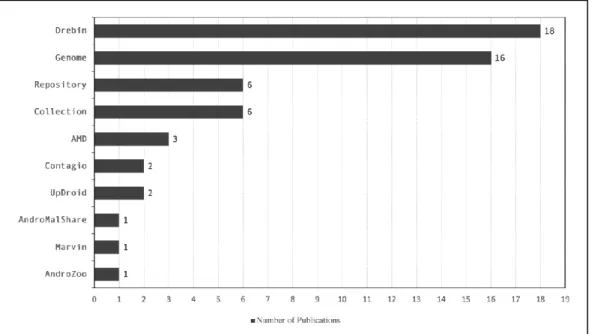
The datasets differ in the number of samples and number of families. For example, AMD [96] contains 4354 malware samples grouped in 42 families. While Drebin [95] has 5560 samples grouped in 179 families, other datasets such as AndroZoo [97] contain many more samples and families, where the number of samples is 10.7 million grouped into more than 3000 families. In Figure 2.4, we show the number of publications that uses each dataset found in the literature. Furthermore, Table 2.2 shows detailed information where the publications are included. The
repository category includes sites like VirusTotal, VirusShare, and Koodous, for which there is no fixed set to be used as benchmarks. Collection category refers to either an unknown collection performed by the author or sites such as HelDroid, FalDroid, and the Anzhi app market. As we see from Figure 2.4, the most used datasets are Drebin [95] and Genome [18]. More details on the commonly used datasets are reported in Table 2.3.
Dataset No. of Pubs. Publications Drebin [95] 18 [51]–[53], [57]–[59], [61]–[64], [71], [72], [78]–[80], [83], [87], [88] Genome [18] 16 [52], [55], [56], [63], [65]–[68], [70], [74]–[77], [81], [83], [88] Collection 6 [58], [60], [62], [73], [82], [85] Repository 6 [53], [60], [63], [69], [84], [87] AMD [96] 3 [50], [51], [61] UpDroid [86] 2 [61], [86] Contagio [100] 2 [53], [83] AndroZoo [101] 1 [54] Marvin [102] 1 [53] AndroMalShare [103] 1 [66]
Figure 2.4 Dataset reported by publications, where the x-axis represents the number of publications.
Dataset Total Samples Number of Families Drebin [95] 5,560 179 Genome [18] 1,260 49 AMD [96] 4,354 42 AndroZoo [101] 10.7M 3K+ 2.6.2. Limitations
As we surveyed forty research papers, we summarize the limitations to the following: First, most of the literature uses small datasets such as a few numbers of families or a few malware samples for studying families. Moreover, they use outdated or discontinues datasets such as Contagiodump (Contagio) [100] and Malgenome Project (Genome) [18]. In addition, several papers build their experiments on manually collected data without testing their model on benchmarked data. Several papers lack the disclosure of the list of features applied to reproduce the work.
2.6.3. Challenges
Family naming. One of the challenges that we observe is that there are no naming schemes (conventions) for the malware family. Naming a family is varied depending on the AV company. Families such as BaseBridge (or adSMS), Smssend (or fakeplayer), and DroidDream (or DORDRAE) are some of the families that have multiple names. One of the reasons is that one company names a family based on different share characteristics than other companies. Characteristics such as installation methods, activation, or the name of their malicious file name
are discussed in [18], [104], [105]. Attempts have been made by [101], [106], [107] to establish naming standards. Sebastian et al. [108] address the issue of inconsistent labeling (naming) of malware family and contribute the AVclass tool, an auto-labeling, as an effort to unify labeling. In addition, Euphony is a system proposed by [101] to unify different AV companies.
Imbalance Dataset. Some of the malware families contain hundreds of samples, while others contain as little as one sample such as DroidKungFuUpdate family in the Genome [18]. Other families with one sample in Genome dataset [18] are listed in Table 2.4. The rest of families in the dataset are shown in Table 4.1. This cause identifies the characteristics of a family as challenging. In case of standalone malware (not repackaged), the identification is almost impossible. Family SMSReplicator Walkinwat Endofday GGTracker GamblerSMS Lovetrap Zitmo CoinPirate DogWars NickyBot DroidCoupon DroidDeluxe Spitmo DroidKungFuUpdate FakeNetflix Jifake 2.6.4. Directions
Advanced machine learning. Malware families should be deeply analyzed and identified. Deep learning technology has been adapted to address various research problems including voice
recognition, image processing, and text analysis. One of the advanced techniques of Deep Learning is reinforcement learning, which can be utilized to better understand the families’ characteristics. Reinforcement learning has shown very promising results, especially in dynamic analysis. Another technique that should be adopted is transferred learning, which can be utilized to address the lack of samples in families.
Big data handling. Since the amount of malware is increasing exponentially, as it was reported by GDATA that almost 9K of new malware programs are reported daily [109], a scalable solution should be considered. For example, the AndroZoo [97] dataset has millions of samples that can be handled using big data technologies. One of the most important tools are Hadoop [110] and Spark [111]. They can handle a huge amount of malware data with fast processing.
Crowdsourcing. Beside Big data technologies, a group of malware family analyzers can be utilized to better identify and characterize the families. For example, a source can use a subset of features, while other sources investigate other feature sets. A malware repository VirusTotal [98] and VirusShare [99] are some examples.
Automated detection. The huge number of generated malware necessitate the call for automated analysis and classification of malware family rather than performing such tasks manually [85], [112].
CHAPTER 3: RESEARCH PLAN
The research developed a Reverse Engineering framework (RevEng). Within RevEng, applications' permissions were selected and then fed into machine learning algorithms (MLA). Through our research, we created a reduced set of permissions using Extremely Randomized Trees that achieved high accuracy and a shorter execution time. Furthermore, we conducted two approaches based on the extracted information. The first approach used a binary value representation of the permissions. The second approach used the features' importance. We represented each selected permission in Approach One by its weight value instead of its binary value. We conducted a comparison between the results of our two approaches and other relevant works. Our approaches achieved better results in both accuracy and time performance with a reduced number of permissions.
3.1 Proposed Framework
RevEng consists of four main components that include the Dataset, Family, App, and Analysis components. Each component parses and collects information on the dataset. The
Dataset, Family, and App components are included in the preprocessing stage, whereas the Analysis component is used in the processing stage. To explain our framework, we used the term
extracted features to indicate the result of collecting the selected features from the application; this is not to be confused with feature extraction terminology.
In the following section, we identify the functionality of each component in RevEng framework and their interactions to classify malware app and predict malware family. The following is a general flow of the framework. More details are added in the following section.
1) The Dataset is needed to parse and maintain information about the malware families in the dataset. The component takes the dataset and assigns each family to a Family component to be processed. At the end of the preprocessing stage, the Dataset processes the results of each Family component and constructs the input matrices (MBcand and MWcand) for the Analysis component in
the processing stage.
2) The Family component processes one malware family and keeps a list of all malware apps in the family. The component maintains and removes any duplicate of an application using the hash value of the malware. Each member of the malware family is assigned to an App component to be processed. In the end, the Family component processes the result obtained from each App component and passes them back to the Dataset.
3) The App component represents a malware app. It reverse-engineers the malware application, extracts the features and passes them back to the Family component.
4) The Analysis component is the where the framework applies MLA to generate classification models, train and validate them using input data from the Dataset to predict the malware families.
3.2 Framework Components
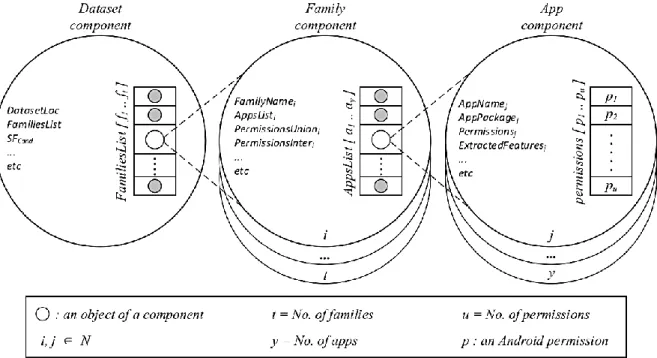
Dataset: This component contains general information about the dataset such as FamiliesList (a list of families in the dataset), SFCand (a candidate subset of selected features SF),
MBcand (a two dimensional binary matrix result from applying SFCand), MWcand (a two dimensional
weighted matrix result from applying the weight of each features in SFCand), and NoOfThreads
(number of threads set for framework efficiency, default is 4).
Family: This component contains detailed information on a malware family. Parameters such as FamilyName (name of the family), AppList (a list of apps in the malware family), PermissionsUnion (a set of all permissions declared in the malware family), and PermissionsInter (the intersection set of all permissions declared the malware family) are collected by this component.
App: This component is responsible for reverse engineering a malware app. It extracts information such as AppName (the application file’s name in the dataset), AppPackage (the application’s package name), Permissions (a list of permissions declared in the malware app), and ExtractedFeatures (a binary array result from applying feature selection in SFCand).
Analysis: This component consists of several machine learning algorithms or classifiers (MLAs). Each MLA creates a model with pre-set hyperparameters. These hyperparameters are elected and tuned based on trial and error to produce optimal results in our experiments. The MLAs’ models are trained, validated, and tested on MBcand and MWcand that are produced by the
Dataset component as inputs to each model to classify each input into its predicted malware family. In this component, we take advantage of Scikit-Learn libraries [113] to implement machine
learning algorithms. Figure 3.1 demonstrates the Dataset, Family, and App components’ data structure with pseudo-code.
3.3 Application’s Features
The features used in this research is an app’s permissions as requested by the malware apps (samples). The focus is on finding the optimal set of permissions, a set that gives high accuracy, out of all the permissions provided by an Android operating system. To accomplish this, one of the ensemble classifiers, called Extremely Randomized Trees (ET), [114] was utilized. ET, like Random Forest (RF) [115], is based on building a large collection (forest) of decision trees (DT). Each DT uses the whole set to build the tree and, for each split, finds the optimal cut-point based on information gain. RF develops each tree by selecting a random set of data and a random set of features. The target class of the observation predicted is based on the majority vote. For ET, the
algorithms add more randomness to RF such that on each split in a tree, instead of selecting the optimal cut-point, ET selects a feature at random. In addition, ET ranks the importance of each feature using Gini importance [116].
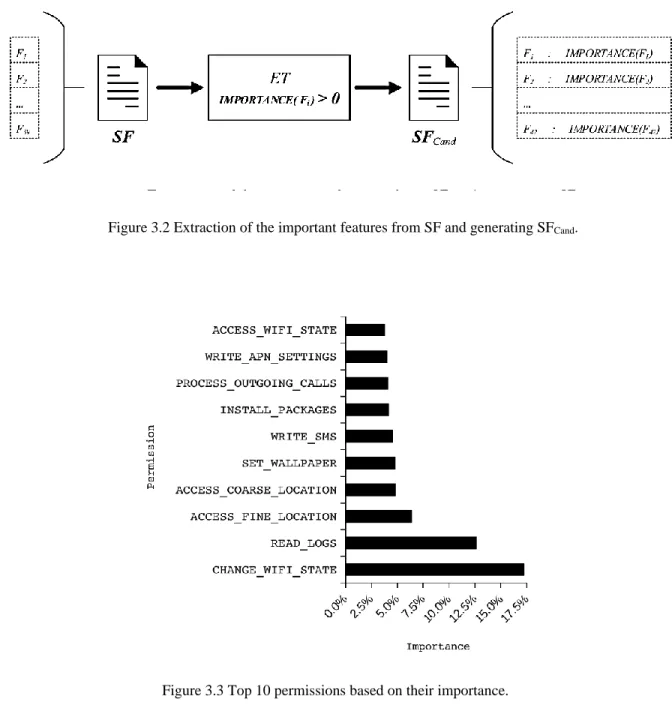
Features Reduction: The SF here is the permissions feature used in StormDroid [7]. To extract the important features, we run an ET algorithm on the SF. As a result, each feature in SF is assigned an importance value between zero and one, based on the information that the attribute provides in ET’s DT. All features with zero importance have been excluded since such features either do not add significance to uniquely classify a malware family (noise) or have some dependency between features. By collecting all features greater than zero, we have a Candidate Selected Features set (SFCand), a reduced set of features as shown in Figure 3.2. The ultimate SFCand
contains 42 out of 59 permissions. The SFCand chosen, with their importance, are included in Table
5.6. The top 10 permissions with high importance are shown in Figure 3.3.
Our analysis of the dataset shows that a group of permissions is requested by many malware families. For example, INTERNET (which permits opening a network socket) is requested by more than 82% of the malware families; READ_PHONE_STATE (which permits a reading of the device’s phone number, a status of ongoing calls, and phone accounts in the device) is requested by more than 60.5% of the malware families; ACCESS_NETWORK_STATE (which permits querying into the status of the network, such as if the device is connected to a network) is requested by more than 42.5% of the malware families. These permissions are also the top three permissions in both [18] and [17]. For this reason, these permissions are not critical to identify and classify one malware family from another. Therefore, the ET classifier assigns a very low importance to such features, as shown in Table 5.6.
3.4 Data Preprocessing
Upon beginning the execution of the framework, the Dataset component is initialized (Dataset.Init) with the dataset. Once the component is ready, RevEng starts loading and parsing
Figure 3.2 Extraction of the important features from SF and generating SFCand.
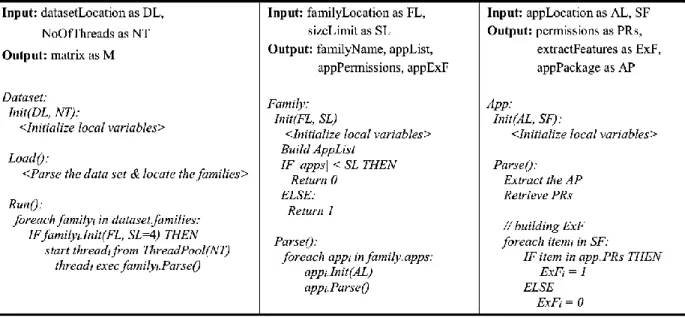
the dataset by executing Dataset.Load. To start creating the families’ objects, RevEng forks several threads (NoOfThreads) assigned in the initialization during the execution of Dataset.Run as illustrated in Figure 3.4.
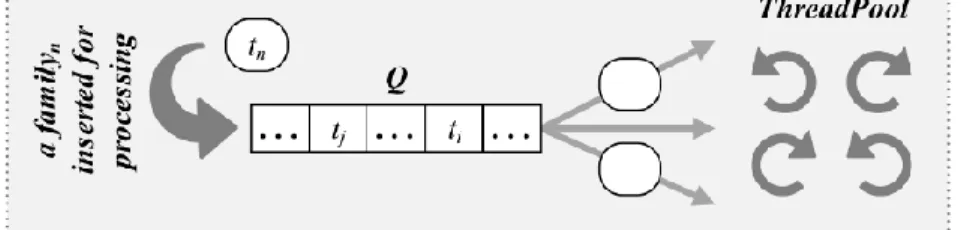
Multi-threading utilizes the processor and increases the reverse engineering process of the applications as illustrated in Figure 3.5. All objects of the Family component in this case, malware families–are inserted in a list (i.e., Q). Each thread processes one object as a task, (i.e., ti). Each
task initializes a family (Family.Init), loads a family’s contents, and starts parsing a family’s application (Family.Parse) as shown in Figure 3.4. Family.Parse initializes the App component (App.init) and parses it (App.Parse).
The App.Parse method, in turn, extracts information from the application such as the package name, all permissions in the manifest file, and checks the existence of each permission in SF in the app’s list of permissions. To extract the package name and the declared permissions in
the app’s manifest file, we used the Android Asset Packaging Tool (AAPT), which is part of the Android Software Development Kit (SDK). AAPT is a utility with powerful features that decompiles the package’s permissions listed in the Application manifest XML file, and it can also extract the resources’ table. The items’ indices in ExFA (extracted features) and SF (selected
feature) are in the same order. If an app A has a feature 𝜌 | 𝜌 𝜖 𝑆𝐹 in index i, then ExFA(i) = 1, otherwise ExF(i) = 0, and so on.
Each App’s ExF is cascaded back to the app’s family and then to the Dataset components as shown in Figure 3.6.
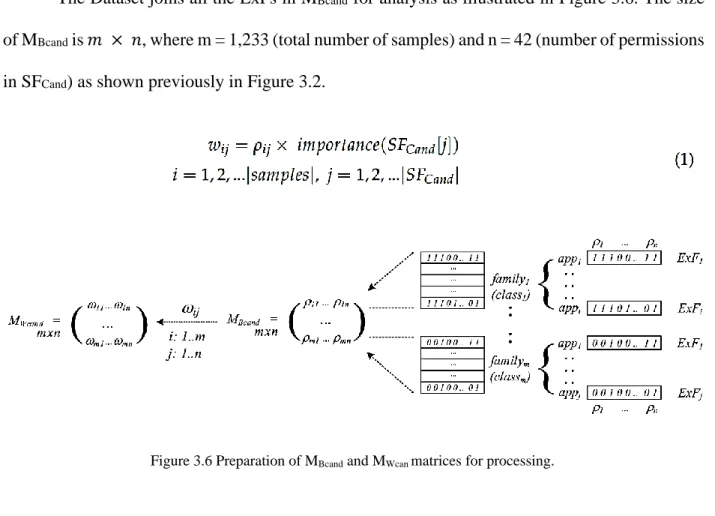
The Dataset joins all the ExFs in MBcand for analysis as illustrated in Figure 3.6. The size
of MBcand is 𝑚 × 𝑛, where m = 1,233 (total number of samples) and n = 42 (number of permissions
in SFCand) as shown previously in Figure 3.2.
To generate the Weighted Candidate Matrix MWcand, each element is calculated as in (1).
Each 𝜌𝑖𝑗 value in MBcand is multiplied by the permissions’ importance as generated by ET for the
permission’s index j. The Y matrix contains the malware families (classes: ci) of each malware
sample at row i in both MBcand and MWcand. MBcand and Y matrices are shown below: Figure 3.6 Preparation of MBcand and MWcan matrices for processing.
The overall framework is shown in Figure 3.7.
CHAPTER 4: EXPERIMENTAL SETUP
In this chapter, we show some details on the Genome dataset that we use in our research. Then will show the implementation and the evaluation of the approaches.
4.1 Dataset
We relied on the Genome dataset that was provided by [17]. This dataset contained 49 malware families with a total of 1,260 applications. Each family differed in size between 1 and 300 applications. In this research, families that contained less than 4 applications have been excluded to maintain accurate results. Table 4.1, lists the malware families and their samples used in our experiments, for a total of 1,233 applications in 28 families.
4.2 Implementation
The programming language Python was used in all our implementations. Python is supported by the research community in various fields and it has rich libraries. Scikit-Learn is one of the communities that has implemented Machine Learning Algorithms [113].
The Analysis component contains the following classifiers: Support Vector Machine (SVM), Decision Tree (ID3), Random Forest (RF), Neural Network (NN), K-Nearest Neighbor
Malware Family No. of Samples Malware Family No. of Samples GingerMaster 4 jSMSHider 16 HippoSMS 4 ADRD 22 FakePlayer 6 YZHC 22 GPSSMSSpy 6 DroidKungFu2 30 Asroot 8 DroidKungFu1 34 BeanBot 8 DroidDearmLight 46 Bgserv 9 GoldDream 47 Gone60 9 KMin 52 RogueSPPush 9 Pjapps 58 SndApps 10 Geinimi 69 Plankton 11 DroidKungFu4 96 zHash 11 BaseBridge 122 Zsone 12 AnserverBot 187 DroidDream 16 DroidKungFu3 309 Total 1,233 4.3 Evaluation
Cross-validation: Since the number of malware families is very low, as is the number of malware samples, we used the cross-validation (or stratified k-fold) technique to split and alternate between the training and testing sets. We set up the number of folds (𝑘 = 4) such that on each iteration, the classifier used 75% of a family’s samples for training and 25% for testing. In the processing stage, the Analysis component is fed MBcand and MWcand to be processed. Each classifier
trains, validates, and tests the model on the two inputs using the aforementioned setup. As a result of the analysis, we calculated each classifier’s accuracy (2) and the execution time in seconds.
Training-testing split: To address the imbalance data issue, we split the data into two sets, training, and testing set. We further apply random oversampling technique to the training set. We evaluate the model on the testing set.