THE PATHWAY ACTIVE LEARNING ENVIRONMENT: AN INTERACTIVE WEB-BASED TOOL FOR PHYSICS EDUCATION
by
CHRISTOPHER MATTHEW NAKAMURA
B.S., The University of Michigan, 2003 M.S., Kansas State University, 2006
AN ABSTRACT OF A DISSERTATION
submitted in partial fulfillment of the requirements for the degree
DOCTOR OF PHILOSOPHY
Department of Curriculum and Instruction College of Education
KANSAS STATE UNIVERSITY Manhattan, Kansas
Abstract
The work described here represents an effort to design, construct, and test an interactive online multimedia learning environment that can provide physics instruction to students in their homes. The system was designed with one-on-one human tutoring in mind as the mode of instruction. The system uses an original combination of a video-based tutor that incorporates natural language processing video-centered lessons and additional illustrative multimedia. Our Synthetic Interview (SI) tutor provides pre-recorded video answers from expert physics
instructors in response to students’ typed natural language questions. Our lessons cover
Newton’s laws and provide a context for the tutoring interaction to occur, connect physics ideas to real-world behavior of mechanical systems, and allow for quantitative testing of physics. Additional multimedia can be used to supplement the SI tutors’ explanations and illustrate the physics of interest. The system is targeted at students of algebra-based and concept-based physics at the college and high school level. The system logs queries to the SI tutor, responses to lesson questions and several other interactions with the system, tagging those interactions with a username and timestamp. We have provided several groups of students with access to our system under several different conditions ranging from the controlled conditions of our interview facility to the naturalistic conditions of use at home. In total nearly two-hundred students have accessed the system. To gain insight into the ways students might use the system and understand the utility of its various components we analyzed qualitative interview data collected with 22 algebra-based physics students who worked with our system in our interview facility. We also performed a descriptive analysis of data from the system’s log of user interactions. Finally we explored the use of machine learning to explore the possibility of using automated assessment to augment the interactive capabilities of the system as well as to identify productive and
unproductive use patterns. This work establishes a proof-of-concept level demonstration of the feasibility of deploying this type of system. The impact of this work and the possibility of future research efforts are discussed in the context of Internet technologies that are changing rapidly.
THE PATHWAY ACTIVE LEARNING ENVIRONMENT: AN INTERACTIVE WEB-BASED TOOL FOR PHYSICS EDUCATION
by
CHRISTOPHER MATTHEW NAKAMURA
B.S., The University of Michigan, 2003 M.S., Kansas State University, 2006
A DISSERTATION
submitted in partial fulfillment of the requirements for the degree
DOCTOR OF PHILOSOPHY
Department of Curriculum and Instruction College of Education
KANSAS STATE UNIVERSITY Manhattan, Kansas
2012
Approved by: Major Professor Dean A. Zollman
Copyright
CHRISTOPHER MATTHEW NAKAMURA 2012
Abstract
The work described here represents an effort to design, construct, and test an interactive online multimedia learning environment that can provide physics instruction to students in their homes. The system was designed with one-on-one human tutoring in mind as the mode of instruction. The system uses an original combination of a video-based tutor that incorporates natural language processing video-centered lessons and additional illustrative multimedia. Our Synthetic Interview (SI) tutor provides pre-recorded video answers from expert physics
instructors in response to students’ typed natural language questions. Our lessons cover
Newton’s laws and provide a context for the tutoring interaction to occur, connect physics ideas to real-world behavior of mechanical systems, and allow for quantitative testing of physics. Additional multimedia can be used to supplement the SI tutors’ explanations and illustrate the physics of interest. The system is targeted at students of algebra-based and concept-based physics at the college and high school level. The system logs queries to the SI tutor, responses to lesson questions and several other interactions with the system, tagging those interactions with a username and timestamp. We have provided several groups of students with access to our system under several different conditions ranging from the controlled conditions of our interview facility to the naturalistic conditions of use at home. In total nearly two-hundred students have accessed the system. To gain insight into the ways students might use the system and understand the utility of its various components we analyzed qualitative interview data collected with 22 algebra-based physics students who worked with our system in our interview facility. We also performed a descriptive analysis of data from the system’s log of user interactions. Finally we explored the use of machine learning to explore the possibility of using automated assessment to augment the interactive capabilities of the system as well as to identify productive and
unproductive use patterns. This work establishes a proof-of-concept level demonstration of the feasibility of deploying this type of system. The impact of this work and the possibility of future research efforts are discussed in the context of Internet technologies that are changing rapidly.
vi
Table of Contents
List of Figures...ix List of Tables...x Acknowledgements...xi Chapter 1 - Introduction...11.1 Background & Motivation...2
1.2 Research Questions ...8
1.3 Research Approach ...9
1.4 Broader Impact and Implications...11
1.5 Dissertation Organization...12
Chapter 2 - Review of Relevant Literature ...14
2.1 The Constructivist Perspective ...14
2.1.1 Piaget and Constructivism ...15
2.1.2 Vygotsky and the Zone of Proximal Development ...18
2.1.3 The Learning Cycle ...19
2.1.4 Ideas from Physics Education Research ...22
2.2 Related Work on Human Tutoring...24
2.2.1 The “Two-sigma Problem” ...24
2.2.2 Explaining the Effectiveness of Human Tutoring...26
2.3 Related Work on Human-Computer Tutoring...28
2.3.1 Computer-Human Coaching Research ...28
2.3.2 A Social Component of Human-Computer Interaction ...29
2.4 Multimedia & Digital Video in Physics Education and Beyond ...29
2.4.1 Digital Video in Physics Education...29
2.4.2 Prior Research on Multimedia in Instruction...33
Chapter 3 - Research Design and Methodology...36
3.1 Populations of Interest...36
3.2 The Pathway Active Learning Environment ...37
vii
3.2.2 The Pathway Active Learning Environment Lesson Materials ...41
3.2.3 Pathway Active Learning Environment Support Multimedia...50
3.3 Research Designs and Data Collection Methods ...50
3.4 Sampling Methods ...51
3.5 Data Analysis Methods...53
3.5.1 Qualitative Analysis of Interview Data ...53
3.5.2 Descriptive Analysis of PALE Log Data...54
3.5.3 Using Machine Learning to Group Student Responses ...55
3.6 Summary...59
Chapter 4 - Understanding Student Experiences with the Pathway Active Learning Environment ...61
4.1 Analysis of Data Logs and Interview Data...61
4.1.1 Student Perceptions of and Interactions with the SI Tutor ...62
4.1.2 Analysis of Student Queries to the SI Tutor ...66
4.1.3 Students’ Perceptions and Use of Video Measurement...69
4.1.4 Quantitative Analysis of Student Use of Video Measurement ...71
4.1.4 Student Perceptions and use of Multimedia Support...73
4.2 Discussion of Results ...73
4.3 Summary & Conclusions...77
Chapter 5 - Automated Analysis of Short Text Responses...79
5.1 Automated Analysis of the Short Responses to Lesson Questions...79
5.1.2 Automated Assessment Analysis Procedure...79
5.1.2 Success Criteria for the Analysis Scheme ...83
5.1.3 Results of Automated Analysis Procedure...84
5.3 Discussion of Short Response Data and Analysis ...92
5.4 Summary & Conclusions...95
Chapter 6 - Conclusions ...96
6.1 Overview of the work...96
6.2 Research Questions Answered...96
6.3 Future Work...98
viii
6.3.2 Further Work...99
6.3.3 Understanding this Work in the Context of Emerging Internet Technology...100
6.4 Final Conclusions...102
References ...106
ix
List of Figures
Figure 1.1 The Physics Teaching Web Advisory Interface ...3
Figure 1.2 An early design sketch for the synthetic tutoring system...8
Figure 2.1 The three stage learning cycle ...20
Figure 3.1 The Pathway Active Learning Environment interface...38
Figure 3.2 Schematic of SI-Tutor's functionality ...39
Figure 3.3 Tutors recruited for the project ...40
Figure 3.4 Proposed machine learning analysis scheme for student responses to lesson questions ...58
x
List of Tables
Table 2.1 Piaget’s Logical Knowledge Stages of Cognitive Development ...15
Table 3.1 Lesson one exploration activities ...44
Table 3.2 Lesson one application activities...45
Table 3.3 Lesson two exploration activities...46
Table 3.4 Lesson two application activities ...47
Table 3.5 Lesson three exploration activities...48
Table 3.6 Lesson three application activities ...49
Table 3.7 Student sampling for PALE studies ...52
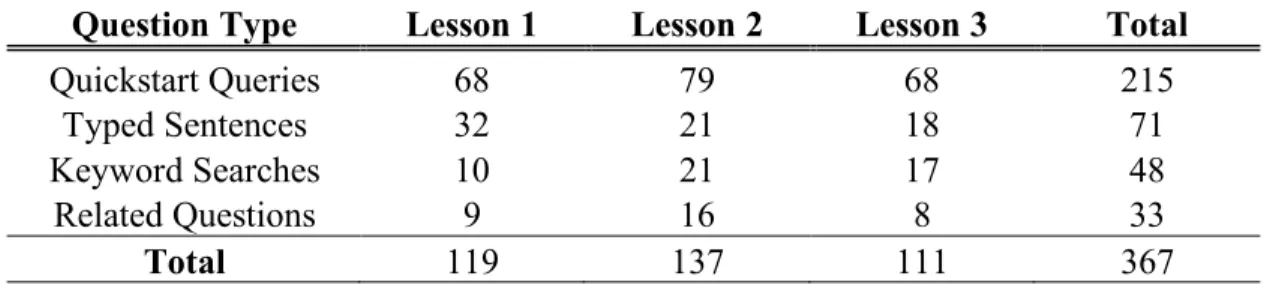
Table 4.1 Querying behavior across all three lessons for all interviewed students who had access to the SI Tutor (N=19)...68
Table 4.2 Average number of queries submitted to the SI tutor for the four treatment groups across all three lessons and in total. The indicated error bar is the standard error. ...68
Table 5.1 Benchmarking demarcations for Cohen’s Kappa values...84
Table 5.2 Match rate for machine learning analysis method ...85
Table 5.3 Match/mismatch details for lesson 1 exploration activity 1 question 5 ...88
Table 5.4 Match/mismatch details for lesson 1 exploration activity 3 question 5 ...89
Table 5.5 Match/Mismatch details for lesson 1 application activity 1 question 1 ...90
Table 5.6 Match/Mismatch details for lesson 2 application activity 1 question 1 ...91
xi
Acknowledgements
I would like to acknowledge the help and support of many without whom I would not have been able to complete this work. Obviously many thanks are due to my advisor, Dean Zollman, who has an amazing ability to strike the right balance between giving advice and encouraging independence. I have learned so much from working with him. Dean, thank you for taking a risk and taking me on as your student. Sanjay Rebello is a remarkable individual who teaches so many of us in the K-SUPER group by advising and by example. I’ve learned a great deal from talking with him and from watching him work as a researcher and teacher. I feel very fortunate to have worked with amazing people on the Pathway project: Sytil Murphy, Josh Gross, Bryan Maher, Mike Christel, Scott Stevens, Brian Adrian, and Nasser Juma. I also feel fortunate to have gotten to work with so many great people in the K-SUPER group over the years; it has been such a great environment to work in. Two stand out, however as needing special mention: Adrian Madsen who always checks to make sure we’re all still alive and Liz Gire who, in such a brief period of time, served as an unexpected role model. I have to thank Kim Coy for all the important things she does to help us conduct our research and drag our posters and papers all across the country. I also have to thank Peggy Matthews for fixing my tuition approximately forty-seven times and generally making life go more smoothly. For all of us, the significance of our lives can be defined only in terms of connections to the lives of others. I have been very fortunate to have benefited from so many helpful connections with friends, former co-workers (almost all of whom are also friends) and family. A huge thanks to my parents for instilling in me the love of learning that started all this trouble, for their love and for generously supporting me in my endeavors in many ways. Thanks to my brother for always being there to talk about interesting things and provide another view on whatever I’m thinking about. Finally, I am forever grateful to Sarah Nuss-Warren for her love and support. This work was supported in part by grants from the United States National Science Foundation under grant numbers REC-0632587 and REC-0632657.
1
Chapter 1 - Introduction
Reliable research findings on the instructional efficacies of emerging technologies have often lagged behind the claims about the transformative power of these technologies in
education. A contemporary example can be seen in discourse surrounding the Khan Academy, an online instructional website based around explanatory videos narrated by founder, Salman Khan (www.khanacademy.org, 2011). Proponents of online instruction have claimed that this system, and others like it will supplant traditional classroom instruction. Steven Pearlstein, for example harshly criticizes the current state of education and concludes, without research-based evidence, that video instruction, like that offered by the Khan Academy, represents a good solution (Pearlstein, 2011). The objective validity of this assertion is unknown, but the author’s perceived authority may lend the argument some weight, regardless of its actual validity. The economic implications for parents, teachers and society at large associated with accepting or rejecting these claims are clear and underscore the importance of solid research findings being the underpinnings of decisions about curriculum, and educational policy. Unfortunately Pearlstein does not cite research findings that suggest short narrated videos are superior to classroom instruction (2011). As Internet technologies increasingly become a part of 21st century life we can expect people to increasingly call these technologies into service for
education. In order to make good decisions about implementation, we need solid research results that help identify best practices for using these technologies for instruction.
The idea that educators can use video, multimedia and the Internet to positive effect is intuitive, and prior research results that support this idea are presented in this dissertation. These technologies can be used in many different ways and the most interactive and novel of these are only now emerging as the Internet continues to develop. It is not clear how to most effectively combine and use the various available technologies for instruction. Presently, the Internet offers a wealth of interactive capabilities that can be combined with multimedia modes of presentation to build very sophisticated learning environments, but research establishing clear design
principles and implementation strategies is lacking. Without these principles and strategies teachers, researchers and other curriculum developers are left with trial and error as the primary means of developing effective web-based instructional materials.
2
In this dissertation we present research designed to help fill in this gap. At its most general, the fundamental research question addressed by our work is this: what would a modern interactive multimedia-driven learning environment look like? More specifically we have explored this question in the context of physics, which is an active area of discipline-specific education research and provides a natural context for exploring these issues. To address this broad overarching question we tested several combinations of interactive web-based multimedia technologies in an effort to explore the ways that these technologies could be used to positive effect in supporting student learning of Newton’s laws by algebra-based and concept-based physics undergraduate physics students as well as high school physics students . At the same time we have explored the assertion that this type of technology can be used to study student learning of physics in those same populations. To do this we have exploited the Internet’s ability to quickly deliver multimedia, as well as its interactivity to produce a learning environment that is designed to emulate one-on-one tutoring. Learning frequently a social activity. One-on-one tutoring is both one of the most socially interactive methods of learning, and one of the most effective. Recognizing the benefits of one-on-one tutoring leads us naturally towards
incorporating that mode of instruction into our system design. It then becomes part of our goal to explore to what extent it is possible to create an online instructional system that emulates the positive social components of tutoring.
The remainder of this chapter provides an introduction to the research we are presenting, beginning with a previous research project from which this research has evolved. In this chapter we also discuss the motivations for performing this research, the research questions we have investigated, and our general research approach. The anticipated broader impact of our research within the physics education research community and beyond is also discussed. The chapter concludes with a discussion of the organization of the remainder of this dissertation.
1.1 Background & Motivation
This project is a natural evolution of the Physics Teaching Web Advisory (Physics Pathway) project. In that work educator-researchers sought to provide pre-service and in-service high school physics teachers with an electronic resource to help them better teach physics
(Stevens, Zollman, Christel & Adrian, 2007). A significant fraction of high school physics teachers are not primarily trained in physics, but must teach physics as part of their appointments
3
(Neuschatz & McFarling, 2000). At the same time, even beginning teachers whose content knowledge is quite solid, may have little practical experience in how to best teach physics topics. People in these situations may have questions about how to most effectively teach physics, and it would be helpful for them to be able to discuss these issues with a more experienced physics teacher. The Physics Pathway is a website developed to meet this need. With the aid of
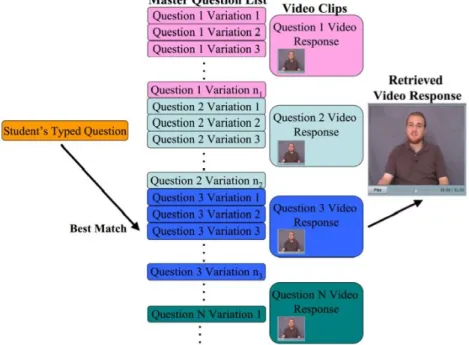
Synthetic Interview (SI) technology, which is discussed in detail in Chapter 3, section 3.1, novice physics teachers can ask natural language questions regarding physics demonstrations and
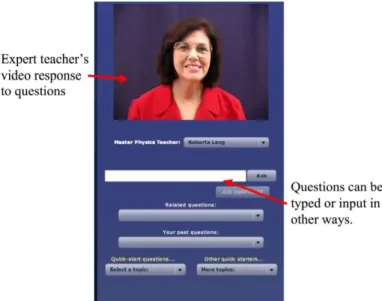
pedagogy via the keyboard. They then receive pre-recorded video responses to those questions, delivered by expert physics teachers (Stevens et al., 2007). The goal of the SI technology is to lend a socially interactive element to obtaining information on the web. By trading questions and answers the system begins to simulate some of the basic features of a simple conversation (Marinelli & Stevens, 1998). To create an effective help system several master teachers have recorded responses to common questions, and in total, answers to approximately 7,600 distinct questions can be viewed. This SI technology is the central feature of the Physics Pathway. The portion of the system interface that contains and controls the SI is shown in Figure 1.1.
Figure 1.1 The Physics Teaching Web Advisory Interface
The explanations that teachers receive from the SI interface are then supplemented by additional multimedia in two ways. First, in some instances the master physics teachers felt that their answer could be clarified by an image, and they produced the image, typically by hand.
4
Because of the difficulty involved in displaying their images within the SI video response, the pictures were digitized so that they could be displayed alongside the expert teacher’s response at the appropriate time. In addition to these images, the Physics Pathway provides access to a powerful digital video library that allows teachers to access video clips that reference physics concepts relevant to their questions (Christel, Kanade, Mauldin, Redy, Sribu & Stevens, 1995). The combination of these multimedia components creates a multimodal learning aid that can address multiple learning styles. The system also provides teachers with video clips that they can directly use in their classrooms.
A natural extension of this project is to ask whether a similar online interface could help answer students’ questions about physics content. It is not difficult to envision a student having difficulties with homework late at night or on the weekend. At that point the teacher is
unavailable. Without a resource, the student’s progress may be impeded for the evening. With a resource, the student may be able to get past the difficulty and continue to make progress. Even if the resource does not enable the student to completely resolve the difficulties, at the very least it may both prolong the time spent thinking about the material and change the manner in which the student thinks about the material. In the long run that additional effort and the experience of working with the resource could still help the student improve his or her understanding,
particularly when coupled with further instruction. In the past the only resource one could really envision in this type of situation was a textbook. More recently one could envision a search engine on the Internet providing the student with information, but this is still not particularly interactive. It also depends entirely on the student for creating a sense of focus or coherence; the student could easily spend a great deal of time with the search engine while doing very little to improve his or her understanding of the relevant material. The goal of this project is to construct and evaluate a resource that is interactive and can also be of direct help to a student when his or her teacher is unavailable. Our goal is to build and evaluate an online tutoring system based on the SI technology described above and similar in nature to the Physics Pathway that can provide students with video responses to their natural language questions. Those SI video responses can are supplemented with additional images or demonstrative video clips that address the relevant concepts, help the tutor connect physics ideas to physical reality and may help the students better build their physics knowledge. We call this system the Pathway Active Learning Environment (PALE).
5
Viewing our system in the context of tutoring provides us with a wealth of tutoring literature to build upon throughout the development process. Tutoring may, in some sense, be the oldest form of instruction. It also may be the most effective (Bloom, 1984). Learning gains similar to tutoring can be achieved by other means, but with significant effort (Bloom, 1984). The ability to achieve the efficacy of tutoring via direct replication of the tutoring intervention would therefore be of significant value to educators.
The social engagement inherent to tutoring may, in part, explain its efficacy as an
instructional method (Chi, Siler, Jeong, Yamauchi & Hausmann, 2001; Chi, Siler & Jeong 2004; Okita, Bailenson & Schwartz 2007). One could argue that since students only interact with a video interface the described system is not socially interactive. Prior research has addressed this issue, suggesting simulated social interactions via computer also provide learning benefits (Okita et al., 2007). We discuss that work in detail in Chapter 2. The key finding in Okita et al.’s work is that a student’s perception of social interaction may be more important than the presence of a real social interaction (2007). We believe that students, aware that the SI represents a real human who recorded the video, may assign some social weight to the interactions. This idea, that people interact with computers as if they were people is sometimes referred to as the computers as social actors hypothesis (Reeves & Nass, 1986). This hypothesis is one that our system can investigate. One could also argue that since the system we propose requires students to type questions and answers, rather than speaking them as one would do in a normal tutoring session, the system is very different from real tutoring and is lacking in social interaction. However, recent research has shown that students reap similar educational benefits from a computerized tutoring system regardless of whether they type or speak (D’Mello, Dowell & Graesser, 2011). At a more intuitive level we know that online chatting, which is an interaction that requires typing, is quite common and I doubt many would argue either that this is not socially interactive or that it is socially interactive in a very different way than talking face-to-face. Students may perceive elements of social interaction while working with our system, and those elements, should they exist, would likely have commonalities and differences with the social elements of a real tutoring session. One of our research motivations is then to empirically investigate to what extent we can simulate the social interaction of a tutoring session with our SI interface, and how the various multimedia components of our SI tutoring system can affect the system’s overall utility.
6
A key realization in the development of the system is that tutoring does not typically consist only of question-answer exchanges that occur in a vacuum. It is typically conducted within the context of some type of homework or other assignment. While ideally a student could bring his or her own homework to the interaction, clearly this is an overly ambitious first step. Predicting the type of work that the student will bring, the range of content knowledge that will be required to complete the work, and a variety of other information that is necessary to help the student with the work is impossible. For the computer to gather and interpret this information on a case-by-case basis is also essentially impossible. In order to be successful in building a proof-of-principle system and to be successful in encouraging a synthetic tutoring interaction, we will need to begin by providing the lesson materials that provide the context for the interaction. Once we have achieved success at the level, we may begin to consider how to address the case in which the student brings an unknown assignment to the tutoring session.
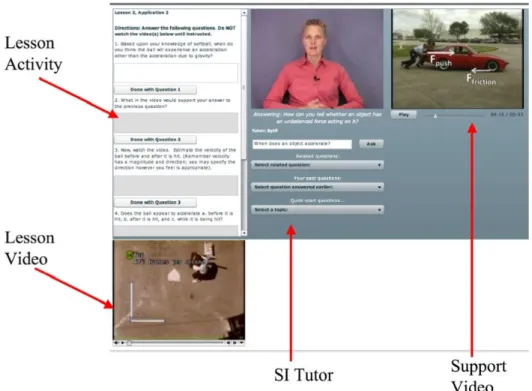
The lesson materials that we design obviously should provide students with questions, tasks, and problems that build and test their understanding of the relevant content material. At the same time, they should be designed to promote use of the SI-tutor. The lessons which we designed to meet this need will be discussed in detail in Chapter 3; here it is sufficient to note that our system really must consist of three components: the lessons, the SI-based tutor, and supplemental multimedia. An early conceptualization of the system’s interface, which shows these three components, is shown in Figure 1.2. Our goal then becomes to investigate the way in which these three components can be brought together to support learning.
Questions about the efficacy of different multimedia and pedagogical constructions flow naturally from this research goal. Research and curriculum development activities focused on the utility of digital video and video measurement and analysis in physics instruction has already established digital video as a useful instructional tool in physics (Brown & Cox, 2009; Laws & Pfister, 1998; Escalada, & Zollman 1997; Zollman & Fuller, 1994). Criticism has been leveled that in the physics education community controlled experiments have not produced sufficient quantitative data to test the efficacy of multimedia in instruction (Lewis, 1995). However, research aimed at experimentally testing and comparing the efficacies of various multimedia modes of presentation in the context of instruction can suffer from a number of severe confounding factors that are not easily overcome. These difficulties include problems
7
examples include the Hawthorne, John Henry and novelty effects). In essence a conflict exists between constructing an experimental design that is simple enough to execute and simple enough that one can reasonably expect to obtain results that are easily interpretable, and constructing a design that actually reflects the complexities of using multimedia as an instructional tool. These difficulties call into question the utility of simple “this versus that” experimental designs. Correspondingly, a lack of consensus exists on the relative efficacy of different modes of
multimedia presentation (Clark, 1983,1994). Clark has gone so far as to suggest that all modes of presentation are fundamentally equivalent (1994). While different modes of presentation can be made equivalent through methodical design, all implementations are clearly not equivalent. We therefore argue that, while simple comparative, experimental designs may not provide great insight into multimedia design, research on multimedia in instruction is- or can be a productive area of study. We further argue that research in this area should focus less on arguments about intrinsic efficacy and design principles and more on naturalistic observation and the development of effective implementation techniques. The research we have conducted centers on methods of effectively combining various multimedia components, including the interactive SI tutor, in ways that promote learning. Therefore, while comparing multimedia is inherent to the research, we do not adopt simple comparative experimental designs. Preliminary work on this project has shown that observing significant differences on a standardized pre-test and post-test is unlikely, but much can be learned from studying multimedia in instruction (Nakamura, Murphy, Zollman, Christel & Stevens, 2010). The research we discuss here does not seek to answer the questions about the efficacy of various forms of multimedia in instruction, which have been unanswered for decades, but instead seeks to establish naturalistic, observational research methods that can serve ongoing programs of study that we hope will ultimately produce richer, more nuanced answers to these lingering questions.
8
Figure 1.2 An early design sketch for the synthetic tutoring system
1.2 Research Questions
Beyond the broad overarching question of whether or not we can tutor effectively with an online system, the proposed research is appropriate for addressing several basic research
questions. The project is largely exploratory in nature, rather than explanatory. The research questions that we explored with this system are:
• How might students productively, or unproductively, interact with our online tutoring environment?
• How do students feel about working with this type of system? Is this something they perceive to be beneficial?
• How does the introduction and variation of multimedia components within the tutoring environment impact student learning?
• What technological or pedagogical features must be developed and implemented to build a video-based tutoring system?
Other projects that have sought to explore computerized tutoring from different
perspectives, such as Andes Tutor and Autotutor, have been ongoing for many years (VanLehn, Lynch, Schulze, Shapiro, Shelby, Taylor & Treacy, 2005; Graesser, Jeon, & Duffy, 2008). Thus, the research proposed in this prospectus is not an attempt to thoroughly document and refine every facet of the system’s educational and research merits, but instead an initial effort to
9
develop this type of system and explore some of the most fundamental and accessible features and capabilities, as a basis for further research.
1.3 Research Approach
Because of the exploratory nature of the research questions and the difficulties associated with objective measurement of student understanding and the process of knowledge construction, a mix of qualitative and quantitative research is appropriate. During the project we monitored students’ learning as they worked with the system. We looked for ways to establish means of comparing the work of students who have experienced different multimedia instruction while also collecting and examining students’ typed responses to free-response questions as a means of developing a richer picture of their understanding of physics.
There are several research contexts or environments appropriate for studying this type of tutoring system. Ultimately, we hope this type of system will be useful to students in their homes. If we are to learn anything from the system when students are using it in that context, we must design it to log as much of the students’ interactions with the system as possible. The system was designed to log students’ queries to the SI tutor, responses to lesson questions, and user ratings of SI responses. At the same time we cannot know everything about student use of the system in that context. We therefore observed student use of the system in controlled, though artificial, environments. The two obvious choices then become the classroom setting which allows instructors or facilitators to supervise and observe student use and the clinical interview setting, which allows for still more control and observation. As we will discuss in Chapter 3, our data collection focused on these three contexts:
1. Use in a clinical interview setting 2. Classroom use
3. At home use (or use in a location of the student’s choosing)
Looking at data from all three settings provided us with the best chance of piecing together an understanding of how our system can be effective. Data consisted of student interactions that can be logged by the system, transcripts from interviews, and video observational data obtained from student interview participants.
Data analysis will be discussed in greater detail in chapter 3, section 3.5. Here we note that the data analysis is both qualitative and quantitative in nature, especially in the beginning of
10
the data analysis process. The data that we have collected are comprised of the log of student interactions with our system (questions to the tutor, responses to lesson questions, etc…), as well as transcripts of interviews conducted with students who used the system in the clinical setting. These types of data can be analyzed from a phenomenographical perspective (Marton, 1981, 1988). The phenomenographical perspective seeks to characterize the different ways in which people experience a given phenomena (Marton, 1981). This perspective on qualitative research is applicable to education because of its intrinsically experiential nature, and its use in that capacity has been explored (Marton, 1981, 1988). Our approach is not a pure
phenomenographical design in the sense that we did not attempt to build a hierarchical outcome space, but rather, our approach was informed by the phenomenographical perspective. In our approach students’ statements in interviews can be coded line-by-line and analyzed for emergent themes and important instances. These can be brought together to form a coherent picture of students’ experiences with the system. By generating multiple lessons and letting students work with the system over the course of multiple weeks we may observe changes in their attitudes or understanding over time.
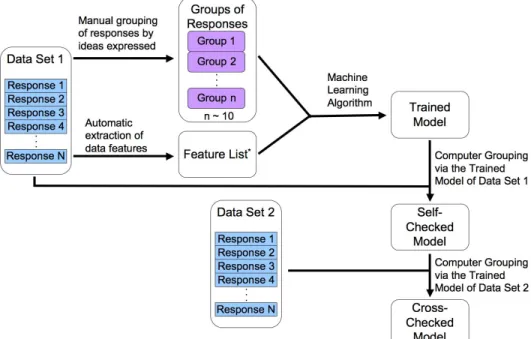
One approach to data analysis that is more quantitative and that might facilitate the generation of this type of time-resolved picture of students’ system usage and learning uses techniques from data mining and natural language processing. In this approach we begin by looking for similarities in the ideas different students express in their responses to a given question. Our observation of these types of groups, may allow for the identification of correlations in student responses across questions, that is identify patterns of responses that characterize differences in how students understand the material. At the same time, we show that it is possible to train computer models to tag responses based these groups. There are many positive implications of a trained computer model being able to effectively code student
responses, the most important being that the computerized classification of student responses may facilitate feedback to students, which in turn would help the system function more like a computer. Computer programs appropriate for this type of analysis have already been written and we make use of this prior work (Rosé, Wang, Cui, Arguello, Stegmann, Weinberger & Fischer, 2007). Furthermore, this type of approach has been used in biology education to code essays automatically (Nehm & Haertiz, 2011). It is also beginning to emerge as an interesting means of analyzing short-answer questions in physics education (Butcher & Jordan, 2010;
11
Nakamura, Murphy, Zollman, Christel & Stevens, 2011; Jordan, 2012) This approach to analysis is discussed in greater detail in Chapter 3, section 3.5 and the results of the analysis are discussed in Chapter 5.
Because of the exploratory nature of this research, the goal of this work is not to produce a theory, or test existing theory, but instead to explore the themes associated with students’ interactions with online interactive instructional materials.
Once a qualitative analysis is complete we may have better insight into ways that quantitative techniques can be used to extract more information about student usage patterns from the system’s logs. This possibility is also discussed in Chapter 3, section 3.5.
The research is grounded in a constructivist framework. The central ideas is that students must create their own knowledge structures based on their educational experience and that their prior knowledge in a certain sense acts as a seed for that knowledge construction process, and in every sense informs and affects the knowledge construction process. This theoretical grounding is discussed in greater detail in Chapter 2, section 2.1.
1.4 Broader Impact and Implications
The first and most direct opportunity for this proposed research to impact the broader communities of physics education research and physics instruction is in the sense that the lessons we learn in developing this proof-of-principle implementation may be applied to the generation of a more advanced learning environment that is useful for helping students to better learn across an entire curriculum. The Physics Pathway project has now expanded to address teachers’ questions on all of mechanics, electrodynamics, and much of modern physics. If this work shows that our system is useful for teaching students about kinematics and Newton’s laws, then it may be productive to expand the lessons to cover much of the same material addressed by the Physics Pathway system.
Beyond this purely pedagogical impact the expectation is always that research will produce results that inform further research. There are several ways in which this project has produced result that are of interest for future research projects. This research provides insight and guidance for the best methods of developing this type of technology for student learning, and for implementing this type of technology in ways that promote student learning, and in ways that avoid potential pitfalls of the misuse of technology.
12
1.5 Dissertation Organization
The remainder of this dissertation will discuss the research that has been done, in greater detail. Chapter 2 will discuss prior research relevant for this study, including theoretical
foundations, most notably the constructivist theories of learning, as well as review of work that has set these theories in a context more suitable for physics education research. Relevant
literature on useful knowledge organization schemes and cognition models will also be discussed in Chapter 2. Empirical and theoretical research that has bearing on this work will also be discussed. This research mostly focuses on prior studies of tutoring, both purely human tutoring, and human-computer tutoring. Assessment in physics education research will also be discussed. Chapter 2 will close with discussions of research focused on the instructional efficacy of
multimedia, including multimedia design theory and cognitive load theory which are related to this proposed work, not as much as a theoretical groundwork but as a research domain on which this work might have potential positive impact.
Chapter 3 discusses the methodology that will be used to conduct the research, including an in-depth discussion of the technology developed for this proposed research, the populations of interest, research designs, the methods of obtaining samples, data collection methods, as well as data analysis techniques.
In Chapter 4 the results of a quantitative analysis of data extracted from the PALE data logs as well as interview data collected with general physics students will be presented. This analysis is qualitative in nature and focuses on students’ experiences as they worked with the system.
Chapter 5 presents the results of an analysis scheme for typed responses to the short-answer questions collected through the PALE lesson activities. This approach combines human classification of text responses with analysis via computer models trained on human
classification schemes to investigate the possibility of automated analysis of future responses. This approach may enable us to provide more detailed, specific feedback to students based on their actual use of the PALE system. The approach may be of interest to designers of online learning environments more generally because of its potential for enabling feedback without constant human intervention.
13
Chapter 6 concludes the dissertation and presents a summative discussion of the research questions answered, the potential for future research, and final conclusions that can be drawn from this research effort.
14
Chapter 2 - Review of Relevant Literature
The literature relevant to our project can be divided into three components. The first component is literature that forms a theoretical groundwork upon which our work is based. Most prominent amongst this material are the constructivist theories of Piaget and Vygotsky. The second major component comprised of research specifically related to tutoring, and human-computer interaction. These studies allow our present research to connect to a web of related research efforts, and ultimately, to inform the future generation of theory and empirical studies in the field of computer-based tutoring. The third component is comprised of previous work on digital video usage in physics education as well as work on multimedia in instruction more generally. The former will focus on applications to give the reader a sense of what has already been done. The latter will center on a discussion of cognitive load theory and multimedia design theory, which is relevant to research in that researchers in those fields have established ideas on what constitutes effective use of multimedia in instruction but, for reasons that will be discussed in detail, we do not use this work as a theoretical grounding for ours.
2.1 The Constructivist Perspective
Efforts to understand learning in individuals have gradually shifted from being largely grounded in philosophy to being more scientifically grounded in the discipline of psychology (Vygotsky, 1997). Similarly psychology has increasingly shifted from a mind-centered orientation to a brain-centered orientation (Vygotsky, 1997). This shift reflects a scientific understanding of humans as wholly biological entities whose mental and physical existences are intimately intertwined. Clear evidence for these transitions can be seen during the first half of the twentieth century. An important result of scientific efforts to understand learning is the constructivist perspective on learning.
The constructivist perspective on learning has, at its core, the fundamental assumption that the process of learning is the process of constructing and organizing knowledge based on life experience. Directly following this assumption in importance is the assertion that our prior knowledge exerts great influence on how we construct and organize new knowledge. Two of the main figures whose independent work informs constructivist theories of learning are Jean Piaget
15
and Lev Vygotsky. Their theories differ somewhat in focus, but here we adopt the perspective that these differences are not contradictory, but instead reflect different facets of the knowledge construction process. Their respective views on knowledge construction will be discussed in turn, beginning with Piagetian constructivism.
2.1.1 Piaget and Constructivism
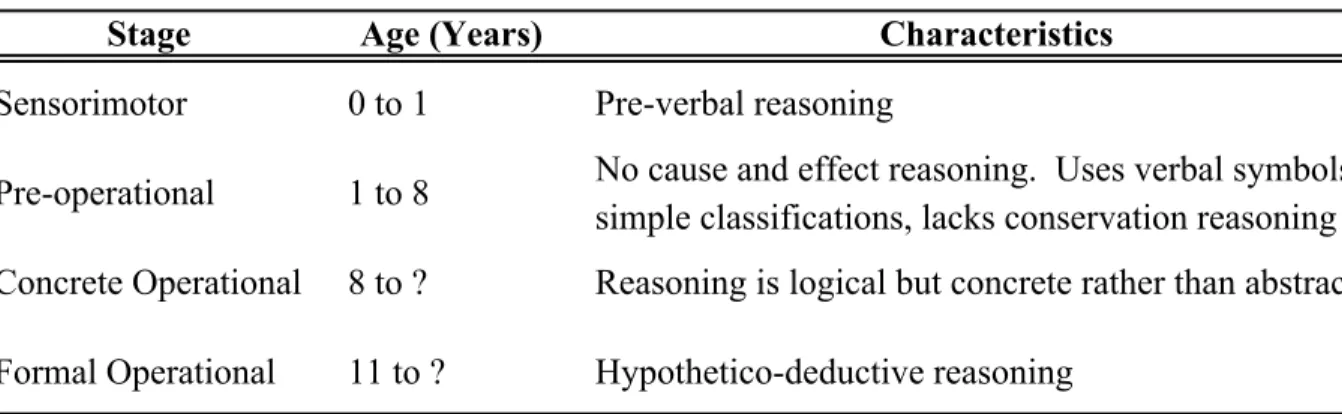
Piaget’s work as an epistemologist, studying learning processes in children and adolescents is most associated with constructivist theories of learning that emerged from his work (Beilin, 1992). Piaget’s perspectives on learning evolved through multiple stages (Beilein, 1992). We, however do not adopt the entire body of his work as grounding for our research. We are primarily interested in the facets of Piagetian constructivism that deal with formal reasoning and application of the ideas of adaptation and assimilation to the modification of knowledge structure (Flavell, 1996). Researching children’s intellectual development, it was natural for developmental staging to be a naturally emergent idea in his work (Beilin, 1992; Inhelder & Piaget, 1958). Useful logical knowledge stages of cognitive development identified by Piaget and the different characteristics of thinking that typically occur within those stages are described in Table 2.1 (Fuller, Campbell, Dykstra & Stevens 2009).
Table 2.1 Piaget’s Logical Knowledge Stages of Cognitive Development
Piaget characterizes these stages of learning based on the level of abstract of thinking that a child is capable of during that stage of development (Inhelder & Piaget, 1958; Fuller et al., 2009). Piaget identified these stages by observing children working through different tasks that required certain levels of reasoning ability, and determining the ages at which those reasoning abilities began to appear (Inhelder & Piaget, 1958). Researchers in physics education have
Stage Age (Years) Characteristics
Sensorimotor 0 to 1 Pre-verbal reasoning
Pre-operational 1 to 8 No cause and effect reasoning. Uses verbal symbols, simple classifications, lacks conservation reasoning Concrete Operational 8 to ? Reasoning is logical but concrete rather than abstract Formal Operational 11 to ? Hypothetico-deductive reasoning
16
observed that the concrete and formal operational classifications to be useful ideas even in adult populations (McKinnon & Renner, 1971). McKinnon and Renner found that about 50% of 131 college freshmen exhibited concrete operational behavior patterns when given tasks developed by Inhelder and Piaget to evaluate formal reasoning (1971). Only 25% of the students in that study operated at the formal operational level. The remainder exhibited a “Post-Concrete” level of thinking which is somewhere in between Concrete and Formal operational states. This finding begs the questions of whether students can become more formal in their thinking, and whether the study of subjects such as physics will promote such growth. McKinnon and Renner did observe changes in students’ logical thinking over time. In the same study, they contrasted the formal reasoning of a group that received an inquiry-based treatment curriculum with that of a control group, which had not received instruction. They found gains in the number of students who functioned at the formal operational level in both groups. However, they observed
significantly larger gains for the group that was taught with the inquiry-based curriculum. Piaget and colleagues, however never worked with adult populations, and may have been unaware of the possibility that adults could exhibit traits of concrete operational reasoning. McKinnon and Renner’s work suggests that Piaget’s Concrete and Formal Operational categories are useful for describing student reasoning in adult populations. Even within pre-adult populations there are questions about the universality of the scheme. Hundeide conducted research on student reasoning that indicated that the level at which children operated depended critically on the methods of investigation (1977). We suggest that though the age ranges outlined by Piaget and colleagues may provide a useful framework for understanding reasoning in some children, they can be rejected when dealing with adults without rejecting other relevant facets of their work. In particular, we suggest that the levels of reasoning may be meaningfully applied without the age ranges.
An important concept in Piagetian constructivism is the idea of a schema (Inhelder & Piaget, 1958). We can think of a schema as a conceptualization of a person’s knowledge as well as its structure and organization. Schemata can be modified either by assimilation or
accommodation. In the case of the former, new information, which is consistent with prior knowledge is added into a person’s schema. In the case of the later the schema is more radically altered to accommodate information that is in some way inconsistent with prior knowledge. In general assimilation is much easier than accommodation (Reddish, 2003). Accommodation
17
generally requires a form of motivation on the part of the student (Reddish, 2003). The student must recognize a problem with the current understanding and a compelling reason to change to a better understanding (Reddish, 2003). It is the two-component assimilation-accommodation model of learning more than any other idea that places emphasis on an active, constructivist perspective on learning, and this may be Piaget’s most lasting contribution to educational psychology (Flavell, 1992).
This process is related to the idea of cognitive dissonance, a feeling of discomfort due to a schism either between a person’s knowledge and an external observation (which is typically undeniable in nature) or a schism between two or more beliefs of which the person has
previously been unaware (Festinger, 1957). Obviously, the cognitive dissonance can be addressed in two ways. One can avoid ideas that are in conflict with one’s own beliefs, or one can change one’s beliefs to conform to external observations. Much of the research on cognitive dissonance has focused on self-image and the rationalization of actions that may be in conflict with a person’s self-image; a good example being the action of smoking in spite of the facts that it shortens life, and most people want to live a healthy and long life (Freeman, Hennessy, & Marzullo 2001). This view is not inconsistent with an application of the concept in education. For example, the clear demonstration of a conflict between how a student describes an object’s motion and how Newtonian dynamics describes an object’s motion can produce two internal conflicts. Clearly, the conflict is between the student’s understanding of the situation and science’s accepted description of the situation. However, the conflict is also between the student’s self-image as a knowledgeable person who understands how things work, and a demonstrated image of someone who does not view the world in a way that is consistent with Newtonian dynamics, a well-accepted model of physical behavior.
Two methods of addressing cognitive dissonance were mentioned: changing beliefs and avoiding the source of conflict. It is therefore in some sense logical, though from our standpoint undesirable, to conclude that if the study of physics produces this conflict, one should stop studying physics. We therefore argue that teachers, instructional materials and other pedagogical interventions must carefully strike a balance in which students’ conceptions are elicited and confronted, but in ways that do not drive students away from the study of physics.
One technique that has been devised to confront beliefs that are in conflict with accepted theory in a relatively innocuous manner is the Predict-Observe-Explain task that has been
18
promoted by White and Gunstone (1992). The technique was first used at the University of Pittsburgh as Describe-Observe-Explain (Champagne, Klopfer & Anderson, 1980). In either case, the key to this technique is to elicit student predictions and compare, contrast those
predictions with clearly observable phenomena and generate an explanation of the phenomenon, which is in concert with accepted theory. This work has bearing on our project directly, in the sense that we should use this type of activity in our lesson materials to encourage students to build knowledge that is consistent with the physical world. It will be asserted, with deeper discussion, in section 2.2.2 that this type of task is also useful for simulating some of the actions of tutors.
Intuitively, the process of knowledge construction can only occur if the student has means of interaction with the outside environment. Much of the interaction associated with learning consists of social interactions between people. In the next section we address how Vygotsky’s work on social learning connects to the constructivist foundation laid in this section.
2.1.2 Vygotsky and the Zone of Proximal Development
Like Piaget, Lev Vygotsky’s work focused on developmental psychology and learning in individuals, but with a greater emphasis on social aspects of learning than knowledge structure and organization (1978). A key concept introduced by Vygotsky to explain learning as a social process is the Zone of Proximal Development (ZPD) (Vygotsky, 1978). The ZPD is defined as the range of achievement, which is made accessible to a student by aid from a more
knowledgeable person (Vygotsky, 1978 p. 86). Therefore the ZPD naturally excludes the students’ current abilities, since those do not require a more knowledgeable person to become apparent. It also excludes a range of achievement that the student cannot attain even with more knowledgeable aid. With this concept in place the process of learning is mediated through social interactions which move achievements within the ZPD into the range of achievement which the student can accomplish alone, and achievements beyond the ZPD into it.
The social mechanism by which the ZPD is changed as described can then be termed scaffolding. Scaffolding, in analogy to its use in construction, is support provided by the more knowledgeable person to help the student construct sound knowledge (Wood, Bruner & Ross, 1976). Over time the idea is that the scaffolding will be removed, again in analogy to
19
the student’s current unaided ability. With this newly achieved competency the student will hopefully be ready to study material that was further beyond the ZPD, again with scaffolding provided by the more experienced teacher. Some research on the idea of self-scaffolding exists. This idea that the student may provide a form of socially interactive support for her or his own knowledge construction processes is an interesting one which might serve as an important conceptual bridge between Piagetian and Vygostky’s constructivism.
The view that Piagetian constructivism and Vygotsky’s theory of social learning are not in conflict, but address different aspects of the learning in a complimentary manner, is adopted here. At the same time, many other flavors of constructivist thought blend ideas from Piaget, Vygotsky and others. Readers interested in some of these different ideas might consider reading the article by Phillips for a broader discussion of different theories of constructivism in education (1995).
Vygotsky’s work on social learning obviously relates to tutoring. In our work we must attempt to build our system to exploit a student’s ZPD and use the SI-tutor as the knowledgeable expert. Since the system will not be intelligent, we will have to depend on the student to make choices that will ensure that they are working in their ZPD. This will be discussed in greater detail in chapter 3. From the opposite perspective, Vygotsky’s work relates to ours in that future efforts using this type of system might set out to measure a student’s ZPD. By building a
tutoring system with tasks of differing difficulty and monitoring whether students can complete the tasks, and how much scaffolding is required to do so, the ZPD could feasibly be measured. Doing so with a system like this has benefits as compared to using teaching interviews. Since the computer-based system behaves the same way every time, it might provide a better standard of reference than human teacher-researchers. While the primary goal of this project is not to work towards this measurement, evidence for students ZPD will be noted for its value to future work.
2.1.3 The Learning Cycle
An important educational development that is consistent with a constructivist perspective is the learning cycle. The learning cycle is a way of organizing and presenting material that promotes the knowledge construction process (Atkin & Karplus, 1962; Karplus & Butts, 1978). Several types of learning cycles, differing mostly in the number of stages within the learning
20
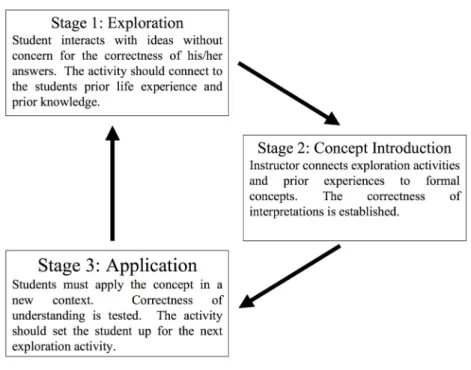
cycle, have been developed. The most basic is a three stage learning cycle, though five and seven stage learning cycles are also common. In the following paragraphs in this section the three stage learning cycle as implemented in this research will be discussed. The cycle is shown schematically in Figure 2.1.
Figure 2.1 The three stage learning cycle
The first stage of our learning cycle is called the exploration stage. In this stage students perform an activity that is designed to help them build some kind of basic familiarity with the material that is to be learned. One of the important ideas of constructivism is that learning is built upon prior knowledge, and in many cases students will come to the classroom with a great deal of prior knowledge obtained by formal or informal means, but this may not always be the case. In the case that the student has a significant amount of prior knowledge the exploration phase serves to encourage the student to bring his or her attention to that knowledge and think about how these ideas are related to the material that is to be learned. It may also serve to encourage the student to explore related ideas that had not previously been explored and to develop and refine his or her prior knowledge. In the case that the student does not have much prior knowledge the exploration stage serves as a way of creating a base of prior-knowledge which can be built upon in the succeeding stages of the learning cycle. Exploration activities should typically be designed to be free from the constraints of right and wrong. The goal is not
21
to develop knowledge that is consistent with an external authority of correctness, but for the students to freely create knowledge based on their experiences with a phenomenon. Since their experiences cannot be right or wrong, the knowledge created in the exploration activity cannot be right or wrong. This of course does not preclude the incorrect application of that knowledge in a subsequent activity, but within the exploration activity itself there should be a de-emphasis of the concepts of right and wrong.
The second stage of the learning cycle, called the concept introduction stage, is a more formal stage in which the events of the exploration activity can be discussed and connected to a formal introduction of the material that is to be learned. Evidence indicates that direct
instruction can be an effective means of instruction if the student has some prior knowledge as well as some understanding about their difficulties with the material (Schwartz, 1998).
Therefore, although concept introduction stages need not be direct instruction, such as a lecture, or reading a text, research indicates that this should not necessarily be viewed as an inferior method of constructing the lesson. The goal of the second stage of the learning cycle is to help the student generate organized knowledge, a schema, in which to interpret the events of the exploration activity and form a coherent understanding of the material being studied. This may involve showing the student how to generalize to fundamental principles from the specifics of what was observed in the exploration, or how the specifics of the exploration activity could have been predicted from general principles obtained by other means, or other types of discussion which serve to help construct deeper understanding.
The final stage is called the application stage of the learning cycle. This stage, in a sense, is about solidifying the newly built knowledge, with an eye towards formative assessment of student understanding. The goal of the application stage is to present the student with a new activity, which they have not seen before, and which requires the application of the material addressed in the first two stages. Successful application of this material has positive implications for the student’s learning, and should also serve to further enforce the material in the student’s mind. Unsuccessful application of the material has negative implications for the student’s learning, but should serve as another exposure to the material, that should aid in the knowledge construction process, though further study may be needed for mastery. Once the learning cycle is completed the student should be in a position to start the next cycle and continue working through the larger curriculum. With this in mind, it is useful to construct the application
22
activities in such a way as to connect to the next exploration activities, in order to take maximum advantage of what will soon be prior knowledge.
A learning cycle can be implemented on a number of time-scales, and with different numbers of students. The learning cycles developed for this proposed research are completed by individuals over the course of an hour or so, but learning cycles have been implemented in large lecture classes on the time-scale of a week (Zollman, 1990). The organizational and pedagogical benefits of learning cycles in education suggest that it would be beneficial to create the lesson materials that must be developed for this project in the form of learning cycles.
2.1.4 Ideas from Physics Education Research
Much work has been done by physicists to adopt and incorporate the findings and
theories of cognitive science with experimental and observational studies of physics students into a coherent theory of learning physics. In this section we will give a brief review of literature relevant to establishing a coherent understanding of learning physics as a science. It has long been recognized that scholarly work focused on improving the teaching of physics was a worthwhile and perhaps necessary pursuit; this recognition resulted in the establishment of the American Association of Physics Teachers, which would be tasked with solving the problem of optimizing physics instruction (Richtmyer, 1933). Recognition that understanding how to best teach physics would have to be a slow, ongoing pursuit that drew on previous work in cognitive psychology was slower to follow, but a key development in physics education research (Mestre & Tougher, 1989; Reddish, 1994). This has resulted in a physics education research community that is generally receptive to the ideas from cognitive science, such as the constructivist ideas discussed previously.
Early efforts in physics education research focused on the study and remediation of common misconceptions in physics (Trowbridge & McDermott, 1980; 1981). These misconceptions can be robust against instructional intervention. Misconceptions research provides one classification scheme for student responses to conceptual questions. Therefore, familiarity with literature in this area can provide important insight into unifying themes in student responses to conceptual questions, such as the ones in our lesson materials.
A key idea that has emerged in physics education is that students’ knowledge is typically fragmented (Hammer, 2000; Paul, diSessa & Roschelle, 1994). This view is in most ways
23
consistent with the constructivist idea of knowledge building, but differs in that the term schema typically conveys a level of organization and coherence which need not be present in any given students knowledge. This has lead to the ideas of resources and resource activation in physics education. We can think of a resource as a knowledge element, which can be productively or unproductively activated in a given context (Hammer, 2000). In general, resources are not right or wrong, but usually context-dependent. A type of resource that is particularly important to this work is an epistemological frame. A student’s epistemological frame addresses information about how they view the nature of knowledge within the current context (Scherr & Hammer, 2009). Clearly students can frame a learning situation in different ways, depending on how they view the way in which learning should occur (e.g. knowledge should come from an expert vs. knowledge should come from observation and experience). In our work we would like to foster an attitude that is grounded in ideas of knowledge is created through observation of nature and through social interaction with a more experienced guide (tutor).
Another concept important to physics education research is the idea of multiple
representations: that a physics idea can be represented in multiple ways (Larkin, 1983; Dufresne, Gerace & Leonard, 1997). To recognize that this is true one need only realize that acceleration can be explained in words, equations, or depicted on a graph. Not all students are equally adept at understanding and using the different representations that we can associate with a given concept. Competency, however, demands a minimum level of skill across a range of
representations, and this then becomes one measure of expertise. The idea that we can represent concepts in different ways, which may evoke different student difficulties, is important to our synthetic tutoring project because of the many ways we must convey information via our interface. The system will provide students with information via printed text, verbal/auditory information, video/pictorial information, and require them to interpret the information and provide printed responses, which may require mathematical manipulations to generate.
Each of these ideas that are commonly used in physics education research:
misconceptions, resource activation, transfer and multiple representations are important to review for this research because they give us a variety of perspectives that we can adopt when looking at data from our synthetic tutoring system. We need to be familiar with a wide variety of perspectives so that we can see if and how they manifest themselves in our data.
24
2.2 Related Work on Human Tutoring
2.2.1 The “Two-sigma Problem”In the early 1980’s Benjamin Bloom and his students conducted seminal research on the effectiveness of one-on-one tutoring as compared to other instructional methods (Bloom, 1984). This frequently cited result is that one-on-one tutoring is far more effective than normal
classroom instruction, or even mastery learning in which students studied material until they know the material well enough to obtain a minimum score on an assessment (Bloom, 1984). This is often characterized as the “two-sigma problem”, that is students taught by tutor scored two standard deviations of the mean higher on assessments than students taught by normal classroom instruction and one standard deviation of the mean higher than students taught by mastery learning (Bloom, 1984). The “problem” in the “two sigma problem” is that one-on-one tutoring is not a very resource efficient method of instruction. For each student to be taught everything that they must know via one-on-one instruction is not feasible. Therefore Bloom set out to find methods of instruction that were as effective as one-on-one tutoring (Bloom, 1984).
Most of the methods that Bloom found that can rival the efficacy of one-on-one tutoring were composite methods, that is the combination of one or more instructional methods that did not yield such dramatic results by itself (Bloom, 1984). Ultimately, however most of these methods suffer from some level of complication in their application. One of the interesting facets of human tutoring is that it is so very effective, and so very simple. Bloom concludes his paper with a standing challenge to the educational community to continue to find instructional methods that have the potential to match human tutoring in efficacy (Bloom, 1984). Bloom’s work provides great incentive to consider technological methods that were not available at the time of that study.
Beyond this well-known study, the efficacy of human one-on-one tutoring has been replicated and is well established. Cohen, Kulik and Kulik have done a meta-analysis of 65 studies on tutoring (1982). Of these studies 20 produced statistically significant results, 19 in favor of tutoring and 1 in favor of conventional instruction. The authors characterize the effectiveness of tutoring on the tutee in terms of effect size, which ranged from -1 to 2.3, with a mean of 0.400 and a standard error of 0.069 (Cohen et al., 1982). This mean effect size
25
be considered a modest effect by the standards established by statistician Jacob Cohen (no relation) (J. Cohen, 1977). Despite the mean effect being modest, commonalities were observed amongst studies that reported large effects. Identified traits shared by studies producing larger effects were:
1. more structured tutoring programs, 2. programs that were shorter in duration, 3. programs that taught lower level skills,
4. programs that focused on mathematics over reading, 5. programs that used locally developed assessments, and
6. programs that were published in journals (as opposed to dissertations).
Of these six commonalities, the last may be a self-selection effect associated with the difficulties in publishing less-spectacular results, the fifth may reflect either flawed or superior assessment, and the other four likely reflect adept use of tutoring in situations where it is in fact most
effective. One-on-one tutoring implemented in an optimal manner will likely outperform typical implementations. Therefore, optimally implemented tutoring could outperform the mean effect size of 0.400. Beyond looking at efficacy, comparisons of students’ attitude towards the material and self-concept were also performed. The authors conclude that tutoring has a statistically reliable and positive effect on students’ attitudes towards a subject, but that any effects on self-concept are too small to be deemed statistically reliable. The authors point out that their results are consistent with other meta-analyses. Therefore a well-established literature documents the efficacy of tutoring as an instructional method (Rosenshine & Furst, 1969; Ellson, 1976; Fitz-Gibbon, 1977). Thus, we conclude that, even if Bloom’s results are at the high end of what is realistically achievable, the superior efficacy of this instructional method is still reproducibly established, and a positive impact on students’ perceptions of the material is established as well.
The question, then, is to what extent can a computer play a role similar to a tutor? This is one of the research questions outlined in Chapter 1 and is re-stated to remind the reader of the strong connections between Bloom’s work and future work on developing computer/web-based instructional materials. As we will see in section 2.3 it is a question that is actively being investigated by researchers. One of the most useful pieces of information in investigating the possibilities associated with these technologies is what gives rise to the high level of efficacy. This will be discussed in the next section.