by Nevrus Kaja
A dissertation submitted in partial fulfillment of the requirements for the degree of
Doctor of Philosophy
(Electrical and Computer Engineering) in The University of Michigan-Dearborn
2019
Doctoral Committee:
Associate Professor Di Ma, Co-Chair Professor Adnan Shaout, Co-Chair Associate Professor Hafiz Malik Professor Armen Zakarian
ii Nevrus Kaja [email protected] ORCID iD: 0000-0002-9625-7032 © Nevrus Kaja 2019
iii
DEDICATION
In dedication to my fiancée and my family, both of which have always been a tremendous support for me, pushing me further with every step of my career and life.
iv
ACKNOWLEDGEMENTS
I would like to thank and express my appreciation to my undergraduate and graduate advisor, Dr. Adnan Shaout, for his contribution and effort in developing, advising, and
supporting me during my studies. Dr. Shaout has been a true mentor for the last eight years, and without his support, I would not have been able to achieve such an accomplishment. I also wish to thank my committee co-chair, Dr. Di Ma, and the other members of the committee, Dr. Hafiz Malik and Dr. Armen Zakarian, for their support throughout my studies.
Most importantly, I would like to thank my loving and supporting family. My fiancée, Anisa, who has always been a life mentor, a supporting pillar, a friend, and a true partner throughout this journey. Her love, consulting, and motivation have always guided me down the right path. My parents, their endless love, and my sisters have always encouraged me forward and been proud of every step I have taken. This accomplishment would not have been possible without them.
In addition, I would like to thank my friends who have always pushed me to go further. I would like to express my gratitude to my colleagues at work and the whole department of Electrical and Computer Engineering at the University of Michigan – Dearborn. This University prepared me to conquer the future.
v
TABLE OF CONTENTS
DEDICATION iii
LIST OF TABLES viii
LIST OF FIGURES ix
ABSTRACT xi
Chapter 1. Introduction 1
1.1. Problem Definition 2
1.2. Purpose and Significance of the study 3
1.3. Research Hypotheses 4
1.4. Limitations 5
1.5. Research Methodology and Procedures 6
Chapter 2. Literature Survey 9
2.1. Automotive Industry: A historical perspective 9
2.2. Advanced Vehicle Architecture 13
2.2.1. Vehicle Sensors 15
2.2.2. Vehicle Communications 16
2.2.3. Vehicle Computing 17
2.3. Automotive Cybersecurity 17
2.4. Connected Vehicle: V2X 22
2.4.1. DSRC – Dedicated Short-Range Communication 23
2.4.2. IEEE 1609.2 – Security for DSRC 26
2.5. Artificial Intelligence and Machine Learning 27
2.5.1. Supervised Learning 28
2.5.2. Unsupervised Learning 29
vi
2.6. Intrusion Detection Systems 32
2.6.1. Signature-Based IDS 33
2.6.2. Anomaly-based 34
2.6.3. IDS State-of-the-art 34
Chapter 3. Threat Analysis 36
3.1. Spoofing 36 3.2. Tampering 37 3.3. Repudiation 38 3.4. Information Disclosure 38 3.5. Denial of Service 39 3.6. Elevation of Privilege 39
Chapter 4. Assess: Fuzzy-based Threat Assessment Model (FTAM) 41 4.1. Threat Assessment Models in Automotive Cybersecurity 42
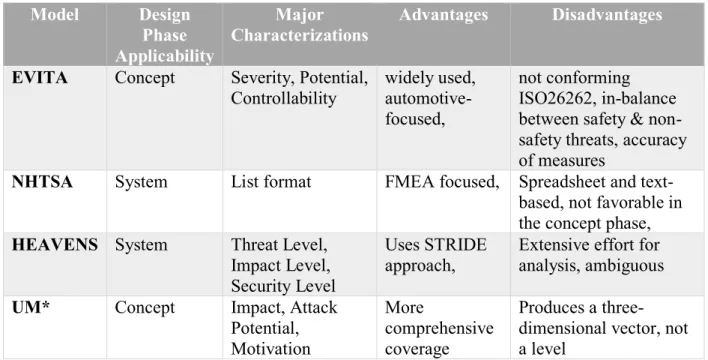
4.1.1. EVITA 43
4.1.2. NHTSA 44
4.1.3. HEAVENS 48
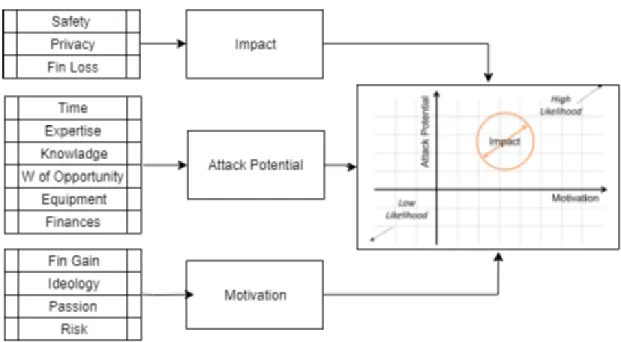
4.1.4. UM Risk Assessment Model 48
4.1.5. OCTAVE 49
4.2. Multistage Fuzzy Architecture 50
4.3. Fuzzy-Based Threat Assessment Model (FTAM) 52
4.4. Attack Impact 54
4.4.1. FIS1: Privacy and Safety 55
4.4.2. FIS3: Security and Financial Loss 59
4.5. Attacker 63
4.5.1. FIS2: Expertise and Resources 64
4.5.2. FIS4: Agent Level and Financial or Other Gains 70
4.6. Withstand Potential 74
vii
4.7. Threat Level 80
4.7.1. FIS 6: Severity, Motivation, and Likelihood 81
4.8. Final Integration 84
Chapter 5. Detect: Two Stage Intrusion Detection Intelligent System based on FTAM 86
5.1. Data Set: Wyoming Connected Vehicle Pilot 87
5.1.1. Data Collection 87
5.1.2. Data Description 88
5.2. Adversary Model 91
5.3. Feature Engineering 92
5.4. Two Stage IDS 94
5.4.1. First stage: Detect! 95
5.4.2. Second Stage: Classify! 98
5.4.2.1. J48 98
5.4.2.2. Random Forest 101
5.4.2.3. AdaBoost 103
5.4.2.4. Naive Bayes 104
Chapter 6. Performance Evaluation and Conclusions 107
6.1. Assess and Detect – Their Correlation 108
6.2. Performance Summary 109
6.2.1. FTAM Performance Benchmarking and Analysis 109
6.2.2. FTAM Advantage 111
6.2.3. IDS Performance Evaluation 113
6.2.4. IDS Computational Performance 114
6.2.5. State-of-the-art Comparison 115
6.3. Summary 116
6.4. Conclusions and Future Work Recommendations 118
APPENDIX 120
viii
LIST OF TABLES
Table 2.1: AV Impact and Barriers [37] 10
Table 2.2: Autonomous Vehicle Research Universities 11
Table 2.3: SAE J3016 Autonomy Levels [44] 12
Table 2.4: OEM Autonomous Vehicle Planned Launches 13
Table 2.5: Vehicle Sensors 16
Table 2.6: Automotive Cybersecurity Developments 19
Table 2.7: Vehicle Network IDS Based on [95] and Individual Papers 35
Table 3.1: STRIDE Threat Summary 40
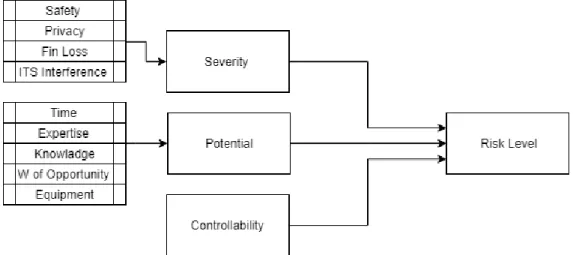
Table 4.1: EVITA Threat Elements 44
Table 4.2: NHTSA Threat Matrix [12] 45
Table 4.3: HEAVENS 48
Table 4.4: Threat Assessment Models 50
Table 5.1: BSM Data Dictionary According to [123] 89
Table 5.2: Clustering Algorithm Performances 96
Table 5.3: Stage 1 Results (Detect) 98
Table 5.4: J48 Performance Results 99
Table 5.5: J48 Confusion Matrix 100
Table 5.6: Random Forest Performance Results 101
Table 5.7: Random Forest Confusion Matrix 102
Table 5.8: AdaBoost Performance Results 103
Table 5.9: AdaBoost Confusion Matrix 103
Table 5.10: Naive Bayes Performance Results 105
Table 5.11: Naive Bayes Confusion Matrix 105
Table 6.1: Best Performing IDS algorithms for each FTAM level 108
Table 6.2: Assess-Detect Correlation 108
Table 6.3: FTAM - STRIDE Threat Levels 111
Table 6.4: STRIDE Threat Levels for FTAM, EVITA, and HEAVENS 111
Table 6.5: FTAM Levels 113
Table 6.6: Summarized Results 115
ix
LIST OF FIGURES
Figure 2.1: Advanced or Autonomous Vehicle Architecture 14
Figure 2.2: AV Sensors Diagram from [5] 15
Figure 2.3: AV Communications 17
Figure 2.4: Automotive Complexity vs. Cybersecurity Capabilities 21
Figure 2.5: Design Solution Patterns [68] 22
Figure 2.6: DSRC-based Collision Avoidance System from [70] 23 Figure 2.7: Architecture of DSRC Communication in the US from [70] 25
Figure 2.8: Intrusion Detection System Architecture 33
Figure 4.1: EVITA Architecture 44
Figure 4.2: UM Risk Assessment Model 49
Figure 4.3: Traditional Fuzzy Approach in Performance Appraisal System [28] 51 Figure 4.4: Multistage Fuzzy Architecture Proposed in [28] 51
Figure 4.5: Fuzzy-based Threat Assessment Model (FTAM) 54
Figure 4.6: Attack Impact 55
Figure 4.7: Fuzzy Inference System Model 55
Figure 4.8: FTAM FIS1 56
Figure 4.9: FIS1 Safety 56
Figure 4.10: FIS1 Privacy 57
Figure 4.11: FIS1 Security 58
Figure 4.12: FIS1 Rules 58
Figure 4.13: FIS1 Output 59
Figure 4.14: FTAM FIS3 59
Figure 4.15: FIS3 Financial Loss 61
Figure 4.16: FIS3 Attack Severity 62
Figure 4.17: FIS3 Rules 63
Figure 4.18: FIS3 Surface 63
Figure 4.19: FTAM Attacker 64
Figure 4.20: FIS2 65
Figure 4.21: FIS2 Expertise 66
Figure 4.22: FIS2 Resources 68
Figure 4.23: FIS2 Rules 68
Figure 4.24: FIS2 Agent Level 69
Figure 4.25: FIS2 Surface 70
Figure 4.26: FIS4 70
Figure 4.27: FIS4 Financial and Other Gains 72
x
Figure 4.29: FIS4 Motivation 74
Figure 4.30: FIS4 Surface 74
Figure 4.31: Withstand Potential 75
Figure 4.32: FIS5 75
Figure 4.33: FIS5 Controllability 76
Figure 4.34: FIS5 Difficulty 78
Figure 4.35: FIS5 Withstand Potential 79
Figure 4.36: FIS5 Rules 79
Figure 4.37: FIS5 Surface 80
Figure 4.38: FTAM Architecture 81
Figure 4.39: FIS6 82
Figure 4.40: FIS6 Threat Level 82
Figure 4.41: FIS6 Rules 1-20 83
Figure 4.42: FIS6 Rules 20-40 83
Figure 4.43: FIS6 Rules 40-60 84
Figure 4.44: FTAM Simulink Model 84
Figure 5.1: Wyoming I80 Corridor - Connected Vehicle Map [3] 88 Figure 5.2: Google Map Generated from Training Data BSM Points 89
Figure 5.3: Intrusion Detection System Architecture 94
Figure 5.4: FarthestFirst Clustering 97
Figure 6.1: Complete Framework 107
xi ABSTRACT
Automotive technology has continued to advance in many aspects. As an outcome of such advancements, autonomous vehicles are closer to commercialization and have brought to life a complex automotive technology ecosystem [1]. Like every other technology, these developments bring benefits but also introduce a variety of risks. One of these risks in the automotive space is cybersecurity threats. In the case of cars, these security challenges can produce devastating results and tremendous costs, including loss of life. Therefore, conducting a clear analysis, assessment and detection of threats solves some of the cybersecurity challenges in the
automotive ecosystem. This dissertation does just that, by building a three-step framework to analyze, assess, and detect threats using machine learning algorithms.
First, it does an analysis of the connected vehicle threats while leveraging the STRIDE framework[2].
Second, it presents an innovative, Fuzzy based threat assessment model (FTAM). FTAM leverages threat characterizations from established threat assessment models while focusing on improving its assessment capabilities by using Fuzzy logic. Through this methodology, FTAM can improve the efficiency and accuracy of the threat assessment process by using Fuzzy logic to determine the “degree” of the threat over other existing methods. This differs from the current threat assessment models which use subjective assessment processes based on table look-ups or scoring.
xii
Thirdly, this dissertation proposes an intrusion detection system (IDS) to detect malicious threats while taking in consideration results from the previous assessment stage. This IDS uses the dataset provided from Wyoming Connected Vehicle Deployment program [3] and consists of a two-stage intrusion detection system based on supervised and unsupervised machine learning algorithms. The first stage uses unsupervised learning to detect whether there is an attack present and the second stage classifies these attacks in a supervised learning fashion. The second stage also addresses data bias and eliminates the number of false positives. The simulation of this approach results in an IDS able to detect and classify attacks at a 99.965% accuracy and lowers the false positives rate to 0%.
1
Chapter 1. Introduction
Urban populations are increasing at a quick pace [4]. This densification of the population is playing an important role in urban mobility and transportation overall. Considering these factors and customer demands, almost every major automotive manufacturer is researching advanced vehicle connectivity technologies and working on plans to launch driverless (autonomous) cars. Testing is currently underway, and experiments are growing rapidly. The prolonged future of autonomous cars is right around the corner and customers are waiting to exploit them. This new form of transportation will have a huge impact on our society. It will not only lead to a boom in innovations, but it will also bring the potential for new challenges which require innovative ways of thinking and solving [5].
From the other side, vehicle cybersecurity research and experiments have shown that malicious attackers can penetrate a broad range of physical and remote attack surfaces in a car. Multiple research papers such as [6]–[10] give clear examples of vehicle breaches and have already made news headlines. With increased complexity and accessibility in intelligent automotive systems, the potential for additional attacks and vulnerabilities against safety and privacy increases even more. To cope with these challenges, this dissertation studies and proposes a three-step framework, which solves some of the cybersecurity issues in the V2X automotive area using machine learning algorithms.
2 1.1.Problem Definition
The problem definition for this dissertation evolves from the following issues/gaps in the available research area.
- Cybersecurity in automotive systems is a widely researched area, but specifically intrusion detection systems in V2X BSM datasets are not explored. Because connected automotive technology has not been widely deployed and commercialized, there are not many holistic studies for V2X cybersecurity as related to threat analysis, assessment, and detection [11] .
- From the literature survey, multiple models for threat assessment and characterizations do exist such as EVITA, NHTSA, HEAVENS, OCTAVE, and others [11]–[13]. These threat assessment techniques are key to private organizations attempting to define the severity of a threat, but there is no defined framework which uses and considers this output in the specific implementation of other security systems (i.e., intrusion detection systems). This dissertation establishes a correlation between threat assessment and intrusion detection algorithms.
- All of threat or risk assessments studied in this dissertation are done in a subjective manner, using tables, or scoring. During this process, the threat characterization
assignment is not done using discrete variables. They are often assessed based on users prospective using linguistic variables and non-discrete definitions. Due to the Fuzzy nature of this process, this threat assessment process often leads to inefficient scoring and inaccurate assessments. This research is one of the firsts to attempt using a Fuzzy logic method to resolve threat assessment inefficiencies.
3
- When considering intrusion detection systems in the automotive V2X, they are often not seen as a feasible solution for implementation either due to a high number of false positives or due to high computational requirements. This dissertation attempts to propose a feasible IDS for implementation.
- Lastly, there is simply not enough publicly available V2X or DSRC datasets for research, so the overall results are scarce. This dissertation uses one of the latest datasets released in this field.
1.2.Purpose and Significance of the study
Autonomous and connected vehicles have promised to lower the number of accidents caused by human behavior[14]. Some studies estimate that vehicles enabled by connected and self-driving technologies could reduce the number of accidents by up to 40% [15]. NHTSA estimates that V2X safety applications could eliminate or mitigate the severity of up to 80% of unimpaired vehicle crashes[16]. So, in overall the business case for connected and autonomous vehicles is clear; They will save lives and money if implemented correctly. Although there is a high potential for life-saving solutions, cybersecurity can be a bad syndrome preventing technology adoption. If these systems (autonomous or connected) are prone to cybersecurity attacks, then there is a chance that the number of accidents can increase significantly rather than decrease. Because the control is being passed from humans to technology, cybersecurity threats can do significantly more damage than they would in a driver-controlled scenario. The purpose of the research in this dissertation is to lay out those foundations as well. This study attempts to do quantitative and qualitative research in V2X cybersecurity while using artificial intelligence-based technologies.
4
V2X security is also a relatively new area from a research perspective. V2X has not been widely deployed from automotive manufacturers yet, and that is the main reason why there is not enough available research on its security detection aspects. Currently, there are not many
extensive and complete datasets available; therefore, there has not been a lot of experimentation with the intrusion detection systems in V2X systems. A simple search for “intrusion detection systems in v2x” in major research databases yields almost no relevant results. The dataset [17] used in this dissertation was gathered and compiled only a few months prior to being used. Therefore, this research study is significant from a qualitative perspective and one of the first research works using this particular V2X dataset from a quantitative perspective as well.
1.3.Research Hypotheses
The core question of this dissertation is: how can Artificial Intelligence-based technologies improve cybersecurity in automotive connected and intelligent systems? According to this question, there are three main hypotheses that this dissertation:
- Use of the Fuzzy Logic methodology increases the efficiency and accuracy in threat assessment models.
- Two-stage Intrusion Detection System using supervised and unsupervised learning is a feasible solution for V2X threat detection using basic safety message data.
- There is a correlation between threat assessment and the algorithm or the configuration of an Intrusion Detection System.
5 1.4.Limitations
Throughout this dissertation, there have been a set of general and specific limitations. Some of these limitations are listed below.
- There are a limited number of datasets available to evaluate intrusion detection solutions in the V2X – DSRC space. Basic Safety Messages are used from the Wyoming
Connected Vehicle Pilot project [17]. By using a newly released dataset with no published research available at the time of the study, there is a limitation to performing state-of-the-art benchmarking and comparison with other relevant works.
- There is limited processing power available in today’s vehicles, making it challenging to fully explore advanced performance-based and machine learning algorithms in building intrusion detection systems. That is why Deep Learning-based techniques have been avoided in the second stage of the proposed intrusion detection system.
- Threat analysis has been based on currently available research and not every threat has been tested in an actual vehicle or been taken into consideration for Threat vs. IDS relationship as shown in 6.1 [18].
- When assessing threats, there is no ground truth to measure the performance of the proposed FTAM solution. This is because different organizations assess threats in a different manner and this process is organization or technology specific. To cope with this, the FTAM performance is benchmarked and compared with other available models rather than validation with ground truth. It will be up to the end users to validate such a model.
- Due to the nature and limited duration of the study, there is a limitation in establishing a defined relationship between the assess and detect phases. This dissertation does prove
6
the concept of the relationship, but further detailed and functional testing in real-world datasets need to happen before these correlations are concluded.
1.5.Research Methodology and Procedures
This study started with an extensive literature review of the following areas: - Automotive technology and connectivity;
- Fuzzy Logic theory;
- Cybersecurity and Intrusion Detection Systems; - Supervised and Unsupervised Learning algorithms.
The results from the literature survey will be provided in Chapter II. This dissertation uses methods, results, literature survey, and builds upon my previously published work as referenced in [19]–[26]. Problem definition as provided in 1.1 identified gaps in the current state-of-the-art development. After a holistic view of the area, a three-step framework was then defined with the objective of covering some of these gaps and proving out the claims laid out from the research hypothesis given in 1.3. These steps are provided below and follow their respective
methodologies.
- Analyze: In this step, an analysis of automotive threats with a focus on V2X is done. This dissertation attempts to stay close to established standards, so the proposed solution has a higher chance of implementation and adoption. In this step, Microsoft STRIDE model is used for threat analysis [27]. Results are shown in Chapter III.
- Assess: The assessment stage builds a Fuzzy-based Threat Assessment Model (FTAM). In this stage, five established models are used to benchmark and drive the design of the new proposal. FTAM attempts to close gaps and eliminate or mitigate drawbacks
7
identified from the literature survey for models. Although a new model is proposed, all the threat characterization levels are based on established models. From a Fuzzy logic perspective, a multistage methodology proposed from [28] is used. Building six Fuzzy inference systems is time-consuming, but all the Fuzzy rules are accounted for due to the possibility that they can all happen. The methodologies of Mamdani [29] and Sugeno [30] were considered for use in this stage. Sugeno is more computationally efficient and works better with linear and mathematical techniques. This solution required a more efficient method for human input, and that is one of the main reasons why FTAM uses the Mamdani method. As it will be described in 1, multiple established threat assessment models were used to benchmark and drive the design based on STRIDE threats.
- Detect: The third detection stage aims to design an intrusion detection system. The methodology used in this stage is similar to a two-stage architecture approach used in previously published papers [20], [21], [31]. This method is validated to reduce the number of false positives, lower bias in data, and help with computational requirements in a variety of applications (vision and cybersecurity). The first stage aims to simply detect a threat, while the second stage attempts to classify it and increase the accuracy and lower the number of false positives. This stage uses the dataset from the United States Department of Transportation, Intelligent Transportation Systems Joint Program Office – Wyoming Connected Vehicle Pilot Deployment Program [3], [17]. This dataset will be described in 5.1.2.
The rest of this dissertation is organized as follows:
- Chapter I gives an overview of the paper, along with problem definition, purpose of the research, research methodologies used and its limitations.
8
- Chapter II gives the literature review on automotive cybersecurity, connectivity, and intrusion detection systems.
- Chapter III performs an analysis of different threats in the automotive arena with a focus on V2X ones.
- Chapter IV is focused on the assessment phase. After a review of current existing threat assessment models, it goes on to explain in detail the proposed Fuzzy based Threat Assessment Model (FTAM).
- Chapter V focuses on intrusion detection systems. It first provides an overview of the dataset used in this dissertation and then proposes a new, two-stage intrusion detection system. This IDS leverages the results from the FTAM proposed in Chapter IV. - Chapter VI attempts to bring everything (Chapter III, IV and V) together in order to
review and evaluate the complete framework. In addition, it provides details on results, performance evaluation, benchmarking, and conclusion.
9
Chapter 2. Literature Survey
This chapter will expand on the literature survey for this dissertation. Section 2.1 will provide a historical perspective of the automotive industry, and 2.2 will give some insights on the vehicle architecture. Section 2.3 will start discussing automotive cybersecurity, 2.4 will dive deeper on the connected vehicle aspects, and the last section 2.5 will discuss different types of Intrusion Detection Systems (IDS) and their state-of-the-art results.
2.1.Automotive Industry: A historical perspective
The automotive industry has been around since 1770 when French engineer and mechanic Nicolas-Joseph Cugnot created the first self-propelled road vehicle [32]. Since then the
technology has advanced, and an estimated number of 100,000 patents have been created from such evolution [33]. The revolution and wide commercialization came in 1913, when Henry Ford launched Ford Model T, an iconic car in the automotive industry. The continued evolution of automotive has brought to life many innovations and autonomous vehicles. From a technology perspective, autonomous cars have been in research long before today. The ability of cars to drive themselves has been an inspiring problem for many researchers and automotive companies. Currently, there are three main areas where the automotive field is heading towards[34]:
- Connectivity
- Autonomous mobility - Electrification
10
All three of these include certain cybersecurity aspects within.
While Henry Ford once said that cars are “opening the highways to all mankind,”
autonomous vehicles now are enabling mobility to all mankind [35]. They have the potential to revolutionize the way we move. Every breakthrough or advancement in technology comes with security and other risks [36] . Autonomous vehicles will have a huge impact on society but also face a few barriers before they go in full commercialization. The paper in [37] gives autonomous vehicle barriers and impacts as shown in Table 2.1.
Table 2.1: AV Impact and Barriers [37]
Impacts Barriers
Safety Security
Congestion reduction AV Legislation Travel behaviors Litigation Freight transportation Privacy Vehicle ownership Vehicle costs Economic factors Digital Mapping Urban development Infrastructure Mobility
Insurance Models
As seen in Table 2.1, security and privacy are barriers in autonomous vehicle development, and they will result in an impact on safety and other factors. Research has been the lead of advanced technologies in vehicle development. To achieve and develop autonomous and other advanced automotive technologies, it requires extensive study and collaboration among many different areas. Major universities have put a significant amount of resources into autonomous and connected vehicle research, and they have been a crucial driver in this area. Some of the major research universities along with their centers are provided in Table 2.2.
11
Table 2.2: Autonomous Vehicle Research Universities
Research University Description
Carnegie Mellon University Carnegie Mellon’s robotics laboratory has developed and published research in autonomous vehicles and automated driving for over 30 years [38]
Tsinghua University Tsinghua University has a massive research program focused on automated driving and electric vehicles. In 2016, they opened a Joint Research Center for Intelligent Mobility with Nissan [39].
Stanford University
Stanford AI Lab was one of the pioneers to win the 2005 DARPA Grand Challenge in autonomous vehicles. Since then, they have been one of the leads in AV research [40].
University of Michigan
Mcity is a 32-acre, 10-million-dollar one-of-a-kind urban test facility for AV. The project scope looks at AC research but also evaluates how autonomous driving will shape urban planning [41].
Massachusetts Institute of Technology
MIT explores the various dimensions of autonomous cars. Their Media Lab is researching the use of blockchain technology or morality for self-driving cars [42]. University of California –
Berkley
DeepDrive program at Berkley focuses on researching computer vision and machine learning technologies for automotive applications [43].
Table 2.2 is not an exhaustive list of all universities or research groups conducting state-of-the-art research in the automotive industry, but it provides some of the pioneers in the field. These university research centers have also served as the main sources from which this dissertation has derived its literature review.
Autonomous vehicles are coming to the market gradually. As their evolution goes on, Society of Automotive Engineers (SAE) have developed the J3016 standard to define the level of automation for on-road vehicles [44]. Table 2.3 provides a description of this standard.
12
Table 2.3: SAE J3016 Autonomy Levels [44]
Autonomy Level
Name Vehicle Control
0 No Automation Full driver control. Human drivers perform all driving actions.
1 Driver
Assistance
Driver assistance technologies. The human driver is assisted by the system only in specific functions.
2 Partial
Automation
The system can perform partial automation. The driver should always be ready to take over.
3 Conditional Automation
System drives and monitors environments. The driver should be ready to take over when requested by the system.
4 High
Automation
The system handles the driving and monitoring environments. The driver is not required after the system takes over.
5 Full
Automation
The system handles all aspects of driving.
Although autonomous vehicles are being deployed and put into production by automakers, it has required a set of industry, governmental, non-profit, and academic institutions to bring
together important pieces to enable such a system. A chronological series of these events and contributions from these players is shown below:
- 1948 – Modern cruise control invented - 1968 – Electronic cruise control
- 1980 – Carnegie Mellon University’s Navlab - 1995 – Laser-based adaptive cruise control - 2001 – Lane-departure warning system - 2003 – Pre-crash mitigation system - 2004 – DARPA Grand Challenge - 2010 – Google driverless car debuts - 2012 – Nevada licenses autonomous cars - 2014 – SAE J3016 created
13 - 2015 – University of Michigan’s MCity
- 2019 – Multiple pilots on autonomous vehicles. Commercially available programs deployed (i.e., Aptiv-Lyft Partnership in Las Vegas or Waymo One)
Table 2.4 provides plans from the major automotive manufacturers about their autonomous vehicle production. Please note that not all these plans are confirmed from their respective manufacturers and this information is current as of the time this paragraph was written (6/2018).
Table 2.4: OEM Autonomous Vehicle Planned Launches OEM Autonomy
Level Planned Launch Comments
Audi 3
4
2018 2021
World’s first-to-market Level 3 AV [45]
Tesla 4 2019 Tesla is currently selling “Self-Driving Capability” [46]
Ford 4 2021 Ride-sharing or ride-hailing
production [47]
Mercedes 4 2021 “Drive Pilot” – partnership with Bosch [48]
BMW 4
5 2021 2030 Partnership with Intel and others [49] Volvo 4 2021 Partnership with NVIDIA [50] Honda 3
4
2020 2025
Vision to create a collision-free society [51]
Hyundai 3 4
2020 2030
Targeting for the highway in 2020 and urban driving in 2030 [49]
Toyota 4 2020 Self-Driving on the Highway [49] 2.2.Advanced Vehicle Architecture
To understand vehicle cybersecurity, one must start by looking at the recent vehicle architectures and their points of interaction. For the purposes of this dissertation, we define an “advanced vehicle” as a recently developed vehicle system with multiple complex automotive technology systems. These vehicles include a wide range of sensors, actuators, driver assist systems, and in cases also offer various levels of autonomous driving capabilities. The terms
14
“Advanced Vehicles” or “Autonomous Vehicles” are used interchangeably to depict such systems throughout this dissertation. The following three items are the major component categories that have major potential vulnerabilities in regards to cybersecurity [52]:
- Sensors used to monitor the surrounding environments and make critical decisions on its driving patterns.
- Communications provide a resource for the vehicle to interact and engage with other services to provide convenience and safety features for the driver.
- Computing power and capabilities to manage and process the required information.
Sections below will provide a summary of these components in each of the categories. Figure 2.1 provides a detailed architecture for an autonomous or advanced vehicle system.
15 2.2.1. Vehicle Sensors
The objective of vehicle sensors is to provide detailed monitoring of the surrounding environment and offer redundancy to maximize safety. Figure 2 provides an overview for a typical autonomous vehicle’s suite of sensors that work together to provide a 360-degree view of the environment around the vehicle.
Figure 2.2: AV Sensors Diagram from [5]
Table 2.5 is a detailed list of these sensors for each category along with the estimated number of them found in a Level 4 Autonomous Vehicle.
16
Table 2.5: Vehicle Sensors
Sensor # Description
Ultrasonic 12 Provides short range distance for parking and backup.
Long Range
Radars 2 Long range radar uses radio waves to determine long-range distances between the obstacle and the sensor. Short Range
Radars 6 Short range radar uses radio waves to determine short range distances between the obstacle and the sensor. Cameras 10 Cameras collect images to monitor the
environment.
LIDAR 1 LIDARs are 360-degree sensors that use a light beam to determine distance. Infrared
Sensors X Infrared sensors detect lane markings, pedestrians in low lighting by emitting or detecting infrared radiation.
GPS 1 Global Positioning System
2.2.2. Vehicle Communications
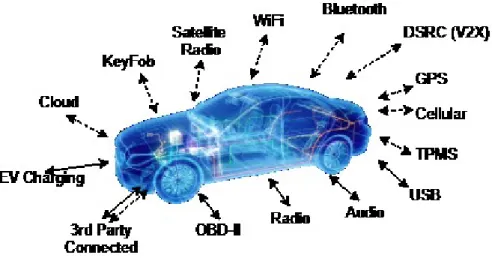
For any vehicle to engage and interact with itself, with the driver or with other systems, it must have a communication system. Today’s advanced vehicle and tomorrow’s autonomous vehicles contain a variety of communication interfaces. These interfaces are usually categorized in physical and remote connections. Figure 2.3 provides a visual representation of such
17
Figure 2.3: AV Communications
Disconnected arrows represent remote access while continuous arrows represent physical access.
2.2.3. Vehicle Computing
The third main element in vehicles related to cybersecurity is the computing power and algorithmic capabilities. Since the early 1980s, vehicles have implemented microprocessors in their vehicle designs, mainly due to the complexity of features being offered. Based on different estimates, an autonomous or advanced vehicle will include an average of over 100 ECUs. Often the challenge is that these ECUs come from different suppliers with different capabilities and responsibilities. So, to unify this system and make it secure, there is a great amount of effort required from OEMs and suppliers.
2.3.Automotive Cybersecurity
With autonomous vehicles, the automotive world enters an area where security takes
another level. Traditional computer security has already proven to be challenging on its own, and its consequences have often been disastrous[53]. Autonomous vehicle cybersecurity is another step which adds complexity into the system and brings the potential for even bigger disasters.
18
Cyberattacks in a computer system result in mostly financial losses, but autonomous vehicle cyberattacks have the potential to impact human lives even in a small-scale attack.
Automotive security is often considered an emerging area, but vehicle security has been studied for quite some time. Traditionally, vehicles have been isolated systems, with critical components controlled by mechanical systems and separated from electronic or digital controls. This way, hackers have not been able to penetrate or control a vehicle due to the physical requirements for an attack. Other researchers and OEMs have reasonably argued that if a
physical connection is required to perform cyberattacks then these attacks are simply not feasible or vulnerable enough [54][55]. One automotive cybersecurity solution is encryption-based. These solutions are proven to be inefficient for the CAN protocol [56], [57], due to
computational and data overheads. To address the limitations of crypto-based solutions,
researchers have proposed other methods such as Intrusion Detection Systems [56]. For instance, Hafeez et al. propose an intrusion detection at the physical layer. This is achieved by estimating the frequency response of each transmitter and training a neural network to use the frequency response as a signature to identify the electronic control unit/transmitter [58].
Lately, with the digitization of critical vehicle controls and drive-by-wire systems, the vehicle is turning into a “computer on wheels,” opening the doors to many vulnerabilities and cyberattacks. Many of these vehicle systems (such as CAN) were not designed with security in mind, but to simplify in-vehicle communications or OEM processes. With the introduction of the internet, computers started to connect with each other more and more. This essentially brought a revolution in the technology industry, and researchers found it difficult to put security measures in place because the technology or internet protocols were not built with security in mind. A
19
similar analogy is happening in the car industry [59]. Now that cars are starting to have inter and intra communication systems, it will be difficult to put cybersecurity measures in place.
Vehicle security started to emerge in the last decade, once media put heavy attention to it. Table 2.6 shows a chronological series of events which have catalyzed the importance of vehicle security.
Table 2.6: Automotive Cybersecurity Developments
Year Event Security Compromise
2002 Forbes published an article “How to Hack your Car” [60]
Many news outlets followed
Compromise engine, hybrid, and other performance factors
2005 Car Whisperer tool from Trifinite exploited standard passkeys in Bluetooth connections [61]
Bluetooth eavesdropping
2007 The Telegraph published news about Hackers intercepting navigation systems [62]
Navigation break-in
2010 Koscher et al. published “Experimental Security Analysis of a Modern Automobile” [63]
Disable brakes, stop engine using physical access
2011 Koscher et al. published “Comprehensive
Experimental Analyses of Automotive Attack Surfaces” [8]
Exploits remote attacks
2013 Valasek and Miller published “Adventures in Automotive Networks and Control Units” [10]
Tutorial to Alter vehicle behavior via remote attacks.
2014 Valasek and Miller publish “A survey of remote
automotive attack surfaces” [9]
The first resource for automotive network architecture review
2016 Valasek and Miller published “CAN message injection” [64]
Taking vehicle control via CAN message injection
20 2016 Keen Security Lab of
Tencent published remote Tesla attacks [65]
Tesla vehicle vulnerabilities
2016 Liu et al. presented at DEFCON “Can you trust Autonomous Vehicles: Contactless attacks against sensors of self-driving vehicle” [6]
Sensor attack on self-driving vehicles
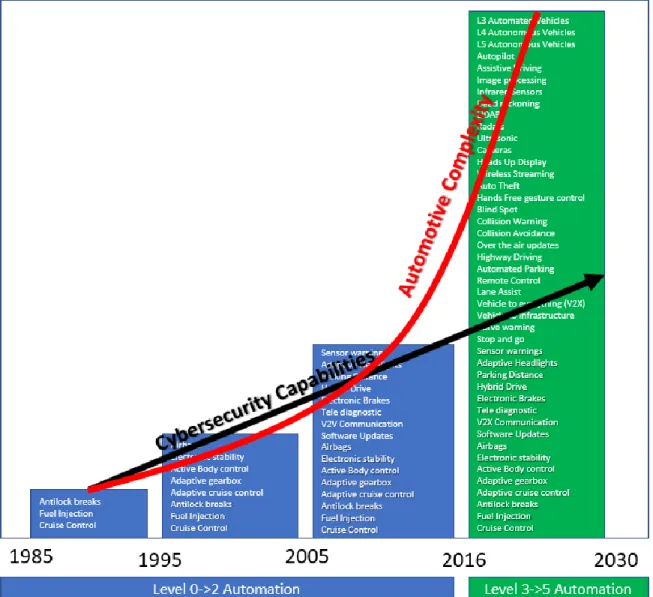
Back in 1985, only a few vehicle features were offered through electronic control, but nowadays and in the future, almost all the features are based on x-by wire or digital systems. While the vehicle technology and its complexity have increased exponentially, the vehicle cybersecurity capabilities have only developed linearly as shown in Figure 2.4 [66] [67]. This is often fueled by customer demand and the need for a fast-paced innovation in the automotive industry.
21
Figure 2.4: Automotive Complexity vs. Cybersecurity Capabilities
Through computing, communication, and sensors, many intruders can lunch malicious attacks into a vehicle. At the same time, a lot of research has been conducted in the area to find cybersecurity solutions. Figure 2.5 provides a high-level overview of where these solutions are focused and what each of them means.
22
Figure 2.5: Design Solution Patterns [68] This study primarily focuses on Anomaly Detection type of solutions.
2.4.Connected Vehicle: V2X
Vehicle to everything (V2X) is a communication protocol designed to enable intra vehicle communication. It provides a way for the vehicle (V) to communicate with other (X) systems. It is currently based on two competing standards: DSRC and Cellular V2X. These are two-way wireless communications with short to medium range which allows for high data transmissions in vehicle to infrastructure type of communications [2]. These protocols have an emphasis on active safety application and are designed to have different capabilities for both critical
communications for safety systems and service-based communications for added functionalities.
According to FCC-03-324 [69], the FCC has reserved 75 MHz range in the 5.9 GHz band to be used for vehicle communication and mobility applications [70]. The purpose of these
initiatives has been to ensure safe and secure connectivity between vehicles and other
infrastructure components. These protocols promise to prevent a significant number of crashes and accidents in transportation, which account for around more than 35,000 deaths in the USA
23
alone [71]. Another main reason that V2X has been studied and implemented is to enhance mobility services within the transportation landscape. This will increase driver and passenger mobility along with new revenue streams and profitable business models from OEMs and other stakeholders. The subsection below provides more details on the DSRC protocol that is used for V2X.
2.4.1. DSRC – Dedicated Short-Range Communication
The basic idea behind the deployment of Dedicated Short-Range Communication (DSRC) is to enable applications for collision prevention. These applications are dependent on frequent data and message exchange between vehicles and other vehicles or infrastructure. Therefore, the DSRC standard defines a set of rules on how vehicles can exchange messages in a certain time frame for time-critical applications.
Figure 2.6 shows an example of a working DSRC-based collision avoidance system.
24
Each vehicle equipped with DSRC creates a 360-degree situational awareness around itself. Through this “cloud,” it broadcasts information of its state in the form of Basic Safety Messages (BSM), which include speed, acceleration, location, control information, path tracking, etc. This information is usually sent out 10 times per second over a range of 100 meters. Every other vehicle within the range will also receive these messages from other vehicles equipped with DSRC. After receiving the message, the vehicle will estimate the trajectory motion of its
neighbor, compare it with its own path, and compute if any of its surrounding vehicles poses any threat of collision [70]. In Figure 2.6, vehicles can prevent a collision in front of them, provide a warning when there is a vehicle at the “blind spot” or alert the driver of vehicles approaching the intersection. In addition to the V2V communication, vehicles can also communicate via roadside units using BSM messages. If a vehicle calculates that there is a potential collision approaching, the DSRC system will warn or assist the driver in controlling the vehicle.
To explain this further, consider the following use-case scenario: The driver of a highway car does not stop after seeing a stopped car within a certain distance. This is a typical scenario in highway accidents. In this case, other cars that do not have a safe distance or the driver is
distracted will result in rear-ending the vehicle and causing a chain accident. If these cars are equipped with DSRC, a warning can be issued to the car and breaks could be applied
automatically avoiding the collision. To enable this use case, DSRC has a protocol and standard that specifically defines how the vehicles will communicate and interact with each other. This communication is based on a standard allowing interoperability among devices.
Figure 2.7 shows a block diagram of the protocol stack for DSRC communication. Starting with the physical layer, DSRC uses IEEE 802.11p, the 11p is mainly for the PHY and the MAC
25
layer. Going a layer higher, DSRC uses a set of standards defined by IEEE 1609. IEEE 1609 includes 1609.1 for applications, 1609.2 for security services, 1609.3 for network services and 1609.4 for channel switching.
Figure 2.7: Architecture of DSRC Communication in the US from [70]
As a collision preventing mechanism, 802.11p leverages the Carrier Sense Multiple Access with Collision Avoidance (CSMA/ CA), and for modulation technique, it uses Orthogonal- Frequency Division Multiplexing (OFDM). MAC sublayer establishes rules to access the common medium which can be shared fairly and effectively among various sets of stations. The Logical Link Layer (LLC) is based on the IEEE 802.2. Going further up, the protocol defines the type of network layer mechanism, that is either IPv4 or IPv6. This can be used to control the MAC layer [70].
At the top, SAE J2735 specifies the message formats that supports many vehicles-based communication which includes the basic safety message (BSM), responsible for sending safety-critical vehicle state information. In this dissertation, BSMs are used to build an intrusion
26
detection system and inject attacks. In its competing standard, for C-V2X, these message sets are defined from CAM (cooperative awareness message) and DENM (decentralized environmental notification message. While this dissertation is focused on BSM / DSRC, the proposed IDS and other methodologies can be applied to C-V2X as well.
2.4.2. IEEE 1609.2 – Security for DSRC
IEEE 1609.2 is the standard which defines the security of message formats and their processing used by Wireless Access Vehicular Environments (WAVE) devices. This part describes methods to secure messages and applications within DSRC. As it will be described later in Chapter III, there are multiple kinds of attacks that can hit WAVE, and due to the critical nature of this technology, it is crucially important to detail the operations and have a standard to carefully unify those services [69].
Clauses 5 through 9 in [72] provide in detail the protocols, methods, specifications, and rules for all security services in WAVE. It is redundant to explain the whole standard in this dissertation but below some possible drawbacks are identified that might lead to attacks on this technology.
The latest version of this standard was released in March of 2016, and it includes some updates for pseudonymous data and CRL (Certificate Revocation Lists) format. One of the things that IEEE 1609.2 defines is a signed protocol data unit (PDU). These signed PDU security
managements contain a provider service ID with permissions headers, validity checks, security management fields, a reference to certificates, etc. And as the name states, they should also be signed. The signature is contained within the message, and the message is signed by a certificate.
27
The certificate is issued by a CA (certificate authority), which is chained to the root certificate itself [72]. This is similar to web-based security and introduces the risk of CA compromising.
In addition, different from web-based security, vehicles are still behind on their
connectivity, specifically if WAVE is retrofitted. Another drawback that raises here is how do you efficiently distribute CRLs in a vehicle environment when a CA is compromised?
2.5.Artificial Intelligence and Machine Learning
Artificial Intelligence (AI) is a growing field in the area of computer science. It focuses on using certain algorithms to train or build machines to perform tasks which mimic human intelligence. The term was used first in 1956 at Dartmouth College where computer scientists from Massachusetts Institute of Technology, Carnegie Mellon University, and IBM presented methods where computers would learn certain strategies [73].
The field of AI started to become popular claiming success in problem-solving with
symbolic methods, rule-based systems, expert systems, etc. Defense Advanced Research Projects Agency (DARPA) completed multiple projects, and years 1956 through 1974 were known as the golden years of AI. During this time, research was focused on reasoning, optimization, natural language, etc. After a long period of funding but with no major breakthroughs, multiple agencies started cutting their research funds, and criticism started looming. Limited computational power, limited processing, and storage capabilities made AI enter into its first “winter” (1974–
1980)[73].
The technology evolved, big data became a trend, Moore’s law continued its progression, processing capabilities became abundant, and so Artificial Intelligence started to shine back up.
28
This is also known as the rebirth of AI. Lately, Artificial Intelligence is used in areas like customer experience, human resources, fraud detection, predictive analytics, robotics, vision, gaming, medical science, etc. AI is starting to become pervasive across different industries. Learning to reason and make a decision based on data is a powerful “prediction tool” and it can be used in almost any area where human reasoning or decision making is required. While it is impossible to go into detail for all its uses or branches in this dissertation, one of the most predominant branches of AI is Machine Learning (ML).
Machine Learning (ML) is simply a set of algorithms which can train machines to do certain tasks without explicitly programming these tasks. This ability is what makes ML attractive in many areas, including cybersecurity. In this dissertation, supervised and unsupervised learning methods are used to build an Intrusion Detection System as shown in Chapter V. In addition, Fuzzy Logic as another branch of Artificial Intelligence is used to build the Fuzzy based Threat Model as it will be explained in Chapter IV. The sub-paragraphs below provide some review of all these three Artificial Intelligence branches.
2.5.1. Supervised Learning
In order to build a Machine Learning model, the algorithm has to “learn” in a set of data which is called training data. Supervised learning is a method used in Machine Learning where the training data contains labels. In the case of supervised learning, this data is labeled, which means that the data contains input variables (x) and output variables (y). The simplistic view of this method, is that the algorithm learns a mapping function from the input to the output y = f(x) [74]. These types of algorithms are used in stage two of the proposed Intrusion Detection System
29
to classify the type of attacks. Some of the best-performing and most well-known algorithms in this space are:
- Neural networks - Decision Trees
- Support Vector Machines - Random Forest
- AdaBoost
2.5.2. Unsupervised Learning
Contrary to supervised learning, the algorithm “learns” on unlabeled data in unsupervised learning. This means that the training data contains only input variables with no output variables. The objective of these algorithms (also referred as clustering algorithms) is to learn by modeling and understanding the structure, behavior or distribution of the data [74]. These types of
algorithms are used in stage one of the proposed Intrusion Detection System. Different algorithms are tested in this stage such as:
- Canopy
- Density Based K-Means - Filtered Cluster
- K-Means - FarthestFirst
2.5.3. Fuzzy Logic
Fuzzy Logic by its definition refers to all the methodologies used to categorize classes with undefined boundaries. This theory of methodology was developed from Lofti A. Zadeh in 1964
30
at the University of California, Berkeley. The inspiration came due to a need to solve real-world, complex problems, which often did not have binary or discrete representations. In a similar fashion, threat models and their characterizations are indeed cloudy or fuzzy rather than discrete. This is also the reason why this dissertation attempt to use Fuzzy Logic in Threat Assessment. Since 1964, Fuzzy Logic has been used in a variety of applications, but according to the
literature survey in this work, there is no substantial research that attempts to use Fuzzy Logic in threat assessment.
Fuzzy Systems work on the premises of the following foundational elements:
- Fuzzy Sets: Data sets with smooth boundaries. Majority of the elements described in the previous threat assessment models can be considered Fuzzy sets because they do not have strict or describe boundaries.
- Fuzzy Rules: A rule used for knowledge representation describing the relationship between two linguistic variables.
- Linguistic Variables: Variables or properties as describes by Fuzzy sets.
As was mentioned earlier, Fuzzy Logic has had tremendous progress since its discovery. In [75], Yen and Langari do a thorough job at explaining Fuzzy Logic and providing its relationship with other areas. Let us look briefly at where Fuzzy Logic has been able to make an impact.
- Approximate Reasoning: One of the first and most predominant papers in this area is the one from Mamdani [76]. In this dissertation, Mamdani introduces his method and uses it as a basis for modeling and decision making. If-Then rules and propositional calculus allowed Fuzzy to be used as a predominant algorithm in a variety of such applications. The usage of Fuzzy Logic in Threat Assessment falls into this category.
31
- Probability Theory: Probability theory and Fuzzy Logic are often seen as two competing methodologies. But Chain, Zhu, and Bazzi in [77] provide solid research about the relationship of those two. They use applications such as signal detection in the presence of noise or image segmentation to illustrate the value of hybrid Fuzzy-probability techniques.
- Control Engineering: Fuzzy Control is essentially a control engineering technique based on the Fuzzy set theory. Many applications use Fuzzy Logic Controllers, which are a way to convert linguistic control methods into automatic control methods. Lee provides a good overview of such control techniques in [78].
- Intelligent Controls: As a control algorithm, Fuzzy Logic is also being used in intelligent control systems by representing its knowledge in an organizational or hierarchal
structure. Currently, there are many applications in this area such as vision-based systems, autonomous systems, and industrial controls. Silva gives a variety of examples specifically focused in this area of his book [79].
- Analytics: Data science and analytics is an emerging field of today’s technology. The abundance of data creation along with advancements in computing and algorithms have made this field an important one for discovering and solving a variety of analytical problems. Classic machine learning algorithms are often used, but they are not effective for model interpretation. Fuzzy Rule-based systems have proven to be a successful method for model and knowledge interpretation in big data applications around
cybersecurity, finance, medicine, etc. Fernandez and others provide a relationship of big data models and Fuzzy representation of knowledge in their publication [80]. In addition,
32
Herrera gives a good view of Fuzzy systems in data science and big data in his lecture [81].
- Pattern Recognition and Machine Learning: Pattern recognition algorithms are mainly categorized in supervised and unsupervised techniques. Fuzzy Logic has been mainly used in unsupervised learning methods to improve accuracy and handle uncertainty or outliers. For example, the Fuzzy C-Means algorithm (FCM) improves the traditional c-means algorithm allowing a data point to partially belong in multiple clusters at the same time. A similar method also exists for the K-Nearest neighbor algorithm and is usually referred to as Fuzzy-KNN. Friedman and Kandel’s book [82] explains the usage of Fuzzy models in pattern recognition.
- Cybersecurity: One of the chapters in [83] describes the usage of Fuzzy in computer security. An area where Fuzzy has been successful in Fuzzy logic is the intrusion
detection system due to its ability to predefine and discover attack models. Fuzzy logic is mostly used in signature-based Intrusion Detection Systems. In addition, anti-virus companies have used Fuzzy methods to detect viruses. In this aspect, Fuzzy is used more for pattern matching as described in the paragraph above. This dissertation work uses Fuzzy Logic for threat assessment analysis rather than intrusion detection systems.
2.6.Intrusion Detection Systems
As seen in Figure 2.5, anomaly detection is one of the areas for vehicle cybersecurity solutions. These solutions are often called Intrusion Detection Systems. IDS are software
applications that usually monitor network traffic for suspicious activity or any malicious attacks. They are evolving in their nature as well to keep up with the progress. They usually work by modeling the normal behavior of a system and then comparing it with the current monitored state
33
of the system. When an action significantly deviates from normal behavior, then the system analyses such behavior and categorizes the actions into a certain anomaly [31]. This is often called anomaly-based detection, and it works on the premise of real-time data. In most general scenarios, attacks start with probes and sweeps against the network hardware. Intrusion
Detection Systems (or Intrusion Prevention Systems – IPS) look at the data to identify these sweeps and probes and give an alert against an expected attack behavior. Generally, IDS systems have the architecture shown in Figure 2.8.
Figure 2.8: Intrusion Detection System Architecture
IDS are separated into the following two main categories: signature-based systems and anomaly-based systems [84] [85]–[88]. Paragraphs below describe each of these categories.
2.6.1. Signature-Based IDS
Signature-based IDS monitor network traffic for probes and sweeps. Probes and sweeps are preconfigured, and predetermined attack patterns are known as signatures. These types of IDS are efficient for pre-known signatures but are inefficient when the IDS has no prior signature
34
knowledge [89] [90]. Therefore, the main drawback of signature-based systems is the
requirement to continuously update the signature database. In addition, signature-based systems are also not efficient towards attacks with self-modifying behavior.
2.6.2. Anomaly-based
Anomaly-based Intrusion Detection Systems work on the principle of modeling the normal behavior of the system. They continuously monitor the data to create the baseline model, then look for deviations from that. The benefit of these systems from the signature ones would be the detection of malicious attacks even if those attacks were unknown to the system prior. These types of IDS have problems with high false alarm rates, the bias in the data, and high
computational requirements [86], [91]–[94]. The IDS proposed in Chapter V falls under this category.
2.6.3. IDS State-of-the-art
When researching the automotive intrusion detection systems, there are several papers that have designed, built, and validated vehicle intrusion detection systems in a variety of approaches. As part of the literature, over 30 of these papers were considered to evaluate the state-of-the-art. On October 2018, the highly rated Journal of Ad Hoc Networks published a survey paper from researchers in the United Kingdom and Greece providing a great summary of these methods [95]. [95] has provided an overview of IDS in many environments ranging from aircraft, land vehicles, onboard systems, VANETs, etc. IDS is evaluated in this dissertation as state-of-the-art are the ones focused in VANETs. Table 2.7 gives a summary of these IDSs. All of the IDS given in this table are models with a TRL maturity level of 3. TRL 3 is described as “IDS have been evaluated the inaccurate simulation of vehicle states and attack mechanisms, possibly using data
35
from real vehicles” according to [95]. Below is a description of the elements provided in Table 2.7.
- IDS Reference: Reference of the IDS considered
- Type: Whether the IDS is a signature based or anomaly based as explained previously. - Description: one sentence summary of the IDS.
- Evaluation: Whether an analytical, simulation or experimental evaluation approach was used for the references IDS.
- Technique: What technique does the IDS use. - Performance: performance results on the IDS
Table 2.7: Vehicle Network IDS Based on [95] and Individual Papers
IDS Type Description Evaluation Technique Performance
[96] Anomaly Use SVM and NN to detect grey
hole and rushing attacks. Simulation SVM, feedforward NN FP:1.21% FN: 0.23% [97] Anomaly Extension of [96] with sensor data
and different algorithms. Simulation k-nearest neighbor, FFNN, SVM
FN:0.12% FP: 0.22% [98] Anomaly Represent anomalous and normal
behavior using entropy and detect outliers using K-means clustering.
Simulation k-means clustering
varies [99] Anomaly Detect threats based on data
collected in a collaborative fashion (speed, flow, density, location).
Simulation Statistical t-test FP: 2% [100] Signature
and Anomaly
Trust-based mechanism geared towards denial of service attacks.
Simulation Rule-based system
Accuracy 88% [101] Signature Detect DoS based on # of TCP
SYN that has not been acknowledged within a certain time.
Simulation Rule-based FP: 4-25%
[31] Anomaly Using Deep Learning to detect
CAN message intrusions. Simulation Deep Learning Acc: 99.91%-99.97% FP: 0.018-0.09%
36
Chapter 3. Threat Analysis
The primary purpose of designing V2X connectivity is to improve road safety, decrease the number of accident fatalities and increase traffic efficiency. However, the desired functionality could be impacted by several threats, and attacks as this technology heavily rely on wireless communications. The main V2X threats are more likely to affect the following properties: availability, authenticity, confidentiality, and integrity. This section explores in detail the main threats and attacks that affect V2X systems. Threats below are primarily based out of the analysis done in [18], [102], [103], and [104], according to the STRIDE model. STRIDE is a threat
modeling developed from Microsoft. Each of the STRIDE categories will be analyzed as follow: Spoofing in section 3.1, Tampering in 3.2, Repudiation in 3.3, Information Disclosure in 3.4, Denial of Service in 3.5, and Elevation of Privilege in 3.6 [27].
3.1.Spoofing
Spoofing attacks attempt to spoof the authentication layer. Authentication layer is used to protect legitimate nodes from rogue insiders and outsiders. A good authentication mechanism generally prevents against several attacks, including black holes, spoofing GPS signals and replay attacks. The objective of this mechanism is that the resources and services should be accessed only by authenticated users.
An example of spoofing type of attacks are masquerading attacks. In order to impact the decision of a surrounding vehicle, this attack uses a valid entity known as a mask. This may appear as a legitimate node, and it is hidden. It tries to fabricate false messages and sends them to
37
surrounding vehicles in order to impact the vehicle’s decisions. A malicious vehicle node can try to act as an emergency vehicle, and thus deceive other vehicles by broadcasting false basic safety messages into the V2X network, Other surrounding vehicles are deceived into believing that another vehicle is responsible for this attack [67].
When malicious nodes fail or refuse to forward messages, then they create a black hole attack [16]. The black hole attack can be injected into any ad hoc network and is a common attack against the authentication mechanism. Black hole attack means that a legitimate vehicle never receives messages because of the malicious vehicle which pretends to be part of the network. The malicious vehicle is not a legitimate node in the network. As a result, legitimate vehicles become vulnerable to such attacks from vehicles. These attacks are usually performed by insider actors in the network.
Another spoofing attack is GPS spoofing. In vehicular systems, GPS position information is an important variable for the vehicle and should be accurate. This information usually comes from Global Navigation Satellite Systems (GNSS). In spoofing attacks, a GPS satellite simulator is used to generate radio signals or messages that overwrite the signals from the accurate GPS satellite. This way, an attacker can spoof the vehicle to receive and process a different location than the one that they actually are. This can cause serious consequences for a car.
3.2.Tampering
Tampering attacks attempt to modify or inject malicious code or messages in the execution of the program. This has the potential to disrupt the operations of the vehicular network, OBUs, and RSUs because they receive periodic updates. As an example, we can look at [103], which describes a misconfiguration attack using country string field.
38
Another example of tampering attacks is when they fabricate and broadcast false basic safety messages (BSM). This is often done to deceive other cars and get other vehicles to behave in a certain manner. In addition to broadcast tempering, an attacker can also tamper transaction messages in flight. Tampering attacks are categorized as active attacks [105].
3.3.Repudiation
This attack happens when a vehicle refuses to accept the message causing the sender node to resend the message. Usually, this happens when the receiver does not verify the sender’s
authenticity or freshness. Due to the broadcast nature of DSRC, these attacks are not feasible to happen in this environment, that is why they are out of scope for this dissertation.
3.4.Information Disclosure
Information Disclosure attacks attempt to violate the confidentiality of messages. These attacks are often used to track or record certain confidential information and have privacy consequences. A common example of these is an eavesdropping attack. These attacks only impact one vehicle and attempt to collect user or other information about that vehicle, such as payment information, identity information, etc.
Another common example related to information disclosure is when attackers try to exploit vehicle tracking information. In general, an OBU sends out a BSM to inform other surrounding vehicles for traffic or safety situations. This message is signed with the OBU’s certificate and other identifiers. If the attacker is able to track this piece of information across time, then it is able to track vehicle location.
39 3.5.Denial of Service
In a DoS scenario, the attacker attempts to bring down or overload the communication medium either by jamming signals at the physical layer thereby causing channel jamming or by flooding the nodes, so the vehicle nodes are prevented from accessing the network. The main purpose of the attacker in a denial of service attack is to prevent legitimate vehicles from accessing the V2X network and exchanging messages with other vehicles. A DoS intruder may attack either the individual vehicles (OBUs) or network units, i.e., RSUs[103].
An implementation of Denial of Service attack is flooding. These attacks flood the network with many false messages generated by malicious vehicle nodes. This causes the OBUs and RSUs to be flooded and unable to communicate with each other over the V2X channel. As a result of this attack, important basic safety messages are lost, and collision or other warnings are not delivered by the legitimate vehicle nodes. Spamming attacks are another type of DoS attack, and they occur when an intruder sends a series of messages to simply consume the network resources. The control of this attack is difficult in V2X as there is no centralized infrastructure.
Lastly, jamming attacks disrupt the communication channel at the physical layer by injecting noisy signals in order to halt message transmission delivery. As a result, the
communication channel goes down, and the vehicles are unable to communicate with each other or infrastructure services. Jamming is also used to hide the identity of the attacker. [18]
3.6.Elevation of Privilege
This attack happens when messages attempt to obtain higher privileges. For example, fake high priority messages which attempt to flash malicious software would consist of this type of attack. Because this dissertation looks at BSM messages, the elevation of privilege attacks has
40
similar properties to the tempering attacks. For this purpose, this type of attack is not injected or categorized separately from the tempering attacks on the dataset used in Chapter V.
Table 3.1: STRIDE Threat Summary
Threat Type Description Property Targeted Discoverable in BSM
Spoofing Fake identity Authentication Yes
Tempering Temper data Integrity Yes
Repudiation Refuse to have done an action Non-repudiation No Information Disclosure Eavesdrop information Confidentiality Yes
Denial of Service Overload the network with many messages
Availability Yes
Elevation of Privilege
Unauthorized actions Authorization No

![Figure 2.2: AV Sensors Diagram from [5]](https://thumb-us.123doks.com/thumbv2/123dok_us/10972636.2985322/27.918.242.703.334.626/figure-av-sensors-diagram-from.webp)
![Figure 2.5: Design Solution Patterns [68]](https://thumb-us.123doks.com/thumbv2/123dok_us/10972636.2985322/34.918.215.715.124.408/figure-design-solution-patterns.webp)

![Figure 2.7: Architecture of DSRC Communication in the US from [70]](https://thumb-us.123doks.com/thumbv2/123dok_us/10972636.2985322/37.918.315.656.243.578/figure-architecture-dsrc-communication.webp)