Overview of the Course in
“Wireless and Mobile Security”
Maryna Yevdokymenko, Department of Іnfocommunication Engineering, Kharkiv National University of Radio Electronics, Kharkiv, Ukraine. Е-mail: [email protected] Volodymyr Sokolov, Department of Information Cybersecurity,
Borys Grinchenko Kyiv University, Kyiv, Ukraine. Е-mail: [email protected] Abstract — This paper provides an overview of “Wireless and Mobile Security” course. The course off ers practical study of security issues and features concerning wireless security. The program of the course effi ciently interleaves systematic theoretical knowledge and prac-tical work. The theoreprac-tical part of the course includes basic information about the architec-ture of wireless networks, as well as available in this area to modern standards and protection mechanisms built into the equipment for wireless networks. It is also proposed an eff ective method for integrating a wireless network with the existing network infrastructure, taking into account all aspects of security. More than 50 percent of teaching time is devoted to prac-tical work on the protection of wireless networks.
During the course skills to work with software NetStumbler, Kismet, AirSnort, Aircrack, and other monitoring wireless and network tools will be acquired. Particular attention is paid to the use of the most common tools of audit wireless networks, both commercial, and open source. In conclusion, a comprehensive approach to wireless security will be off ered for each wireless technology.
Keywords: Wireless Network; Wireless Security; Wireless Threats; Arduino IDE; Bluetooth; DECT; ZigBee; Rogue Access Point; RADIUS; WPA; WPA2; AES; TKIP; PEAP; TTLS; EAP-FAST; PololuWixel; Access Point, Spectrum Analyzer.
INTRODUCTION
Wireless and mobile networks are rapidly extending their capabilities. One of the most benefi cial features of wireless networks is that they support user mobility in a convenient way. The downside is that wireless networks are more susceptible to attacks than their wired counterparts. This increased vulnerability mainly stems from the lack of physical con-nections and the broadcast nature of radio communications. It is, therefore, important to provide appropriate security measures for wireless networks, which ensure the robustness of their operation even in case of malicious attacks.
In practice, many companies and organizations still use and deploy vulnerable wireless gear, often in their default confi gurations. This is most often due to poor security awareness or a lack of understanding of the risks and ramifi cations. Home computer users and businesses that lack security are putting themselves at risk of many serious problems, including (but not limited to):
• Identity theft and all the problems caused by it.
• Corruption of important fi les and data, installing viruses, etc.
• Other people reading your private details and information.
• Stealing of credit card numbers, bank account details and secure information.
Articles
• Large bills for the download of huge amounts of data by other people.
• Being reported for the download of illegal or copy-righted materials.
• Having your computer used as a part of a network to attack others.
• Handing control of your computer to those with un-welcome agendas.
Early wireless networks heavily leaned on Virtual Pri-vate Networks to provide Layer 3 security, which — aside from the additional overhead of encapsulation and chal-lenges of roaming, Quality of Service, client support and scalability — left the IP network vulnerable to attacks.
Today current security features are ineff ective, costly, or non-Universal. Home users want something they can fi gure out that works without having to purchase any-thing extra. Network administrators also consider cost, but their primary concern has to be making the network available to most of their users while still off ering authen-tication and protection from intruders.
The goal of the course in “Wireless and Mobile Securi-ty” is to provide an overview of what is required to provide a secure communication channel in a wireless environ-ment. The focus is on the security techniques available for wireless local area networks and for wireless devices used to access the Internet. This course assists in understanding wireless security requirements and their implementation.
A non-exhaustive list of topics to be taught includes:
• Security basics of the wireless network;
• Wireless data collection and Wi-Fi MAC analysis;
• Wireless tools and Information analysis;
• Client, crypto, and enterprise attacks;
• Bluetooth, DECT and ZigBee attacks;
• Advanced Wi-Fi attack techniques;
• Wireless security strategies, and implementation;
• Protection methods in mobile technologies.
Also, the purpose of the course is to provide knowledge in the security architecture of wireless and mobile com-munication systems, information threats models, vulnera-bilities and protection avulnera-bilities in wireless networks. After the course in “Wireless Security” the students will obtain practical skills in penetration testing of wireless networks and using various protection methods and will be able to:
• Design a wireless infrastructure;
• Choose wireless confi guration;
• Create security policies;
• Set permissions rankings;
• Conduct an audit of the service network;
• Match the current network with other wired and wire-less networks;
• Ensure the availability and scalability of the wireless network;
• Protect a mobile device and communication channels against cyberattacks.
So, the main contributions of the course in “Wireless and Mobile Security”are summarized as follows. Firstly, in this course a review of security threats and vulnerabi-lities at diff erent protocol layers and commencing from the physical layer up to the application layer is pre-sented,. Secondly, the family of security protocols and algorithms used in the existing wireless networks are summarized, such as the Bluetooth, Wi-Fi, WiMAX, and Long-Term Evolution (LTE) standards. Additionally, course provides a review on various wireless sniff ers and tools as well as their detection and prevention techniques and proposes some of the open challenges in wireless security.
A.Security Basics of the Wireless Network
Security is especially important for Wi-Fi wireless networks. Hackers can easily intercept wireless network traffi c over open air connections and extract information like passwords and credit card numbers. Several Wi-Fi network security technologies have been developed to combat hackers, of course, although some of these tech-nologies can be defeated relatively easily.
As wireless communication and the Internet become truly interoperable, users will want this communica-tion channel to be secure and available when needed. For a message sent using this communication channel, the user expects assurance of:
• Authentication (the sender and receiver are who they say they are).
• Confi dentiality (the message cannot be understood except by the receiver).
• Integrity (the message was not altered).
The goal of this course is to provide an overview of what is required to provide a secure communication chan-nel in a wireless environment. The focus is on the securi-ty techniques available for Wireless Local Area Networks (WLAN) and for wireless devices (e.g. cell phones and PDA’s) used to access the Internet.
Wireless networking provides many advantages but it is also coupled with new security threats and alters the organization’s overall information security risk profi le. Al-though implementation of technological solutions is the usual response to wireless security threats and vulnera-bilities, wireless security is primarily a management issue. Effective management of the threats associated with wireless technology requires a sound and thorough assessment of risk given the environment and development of a plan to mitigate identifi ed threats.
The wireless networks consist of such basic com-ponents: the transmission of data using radio frequencies; access points that provide a connection to the organizational network and/or the client’s devices (laptops, PDAs, etc.) and users. Each of these components provides an avenue for attack that can result in the compromise of one or more of the three fundamen-tal security objectives of confi dentiality, integrity, and availability.
Wireless Threats. Wireless networks are exposed to various threats and vulnerabilities. Wireless
net-works are vulnerable because of their open medi-um nature. The networks have dynamically changing topology and also there is no centralized monitoring and management. Generally, a threat model is used to classify threats or attacks. The attacks are classified into two categories namely passive attacks and active attacks.
Passive Attacks. Passive attacks are those attacks that only snoop the traffic without modifying the data or traffic between the two nodes. In this the attacker does not disrupt the normal routine, but only tries to gather valuable information from snooping the traffic. Examples of passive attacks are Eavesdropping, Man-in-the-Middle attack, Traffic Analysis etc. Active attack categories are WEP key cracking, evil twin AP and AP phishing, etc.
Active attacks. Active attacks are those attacks that either modifi es the data being exchanged or dropping of packets in network. Following are a list of active attacks in WLAN technology: Unauthorized Access, Rogue Ac-cess Point, Man-in-the-Middle Attack (MITM), Denial-of- Service, Reply Attack, Session Hijacking.
Fig. 1. Attacks on WLANs
Passive
Rogue AP
Active
Man in the
middle
DoS
Application
Layer
War
Driving
Spoofi ng
Packet
Insertion
Sniffi ng
Attacks on WLANs
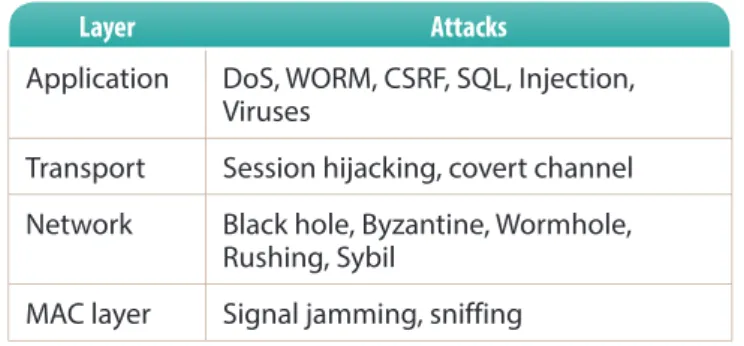
There are also attacks against the various layers of TCP/IP protocol stack. The attacks can be shown as fol-lows (see Table I).
Table I. Attacks against the various layers of OSI model
Layer Attacks
Application DoS, WORM, CSRF, SQL, Injection, Viruses
Transport Session hijacking, covert channel Network Black hole, Byzantine, Wormhole,
Rushing, Sybil
MAC layer Signal jamming, sniffing
Application layer:
The application layer is responsible for running the services. The attacks that are made against this layer are Denial of Service, executing malicious code, worms, etc. The defense mechanism for this layer is proper maintenance of sequence numbers and also maintain-ing the routmaintain-ing information to avoid denial of service.
Transport layer:
The transport layer is vulnerable to session hi-jacking which can lead to an attacker taking over the session of a legitimate user and perform malicious actions. Another attack is the covert channel, i.e. hid-ing information in network header and ushid-ing a chan-nel for communication that goes undiscoverable. The defense mechanisms for the session hijacking are change of session ІD immediately after logging into a session.
Network layer:
The attacks on network layer mainly involve the at-tacks on the various routing protocols used in ad hoc networks such as Ad hoc On-Demand Distance Vec-tor (AODV) protocol and the Dynamic Source Routing (DSR) protocol. The various attacks taking place on these routing protocols are Black hole, Byzantine, Sybil and Wormhole attacks. These attacks are discussed in detail further.
MAC layer:
The attacks on MAC layer are associated with the channel allocation for the wireless medium. Various at-tacks such as signal jamming can lead to denial of service. Sniffi ng can lead to modifi cation of the packets being transferred in the wireless medium. To avoid sniffi ng pack-ets can be encrypted at the sender side and decrypted at the receiver side. There are various encryption techniques and the standards being used include WPA and WEP.
Multi-layer:
The attacks that occur in any layer of the network protocol stack come under this category. The attacks in-cluded are spoofi ng attacks, denial of service attack etc.
This section mainly focuses on:
• Wireless impact on traditional security approaches;
• Signal exposure threats;
• Common misconceptions in wireless security;
• Wireless LAN and MAN signal leakage;
• Information disclosure threats;
• DoS attacks;
• Rogue AP attacks;
• Wireless protocol defi ciencies;
• Anonymity attacks;
• Home user threats.
Thus, in the fi rst part of the course, all existing attacks in wireless networks will be analyzed.
In addition, the following issues will be discussed:
• Wireless standards bodies, role of the WiFi Alliance for interoperability testing, capabilities and features of WPA and WPA2, IETF standards, RADIUS, and EAP pro-tocols.
• Enterprise impact of security-pertinent wireless stand-ards including: 802.11z “Direct Link Setup”, 802.11ac “Gigabit over Wi-Fi”, 802.11af “Wi-Fi in TV White Space”.
• Information about standards bodies work and working group resources.
As a result, the fi rst section of the course “Wireless and Mobile Security” will cover all the principles of wire-less LAN organizations, standards and the wirewire-less threats. Also, the risks and threats using BYOD will be dis-cussed, as it can lead to data breaches and increased lia-bility for the organization.
B. Wireless LAN Assessment Techniques
The second section of the course will present the important question of the wireless LAN assessment tech-niques.
In fact, companies should conduct regular, perio dic security reviews to ensure that changes to the WLAN don’t make the system vulnerable to hackers. A review once each year may suffi ce for low risk networks, but a re-view each quarter or more often may be necessary if the network supports high risk information (e.g., fi nancial data, postal mail routing, manufacturing control func-tions, etc.).
When performing a wireless LAN security assess-ment, consider completing the following steps:
1.Review existing security policies.
2.Review the system architecture and confi gurations.
3.Review operational support tools and procedures.
4.Interview users.
5.Verify confi gurations of wireless devices.
6.Investigate physical installations of access points.
7.Identify rogue access points.
8.Perform penetration tests.
9.Analyze security gaps.
10.Recommend improvements.
In the course diff erent methods and analysis for a WLAN audit will be discussed. For example, the appli-cation of the method of fi ngerprinting is associated with the fact that identifying devices connected to a network (i.e., device fi ngerprinting) has become of critical impor-tance to ensure, among other security services, access control to the network. In the same vein, there has also been a need to understand the type of a device that is connected to a network (i.e., device type fi ngerprint-ing). Device fi ngerprinting seeks to uniquely identify de-vices on a network without considering existing easily forgeable identifi ers (e.g., IP and MAC addresses). On the other hand, device type fi ngerprinting can be used to determine if a device belongs to a particular cohort. This method includes three categories: OS fi ngerprinting, host fi ngerprinting, and device type/driver fi ngerprinting.
The following WLAN assessment techniques will be described: client post-processing analysis with Kismet XML fi les, identifying the authentication and encryption options used on the WLAN with Kismet and Wireshark, techniques for mapping the range of indoor and outdoor WLANs, assessing traffi c captured in monitor mode for information disclosure, identifying multicast protocols
with MAC analysis, evaluating encrypted traffi c and pro-prietary encryption functions, etc.
After the course the students will have a full under-standing of the Rogue AP Analysis (Fig. 2.).
Rogue AP Analyse includes:
Defi ning and understanding rogue networks
How attackers exploit rogue networks
Types of rogue networks
Examples of malicious Rogue AP
compromises
Ad-hoc rogue networks
Windows bridging and the Ad-hoc threat
SOHO devices as a node threat, threat of
Windows soft APs
Behavior and spread of the "Free Public
Wi-Fi" ad-hoc networks
Fig. 2. Rogue AP analysis
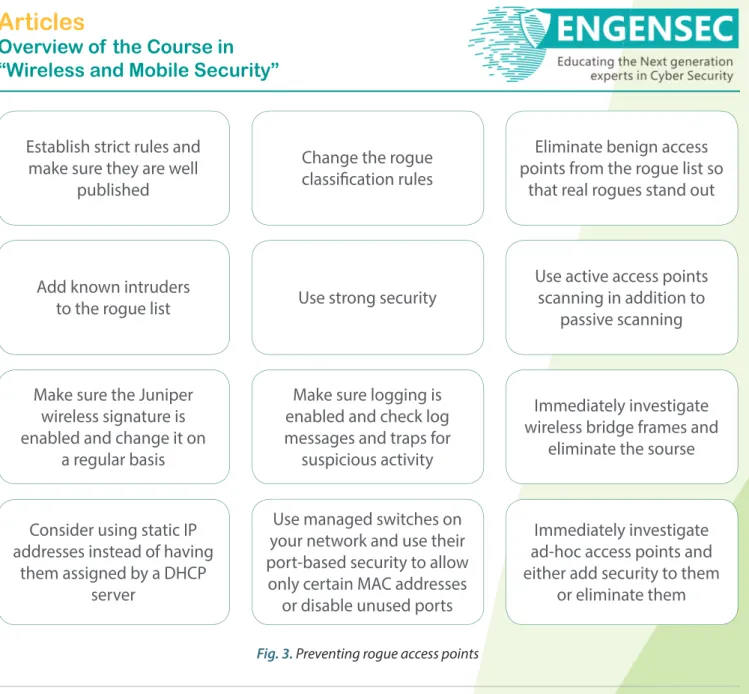
Based on the analysis, diff erent techniques will be off ered for identifying rogue devices (such as: wired-side AP fi ngerprinting, wired-side MAC prefi x analysis, wire-less-side warwalking, wirewire-less-side client monitoring, wireless-side IDS, Nmap rogue AP scripting analysis) and for preventing rogue APs (Fig. 3).
Establish strict rules and
make sure they are well
published
Change the rogue
classifi cation rules
Eliminate benign access
points from the rogue list so
that real rogues stand out
Add known intruders
to the rogue list
Use strong security
Use active access points
scanning in addition to
passive scanning
Make sure the Juniper
wireless signature is
enabled and change it on
a regular basis
Make sure logging is
enabled and check log
messages and traps for
suspicious activity
Immediately investigate
wireless bridge frames and
eliminate the sourse
Consider using static IP
addresses instead of having
them assigned by a DHCP
server
Use managed switches on
your network and use their
port-based security to allow
only certain MAC addresses
or disable unused ports
Immediately investigate
ad-hoc access points and
either add security to them
or eliminate them
Fig. 3. Preventing rogue access points
Currently, there is already a number of diff erent me-thods of protection:
• Encryption protocol WEP;
• WPA encryption protocol;
• WPA2 protocol;
• 802.1X security standard;
• Filtering by MAC address;
• Hiding the SSID;
• Denying access to the settings of the access point or router through the wireless network.
However, there is no diffi culty in overcoming a wireless network security system Therefore, it is necessary to use a comprehensive approach to protect a wireless network. For this, the course will consider all methods of protection,
starting with methods from Client, Crypto, Enterprise and fi nishing Advanced attack.
С. Client, Crypto, Enterprise, and Advanced Attacks
If in a wireless network of small dimensions using standard security methods is usually enough, in large net-works, it is necessary to use a more thorough approach to security issues.
For a more detailed understanding of Enterprise attacks, the course will look in detail at the following issues:
• Understanding the risks and challenges of legacy au-thentication sources, how PEAP addresses this weak-ness using TLS.
• Understanding TLS tunnel establishment exchange and validation, behavior of PEAP Phase 1 and PEAP Phase 2 connections, identity disclosure in PEAP sup-plicants.
• Diff erences between WPA2-PSK and WPA-Enterprise authentication, EAPOL-Key distribution and use, PMK generation and delivery from RADIUS, PTK derivation and key rotation mechanisms.
• Attacks against PEAP networks including authenti-cation attacks, Man-In-The-Middle attacks, EAPOL key-distribution attacks, client-specifi c attacks.
• Exploiting weaknesses in certifi cate validation mecha-nisms in Windows, Apple iOS, and Android platforms.
• Protecting PEAP networks, WZC recommended suppli-cant confi guration properties, mitigating PEAP user-name disclosure with third-party supplicants, client fi rewall devices and wireless security recommenda-tions.
Advanced Wi-Fi attack techniques are discussed in more detail. The most compatible wireless hardware con-fi gurations nowadays are WPA + WPA2 Mixed Mode, WPA-TKIP, WPA2-AES and WPA-AES, WPA2-TKIP.
D. Wireless Security Strategies and Implementation
The main goals of the course in “Wireless and Mobile Security” is to provide modern methods and techniques of preventing diff erent types of existing attacks. Part of these methods are using Intrusion Detection System (IDS)/Intrusion Prevention System (IPS). The WIDS is the software that detects an attack on a wireless network or wireless system. A network IDS (NIDS) is designed to sup-port multiple hosts, whereas a host IDS (HIDS) is set up to detect illegal actions within the host. Most IDS programs typically use signatures of known cracker attempts to sig-nal an alert. Others look for deviations of the normal rou-tine as indications of an attack.
1. WIDS Deployment Models:
WIDS deployment models can classify by three WIDS model categories: overlay deployment, integrated deployment, and hybrid deployment.
WIDS overlay deployment model (Fig. 4) has next advantages and disadvantages.
Advantages:
1.Ability to deploy a monitoring solution that is sepa-rate from the wireless transport provider.
2.The organization can leverage the overlay WIDS prod-uct to monitor for the vulnerability, if a vulnerability is discovered in the transport network implementation equipment.
3.Allowing organizations to monitor for the presence of unauthorized wireless devices.
Disadvantages: 1.Cost.
2.Organizations must deploy wireless sensor devices in all areas that require WIDS monitoring.
3.The lack of integration with the transport network can constrain the analysis capabilities of the overlay model.
The sensors passively listen to the events on the wire-less network and use various analysis techniques to iden-tify attacks.
Fig. 4. Overlay WIDS Example, where AM —
Air Monitors, AP — Access Point
2. WIDS integrated deployment model:
By using WIDS integrated deployment model the access point operates as both a transport provider, and a WIDS sensor, identifying and reporting attacks.
WIDS integrated deployment model characterizes the following advantages and disadvantages.
Advantages:
1.More cost-eff ective solution for organizations.
2.Has knowledge of dynamic encryption keys.
Disadvantages: 1.The lack of resources.
2.Must provide service and analysis capabilities, re-stricting the AP’s ability to devote available CPU and memory resources to monitoring tasks.
3.Constrain to monitoring the frequency for which it is servicing users.
Fig. 5. Integrated WIDS Example, where Dual-purpose AP/ AM devices
3. WIDS Hybrid Deployment Model:
WIDS Hybrid Deployment Model uses both dual-pur-pose APs and dedicated AMs for intrusion detection and protection. Analysis is performed by a centralized control-ler similar to what is used with an overlay model, rather than the approach used in an integrated WIDS deploy-ment, where processing is handled by distributed access points.
Advantages:
1.Increased fl exibility in deployment.
2.Focused analysis mechanisms.
3.More comprehensive attack detection.
4.Powerful response mechanisms.
5.Using a centralized access controller that integrates an identity-based ICSA-certifi ed fi rewall.
Disadvantages: 1.Cost.
2.The lack of resources.
Fig. 6. Integrated WIDS example, where Dual-purpose AP/ AM devices
Methods for detection of attacks in modern Intrusion Detection Systems (IDS) not suffi ciently elaborated in terms of the formal model of attacks, and for them it is quite diffi cult to strictly evaluate properties such as com-putational complexity, accuracy, etc. Intrusion detection methods are divided into methods for anomaly detec-tion and misuse detecdetec-tion methods. The second type of methods are most of today’s commercial systems (Cisco IPS, ISS RealSecure, NFR) — they use a signature (expert) detection methods. There are a lot of academic research-es in the fi eld of anomaly detection, but in industrial ap-plications, they are used sparingly and with great cau-tion, as these systems generate a large number of false posit ives. For expert systems the main problem is the low effi ciency of detecting unknown attacks (adaptability). Low adaptability still remains a problem, although such advantages as a low computational complexity and low cost deployment of such systems determine dominance in this area.
4. Methods of Intrusion Detection:
In this section of the course the following criteria were selected for the comparative analysis of intrusion detection methods:
The level of system monitoring. This criterion deter-mines the level of abstraction of the analyzed events in
the protected system, and determines the limits of appli-cability of the method for the detection of attacks on net-works. The following levels are considered in this review:
• HIDS — Host-based IDS.
• NIDS — Network-based IDS.
• AIDS — Application-based IDS.
• Hybrid — A combination of diff erent levels of observer.
Verifi ability of the method. This criterion allows to evaluate whether a person can (for example, a skilled ope-rator of IDS or expert) to reproduce the sequence of steps for the adoption of a decision on the presence of an attack by comparing the input and output of IDS. For example, signature-based methods will be considered verifi a ble, and clustered — not. Verifi a bility allows the correctness of the method and its implementation at any given time for peer review. The property of this method is important to the operation of the intrusion detection system in real environment as a means of gathering evidence about the attacks.
Adaptive methods. Assessment of the stability of the method to small changes in the implementation of the attacks, which do not change the result of the attack. Adaptability is the only signifi c ant a dvantage o f “ alter-native” methods of detection of attacks before “signaturebased”. Lack of adaptability does not allow protection system to respond quickly to unknown attacks and requires the organization of the system some regular up-dating databases of known attacks, similar to antivirus systems.
Stability. Output method does not depend on the protected system. The stability problem is acute for sta-tistical methods that analyze the absolute values of the parameters of performance and utilization of network resources and components. Trained in the same network recognizer can be sustained in this network, and unsta-ble in all other networks. This stability will be called lo-cal. Since learning is usually an “expensive” procedure because it requires the use of large amounts of resourc-es and time, the number of training procedurresourc-es should be minimized. Methods for detection of attacks, analyz-ing the input semantics, are more stable than statistics.
Computational complexity. The complexity of this method of analysis is considered in the acquisition mode, without taking into account the possible preliminary stag-es of setup and training. This criterion is a key problem for intrusion detection in telecommunication networks. Complexity Estimation is sublinear, linear, quadratic, etc.
Based on the comparative analysis it can be conclud-ed that none of the above open IDS does fully conform to the criteria of the “ideal” IDS. The main disadvantage is the lack of adaptability to unknown attacks and the inability to analyze the behavior of objects in a tele-communications network at the same time, at all levels. Based on the analysis and identifi ed disadvantage the requirements have been developed for modern IDS [6–9] that can be put into the development of a hy-brid adaptive intrusion detection method based on signature analysis and state transition. It requires to:
• Cover all classes of attacks.
• Allow to analyze the behavior of the telecommunica-tions network to be protected at all levels: network, nodes, and the level of individual applications.
• Be adaptable to unknown attacks (using an adaptive method of intrusion detection).
• Scale to telecommunications networks of diff erent classes (from small local networks of class “home of-fi ce” to large multi-segment and switched enterprise networks, providing centralized management of all IDS components).
• Have integrated mechanisms to respond to an attack.
• Be protected against attacks on IDS components, in-cluding interception control or attacks “denial of service”.
• Be open.
So, the role of intrusion detection systems for infor-mation security has increased steadily. The cost of systems and the cost of exploitation for commercial IDS is very high. Given the growing popularity of open source software and its signifi cantly lower cost, it appears that the role of free IDS will grow even faster.
Organizations should consider using multiple types of IDPS technologies to achieve more comprehensive and ac-curate detection and prevention of malicious activity. For most environments, a combination of network-based and host-based IDPSs is needed for an eff ective IDS solution. Wireless IDPSs may also be needed if the organization deter-mines that its wireless networks need additional monitor-ing or if the organization wants to ensure that rogue wire-less networks are not in use in the organization’s facilities.
The course identifi es deploying a secure wireless infrastructure, confi guring and securing wireless clients:
• Recommendations for managing an authentication ar-chitecture, leveraging the RADIUS protocol for authen-tication validation, RADIUS data encoding rules, EAP transmitted over RADIUS.
• Understanding the impact of a compromised CA, “evil twin” attack.
• Recommendations and preferences for selecting an EAP type, understanding the advantages and disad-vantages of EAP/TLS, PEAP, PEAPv1, PEAPv2, TTLS, EAP-FAST, PEAP-EAP-TLS.
• Four techniques for deploying a new root certifi -cate authority: manual, web-server delivery, script-ed web-server delivery, automatic trust with GPO.
• Managing client confi guration settings with Windows, cached authentication credentials with PEAP on Win-dows WZC, deploying GPO settings for preferred wire-less network, specifying the confi guration and settings of preferred WZC networks, editing and implementing wireless-specifi c GPO policies, recommendations for securing PEAP through GPO.
• Managing third-part wireless manager tools with the Funk Odyssey supplicant, creating a custom installer with Odyssey manager.
Besides security in Wi-Fi network, Protection methods in Bluetooth, DECT, and ZigBee and Mobile technologies are also reviewed in the course.
E.Practical Skills in the Course in “Wireless and Mobile Security”
During the course, students acquire the skills to work with software NetStumbler, Kismet, AirSnort, aircrack and other wireless network monitoring tools. Particular atten-tion is paid to the use of the most common tools of audit wireless networks, both commercial and open source.
The main topics for practice are listed below:
1. Wireless Network Mapping:
The purpose of this practice is to obtain data on wire-less networks and visualize the relationships between the elements.
After the study, the students must know and be able to:
• Collect data about wireless devices and their geoloca-tion.
• Write a small Python scripts for data conversion.
• Make a wireless network mapping.
• Build a “client to access point” and “client to probe” re-lationship graphs.
• Use GPS module in wireless network scanning.
• Parse airodump-ng results and to export its as JSON.
• Make a GPS track on Google maps (for independent work).
2. Monitor Network Traffi c:
The purpose of this practice is to collect wireless net-work data using sniff er and analyze this data on vulnera-bilities.
After the study, the students must know and be able to:
• Choose a sniff er for the monitoring of network traffi c.
• Restrict on packet processing.
• Collect data from network sniff er.
• Write their own sniff er based on external tools.
3. WEP and WPS Hacking Technologies:
The purpose of this practice is to consider the com-mon methods of hacking Wi-Fi networks.
After the study, the students must know and be able to:
• Conduct attacks on Wi-Fi.
• Set up wireless access point based on known vulner-abilities.
• Test an AP on WEP and WPS vulnerabilities.
• Disable insecure services.
4. Research of Radio Frequency Wi-Fi Resources
in 2.4–2.5 GHz Range:
The purpose of this practice is to consider diff erent ways to obtain information about the radiation levels in wireless networks without the use of special spectrum analyzers.
After the study, the students must know and be able to:
• Know ways to obtain information about the energy uti-lization of channels.
• Know how to get workload of the frequency range.
• Use a mobile phone to receive a list of available wire-less networks.
• Determine the workload channel.
• In this practice there are two types of spectrum ana-lyzers used:
• Fourier analyzer (FFT analyzer).
• Analyzers operating in accordance with the hetero-dyne principle.
In the course a lot of spectrum analyzers for the 2.4–2.5 GHz ISM band will be implemented to connect via USB-in-terface (FFT analyzer). For example, Ubiquiti AirView2, MetaGeek Wi-Spy, Wi-Detector, as well as on the basis of diff erent sets of debugging (such as TI eZ430-RF2500) or network interface cards (e.g., Atheros AR92xx and AR93xx with Spectral Scan mode [3]). These devices have a num-ber of drawbacks: the price; the diffi culty of obtaining data that are usually tied to a particular program; the inability to change the fi rmware of devices. In addition, there are of course many homemade projects, usually based on TI CC2500 chip and Cypress 693x, as well as modules on their basis.
5. Wi-Fi Fuzzing:
The purpose of this practice is to make fuzz testing of wireless access point and to conduct security analysis of the part of PCI DSS standard that is responsible for the wireless network.
After the study, the students must know and be able to:
• Know diff erent ways of Wi-Fi fuzzing.
• Know wireless part of PCI DSS standard.
• Make a fuzz testing of an AP.
• Security analysis of AP in accordance with PCI DSS standard.
Fuzz testing or fuzzing is a black box software testing technique, which basically consists in fi nding implemen-tation bugs using malformed/semi-malformed data injec-tion in an automated fashion.
A fuzzer is a program which injects automatical-ly semi-random data into a program/stack and detects bugs. The data-generation part is made of generators, and vulnerability identifi cation relies on debugging tools. Generators usually use combinations of static fuzzing vectors (known-to-be-dangerous values), or totally ran-dom data. New generation fuzzers use genetic algorithms to link injected data and observed impact. Such tools are not public yet.
6. Wi-Fi Network DoS Attacks:
The purpose of this practice is to consider DoS ways to attack the Wi-Fi network.
After the study, the students must know and be able to:
• Know types of DoS attacks on the Wi-Fi network.
• Know typical signs of DoS attack.
• Test an AP by DoS attacking.
• Get an answer on the status of running AP.
A denial of service (DoS) occurs when a system is not providing services to authorized clients because of resource exhaustion by unauthorized clients. In wireless networks, DoS attacks are diffi cult to prevent, diffi -cult to stop an on-going attack; the victim and its clients may not even detect the attacks. The duration of such DoS may range from milliseconds to hours. A DoS attack against an individual station enables session hijacking.
Jamming the air waves. A number of consumer ap-pliances such as microwave ovens, baby monitors, and cordless phones operate on the unregulated 2.4 GHz ra-dio frequency. An attacker can unleash large amounts of noise using these devices and jam the airwaves so that the signal to noise drops so low, that the wireless LAN ceases to function. The only solution to this is RF proofi ng the surrounding environment.
Flooding with associations. The AP inserts the data supplied by the station in the Association Request into a table called the association table that the AP maintains in its memory. The IEEE 802.11 specifi es a maximum value of 2007 concurrent associations to an AP. The actual size of this table varies among diff erent models of APs. When this table overfl ows, the AP would refuse further clients. Having cracked WEP, an attacker authenticates several non-existing stations using legitimate-looking but ran-domly generated MAC addresses. The attacker then sends a fl ood of spoofed associate requests so that the associa-tion table overfl ows. Enabling MAC fi ltering in the AP will prevent this attack.
Forged dissociation. The attacker sends a spoofed Dis-association frame where the source MAC address is set to that of the AP. The station is still authenticated but needs only to reassociate and sends Reassociation Requests to the AP. The AP may send a Reassociation Response accepting the station and the station can then resume sending data. To prevent Reassociation the attacker con-tinues to send Disassociation frames for a desired period. Forged deauthentication. The attacker monitors all raw frames collecting the source and destination MAC addresses to verify that they are among the targeted vic-tims. When a data or Association Response frame is ob-served, the attacker sends a spoofed Deauthentication frame where the source MAC address is spoofed to that
of the AP. The station is now unassociated and unauthen-ticated, and needs to reconnect. To prevent a reconnec-tion, the attacker continues to send Deauthentication frames for a desired period. The attacker may even rate the limit of the Deauthentication frames to avoid over-loading the already congested network. The mischievous packets of Disassociation and Deauthentication are sent directly to the client, so these will not be logged by the AP or IDS, and neither MAC fi ltering nor WEP protection will prevent it.
Obviously, the primary thing they can do is to force stations (clients) off of a given network, causing a DoS at-tack. It can also use death attacks to reveal otherwise hid-den SSIDs (not included in beacon frames) by disconnect-ing the clients, and then monitordisconnect-ing for Probe Requests which always contain the SSID.
7. Over the Air (OTA)
The purpose of this practice is to check the fi rmware updates over the network; to analyze the data transmit-ted over the network during the upgrade; to investigate the possibility of substitution of transferred fi rmware.
After the study, the students must know and be able to:
• Know principles of OTA.
• Know weak spots of OTA.
• Create the fi rmware.
• Provide online fi rmware.
OTA update is the process of loading the fi rmware to ESP module using Wi-Fi connection rather that a serial port. Such functionality became extremely useful in case of limited or no physical access to the module.
OTA may be done using:
• Arduino IDE.
• Web Browser.
• HTTP Server.
Arduino IDE option is intended primarily for software development phase. The two other options would be more useful after deployment, to provide module with applica-tion updates manually with a web browser or automatical-ly using a http server.
In any case fi rst fi rmware upload has to be done over a serial port. If OTA routines are correctly implemented in a sketch, then all subsequent uploads may be done over the air.
There is no imposed security on OTA process from be-ing hacked. It is up to developer to ensure that updates are allowed only from legitimate / trusted sources. Once update is complete, module restarts and new code is exe-cuted. Developer should ensure that application running on module is shut down and restarted in a safe manner. Chapters below provide additional information regarding security and safety of OTA process.
8. Research of Stress Loading of Wireless Network:
The purpose of this practice is to assemble a sample of the test access point based on single-board computer; to explore one of the security aspects of wireless infra-structure — availability.
After the study, the students must know and be able to:
• Restrict imposed on the wireless infrastructure.
• Know methods of collecting system information in OS Linux.
• Establish basic network services for wireless access points in OS Linux.
• Work with the indicator displays (OLED).
Availability is ensuring that authorized users can ac-cess and work with information assets, resources, and systems they need, while providing the required per-formance. Ensuring availability includes measures to support access to information, despite the possibility of interference, including system failure and deliberate at-tempts to violate availability. The protection of access to and the capacity of mail service would be an example.
Ensuring availability is to identify possible points of failure and liquidation of these points. Strategies for re-ducing the negative consequences of failure can be man-agement and technology.
The fi rst step is to identify potential points of failure in the network infrastructure. These mission-critical devices, such as switches and routers, as well as the basic terms of the functioning of servers, such as DNSs, need to be analyzed in terms of a possible failure and its impact on the functioning of the IT capabilities. This is related to risk management — identify and minimize risk.
From the standpoint of availability, the following defi -nitions can be given.
Reliability — the ability of a system or an individual component to perform its required function under cer-tain conditions in the specifi ed time period.
Redundancy — the creation of one or more cop-ies (backup) systems, which are available in the event of primary system failure or the presence of the addition-al capabilities of the system for the organization of its resiliency.
Resiliency — method of operation, in which the functions of the system component (such as CPU, serv-er, network or database) run redundant components in case of failure or a planned shutdown major compo-nent. The ability of a system or component to contin-ue to function normally in case of failure of equipment or software.
It is necessary to analyze the possible points of failure in the following components: data, system components, network topology, routers and switches, some critical services.
9. 125 kHz RFID Sniffi ng
The purpose of this practice is to consider the work of EM-Marin (EM4100 or EM4102) protocol for 125 kHz RFID and sniff it.
After the study, the students must know and be able to:
• Know EM-Marin protocol.
• Receive data from RFID.
• Sniff and analyze data from RFID.
EM4100 (EM4102, EM-Marin) is a format of contactless radio frequency ID cards by the company EM Microelec-tronic-Marin (one of the most popular in Ukraine).
They belong to a class of passive RFID cards, because they do not have a built-in power supply. They operate in the frequency range 125 kHz and have a unique number of 40-bit.
They are available in a variety of forms (the most common Clamshell cards, ISO 7810 cards, key rings). ISO-card can be issued in addition to the magnetic stripe identifi cation number, made by stamping, a fi eld for the signature of the cardholder. Personalization ISO-cards is made by thermal printing, screen print-ing, off set printing. Personalization Clamshell-cards are made using labels that are applied to all the necessary information.
The reader generates a magnetic fi eld frequency of 125 kHz. Once in the magnetic fi eld of the reader, the card receives power and begins to cyclically modulate the magnetic fi eld of the reader signal in which its identifi
ca-tion code is encrypted. The range of labels is ranging from 5–10 to 60–70 centimeters, depending on the structural elements tags and readers.
Modulation method of the carrier is amplitude. Data encryption — Manchester. 64 bits, including 40 bits of proper unique number, the special synchronization se-quence and parity check bits are cyclically transmitted. The main use is the control of access to the premis-es and a car park. A distinctive feature of identity cards Em-marine is lower cost compared to other proximi-ty-card standard (e.g., HID or Mifare).
F.Equipment and Software Components for the Workplace.
Many manufacturers of wireless equipment insert algorithms, but the spectrum is scanned only in the lo-cation area of AP, thus, they do not consider particularly customer location. AP starts at the clear channel at the place of its location, which to some extent improves the performance of the entire network, but does not make it the optimal.
Usually existing wireless cards are used for col-lecting the information, but their range of visibility is often limited only by the IEEE 802.11 standard works (and some maps do not even see “hidden” net-works). Because universal method should consider the use of additional independent devices (spectrum analyzers).
For conducting good practice our course off ers a spectrum analyzer for separate scheme. The control unit implemented on Arduino Nano v3.0 (with 3.3V supply) and the receiver — on TI CC2500+PA+LNA module with external antenna. Scheme is equipped with OLEDs 0.96” 128×64 I2C and SPI SSD1306 for visualizing the measure-ment results. The program is written in Arduino IDE and compiled with GCC.
The Fig. 7 shows a diagram of the connection mo dule and power to the device. This device can be operated with a controller that receives data via a USB interface (the virtual COM port). On two screens displayed range of 2400.01–2503.40 MHz with spacing in 405.5 kHz. And
Fig. 8 shows an example of display device assembly in a transparent case.
It was found that the control unit memory is not enough (only 2 KB of RAM) to analyze the available chan-nels. Also, this device does not fulfi ll one of the require-ments — must be non-directional antenna, and the half-wave dipole has a distinct polarization.
To implement the analyzer on a single chip Polo-lu Wixel has been selected, whose RAM size is 4 KB, the non-directional antenna, fi ve times lower power con-sumption, almost one and a half times better resolution and SDK with detailed documentation.
Spectrum analyzer on PololuWixel (CC2511F32) with SPI and/or I2C OLED’s SSD1306. The spectral width is 2403.47–2476.50 MHz with spacing in 286.4 kHz on two SPI displays. Displays available channels on I2C display. This scheme takes less than 10mA (on 5V).
Prototype can be assembled in a clear acrylic case for Raspberry Pi, but can be built more compactly. Button with a red cap — switch on, and the second one — pause. The left screen displays ZigBee and Wi-Fi channels (not all channels fall within the available range).
So, for practice in the course “Wireless and Mobile Se-curity” the following equipment will be used:
1.Arduino Nano v3.0.
2.TI CC2500+PA+LNA module with external antenna.
3.PololuWixel.
4.OLED’s SSD1306 SPI or I2C.
5.Raspberry Pi 3.
6.GPS module (e.g., NEO-6M).
7.UART to TTL adapter with 3.3 V levels (optionally).
8.NodeMCU (ESP-12E).
In the process of learning the course, students will ac-quire skills to work with diff erent software components: Kismet, AirSnort, Ettercap, Wixel SDK, Arduino IDE, WiF-iBeaconJam, WIDS, WIPS, Aircrack and other wireless net-work monitoring tools.
SUMMARY
The world of wireless and mobile devices is evolv-ing day-to-day, with many individuals relyevolv-ing solely on their wireless devices at workplace and at home. The growing use of mobile devices demands that organ-izations become more educated in securing this growing technology and determining how to protect their as-sets best. Using case studies and real-world events, it goes on to discuss risk assessments, threats, and vulnerabilities of wireless networks, as well as the se-curity measures that should be put in place to mitigate breaches.
Fig. 7. Schematic diagram of separated receiver and control unit
Fig. 8. Separated receiver with external antenna and
The wireless networks consist of fourbasic compo-nents: the transmission of data using radio frequencies; access points that provide a connection to the organiza-tional network and/or the client devices (laptops, PDAs, etc.); and users. Each of these components provides an avenue for attack that can result in the compromise of one or more of the three fundamental security objectives of confi dentiality, integrity, and availability.
Due to the intensive development of wireless net-works course in “Wireless and Mobile Security” is very im-portant. The course covers a comprehensive wireless and mobile security overview including the design, planning, installation, and maintenance of wireless network securi-ty infrastructures.
The course in “Wireless and Mobile Security” provides knowledge in security architecture of wireless and mobile communication systems, information threats models, vul-nerabilities and protection abilities in wireless networks. The students will obtain practical skills in penetration testing of wireless networks by using various protection methods.
REFERENCES
[1] Wireless Geographic Logging Engine database
https://wigle.net/graph-large.html.
[2]Astapenya V. M., Sokolov V. Yu. “Modifi ed acceler-ating lens as a means of increasing the throughput, range and noise immunity of IEEE 802.11 systems,” ICATT’2015 Proceedings of the X Anniversary Inter-national Conference on Antenna Theory and Tech-niques, Kharkiv, Apr. 2015, pp. 267–269.
[3] “CC2500 Low-Cost Low-Power 2.4 GHz RF Transceiver,” Texas Instruments, 2016, 97 p.
[4] “Pololu Wixel User’s Guide,” Pololu Corporation, 2015, 67 p.
[5]V. Buryachok, G. Gulak, V. Sokolov. “Miniaturization of Wireless Monitoring Systems 2.4–2.5 GHz Band,” Proceedings of the II International Scientifi c-Technical Conference on Actual Problems of Science and Tech-nology, Kiev, Dec. 2015, p. 41.
[6] “nRF24L01 Single Chip 2.4GHz Transceiver Product Specifi cation,” Nordic Semiconductor ASA, Version 2.0, July 2007, 74 p.
[7]Graham E., Steinbart P. J. Wireless Security. 2006. [8] Cisco. Dictionary attack on Cisco LEAP vulnerability,
Revision 2.1, 19 July 2004.
[9] CSI. CSI/FBI Computer Crime and Security Survey. 2004.
[10] Hopper D. I. (2002). Secret Service agents probe wireless networks in Washington.
[11] IEEE 802.11-2007, New York, NY, USA. 2007. [12] IEEE 802.11i-2004, New York, NY, USA. 2004.
[13] Bellardo J., Savage, S. 802.11 denial-of-service at-tacks: Real vulnerabilities and practical solutions. In: Proceedings of the 12th USENIX Security Sympo-sium, Berkeley, CA, USA, USENIX Association, 2003. [14] Aime M. D., Calandriello G., Lioy A. Dependability in wireless networks: Can we rely on Wi-Fi IEEE Secu-rity and Privacy 5, p. 23–29, 2004.
[15] Devine C., d’Otreppe T., Beck M. Aircrack-ng. 2009.
http://www.aircrack-ng.org.
[16] Smith J. Denial of service: Prevention, modelling and detection. 2007.
[17] Glass S., Muthukkumarasamy, V. A study of the TKIP cryptographic DoS attack. In: ICON 2007: Pro-ceedings of the 15th IEEE International Conference on Networks, New York, NY, USA, IEEE, p. 59–65. 2007. [18] Tews E., Beck M. Practical attacks against WEP and
WPA. In: WiSec ’09: Proceedings of the second ACM conference on Wireless network security, New York, NY, USA, ACM, p. 79–86. 2009.
[19] IEEE: IEEE 802.11e-2005, New York, NY, USA. 2005. [20] Halvorsen F. M., Haugen O., Eian M., Mjølsnes S. F.
An improved attack on TKIP. In: NordSec ’09: Proceed-ings of the 14th Nordic Conference on Secure IT Sys-tems, Berlin, Heidelberg, Springer-Verlag, p. 120–132. 2009.
[21] IEEE: IEEE 802.11h-2003, New York, NY, USA. 2003. [22] Harkins D. Attacks against Michael and Their
Countermeasures. IEEE 802.11 Working Group Doc-ument 03/211r0, New York, NY, USA. 2003.
[23] The OpenWrt Project: OpenWrt. 2009. http://www. openwrt.org.
[24] Malinen J. Hostapd: IEEE 802.11 AP, IEEE 802.1X / WPA / WPA2 / EAP / RADIUS Authenticator. 2009.
http://hostap.epitest.fi /hostapd.
[25] Zarate J. Tomato Firmware (2009) http://www. polarcloud.com/tomato.
[26] Cisco Systems Inc.: Enterprise Mobility 4.1 Design Guide, San Jose, CA, USA. 2009.
[27] M. Beck. Enhanced TKIP michael attacks. Retrieved 4 February, 2013, from http://download.aircrack-ng. org/wiki-fi les/doc/enhanced_tkip_michael.pdf.
[28] J. Bellardo and S. Savage. 802.11 denial-of-service attacks: real vulnerabilities and practical solutions. In Proceedings of the USENIX Security Symposium, 2003.
[29] K. Bicakci and B. Tavli. Denial-of-service attacks and countermeasures in IEEE 802.11 wireless networks, 2009. [30] A. Stubblefi eld, J. Ioannidis, A. D. Rubin. A key reco-very attack on the 802.11b wired equivalent privacy protocol (wep). ACM Trans. Inf. Syst. Secur., 7(2), 2004. [31] E. Tews, M. Beck. Practical attacks against WEP and
WPA. In Proceedings of the second ACM conference on Wireless network security, WiSec ’09, 2009. [32] Y. Todo, Y. Ozawa, T. Ohigashi, M. Morii. Falsifi
ca-tion attacks against WPA-TKIP in a realistic environ-ment. IEICE Transactions, 95-D (2), 2012.
[33] F. M. Halvorsen, O. Haugen, M. Eian and
S. F. Mjølsnes. An improved attack on TKIP. In 14th Nordic Conference on Secure IT Systems, NordSec ’09, 2009.
[34] B. Harris, R. Hunt. Review: TCP/IP security threats and attack methods. Computer Communications, 22(10):885–897, 1999.
[35] J. Huang, J. Seberry, W. Susilo, M. W. Bunder. Se-curity analysis of michael: The IEEE 802.11i message integrity code. In EUC Workshops, pp. 423–432, 2005.