Digital Commons @ West Chester University
Digital Commons @ West Chester University
West Chester University Doctoral Projects Masters Theses and Doctoral Projects Spring 2020
Negotiating Difference: A Critical Discourse Analysis of Writing
Negotiating Difference: A Critical Discourse Analysis of Writing
Center Interactions Between Peer Tutors and Multilingual Tutees
Center Interactions Between Peer Tutors and Multilingual Tutees
Lisa DiMaioFollow this and additional works at: https://digitalcommons.wcupa.edu/all_doctoral Recommended Citation
Recommended Citation
DiMaio, Lisa, "Negotiating Difference: A Critical Discourse Analysis of Writing Center Interactions Between Peer Tutors and Multilingual Tutees" (2020). West Chester University Doctoral Projects. 74.
https://digitalcommons.wcupa.edu/all_doctoral/74
This Dissertation is brought to you for free and open access by the Masters Theses and Doctoral Projects at Digital Commons @ West Chester University. It has been accepted for inclusion in West Chester University Doctoral Projects by an authorized administrator of Digital Commons @ West Chester University. For more information, please contact [email protected].
Negotiating Difference: A Critical Discourse Analysis of Writing Center Interactions Between Peer Tutors and Multilingual Tutees
A Dissertation
Presented to the Faculty of the College of Education & Social Work
West Chester University West Chester, Pennsylvania
In Partial Fulfillment of the Requirements for
the Degree of Doctor of Education By Lisa DiMaio May 2020
© Copyright 2020 Lisa DiMaio West Chester University College of Education & Social Work
Dedication
I dedicate this dissertation to my past, present, and future students. Because of your courage and trust in me, I am and always will be your ally, rallying for you when you think you are alone, expressing my voice when you might not be able to express yours.
I also dedicate this dissertation, which involved countless hours, energy, and
determination, to my daughters, Claire and Corinne. To Claire, my Rainbow Baby: Her optimism and confidence supported me throughout this journey. I will forever hear her voice: “You got this, mom! I’m so proud of you!” She has always been my rainbow after the storm. To Corinne, who first gave me the title “Mom”: Her faith in me and her thoughtfulness carried me on the toughest days of this journey, and my gratitude for her is infinite. She soon will be navigating college life, and I am confident that she will thrive. I hope my example of a hard-working woman lifts her up on her toughest days.
And, to Christopher: He energized me with his motivating notes and texts when I was tired and felt like I could not push forward. He has continued to be my biggest fan, and I look forward to making up the lost time. I also dedicate this project to my parents and sister, who understood why I turned down so many dinner invitations, and that this was an academic and personal goal I had postponed for decades. I appreciated their words of encouragement and their unending support. Luckily, they will not hear me say “I have school work to do” anymore, and we can share more laughs!
Acknowledgements
I have always believed, partly due to the existing evidence, that effective writing occurs when we participate in conversations. This dissertation would not be possible without the
numerous conversations I shared with many instrumental people. My committee chair, Dr. David Backer, guided me and asked critical questions, propelling my writing forward. He had hinted that by the end of this journey, we would be speaking as colleagues, and that is when I will know I’ve contributed new knowledge. During one of our last meetings as advisor and advisee, we spoke as colleagues, and that moment will forever be ingrained in my mind, symbolizing one of my greatest academic accomplishments.
To my committee members, Dr. Margaret Ervin and Dr. Scott Warnock: They were instrumental in guiding my revisions with their expertise in the field. I appreciated Margaret’s reassurance and keen eye during my revising process. I have always valued Scott’s support of my professional goals over the past ten years, and I certainly valued his critical eye and our fruitful conversations during my writing process. I must also express my gratitude to Janel McCloskey. While she was in her office doing her own research, she stepped away to listen to me cry and express doubts about my topic. Her words assisted me in narrowing my focus; she consistently championed my academic and professional goals. Additionally, Dr. Asta
Zelenkauskaite aided me in the early stages of my topic development. Conversations with Asta proved invaluable as they helped me clarify my research direction. Last, I must acknowledge a special colleague who met with me in the early stages of recruiting students for this study; I appreciate his time and effort.
Abstract
Collier (1995), Cummins (1981), and Mitchell, Destino and Karam (1997) claimed that it could take ten years for multilingual (ML) students to become proficient in academic English. In 2001, the Conference on College Composition and Communication [CCCC] Statement on Second-Language Writing and Writers asserted the same. Yet, faculty might judge the writing of ML students as deficient because they write with an “accent” (Bruce and Rafoth, 2016; Leki, 1992; Matsuda and Cox, 2011; Severino and Deifell, 2011). Consequently, ML students often seek assistance from peer tutors at the university writing center. In this dissertation, I perform a qualitative study to explore how peer tutors and ML students negotiate difference at a university writing center set in a predominantly White institution. I provide background regarding the historical approaches to tutoring. Using sociocultural theory and the Interaction Hypothesis, I understand the data of 15 hours of writing center interactions, three hours of focus group interviews, and numerous written artifacts from the ML tuteees. I also find a critical discourse analysis reveals inequalities in power and authority between the peer tutors and the ML students. In the end, I suggest paths for future research.
Keywords: multilingual students, writing center, tutoring, sociocultural theory, Interaction Hypothesis, critical discourse analysis
Table of Contents
CHAPTER I: INTRODUCTION ... 1
Problem Statement ... 3
Research Questions ... 6
Rationale for Methods... 7
Case Study ... 8
Critical Discourse Analysis... 8
Significance of the Study ... 9
Limitations ... 10 Unpredictability of Students ... 10 Researcher Bias ... 10 Time Frame ... 10 Definitions of Terms ... 11 Summary ... 11
CHAPTER II: REVIEW OF LITERATURE ... 13
Predominantly White Institutions ... 13
Differences and Deficiencies ... 15
Addressing Difference ... 19
Approaches to Tutoring ML Writers ... 24
Theoretical Frameworks: Sociocultural Theory and Interaction Hypothesis ... 28
Summary ... 31
CHAPTER III: METHODOLOGY ... 33
Overview ... 33 Setting ... 34 Participants ... 35 Recruiting volunteers ... 35 Students ... 36 Researcher as Participant/Observer ... 37 Procedures ... 38 Overview ... 38 Data Collection ... 43
Critical Discourse Analysis... 46
Instrumentation ... 47
Threats to Internal and External Validity ... 48
Reflexivity... 50
Reliability ... 51
Summary ... 51
Chapter IV: Results ... 53
Preview of Findings ... 53 Case #1: Amani ... 57 Correcting Difference ... 57 Negotiating Difference... 66 Case #2: Luca ... 69 Correcting Difference ... 69 Negotiating Difference... 74 Case 3: Alyia ... 79 Correcting Difference ... 79 Negotiating Difference... 86 Case #4: Gabriela ... 89 Correcting Difference ... 90 Negotiating Difference... 95 Summary ... 98 Chapter V: Discussion ... 100 Summary ... 100
Discussion of Results: Critical Discourse Analysis ... 102
Correcting Difference: Amani ... 104
Correcting Difference: Alyia ... 108
Negotiating Difference: Gabriela ... 112
Sociocultural Theory and Interaction Hypothesis: Application to Findings ... 117
SCT and IH: Correction ... 117
SCT and IH: Negotiation ... 120
Implications for Practice ... 121
Tutor Training ... 121
Challenging the Lore: Relying on Theory ... 123
Gatekeeper Expectations and Faculty Development ... 124
Implications for Future Research ... 126
Limitations in Methodology ... 126
Limitations in Analysis ... 127
Limitations in Generalizability ... 127
Summary ... 127
Appendix A: IRB Approval Documentation ... 129
Appendix B: Recruitment Materials ... 130
Appendix C: Interview Protocol ... 135
References ... 136
List of Tables and Figures Table 3-1 Multilingual Tutees……….. 36
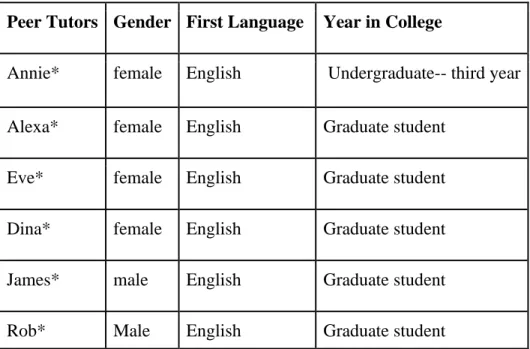
Table 3-2 Peer Tutors………....37
Table 3-3 Amani’s Tutoring Sessions………...39
Table 3-4 Luca’s Tutoring Sessions………..40
Table 3-5 Alyia’s Tutoring Sessions……….41
Table 3-6 Gabriela’s Tutoring Sessions………42
Table 4-1 Number of Times Each Code Applied………..54
Table 4-2 Number of Times Specific Codes Applied to ML Students……….55
Table 4-3 Negotiation of Meaning………56
Figure 1 Fairclough’s Three-Dimensional Model of CDA……….103
CHAPTER I: INTRODUCTION
I have been working with multilingual (ML) students for over twenty years. In one role, I work as a tutor in the writing center at a diverse four-year university in Philadelphia. Training peer tutors in strategies for working with ML students is part of my position as well.
Approximately 40 percent of the appointments in this writing center are with ML students; thus, the peer tutors need sufficient training, so they can interact successfully with ML writers. Interaction and negotiation (Ellis, 2000; Harris and Silva, 1993; Long, 1983; Thonus, 2001; Williams, 2005) are the pillars of second language acquisition, as these facilitate language acquisition. Ellis (2000) mentioned that tutors facilitate learning through collaboration and scaffolded tasks; learning occurs in the interactions themselves. As tutors and tutees collaborate, tutors make interactional adjustments (Long, 1983) to make the input more comprehensible and this comprehensible input supports language development. When communication breaks down, however, the tutor modifies and clarifies conversational input (Long, 1983; Pica, 1996) using modifications called “confirmation checks,” (Pica, Young, & Doughty, 1987, p. 74)
“clarification requests,” (Pica, Young, & Doughty, 1987, p. 74) and “comprehension checks” (Pica, Young, & Doughty, 1987, p. 74). These interactions and modifications help the learner reach a level they would not have been able to reach without them. One of the major benefits of interaction is an increase in the amount of input that is comprehensible for the ML student (Long, 1983).
In addition to tutoring ML students and training tutors, I teach composition courses designed for ML students, i.e. longer class time, scaffolded activities, substantial feedback on
their drafts. After class one day, a student asked to talk to me. His face, forlorn and concerned, began to tell me the story: “I am so frustrated and upset. My philosophy professor took ten points off for my grammar errors. Ah! Can you help me with my next paper, so I don’t lose points?” Trying to hide my disdain for this colleague’s fixation with grammatical perfection, I asked, “Does your professor know that English is not your first language?” “Yeah, he does, but he wants my grammar to be perfect.” “Let’s look over your next paper before you hand it in to him, ok? I can help you identify some patterns of errors, and discuss ways to revise, ok?” This is a student who had been drafting and revising effectively in my class all year. Upon hearing my suggestion, he expressed his gratitude and relief and said he would like to discuss it with me before he turns in the final. Thus, he brought me a draft of his next philosophy paper. I read it aloud once to get the gist, and then a second time to identify errors. I did not “correct” the errors for him, but instead I identified some global errors and grouped them into categories like word form, tense, and word endings. Then, we had a conversation about ways to revise the errors. We did not discuss his misuse of articles and prepositions; I simply corrected them because I knew his professor would be grading his essay with a narrow eye. Faculty often are not aware that ML students still might not write like a native speaker of English-- and they should not nor be expected to.
Collier (1987, 1995), Cummins (1981), and Mitchell, Destino and Karam (1997) claimed that it could take ten years for ML students to become proficient in academic English; in 2001, the Conference on College Composition and Communication [CCCC] Statement on Second-Language Writing and Writers asserted the same. Articles are especially challenging for students whose language background has no articles (Deckert, 2009; Ritter, 2005). This particular student
had only been learning English for five years, so to expect him to produce native-like fluency was unrealistic.
In a concurrent role, as a graduate assistant working as a tutor in another writing center, I have another opportunity to mentor peer tutors as they navigate strategies in working with ML writers. In this writing center situated within a suburb west of Philadelphia in a predominantly White institution (PWI), the number of undergraduate White students is over 70% (College Factual) and to be named a PWI, enrollment must be at least 50% (Brown and Dancy, 2010). The number of international students is much lower, at only 0.7% of the enrollment, or 118 students according to a report by College Factual. Even though the enrollment is low, tutors express their hesitation and lack of skills regarding working with ML students. One tutor said, “We don’t really know what to do, so we just end up copy-editing.” Another tutor said that since they never had formal training, they usually “correct grammar” unless other glaring errors stand out like organization and/or comprehensibility. My participation in a writing center situated within a PWI has allowed me to glean multiple pieces of observational evidence.
Problem Statement
The writing center in my study is set within a PWI, which often asserts the power and privilege of the majority group, according to Brown and Dancy (2010). In this atmosphere and because of their linguistic and cultural differences, ML students often feel inferior and are seen as deficient in many ways, including in their language ability because they write with an “accent” (Bruce and Rafoth, 2016; Leki, 1992; Matsuda and Cox, 2011; Severino and Deifell, 2011). As a result of criticism from faculty who are inadequately prepared to work with
linguistically diverse students (Cox, 2014; Harris and Silv,a, 1993; Waldo, 1993; Yockel, 2008) ML writers seek support from the university writing center to “clean up” their grammar because
so often faculty judge their writing as inferior. The tutor, however, is not always equipped with the most appropriate approach to meet the needs of their ML writers.
This second issue of deciding the best tutoring approach for ML students is a complex one. Although studies support the non-directive approach (Harris and Silva, 1993; Harris, 1995; Henning, 2001; Thonus, 2001), others have also found that being directive (Cogie, Strain, and Lorinskas, 1999; Powers, 1993) or combining the two approaches (Blau, Hall, and Strauss, 1998; Clark, 1985; Shamoon and Burns, 1995; Truesdell, 2014) works well. Most researchers agree that in allowing students to set the agenda, they can lead the session, but some students look to the tutor as an authority figure who will dictate the direction of the session.
In the literature review, I briefly discuss PWIs since the setting of my study is within a PWI. Additionally, because ML students write with an “accent,” (Bruce and Rafoth, 2016; Leki, 1992; Matsuda and Cox, 2011; Severino and Deifell, 2011) faculty judge them as deficient and/or intellectually inferior, so I also discuss research regarding differences and deficiencies. I then give a historical overview of the approaches to tutoring. I end the literature review with an explanation of the theoretical frameworks that inform my findings.
Purpose of Study
This qualitative study will explore how peer tutors and multilingual (ML) students negotiate difference during writing center sessions at a writing center situated within a PWI. While observing tutoring sessions and analyzing student artifacts, I will investigate how tutors and tutees work through differences in their interactions. I will employ Critical Discourse Analysis (CDA) (Fairclough, 1995, 2003) of selected transcripts to uncover how “language shapes and positions” (Fernsten, 2008, p. 45) tutors and tutees. This study will add to the body of existing literature (Cushing-Weigle, 2004; Harris and Silva, 1993; Pica, 1994; Pica, Young, &
Doughty, 1987; Ritter, 2002; Thonus, 2014; Vargas, 2010) that has examined the interactions between peer tutors and their ML tutees during writing center sessions. This study will also contribute to the limited number of studies that have analyzed tutors’ and ML tutees’ interactions using Critical Discourse Analysis (Kang and Dykema, 2017).
Rationale for Study
This study is important to the field of writing center studies and ML writing studies for several reasons. Many researchers have investigated what happens during writing center sessions, but more work needs to be done (Cushing-Weigle and Nelson 2004; Harris and Silva, 1993; Thonus 2014; Williams, 2004). William’s study (2004) looked at how interactions led to effective revisions but in first-generation students (U.S. citizens but who speak another language other than English at home), not ML students (refer to the definition of ML in the Definitions of Terms). She mentioned that a gap exists in the research regarding ML writers who visit the writing center (Williams, 2004). In another study, Harris and Silva (1993) investigated the ways in which the tutors addressed ML students’ errors, and they claimed, not surprisingly, that ML students needed more support outside of their classrooms and the individualized attention of the writing center can address their needs. Other researchers (Thonus 2014; Cushing-Weigle and Nelson 2004) examined the perceptions of success instead of errors. Thonus (2014) found that the role a tutor plays influenced the ML students’ perception of success. That study, however, was not able to judge whether the interactions had any effect on the students’ revisions. Cushing-Weigle and Nelson (2004) found that tutors defined success differently based on their ML students’ ability to improve, understand feedback, and set goals for revision.
Additionally, while the overall enrollment of international students at colleges and universities across the U.S. has declined over the past two years, countries like China and
Vietnam have increased their numbers (Redden, 2018). ML students, seen as deficient by
administrators, faculty, and peers (Condon & Olson, 2016; Comeau-Kirschner, 2014; Cox, 2014; Fernsten, 2007; Harris, 1995; Zamel 1995; Canagarajah, 2002, 2006) look for support and
opportunities to gain acceptance and for fewer red marks on their pages.
The findings of this study contribute to the assertion that unskilled and/or
unwilling administrators and faculty (Cox, 2014; Harris and Silva, 1993; Waldo, 1993; Yockel, 2008) need to make more informed decisions about writing center policies. This study is also significant because I propose utilizing specific theories in working with ML writers. My findings challenge the “lore” of writing center work-- “the reliance on experience-based conceptions of writing center work, [which] has long dominated the field” (Denton, 2017, p. 186). Denton (2017) argued that writing center professionals need to re-examine lore. She asserted:
This simple storying becomes the simple story of writing center work when we remain entrenched in discussions, experiences, and observations largely uninformed by research [that] helps us to hold our ideas up to the light, to examine the bases for our beliefs, and offers us the opportunity, even when we are unable to reach a consensus, to establish some common grounds on a given issue. (p. 183, 192)
Research Questions
The researcher will ask:
1. How do peer tutors and tutees negotiate difference during their interactions at a university writing center?
2. How do interactions between tutors and ML tutees exhibit inequalities in power and authority?
Rationale for Methods
Qualitative methodologyis the best choice for my study since my main goal is to give voice (Creswell, 2015) to ML students who are often silent and/or seen as deficient by
unsympathetic audiences. Effective qualitative research will seek to gather information on “a central phenomenon” (Creswell, 2015, p. 205), and in this case, the interactions between the peer tutor and ML tutee. As the inquirer, I will ask my participants to “share ideas...and [I will] build general themes based on those ideas” (Creswell, 2015, p. 205). The goal here is to develop a rich understanding of the thoughts and views of the participants. Creswell (2015) states that the “qualitative researcher seeks to explore and understand one single phenomenon and doing so requires considering all of the multiple external forces that shape this phenomenon” (p. 205). Merriam and Grenier (2019) added that “meaning is socially constructed by individuals interacting with their world. Their world, or reality, is not fixed, single, agreed upon, or measurable phenomenon that it is assumed to be in a positivist, quantitative research” (p. 4).
Qualitative research, according to Lichtman (2013) fits our style if we possess empathy, are interested in examining “behaviors, thoughts, or feelings of individuals with certain traits or characteristics,” (p. 36) and if we enjoy interacting with people. She said this style of research would work well for us if we like looking beyond facts (Lichtman, 2013). Lichtman (2013) claims that a major aspect of qualitative research relies on what the participants have to say. It is our job as qualitative researchers “to understand people by listening to them, watching them interact, and thinking about the meaning beyond, beneath, and around the words” (p. 34).
According to Denzin and Lincoln (2005), qualitative researchers are “observers in the world” (p. 3), interpreting interactions and practices. They state that we “turn the world into a series of representations, including field notes, interviews, conversations, photographs, recordings, and
memos to the self” (Denzin and Lincoln, 2005, p. 3). Merriam and Tisdell (2016) claim that being a “careful observer” (p. 37) who probes effectively with open-ended questions is also key to researching qualitatively.
Case Study
Case Study is appropriate for my research because it focuses on an intense inspection of the cases themselves and is often used when researchers seek to intensely explore new or misunderstood events (Yin, 2014). In a 2016 study by Tannebaum, he provided a rich portrayal of the “lived-experiences” of pre-service social studies teachers using case study as this method allowed for thick description, which led to “cross-case analysis and single-participant reports” (Tannebaum, 2016, p. 99). Case study methods are appropriate and useful for inquirers
‘‘interested in the richness of actual cases, understanding a good story, staying close to naturalistic events, exploring new areas and discovering new phenomena, and applying our understanding to therapeutic ends’’ (Tannebaum, 2016, p. 101). Modeling this style of research fits my study since I will be looking at each student individually and then exploring combined patterns and themes. My goal is to examine the interactions of tutors and tutees in their natural setting of the writing center, and through observations and field notes, focus group interviews, and written artifacts, explore how they negotiate difference-- if they do-- and offer implications for practice based on my findings.
Critical Discourse Analysis
Critical Discourse Analysis as a methodology allows a researcher to uncover
relationships between participants. By applying Fairclough’s (1989) method, which analyzes discourse in three ways, this study examines inequities in power and authority. Researchers use CDA to interpret texts and move beyond the surface level (Fairclough, 1989; Mumby & Clair,
1997; Sarangi & Roberts, 1999) while investigating the relationships between discourse and other social factors like identities, power, inequality, values and beliefs (Fairclough, 2013; Fairclough & Wodak, 1997; van Dijk, 1993).
Significance of the Study
By observing tutoring sessions, conducting focus group interviews with tutors and tutees separately, and examining tutees’ drafts and revisions, I will explore how tutors and
tutees negotiate difference. Using Critical Discourse Analysis (CDA) (Fairclough, 2013) of selected transcripts, I will investigate how interactions exhibit inequalities in power and authority.
ML students and the writing they produce are often criticized as unsatisfactory. Their writing is often judged as deficient because ML students often write with an accent (Bruce and Rafoth, 2016; Leki, 1992; Matsuda and Cox, 2011; Severino and Deifell, 2011). As a result, they might seek out support at the university writing center. Once they arrive, peer tutors might copy edit and/or correct errors for them in a directive way (Cogie, Strain, and Lorinskas, 1999; Powers, 1993) because that is what the student requests to save their grade, or the tutor might focus on utilizing a non-directive, collaborative approach to tutoring (Harris and Silva, 1993; Harris,1995; Henning, 2001; Thonus, 2001). Even though a large body of research supports a collaborative approach to tutoring, depending on the needs of the student, tutees might need to adjust their methods.
The findings of this study will offer implications for additional practice and research. It will also offer suggestions for writing center administrators who can implement training
strategies for peer tutors, so they are more aware of how to better assist ML tutees work through the difference.
Limitations
Limitations to this study include 1) unpredictability of students; 2) researcher bias; and 3) time frame.
Unpredictability of Students
The original plan for this study described three tutor-tutee pairs who would meet three times during the semester. However, due to the unpredictability and conflicting schedules of the ML tutees, most of the ML participants were not able to meet with the same tutor several times. In the end, I observed and recorded the four ML tutees who met 23 times with 5 tutors over 11 weeks. This actually allowed for more data collection which increased my ability to make more interpretations and connections among data.
Researcher Bias
One limitation was the fact that I was the only researcher who collected and analyzed the data. My positionality and/or bias could affect my interpretations of the data. The rigorous methods and recursive processes of analyzing data, however, guided my interpretations and explanations and accurately represented the concentrated results for which this study was aiming.
Time Frame
The last potential limitation is the timeframe. I gathered data over 11 weeks because of the structure of the university semester. This yielded the appropriate amount of data to answer the research questions of this qualitative study.In the future, though, a longitudinal study could
also be beneficial as it would yield more data, i.e. more writing center sessions and more drafts of writing assignments, and possibly different findings.
Definitions of Terms
Multilingual (ML) writer: I must first begin with an explanation of the word choice
“multilingual” writer as opposed to “second language” writer. The term “multilingual writer” is being used more frequently in academic research (Morton, Storch, & Thompson, 2015).
Pomerantz and Kearney (2012) emphasize that multilingual writers possess various assets and experiences on which to rely when formulating their writing. I refer to the tutees in this study as multilingual (ML) students/writers.
Second language: Second language refers to any language that is not the student’s first language
(Cox, 2016).
Native English speaker (NES): An NES is a speaker who learned English as their first language.
Global errors: Global errors affect reading comprehension and can include word choice, relative clauses, and word order (Reid, 1998; Ritter, 2002).
Local errors: Local errors do not usually affect reading comprehension and can include articles, prepositions, and pronoun agreement (Reid, 1998; Ritter, 2002).
Summary
At the location of my study where I work as a graduate assistant, 76.5% of the
undergraduates are White (College Factual); this fits the definition of a predominantly White institution. The international enrollment is just 0.7% (College Factual). This qualitative study at
the writing center in a PWI explored the interactions of four ML tutees and six peer tutors over 11 weeks. I investigated how tutors and tutees worked through difference in their interactions by observing sessions, transcribing audio recordings, and analyzing written artifacts. I applied Critical Discourse Analysis (CDA) (Fairclough, 2013) to selected transcriptions of the writing center sessions to identify inequalities of power and authority.
CHAPTER II: REVIEW OF LITERATURE
This literature review begins with a description of predominantly white institutions (PWIs), since this is the setting for my study. I then discuss differences and deficiencies regarding ML students. I examine how best to address the differences in ML students’ writing, which includes a survey of writing center studies. As a result of ML students’ perceptions as inferior writers due to differences/deficiencies, they seek the support of a smaller institution, the university writing center. In that section, I include an explanation of the various historical approaches to tutoring ML students. Finally, I end this chapter with an explanation of the theoretical frameworks of Sociocultural Theory and the Interaction Hypothesis. SCT is a learning theory that supports the notion that tutoring ML students requires negotiation,
collaboration, and social interaction. Similarly, the Interaction Hypothesis (Long, 1985) supports the same ideology. These theoretical frameworks anchor my study and guide my
recommendations in Chapter 5.
Predominantly White Institutions
Because the setting of my study is a predominantly white institution, it is important to discuss characteristics of PWIs and the implications for multilingual students.Brown and Dancy (2010) defined PWIs as:
...institutions of higher learning in which Whites account for 50% or greater of the
student enrollment. However, the majority of these institutions may also be understood as historically White institutions in recognition of the binarism and exclusion supported by the United States prior to 1964. It is in a historical context of segregated education that
predominantly White colleges and universities are defined and contrasted from other colleges and universities that serve students with different racial, ethnic, and/or cultural backgrounds (e.g., historically Black colleges and universities, HBCUs). (Brown and Dancy, 2010, p. 2)
Much research explained how members of underrepresented cultural and racial groups were marginalized in terms of numbers and power in universities and colleges across the United States (Bourke, 2016; Donahue 2018; Hurtado et al. 1998; 1999; Tatum 2003). Tatum (2003) mentioned that the dominant culture is the standard or norm, and the subordinate, or inferior, group is supposed to learn from, or model, the dominant culture. This often leads to segregated groups and activities. In terms of the implications for non-white students, Bourke (2016) claimed that because these institutions preserve practices based on Whiteness, non-white students (which include ML students) often feel disconnected and on the periphery, which means as this feeling of inequity grows, so should the impetus to address the antiquated practices and pedagogies.
According to the Institute of International Education, the enrollment of new international students has declined for the second consecutive year, marking a decline of 6% in 2017. Although the population of international students has declined overall, the numbers are still high: in 2017/2018, over one million international students attended U.S. higher educational institutions (Institute of International Education, 2019).Further, the number of students from the country who sends the most students to colleges and universities in the U.S., China, has continued to increase its enrollment (Redden, 2018). Other countries whose enrollments continue to increase include Vietnam, Brazil, and Nepal (Redden, 2018).
Even though the overall enrollment of international students has declined, the approximately one million who did attend in 2017/2018 according to the Open Doors Report
(2019) proves that the kinds of writers (Donahue, 2018) are changing; thus, policies based on White privilege and power must shift as well. Along with the diversification of higher education environments, modifications of writing programs and pedagogies need to occur (Donahue 2018; Matsuda, Cox, Jordan, and Ortmeier-Hooper, 2006; Rose and Weiser, 2015; Silva and Matsuda, 2001; Tardy, 2011)
Differences and Deficiencies
ML students’ writing is often judged as deficient because they write with an “accent” (Bruce and Rafoth, 2016; Leki, 1992; Matsuda and Cox, 2011; Severino and Deifell, 2011), and unsympathetic readers claim it sounds foreign. This section includes literature regarding
differences and also addresses some effective methods for working through differences in ML students’ writing.
As colleges and universities across the United States are constantly seeking to increase the enrollment of their international students in order to “diversify their student body” (Condon and Olson, 2016, p. 38), this diversification brings challenges to faculty perceptions, writing curriculum, and teaching pedagogy. Along with the influx of ML students, came the perspective that these students were problematic and even “deficient” in their writing skills (Canagarajah, 2002, 2006; Comeau-Kirschner, 2014; Condon & Olson, 2016 Cox, 2014; Fernsten, 2007; Harris, 1995; Zamel 1995). Comeau-Kirschner (2014) mentioned that second language writers “face a specific set of writing-related concerns that differ from their NES counterparts, which Zamel (2002) called the ‘ESL Problem’” (Zamel, 1995, p. 507). This “problem” has resulted in faculty and administrators who are unable, unskilled, and/or unwilling to meet the needs of their ML students (Cox, 2014; Harris and Silva, 1993; Waldo, 1993; Yockel, 2008) who require more
support to become proficient writers than what is offered in their classrooms and by their instructors who are not proficient in working with ML writers. Silva (1993) acknowledged that with appropriate time and writing practice, ML students will “develop fluency and accuracy even though their writing may still be marked by some language differences” (p. 671).
Zamel (1995) also explored the notion of difference in her study, “Strangers in Academia,” where she examined the experiences of faculty and ML students across the curriculum. She claimed that in predominantly white institutions, “Othered bodies, Othered voices, Othered languages and cultures” were treated as a “problem” (p. 507) that educators and administrators were required to “fix” (p. 516). Zamel believed that faculty possessed strict views on language skills which led to a “deficit model of instruction” where ML writers would need to “eliminate their language deficiencies” or be “judge[d] harshly” (Zamel, 1995, p. 510).
Waldo (1993), in his article regarding writing program administration, asserted that professors will actually resist using writing, especially in large classes, if they perceive conferencing as an overwhelming consequence. Further, few professors outside of the composition classroom will collect, write comments on, and return student drafts before the paper is due because of time constraints and the notion that they might be accountable for the writing of their linguistically diverse students. As faculty struggle to “deal with” differences in ML students’ writing, their inadequate preparation and unwillingness results in inconsistent and potentially harmful consequences for multilingual students. Meeting students’ needs would require additional professional development, potential conferencing with students, and actually collecting their writing and offering useful feedback.
In their chapter “Negotiating ‘Errors’ in L2 writing: Faculty Dispositions and Language Difference,” Zawacki and Habib (2014) built off of Leki’s claim that ML writers possess anxiety
regarding their “language deficiencies” (as cited in Zawacki and Habib, 2014, p. 189) and fear in speaking to faculty who are “already disturbed by them” (p. 189). By examining interview transcripts from faculty, Zawacki and Habib (2014) found that faculty discussed student errors by using a variety of words/phrases: “zero tolerance for error,” “a ‘take no prisoners’ approach,” “blast students on errors,” “no broken English,” and “no scatter shot writing, just one bullet at the target” (p. 189). Zawacki and Habib (2014) asserted that these kinds of phrases regarding ML writers’ errors “suggests that [the faculty think the] errors are non-negotiable” (p. 189).
Because some faculty are unaware of how to manage the differences in their ML students’ writing, according to Cox (2014), they tend to judge ML students’ writing the same as native English students’ writing, which is unethical. If that were the case, then we would have to require our native English writers to write in a second language. In “Identity Construction, Second Language Writers, and the Writing Center,” Cox (2016) mentioned that ML students write with an accent just as they speak with an accent, although cleaning up this written accent can strip the student of their identity. However, leaving in the lexical markers of their identity, i.e. incorrect or missing articles, prepositions, and word endings, might not lead the student to meet the professor’s expectations, resulting in red-pen marks and low grades.
In order to negotiate difference effectively, Canagarajah (2002), in “Understanding Critical Writing” suggests that, “in place of this ‘limiting’ stance, we move toward a ‘difference-as-resource’ stance, in which we respect and value the linguistic and cultural peculiarities our students may display, rather than suppressing them” (Canagarajah, 2002, p. 210). In this stance, the focus shifts from the deficits of the ML students to their strengths, emphasizing their abilities instead of their inabilities. Through understanding various pedagogies, faculty and tutors must facilitate the growth of their ML students’ learning by boosting their competencies.
In an ethnography by Lam (2000), she discussed a student, Almon, who spoke “broken English” during school where he felt excluded and marginalized since he did not sound like a native speaker. The school setting discouraged him, ironically, from “developing a sense of belonging and connectedness to a global English-speaking community” (p. 476) when the goal of education is to equip learners with the skills needed for careers and engagement in society. This is just one of the many examples where teachers and schools fail to accept and support student differences. Besides, writes Canagarajah, a curriculum based on “standard” English only inhibits the “linguistic acquisition, creativity, and production among students” (2006, p. 592), recognizing differences as deficiencies. On the contrary, accepting differences is valuing the student’s identity and voice.
Fernsten (2007) found that students who could not produce the college-level discourse that faculty expected became persuaded that they were “bad writers” in an environment that “marginalize[d] or devalue[d] other discourses” (p. 33). She mentioned that ML writers “struggle within the academy to find a voice and gain acceptance of their writing” (p. 33). Often viewing their writing identity as inadequate or inferior, ML writers’ voices are silenced because they are unable to produce the academic discourse that unsympathetic audiences expect of them. ML writers might always write with an accent, but their writing is not deficient, just different (Fernsten, 2007). Faculty do not realize that their teaching methodologies might be to blame for their students’ inability to progress, rather than the students’ differences or their lack of knowledge.
Addressing Difference
Ways of considering difference is a complex and often unfair process. When ML writers, with their varied cultures and languages, go to the writing center, tutors might regard their linguistic differences as weaknesses. The diversity they bring might not be positive, especially in a predominantly white institution. Dees, Godbee, and Izias (2007) advocate caution regarding diversity in the writing center: “Differences are more than just differences: they become unfair organizers of our lives, providing some of use with fewer opportunities, less insider knowledge, and limited access” (p. 1). When faculty and tutors alike allow differences to define students and their interactions with them, then they are essentially allowing differences to divide them.
In their article, “Building a House for Linguistic Diversity,” Condon and Olson (2016) addressed how tutors focus on difference. They questioned what the relationship is “among language, intellectual ability, individual value, and national belonging?” (p. 37). They said that tutors must be cognizant of the perceptions “regarding language and difference” (p. 41). While tutors need to acknowledge that differences do exist in their ML students’ writing, they need to create conditions to promote learning. The issue, though, is much larger than a writing center session; tutors must also realize that addressing difference spans beyond them and their writing, and into the university and across the universities in the U.S. This involves the relationships among diversity, language proficiency and ability, and identity.
As a result of negative self-perception ML writers feel, they seek the support of their peers at the writing center. How do tutors avoid “naming difference” (Condon and Olson, p. 37) in order to avoid the labeling their tutees as deficient? Condon and Olson suggest the reliance on Severino’s (2009) “The Sociopolitical Implications of Response to Second-Language and
Second-Dialect Writing,” which suggests three ways of reading “World Englishes” (Condon and Olson, 2016, p. 42). A tutor who takes an “assimilationist” stance might help the writer
“smoothly blend or melt into the desired discourse communities and avoid social stigma”
(Severino, 2009, p. 338) by an audience with privilege and power who might deem the writing as inadequate. Assimilationists view differences as deficiencies or errors that need to be corrected (Severino, 2009). Advocates of a “separatist” stance want to “preserve and celebrate linguistic diversity, not eradicate it” (Severino, 2009, p. 339). Separatists “read texts generously...forgive and applaud derivations from Standard English rhetorical and grammatical patterns” (p. 340). However, this stance could lead to shock and dismay when the next reader, who takes an assimilationist stance, i.e. teacher, employer, deems it deficient. In Severino’s last stance, “accommodationist” (p. 340), she suggested encouraging writers to maintain their own patterns of discourse while adding new patterns. She mentioned:
Sensitive accommodationists are… accommodating of both linguistic differences and societal conventions. Insensitive accommodationists are over-explainers, whose agenda, shared by many separatists, to rid themselves of any association with academic or linguistic assimilation or colonization, can overwhelm their teaching of
writing. (Severino, 2009, p. 340)
These stances are helpful in guiding the tutors in the decisions that best fit the needs of their tutees (Condon and Olson, 2016).
In “Identity Construction, Second Language Writers, and the Writing Center,” Cox (2016) explored ML writers’ identities as faculty and tutors address difference. She said that ML students are often “lumped together” (p. 54) even though they have unique identities, backgrounds, and proficiencies. The student in Cox’s case study, Min, internalized the feedback she received about
her “issues” with language as negative and as an attack on her identity as an ML writer. The type of feedback faculty and tutors provide can unknowingly shape the ML students’ identities negatively (or positively), consequently affecting their confidence and willingness to take risks.
Writing Center Studies with ML Writers
This section will give background regarding the features of ML tutorials and a survey of studies that have been conducted regarding multilingual writers and their peer tutors
(Cushing-Weigle & Nelson, 2004; Harris and Silva, 1993; Ritter, 2002; Thonus, 2014; Williams, 2004). Researchers examined the features of writing center sessions between tutors and their ML tutees, their interactions and revisions, their interactions and handling of errors, perceptions of learning, and roles of the tutor and tutee.
Ritter (2002) researched the features of writing center tutorials. She found that the sessions were shorter, and tutors had fewer conversations with ML writers than NESs, native English speakers.Also, she found that tutors took over the sessions with ML writers as opposed to NESs. She suggests, as a result, that tutors have not figured out interaction appropriate for working with ML writers.
Williams (2004) claimed that very little research shows how tutors’ interactions lead to effective revisions in second language learners’ writing (Williams, 2004) as research does not include a discussion of the revisions the students made on subsequent drafts (Williams, 2004). This gap in the literature is particularly evident concerning second language (L2) writers who visit the writing center for assistance (Williams, 2004). In her mixed methods study, Williams used only five generation 1.5 students, not true ESL; as a result, we need additional studies that focus on L2 writers. Williams also states that the writing center community is somewhat hesitant
to assess the effectiveness of tutoring sessions (Williams, 2004). Williams claimed, “The results of this study leave unspecified the relationship between better texts and better writers…writing center visits… do not always immediately result in better papers…[we] still need to pursue more effective ways to assist [L2 writers] in this process” (Williams, 2004, p. 195).
In addition to the features of tutorials with ML writers and their subsequent revisions, researchers also focused on the interactions between tutor and tutee. In their study, Harris and Silva (1993) discussed the kinds of errors that tutors focused on in writing center interactions, claiming that ML students need more support to become proficient writers than what is offered in their writing classroom. They asserted that ML students need the individualized attention that tutors in the writing center offer and the ML students possess a diversity of issues that need a one-one setting “where the focus of attention is on that particular student and his or her
questions, concerns, cultural presuppositions, writing processes, language learning experiences, and conceptions of what writing in English is all about” (p. 525). The authors examine the kinds of errors that the tutors need to identify, specifying that tutors need to distinguish between errors that will interfere with the intended reader's understanding of the text (global errors) and those that will not (local errors) and to give priority to the former. Tutors also need to negotiate with the ESL writer, as many of them want their grammar corrected. They hoped that their article will help guide the training of tutors who work with ESL writers. Thus, tutors and writers need to set goals and prioritize issues (p. 530).
Other researchers focused not on errors or differences but the perception of success through interaction. Thonus (2014), for instance, analyzed the “interactional characteristics of sessions that they considered successful” (p. 200). Thonus noted, “The role that a tutor plays is highly dependent upon context and is negotiated anew with every tutorial. However, little
systematic research has been done that specifies the contextual factors that influence this negotiation and how the negotiation of the tutor role contributes to the perceived success of a tutoring session” (Thonus, 2014, p. 200). However, her study was unable to answer the question as to whether the session had any significant impact on the student’s writing (Thonus, 2014). In another study, Cushing-Weigle and Nelson (2004) investigated the tutor’s role as he/she works with the ESL tutee and identified various factors that led to the tutor’s views/perceptions of success. They found that the tutors defined success differently: one based on the tutee’s ability to improve their writing; one based on the tutor’s ability for her tutee to understand her suggestions appropriately; and, the third defined success as her tutee’s ability to plan the next steps in her writing process (Cushing-Weigle & Nelson, 2004). They examined which factors led the tutors to feel their sessions were successful (Cushing-Weigle & Nelson, 2004).
Another aspect that researchers examined is the potential link between tutor input and the perceived learning of the tutee. Smith found in his 2010 study of ESL students in learning
communities that students who felt supported was the most important predictor in the students’ positive perceptions of their learning. Smith’s message was that students’ feelings of “being encouraged and supported play a large part in the learning they think they achieve” (Smith, 2010, p. 263).
In terms of peer tutoring, Bruffee (1984) in his “Conversation of Mankind,” mentioned that peer tutoring makes “learning a two-way street” (p. 87). Bruffee emphasized the value in peer tutoring as tutors “engage students in conversation” (p. 87) during their process of
developing and drafting ideas. Peer tutors stimulate conversation in a “social context” (p. 93) and works with the tutee to bring them into that conversation. Regardless of the student’s proficiency in English, peer tutoring creates a “community of knowledgeable peers” (Bruffee, 1984, p. 93).
Approaches to Tutoring ML Writers
Unsympathetic readers often judge ML writing as deficient, and as a result, students visit the writing center feeling inferior due to the “accents” (Bruce and Rafoth, 2016; Leki, 1992; Matsuda and Cox, 2011; Severino and Deifell, 2011) in their written English. This section includes an explanation of the various approaches to tutoring ML students.
Historically, two approaches to tutoring were used and varied from rigid and direct (Powers, 1993; Cogie, Strain, and Lorinskas, 1999) to a flexible, more collaborative approach (Harris and Silva, 1993; Harris, 1995; Henning, 2001; Thonus, 2001). Some offered a
combination of the two (Blau, Hall, and Strauss, 1998; Truesdell, 2014). On one side of the continuum, Powers (1993) claimed that tutors should be direct and treat the ML writers the same as native speakers. Powers (1993) supported using a direct approach, the same as native speakers of English, but asserts that tutors teach the ML writers the rhetorical styles and language
differences, serving as “cultural informants” (p. 41) who focus on informing the ML writers about the “cultural, rhetorical and linguistic differences” (Cogie et al., 1999, p. 8) in the English language. Powers also recommended informing students about various cultural differences in rhetorical patterns and grammatical rules. Powers said that “second-language writers, already handicapped by an unfamiliar rhetoric, are likely to be writing to an unfamiliar audience as well…ESL writers are asking us to become...cultural informants about American academic expectations” (Powers, 1993, p. 41). Cogie et al. (1999) claimed that tutors must help ML writers become “self-editors” (p. 9), teaching them strategies to revise language issues.
On the other end of the continuum, many researchers historically supported a non-directive, or “minimalist” (Brooks, 1991), collaborative approach to tutoring ML writers (Brooks, 1991; Harris and Silva, 1993; Harris, 1995; Henning, 2001; Thonus, 2001; Williams,
2002). The strategies tutors use with native writers of English cannot be expected to be beneficial for ML writers, who are entering a brand new “discourse community” (Williams, 2002, p. 76). Harris and Silva (1993) stated that tutors collaborate with the ML writer, involve the student in setting the agenda (Harris and Silva, 1993; Harris, 1995; Henning, 2001; Thonus, 2001), and modify the interaction to fit the needs of the tutee. Tutors need to engage in conversation and open-ended questions (Harris, 1995, Truesdell, 2001) and capitalize on the face-to-face synergy in order to move the session further. Flexibility and interaction allow the tutor and tutee the freedom to discuss any concerns the writer may have (Harris, 1995). This approach facilitates a communicative tutoring session that can encourage learning and improvement (Brooks, 1991; Truesdell, 2014).
Some researchers conducted studies that show the benefits of a hybrid, or “blended” (Condon and Olson, 2016, p. 43) approach to tutoring (Blau, Hall, and Strauss, 1998; Truesdell, 2014). In their study of writing center tutors over three semesters, Blau, Hall, and Strauss (1998) found that tutors “asking open-ended questions, echoing each other’s speech, and using
qualifiers” facilitated collaboration. Some attempts at collaboration, however, “seemed to waste time and lack[ed] clear direction” (Blau, et al, 1998, p. 38). They did not encourage that
collaboration be abandoned, though, just employed carefully and in appropriate situations. They called this “informed flexibility” (p. 38) and suggested using a non-directive approach when working with meaning and ownership so writers can elucidate their own meaning. In terms of grammatical rules and mechanics, they suggested a directive approach, as to avoid wasting time indirectly answering questions about grammar and mechanics. They make this distinction: “directive seems better suited for content and non-directive for process” (p. 38) but suggested the creation of a “new, more flexible model for writing center tutoring (p. 39).
In his study, Truesdell (2014) combined directive and non-directive approaches to meet his tutee’s needs. During a writing center session with “Jackie,” Jackie mentioned that she wanted to work on grammar because “something [didn’t] sound right” (p. 7), yet Truesdell encouraged focusing on global issues first as they interfere with the writer’s intended meaning. He was directive in guiding the tutorial since Jackie did not recognize the bigger issues in her writing. If he were non-directive, Truesdell claimed, he would have “ignored the main obstacle preventing her from communicating effectively…” (p. 9). Thus, he encouraged tutors to combine both directive and non-directive approaches to meet the needs of their tutees.
Rather than focus on a directive, non-directive, or hybrid/blended approach, Condon and Olson (2016) recommended using the categories described by Severino (2009) “to carefully and critically [reexamine] attitudes about language and identity” (p. 44). Tutors can determine their approach based on the kind of reader they need to be for their tutee. The goal should not be to “exclude or erase difference,” (Condon and Olson, 2016, p. 45), but to “recognize and
acknowledge...the experiences, knowledge, ability, and skill individual writers already possess, building upon those strengths in service of learning” (p. 33). ML writers already come to the writing center with their own identity, voice, skills, and writing style; tutors need to reinforce what already exists.
Condon and Olson (2016) also mentioned that “absent a theoretical framework that might enable tutors to make discerning choices about which strategies to employ under what
circumstances” they found that the tutors utilized an assimilationist approach “by default” (p. 44). Thus, without approaches rooted in theory, tutors may fall back on outdated practices, especially the practice of correcting or erasing difference. This raises the issue of challenging the
lore in the field, i.e. the stories and experiences that have shaped writing center practices (Denton, 2017). Condon and Olson (2016) added:
We believe that by giving space for tutors to engage in a deeper, more theoretical understanding of their work...writing centers can be a locus of participatory agency for change. We can help our institutions to transform the conditions in which Othered students write and learn. (p. 9)
Neither past approaches of directive/non-directive nor more modern methods of tutoring ML students using Severino’s guidelines are based on a theoretical framework (Condon & Olson, 2016; Nordlof, 2014). Sociocultural theory is a pathway to learning that supports an interactional, collaborative approach (Brooks, 1991; Harris and Silva, 1993; Harris, 1995; Henning, 2001; Thonus, 2001; Williams, 2002) to tutoring ML students as this method relies on negotiation, collaboration, and social interaction.Also, Long’s Interaction Hypothesis (1983) backs the collaborative approach to tutoring ML writers. Long affirms that when peers interact, i.e. in the writing center, tutors make adjustments, so the input becomes comprehensible for their tutees; interactional adjustments facilitate language acquisition leading ML writers beyond their current level. In addition, Ellis (2000) noted that interaction is not always positive; he added that
extensive and/or complex interactions can cause confusion for the learners. For instance, long-winded explanations or complex definitions can lead to unsuccessful interactions, Ellis (2000) claimed.
Theoretical Frameworks: Sociocultural Theory and Interaction Hypothesis
My study is rooted in Sociocultural Theory (SCT) (Vygotsky, 1978; Wertsch, 1985) and Interaction Hypothesis (IH) (Long, 1983) as both relate to ways of engaging learners through social interaction. When ML students seek assistance from writing center tutors, they benefit from tutors who are aware of the various approaches to tutoring ML students, and the
frameworks that support those approaches. Tutors might wonder why some approaches work better than others? The historical approaches of directive and non-directive tutoring were not tied to a theoretical base (Nordlof, 2014), but both relied on social interaction for learning to
occur. Choosing how to read a ML student’s writing based on Severino’s guidelines also relies on social interaction in order for learning to occur. And, the ultimate goal is to assist the writers, not to rewrite the student’s paper.
Asserting that learning occurs through social interaction with others, Vygotsky (1978) is well-known for his work in SCT. Vygotsky preferred the terms “cultural psychology” over “sociocultural” since he was referring to a “theory of psychological development” (Lantolf and Beckett, 2009, p. 459). In fact, Wertsch (1985) originally named the theory sociocultural as a way of emphasizing how cognition grows from social involvement and interaction with various aspects of culture. In fact, the two main tenets of SCT are mediation and internalization (Lantolf, 2006; Werstch, 1994; Vygotsky, 1978). In terms of mediation, certain cultural tools, i.e.
education, books, language, intervene on relationships between people/learners (Mitchell and Myers, 2004; Lantolf, 2006; Turuk 2008). Mitchell and Myers (2004) agreed that learning is a “mediated process” and through social interaction and face-to-face interaction “the shared processes of joint problem solving and discussion” can occur (p. 195). Turuk (2008) added that mediation means helping the learner move to a higher level of comprehension. Internalization,
according to Lantolf (2006) is intertwined with the first construct of mediation. It occurs through “imitation… and is a transformative process” (p. 67).
A goal of SCT is to provide learners opportunities to interact, so they can create meaning “at the leading edge of their current functioning” (Brooks 2013, p. 274). Vygotsky (1978) asserted that social interaction plays an important role in learning, and devised the phrase, “the zone of proximal development” (p. 84). He defined the zone as the "difference between the child's actual level of development and the level of performance that he achieves in collaboration with the adult" (Vygotsky, 1987, p. 209). Mitchell and Myers (2004) added that students can “achieve desired outcomes given relevant scaffolded help” (p. 195) with “more capable peers” (Vygotsky, 1987, p. 85). Wood, Bruner, and Ross (1976) defined scaffolding as the “process of supportive dialogue which directs the attention of the learner to key features of the environment, and which prompts them through successive steps of a problem (as cited in Mitchell and Myers, 2004, p. 195).
Students learn better when they discuss their work with a peer/partner. Van Patten and Williams (2007) and Williams (2002) further explained that the ZPD is that area where skilled peers support less capable peers through vital collaboration and scaffolding. This assistance facilitates learning and guides students to surpass their current level of knowledge (Williams, 2002). Mitchell and Myers added that “new language knowledge arises during social interaction” and from an interactional perspective, this is known as “negotiation of meaning” (Long, 1996, p. 414). According to Mitchell and Myers (2004), researchers gained an interest during the 1990s (Lantolf, 1994; Lantolf and Appel, 1994) in “applying Vygotsky’s theory to the domain of second language learning” (p. 194). Lantolf was one of the key researchers who supported the connection of SCT to second language learning (Mitchell and Myers, 2004). Lantolf and Thorne
(2007) and Van Patten and Williams (2007), with their work in writing center studies, showed how SCT is an approach to learning that involves a process by which the learner interacts with culture and in appropriate environments, i.e. peer interaction and in writing centers. In writing center work, the intervention is the tutor’s input and the collaboration of the tutor and tutee. This mediation includes interactions where peers help learners scaffold new tasks (Elllis, 2000). Research within a sociocultural framework supports collaboration since learners build
knowledge through social interaction (Lunsford, 2001). Ellis(2000) asserted that SCT centers on how the “interaction between learners can scaffold and assist in the L2 acquisition process” (p. 209). As Ellis (2000) puts it, “sociocultural theory assumes that learning arises not through interaction but in interaction” (p. 209). In writing center sessions, tutor input mediates the tutee’s learning of the language and their growth as a writer.
In addition to SCT, my study is also rooted in Long’s (1983) Interaction Hypothesis, which is an “extension of Krashen’s original input hypothesis” (Mitchell and Myers, 2004, p. 167). Long also revised his Interaction Hypothesis in 1996 to take into account the following: “Environmental contributions to acquisition are mediated by selective attention and the learner’s developing [second language] processing capacity, and that resources are brought together most usefully… during negotiation of meaning (Long’s italics) (p. 414).
Long stated that when native speakers make adjustments in the language they use with ML speakers, input becomes comprehensible; interactional adjustments facilitate language acquisition leading ML writers beyond their current level. Gass and Mackey (2007) mentioned that the Interaction Hypothesis, or “Approach” (p. 176) as they called it, was not technically a theory of SLA, but, as Pica (1998) claimed, “a perspective on learning…that lends weight to other theories” (p. 10).Researchers in SLA have tested this approach and were able to make
associations between interaction and learning (Gass and Mackey, 2007, p. 176); thus, it is now widely accepted within SLA research and pedagogy.
In terms of writing center interactions, for instance, one can expect the tutor to modify and clarify conversational input (Pica, 1996) as requested by the ML writer. When
communication breaks down, negotiation occurs to repair the incomprehensible messages (Pica, 1996). When negotiation arises, it involves the following:
1) [native speakers] anticipate possible communication breakdowns, as they ask clarification questions and check each other's comprehension
2) they identify communication breakdowns for each other
3) they repair them through signals and reformulations. (Pica, 1996, p. 246)
Modifications are named “confirmation checks,” (Pica, 1987, p. 74) “clarification requests,” (Pica, 1987, p. 74) and “comprehension checks” (Pica, 1987, p. 74). These interactions and modifications help the learner reach a level he/she would not have been able to reach without them. One of the major benefits of interaction is an increase in the amount of input that is comprehensible for the ML student (Williams, 2002, p. 81). In effective negotiations, learners are able to indicate to their peers what they might not comprehend, and as Long (1983) mentioned, input must be comprehensible for acquisition to occur. This also gives learners an opportunity to mold more accurate and intelligible language (Williams, 2002).
Summary
The literature review began with a discussion of predominantly white institutions and zeroes in on addressing differences. The theoretical frameworks, Sociocultural Theory and the Interaction Hypothesis, involve the social processes of interaction and negotiation (Williams, 2002). A collaborative approach to tutoring, which relies on social interaction and negotiation
(Harris and Silva, 1993; Harris, 1995; Thonus, 2001; Williams, 2002; Long, 1996) is reinforced by Sociocultural Theory and the Interaction Hypothesis.
SCT purports that interaction with others is mandatory as learning is a social process; the Interaction Hypothesis claims that when peers make modifications in language, these
adjustments facilitate understanding and aid learning for their less proficient ML peers. Especially in an environment like the writing center, the peer tutor and the ML writer must collaborate and negotiate meaning by utilizing scaffolds and making conversational changes in order for learning to occur. This framework can assist tutors and tutor educators in understanding the importance of encouraging involvement and negotiation despite the challenges it might pose.
CHAPTER III: METHODOLOGY Overview
For over two decades, researchers have investigated the interactions between peer tutors and ML students in terms of errors, identity, and perceived success (Cushing-Weigle & Nelson, 2004; Harris and Silva, 1993; Smith, 2010; Thonus, 2014; Williams, 2004). This qualitative study, while examining the interactions between peer tutors and ML students, explores how tutors and tutees negotiate, or work through, difference in their writing center sessions over 15 weeks. I used Critical Discourse Analysis (CDA) as a methodology to examine the discourse between the tutors and tutees. CDA helps researchers understand how “language shapes and positions people as they negotiate the socially available discourses at their disposal” (Fernsten, 2008, p. 45).
This chapter discusses the setting, participants, procedures, and instrumentation that I used to gather the data for this study. It also details the topics of validity, reliability, and limitations that are applicable to this study. The study seeks to answer two research questions:
1. How do peer tutors and tutees negotiate difference during their interactions at a university writing center?
2. How do interactions between tutors and ML tutees exhibit inequalities in power and authority?
Setting
In order to collect data, Creswell (2012) asserted that the researcher spends time in the participants’ site where patterns are shared. In this case, the context is the writing center and the shared experiences are the interaction and collaboration of tutors and tutees. The researcher gathers “emic” data” providing the “insider’s perspective” when the researcher “goes to the field” (Creswell, 2012, p. 470). The context or setting for this study is the writing center within a predominantly White university in a suburb on the outskirts of Philadelphia. The writing center is a free-flowing, collaborative, conversational setting where tutors and tutees alike can share ideas and questions.The total student population is 17,005 but the university only has 118 international students on F-1/J-1 visas from more than 40 countries, according to the Office of the President (2019). The international student body consists of:
Countries represented and number of students from those countries:
· 20 from India
· 16 from China
· 10 from Nigeria, Saudi Arabia
· 7 from Norway
· 6 from South Korea
· 5 from Hong Kong
· 3 from Ireland, Venezuela, Vietnam
· 2 from Albania, Japan, Kenya, Sweden
· 1 from Antigua, Australia, Austria, Bahamas, Brazil, Burma, Cameroon, Canada, Czech Republic, Congo (Brazzaville), Ecuador, Egypt, Estonia, Gabon, Georgia, Ghana, Greece, Italy, Jamaica, Kazakhstan, Lithuania, Malaysia, Netherlands,