57 | P a g e
A comparative study on change of compressive strength of
concrete cubes having a partial replacement of fine
aggregates with glass powder as additive
Anirban Dey
1, A. M. Vamsi Krishna Reddy
21. Civil Engineering Department, Lovely Professional University, (India)
2. Civil Engineering Department, Lovely Professional University, (India)
ABSTRACT
The aim of this project is to investigate the change of compressive strength of concrete cubes having a partial
replacement of fine aggregates with glass powder. For this research work M30 grade of concrete was used.
Fine aggregate was replaced upto the 40%. To determine the property of concrete, experiments like slump test
was carried out as per the mix design,the ratio was found out to be – 1:1.66.3.36, and slump value of 60 mm.
The water cement ratio was kept 0.50. Physical Properties of concrete cube, i.e. Compressive Strength after
addition of various percentage of glass powder were studied and results were compared. The changes were
observed and are plotted respectively.
Keywords: Compressive strength, Fine aggregate, Glass powder, Mix-design, Water-cement ratio
I. INTRODUCTION
We have used M30 grade of concrete to observe the variation of compressive strength on addition of various
percentage of glass powder. It gives the compressive strength of 30 N/mm2, after 28 days of curing. The water – cement ratio was kept 0.50.We use glass widely in our daily lives it may in pure form or recycled form. Through
this study we are trying to implement a new use of glass in construction works of building. Use of glass powder
in concrete works reduces energy consumptions and also reduces the dead load of the structure. Glass powder
can also be used in concrete for the decorative purposesIn this study the variation of compressive strength of
concrete cube with partial replacement of fine aggregate with glass powder has been studied. The replacement
of fine aggregate has been done upto the 50%.
II. INTRODUCTION TO MATERIALS
2.1. Cement
In this work, Ordinary Portland cement of 43 grade is used for the present investigation. The cement is of
58 | P a g e
2.2. Fine Aggregates
The fine aggregates used for the experimental work is locally procured and conformed to grading zone III. Sieve
Analysis of the fine aggregate is carried out in the laboratory as per IS 383-1870. The sand is first sieved
through 4.75 mm sieve to remove any particle greater than 4.75 mm sieve and then washed to remove the dust.
2.3. Coarse Aggregates
Crushed stone aggregate (locally available) of nominal size 10 mm are used throughout the experimental study.
The aggregates are washed to remove dust and dirt and are dried to surface dry condition.
2.4. Water
Fresh and clean tap water is used for casting the specimens in the present study. The water is relatively free from
organic matter, silt, oil, sugar, chloride and acidic material as per Indian standard.
2.5. Glass powder
White glass sheets were crushed uniformly. Before crushing glasses, all the glass sheets were washed
thoroughly to remove any impurities. Width of all glass sheets were uniform. With the help of sieve analysis, all
the lumps present and un-uniform glass pieces were removed. For sieve analysis, 4.75 mm sieve was used to
59 | P a g e
III. METHODOLOGY
To investigate study the variation of compressive strength of concrete cube with partial replacement of fine
aggregate with glass powder has been studied.
The concrete cube size was kept 150×150×150 mm. The batching of the concrete was carried out by weight.
Mixture was proportioned for the targeted cube strength of 30N/mm2 and had a cementitious material content of 383.2kg/m3, a fine aggregate content of 800.94kg/m3, a coarse aggregate content of 1087.75kg/m3 and a water
cement ratio of 0.50. The slump cone was maintained upto 60 mm in height. When the concrete was properly
mixed using the glass powder of various percentage (such as, 0%, 10%, 20%, 30%, 40%, 50%) respectively, the
concrete cubes mould was filled to one third of their height and compacted 25 times. The cube mould was later
filled to two third of their height and finally filled completely. In each of the layer, the concrete cubes were
compacted 25 times respectively. The concrete cubes were cast and cured for 7, 14 and 28 days respectively.
After each hydration period, cubes were tested and the average compressive strength was recorded. The concrete
cubes were tested in compression testing machine and the result was presented in chart and graph in the
following.
IV. RESULT AND ANLYSIS
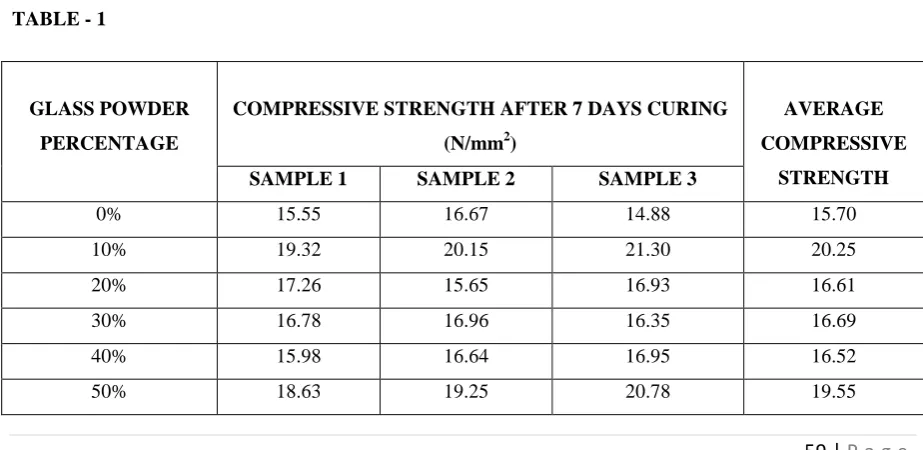
4.1. Compressive strength of cubes after 7 days of curing
TABLE - 1
GLASS POWDER PERCENTAGE
COMPRESSIVE STRENGTH AFTER 7 DAYS CURING (N/mm2)
AVERAGE COMPRESSIVE
STRENGTH SAMPLE 1 SAMPLE 2 SAMPLE 3
0% 15.55 16.67 14.88 15.70
10% 19.32 20.15 21.30 20.25
20% 17.26 15.65 16.93 16.61
30% 16.78 16.96 16.35 16.69
40% 15.98 16.64 16.95 16.52
60 | P a g e
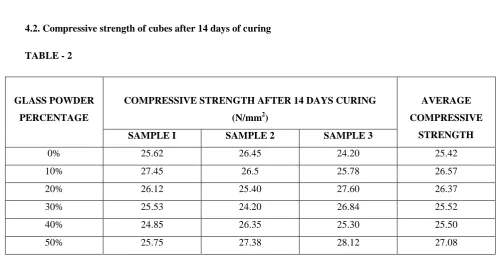
4.2. Compressive strength of cubes after 14 days of curing
TABLE - 2
GLASS POWDER PERCENTAGE
COMPRESSIVE STRENGTH AFTER 14 DAYS CURING (N/mm2)
AVERAGE COMPRESSIVE
STRENGTH SAMPLE I SAMPLE 2 SAMPLE 3
0% 25.62 26.45 24.20 25.42
10% 27.45 26.5 25.78 26.57
20% 26.12 25.40 27.60 26.37
30% 25.53 24.20 26.84 25.52
40% 24.85 26.35 25.30 25.50
50% 25.75 27.38 28.12 27.08
4.3. Compressive strength of cubes after 28 days of curing
TABLE - 3
GLASS POWDER PERCENTAGE
COMPRESSIVE STRENGTH AFTER 28 CURING (N/mm2) AVERAGE COMPRESSIVE
STRENGTH SAMPLE 1 SAMPLE 2 SAMPLE 3
0% 29.33 30.62 29.96 29.97
10% 31.32 30.63 30.75 30.9
20% 31.65 29.69 31.90 31.08
30% 29.63 30.78 30.25 30.22
40% 30.62 29.45 28.20 29.40
61 | P a g e
15.7
20.25
16.61
16.69
16.52
19.55
25.42
26.57
26.37
25.52
25.527.08
29.97
30.931.08
30.22
29.429.98
0
5
10
15
20
25
30
35
0 10 20 30 40 50
COMPRE
SSIV
E
STRENG
TH
(MPa
)
GLASS POWDER %
7 DAYS CURING
14 DAYS
CURING
28 DAYS
CURING
Chart – 1 Graphical representation of average compressive strength of concrete cubes for partial replacement of fine aggregate (0%, 10%, 20%, 30%, 40%, 50% of replacement)
V. CONCLUSIONS
1. Glass powder can be effectively be used as fine aggregate replacement.
2. There is a marginal increase in the 28 days curing as compared to 14 days curing.
3. In 28 days curing addition of 20% glass powder gives the highest compressive strength.
4. 7 days curing has least compressive strength as compared to 14 days curing & 28 days curing.
5. In 7 days curing there is a slight rise in compressive strength in addition of 10% glass powder.
6. In 14 days curing addition of 50% glass powder gives highest compressive strength.
REFERENCES
[1] Masaki, O. 1995. Study on the hydration hardening character of glass powder and basic physical
properties of waste glass as construction material. Asahi Ceramic Foundation Annual Tech. Rep.
62 | P a g e
[2] Topcu, I.B. and Canbaz, M. 2004. Properties of concrete containing waste glass. Cement Concrete Res.34: 267– 274.
[4] Pereira de Oliveira. L.A, J.P. castro – Gomes, P. Santos, “ Mechanical and Durability Properties of
concrete with Ground waste Glass Sand”, International conference on durability of Building Materials
and components, Turkey, 2008.
[5] C.Meyer, S.Baxter and W.Jin, “ alkali – Aggregate Reaction in Concrete with waste Glass as
Aggregate”, Proceedings of the 4th Materials Engineering Conference : Materials for the new
millennium, ASCE, Reston, V.A,pp.1388-1397, 1996.
[6] Ghambhir, M. L. (2003). Concrete Technology (2nd edition), Huang, B., Li, G., Pang, S., and Eggers, J.,
(2004).“Investigation into Waste Tire Rubber- Filled Concrete. Journal of Materials in Civil