Florida International University
FIU Digital Commons
FIU Electronic Theses and Dissertations University Graduate School
3-21-2018
The Development and Initial Validation of a
Self-Assessment for Global Leadership Competencies
Sabrena A. O'Keefe
Florida International University, [email protected]
DOI:10.25148/etd.FIDC006566
Follow this and additional works at:https://digitalcommons.fiu.edu/etd
Part of theEducational Assessment, Evaluation, and Research Commons,Educational
Leadership Commons,Leadership Studies Commons, and theOther International and Area Studies Commons
This work is brought to you for free and open access by the University Graduate School at FIU Digital Commons. It has been accepted for inclusion in
FIU Electronic Theses and Dissertations by an authorized administrator of FIU Digital Commons. For more information, please [email protected].
Recommended Citation
O'Keefe, Sabrena A., "The Development and Initial Validation of a Self-Assessment for Global Leadership Competencies" (2018).FIU Electronic Theses and Dissertations. 3694.
FLORIDA INTERNATIONAL UNIVERSITY Miami, Florida
THE DEVELOPMENT AND INITIAL VALIDATION OF A SELF-ASSESSMENT FOR GLOBAL LEADERSHIP COMPETENCIES
A dissertation submitted in partial fulfillment of the requirements for the degree of
DOCTOR OF PHILOSOPHY in HIGHER EDUCATION by Sabrena O’Keefe 2018
ii
To: Dean Michael R. Heithaus
College of Arts, Sciences and Education
This dissertation, written by Sabrena O'Keefe, and entitled The Development and Initial Validation of a Self-Assessment for Global Leadership Competencies, having been approved in respect to style and intellectual content, is referred to you for judgment. We have read this dissertation and recommend that it be approved.
_______________________________________ Haiying Long _______________________________________ Thomas G. Reio _______________________________________ Maria Lovett _______________________________________ Hilary Landorf, Major Professor
Date of Defense: March 21, 2018
The dissertation of Sabrena O'Keefe is approved.
_______________________________________ Dean Michael R. Heithaus College of Arts, Sciences and Education
_______________________________________ Andrés G. Gil Vice President for Research and Economic Development
and Dean of the University Graduate School
iii
© Copyright 2018 by Sabrena O’Keefe All rights reserved.
iv DEDICATION
To my mother, Pamela O’Keefe, because her early death inspires me to live like I’ll die tomorrow, but learn like I’ll live forever.
v
ACKNOWLEDGMENTS
First and foremost, I must thank my committee whom guided and supported me through this process - Dr. Hilary Landorf, Dr. Haiying Long, Dr. Thomas Reio, and Dr. Maria Lovett. I offer extra appreciation for my chair Dr. Landorf with whom I spent many hours discussing global leadership concepts while trying to get my theoretical concepts complete as I was writing Chapters 1 and 2, and my methodologist Dr. Long who was essential in pushing/helping me make Chapters 3 and 4 richer and deeper - even if that meant late night calls and quick feedback turn arounds for me to be able to meet my defense deadlines.
I would also like to thank all the faculty that helped me along the way. While I started this journey with just the end in mind, I was truly transformed along the way because of them. I’ll never forget my first doctoral class with the late Dr. Bob Farrell, who I thought was a little crazy, but credit for helping me begin to think critically at a higher level. After that Dr. Linda Bliss, Dr. Joy Blanchard, Dr. Dawn Addy, Dr. Diann Newman, Dr. Benjamin Baez, Dr. Mido Chang, Dr. Cathy Akens, and Dr. Haiying Long all continued to challenge me in very different ways, contributing to my growth as an academic.
I’ll be forever grateful for Dr. Corey Seemiller. Her Student Leadership Competencies research is the backbone to the many projects that have allowed me to enhance experiences for students, and especially to my dissertation. Her counsel in the early stages of my instrument development really helped put me on the right track and the feedback she provided when she served as an expert during phase one of my study was invaluable.
vi
I also want to thank the others that served as experts during phase one: Dr. Beverly Dalrymple, Dr. Hilary Landorf, Dr. Thomas Reio, Dr. Maria Lovett, Dr. Stephanie Doscher, Eric Feldman, Patricia Lopez-Guerrero, Joanna Garcia, Nashira Williams, Kaleen Martinez, Peter Melnik, and Shannonlee Rodriguez. I know it took them all a significant amount of time to fill out both tables of specifications, and their input was essential to my process. Another person that dedicated much time to help me in my process was Emani Jerome, who participated as a second researcher during phase two of my process. I appreciated his thoughtful inquires and analysis throughout that process.
I have been blessed to have many different support systems as I have moved through this process. Starting with my GRE study group Michelle Castro, Nikki Kogan, and Franklin McCune. Then my mini-cohort: Dr. Bronwen Bares Pelaez, Dr. Carolyn Meeker, Yselande Pierre, Nashira Williams, and many more. I appreciate that misery loves company and we have all been able to be there for each other through the ups and downs of this process. FIU in general has been a very supportive place to work while completing my doctoral degree and I’ll be forever grateful to the institution and in particular my office for that support. I must also give a shout out my incredible network of colleagues across the country that helped recruit students to take my instrument during my final phase, I literally could not have completed this process without them!
Additionally, I would be nowhere without the unconditional love and support of my friends and family. Thank you for always being there to listen and for your patience with me. Even when you had no idea what exactly I was going through, you did your best to either be there or leave me alone as necessary. There were many sacrifices each
vii
of you had to make in order for me to be successful and I truly appreciate your willingness to make them.
Most importantly I need to thank my sister and best friend, Carren O’Keefe, father, Raymond O’Keefe, and stepmother, Crystal O’Keefe. Even from far away the three of you have been my biggest cheerleaders. When I did not believe I could do this, the three of you never doubted my capabilities. Everything I am is because of you three (and mom who has been watching over us). I can never thank you enough.
All of you, and many more, have empowered me to achieve this accomplishment. I am so lucky to have each and every one of you in my life. Thank you again from the bottom of my heart.
viii
ABSTRACT OF THE DISSERTATION
THE DEVELOPMENT AND INITIAL VALIDATION OF A SELF-ASSESSMENT FOR GLOBAL LEADERSHIP COMPETENCIES
by
Sabrena O’Keefe
Florida International University, 2018 Miami, Florida
Professor Hilary Landorf, Major Professor
Global leadership has been a growing area of research as our world becomes interconnected. The National Association for College Employers (NACE) Career Readiness Competencies Work Group even added an eighth competency:
global/intercultural fluency. Employers have also expressed a skill crisis regarding students graduating from college without the necessary global leadership skills.
However, there are often not enough resources at institutions of higher education to add specific co-curricular programs around global leadership. At the same time many
institutions have begun to use the Student Leadership Competencies (Seemiller, 2013) as learning outcomes for their co-curricular programs.
This research study aimed to combine the concepts of global leadership and the Student Leadership Competencies so that students have the opportunity to develop global leadership competencies on their own. The researcher created a global leadership
competencies self-assessment instrument mapped within the Student Leadership
Competencies, then demonstrated the extent to which the instrument yields evidence that supports valid and reliable inferences about students’ global leadership competencies.
ix
Validity evidence based on content was established through the use of 13 subject matter experts. Validity evidence based on cognitive process was established through cognitive interviews. Validity evidence based on internal structure was established by conducting an exploratory factor analysis. Specifically, a principal axis factor analysis with a varimax rotation was conducted on data gathered from 279 participants. Evidence supported the finding that the instrument yielded reliable inferences about students’ global leadership competencies (30 items; α = .932).
There were six constructs uncovered and measured through the validation process: Interpersonal Impact, Perspective-taking, Adapting, Diversity, Responding to Ambiguity, and Resiliency. The instrument created in this study provides self-awareness of a student’s proficiency in these global leadership competencies, which enables them to seek out development opportunities for those competencies either on their campus or in other out-of-the-classroom activities based on their results. This instrument can now be used to guide a students’ global leadership competency development journey.
x
TABLE OF CONTENTS
CHAPTER ... PAGE
I. INTRODUCTION ... 1
Background of the Study ... 1
Research Problem ... 11
Purpose of the Study ... 14
Research Questions ... 14 Theoretical Framework ... 14 Significance of Study ... 15 Delimitations ... 16 Assumptions ... 16 Definitions of Terms ... 16
Overview of Succeeding Chapters ... 18
II. REVIEW OF LITERATURE... 20
The Evolution of Global Leadership Literature ... 20
Global Leadership Competency Frameworks and Models ... 23
Global Leadership Assessments ... 30
Summary ... 43
III. METHODS ... 44
Research Questions ... 44
Research Design... 44
Population ... 46
Relevant Conceptions of Validity and Reliability ... 46
Data Collection Procedures and Methods ... 48
Data Analysis Procedures ... 59
Summary ... 67 IV. RESULTS ... 68 Phase One... 68 Phase Two ... 78 Phase Three ... 82 Phase Four ... 91 Summary ... 102 V. DISCUSSION ... 103
Summary of the Study ... 103
Methods... 105
Results ... 107
Interpretation and Analysis of Results ... 108
Study Limitations ... 111
xi
Recommendations for Future Research ... 115
Conclusions ... 117
REFERENCES ... 118
APPENDICES ... 129
xii
LIST OF TABLES
TABLE PAGE
1. Research Design... 59
2. Inter Item Correlations for Pilot Study ... 84
3. Descriptive Statistics for Pilot Study (N = 70) ... 86
4. Summary of Exploratory Factor Analysis Results for Pilot Study (N = 70) ... 89
5. Descriptive Statistics for O’Keefe Global Leadership Assessment (N = 279) ... 92
6. Summary of Exploratory Factor Analysis Results for O’Keefe Global Leadership Assessment (N = 279) ... 97
xiii
LIST OF FIGURES
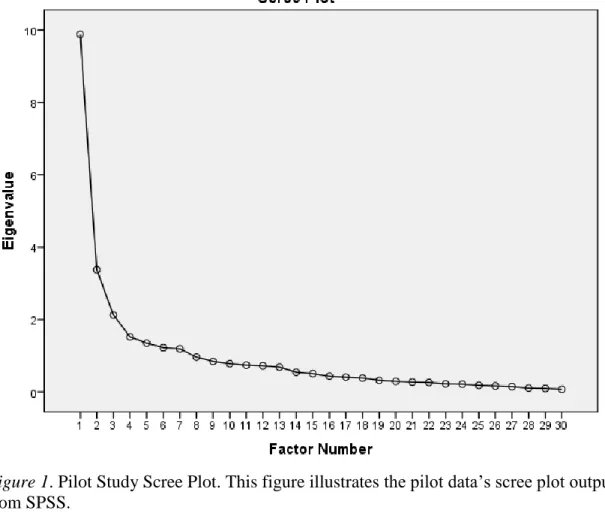
TABLE PAGE 1. Pilot Study Scree Plot ... 86 2. O’Keefe Global Leadership Assessment Scree Plot ... 94 3. O’Keefe Global Leadership Assessment Collapsed Factors Scree Plot ... 95
xiv
LIST OF ACRONYMS
ACE American Council on Education
AERA American Educational Research Association
APA American Psychological Association
BASIC Behavioral Assessment Scale for Intercultural Communication Effectiveness
BBC Biscayne Bay Campus of Florida International University
CAS Council for the Advancement of Standards
CCAI Cross-Cultural Adaptability Inventory
CCSS Cross-Cultural Sensitivity Scale
CLS Center for Leadership and Service
CQ Cultural Intelligence Scale
DiSC Personal Profile System
FIU Florida International University
GCI Global Competencies Inventory
GMI Global Mindset Inventory
IBA Intercultural Behavioral Assessment
ICAPS Intercultural Adjustment Potential Scale
ICC Intercultural Communication Competence
ICSI Cultural Intelligence Scale
IDI Intercultural Development Inventory
IS Intercultural Sensitivity Scale
LPI Leadership Practices Inventory
xv
MBTI Meyers-Briggs Typology Indicator
MMC Modesto Maidique Campus of Florida International University
MPQ Multicultural Personality Inventory
NACE National Association for College Employers
NAFSA Association for International Educators
NCME National Council on Measurement in Education
SLC Student Leadership Competencies
SRLS Socially Responsible Leadership Scale
1
CHAPTER I INTRODUCTION
The purpose of this study is to develop a self-assessment instrument with psychometrically sound reliability and validity inferences to measure global leadership competencies. Specifically, it presents a two-stage approach: (a) the identification of scale items that reflect global leadership competencies, which addresses evidence of test content and cognitive response aspects of validity, and (b) the discovery of evidence for internal structure, as well as, reliability estimates of the developed scale items. Chapter 1 provides the background of the proposed study, the research problem and purpose, research questions, the theoretical framework, and the study’s significance, assumptions, and delimitations. The chapter concludes with definitions of terms and an overview of succeeding chapters.
Background of the Study
For decades, institutions of higher education across the United States have offered co-curricular activities that help undergraduate students develop leadership capabilities (Astin & Astin, 2000; Hamrick, Evans, & Schuh, 2002; National Association of Student Personnel Administrators, 2016). Leadership seminars and workshops, mentoring programs, guest speakers, service projects, outdoor education, and leadership courses have been used to teach communication, problem-solving, personal and social
responsibility, vision, conflict resolution, and other leadership related topics
(Zimmerman-Oster & Burkhardt, 2000). More recently this area has expanded to include leadership that incorporates global or intercultural competencies. In 2002, the American Council on Education (ACE) released a report that pointed out the shortcomings of the
2
nation’s international expertise and citizens’ understanding of other cultures and global affairs. In 2007, the Association of American Colleges and Universities (AAC&U) after conducting an employer survey, determined that there was a need for global competence development for students. A study by Ghasabeh, Soosay, and Reaiche on
transformational leadership stated, “today’s globalized nature of competitiveness is placing more pressure on organizations to employ effective leaders who are capable to develop a global vision for organizations” (2015, p. 460). The need for global vision was again confirmed in 2017 when the National Association for College Employers (NACE) Career Readiness Competencies Work Group expanded the career-readiness
competencies research originally conducted in 2014 with the addition of an eighth
competency - global/intercultural fluency (NACE, 2017). Examples of competencies that require a higher level of proficiency for people desiring to be global leaders include ability to adapt, willingness to learn, comfort with ambiguity, understanding other cultures, valuing diversity, and being able to recognize complex interconnections (Levy,
Beechler, Taylor, & Boyacigiller, 2007). As Keeling (2004) established in Learning
Reconsidered, students do not simply absorb material presented to them; they need to be engaged with the material to integrate it into their personal development. Because co-curricular activities are based on personal engagement, they can therefore be essential to help students develop the skills necessary for global leadership.
Student Affairs is the name given to the group of services and the administration in higher education institutions that enhance student growth and development through co-curricular programs. One of the greatest challenges for this field is obtaining funding (Sandeen & Barr, 2014), and as such creating a new program that specifically focuses on
3
global leadership competencies may not be feasible for most institutions. However, many institutions have started to use the Student Leadership Competencies (SLC) to help identify learning outcomes for existing co-curricular programs. The SLCs are 60
leadership competencies derived from analyzing standards, models, and theories of leadership, and the outcomes of 522 accredited academic programs in higher education (Seemiller, 2013). Many institutions are publicizing the Student Leadership
Competencies associated with each of their programs, so students can identify the
competencies they wish to enhance and choose co-curricular activities that develop those competencies (Seemiller & O’Keefe, 2016).
Leadership
There is no agreed upon research definition of leadership (Bass, 1990; Komives, Lucas, &McMahon, 2007; Rost, 1993; Yukl, 2006). In fact, 60% of the leadership research studies conducted from 1910 to 1990 did not offer a clear definition for
leadership (Rost, 1993). The social scientists who did attempt definitions in their studies did not offer a holistic definition of leadership, but instead only defined the approach of the particular leadership they were studying (Komives et al., 2007; Yukl, 2006).
Yuki (2006) identified five general approaches to studying leadership: trait, behavior, situational, power-influence, and integrative. The trait approach studies the traits that make leaders different from their peers. The behavior approach focuses on what leaders actually do that is different from followers. The situational approach explores how the context and environment influences the effectiveness of a leader. The power-influence approach focuses on the processes that happen between a leader and
4
his/her followers. Finally, the integrative approach involves studying combinations of the other four approaches (Bass, 1990; Komives et al., 2007).
Within each of these approaches there are leadership theories that have also been categorized by Yukl (2006): leader versus follower-centered theories, descriptive versus prescriptive theories, and universal versus contingency theories. Leader versus follower-centered theories focus solely on the leader’s behaviors and/or characteristics without much, if any, consideration of the followers (Bass, 1990). Descriptive versus prescriptive theories describe the typical activities of effective leaders. Universal versus contingency theories can be either prescriptive or descriptive ways that leadership issues are applied in different contexts (Yukl, 2006).
In general the goals of student affairs practitioners are to foster students’ development in becoming self-aware and interpersonally sensitive individuals,
democratic citizens, educated persons, skilled workers, and life skills managers (Hamrick et al., 2002). Student affairs practitioners use different leadership theories to assist in the design of programs that help to develop students’ leadership potential. They accomplish this through leadership seminars/workshops, mentoring programs, guest speakers, service projects, outdoor education, and leadership courses (Zimmerman-Oster & Burkhardt, 2000). As new leadership theories emerge, they try to incorporate them into existing programs or create new programs to help prepare students.
Global Leadership
The acceleration of globalization has created a need for an additional skill set not covered in the traditional leadership theories. The skill set is called global leadership (Blaess, Hollywood, & Grant, 2012; Jokinen, 2005; Mendenhall & Osland, 2002; J. S.
5
Osland, Bird, Mendenhall, & A. Osland, 2006; Rhinesmith, 1993). As with leadership, there is no agreed upon definition of global leadership. When trying to define global leadership, researchers focus on tasks and responsibilities, process, or both (Mendenhall, Reiche, Bird, and Osland, 2012). Suutari’s (2002) definition is an example of tasks and responsibilities: “Global leaders are managers with global integration responsibilities in global organizations” (p. 229). An example of a process definition is “global leadership is the process of influencing the thinking, attitudes, and behaviors of a global community to work together synergistically toward a common vision and common goal” (Osland & Bird, 2005, p. 123). A definition that includes both is “global leaders, defined as executives who are in jobs with some international scope, must effectively manage through the complex, changing, and often ambiguous global environment” (Caligiuri, 2006, p. 219).
Some of the new challenges for global leaders include, but are not limited to: working in different cultures; combining business practices to fit multinational needs; cultivating trust among team members that may not be of the same nationality or only work with each other remotely or both; overcoming communication barriers; creating clarity in team objectives where values may differ, dealing with different laws and regulations; overcoming stereotypes and prejudices; and managing through the complex, changing, and often ambiguous global environment (Caligiuri, 2006; Danielsson, 2015; Govindarajan & Gupta, 2001; Hassanzadeh, Silong, Asmuni, & Wahat, 2015; Holt, 2015; Levy et al., 2007; Taneja, Sewell, & Odom, 2015; Voronchenko, Klimenko, & Kostina, 2015). The Center for Creative Leadership handbook stated, “it is our contention that managers who fail to adapt how they lead, negotiate, make decisions, or share
6
information to fit the global context are more likely to fail” (McCauley & Van Velsor, 2004, p. 371). It has been argued that global leadership
…differs from domestic leadership in degree in terms of issues related to
connectedness, boundary spanning, complexity, ethical challenges, dealing with tensions and paradoxes, pattern recognition, and building learning environments, teams and community and leading large-scale change efforts – across diverse cultures. (Osland & Bird, 2006, p. 123)
For the purposes of this study, the researcher has used the definition of global leader of Mendenhall et al.:
global leaders are individuals who effect significant positive change in
organizations by building communities through the development of trust and the arrangement of organizational structures and processes in a context involving multiple boundary stakeholders, multiple sources of external cross-boundary authority, and multiple cultures under conditions of temporal, geographical, and cultural complexity. (2013, p. 262)
As well as NACE’s definition for the Global/Intercultural Fluency competency as
“Value, respect, and learn from diverse cultures, races, ages, genders, sexual orientations, and religions. The individual demonstrates, openness, inclusiveness, sensitivity, and the ability to interact respectfully with all people and understand individuals’ differences” (NACE, 2017).
Global
Mendenhall et al. (2012) discussed three dimensions of the global in global leadership - complexity, flow, and presence. Complexity is the contextual dimension.
7
Lane, Maznevski, Mendenhall, and McNett, (2009) described four dimensions of
complexity causing challenges in the face of globalization: multiplicity, interdependence, ambiguity, and flux. Multiplicity is the necessity of working with more and different competitors. Interdependence is managing complex and connected systems of human and technology interactions. Ambiguity is functioning with a lack of information. These three elements working together create the fourth, flux, which is the always changing element in explaining the complexities brought by an acceleration of globalization (Lane et al., 2009).
Flow is the relational dimension of global. There are two dimensions contained within flow: richness and quantity. Richness is “frequency of information flow, the volume of information flow, and the scope of information flow.…Quantity refers to the magnitude or number of channels the global leaders must use to proactively boundary span in his/her role” (Mendenhall et al., 2012, p. 498). Technology allows resources and information to span across borders creating a global market instead of separate national markets (Caligiuri, 2006; Chase-Dunn, 1999; Govindarajan & Gupta, 2001; Taneja et al., 2015). Beechler et al. (2004, p. 124) explained that effective individual global leaders “ensure that boundaries do not hamper the flow of essential knowledge and information. Interpersonal networks are vital in this effort because they serve as the glue that holds these vast geographically dispersed and internally differentiated organizations together.”
Presence is the spatial-temporal dimension. Presence is how much time a person must physically be present with key stakeholders around the world in order to engage them. A low degree of presence is when there is little to no travel requirements. A medium level of presence is when occasional trips need to be made to other countries to
8
visit stakeholders. A high degree is constant international business travel and to various locations (Mendenhall et al., 2012).
Being able to understand and work in a global environment where complexity, flow, and presence exist, and to be effective, requires a different set of leadership competencies. Identifying these specific leadership competencies is essential for, those persons who need to train and prepare others to successfully function in this type of environment and to help those desiring global positions educate themselves and enhance their skills in leadership.
Student Leadership Competencies
In 2008, researchers from the University of Arizona conducted a study that analyzed the Council for the Advancement of Standards (CAS) and identified outcomes related to leadership development, then created a framework of leadership competencies (Seemiller, 2016). They then used that framework to analyze contemporary leadership models: Relational Leadership Model, the Social Change Model of Leadership
Development, and the Five Practices of Exemplary Leadership. After piloting this version of the framework in their programs, they assessed learning outcomes from academic programs and accrediting agencies. During the five year study, they analyzed learning outcomes in 413 academic programs from 49 different academic accrediting organizations affiliated with the Council for Higher Education Accreditation.
Subsequently they added 23 additional accrediting organizations from the Association of Specialized and Professional Accreditors and the U.S. Department of Education.
The result was identification of 60 competencies derived from the 72 different academic accrediting agencies was the result (Seemiller, 2013). After identifying these
9
competencies which included such things as problem solving, self-development, group development, initiative, diversity, organization, conflict negotiation, and collaboration, Seemiller and Murray (2013) then conducted a study to statistically confirm the
prevalence and frequency of the 60 competencies that existed among the 475 academic programs in the 72 accrediting organizations studied. These competencies are now being used by universities across the United States to help connect out-of-classroom activities to learning outcomes that resonate across all academic disciplines. Institutions are now redesigning current or creating new leadership programs based on these competencies. These programs range from workshops to semester long curricula (Seemiller, 2016).
As institutions develop or adapt programs utilizing the Student Leadership Competencies, the competencies on which they focus are then specified in the various program learning outcomes. Different frameworks - academic, learning, retention, leadership, career, service, or professional, containing competencies derived from theory or research, are used to design programs and establish learning outcomes. These
different frameworks generally focus on developing a smaller number of competencies because mastering 60 Student Leadership Competencies at one time is relatively unattainable. As well students may desire a different theory/research based framework than is being offered by their institution, so these resources are also being provided to students. The combination of advertising the learning outcomes for programs and utilizing frameworks enables students to create their own self-development plans (Seemiller & O’Keefe, 2016).
10
Self-Assessments to Create Self-Awareness
Becoming a self-aware, interpersonally sensitive individual, as well as an educated person is the focus in leadership education (Gehrke, 2006; Komives, Dugan, Owen, Slack, & Wagner, 2011). A study of leadership identity development identified six stages of a student’s experience: awareness, exploration/engagement, leader
identified, leadership differentiated, generativity, and integration/synthesis (Komives et al., 2007, p. 395). Self-assessments are often used as the first step in creating self-awareness because they encourage students to begin to understand themselves by
uncovering both strengths and; weaknesses that may have been unknown to them (Luft & Ingham, 1961; Shertzer & Doyle, 2006).
Assessments like the Meyers-Briggs Typology Indicator (MBTI; The Myers & Briggs Foundation, 2016), StrengthsQuest (Gallup, 2016), Kolb Learning Style Inventory (LSI; McLeod, 2013), Leadership Practices Inventory (LPI; Wiley, 2016b), Personal Profile System (DiSC; Wiley, 2016a), Socially Responsible Leadership Scale (SRLS; National Clearinghouse for Leadership Programs, 2016), and True Colors (TC; True Colors Inc, 2016) are often used in leadership development programs not because they are great predictors of leadership ability (John & Robins, 1993), but because their results facilitate self-reflection. Self-reflection then leads to better self-awareness, which allows people to better employ their strengths and improve their weaknesses (Drucker, 2005; Moore, Jenkins, Dietz, & Feuerbaum, 1997; Luft & Ingham, 1961; Pearman, 1999; Shertzer & Doyle, 2006; Tjan, 2012; Travers, Morisano, & Locke, 2015; Zimmerman-Oster & Burkhardt, 2000). The Center for Creative Leadership claimed that assessments motivate because they create a “desire to close the gap between current self and ideal
11
self” and bring “clarity about needed changes; clues about how the gap can be closed” (McCauley & Van Velsor, 2004, p. 5).
Many of these assessments have associated developmental activities so as to give students the opportunity to further improve areas of weakness. As an example, the LPI gives results that refer to The Five Practices of Exemplary Leadership, a commonly used framework for emerging leadership programs (Kouzes & Posner, 2016). When students
take that inventory, they may identify that they need further development in Modeling the
Way; and can then sign up for their institution’s emerging leaders program to help
develop that practice.
Research Problem
As the need for global leaders increases, employers are experiencing a skill crisis in that graduates are entering the workforce without the appropriate skills to perform in a global environment (Bersin, 2012; Elmore, 2013; Ficsher, 2015; Gillis, 2011; Zenger, Folkman, & Evans, 2014). At the 2015 annual conference of NAFSA: Association of International Educators, Fanta Aw, NAFSA’s president, stated that the demand for global competencies from graduates is high; we can no longer count on study abroad alone to prepare globally-minded students, and we need to be doing more at home to help them develop these skills (Fischer, 2015). Many universities have responded to the need for increasing global leadership skills by internationalizing the curriculum (ACE, 2013; Gacel-Ávila, 2005; Gibson, Rimmington, & Landwehr-Brown, 2008; Global Learning, 2015; Grudzinski-Hall, 2007; Landorf & Doscher, 2015; NAFSA, 2016).
Internationalizing the co-curriculum is also often considered part of this effort, though more could be done in this realm of the student’s out-of-the-classroom education to help
12
develop global leadership competencies (Commission on International Education, 1998; Ficsher, 2015; NAFSA, 2016).
Mendenhall (2006) stated, “people cannot develop global leadership
competencies if they do not understand the degree to which they already possess these competencies” (p. 424). Specifically, there is a need for a global leadership competency assessment that can be used by student affairs practitioners to help students begin to understand their level of proficiency of global leadership competencies earlier in their development instead of once they enter the workforce (Zenger, 2014).
There are assessments currently available in the areas of global leadership but they have been developed for and by corporations as training and promotional tools for their top managers (Bird & Stevens, 2013). Assessments developed by corporations are for their own particular global leadership assessments and models derived from the needs or observations of their employees in the context of the different countries in which they operate (Mendenhall et al., 2013). Some of these corporations have generalized global leadership assessments or created new entities to use the information they gained about global leadership competencies and market them to others. Such corporations include: Vangent; Global Leadership Excellence, LLC; Kozai Group, Inc; IDI, LLC; Van der Maesen Personnel Management; PAR, Inc; Thunderbird Schools of Global Management; Pfeiffer; and Aperian Global (Bird & Stevens, 2013). While these global leadership assessments are useful for corporations, they were not designed to help provide self-awareness to college students. There are also no developmental activities associated with the results that are produced after taking the assessments.
13
According to a comprehensive review of global leadership assessments conducted by Bird and Stevens (2013), there are several assessments designed for both education and/or business that have demonstrated reasonable validity and reliability measures. Of these the Global Mindset Inventory (GMI) and the Global Competencies Inventory (GCI) emerged as the most relevant for comparison against the objectives of the current study since they both take a more holistic approach to assessing global leadership. The GMI was designed for education and the GCI was designed for intercultural settings or cross-culture encounters, whereas the other assessments were designed specifically for global leaders and expatriates in corporations (pp. 113-140).
The price, certification requirements, length of survey, and lack of developmental activities associated with the results of the current global leadership assessments are not conducive to their use by student affairs practitioners in leadership programs. The GMI costs about $150 per individual user, requires the administrator to be certified, and takes about 15 minutes to complete. The GCI costs about $130 per individual user, requires the administrator to be certified, and takes about 45 minutes to complete (Bird & Stevens, 2013, p. 139).
There is a need for a global leadership competency assessment that is compatible with terminology currently being used by leadership development programs in university settings such as that used in the Student Leadership Competencies. Universities provide students with the opportunity to develop their leadership skills, but the emerging area of concentration - global leadership currently lacks appropriate resources and tools, such as a global leadership competency self-assessment instrument mapped within the Student Leadership Competencies.
14
Purpose of the Study
The purpose of this study was to create a global leadership competencies self-assessment instrument mapped within the Student Leadership Competencies, and then demonstrate the extent to which the instrument yields evidence that supports valid and reliable inferences about students’ global leadership competencies.
Research Questions
This study will address the following research questions:
1. Does the Global Leadership Competencies self-assessment instrument yield valid
inferences about students’ global leadership competencies?
2. Does the Global Leadership Competencies self-assessment instrument yield
reliable inferences about students’ global leadership competencies?
Theoretical Framework
Constructivism is the guiding theoretical framework of this study. Constructivism is grounded on the idea that human beings generate knowledge and meaning by reflecting on experience (Basseches, 1986; Baxter Magolda, 1992; Belenky, Clinchy, Goldberger, & Tarule, 1997; Fisher, Rooke, & Torbert, 2000; Kegan, 1982, 1994; Kitchener, 1986; Perry, 1968; Piaget, 1950). Kegan (1994) described continual adaptation as striving for the self-transforming mind or fifth order. The fifth order is the final level of
consciousness where individuals see beyond themselves, others, and the systems of which they are a part, to form an understanding of how all people and systems
interconnect. At the fifth level, humans are not just relying on their own thinking, but also relating to others while forming their own journey through life. Humans are constantly interpreting information presented to them then making decisions about to
15
how to enhance themselves since it is in their genetic make up to develop intellectually (Piaget, 1950).
As people strive for the fifth order, they desire to be more self-aware because it helps them make sense of their journey. The instrument will ultimately be a tool that can be used in this process. Constructivism will help inform the analysis of the cognitive interviews where the researcher will be looking to identify and then address any elements of the questions that could be contributing to response error (Willis, 2005). Specifically, interviewees will have different experiences they will reflect on as they answer the questions, so a similar understanding of what the question is asking will help decrease the response error. Additionally, it provides guidance in the analysis of the global leadership competencies literature since individuals will need to be functioning at the level of the fifth order to be a global leader.
Significance of Study
Currently, there are no appropriate tools for the university setting to help students develop global leadership competencies. Students, student affairs practitioners, and employers will all potentially benefit from the development of this instrument. Students will benefit from the self-reflection they may gain by utilizing the instrument. Student affairs practitioners will benefit by having a tool to help students develop global leadership competencies. Finally, employers will benefit because more students will graduate with global leadership competency skills.
16
Delimitations
In this study, the sample for the cognitive interviews and pilot study was
delimited to FIU students. The final sample was delimited to students who are enrolled in U.S. institutions of higher education.
Assumptions
The underlying premise of this study is that global leadership is a substantively different process than traditional leadership. The study stems from the idea that self-assessments are a useful educational tool that facilitates self-awareness.
Definitions of Terms
Cognitive Interviews. When participants verbalize their thoughts while they answer a survey question, so the interviewer can determine the inferences being made about the questions in the instrument.
Competencies. “Leadership competencies are knowledge, values, abilities, and
behaviors that contribute to someone successfully completing a role or task” (Seemiller, 2013).
Constructivism. An epistemology based on the idea that human beings generate knowledge and meaning by reflecting on experience.
Exploratory Factor Analysis. A statistical method used to uncover the underlying structure of a relatively large set of variables. EFA is a technique within factor analysis whose overarching goal is to identify the underlying relationships between measured variables.
17
Exploratory sequential mixed methods design. A mixed methods procedure where qualitative data are collected in early phases of a study; then, after that data is analyzed it is used to develop the instrument that will be used for the following quantitative data phase(s).
Framework. An underlying structure of a concept created by translating the components and/or research findings of models, theories, concepts, or studies to the 60 Student
Leadership Competencies (Seemiller, 2016).
Globalization. “Globalization is a process of interaction and integration among the people, companies, and governments of different nations, a process driven by
international trade and investment and aided by information technology” (The Levin Institute, 2015).
Global Leader. “Individuals who effect significant positive change in organizations by building communities through the development of trust and the arrangement of
organizational structures and processes in a context involving multiple cross-boundary stakeholders, multiple sources of external cross-boundary authority, and multiple cultures under conditions of temporal, geographical, and cultural complexity” (Reiche &
Mendenhall, 2013, p. 262).
Reliability. “refers to the accuracy or precision of a measurement procedure” (Thorndike
& Thorndike-Christ, 2010, p. 118).
Student Leadership Competencies. Sixty leadership competencies derived from a 5-year research study, conducted by Corey Seemiller, analyzing learning outcomes in 522 accredited academic programs in higher education (Seemiller, 2016).
18
Table of Specifications. A two-way chart used to identify relevant content of the items, which describes the topics to be covered by an instrument and the number of items or point values that will be aligned with each topic or response.
Theoretical Framework. A rationale for the study that provides the reader an understanding of the researcher’s perception of the connection to theory.
Validity. “An evaluative judgment of the degree to which empirical evidence and
theoretical rationales support the adequacy and appropriateness of interpretations and actions based on test scores or other modes of assessment” (Messick, 1996, p. 1).
Validity evidence based on internal structure. An analysis that “can indicate the
degree to which the relationships among test items and test components conform to the construct on which the proposed test score interpretations are based” (AERA, 2014, p. 16).
Validity evidence based on response processes. The evidence of validity based on information about the test takers’ cognitive processes (AERA, 2014, p. 15).
Validity evidence based on test content. The evidence of validity based on the relationship between the content of the test and what it is intended to measure (AERA, 2014, p. 14).
Overview of Succeeding Chapters
This dissertation consists of four additional chapters. Chapter 2 presents a review of related literature including an overview of the global leadership literature and global leadership competency frameworks and models. Chapter 2 continues with a review of instruments used to assess global leadership and the validity and reliability studies conducted for these instruments. Chapter 3 describes the methods used for the study. It
19
reviews the study’s research questions, relevant conceptions of validity and reliability, the research design, descriptions of the sample, data collection procedures, data analysis procedures to be utilized to address the previously outlined research questions, and limitations. The results of the study and data analysis are presented in Chapter 4. Finally, Chapter 5 summarizes the study and research findings, provides an analysis of the results as they relate to the relevant literature, and presents study limitations, implications for practice, and recommendations for future research.
20
CHAPTER II
REVIEW OF LITERATURE
Chapter 2 begins with an overview of the global leadership literature and global leadership competency frameworks and models. An examination of the literature is necessary to help identify and define current relevant global leadership competencies. Following this discussion, Chapter 2 continues with a review of instruments that have been used to assess global leadership and an exploration of validity and reliability studies conducted for these instruments.
The Evolution of Global Leadership Literature
Literature regarding global leadership began to emerge in the 1990s as a response to a need to distinguish the differences in the roles of domestic leaders, global managers, and expatriates as the world became more connected by the internet and proliferate of air travel. Domestic leaders are those who work within their own country, global managers are those who manage around the world, and an expatriate is someone whom lives outside their country. In the literature there was an evolving recognition that global leadership is more complicated than domestic leadership and required a different set of competencies in order for leaders to be successful (Mendenhall et al., 2013, p. 21). The concepts found throughout this evolution were used in helping to develop the Global Leadership Competencies framework.
In 1992, Tichy and his colleagues coined the term “true globalists” as those with a global mindset, global leadership skills and behaviors, energy, skills and talent for global
networking, ability to build effective teams, and as having global change agent skills.
21
as a balance of contradictions, value diversity and team work, focus on process, see change as an opportunity, and strive for openness to the unexpected.
Yeung and Ready (1995) conducted the first quantitative cross-national global leadership study using 1,200 managers from eight different nations to discover their perceived most important global leadership capabilities. The eight different nations included in the study were Australia, France, Germany, Italy, Japan, Korea, United Kingdom, and the United States. The researchers found six common leadership competencies in the managers shared among these countries. Those leadership
competences included: (a) the ability to articulate a tangible vision, values, and strategy, (b) being a catalyst for strategic change, (c) cultural change, (d) ability to empower others, (e) possession of both results and (f) customer orientation (p. 542).
In 1997, Brake presented a model called the Global Leadership Triad. The three characteristics he used to create the triad were (a) relationship management, (b) business acumen, and (c) personal effectiveness. The center of the triad consisted of
transformational self, which is the “drive toward meaning and purpose through activity strengthened by reflection, personal mind management, and openness to change” (p.44). Each characteristic contained components. Business acumen’s components were depth of field (an ability to switch perspectives from global to local), entrepreneurial spirit, professional expertise, stakeholder orientation, and total organizational astuteness. Relationship management included change agentry, community building, conflict management and negotiation, cross-cultural communication, and influencing. Lastly, personal effectiveness contained accountability, curiosity and learning, improvisation, maturity, and thinking agility.
22
In 1999, Black, Morrison, and Gregersen devised the Global Explorer Model which identified four general capabilities of a global leader. They interviewed over 130 senior line and human resource executives in fifty companies in Europe, North America, and Asia and then interviewed forty nominated global leaders from these firms. The characteristics that emerged were: (a) inquisitiveness, (b) embracing duality,
(c) exhibiting character, and (d) demonstrating savvy. Inquisitiveness is the love of learning and being intrigued by diversity. Embracing duality is when uncertainty is viewed as invigorating and a natural part of global business. Exhibiting character is the ability to connect emotionally with people of different backgrounds and cultures and consistently demonstrate personal integrity in a world full of ethical conflicts. Demonstrating savvy is being both business and organizational savvy (p. xi - xii).
Harvey and Novicevic (2004) published a conceptual article that argued that global assignments like expatriation developed four types of global leader capital: (a) human capital, (b) cultural capital, (c) social capital, and (d) political capital. Human capital was the skills and competencies leaders need to have based on expert and referent power in their organization. Cultural capital was acceptance and social inclusiveness due to having tacit knowledge of how the organization operates. Social capital was the standing and concurrent ability to draw on standing to accomplish tasks in an
organization. Finally, political capital was the ability to use power or authority and gain the support of constituents in a socially effective way (p. 1,177).
Marshall Goldsmith and a team of researchers gathered information from focus groups with 28 CEOs, various focus groups/dialogue forums with current and future global leaders, 73 surveys, and over 200 interviews with high-potential leaders nominated
23
by 120 international organizations. They discovered 15 dimensions of global leadership: (a) demonstrating integrity, (b) encouraging constructive dialogue, (c) creating a shared vision, (d) developing people, (e) building partnerships, (f) sharing leadership,
(g) empowering people, (h) thinking globally, (i) appreciating diversity, (j) developing technical savvy, (k) ensuring customer satisfaction, (l) maintaining a competitive advantage, (m) leading change, (n) achieving personal mastery, and (o) anticipating opportunities. They predicted that thinking globally, appreciating cultural diversity, developing technological savvy, building partnerships and alliances, and sharing leadership would be especially important in the future as globalization increased (Goldsmith et al., 2003, p. 329 - 333).
The literature attempted to distinguish and define domestic leaders, global managers, and expatriates. As the literature on global leadership developed, it identified the traits and competencies needed to be a global leader. Frameworks and models of global leadership characteristics started to emerge as resources for corporations and individuals desiring to learn or teach global leadership.
Global Leadership Competency Frameworks and Models
As global leadership competencies have been identified throughout the years, researchers have attempted to group them into useable frameworks and models. Many similar competencies appear in different frameworks and models, which demonstrated some consensus on individual competencies, although there is still no complete
agreement on a useful organization of those competencies. The frameworks and models below are examples of some of the latest research that attempted to organize global leadership competencies.
24
In 2002, Mendenhall and Osland observed the efforts being made by corporations to create global leaders and uncovered a multidimensional construct of global leadership. They discovered some conceptual patterns after reviewing 56 different competencies being used by these corporations. They categorized those into six core dimensions: (a) cross-cultural relationship skills, (b) traits and values, (c) global business expertise, (d) global organizing expertise, (e) cognitive orientation, and (f) visioning. Cross-cultural relationship skills referred to developing and maintaining interpersonal
relationships in global/cross-cultural contexts. Traits and values are personality traits and habits. Global business expertise is knowledge about the global business practices. Global organizing expertise is the ability to organize and structure processes in a global context. Cognitive orientation referred to how one processes information and their world-view. Finally, visioning is knowing where the company should be heading and knowing how to get others to help achieve that vision (Osland, 2013).
In 2004, Bird and Osland developed a pyramid model of global leadership. Their premise was that one must have the base skills in order to have or learn the upper level skills. The foundation for their pyramid was global knowledge. Level one is traits, which include integrity, humility, inquisitiveness, and hardiness. These were also
referred to as the threshold traits. Level two was attitudes and orientations, which include cognitive complexity and cosmopolitanism. Level two was referred to as global mindset. Level three was interpersonal skills including mindful communication and creating and building trust. Finally, at the top, level four was systems skills, which included making ethical decisions, span boundaries, and building community through change (Osland, 2013).
25
In 2005, Jokinen reviewed all previous global leadership and expatriate competency models to create a more integrated global leadership competency model. The model had three tiers: (a) core global leadership competencies, (b) desired mental characteristics of a global leader, and (c) behavioral level global competencies. Core global leadership competencies were self-awareness, engagement in personal
transformation and inquisitiveness. To be self-aware indicated that a person is
knowledgeable of their strengths, weaknesses, desires, motivators, and typical reactions. Self-awareness is important because it helped the person assess a situation and figure out how they can assist with it. Engagement in personal transformation was the idea of trying to keep oneself up-to-date, always looking for new opportunities to learn and enhance oneself as well as being open to change. Inquisitiveness, on the other hand, was curiosity and the desire to find new information about old topics. It often helped
motivate a person to take risks, initiative, and commit to new projects.
According to Jokinen, desired mental characteristics of a global leader are
“characteristics that affect the way a particular individual attempts to influence others and approaches a certain task” (p. 206). The characteristics included optimism,
self-regulation, social judgment skills, empathy, motivation to work in an international environment, cognitive skills, and acceptance of complexity and its contradictions. Optimism was the idea that good will prevail. A person will be more motivated to do something that they believe will happen, so if a person is remaining positive, a can-do attitude emerges during complicated situations. Self-regulation was the ability to control your impulses and moods. Social judgment skills referred to the ability to look beyond the situation to the bigger picture; a systems approach that allows a person to switch
26
viewpoints and understand interdependence. Empathy was having a genuine concern for others’ needs and perceptions and helped one develop and embrace cross cultural
sensitivity. Motivation to work in an international environment was important or a person will lose motivation quickly if they never wanted to work with an international population in the first place. Cognitive skills determined how much one learns from a situation or environment. These skills also helped an individual to create new solutions to problems and allow them to quickly switch their concentration from one thing to another based on need. Acceptance of complexity and its contradictions is essential for a leader that is dealing with a culture that is different from their own. Many of the
situations a leader encountered may seem ambiguous and unpredictable, so one must see these conditions as opportunities to succeed (Jokinen, 2005).
Behavioral level global competencies are “related to abilities to perform concrete actions and producing visible results” (Jokinen, 2005, p. 208). The behavioral level global competencies entailed social skills, network management skills, and knowledge. Social skills are more informal person-to-person interactions. A leader must be a change catalyst, visionary, good at building and leading teams, have strong communication and listening skills, be motivating, and able to manage conflict. Essentially, one must be good at bringing out the best in people. Network management skills referred to formal relationships created through organizations. One must actively pursue partnerships, create networks, and build connections so they have a community with which to work. Knowledge refers to the technical stuff. They must understand who has the power and influence in their company and what processes and procedures are important. They must
27
also clearly know how to do their specific job. Most importantly, they must also do the research on the culture with which they are trying to work (Jokinen, 2005).
Javidan and Walker (2013) consolidated the prior research on global mindset and created three categories: intellectual capital, psychological capital, and social capital, which are further defined by three competencies in each category. The intellectual capital competencies included global business savvy, cosmopolitan outlook, and cognitive complexity. The psychological capital competencies were passion for
diversity, quest for adventure, and self-assurance. Finally, the competencies that make up social capital were intercultural empathy, interpersonal impact, and diplomacy.
Intellectual Capital was the cognitive category of global mindset. The first component, global business savvy, consists of knowledge of global industry, global competitive business and marketing strategies, how to transact business and assess risks of doing business internationally, and supplier options in other parts of the world. Global business savvy concept was not just for business people, but demonstrated the need to understand the processes of whatever industry the person is working for globally. The next component was a cosmopolitan outlook, which includes knowledge of cultures in different parts of the world, geography, history, and important persons of several
countries, economic and political issues, concerns, and hot topics of major regions of the world, and important world events. Finally, cognitive complexity comprised the ability to grasp complex concepts quickly, analyze and problem-solve, understand abstract ideas, and take complex issues and explain the main points simply and understandably (Javidan & Walker, 2013).
28
Psychological Capital was the affective component of global mindset. Passion for diversity referred to enjoyment of exploring other parts of the world, getting to know people from other parts of the world, living in another country, and traveling. Quest for adventure discussed the interest in dealing with challenging situations, willingness to take risk and test one’s abilities, and enjoyment of dealing with unpredictable situations. Finally, self-assurance was being energetic, self-confident, comfortable in uncomfortable situations, and witty in touch situations (Javidan & Walker, 2013).
Global Social Capital was the behavioral component of global mindset. Intercultural empathy is the ability to work well with people from other parts of the world, understand nonverbal expressions of people from other cultures, emotionally connect to people from other cultures, and engage people from other parts of the world to work together. Interpersonal impact is experience in negotiating contract/agreements in other cultures, having strong networks with people from other cultures and with
influential people, and your reputation as a leader. Diplomacy is ease of starting conversation with a stranger, ability to integrate diverse perspectives and listen to what other have to say, and willingness to collaborate (Javidan & Walker, 2013).
In 2013, Bird reviewed theoretical and empirical studies published from 1993 to 2012 in an effort to organize global leadership competencies into a framework of nested global leadership competencies. He found 160 separate competencies associated with global leadership. He grouped these competencies into three categories: (a) business and organizational acumen, (b) managing people and relationships, and (c) managing self. Each of these categories contain composite competencies, which provide more specific
29
skills, abilities, knowledge bases, or orientations. Fifteen complex, multifaceted global leadership competencies were created.
The first category, business and organizational acumen, was the “practical understanding or business and organizational realities and how to get things done efficiently and effectively” (Bird, 2013). It contained composite competencies of vision and strategic thinking, business savvy, organizational savvy, managing communities, and leading change. Vision and strategic thinking encompasses the ability to comprehend and strategically think about the complexity of the environment, activities related to developing and articulating a global vision, and the ability to develop and implement a global strategic plan. Business savvy includes practical understanding and wisdom, as well as, an attitude toward finding efficient value adding solutions. Managing
communities focuses on the ability to deal with the network of relationships through boundary-spanning, influencing stakeholders, and cultivating a community of
stakeholders that help accomplish strategic objectives. Organizational savvy is the ability to design global organizational structures and processes. Leading change is the ability to implement change (Bird, 2013, p. 89 - 90).
The second category, managing people and relationships was “directed toward people and relationships” (Bird, 2013). It contained the composite competencies of cross-cultural communication, interpersonal skills, valuing people, empowering others, and teaming skills. Cross-cultural communication includes cultural awareness of both self and others, as well as, the ability to communicate across cultures through speaking the language, negotiating, and contextualizing communication in culturally appropriate ways. Interpersonal skills are broken into the broad definitions of emotional intelligence
30
and relationship management skills. Valuing people is the foundation of this category, which includes respecting differences, the ability to understand people as individuals, and creating and maintaining trusting relationships. Empowering others is energizing
individuals by increasing their self-efficacy. And finally, teaming skills is the ability to work in multicultural and global virtual teams (Bird, 2013).
The third category, managing self, is “directed inward to the predispositional, cognitive, and attitudinal processes in the mind of the global leader or involve aspects of personal management” (Bird, 2013, p. 92). The third category contained the composite competencies of resilience, character, inquisitiveness, flexibility, and global mindset. Resilience is the ability to cope with the highly stressful situations and incorporates work-life balance and maintenance of physical, social, and mental health. Character is a combination of integrity, maturity, and conscientiousness. Inquisitiveness is an innate curiosity, being open-minded, having humility, and life-long learning. Flexibility is the willingness to tolerate ambiguity and adapt to various situations. Lastly, global mindset includes having cognitive complexity and cosmopolitanism (Bird, 2013).
The various frameworks and models discussed her demonstrate some consensus on individual competencies, though not completely. These models and frameworks have attempted to organize the competencies of a global leader for use by corporations and individuals in training and learning. However, in order to use them there needed to be an ability to assess or measure those competencies and their identified attributes.
Global Leadership Assessments
As the research on global leadership progressed, researchers sought to measure and attempt to predict this phenomenon. Bird and Stevens (2013) conducted a review of
31
global leadership assessment instruments and classified them into three categories: cultural difference assessments, intercultural adaptability assessments, and global leadership competency assessments. Cultural difference assessments were not used to directly measure global leadership competencies, but some companies have used them for indirect competency assessment. Intercultural adaptability assessments were often
associated with global manager development programs since interactions with different cultures is essential. Global leadership competency assessments attempted a broader focus that is beyond just intercultural competence (Bird & Stevens, 2013). The literature review further divides and discusses global leadership competency assessments most appropriate for use in a business setting and an educational setting.
Cultural Difference Assessments
Cultural difference assessments are instruments used to help identify differences in national cultural values. In 2009, Taras, Rowney, and Steel conducted an analysis of 121 instruments for measuring culture. They found most instruments utilized self-assessments to try to quantify culture. Sample size and procedures of the instruments varied and over 60 countries/societies representing the majority of the world's population were surveyed. They concluded that the major challenges with cultural surveys were that data need to be collected from multiple cultures to provide a basis for comparison, the researcher must choose between sample representativeness and cross-sample
comparability, and use items that are familiar across multiple cultures.
In regard to reliability, they found that the average Cronbach's alpha to be 0.67 with a range of 0.41 to 0.82. When examining validity reported for these instruments, only 30% reported on the validity of the measure. Most reported out on criterion-related
32
validity where they analyze the correlations between the test scores and theoretically relevant external variables. Convergent validity was also reported out for the large-scale surveys that compared the national cultural data to data from prior instruments.
The researchers concluded that while there were improvements to conceptualizing and measuring culture as instruments progressed, the most notable developments “go beyond studying culture exclusively” (Taras et al., 2009, p. 369). So, intercultural adaptability assessments and global leadership assessments have emerged. While cultural difference assessments might be useful in some situations, they only provide information on one aspect of global leadership. These assessments will not be used in this study’s comparison for these reasons.
Intercultural Adaptability Assessments
Intercultural adaptability assessments are instruments that focus on intercultural competence. In 2013 Matsumoto and Hwang conducted an analysis of instruments that measure cross-cultural competence. The ten assessments included in their analysis were Cross-Cultural Adaptability Inventory (CCAI), Cross-Cultural Sensitivity Scale (CCSS), Cultural Intelligence Scale (CQ), Intercultural Behavioral Assessment (IBA), Behavioral Assessment Scale for Intercultural Communication Effectiveness (BASIC), Intercultural Adjustment Potential Scale (ICAPS), Intercultural Communication Competence (ICC), Cultural Intelligence Scale (ICSI), Intercultural Development Inventory (IDI),
Intercultural Sensitivity Scale (ISS), and Multicultural Personality Inventory (MPQ). They chose instruments that had empirical articles published in English in peer reviewed journals.
33
They examined content validity, construct validity, and ecological validity for each of the 10 instruments. The ICC and BASIC surveys had questionable content validity, while the other instruments demonstrated reasonable validity, though measured different knowledge, skill, and ability domains. Construct validity was lacking for all instruments except MPQ and CQ where multiple studies had been conducted to confirm the factors being measured in each of those assessments. Additionally, it was found that the evidence for ecological validity was also inadequate for all the instruments except CQ, ICAPS, and MPQ, because “they lack the use of valid and reliable criterion variables of intercultural adjustment or adaptation, have limited breadth of cross-cultural samples, do not use mixed methodologies, and do not provide evidence of concurrent, predictive, and/or incremental ecological validity” (Matsumoto & Hwang, 2013, p. 866).
Matsumoto and Hwang (2013) concluded that CQ, ICAPS, and MPQ emerged as the instruments demonstrating the most validity in measuring intercultural adaptability of the ten instruments analyzed. The domains measured in these three instruments will be included when forming the Global Leadership Competencies framework. The CQ
domains included motivational CQ, cognitive CQ, metacognitive CQ, and behavioral CQ. The ICAPS domains include emotion regulation – emotional robustness, openness – rigidity, flexibility and creativity, critical thinking and social conscientiousness. The MPQ domains included cultural empathy, open-mindedness, social initiative, emotional stability, and flexibility (Matsumoto & Hwang, 2013). There are two other instruments that fall into the intercultural adaptability assessment category, not included in the study above but relevant to this study: Global Competence Aptitude Assessment and Global Perspectives Inventory.