University of Nebraska - Lincoln
DigitalCommons@University of Nebraska - Lincoln
Library Philosophy and Practice (e-journal) Libraries at University of Nebraska-Lincoln
August 2015
Library Collection As Correlate Of Library Use: A
Study Of Secondary Schools In Oyo State, Nigeria.
Omobolanle Seri Fasola
Ajayi Crowther University, Oyo, Nigeria, [email protected]
Follow this and additional works at:http://digitalcommons.unl.edu/libphilprac Part of theLibrary and Information Science Commons
Fasola, Omobolanle Seri, "Library Collection As Correlate Of Library Use: A Study Of Secondary Schools In Oyo State, Nigeria." (2015).Library Philosophy and Practice (e-journal). 1279.
INTRODUCTION
A school library is useful in literacy work from the earliest stage because it encourages good reading habits to be formed when children are young. Nothing is as important to the quality of library services provided to library patrons whether academic, public, special or school library as the quality and range of resources selected, acquired and retained by a library. A school library may be seen by some to be small and inconsequential but if the fact that it is part of the overall school system is critically looked at, it becomes obvious that as much as the collection of a university library is important to its community, so also is the collection of a school library to its pupils and staff. (Badawi, 2004).
The importance of libraries and their collections in the school system cannot be overemphasized. Effective teaching and learning requires the support of librarians and well-stocked libraries. Similarly, meaningful study and learning demand adequate provision of library services. (Fadero, 2001).
The Taiwo Commission (1968) on the review of the failed first Universal Free Education System, launched in the defunct Western Region noted that there was an appalling shortage of reading materials in most of the schools in the then Western region. The Commission observed further that very little consideration was given to the building up of libraries and to the inculcating in pupils the culture of using the library. Several studies have shown that library usage cannot be divorced from academic performance. The Ontario Library Association (2006) using a huge sample (800 elementary schools, 50,000 students, with a sample specifically of grades 3 and 6) showed correlations between library staffing and reading performance in both grades, as well as a decline in enjoyment of reading correlating with a decline in staffing of libraries. Dent (2006), similarly found in a study of three Ugandan schools with varying levels of library access, that those students with library access scored higher in particular subjects than those who did not have access. Goodall and Pattern (2011) also show a correlate between library use and performance in a research carried out at the Huddersfield
Well-equipped libraries are necessities in all institutions and especially in secondary schools since they are the foundations for higher education. Well-equipped school libraries not only enrich the curriculum but also serve as the common laboratory of every school, providing leadership in the teaching of everything in the sciences, humanities, management and in fact, all fields of endeavour. Libraries are places where information services are rendered to users. Catering for the needs of users, in the context of the libraries, ideally means the provision of physical and bibliographic access to information sources (Oyewumi, 2006) and (Aina et al, 2011). It is sad therefore to note that despite the importance of a well-stocked library, it is generally denied the attention that it deserves in major education plans especially pertaining to public secondary schools in Nigeria.
Hay and Stuart (2005) in a research conducted on school libraries in Australia found out that there is a strong relationship between the collection of a library and patronage. Their research showed that more pupils visited a well-stocked library and this further boosted high academic performance because they usually have the perception that the library will supply their academic needs. Reading skills involve thinking skills. The extent to which young people use information depends upon their ability to understand what they read, to integrate their understanding with what they already know and to realize their unanswered questions. To this end, school libraries model and collaboratively provide the much needed support.
Academic performance and library use cannot be separated. Kumar (1982), noted that the performance of students can be considerably improved if they use the library regularly. A school library does not exist in isolation but exists to serve the objectives of the parent organization. The objective of a good educational system is to equip pupils to be able to play their role in the society effectively. The library attempts to advance the objectives of the school and the aim of a good school library is to become a force for educational excellence (Wong and Webb, 2011).
Kumar (1982) again noted that patronage of a school library is enhanced when the library is well equipped, book and non-book materials are readily available for use and the library staff is ready and willing to assist the pupils in their search for information.
LITERATURE REVIEW Management of Schools
One cannot fully appreciate the problem of library development in Nigerian schools without looking at management of schools. Management is partly responsible for the poor state of school libraries in Nigeria. Personal or group interests on the part of management forms the key to library development in the few schools that have libraries throughout the country. A school proprietor with interest in school libraries would at all times develop a soft spot for a library in his school. This is true regardless of whether it is an individual or groups of people, mission, local councils, state or federal governments. (Kochar and Sudarshan, 1997).
Private schools charging high fees have manageable enrolments and as such are at an advantage to provide facilities for teaching and learning aids which are generally lacking in most public schools. Because of the high fees collected in private schools, coupled with their regulated enrolment, private school libraries are expected to provide the much needed support for teaching and learning unlike what obtains at the over-crowded public schools. This factor is also responsible for the high academic performance witnessed in private schools where all the facilities needed for effective teaching and learning is available. Even with all this, Ogunniyi and Jato (2010) in a research on staff and organization of private schools in Ondo west local government of Ondo found out the though there were plenty of materials in the libraries surveyed, most of the materials were not relevant to the students’ needs.
Private schools include not only one-man-owner schools but those specially created to serve the interests of a particular class of people that may be regarded
university staff schools, Command schools, the Navy and the Air Force Primary/Secondary schools. Funding of these schools does not follow the normal pattern of the generality of public schools. Admission to them is strictly regulated to promote interests of their authorities. They are not public schools in the real sense even though they sometimes admit a very small number of civilian children (Okusaga, 2008).
Management of public schools on the other hand has for long been over-burdened with bureaucracy which has been detrimental to their development. School administration has its share in the civil service red-tapism, as a result, those initiatives of many school administrators often died premature deaths on pages of files. (Fadero, 2001). He further noted that this red-tapism often slow down development in many areas thereby denying schools the much needed facilities which are essential for effective learning and teaching. These facilities often include provision of well stocked libraries. The introduction of UPE in the 60s and late 70s led to student population becoming highly explosive to the extent that existing library rooms had to give way to classrooms. This trend has continued with the introduction of SUBEB. Petterrs and Otong’s (2012) research support this assertion as they found in a research on school library development in Calabar that school administrators often use funds meant for library development for other projects that will be more visible and attract public interests such as plastering of classroom blocks or purchase of school buses and other projects of less academic interest.
The Role of Libraries in Education
Fargo (2003) observed that education and libraries are two inseparable, indivisible concepts, both being fundamentally and synchronically related to and co-existent with each other. One cannot be separated from the other, and the existence of one is impossible without the other. None of them is an end in itself; rather both of them together are a means to an ultimate end. Education cannot exist alone in the absence of library and library has no meaning if it cannot impact education. Library makes available all the records of knowledge of the
past and present, where a man acquires that conserved knowledge to choose between good and bad, right and wrong (Okusaga, 2008).
A good well stocked library is a sine qua non for the intellectual, moral and spiritual advancement and elevation of the people of a community. Onadiran (1980) posited that school libraries are an important element in education as they are regarded as the ‘heart’ of the school and the pedestal on which intellectual life rests. A school library besides aiding in the studies of children and assisting the teachers in their teaching and periodical research is mainly concerned to pro-create an urge for reading amongst the children who here get a first-hand knowledge to use the library resources most effective in their future career. This institution serves to build up a strong mental base and character for the pupil. The importance of well-stocked libraries cannot be overemphasized and this no doubt led to the Guardian editorial’s attempt to draw attention to the role of libraries in the community (Guardian, Sept. 1987);
“Libraries of course, have a central role to play in the process of disseminating ideas. This is why most local governments in other parts of the world, accept it as part of their essential duty to build at least one public library in each area. A potential
genius is sometimes ignited into action through the mere process of browsing through a book, and suddenly meeting with ideas of others. In a society such as ours, filled with so much spectacle, ceremony and gossip, such libraries alone can offer the author the necessary privacy and silence he needs for his genius to flower”. From the excerpt above, it is obvious that the well-stocked school library would provide the necessary exposure and access to information for both students and teachers at school during school hours. Both learning and teaching at school have their constraints. The teacher uses his knowledge and experience acquired over the years to impact knowledge while the students sit quietly to absorb all the teacher has to offer amidst distractions and sometimes personal incapacity. He is usually not at ease in the class under the watchful eyes of the teacher unlike
what obtains in the library where every child moves round or quietly browse books suitable for his age, ability and level of understanding.
In a survey carried out in Offa local government area of kwara state on school library facilities and resources, Bello, Issa and Jimoh (2013) discovered that libraries were almost none existence in the primary schools surveyed as only five out of forty nine had any semblance of a library while the secondary schools had a form of library or another. Despite having a library however, it was discovered that most of the so called libraries were not up to par in terms of location, collection and staffing.
The following are the roles that a well-stocked library plays in education as identified by Ike (1983);
(1) The well-stocked school library facilitates the planning and implementation of learning programmes that will equip pupils with the skills necessary to succeed in a constantly changing social and economic environment. Through resource-based programmes, pupils acquire skills to collect critically, organize and analyze information, problem-solve and communicate their understanding.
(2) It also ensures the provision and promotion of quality fiction to develop and sustain in pupils the habit and enjoyment of reading for pleasure and to enrich pupils’ intellectual, aesthetic, cultural and emotional growth. (3) It caters for differences in learning and teaching styles through the
provision of and equality of access to, a wide range of materials, fiction and non-fiction, print, audio, video and digital.
(4) Provide teachers with access to relevant curriculum information and professional development materials within and outside the school; and opportunities to cooperatively plane, implement and evaluate learning programmes which integrate information resources and technologies. (5) Provide students and staff with open non-restricted access to a varied
high quality collection of reading materials in multiple formats that reflect academic needs and personal interest.
Ajumobi (1983) noted that a functional library in every school was a necessity in order to enhance effective intellectual growth and unleash the creative thinking ability to supplement classroom teaching. This view was supported by Njoku (1999) who posited that pupils can through reading, expand their world view, appreciate other cultures and be more equipped to survive in the ever shrinking world of the global village. He stated further that reading enables children to question what they already know and what they are told so as to verify facts told them by their teachers.
SCHOOL LIBRARY COLLECTION
It is essential to build up an adequate collection of instructional materials for the development of effective library services. These materials should be in both print and non-print format. In doing this, the requirements of staff and students must be taken care of adequately. Book selection policy should be varied enough to stimulate the interests of students and staff. Adebamowo (2011) in a research carried out in Ijebu North local government of Ogun state to find out the use of school library resources by students discovered that though the schools surveyed had libraries, the libraries were not adequately equipped showcasing a sparse collection. These were also not professionally manned and the students did not find the resources particularly useful to their needs. This finding supported that of Udo-Ilomechine (2008) who reported a study of Novena University staff school Kwale, on the significance of school libraries in the educational development of students. The survey showed that the pupils of the staff school were not satisfied with their library’s collection and services. They felt that it did not meet their needs and that the resources available were not satisfactory.
ALA (1998) noted that every school system should have a comprehensive policy on the selection of instructional materials. It should relate to and include all materials such as textbooks, periodicals, films, videocassettes, records, audio cassettes and cds. This is because a haphazard pattern of acquisition will result in waste because some materials will overlap in content or will be unrelated to
the changing patterns of instruction which will in the long run defeat the aim of the collection and invariably, affect patronage.
A well-stocked library should possess the following kinds of materials (ALA, 1998).
• Textbooks and related curriculum enrichment materials e.g. books on
instructional methods, curriculum formulation, psychology of children etc
• Books on education, information, inspiration and recreation
• Novels – fiction, non-fiction (biographies, autobiographies, motivational,
spiritual, life planning etc
• Reference books such as various types of dictionaries both multilingual and ordinary, atlases, encyclopedias etc
• Newspapers, weeklies, monthlies, dailies and magazines
• Audio visual materials including new media such as films, slides, film strips, audiocassettes, DVDs etc
Adeyemi (2010) in a research on school libraries and students learning outcomes in secondary schools in Ekiti state found that library development in Ekiti sate was very poor. This findings show a correlation with research done in other parts of Nigeria on the state of school libraries and their collections such as those of Petterrs and Otong (2012), Idiegbeyen-ose (2012), Adebamowo (2011) and Udo-Ilomechine (2008). The collections were inadequate as those available were poor and in shabby conditions. There were also no indications that there were any moves to improve the collections as majority of the materials were old, archaic and obsolete. These findings corroborate those of Junaidu (1991) and Fagbeja (1993). The collections of almost all of the school libraries surveyed were far below that recommended by the American library Association, ALA, which is 20,000 for a school of 500 or less at 40 items per pupil (Adeyemi, 2010). The study further revealed that academic performance in the surveyed secondary schools was low. It showed a considerable correlation between the library collection, their quality and the students’ performance. Research works of Fueko (2005), Obinna (2004) and Fakinya (2002) support this assertion but that of
of the library by secondary school students in enhancing success in their examinations that library use has no correlation with academic performance. From literature reviewed, it would be safe to assert that the state of school libraries in Nigeria is below expectation and needs a lot of improvement. It can be clearly seen that focus is not placed on libraries and on developing their collection which invariably leads to under resourced, understaffed and underutilized school libraries.
OBJECTIVES OF THE STUDY
The broad objective of this research is to look at the library, it collections and how it affects patronage and academic performance from the perspective of the pupil. A lot of research has been conducted on the issue of staffing, funding, administrators and librarians but here appears to be a dearth of literature on the pupils who are most affected themselves.
The following are the specific objectives of the study
1. To determine the collection of the selected school library.
2. To find out the students perception of the adequacy of their school library collection to effective teaching and learning.
3. To determine if the school library collection meets the expectation of the students.
4. To determine if the school library collection influences patronage
RESEARCH METHODOLOGY
This study is based on the survey research method. Questionnaire and interview were used to gather response from the respondents with the questionnaire prepared in line with the research objectives with well-structured questions which identifies the important variables. The questionnaire was structured into three sections to elicit responses on A: demographics, B: Library collections and C: Library patronage. A total of 1200 questionnaires were administered to secondary school pupils from SSS1 to SSS3 in Oyo state using the simple
questionnaires and was able to retrieve 1047 fully completed ones which amount to 87.2% of the population. The frequency count and simple percentage table were used to present the findings of the research.
DATA PRESENTATION
Section one (Demographic Questions)
Table 1 showing distribution of respondents by gender
No %
Male 636 60.7
Female 411 39.3 Total 1047 100
Table 1 shows that majority of the respondents are males with 60.7%
Table 2 showing distribution of respondents by Age
Age range No of respondents Percentage 12 –14yrs 325 31 15-17yrs 518 49.5 18 above 204 19.5 Total 1047 100
The table above shows the distribution of the respondents by age. Those in the age range of 15-17years are in the majority with 49.5% followed by those of 12-14years with 31%
Table 3 showing distribution of respondents by class (Senior secondary school)
Class of respondent No of Respondents Percentage SSS I 275 26.3 SSS II 468 44.7 SSS III 304 29 Total 1047 100
In the table above, the distribution of respondents by their class is shown. Those in senior secondary class 2 are in the majority with 44.7% followed by those in senior secondary class 3 with 29%
SECTION B (LIBRARY COLLECTION)
Table 4 showing respondents with school libraries
Have library No of Respondents Percentage Yes 985 94.1 No 62 5.9 Total 1047 100
Table 4 shows representation of respondents with libraries. Majority of the respondents at 94.1% say that their schools have libraries. Data henceforth is going to be based on the number of respondents with libraries.
Table 5 showing size of library
Library No of respondent Percentage A room 320 32.5 Part of a room 448 45.5 A building 217 22 Total 985 100
In the table above, majority of the respondents with 45.5% answered that their libraries is part of a classroom, followed by 32.5% who say that a whole classroom houses their school library and 22% of the respondents say their school library is housed in an entire library.
Table 5 showing library’s collection Collection No of Respondents Percentage Textbooks 985 100 Reference materials 563 57.1 Novels 483 49.0 Magazines 548 55.6 Newspapers 632 64.2 Journals 427 43.3 Computer 762 77.4 Internet 0 0 Databases 0 0
Table 5 shows the distribution of respondents based on the collection in their school library. All of the respondents say that they have textbooks in their libraries followed by 77.4% of the respondents saying they have computers in their libraries. This is closely followed by 64.2% of respondents with newspapers while 57% of the respondents say that there are reference materials such as dictionaries and encyclopedia. 55.6% of the respondents say they have magazines, followed by 49.0% of the respondents saying they have novels and story books in their libraries. The least number of respondents with 43.3% say they have journals. None of the respondents have internet facility or databases in their libraries.
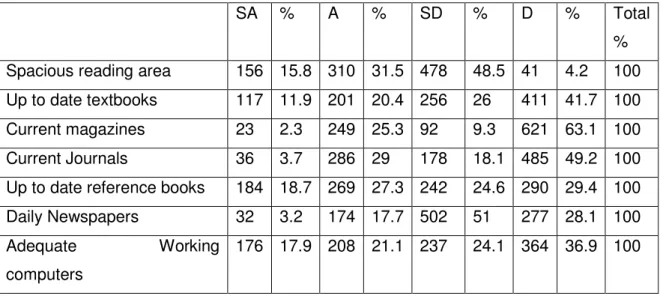
Table 6 showing Response on relevancy of available collection
SA % A % SD % D % Total
% Spacious reading area 156 15.8 310 31.5 478 48.5 41 4.2 100 Up to date textbooks 117 11.9 201 20.4 256 26 411 41.7 100 Current magazines 23 2.3 249 25.3 92 9.3 621 63.1 100 Current Journals 36 3.7 286 29 178 18.1 485 49.2 100 Up to date reference books 184 18.7 269 27.3 242 24.6 290 29.4 100 Daily Newspapers 32 3.2 174 17.7 502 51 277 28.1 100
Adequate Working
computers
176 17.9 208 21.1 237 24.1 364 36.9 100
On the question about the relevancy of the materials in their library, majority of the respondents at 52.7% say that the reading area was not spacious enough. 67.7% of the respondents say that the textbooks in their libraries were not adequate and relevant for the learning process. 72.4% of the respondents say that the magazines in their school libraries were old, not relevant and not useful. The same went for journals, reference materials and daily newspapers with 67.3%, 54% and 79.1% respectively. The computers were also not adequate or working as revealed by majority of the respondents with 60.1%.
SECTION C (LIBRARY USE)
Table 7 showing frequency of library use
How often Frequency percentage
Very often 126 12.8
Often 221 22.4
Seldom 534 54.2
never 104 10.6
total 985 100
It is shown here that majority of the respondents at 54.2% seldom use their school libraries as it does not meet their academic and social needs. This is
respondents say the very often use the library while the least number of students at 10.6% do not use the library at all.
DISCUSSION OF FINDINGS
In the research, it was found that majority of the school libraries in Oyo state have libraries. It was however discovered that majority of the libraries were situated in part of classrooms thereby not making the reading areas spacious enough for students to read in. This finding is consistent with that of Adeyemi (2010) and that of Elaturoti (1983). This finding showed that the state of school libraries in Oyo state has not improved from the time of Elaturoti’s study in the 1980s. Space in the library is very essential as there has to be adequate place to seat many number of students, tables and chairs also need space. Housing the library in part of a classroom means that adequate studying cannot be done there as other activities earmarked for the remaining part of the room will be ongoing and very likely be at cross purposes with activities meant for the library.
The findings also showed that majority of the libraries had collections of textbooks, reference materials, journals, newspapers and computers; majority of these materials were more often than not obsolete, archaic and irrelevant to the educational needs of the students. The finding supports those of Idiegbeyan-Ose (2012), Adebamowo (2011) and Aniebo (2006). Their findings revealed that majority of secondary schools’ libraries in states across Nigeria have very poorly developed collections and the materials available ranged from being torn and outdated to being outrightly irrelevant to educational development. This finding also support that of Petterrs and Otong (2012) who found that administrators of schools would rather fund visible projects such as construction of additional classrooms rather than stock the library with needed relevant materials.
Lastly, the findings revealed that the quality of the collections of their school libraries was a factor in their usage or non-usage of the libraries. It was revealed that majority of the respondents seldom used the school library. The students posited that there was no use in going to the library as they saw it as a waste of
information needs. This finding is consistent with that of Adeyemi (2010) whose study in Ekiti state showed a major finding of low patronage of school libraries by students to be attributed to poor library collection. The research found that majority of the students did not use their school libraries as they said it wasn’t meeting their educational need. The findings also support that of Adebamowo (2012) who found that non-use of Library resources in Ijebu North Local Government Area of Ogun state was due to the poor collection of the available library materials and lack of space.
The findings indicate a significant relationship between the library collection and students’ use of the library. This finding is consistent with that of previous research of Adebamowo (2012) and Adeyemi (2010)
CONCLUSION AND RECOMMENDATIONS
A school library should aim to build up a collection of pamphlets and audio visual resources on a wide ranging topic such as farming, insurance, vocational career and guidance, tourism, scientific equipment, non-governmental organizations, life planning education and entrepreneur (Dike, 1998). This is essential in lieu of the lack of blue and white collar jobs, pupils need to be equipped for self-employment and self-empowerment. Considering the spate of technological advancement, a school library must give special emphasis to acquisition of audio-visual materials and it should also be equipped for the use of such materials.
Ogunmodede and Emeachara (2010) observed that one of the fundamental laws of the library is that the resources – books and non- books, must be well consulted. The user is very important in the practice of Librarianship because the library process revolves around the user. No matter how large the stock of a library is, if its resources are not fully utilized, such a library becomes a white elephant. The Librarian has to acquire relevant books that would be of interest to the students’ educational and social pursuit.
It is recommended that the library should be housed in its house room or building. It should not share space for any other activity other than activities related to the library
The state government should provide funds for the acquisition of relevant and adequate materials for libraries in public schools since as noted earlier, the building does not make the library. This should be strictly done and monitored to ensure that administrators do not divert funds meant for the library to other uses. The internet has made the world a global village, observation has shown that pupils in private secondary schools are being made aware of this through the provision of internet facilities and online databases. This should also be made available to public secondary schools. Having access to the internet would increase their access to reading materials as there are a lot of such available on the web.
The school library must aim to become the hub of activities and therefore a force for educational excellence. The building does not make the library and neither does the collection without the user. The teacher Librarian should do all in her power to introduce programmes that will draw the pupils into the library to make effective use of the collection.
Capacity building has to be from bottom-to-top rather than the top-to-bottom presently practiced in Nigeria. A reading nation is a cultural nation and for any sustainable development to take place, the young ones of today have to be fully carried along in the process of development. This can only be done when these young, impressionable ones are introduced to the world of the library and all the benefits accruable from it at an early age.
In order to build and sustain life skills in pupils of secondary schools in Nigeria, the school library must be positioned firmly in the day to day activities of pupils.
REFERENCES
Adebamowo, Olusola (2011) The use of school library resources in Ogun state secondary schools: a study of selected secondary schools in Ijebu North LGA,
Nigeria. Journal of Research in Education and Society, Vol 2, No 1:pp113-121.
Adeyemi, T.O. (2010) The school library and students’ learning outcomes in
secondary schools in Ekiti state, Nigeria. Asian Journal of Business
Management, 2 (1): pp1-8.
Aniebo, M.U. (2006). Problems associated with applications of school library standards in Imo State. Coal City Libraries 4
Aina A.J., Ogungbeni J.I. and Adigun J.A (2011) Poor Reading Habits among
Nigerians: the Role of Libraries. Library Philosophy and Practice.
http://unllib.unl.edu/LLP/ (retrieved 30th August, 2012)
Badawi Gbagi Abubakar (2004) Libraries as Tools for Promoting Education in the Society: an Analysis of Library Utilization by Women in Kano State Libraries. Paper presented at the Nigerian Library Association 42nd National Conference AGM, June 20-25, 2004 in Akure.
Bosah L.Eghosa (2011) Perception of the Library by Secondary School Students in Enhancing Success in their Examination: Myth or reality. Proceedings of the 2011 Conference on Teaching and Learning and Change hosted by the International Association for Teaching and Learning (IATEL), pp573-580
De Jager, K. (2002) “Successful Students: does the Library make a difference?” Performance Measurement and Metris, 3 (3), pp 140-144
Dent V.F (2006) Observations of School Library Impact at Two Rural Ugandan
Dike Virginia W. (1998) “Reading promotion in Nigeria: the Role of School Libraries” in Elaturoti David (ed) Nigeiran School Librarianship: Yesterday, Today and Tomorrow. Ibadan: Nigerian School Library Association, pp 173-188.
Elaturoti, D.F. (1983) Survey of secondary school libraries in Oyo, Ondo and Ogun States of Nigeria. Nigeria Journal of Library and Information
Fagbeja, O. (1993) Recent development in the provision and development of school libraries in schools in Nigeria (1985-1990).Unpublished PhD Thesis, University of Pittsburgh, Dissertation Abstract CD Rom Order No: AAC8712573 Fadero Joseph Olatunji (2001) School Libraries and the 6-3-3-4 Educational System in Nigeria: Libraries and Librarianship in Nigeria: a festschrift for Ezekiel Bejide Bankole. Pp 165-179
Fargo Lucille F. (2003) The Library in the School. Chicago ALA 47. p35 (www.ala.org/../roleinreaading.cfm (Retrieved August, 29th 2012).
Goodall, D. and D. Pattern (2011) “Academic Library Non/Low Use and Undergraduate Student Achievement: a preliminary Report of Research in Progress”, Library Management, 32 (3)
Hay T.A and Stuart B.N (2005) The Relationship between Library Use and
Library Collection. Library Philosophy and Practice www.unllib.edu/LPP/ (retrieved Sept., 26th 2012)
Ifueko, T., 2005. Salvation’s concern for low reading culture Lagos: The Punch, Friday, July 22,pp: 66
Idiegbeyan-Ose, Jerome (2012) A survey on the present state of school libraries
in Benin City. Library Philosophy and practice
Ike, A.O. (1983) “The Role of School Libraries in the Implementation of the New National Policy on Education”. Presented at the Second Annual Conference of the Borno State Division of NLA. Maiduguri, June 2, p.9.
Kochar R.S. and Sudarshan K.N (1997) Theories and Principles of Librarianship. APH Publishing Corporation.
Kumar Krishan (1998) Library organization. Vikas Publishing House,PVT ltd Mahmud, S.B. (2001) “The Role of School Library in Educational Development and Growth in Nigeria“ The Guardian Newspaper. February, 20, p.13
Njoku, A.A. (1999) “School Libraries as Learning Facilitators. The Punch December, 19, p.9
Ogunmodede T.A and Emeachara E.N (2010) The Effect of Library Use Education as a Course on Library Patronage: a Case Study of Lautech Library,
Ogbomoso, Nigeria.; Library Philosophy and Practice. www.unllib.edu/LPP/
(Retrieved Sept. 26th 2011)
Ogunniyi, Samuel O and Jato, Micheal (2010) Survey of staff and Organisation of Private secondary school libraries in Ondo West Local government Area of Ondo state. Library Philosophy and Practice. www.unllib.unl.edu/LPP/ogunniyi-jato.pdf Okusaga T.O. (2008) “Development of School Library for effective
implementation of Universal Basic Education in Lagos State in the 21st century”
in Odubunmi E.O and R.O Okuneye (ed) Dynamics of Education in Lagos state in the 21st century. Lagos: faculty of Education, Lagos State University, pp149-160.
Onadiran, G.T and Onadiran, W.R. (1980) “Current Problems in School Library
Development in Developing Countries“. The School Librarian 28 (1) p. 14
Petterrs, Janet S. and Ottong, E.J. (2012) Correlates of school Library
development in Calabar, Nigeria: Implications for Counselling. Journal of
Education and Practice, Vol 3 (12): pp67-71
Rasaq Bello, Issa Abdulwahab Olanrewaju and Jimoh, Rafiu Ango (2013) School Library facilities and resources in Offa Local government Area of Kwara state.
Retrieved in http://www.unilorin.edu.ng/publications/issa/DR.%20issa%2013.doc
Retrieved 16/10/2014
Report of the Committee on the review of the Primary Education system in Western States of Nigeria (1968).
Shun Han Rebekah Wong and T.D Webb (2011) Uncovering Meaningful Correlation between Student Academic performance and Library Material Usage. College and Research Libraries, No 724, pp 361-374
The Guardian, Wed., Sept, 9th 1987, p8 ‘ if the Minister is Listening’ an Editorial
Comment
Udoh-Ilomechine, Queenette (2008) The significance of school libraries in the educational development of students: the case of Novena University Staff
School, Kwale, Delta State, Nigeria. Library Philosophy and Practice