Second Language Studies, 36(2), Spring 2018, pp. 155-195.
EXTENSIVE READING AND LISTENING MATERIALS
R
AQUELR
EINAGELUniversity of Hawai‘i at Mānoa
This paper aims to explain the process of creating extensive reading (ER) and extensive listening materials (EL) for learners of English. Four graded readers and four episodes of a podcast were produced in collaboration with other graduate students and faculty at the University of Hawaiʻi at Mānoa. Although a direct learner population is not specified, these materials were designed for second/foreign English language learners preparing for or entering their first years at an English medium university. The main goals of this paper are to:
1. Explain my materials development process
2. Explain the pitfalls and solutions that occur during the materials development process 3. Show what materials exist online that can be used for extensive reading and listening
BRIEF LITERATURE REVIEW
Extensive Reading
The pervasive nature of extensive reading literature has created various conceptions of what is and is not extensive reading. For this paper, I will define extensive reading along the lines of Day and Bamford (1998) as reading a variety of easily understandable materials for the purpose of enjoyment or information as much as possible. For a more in-depth description of the
principles of extensive reading, please see Day and Bamford (2002).
The literature on ER is extensive. Primarily, research has focused on vocabulary (Horst, 2005; Laufer, 2003; Nation, 2014; Nation, 2006; Poulshock, 2010; Waring & Takaki, 2003; Wodinsky & Nation, 1988), proficiency (Janopoulos, 1986; Mason & Krashen, 1997;
Mermelstein, 2015; Robb & Kano, 2013; Robb & Susser, 1989), reading rate (Beglar & Hunt, 2014; Beglar, Hunt, & Kite, 2012; Bell, 2001, Huffman 2014; Iwahori, 2008; Taguchi,
Takayashu-Maass, Gorsuch, 2004), attitudes (Camiciottoli, 2001; Constantino, 1995;
2014; Ro, 2013; Tabata-Samdom, 2017; Takse, 2007; Yamashita, 2004), various skills (Al-Homoud & Schmitt, 2009; Leung, 2002; Sakurai, 2015; Tanaka & Stapleton, 2007), and ER program setup and evaluation (Asraf & Ahmad, 2003; Brown, 2009; Eur, 2013; Kitao, Yamamato, Kitao, & Shimatani, 1990; Nation, 2015; Pino-Silva, 2006; Raj & Hunt, 1990; Tomlinson, 2000; Walker, 1997). The majority of this research claims that learners’ abilities increase in all of these areas to some degree. There are, however, a few studies that found either no difference or less improvements compared to other learning methods (Laufer, 2003, Mikami, 2016; Nakanishi & Ueda, 2011; Reynolds, 2014). With the overwhelming number of studies that show language improvements with ER, it is clear that ER helps learners improve their language in various capacities. For a summarized view of the positive impact of ER, see the meta-analyses of Jeon and Day (2016) and Nakanishi (2015).
The beginning of the current decade brought a new mode of ER, online reading. With the growing accessibility of online technology, many schools now use online reading sources for all subjects, including language education. Nevertheless, research on online ER is minimal. Arnold (2009) conducted an online ER program with eight learners of German. Although the learners occasionally chose books above their language level, the online ER sessions were shown to increase their motivation and self-confidence. Additionally, because of the online nature of the project, the students felt they were more compelled to read outside of class on German websites.
Sun (2003) used an online ER program for 59 freshmen students at a university in Taiwan. The program itself had both points of criticism and praise, but what is more interesting is the findings that the students liked the interface design and believed that the online program enhanced opportunities for reading and improving their English. Unfortunately, a downfall of this study is that there was no comparison group of non-online ER readers, so it is unknown if the results are connected to the online aspect of ER.
Regardless of the flaws of these studies, it appears that online ER is growing in popularity and may have a positive impact on language learners. Therefore, the need of online reading materials is bound to grow. I hope my graded readers add to the expanding number of free online materials for extensive reading.
Graded Readers
Graded readers are one of the most common material types for ER. Graded readers are traditionally defined as “short books of fiction and non-fiction which are graded structurally and lexically – and occasionally in other ways” (Bamford, 1984, p. 218). In his paper on the relation of graded readers to ER, he additionally states that “grading ostensibly ensures that learners can read with relative fluency without being overwhelmed by unfamiliar structure and vocabulary” (p. 218). Therefore, the graded part of graded readers allows for these books to fit into the easily understandable part of my definition of ER.
Simensen (1987) claimed that there are three types of graded readers: Authentic readers, pedagogic readers, and adapted readers. Authentic readers are written for native speaker audiences. Pedagogic readers are written for language learning. Adapted readers are stories adapted for language level from authentic readers. Graded readers are often viewed as simplified texts or adapted materials, but Day (2003) argues that original graded readers should be claimed under a new genre of literature called “Language Learner Literature” (pp. 8-9). By calling original graded readers Language Learner Literature, it legitimizes the value of graded readers and substantiates the argument that the content of graded readers is not somehow lesser than books written for first language readers. With its growing use in language classrooms and the support of practitioners in its legitimization, graded readers are a common and effective material for ER.
Extensive Listening
Compared to the protracted amount of literature on ER, extensive listening (EL) has a somewhat shorter and less diverse research background. Research in EL is closely connected to ER research. EL research often cites ER studies, as they both stem from the belief that an extensive amount of input will help improve language ability. EL can be defined as “students listeningto large amounts of motivating and engaging materials which are linguistically appropriate over a period of time where they listen with a reasonable speed for general
understanding, with a focus on meaning rather than form” (Renandya & Jacobs, 2016). Although the idea of EL is not as prevalent as ER, Stephens (2011) declares that EL should not be left in the shadow of ER. In fact, teachers often focus more on teaching through reading, which builds up familiarity with the language from a textual perspective. Therefore “teachers may overlook
the fact that students do not share the same oral foundation. Hence they should supply additional support in the form of extensive listening” (p. 313). Renandya and Farrrell (2011) also suggest that the popularity of teaching listening strategies should not be the sole focus of a listening course, but to also include EL. Research shows that using EL increases strategy use (Bidabadi & Yamat, 2014; Cross, 2014), comprehension (Kim, 2004; Takaesu, 2017), and attitudes (Chang, 2010; Mayora, 2017).
Podcasts
The word podcast comes from the words iPod and broadcast (Rosell-Aguilar, 2007).
Podcasts are primarily audio content (sometimes visual as well) that are synchronized to an RSS feed publicly available online. Podcasts came into popularity at the beginning of the 21st century and were spread by the rising use of mobile devices for streaming. It was at this time that
educators began to encourage the use this freely distributable resource for teaching, which included language teaching (Godwin-Jones, 2005).
A majority of the literature about research using extensive listening used podcasts as the source of material. Other research involving podcasts used it as a speech production activity with varying results in language ability changes (Ducate & Lomika, 2009; Farangi, Megadghanbar, Askary, & Ghorbani, 2015; Lord, 2008). Lomika and Lord (2011) found that many language educators used podcasts for older learner groups, but at all language levels. They also found that teachers used them for a variety of reasons including listening practice, speaking practice, pronunciation practice, increasing independence, exposing students to cultural information, and promoting digital literacy among other uses.
In his justification of using podcasts for language learning, Thorne (2005) stated “Podcasting can be viewed as another avenue for providing language learners with access to diverse authentic materials” (p. 385). Rosell-Aguilar (2007) also justified the use of podcasts under the historical influence of the input hypothesis (Krashen, 1982). Rosell-Aguilar states:
Podcasting can provide access to a large amount of authentic input, as well as to teaching materials of varying quality that have different approaches to language learning behind them (depending on the content provider): from behaviourist to cognitive constructivist and communicative approaches, situated learning, and lifelong learning (p. 473).
Other advantages of podcasts stated by Rosell-Aguilar are: portability, motivating, easily accessible, and value for money (free).
Fernandez (2011) posited four language learning objectives podcasts can have for second language (L2) learning. These are “(1) language acquisition, (2) development of listening comprehension skills, (3) learning of explicit information about the L2, and (4) awareness of the target culture” (p. 24). Of course, different types of podcasts can facilitate greater
accomplishment of these objectives. Nurmukhamedov and Sadler (2011) categorized language learning podcasts as discrete category (focusing on discrete categories related to language parts), ESL focused podcasts (following the procedures of classroom-taught English, general audience podcasts (not made for language learners), and super-podcasts (podcasts that include a variety of material and language foci). Looking at podcasts related to English language education, many podcasts do seem to fall into these categories. However, this does not mean that there are only four categories for language learning podcasts. Talk show-type podcasts have entered the scene. Moreover, the potential of creating podcasts designed as EL material based on a fiction story series is a possible new category that my materials hope to create.
Although literature on podcast usage in language learning settings has somewhat died down since the early 2010s, research experiments and beliefs lean towards the encouragement of using podcasts as listening materials. The next section of this paper will cover the motivation for the creation of these materials for ER and EL.
EXTENSIVE READING AND LISTENING MATERIAL DEVELOPMENT MOTIVES
Vary rarely does a paper thoroughly address the motives behind a research or materials development project. I, however, will attempt to display to you, the reader, various aspects that motivated this project. First, I will begin with my own personal motives, followed by a small needs analysis.
Personal Teaching and Language Learning Experiences
This project truly began in two stages which relate to reading and listening respectively. The first part of the project, the graded readers, was conceived when I discovered the existence of graded readers and their ability to encourage reading in a foreign or second language. In my
youth I enjoyed writing short stories and writing graded readers seemed to be a logical
connection between one of my hobbies and my desire to create materials for ESL/EFL learners. This was also accompanied by my positive experience utilizing extensive reading in my own English reading classroom.
The listening component of this project developed somewhat differently from my graded reader realization. In my own search for listening material in Korean, I found a podcast from www.talktomeinkorean.com that provided ten-minute conversations in Korean for Korean language learners. I began to listen to this podcast daily and realized how my listening skills were ever-so-slightly improving. Additionally, I was enjoying listening to the podcast episodes. I began to wonder if there was a similar podcast offered in English. Through my search on iTunes, I found that there are many podcasts devoted to English language education. However, many of these podcasts focus on grammar instruction. A few were designed similarly to the Korean podcast I listen to in that they were unscripted dialogues between two people. I immediately knew there was a market for my brand of podcast. Therein I began to consider the potential readers and listeners of these materials from the lens of a loose needs analysis.
Needs Analysis
In preparation for making these materials, only a minimal needs analysis occurred, as there was no specific target population that could be quickly or easily assessed. I created these materials for any person learning English at a language level that would permit them to begin studying at an English-medium university. This means that the potential consumers of these materials could be attending or soon to enter one of the thousands of universities around the world that claim to have most of their classes taught in English. However, since the materials made for this project are openly accessible via the internet, there really is no controlling who listens to or reads the content. These potential readers and listeners are so numerous and diverse that it would be impossible to even gather a fraction of them to understand their needs.
Therefore, I could only vaguely assess the needs of the students I have encountered during my time as the University of Hawaiʻi and University of Macau.
As previously mentioned from my experience teaching newly admitted international students at the University of Hawaiʻi at Mānoa and the University of Macau, I realized that my students did not interact with English as much outside of the classroom as their instructors desired. They
also did not know of many online resources that provided reading or listening materials. Of course, there were libraries on campus that had graded readers and audio tools. These students could have easily gone to one of these physical sites to rent reading and listening materials. However, I noticed that most of my students preferred using laptops, tablets, or mobile phones to consume content. A natural progression of thought was to make materials for an online or mobile audience.
Additionally, most of the content they consumed was in their first language (L1). Many of the students were not interested in reading or listening to English beyond their classes. I informally asked a few students why this was, and many students claimed that they were too tired for extra reading or listening to English. This could mean that the content in their classes was difficult for them and it caused them to become tired. Maybe they assumed that practicing English outside of the classroom would be challenging, too. This made me consider making extensive reading and listening materials, as they should be easy for learners to understand, thus lessening the load on their minds and making them more willing to consume English outside of class.
From incorporating extensive reading into the reading class that I taught, I found that a few students particularly enjoyed the extensive reading and/or saw benefits from it. My reading class used an online graded reader repository that required paid subscription called xreader.com. After the end of the semester, these students asked me for other online reading resources. After
searching online, I found several websites claiming to provide free graded readers as seen in Table 1.
Table 1
English Language Free Graded Reader Websites
Website Name Language Level Range* Original/Adapted
English E-Books Elementary-Advanced Adapted
ER Central 1-20 Original
eslfast.com 1-6 Original
gradedreading.com 1-8, 9 Original
Lit2Go Kindergarten- 12th Adapted
Paul Nation’s Page Mid-range Original/adapted
readlistenlearn.net 1-5 Original/adapted
Teaching English Blog Elementary-Intermediate Original
*Language revel range is as reported on the websites. These reported levels do not necessarily equal one another
The issue with many of these websites, however, was the lack of explanation of how their graded readers were levelled. Websites often arranged their graded readers into language levels, but there was hardly ever a rationale behind the levelling. My graded readers, however, have clear explanation of the levelling process which can be seen on the website alleande.com.
Research on the production of graded readers has shown that publishers generally have the teacher or librarian in mind, rather than the student, when producing graded readers (Claridge, 2012). However detrimental to the wants of the learner, this is logical for publishers of graded readers because teachers and institutions are more likely to make purchases of graded readers. To separate my materials from these types of pressures, I decided that the graded readers produced for this project would be freely accessible online. This would allow for the graded readers to be designed with the learner in mind.
Turning to podcasts, Yeh (2017) identifies two types: podcasts created for and by L1
speakers and podcasts that teach content created for language learning. In many implementations of podcast listening activities, teachers have let their students choose any podcast regardless of the language level or aim of the podcast (Abdous, Camarena, & Facer, 2009; Lacina, 2008). I searched on iTunes for podcasts related only to English language learning, as it is a smaller and more focused group than the potential thousands of English podcasts created every day. These podcasts can be seen in Table 2.
I found that many of these podcasts focused on teaching small aspects of English such as idiomatic phrases or grammar. Otherwise, these English-centered podcasts provided real English conversations on a variety of topics. Real conversations meant unscripted speech between two
native speakers. Seeing this amount of English language education related podcasts focusing on minute points of language or unscripted language meant that a gap of scripted, realistic language not focusing on a specific language point could be filled. None of the podcasts found were specifically labeled as extensive listening. Additionally, all of the scenarios wherein two or more people were speaking focused on discussing non-fictional topics. This means that my fictional, realistic story-based podcast would fill a gap in podcasts related to English language learning.
Table 2
English Language Podcasts* Podcast
Name Type of Podcast
Estimated Language Level**
Number of voices per episode
6 Minute English
6-minute episodes with dialogues about non-fiction topics Intermediate to advanced 2-3 Adept English Roughly 10-minute episodes about tips for learning English or non-fiction topics High-intermediate to advanced 1 All Ears English 15-20-minute episodes wherein two females have conversations about learning English or non-fiction topics
Advanced 2
Business English Pod
10-20-minute episodes that give tips on using English in a business setting Intermediate-advanced 1 Dramatic Listening
30+minute episodes that provide previously recorded radio plays in English with English and Chinese translations
High 2+
Effortless English
20+ minute episodes providing tips for learning English and monologues on non-fiction topics High-intermediate to advanced 1 Elemental English
3-7-minute episodes for practicing connected speech, intonation, and grammar
Intermediate to advanced
1
English 2.0 5-20-minute video episodes on grammar, common phrases, and speaking skills such as stress and word-pronunciation
Intermediate to advanced
English Class 101
5-10-minute video or audio clarifying certain grammar points and answering English-related questions from listeners Intermediate to advanced 1 English Fluency Now 10-20-minute episodes of authentic English on non-fiction topics Intermediate to advanced 1 Espresso English 5-10-minute conversations on grammar, common phrases, and language learning tips Intermediate to advanced 1 Go Natural English Podcast
5-15-minute episodes about tips for learning English or non-fiction topics Intermediate to advanced 1 Rachel’s English
Overviews idioms, phrasal verbs, and phrases used by native speakers on particular topics Intermediate to advanced 1-2 Real English Conversations 20-minute episodes providing real English conversations on non-fiction topics Intermediate to advanced 2 Real Life English Podcast
30+ minute episodes about grammar, culture, and common phrases Advanced 2 Speak English Podcast Addresses perceived English errors and includes question and answer practices from an English dialogue
Intermediate to advanced
1
Zapp English Native speakers saying short dialogues about a particular subject. Listeners are given tasks to do while listening
High-intermediate to advanced
2-4, but no interaction between speakers
*These are only a fraction of the podcasts about English language learning/practice provided through iTunes. These podcasts were chosen because of their popularity when searching for English listening or English language.
**These levels are estimated by me, however some of the podcasts did have a suggested language levels of their audience.
It is with these brief analyses that I roughly determined the needs of my unpredictable number of potential listeners and readers. Even if small, there does seem to be a need for free online graded readers at the university level that are clearly labeled for language level. English language learning podcasts, too, are unknown to many students and primarily focus on minute grammar or authentic speech that may be difficult for learners to listen to with ease.
GRADED READER MATERIALS DEVELOPMENT PROCESS
Creation of the graded readers began with an idea to create a choose your own adventure graded reader. A choose your own adventure story is one wherein the plot has various routes from which the reader can choose that lead to different endings. This style of book is often seen in mystery, action, or adventure genres. Originally, I wanted to create a choose your own adventure graded reader to be used in an app. However, the project faced logistical issues that were too large to overcome, so instead I set the goal of creating more graded readers for free online use.
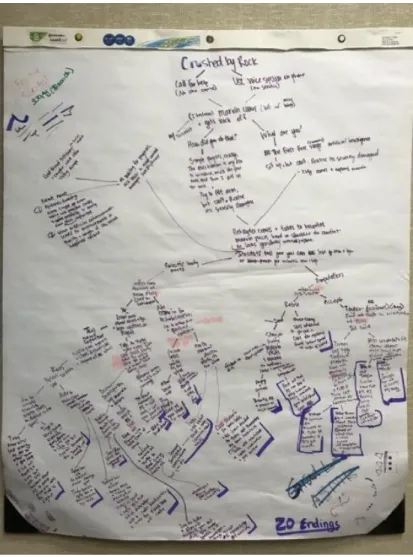
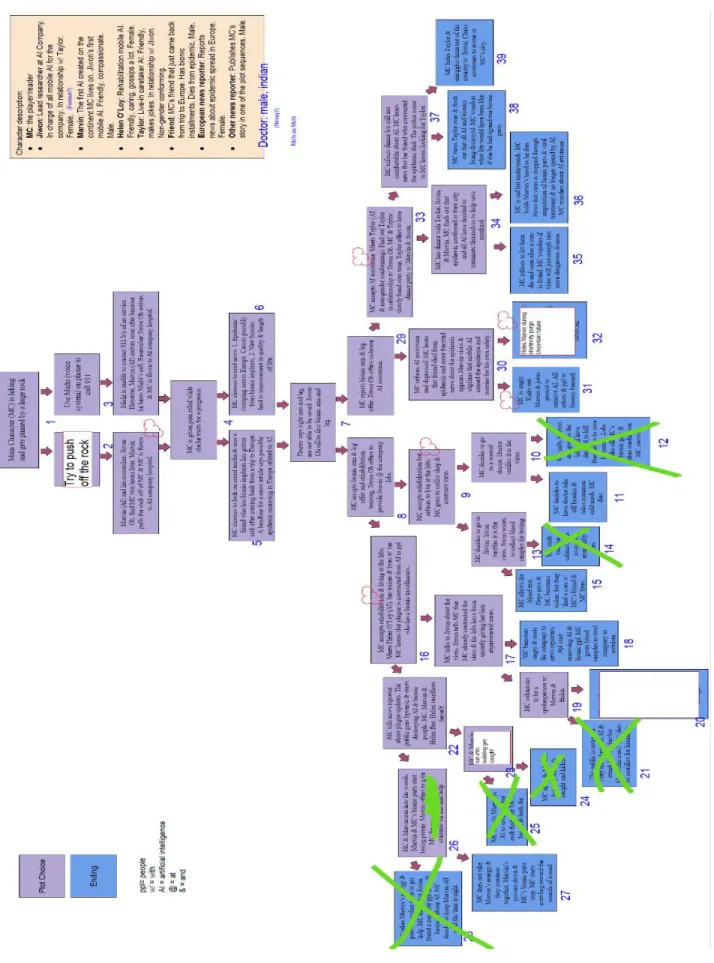
Two of the graded readers, Bionic Body? and Inside the Dream, were written by me. The general process for creating my graded readers was to first brainstorm ideas. Once a general theme was chosen I then drew a plot map. An example of my first plot map can be seen in Figure 1. A later, digital plot map can be seen in Figure 2. The next step was to begin writing the story. For the first story, the original plan included 20 different endings. However, during the writing process, the endings were narrowed down to twelve.
Two other authors were recruited to write graded reader as well. These authors were also students in the Department of Second Language Studies (SLS) at UHM. There were no
restrictions on the genre or content of their stories other than refraining from explicit sexual or violent content. The two writers sent in rough drafts to me roughly two weeks after agreeing to collaborate with me.
Next, all of the stories were sent to a copy editor. The copy editor checked for basic errors and plot flow. Once edits were made, each section of the story for the choose your own adventure story, Bionic Body, and the whole story for the other books were run through readability software to determine the Flesch-Kincaid Grade Level and was also ran through VocabProfile. The Flesch-Kincaid Grade Level readability measure assesses the grade level of a
text according to first language reading ability per grade level. VocabProfile analyzes each word in a text and separates them into the most to least common vocabulary in 1,000-word levels.
The Flesch-Kincaid Grade Level readability measure was chosen because it is one of the most popular readability measures. Although it has flaws, there are three reasons for using it as the primary language measurement. The first reason is that it is well known. Many teachers and researchers alike are familiar with this measure and it has been used countless times in previous research. The second reason it that the software for measuring readability for Flesch-Kincaid Grade Level is easily accessible and easy to understand. Other readability measures have complicated systems to interpret the data or their websites are not consistently available for measurement. By using Flesch-Kincaid Grade Level and websites where this is easily
measurable, it allows for learners and teachers alike to measure their other reading material and easily assess their reading level. If they measure their other reading material, then they can compare that to the graded readers in this project and immediately know if a book would approximately fit their level of understanding in English. The third reason is that Holster, Lake, and Pellowe (2017) found that the difficulty of graded readers is better determined by book length and mean sentence length, not by the number of headwords. As a matter of practice, most publishers advertise their readability levels by the number of headwords, which I chose not to do as it can be confusing and unfamiliar to readers.
In order to estimate an appropriate reading level for the target audience, 15 excerpts from graded readers that students in academic reading classes at UHM were run through the same readability measures. The average Flesch-Kincaid Grade Level was 3.86 and the average for the highest VocabProfile 1,000-word level was in the 7,000 range. The Flesch-Kincaid Grade Level and VocabProfile measures for the four graded readers made for this project can be seen in Table 3.
Table 3
Readability Measures for the Graded Readers
Title of Book Flesch-Kincaid Grade Level Word List Level
Among Demons 4.40 8,000
Bionic Body? 4.70 7,000
Inside the Dream 4.00 8,000
The Dive 4.80 8,000
Average of graded readers read by students in an academic reading class
Nation and Ming-tzu (1999) suggested that learners read several of books within the same level to maximize the repetition of frequent words for that level before moving to a higher graded reader. Therefore, a base-line of 4th grade level and 7,000-8,000-word list level was set. This follows the average graded reader the academic reading students read on xreading.com, thus approximating the language level desired for the target population. Regarding vocabulary,
researchers such as McQuillan (2016) claim that most graded readers end at the 4,000 word list level, leaving a gap before academic texts starting at the 9,000 word list level. Therefore, making graded readers at the 7,000-8,000 word list level could act as a bridge between other graded readers and academic texts. If the first edit of the story scored too high on the Flesch-Kincaid Grade Level measure or on VocabProfile, I changed the language used in the stories until it fit within these parameters.
While editing was taking place, I hired four separate illustrators for the books. Each illustrator was sent the description of illustrations for the book. Where the illustrations would occur in the story was chosen by each author. Communication about the illustrations was handled by me. Different illustrators were chosen to give diversity to the texts. Figure 3 shows the difference in art styles that adds a uniqueness to each book.
Figure 3. Illustrations from Three of the Graded Readers.
Once the illustrations were reviewed, the stories were made into e-books through the web resource canva.com, except for Bionic Body? which was created via Microsoft PowerPoint. One difficulty that I faced during the e-book making process was that the other two authors did not always evenly spread their illustrations throughout the story. The original purpose of including illustrations was to assist in reading comprehension due to the higher language level. However, some of the books had long portions of text with no image support, while other parts of the book had an overflow of illustration usage. This is partially my own error because I did not explicitly tell the authors to evenly choose where to suggest illustrations.
After the e-books were finalized, I sent a copy of the e-book to the other authors for proofreading and appraisal of the content and layout. If the other authors saw any errors, they notified me, and I made changes. This concludes the process of creating the graded readers. I will now move onto the podcast development process.
PODCAST MATERIALS DEVELOPMENT PROCESS
The first step in making the podcast was to research other competing English language podcasts. As shown in Table 2, many of the podcasts that exist focus on strategies for learning English, monologues/dialogues on non-fictional topics, and the instruction of English grammar, phrases, and speaking nuances. There was only one podcast that had fictional, scripted dialogue, which was Dramatic Listening. However, Dramatic Listening uses previously recorded radio stories and spends roughly half of each podcast episode covering the English usage within the radio stories.
From searching through various English language podcasts, I realized that there was a lack of fictional stories being told via podcasts. Additionally, most podcasts only used one to two voices. Therefore, I knew I wanted to create fictional stories told week-by-week with a multitude of voice actors. The reason for multiple voice actors is that the listener would be able to gain experience listening to a variety of English accents interacting with one another (Rosell-Aguilar, 2007).
The production process of a four-episode story is as follows: (a) Genre/topic selection and script writing, (b) voice casting, (c) audio mixing, and (d) publishing. First, my podcast co-creator and I sat down and brainstormed genres. We considered romance, science fiction,
mystery, and action. In the end, we chose crime/mystery, as it is a classic genre for radio stories. Additionally, the mysterious nature of the story would also encourage the listener to continue listening to each episode. To give an overview of the plot: two police officers investigate a bank robbery in search of the robber’s partner in crime. The officers interview three suspects before they discover that the bank’s CEO was the robber’s accomplice.
Script writing took place over four days wherein we wrote each scene together. Each script was written to be relatively short (around five minutes) as suggested in Corbeil and Corbeil’s research (2011). I wanted the dialogues to reflect real interviews between cops and interviewees, so various publicly accessible interviews were used as models (Detective & Wilson, 2014; Henning & Yanez, 2017; CABank TalkBank, n.d.; Transcripts of police and FBI interviews, 2014; Warthen & Kinkel, 1998). While writing the dialogues, my partner and I also vocally practiced the dialogues to test for language that we considered awkward in spoken English. For
certain portions of longer monologues, I called speakers of English and read the monologues to them as if they were stories I was telling in real life. I made note of what verbal comprehension markers they used (uh-huh, oh, etc.) and at what points in the story they used them. I then inserted these verbal markers into the dialogue to create a sense of natural, unscripted dialogue.
Connected speech was also written into the scripts for recording purposes and then revised to full-forms when provided to the public. Connected speech occurs in spoken language and
includes “words stress, sentence stress and timing, reduction, strong and weak forms of words, elision, intrusion, assimilation, transition, liaison, and contraction” (Brown, 2006). The types of connected speech we included were deletion (needa= need to), contraction (must’ve, y’all, why’d), and elision (ya= you, ‘em= him, feelin’= feeling, somethin’= something). By adding in connected speech, the dialogues more closely mirror naturalistic speech and can also help normalize listeners to common connected speech patterns used by fluent speakers of English (Brown & Hilferty, 2006; Brown & Kondo-Brown, 2006; Lee, 2013; Weinstein, 2007). The connected speech was written into the scripts for the voice actors to read, but once the podcast was recorded, the connect speech was changed to standard written forms for learners to reference when listening. Most of the connected speech was written for the characters played by people born in the United States, which says something to our preconceived notion as to who uses connected speech and who does not.
Although it is difficult to measure the difficulty of a listening text, I measured the Flesch-Kincaid grade level of each script and the words per minute. Flesch-Flesch-Kincaid grade level was measured after the scripts had been changed back to standard written forms. A summary of this can be seen in Table 3. The texts were within the 3rd grade level. The average words per minute (wpm) was 139.38, which is 81.99% the speed of normal speech (170 wpm) (Blau, 1990).
Table 3
Readability and Speed of Podcast Episodes
Episode Flesch-Kincaid Grade Level Speed (word/minute)
1 5 (3.5)* 137.77
2 3.1 150.50
3 3.7 147.73
4 3.8 121.52
Average 3.53 139.38
*The initial Flesch-Kincaid grade level was 5, but this is due to the introduction which
explains extensive listening. If the introduction is removed, the grade level is 3.5. The average uses 3.5, not 5.
One of the most important considerations during script writing was the type of characters that would be written into the story. Drawing on themes from Critical Language Pedagogy (Crookes, 2013), the characters were written to show diverse cultural, age, and gender backgrounds. Moveover, I wanted to show that the target language culture is not only two L1 speakers
speaking to one another. Fernandez (2011) encourages podcasts to bring awareness of the target culture, but with a language such as English that is spread all over the world, only incorporating L1 speakers in stereotypical roles would not adhere to the reality of the target culture. Two characters who held the most power in the story, the police chief and the CEO of the bank, were women. Two of the characters were older men while the others did not have a specified age. In total there were four female characters and four male characters. Additionally, two of the
characters were written as ethnically Japanese. What could be considered the most controversial is the inclusion of a man who is not explicitly said to be gay but shows markers of homosexuality in his story-telling such as hinting to find the male robber attractive. By writing characters that represent a variety of linguistic and social backgrounds, the texts displayed deeper connections to real-life situations. These characters also challenge preconceived notions about sexuality, gender, and age in a way that does not directly affect the plot of the story. Instead, these characters work through the narrative just as any other character would, which implies that their differences do not make them so different from normal characters.
Once the scripts were written, we began to recruit voice actors. These voice actors were graduate students and faculty of the Department of SLS at UHM. As previously mentioned, two
of the characters were written as Japanese, but other characters had no specified language or cultural background. Therefore, we were able to use voice actors from any language background. In total there were four English native speakers from the U.S. and four non-native speakers, two from China and two from Japan. One issue we ran into when recruiting voice actors was the availability of speakers from different language backgrounds. As a generalization, a large number of international students studying in the Department of SLS are from East Asia. This resulted in second language (L2) speakers being from East Asia.
Script recording sessions were held in a library study room at UHM. Dialogues were
practiced two or three times before recording, as suggested in previous podcast research (Corbeil & Corbeil, 2011). During these practice rounds, minor changes in the script were made if the voice actor deemed the language to be unnatural or difficult for them to say. Each dialogue was recorded twice with a Blue Snowball USB Microphone into Adobe Audition. Between recording takes, I coached the voice actors on speed, naturalness, and pronunciation of character names.
Once the recordings were completed, I mixed the podcast episodes on Adobe Audition. Opening and closing music were provided by an indie musician and sound effects were used from freesound.org. During mixing session, I occasionally added short pauses (approximately 0.25 of a second) between dialogue pieces and adjusted loudness levels to make the episodes easier to understand. After exporting the podcast episodes, they were proof-listened to by myself and my podcasting partner.
The last step was uploading and disseminating the podcast to various podcast-hosting
platforms. Each week one podcast episode was uploaded onto alleande.com. I then synchronized the website’s RSS feed with iTunes, Google Play Music, Pocket Casts, Podcast Addict, and a few other podcast platforms. Some of these platforms required review while others automatically accepted podcasts. After synchronization, each time a podcast was uploaded it was available through various online platforms almost automatically.
FEEDBACK SURVEY DEVELOPMENT PROCESS
The purpose of creating a survey along with each material was to receive feedback from English language learners. These feedback surveys allow readers/listeners to assess the materials. This feedback can help with the development of future materials as well.
To define my meaning of a survey, it is the same definition as questionnaires as written in Brown (2005): “written instruments that present respondents with a series of questions or
statements to which they are to react either by writing out their answers or selecting from among existing answers” (p. 6). It is with this definition and the guidance of proper item creation as suggested in Brown (2005) that I created a survey focusing on perceived text difficulty and suggestions. For the full surveys, see Appendices A and B.
First a biodata section was made to gain an understanding of what type of language
background theses learners possessed. The feedback section was made to determine the reason for reading/listening, the perceived difficulty of the material, and suggestions or comments. These items were inspired by Xreading’s book review questions (Xreading, 2017). After reading a book on Xreading.com, readers have the option to rate the book. I wanted to emanate this way of asking for reviews and apply it to these materials because both Xreading.com and my
materials were accessible online. Once the items were created the surveys were made using Google Forms.
The feedback section consisted of three open ended items and five 4-point Likert scale items. The three open-ended items asked about why they chose to read/listen to the story, what they found difficult, and comments or reviews. The Likert scale items were designed to measure likability, interest, and difficulty in the story.
The Bionic Body? and a graded reader feedback survey were piloted with ten students in a hybrid advanced academic reading course in the ELI at the University of Hawai´i at Mānoa. For the testing of the narrative, the story was made into a PowerPoint because the app was not yet created. The pilot showed overall interest in the story. Some vocabulary was changed in the survey, as some pilot participants had to look up the definitions of some of the words.
MATERIALS FEEDBACK
Although website analytics showed that each graded reader’s website page received an average of 55 visits in the first 30 days of uploading, only a total of seven surveys were
submitted by learners. For the podcast, each episode’s web page received an average of 15 visits within the first 30 days of the website’s creation. However, the number of surveys submitted for the podcasts was three. There is no way to tell if the hits on a page indicate that visitors read or listened to the material. However, when speaking to colleagues, it appeared that many
readers/listeners did not see the survey link on the webpages but did read/listen to the materials.
Graded Reader Feedback
Due to the lack of data, only descriptive statistics will be reported. Tables 4 and 5 show the biodata for the participants who read the graded readers. Although the countries of the people who visited the website include the Republic of Korea, Macau, Japan, China, Macedonia, Germany, Portugal, Israel, Ireland, Luxembourg, France, Switzerland, Taiwan, Austria, and Vietnam, the countries of origin of the participants are much smaller. Additionally, more women than men took these surveys. As expected, most of the participants had studied English for a long period of time, between six and twenty years. Only two of the graded readers, Among Demons and Inside the Dream, had survey results.
Table 4
Biodata for Among Demons Readers
Number Gender Age
Country of Origin
First
Language(s)
Language Most Used Other Than English Country of Current Study/Living Number of Years Studying English
1 Female 21 China Chinese Chinese USA 15
2 Male 21 Saudi Arabia
Table 5
Biodata for Inside the Dream Readers
Number Gender Age
Country of Origin
First
Language(s)
Language Most Used Other Than English Country of Current Study/Living Number of Years Studying English
3 Male 21 Indonesia Indonesian Indonesian USA 11
4 Female 19 Japan Japanese Japanese USA 7
5 Female 18 Germany German German USA 14
6 Female 24 USA Vietnamese German USA 20
7 Female 23 USA Vietnamese Vietnamese USA 20
Five survey items used a Likert scale to measure enjoyment of the story and its difficulty. For Among Demons, the two participants responded 3-liked it to the item How much did you like the story. For the item How interesting was the story? they both answered 3-interesting. For the item How difficult was the vocabulary in this book? the two answers were 4-too easy and 2-so-so. However, both participants answered 3-perfect level to the question How difficult were the sentences in this book? Lastly, the participants answered 4-too easy and 3-perfect level to the question How difficult was the story to read overall?
Table 6
Feedback for Among Demons* Number 1. How much did you like the story? 2. How interesting was the story? 3. How difficult was the vocabulary in this book? 4. How difficult were the sentences in this book? 5. How difficult was the story to read overall? 1 3 3 4 3 4 2 3 3 2 3 3
*Likert scales are as such:
Item 1: 1-Hated it, 2-Disliked it, 3-Liked it, 4-Loved it;
Item 2: 1-Very uninteresting, 2-Uninteresting, 3-Interesting, 4-Very interesting; Items 3-5: 1-Difficult, 2-So-so, 3- perfect level, 4- Too easy
Feedback for Inside the Dream showed overall liking of the story with an average of 3 (Liked it). The story was found to be very interesting to all participants except participant 3, who found
the story to be uninteresting. The vocabulary and sentence difficulty had an average score of 2.80, meaning that the vocabulary was rated between so-so and perfect level. Lastly, the average score for the difficulty of the story overall was 3.20, between perfect level and too easy.
Table 7
Feedback for Inside the Dream* Participant 1. How much did you like the story? 2. How interesting was the story? 3. How difficult was the vocabulary in this book? 4. How difficult were the sentences in this book? 5. How difficult was the story to read overall? 3 3 2 3 3 3 4 4 4 2 2 4 5 4 4 3 3 3 6 4 4 3 3 3 7 4 4 3 3 3 Average 3.00 3.60 2.80 2.80 3.20
*Likert scales are as such:
Item 1: 1-Hated it, 2-Disliked it, 3-Liked it, 4-Loved it;
Item 2: 1-Very uninteresting, 2-Uninteresting, 3-Interesting, 4-Very interesting; Items 3-5: 1-Difficult, 2-So-so, 3- perfect level, 4- Too easy
The reasons the participants reported choosing to read the books mainly focused around interest because of the title or cover artwork. The difficulties reported with the stories are reported below:
-Some new words and the utility of grammar -some vocabulary words
-the writer doesn't explain quite clearly on some sentence
-There were some words that I don't know, so some parts of this story were hard to understand.
-The story was a bit confusing since it incorporated so many little stories, but overall I liked it.
-Nothing :] I think it's quite appropriate for a range of ages. -The names were similar, both starting with L
Comments and reviews of the two stories are as such:
-If that is possible please write the continue story, I really want to know the following things -thank you for this assignment
-the writer has a good imagination, but it will be better if he use more descriptive words, so that its easier to understand the story
-I like this story!
-It was a really creative story and I especially enjoyed the picture. -It was enjoyable to read and had a great message
Overall, it appears that the readers liked the two graded readers and found the stories interesting. The Likert scale items showed the difficulty of the stories was within their comfort range, but the open-ended responses showed that difficulty arose because of vocabulary,
sentence structure, and story sequencing. The qualitative data shows an interest in reading more stories and an enjoyment in the stories.
Podcast Feedback
As stated previously, only three learners submitted feedback for the podcast episodes. Similar to the graded reader webpages, each podcast episode’s webpage had many more visits than the amount of surveys submitted. The lack of submissions may also be attributed to listeners not seeing the link on the website, or the listeners could be streaming the podcast from other platforms wherein there is no survey link.
Unfortunately, one of the participants did not fill in the biodata beyond stating she was a female, so it is uncertain what her language background was. However, the other participants were a 23-year-old male Japanese national who had studied English for 10 years and 23-year-old female Chinese national who had studied English for 13 years. The reasons they reported
listening to the podcast were “a friend of mine suggested to me,”“Facebook,” and “I
participated in recording it; the other recorders are my friends so its interesting to listen to them in a podcast. Also, I want to know the whole story.”
Table 8
Feedback for Episode 1 of the Podcast Participant 1. How much did you like this podcast? 2. How interesting was this podcast? 3. How difficult was the vocabulary in this podcast? 4. How difficult were the sentences in this podcast? 5. How difficult was the speed in this podcast? 6. How difficult was the story to listen to overall? 1 3 3 2 2 2 2 2 3 3 2 2 1 2 3 3 3 2 3 3 3 Average 3 3 2 2.33 2 2.33
*Likert scales are as such:
Item 1: 1-Hated it, 2-Disliked it, 3-Liked it, 4-Loved it;
Item 2: 1-Very uninteresting, 2-Uninteresting, 3-Interesting, 4-Very interesting; Items 3-6: 1-Difficult, 2-So-so, 3- perfect level, 4- Too easy
Delineating from the feedback for the graded readers, these listeners seemed to have more difficulty with the podcast. The Japanese participant noted difficulty in the speed of the story; otherwise participants found more difficulty in the vocabulary, sentences, and overall. The reasons for these ratings can be seen in the open-ended comments stating that the difficulty was because of “speed,” “some slangs” and “sometimes the voices was not clear.” Speed is a clear issue, but unclear voices could mean the sound was too low, the speech was too fast, or the way the voice actors spoke was somehow unintelligible. Their other comments were:
-overall it was interesting and looking forward to see the other episodes -Looking forward to the next
-A little bit slow might be better I think.
Overall, it appears that the listeners had a little difficulty while listening to the podcast, but they enjoyed the story and were looking forward to listening to more episodes.
In general, the readers/listeners of these materials like the stories and found them interesting. Additionally, the graded readers were not perceived as difficult, whereas the first podcast
CONTRIBUTIONS TO THE FIELD
At the beginning of this paper, I stated the main goals were to (a) show what materials exist online that can be used for extensive reading and listening, (b) explain my materials development process, and (c) explain the pitfalls and solutions that occur during the materials development process. Finding suitable online materials is not an easy or quick task for teachers. It is difficult to know where to start or how many resources are out there. Referring to Tables 1 and 2, it is shown that there are a number of free sources online that provide materials which could be used for ER and EL. Clearly there are preexisting online materials, but they all have their faults. However, I see these two tables, in addition to my own materials, as a helpful resource for teachers when looking for possible resources.
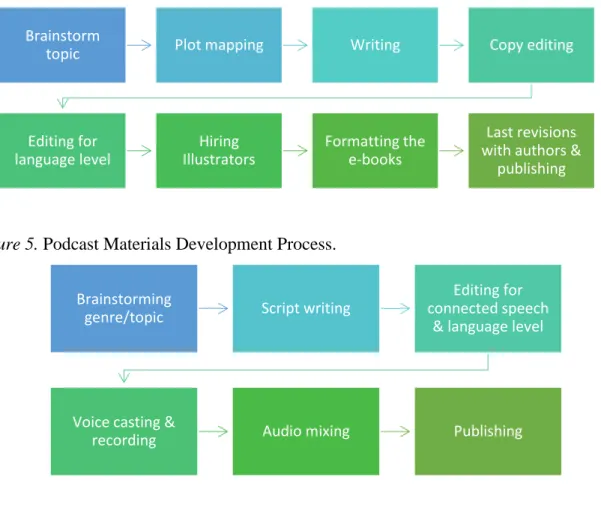
My materials development process followed two general outlines which can be seen in Figures 4 and 5. Although not unprecedented or extremely groundbreaking, these outlines can provide future materials developers a backbone for their own projects. Additionally, detailed explanation of the whole paper as described earlier in this paper can give extra insight to these outlines.
Lastly, Table 9 lists my pitfalls and solutions during the materials development process can be beneficial to future materials developers in avoiding my own mistakes or gaining insight on what can be done if pitfalls occur. Table 9 lists my observed pitfalls and their solutions.
Figure 4. Graded Reader Materials Development Process.
Figure 5. Podcast Materials Development Process.
Brainstorm
topic Plot mapping Writing Copy editing
Editing for language level Hiring Illustrators Formatting the e-books Last revisions with authors &
publishing
Brainstorming
genre/topic Script writing
Editing for connected speech
& language level
Voice casting &
Table 9
Pitfalls and solutions during ER and EL materials development
Pitfalls Solutions
Lack of experience creating graded readers or podcasts
Consulted previously written graded readers, literature on materials development, and peers/advisors
Tight budget Applied for funding, used connections, found passionate people who would work for free Language levelling of graded readers Ensured transparency on website so
readers/teachers could determine the appropriateness of the materials Time setbacks Planned extra time in case of delays
Little e-book or website design experience Used online tools that do not require coding or design experience (canva.com for e-book and squarespace.com for website)
CONCLUSION
Developing reading and listening materials is no easy task. It requires months of planning, redrafting, scrapping, and collaborating to produce something that may simultaneously intrigue and provide educational content to learners. The act of creating materials involves dipping into several academic and business fields, which is not done overnight. The knowledge that I have gained from this project, the trials and tribulations, has made me a wiser materials developer.
With any materials creation, there are always limitations in hind sight. The first limitation is that I did not know much about creating graded readers or educational podcasts before making the materials. It was only during the process of making the materials that I found useful
resources. Within this limitation, I did not consider speed in a quantifiable manner when recording the dialogues for the podcasts. Even though I did advise on speed if the speaking felt too fast, I only calculated words per minute after the recordings were finished, not during the script writing or rehearsal process. Regarding graded readers, I came in blind to adjusting
language in my own writing. Upon delving into the literature, I found that graded readers can be graded on many different levels, wherein I went on intuition for grammatical complexity and relied more on pre-existing readability and vocabulary measures. Another limitation is the small number of surveys I received as feedback. Perhaps this was due to the placement of the surveys on the website or general apathy of taking a survey which has to explicit benefit to the
participant. However, the feedback I received from readers and listeners showed that they enjoyed the content, but of course had suggestions for future improvements. I will take their considerations into account when creating future online extensive reading and listening materials.
On a last note, every educator makes materials for their students, yet the amount of information that displays the step-by-step creation and dissemination of materials that are
actually used is small. More research should be done on the creation of materials, not just guides of how to create materials. By sharing individual projects of materials development, we can learn from others’ mistakes and collect blueprints for future materials development projects.
Oftentimes teaching is a solitary position, but by sharing our own methods, we can learn more from one another than we could have learned on our own.
REFERENCES
Abdous, M., Camarena, M. M., & Facer, B. R. (2009). MALL technology: Use of academic podcasting in the foreign language classroom. ReCALL, 21(1), 76-95.
Al-Homoud, F., & Schmitt, N. (2009). Extensive reading in a challenging environment: A comparison of extensive and intensive reading approaches in Saudi Arabia. Language Teaching Research, 13(4),383-401.
Arnold, N. (2009). Online extensive reading for advanced foreign language learners: An evaluation study. Foreign Language Annals, 42(2),340-366.
Asraf, R. M., & Ahmad, I. I. (2003). Promoting English language development and the reading habit among students in rural schools through the Guided Extensive Reading program. Reading in a Foreign Language, 15(2),83-102.
Bamford, J. (1984). Extensive reading by means of graded readers. Reading in a Foreign Language, 2(2),218-260.
Beglar, D., & Hunt. A. (2014). Pleasure reading and reading rate gains. Reading in a Foreign Language, 26(1),29-48.
Beglar, D., Hunt, A., & Kite, Y. (2012). The effect of pleasure reading on Japanese university EFL learners’ reading rates. Language Learning, 62(3),665-703.
Bell, T. (2001). Extensive reading: speed and comprehension. The Reading Matrix, 1(1),1-13. Bidabadi, F. S., & Yamat, H. (2014). Strategies emploted by Iranian EFL freshman university
students in extensive listening: A qualitative research. International Journals of Qualitative Studies in Education, 27(1),23-41.
Blau, E. K. (1990). The effect of syntax, speed, and pauses on listening comprehension. TESOL Quarterly, 24(4), 746-753.
Brown, D. (2009). Why and how textbooks should encourage extensive reading. ELT Journal, 63(3), 238-245.
Brown, J. D. (2006). Authentic communication: Whyzit important’ ta teach reduced forms? Proceedings from JALT Pan-SIG ’06: Authentic Communication. Shizuoka, Japan: JALT. Brown, J. D. (2005). Using surveys in language programs. New York: Cambridge University. Brown, J. D., & Hilferty, A. (2006). The effectiveness of teaching reduced forms for listening
connected speech to second language speakers (pp. 247-264), Honolulu, HI: University of Hawaii.
Brown, J. D., & Brown, K. (2006). Testing reduced forms. In J. D. Brown & K. Kondo-Brown (Eds.), Perspectives on teaching connected speech to second language speakers (pp. 247-264), Honolulu, HI: University of Hawaii.
Camiciottoli, B. C. (2001). Extensive reading in English: Habits and attitudes of a group of Italian university EFL students. Journal of Research in Reading, 24(2),135-153.
Chang, A. C. S. (2010). Second-language listening anxiety before and after a 1-yr. intervention in extensive listening compared with standard foreign language instruction. Perceptual and Motor Skills, 110(2),355-365.
Claridge, G. (2012). Graded readers: How the publishers make the grade. Reading in a Foreign Language, 24(1),106-119.
Constantino, R. (1994). Pleasure reading helps, even if readers don’t believe it. Journal of Reading, 37(6), 504-505.
Constantino, R. (1995). Learning to read in a second language doesn’t have to hurt: The effect of pleasure reading. Journal of Adolescent & Adult Literacy, 39(1), 68-69.
Corbeil, M. E., & Corbeil, J. R. (2011). In B. R. Facer & M. Abdous (Eds.), Academic
podcasting and mobile assisted language learning: Applications and outcomes (pp. 54-69), Hershey, PA: Information Science Reference.
Crookes, G. V. (2013). Critical ELT in action: Foundations, promises, praxis. New York: Routledge.
Cross, J. (2014). Promoting autonomous listening to podcasts: A case study. Language Teaching Research, 18(1),8-32.
Day, R., & Bamford, J. (1998). Extensive reading in the second language classroom. Cambridge: Cambridge University.
Day, R., & Bamford, J. (2002). Top ten principles for teaching extensive reading. Reading in a Foreign Language, 14(2),136-141.
Day, R. (2003). Authenticity in the design and development of materials. In W A. Renandya (Ed.), Methodology and materials design in language teaching: Current perceptions and practices and their implications (pp. 1-11). Singapore: SEAMEO RELC.
Detective (Interviewer), & Wilson, D. (Interviewee). (2014). Witness 09 (Darren Wilson): 08/10 Interview [Interview transcript]. Retrieved from www.documentcloud.org:
https://www.documentcloud.org/documents/1370766-interview-po-darren-wilson.html. Ducate, L., & Lomicka, L. (2009). Podcasting: An effective tool for honing language students’
pronunciation? Language Learning & Technology, 13(3),66-86.
Eur, D. S. (2013). Extensive reading (ER) as a remedial program for problems in EFL reading: Benefits of ER, new insights, and justification for the use of ER in Korea. The SNU Journal of Education Research, 22, 55-89.
Farangi, M. R., Mejadghanbar, H., Askary, F., & Ghorbani, A. (2015). The effects of podcasting of EFL upper-intermediate learners’ speaking skills. CALL-EJ, 16(2),1-18.
Fernandez, C. (2011). Four L2 learning objectives to guide podcast design. In B. R. Facer & M. Abdous (Eds.), Academic podcasting and mobile assisted language learning: Applications and outcomes (pp. 21-36), Hershey, PA: Information Science Reference.
Godwin-Jones, R. (2005). Skype and podcasting: Disruptive technologies for language learning. Language Learning & Technology, 9(3),9-12.
Hagley, E. (2017). Extensive graded reading with engineering students: Effects and outcomes. Reading in a Foreign Language, 29(2),203-217.
Henning, D. (Interviewer), & Yanez, J. (2017). Transcript of Jeronimo Yanez’s BCA interview the day after the shooting [Interview Transcript]. Retrieved from Twin Cities Pioneer Press: https://www.twincities.com/2017/06/20/transcript-of-jeronimo-yanezs-bca-interview-the-day-after-the-shooting/.
Hitosugi, C. I., & Day, R. R. (2004). Extensive reading in Japanese. Reading in a Foreign Language, 16(1), 20-39.
Holster, T. A., Lake, J. W., & Pellowe, W. R. (2017). Measuring and predicting graded reader difficulty. Reading in a Foreign Language, 29(2),218-244.
Horst, M. (2005). Learning L2 vocabulary through extensive reading: A measurement study. The Canadian Modern Language Review, 61(3),355-382.
Huffman, J. (2014). Reading rate gains during a one-semester extensive reading course. Reading in a Foreign Language, 26(2),17-33.
Iwahori, Y. (2008). Developing reading fluency: A study of extensive reading in EFL. Reading in a Foreign Language, 20(1),70-91.
Janopoulos, M. (1986). The relationship of pleasure reading and second language writing proficiency. TESOL Quarterly, 20(4),763-768.
Jeon, E. Y., & Day, R. R. (2016). The effectiveness of ER on reading proficiency: A meta-analysis. Reading in a Foreign Language, 28(2),246-265.
Johnson, M. (2013) O’Rourke, B., Bermingham, N., & Brennan, S. (Eds.) Proceedings from the British Association for Applied Linguistics 46th: Opening New Lines of Communication in Applied Linguistics.
Kim, J. H. (2004) Intensive or extensive listening for L2 beginners. English Teaching, 59(3), 93-114.
Kirchhoff, C. (2013). L2 extensive reading and flow: Clarifying the relationship. Reading in a Foreign Language, 25(2),192-212.
Kitao, K., Yamamato, M., Kitao, S. K., & Shimatani, H. (1990). Independent reading in English – Use of graded readers in the library English as a second language center. Reading in a Foreign Language, 6(2), 383-389.
Krashen, S. D. (1982). Principles and practices in second language acquisition. Oxford: Pergamon.
Lacina, J. (2008). Technology in the classroom: Learning English with iPods. Childhood Education, 84(4),247-249.
Laufer, B. (2003). Vocabulary acquisition in a second language: Do learners really acquire most vocabulary by reading? Some empirical evidence. The Canadian Modern Language Review, 59(4),567-578.
Lee. S. S. (2013). Korean university students’ listening comprehension and learning effects of connected speech processes in English. Korean Journal of Applied Linguistics, 29(3), 133-169.
Leung, C. Y. (2002). Extensive reading and language learning: A diary study of a beginning learner of Japanese. Reading in a Foreign Language, 14(1),66-81.
Lin, C. C. (2014). Learning English reading in a mobile-assisted extensive reading program. Computers & Education, 78, 48-59.
Lord, G. (2008). Podcasting communities and second language pronunciation. Foreign Language Annals, 41(2),364-379.
Lomika, L., & Lord, G. (2011). Podcasting – past, present and future: Applications of academic podcasting in and out of the language classroom. In B. R. Facer & M. Abdous (Eds.), Academic podcasting and mobile assisted language learning: Applications and outcomes (pp. 1-20), Hershey, PA: Information Science Reference.
Mason, B. & Krashen, S. (1997). Extensive reading in English as a foreign language. System, 25(1),91-102.
Mayora, C. A. (2017). Extensive listening in a Colombian university: Process, product, and perceptions. HOW, 24(1),101-121.
McQuillan, J. (2016). What can readers read after graded readers? Reading in a Foreign Language, 28, 63-78.
Mermelstein, A. D. (2015). Improving EFL learners’ writing through enhanced extensive reading. Reading in a Foreign Language, 27(2),182-198.
Mikami, A. (2016). Students’ attitudes toward extensive reading in the Japanese EFL context. TESOL Journal, 8(2), 471-488.
Nakanishi, T., & Ueda, A. (2011). Extensive reading and the effect of shadowing. Reading in a Foreign Language, 23(1),1-16.
Nakanishi, T. (2015). A meta-analysis of extensive reading research. TESOL Quarterly, 49(1), 6-37.
Nation, P., & Ming-tzu, K. W. (1999). Graded readers and vocabulary. Reading in a Foreign Language, 12(2),355-380.
Nation, P. (2006). How large a vocabulary is needed for reading and listening? The Canadian Modern Language Review, 63(1),59-81.
Nation, P. (2014). How much input do you need to learn the most frequent 9,000 words? Reading in a Foreign Language, 26(2),1-16.
Nation, P. (2015). Principles guiding vocabulary through extensive reading. Reading in a Foreign Language, 27(1), 136-145.
Nurmukhamedov, U., & Sadler, R. (2011). In B. R. Facer & M. Abdous (Eds.), Academic podcasting and mobile assisted language learning: Applications and outcomes (pp. 176-195), Hershey, PA: Information Science Reference.
Pino-Silva, J. (2006). Extensive reading through the internet: Is it worth the while? The Reading Matrix, 6(1),85-96.
Poulshock, J. (2010). Extensive graded reading in the liberal arts and sciences. Reading in a Foreign Language, 22(2),304-322.
Raj, D., & Hunt, B. (1990). The Malaysian class reader programme. Reading in a Foreign Language, 6(2), 369-382.
Renandya, W. A., & Farrell, T. S. C. (2011). ‘Teacher, the tape is too fast!’ Extensive listening in ELT. ELT Journal, 65(1),52-59.
Renandya, W. A., & Jacobs, G. M. (2016). Extensive reading and listening in the L2 classroom. In W. A. Renandya, & Handoyo, P. (Eds.), English language teaching today (pp. 97-110). New York: Routledge.
Reynolds, B. L. (2014). A mixed-methods approach to investigating first- and second-language incidental vocabulary acquisition through the reading of fiction. Reading Research
Quarterly, 50(1),111-127.
Ro, E., & Chen, C. A. (2014). Pleasure reading behavior and attitude of non-academic ESL students: A replication study. Reading in a Foreign Language, 26(1),49-72.
Ro. E. (2013). A case study of extensive reading with an unmotivated L2 reader. Reading in a Foreign Language, 25(2),213-233.
Robb, T., & Kano, M. (2013). Effective extensive reading outside the classroom: A large-scale experiment. Reading in a Foreign Language, 25(2),234-247.
Robb, T., & Susser, B. (1989). Extensive reading vs. skills building in an EFL context. Reading in a Foreign Language, 5(2),239-259.
Rosell-Aguilar, F. (2007). Top of the pods – In search of a podcasting “podagogy” for language learning. Computer Assisted Language Learning, 20(5),471-492.
St. Louis Post-Dispatch. (2014). Transcripts of police and FBI interviews [Interview transcripts]. Retrieved from St. Louis Post-Dispatch:
http://www.stltoday.com/news/multimedia/special/transcripts-of-police-and-fbi-interviews/html_0c5bbc4c-c0b9-5aec-821d-937846293161.html.
Sakurai, N. (2015). The influence of translation on reading amount, proficiency, and speed in extensive reading. Reading in a Foreign Language, 27(1),96-112.
Simensen, A. M. (1987). Adapted readers: how are they adapted? Reading in a Foreign Language, 4(1),41-57.
Sun, Y. C. (2003). Extensive reading online: An overview and evaluation. Journal of Computer Assisted Learning, 19, 438-446.
Tabata-Sandom, M. (2017). L2 Japanese learners’ responses to translation, speed reading, and ‘pleasure reading’ as a form of extensive reading. Reading in a Foreign Language, 29(1), 113-132.
Taguchi, E., Takayashu-Maass, M., & Gorsuch, G. J. (2004). Developing reading fluency in EFL: How assisted repeated reading and extensive reading affect fluency development. Reading in a Foreign Language, 16(2), 70-96.
Takaesu, A. (2017). TED talks as an extensive listening resources for EAP students. In K.
Kimura & J. Middlecamp (Eds.), Asian-Focused ELT research and practice: Voices from the far edge (pp. 108-126). Phnom Penh: IDP Education.
Takase, A. (2007). Japanese high school students’ motivation for extensive L2 reading. Reading in a Foreign Language, 19(1),1-18.
Talkbank.org. (n.d.) CABank TalkBank. Retrieved from: https://talkbank.org/access/CABank/. Tanaka, H., & Stapleton, P. (2007). Increasing reading input in Japanese high school EFL
classrooms: An empirical study exploring the efficacy of extensive reading. The Reading Matrix, 7(1),115-131.
Thorne, S. L. (2005). Evolutionary trajectories, internet-mediated expression, and language education. CALICO, 22(3),371-397.
Tomlinson. B. (2000). Beginning to read forever: A position paper. Reading in a Foreign Language, 13(1), 523-538.
Walker, C. (1997). A self-access extensive reading project using graded readers (with particular reference to students of English for academic purposes). Reading in a Foreign Language, 11(1),121-149.
Waring, R., & Takaki, M. (2003). At what rate do learners learn and retain new vocabulary from reading a graded reader? Reading in a Foreign Language, 15(2), 130-163.
Warthen, A. (Interviewer) & Kinkel, K. P. (Interviewee). (1998). Transcript of Kip Kinkel’s confession [Interview transcript]. Retrieved from PBS:
https://www.pbs.org/wgbh/pages/frontline/shows/kinkel/etc/confesst.html.
Weinstein, N. (2007). Reduced forms, a powerful tool for listening comprehension. TexTESOL, 3, 3-5.
Wodinsky, M., & Nation, P. (1988). Learning from graded readers. Reading in a Foreign Language, 5(1),155-161.
Yamashita, J. (2004). Reading attitudes in L1 and L2, and their influence on L2 extensive reading. Reading in a Foreign Language, 16(1),1-19.
Yeh, C. C. (2017). An investigation of a podcast learning project for extensive listening. In K. Kimura & J. Middlecamp (Eds.), Asian-focused ELT research and practice: Voices from the far edge (pp. 87-107). Phnom Penh: IDP Education.