Monika K
vietková, Štefan B
arcík, Jan B
omba, Patrik Aláč
1IMPACT OF CHOSEN PARAMETERS ON
SURFACE UNDULATION DURING THE CUTTING
OF AGGLOMERATED MATERIALS WITH AN ABRASIVE
WATER JET
The paper deals with the cutting of agglomerated materials with an abrasive water jet from the point of view of surface finish undulation. It shows the impact on un -dulation of technical and technological parameters (feed rate and abrasive mass flow) and material parameters (material thickness and cutting direction). The paper also contains a methodology for the assessment of the effect of these parameters on surface finish undulation, and presents the results of experiments using this metho -dology on MDF, OSB boards and on technical beech plywood. MDF boards, out of all the materials monitored, have the most homogeneous structure throughout their whole cross section, which affected the insignificance of parameter Ra. For OSB boards, a lower surface quality with a higher feed rate was found, in contrast to plywood, where a higher feed rate improved the surface quality. A higher amount of abrasive flow caused lower surface quality. In the change of cutting direction from longitudinal to cross cutting, the arithmetic average deviation increased and surface quality declined.
Keywords: feed rate, abrasive flow, abrasive water-jet, cutting by abrasive water-jet
Introduction
Unconventional technologies use electrothermal, electrochemical, chemical and mechanical principles for the reduction of manufactured material. Among mecha -nical technologies, the most suitable is water jet machining. Water jet machining
Monika Kvietková, Czech University of Life Sciences, Prague, Czech Republic
e-mail: [email protected]
Štefan Barcík, Czech University of Life Sciences, Prague, Czech Republic
e-mail: [email protected]
Jan Bomba, Czech University of Life Sciences, Prague, Czech Republic
e-mail: [email protected]
Patrik Aláč, Technical University in Zvolen, Zvolen, Slovakia
seems to be the best unconventional, mechanical (erosive) method because of its outstanding features. This technology has wide appplication. The right title for this technology is “water jet machining” because it is used for various operations. The possibility of using AWJ is determined by various input factors and also by the quality requirements of the final product. AWJ can be used for the cutting of metal materials, but also for manufacturing in the wood processing industry. Therefore, the parameter characterizing the geometric and shape accuracy of the cutting surface is extremely important. This mainly concerns roughness, wave shapes, and shape surface deflection. These are the parameters which describe the topography of the cutting surface, created by the application of AWJ technology.
The paper aims to eliminate particular deficiencies within the practical use of AWJ in the wood industry. It presents the results of an experimental investigation of the influence of selected technological and material factors on the arithmetic mean deviation (Ra) as an indicator representing the surface finish undulation of manufactured agglomerated materials.
The quality of the surface finish is given by the surface roughness, which is formed after processing. Monitoring surface roughness is the most common way to assess the quality of the surface. Surface roughness is created by irregularities in the surface of a relatively small pitch – irregularities resulting from the machin-ing method used.
Water jet technology is one of the latest untraditional industrial methods used for manufacturing/cutting. Two practical methods of water jet manufacturing/cut-ting are used: pure Water Jet (WJ) and Abrasive Water Jet (AWJ). Both have unique properties for industrial application. Cutting power is reached by the trans -formation of hydrostatic energy (400 MPa) into steam with sufficient kinetic energy (almost 1000 m.s-1) [Kulekci 2002; Hashish 1993].
The principle of waterjet machining technology can easily be explained as the removal of material by mechanically-impacted fluid on the workpiece [Bernd 1993].
Clean water is used after chemical and mechanical processing without added mechanical particles. The properties of water at high pressure (water pressure of around 400 MPa) is used as a cutting tool [Maňková 2000].
When hard and tough materials are machined or when it is necessary to increase cutting efficiency, the water jet is replenished by abrasive grains. This kind of method is called Abrasive Water Jet machining [Krajný 1998].
The nature of the material breach caused by the water jet is based on the prin -ciple that the beam – the tool moving at a certain speed (max. 885 m∙s-1 at a pres-sure of 400 MPa) – can be seen as a solid body in terms of its effect. Disruption of the material is a result of the transformation of the input energy of a continuous flow of drops which create a beam directed into the material. The input energy causes tension in a very small area (e.g. a 0.3 mm diameter beam represents an area of 0.07 mm2), which leads to deformation of the original structure and the
removal of a certain volume of material. A water jet with abrasive grains is not dissimilar to a wedge tool with an undefined cutting edge (like grinding), and the basic mechanism of material removal is also similar to the abovementioned method. Cutting wedges are formed with abrasive grains randomly oriented in the beam [Barcík et al. 2011].
Water jet cutting technology is a unique, future-oriented option for the in -troduction of high automation in the heavy-duty cutting of materials [Fabian, Hloch 2005].
Flexibility and cold cutting are the typical features of AWJ and also the features of a tool for the cutting of new materials, e.g. composite materials, and sandwich materials, which are hard-to-machine materials in terms of traditional technology [Kalpakjian 1995; Öjmerts Amini 1994].
The surface quality should meet the quality of flat milling. This is the require -ment for the application of AWJ as the final operation in surface finishing. Milling can be divided, from the point of view of surface quality, into smooth milling, middle smooth milling and rough milling [Barcík et al. 2011].
Surface roughness is evaluated by the system in which the spatial character of inequalities formed on the surface during the process of implementation is reduced to the plane. At this level, the profile obtained is evaluated in accordance with the centerline profile [Dubovská 2000].
Material and methods
During the experiment, samples of agglomerated materials were used with the following dimensions:
– thickness of the test samples: 22 mm / 44 mm / 66 mm – MDF, 16 mm / 32 mm / 48 mm – OSB, 18 mm / 36 mm / 54 mm – plywood, – required width of the test samples: w = 180 mm (±2.5 mm),
– required length of the test samples: l = 500 mm (±5 mm), – moisture content of the test samples: w = 8% (±2%).
Medium Density Fibreboard is medium hardboard with an almost homogene -ous structure. Due to their good qualities, these boards often replace solid wood. Their density is ρ – 750 kg∙m-3.
Particle board oriented strand (OSB) is a developing large-scale ma -terial. It consists of long, thin wood chips of a length 60–150 mm, a width of 5–12 mm and thickness of 0.4 to 0.6 mm. The experiment used plates at a density of ρ – 590 kg∙m-3.
Plywood is a board created by gluing together three or more veneer sheets, with the fibers of adjacent layers usually arranged perpendicular to each other. Dimensional stability and balanced property values in both directions are achie -ved in this way, in contrast to solid wood (ρ – 730 kg∙m-3).
The cutting of the samples was done at DEMA Ltd., Zvolen. The equipment was assembled based on the components of the American firm FLOW Int. by the firm PTV Ltd., Prague. It consisted of a high-pressure pump PTV 37-60 Compact, and a work table with a water-jet head WJ 20 30 D-1Z supplied by the firm PTV.
Working cuts were performed on three samples for each thickness in order to eliminate the impact of specific characteristics of the samples.
The experiments were carried out using equipment with the following techni -cal parameters:
– cutting liquid pressure: 4000 bar = 400 MPa
– abrasive: Australian garnet GMA (grain size 80 MESH = 0.188 mm) – diameter of abrasive jet nozzle: 1 mm
– diameter of water-jet: 0.013 inch = 0.33 mm – distance of jet nozzle above the workpiece: 4 mm – abrasive mass flow: ma = 250 g∙min-1/m
a = 350 g∙min-1/ma = 450 g∙min-1 – feed rate: vf = 0.6 mm∙min-1/v
f = 0.4 m∙min-1/vf = 0.2 m∙min-1 Working steps
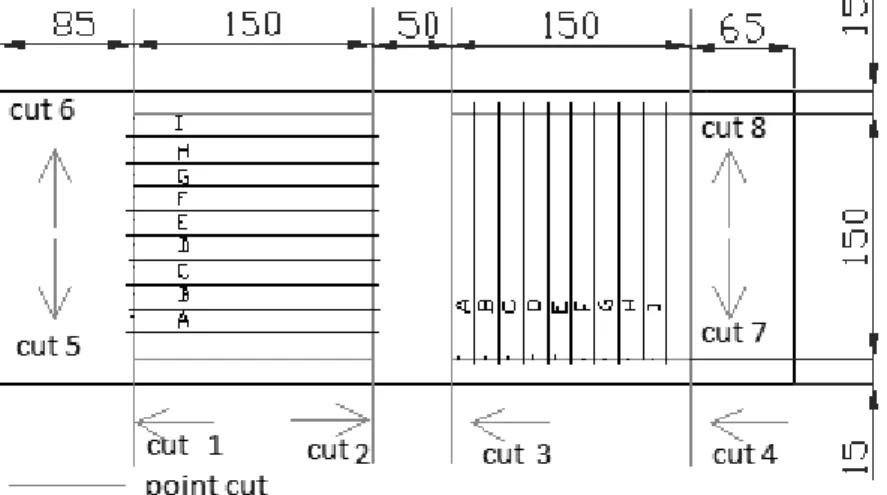
Each working sample was further divided into particular parts according to the following cutting plan (fig.1) [Kvietková 2011].
Fig. 1. Cutting plan of samples
Definition of measured indicator
During the experiments, the relevant parameter-surface abrasiveness Ra was mo -nitored – representing the arithmetic average deviation of abrasiveness profile.
Ra – arithmetic average deviation of abrasiveness profile: this means the arithme -tic average level of absolute profile deviations within the basic length, measured
on the abrasiveness profile (i.e. the profile derived from the primary profile by eliminating particles with long wave length).
Procedure of measuring
The sample was oriented in the laser profilometer in such a direction that it was possible to measure the roughness of the processed surface in a given track. The Laser profilometer LPM 120 has a working range of 200 micron – 30 mm (ISO 4287). The device consists of a personal computer (Lenovo N 1000) to facilitate communication with a laser profilometer (via IEEE 1394 FireWire) equipped with software for evaluation of the recorded profiles (LPM View V 2.0). Compact laser profilometry LPM provides an optical non-contact measurement of 2D profile objects along a defined cut. The measured surface is initially a screened laser line, which is then captured using a digital camera. For each scanned image it is possible to evaluate the current 2D surface profile of the body. The applied laser line creates a virtual cut surface pre-selected for the evaluation of the surfa -ce. This principle corresponds exactly with the methodology of determining the characteristics of the profile according to ISO 4287.
Conditions
– all tracks were parallel with the lateral edge of the sample, – the first track was 5 mm from the lateral edge of the sample, – each further track was moved by 5 mm,
– the last track was 5 mm from the opposite lateral edge of the sample, – tracks were lined up with the centre of the sample length.
The track of measurement represented places in the sample´s height where the measurement was carried out. The given system of measurement corresponded to the 3 cutting zones of AWJ. The first zone is the so-called zone of cutting erosion, the second zone is the zone of material erosion through deformation and the final zone is the zone of material which is not fully cut through.
Finally, the measured data were exported to the program STATISTICA 7, where they were evaluated.
Results and discussion
During the experiment the arithmetic average deviation Ra of the profile was mo -nitored and evaluated and, in addition, was statistically processed by the analysis of variance.
MDF boards
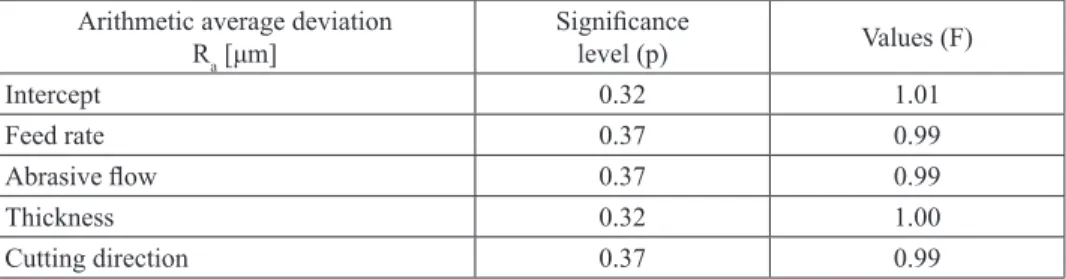
It can be seen from the analysis of variance for MDF, that all the monitored factors were statistically unimportant (table 1).
Table 1. Final results from variance analysis of arithmeticaverage deviation Ra for MDF boards
Arithmetic average deviation Ra [μm] Significance level (p) Values (F) Intercept 0.32 1.01 Feed rate 0.37 0.99 Abrasive flow 0.37 0.99 Thickness 0.32 1.00 Cutting direction 0.37 0.99
MDF boards, out of all the monitored materials, have the most homogeneous structure throughout their whole cross section, which affected the insignificance of parameter Ra.
OSB boards
The measured file of arithmetic average deviaton of Ra was processed by a multi -factorial analysis of variance (table 2).
Table 2. Final results from variance analysis of the arithmeticaverage deviation Ra for OSB boards
Arithmetic average deviation Ra [μm] Significance level (p) Values (F) Intercept 0.00 17687.6 Feed rate 0.02 0.71 Abrasive flow 0.00 14.52 Thickness 0.01 4.51 Cutting direction 0.00 108.77
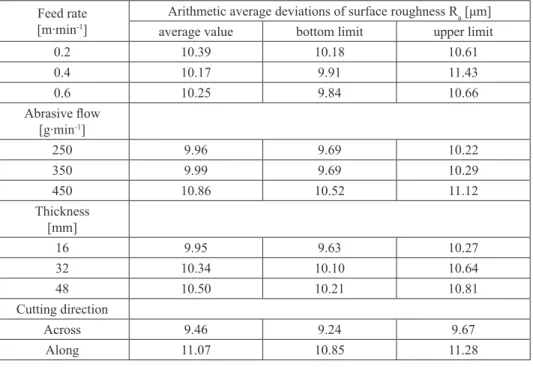
The feed rate had an important impact on the surface roughness. The arithme -tic average deviation Ra varied according to the feed rate (table 3):
– the arithmetic average deviation decreased by 0.22 μm* when the feed rate changed from 0.2 to 0.4 m∙min-1,
– the arithmetic average deviation increased by 0.08 μm* when the feed rate changed from 0.4 to 0.6 m∙min-1.
Table 3. Arithmetic average deviations Ra for OSB board
Feed rate [m∙min-1]
Arithmetic average deviations of surface roughness Ra [μm]
average value bottom limit upper limit
0.2 10.39 10.18 10.61 0.4 10.17 9.91 11.43 0.6 10.25 9.84 10.66 Abrasive flow [g∙min-1] 250 9.96 9.69 10.22 350 9.99 9.69 10.29 450 10.86 10.52 11.12 Thickness [mm] 16 9.95 9.63 10.27 32 10.34 10.10 10.64 48 10.50 10.21 10.81 Cutting direction Across 9.46 9.24 9.67 Along 11.07 10.85 11.28
With an increase in shift speed from 0.4 to 0.6 m∙min-1 there was also incre -ased roughness which negatively impacted surface quality. The given effect can be explained: with increased feed rate, the cutting tool had to dismantle more material which lowered surface quality. This was caused by the higher uprooting of fibres from the cutting material.
The arithmetic average deviation Ra changed according to the amount of abra -sive flow, as shown in (table 3):
– during the change of abrasive flow from 250 to 350 g∙min-1, the change of – deviation was only 0.03 μm*,
– during the change of abrasive flow from 350 to 450 g∙min-1, the deviation in creased by 0.87 μm*.
* given value corresponds to table 3.
With an increase in abrasive fl ow, there was also an increase in surface rough- increase in abrasive fl ow, there was also an increase in surface rough-e in abrasive fl ow, there was also an increase in surface rough- in abrasive fl ow, there was also an increase in surface rough-in abrasive fl ow, there was also an increase in surface rough- abrasive flow, there was also an increase in surface rough-, there was also an increase in surface rough- there was also an increase in surface rough-there was also an increase in surface rough- was also an increase in surface rough-was also an increase in surface rough- also an increase in surface rough-an increase in surface rough-surface rough -ness, and therefore the quality was lowered. This was caused by the bigger amount of material removed by the tool with a higher value of abrasive flow. There were more abrasive particles in the kerf which caused increased roughness and therefo-which caused increased roughness and therefo- caused increased roughness and therefo-caused increased roughness and therefo- increased roughness and therefo-increased roughness and therefo-roughness and therefo -re a further lowering of the quality of the material surface in accordance with the natural decomposition of AWJ. This was a similar effect to that in the feed rate.
The arithmetic average deviations Ra increased with increasing thickness (table 3): – during the change of thickness from 16 mm to 32 mm, the arithmetic average
– during the change of thickness from 32 mm to 48 mm, Ra again increased by about 0.16 μm*.
*given value corresponds to table 3.
The increasing thickness of OSB caused an increase in the arithmetic average deviation Ra and therefore a lower surface quality of the material. It could be seen that in thicker materials, there was a higher uprooting of the fibres from the cutting material, and consequently this led to a decrease in roughness.
The arithmetic average deviation Ra for the longitudinal cutting direction was 9.46 μm*, and for cross cutting this value was 11.07 μm* (table 3).
The effect of this dependence can be explained from the energy perspective – cross cutting of OSB boards is more energy consuming than longitudinal cutting. This effect is apparent in the reduction of cutting depreciation and in the extension of the zone of deformation depreciation, which leads to worse roughness in cross cutting.
Technical beech plywood
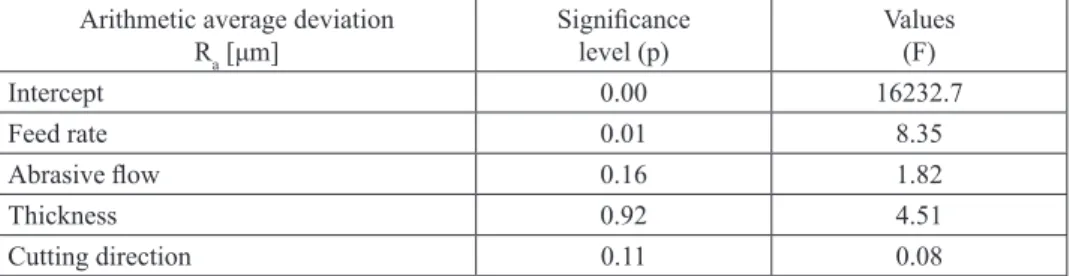
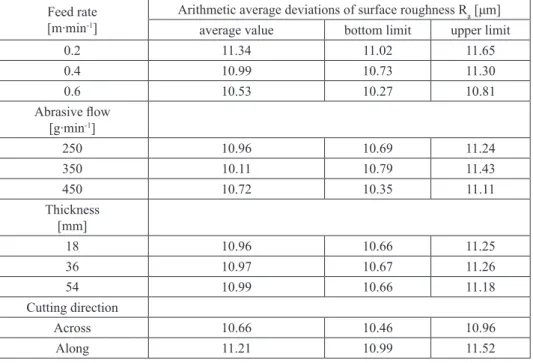
The results for all the experiments for plywood are presented in tables 4 and 5. Table 4. Summary results of variance analysis for arithmetic average deviation Ra for plywood
Arithmetic average deviation Ra [μm] Significance level (p) Values(F) Intercept 0.00 16232.7 Feed rate 0.01 8.35 Abrasive flow 0.16 1.82 Thickness 0.92 4.51 Cutting direction 0.11 0.08
The multifactorial analysis of variance confirmed that the abrasive flow was a statistically unimportant parameter.
The arithmetic average deviation Ra changed according to the feed rate (table 5):
– the arithmetic average deviation decreased by 0.35 μm* when the feed rate changed from 0.2 to 0.4 m∙min-1,
– the arithmetic average deviation decreased by 0.46 μm* when the feed rate changed from 0.4 to 0.6 m∙min-1.
Table 5. Arithmetic average deviations Ra for plywood
Feed rate [m∙min-1]
Arithmetic average deviations of surface roughness Ra [μm]
average value bottom limit upper limit
0.2 11.34 11.02 11.65 0.4 10.99 10.73 11.30 0.6 10.53 10.27 10.81 Abrasive flow [g∙min-1] 250 10.96 10.69 11.24 350 10.11 10.79 11.43 450 10.72 10.35 11.11 Thickness [mm] 18 10.96 10.66 11.25 36 10.97 10.67 11.26 54 10.99 10.66 11.18 Cutting direction Across 10.66 10.46 10.96 Along 11.21 10.99 11.52
It was confirmed that with increasing feed rate, the arithmetic average devia -tion of roughness Ra decreased. The quality of the material surface also increased. During the cutting of technical beech plywood, there were easily-removed wood elements causing smaller surface destruction and therefore less roughness of the surface.
With a change in cutting direction from longitudinal to cross cutting, the value of the arithmetic average deviation increased by approx. 0.45 μm*. As presented in table 5, the arithmetic average deviation Ra for the longitudinal cutting direction was 10.66 μm* and for the cross-cutting direction this value was 11.21 μm*.
* given value corresponds to table 5.
When the cutting direction was changed from longitudinal to cross-cutting, the arithmetic average deviation grew and this caused a lower quality of material surface. This was a similar result to that of OSB boards.
The arithmetic average deviation Ra for plywood changed according to mate -rial thickness (table 5):
– during the change of thickness from 18 mm to 36 mm, the arithmetic average deviation increased by 0.01 μm*,
– during the change of thickness from 36mm to 54 mm, the arithmetic average deviation increased by approx. 0.02 μm*.
Material thickness was a statistically unimportant factor which only minimally impacted the arithmetic average deviation.
The arithmetic average deviation Ra changed according to the change in abra -sive flow, as follows (table 5):
– during the change in abrasive flow from 250 to 350 g∙min-1, the deviation Ra decreased by 0.85 μm*,
– during the change in abrasive flow from 350 to 450 g∙min-1, the deviation Ra increased by 0.61 μm*. This parameter is statistically unimportant.
* given value corresponds to table 5.
The value of the arithmetic average deviation was statistically unimportant for this material. Plywood is very similar in structure and characteristics to native raw wood because the surface is created by a cutting tool cutting planes and the amount of abrasive flow does not change their size but only their number.
Economic aspects of measured parameters
First of all, it is necessary to decide whether to use water jet cutting (WJC) or conventional cutting methods. Water jet cutting is an economical way to cut 2D shapes into a very wide range of materials with no tooling costs. The unique process of water jet cutting provides reasonably good edge quality, no burrs and usually eliminates the need for secondary finishing processes. The process also generates no heat so the material edge is unaffected and there is no distortion. Wa -ter jet cutting can cut single or multi-layer ma-terials [Pavelková, Knápková 2005].
It is essential to take into account the economic viewpoint for the whole pro -cess of WJC. It should be compared to other cutting techniques from the point of view of costs and benefits. The costs of WJC assembly and the whole mate -rial flow must be monitored and quantified; including fixed costs, variable costs (e.g. energy consumption) and also alternative costs related to other (conventional) methods of cutting [Chromjaková, Tuček 2007].
Other very important parameters which should be considered are the costs of potential repairs or of the bad-quality performance of water jet cutting.
Another vital economic aspect to consider is the total time of production (the cutting itself, as well as the necessary operations that precede and follow it) which affects the total capacity utilization and also productivity of assembly within the material flow. A shorter processing time leads to a more satisfied customer. Of course, production must correlate with demand and it must also meet quality demands.
Last but not least, the amount of waste from water jet cutting must also be considered compared to conventional methods of cutting [Rašner 2001].
All the measured and monitored parameters which impact the arithmetic ave -rage deviation Ra – abrasive flow, material thickness, feed rate and cutting direc -tion – also impact the economic aspect of AWJ cutting performance. Therefore,
it can be said that these four parameters are some of the most important parame -ters affecting the costs of material processing by the AWJ method of cutting, and especially from the point of view of material and energy consumption, as well as machinery amortization.
Conclusions
The quality of a surface is given by its undulation, which is created during mate -rial processing and manufacturing. The quality of a surface corresponds to a scale from middle smooth milling to rough milling. The monitoring of surface rough -ness is the most common method for surface quality assessment.
As can be seen from the abovementioned results, the fundamental indicator for roughness assessment is the arithmetic average deviation of roughness profile Ra. MDF boards have the most homogeneous structure throughout their whole cross section and therefore these boards were evaluated as statistically unimpor -tant material.
The impact of the feed rate on OSB boards and plywood was a statistically im -portant parameter. For OSB boards, lower surface quality with a higher feed rate was noted, whereas for plywood, a higher feed rate improved the surface quality. From these results it can be said that the Ra for OSB is higher and for plywood this indicator is lower.
The impact of abrasive flow only seemed to be a statistically important pa -rameter for plywood. The bigger the abrasive flow, the higher the values of the arithmetic average deviation Ra. A bigger amount of abrasive flow caused lower surface quality (this did not apply to MDF boards and plywood because this factor was statistically unimportant for them).
The impact of cutting direction was a statistically important parameter for OSB boards and plywood. Higher values of Ra were measured in cross-cutting than in longitudinal cutting. With a change in cutting direction from longitudinal to cross-cutting, the arithmetic average deviation increased and surface quality declined.
The impact of material thickness was a statistically important parameter only for OSB boards. The experiments showed that a greater thickness corresponded to a lower surface quality and this implied a higher value of Ra.
References
Barcík Š., Kvietková M., Aláč P. [2011]: Effect of chosen parameters on deflection angle between cutting sides during the cutting of aglomerated materials by water jet. Wood Research 56 [4]: 577–588
Barcík Š., Kvietková M., Kminiak R., Aláč P. [2011]: Optimization of cutting process of medium density fibreboards by abrasive water jet. In: Drvna Industrija 62 [4]: 263–268
Bernd K. et al. [1993]: Schneiden mit Laserstrahlung und Wasserstrahl. Ehningen bei Böblinger: expert verlag. 3–93
Dubovská R. [2000]: Niektoré poznatky o kvantifikácii drsnosti pri obrábaní dreva (Some knowledge on quantifying roughness in woodcutting). In: Procesy trieskového a beztrie
-skového obrábania dreva. 43–47
Fabian S., Hloch S. [2005]: Influence of abrasive water jet process factors on stainless steel AISI 304 Macro geometrical cutting duality. Scientific bulletin, Volume XIX, North University of Baia Mare, Romania: 261–266
HashishM. [1993]: Prediction models for AWJ machining operation. In: Proceedings of the Seventh American Waterjet Conference, USA: 205–209
Chromjaková F. [2008]:Flexibilné riadenie nákladov vo výrobe (Flexible cost management in production). Plzeň: BPM Portál
Krajný Z. [1998]: Vodný lúč v praxi (Water jet and its application in practice). Bratislava:
EPOS: 10–250
Kulekci M.K. [2002]: Processes and apparatus developments in industrial water jet applica-tions, int. j. mach. tool manuf. 42, pp. 1297–1306
Kvietková M. [2010]: Analýza faktorov vplývajúcich na kvalitu opracovania drevných materi
-álov pri rezaní vodným lúčom (Analysis of factors which impact the quality of manufactu
-ring wood materials by abrasive water jet cutting). Písomná práca k dizertačnej skúške. 59 Maňková I. [2000]: Progresívne technológie (Progressive Technologies). Košice: VIENA
--LA. 63–90
Öjmerts C., AminiN. [1994]: Discrete approach to the abrasive waterjet milling process, In: Proceedings of the 12th International Conference on Jet Cutting Technology, Rounen France, 425–434
Pavelková D., Knápková A. [2005]: Výkonnost podniku z pohledu finančního manažéra (Business performance from the perspective of a financial manager). Praha: Linde, 302 Rašner J. et al. [2001]: Economy and management of logistics and distribution systems
of wood industrial enterprises. 1/2001/B. 140
Tuček D., Zámečník R. [2007]: Řízení a hodnocení výkonnosti podnikových procesů v praxi (Management and performance evaluation of business processes in practice). Zlín: Technická univerzita vo Zvolene, 206
WPŁYW WYBRANYCH PARAMETRÓW NA POFAŁDOWANIE
POWIERZCHNI W TRAKCIE CIĘCIA MATERIAŁÓW
AGLOMEROWANYCH Z WYKORZYSTANIEM TECHNOLOGII
AWJ (ABRASIVE WATER JET)
Artykuł omawia cięcie materiałów aglomerowanych z wykorzystaniem technologii AWJ (abrasive water jet) z puktu widzenia pofałdowania wykończenia powierzchni. W opraco
-waniu przedstawiono wpływ parametrów technicznych i technologicznych (prędkość po
-suwu i przepływ masy ściernej) oraz parametrów materiału (grubość materiału i kierunek cięcia) na pofałdowanie. Omówiono także metodologię oceny wplywu tych parametrów
na pofałdowanie wykończenia powierzchni oraz przedstawiono wyniki eksperymentów z zastosowaniem tej metodologii do płyt MDF i OSB oraz do technicznej sklejki bukowej. Ze wszystkich skontrolowanych materiałów, płyty MDF mają najbardziej homogeniczną strukturę na całej powierzchni przekroju poprzecznego, co miało wpływ na brak istotnoś
-ci parametru Ra. W przypadku płyt OSB, w odróżnieniu of sklejki, występowała gorsza jakość powierzchni oraz większa prędkość posuwu, która przyczyniała się do poprawy jakości powierzchni. Większy przepływ ścierny skutkował gorszą jakością powierzchni. Zmiana kierunku cięcia ze wzdłużnego na poprzeczny spowodowała wzrost średniego odchylenia arytmetycznego oraz pogorszenie jakości powierzchni.
Słowa kluczowe: prędkość posuwu, przepływ ścierny, technologia AWJ (abrasive water jet), cięcie z wykorzystaniem technologii AWJ
Acknowledgements
This article is the result of research financed by CIGA (CULS Grant Agency), Project No.