This article was downloaded by:[Universita Studi di Verona] On: 19 September 2007
Access Details: [subscription number 777257298] Publisher: Routledge
Informa Ltd Registered in England and Wales Registered Number: 1072954 Registered office: Mortimer House, 37-41 Mortimer Street, London W1T 3JH, UK
Journal of Sports Sciences
Publication details, including instructions for authors and subscription information: http://www.informaworld.com/smpp/title~content=t713721847
Energy balance of locomotion with pedal-driven
watercraft
Paola Zamparoab; Giuseppe Carignanic; Luca Plainoa; Barbara Sgalmuzzoa; Carlo Capellib
aCorso di Laurea in Scienze Motorie, Università di Udine, Gemona del Friuli, bFacoltà di Scienze Motorie, Università di Verona, Verona
cDipartimento di Ingegneria Gestionale Elettrica e Meccanica, Università di Udine, Udine, Italy
Online Publication Date: 01 January 2007
To cite this Article: Zamparo, Paola, Carignani, Giuseppe, Plaino, Luca, Sgalmuzzo, Barbara and Capelli, Carlo (2007) 'Energy balance of locomotion with pedal-driven watercraft', Journal of Sports Sciences, 1 - 7
To link to this article: DOI: 10.1080/02640410701305420 URL:http://dx.doi.org/10.1080/02640410701305420
PLEASE SCROLL DOWN FOR ARTICLE
Full terms and conditions of use:http://www.informaworld.com/terms-and-conditions-of-access.pdf
This article maybe used for research, teaching and private study purposes. Any substantial or systematic reproduction, re-distribution, re-selling, loan or sub-licensing, systematic supply or distribution in any form to anyone is expressly forbidden.
The publisher does not give any warranty express or implied or make any representation that the contents will be complete or accurate or up to date. The accuracy of any instructions, formulae and drug doses should be independently verified with primary sources. The publisher shall not be liable for any loss, actions, claims, proceedings, demand or costs or damages whatsoever or howsoever caused arising directly or indirectly in connection with or arising out of the use of this material.
Downloaded By: [Universita Studi di Verona] At: 10:10 19 September 2007
Energy balance of locomotion with pedal-driven watercraft
PAOLA ZAMPARO
1,2, GIUSEPPE CARIGNANI
3, LUCA PLAINO
1,
BARBARA SGALMUZZO
1, & CARLO CAPELLI
21
Corso di Laurea in Scienze Motorie, Universita` di Udine, Gemona del Friuli,2Facolta` di Scienze Motorie, Universita` di Verona, Verona, and3Dipartimento di Ingegneria Gestionale Elettrica e Meccanica, Universita` di Udine, Udine, Italy (Accepted 27 February 2007)
Abstract
In this study, we examined the mechanics and energetics of locomotion with a paddle-wheel boat and a water bike. Power output (W_tot) was measured directly on the water bike by means of an instrumented chain-ring. The simultaneous
assessment of oxygen uptake (V_O2) allowed the computation of the ‘‘overall’’ efficiency of locomotion (Zo¼W_tot/V_O2).
MeanZowas 0.27 (s¼0.02), which was unaffected by the speed, and was assumed to be the same for the two boats as both are semi-recumbent bicycles. For the paddle-wheel boat,W_ totwas then obtained fromZoand measures ofV_O2. The power
to overcome (passive) drag was calculated asW_d¼Dv(whereDis the force measured by means of a load cell when towing
the boats at given speeds). Propelling efficiency was calculated asZp¼W_d/W_tot, which was lower with the paddle-wheel
boat (mean 0.35,s¼0.01) than with the water bike (mean 0.57,s¼0.01). The observed differences inZpandW_ dexplain
why at the highest speed tested (*3 ms71), the energy required to cover a unit distance with the water bike is similar to that required to move the paddle-wheel boat at 1.3 ms71.
Keywords:Hydrodynamic resistance, propelling efficiency, energy cost of locomotion, human-powered boats
Introduction
To compute a complete energy balance of aquatic locomotion, two parameters must be known: the energy expended to cover one unit distance and the efficiency with which this energy is trans-formed into mechanical work (Pendergast et al., 2003). The energy cost per unit distance (C) is defined as:
C¼E_ v1 ð1Þ whereE_ is the net metabolic power expenditure and
v is the speed of progression. The mechanical (overall) efficiency (Zo) is defined as:
Zo¼WtotC1 ð2Þ
where Wtot is the total mechanical work per unit distance. In aquatic locomotion, Wtot can be calculated on the basis of measures of Wd (the work to overcome hydrodynamic resistance) and of propelling efficiency (Zp) – that is, the efficiency with which the total mechanical work produced by the
muscles is transformed into useful work (e.g. Alexander, 1983):
Zp¼Wd=Wtot ð3Þ
Data forZpand ofWtotfor aquatic locomotion are scanty because of the difficulties in measuring the forces applied to the water (e.g. Pendergast et al., 2003). Pedal-driven watercraft constitute an inter-esting tool to investigate the energetics of aquatic locomotion, since they allow (if properly instrumen-ted) the measurement ofWtot(and hence calculation ofZp) directly and accurately.
The aim of this study was to compute an energy balance of aquatic locomotion for pedal-driven watercraft by examining the bioenergetics and bio-mechanics of two human-powered crafts that are widely different in terms of hydrodynamic resistance and propelling efficiency: a paddle-wheel boat and a propeller-driven catamaran. The data were then compared with those reported in the literature on other means of ‘‘aided’’ locomotion in water (e.g. gondola, rowing shell, slalom kayak, and Olympic kayak).
Correspondence: P. Zamparo, Facolta` di Scienze Motorie, Universita` di Verona, Via Casorati 43, 37131 Verona, Italy. E-mail: [email protected] ISSN 0264-0414 print/ISSN 1466-447X onlineÓ2007 Taylor & Francis
Downloaded By: [Universita Studi di Verona] At: 10:10 19 September 2007
Materials and methods
The experiments were performed with five male and two female participants whose principal anthropo-metric characteristics are reported in Table I. The participants were informed of the aims and methods of the study before providing their written informed consent. The experiments were carried out with the approval of the faculty ethics committee.
The watercraft
Schematic representations of the watercraft investi-gated in this study are shown in Figure 1. The watercraft studied are completely different in their intended use and therefore in their design goals. In both craft, propulsion was generated by pedalling in a semi-recumbent position. Both craft are also double-hulled catamarans.
The paddle-wheel boat.The paddle-wheel boat used in this study is a typical example of the recreational boats rented on beaches throughout the world. Speed and efficiency are not a priority for this boat, whereas low cost and heavy-duty capabilities are; the rugged design and heavy construction of the boat are thus understandable. This two-seater craft is made of glass-fibre reinforced plastic, with a central paddle wheel directly connected to two pair of cranks. It is 4 m long by 1.6 m wide and has a mass of 95 kg (see Figure 1a). During the experiments, an operator (always the same individual with a body mass of 52 kg) sat on the boat, on the opposite side to the participant, to balance the hull and maintain the paddles horizontal.
The water bike. The water bike used in this study (http://www.geocities.com/waterbike_it) is a top-class lightweight carbon-kevlar catamaran, ‘‘one of the fastest HP boats in Europe’’ according to Free (2001). Designed by one of the authors (G.C.), the boat was built at Lamar (Udine, Italy) while the propeller and the drive unit were provided by Free
Enterprises (Indiana, USA). The water bike is 5.05 m long (waterline length of 4.8 m) and 1.55 m wide with a mass of 45 kg (see Figure 1b). Thrust is provided by a high-efficiency propeller (diameter 450 mm, pitch 500 mm) connected via a twisted chain unit to a regular bicycle crank. This prototype won the International Human Powered Vehicle Association (IHPVA) World Championship in 1999 (long-distance race, single) covering 15 km in 96 minutes (at an average speed of 2.61 ms71).
Experimental protocol
The participants were asked to follow a linear course traced on the lake of Cavazzo (Udine, Italy) with both watercraft at a constant speed and to increase the speed on each subsequent lap until fatigued. The experiments were performed in conditions of no wind.
The increments in speed were obtained by asking the participants to pedal at different cadences (with steps of 10 revmin71, starting at 40 and 60 revmin71 for the paddle-wheel boat and the water-bike, respectively) following the indications of the power control of the SRM system (see below) in the case of the water bike, and of a metronome set by the operator in the case of the paddle-wheel boat. The speeds examined were 1.5 – 2.9 ms71 for the water bike and 1.0 – 1.6 ms71for the paddle-wheel boat. Track distance, direction, and speed were recorded by means of a GPS (Garmin, USA) interfaced to the metabolimeter. The course was about 800 m long and was covered in a time that allowed steady-state metabolic measurements. Only the values obtained when the respiratory exchange ratio (RER) was below 1.0 were used (aerobic conditions). Before the experiments, the participants were requested to sit quietly on the watercraft for 5 – 6 min to allow measurement of metabolic para-meters at rest.
During the experiments, heart rate (HR), oxygen consumption (V_O2), carbon dioxide production (V_CO2), minute ventilation (V_E), and respiratory
Table I. Anthropometric characteristics of the participants.
Sex Age (years) Body mass (kg) Stature (m) BMI (kgm72) BSA (m2)
S1 M 31 54 1.71 18.47 1.60 S2 M 32 59 1.69 20.66 1.65 S3 F 29 52 1.63 19.57 1.52 S4 M 28 65 1.81 19.84 1.80 S5 F 39 58 1.68 20.55 1.63 S6 M 24 69 1.84 20.38 1.87 S7 M 34 67 1.80 20.68 1.82 mean+s 31.0+4.8 60.6+6.6 1.74+0.08 20.02+0.81 1.70+0.13
Note: BMI¼body mass index; BSA¼body surface area (calculated according to Shuter & Aslani, 2000). 2 P. Zamparo et al.
Downloaded By: [Universita Studi di Verona] At: 10:10 19 September 2007
exchange ratio (RER) were assessed using a portable metabolimeter (K4b2, Cosmed, Italy), placed in a waterproof knapsack on the participant’s shoulders, the sensors and flow transducer of which were calibrated before each experiment.
The water bike was instrumented with a chain-ring (Powermeter, SRM, Germany), calibrated before each experiment, allowing the measurement of pedalling frequency (revmin71) and of external mechanical power (W_ tot). All data were collected at a sampling rate of 1 Hz.
Hydrodynamic resistance
In a separate set of experiments, the hydrodynamic resistance (passive drag) of the two vessels was assessed as follows. Two motor boats were con-nected to each other through a 10-m wooden beam, in the middle of which a load cell was positioned (UU, Leane, Italy). The load cell was connected to a short rope with which the vessels were dragged at different and constant speeds over the same range utilized during the metabolic measurements. The
load cell was calibrated before the experiments with known loads and was powered by a custom amplifier and the DC output was fed to a digital multimeter. With this experimental set-up it was possible to avoid the wave interferences generated by the motor boats. This set of experiments was performed with a participant sitting on the boat (body mass of 67 kg); in the case of the paddle-wheel boat, he was accompanied by the operator (body mass of 52 kg) as for the metabolic measurements (see above).
Calculations
For each participant, at each speed and for both watercraft, the energy cost of locomotion, C
(kJm71) was calculated as: C¼V_O2net/v, where _
VO2net is the net oxygen uptake (above that measured at rest) expressed in kilowatts by assuming an energy equivalent of 20.9 kJ per litre of oxygen consumed (di Prampero, 1986).
From the values ofW_ totandV_O2net collected for each participant at each speed with the water bike, Figure 1. Schematic representations of the two watercraft used in this study: (a) a paddle-wheel boat (adapted from Abbottet al., 1995) and (b) a propeller-driven catamaran (the water bike).
Downloaded By: [Universita Studi di Verona] At: 10:10 19 September 2007
the overall efficiency of ‘‘cycling’’ was calculated as: ZoWB¼W_ totWB/V_O2netWB.
For each participant, overall efficiency for the paddle-wheel boat was assumed to be the same as for the water bike (ZoWB¼ZoPW), since both are semi-recumbent cycling boats. Therefore, for the paddle-wheel boat, W_ totPW was obtained from the product of V_O2netPW and ZoWB, where V_O2netPW is the equivalent net oxygen uptake as measured on the paddle-wheel boat andZoWBis the overall efficiency of the water bike.
The power (W_ d) to overcome hydrodynamic resistance (passive drag) was calculated asW_ d¼Dv (whereDis the force in Newtons, measured with the load cell, and vis the speed in ms71). Propelling efficiency was then calculated as Zp¼W_ d/W_ tot.
Drag efficiency is defined as the efficiency with which the metabolic input is transformed into useful power (the power to overcome water resistance) and was calculated as Zd¼W_ d/V_O2net. Drag efficiency, Zd, can also be calculated from the product ofZpand Zo(e.g. Daniel, 1991).
Statistics
The data are presented as mean values and standard deviations (s). Regressions were calculated by means of the least squares method using a software package (Cricket Graph III, USA). Differences in propelling efficiency between the two watercraft was investi-gated by means of a Student’s t-test for unpaired data.
Results
The energy cost per unit distance, C(kJm71), as a function of speed, v(ms71), is shown in Figure 2 for both watercraft. At any given speed, C is higher with the paddle-wheel boat than the water bike and the difference between the two increases with speed. The metabolic power required to propel a paddle-wheel boat at 1 ms71equals that required to move a water bike at a speed of 2 ms71. At the highest speed tested (*3 ms71), the energy cost of the water-bike is similar to that required to propel a paddle-wheel boat at 1.3 ms71.
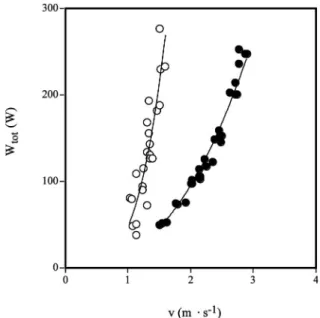
The total mechanical power output,W_ tot(W), as a function of speed, v(ms71), is shown in Figure 3 for both watercraft. In this case also, W_ tot increases steeply with speed and is higher with the paddle-wheel boat than water bike. For example, a power output of 125 W is attained at 1.3 ms71 for the paddle-wheel boat and at 2.25 ms71 for the water bike.
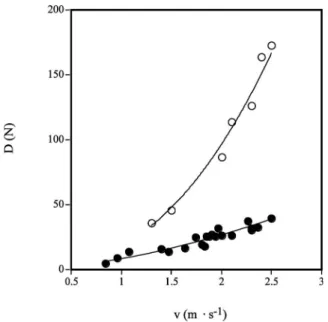
Hydrodynamic resistance, D(N), as a function of speed, v (ms71), is shown in Figure 4 for both watercraft. At 1 ms71the power to overcome water
resistance (W_ d¼Dv) is of about 20 W with the paddle-wheel boat; with the water bike, the same power is needed to overcome (passive) drag at a speed of 1.5 ms71.
Mean overall efficiency (Zo) when cycling with the water bike was independent of speed (0.27,s¼0.02) for all participants and at all speeds. Propelling efficiency (Zp¼W_ d/W_ tot) was also found to be Figure 2. Net energy cost per unit distance, C (kJm71), as a function of speed,v(ms71), for the paddle-wheel boat (PW,
) and the water bike (WB,.). The data are well interpolated by power functions of the form:CWB¼0.063v1.57
,n¼26,r2¼0.96;
CPW¼0.179v2.66,n¼23,r2¼0.80.
Figure 3. Total mechanical power output,W_tot(W), as a function
of speed,v(ms71), for the paddle-wheel boat (PW,
) and the water bike (WB, .). The data are well interpolated by power functions of the form: W_totWB¼16.3v2.5, n¼26, r2¼0.98;_
WtotPW¼47.5v3.7,n¼23,r2¼0.74.
Downloaded By: [Universita Studi di Verona] At: 10:10 19 September 2007
unaffected by the speed and to be significantly lower (P50.001) with the paddle-wheel boat (mean 0.35,
s¼0.01) than with the water bike (mean 0.57,
s¼0.01).
Discussion
The aim of this study was to compute an energy balance of locomotion in water with pedal-driven watercraft; this was obtained by analysing the bioenergetics and biomechanics of two boats differing widely in hydrodynamic resistance and propelling efficiency but similar in the pattern of movement (cycling) and the position of the body (semi-recumbent).
The reason for measuring these parameters in high-performance pedal boats stems from the fact that such watercraft outperform faster Olympic oars boats (the rowing shells) over short distances. The performance of pedal boats (such as the water bike in this study) over long distances, however, is not known. These watercraft are designed for efficiency at powers sustainable for several hours rather than sheer speed. Little development and research effort has been devoted to them, notwithstanding the interest in these watercraft for sports, tourism and leisure activities.
Computing an energy balance for a pedal boat is relatively ‘‘easy’’ when, as in our case, the craft can be instrumented with an SRM system. However, knowledge of an individual’s overall efficiency of cycling allows estimation of W_ tot (and hence derivation of all the parameters of interest) for any
boat that utilizes cycling as a mode of locomotion. The calculations proposed in this study can therefore be applied to compute an energy balance for any type of pedal-driven watercraft (e.g. a paddle-wheel boat, as in this paper). Even if the comparison, in terms of performance, between the water bike and the paddle-wheel boat is uneven, the observed differences allow us some insight into the determinants of aquatic locomotion, especially when considered together with other kinds of ‘‘aquatic locomotory tools’’ (propulsion by oars).
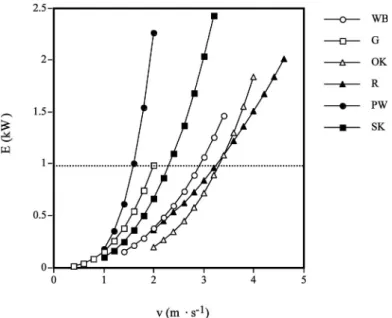
Figure 5 reports data forE_ as a function of vfor different types of boats: paddle-wheel boat, water-bike, Olympic kayak (data from Zamparo, Capelli, & Guerrini, 1999), rowing shell (data from di Prampero, Cortili, Celentano, & Cerretelli, 1971), venetian gondola (data from Capelli et al., 1990), slalom kayak (data from Pendergast, Bushnell, Wilson, & Cerretelli, 1989). At the same metabolic power (e.g. at 1 kW, dotted line), the decrease in the energy cost from the paddle-wheel boat to the Olympic kayak is matched by a proportional increase in the cruising speed. At speeds less than 2.5 ms71, moving in water with a pedal-driven propeller catamaran (the water-bike) is as economical as moving with a rowing shell, whereas pedalling with a paddle-driven boat is more energy demanding than sculling a 245-kg gondola at speeds greater than 1 ms71.
The differences in C among different boats/sculls can be attributed to differences in propelling efficiency, overall efficiency or hydrodynamic resis-tance, as it can be seen by combining and rearran-ging equations (2) and (3):
C ¼ ðW_d=ZpÞ Zo1 ð4Þ
For boat locomotion, to our knowledge, data on _
Wd and Zp (as well as W_ tot, Zd, and Zo) have previously only been reported for the slalom kayak and the rowing shell (see Pendergast et al., 2003). The values reported for these two boats are given in Table II, together with the corresponding values reported in this study for the water bike and the paddle-wheel boat. All data refer to a metabolic power input (E_) of 0.5 kW.
Overall efficiency (Zo). As indicated in Table II, the decrease in C, for a given metabolic power, is not attributable to differences in overall efficiency, which is similar (Zo¼0.24 – 0.27) with different hulls and boats. Indeed, the total mechanical power output (at an E_ of 0.5 kW to which these data refer) is essentially the same (122 – 141 W) for the slalom kayak, rowing shell, water bike, and paddle-wheel boat. Overall efficiency for the slalom kayak and the Figure 4. Hydrodynamic resistance,D(N), as a function of speed,
v(ms71), for the paddle-wheel boat (PW,
) and the water bike (WB,.). The data are well interpolated by power functions of the form:DWB¼8.06v1.7
,n¼7,r2¼0.90;DPW¼17.5v2.7,n¼21,
Downloaded By: [Universita Studi di Verona] At: 10:10 19 September 2007
rowing shell is similar to that measured on land with rowing ergometers (about 0.20 – 0.30, as reviewed by Hagerman, 2000), andZofor the water bike and the paddle-wheel boat is similar to that assessed on land with cycle ergometers. Thus, in boat locomotion, maximal mechanical power output (W_ tot max) can be safely estimated on the basis of measures of maximal metabolic power input (E_max) by measuring, on land, the individual’s Zo with an appropriate ergometer (Zo¼W_ tot max/E_max).
Since no major differences inZoare observed when comparing different boats, the differences in C
should be attributed to differences inW_ dand/orZp. Differences in W_ d (and in drag efficiency: Zd). One source of variability in C is indeed attributable to differences in W_ d. As indicated in Table II, for a metabolic power input of 0.5 kW, the power to
overcome drag (W_ d) ranges from 44 (rowing shell) to 99 W (paddle-wheel boat), so that drag efficiency (Zd¼W_ d / V_O2net) is twice as high in the rowing shell (0.19) than the paddle-wheel boat (0.09), while data on the water bike and the slalom kayak are somewhere in between (0.14 – 0.17) the shell and the paddle-wheel boat.
Differences in propelling efficiency (Zp).As indicated in Table II, differences inCcould also be attributed to differences in propelling efficiency, which is almost twice as high in a slalom kayak and a rowing shell (0.70) than in the paddle-wheel boat (0.39). It should be noted that: (1) propelling efficiency for slalom kayak and rowing shell were estimated from data reported in the literature, and not measured directly (it can range from 0.65 to 0.75, as reviewed by Abbott, Brooks, & Wilson, 1995); and (2) the efficiency of propellers (such as that mounted on the water bike) can be as high as 0.9 (Abbott et al., 1995).
Propelling efficiency is given by the product of hydraulic efficiency and Froude efficiency (e.g. Alexander, 1983); either of these, or both, could be responsible of the observed differences in Zp. Unfortunately, the protocol adopted in this study cannot provide insight into this partitioning.
The low values ofZpobserved for the paddle-wheel boat were anticipated, since the energy losses for a paddle-wheel system are quite large (Abbott et al., 1995). It is important to point out, however, that the ‘‘in-efficiency’’ of this kind of boat has to be attributed to the propelling system only and does not depend on the fairly large hydrodynamic Figure 5. Metabolic power input,E_ (kW), as a function of speed,v(ms71), for different watercraft: paddle-wheel boat (PW), water bike (WB), Olympic kayak (OK), rowing shell (R), gondola (G), slalom kayak (SK). The dotted line indicates the differences in the speed attainable with the different boats for a given metabolic input (of 1 kW). See text for details.
Table II. The speed (v), energy cost (C), power to overcome hydrodynamic resistance (W_d), total power output (W_ tot),
propelling efficiency (p), overall efficiency (o), and drag
efficiency (d) corresponding to a metabolic power input (E_) of
0.5 kW in four boats (adapted from Pendergastet al., 2003). Paddle-wheel boat Slalom kayak Water bike Rowing shell v(ms71) 1.3 1.8 2.3 2.4 C(kJm71) 0.36 0.28 0.23 0.22 _ Wd(W) 44 85 73 99 _ Wtot(W) 127 122 128 141 p 0.39 0.70 0.57 0.70 o 0.27 0.24 0.27 0.27 d 0.09 0.17 0.14 0.19 6 P. Zamparo et al.
Downloaded By: [Universita Studi di Verona] At: 10:10 19 September 2007
resistance of the craft or on the fact that it was tested with two people seated in it, since these factors equally affect the two terms of the ratio
_
Wd/W_ tot.
The ‘‘fairly low’’ values of Zp observed for the water bike have to be attributed to ‘‘losses’’ in the transmission chain (from the pedals to the propeller) rather than to poor functioning of the propeller. Indeed, the efficiency of the transmission system could be the result of several factors, including: (1) the ‘‘twisted-chain’’ transmission design itself, which is a compromise between the goal of preserving transmission efficiency and other relevant technical issues, such as the enclosure of the propulsion unit in a compact waterproof cart; and (2) the fact that the drive unit enclosed custom-made ball-bearings and mechanical details that may not have been efficient as industry standard products.
Conclusions
Our results provide interesting – even if expected – conclusions and some suggestions that can help drive the further development of long-distance pedal boats. First, as expected, the propelling efficiency of the paddle-boat was very poor. This, together with its high hydrodynamic resistance, confirms that, while aimed at beach leisure activities, the ubiquitous paddle boats are unsuitable as a means of transporta-tion or for any sports activity. Second, within its speed design range, a long-distance pedal boat can be almost as economical as the fastest Olympic crafts (the rowing shells). Third, a significant increase in propelling efficiency could lead to improvements in water bike performance and see it become one of the most efficient types of human-powered watercraft within its ‘‘natural speed range’’ of 2.5 – 3.5 ms71 (about 5 – 7 knots).
Acknowledgements
The technical assistance of Franco Mazzante (Lamar, Udine) and Ciro Di Piazza is gratefully
acknowledged. We also would like to thank Marco Pasianotto (Nautilago, Udine) for his support during the experiments and all the participants for their patience and kind cooperation.
References
Abbott, A. V., Brooks, A. N., & Wilson, D. G. (1995). Human-powered watercrafts. In A. V. Abbott & D. G. Wilson (Eds.),
Human-powered vehicles(pp. 49 – 67). Champaigin, IL: Human Kinetics.
Alexander, R. McN. (1983). Motion in fluids. InAnimal mechanics
(pp. 183 – 233). Oxford: Blackwell Scientific.
Capelli, C., Donatelli, C., Moia, C., Valier, C., Rosa, G., & di Prampero, P. E. (1990). Energy cost and efficiency of sculling a Venetian gondola.European Journal of Applied Physiology, 60, 175 – 178.
Daniel, T. (1991). Efficiency in aquatic locomotion: Limitations from single cells to animals. In R. W. Blake (Ed.),Efficiency and economy in animal physiology(pp. 83 – 95). Cambridge: Cam-bridge University Press.
di Prampero, P. E. (1986). The energy cost of human locomotion on land and in water.International Journal of Sports Medicine,7, 55 – 72.
di Prampero, P. E., Cortili, G., Celentano, F., & Cerretelli, P. (1971). Physiological aspect of rowing. Journal of Applied Physiology,31, 853 – 857.
Free, J. (2001). Vogalonga: The ‘‘long row’’ in Venice. InHPV News – Official Newsletter of the Human Powered Vehicle Association(pp. 10 – 16).
Hagerman, F. C. (2000). Physiology of competitive rowing. In W. E. Garrett & D. T. Kirkendall (Eds.),Exercise and sport science(pp. 843 – 874). Philadelphia, PA: Lippincott Williams & Wilkins.
Pendergast, D. R., Bushnell, D., Wilson, D. R., & Cerretelli, P. (1989). Energetics of kayaking. European Journal of Applied Physiology,59, 342 – 350.
Pendergast, D., Zamparo, P., di Prampero, P. E., Mollendorf, J., Capelli, C., Cerretelli, P. et al. (2003). Energy balance of human locomotion in water. European Journal of Applied Physiology,90, 377 – 386.
Shuter, B., & Aslani, A. (2000). Body surface area: Du Bois and Du Bois revisited. European Journal of Applied Physiology, 82, 250 – 254.
Zamparo, P., Capelli, C., & Guerrini, G. (1999). Energetics of kayaking at submaximal and maximal speeds.European Journal of Applied Physiology,80, 542 – 548.