MACC-II Deliverable D_66.11
Assessment of changes in patterns
of precipitation, cloud cover and
cloud water
Date:
07/2014
Lead Beneficiary:
(ULEI (32)
Nature:
R
Dissemination level:
PU
Work-package
66 (AER: Further development of core aerosol
services)
Deliverable
D_66.11
Title
Assessment of changes in patterns of
precipitation, cloud cover, and cloud water
Nature
O
Dissemination
RE
Lead
Beneficiary
ULEI (32)
Date
07/2014
Status
Final version
Authors
(Johannes Quaas (Universität Leipzig)
Approved by
Olivier Boucher
Contact
[email protected]
This document has been produced in the context of the MACC-II project (Monitoring Atmospheric Composition and Climate - Interim Implementation). The research leading to these results has received funding from the European Community's Seventh Framework Programme (FP7 THEME [SPA.2011.1.5-02]) under grant agreement n° 283576. All information in this document is provided "as is" and no guarantee or warranty is given that the information is fit for any particular purpose. The user thereof uses the information at its sole risk and liability. For the avoidance of all doubts, the European Commission has no liability in respect of this document, which is merely representing the authors view.
Executive summary / Abstract
Semi-direct and also secondary indirect effects on cloud cover, as well as potentially on precipitation shifts and cloud liquid water, may be important climate forcings beyond the first aerosol indirect effect diagnosed within MACC. Here, we compare the cloud fields as diagnosed by the MACC reanalysis, that includes aerosol-radiation interactions, and the ERA-Interim reanalysis that does not. Two methods, regressing the relative difference in total cloud cover between the two reanalyses on aerosol optical depth (AOD) by component focusing on black carbon (BC) AOD, and analysing the relative difference for high vs. low terciles of the BC distributions at each grid-point, are examined. The results of both methods agree that no distinct features of TCC differences stick out of the statistical noise. The preliminary conclusion is thus that the semi-direct effect as represented in the reanalyses is small compared to the noise.
Introduction
So far, the MACC aerosol indirect radiative forcing only addressed the first aerosol indirect effect, or Twomey (1974) effect, that is considered to change cloud albedo due to a perturbation of the cloud droplet number concentration with cloud cover and cloud liquid water path remaining unchanged. There are several hypotheses how cloud cover and cloud liquid water might be changed, such as by reducing the precipitation formation efficiency and increasing cloud lifetime (Albrecht, 1989; “second aerosol indirect effect” or “cloud lifetime effect”). It has further been hypothesised that besides the resulting increase in time-average cloud cover and cloud liquid water path, cloud geometrical thickness might increase (Pincus and Baker, 1994). For convective clouds, if precipitation formation rate is reduced in the liquid phase, more liquid water may reach the freezing level, and freezing can be delayed to higher altitudes, the so-called thermodynamic effect or convective invigoration effect (Andreae et al., 2004; Koren et al., 2005). Such an effect would lead to deeper clouds, and more intense precipitation (Rosenfeld et al., 2008).
If anthropogenic aerosols are strongly absorbing sunlight, they may alter the thermodynamic structure of the troposphere. In particular, as hypothesised for the “semi-direct effect”, local heating may lead to evaporation of clouds (Ackerman et al., 2000); it may on the contrary lead to increased cloudiness if the absorbing aerosol layer is above the cloud and stabilises the thermodynamic profile. Finally, as a feedback, the effects of aerosols on surface radiation, and subsequent
surface cooling, may lead to a reduction in cloudiness (Rosenfeld et al., 2008). Along with the hypothesised effects listed above, there is a large variety of
processes which partially offset these aerosol effects on clouds, such as a reduced maximum supersaturation if more droplets compete for the available water
vapour (Twomey, 1959), a larger evaporation rate of smaller droplets (Small et al., 2009), or increased droplet spectrum dispersion (Liu and Daum, 2002; Brenguier et al., 2011). Due to this, and, more importantly so, because the different effects oppose each other (Table 1), at a larger scale, clouds may generally buffer the effect of anthropogenic aerosols so that the resulting net forcing could be small (Khain et al., 2008; Khain, 2009; Stevens and Feingold, 2009).
The aim of the present study is to assess the secondary aerosol indirect effects and semi-direct effects.
Method
It has been foreseen that a simulation parameterising the effect of cloud droplet sizes on precipitation formation (autoconversion) should be conducted in an experimental mode using the MACC system. This simulation which was a
prerequisite to some of the studies planned within this Deliverable, but was not planned to be conducted within it itself, unfortunately was not realised.
However, we had the MACC-reanalysis (Morcrette et al., 2009) available as well as the standard, ERA-Interim reanalysis (Simmons et al., 2007). In the MACC
reanalysis, aerosols are interactive with the radiation, but not at a microphysical level with clouds and precipitation. In the ERA-Interim reanalysis, aerosols are not interactive with either clouds, precipitation, or radiation. In both reanalyses, meteorological fields are assimilated. The broad meteorological regimes in both reanalyses are thus the same. In the MACC reanalysis, however, the aerosol-radiation interactions may lead to fast adjustments of cloud fields (semi-direct effect and effect on cooling at fast timescales; Boucher et al., 2013).
We compared the MACC reanalysis to the ERA-Interim reanalysis over a period of five years (2003 - 2007). The aim was to quantify a semidirect aerosol effect, and other fast adjustments to aerosol-radiation interactions, in MACC by analyzing the difference in cloud cover as a function of the presence of aerosol.
We expect the semi-direct effect to be the dominant fast adjustment to aerosol-radiation interactions, and it is to be expected that black carbon (BC) is the dominant aerosol type with respect to sunlight absorption by aerosol. Thus, possible changes in cloud cover due to the semi-direct effect are expected to be largest where black carbon concentrations are largest.
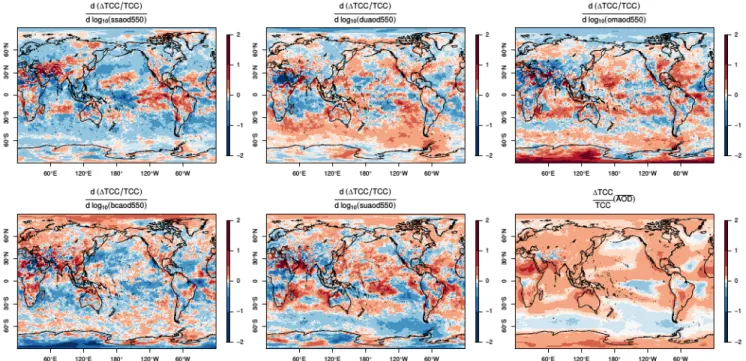
Two approaches were used. In the first, we performed a multiple linear regression of the time series of fractional difference in total cloud cover (TCC) versus the time series of log10 AOD(550 nm) of the MACC aerosol species at each grid point.
A reduction in cloud cover due to absorbing aerosol would present itself as a negative regression slope d(ΔTCC/TCC) / d log10 AOD(550 nm)_BC (throughout,
ΔTCC is defined as TCC(MACC) - TCC(ERA)). For the non-absorbing aerosol species, no large slopes are expected, and the slopes we do measure can serve as an estimate of the noise in this method due to other differences between the two reanalyses.
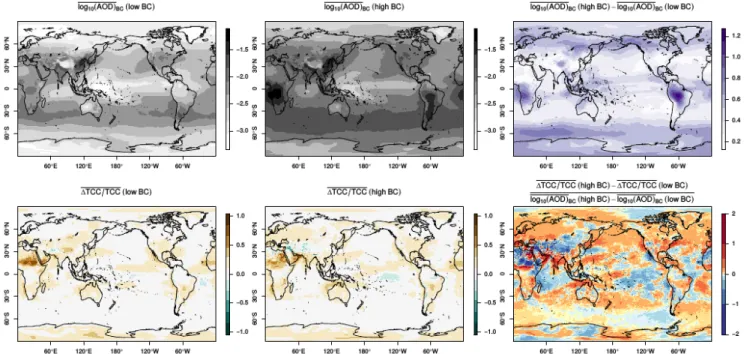
The second approach is to partition the time series at each grid point into high-BC months and low-BC months (the upper and lower tercile of the AOD(550 nm)_BC distribution were used). We then compare the fractional difference in TCC between MACC and ERA-Interim in the high-BC and low-BC months. The semidirect effect of absorbing aerosol would present itself as ΔTCC (high BC) < ΔTCC (low BC).
Results and Discussion
The results are shown in Fig. 1 for the first method. The fact that the cloud cover differences between the two reanalyses regressed on total AOD is a relatively smooth field and shows increases, which is not found for any of the component AODs, is likely a result of the co-variation of AOD and cloud cover due to relative humidity (Quaas et al., 2010; Boucher and Quaas, 2013). Analysing the TCC differences regressed on the component AODs, noisy distributions are found. The large geographic variability in results, which does not seem very systematic, tends to prohibit strong conclusions.
Fig. 2 shows the results for the second method. The region over Africa just south of the Equator, and Amazonia, stand out as regions with strong BC variability. However, cloud cover differences between the two re-analyses are not particularly large in these regions; they are rather similar in magnitude compared to the other regions across the globe. Also, the differences are not systematically negative in these regions, nor in general for the high vs. low BC terciles.
As such, we conclude that both methods agree that this diagnostic of the semidirect effect overall indicates a small effect compared to the noise.
However, it may also be stated that a plausible effect, namely a decrease in cloud cover, can be seen in both methods west off southern Africa and in the tropical southeastern Pacific, although this conclusion is not statistically significant
The fact that in cloud cover, and as such the most relevant metric for semi-direct and secondary indirect effects, no significant effect is found, suggests that for preciptiation and cloud liquid water not effects can be expected either.
Future improvements are to use daily rather than monthly data, investigate high-, low- and mid-level cloud cover separately and to use the forecast steps rather than the analysis step to mitigate the possible reduction in differences between the two reanalyses due to assimilation.
Fig. 1: Method I: regression of the time series of five years (2003 - 2007) of monthly data of the relative difference in total cloud cover (TCC) between the MACC and ERA-Interim re-analyses and the aerosol optical depth by species (top from left to right: sea salt, dust, organic matter; bottom from left to right: sulfate, black carbon, total aerosol).
Fig. 2: Method II: Upper panel: left: lower tercile of the time series of five years (2003-2007) of monthly data of black carbon AOD at each grid point as diagnosed by the MACC reanalysis; middle: upper tercile, right: difference between the two; all are in log space. Lower panel: relative difference in total cloud cover (TCC) between the MACC and ERA-Interim reanalyses for left the lower and middle the upper tercile in BC AOD. Right: Difference between the two.
References
Ackerman, A. S., O. B. Toon, D. E. Stevens, A. J. Heymsfield, V. Ramanathan and E. J. Welton: Reduction of tropical cloudiness by soot. Science, 288, 1042-1048, 2000.
Albrecht, B., Aerosols, cloud microphysics, and fractional cloudiness. Science, 245, 1227-1230, 1989.
Bellouin, N., J. Quaas, J.-J. Morcrette, and O. Boucher. Estimates of aerosol
radiative forcing from the MACC re-analysis. Atmos. Chem. Phys., 13, 2045-2062, doi:10.5194/acp-13-2045-2013, 2013.
Boucher, O., D. Randall, P. Artaxo, C. Bretherton, G. Feingold, P. Forster, V.-M. Kerminen, Y. Kondo, H. Liao, U. Lohmann, P. Rasch, S.K. Satheesh, S. Sherwood, B. Stevens and X.Y. Zhang, Clouds and Aerosols. In: Climate Change 2013: The
Physical Science Basis. Contribution of Working Group I to the Fifth Assessment Report of the Intergovernmental Panel on Climate Change [Stocker, T.F., D. Qin, G.-K. Plattner, M. Tignor, S.K. Allen, J. Boschung, A. Nauels, Y. Xia, V. Bex and P.M. Midgley (eds.)]. Cambridge University Press, Cambridge, United Kingdom and New York, NY, USA, 2013.
Boucher, O., und J. Quaas, Water vapour affects both rain and aerosol optical depth, Nature Geosci., 6, 4-5, doi:10.1038/ngeo1692, 2013.
Brenguier, J.-L., F. Burnet, F., and O. Geoffroy, Cloud optical thickness and liquid water path – does the k coefficient vary with droplet concentration?, Atmos. Chem. Phys., 11, 9771-9786, doi:10.5194/acp-11-9771-2011, 2011.
Kaufman, Y. J., and I. Koren: Smoke and pollution aerosol effect on cloud cover. Science 313, 655 – 658, doi:10.1126/science.1126232, 2006.
Khain, A. P., Effects of aerosols on precipitation: a review. Environ. Res. Lett. 4, 015004, doi: 10.1088/1748-9326/4/1/015004, 2009.
Khain, A. P., N. BenMoshe, A. Pokrovsky, Factors determining the impact of aerosols on surface precipitation from clouds: an attempt of classification. J. Atmos. Sci. 65, 1721-1748, 2008.
Koren, I., Kaufman, Y., Rosenfeld, D., Remer, L., and Rudich, Y.: Aerosol invigora15 tion and restructuring of Atlantic convective clouds, Geophys. Res. Lett., 32, L14828, doi:10.1029/2005GL023187, 2005.
Liu, Y. and P. H. Daum, Warming effect from dispersion forcing. Nature, 419, 580-581, 2002.
Morcrette, J.-J., et al. Aerosol analysis and forecast in the ECMWF Integrated Forecast System: Forward modeling. J. Geophys. Res., 114, D06206,
doi:10.1029/2008JD011235, 2009.
Pincus, R., and M. B. Baker, Effect of precipitation on the albedo susceptibility of clouds in the marine boundary layer, Nature, 372, 250-252, 1994.
Quaas, J., B. Stevens, U. Lohmann, und P. Stier, Interpreting the cloud cover - aerosol optical depth relationship found in satellite data using a general
circulation model, Atmos. Chem. Phys., 10, 6129-6135, doi:10.5194/acp-10-6129-2010, 2010.
Rosenfeld, D., U. Lohmann, G.B. Raga, C.D. O’Dowd, M. Kulmata, A. Reissell, M.O.. Andreae, Flood or drought: How do aerosols affect precipitation? Science, 321, 1309-1313, 2008.
Simmons, A., S. Uppala, D. Dee, and S. Kobayashi, ERA-Interim: New
ECMWF reanalysis products from 1989 onwards. ECMWF Newsletter , 110, 29–35, 2007.
Small, J. D., P. Y. Chuang, G. Feingold, and H. Jiang, Can aerosol decrease cloud lifetime? Geophys. Res. Lett., 36, L16806, doi:10.1029/2009GL038888. 2009. Stevens, B., and G. Feingold, Untangling aerosol effects on clouds and
precipitation in a buffered system, Nature, 461, 607-613, doi:10.1038/nature08281, 2009.
Twomey, S., The nuclei of natural cloud formation. Part II: The supersaturation in natural clouds and the variation of cloud droplet concentration, Geofis. Pura Appl., 43 , 243–249, 1959.
Twomey, S.: Pollution and the planetary albdeo. Atmos. Environ., 8, 1251-1258, 1974.