Applications in Rewriting Logic
Mar´ıa Alpuente1, Demis Ballis2, and Daniel Romero1
1 Universidad Polit´ecnica de Valencia,
Camino de Vera s/n, Apdo 22012, 46071 Valencia, Spain {alpuente,dromero}@dsic.upv.es
2 Dipartimento di Matematica e Informatica,
Via delle Scienze 206, 33100 Udine, Italy [email protected]
Abstract. This paper presents a Rewriting Logic framework that for-malizes the interactions between Web servers and Web browsers through a communicating protocol abstracting HTTP. The proposed framework includes a scripting language that is powerful enough to model the dy-namics of complex Web applications by encompassing the main fea-tures of the most popular Web scripting languages (e.g. PHP, ASP, Java Servlets). We also provide a detailed characterization of browser actions (e.g. forward/backward navigation, page refresh, and new win-dow/tab openings) via rewrite rules, and show how our models can be naturally model-checked by using the Linear Temporal Logic of Rewrit-ing (LTLR), which is a Linear Temporal Logic specifically designed for model-checking rewrite theories. Our formalization is particularly suit-able for verification purposes, since it allows one to perform in-depth analyses of many subtle aspects related to Web interaction. Finally, the framework has been completely implemented in Maude, and we report on some successful experiments that we conducted by using the Maude LTLR model-checker.
1
Introduction
Over the past decades, the Web has evolved from being a static medium to a highly interactive one. Currently, a number of corporations (including book re-tailers, auction sites, travel reservation services, etc.) interact primarily through the Web by means of complex interfaces which combine static content with dy-namic data produced “on-the-fly” by the execution of server-side scripts (e.g. Java servlets, Microsoft ASP.NET and PHP code). Typically, a Web applica-tion consists of a series of Web scripts whose execuapplica-tion may involve several This work has been partially supported by the EU (FEDER) and the Spanish MEC TIN2007-68093-C02-02 project, by the Universidad Polit´ecnica de Valencia program PAID-06-07 (TACPAS), Generalitat Valenciana, under grant Emergentes GV/2009/024, and by the Italian MUR under grant RBIN04M8S8, FIRB project, Internationalization 2004. Daniel Romero is also supported by FPI–MEC grant BES– 2008–004860.
A. Cavalcanti and D. Dams (Eds.): FM 2009, LNCS 5850, pp. 790–805, 2009. c
interactions between a Web browser and a Web server. In a typical scenario, the browser/server interact by means of a particular “client-server” protocol in which the browser requests the execution of a script to the server, then the server executes the script, and it finally turns its output into a response that the browser can display. This execution model -albeit very simple- hides some subtle intricacies which may yield erroneous behaviors.
Actually, Web browsers support backward and forward navigation through Web application stages, and allow the user to open distinct (instances of) Web scripts in distinct windows/tabs which are run in parallel. Such browser actions may be potentially dangerous, since they can change the browser state without notifying the server, and may easily lead to errors or undesired responses. For instance, [1] reports on a frequent error, called the multiple windows problem, which typically happens when a user opens the windows for two items in an online store, and after clicking to buy on the one that was opened first, he frequently gets the second one being bought. Moreover, clicking refresh/forward/backward browser buttons may sometimes produce error messages, since such buttons were designed for navigating stateless Web pages, while navigation through Web applications may require multiple state changes. These problems have occurred frequently in many popular Web sites (e.g. Orbitz, Apple, Continental Airlines, Hertz car rentals, Microsoft, and Register.com) [2]. Finally, na¨ıvely written Web scripts may allow security holes (e.g. unvalidated input errors, access control flaws,etc.[3]) producing undesired results that are difficult to debug.
Although the problems mentioned above are well known in the Web com-munity, there is a limited number of tools supporting the automated analysis and verification of Web applications. The aim of this paper is to explore the application of formal methods to formal modeling and automatic verification of complex, real-size Web applications.
Our contribution.This paper presents the following original contributions.
-We define a fine-grained, operational semantics of Web applications based on a formal navigational model which is suitable for the verification of real, dynamic Web sites. Our model is formalized within the Rewriting Logic (RWL) frame-work [4], a rule-based, logical formalism particularly appropriate to modeling concurrent systems [5]. Specifically, we provide a rigorous rewrite theory which i) completely formalizes the interactions between multiple browsers and a Web server through a request/response protocol that supports the main features of the HyperText Transfer Protocol (HTTP); ii) models browsers actions such as refresh, forward/backward navigation, and window/tab openings; iii) supports a scripting language which abstracts the main common features (e.g. session data manipulation, data base interactions) of the most popular Web scripting languages. iv) formalizesadaptive navigation [6], that is, a navigational model in which page transitions may depend on user’s data or previous computation states of the Web application.
-We also show how rewrite theories specifying Web application models can be model-checked using theLinear Temporal Logic of Rewriting (LTLR) [7,8]. The
LTLR allows us to specify properties at a very high level using RWL rules and hence can be smoothly integrated into our RWL framework.
-Finally, the verification framework has been implemented in Maude [9], a high-performance RWL language, which is equipped with a built-in model-checker for LTLR. By using our prototype, we conducted an experimental evaluation which demonstrates the usefulness of our approach.
To the best of our knowledge, this work represents the first attempt to provide a formal RWL verification environment for Web applications which allows one to verify several important classes of properties (e.g. reachability, security, authen-tication constraints, mutual exclusion, liveness,etc.) w.r.t. a realistic model of a Web application which includes detailed browser-server protocol interactions, browser navigation capabilities, and Web script evaluation.
Plan of the paper. The rest of the paper is organized as follows. Section 2 briefly recalls some essential notions about Rewriting Logic. Section 3 illustrates a general model for Web interactions which informally describes the navigation through Web applications using HTTP. In Section 4, we specify a rewrite theory formalizing the navigation model of Section 3. This model captures the interac-tion of the server with multiple browsers and fully supports the most common browser navigation features. In Section 5, we introduce LTLR, and we show how we can use it to formally verify Web applications. In Section 6, we discuss some related work and then we conclude.
2
Preliminaries
We assume some basic knowledge of term rewriting [10] and Rewriting Logic [5]. Let us first recall some fundamental notions which are relevant to this work. The static state structure as well as the dynamic behavior of a concurrent sys-tem can be formalized by a RWL specification encoding arewrite theory. More specifically, arewrite theory is a triple R= (Σ, E, R), where:
(i) (Σ, E) is an order-sorted equational theory equipped with a partial order< modeling the usual subsort relation. Σ, which is called the signature, specifies the operators and sorts defining the type structure ofR, whileEis a set of (pos-sibly conditional) equational axioms which may include commutativity (comm), associativity (assoc) and unity (id). Intuitively, the sorts and operators contained in the signature Σ allow one to formalize system states as ground terms of a term algebraτΣ,E which is built uponΣ andE.
(ii) R defines a set of (possibly conditional) labeled rules of the form (l : t ⇒
t ifc) such that l is a label, t, t are terms, andc is an optional boolean term
representing the rule condition. Basically, rules in R specify general patterns modeling state transitions. In other words, R formalizes the dynamics of the considered system.
Variables may appear in both equational axioms and rules. By notationx:S, we denote that variablexhas sortS. Acontext C is a term with a single hole, denoted by [ ], which is used to indicate the location where a reduction occurs.
C[t] is the result of placingtin the hole ofC. Asubstitution σis a finite mapping from variables to terms, andtσ is the result of applyingσto termt.
The system evolves by applying the rules of the rewrite theory to the system states by means ofrewriting moduloE, whereE is the set of equational axioms. This is accomplished by means of pattern matching moduloE. More precisely, given an equational theory (Σ, E), a termtand a termt, we say thattmatches
t modulo E (or thatt E-matchest) via substitutionσif there exists a context
C such that C[tσ] =E t, where =E is the congruence relation induced by the equational theory (Σ, E). Hence, given a rule r = (l : t ⇒ t ifc), and two ground termss1 ands2 denoting two system states, we say that s1rewrites to
s2moduloEviar(in symbolss1→r s2), if there exists a substitutionσsuch that
s1E-matchestviaσ,s2=C[tσ] andcσholds (i.e. it is equal totruemoduloE). A computation overRis a sequence of rewrites of the form s0 →r1 s1. . . →rk sk, withr1, . . . , rk ∈R,s0, . . . , sk ∈τΣ,E.
3
A Navigation Model for Web Applications
A Webapplication is a collection of related Web pages, hosted by a Web server, containing Web scripts and links to other Web pages. A Web application is accessed using a Web browser which allows one to navigate through Web pages by clicking and following links.
Communication between the browser and the server is given through the HTTP protocol, which works following arequest-response scheme. Basically, in the re-questphase, the browser submits a URL to the server containing the Web pageP to be accessed, along with a string of input parameters (called thequery string). Then, the server retrievesPand, ifP contains a Web scriptα, it executesαw.r.t. the input data specified by the query string. According to the execution ofα, the server defines the Web applicationcontinuation (that is, the next pageP to be sent to the browser), andenables the links inP dynamically (adaptive naviga-tion). Finally, in theresponse phase, the server deliversP to the browser.
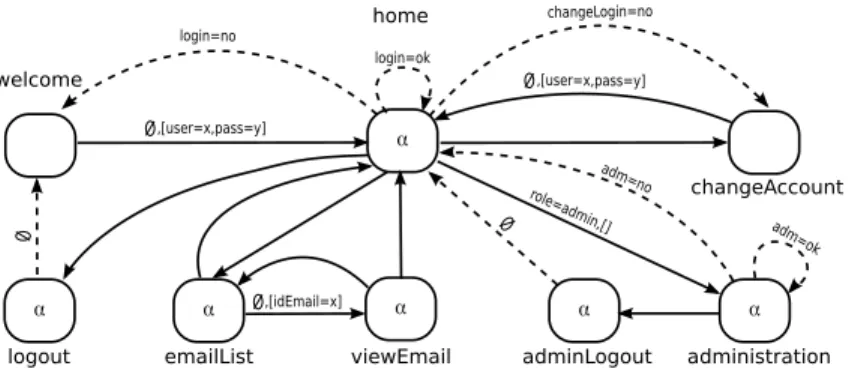
Since HTTP is a stateless protocol, the Web servers are coupled with a session management technique, which allows one to define Web application states via the notion ofsession, that is, global stores that can be accessed and updated by Web scripts during an established connection between a browser and the server. The navigation model of a Web application can be graphically depicted at a very abstract level by using a graph-like structure as follows. Web pages are represented by nodes which may contain a Web script to be executed (α). Solid arrows connecting Web pages model navigation links which are labeled by a condition and a query string. Conditions provide a simple mechanism to imple-ment a general form of adaptive navigation: specifically, a navigation link will be enabled (i.e. clickable) whenever the associated condition holds. The query string represents the input parameters which are sent to the Web server. Finally, dashed arrows model Web application continuations, that is, arcs pointing to Web pages which are automatically computed by Web script executions. Con-ditions labeling continuations allow us to model any possible evolution of the
Fig. 1.The navigation model of a Webmail application
Web application of interest. Web application continuations as well as adaptive navigations are dynamically computed w.r.t. the current session (i.e. the current application state).
Example 1. Consider the navigation model given in Figure 1 representing a generic Webmail application which provides some typical functions such as login/logout features, email management, system administration capabilities, etc. The solid arrow between the welcome and the home page whose label is ∅,{user=x,pass=y} defines a navigation link which is always enabled and re-quires two input parameters. Thehomepage has got two possible continuations (dashed arrows)login=okandlogin=no. According to the user and pass values provided in the previous transition, only one of them is chosen. In the former case, the login succeeds and thehomepage is delivered to the browser, while in the latter case the login fails and thewelcomepage is sent back to the browser. An example of adaptive navigation is provided by the navigation link con-necting the home page to the administration page. In fact, navigation through that link is enabled only when the conditionrole=adminholds, that is, the role of the logged user isadmin.
4
Formalizing the Navigation Model as a Rewrite Theory
In this section, we define a rewrite theory specifying a navigation model, which allows us to formalize the navigation through a Web application via a commu-nicating protocol abstracting HTTP. The communication protocol includes the interaction of the server with multiple browsers as well as the browser navigation features. Our formalization of a Web application consists of the specifications of the following three components: the Web scripting language, the Web application structure, and the communication protocol.
The Web scripting language. We consider a scripting language which in-cludes the main features of the most popular Web programming languages.
Basically, it extends an imperative programming language with some built-in primitives for reading/writing session data (getSession, setSession), accessing and updating a data base (selectDB, updateDB), capturing values contained in a query string sent by a browser (getQuery). The language is defined by means of an equational theory (Σs, Es), whose signature Σs specifies the syntax as well as the type structure of the language, while Es is a set of equations modeling the operational semantics of the language through the definition of an evalua-tion operator [[ ]] :ScriptState→ScriptState, whereScriptStateis defined by the operator
( , , , , ) : (Script×PrivateMemory×Session×Query×DB)→ScriptState Roughly speaking, the operator [[ ]] takes as input a tuple (α,m,s,q,db) repre-senting a scriptα, a private memorym, a sessions, a query stringqand a data base db, and returns a new script state (skip,m,s,q,db) in which the script has been completely evaluated (i.e. it has been reduced to theskip statement) and the private memory, the session and the data base might have been changed because of the script evaluation. In our framework, sessions, private memories, query strings and data bases are modeled by sets of pairs id = val, where id
is an identifier whose value is represented byval. The full formalization of the operational semantics of our scripting language can be found in the technical report [11].
The Web application structure. The Web application structure is modeled by an equational theory (Σw, Ew) such that (Σw, Ew)⊇(Σs, Es). (Σw, Ew) con-tains a specific sortSoup[9] for modeling multisets (i.e.soup of elements whose operators are defined using commutativity, associativity and unity axioms) as follows:
∅:→Soup (empty soup)
, :Soup×Soup→Soup[comm assoc Id:∅] (soup concatenation).
The structure of a Web page is defined with the following operators of (Σw, Ew) ( , ,{ },{ }) : (PageName×Script×Continuation×Navigation)→Page ( , ) : (Condition×PageName)→Continuation
,[ ] : (PageName×Query)→Url ( , ) : (Condition×Url)→Navigation
where we enforce the following subsort relations Page<Soup, Query<Soup,
Continuation<Soup, Navigation<Soup, Condition<Soup. Each subsort rela-tionS<Soupallows us to automatically define soups of sortS.
Basically a Web page is a tuple (n, α,{cs},{ns})∈Pagesuch thatnis a name identifying the Web page,αis the Web script included in the page,csrepresents a soup of possible continuations, andnsdefines the navigation links occurring in the page. Each continuation appearing in {cs}is a term of the form (cond,n), while each navigation link innsis a term of the form (cond,n,[q1, . . . ,qn]). A con-dition is a term of the form{id1=val1, . . . ,idk=valk}. Given a sessions, we say that a continuation (cond,n) isenabled ins, iffcond⊆s, and a navigation link (cond,n,[q1, . . . ,qn]) isenabled in siff cond⊆s. A Web application is defined as a soup ofPageelements defined by the operator :Page→WebApplication.
Example 2. Consider again the Web application of Example 1. Its Web application structure can be defined as a soup of Web pages
wapp=p1,p2,p3,p4,p5,p6,p7,p8 as follows: p1=(welcome,skip,{∅},{(∅,home,[user,pass])})
p2=(home, αhome,{(login=no,welcome),(changeLogin=no,changeAccount),
(login=ok,home)},
{(∅,changeAccount,[∅]),(role=admin,administration,[∅]) (∅,emailList,[∅]),(∅,logout,[∅])})
p3=(emailList, αemailList,{∅},{(∅,viewEmail,[emailId]),(∅,home,[∅])})
p4=(viewEmail, αviewEmail,{∅},{(∅,emailList,[∅]),(∅,home,[∅])})
p5=(changeAccount,skip,{∅},{(∅,home,[user,pass])})
p6=(administration, αadmin,{(adm=no,home),(adm=ok,administration)},
{∅,adminLogout,[∅]}) p7=(adminLogout, αadminLogout,{(∅,home)},{∅})
p8=(logout, αlogout,{(∅,welcome)},{∅})
where the application Web scripts might be defined in the following way
αhome=
login := getSession(”login”) ; if (login = null) then
u := getQuery(user) ; p := getQuery(pass) ; p1 := selectDB(u) ; if (p = p1) then r := selectDB(u.”-role”) ; setSession(”user”, u) ; setSession(”role”, r) ; setSession(”login”, ”ok”) else setSession(”login”, ”no”) ; f := getSession(”failed”) ; if (f = 3) then setSession(forbid,”true”) fi ; setSession(”failed”, f+1) ; fi fi αadmin= u := getSession(”user”) ; adm := selectDB(”admPage”) ; if (adm = ”free”)∨(adm = u) then
updateDB(”admPage”, u) ; setSession(”adm”, ”ok”) else setSession(”adm”, ”no”) fi αemailList= u := getSession(”user”) ; es := selectDB(u . ”-email) ;
setSession(”email-found”, es) αviewEmail =
u := getSession(”user”) ; id := getQuery(idEmail) ; e := selectDB(id) ; setSession(”text-email”, e)
αadminLogout= updateDB(”admPage”, ”free”) αlogout= clearSession
The communication protocol. We define the communication protocol by means of a rewrite theory (Σp, Ep, Rp), where (Σp, Ep) is an equational theory formalizing the Web application states, andRpis a set of rewrite rules specifying Web script evaluations and request/response protocol actions.
The equational theory (Σp, Ep). The theory is built on top of the equational theory (Σw, Ew) (i.e. (Σp, Ep) ⊇(Σw, Ew)) and models, on the one hand, the entities into play (i.e. the Web server, the Web browser and the protocol mes-sages); on the other hand, it provides a formal mechanism to evaluate enabled continuations as well as enabled adaptive navigations which may be generated
“on-the-fly” by executing Web scripts. More formally, (Σp, Ep) includes the fol-lowing operators.
B( , , ,{ },{ }, , , ) : (Id×Id×PageName×URL×Session×Message
×History×Nat)→Browser S( ,{ },{ }, , ) : (WebApplication×BrowserSession×DB×Message
×Message)→Server H( ,{ }, ) : (PageName×URL×Message)→History
B2S( , , ,[ ], ) : (Id×Id×PageName×Query×Nat)→Message S2B( , , ,{ },{ }, ) : (Id×Id×PageName×URL×Session×Nat)→Message
BS( ,{ }) : (Id×Session)→BrowserSession
|| || : (Browser×Message×Server)→WebState
where we enforce the following subsort relations History<List, URL<Soup,
BrowserSession<Soup,Browser<Soup, andMessage<Queue1. We model a browser as a term of the form
B(idb,idt,n,{url1, . . . ,urll},{id1=val1, . . . ,idm=valm},m,h,i)
whereidb is an identifier representing the browser;idt is an identifier modeling an open tab of browseridb; nis the name of the Web page which is currently displayed on the Web browser;url1, . . . ,urllrepresent the navigation links which appear in the Web page n; {id1 =val1, . . . ,idm =valm} is the last session that the server has sent to the browser;m is the last message sent to the server; h
is a bidirectional list recording the history of the visited Web pages; andiis an internal counter used to distinguish among several response messages generated by repeated refresh actions (e.g. if a user pressed twice the refresh button, only the second refresh is displayed in the browser window).
The server is formalized by using a term of the form
S(p1, . . . ,pl ,{BS(idb1,{s1}), ..,BS(idbn,{sn})},{db},fiforeq,fifores) wherep1, . . . ,pl defines the Web application currently in execution;si={id1=
val1, . . . ,idm=valm}is the session that belongs to browseridbi, which is needed to keep track of the Web application state of each user;db={id1=val1, . . . ,idk=
valk}specifies the data base hosted by the Web server; andfiforeq,fiforesare two queues of messages, which respectively model the request messages which still have to be processed by the server and the pending response messages that the server has still to send to the browsers.
We assume the existence of a bidirectional channel through which server and browser can communicate by message passing. In this context, terms of the form
B2S(idb,idt,n,[id1=val1, . . . ,idm=valm],i)
model request messages, that is, messages sent from the browser idb (and tab
idt) to the server asking for the Web page n with query parameters [id1 =
val1, . . . ,idm=valm]. Instead, terms of the form
S2B(idb,idt,n,{url1, . . . ,urll},{id1=val1, . . . ,idm =valm},i)
1 We represent a queue with elementse
1, . . . , en by (e1, . . . , en), wheree1 is the first element of the queue.
modelresponse messages, that is, messages sent from the server to the browser
idb(and tab idt) including the computed Web pagenalong with the navigation links{url1, . . . ,urll} occurring inn, and the current session information2.
Using the operators described so far, we can precisely formalize the notion of Web application state as a term of the form
br||m||sv
wherebr is a soup of browsers,mis a channel modeled as a queue of messages, and svis a server. Intuitively, a Web application state can be interpreted as a snapshot of the system capturing the current configurations of the browsers, the server and the channel.
The equational theory (Σp, Ep) also defines the operator
eval( , , , ) :WebApplication×Session×DB×Message→Session×DB×Message whose semantics is specified by means of Ep (see [11] for the precise formal-ization ofeval). Given a Web applicationw, a session s, a data basedb, and a request messageb2s=B2S(idb,idt,n,[q],k),eval(w,s,db,b2s) generates a triple (s,db,s2b) containing an updated session s, an updated data base db, and a response message s2b = S2B(idb,idt,n,{url1, . . . ,urlm},s,k). Intuitively, the operatorevalallows us to execute a Web script and dynamically determine (i) which Web pagenis generated by computing an enabled continuation, and (ii) which links ofn are enabled w.r.t. the current session.
The rewrite rule set Rp. It defines a collection of rewrite rules of the form
label:WebState⇒WebStateabstracting the standard request-response behavior of the HTTP protocol and the browser navigation features. First, we give the rules that formalize the HTTP protocol, and then the rules that correspond to the browser navigation features. More specifically, the HTTP protocol specifies the requests of multiple browsers, the script evaluations, and the server responses by means of the following rules.
ReqIni:B(idb,idt,pc,{(np,[q]),urls},{s},lm,h,i),br||m||sv⇒
B(idb,idt,emptyPage,∅,{s},midb,idt,hc,i),br||(m,midb,idt)||sv
wheremidb,idt=B2S(idb,idt,np,[q],i) andhc=push((pc,{(np,[q]),urls},midb,idt),h)
ReqFin:br||(midb,idt,m)||S(w,{bs},{db},fiforeq,fifores)⇒
br||m||S(w,{bs},{db},(fiforeq,midb,idt),fifores)
wheremidb,idt=B2S(idb,idt,np,[q],i)
Evl:br||m||S(w,{BS(idb,{s}),bs},{db},(midb,idt,fiforeq),fifores)⇒
br||m||S(w,{BS(idb,{s}),bs},{db},fiforeq,(fifores,m))
where (s,db,m) =eval(w,s,db,midb,idt)
2 Session information is typically represented by HTTPcookies, which are textual data
sent from the server to the browser to let the browser know the current application state.
ResIni:br||m||S(w,{bs},{db},fiforeq,(midb,idt,fifores))⇒
br||(m,midb,idt)||S(w,{bs},{db},fiforeq,fifores)
ResFin:B(idb,idt,emptyPage,∅,{s},lm,h,i),br||(S2B((idb,idt,p,urls,{s)},i),m)||sv
⇒B(idb,idt,p,urls,{s},lm,h,i),br||m||sv
where idb,idt:Id, br:Browser, sv:Server, urls:URL, i:Nat, q:Query,
h:History, w:WebApplication, m,m,midb,idt,fiforeq,fifores:Message, pc,p,np:
PageName, s,s:Session, and bs:BrowserSessionare variables.
Roughly speaking, the request phase is split into two parts, which are re-spectively formalized by rulesReqIniandReqFin. Initially, when a browser with identifieridb requests the navigation link (np,[q]) appearing in a Web pagepc of the tab idt, rule ReqIniis fired. The execution of ReqInigenerates a request messagemidb,idt which is enqueued in the channel and saved in the browser as the last message sent. The history list is updated as well. RuleReqFinsimply de-queues the first request messagemidb,idt of the channel and inserts it intofiforeq, which is the server queue containing pending requests. Rule Evl consumes the first request message midb,idt of the queue fiforeq, evaluates the message w.r.t. the corresponding browser session (idb,{s}), and generates the response message which is enqueued infifores, that is, the server queue containing the responses to be sent to the browsers. Finally, rulesResIniandResFinimplement the response phase. First, ruleResIni dequeues a response message fromfifores and sends it to the channel m. Then, rule ResFin takes the first response message from the channel queue and sends it to the corresponding browser tab.
It is worth noting that the whole protocol semantics is elegantly defined by means of only five, high-level rewrite rules without making any implementa-tion detail explicit. Implementaimplementa-tion details are automatically managed by the rewriting logic engine (i.e. rewrite modulo equational theories). For instance, in the rule ReqIni, no tricky function is needed to select an arbitrary navigation link (np,[q]) from the URLs available in a Web page, since they are modeled as associative and commutative soups of elements (i.e.URL<Soup) and hence a single URL can be extracted from the soup by simply applying pattern matching modulo associativity and commutativity.
We formalize browser navigation features as follows. Refresh:B(idb,idt,pc,{urls},{s},lm,h,i),br||m||sv⇒
B(idb,idt,emptyPage,∅,{s},midb,idt,h,i+1),br||(m,midb,idt)||sv
wherelm=B2S(idb,idt,np,q,i) andmidb,idt=B2S(idb,idt,np,q,i+1)
OldMsg:B(idb,idt,pc,{urls},{s},lm,h,i),br||(S2B(idb,idt,p,urls,{s},k),m)||sv⇒
B(idb,idt,pc,{urls},{s},lm,h,i),br||m||sv ifi=k
NewTab:B(idb,idt,pc,{urls},{s},lm,h,i),br||m||sv⇒
B(idb,idt,pc,{urls},{s},lm,h,i),B(idb,idnt,pc,{urls},{s},∅,∅,0),br||m||sv
Backward:B(idb,idt,pc,{urls},{s},lm,h,i),br||m||sv⇒
B(idb,idt,ph,{urlsh},{s},lmh,h,i),br||m||sv
where (ph,{urlh},lmh) =prev(h)
Forward:B(idb,idt,pc,{urls},{s},lm,h,i),br||m||sv⇒
B(idb,idt,ph,{urlsh},{s},lmh,h,i),br||m||sv
where (ph,{urlsh},lmh) =next(h)
where idb,idt,idnt:Id, br:Browser, sv:Server, urls,url,urlsh:URL, q:Query,
h:History m,lm,lmh,midb,idt:Message, i,k:Nat, pc,p,np,ph:PageName, and
s,s:Session are variables.
Rules Refresh and OldMsg model the behavior of the refresh button of a browser. Rule Refreshapplies when a page refresh is invoked. Basically, it first increments the browser internal counter, and then a new version of the last re-quest messagelm, containing the updated counter, is inserted into the channel queue. Note that the browser internal counter keeps track of the number of re-peated refresh button clicks. RuleOldMsg is used to consume all the response messages in the channel, which might have been generated by repeated clicks of the refresh button, with the exception of the last one (i=k).
Finally, rulesNewTab,BackwardandForwardare quite intuitive: an applica-tion ofNewTab simply generates a new Web application state containing a new fresh tab in the soup of browsers, whileBackward(resp.Forward)) extracts from the history list the previous (resp. next) Web page and sets it as the current browser Web page.
It is worth noting that applications of rules inRp might produce an infinite number of (reachable) Web application states. For instance, an infinite appli-cations of rule newTab would produce an infinite number of Web application states, each of which represents a finite number of open tabs. Therefore, to make analysis and verification feasible, we set some restrictions in our prototypical im-plementation of the model to limit the number of reachable states (e.g. we fixed upper bounds on the length of the history list, on the number of tabs the user can open,etc.). An alternative approach that we plan to pursue in the future is to define a state abstraction by means of a suitable equational theory in the style of [12]. This would allow us to produce finite (and hence effective) descriptions of infinite state systems.
5
Model Checking Web Applications Using LTLR
The formal specification framework presented so far allows us to specify a num-ber of subtle aspects of the Web application semantics which can be verified using model-checking techniques. To this respect, the Linear Temporal Logic of Rewriting (LTLR)[8] can be fruitfully employed to formalize properties which are either not expressible or difficult to express using other verification frameworks.
The Linear Temporal Logic of Rewriting. LTLR is a sublogic of the fam-ily of the Temporal Logics of Rewriting TLR∗ [8], which allows one to specify properties of a given rewrite theory in a simple and natural way. In particular, we chosen the “tandem” LT LR/(Σp, Ep, Rp). In the following, we provide an intuitive explanation of the main features of LTLR; for a thorough discussion, please refer to [8].
LTLR extends the traditional Linear Temporal Logic (LTL) withstate predi-cates(SP) andspatial action patterns (Π). A LTLR formulae w.r.t.SP andΠ can be defined by means of the following BNF-like syntax:
ϕ::=δ|p| ¬ϕ|ϕ∨ϕ|ϕ∧ϕ| ϕ|ϕUϕ|♦ϕ|ϕ whereδ∈SP, p∈Π, and ϕ∈LT LR(SP, Π)
Since LTLR generalizes LTL, the modalities and semantic definitions are entirely similar to those for LTL (see, e.g., [13]). The key new addition is the semantics of spatial actions; the relationR,(π, γ)|=δ holds if and only if the proof term
γ(0) of a current computation is an instance of a spatial action pattern δ. Let us illustrate the state predicates and the spatial action pat-terns by means of a rather intuitive example. Let (Σp, Ep, Rp) be the rewrite theory specified in Section 4, modeling the Web applica-tion states as terms b||m||s of sort WebState. Then, the state predicate
B(ibb,idt,page,{urls},{s},m,h,i)||m||sv|=curPage(page) =trueholds (i.e. evalu-ates to true) for each state such that page is the current Web page displayed in the browser. Besides, the spatial action pattern ReqIni(idb\A) allows us to localize all the applications of the rule ReqIniwhere the rule’s variable idb are instantiated withA, that is, all ReqIniapplications which refer to the browser with identifierA.
LTLR properties for Web Applications. This section shows the main ad-vantages of coupling LTLR with Web applications specified via the rewrite theory (Σp, Ep, Rp).
Concise and parametric properties. As LTLR is a highly parametric logic, it allows one to define complex properties in a concise way by means of state predicates and spatial action patters. As an example, consider the Webmail application given in Example 1, along with the property“Incorrect login info is allowed only 3 times, and then login is forbidden”. This property might be formalized as the following standard LTL formula:
♦(welcomeA)→♦(welcomeA∧ (¬(forbiddenA)∨(welcomeA∧ (¬(forbiddenA)∨ (welcomeA∧ (¬(forbiddenA)∨ (forbiddenA∧(¬welcomeA))))))))
wherewelcomeAandforbiddenAare atomic propositions respectively describing (i) user A is displaying the welcome page, and (ii) login is forbidden for user
A. Although the property to be modeled is rather simple, the resulting LTL formula is textually large and demands a hard effort to be specified and verified.
Moreover, the complexity of the formula would rapidly grow when a higher number of login attempts was considered3.
By using LTLR we can simply define a login property which is parametric w.r.t. the number of login attempts as follows. First of all, we define the state predicates: (i)curPage(id,pn), which holds when userid4is displaying Web page
pn; (ii) failedAttempt(id,n), which holds when user id has performed n failed login attempts; (iii) userForbidden(id), which holds when a user is forbidden from logging on to the system. Formally,
B(id,idt,pn,{urls},{s},lm,h,i),br||m||sv|=curPage(id,pn) =true
br||m||S(w,{BS((id,{failed=n}),bs},{db},freq,fres)|=failedAttempt(id,n) =true
br||m||S(w,{BS((id,{forbid=true}),bs},{db},freq,fres)|=userForbidden(id) =true
Then, the security property mentioned above is elegantly formalized by means of the following LTLR formula
♦(curPage(A,welcome)∧ (♦failedAttempt(A,3)))→userForbidden(A) Observe that the previous formula can be easily modified to deal with a distinct number of login attempts —it is indeed sufficient to change the parameter count-ing the login attempts in the state predicatefailedAttempt(A,3). Besides, note that we can define state predicates (and more in general LTLR formulae) which depend on Web script evaluations. For instance, the predicatefailedAttempt de-pends on the execution of the login scriptαhome which may or may not set the
forbidvalue totruein the user’s browser session.
Web script evaluation witnesses the “on-the-fly” capability of our framework which allows us to specify, in a natural way, suitable properties to check the behavior of the scripts.
Unreachability properties. Unreachability properties can be specified as LTLR formulae of the form¬ State , where Stateis an unwanted state the system has not to reach. By using unreachability properties over the rewrite theory (Σp, Ep, Rp), we can detect very subtle instances of themultiple windows problem mentioned in Section 1.
Example 3. Consider again the Webmail application of Example 1. Assume that a user may interact with the application using two email accountsMAandMB. Let us consider a Web application state in which the user is logged in thehome
page with her accountMA. Now, assume that the following sequence of actions is executed: (1) the user opens a new browser tab; (2) the user changes the account in one of the two open tabs and logs in using MBcredentials; (3) the user accesses theemailListpage from both tabs.
After applying the previous sequence of actions, one expects to see in the two open tabs the emails corresponding to the accountsMAand MB. However, the
3 Try thinking of how to specify an LTL formula for a more flexible security policy
permitting 10 login attempts.
Webmail application of Example 1 displays the emails ofMBin both tabs. This is basically caused by action (2) which makes the server override the browser session withMB data without notifying the state change to the tab associated with theMAaccount.
This unexpected behavior can be recognized by using the following LTLR unreachability formula ¬inconsistentState where inconsistentState is a state predicate defined as:
B(id,idA,pA,{urlsA},{(user=MA),sA},lmA,hA,iA),
B(id,idB,pB,{urlsB},{(user=MB),sB},lmB,hB,iB),br||m||sv
|=inconsistentState=true if(MA=MB) Roughly speaking, the property¬inconsistentStatestates that we do not want to reach a Web application state in which two browser tabs refer to distinct user sessions. If this happens, one of the two session is out-of-date and hence inconsistent.
Finally, it is worth noting that by means of LTLR formulae expressing un-reachability statements, we can formalize an entire family of interesting proper-ties such as:
– mutual exclusion(e.g. ¬(curPage(A,administration)∧
curPage(B,administration)),
– link accessibility (e.g.¬curPage(A,PageNotFound)),
– security properties, (e.g.¬(curPage(A,home)∧userForbidden(A))). Liveness through spatial actions. Liveness properties state that something good keeps happening in the system. In our framework, we can employ spatial actions to detect good rule applications. For example, consider the following property “user A always succeeds to access her homepage from the welcomepage”. This amount to saying that, whenever the protocol ruleReqIniis applied to request thehomepage of user A, the browser will eventually display the homepage of userA. This property can be specified by the following LTLR formula:
([ReqIni(Idb\A,pc\welcome,np\home)]→♦curPage(A,home))
Implementation. The verification framework we presented has been im-plemented in a prototypical system, written in Maude [9], which is publicly available along with several examples at
http://www.dsic.upv.es/~dromero/web-tlr.html.
The prototype allows one to define Web application models as extended rewrite theories specified by means of Maude specifications. Then, specifications can be automatically verified using the Maude built-in operatortlr check[7] which sup-ports model checking of rewrite theories w.r.t. LTLR. We tested the tool on several examples including all the examples presented in the paper. Preliminary experi-ments have demonstrated that the experimental system work very satisfactorily on several Web applications models. We are currently developing a Web interface for the tool. Moreover, as future work, we want to define a translator from Web applications written in a commercial language to our Web models.
6
Related Work and Conclusions
Web applications are complex software systems playing a primary role of primary importance nowadays. Not surprisingly, several works have previously addressed the modeling and verification of such systems. A variant of theμ-calculus (called constructiveμ-calculus) is proposed in [14] which allows one to model-check con-nectivity properties over the static graph-structure of a Web system. However, this methodology does not support the verification of dynamic properties— e.g. reachability over Web pages generated by means of Web script execution.
Both Linear Temporal Logic (LTL) and Computational Tree Logic (CTL) have been used for the verification of dynamic Web applications. For instance, [15] and [16] support model-checking of LTL properties w.r.t. Web application models represented as Kripke structures. Similar methodologies have been de-veloped in [17] and [18] to verify Web applications by using CTL formulae. All these model-checking approaches are based on coarse Web application models which are concerned neither with the communication protocol underlying the Web interactions nor the browser navigation features. Moreover, as shown in Section 5, CTL and LTL property specifications are very often textually large and hence difficult to formulate and understand. [6] presents a modeling and verification methodology that uses CTL and considers some basic adaptive nav-igation features. In constrast, our framework provides a complete formalization which supports more advanced adaptive navigation capabilities.
Finally, both [2] and [19] do provide accurate analyses of Web interactions which point out typical unexpected application behaviors which are essentially caused by the uncontrolled use of the browser navigation buttons as well as the shortcomings of HTTP. Their approach however is different from ours since it is based on defining a novel Web programming language which allows one to write safe Web applications: [2] exploits type checking techniques to ensure application correctness, whereas [19] adopts a semantic approach which is based on program continuations.
In this paper, we presented a detailed navigation model which accurately formalizes the behavior of Web applications by means of rewriting logic. The proposed model allows one to specify several critical aspects of Web applica-tions such as concurrent Web interacapplica-tions, browser navigation features and Web scripts evaluations in an elegant, high-level rewrite theory. We also coupled our formal specification with LTLR, which is a linear temporal logic designed to model-check rewrite theories. The verification framework we obtained allows us to specify and verify even sophisticated properties (e.g. the multiple windows problem) which are either not expressible or difficult to express within other verification frameworks. Finally, we developed a prototypical implementation and we conducted several experiments which demonstrated the practicality of our approach.
Model checking as a tool is widely used in both academia and industry. In order to improve the scalability of our technique, as future work we plan to look at the approach of encoding the model-checking problem into SAT, and the resulting question of determining the efficiency in Maude of different encodings.
References
1. Message, R., Mycroft, A.: Controlling Control Flow in Web Applications. Electronic Notes in Theoretical Computer Science 200(3), 119–131 (2008)
2. Graunke, P., Findler, R., Krishnamurthi, S., Felleisen, M.: Modeling Web Interac-tions. In: Degano, P. (ed.) ESOP 2003. LNCS, vol. 2618, pp. 238–252. Springer, Heidelberg (2003)
3. Open Web Application Security Project: Top ten security flaws, http://www.owasp.org/index.php/OWASP_Top_Ten_Project
4. Mart´ı-Oliet, N., Meseguer, J.: Rewriting Logic: Roadmap and Bibliography. The-oretical Computer Science 285(2), 121–154 (2002)
5. Meseguer, J.: Conditional Rewriting Logic as a Unified Model of Concurrency. Theoretical Computer Science 96(1), 73–155 (1992)
6. Han, M., Hofmeister, C.: Modeling and Verification of Adaptive Navigation in Web Applications. In: 6th International Conference on Web Engineering, pp. 329–336. ACM, New York (2006)
7. Bae, K., Meseguer, J.: A Rewriting-Based Model Checker for the Linear Temporal Logic of Rewriting. ENTCS. Elsevier, Amsterdam (to appear)
8. Meseguer, J.: The Temporal Logic of Rewriting: A Gentle Introduction. In: Degano, P., De Nicola, R., Meseguer, J. (eds.) Concurrency, Graphs and Models. LNCS, vol. 5065, pp. 354–382. Springer, Heidelberg (2008)
9. Clavel, M., Dur´an, F., Eker, S., Lincoln, P., Mart´ı-Oliet, N., Meseguer, J., Talcott, C.: All About Maude - A High-Performance Logical Framework. LNCS, vol. 4350. Springer, Heidelberg (2007)
10. TeReSe (ed.): Term Rewriting Systems. Cambridge University Press, Cambridge (2003)
11. Alpuente, M., Ballis, D., Romero, D.: A Rewriting Logic Framework for the Spec-ification and the Analysis of Web Applications. Technical Report DSIC-II/01/09, Technical University of Valencia (2009),
http://www.dsic.upv.es/~dromero/web-tlr.html
12. Meseguer, J., Palomino, M., Mart´ı-Oliet, N.: Equational Abstractions. Theoretical Computer Science 403(2-3), 239–264 (2008)
13. Manna, Z., Pnueli, A.: The Temporal Logic of Reactive and Concurrent Systems. Springer, Heidelberg (1992)
14. Alfaro, L.: Model Checking the World Wide Web. In: Berry, G., Comon, H., Finkel, A. (eds.) CAV 2001. LNCS, vol. 2102, pp. 337–349. Springer, Heidelberg (2001) 15. Flores, S., Lucas, S., Villanueva, A.: Formal Verification of Websites. Electronic
notes in Theoretical Computer Science 200(3), 103–118 (2008)
16. Haydar, M., Sahraoui, H., Petrenko, A.: Specification Patterns for Formal Web Verification. In: 8th International Conference on Web Engineering, pp. 240–246. IEEE Computer Society, Los Alamitos (2008)
17. Miao, H., Zeng, H.: Model Checking-based Verification of Web Application. In: 12th IEEE International Conference on Engineering Complex Computer Systems, pp. 47–55. IEEE Computer Society, Los Alamitos (2007)
18. Donini, F.M., Mongiello, M., Ruta, M., Totaro, R.: A Model Checking-based Method for Verifying Web Application Design. Electronic Notes in Theoretical Computer Science 151(2), 19–32 (2006)
19. Queinnec, C.: Continuations and Web Servers. Higher-Order and Symbolic Com-putation 17(4), 277–295 (2004)