Anna van Saksenlaan 51 2593 HW Den Haag P.O. Box 95366 2509 CJ Den Haag The Netherlands Telephone: +31 70 342 15 42 E-mail: [email protected] Website: www.rathenau.nl
R&D goes global
Policy implications for the Netherlands
as a knowledge region in a global perspective
Policy implications for the Netherlands
as a knowledge region in a global perspective
Prof. dr. R. Cools Dr. J.H.M. Dröge Drs. E.J.F.B. van Huis Prof. dr. ir. H.W. Lintsen Prof. mr. J.E.J. Prins Prof. dr. M.C. van der Wende Dr. ir. M.M.C.G. Peters (secretary)
Rathenau Instituut Anna van Saksenlaan 51 PO Box 95366 2509 CJ Den Haag The Netherlands Telephone: +31 70 342 15 42 E-mail: [email protected] Website: www.rathenau.nl Publisher: Rathenau Instituut
Layout: Boven de Bank, Zeist Editor: Ann Maher
Preferred citation:
Deuten, J., R&D goes global: Policy implications for the Netherlands as a knowledge region in a global perspective. Rathenau Instituut, The Hague 2015
The Rathenau Instituut has an Open Access policy. Its reports, background studies, research articles and software are all open access publications. Research data are made available pursuant to statutory provisions and ethical research standards concerning the rights of third parties, privacy and copyright. © Rathenau Instituut 2015
This work or parts of it may be reproduced and/or published for creative, personal or educational purposes, provided that no copies are made or used for commercial objectives, and subject to the condition that copies always give the full attribution above. In all other cases, no part of this publication may be reproduced and/or published by means of print, photocopy, or any other medium without the prior written permission of the Rathenau Instituut.
Preface
On the back of my smart phone it reads “Designed by Apple in California. Assembled in China.” This division of labour between California and China seems typical for economic globalisation. Lucrative activities like research and development (R&D), design and marketing are done in the West, while production is outsourced to low-wage countries in the East and elsewhere.
Increasingly, however, this reassuring narrative of globalisation is being challenged. China is striving to become a powerhouse in science and technology, and India and other emerging economies are trying to get a position in the more lucrative parts of globalised value chains. Western multinational corporations used to keep their core R&D activities close to their headquarters in their home countries, but this is no longer evident. Their R&D footprints are becoming truly global.
The R&D process is thus not as immune to globalisation as was once thought.1 Have we
entered a new phase of globalisation of R&D? This report aims to increase our understanding of what globalisation of business R&D means for a rich industrialised country like the
Netherlands. To what extent are our home-grown multinational corporations (re-)locating their R&D activities to other countries? And to what extent does the Netherlands succeed in attracting R&D investment from companies from abroad, for example from Chinese or Indian multinationals? What competitive assets can Netherlands bring to the table in the international competition for R&D investments? In view of our mission to increase insight into the functioning of the science system, the report will pay special attention to the role that the science policy plays in retaining and attracting business research.
Interestingly, globalisation of R&D implies that the regional level is becoming increasingly important. Globalisation does not lead to the ‘death of distance’. Instead, proximity matters. R&D investments cluster in regional ‘hotspots’. Therefore, an important topic in this report is how policymakers in cities, provinces and the national government can get their policies together in hotspot promotion. The Netherlands should act as one region in Europe in the international competition for foreign investments in R&D.
This report is based on a study of the literature, an analysis of statistical data on R&D expenditures and on interviews with R&D leaders within multinational companies in the Netherlands and in China, and with policymakers in The Hague and in the Dutch regions. The report shows that the globalisation of R&D is clearly visible in the R&D statistics for the Netherlands. Cross-border R&D investments are on the rise. Moreover, the growth in outward R&D investment is not matched by a growth in inward R&D investment. To understand what is happening, the report argues that we need to understand that the globalisation of R&D has two distinctive patterns. The globalisation of business research (aimed at creating new knowledge for innovation) is largely driven by access to excellent and relevant knowledge, access to labour pools of talented researchers, and attractive opportunities for research collaboration. The globalisation of development (aimed at exploiting existing knowledge for innovation), on the other hand, is much more driven by access to attractive markets, proximity to main customers
and/or suppliers (in globalised value chains), and proximity to production facilities. Both patterns of globalisation of R&D give rise to different worries and hopes. Outward investments in
research suggest that the Netherlands is losing its position in science and technology. Outward investments in development, on the other hand, suggest that Dutch-based MNCs are stepping up their operations in foreign markets. Clearly, retaining and attracting investments in research and in development call for different policy approaches.
One recurrent theme is how to get all relevant stakeholders together in ensuring the
Netherlands retains its position as an attractive location for research and development. I hope that this report inspires the discussion on how to deal collectively with the challenges of globalisation of business research and development.
Melanie Peters
Summary
Globalisation has changed the way companies develop, produce and market their products and services. With the opening of markets in countries like China and India, companies can make and sell their products and services across the globe. Advances in information and
communication technologies, international standardisation and modularisation, trade
liberalisation, and transport and logistics, have led to the fragmentation of value chains and the emergence of complex divisions of labour between specialised suppliers in many different countries. Value chains, in which these products and services are created, have also
globalised. Global competition spurs companies to innovate faster and more effectively. They seek collaboration with external knowledge partners in open innovation strategies in global knowledge networks.2
Globalisation forces companies to carefully consider where they locate their business activities. For each of their activities they seek locations where conditions are most favourable. For different types of activities, different location factors play out. For instance, many Western multinational corporations (MNCs) have moved labour-intensive production operations offshore to other countries where wages are lower. Until recently, rich industrialised countries could find comfort in the thought that knowledge-intensive activities, such as research and development (R&D), would remain relatively ‘immune’ to globalisation. Increasingly, however, MNCs are deploying or acquiring R&D activities in Asia or other parts of the world. Emerging economies like China are stepping up their investments in knowledge and innovation in an effort to strengthen their position in the more profitable knowledge-intensive parts of global value chains. Is the position of rich industrialised countries like the Netherlands as location for business R&D under threat? A next question is, how should such countries respond to the challenges of globalisation of R&D? These questions are particularly important for the
Netherlands with its open economy and the large role that multinational corporations play in its national economy and innovation system.
The R&D position of the Netherlands in a globalising R&D landscape
This report aims to improve our understanding of what the globalisation of R&D means for a rich, industrialised country like the Netherlands. How does the globalisation of business R&D affect the R&D position of the Netherlands? Statistics on R&D expenditures show a gradually weakening position of the Netherlands in the global R&D landscape. CBS statistics show that the domestic business sector spends an increasingly larger share of their R&D investments abroad, and this trend is not matched by an increase in incoming R&D investments.3 Moreover,
large technology-based MNCs in the Netherlands are spending a smaller share of their world-wide R&D budgets in the Netherlands.4
2 OECD (2014a).
3 R&D statistics show that the share of R&D expenditures that firms in the Netherlands spent abroad increased from 10% in 1999 to 23% in 2013 (CBS statline). See also CBS (2015).
Separating the R and D: two patterns of R&D globalisation
How concerned should the Netherlands be about this trend? A key insight from our interviews with R&D leaders in large technology-based firms in the Netherlands and in foreign affiliates of Western MNCs in China, and from our study of the extensive literature on R&D globalisation, is that the answer to this question requires us to distinguish between the ‘R’ and the ‘D’ in R&D. Whereas research aims to create new knowledge, development uses existing knowledge gained from research and/or practical experience in order to create innovations in materials, products, devices, processes, systems or services.5
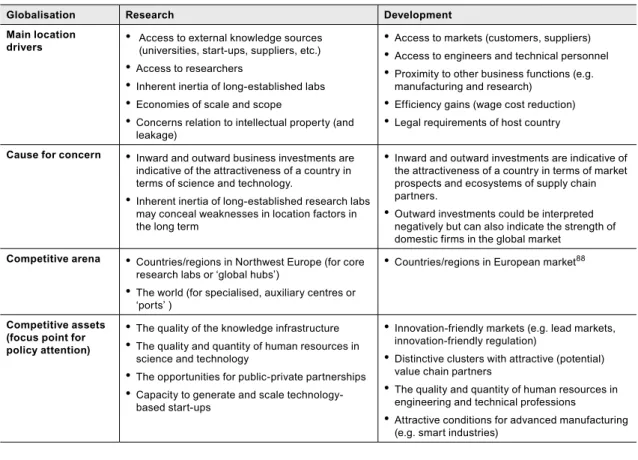
Each of the two patterns of R&D globalisation is shaped by different sets of location drivers and has different implications. On the one hand, the globalisation of research is largely driven by MNCs that want to get access to (scientieif) knowledge and expertise, access to talented researchers, and opportunities for research collaboration with universities, research institutes, specialised suppliers and others. The globalisation of development, on the other hand, is mainly driven by MNCs that seek access to markets, proximity to partners in the supply chain and proximity to manufacturing sites. This helps them to adapt their products and services to local tastes, preferences and requirements faster and more effectively.
These different sets of location drivers lead to different global footprints of research and develop- ment. Large MNCs tend to concentrate their research in one or a few core labs, often supple-mented by smaller centres, in order to gain access to interesting ‘hotspots’ in science and tech-nology all over the world. Mature core labs are firmly embedded in and interconnected with their knowledge environments. They tend to be ‘sticky’ and costly to relocate. Development centres, on the other hand, are usually dispersed across all the various markets in which they operate. It is unfortunate that the statistics on cross-border R&D expenditures do not make this distinction. This makes it difficult to assess how worrisome the trend is that companies in the Netherlands spend relatively more on R&D abroad. It could mean that the Dutch knowledge infrastructure is becoming less attractive – which would be worrisome. It could also mean that Dutch companies are successful in foreign markets and need to perform development abroad – which would be positive.
Based on our interviews and study of the literature on the globalisation of R&D we can give a qualitative answer. The globalisation of research and development can happen in three main modes: through greenfield investments when MNCs decide to set up a new lab abroad; via extending the remit of established foreign affiliates with research and/or development tasks; and via cross-border mergers and acquisitions (M&A) that bring R&D centres under foreign ownership. The third mode is prevalent in many industries. It could be argued that M&A are often motivated by broader strategic consideration and that specific location drivers for research or development are a side issue in these decisions. However, M&A often lead to the
consolidation of business activities. When new owners decide how to reorganise the footprints of their research and development activities, the specific location drivers of research (access to knowledge, access to researchers, opportunities for research collaboration) and development (access to markets, proximity of supply chain partners and proximity to manufacturing sites) are all the more important.
The Dutch economy has the advantage that it is home to relatively many MNCs that have core research labs rooted in the Netherlands, close to their headquarters. The inertia of such labs, as described above, may help to explain why we found no indications of a mass exodus of R&D investments in our interviews with R&D leaders in technology-based MNCs. Indeed, several interviewees reported new investments in these core labs.
In the longer term, however, this stickiness offers no guarantee to the ‘home’ economies of MNCs. For instance, when developments in science and technology lead to radically new innovations, accumulated knowledge and expertise and historical ties become less relevant; research labs become less ‘sticky’. The slogan ‘Refresh in the West, grow in the East’ sums up the trend that Western MNCs do not so much close or relocate their existing research centres, but that they make their investments in new innovation domains increasingly abroad, notably in Asia. We can conclude that the two patterns of R&D globalisation give rise to different concerns. In short, trends in outward and inward investments in business research tell us something about the quality of the knowledge infrastructure, the quality and quantity of human capital in science and technology and opportunities for research collaboration, or at least about how MNCs perceive this. Trends in outward and inward investments in development, on the other hand, inform us about where MNCs have their (lead) markets and where their supply chain partners and manufacturing sites are located.
Implications for the Netherlands and Dutch policymakers
A third question is what are the implications of the globalisation of R&D for the Netherlands and Dutch policymakers? The policy ambition to raise the gross domestic expenditure on R&D to 2.5% of GDP in 2020 is under pressure as outward R&D investments outgrow inward R&D investments. The perspective of R&D globalisation highlights that intensifying R&D investment is not only a matter of stimulating (domestic) firms to spend more on R&D, but also to stimulate companies – whether domestic or foreign, existing or new – to make these expenditures in the Netherlands. The Netherlands should strengthen its attractiveness as a location for such investments vis-à-vis competing countries and regions. We argue that the competitive arena varies according to the different types of R&D investment. For the core research labs, the Netherlands mainly competes with knowledge regions in (Northwest) Europe. For specialised smaller research centres, the arena is truly global and is based on specialist knowledge and opportunities for research collaboration. For development centres, the Netherlands competes with other countries and regions in the single European market.
It follows from our analysis that in the competition between countries for investment, the main competitive assets are distinctive strengths in specific location drivers. For investment in research, they include strengths in the knowledge infrastructure, high quality and sufficient quantity of human capital in science and technology, and distinctive opportunities for research collaboration. The main competitive assets in the competition for business investments in development, on the other hand, are related to the specific location drivers for development. These include attractive lead markets, attractive ecosystems or clusters with complementary firms, sufficient well-trained technologists and technicians, and good conditions for advanced or smart manufacturing.
Policy issues
Based on our interviews with R&D leaders in technology-based MNCs in the Netherlands and in foreign affiliates of Western MNCs in China, our interviews with policymakers in central and regional governments, and on our study of the literature, we highlight various issues.
Firstly, it is important to consider how international businesses perceive the quality of the knowledge infrastructure. They seek to source knowledge for a variety of reasons, from idea generation to practical problem solving. This means that they are not only attracted by demand-driven and application-oriented research. ‘Free’ basic research can also be attractive for them – if only because it attracts talented scientists. Simplistic dichotomies between ‘science-for-science is good for ‘science-for-science’ and ‘‘science-for-science-for-competitiveness is good for business’ should therefore be avoided in the policy discourse and in the offerings in research programmes of science councils.
Secondly, different knowledge needs call for different modalities of public-private research collaboration. Countries or regions can create an important strategic asset when they offer distinctive modes of collaboration that go beyond conventional co-funded PhD-projects in temporary programmes or virtual institutes. In particular, long-term strategic partnerships and mission-oriented research institutes can be an attractive location driver for research investments. In general, the connectivity of the public knowledge infrastructure can be improved if the current bias in the academic incentive system (towards disciplinary research that can be published in high-impact journals) were to be removed. Complementary incentives need to be developed to create more room for multidisciplinary, mission-oriented research.
Thirdly, business investors perceive the attractiveness of the knowledge infrastructure in many different ways. One aspect is the capacity to generate high-potential technology-based start-ups. These innovative companies are important knowledge partners and investment targets for MNCs that follow open innovation strategies. In a general sense, they contribute to the vitality of innovation ecosystems as they challenge existing businesses and business models. A second aspect is the knowledge infrastructure as the supplier of human capital. MNCs seek access to talent pools of scientists and engineers (for research) as well as talent pools of technologists and technicians (for development). The alignment of academic and vocational training with business needs can be a strong competitive asset. A third aspect is the knowledge
infrastructure as gateway to international knowledge networks. Universities that act as a portal to these networks can be attractive knowledge partners for firms.
Acting as one knowledge region in Europe
Globalisation enhances the importance of regions and regional governments. Regional government have more attention and higher policy budgets for the development of the knowledge economy at regional level. The high-tech regional Brainport around Eindhoven is an example of this regional development. There is a spatial dimension to many of the competitive assets in the international competition for business investments in research and development. Connections are fundamental to (open) innovation therefore proximity between knowledge partners is advantageous. This is enhanced by agglomeration: investments in research and development often cluster in regional hotspots.
The term region can easily arouse misunderstanding. In Northwest Europe, the Netherlands has to compete with metropolitan regions around Paris, London, Munich, etc. From a global
perspective, the Netherlands is a single knowledge region. Dutch regions are too small on their own to carry comparable weight so it makes sense to bundle regional strengths and act as a single knowledge region in Europe. The high-tech cluster Brainport, for example, is underpinned by an innovation ecosystem that stretches across multiple provinces. This presents a major coordination challenge for policymakers at municipal, provincial and national levels and for other stakeholders in the Dutch innovation system.
On the one hand, there is a proliferation of regional policies and initiatives that leads to fragmen-tation. Many ‘valleys’, technology campuses and other regional cluster initiatives are being promoted. Often they have subcritical mass from a global perspective. On the other hand, the central government has a largely decentralised regional economic policy and has refrained from including an explicit spatial strategy, notably in its ‘top-sector’ policy.6 Moreover, national science
and innovation policies tend to suffer from an inward looking bias. For instance, Dutch science policy expects universities to differentiate themselves vis-à-vis other universities in the national science system, rather than considering how the Dutch science system could be organised from a globalisation perspective. In Dutch top-sector policy there is much attention given to stimulating domestic firms to collaborate with national knowledge institutes, but much less attention for stimulating cross-border R&D collaboration and attracting foreign R&D parties. The sectoral perspective reinforces this bias because it does not capture the reality of fragmented global value chains and the need for cross-sectoral innovations to address societal challenges. To enhance the attractiveness of the Netherlands as a location for investments in research and development, all stakeholders in the Dutch innovation system should join forces. The starting point is that hotspots are underpinned by innovation ecosystems that spread across and beyond provincial jurisdictions. The core of the agrocluster is located in Wageningen, but it is strongly supported by innovative producers and business activities throughout the Netherlands. Seen from Asia, Wageningen is located next to the mainport Schiphol and Aalsmeer, the largest flower auction in the world. The high-tech cluster in the province of North-Brabant, for instance, is based on a high-tech ecosystem that has branches in the metropolitan area of Amsterdam, the region of Twente, and elsewhere. Collaborative policy arrangements should be based on the underlying flows of knowledge, in the same way that age-old Dutch Water Boards are based on flow areas or rivers that may span several municipalities and provinces.
The collective ambition should be to create competitive assets that make a difference in the international arenas for investments in research and development. We have already argued that different assets matter in different arenas. This should be reflected in the coordination
arrangements that are developed and the parties that are involved. To strengthen location drivers for investments in development, for instance, universities of applied sciences and regional triple-helix organisations are important parties.
6 This policy aims to stimulate nine ‘top-sectors’ in the Dutch economy that are knowledge-intensive and export-oriented, and can make a substantial contribution to solving global societal problems. A key aim of this policy is to strengthen collaborations between businesses and knowledge institutes.
Attracting foreign investment in research and development
The growth of private R&D spending will also depend on foreign investment. Foreign investment policy needs to be closely aligned with science and innovation policies in order to succeed in attracting investments in research and development. There should be a two-way interaction. On the one hand, science and innovation policy can benefit from insights into how foreign investors perceive the Netherlands as a location for research and development. On the other hand, the promotion policy should be based on the strategic choices made in science and innovation policies.
One approach to attract foreign investment in R&D is by targeting affiliates of foreign MNCs that are already present in the Dutch economy and have the potential to do more in terms of R&D. The aim is to make their presence more knowledge-intensive and connect them with the (regional) innovation ecosystem.
A second approach targets R&D-intensive companies that are not yet present in the Netherlands, but that would have a fit with the Dutch knowledge economy. This calls for a targeted, strategic approach to acquisition. It is important to identify firms that have a fit with the various location strengths found in the Netherlands. Which firms seek access to knowledge, researchers, supply chain partners or markets in areas where the Netherlands has distinctive strengths? They need to be approached in an early stage of their decision-making with tailor-made propositions based on detailed evidence. Such an approach requires coordination and collaboration between multiple parties including national and regional foreign investment agencies together with knowledge institutes and organisations active in the specific innovation domains. Such an approach is knowledge and labour-intensive. In order to be effective, it requires long-term commitment from all stakeholders including political (and budgetary) commitment from national and regional governments.
Nederlandse samenvatting
Ontwikkelingen in informatie- en communicatietechnologieën, internationale standaardisatie, liberalisering van de wereldhandel en innovaties in transport en logistiek zijn belangrijke
drijvende krachten achter de huidige mondialisering. Het heeft geleid tot vergaande wereldwijde economische integratie. Bedrijven kunnen hun producten en diensten over de hele wereld ontwikkelen, produceren en verkopen. Mondialisering betekent ook dat activiteiten die vroeger in één bedrijf zaten, nu verdeeld worden over meerdere bedrijven en landen. Door deze fragmentatie van waardeketens ontstaan er complexe arbeidsdelingen tussen toeleveranciers en producenten in verschillende landen. Mondiale concurrentie noopt bedrijven om sneller en effectiever te innoveren en om open innovatiestrategieën te volgen waarin ze samenwerken met externe kennispartners wereldwijd.7
Mondialisering dwingt bedrijven tot een zorgvuldige locatiekeuze voor al hun bedrijfsactiviteiten. Voor elk van hun activiteiten zoeken ze locaties waar de omstandigheden voor dat type
activiteit het meest aantrekkelijk zijn. De factoren die de aantrekkelijkheid van een locatie bepalen verschillen per type bedrijfsactiviteit. Zo hebben veel multinationale ondernemingen (MNO’s) hun arbeidsintensieve productieactiviteiten in de afgelopen decennia verplaatst naar lagelonenlanden. Rijke industrielanden konden zich lange tijd troosten met de gedachte dat kennisintensieve bedrijvigheid, zoals Research & Development (R&D) relatief ‘immuun’ zou blijven voor mondialisering.
Tegenwoordig zien we echter steeds meer MNO’s die ook kennisintensieve R&D-activiteiten ontwikkelen in opkomende economieën in Azië en andere delen van de wereld. Opkomende landen zoals China investeren steeds meer in kennis en innovatie om daarmee toegang te krijgen tot de meer lucratieve kennisintensieve delen van mondiale waardeketens. Staat de positie van rijke industrielanden zoals Nederland als locatie voor R&D onder druk? Een vervolg-vraag is hoe zulke landen moeten omgaan met de uitdagingen van de mondialisering van R&D. Deze vragen zijn juist voor Nederland belangrijk vanwege zijn open economie en de grote rol die multinationale ondernemingen spelen in de nationale economie en in het nationale innovatiesysteem.
De positie van Nederland in een mondialiserend R&D-landschap
Dit rapport heeft als doel om het inzicht te vergroten in de betekenis van de mondialisering van R&D voor een rijk industrieland als Nederland. Wat is de invloed van de mondialisering van R&D op de positie van Nederland? De mondialisering van R&D betreft het verschijnsel dat MNO’s hun onderzoek steeds meer via een netwerk van buitenlandse R&D-vestigingen organiseren. Statistische informatie over R&D-uitgaven wijzen op een geleidelijk verslechterende positie. CBS-cijfers tonen dat bedrijven in Nederland een steeds groter deel van hun R&D-uitgaven in het buitenland doen. Omgekeerd neemt het aandeel van de bedrijfs-R&D dat vanuit het buitenland wordt gefinancierd af.Ook micro-data over uitgaven van acht grote R&D-investeerders in het Nederlandse bedrijfsleven laten zien dat het deel van het wereldwijde R&D-budget dat deze grote bedrijven in Nederland besteden onder druk staat.
Verschil tussen de mondialisering van research en van development
In hoeverre zijn deze trends een reden tot zorg voor Nederland en daarmee voor het Nederlandse beleid? Een belangrijk inzicht uit deze studie is dat we voor een goed antwoord op deze vraag een onderscheid moeten maken tussen de R (research) en D (development) in R&D. Dit blijkt onze interviews met R&D-managers bij grote R&D-investeerders in het Nederlandse bedrijfs-leven en bij buitenlandse R&D-centra van Westerse bedrijven in China en wordt bevestigd door onze literatuurstudie. Research is gericht op het creëren van nieuwe kennis. Development is gericht op het inzetten van bestaande kennis om concrete innovaties te realiseren.
Het gaat om verschillende type activiteiten waarbij bedrijven verschillende afwegingen maken om een locatie te kiezen. De mondialisering van research wordt grotendeels gedreven door kenniszoekende motieven: MNO’s zoeken toegang tot (wetenschappelijke) kennis en expertise, tot getalenteerde onderzoekers en tot mogelijkheden voor samenwerking in onderzoek met kennispartners, zoals universiteiten, onderzoeksinstituten en/of gespecialiseerde toeleveranciers. De mondialisering van development wordt daarentegen grotendeels gedreven door markt-zoekende motieven: MNO’s vestigen hun development-activiteiten bij voorkeur dichtbij hun belangrijke gebruikers, klanten, toeleveranciers en/of hun productiefaciliteiten. Hierdoor kunnen ze producten en diensten sneller en beter aanpassen aan lokale eisen en voorkeuren.
Deze twee verschillende sets van locatiemotieven leiden tot verschillen in de wijze waarop research en development mondiaal zijn georganiseerd. MNO’s spreken van verschillende ‘global footprints’ voor research en development. Grote MNO’s concentreren hun research-activiteiten veelal in één of enkele strategische researchcentra met daaromheen vaak meerdere kleinere gespecialiseerde centra waarmee ze wereldwijd toegang krijgen tot interessante ‘hotspots’ in wetenschap en technologie. De grote strategische labs zijn vaak nauw verweven met hun kennisomgeving. Het kost jaren om een goed draaiend lab op te bouwen. Dat maakt ze lastig en kostbaar om te verplaatsen. Voor development zien we een ander locatiepatroon. MNO’s hebben veelal meerdere centra verspreid over de verschillende markten waarin ze actief zijn. Helaas wordt het onderscheid tussen R en D niet gemaakt in de beschikbare statistieken over grensoverschrijdende investeringen in R&D. Daardoor is het lastig om een goede inschatting te maken over hoe zorgwekkend de trend is dat MNO’s in Nederland relatief meer R&D gaan doen in het buitenland. Dat kan er op wijzen dat de Nederlandse kennisinfrastructuur minder
aantrekkelijk wordt – en dat zou zorgwekkend zijn. Het kan er ook op wijzen dat Nederlandse bedrijven succesvol zijn op buitenlandse markten en daarvoor ter plekke meer Development moeten doen – en dat is positief.
Wel is het mogelijk om een kwalitatief antwoord te geven op basis van onze interviews en studie van de literatuur over de mondialisering van R&D. De mondialisering van research en develop-ment gebeurt op drie manieren: (1) door ‘greenfield’ investeringen van MNO’s, dat wil zeggen het opstarten van geheel nieuwe R&D-vestigingen in het buitenland; (2) doordat MNO’s
bestaande buitenlandse vestigingen nieuwe R&D-taken geven; en (3) door internationale fusies en overnames (M&A: ‘mergers and acquisitions’) waardoor bestaande R&D-centra een nieuwe buitenlandse eigenaar krijgen. M&A worden vaak gedaan om strategische redenen, waarbij specifieke R&D-gerelateerde motieven vaak bijzaak zijn. Na fusie of overname, wanneer de nieuwe eigenaar moet besluiten over de reorganisatie van de R&D-organisatie, zijn de locatie-factoren voor research (toegang tot kennis, onderzoekers en samenwerking) en development (toegang tot gebruikers, klanten, toeleveranciers en/of productiefaciliteiten) juist des te belangrijker.
De Nederlandse economie kent relatief veel MNO’s van Nederlandse origine. De private R&D-investeringen in Nederland worden gedomineerd door een paar grote bedrijven die hun strategische R&D van oudsher in Nederland hebben georganiseerd, nabij het hoofdkantoor. Zoals hierboven beschreven zijn deze labs lastig en kostbaar te verplaatsen. Dit verklaart mede waarom in deze studie geen aanwijzingen werden gevonden voor een massale uittocht van R&D-investeringen. Een aantal MNO’s heeft juist recent weer geïnvesteerd in de modernisering van hun strategische researchcentra in Nederland.
Op de langere termijn biedt deze verankering echter geen garantie voor het thuisland van een MNO. Met name wanneer ontwikkelingen in wetenschap en technologie zorgen voor radicale innovatie, worden opgebouwde kennis en expertise en historisch gegroeide verbanden met de kennisinfrastructuur minder relevant. De slogan ‘Refresh in the West, grow in the East’ verwijst naar de trend dat Westerse MNO’s niet zozeer hun bestaande researchcentra sluiten of verplaatsen, maar dat ze hun investeringen in nieuwe innovatiedomeinen steeds meer in het buitenland doen, met name in Azië.
De twee mondialiseringspatronen leiden tot verschillende uitdagingen voor beleid.
Ontwikkelingen in buitenlandse investeringen in research zeggen iets over MNO’s oordelen over de kwaliteit van de kennisinfrastructuur, de kwaliteit en kwantiteit van onderzoeks-personeel, en over de mogelijkheden voor publiek-private samenwerking in onderzoek. Ontwikkelingen in buitenlandse investeringen in development zeggen daarentegen iets over waar MNO’s hun belangrijkste markten zien en over waar hun belangrijkste klanten,
toeleveranciers en/of productiefaciliteiten zijn gevestigd.
Beleidsimplicaties voor Nederland
Wat zijn de implicaties van de mondialisering van R&D voor Nederland en het Nederlandse beleid? De beleidsdoelstelling om de totale uitgaven aan R&D (dus publiek en privaat gezamenlijk) te intensiveren tot 2,5% van het bruto binnenlands product in 2020 staat onder druk, mede omdat uitgaande investeringen sneller groeien dan inkomende investeringen. Het mondialiseringsperspectief laat zien dan het intensiveren van R&D-investeringen niet alleen een zaak is van het stimuleren van bedrijven in Nederland om meer uit te geven aan R&D. Het is ook een zaak van het stimuleren van bedrijven, zowel in binnen- als buitenland, om deze investeringen in Nederland te doen. Daarbij gaat het niet alleen om bestaande bedrijven, maar ook om nieuwe snelgroeiende technologiegebaseerde bedrijven. Het is dus een belangrijke uitdaging voor Nederland om zijn aantrekkelijkheid als locatie voor investeringen in research en development ten opzichte van concurrerende landen en regio’s te versterken. Met welke landen en regio’s Nederland concurreert verschilt per type
R&D-investeringen. De concurrentie om de grote strategische researchlabs van MNO’s speelt zich met name af tussen landen binnen een landenregio (EU, VS, Azië) omdat mondiaal opererende bedrijven veelal in elk werelddeel aanwezig willen zijn met een hoofdvestiging. Nederland concurreert hier dus met andere kennisregio’s in de Europese Unie, met name in Noordwest Europa. De concurrentie om de kleinere gespecialiseerde researchcentra is mondiaal en is gebaseerd op specialistische kennis en expertise en bereidheid tot samenwerking. De concurrentie om developmentcentra speelt zich vooral af binnen afzetgebieden. Nederland concurreert hier vooral met andere landen in de gemeenschappelijke Europese markt.
Uit onze analyse volgt dat belangrijke concurrentievoordelen in de concurrentie om internatio-nale investeringen in research en development worden gevormd door onderscheidende sterktes in specifieke locatiefactoren. Bij investeringen in research gaat het om sterktes in de kennis-infrastructuur, de kwaliteit en kwantiteit van onderzoekers en mogelijkheden voor publiek-private samenwerking in onderzoek. Bij investeringen in development gaat het om sterktes die worden gevormd door aantrekkelijke markten voor innovatieve producten en diensten, aantrekke-lijke ecosystemen of clusters met complementaire bedrijven, voldoende goed opgeleid technisch personeel, en goede mogelijkheden voor geavanceerde productie of ‘smart manufacturing’.
Uitgangspunten voor beleid
Naar aanleiding van onze bevindingen uit interviews met R&D-managers en beleidsmakers en uit de literatuurstudie formuleert het rapport enkele belangrijke uitgangspunten voor beleid. Een eerste uitgangspunt is om het perspectief van internationale bedrijven op de kwaliteit of aantrekkelijkheid van de kennisinfrastructuur serieus te nemen. MNO’s zoeken toegang tot externe kennisbronnen om meerdere redenen, variërend van inspiratie voor nieuwe ideeën voor innovatie tot praktisch oplossingen voor problemen. Ze worden niet alleen aangetrokken door goed pragmatisch toepassingsgericht onderzoek. Ook baanbrekend ‘nieuwsgierigheids-gedreven’ fundamenteel onderzoek draagt bij aan de aantrekkelijkheid van de kennisinfra-structuur voor MNO’s – niet alleen als bron van inspiratie voor nieuwe innovaties maar ook omdat het excellente wetenschappers aantrekt. De kwaliteit van de kennisinfrastructuur wordt dus niet alleen bepaald door prestaties in ‘science for competitiveness’, maar ook door prestaties in ‘science for science’.
Een tweede uitgangspunt is dat verschillende kennisbehoeften vragen om verschillende vormen van publiek-private samenwerking. Landen of regio’s kunnen een concurrentievoordeel behalen met een aanbod van onderscheidende modaliteiten van samenwerking die verder gaan dan de conventionele private co-financiering van AiO-projecten in tijdelijke
onderzoeks-programma’s of virtuele instituten. Met name lange termijn strategische partnerships en missiegeoriënteerde onderzoeksinstituten kunnen een aantrekkelijke locatiefactor vormen voor bedrijfsinvesteringen in research. Meer in het algemeen kan de connectiviteit van de publieke infrastructuur verder verbeterd worden als de huidige bias in de academische incentive structuur wordt weggenomen. Momenteel worden universitaire onderzoekers met name geprikkeld om disciplinair onderzoek te doen dat publiceerbaar is in wetenschappelijke tijdschriften met een hoge impact-score. Om meer ruimte te creëren voor multidisciplinair, missiegedreven onderzoek zijn andere prikkels nodig.
Een derde uitgangspunt is dat de publieke kennisinfrastructuur op veel verschillende manieren aantrekkelijk kan zijn voor MNO’s als investeerders in research. Een aspect is het vermogen van de kennisinfrastructuur om technologiegebaseerde start-up bedrijven met groeipotentie te genereren. Dit soort bedrijven zijn belangrijke kennispartners en investeringsobjecten voor MNO’s met open innovatiestrategieën. In algemene zin dragen jonge, snelgroeiende bedrijven bij aan de vitaliteit van innovatie-ecosystemen omdat ze bestaande bedrijven en business modellen uitdagen. Een tweede aspect is de kennisinfrastructuur als leverancier van goed opgeleid R&D-personeel. MNO’s zoeken toegang tot ‘talent pools’ van wetenschappers en ingenieurs (voor research) en technici (voor development). De afstemming van opleidingen van universiteiten en hogescholen op behoeften uit het bedrijfsleven kan een belangrijk concurrentie-voordeel opleveren. Een derde aspect is de kennisinfrastructuur als ‘toegangspoort’ tot
internationale kennisnetwerken. Universiteiten kunnen bij uitstek deze rol vervullen en daarmee aantrekkelijke kennispartners zijn voor bedrijven.
Optreden als één kennisregio binnen Europa
Een gevolg van mondialisering is dat regio’s en regionale bestuurslagen een belangrijkere rol gaan spelen in het R&D- en innovatiebeleid. Regionale overheden hebben meer aandacht en meer middelen voor de ontwikkeling van de kenniseconomie op regionaal en stedelijk niveau. De high-tech regio Brainport is een voorbeeld van deze regionale ontwikkeling. Veel van de troeven in de internationale concurrentie om bedrijfsinvesteringen in research en development hebben een ruimtelijke dimensie. Samenwerking in (open) innovatie gedijt bijvoorbeeld bij nabij-heid tussen kennispartners. Door agglomeratie- en clustervoordelen worden aantrekkelijke regio’s steeds aantrekkelijker. Investeringen in research en development clusteren in regionale hotspots.
De term regio kan makkelijk misverstand wekken. Nederland concurreert in Noordwest-Europa met metropoolgebieden rondom steden als Parijs, Londen, München, etc. Mondiaal gezien is Nederland één kennisregio. Ieder voor zich missen Nederlandse regio’s vergelijkbare agglomeratie-kracht. Nederland moet het hebben van regionale krachtenbundeling. Dit creëert een grote coördinatie-uitdaging voor beleidsmakers op gemeentelijk, provinciaal en nationaal niveau en voor andere partijen in het Nederlandse innovatiesysteem.
In de praktijk zien we enerzijds een proliferatie van regionale beleidsinitiatieven die leidt tot een gefragmenteerd beeld op nationaal niveau met allerlei ‘valleys’, technologiecampussen, science parks, etc. die vanuit mondialiseringsperspectief veelal onvoldoende kritische massa hebben. Anderzijds heeft de Rijksoverheid het regionaal economisch beleid grotendeels gedecentrali-seerd. In het topsectorenbeleid ontbreekt bijvoorbeeld een expliciete ruimtelijke strategie. Bovendien speelt het perspectief van de mondialisering van R&D in het nationaal wetenschaps- en innovatiebeleid vaak geen hoofdrol. In het profileringsbeleid ten aanzien van Nederlandse universiteiten gaat het bijvoorbeeld vooral om onderlinge differentiatie van universiteiten binnen het nationale wetenschapssysteem. Terwijl juist ook de vraag centraal zou moeten staan wat de mondialisering van R&D betekent voor de huidige organisatie van het Nederlandse wetenschaps-systeem met zijn 13 gelijkwaardige researchuniversiteiten. In het topsectorenbeleid is er bijvoorbeeld veel aandacht voor het stimuleren van Nederlandse bedrijven om met nationale kennisinstellingen samen te werken, en veel minder voor het stimuleren voor grensoverschrijdende samenwerking en het aantrekken van buitenlandse R&D-intensieve bedrijven. De sectorale insteek versterkt de nationale bias omdat die niet goed aansluit bij de realiteit van gefragmen-teerde mondiale waardeketens en het belang van cross-sectorale innovatie voor het
ontwikkelen van oplossingen voor maatschappelijke uitdagingen.
Het verder versterken van de internationale aantrekkelijkheid van Nederland als locatie voor investeringen in research en development vraagt om een bundeling van krachten van alle betrokkenen in het Nederlandse innovatiesysteem. Het uitgangspunt hiervoor is dat hotspots worden gedragen door innovatie-ecosystemen die dwars door bestuurlijke grenzen heen gaan. De kern van het agrocluster ligt in Wageningen, maar wordt sterk ondersteund door innovatieve producenten en bedrijfsactiviteiten door heel Nederland. Vanuit Azie ligt Wageningen naast Schiphol en Aalsmeer. Het high-tech cluster in Noord-Brabant is bijvoorbeeld gebaseerd op een onderliggende ecosysteem met vertakkingen in het metropoolgebied rond Amsterdam, de regio Twente en elders. De krachtenbundeling en samenwerking in beleid moeten daarom zijn
gebaseerd op de kennisnetwerken en kenniscirculatie in een bepaald innovatiedomein. Een mooie analogie is de manier waarop de eeuwenoude waterschappen in Nederland zijn gebaseerd op stromingsgebieden van rivieren die dwars door allerlei bestuurlijke grenzen van provincies en gemeenten lopen.
De gezamenlijke ambitie zou moeten zijn om concurrentievoordelen te creëren die onder-scheidend zijn in de internationale arena’s voor investeringen in research en development. In verschillende arena’s zijn verschillende concurrentievoordelen bepalend. Dit moet weerspiegeld worden de coördinatiemechanismen die worden ingezet en in de partijen die erbij betrokken zijn. Om locatiefactoren voor investeringen in development te versterken zijn hogescholen en regionale ‘triple-helix’ organisaties bijvoorbeeld belangrijke partijen.
Aantrekken van buitenlandse investeringen in research en development
De groei van private R&D uitgaven is ook afhankelijk van buitenlandse investeringen. Het aantrekken van buitenlandse investeringen in research en development vraagt om nauwe afstemming en wisselwerking tussen buitenlands investeringsbevorderingsbeleid en wetenschaps- en innovatiebeleid. Enerzijds kunnen het wetenschaps- en innovatiebeleid profiteren van inzichten in hoe buitenlandse investeerders aankijken tegen Nederland als locatie voor research en development. Anderzijds moet het investeringsbevorderingsbeleid gebaseerd zijn op strategische keuzen in het wetenschaps- en innovatiebeleid.
Een eerste aanpak om meer buitenlandse investeringen in R&D aan te trekken is om het R&D-gehalte van bestaande buitenlandse investeringen te vergroten. Als buitenlandse MNO’s eenmaal een dochteronderneming hebben in Nederland is het zaak om deze aanwezigheid kennisintensiever te maken en hun te verankeren in het (regionale) innovatie-ecosysteem. Een tweede aanpak is gericht op R&D-intensieve bedrijven die nog niet in Nederland actief zijn, maar wel goed zouden passen bij de Nederlandse kenniseconomie. Dit vraagt om een gerichte, strategische acquisitieaanpak. Eerst moeten buitenlandse bedrijven worden geïdentificeerd die passen bij de verschillende locatiesterktes van Nederland. Welke buitenlandse bedrijven zoeken toegang tot kennis, onderzoekers, ketenpartners en/of markten in gebieden waarin Nederland zich kan onderscheiden? Deze bedrijven moeten al in een vroeg stadium van hun R&D-investeringsbesluitvorming worden benaderd met op maat gemaakte proposities die zijn onderbouwd met specifieke informatie. Een dergelijke aanpak vereist coördinatie en
samenwerking tussen verschillende partijen; niet alleen tussen de nationale en regionale overheidsinstanties voor het aantrekken van buitenlandse investeringen, maar ook met publieke en private partijen in het specifieke innovatie-ecosysteem die over de inhoudelijke kennis omtrent R&D-locatievoordelen beschikken. Dit maakt een gerichte strategische
acquisitieaanpak kennis- en arbeidsintensief. Het is bovendien een zaak van de lange adem. Om effectief te zijn is lange termijn commitment vanuit de nationale en regionale politiek onontbeerlijk.
Contents
Preface ...7 Summary ...9 Nederlandse samenvatting...15 Contents ...21 1 Introduction ...23 1.1 What is at stake? ...231.2 The phenomenon of the globalisation of R&D ...25
1.3 Structure of the report ...26
1.4 Our approach ...27
2 Quantitative evidence on R&D in the Netherlands ...29
2.1 R&D expenditure in the Netherlands ...29
2.2 R&D funding from abroad ...30
2.3 Outward R&D funding ...32
2.4 Inward and outward R&D funding ...33
2.5 R&D funding by MNCs in the Dutch economy ...34
2.6 In conclusion ...36
3 Two patterns of R&D globalisation ...37
3.1 Unravelling R&D ...37
3.2 Establishing a global research footprint ...38
3.3 Location drivers: research ...40
3.4 Location drivers: development ...44
3.5 Differences between industries in R&D globalisation ...47
3.6 In conclusion ...49
4 Causes for (policy) concerns? ...51
4.1 “Refresh in the West, grow in the East” ...51
4.2 The impact of China and Asia ...52
4.3 M&A: do specific location factors really matter? ...55
4.4 In conclusion ...57
5 Implications for policy ...59
5.1 Raising R&D intensity in the context of globalisation ...59
5.2 Policy focus points ...61
5.2.1 Strengthening location drivers for research ...62
5.2.2 Strengthening location drivers for development ...62
5.2.3 A distributed responsibility ...63
5.2.4 Promoting location strengths abroad ...63
6 An attractive knowledge infrastructure ...65 6.1 What is a high-quality knowledge infrastructure? ...65 6.2 Connectivity of the knowledge infrastructure ...66 6.3 Knowledge infrastructure: the many sides of
attractiveness in a global R&D investment perspective ...69 7 Acting as one region in Europe ...73 7.1 The prominent role of regions ...73 7.2 A coordination challenge ...74 8 Promotion of foreign investments in R&D ...79 8.1 Together we’re strong ...79 8.2 Image building ...80 8.3 Pre-investment services ...81 8.4 Post-investment services ...84 A note on the methodology ...87 Bibliography ...91 Abbreviations ...97 Members of the Advisory Committee ...99
1 Introduction
1.1 What is at stake?
Globalisation has changed the way companies develop, produce and market their products and services. With the opening of markets in countries like China and India, companies can make and sell their products and services across the globe. Advances in information and communication technologies, international standardisation and modularisation, trade liberalisation, and advances in transport and logistics, have led to the fragmentation of value chains and the emergence of complex divisions of labour between specialised suppliers in many different countries. Global competition spurs companies to innovate faster and more effectively. They seek collaboration with external knowledge partners in open innovation strategies in global knowledge networks.8
Globalisation forces companies to carefully consider where they locate their business activities. For each of their activities they seek locations where conditions are most favourable. For different types of activities, different location factors play out. For instance, many Western multinational corporations (MNCs) have offshored labour-intensive production operations to countries where wages are lower. China has become the ‘factory of the word’. India has
become a favourite location for software development and customer support services. For quite some time, rich industrialised countries found comfort in the globalisation narrative that
suggested globalisation mainly affected non-core activities. Key knowledge-intensive activities, such as research and development (R&D), were assumed to be relatively ‘immune’ to
globalisation.9 Core activities including R&D were thought to be firmly tied to the location of the
headquarters of MNCs.
Increasingly, however, MNCs deploy or acquire R&D activities in Asia or other parts of the world. Emerging economies like China are stepping up their investments in knowledge and innovation in an effort to strengthen their positions in the more profitable, knowledge-intensive parts of global value chains. These developments are illustrated by news items about MNCs that open new R&D labs in Asia or other parts of the world (see Textbox 1). When an MNC decides to close an R&D facility in the Netherlands, it fuels worries about the effects of globalisation for the Netherlands as a ‘knowledge-based economy’. An example is the Dutch pharmaceutical company Organon that was taken over by the American Schering-Plough (later merged into MSD) in 2007. The new foreign owner announced the restructuring of the global R&D operation. As a consequence, the R&D centre in the Dutch city Oss had to be closed. This led to concerns and political debate in the Netherlands.
The question is whether the position of rich industrialised countries like the Netherlands as preferred location for business R&D is under threat. For the Netherlands with its open economy in which MNCs play a prominent role, this threat is an urgent issue. A next question is, how such countries should respond to the challenges of globalisation of R&D?
8 OECD (2014a).
Textbox 1 Examples of multinational corporations with Dutch origins setting up R&D centres abroad
In 2014, Philips announced the establishment of the Philips Africa Innovation Hub in Kenya as the centre for developing innovations “in Africa-for Africa” in the areas of healthcare, lighting and healthy living.10
In 2013, the Dutch dairy company FrieslandCampina opened a new Development Centre in Singapore.11
In 2011, NXP Semiconductors announced the establishment of a new Automotive Technical Center in Shanghai as a regional hub for technical expertise in automotive systems and applications.12
In 2008 Océ, an international provider of document management and printing for professionals, opened Océ Technologies Asia in Singapore to become the control tower for Océ’s Asian activities including research and development, product introductions, supply chain management and procurement.13
DSM (life sciences and materials sciences) opened its DSM China Campus in Shanghai in 2007. DSM recognised that China is not only a market and production base, but also a strategic starting point for research and development.14
From the perspective of the home countries of Western MNCs, there are several reasons to have at least some concerns about the globalisation of R&D.15 A rise in outward R&D investment could result in a loss of high quality jobs and a loss of capabilities in science and technology. It could result in the ‘hollowing out’ of domestic industry with companies losing their position in global value chains; the disappearance of collaboration or contract partners for universities and research institutes; and the overall unravelling of research and innovation networks. On the other hand, globalisation offers opportunities for rich industrialised countries as the host country for inward investments in R&D. For example, from foreign MNCs that seek to expand the global footprint of their R&D within Europe (see Textbox 2). Outward investments can have beneficial aspects as well, in particular when they are complementary rather than substitutive for domestic investments. MNCs with multiple foreign R&D centres may act as channels for international knowledge flows.
10 http://www.newscenter.philips.com/main/standard/news/press/2014/20140321-philips-to-establish-research-and-innovation-hub-in-africa.wpd#.VNyCN-aG_QI. 11 https://www.frieslandcampina.com/en/news/2013-09-09-frieslandcampina-opens-development-centre-in-singapore/ 12 http://www.nxp.com/news/press-releases/2011/04/nxp-relocates-automotive-sales-and-marketing-headquarters-to-shanghai-and-establishes-new-automotive-technical-center-in-china.html. 13 http://global.oce.com/news/press-releases/2008/oce-opens-technology-center-in-singapore.aspx. 14 http://www.dsm.com/corporate/media/informationcenter-news/2007/09/55-07-DSM-china-campus-shanghai.html#. 15 See for example Moncada-Paternò-Castello, P. et al. (2011).
Textbox 2 Examples of multinational corporations from abroad setting up R&D centres in the Netherlands
In January 2014, the Swedish company SKF (active in bearings, seals, mechatronics, lubrication systems and services) announced plans to build a new Global Technical Centre in Nieuwegein, the Netherlands, as part of a Global Technical Centre Europe (GTCE) structure.16
In January 2013, the Indian multinational corporation Apollo Tyres announced the opening up of a new global R&D centre in Enschede, the Netherlands.17
In July 2011, the dairy firm Fonterra from New Zealand opened a new R&D centre in Amsterdam as a European complement to its main research centre in New Zealand.18
1.2 The phenomenon of the globalisation of R&D
In essence, the globalisation of R&D refers to multinational corporations (MNCs) increasingly organising their R&D activities on a global scale, by using a network of foreign affiliates to perform R&D.19 Rather than being predominantly tied to the location of the corporate
headquarters in the home country, a network of R&D centres are globally dispersed. In other words, the globalisation of R&D refers to MNCs getting a global ‘R&D footprint’. As a result, a global division of R&D labour emerges.
The globalisation of R&D is a key element in the broader globalisation of an economy. However, within this broad globalisation process, there are differences in globalisation patterns between industries. Location factors for various business activities work out differently in different sectors. Aspects like R&D intensity, labour intensity, capital intensity, energy intensity, trade intensity and value density, determine how companies decide on the location of their business activities.20
A general phenomenon is that companies – and countries – try to get or maintain a position in the upstream and downstream parts of the value chain. This is where most value is usually created. Upstream activities include R&D, new product development, and manufacturing of key components. Downstream activities include sales and marketing. Companies and countries do not just compete for market share in high value-added industries but also increasingly compete for high value-added activities within globalised value chains. MNCs usually have a prominent position in these global value chains because of their international investments and international (intra-firm) trade.
The globalisation of R&D occurs in three basic modes. A common route in many industries is through cross-border merger and acquisition (M&A) that results in foreign ownership of R&D
16 http://www.skf.com/group/investors/press-releases/skf-invest-two-new-global-technical-centres-europe. 17 http://www.apollovredestein.com/nieuws/314/apollo-tyres-opens-its-global-r-d-centre-in-the-netherlands.
18 http://www.oostnv.com/news/fonterra-opens-new-european-rd-centre-amsterdam-proximity-wageningen-ur-was-significant-factor. 19 OECD (2008) and OECD (2014a).
centres. It should be noted that because M&A tend to be based on broader strategic business considerations than solely R&D, the globalisation of R&D might be an unintended consequence of cross-border M&A. A second route is through ‘brownfield’ investments. This means that MNCs expand the remit of their existing foreign affiliates with an R&D function. A location for manu-facturing or distribution now becomes a centre for R&D as well. A third route is through ‘greenfield’ investments. This means that an MNC sets up a completely new R&D centre abroad. The globalisation of R&D is not in itself a new phenomenon. It appears, however, that it is developing rapidly and in new ways. In the past, internationalisation of R&D referred to MNCs setting up R&D activities abroad to support their foreign subsidiaries in the sales and marketing, distribution and/or manufacturing of products. Foreign subsidiaries needed to adapt products that had been developed for a home market to the demands and requirements of markets in other countries. Nowadays, MNCs also have foreign R&D centres to perform innovative R&D, not just adaptive R&D.21 Foreign R&D centres have become part of global innovation strategies.
1.3 Structure of the report
How does the globalisation of R&D affect the international position of the Netherlands in industrial R&D? In the next chapter we will discuss what statistical data tell us about outward and inward investments in R&D and the extent to which multinational corporations (MNCs) in the Netherlands spend their R&D budgets abroad.
In chapter 3 we will discuss how to assess this quantitative evidence. We will argue that the two basic components – ‘R’ and ‘D’ – need to be considered separately. The globalisation of
research is driven by a different set of location drivers than the globalisation of development. Unfortunately, in the statistical data this distinction cannot be made, which makes it difficult to make a good assessment of the situation based on quantitative evidence only.
In chapter 4 we will discuss qualitative evidence from our interviews with R&D leaders in technology-based MNCs in the Netherlands and in foreign affiliates of Western MNCs in China and on our study of the extensive literature on globalisation of R&D. What are the strategic considerations behind the two patterns of R&D globalisation? And what does the rise of China mean for the globalisation of research and development?
Chapter 5 argues that both patterns in R&D globalisation call for a different approach. How to strengthen the location of the Netherlands as a location for business investments in both research and development? What are key competitive assets in the international competition for business investments in research and development? We discuss several focus points for policymakers, based on our interviews and study of the literature.
The attractiveness of the knowledge infrastructure is an important location driver for business investments in research. Chapter 6 focuses on what attractiveness means in the eyes of international business investors in R&D.
Chapter 7 elaborates on the role of regions in creating distinctive competitive assets in the international competition for investments in research and development. How can the
Netherlands compete with large metropolitan regions in neighbouring countries and elsewhere? Finally, in chapter 8 we discuss strategic approaches to attracting foreign investments in
research and development.
1.4 Our approach
This report is based on a study of scientific articles and reports on globalisation of R&D (see the Bibliography at the end of this report).
In addition, we interviewed 20 R&D leaders from technology-based MNCs in the Netherlands. They informed us about their global R&D footprints and explained their R&D location decisions. We also asked them for their views on public policies that could affect their location decisions. In a background study, International Top Talent (ITT) interviewed 14 R&D leaders in foreign affiliates of Western MNCs in China and one expert at the China Europe International Business School of Zheijang University. A specific focus in these interviews was the changing role of China in the globalisation of R&D.
We also interviewed policymakers at national and regional policy levels in order to get insights into relevant policies and policy instruments, and their rationales. Several of these interviews took place as part of a second background study on regional initiatives by Bodewes Beleidsadvies. In the Appendix our methodology is further explained.
2 Quantitative evidence on R&D in
the Netherlands
In this chapter quantitative evidence on R&D expenditure in the Netherlands is discussed. Firstly, a general picture of R&D expenditure by funding source and sector of performance is given. This helps to understand how much the domestic business sector spends on R&D and which share is funded from abroad. These figures are put in a historical perspective to identify trends. Next, the focus is on R&D that is outsourced abroad by firms in the Netherlands. To assess the position of the Netherlands in a globalising R&D landscape both incoming and outgoing R&D funding flows are compared. Finally, the focus is on eight large R&D-intensive multinational corporations in the Netherlands to examine trends in the proportion of their world-wide R&D budgets that the spend in the Netherlands. The chapter concludes with an assessment of the trends in view of the Dutch policy objective to increase R&D expenditure to 2.5% of GDP in 2020.
2.1 R&D expenditure in the Netherlands
The Netherlands is considered to be a rather attractive destination for foreign direct investments in many respects.22 It ranks highly in terms of the climate for living, for doing business, for
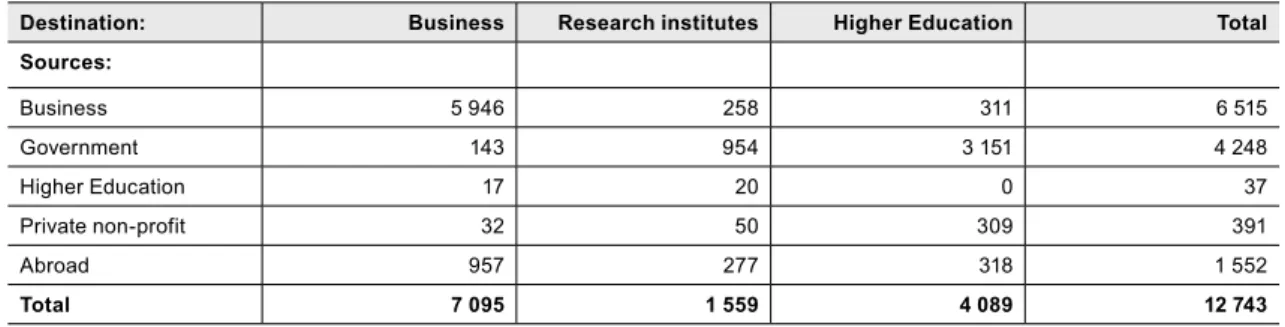
working and for studying. But specifically for R&D expenditure, the Netherlands does not compare well internationally. The total expenditure on R&D in the Netherlands amounted to no more than 1.98% of gross domestic product (GDP) in 2013, which is still far below the Dutch government’s objective of 2.5% of GDP in 2020.23 In absolute terms, companies, higher
education institutes and research institutes in the Netherlands spent EUR 12.7 billion on intramural R&D in 2013 (Table 1). The business sector contributed the most funding (EUR 6.5 billion or 51%) and also performed the most research (EUR 7.1 billion or 56%). In international comparison the Dutch business sector is not very R&D intensive (1.14% of GDP, well below the OECD average of 1.64% in 2013). This is partly related to the structure of the Dutch economy in which the services sector plays a large role. If the Netherlands were to have an average OECD industrial structure, the adjusted business R&D intensity for the Netherlands would be above the OECD average of 2.5% of GDP.24 That said, it remains an important policy objective of the
Dutch government to increase the R&D intensity (and sector structure) of the Dutch economy in order to ensure the future competitiveness and innovativeness of the Dutch knowledge
economy.
22 According to the KPMG report “Investment in the Netherlands” (KPMG, 2014), the attractiveness of the Netherlands as an investment location is related to factors such as a stable economy, a reliable and equitable tax regime, a sophisticated, internationally oriented infrastructure, a society and culture of openness – both to outsiders and to new ideas, stable industrial relations, a productive and well-educated workforce and excellent IT connectivity. The Netherlands plays an important role as a European transportation hub. 23 Source of the data used in this section is the website ‘De Nederlandse Wetenschap’ of the Rathenau Instituut. (http://www.rathenau.nl/
nc/web-specials/de-nederlandse-wetenschap.html). It uses data from Statistics Netherlands CBS and OECD. 24 OECD (2013: 220).
Table 1 R&D expenditure in the Netherlands by funding source and sector of performance in 2013 (in million euro)
Destination: Business Research institutes Higher Education Total
Sources: Business 5 946 258 311 6 515 Government 143 954 3 151 4 248 Higher Education 17 20 0 37 Private non-profit 32 50 309 391 Abroad 957 277 318 1 552 Total 7 095 1 559 4 089 12 743
2.2 R&D funding from abroad
Table 1 shows that R&D funding from abroad plays a significant role within the Netherlands at EUR 1,552 million in 2013. This amounts to 12.2% of the total gross domestic expenditures on R&D of EUR 12.7 billion in 2013. In relative terms the share that is financed from abroad has increased in the past decades from 5.3% in 1993, to 10.8% in 2003, and to 12.2% in 2013.25
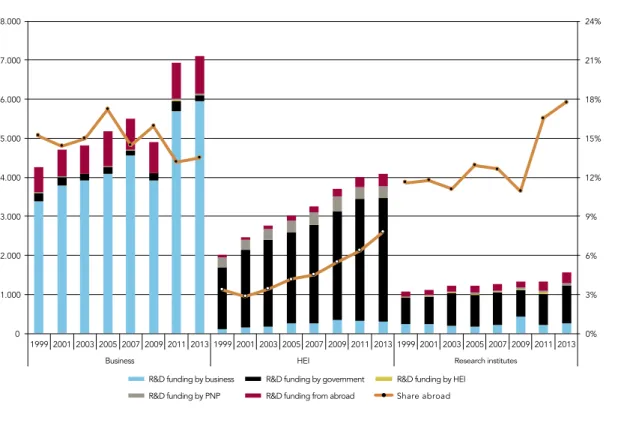
A historical perspective on R&D expenditure in the Netherlands (Figure 1) shows that while R&D funding from abroad for the business sector increased in absolute terms, it decreased in relative terms. The share of R&D funding from abroad dropped from 15.2% to 13.5% in the period 1999-2013. The R&D funding from abroad cannot keep pace with the growth in domestic R&D funding sources. In contrast, the share of R&D funding from abroad increased rapidly for the Higher Education Institutes sector (from 3.4% to 7.8%) and the Research Institutes sector (from 11.6% to 17.8%) in the same period.
25 See the website ‘De Nederlandse Wetenschap’ of the Rathenau Instituut (http://www.rathenau.nl/fileadmin/user_upload/rathenau/ De_Nederlandse_Wetenschap/F-Financiering-uitvoering_van_R_D_vanaf_1990_CBS_.xlsx).
Source: Data on the funding of R&D performed by companies, higher education institutes (HEI) and research institutes in the Netherlands are from the website ‘De Nederlandse Wetenschap’ of the Rathenau Instituut which uses data from Statistics Netherlands CBS and OECD. The data are retrieved from http://www.rathenau.nl/fileadmin/user_upload/rathenau/De_Nederlandse_Wetenschap/ F-Financiering-uitvoering_van_R_D_vanaf_1990_CBS_.xlsx.
Figure 1 Evolution of R&D expenditure in the Netherlands by funding source and sector of performance in 1999-2013 (in million euro)
Funding sources from abroad are particularly substantial for the business sector, which is not surprising given that most of these cross-border funding streams concern flows within MNCs. OECD data show that foreign affiliates perform an increasingly large share of R&D in the Netherlands. At the turn of the century, the share of foreign-affiliated R&D in the total business expenditures in the Netherlands was around one-fifth of the total (21.5% in 1999) and by 2011 it had risen to almost one-third (32.5%).26
26 See Figure 1.10 in OECD (2014b).
Source: Data on the funding of R&D performed by companies, higher education institutes (HEI) and research institutes in the Netherlands are from the website ‘De Nederlandse Wetenschap’ of the Rathenau Instituut which uses data from Statistics Netherlands CBS and OECD. The data are retrieved from http://www.rathenau.nl/fileadmin/user_upload/rathenau/De_Nederlandse_Wetenschap/ F-Financiering-uitvoering_van_R_D_vanaf_1990_CBS_.xlsx. Rathenau Instituut 0% 3% 6% 9% 12% 15% 18% 21% 24% 0 1.000 2.000 3.000 4.000 5.000 6.000 7.000 8.000 1999 2001 2003 2005 2007 2009 2011 2013 1999 2001 2003 2005 2007 2009 2011 2013 1999 2001 2003 2005 2007 2009 2011 2013
Business HEI Research institutes
R&D funding by business R&D funding by government R&D funding by HEI R&D funding by PNP R&D funding from abroad Share abroad
2.3 Outward R&D funding
Obviously, R&D funding does not only come from abroad, it also goes abroad. The share of R&D expenditure by Dutch-based firms outsourced to firms or institutes abroad has increased significantly from EUR 417 million in 1999 to EUR 1559 million in 2013.27 Figure 2 shows the
developments in the destinations of business R&D expenditure in the period 1999-2013.
Figure 2 Destinations of R&D expenditure by firms based in the Netherlands in the period 1999-2013
27 This outsourcing of R&D is dominated by cross-border funding flows within MNCs with foreign affiliates that perform R&D. Source: CBS StatLine (For 1999-2009: http://statline.cbs.nl/Statweb/publication/?DM=SLNL&PA=81244NED&D1=4&D2=1&D3=a&VW=T; for 2011-2013: http://statline.cbs.nl/Statweb/publication/?DM=SLNL&PA=82042NED&D1=a&D2=a&D3=a&VW=T). 0% 2% 4% 6% 8% 10% 12% 14% 16% 18% 20% 0 1.000 2.000 3.000 4.000 5.000 6.000 7.000 8.000 9.000 10.000 1999 2001 2003 2005 2007 2009 2011 2013
R&D performed by companies R&D performed by research institutes R&D performed by higher education institutes R&D outsourced abroad % R&D outsourced abroad
Source: Data on the business R&D funding of R&D performed by companies, by research institutes and by higher education institutes are from the website ‘De Nederlandse Wetenschap’ of the Rathenau Instituut which uses data from Statistics Netherlands CBS and OECD. The data are retrieved from http://www.rathenau.nl/fileadmin/user_upload/rathenau/De_Nederlandse_
Wetenschap/F-Financiering-uitvoering_van_R_D_vanaf_1990_CBS_.xlsx.
Data on the R&D outsourced abroad by companies in the Netherlands are from CBS StatLine. Data are retrieved from http://statline.cbs.nl/Statweb/publication/?DM=SLNL&PA=81244NED&D1=4&D2=1 &D3=a&VW=T (1999-2009) and http://statline.cbs.nl/Statweb/publication/?DM=SLNL&PA=82042NED &D1=a&D2=a&D3=a&VW=T (2011-2013).