AWARENESS ON BIODIVERSITY AMONG HIGHER
SECONDARY STUDENTS IN VILATHIKULAM AREA
S. Chandrasekar*
C. Sundaravadivelan**
A. Selvan***
__________________________________________________________
Abstract
In the Present study investigator attempt to find out the significance difference of various groups of sex, student residents, type and nature of School in awareness on Biodiversity among Higher Secondary students in Vilathikulam area. The investigator himself developed a questionnaire on identifying awareness on Biodiversity. The sample consists of 240 School students from Govt., aided and Self-finance Schools in Vilathikulam area. The Stratified Random sampling technique is used for collecting data. In this study the Researcher adopted the Normative Survey Method. The data were analyzed using„t‟ test. The major finding of study reveals that the school students in Vilathikulam area have average level of awareness on biodiversity. At the same time female students have more awareness than male students.
* Sudharsan College of Education, Perumanadu, Pudukkottai. ** Department of Zoology, Karpagam University, Coimbatore. *** Department of Education, Alagappa University, Karaikudi.
Introduction
Biodiversity describes the number, variety and variability of living organisms. Biodiversity leads to stability of the ecosystem. In the process of biological evolution many small and big animals and plants were born and many were rained for ever due to climatic change, earth quake, volcanic eruptions and other natural disasters. Species which could adapt themselves with the changing circumstances survive still; dinosaurs that could not adapt had dwindled away.
Biodiversity of an ecosystem or of a geographical area includes various kinds of trees, plants, animals, birds, insects and even micro-organisms. It has been estimated that in the great store house of the earth‟s biodiversity. The environmental science is being incorporated in the school curriculum in various countries all over the world. The environmental education curriculum and its implementation in different Asian countries and in India are also reported.
The various research findings revealed that the achievement level is low especially higher secondary level due to lack of effective teaching to enhance the achievement level, various effective teaching strategies were adopted by different researcher. The tropical forest areas are the richest store houses of biodiversity. Biodiversity is the foundation of life on earth. It is crucial for the functioning of ecosystems which provide us with products and services without which we couldn‟t live. Oxygen, food, freshwater, fertile soil, medicines, shelter, protection from the storms and floods, stable climate and recreation, all have their source in nature and healthy ecosystems.
Biodiversity is extremely complex, dynamic and varied like no other feature of the earth. Its innumerable plants, animals and microbes physically and chemically unite the atmosphere (the mixture of gases around the earth), geosphere (the solid part of the earth), and hydrosphere (the earth water, ice and water vapour) into the environmental system which makes it possible for millions of species, including people, to exist.
Biodiversity plays a major role in many ecosystem services such as replenishing oxygen through photosynthesis, pollination through bees, bumble bees, birds and bats etc. regulation of global climate, storage and retention of rainwater in aquifers and reservoirs. Control of floods and soil erosion, nutrient cycling, microbial waste treatment, biological control of pests was documented.
The present syllabus of natural science for higher secondary course does not deal with the
about conservation of plants and animals and therefore students have low level of awareness on biodiversity. In order enhance their knowledge level in biodiversity, the investigator made an attempt to identify the awareness level of students in biodiversity and to promote the same.
Objectives
The following objectives are preferred to conduct this study
1. To identify the key concepts of biodiversity from various sources
2. To find out the level of awareness on biodiversity among higher secondary students of
Vilathikulam area.
3. To find out the significant difference if any between the different groups of demographic
variables such as – sex, student residence, location of school, types and nature of school in awareness on biodiversity.
4. To give suggestions to improve the level of awareness on biodiversity among higher
secondary students.
Hypotheses of the present study
1. The level of awareness on biodiversity among higher secondary students is very low.
2. There is a significant difference between the different groups of sex, student residence, and
location of school, types and nature of school in awareness on biodiversity among higher secondary students studying in and around Vilathikulam area.
3. Higher secondary students who are residing in rural are have more awareness on biodiversity.
4. Female students studying in various higher secondary schools located in Vilathikulam area
have more awareness on biodiversity.
Research method
The investigator preferred normative survey method to collect data from the higher secondary students of in and around Vilathikulam area.
The investigator employed simple random sampling technique in order to collect data from the students studying at higher secondary level.
Research tools
The investigator himself developed a questionnaire on identifying awareness on biodiversity among higher secondary students.
Statistical techniques used
The data had been subjected to: 1. Descriptive analysis
2. Differential analysis
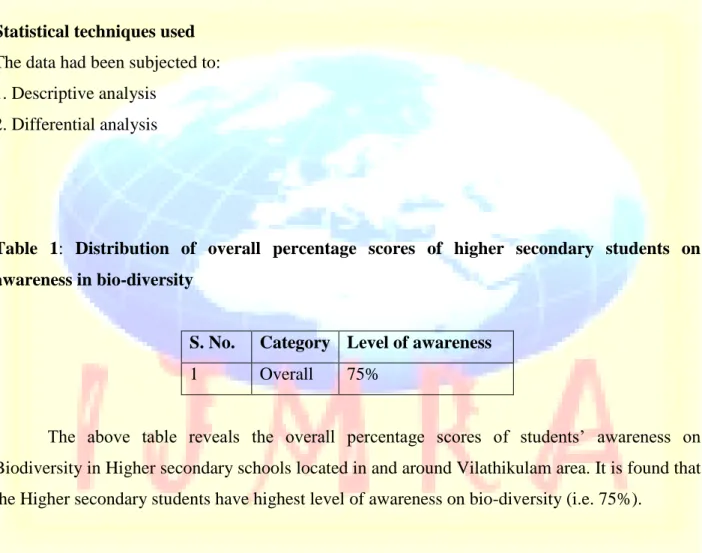
Table 1: Distribution of overall percentage scores of higher secondary students on awareness in bio-diversity
S. No. Category Level of awareness
1 Overall 75%
The above table reveals the overall percentage scores of students‟ awareness on Biodiversity in Higher secondary schools located in and around Vilathikulam area. It is found that the Higher secondary students have highest level of awareness on bio-diversity (i.e. 75%).
Table 2: Significance of mean difference between the boys and girls in connection with the awareness on bio-diversity in higher secondary schools located in and around Vilathikulam area.
S.No. Gender Mean SD N ‘t’ value Level of Significance
1 Boys 36.72 6.05 90
1.33 Not significant
df = 238
The above table reveals the significant mean difference between boys and girls on
awareness in Biodiversity.
It is found that the calculated „t‟ value of 1.33 is lesser than the theoretical value of
1.97 at 5% level with 238 Degrees of freedom.
There is no significant mean difference between boys and girls awareness on
Bio-diversity in Higher secondary schools located in and around Vilathikulam Area and therefore the research hypothesis is not accepted.
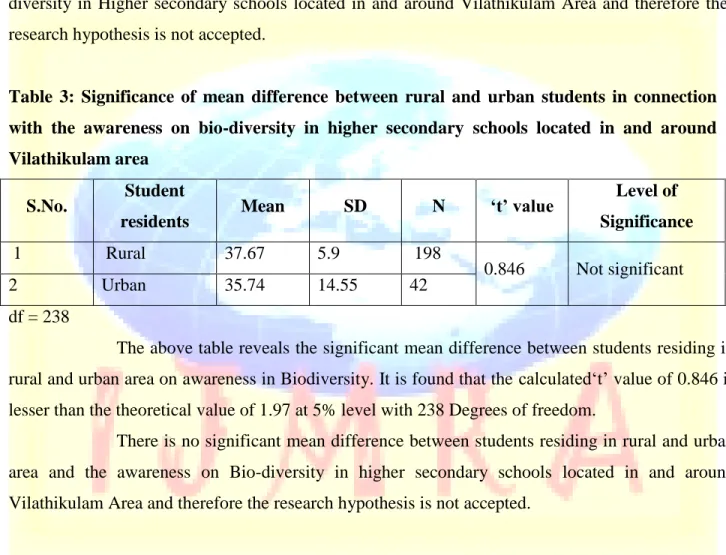
Table 3: Significance of mean difference between rural and urban students in connection with the awareness on bio-diversity in higher secondary schools located in and around Vilathikulam area
S.No. Student
residents Mean SD N ‘t’ value
Level of Significance 1 Rural 37.67 5.9 198 0.846 Not significant 2 Urban 35.74 14.55 42 df = 238
The above table reveals the significant mean difference between students residing in
rural and urban area on awareness in Biodiversity. It is found that the calculated„t‟ value of 0.846 is lesser than the theoretical value of 1.97 at 5% level with 238 Degrees of freedom.
There is no significant mean difference between students residing in rural and urban
area and the awareness on Bio-diversity in higher secondary schools located in and around Vilathikulam Area and therefore the research hypothesis is not accepted.
Table 4: Significance of mean difference between the students in government school and government aided school in connection with the awareness on bio-diversity in higher secondary schools located in and around vilathikulam area.
S.No. Types of School Mean SD N ‘t’
value
Level of Significance
2 Aided school 37.58 6.25 60 significant df = 178
The above table reveals the significant mean difference between government school and
government aided school on awareness in Biodiversity. It is found that the calculated „t‟ value of 0.1326 is lesser than the theoretical value of 1.97 at 5% level with 178 degrees of freedom.
There is no significant mean difference between Government school and government
aided school students‟ awareness on Bio-diversity in Higher secondary schools located in and around Vilathikulam Area and therefore the research hypothesis is not accepted.
Table 5: Significance of mean difference between the students in government school and private school in connection with the awareness on bio-diversity in higher secondary schools located in and around Vilathikulam area.
S.No. Types of School Mean SD N ‘t’ value Level of
Significance 1 Government school 37.71 6.1 120 1.256 Not significant 2 Private school 36.58 5.55 60 df = 238
The above table reveals the significant mean difference between government school
and private school on awareness in Biodiversity. It is found that the calculated„t‟ value of 1.256 is lesser than the theoretical value of 1.97 at 5% level with 238 Degrees of freedom.
There is no significant mean difference between students in government school and
private school awareness on Bio-diversity in higher secondary schools located in and around Vilathikulam Area and therefore the research hypothesis is not accepted.
Table 6: Significance of mean difference between the students in private school and aided school located in and around Vilathikulam area in connection with the awareness on bio-diversity
S.No. Types of School Mean SD N ‘t’ value Level of
Significance
1 Private school 36.58 5.55 60
0.9628 Not
significant
df = 238
The above table reveals the significant mean difference between private school and
aided school on awareness in Biodiversity.
It is found that the calculated„t‟ value of 0.9628 is lesser than the theoretical value
of 1.97 at 5% level with 238 Degrees of freedom.
There is no significant mean difference between students in private school and
aided school and their awareness on Bio-diversity in and around Vilathikulam Area and therefore the research hypothesis is not accepted.
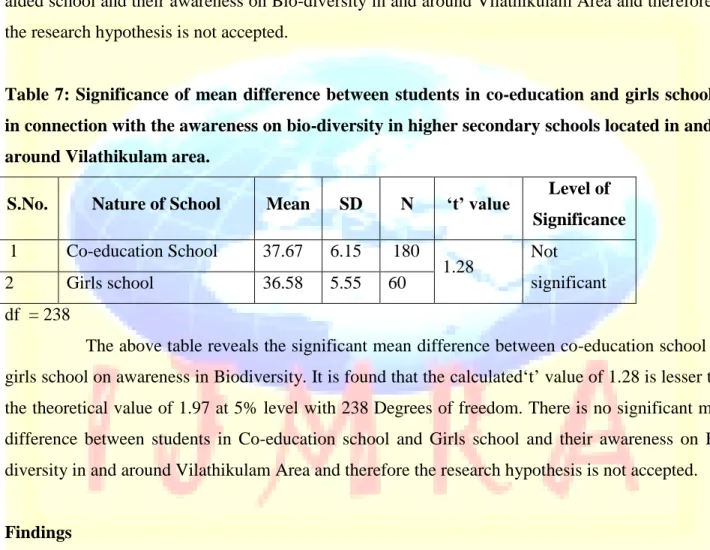
Table 7: Significance of mean difference between students in co-education and girls school in connection with the awareness on bio-diversity in higher secondary schools located in and around Vilathikulam area.
S.No. Nature of School Mean SD N ‘t’ value Level of
Significance 1 Co-education School 37.67 6.15 180 1.28 Not significant 2 Girls school 36.58 5.55 60 df = 238
The above table reveals the significant mean difference between co-education school and
girls school on awareness in Biodiversity. It is found that the calculated„t‟ value of 1.28 is lesser than the theoretical value of 1.97 at 5% level with 238 Degrees of freedom. There is no significant mean difference between students in Co-education school and Girls school and their awareness on Bio-diversity in and around Vilathikulam Area and therefore the research hypothesis is not accepted.
Findings
1) The higher secondary students who are studying in higher secondary schools of
Vilathikulam area have highest level awareness on Bio-diversity (i.e. 75%).
2) Boys and girls students‟ awareness on biodiversity in higher secondary schools located in
and around Vilathikulam area are found to be same.
3) The students residing in rural and urban areas have awareness on Biodiversity in Higher
4) The Government school and Government Aided school students‟ awareness on Biodiversity in Higher secondary schools located in and around Vilathikulam area are found to be same.
5) Government school and private school students‟ awareness on Biodiversity in Higher
secondary schools located in and around Vilathikulam area are found to be same.
6) Private school and aided school students‟ awareness on Biodiversity in Higher secondary
schools located in and around Vilathikulam area are found to be same.
7) Co-education school and girls school students‟ awareness on Biodiversity in Higher
secondary schools located in and around Vilathikulam area are found to be same.
Conclusion
Biological diversity or biodiversity is a term we use to describe the variety of life
on earth. It refers to the wide variety of ecosystems and living organisms, animals, plants, their habitats and their genes. In order to identify the level of awareness on biodiversity, the study has been undertaken by investigator. The findings of this study conclude that both male and female students have average level of awareness on biodiversity. And at the same time, female students have more awareness than male students. Therefore special training programmes and other educational programmes may be offered to male students in order to enhance their level of awareness.
The suggestions were given may be helpful for the curriculum designer of
textbook for colleges and schools. This research study may help future students and they will be benefited lot by developing the basic investigation on bio-diversity.
Reference
Cunningham, Cunningham and Saigo (2003), “Environmental Science – A Global Concern”, McGraw Hill Higher Education, New York.
Maryam Larijani (2010), “Assessment of Environmental Awareness among Higher primary school teachers”, J. Hum. Eco, 31(2) P.121-124.
Saha (2007), “Ecology and Environmental biology”, Books and Allied (P) Ltd., Kolkata, p.498-503.
Shukla and Chandel (1972) “Plant ecology and soil science”, S.Chand and Company Ltd., New Delhi, p.370-378.
Ramadoss and Poyyamoli (2011), “Biodiversity conservation through environmental education for sustainable development: A case study from Puducherry India”, International Electronic Journal of Environmental Education, Vol.1, Issue 2.