Modeling of Motion Primitive
Architectures using Domain-Specific
Languages
by
Dipl.-Ing. Arne Nordmann
Dissertation Faculty of Technology
Bielefeld University
to the most wonderful family one can wish for to the friends and colleages who joined me on this crazy journey they call doing a phd
Abstract
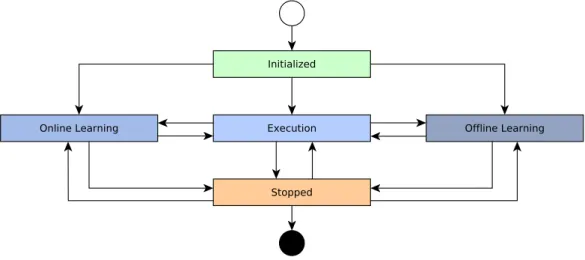
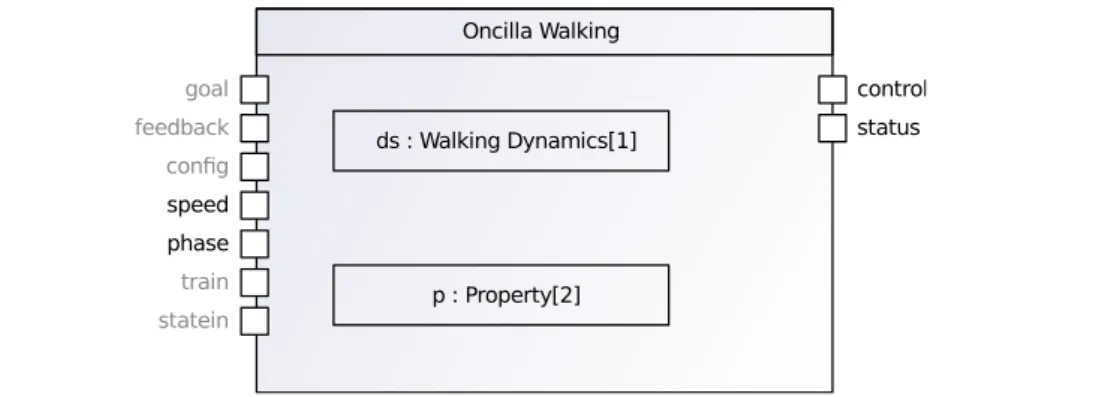
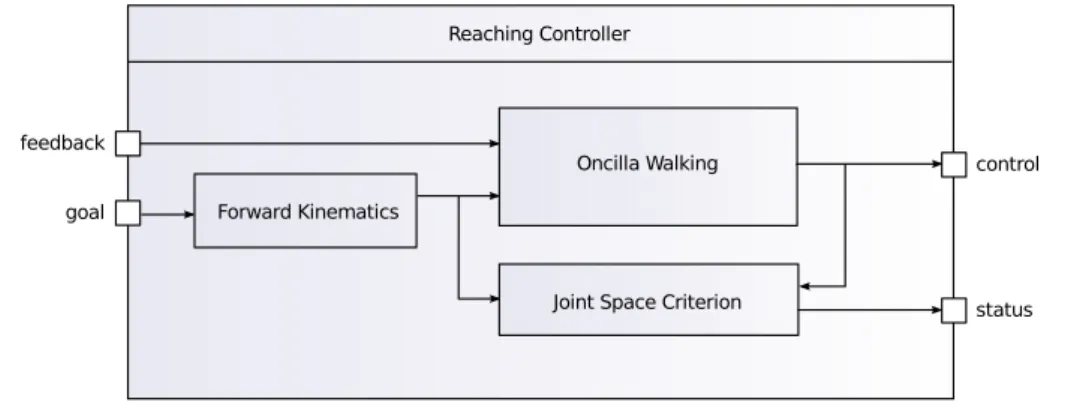
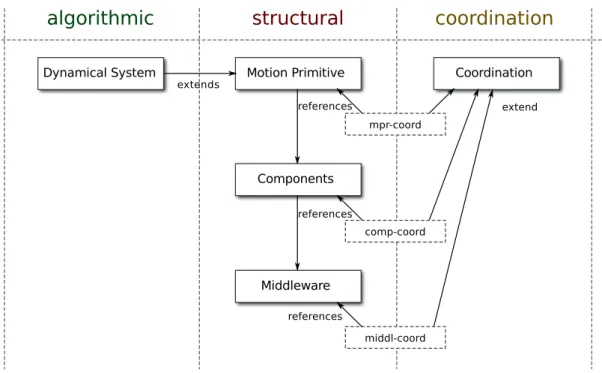
Many aspects in robotics, and their omnipresent ideal models, animals and humans, are still not understood or explored well enough, for example producing motions of animal- and human-like complexity. To explore the inner workings of systems studying this complexity, the essential concepts of interest need to be made explicit and raised from the code-level to a higher level of abstraction to be able to reason about them.
This work introduces a model-driven engineering approach for complex movement control architectures based on motion primitives, which in recent years have been a central development towards adaptive and flexible control of complex and compliant robots. The goal is to realize rich motor skills through the composition of motion primitives. This thesis proposes a design process to analyze the control architectures of representative example systems to identify common abstractions. Identified and formalized concepts can then be used to automate software development of motion primitive architectures through model-driven engineering methods and domain-specific languages. It turns out that the introduced notion of motion primitives implemented as dynamical systems with machine learning capabilities, provide the computational building block for a large class of such control architectures. Building on the identified concepts, a set of modularized domain-specific languages allows the compact specifica-tion of mospecifica-tion primitive architectures. This paves the way for domain experts rather than computing technology specialists to produce systems, which is one of the main goals of this work.
The approach and the accompanying model-driven engineering toolchain is evalu-ated in a task of the European Robotics Challenges (EuRoC) and a real world ex-ample of automatic laundry grasping with the KUKA Lightweight Robot IV, where executable source-code is automatically generated from the domain-specific language specification.
Contents
List of Figures vii
List of Tables ix
I. Introduction 1
1. Introduction 3
1.1. Problem Statement . . . 3
1.2. Contribution and Research Questions . . . 5
1.3. Outline . . . 7
II. Conceptual Perspective 11 2. Model-Driven Engineering in Robotics 13 2.1. Model-Driven Engineering . . . 13
2.2. Domain-Specific Languages . . . 16
2.3. State of the Art . . . 19
2.4. Design Processes . . . 22
2.5. Discussion . . . 23
3. Motion Primitive Architectures 25 3.1. Motion Primitives . . . 26
3.2. Learning Motion Primitives . . . 27
3.3. Domain Analysis and Related Work . . . 28
3.4. Discussion . . . 34
4. Model-Driven Engineering for Motion Primitive Architectures 37 4.1. Project and Domain Context . . . 37
4.2. Objectives and Requirements . . . 39
4.3. Process . . . 41
III. Developer Perspective 45
5. Technology-independent Architecture and Metamodel 47
5.1. Structural Models . . . 48
5.2. Behavioral Models . . . 57
5.3. Algorithmic Models . . . 59
5.4. Discussion . . . 60
6. Language Modularization and Design 63 6.1. Language Workbenches . . . 64
6.2. Language Modularization . . . 65
6.3. Language Design . . . 69
6.4. Transformations . . . 79
6.5. Discussion . . . 83
7. Programming Model and Technology Mapping 85 7.1. Programming Model . . . 86
7.2. Technology Mapping . . . 91
7.3. Mock Platforms and Vertical Prototypes . . . 93
7.4. Deployment Descriptors . . . 96
7.5. Discussion . . . 97
IV. User Perspective 101 8. Toolchain 103 8.1. Integrated Development Environment . . . 103
8.2. Validation . . . 105
8.3. Component Repository . . . 106
8.4. Code Generation . . . 107
8.5. Deployment . . . 111
8.6. Discussion . . . 112
9. Modeling Motion Primitive Architectures 115 9.1. Hypothesis Test Cycle . . . 116
9.2. Discussion . . . 124
10. Evaluation and Application 125 10.1. Qualitative Evaluation . . . 126
10.2. Quantitative Evaluation . . . 134
10.3. Discussion . . . 135
V. Conclusion 137 11. Conclusion 139 11.1. Summary . . . 139 11.2. Outlook . . . 141 References 143 VI. Appendix 155
A. Related References by the Author 157
B. Domain Analysis 159
B.1. Feature Models . . . 159 B.2. Adaptive Module Survey . . . 163
List of Figures
1.1. Left hand trajectories generated with a motion primitive. . . 4
1.2. A typical modeling approach with DSLs. . . 6
1.3. Outline . . . 7
2.1. Four levels of modeling, from meta-metamodel to GPL code. . . 14
2.2. Language and fragment dependencies of language modularization types. 18 3.1. Example of a motion primitives on the iCub robot. . . 27
3.2. Context diagram of motion architectures. . . 30
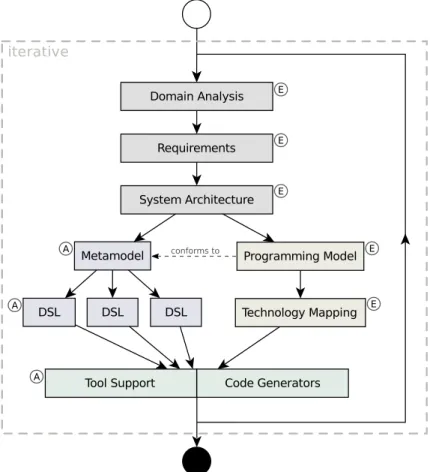
4.1. Proposed design process . . . 42
5.1. Quadruped robot Oncilla in simulation. . . 48
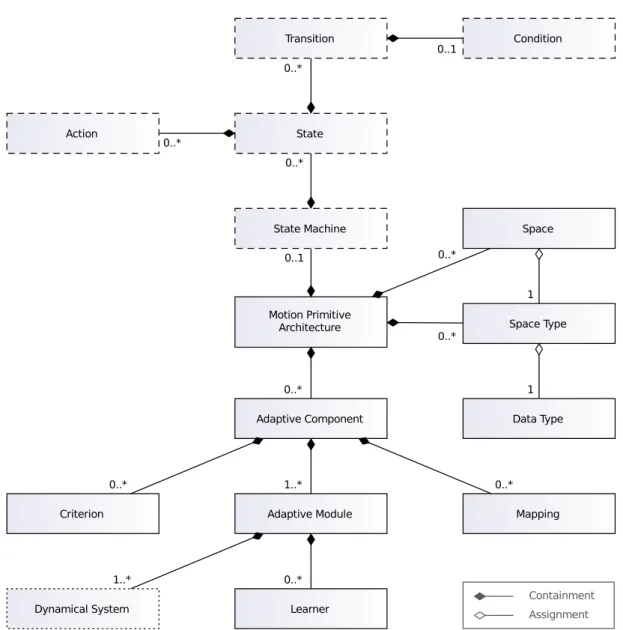
5.2. Main abstractions and relations of the motion primitive architecture. . 49
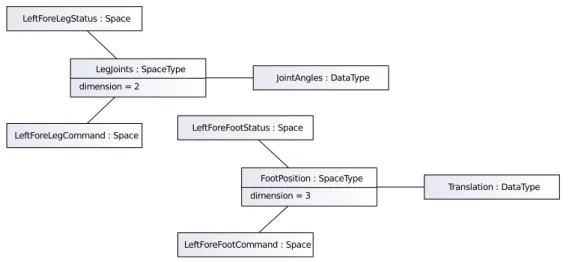
5.3. Object diagram of Spaces, Space Types, and Data Types . . . 50
5.4. Specializations of Mappings and Transformations. . . 51
5.5. Inverse Kinematics Mapping for Foot Position and Leg Joints. . . 52
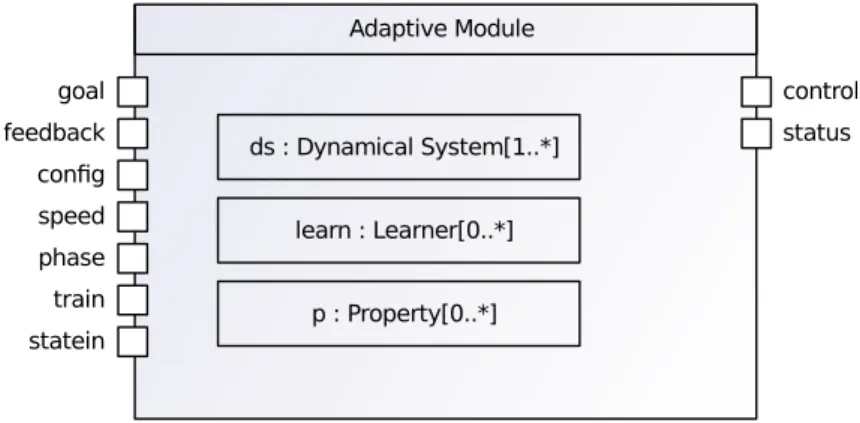
5.6. Composite structure diagram of an Adaptive Module. . . 53
5.7. Adaptive Module lifecycle . . . 54
5.8. Adaptive Module for the walking dynamics . . . 55
5.9. Specializations of the Adaptive Component concept. . . 56
5.10. Reaching Controller for placement of the left fore foot. . . 57
5.11. Metamodel of the behavioral aspects. . . 58
5.12. Metamodel of the algorithmic aspects. . . 59
5.13. Specializations of the Expression concept. . . 60
5.14. Reaching dynamics expressed in the algorithmic model . . . 62
6.1. Parser-based approaches vs. projectional editing. . . 65
6.2. Language modularization and their dependencies. . . 66
6.3. Metamodel of the Component DSL. . . 67
6.4. Language composition of the Primitive Coordination DSL. . . 68
6.5. Language design aspects in Jetbrains MPS. . . 70
6.6. Language structure definition in MPS. . . 72
6.7. Language editor definition in MPS. . . 73
6.8. DSL expression of structural motion primitive architecture aspects. . . 75
6.9. Dynamical System DSL integrated into the Motion Primitive DSL. . . 76
6.10. Integration of domain concepts with the MPS base language. . . 77 6.11. Coordination DSL snippet with Primitive Coordination DSL extensions. 78
6.12. Model-to-model transformations. . . 79
6.13. Transforming an Adaptive Module to a Component. . . 82
6.14. Generator rule to map a Coordination DSL state to SCXML. . . 83
7.1. Class diagram of the programming model. . . 86
7.2. Mapping of a Reaching Controller to Component DSL concepts. . . . 88
7.3. Domain-specific programming model . . . 89
7.4. Technology mapping for the structural aspects. . . 92
7.5. Technology mapping for the behavioral aspects . . . 93
7.6. Oncilla roundtrip. . . 94
7.7. The Dynamical System in the running example replaced by the MVITE. 98 7.8. Levels of modeling in relation to the deployment descriptors. . . 99
8.1. Customized, MPS-based IDE themed for the AMARSi project. . . 104
8.2. Screenshot of the DSL IDE editor view. . . 105
8.3. Using models from the repository in the DSL IDE. . . 106
8.4. Model-to-text transformations. . . 107
8.5. Auto-generated visualization of the coordination of the running example.108 8.6. MSM transformation rule for the Robot Converged condition. . . 109
8.7. TextGen rules for C++ main file generation. . . 110
8.8. Toolchain and software builds on continuous integration server. . . 111
9.1. Hypothesis Test Cycle . . . 117
9.2. Data Type incompatibility solved by adding a suitable Mapping. . . . 120
9.3. Space annotations of middleware scopes. . . 121
9.4. Space annotations of transport configuration. . . 122
10.1. Task 4 of the Shop Floor Logistics and Manipulation task . . . 127
10.2. Example State using Middleware Coordination DSL extensions. . . 129
10.3. Example State using Primitive Coordination DSL extensions. . . 130
10.4. Automated laundry handling use case. . . 131
10.5. System visualization of the laundry handling use case . . . 133
B.1. . . 160
B.2. . . 162
List of Tables
10.1. Total source lines of code of the system specification in the proposed domain-specific languages (DSLs) and with the targeted technology mapping. . . 135 B.1. Exemplary completion of the Adaptive Modules survey for the
Part I.
Chapter 1.
Introduction
“What I cannot make, I do not understand” – Richard Feynman This quote by physicist Richard Feynman sets the tone for this thesis. Feynman meant here that understanding something is not just about working through advanced mathematics. “One must also have a notion that is intuitive enough to explain to an audience that cannot follow the detailed derivation.” Feynman’s position was some-what radical: Once, a colleague of Feynman said to him:
“Explain to me, so that I can understand it, why spin one-half particles obey Fermi-Dirac statistics.” Feynman said, “I’ll prepare a freshman lecture on it.” However, he came back a few days later to say, “I could not do it. I could not reduce it to the freshman level. That means we do not really understand it.”
Lots of aspects in robotics, and their omnipresent ideal models, animals and humans, are still not understood or explored well enough. To explore the inner workings of such complex systems, however, producing hundreds and thousands of lines of source code, constructing then-th prototype with isolated functionality is certainly not the answer, as it hides the essential concepts behind general-purpose language source code. Yet, this approach is still fashionable in robotics.
This thesis aims at an environment where formulation of scientific problems and their solution hypotheses is done in natural notation with domain-specific languages. Technological support then allows validation of these on real executable robotics sys-tems without the need to read hundreds and thousands of lines of source code or write them by hand.
1.1. Problem Statement
The current state of affairs in robotics research is still to a large extent building on isolated islands of functionality that are implemented by hand. One of the problems with this kind of development is that manual implementation takes time, requires software development skills, and is inherently error-prone. This is especially hard since robotics is an inter-disciplinary field, requiring handling of multiple disciplines and technologies to create a working system. Experts of a certain discipline (i.e. “domain experts”) often either need to learn the necessary software development skills, or software developers need to be trained in a certain domain, learn about the essential
Chapter 1. Introduction
(a) The iCub humanoid robot performing a motion primitive in simulation.
−0.1 −0.08 −0.06 −0.04 −0.02 0 −0.1 −0.05 0 0.05 0.1 −0.1 −0.05 0 0.05 0.1 u 1[m] u 2[m] u3 [m] target start generated movements
(b) Left hand trajectories generated with a mo-tion primitive from various starting points to the same target point.
Figure 1.1.: Left hand trajectories generated with a motion primitive and executed on the iCub humanoid robot to execute a reaching motion.[Reinhart and Steil, 2011]
questions, concepts and methods, in order to realize an executable robotics system to test a certain scientific hypothesis.
The domain targeted by this thesis is the domain of robotics movement architectures based on so-called motion primitives. Motion primitives resemble building blocks of complex motions that can generalize to new situations or environments and are robust to perturbations. Motion primitives as flexible and adaptive building blocks for complex motion skills build on insights from biology that suggests that complex motions in animals and humans arise from the composition of these primitives [Bizzi et al., 2008]. Animals and humans orchestrate a vast number of muscles to move in a very flexible way and to optimize complex motions for each task. By using the representation of motion primitives, the need to generate detailed trajectories for all variables of all muscles is reduced.
Applying this theory to the field of robotics is motivated by the idea that accordingly the large number of parameters of all degrees of freedom in an advanced compliant robot and the according computational requirements can be handled through com-putational building blocks that mimic their biological counterparts. An example of a motion primitive reproducing a motion on a robot is shown in Fig. 1.1. A motion primitive with a trained movement shape reproduces a motion of the robot hand from varying start points to the same target point with the trained dynamics that determine the shape of the motion, e.g., for grasping. Combination, sequencing, and composition of several of such modular movement building blocks then form complex, rich motions that can be adapted to various tasks and environments.
Several research projects in the domain of motion primitives based movement gener-ation in robotics already successfully applied this idea, combining discrete and periodic movements to, e.g., catch objects in flight [Shukla and Billard, 2011], walk a quadruped
1.2. Contribution and Research Questions
robot on unperceived rough terrain [Ajallooeian et al., 2013], and a humanoid robot dancing [Nakaoka et al., 2004] or drumming [Degallier et al., 2006]. This domain, however, shares the overall problem of robotics research, being dominated by single, yet incompatible, and handcrafted experiments and solutions [Nordmann and Wrede, 2012]. This means that tremendous code-bases (robotic frameworks, tools, libraries, middleware systems, etc.) coexist without interoperability, which is the base hypoth-esis for motion primitive, though.
This calls for a unifying conceptual framework, which allows the combination of different experiments and their motion primitives to explore the design space of motion control architectures. This is challenging both because of the intrinsic complexity of the underlying control problems and due to the conceptual fragmentation of the domain.
1.2. Contribution and Research Questions
The problems discussed above indicate that research in motion primitive architectures for robotics, especially combination of motion primitives, needs support. Model-driven engineering methods [Schmidt, 2006] are known to cope with the challenges of build-ing complex heterogeneous systems in domains such as aerospace, telecommunication and automotive [van Deursen et al., 2000], which face similarly complex integration and modeling challenges as advanced robotics. Model-driven engineering (MDE) ap-proaches primarily focus on creating and exploiting domain models, i.e., conceptual models of the topics related to a specific problem. A model in this sense represents a particular viewpoint or perspective of a concept. It is“an abstraction of a system often used to replace the system under study” [Rodrigues da Silva, 2015] and is created with the purpose to reason about its properties and relationships. In recent years, several model-driven engineering approaches have been adapted to the robotics domain [Nord-mann et al., 2014], yet not to the domain of motion primitive architectures.
A particularly promising method in the field of MDE is to formalize the domain knowledge with so-calleddomain-specific languages (DSLs) and thereby make it avail-able for automating development of executavail-able robotics systems. A domain-specific language (DSL) is a “programming language or executable specification language that offers, through appropriate notations and abstractions, expressive power focused on, and usually restricted to, a particular problem domain” [van Deursen et al., 2000]. The abstractions are “natural/suitable for the stakeholders who specify that particular concern” [V¨olter et al., 2013]. The concrete syntax of a DSL enables higher under-standability and efficiency because the syntax and notation is closer to the problem domain than general-purpose languages (GPLs).
Fig. 1.2 shows a typical DSL based modeling approach as it is targeted by this work. The metamodel defines the concepts and abstractions to cover the domain, such as motion primitive architectures in this work. A DSL adds a concrete, e.g., textual or graphical, syntax to the metamodel and allows formulation of domain models, i.e. a concrete system or application. The actual executable robotics system can be created
Chapter 1. Introduction
Figure 1.2.: A typical modeling approach with DSLs: The DSLs add a concrete syntax to a metamodel and are used to implement a concrete domain model. Code generation is one approach to make the domain models executable.
from the domain models, e.g., by means of code generation.
This thesis aims at a development process that lifts specification of motion primitive architectures from general-purpose language code level to a higher level of abstraction in terms of the essential concepts of this domain. If this specification is formalized, e.g., with the help of domain-specific languages, it can be technologically supported to allow validation of these architectures and their execution on real robotics systems without the need to understand general-purpose language source code or write it by hand. Therefore, the overarching goal of this thesis is to
establish a model-driven engineering process to efficiently bootstrap and exploit motion primitive architectures in order to ease and speed-up re-search for experts of the domain.
To the best of the author’s knowledge, no such process or DSL for motion primitive architectures in advanced robotics exists so far. The following research questions will be investigated and discussed in the course of this thesis to pursue this goal:
RQ1 Can the complex domain of motion primitive architectures consisting of advanced robotics hardware, distributed software, dynamical systems, and machine learn-ing approaches be exploited and supported by means of model-driven engineerlearn-ing methods?
RQ2 Do these methods make the domain accessible for efficient development processes to ease creation and execution of motion primitive experiments on real robot systems for domain-experts?
RQ3 Can these methods be open and flexible enough to allow continued research in the domain while at the same time producing stable systems for experimentation? RQ4 Can legacy work in terms of both, established development processes as well as
existing software artifacts, be incorporated to ease and lower the risk of intro-ducing model-driven engineering methods into robotics research?
1.3. Outline Concep tu al P e rsp e c tiv e U s e r's Pe rspe ctive De
veloper's Perspective
Method D om ain A p p ro a ch Evalu ation Mod elin g To o lc h a in Mode ls DSLs Pro gram. M odel Chapter 2 Ch ap te r 3 C h a p te r 4 Chapt er 10 Ch ap ter 9 C h a p te r 8 Chapter 6 Chap ter 5 Chap ter 7 Modeling of Motion Primitive Architectures using Domain-Specific Languages
Figure 1.3.: Outline of this thesis, discussing the modeling of motion primitive archi-tectures from a conceptual perspective, a developer’s perspective, and a user’s perspective.
Once this is established, domain experts can formulate their scientific hypothesis in a domain-specific language that is natural to them and restricted to their problem domain. Domain-specific model validation and verification based on the formal models can prevent errors already during specification and code generation allows execution of the motion primitive hypothesis and experiments.
1.3. Outline
The remainder of this thesis investigates and discusses the research questions from three perspectives: from conceptual point of view, from a developer’s perspective, and finally from a user’s perspective. A developer in this sense is the software developer who designs a model-driven engineering process to ease research and development for the user, the domain expert. Fig. 1.3 shows an overview of these three perspectives and their respective chapters.
The conceptual view in Chapter 2 – Chapter 4 discusses model-driven engineering methods and domain-specific languages, introduces the motion primitive domain in more detail, and proposes a design process to systematically set up a model-driven engineering process for motion primitive architectures:
Chapter 1. Introduction
Chapter 2 introduces the basic notation and related work of model-driven engineering in robotics. It introduces the language modularization, extension, and compo-sition (LMEC) approach proposed by V¨olter [2013] to decompose a metamodel into a set of composable domain-specific languages and briefly discusses model-driven engineering approaches related to this work.
Chapter 3 introduces the basic notion of motion primitives as adaptive building blocks for complex motions and introduces the domain of flexible movement generation in robotics with motion primitives. It briefly outlines a domain analysis con-ducted in the motion primitive domain and provides an overview on standard methods.
Chapter 4 proposed a design process for the motion primitive domain based on the language modularization, extension, and composition approach proposed by V¨olter [2013]. It relates to the introduced problem formulation and discusses how the process will lead to the main two artifacts that will be detailed in the course of this thesis: i) a conceptual framework and domain-specific languages targeted to the motion primitive domain, as well as ii) a toolchain that links these concepts with executable artifacts by means of code generation.
The developer’s perspective discussed in Chapter 5 – Chapter 7 details development and specification of a motion primitive architecture metamodel, creation of domain-specific languages by adding concrete syntax, and presents a programming model to homogenize software development for motion primitive architecture in a compatible manner.
Chapter 5 Starting with the developer’s perspective, Chapter 5 introduces the concep-tual framework and metamodel developed in this work as a result of the domain analysis and challenges introduced in Chapter 3 and Chapter 4. It details the models to describe the static structural aspects of motion primitive architectures as well as their dynamic behavioral aspects.
Chapter 6 details design dimensions of domain-specific languages and how the intro-duced metamodel is decomposed into a set of DSLs along the LMEC approach. It discusses the language modularization, design, and transformations of the domain-specific languages developed in this work.
Chapter 7 introduces a programming model compatible with the metamodel that provides an application-programming interface for developers to implement mo-tion primitives and proposes a method to integrate legacy code into the proposed model-driven engineering process. It then introduces an exemplary technology that is used for development and as basis for code generators in the course of the thesis.
The user’s perspective, i.e. the perspective of domain experts to be supported in their research, is discussed and evaluated in Chapter 8 – Chapter 10 based on the toolchain and the model-driven engineering process provided to the domain expert.
1.3. Outline
Chapter 8 starts with the user’s perspective and discusses a toolchain developed in this work that results from the proposed design process. It is the tool exposed to the domain expert to support them with proper editors, model verification and validation, as well as code-generation to produce executable motion primitive architecture experiments.
Chapter 9 builds on this toolchain and shows how modeling of a motion primitive architecture is done in the proposed model-driven engineering process, termed Hypothesis Test Cycle. It discusses the different modeling steps that are con-ducted by different roles of the overall development process.
Chapter 10 evaluates the presented model-driven engineering process in two complex examples. A qualitative evaluation investigates the complexity of the systems that can be developed with the proposed methods in two concrete case stud-ies and how the raised level of abstractions helps in their development. An additional quantitative evaluation compares the required DSL code and the gen-erated source code in terms of source lines of code to investigate the gained expressiveness of the proposed DSLs.
Finally, Chapter 11 discusses the presented results and concludes with lessons learned and future perspectives.
Part II.
Chapter 2.
Model-Driven Engineering in Robotics
This thesis proposes a model-driven engineering approach [Rodrigues da Silva, 2015, Stahl et al., 2006, Zhang and Cheng, 2006] as an answer to the challenges of the robotics domain, especially challenges of motion primitive architectures. This chapter focuses on themethodical approach for the development of the necessary software architecture for enabling the integration, composition and control of motion primitives and the adjacent disciplines and subdomains.
Model-driven and domain-specific development methods are recognized to cope with the challenges of building complex heterogeneous systems in domains such as aerospace, telecommunication, and automotive [van Deursen et al., 2000], which face similarly complex integration and modeling challenges as today’s advanced robotics. For this reason, model-driven engineering (MDE) approaches are more and more ex-plored and adopted by the robotics domain to cope with the huge problem space and increasing complexity of robotics systems [Schlegel et al., 2010, Nordmann et al., 2014] eventually aiming“towards industrial-strength robotics systems” [Schlegel et al., 2009] in terms of their maturity and robustness.
This chapter is intended to provide an overview on MDE and discuss the state of the art in robotics and related domains to provide a baseline for this work. Section 2.1 in-troduces important concepts, terms, and definitions of MDE. The discussion is focused on the concepts and terms that are important in the robotics domain and the context of this work, especially domain-specific languages. Section 2.3 discusses the state of the art of model-driven engineering approaches in robotics and Section 2.4 discusses systematic processes to the design MDE approaches, their models and languages.
2.1. Model-Driven Engineering
The main characteristic behind MDE is that its primary software development focus emphasizes creating and exploiting domain models rather than general-purpose lan-guage (GPL) source code. Domain models are conceptual models that represent a concept of the domain from a certain viewpoint or perspective. It allows reasoning about its properties and relationships in a system. Hence, it aims at expressing systems in abstract representations of the knowledge and activities of a particular application domain, rather than the technological aspects. A major advantage of this approach is that systems expressed in models are independent of an underlying implementation technology and closer to the problem domain than GPLs. This makes the systems
Chapter 2. Model-Driven Engineering in Robotics
Figure 2.1.: Four levels of modeling of modeling, from metamodel to GPL code, con-forming to the OMG’s MDA standard [OMG, 2014].
easier to specify, understand, and maintain. It thereby paves the way for domain ex-perts rather than computing technology specialists to produce systems, which is one of the main goals of this work.
2.1.1. Levels of Modeling
The typical levels of modeling are shown in Fig. 2.1, conforming to the Model Driven Architecture (MDA) standard of the Object Management Group (OMG) [OMG, 2014]. M3, themeta-metamodel is the highest level of abstraction and provides the concepts and constraints that the metamodel and the domain-specific languages (DSLs) have to satisfy. M2, the metamodel, provides abstractions to cover the domain, in the case of this thesis the domain of motion primitive architectures. DSLs are on the same level, as they realize the metamodel by adding a concrete, e.g., textual or graphical, concrete syntax to it. M1, the domain models, uses M2 to express applications or systems. Level M0 is the actual real-world robotics systems implementation, i.e., executable GPL code that can be generated from M1.
One of the main advantages of MDE is that models are less sensitive to the chosen computing technology and to technological changes [Selic, 2003]. This is especially beneficial in a robotics research context, where not only the concepts but also the platforms and technologies are often still evolving and therefore changing rapidly. The concept of platform independent models (PIMs) is often closely connected to MDE. Apart from the general advantages and disadvantages of MDE, some of its features are especially relevant in the context of robotics and the targeted domain of motion primitive architectures.
2.1. Model-Driven Engineering
2.1.2. Separation of Concerns
Ramaswamy et al. [2014b] identify several main features to model-driven engineer-ing approaches in robotics. One of the most important in robotics is separation of concerns to manage the complexity of robotics systems, typically involving functional components of different domains such as visual perception, navigation, control, as well as various hardware and software components. Especially in research, technology neutrality and explicit modeling of the domain knowledge is important to keep mod-els and their properties and specification independent from a particular technology. In research, the target technology is often not as clear as in industrial applications, sometimes still evolving and under construction. Targeting different technologies, even in parallel, his can be achieved by providing various transformations from a PIM to different platform specific models (PSMs) for code generation.
Since modern robotics applications, e.g., service robotics applications and applica-tions involving physical human-robot interaction (pHRI) are often applied in unstruc-tured environment, static and dynamic variability is another key point. Static vari-ability denotes theconfiguration of the system and dynamic variability itscoordination in terms of the 5Cs (Communication, Computation, Configuration, Coordination, and Composition) [Vanthienen and Bruyninckx, 2014]. Especially in unstructured envi-ronment and open-ended scenarios, models play to their full potential when they can also be used at run time, e.g., to explicitly model the variabilities and variation points during the system design to help finding the best possible solution or adapt during run time. This allows to reason on the models at run time, which, however, is not yet widely used in robotics MDE approaches [Ramaswamy et al., 2014b].
2.1.3. Viewpoints
In the robotics domain due to its intrinsic interdisciplinary nature the creation of multiple models is “usually necessary to better represent and understand the system under study”” [Rodrigues da Silva, 2015]. There is a“growing consensus on the need to move to comprehensive, view-based approaches” [Atkinson and Tunjic, 2014] cover-ing the different concerns, aspects, and disciplines, as it is done in most of the MDE approaches reviewed above. A view orviewpoint in this sense is a representation of a whole system from the perspective of a related set of concerns. The termview is often used for the technical view, defined by IEEE STD 1471-2000 [IEE, 2000] as “a repre-sentation of a whole system from the perspective of a related set of concerns. Views are not necessarily orthogonal, but each view generally contains specific information. In MDA [OMG, 2014], a view is a collection of models that represent one aspect of an entire system.” The term viewpoint describes the concern that is shown in a view, defined byIEEE STD 1471-2000 [IEE, 2000] as “a specification of the conventions for constructing and using a view.” It is “a form of abstraction achieved using a selected set of architectural concepts and structuring rules, in order to focus on particular concerns within a system.”[ORMSC, 2001]
repre-Chapter 2. Model-Driven Engineering in Robotics
sent the subject using the available views, while the number of viewpoints should be minimal and have minimal overlap. It is largely unclear what the best number of views and viewpoints is, but separating one particular concern into separate viewpoints can be useful, especially if different stakeholders specify different concerns of a domain. However, if different viewpoints are used for modeling of systems, constraints have to check for their consistency. A simple check is to validate that the target elements of references between viewpoints actually exist, since references will break if they do not. Different roles and stakeholders can the create and maintain the various fragments separately in the development process, while referential integrity is taken care of by the modeling environment. The viewpoint separation is therefore strongly aligned with the development process.
2.2. Domain-Specific Languages
To allow intuitive editing of domain models, targeting the automation of the software development and their execution, domain-specific languages additionally extract and add agreed-upon syntax and semantics from the problem domain to these models. Ac-cording to van Deursen et al. [2000], a DSL is a “programming language or executable specification language that offers, through appropriate notations and abstractions, ex-pressive power focused on, and usually restricted to, a particular problem domain”. The abstractions and notations of a DSL must be “natural/suitable for the stakehold-ers who specify that particular concern” [V¨olter et al., 2013], e.g., by reviewing existing code examples and application-programming interfaces (APIs), through the analysis of formal descriptions found in the literature, or the application of further analysis patterns [Mernik et al., 2005]. The identified abstractions and desired notations can be realized as a language that expresses the domain models.
In contrast to GPLs such as C++, Java, or Python, DSLs usually contain only a restricted set of notations and abstractions. Compared to external DSLs that define their own syntax and semantics, so-called internal DSLs are embedded in extensible GPLs such as Python, Lua, or Ruby. They extend the syntax and potentially the semantics of the host language with domain-specific notations and abstractions. This adds the expressive power of the DSL to the GPL. While internal DSLs typically rely on (and are bound to) the execution semantics of their host language, external DSLs can be transformed to a format that directly allows execution on a target platform or interpretation, e.g., through a virtual machine.
Similarly, domain-specific modeling languages (DSMLs) that use graphical nota-tions must be differentiated from general purpose modeling languages (GPMLs) such as Unified Modeling Language (UML) or Systems Modeling Language (SysML). While it is still possible to add domain-specific abstractions to these languages, e.g., us-ing UML Profiles (cf. Modelus-ing and Analysis of Real Time and Embedded systems (MARTE) [Gerard and Selic, 2008] that extends UML with abstractions to describe and analyze real-time systems), adding domain-specific notation to graphical model-ing languages is much harder. GPMLs typically provide a larger number of generic
2.2. Domain-Specific Languages
constructs and notation, which allows their application in different domains, e.g., the modeling of object-oriented software systems in UML. In contrast, DSMLs (as well as textual DSMLs) are typically comprised of a smaller set of concepts and graphical no-tations that are close to the respective application domain [Rodrigues da Silva, 2015]. A common practice for the definition of GPMLs is the use of the UML Profile mecha-nism that allows adding domain-specific abstractions to UML, e.g., MARTE [Gerard and Selic, 2008] for modeling and analyzing real-time systems.
In order to efficiently implement and apply a DSL approach for the development of robotics systems and to fully exploit its benefits, DS(M)Ls are typically realized in toolchains tailored to model-driven development such as the Eclipse Modeling Project (EMP) [Gronback, 2009]. These so-called language workbenches offer extensive sup-port for the development of the DSLs themselves and for the actual system modeling tasks performed by a language user. DSLs developed in these environments facili-tate the users modeling tasks typically with textual and/or graphical editors with rich code completion and dynamic constraint checking. Furthermore, these environments typically provide model-to-model transformations (M2Ms) and model-to-text transfor-mations (M2Ts) in order to generate code from system models that integrates with the overall environment used for the development.
One of the main difference between metamodels and DSLs is that they add concrete syntax and a natural notation to them, e.g., textual syntax, tabular syntax, mathemat-ical expressions, or a graphmathemat-ical notation. This allows targeting a language to domain experts by providing them with their natural notation and reasonable defaults, easing the overall development. Two fundamental characteristics of well-designed DSLs are therefore their expressive power targeted to a specific domain and the definition of formal notations intuitively understandable for domain experts while being machine processable, eventually yielding executable applications.
Advantages of using DSLs in development are that they“can reduce the costs related to maintaining software.” [Deursen and Klint, 1998] They enable users without soft-ware engineering experience to create programs as long as they possess knowledge of the targeted domain. On top of that, DSLs provide the “ability to generate more veri-fication on the syntax and semantics than a general modeling language does.” [Nguyen et al., 2014] A disadvantage of DSLs is a long learning curve for a new language, even though as it is a domain-specific language, it would be a lot easier to learn than a general programming language.[Nguyen et al., 2014]
2.2.1. Language Modularization
In the same way, modularization of software in object-oriented programming (OOP) makes software development more efficient and software more reusable, being able to reuse domain-specific languages or parts of them in new contexts makes designing DSLs more efficient. This is especially relevant in multi-disciplinary fields such as robotics. Language modularization allows defining separate concern-specific DSLs, each addressing different concern of the domain. A program specified in these DSLs then consists of concern-specific fragments. This approach promotes separation of
Chapter 2. Model-Driven Engineering in Robotics Referencing Extension Reuse Embedding F1 l2 F2 l1 l2 F1+F2 l1 F1 l2 F2 l1 l2 F1+F2 l1 Fragment reference Language dependency
Figure 2.2.: Language and fragment dependencies in the different types of language modularization [V¨olter et al., 2013, Section 4.6].
concerns and language reuse. Domain experts and stakeholders can work on aspects they are experts in, or particularly interested in, independent of others. It also allows independent reuse of the language fragments as well as the languages themselves. This avoids that new DSLs are developed for new problems, each covering several aspects of the targeted domain, but being incompatible with other languages that also cover similar aspects.
V¨olter et al. [2013] discuss an approach termedlanguage modularization, extension, and composition(LMEC) for language modularization that allows the design and com-position of the syntax, constraints, editors, and code generators of different languages. V¨olter et al. [2013] distinguishes four different ways of composing languages. Fig. 2.2 shows how languages and fragments of these languages depend on each other. The document symbols represent DSL fragments, i.e. programs represented in the DSL; the boxes represent DSLs. Dashed lines show language dependencies, solid lines show references between fragments. White and gray elements indicate the languages used in the fragments:
Referencing Areferencing language (l2) depends on thereferencedlanguage (l1) when at least one concept of languagel2 references a concept froml1. This introduces a direct dependency between these two languages, in that languagel2 cannot be used without language l1.
Extension Language extension enables mixing of concepts from two or more different languages. The extending language (l2) adds additional language concepts to the extended language (l1). This also introduces a direct dependency between these two languages, in that language l2 depends on language l1.
Reuse Language reuse is a combination of referencing and extension. An adapter language la is created that extends a language l1 with concepts that reference
2.3. State of the Art
concepts of a language l2 and thereby allows using both languages l1 and l2 without introducing a direct dependency between these two. This still allows using l1 andl2 independent of each other in different context, when the adapter language la is not used. In this context, l2 is thecontext language andl1 is the reused language.
Embedding Language embedding is similar to reuse, but instead of establishing ref-erences between concepts of the two languages l1 and l2, instances of concepts from both languagel2 are embedded into the same fragment. This also needs an additional adapter language la. In this case, l1 is the host language thatembeds the language l2.
While referencing and extension introduce direct dependencies between languages, reuse and embedding use so called adapter languages to make them usable together, but does not introduce direct dependencies. This means, both languages can also be used independent of each other. In the same way as for software components a smaller dependency footprint eases reuse, the latter two types of modularization are preferred in this thesis for languages of different concerns, as discussed in more detail for the motion primitive architecture domain in Chapter 6.
2.3. State of the Art
In the last years, various model-driven engineering approaches were actively adapted to the robotics domain to handle the complexity of robotics systems and help with the separation of concerns regarding thefunctional architecture and software architecture. Motivated from the positive results from the application of MDE in other domains such as automotive and avionics, robotics software engineering is gradually moving in that direction.[Schlegel et al., 2009, Ramaswamy et al., 2014b, Nordmann et al., 2014] A common goal of these approaches is to support the development and ease design space exploration. This requires supporting the entire experimental toolchain ranging from purely functional modeling to software architectural and technical aspects such as software deployment. This section does not and cannot cover the huge body of related work, but rather highlights some relevant related MDE approaches in robotics research and discusses how their design choices, commonalities, and differences relate to the aspects introduced above. A more complete discussion on the state of the art for MDE and DSLs approaches in robotics can be found in [Nordmann et al., 2014].
Most of the approaches emphasize the separation of concerns and employ code gen-eration to map the models to executable systems. One of the most prominent ex-amples, being featured in the European research project BRICS (“Best Practice in Robotics”) [Bischoff et al., 2010], is the BRICS Component Model (BCM). Bruyn-inckx et al. [2013] introduce a Component-Port-Connector (CPC) based model, which is mapped to the Communication, Computation, Configuration, Coordination, and Composition (5Cs) semantics [Vanthienen and Bruyninckx, 2014] and integrated with
Chapter 2. Model-Driven Engineering in Robotics
an Eclipse-based integrated development environment (IDE). Modeling in BRICS fol-lows three steps: i) modeling the structural aspects in the CPC model, ii) adding coordination aspects to the components using state machines, and iii) generating code that targets Orocos [Bruyninckx, 2001] and Robot Operating System (ROS) [Quigley et al., 2009] platforms. The first two steps belong to the PIM, the third step being the PSM.
While BCM distinguishes the PIM into two models, the structural and the coor-dination aspects, V3CMM [Alonso et al., 2010] provides a metamodel for structural, behavioral, and algorithmic views. The structural model describes the static struc-ture of the components, the coordination model describes the event driven behavior of the components and the algorithmic model specifies the algorithm executed by the components based on their current state. The structural view also maps to a Com-ponent-Port-Connector model, the coordination model reuses UML state charts, and the algorithmic models rely on UML activity diagrams.
Another approach with strong focus on separation of concerns, also using UML as base technology, is SmartSoft [Schlegel et al., 2009, 2015, Steck and Schlegel, 2010]. It is a MDE approach focused on service-oriented architectures for service robotics. It uses a DSML that is defined as a UML profile and separates middleware aspects from algorithmic aspects. Component skeletons (termedcomponent hulls) mediate the external visible services of a component and internal component implementation. A component hull provides links to four artifacts: i) internal user code, ii) communication to external components, iii) platform-independent concepts (threads, synchronization, etc.), and iv) platform-specific middleware and operating system. It is implemented in an EMP based toolchain.
All the mentioned approaches emphasize their separation of concerns, which is typi-cally separated into structural, coordination, and optionally computation views. From the discussed approaches, V3CMM has a particular strong focus on viewpoint separa-tion, providing only loose coupling among different viewpoints. It has, however, only a uni-directional relationship between its structural, behavioral, and algorithmic views, so that these have to be manually corrected if one of the viewpoints changes [Ra-maswamy et al., 2014b].
BCM andSmartSoft, amongst others, clearly separate platform independent model and platform specific model, e.g., to keep the functional modeling independent from the actual target platform. This is opposed to theRobot Construction Kit (Rock) [Re-ichardt et al., 2012, Re[Re-ichardt and Berns, 2013] for example, which clearly states its dependency to Orocos as a platform and targets easier development for Orocos. Its tooloroGen supports specification and code generation for three artifacts: i) toolkits, ii) task contexts, and optionally iii) the static deployment of components. It does not aim for platform-independence, but rather supports specification of systems and applications for Orocos in an easy and reliable manner.
Another MDE example closely related to the domain targeted with this thesis is MiRPA (“Middleware for Robotic and Process Control Applications”) [Kr¨oger et al., 2004, Thomas et al., 2003, Finkemeyer et al., 2007]. MiRPA is an architectural ap-proach centered on so-calledmanipulation primitives(MaP), which are small primitive
2.3. State of the Art
tasks that can be combined to complex tasks. MaPs are the expert mode, formulated in the task-frame formalism (TFF) [Kr¨oger et al., 2004]. They are supposed to be combined to more complex tasks (skills) by non-experts in the form of directed graphs of MaPs (primitive nets). A Matlab/Simulink interface allows models from within Matlab to be executed as MiRPA-modules. Interpretation and execution of primitive nets generates setpoints for the respective robot controllers.
2.3.1. Domain-Specific Languages
A significant number of MDE approaches in robotics facilitate DSLs as shown in a survey on DSLs in robotics by Nordmann et al. [2014]. Those approaches have an inherently strong focus on separation of concerns; in fact, most of the DSLs are dedicated to a specific concern. A recent example is the SafeRobots framework (“Self Adaptive Framework for Robotic Systems”) [Ramaswamy et al., 2014a] for developing software for robotic systems. The first phase of the SafeRobots development process is modeling of the domain knowledge in terms of ontologies, DSLs, or knowledge graphs, before these are used for modeling of an actual problem, its solution, and finally generating GPL code for execution. Ramaswamy et al. [2014a] show two examples with i) a system integration and knowledge representation problem, and ii) the issues associated with robotic system development in an industrial scenario.
RobotML (“Robot Modeling Language”) introduced by Dhouib et al. [2012] is an example explicitly following a language modularization approach. RobotML is from the European PROTEUS project, which covers design, simulation, and deployments aspects of robotics applications and is based on an ontology. It is separated in what they call “packages”, separate platform-independent languages for structural, behav-ioral and communication aspects, as well as platform-specific languages for deploy-ment. Schlegel et al. [2015] integrate two language modules [Steck and Schlegel, 2011, Lotz et al., 2013] for different runtime variability mechanism in theirSmartSoft devel-opment environment.
These are also two of only a few examples that exploit models not only for generating executable artifacts, but also at run time, e.g., to allow reasoning based on these mod-els. Steck and Schlegel [2011], Lotz et al. [2013] explicitly model run time variability at design time to allow the robot to access these models, e.g., for resources management and reason about different execution variants. Most MDE approaches in robotics, however, target and support execution of their models via code generation [Nordmann et al., 2014], e.g., [Dhouib et al., 2012, Schlegel et al., 2015, Ramaswamy et al., 2014a, Reichardt et al., 2012, Bruyninckx et al., 2013]. Artifact generation from DSLs be-comes especially powerful and suited for reuse if the toolchain supports different M2Ms and M2Ts transformations. Either to generate different artifacts like visualization, computational routines and glue code [Nordmann and Wrede, 2012], or executable code for different programming languages or software platforms [Frigerio et al., 2013, Klotzb¨ucher et al., 2011, Dhouib et al., 2012].
Chapter 2. Model-Driven Engineering in Robotics
2.4. Design Processes
While several MDE approaches in robotics propose development approaches targeting a similar level of development support, only little is written on the systematic de-sign processes that lead to the proposed models and languages [Schneider et al., 2014, Nordmann et al., 2014]. One reason may be that the development of MDE and DSL based approaches is often performed in an ad-hoc and implicit manner. Mernik et al. [2005] discuss, however, that the identification and formalization of domain-specific abstractions is an important decision pattern for DSL development. This is especially important in the robotics domain, which contains a large-body of knowledge found and developed outside robotics. In the course of this thesis, the term design process is used to denote the systematic process of developing and designing models, DSLs, and accompanying toolchain and establishing a model-driven engineering process to distinguish it from the model-driven and DSL-based development process that is the outcome of the design process.
Schneider et al. [2014] provide one of the most recent and most explicit discus-sions of the design process of a DSL. They present and discuss a design process which they reverse-engineered from the development of a concrete DSL for the specification of grasping problems. Their design process distinguishes different roles of involved persons and consists of several development phases. It starts with extraction and analysis of domain knowledge and subdomains based on use cases, formalization of this knowledge, development of tool support based on this formalization, and finally modeling of use cases to validate the developed concepts and potentially iterate the process. Dhouib et al. [2012] base their DSML on a robotics ontology to reuse the incorporated expert knowledge in their DSL domain models. Laet et al. [2012c] dis-cuss how a thorough definition of the semantics of geometric relations [Laet et al., 2012a,b] is formalized into an external DSL and an internal Prolog DSL. Ramaswamy et al. [2014a] do not distinguish between the design process and the resulting MDE development process, but consider the “General Domain Knowledge Modeling” that comprises modeling of the domain knowledge with the help of e.g., ontologies, DSLs, etc., as first part of their overall development process.
Some of the UML based approaches relate themselves to the MDA OMG [2014] approach as defined by the OMG, which provides a standard for MDE. Its primary focus is on platform independence by explicitly separating into platform independent models and platform specific models. The core of the MDA concepts comprises the UML, eXtensible Markup Language (XML) as well as the related XML Metadata Interchange (XMI) specification, SOAP and other OMG standards. MDA defines an approach to system specifications that separates the specification of the system functionality from the specification of the platform specific implementation. UML and XML are widely used and therefore open this approach to a large amount of tool support, e.g., editing, visualization, code generation, and reverse engineering. An issue with UML is that it is often too generic and vague to be efficient, missing more abstract or specialized concepts. This issue can, however, be resolved by creating domain-specific subsets of UML using so-called UML profiles. These allow tightening
2.5. Discussion
up the UML semantics and adding additional validation to it. The basic structure, however, is still largely defined by UML, e.g. it is hard to remove parts of UML that are not relevant or need to be restricted in a specialized language.[Dalgarno and Fowler, 2008]
V¨olter [2005] proposes a different approach to software architecture that targets au-tomation of many software development aspects by using domain-specific languages instead of UML or UML profiles respectively. He proposes three phases of his architec-tural process: First, in the elaboration phase, a technology-independent architecture is defined, realized in a programming model and concrete implementation (technol-ogy mapping). It is tested with a mock-platform (e.g. a simulator) and then with a full vertical prototype (e.g. the robot hardware). The second iteration phase updates results of the elaboration phase, especially the technology mapping and vertical pro-totype, to incorporate lessons learned in the first phase and correct mistakes. Finally, when the iteration phase produced a good result, a third automation phase sets of tools and support to automate the architectural process, e.g., through DSLs and code generation.
2.5. Discussion
MDE methods are recognized to cope with the challenges of building complex het-erogeneous systems, such as motion primitive architectures for robotics systems as targeted by this thesis. Its main characteristic, focus on creating conceptual domain models rather than general-purpose language source code, suits the context of this work, where users might reside in different disciplines without software engineering background.
DSLs and explicit models allow eased communication about challenges of the do-main, early technical integration, quantitative as well as qualitative validation and later also automation of engineering tasks to ease experimentation and scientific analysis. DSLs make these models conveniently editable by adding syntax, natural notation, and reasonable defaults. Language modularization allows to define separate concern-specific DSLs, each addressing different concern of the domain to allow reuse on a language level, as it is successfully done on a software-level, e.g., in OOP, for many years. As this modularization makes the separation of concerns explicit, it seems to be especially suitable for the robotics domain in general and the motion primitive architecture domain with its several included and adjacent subdomains, as shown in Chapter 3.
Several of the approaches discussed in this chapter were developed or published in the last years, in parallel to the work presented in this thesis. While this raises the question of potential reuse [Nordmann et al., 2014] of the approaches, it can also serve as an indicator for the need of model-driven engineering approaches in robotics as the complexity of today’s advanced robotics systems surpasses the complexity that can be handled with classical software development approaches. The MDE approaches discussed in this chapter can serve to extract best practice in the domain and serve as
Chapter 2. Model-Driven Engineering in Robotics
a baseline to discuss the proposed approach.
While only a few approaches detail the design process that led to their models, languages and development process, Chapter 4 introduces an explicit and systematic process of applying the introduced model-driven engineering methods in the targeted domain of motion primitive architecture.
Chapter 3.
Motion Primitive Architectures
This thesis and the proposed model-driven engineering (MDE) approach target the domain of flexible movement generation in robotics based on motion primitives. This chapter provides the basic problem formulation and introduces the basic notion of motion primitives that resemble adaptive building blocks for complex motions. It turns out that the domain of motion primitive architectures is a complex domain encompassing and bordering multiple different subdomains, to which related MDE and domain-specific language (DSL) approaches are discussed.
One of the most basic and most important abilities of a robot is its ability to move, either to navigate through its environment or to interact with it. This should be done in a flexible and adaptive manner to be able to move and react in various, cluttered and unforeseen environments. Theembodiment position in cognitive science emphasizes the role that the body and movement plays in higher level capabilities, even stating that sensorimotor skills are necessary for all higher levels, e.g., reasoning and intelligence. Typically, though, robots are equipped with a set of pre-defined movements and movement capabilities, for example point-to-point (PTP) movements in joint space, and linear (LIN), circular (CIRC) or spline-shaped (SPL) task space movements. This is especially true for industrial robotics, where precision, speed, and accuracy are important, usually more important than flexibility and adaptation.
Combinations of these movement capabilities allow creating precise movements that can be repeated for thousands of cycles with high precision and high repeat precision. While this serves theclassical automation with large product quantities, new robotics and automation disciplines are on the rise that call for more flexibility and adaptive movement generation. Service robotics and flexible automation are two prominent new and future application domains for robots that ask for more flexibility.
One of the most revolutionary and challenging features of the next generation of robots will be their capability for physical human-robot interaction (pHRI). Robots targeting at pHRI will be designed to coexist and cooperate with humans in applica-tions such as assisted industrial manipulation, collaborative assembly, domestic work, entertainment, rehabilitation, or medical applications. The robot application domain more and more extend from factories to human environments, due to the aging society in industrialized countries, automating more common daily tasks, and high cost of human expertise. Especially in pHRI scenarios, it is desirable to have robots, which do not only move accurately along pre-programmed paths, but show motion behavior similar to humans in order to enhance the predictability and acceptance of the robot
Chapter 3. Motion Primitive Architectures
to the human interaction partner [Oztop et al., 2004, Chaminade et al., 2005].
These challenges require a repertoire of flexible motions and behavioral abilities, which can cope with the complexity of the real world. Recent research in robotics aims to extend their motion generation capabilities to the biological richness of humans and animals. One of the research paths to achieve this is complex movement generation based on combination and composition of so-called motion primitives.
In robotics, motions are typically represented either in joint space or in Cartesian space, i.e. the hand or end effector coordinate systems. The concept of primitives exists in both spaces, called motor primitive and movement primitives respectively [Mussa-Ivaldi et al., 1994]. In the course of the thesis, the termmotion primitives will encom-pass both of these types.
3.1. Motion Primitives
To make a robot perform a desired movement, all degrees of freedoms (DoFs) (all actuators) need to be supplied with appropriate motor commands. The commands must be coordinated to fulfill the desired task, are within the range of the capabilities of the movement system, and comply with external constraints, e.g., obstacles and other constraints from the environment. Due to the number of DoFs in modern robots, e.g., humanoid robots, a large number of possible movement plans have to be considered for every task. This large variety of movements renders it hard to make them available at run time or to learn them.
The idea of motion primitives [Degallier, 2000] restricts this problem to a set of combinable building blocks, typically consisting of autonomous dynamical systems that can generate either discrete (point-to-point) or periodic movements. This approach enables expressing and learning complex movements by adjusting a relatively small set of parameters, both of the motion primitives and their composition.
In context of robotic systems, the representation of motion primitives is typically given in form of dynamical systems [Schaal et al., 2005, Kajita and Espiau, 2008]. Either non-autonomous dynamical systems:
˙
u=g(α,u, t) (3.1)
whereuis a state vector, tis the time parameter andαgives a modulation parame-ter, which can be used to modulate the speed of the system, or autonomous dynamical systems:
˙
u=g(α,u) (3.2)
where no explicit time dependency exists.
Dynamical systems are primarily used for their convenient features regarding flex-ibility and robustness. They appear to be one of the most promising candidates as computational basis for exploitation of flexible motion capabilities featured by mod-ern humanoid robots [Luksch et al., 2012, Kajita and Espiau, 2008]. Autonomous
3.2. Learning Motion Primitives
Figure 3.1.: Example of a motion primitive reproducing an A-shape (left) and C-shape (right) from different start configurations, learned from demonstra-tion [Neumann et al., 2013].
dynamical systems can model goal-directed motion primitives to generate motions in a variety of manipulation tasks.
An example of a motion primitive reproducing movements of different shapes and from flexible start points to the same target point is shown in Fig. 3.1. A motion prim-itive reproduces a trajectory (red, dotted) from flexible start points to the same target point (green cross), e.g., to move an end effector. The dynamics of the motion primi-tive, determining the shape of the motion, can be trained and adapted to the context, for example the task or the environment, without losing the desired features of the dynamical systems. In the example shown in Fig. 3.1, the dynamical system is trained in an Extreme Learning Machine (ELM) [Huang et al., 2006] based on demonstrations (black, dotted) [Neumann et al., 2013].
3.2. Learning Motion Primitives
The flexibility to adapt motion primitives to different situations and environments is accomplished by means of machine learning techniques that can then fine-tune certain additional parameters to improve the movement.[Schaal et al., 2005]
Several approaches have been proposed in the last years to represent motion primi-tives for computation. A widely known recognized approach is called Dynamical Move-ment Primitives (DMPs) [Ijspeert et al., 2002, 2013, Schaal, 2006], which is a technique to generate motions with non-autonomous dynamical systems modeling spring damper systems. The original DMP approach uses the following notation [Ijspeert et al., 2013]: τu¨ =αu(βu(g−u) ˙u) +f(s)(g−u0)s, (3.3) coupled with the canonical system:
Chapter 3. Motion Primitive Architectures
where αu, βu are stiffness and damping constants. The stability of this dynamical system is ensured in case that the perturbation f becomes zero at the end of the movement, which results in linear convergence to the goal pointg.
Having a robotics expert programming all the necessary motion primitives is costly and time consuming, especially when programming has to be repeated every time the task conditions changes, and often not feasible at all due to the large number of DoFs and tasks. An alternative approach to prepare a robotic system for given tasks is programming-by-demonstration (PbD) [Kajita and Espiau, 2008] that allows to teach motions relevant for a task by analyzing recorded trajectory data and generalize from them to new situations. A tutor demonstrates the task either with their own body (observed by a tracking system) or in physical interaction with the robot itself i.e. kinesthetic teaching [Argall et al., 2009, Lee and Ott, 2011, Nordmann et al., 2015].
It is an established paradigm of recent years to use motion primitives to learn motion skills [Pastor et al., 2009, M¨uhlig et al., 2012, Reinhart and Steil, 2012, Phung et al., 2011], for example to get a library of motion primitives to compose complex motions [Lemme, 2015, Mussa-Ivaldi and Bizzi, 2000].
3.3. Domain Analysis and Related Work
Control and learning architectures based on motion primitives is considered as domain of this thesis that should to be supported by MDE and DSLs. The following section describes the domain analysis conducted within this work to find out what the targeted model-driven approach and the targeted DSLs should be able to support and what relevant abstractions and notations they should be able to express. This is one of the key issues in the development of DSLs. The core problem is to not only understand one problem, but to understand a class of problems and its solutions [V¨olter et al., 2013].
In order to do so, a feature-oriented domain analysis (FODA) [Kang et al., 1990] is conducted on compliant robotics control among common robot control frameworks, interfaces of compliant robots and their applications. The FODA is a formal domain analysis method developed that introduced features models and feature modeling. A feature in this context is defined as a “prominent or distinctive user-visible aspect, quality, or characteristic of a software system or system” [Kang et al., 1990].
The resulting feature models, cf. Section B.1, are accompanied with a survey that was conducted together with the research partners of the AMARSi project1, in which the survey was conducted, covering state of the art motion architectures based on motion primitives [Nordmann and Wrede, 2012]. The domain analysis covered the following architectures and their respective experiments and demonstrators:
Quadruped walking over unperceived rough terrain [Ajallooeian et al., 2013] A control architecture for walking and re-balancing the overall pose of the robot. The architecture is hierarchical and modular and couples together four basic mechanisms:
1AMARSi is a large-scale European integration project; see: https://www.amarsi-project.eu/
3.3. Domain Analysis and Related Work
i) a network of coupled central pattern generators (CPGs) (one per end-effector) to generate a periodic gait, ii) a reflex mechanism that modulates the shape of the target trajectories emitted by the CPG system if a leg hits an obstacle, iii) a proportional feedback controller for making the 12 joint angles track the output of the reflex-modulated CPG system, and iv) a higher-level, model-based control loop that stabilizes this pose when perturbed.
Catching objects in flight [Shukla and Billard, 2011] Catching objects with a catch-ing point not located at the center of mass and highly non-linear dynamics, e.g., a tennis racket or a half-filled water bottle. This requires coordination between the arm reaching motion toward the predicted catching location and the hand/finger pose preparation for the actual catching, which is done by coupling two dynamical systems that have been trained individually using the coupled dynamical systems method.
Mixture of controllers to learn inverse kinematics [Waegeman et al., 2013] Con-trol architecture inspired by the MOSAIC conCon-trol architecture [Haruno et al., 2001], but different controllers specialize not on different tasks, but on different regions in joint space.
Redundancy learning [Nordmann et al., 2012a] An approach utilizing the physical interaction capabilities of compliant robots with data-driven and model-free machine learning to allow fast (re)configuration of redundant robots in kinesthetic teaching. This approach facilitates a hybrid controller to join machine learning capabilities with analytical control.
Humanoid upper body control [Reinhart and Steil, 2012] Control architecture for the iCub for three different bi-manual motion skills trained in physical human-robot interaction. Convergence of a discrete primitive triggers the execution of subsequent primitives.
The analysis covered a wide range of point-to-point [Ajallooeian et al., 2013, Shukla and Billard, 2011, Reinhart and Steil, 2012] and periodic movements [Ajallooeian et al., 2013, Reinhart and Steil, 2012] modeled by autonomous dynamical systems and assessed functional and non-functional properties of their diverse implementa-tions. Functional and non-functional properties were surveyed to assess the motion primitives itself as well as their availability for the targeted development process. Func-tional properties in this survey covered parametrization, data representation, learning algorithms (e.g., online vs. offline learning, supervised vs. unsupervised learning), the required sensor feedback, etc. Non-functional properties covered implementation lan-guage, technical data representation, timing, software dependencies and availability, etc. An example of the survey results for the DMP is shown in the appendix in Table B.1.
![Figure 2.1.: Four levels of modeling of modeling, from metamodel to GPL code, con- con-forming to the OMG’s MDA standard [OMG, 2014].](https://thumb-us.123doks.com/thumbv2/123dok_us/9024409.2800304/28.892.295.660.130.405/figure-levels-modeling-modeling-metamodel-gpl-forming-standard.webp)
![Figure 2.2.: Language and fragment dependencies in the different types of language modularization [V¨ olter et al., 2013, Section 4.6].](https://thumb-us.123doks.com/thumbv2/123dok_us/9024409.2800304/32.892.235.725.123.388/figure-language-fragment-dependencies-different-language-modularization-section.webp)