University of Pennsylvania
ScholarlyCommons
Theses (Historic Preservation) Graduate Program in Historic Preservation
1-1-2006
Evaluation of Repair Methods for Structural
Cracks: Early Period Monastic Architecture,
Ladakh Case: Mangyu Monastery
Bhawna Dandona
University of Pennsylvania
Presented to the Faculties of the University of Pennsylvania in Partial Fulfillment of the Requirements of the Degree of Master of Science in Historic Preservation 2006.
Advisor: Julio Vargas Neumann
This paper is posted at ScholarlyCommons.http://repository.upenn.edu/hp_theses/4
Evaluation of Repair Methods for Structural Cracks: Early Period
Monastic Architecture, Ladakh Case: Mangyu Monastery
Abstract
Decorated surfaces on earthen architecture and their structural problems are issues of prime concern to this thesis. It assesses methods of structural repairs to cracks for Early Period (9th-11th century) Monastic buildings in Ladakh, India. The aim is to investigate and evaluate compatible repair techniques for the structural problems in such buildings in accordance with current knowledge for earthen buildings. The main objectives of the study are to research on early period monasteries in India as a building type, their structural and seismic characteristics; document the defects and investigate the structural problems by means of a case study; determine possible causes of deterioration; to review various techniques of repair and consolidation (includes traditional and contemporary) of structural cracks; and finally evaluate the suitability and applicability of these methods for decorated surfaces by using criteria’s developed for intervention.
Disciplines
Architectural History and Criticism
Comments
Presented to the Faculties of the University of Pennsylvania in Partial Fulfillment of the Requirements of the Degree of Master of Science in Historic Preservation 2006.
EVALUATION OF REPAIR METHODS FOR STRUCTURAL CRACKS: EARLY PERIOD MONASTIC ARCHITECTURE, LADAKH
CASE: MANGYU MONASTERY
BHAWNA DANDONA A THESIS
In
Historic Preservation
Presented to the Faculties of the University of Pennsylvania in Partial Fulfillment of the Requirements of the Degree of MASTER OF SCIENCE IN HISTORIC PRESERVATION
[2006]
______________________________ ______________________________ Advisor Readers
Julio Vargas Neumann Frank Matero
Structural Engineer Associate Professor of Architecture
Principal Professor Graduate Program in Historic Preservation
Catholic University of Peru University of Pennsylvania
_____________________________
John Hurd
Hurd Conservation International Lincolnshire. UK
______________________________ Cludia Cancino
Associate Project Specialist Getty Conservation Institute _________________________
Program Chair Frank G. Matero
Associate Professor of Architecture
Graduate Program in Historic Preservation University of Pennsylvania
EVALUATION OF REPAIR METHODS FOR STRUCTURAL CRACKS: EARLY PERIOD MONASTIC ARCHITECTURE, LADAKH
CASE: MANGYU MONASTERY
BHAWNA DANDONA Year of Graduation: 2006
Advisor: JULIO VARGAS NEUMAN Readers:
FRANK MATERO JOHN HURD
CLAUDIA CANCINO
Total number of pages 164
Total number of chapters 8
Abstract
Decorated surfaces on earthen architecture and their structural problems are issues of prime concern to this thesis. It assesses methods of structural repairs to cracks for Early Period (9th-11th century) Monastic buildings in Ladakh, India. The aim is to investigate and evaluate compatible repair techniques for the structural problems in such buildings in accordance with current knowledge for earthen buildings.
The main objectives of the study are to research on early period monasteries in India as a building type, their structural and seismic characteristics; document the defects and investigate the structural problems by means of a case study; determine possible causes of deterioration; to review various techniques of repair and consolidation (includes traditional and contemporary) of structural cracks; and finally evaluate the suitability and applicability of these methods for decorated surfaces by using criteria’s developed for intervention.
ACKNOWLEDGEMENTS
I would like to express my sincere appreciation for the people who helped in different capacities during the various stages that led to the completion of this thesis.
My earnest gratitude goes to my academic advisor, Professor Frank Matero, who supported me generously, guided me with constant encouragement and imperative directions throughout the program. I am very grateful to Mr. Julio Vargas Neumann, my thesis advisor, who graciously imparted his expertise on the subject. I would like to thank Claudia Cancino from Getty Conservation Institute who provided relevant information and also provided the opportunity to participate in current research in the field of earthen architecture; John Hurd for being a comprehensive reader; Dr. Tami Lasseter-Clare for technical advice; and John Hinchamn for his digital expertise.
I appreciate the opportunity provided by INTACH to work and explore the amazing site of Mangyu. My friends and colleagues from India Janhwij Sharma, Deldan Angmo, Tara Sharma, Divay Gupta who answered all the questions and shared relevant material for research. Villagers at Mangyu who hosted my stay can not be thanked enough. Kuang Han Li for being an invaluable friend and for sharing her time and knowledge. My classmates for their insight and suggestions.
Dr. Usha Malik, Dr. G.P. Malik and Nidhi Dandona for providing valuable nformation from India. Sarika Jhawar for making several edits tirelessly. Lastly, thanks to my family and Gautam Malik for his support along the way and standing by my decisions.
TABLE OF CONTENTS
ACKNOWLEDGEMENTS... iii
LIST OF FIGURES ... vi
LIST OF ILLUSTRATIONS... viii
1. RESEARCH BACKGROUND ... 1 1.1 INTRODUCTION ... 1 1.2 OBJECTIVES ... 2 1.3 METHODOLOGY ... 3 2. LADAKH... 4 2.1 PHYSICAL CONTEXT ... 4
2.2 HISTORICAL CONTEXT- EVOLUTION OF BUDDHISM ... 6
2.3 REGIONAL CONSTRUCTION TECHNIQUES ... 8
2.3.1 SUPPORT SYSTEM ... 8
2.3.2 SPANNING SYSTEM... 12
2.3.3 OPENING SYSTEM ... 14
2.4 STRUCTURAL CHARACTERISTICS... 15
2.4.1 WALL SLENDERNESS ... 15
2.4.2 CONNECTIONS - wall/roof, wall/wall, wall/foundation ... 16
2.4.3 LOCATION AND SIZE OF OPENINGS ... 20
2.5 SEISMIC CHARACTERISTICS ... 20
2.6 SUBSOIL CONDITIONS ... 24
3. MANGYU MONASTERY... 26
3.1 EARLY PERIOD MONASTERIES... 26
3.1.1 ASSOCIATION WITH RIN-CHEN-BZAN-PO (958-1055) ... 28
3.1.2 ARCHITECTURE/ PLANNING... 29
3.1.3 DECORATION/APPLIED ORNAMENTATION... 31
3.1.4 DEDICATION TO VAIROCANA... 32
3.2 SIGNIFICANCE OF MANGYU TEMPLE COMPLEX ... 33
3.3 BUILDING DESCRIPTION ... 34
3.3.1 LOCATION ... 34
3.3.2 ARCHITECTURAL DESCRIPTION- EXTERIOR ... 35
3.3.3 ARCHITECTURAL DESCRIPTION - INTERIOR ... 37
3.4 CONSTRUCTION TECHNIQUES AND MATERIALS ... 50
4. CONDITION APPRAISAL... 54
4.1 DISCUSSION : GENERAL BUILDING CONDITION... 54
4.1.1 R-1 CHAMBA LHA-KHANG (MAITREYA) ... 55
4.1.2 R-2 CHENREZIG LHA-KHANG ... 62
4.1.3 R-3 NANG-BAR-NANG-MZAD ... 68
5.1.1 PARTICLE SIZE AND DISTRIBUTION ... 90
5.1.2 ATTERBERG LIMITS- PLASTIC AND LIQUID LIMITS ... 92
5.1.3 X RAY DIFFRACTION... 94
5.2 RESULTS AND INTERPRETATION ... 95
6. ASSESSMENT ... 98
6.1 ASSESSMENT OF DAMAGES ... 98
6.1.1 STRUCTURAL DEFECTS ... 98
6.1.2 NON STRUCTURAL/ MATERIAL PROBLEMS... 103
6.2 PROBABLE CAUSES ... 105
6.2.1 DEFECTS IN EXISTING DESIGN... 105
6.2.2 ENVIRONMENT- MICRO & MACRO ... 106
6.2.3 LACK OF MAINTENANCE ... 107 6.2.4 ADDITIONS/ ALTERATIONS ... 108 7. LITERATURE REVIEW ... 110 7.1 REPAIR TECHNIQUES ... 111 7.2 SEISMIC MITIGATION... 126 8. RECOMMENDATIONS... 135
8.1 CRITERIA FOR INTERVENTION... 135
8.2 INTERVENTION ASSESSMENT FOR TECHNIQUES... 136
8.3 CONCLUSIONS- REPAIR METHODS AND THEIR APPLICATIONS.... 138
8.4 GENERAL RECOMMENDATIONS ... 140
BIBLIOGRAPHY... 142
APPENDIX A LIST OF EARTHQUAKES... 149
APPENDIX B TYPES OF SOILS USED IN CONSTRUCTION ... 150
APPENDIX C GLOSSARY OF TERMS FOR CONDITIONS ASSESSMENT... 151
APPENDIX D SOIL CHARACTERIZATION DATA ... 153
APPENDIX E X RAY DIFFRACTION ANALYSIS... 155
LIST OF FIGURES
All images by author unless otherwise specified.
Figure 1 Map of Kashmir region encompassing western Himalayas ... 4
Figure 2 Typical Cross section – Battered wall ... 9
Figure 3 Typical foundation on slopes... 10
Figure 4 Preparation of raw material at site... 12
Figure 5 Typical roofing system configurations... 13
Figure 6 Column configuration... 14
Figure 7 Joint detail - Wooden ring beam, Themisgam, Ladakh... 17
Figure 8 Wooden beams located at intervals, temple at Basgo ... 18
Figure 9 Column support system with stone base Source: www.thf.org... 19
Figure 10 Indian Seismic Zone Map as per IS: 1893 (Part 1) – 2002 ... 21
Figure 11Tectonic plate boundaries, India... 23
Figure 12 Soils in Ladakh region of Kashmir... 24
Figure 13 Map of Early period Monasteries in Ladakh... 27
Figure 14 Layout of monasteries ... 30
Figure 15 Wooden ornate porch, Alchi, Ladakh... 32
Figure 16 Partial view of Front Façade... 36
Figure 17 Rear Façade ... 36
Figure 18 Tall Tower of Chamba Lha-khang ... 40
Figure 19 Interior Chamba Lha-khang- with clay sculpture... 41
Figure 20 Interior Chenrezig temple- wooden shelves across the wall ... 43
Figure 21 Exterior- Chenrezig Temple ... 43
Figure 22 Front Façade Nang-bar-nang-mzad Temple... 45
Figure 23 Ceiling detail ... 45
Figure 24 Ornate details... 46
Figure 25 Sculpture in R4 ... 48
Figure 26 Rammed Earth Construction ... 51
Figure 27 Portico ceiling Section... 53
Figure 28 Sculpture of the Maitreya- Northwest Wall with sculpture... 56
Figure 29 Wooden pegs to support parts of the sculpture ... 57
Figure 30 Severe basal erosion ... 58
Figure 31 Through wall crack on northeast (right hand side) wall... 60
Figure 32 Southeast wall –crack at intersection of walls... 61
Figure 33 Northwest wall with original paintings, blocked with shelves... 64
Figure 34 Northeast wall condition... 65
Figure 35 Roof leakage above the door ... 66
Figure 36 Cracks starting at the bottom of beams ... 67
Figure 42 Northwest (rear) wall with giant stucco image... 74
Figure 43 Crack at corner of wall ... 75
Figure 44 Extent of wall crack... 76
Figure 45 Cracks at opening ... 100
Figure 46 Cracks starting below beam... 101
Figure 47 Typical cracks in adobe walls... 110
Figure 48 Crack repair for failed corner ... 113
Figure 49 Reinforcements to a crack ... 114
Figure 50 Corner Crack Stitching ... 117
Figure 51 T junction repair ... 118
Figure 52 Chase to receive material... 119
Figure 53 Placement of twigs after wetting ... 119
Figure 54 Sticthing: first layer of mud brick ... 120
Figure 55 stitching in progress... 120
Figure 56 Repairing a crack using column method ... 121
Figure 57 Repairing a crack using a stitching method... 122
LIST OF ILLUSTRATIONS
Drawings and sketches delineated by author unless otherwise specified
AR1: Plan... 38
ELEVATIONS... 49
AR2: Southeast (front) Elevation... 49
AR3: Northwest (rear) Elevation ... 49
CA1: Plan... 78
CA2: Plan with cracks ... 79
INTERIOR WALL SECTIONS ... 80
CA3: Section AA ... 80
CA4: Section BB... 81
CA5: Section CC- R1-Chamba Lha-khang (Maitreya) ... 82
CA6: Section DD- R1- Chamba Lha-khang (Maitreya) ... 83
CA7: Section EE- R2 Chenrezig Lha-khang ... 84
CA8: Section FF- R2 Chenrezig Lha-khang... 85
CA9: Section GG- R3-Nang-bar-nang-mzad... 86
CA10: Section HH-R3- Nang-bar-nang-mzad... 87
CA11: Section JJ-R4- Chamba Lha-khang (Jambeyang) ... 88
1. RESEARCH BACKGROUND 1.1 INTRODUCTION
Mangyu monastery is one of the most important surviving early period monasteries in Ladakh India is taken up as a case study. The monastery dates to later half of 12th century and is associated with Lhotsawa Rin-chen-bZang-po, the master builder. The structure is a unique representation of built heritage along with significant mural paintings and clay sculptures. It has been listed as a grade I building by Indian National Trust for Art and Cultural Heritage under the national register program.
The temple structure at Mangyu and the surrounding Chortens have been subjected to
continuous deterioration affecting both interior and exterior. A number of factors present a continuous threat to the integrity of these structures. Initial documentation os the structure was executed by INTACH in 2001 and a preliminary plan for the restoration for Mangyu Gompa was created by INTACH in 2002 in order to start a phased approach to restore the complex. In 2003 as a part of this plan Nagldan Chorten (ancillary structure) was restored by utilizing funds from a small grant from Indian department of culture. In 2005, the temple complex was nominated by the Indian National Trust for Art and Cultural Heritage (INTACH), as one of ‘The 2005 Most Endangered Sacred Sites’ to the Scared Sites International. In 2005, another ancillary structure, Tsa Tsa Puri Chorten which is a part of the complex was resorted.
1.2 OBJECTIVES
Buddhist monasteries in Ladakh represent buildings of great significance, and are historic earthen buildings of high integrity, i.e. with interior mural paintings as decorated surfaces play an important role in defining the significance and cultural values in these buildings. The structure forms the base for the decorated surfaces and has been showing numerous structural problems in the past few years. Structural repairs to historic earthen buildings with decorated surfaces are a concern all over the world especially in countries with lesser exposure to scientific research in this field. This thesis is an evaluation of repair techniques that have been used on various sites applicable to structural repairs for cracks on decorated surfaces. It also entails development of criteria specific to decorated surfaces.
The main objectives of the study are to:
1. Research early period monasteries as a building type, their structural and seismic characteristics;
2. Document the defects and investigate the structural problems by means of a case study- Mangyu monastery in Ladakh, western Himalayas;
3. Determine possible causes of deterioration;
4. Review various techniques of repair and consolidation (both traditional and contemporary) of structural cracks; and
5. Evaluate the suitability of these methods for decorated surfaces by using criteria’s developed for intervention.
1.3 METHODOLOGY
A research was conducted to study the history, significance and evolution of early period monasteries from various sources. The study was extended to understand construction techniques along with seismic characteristics of the region. Due to lack of detailed documentation available, an exhaustive survey was taken up to record existing conditions, to document the building construction techniques and materials. In addition, conditions were recorded by means of drawings and photographs. These records will be beneficial in future monitoring of the conditions, and making appropriate suggestions for interventions including prioritizing the work. The building was documented in summer of 2005 which included preparation of measured drawings, condition assessment drawings and extensive photo documentation. The focus was on the interiors which are highly significant due to the decorated surfaces and clay sculptures. Due to time constraints the exterior was not documented in detail. Research was carried out in India with help from fellow professionals and some recent unpublished material available on the subject. Interviews were conducted with the caretaker monk and the village head. Information was generated during discussions with professionals from INTACH who have been involved in work at Ladakh. A large amount of input was received by foreign conservation professionals researching and working on projects in Ladakh. Literature research using publications from proceedings and books on repair techniques in earthen construction, Ladakhi history, significance, culture and architecture, were executed through the library at University of Pennsylvania. Testing of earthen samples for basic properties was also carried out in the laboratory at University of Pennsylvania.
2. LADAKH
2.1 PHYSICAL CONTEXT
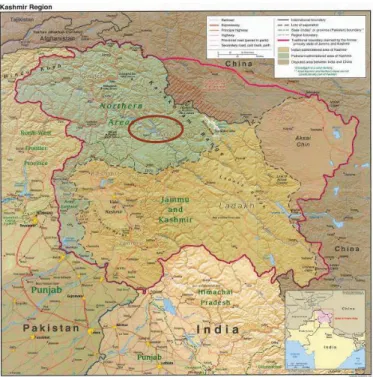
Ladakh is renowned for its stark, picturesque beauty and presence of Tibetan Buddhist culture due to which it is sometimes also referred to as "Little Tibet". It is a part of Western Himalayas, a term frequently and broadly used to describe the geographic region encompassing Indian districts of Ladakh, Spiti, and Lahaul. Located in the Northern Indian State of Jammu and Kashmir, Ladakh consists of two districts, Kargil and Leh, Leh being the capital.
Figure 1 Map of Kashmir region encompassing western Himalayas Source: www.lib.utexas.edu mapsindia.html
Ladakh along with the other two districts is highly inaccessible due to its location- flanked by Karakoram Mountains in the northeast and the great Himalayan ranges on its
enormous area of about 45110 sq km and runs on latitude 32° 17’ to 36°30’ and longitude 75° 50’ to 18°15’.1 The name ‘Ladwags’ implies the land of high passes is very aptly coined because of the altitude where it lies between 10,000 to 16,000 feet (3000-5,000 m) making it one of the highest inhabited areas in the world. This high altitude desert is characterized by a rugged landscape of mountain ranges. Geographically, its location plays an important role in shaping its culture, due to cultural influences from Kashmir on the west, Sinkiang in the North and Tibet on the east. Climatically, it lies in the rain-shadow area of the great Himalayan range, which makes it a high altitude cold desert governed by harsh climatic conditions which is why it is perpetually sealed off during winters. The climate can be characterized by extremes of hot and cold and by excessive dryness typifying a cold desert with great diurnal and annual ranges in temperature. The severe cold season starts from November to April and milder warm season from May to November. The temperature variations illustrate extremes with the short summers where the maximum ambient temperature goes up to 25° and the minimum ambient temperature during winters goes down up to minus 20-30°.2 Dry climate is characterized by low annual precipitation mainly in form of snow, which occurs during December to March and some of it comes down as rain for a few months of July and August. The total precipitation amounts to almost 85mm and hence the relative humidity can be attributed to lack of precipitation and variations in temperatures.
2.2 HISTORICAL CONTEXT- EVOLUTION OF BUDDHISM
Buddhism can be referred to as the prominent feature shaping the character of Ladakh, or in fact the whole of western Himalayan region. Establishment of Buddhism in the western Himalayan region is a result of connections between India and Tibet. The spread of religion can be divided into two phases: initiation and propagation and second advancement. Historical references suggest that Buddhism was introduced in the region around 6th century. The earliest reference can be dated back to c.642 AD when King Sron-bTsan-Sgam-po (c.617-650) married daughter of Chinese and Nepalese Kings and Buddhism was introduced to the region due to the backgrounds from which the princess hailed. The king was inclined to adopt Buddhism which then received royal patronage and made its way into the whole of Kingdom. But it was under his fifth successor sor-Khri-Sron-Ide-bstan (c.755- 797 AD) along with Santaraksita (c.705-762AD) and Padmasambhava (c. 717-762 AD) that institutionalized Buddhism came into existence. This introduction of Buddhism is known as First advancement of Buddhism, which arrived with construction of monasteries and temples, forts in this region. By 9th century it had firmly spread its roots and was dispersed around. But under the reign of King Lang- Darma (c.899-902 AD) who persecuted Buddhists and destroyed all Buddhist institutions it suffered bigotry. The end of this first spreading remained dormant until the second spreading. The Second advancement is attributed to King Khorre (c.970-1040 AD) who himself was a follower of Buddhism and renounced his throne to take up robes of under the name of Yesh-O d. He, together with Great Lhotsawa Rin-chen-bZang-po
contributions that texts in Sanskrit was translated to Tibetan and preserved in Guge. He also accomplished the founding of temples in western Himalayas based on Indian prototypes, as centers of learning and spreading Buddhism and brought about the spreading of Buddhism.
The whole region was under the threat of invasion from neighboring regions and it as initiated when Cenghiz Khan attacked and conquered Tibet in 1206 AD; consequently Buddhism also suffered a big jolt and saw a major turning point. From this point henceforth Chinese rule/influence developed in Tibet after a decline in relationship with India with conversion of Kashmir into a Muslim territory in c.1339 AD. A strong Chinese influence can be observed especially in the architecture of monasteries during this period which stopped getting inspiration from Indian prototypes. In c.1409 AD, a reformation took place due to which the Gelugpa sect eclipsed all other Buddhist sects in Tibet and in five generations took over the religious authority. This is described as a landmark event in Buddhism due to the fact that all the sects were unified and one supreme authority emerged- Dalai Lama who took charge of the temporal. In 1650 AD Ladakh and Guge were attacked by Indian kingdoms repeatedly and Ladakh and Spiti were lost to Kashmir in 1846 AD (after the dissolution into states).
2.3 REGIONAL CONSTRUCTION TECHNIQUES
Most traditional buildings in Ladakh are a testimony to the times where the religion and climate set the basic parameters guiding the architecture. Severe climate and scarce resources demand for a durable and lasting building. This has clearly been achieved by native genius. Formed in unity with the landscape, these unique buildings contribute to the cultural diversity of the world. Set against stark and picturesque beauty of rugged remote country, the architecture of monasteries follows the same principles as the other buildings in Himalayan region, with influences from Kashmir. All the buildings are marked by use of materials found at hand/locally – rubble, soil and timber. Soil is the most common material, a product as a result of natural breakdown of rocks, transported through rivers and glaciers. Earth has been employed as a building material due to its abundant availability, workability and ease to repair, and simple technical skill requirements.3 Wood is scarce is Ladakh and is employed mainly as a structural elements, openings, and occasionally for flooring. Juniper was the most favored variety of wood for its strength and resistance to decay but extinction in this variety of wood has been observed. The buildings follow a load bearing system of construction and the structural components can be resolved into: support, spanning and opening systems. The non structural elements mainly include parapets, balconies and steps.
2.3.1 SUPPORT SYSTEM
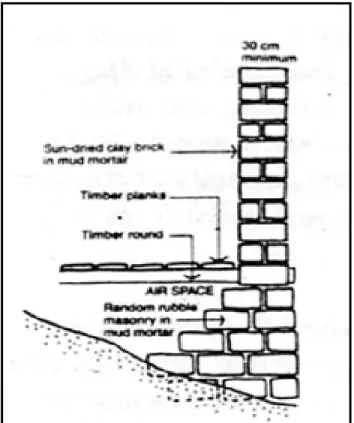
rubble. Roughly dressed stone is laid with thick mud mortar; around 100-150cm deep following the existing terrain.4 Dressed stones are used to make the interior and exterior faces where the core of the wall is filled with loose stones bonded with mud mortar5. In case of a rocky site on hilltops (a kind of location which leaves plenty of land for agriculture) the foundations are not dug but the slope of the site and the rocky substrate beneath are utilized. In these cases the foundation masonry is laid directly on the rock base and the walls are taken down up to a level where a solid base is reached and flat space for a room is achieved. The structural stability is compensated by tapered thick load bearing walls at the base (70-130cm) and may be heavily buttressed.
Figure 2 Typical Cross section – Battered wall
Source: Solar Architecture & Earth Construction in the Northwest Himalayas 4
Figure 3 Typical foundation on slopes Source: www.thf.org
A stone wall acts like a damp proof course which is otherwise absent in this system of construction and helps in preventing the rising damp from the subsoil below. A sound foundation also contributes to the stability of the building by reducing the risk of uneven settlement. The floors are constructed out of wooden joists and planks at first floor level and then plastered with clay. Unlike the foundations, which are constructed in the ways described above, the walls in the super structure are done in more than one ways: 6
Rammed earth walls;
Mud walls from sun dried bricks; and Random rubble with mud mortar
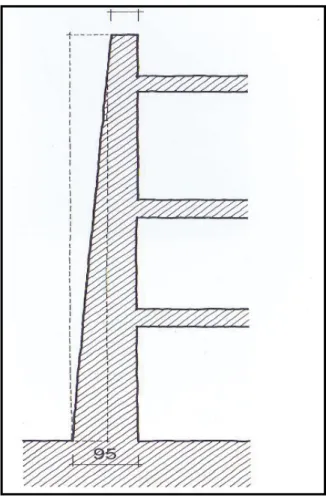
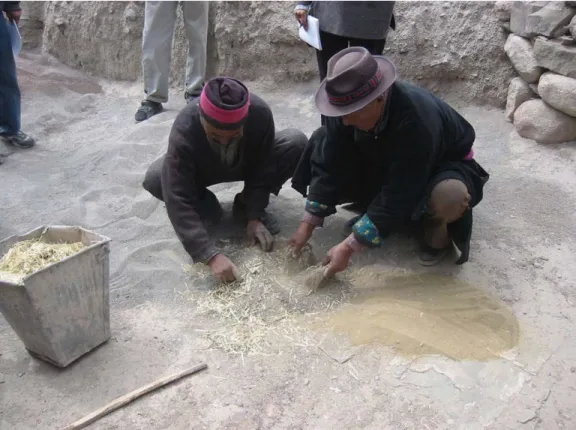
The walls are usually constructed out of sun-baked brick or rammed earth on the upper levels and rubble masonry on the ground level for extra stability and to counter any settlement. The walls are generally tapering (3-6 degrees) in the cross section, thicker at the base and thinner at the top. Earth has been employed in simple ways to create some extraordinary buildings. The soil is used in such a way as to avoid shrinkage and this is achieved by control of soil particle grading, water manipulation and heavy compaction. The mud bricks are made from local soil with river sand and chopped straw. The exterior surface is finished with coarse mud or lime wash with rough dripping texture.7In case of multi- storied buildings, it is often observed that the walls are laced with timber at regular intervals in form of ring beams and are fixed to each other by means of flexible joints that allow for movement during an earthquake.
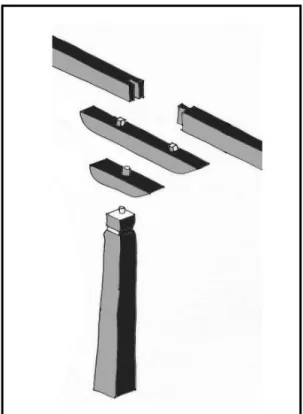
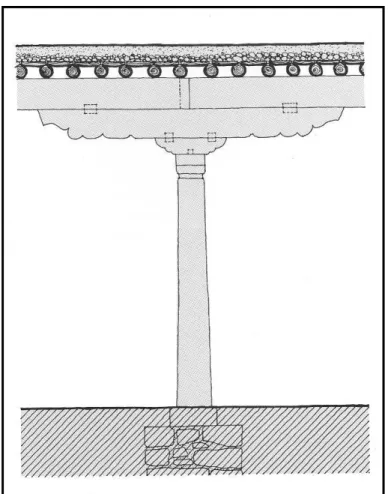
Apart from the load bearing walls, the internal spaces are provided with slender columns spanned symmetrically. These columns are founded on shallow stone pads and are topped with ornate brackets with capital has fluted cross sections that gradually transfer the loads from the roof. They represent a very simple yet efficient mechanism of load transferring.
Figure 4 Preparation of raw material at site Source: Kuang Han Li
2.3.2 SPANNING SYSTEM
The system constitutes a flat roof supported over load bearing walls and columns. The roof composed of composite materials like wood and thick compacted local earth is the most feasible spanning system. Since wood is a scarce material in such a climate it is employed as a structural member to support the earthen roofing. The roof is flat recognizing the functional use of these spaces and also provides for extra space during harsh climates.
Figure 5 Typical roofing system configurations
Source: Kuang Han Li, Conservation Approaches to Sustaining Traditional Ladakhi Roofing Systems, 2005
The configuration of wooden members varies and depends on the span of the room. There may be one or more main beams per room. A series of joists are placed equal distance a part perpendicular to the main beams. Willow twigs (talbu) are usually placed close together in rows over these joists which ultimately covers the whole ceiling in patterns. The wooden substrates are then covered with a thick layer of local grass (yagzee).
The finishing material is earth, which is poured and then compacted and is done in several layers. This multilayered roof is then finished with a fine, locally available clay called Markala (Water resistant). Another important component of this system is the parapet which is essentially made of willow twigs with stones and mud bricks, finished
the cantilevered parapet above. It is important to note that the roofing system makes no provision for water discharge outlets, gradient, flashing or damp-proofing layer.8
Figure 6 Column configuration Source: Delineated by Author
2.3.3 OPENING SYSTEM
Opening system constitutes windows and doors, which are deliberately kept to minimum to avoid the cold drafts and also to avoid structural weakening. The lintel is a wooden beam that forms the support system for openings and also supports the end of the floor-ceiling system. This lintel forms s a continuous band on the exterior. Below this assembly, the frames are usually simply placed and connected to the lintels and sills that
extend on either side into the structure. These openings are highly ornate and are crowned by continuous rows of corbelled wood brackets.
2.4 STRUCTURAL CHARACTERISTICS
These buildings are provided with inherent systems to resists dynamic stresses resulting from earthquakes, wind flow etc but these events cause sudden stresses that spread in the system from load bearing walls to foundation. These sudden loads result in additional dead loads and also for lateral forces which the walls are not necessarily designed for. The structural systems when progressively subjected to these forces result in degradation followed by total failure. Having witnessed some of these disasters and survived these buildings show their resistance and strength. Some structural aspects contributing to good engineering structure are discussed, as an attempt to review these existing technologies. In addition to reviewing the strengths it is necessary to asses the weakness of such systems in order to evaluate how these techniques can be best used, under contemporary circumstances.
2.4.1 WALL SLENDERNESS
The slenderness ratio is the height to thickness ratio of the wall and is one of the fundamental structural considerations in case of earthen walls. Slenderness ratio is usually low in the case of Himalayan buildings and varies from 8 to 10. 9 The walls are quite thick, almost 2-3 feet as compared to the height which varies from small rooms to
high towers (to accommodate the massive sculptures). Lower ratio helps in providing stability to the walls and helps to avoid overturning in event of an earthquake.10 The wall thickness is not consistent even within a structure. The walls of these temples generally taper being wider at base becomes narrow near the top. Therefore, the thickness and tapering of walls serve as buttresses to support the height of the walls. The walls have to carry a considerable amount of weight from the roof which pre stresses the wall, contributing to its resistance to lateral forces. 11 It increases the shear strength and also helps to avoid overturning. The earthen walls don’t provide much strength but are quite flexible and through the eventual cracks dissipate more energy during an earthquake (Coulomb friction), specially if the design control the large displacements with some reinforcements. 12,13
2.4.2 CONNECTIONS - wall/roof, wall/wall, wall/foundation
The walls carry a lot of dead load; the load per meter run of walls in these buildings varies from 3T/m 10T/m and increases with the number of stories from one to three.14 A connection between the roof and the wall supporting it, significant for the stability of the structure is usually missing in the western Himalayan structures. The structural element rests directly on the load bearing mud walls without any wall plate or bond beam. The areas where the rafters rest on the walls create large stresses on the load
10
E. Leroy Tolles, Edna E. Kimbro, and William S. Ginell “Planning and Engineering Guidelines for the Seismic Retrofitting of Historic Adobe Structures” Getty Conservation Institute, December 2002, P-57 11
Gosain and A.S. Arya, "A Report on Anantnag Earthquake of February 20, 1967," Bulletin Of the Indian
bearing walls below, heightened in case of an earthquake. Long lintels are the one of the provisions in these buildings that helps to keep the walls together and tied. The timber beams and floors well connected act as diaphragms and keep the individual wall sections from separating. The floor, especially at the lower levels acts as a diaphragm where the walls are weak and depend on other structural members for strength.
Figure 7 Joint detail - Wooden ring beam, Themisgam, Ladakh
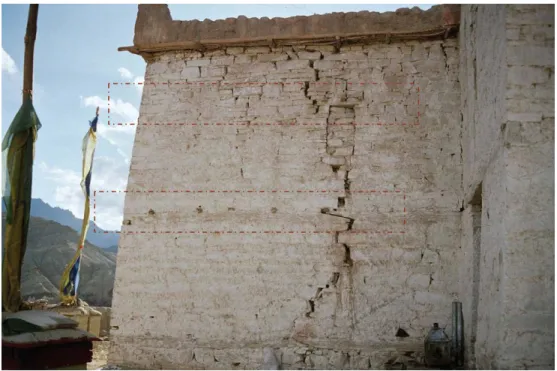
Horizontal wooden members in form of ring beams are a well known technique found in many parts of the world and in the Himalayas from Hunza to central Nepal.15 The earthen structures in the western Himalayan region also utilize the horizontal reinforcement to resist any movements due to earthquakes. In a number of cases, the load bearing walls of the monasteries are reinforced with a wooden framework of horizontal wall ties as ring beams. A ring beam also known as a crown, bond or tie beam or seismic
band depending on the location in the building, helps tie the walls. It is one of the most essential components of earthquake resistance for load-bearing construction. These elements run on the periphery of the building, and are flushed with the exterior walls. The ring beams tie the entire structure together but their position does not necessarily bear any relationship to the height of the floor beams. Adjacent timber members are simply connected using tension resisting scarf and pegged joints.
Figure 8 Wooden beams located at intervals, temple at Basgo Source: Kuang Han Li
The corners in the buildings are cross jointed so that the whole building behaves as one. The importance of these tying elements is that they serve to tie the un-reinforced walls making them work as single unit. It prevents the distortion or displacement of
Figure 9 Column support system with stone base Source: www.thf.org
The spatial arrangement of wooden members i.e. the columns, supporting the roof is also critical. Vertical strength or support is also provided by provision of posts or columns and the number of columns depends on the area to be spanned. It varies depending upon the area to be spanned and the load to be carried by these members. These members aid in load transfer from roof to floor below uniformly thereby reducing the loads on the load bearing walls. Stones are provided timber columns to protect them from rising dampness.
2.4.3 LOCATION AND SIZE OF OPENINGS
The number of opening in Ladakhi structures is kept to minimum due to the weather conditions to keep the interiors comfortable. The elevations have a few openings, oriented to face the south. The opening sizes of the buildings are observed to be very small as compared to the surface area of the wall which ensures more stability to the walls. But this is not necessarily true in case of residential buildings which have comparatively larger windows. As mentioned above the window assembly usually consists of a wooden lintel with appropriate bearings on both sides. A horizontal wall tie beam generally runs above the lintel to provide additional support.
2.5 SEISMIC CHARACTERISTICS
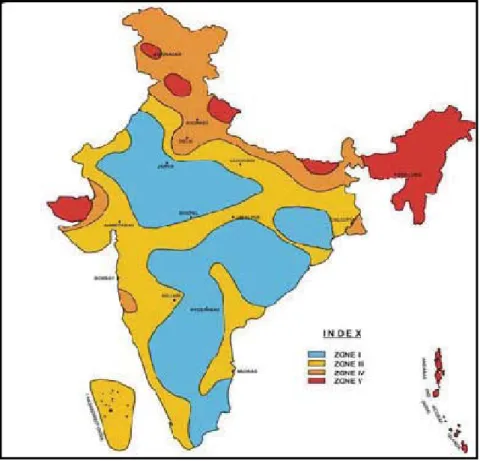
It is important to understand the geology, tectonics and zoning of the Himalayan region to study the impacts of seismic movements on buildings. The Himalayan ranges and the formation of mountain belts is a result of continental drifts, volcanic and seismic activity and are continuously under threat from earthquakes. The seismic zone map for India is currently based on 200 year history of specific Earthquake events. The seismic zones in India are divided into four zones ranging from V to II based on the intensities of the past earthquakes and current research.
Figure 10 Indian Seismic Zone Map as per IS: 1893 (Part 1) – 2002 Source: Learning Earthquake Design and Construction, 2004
The zones with respect to the magnitude of the earthquakes on a decreasing scale - Zone II (no-risk to low risk), Zone III (moderate), and Zone IV (high risk) and Zone V (very high risk). According to this map parts of Himalayan boundary in the north and northeast, and the Kachchh area in the west are classified as zone IV. This area has been classified as zone IV, there has been no evidence of a major earthquake for a recorded span of almost 400 years. This classification could have been a precautionary measure to safe-guard since it lies between zones of extreme seismic activity- Tibet and Kashmir,
India.16 Ladakh, which is a part of Himalayan region comprising parts in India, Nepal and Tibet, is always under the threat of earthquakes.
One of the prominent tectonic sub regions in India is Himalayas, a record of the most dramatic and visible creations of modern plate tectonic forces that primarily composed of sediments accumulated over long geological time.17The formation of lofty Himalayan ranges, which stretch over 2900 km along the border between India and Tibet, are the result of an ongoing orogeny which is primarily the result of a collision between two continental tectonic plates - Indian and Eurasian plates. The collision, a major tectonic event was caused due a process called seduction where one tectonic plate gets under another.18 An initial collision of 50 mm per year synthesizing recent studies in Tibetan and Himalayan region can be associated with a zone of an active thrust fault in the area. This gave rise to the Himalayan mountain ranges, which are relatively young and highly unstable Mountains. After the horizontal contraction phase, the vertical contraction phase is still active, in progress and the northwards movement still continues at the rate of 2-3 cm per year confirming geophysical data from Indian Ocean.19. Though the deep structure of Himalayas and Tibet is insufficiently known compared to other orogenic belts of the world there are enough recent researches to corroborate the fact.
16
Prakash, Sanjay in association with Aromar Revi, R.L. Sawhnay, I.C. Goyal, Arvind Goyal, M.S. Sodha. Solar Architecture & Earth Construction in the Northwest Himalayas New Dehli: Vikas Publishing House Pvt Ltd, 1991, p-32
Figure 11Tectonic plate boundaries, India
Source: Learning Earthquake Design and Construction, 2004
According to studies it is considered as a geologically unstable area and lies in a zone of high risk. Current research and geological surveys have been carried out which reinforce the presence of fault lines and high seismic activity in this region. The buildings here can therefore be at substantial risk and may also be threatening to the life and safety of occupants caused in the event of earthquake.
The Himalayan orogen has produced three thrust earthquakes with moment magnitude (Mw) 7.8 to 8.5 during the past century, yet no surface ruptures associated with these great earthquakes have been documented20. Some earthquakes have been witnessed in the past but the last powerful earthquake that was witnessed by this region
occurred in neighboring area of Lahaul Spiti and Kinnaur district on 19 January 1975 measuring 6.2 on the Richter scale. However, there is a lot of geophysical evidence explaining that the area is highly active and Southern edge of Tibetan plateau and parts of India show localized movements and small earthquakes are very common here. List of significant earthquakes around the region is located in appendix A
2.6 SUBSOIL CONDITIONS
Figure 12 Soils in Ladakh region of Kashmir
Source: District Planning Map Series, Leh (Ladakh) Jammu and Kashmir
The soil conditions of Ladakh and the area around are given by this map which comprises various Entisol soils. Available soils types in the region used for building construction and other activities are given in appendix B. Soil formation in the vast stretches of
areas of Himalayas. In the highest zones with perpetual snow, there is hardly any soil formation. The steep slopes display lithosols.
3. MANGYU MONASTERY
3.1 EARLY PERIOD MONASTERIES
Buddhist monasteries are one of the largest categories of building types in Ladakh. The other types can be broadly categorized as- Palaces & Large houses, Forts, Vernacular houses and Religious landscapes including sacred edifices21. The word Gompa or a monastery is literally a combination of two words- Gom meaning Sunya or emptiness and Pa meaning Place. It is an embodiment of earthly seat of Buddha and other deities which make up Buddhist pantheon.22A monastery also houses sacred texts and objects- Kanjur, Tanjur, and banner paintings Thangkas. Monastic structures are generally built in isolation, away from settlements to provide solitude for the monks. The Gompa or the monasteries were and even today are Centers for intellectual and spiritual training of monks with the main function of education. The development of monasteries was prominent during 10th century and later with the spread of Buddhism has been discussed in the previous section. The monasteries in western Himalayas are usually divided into - early and later period monasteries. For scope of this thesis early period will be discussed in detail.
Figure 13 Map of Early period Monasteries in Ladakh
Source: Modified from http://www.archresearch.tugraz.at/einzelne/westl_himalaya.htm
The term Early Period Monasteries is frequently used to describe the beginning of development of monastic architecture in Ladakh and Guge (Tibet) around 1000 to 1300 AD23. This typology of monastic complexes was established under the patronage of king Guge with assistance of artists, craftsmen and Tibetan scholars.24 The construction that took place during this period is very significant and makes a unique contribution to the distinct architectural and cultural identity of the western Himalayan region. Some monastic complexes dating back to this period are old temple Riba, Nako, Lha-lun, which
is a hybrid or rich fusion of Indian architectural styles, decorative elements from Kashmir and construction techniques from Tibet. Certain features are identifiable while using the term early period monasteries which shape their way of being, religious lineage, architecture principles and iconography etc. Some of these fundamental characteristics are discussed to enhance the understanding of this building type.
3.1.1 ASSOCIATION WITH RIN-CHEN-BZAN-PO (958-1055) 25
The founding of the early period temples is attributed to Lotsawa Rin-chen-bZang-po who contributed to Tibetan religion and emerged as an apostle of resurgence of Buddhism in Tibet. He was responsible for religion, literature, arts and architecture that took place in the Western Himalayan region and his reign is often referred to as the Rin-chen-bzan-po Period. His patron was king Ye- she-o who wanted to re-establish Buddhism on sound footings in the Trans-Himalayan region. To gain knowledge in Buddhism, he sent 21 Tibetan Buddhists along with Rin-chen-bZang-po to India for study where he spent 17 yrs in India on three different visits. Rin-chen-bZang-po was aware of a large number of doctrinal texts that were still not translated and were vital for religious studies. Therefore during his stay he studied the language and undertook the task of translating numerous scriptures into Tibetan. Due to this significant contribution he is referred to as Lotsawa or great translator. His fame can also be attributed to the fact that only two of the scholars including him survived from the trip to India.26He translated the scriptures and deepened and irradiated the faith and therefore he is also associated
with second spreading or resurgence of Buddhism around 1000 AD. The spreading was also accompanied by founding of religious establishments along the route from Kashmir to Guge, in western Tibet and India. He has been credited as the founder of 108 temples and a number of religious structures which spread from Mustang to lower Kinnaur and northward to Lahaul and Ladakh.27 During his visits to India he not only brought back architectural influence that can be seen in the monasteries but also painters and artisans. Another set of 32 artists joined him for his successful venture and undertook the task of decorating the monasteries. Consequently a team headed by Rin-chen-bzan-po together with combined effort of various people with varied expertise initiated the development of monastic architecture in the whole of western Himalayas.
3.1.2 ARCHITECTURE/ PLANNING
The architectural style for early period monasteries is considered very formalized and linked directly with the Indian prototypes. There are no strict planning principles as the layouts are mainly a function of space available for building, which is also the factor governing the location of various functions within the complex. Most of these structures are believed to have been built on Mandala system, or the Indian system of planning which refers to both the site as well as interiors.
Most religious structures built during this period were on sites away from settlements. The temples were built on relatively flat ground, were spread out instead of rising up and the whole area enclosed by wall. The enclosure/ boundary wall (Sanskrit- Sima, Tibetan- Sagri) is a feature not evident anymore and is found missing on most of
the sites with an exception in case of Alchi where the archeological remains can still be seen. The individual structures are small and often single storied and sometimes double storied in height. The layout follows a fixed one way orientation, usually facing an easterly direction with single opening. This opening is typically the entrance opposite the altar, following the Indian tradition with some exceptions like Lha Lun. The architecture incorporates a basic layout, with unicellular square rooms to a few roomed structures approached through a portico.28 According to Sharma J, the Dukhang or the main assembly hall is usually a dark windowless chamber, with some diffused lighting by means of a clear story, a feature quite common in these monasteries where a small door marks the entry to the room.
A niche in the main assembly hall or dukhang marks another significant feature of this periods architectural planning. It can be seen in most of the Early Period Monasteries. The primary function of the niche is to house the central deity and the altar. The elevations of these structures are fairly simple. The exteriors represent a windowless, well composed and a very proportionate mass of building blocks. In spite of the plain façade, the elevation has a number of intricate decorative features like cornices, highlighted by colored bands. The windows are also accentuated by use of black outlines.
3.1.3 DECORATION/APPLIED ORNAMENTATION
The most visually remarkable feature of these temples is the rich frescoes, stucco or wooden sculpture, and motifs i.e. applied ornamentation.29 Wall paintings reflect a great deal of skilled workmanship along with refined styles. The paintings usually depict a theme on all the wall surfaces in a room. Entire iconography revolves around the deity to which the temple is dedicated. However, most of them are typically adorned with
mandala which is also a dominant feature in early period monasteries. The stucco statues
are oversized images of deities mostly placed in niches which form the extension of the rooms or in smaller structures adjacent to main assembly hall.30 The architectural elements like door lintels are profusely carved and decorated. The predominant influence of Kashmir on art and architectural motifs can largely be observed in all the decorative features including architectural elements. It is perhaps the beautiful blend of Indian and
Tibetan artistic styles which is reflected in the plastic art forms, wooden architectural elements and large standing images.
Figure 15 Wooden ornate porch, Alchi, Ladakh
3.1.4 DEDICATION TO VAIROCANA
Another distinctive aspect that makes this monastery type unique is the dedication of the temples to omniscient Vairocana, (rNam-par-sNam-mdzad) which is the central white Buddha with four others. The manifestations of this Buddha can be seen at mostly all the temples of this period like- Rabo, Alchi, Lha-Lun, and Mangyu. The cult of Vaircona was not known in Tibet till later half of 10th century but it was developed in India since 8th century AD.31 It was Rin-chen-bZang-po who was responsible of introducing the large Vairocana cult into western Tibet.32