04 August 2020
IoT Notifications: from disruption to benefit Architectures for the future of notifications in the IoT / Montanaro, Teodoro. -(2018 Sep 10).
Original
IoT Notifications: from disruption to benefit - Architectures for the future of notifications in the IoT
Publisher: Published DOI:10.6092/polito/porto/2712588 Terms of use: openAccess Publisher copyright
(Article begins on next page)
This article is made available under terms and conditions as specified in the corresponding bibliographic description in the repository
Availability:
This version is available at: 11583/2712588 since: 2018-09-11T09:56:41Z Politecnico di Torino
Doctoral Dissertation
Doctoral Program in Computer and Control Engineering (30thcycle)
IoT Notifications: from disruption to
benefit
Architectures for the future of notifications in the
IoT
By
Teodoro Montanaro
******Supervisor(s):
Fulvio Corno, Supervisor
Pino Castrogiovanni (TIM), Co-Supervisor
Doctoral Examination Committee:
Prof. Franceschinis G. A., Referee, Univ. Piemonte Orientale “Amedeo Avogadro” Prof. Bernardos Ana M., Referee, Universidad Politecnica De Madrid - Etsidi Prof. Torchiano M., Politecnico di Torino
Prof. Servetti A., Politecnico di Torino
Prof. Gena C., Università degli Studi di Torino Politecnico di Torino
I hereby declare that, the contents and organization of this dissertation constitute my own original work and does not compromise in any way the rights of third parties, including those relating to the security of personal data.
Teodoro Montanaro 2018
* This dissertation is presented in partial fulfillment of the requirements forPh.D. degreein the Graduate School of Politecnico di Torino (ScuDo).
I would like to dedicate this thesis to my parents, my brother, and all the people (uncles, aunts, cousins, friends and grandmother) who believed in me.
I know that it is not a good practice to use emoticons in a doctoral thesis, but I think I can do it in the acknowledgments paragraph.
As almost everyone knows, I love to speak :-). I’m not as good as my brother to establish a conversation with every person, animal or object present on the earth XD, but I cannot declare that I can stay more that a minute without speaking. Now that it is clear, I will use the same approach I usually use when I am near a person (and I am not tired, this is the only situation in which I could be a silent person) to say thanks to the people who helped me during my Ph.D.
At first, I want to thank all the people that guided me and “walked” near me during the Ph.D.! Specifically, I want to thank Fulvio Corno and Luigi De Russis, my mentors. Their patience and support allowed me to grow, improve my skills, and, most important, arrive at the end of the Ph.D. :-) In addition, I would like to thank them, together with Laura Farinetti, a teacher of rare goodness, for the opportunity they gave me to discover my passion in teaching. They involved me in the teaching activities of the two courses “Ambient Intelligence” and “Social Networking: technologies and applications” letting me improve my teaching skills and, maybe, find my future way.
Then, I would like to thank all the other members and alumni of the e-Lite research group for their support: Sebastian Aced Lopez, who convinced me to continue my training with a Ph.D., Alberto Monge Roffarello and Juan Pablo Sáenz that started their Ph.D. in our research group one year before my departure, and Fabio Ballati who started a few days before my last day.
Moreover, I’m indebted with all the TIM members: Pino Castrogiovanni, my industrial tutor and Claudio Borean who guided me in cooperating within the JOL Swarm team. Also, I would like to thank Dario, Ennio, Roberta, Giuseppe and
v
Alfonso who cooperated with me in some projects and that taught me a lot of industrial tricks that I am appreciating now in my new job.
Furthermore, I want to thank all the people I have met in these years, even if only for a few moments, in the department, in the laboratory (“lab6” has been my second house during the Ph.D., so Alessandro, Andrea, Francesco, Roberta, Alberto and Giuseppe were my second family) and also all around the Politecnico.
And it is not finished: I would like to thank Andrea Marcelli for involving me in some of his projects and supporting me in almost all the machine learning experiments, and also, Edoardo Fadda, Giovanni Zenezini, Maliheh Ghajargar and Rosario Scatamacchia for their patience in the collaborations we made during some extra projects carried on during the Ph.D.
I’m proud of have been part of the DAUIN department at Politecnico di Torino but also of the TIM JOL Swarm team and I hope to continue to meet all of you in the future! ;-)
Finally, I would like to thank all the people who helped me by testing the XDN framework: Alberto Monge Roffarello, Luca Venturini, Alberto Cannavò, Fabio Ballati, Federica Bazzano, Federico Salaroglio, Gianpaolo Paterno, Giovanni Piumatti, Giuseppe Ministeri, Juan Pablo Sáenz, Luca Mannella, Orazio Scivolone, Tamer Saadeh and Mohammad Ghazi Vakili.
Ok, if you arrived here and you are not yet in the list, the answer to your question is: NO, I did not forget you. However, I wanted to leave you at the end to oblige you to read everything XD!
I am forever grateful to my parents, Rosario and Francesca, my brother Andrea, all the members of my big family (aunts, uncles, cousins, and grandma) and all my friends (you are too many to be mentioned in a few lines, so I will thank you personally after the discussion XD) who have always supported and encouraged me.
And last, but not the least, I would like to thank the reviewers of this thesis: even though I will discover who you are only when I will have finished to write the thesis, I would like to thank you for your work and your suggestions.
The growing number of mobile and IoT devices able to generate and show incoming notifications is fostering the spread of notifications in people lives. Nonetheless, although users are getting used to them, their presence is not always perceived as a benefit by recipients. With the aim of improving user experience with notifications, two different approaches are presented in this dissertation. The former acts at the distribution level, i.e., notifications are intercepted and then a system decides if, when, and how to show them; while the latter acts at the design level, i.e., notifications and their distribution strategies are designed with the aim of reducing user disruption and exploiting all the benefits that the availability of multiple devices could bring.
An IoT architecture is proposed for each approach: the Smart Notification Sys-tem that relies on machine learning algorithms to adequately manage incoming notifications, and the XDN (Cross-Device Notification) framework that assists devel-opers in creating cross-device notifications by scripting. The modular nature of both architectures allowed the simultaneous development and test of different indepen-dent but compatible subsystems and their exploitation in preliminary deployment sessions. The results, feedbacks and lessons learned from such sessions can foster the development of future solutions in the IoT notifications field and related domains.
Contents
List of Figures xi
List of Tables xiii
1 Introduction 1
1.1 Overview . . . 1
1.1.1 Internet of Things (IoT) . . . 2
1.1.2 IoT building blocks . . . 3
1.1.3 IoT applications . . . 4 1.1.4 IoT notifications . . . 6 1.2 Thesis Motivation . . . 7 1.3 Goal . . . 9 1.4 Thesis organization . . . 10 1.5 Original contribution . . . 10
2 SNS (Smart Notification System) 12 2.1 Introduction and Motivation . . . 12
2.2 Background . . . 13
2.2.1 Machine Learning Approach . . . 13
2.2.2 REST API . . . 17
2.4 Scenario . . . 24
2.5 Architecture . . . 24
2.6 Prototypes: design, implementation and preliminary deployment . . 29
2.7 Decision Maker . . . 31
2.7.1 Preliminary experiments and results . . . 31
2.7.2 Preliminary Evaluation and Conclusion . . . 38
2.8 Collectors . . . 38
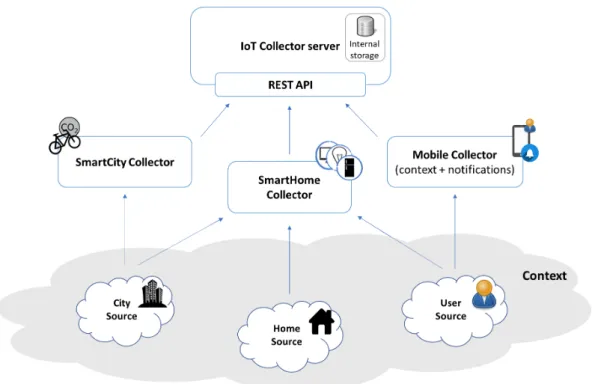
2.8.1 IoT Collector server . . . 42
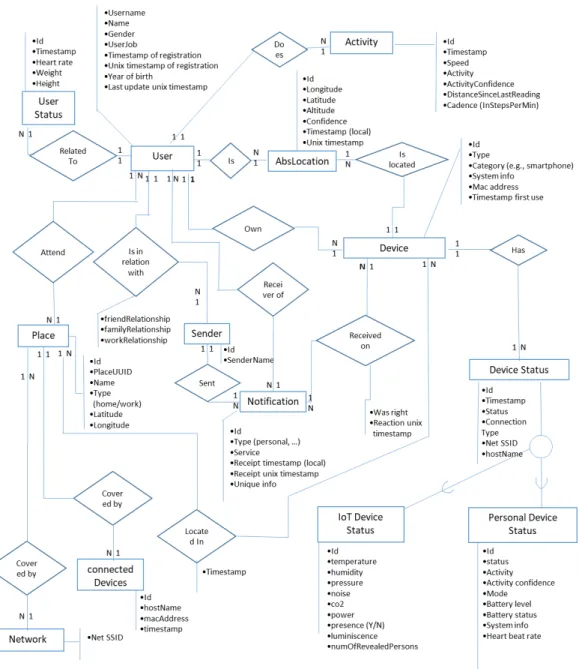
2.8.1.1 Data structure: ER model . . . 42
2.8.1.2 REST API . . . 45
2.8.1.3 Prototype Implementation . . . 47
2.8.1.4 Preliminary Deployment Session . . . 47
2.8.2 Mobile Collector . . . 48
2.8.2.1 How to collect user reactions to notifications . . . 48
2.8.2.2 Dataset definition . . . 54
2.8.2.3 Prototype implementation . . . 55
2.8.2.4 Preliminary Deployment Session and Results . . . 58
2.8.3 SmartHome Collector . . . 60
2.8.3.1 Prototype implementation . . . 62
2.8.3.2 Preliminary Deployment Session and Results . . . 64
2.8.4 SmartCity Collector . . . 65
2.8.4.1 Architecture . . . 67
2.8.4.2 Prototype . . . 70
2.8.4.3 Preliminary Results . . . 73
2.8.5 Final Performed Experiments . . . 75
2.9 Context Analysis . . . 79
Contents ix
2.9.1.1 Method . . . 80
2.9.1.2 Data collection . . . 81
2.9.1.3 Meaningful places estimation . . . 83
2.9.1.4 Features selection and Pre-processing . . . 84
2.9.1.5 Cross validation . . . 85
2.9.1.6 Results evaluation . . . 86
2.9.1.7 Related works . . . 90
2.9.1.8 Conclusions and future work . . . 91
2.10 Discussion and Conclusion . . . 92
3 The XDN (Cross-device Notification) Framework 94 3.1 Introduction . . . 95
3.2 Background and Motivation . . . 97
3.2.1 Scenario: Messaging Application . . . 97
3.2.2 Frameworks for customizing notifications and/or designing notification strategies . . . 100
3.2.2.1 Frameworks and tools for developers for manag-ing notifications . . . 102 3.2.2.2 Cross-device interactions . . . 105 3.3 Requirements . . . 108 3.4 Framework . . . 111 3.4.1 XDN GUI . . . 113 3.4.2 XDN library . . . 114 3.4.3 XDN runtime environment . . . 119 3.4.4 XDN IoT/mobile library . . . 119 3.5 Implementation . . . 120 3.5.1 Implementation details . . . 120 3.6 Evaluation . . . 121
3.6.1 Tests’ goal . . . 121
3.6.2 Scenarios for tests . . . 122
3.6.2.1 Scenario 1: Smart Fridge . . . 122
3.6.2.2 Scenario 2: messaging application . . . 123
3.6.3 Test Deployment . . . 124 3.6.3.1 Task 1 . . . 125 3.6.3.2 Task 2 . . . 126 3.6.4 Results . . . 126 3.7 Discussion . . . 129 3.7.1 Successes . . . 129 3.7.2 Challenges . . . 130 3.8 Conclusions . . . 131
4 Conclusions and Future Developments 134 4.1 Summary of contributions . . . 134
4.2 Results . . . 136
4.3 Future works . . . 137
References 138
Appendix A Detailed SmartBike Survey Results 145
List of Figures
2.1 Different ways of showing notifications. Image from [1] . . . 20 2.2 The resulting C4.5 decision tree obtained by Poppinga et al. [2].
It consists of 20 elements and 11 leaves. It classified whether a notification should be issued (true) or not (false) with an accuracy of 77.85 percent. Image from [2] . . . 22 2.3 Architecture design . . . 25 2.4 Simplified version of the SNS Architecture with additional
informa-tion about the developed contribuinforma-tion . . . 30 2.5 Steps followed in test the first prototype of the Dispatcher module . 32 2.6 Possible future scenario . . . 39 2.7 Architecture design . . . 40 2.8 ER diagram representing the data structure implemented on the IoT
Collector server . . . 43 2.9 Temporary App1: Survey to acquire User Reaction to Notifications . 50 2.10 Experiment to investigate on the best way of acquiring user reaction
to notifications . . . 51 2.11 ER diagram representing the data structure implemented on the
Mobile Collector . . . 54 2.12 Screenshots of the implemented Mobile Collector application . . . . 57 2.13 Power consumption of the Notification Collector app on the two
2.14 Age of participants . . . 59
2.15 Employment of respondents . . . 59
2.16 Devices chosen for developing the SmartHome Collector prototype . 63 2.17 High level architecture design of the SmartBike platform . . . 68
2.18 The SmartBike device prototype . . . 72
2.19 Screenshots of the designed prototypal application . . . 73
2.20 The position of the bike can be remotely visualized on a map with the traveled route . . . 74
2.21 Map of the area of Turin (Italy) monitored within the test . . . 74
2.22 Model that describes the estimation process performed for each user 81 2.23 Absolute locations recorded for user 5 . . . 84
2.24 Absolute locations recorded for user 11 . . . 85
3.1 Notification strategy implemented by the Slack team . . . 101
3.2 Architecture of the XDN framework . . . 111
3.3 Screenshot of the XDN GUI . . . 132
3.4 Class diagram that shows the structure of the xdn.notification Object 133 3.5 Class diagram that shows the structure of the xdn.device Object . . . 133
A.1 User Survey: age distribution . . . 146
List of Tables
2.1 Results obtained in the example used to present the accuracy paradox 16 2.2 Results obtained by the “dumb” classifier in the example used to
present the accuracy paradox . . . 16
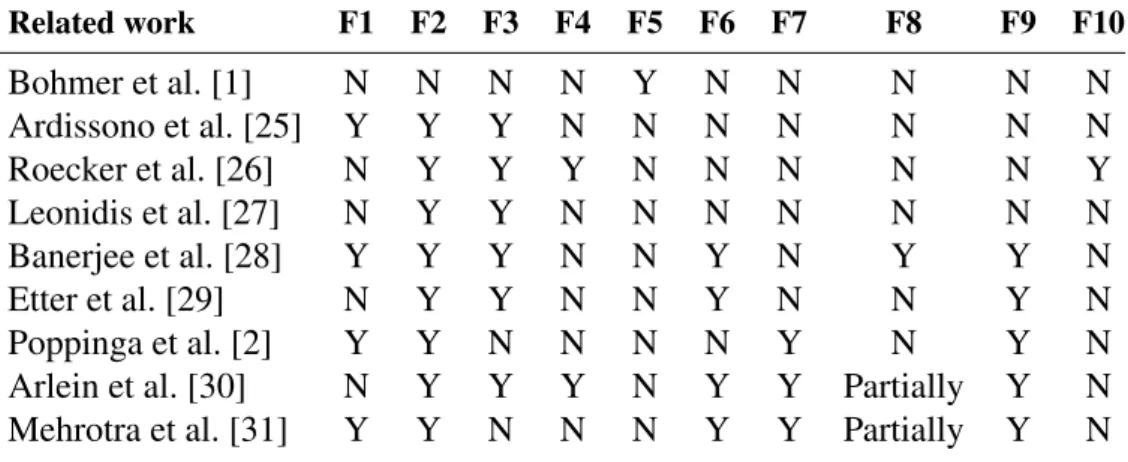
2.3 Summary of features provided by related works . . . 19
2.4 Summary of related works’ features . . . 19
2.5 Context information . . . 27
2.6 “Converted Notifications” information . . . 27
2.7 Simplified version of Context information: for the prototype . . . . 32
2.8 Simplified version of Notifications information: for the prototype . . 33
2.9 Dimension of used dataset . . . 34
2.10 Percentage of correct predictions obtained with used algorithms . . 36
2.11 CPU time for a training phase with 33058 samples . . . 37
2.12 Average CPU time for each notification classification . . . 37
2.13 Information identified for creating pilot dataset . . . 41
2.14 HTTP Verbs available in the IoT Collector Server . . . 45
2.15 IoT Collector Server: API Specification - part 1 . . . 46
2.16 IoT Collector Server: API Specification - part 2 . . . 47
2.17 Preliminary results with real data . . . 79
2.18 Collected data . . . 82
2.20 First part of experimental results (Accuracy, Precision and Recall)
-all values are percentages . . . 88
2.21 Second part of experimental results (Accuracy, Precision and Recall) - all values are percentages . . . 89
3.1 Summary of features provided by related works . . . 102
3.2 Summary of related works’ features . . . 102
3.3 Notification properties . . . 115
3.4 Device properties (above) and statuses (below) . . . 116
3.5 Device actions . . . 117
3.6 XDN: final survey proposed to users . . . 127
A.1 List of possible technological bike improvements with percentage of users that selected each of them . . . 148
Chapter 1
Introduction
1.1
Overview
Thanks to the continuous introduction of new devices and services, technology has become part of citizens’ lives during the last decades and it is really difficult to think at any moment of the day in which it has not been transferred. Thanks to the useful services that they provide, in fact, tablets, smartwatches, smartphones, smart TVs, smart fridges, smart washing machines and other common devices became part of our lives and changed our habits and behaviors. Indeed, for example, since a few decades ago, no one would have imagined at the possibility of controlling the house heating system by her voice except in science fiction. In addition, since a few decades ago, our parents used to consult a paper map before every travel, while now we are accustomed to real-time positioning systems able to suggest the shortest path, also depending on the current traffic condition.
All these examples are only some of the innovations that are fostering the spread of one of the most pronounced concept of the last decades: the Internet of Things (IoT). It is the network of physical objects that are always connected to the Internet with the aim of sharing services and information with other connected “things”.
The next paragraphs present some details about this innovative network of objects also reporting the most important elements that constitute an IoT system and some example of application of the IoT.
1.1.1
Internet of Things (IoT)
One of the hottest topic of the last decade is certainly the Internet of Things (IoT). Its spread is demonstrated by the huge number of different synonyms that were already introduced to represent the same concept. Internet of Everything (IoE), Industrial Internet, Pervasive Computing, Pervasive Sensing, Ubiquitous Computing, Cyber-Physical Systems (CPS), Wireless Sensor Networks (WSN), Smart Objects, Cooperating Objects, and Machine-to-Machine (M2M) are only a minimal part of the list of synonyms that compose the so called “terminology zoo” surrounding IoT.
Cisco, one of the biggest companies that is investing in IoT in recent years, declares that one of the first use of the term “IoT” dates back to 19991. In fact, in a 1999 article for the RFID Journal, Ashton Kevin wrote the following visionary paragraph:If we had computers that knew everything there was to know about things using data they gathered without any help from us, we would be able to track and count everything, and greatly reduce waste, loss and cost. We would know when things needed replacing, repairing or recalling, and whether they were fresh or past their best. We need to empower computers with their own means of gathering information, so they can see, hear and smell the world for themselves, in all its random glory. RFID and sensor technology enable computers to observe, identify and understand the world without the limitations of human-entered data.2
Due to the early implementation of some technologies and the absence of some others, this declaration only represented the visionary point of view of a society that was starting to think at the possibility of exploiting the Internet to develop new devices and services. Although, since then, a lot of obstacles have been solved and, thanks to the rapid proliferation of connectivity and the introduction of sensors and actuators in everyday physical devices, the Internet of Things (IoT) is becoming reality in recent years [3].
As described by Cisco, IoT represents systems in which “things” (i.e., objects in the physical world) are connected to the Internet via wireless and wired Internet connections with the aim of collecting and sharing data and services. To better understand this definition, the next paragraphs present both the essential blocks that compose an IoT object/system and some examples of application in the IoT domain.
1https://www.cisco.com/c/dam/en_us/solutions/trends/iot/introduction_to_IoT_november.pdf 2http://www.rfidjournal.com/articles/view?4986
1.1 Overview 3
1.1.2
IoT building blocks
This section presents the main building blocks that an object, a sensor, or a system should possess to act in the IoT domain. They are presented with the aim of helping readers in understanding what the IoT is.
As effectively summarized by Atzori et al. [4], the actualization of the IoT concept into the real world is possible through the integration of several enabling technologies:
• Identification, sensing and communication technologies; they represent all the components that are encouraging the adoption of new objects in people daily routine actually leading to the IoT concept.
– Identification: as declared by Al-Fuqaha et al. [5], it is essential for every IoT object to be uniquely identified within a communication network. For this purpose, two different properties may be exploited: the “object ID”, that represents the name assigned to the object and allows humans to identify the object, and the “object address”, that allows to reach the object and its exposed services within the network in which it is installed.
– Sensing: another important property that could be adopted by an IoT object resides in the possibility of gathering data from related objects within the network and sending it back to a data warehouse, database, or cloud. In general, the collected data is analyzed to take specific actions based on required services. The sensors can use various types of local area connections (e.g., RFID, NFC, Wi-Fi, Bluetooth, and Zigbee) or wide area connectivity (e.g., GSM, GPRS, 3G, and LTE) to transmit or receive data to/from the connected other things. In addition, due to the high variability of both data and connectivity used to transmit it, such data differs from traditional computing ones because of their small size and the high frequency used for its transmission.
– Communication: as declared by Al-Fuqaha, the IoT communication technologies connect heterogeneous objects together to deliver specific smart services. Typically, the IoT nodes should operate using low power in the presence of lossy and noisy communication links.
• Middleware; it represents a software layer that hide the details of different technologies that act behind the scene. It aims at abstracting the devices functionalities and communications capabilities, providing a common set of services. As summarized by Atzori et al. [4], it relies on 5 main components.
– “Applications”: this component represents all the elements that export the system’s functionalities to the final user and let her interact with them. These elements include both software elements, e.g., graphical user interfaces or notifications, and physical devices, e.g., smart lamp or interactive touch screen that let the user interact with the system.
– “Service composition”: it represents all the functionalities aimed at the composition of single services offered by networked objects then used to build specific applications. At this level, there is no notion of devices and the only visible assets are services.
– “Service management”: it includes all the functions that are expected to be available for each object and that enable their management in IoT scenarios.
– “Object abstraction”: IoT relies on a vast and heterogeneous set of objects, each one providing specific functions accessible through its own dialect. Thus, there is the need to harmonize the access to the different devices with a common language and procedure.
– “Trust, privacy and security management”: the deployment of automatic communication of objects represents a danger for people future. The mid-dleware must consequently include functions related to the management of the trust, privacy and security of all the exchanged data.
Even though, in some situations, these elements could be distributed among different devices, they represent the essential requirements for an object or a system that acts in the IoT domain.
1.1.3
IoT applications
In recent years, the interest in IoT is growing and the range of domains in which it is applied is raising in parallel. This subsection presents an updated list of some of the most explored areas in which IoT has been fostered up to the moment of writing.
1.1 Overview 5
It is inspired by the two works proposed by Kamilaris et al. [3] and by Rehman et al. [6]. The first is mainly focused on mobile phones, but considering that the IoT and mobile domains are strictly related, the contained information are used to enrich the effective analysis proposed by Rehman et al. [6].
• Participatory Sensing: it represents all the activities and the projects that encourage users to record and share information with the aim of cooperating to a general public shared objective. An example in such domain is represented by the use of bikes as IoT probes to collect data for monitoring the city air quality.
• Eco-Feedback: this category represents all the projects in which technology is used to give users a feedback about their personal impact on public envi-ronmental phenomena or events. For instance, the user personal smartwatch could be used to understand how much time the user usually spends in driving and how this time is influencing the city air quality.
• Actuation and Control: it represents cases in which technology is used to control physical devices. A smart home heating system is the most common example of such domain: the user, for instance, can set the system to have a constant temperature in the house.
• Health: it represents all the circumstances in which electronic devices are used to monitor the user’s health. All the modern smart bracelets and smartwatches are, for example, designed to monitor user heart rate or sleep quality. Such information can be used to feed a smart system able to suggest which is the best moment to drink or to have a rest.
• Sports: This domain represents all the systems that use a combination of various sensors (e.g., heart rate, foot counter, etc.) during sport activities to record various information and help users to improve their performance. • Agriculture: it is related to smart farming practices aiming at improving
productivity, management of livestock and increase consumer satisfaction and transparency.
• Gaming: this area is about virtual games which foster the physical presence or status of the user to enhance the gaming experience.
• Transportation: it represents all the projects in which sensing features are harnessed to foster and improve user driving experience and/or parking. • Interaction With Things: this category represents all the efforts focused on
interacting with physical entities that are located near the user. An example of such area is a smart exhibition area like the one we presented in [7] that, for instance, allows visitors to interact with exposed innovative IoT devices (e.g., car robot).
• Social Interactions With People: this area groups all the projects that foster data extracted from online social networks or similar platforms to provide innovative services that, for example, are able to predict a user behavior. • Security and Surveillance: security has been underestimated for a lot of years
but, recently, it has become one of hottest topic treated in both research and industry sectors. Technologies proposed by the IoT domain, in fact, provide new ways and opportunities to adopt security measures in different domains. As an example, IoT can be applied to a house door by the use of IoT door locks to allow users to close the door remotely, but also by the use of smart power appliances that can avoid fire in case of user oversights (e.g., coffee pot forgotten on the stove).
1.1.4
IoT notifications
Since the early introduction of mobile devices in our society, notifications have earned an important role in providing to users the needed information in the right moment (e.g., the reminder of a business call sent 10 minutes before the call). However, since the introduction of IoT, their role has been changing.
In this thesis, the terms “common notifications” and “mobile notifications” will be used as synonyms to indicate notifications usually generated and/or notified on the devices used before the advent of IoT (e.g., smartphones or PC), while the term “IoT notifications” will be used to indicate the notifications usually generated and/or notified on all the existing IoT devices, in addition to all the devices already used by “common notifications”.
1.2 Thesis Motivation 7
The term notification is usually used to depict all the messages and actions sent or performed to notify useful information to a receipt (e.g., a user or a system). Each notification is mainly composed by four important components:
• the source of the notification; • the destination of the notification; • the content of the notification;
• the modality used to show the arrival of the notification.
The differences among “common” and “IoT” notifications are equally distributed in all the components.
At first, the introduction of IoT added a huge number of heterogeneous sources and destinations for notifications. New devices and services are in fact introduced every day with the aim of helping people in their daily activities and almost all of them are able to generate and/or receive notifications. A smart toothbrush, for example, can generate a notification about its battery status or also the high pressure that the user is putting on her teeth. And, at the same time, it could vibrate as soon as a new notification arrives to the user while the user is cleaning her teeth.
In addition, also the content of the notification has drastically changed with the introduction of IoT. Looking at the previous example, in fact, the notifications generated by the smart toothbrush are really different from the ones generated before the advent of the IoT (e.g., a calendar reminder).
Finally, IoT has also introduced new ways of notifying people about incoming notifications. As an example, the red color of a smart lamp can now be used to warn the user about an event that requires her maximum attention (e.g., alarms).
1.2
Thesis Motivation
As depicted in the previous section, one of the main IoT enabling technologies is the middleware that is mainly exposed to end users through the “Applications”, specific features, devices or services with which user can interact.
One of the features provided by almost all the IoT devices is the possibility to generate notifications and, in some cases, to receive and show notifications sent by other services/devices. As a consequence, the number of notifications received every day by users is raising together with the growth of services (e.g., instant messaging apps, cloud services) able to send and/or receive notifications in almost every moment of the day. As declared by Weber et al [8], in fact, “the ongoing wave of smart devices makes it possible to reach the user through multiple devices at once” increasing the number of notifications received by each user.
Such a widespread use of notifications can be perceived both as an advantage or a disadvantage: users can appreciate or criticize the arrival of a notification depending on different factors.
Several researches investigated the effects of notifications on users: almost all of them reveal that the first sensation that people feel thinking at notifications is often frustration. As declared by [9], in fact, notifications often arrive at inconvenient moments causing user frustration and/or annoyance.
Bailey et al. [10], for example, demonstrate that interruptions, e.g., those caused by notifications, have a disruptive impact on completion time and error rate for primary tasks. The conducted experiment uses a sample of primary and peripheral tasks representative of those often performed by users and measures the effects of interruption on task completion time, error rate, annoyance, and anxiety. In addition, Kushlev et al. [11] demonstrate that higher levels of user inattention and hyperactivity is mainly revealed when alerts are on than when alerts are off. Their work, in fact, investigates inattention and hyperactivity possibly caused by smartphones’ interruptions. In the performed experiments, participants were asked to maximize phone interruptions for a week (by keeping notification alerts on and their phones within their reach/sight) and then minimize phone interruptions for another week (by keeping alerts off and/or their phones away). As additional contribution, the study reveals one of the first (and easiest) solutions that would solve the problem: the manual deactivation of notifications. Nonetheless, nowadays, notifications are essential for users and, in fact, other existing studies demonstrate that this solution is not applicable. In this context, Iqbal et al. [12] investigate how user task-execution patterns can be affected by email notifications. Results obtained by their field study in the workplace mainly show, again, that user focus on primary tasks is largely unaffected if notifications are disabled. However, the most important result is that
1.3 Goal 9
the value that users assign to the awareness provided by notifications is enough to let them declare that they are willing to incur some disruption to maintain that awareness. Similarly, Adamczyk et al. [13] present another work that analyzes effects of interrupting a user at different moments within task execution in terms of task performance, emotional state, and social attribution. Results confirm that a system should enable a user to maintain a high level of awareness while mitigating the disruptive effects of interruption.
1.3
Goal
The research goal of this dissertation regards the investigation of the intelligence component in Internet of Things (IoT) architectures and applications. The research activity aimed at the study, definition, and prototyping of intelligent distributed architectures, and their main software components that may extract additional value and intelligent behaviors for end users.
Specifically, the distribution and customization of notifications in the IoT domain has been treated as an example of possible future IoT scenarios.
With the aims of reducing the disruption caused by notifications to end-user and, at the same time, allowing developers to exploit the spread of notifications to enhance their services, tools and applications, in this research, two different approaches have been adopted to reduce the disruption caused by notifications.
The first one focuses on users’ needs and, by acting at the distribution level (i.e., notifications are intercepted and then the system decides if, when, and how to show them) investigates techniques and methodologies able to directly enhance user experience with notifications (e.g., through Machine Learning techniques).
Instead, the second one focuses on developers’ needs and acts at the design level, i.e., it allows developers to design notifications and their distribution strategies with the aim of reducing user disruption and fully exploiting the advantages brought by the possibility of distributing them among different devices.
Two innovative independent IoT architectures are proposed as solutions for the approaches: the SNS (Smart Notification System) system [14] that is able to manage notifications using machine learning algorithms, and the XDN
(Cross-Device Notification) framework [15] that assists developers in creating cross-device notifications by scripting.
The user-centered design methodology is adopted in the design of such architec-tures: it is a problem-solving process that involves users in all the design phases. In fact, it not only requires designers to analyze and envision the way users are likely to consume a product, but also to validate their assumptions with regard to the user behavior in real world tests.
Such methodology, together with the modular nature of both architectures al-lowed the simultaneous development of the two architectures and the different independent but compatible submodules that compose them. Within the whole work, different simultaneous tests and preliminary deployment sessions were organized with the aim of a) collecting data for future experiments, b) verify the feasibility of the system, c) receive users’ feedback about the designed system, and, finally, d) foster the development of future solutions in the IoT notifications’ field and related domains. Obtained results and feedbacks demonstrate the effectiveness and the usefulness of the proposed approaches and pose the basis for future works in such domain.
1.4
Thesis organization
The remainder of the thesis is organized as follows. Chapter 2 presents the SNS system, with all its related works and the details of the independent but compatible internal modules. Then, Chapter 3 presents the XDN Framework and the results obtained by testing the system with real users. Finally, Chapter 4 concludes the thesis and discusses future developments.
1.5
Original contribution
Part of the work described in Section2has been previously published in [14, 16, 17], however it was revised and extended in the present dissertation. Specifically, the architecture of the Smart Notification System (presented in Section 2.5) and the initial experiments with the prototype of theDecision Makermodule (presented in Section 2.7) were already described in [14]. In addition, theSmartCity Collector
1.5 Original contribution 11
contribution (described in section 2.8.4) and theLocation Estimationextra work (presented in Section 2.9.1) were already described in [16, 17]. Instead, theIoT Col-lector Server(presented in Section 2.8.1), theMobile Collectormodule (presented in Section 2.8.2), and theSmartHome Collectormodule (presented in Section 2.8.3) are original contributions of the present thesis.
Furthermore, part of the work described in Section3has been also published in [15], but it was revised and extended in the present dissertation: all the tests with real users and the corresponding results, reported in Section3.6are original contributions of this thesis.
SNS (Smart Notification System)
1
2.1
Introduction and Motivation
As already depicted in the Introduction Chapter, notifications are overwhelming people lives and the benefit of receiving them on almost every mobile and IoT device has slowly became a problem for almost every user.
Such a problem is supported by different studies. One of them is the study conducted by Church et al. [18] on the reasons and perceptions of WhatsApp, a popular mobile messaging application, in which some interviewees declared they were annoyed with the amount of notifications received by mobile messaging ap-plications in general. Moreover, the large-scale assessment of mobile notifications made by Sahami et al. [19] demonstrates that, even though not all the notifications are equally valued by users, they are becoming invasive and sometimes they reduce users’ overall performance distracting them from other tasks. Furthermore, they observed that the users’ reaction to notifications changes according to what she was doing before it (e.g., during a voice chatting the notification is temporarily ignored), the context in which the user was involved (e.g., if the user was at work, she used notifications to keep in contact with everything she did) and obviously on her habits.
1Part of the work described in this chapter has been previously published in [14, 16, 17].
Specifi-cally, the architecture of the proposed system was revised to introduce new, more detailed, components and allow the simultaneous development of preliminary prototypes. In addition, in this thesis, the preliminary implementation of the most important modules of the SNS system are presented and the results obtained through some preliminary deployment sessions are discussed.
2.2 Background 13
This chapter presents the Smart Notification System (SNS), a modular archi-tecture that was designed to deal with notifications at the distribution level, i.e., notifications are intercepted and then the system decides if, when, and how to show them. It uses machine learning algorithms to manage incoming notifications according to context awareness and users habits.
The SNS system is based on supervised machine learning algorithms and is composed of different modules that cooperate to monitor both environment and users to make decisions on a) who should receive an incoming IoT notification; b) what is the best moment to show the notification to the chosen user(s); c) on which device(s) the chosen user(s) should receive the notification; d) which is the best way to notify the incoming notification (e.g., vibration, light, sound). With the aim of obtaining incremental preliminary results and feedbacks, the system is designed as a group of collaborative but independent modules aiming at fostering the simultaneous independent design and implementation of each single module and, in the meantime, generating initial results and feedbacks.
For this reason, the remainder of the chapter will be organized as follows. The first four Sections describe the whole SNS Architecture: theRelated worksSections present all the works that inspired its design; theArchitectureSection introduces all the details of the designed Architecture. Then, the following Sections, i.e.,
Prototypes: design, implementation and preliminary deploymentwith itsDecision Maker,Collectors, andContext Analysissubsections, present all the independent but compatible modules that were designed and prototyped within the present work. At the end of each subsections the results and feedback obtained by the independent experiments performed for each submodule are discussed and, finally, theDiscussion and Conclusionconcludes the chapter.
2.2
Background
2.2.1
Machine Learning Approach
As already depicted, SNS is based on machine learning algorithms.
Machine learning is based on algorithms able to learn from and make predictions on data: they use sample inputs, called training sets, to build a model that is then
exploited to make predictions [20]. Two different main machine learning algorithm categories can be identified: supervised learning and unsupervised learning algo-rithms. The difference between them is in the used dataset: supervised learning algorithms use data that have already been classified and to which labels have already been assigned. This kind of data are called labeled data and helps the algorithm to make the same prediction in similar situations. Unsupervised learning algorithms, instead, try to find hidden structure in unlabeled data by creating groups of data with similar properties.
Among the two different existing machine learning algorithm categories, SNS is based on supervised machine learning algorithms.
In addition, as effectively described by Gareth et al. [21], two main phases characterize the creation of a machine learning model: the training and the validation phases. As the names suggest, in the training phase the model is created, while in the validation phase, it is tested and validated through the analysis of some measures (that will be discussed at the end of this paragraph) representative of the effectiveness of the obtained model.
The most important element of machine learning approaches is the data: as already discussed, in fact, the algorithm learns from existing data to predict future behaviors. To be sure that the model is properly trained and that predictions are enough accurate as needed, the data used to train the model should not be the same used for the tests. However, considering that it is not always possible to have two separate datasets for the two phases, typically, the same dataset is used for both phases but it is randomly divided into two parts, a training set and a validation set. Thus, the model is fit on the training set, and the obtained fitted model is, then, used to predict the responses for the observations in the validation set.
Different techniques exists to divide the dataset into two parts. One of the most used [21] is thek-fold cross-validationtechnique. This approach involves the ran-dom division of the set of observations into k groups, or folds, of approximately equal size. The first fold is treated as a validation set, and the model is fit on the remaining k-1 folds. A measure representative of the effectiveness of the obtained model is then computed on the observations contained in the validation fold. This procedure is repeated k times; each time, a different group of observations is treated as a validation set and finally a mean value of the k validations’ measure is reported [21].
2.2 Background 15
The most used measures to represent the effectiveness of the model are the “accuracy”, the “precision” and the “recall” values [22]. The following description presents such values in a “single class” model, a model in which the Machine Learning algorithm makes predictions by choosing among only two possible values (also called “labels”): positive and negative (e.g., in medical domain, the algorithm could have to decide if the patient is affected or not by a specific illness). However, the explanation can be extended to cases with more labels: usually, a weighted value of repeated single class classification is computed.
As accurately described by Buži´c et al [23], the calculation of the accuracy, precision and recall is based on four main parameters that are extracted from each validation phase:
• true positive (TP), • true negative (TN), • false positive (FP), • false negative (FN).
As the names suggests, they represent the effectiveness of the model in predicting the corresponding labels: all the correct (True) estimations of a Positive label are counted in the TP value, while all the correct (True) estimations of a Negative label are counted in the TN value, and so on. From such values it is possible to estimate the accuracy, precision and recall:
• Accuracy, that represents the percentage of correct estimations, can be calcu-lated through the following formula:
Accuracy= (T P+T N)
(T P+T N+FP+FN) (2.1)
• Precision, that is a measure of the ability to detect positive cases (i.e., the result relevancy), can be calculated through the following formula:
Precision= T P
Classified positive Classified negative Positive class 10 (TP) 15 (FN)
Negative class 25 (FP) 100 (TN)
Table 2.1 Results obtained in the example used to present the accuracy paradox
Classified positive Classified negative Positive class 0 (TP) 25 (FN)
Negative class 0 (FP) 125 (TN)
Table 2.2 Results obtained by the “dumb” classifier in the example used to present the accuracy paradox
• Recall, that is a measure of the ability to avoid incorrect detection of negative cases (i.e., the result sensitivity), can be calculated through the following formula
Recall= T P
(T P+FN) (2.3)
Analyzing the reported formulas and description it could be deducted that the accuracy measure is enough to estimate the effectiveness of a machine learning model: the higher the accuracy value, the more the model is able to correctly make predictions. However, it is common to fall into the “accuracy paradox”. To explain such concept an example is introduced: a classifier is trained to do spam filtering and, after a training and validation phases the results reported in table 2.1 are obtained.
In this case, accuracy is equal to 73.3% and could lead to the conclusion that the classifier is working fine. However, by comparing it with a dumb classifier that always says “no spam” and returns the results reported in table 2.2, it could be deducted that the second one is better than the first one.
This phenomena is called “accuracy paradox”: when TP < FP, then accuracy will always increase when a “always output negative” classification rule is choosen. For this reason the “precision” and“recall” values are introduced. In fact, as already discussed, they are respectively representative of the result relevancy and the result sensitivity and are complementary: by increasing one measure it is likely to decrease another (or, at best, another will remain the same) [23]
2.2 Background 17
In the ideal case, if the classifier does not make mistakes, then precision = recall = 1. But in real world it is almost impossible to achieve. Even though, in fact, it would be easy to construct a completely useless classifier which would classify all cases as positive, making the recall measure perfect 1, this will, in turn, make the precision be very small.
In addition to the “accuracy paradox”, another phenomenon could be lead in training the model: the “overfitting”. It is defined as the “production of an analysis that corresponds too closely or exactly to a particular set of data, and may therefore fail to fit additional data or predict future observations reliably”2. Therefore, even though the results of the validation phase reports good values for accuracy, recall and precision, the model is actually only too close to the data used in the training phase and it will not work effectively in real cases. The presented k-fold cross validation technique, is one of the techniques commonly used in literature to avoid this situation.
All the experiments performed within the current dissertation use the k-fold cross-validation technique to validate the designed and implemented models. In addition, the accuracy, precision and recall measures are used as representative of the effectiveness of the model.
2.2.2
REST API
In the following paragraphs the architecture of the SNS system will be presented and all the details of the modules that compose it will be discussed. One of the characteristics that is shared among almost all the modules that compose the SNS system is the design style used to design the interaction among all the modules: the REpresentational State Transfer (REST) architectural style [24].
As described by Costa et al [24], it consists of a set of constraints applied to elements within the architecture itself:
• Client–server
The uniform interface separates clients from servers. This separation means that, for example, clients are not concerned with data storage, which remains
internal to each server and servers are not concerned with the user interface or user state, which remains internal to each client.
• Stateless
It means that the necessary state to handle the request is contained within the request itself, whether as part of the URI, query-string parameters, body, or headers.
• Cacheable
As on the World Wide Web, clients can cache responses. Responses must therefore, implicitly or explicitly, define themselves as cacheable, or not, to prevent clients reusing stale or inappropriate data in response to further requests.
• Layered system
A client cannot ordinarily tell whether it is connected directly to the end server, or to an intermediary along the way. Intermediary servers may improve system scalability by enabling load-balancing and by providing shared caches. Layers may also enforce security policies.
• Uniform Interface
The uniform interface constraint defines the interface between clients and servers. It simplifies and decouples the architecture, which enables each part to evolve independently.
• Code on demand(optional)
Servers are able to temporarily extend or customize the functionality of a client by transferring logic that it can execute to it. Examples of this may include compiled components such as Java applets and client-side scripts such as JavaScript.
2.3
Related works
This section discusses the related works referred to the whole SNS system leaving the discussion about the single independent modules to each dedicated section.
2.3 Related works 19
Feature Description
F1 Exploit user information and/or habits in decision process F2 Exploit user preferences in decision process
F3 Exploit context information in decision process F4 Distribute notifications to multiple devices F5 Distribute notifications to multiple users F6 Threat heterogeneous notifications
F7 Exploit ML algorithms in decision process F8 Support IoT notifications
F9 Exploit notification receipt time in decision process
F10 Exploit notification effects (e.g., notification, sound) in decision process
Table 2.3 Summary of features provided by related works
Related work F1 F2 F3 F4 F5 F6 F7 F8 F9 F10 Bohmer et al. [1] N N N N Y N N N N N Ardissono et al. [25] Y Y Y N N N N N N N Roecker et al. [26] N Y Y Y N N N N N Y Leonidis et al. [27] N Y Y N N N N N N N Banerjee et al. [28] Y Y Y N N Y N Y Y N Etter et al. [29] N Y Y N N Y N N Y N Poppinga et al. [2] Y Y N N N N Y N Y N
Arlein et al. [30] N Y Y Y N Y Y Partially Y N
Mehrotra et al. [31] Y Y N N N Y Y Partially Y N
Table 2.4 Summary of related works’ features
Intrusive, annoying and repetitive notifications have been treated in several existing works and projects and several specific solutions acting at the distribution level can be found in literature. However, only a few of them uses machine learning (ML) to approach the problem.
A comparison of all the contributions presented in this section is reported in Table 2.4 that summarizes all the presented related works with respect to the exposed features and services reported in Table 2.3 (these features are extracted from the presented related works).
One of the first works to propose a solution to address the disrupting notification problem is the one proposed by Bohmer et al. [1]. In their work an initial introduction carefully explains how the abrupt full-screen notifications used since a few years ago to alert user(s) about incoming calls forcibly interrupted whatever activity the user
Fig. 2.1 Different ways of showing notifications. Image from [1]
was already engaged in. They compare three different ways of notifying the user about an incoming call.
Figure 2.1 shows all the three modalities: a and b represent abrupt full-screen notifications with different proposed actions, while c shows the proposed multiplex UI, a smaller partial-screen notification. Even though their solution does not use any machine learning approach, the proposed multiplex UI is very similar to the one that was, then, introduced in all the smartphones’ operating systems and that is currently used by every people all around the world. Moreover, Ardissono et al. [25] propose a notification model to reduce the disruptive effect of notifications on user attention. Their model predicts user activities using information received by different heterogeneous Web applications and uses these predictions to decide whether to show, postpone or delete received notifications based on user preferences. Even though this work does not use machine learning techniques to manage incoming notifications, it follows an approach that is similar to the one presented in this thesis: user and environment context information are used to distribute notifications.
In addition, some other related projects could inspire or may be integrated in the next versions of our system, however, only few of them uses machine learning techniques due to the reported description. Roecker et al. [26], for instance, explore alternative approaches and strategies for email filtering and notification with the
2.3 Related works 21
rationale of developing an unobtrusive notification interface that can be adapted to the user’s context. Their goal was to continuously inform the user about relevant emails while trying to minimize the distractions through the use of peripheral interfaces that are more manageable and effective than traditional desktop pop-up windows. They act into two different ways: by distributing notification effects among differ-ent devices and interfaces (e.g., PDAs and ambidiffer-ent displays) and by categorizing incoming emails according to their importance. They demonstrate that notification effects can be distributed among different devices due to their importance to enhance user experience. Leonidis et al. [27] present a semantics-based, context-aware noti-fication system that provides personalized university alerts (e.g., reminders about timetable) to graduate students based on their preferences. The “AlertMe” system takes advantage of semantic technologies in order to make context-dependent and policy based decisions. The available context information is modeled through an ontology and the final decision is drawn by a reasoner, a rule engine that is based on policies expressed as a set of SWRL rules. Banerjee et al. [28] present a UNS (Universal Notification System) that provides a framework to developers that want to develop an app that should be able to distribute notifications based on context information. The presented UNS provides to registered applications information about connected solutions, context awareness, and user preferences and let them generate and distribute smart city notifications. Even though this work would be used as starting point for our SNS system, unfortunately, no source code was found and it was only used as inspiration for the design of our architecture. Etter et al. [29] propose a similar service: the Awareness and Notification Service (ANS), that makes applications aware of context changes by notifying them with appropriate rendering of intensity. ANS takes a rule based approach based on the event-condition-action pattern: users specify when and what should be notified to them by using a con-venient ANS rule language. This flexible mechanism, that demands decisions to users, allows to rapidly develop applications that provide context-aware notifications without the need to write programming code to activate rules, nor to implement personalized notifications. Furthermore, some commercial products have already been developed: one of them is Google Inbox3that scans user email accounts to identify important and similar information aiming at presenting what it considers the most important parts of the email first and group similar emails.
Fig. 2.2 The resulting C4.5 decision tree obtained by Poppinga et al. [2]. It consists of 20 elements and 11 leaves. It classified whether a notification should be issued (true) or not (false) with an accuracy of 77.85 percent. Image from [2]
Moreover, Poppinga et al. [2] conducted a large-scale, longitudinal study, collect-ing 6,581 notifications from 79 different users over a 76-day time period, aimcollect-ing at developing a model for predicting suitable moments for issuing notifications.
By using a machine learning approach based on decision tree algorithm they derived the model reported in Figure 2.2. As shown in the reported figure, it exploits user context information and notification receipt time to predict opportune moments to issue notifications with approximately 77 percent accuracy. Even though they declare that their findings could lead to intelligent strategies to issue unobtrusive notifications on today’s smartphones at no extra cost, unfortunately, the collected
2.3 Related works 23
notifications dataset contains only information about users reaction to a notification (immediately answer or not) without any information about the type of received notification and/or the user that received it.
Finally, two works that are very similar to our SNS system are the ones proposed by Arlein et al. [30] and Mehrotra et al. [31]. Arlein et al. [30] propose a notifi-cation framework architecture that is similar to our SNS system: in fact, it allows notifications to be efficiently and effectively distributed and displayed in diverse new environments. However, it is different from our work due to a different approach to the problem. The first assumption that they do is related to the replication of the system: they assume that the system should be replicated for each user considering only devices in the decision process instead of the combination of both users and devices. Moreover, even though both the architectures accept notifications over multiple protocols, the architecture proposed by Arlein uses a deterministic approach to make decisions: a sequence of conditions are evaluated and, consequently, the system does not learn behaviors from previous detections (like we do by using machine learning algorithm). In addition, they do not consider context aware and user habits: contexts are only handled in the adaptation process in which the system chooses to adapt the notification as a summary or a complete notification.
Moreover, Mehrotra et al. [31], based on results of their previous works [32, 9, 33] design, implement and evaluate PrefMiner, a novel interruptibility management solution that learns users’ notification preferences based on automatic extraction of rules. Rules are mined through a machine learning approach based on Association Rules and are able to evaluate user interaction with mobile phones to determine a behavior that users usually perform when a notification arrives. Such rules are then shown to users who might decide to accept or discard them at run-time and, only if the rule is accepted, it is then applied whenever a new notification arrives. This work is different from our work for two main reasons. The first one regards the involved notifications: their work consider only mobile notifications, while the SNS system is designed to work with both mobile and IoT notifications. In addition, their work does not consider context information about the environment and/or the user except the ones that can be collected through the user smartphone.
2.4
Scenario
A typical intended usage of the SNS system is described in the following scenario, that will be used as a running example: a user (let’s call her Maria) is in her house and it is 10 o’clock in the morning. She owns a smartphone, a smart washing machine, a smart fridge and a smart TV. While Maria is having a shower, the washing machine ends its washing cycle and sends a notification to Maria. Considering that she is involved in an activity that does not let her use any available device, the system decides to postpone the notification of the message by 15 minutes, the predicted moment in which she will exit the bathroom and take her smartphone (the prediction of the delay time is based on her habits: the activities performed in the bathroom usually last 15 minutes). Furthermore, due to the current time and the available notification modes, a sound and a message on the phone are chosen as methods to deliver the notification. Therefore, the smartphone is chosen as the receiver of the notification and the end of the shower is chosen as the right moment to notify it with a sound and a message on the phone.
2.5
Architecture
The SNS system is a modular architecture that deals with notifications at the distri-bution level and uses machine learning algorithms to adequately manage incoming notifications according to context awareness and users habits.
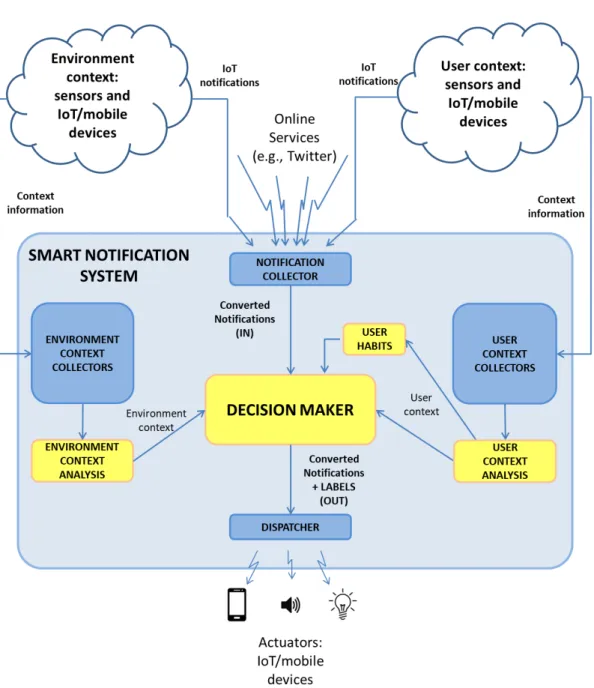
Figure 2.3 shows the architecture of the proposed system: it accepts notifications from different external sources through its Notification Collector module that is also responsible for the conversion of the incoming notifications into a common format containing the information discussed in the following paragraphs. Converted notifications are then sent to theDecision makerthat is aware of environment status (e.g., weather information, current date and time), user context (e.g., location, status, current activity), and user habits and uses them to choose the best devices and the best ways (e.g., vibration, sound, or a light signal) to present the received notifications. The decision is then attached as an additional information to the notifications and the result (called “Converted Notifications + LABELS” in Figure 2.3) is finally sent to theDispatchermodule that adapts the notifications to the chosen target devices and actually sends them.
2.5 Architecture 25
Fig. 2.3 Architecture design
The following description depicts the details of the most important architectural elements.
The Environment Context Collectors and User Context Collectors modules are responsible for retrieving information shown in the following Table 2.5 about environment and user context, but also about the status of the involved devices. These data are acquired from external blocks such as sensors, cloud services (e.g.,
calendar), and IoT devices. Then, the Environment Context Analysis, the User Context Analysisand theUser Habitsmodules are responsible for elaborating the information retrieved by the two Collectors to support theDecision makerin making decisions.
The Decision maker is the core of the system being responsible for all the decisions: every time it receives a notification, it takes the information from the two context analysis components and from the habits module, and decides:
• who should receive the incoming notification (one or more users);
• what is the best moment to show the notification to the chosen user(s) (i.e., a notification can be postponed or ignored if it does not contain important information);
• on which device(s) the chosen user(s) will receive the notification; • which is the best way to notify the incoming notification.
The most important characteristic of this module is the way used to make de-cisions: a supervised learning classification algorithm is responsible for all the described choices.
As already explained, supervised machine learning algorithms are trained through labeled datasets, so we defined the essential characteristics and information that the system should manage to make the right decision:
• Table 2.5 shows the list of context information needed by the algorithm to make decisions, such as information related to available IoT devices (such as device owner, device current location and device current status), user context and environment context (e.g., user current position or current timestamp); • Table 2.6, instead, lists the information related to both incoming (i.e., the
“Converted Notifications” of Figure 2.3) and outgoing notifications (i.e., the “Converted Notifications + LABELS” of Figure 2.3).
Every time a notification arrives, theDecision makercollects available context data and, using the trained algorithm, considers incoming information to make a decision.
2.5 Architecture 27 User context Current activity Current location User preferences Personal user information
Environment context
Current timestamp Weather condition
Number of people present in involved buildings/rooms Status of involved buildings/rooms (e.g., temperature)
Other static information (e.g., information about the involved building) Available IoT devices informa-tion Owner Current location
Current status (e.g., on, off, standby) Available modes
Table 2.5 Context information
Information about incoming notification
Sender Receiver Type of notification Timestamp of receipt Contained message/information
Assigned labels to outgoing notifications
Target devices Chosen mode Delivery timestamp
As a running example, the following paragraph will report the information that the dataset would contain in the situation described in the scenario presented at the beginning of the section. Only key information are reported to let readers better understand the behavior of theDecision maker:
• User context information
– user: Maria
– current activity: having a shower
– current location: house - bathroom
– user habit: activities performed in the bathroom usually last 15 minutes • Environment context information
– current timestamp: 2015-06-11T10:00:30
– involved building: user house
– involved rooms: bedroom, kitchen, bathroom
– people in the bedroom: 0
– people in the kitchen: 0
– people in the bathroom: 1 • Available IoT devices information
– Smartphone
* current location: bedroom (home) * current status: on
– Smart TV
* current location: kitchen (home) * current status: off
• Information about incoming notification
– Sender: washing machine
– Receiver: every family member
2.6 Prototypes: design, implementation and preliminary deployment 29
– Timestamp of receipt: 2015-06-11T10:00:15
– Message: washing cycle ended.
TheDecision makeruses this dataset to make the following decision (the follow-ing information will be contained in the outgofollow-ing notification):
• target devices: smartphone • chosen mode: sound + message
• delivery timestamp: 2015-06-11T10:15:30.
Moreover, as depicted in Figure 2.3, theDecision makeris supported by other modules. The first one is theNotification Collectorthat is responsible for retrieving any kind of notification generated or arrived from every external service and IoT device. It is also responsible for the conversion of the incoming notifications into a common JSON format containing the information reported in Table 2.5 and Table 2.6.
Secondly, theDispatchermodule is responsible for the distribution of the noti-fications: it adapts the notifications generated by theDecision maker (“converted notifications + labels) according to the output methods supported by each device and to the method selected by theDecision maker. Then, it sends them to the right device.
2.6
Prototypes: design, implementation and
prelimi-nary deployment
The modular nature of the SNS system architecture inspired the design and the prototyping of three main groups of contributions provided as first outcome of the present dissertation:
• TheDecision Makercontribution, that presents all the experiments performed with the objective of validating the role of theDecision makermodule and to test its feasibility;
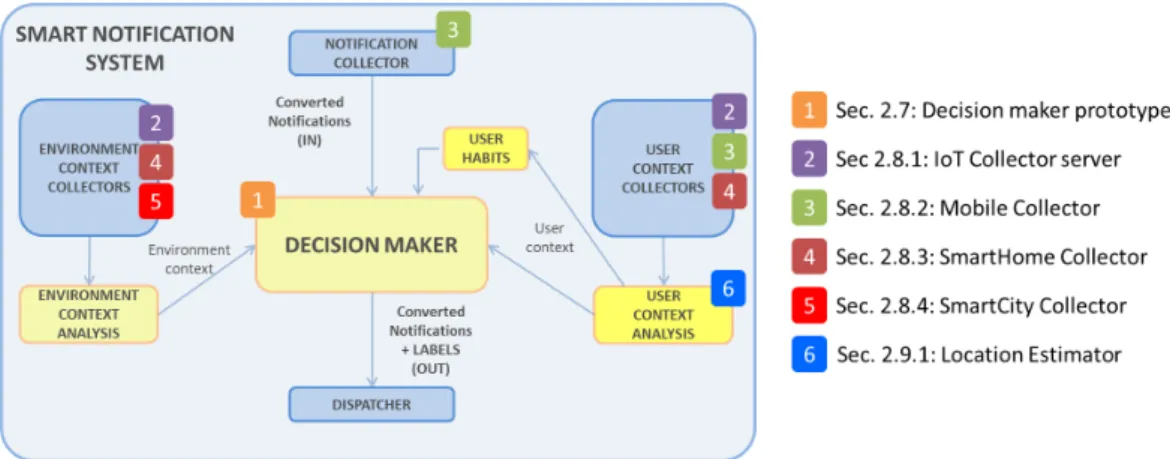
Fig. 2.4 Simplified version of the SNS Architecture with additional information about the developed contribution
• TheCollectorsgroup of contributions, that gathers all the work performed to validate and test a) the Environment Context Collectors and the User Context Collectorsmodules responsible for collecting real context data, and b) theNotification Collectormodule responsible for retrieving the notifications generated by or arrived from external service and IoT device.
• TheContext Analysisgroup of contributions, that gathers all the work per-formed to validate and test theContext Analysismodule responsible for pro-viding additional information, i.e., information extracted from the raw data received from the collectors.
Each contribution may have multiple roles with respect to the modules of the architecture: Figure 2.4 reports a simplified version of the already presented SNS architecture on which some graphical signs help to identify the role of each contri-bution. Specifically, a colored and numbered circle is assigned to each contribution and, as a consequence, each circle is replicated near the architectural modules at which it actually contributes. As can be depicted in the Figure, each contribution can be involved in more than one architectural module: for instance, the IoT Collector server acts in both the Environment and User Context Collectors modules because it is used to collect data from both contexts. In addition, each architectural module can be implemented in different contributions: for instance the User Context information (gathered by the User Context Collectors module) can be gathered through different contributions (e.g., the IoT Collector server and the Mobile Collector).
2.7 Decision Maker 31
The details of such prototypal contributions are discussed in the following sec-tions together with the data and results obtained from the preliminary deployment sessions already performed.
2.7
Decision Maker
The first contribution provided as part of the SNS system regards the development of a prototype of theDecision makermodule with the aim of obtaining some preliminary results and feedbacks about the feasibility of the proposed approach.
As already depicted in the previous sections, the Decision maker module is responsible for all the decisions regarding a) who should receive the incoming notification (one or more users), b) what is the best moment to show the notification to the chosen user(s), c) on which device(s) the chosen user(s) should receive the notification, and d) which is the best way to notify the incoming notification.
The most important characteristic of theDecision makermodule is the way used to make decisions: a supervised learning classification algorithm is responsible for all the described choices.
2.7.1
Preliminary experiments and results
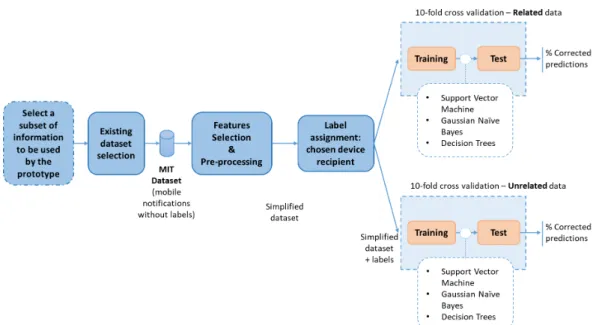
Figure 2.5 shows all the steps followed in developing and testing a prototype of the
Decision makermodule. In this preliminary prototype implementation the work of theDecision makerwas simplified with respect to the one presented in the previous Section by:
• choosing only one device as receiver of the notification instead of more than one;
• assuming that only one user is involved in the system;
• assuming that each device has only one available mode to show the notification; • ignoring the decision related to the best time to deliver the notification. Therefore, due to this simplification, the first step in developing such prototype regards the identification of a reduced set of information needed by theDecision
![Fig. 2.1 Different ways of showing notifications. Image from [1]](https://thumb-us.123doks.com/thumbv2/123dok_us/9066327.2804825/35.892.156.738.174.505/fig-different-ways-showing-notifications-image.webp)
![Fig. 2.2 The resulting C4.5 decision tree obtained by Poppinga et al. [2]. It consists of 20 elements and 11 leaves](https://thumb-us.123doks.com/thumbv2/123dok_us/9066327.2804825/37.892.152.745.168.736/fig-resulting-decision-obtained-poppinga-consists-elements-leaves.webp)