By
Jeffrey Mitchell Herndon
A Master's Paper submitted to the faculty of the University of North Carolina at Chapel Hill
in partial fulfillment of the requirements for the degree of Master of Public Health in
the Public Health Leadership Program.
Abstract
Sex. Most individuals have had or will have sexual intercourse or sexual activity
at some point in their lives. When individuals have sexual activity, regardless of their
age, gender, race, ethnicity, marital status or sexual orientation, there is a level of risk
with contracting a sexually transmitted infection (STI). STIs are common among the
United States population, as more than half of all people in the United States will have
an STI at some point in their lifetime (Koutsky, 1997). One of the most common of
these STIs is caused by human papillomavirus (HPV). Of the more than 100 types of
HPV that can affect various parts of the body, 30 are regarded as transmitted primarily
through sexual activity. As stated by many organizations including the American Social
Health Association (ASHA), genital HPV is common. It is contracted by approximately
80% of sexually active women and men at some point during their lifetime (Koutsky,
1997). Further, more than half of all STI cases were among adolescents and young
adults between the ages of 15 and 24 during the year 2000, with 88% of those new STI
cases resulting from HPV, trichomoniasis and Chlamydia (Weinstock, 2004). Specific to
HPV overall, there are approximately 6.2 million new cases each year in the United
States (Steinbrook, 2006).
Genital HPV is most often a minor, asymptomatic condition that is typically held under control by an individual’s immune system. Still, according to many sources
including the International Agency for Research on Cancer (IARC), certain HPV types
can serve as co-factors for cancers of the cervix, vagina, vulva, and anus in women,
and of the penis and anus in men (IARC, 1995). Of these conditions, cervical cancer is
2009). HPV information and awareness efforts are often targeted more toward the
female population as cervical cancer can only occur in females. Additionally, HPV
tends to only cause benign symptoms in men such as genital warts or bumps, whereas
it can cause cervical cancer precursors (cervical dysplasia) in women. Although it is
important for women to become educated about HPV, males are also in need of
information on the virus. The intent of this paper is to identify the prevalence,
characteristics, and issues surrounding HPV and discuss how topics such as
awareness, symptoms, testing, treatment, risk reduction, vaccines, and psychosocial
Table of Contents
Abstract……….. 2
List of Abbreviations……… 5
List of Figures………... 6
Genital HPV: The Problem………. 7
Genital HPV: Characteristics and Issues………. 10
Who gets HPV?... 10
Transmission………. 11
Signs and symptoms………... 12
Risk and risk reduction……… 14
Testing……… 14
Treatment options……… 15
Psychosocial issues……… 16
Vaccines……… 17
Cancer………... 18
Genital HPV: How to Get Information to Men……….. 22
Web-based initiatives……….. 23
Schools……….. 24
Healthcare providers……… 25
Conclusion………. 25
List of Abbreviations
ACIP Advisory Committee on Immunization Practices
AGI Alan Guttmacher Institute
AIDS Acquired Immune Deficiency Syndrome
AMA American Medical Association
ASHA American Social Health Association
CDC Centers for Disease Control and Prevention
DHHS Department of Health and Human Services
DNA Deoxyribonucleic acid
FDA United States Food and Drug Administration
HIV Human Immunodeficiency Virus
HPV Human Papillomavirus
IARC International Agency for Research on Cancer
MSM Men who have sex with men
NCI National Cancer Institute
NIH National Institutes of Health
SEER Surveillance, Epidemiology, and End Results
STI Sexually Transmitted Infection
TCA Trichloracetic acid
List of Figures
Figure A: Cervical cancer incidence in United States……….9
Figure B: Female genital region………13
Figure C: Male genital region………13
Figure D: Yearly counts of HPV-associated cancers in the US……….…..20
Figure E: HPV-associated anal cancer rates by race and ethnicity, US……....21
Genital HPV: The Problem
The World Health Organization (WHO) defines health as, “a state of complete
physical, mental and social well-being and not merely the absence of disease or
infirmity” (Turnock, 2007). Individuals can be in good health and still have viruses such
as HPV. As human beings, we are exposed to viruses each and every day, and, as our bodies are perfect “hosts” for viruses, we often contract them with or without knowledge.
HPV is an example of a virus that can cause infection, but not disease. More simply
put, it is a virus that individuals can unknowingly have for many years. An estimated 5.5
million individuals contract HPV each year in the United States, and an estimated 20 million individuals currently have the virus (Cates, 1999). “Currently” is the key phrase
here, as many individuals’ immune systems are able to clear the virus to undetectable
levels. A study conducted by Ho and reported in 1998, showed that in 91% of women
with new HPV infections, HPV became undetectable within just two years (Ho, 1998).
However, reactivation at any point for females or males is a possibility. A key element
about HPV is that it is actually a family of viruses with different geno types that affect
different areas of the body. These different viral types fall into classifications of low risk
and high risk, and can affect males and females symptomatically and asymptomatically
in separate ways. While this paper will go into more detail with cervical cancer, genital
HPV can also serve as a cofactor to other cancers as documented by Parkin. HPV is
estimated to be responsible for approximately 90% of anal cancers and about 40% of
vulvar, vaginal, and penile cancers (Parkin, 2006).
Genital warts are referred to as low risk types and rarely cause complications of
as warts but also as simple growths or bumps, raised or flat, single or multiple, that
cause little to no pain or discomfort. These symptoms can appear anywhere in the
genital region below the waist and above the thighs including the penis, scrotum,
vagina, vulva, anus, groin and buttocks. These symptoms may never appear or show
for weeks, months or years after contracting the virus. They may disappear on their
own, and may be a single occurrence or potentially recur again. Hence, it is virtually
impossible for one to know when and from whom they contracted the virus.
There are also high risk types that do not affect men but affect women by
causing cell changes to the cervix, referred to as cervical dysplasia. These abnormal
cell changes can be found by healthcare providers via a Pap test (sometimes referred to as Pap smear) where a sample of cells is taken from the woman’s cervix. This is a
standard test for detecting precancerous cells or tumors. Although not a guarantee,
these high risk types can contribute to the development of cervical cancer. HPV is the
cause of almost all cervical cancer (Walboomers, 1999). Cervical cancer is not rare and
is the 11th most common cancer among women in the United States (Steinbrook, 2006).
As of 2006, approximately 9,710 cases were documented and approximately 3,700
women died (Steinbrook, 2006). Per the Centers for Disease Control and Prevention,
an estimated 10,800 cases of cervical cancer occur each year in the United States
(CDC, 2009). In terms of race and ethnicity, more African American and Hispanic
women develop cervical cancer and are diagnosed at later stages than women of other
races and ethnicities. Approximately 14 Hispanic women, 8 white women, 13 African
American women, and 8 Asian/Pacific Islander women were diagnosed with cervical
of diagnosis for cervical cancer was 47 years (Watson, 2008). Additionally as reported
by Benard, roughly 10 out of every 100,000 women who live in poorer counties (defined
as counties where more than 10% of residents have an income below the federal
poverty level) are diagnosed with cervical cancer each year. The rate climbs to 13
women per 100,000 in counties in which less than 20% of residents are below poverty
level, and peaks at about 19 per women 100,000 in poorer counties (Benard, 2008).
As of 2005, roughly 25 states had cervical cancer rates between 7.9 and 12.8 per
1,000 individuals according to the National Cancer Institute or NCI (NCI, 2005). There
were 12 states and the District of Columbia with incidence rates between 8.7 and 12.8
as displayed in Figure A from the National Cancer Institute. Additionally, there were 12
states with rates between 7.9 and 8.6 as indicated by the incidence rates in Figure A
from NCI. All other states, shown in Figure A in purple, had rates below 7.9. These
overall rates should be considered too high in light of the United States having one of
the highest amounts of yearly spending on healthcare (WHO, 2008).
Figure A: Cervical Cancer Incidence in United States
Cervical Cancer Incidence Rates 2005
Surveillance, Epidemiology, and End Results (SEER) Program, National Cancer Institute (NCI) 1975–1991 =
SEER 9; 1992–2005 = SEER 13
8.7 to 12.8 Incidence Rate
Alaska, Arkansas, Delaware, District of Columbia, Florida, Kentucky, Louisiana,
Nevada, New Mexico, New York, Tennessee, Texas, and West Virginia
7.9 to 8.6 Incidence Rate
Alabama, California, Georgia, Illinois, Missouri, New Jersey, North Carolina, Ohio, Oklahoma, Pennsylvania, Rhode
Island, and South Dakota
Less than 7.9
Genital HPV: Characteristics and Issues
HPV infections are common among men of all ages (Giuliano, 2008). Males
who are sexually active or will be at some point in their lives need to be empowered with
information on HPV. For their own benefit as well as the benefit of their partner, gaining
knowledge of HPV and its potential effects on the body is worthwhile for men. Strategies for increasing men’s access to accurate, non-alarmist information is warranted and
programs offering such information should be implemented nationally. Programs,
outreach efforts, and initiatives with the goal of educating the public on HPV should
consider the importance of offering gender-specific information as part of a
comprehensive approach. Based on my 11 years of experience at addressing sexually
transmitted infections, I will discuss the HPV topics below:
Who gets HPV?
Transmission
Signs and symptoms
Risk and risk reduction
Testing
Treatment options
Psychosocial Issues
Vaccines
Cancer
Who gets HPV?
Just as any female who has had sexual activity could contract HPV, any male
good or bad, clean or dirty, or deserving of contracting it; the simple fact is sexual
activity engenders a risk for contracting the virus. The CDC estimates that most
sexually active people in the United States will contract HPV at some point during their
lifetime (CDC, 2009). Most experts agree that the majority of sexually active people will
be exposed to the virus at some point in their lives and potentially contract it
unknowingly. Individuals with HPV span across all demographics and it is estimated
that approximately 80% of sexually active women and men contract HPV at some point
during their lifetime (Koutsky, 1997). One challenge is that most individuals simply do
not know they have the virus and can pass it to a partner unknowingly, which takes us
to the next topic of transmission.
Transmission
Genital HPV can be spread by direct, skin-to-skin contact during vaginal or anal
sex, as well as genital-to-genital contact. It is important to note that an individual may
not have intercourse, but still contract the virus through intimate genital contact where one person’s skin touches another person’s skin. Oral sex, where an individual’s mouth
touches the genital region of another person, has been correlated with HPV in the mouth and oropharyngeal cancer (D’Souza, 2007). However, little is confirmed about
oral HPV infection (Syrjänen, 2007). Still, while oral sex is less well understood as a risk for HPV, the practice is increasingly linked to HPV infections. (D’Souza 2009). Also
important is that the facts above apply to heterosexual couples as well as homosexual couples, “straight” or same-sex partners. Finally, the virus can be passed even when
is a common topic of concern among those with questions about HPV. An
observational study was conducted to collect and analyze survey data from participants
who contacted an HPV hotline and email service. The findings indicated that
transmission was one of the concerns most often expressed about HPV (Herndon,
2006).
Signs and symptoms
It is important to note that many people with genital HPV are asymptomatic –
meaning they have no symptoms of the virus. True too is that symptoms can often
appear but be unrecognizable and thus a person may not realize they have the virus.
As mentioned previously, there are different types of HPV with some causing genital
warts and other causing cervical dysplasia. Cervical cancer rarely has detectable
symptoms, unless it is quite advanced (American Cancer Society, 2009). Thus,
information disseminated on the topic symptoms typically centers on genital warts only.
For both women and men, symptoms of genital warts can appear anywhere below the
waistline and above the upper thigh area (see Figure B and Figure C below from
A.D.A.M. Images – one of the world's largest libraries of medical illustrations with nearly
30,000 detailed and medically accurate images (A.D.A.M., 2010). Contrary to what
some individuals believe, the areas for symptoms include not just the penis and vagina,
but also the anus, buttocks, scrotum, upper thighs, and perineum. The bumps or warts
can vary from one person to another and may appear as single or multiple painless
itch or be sensitive. Finally, the symptoms may come and go with or without treatment of any kind and potentially recur if one’s immune response is weakened.
Figure B: Female genital region (From A.D.A.M. Images, 2010)
Risk and risk reduction
Knowing the signs and symptoms mentioned above, one risk reduction approach
regarding acquisition of genital HPV or any STI is to abstain from sexual activity while
symptoms are present. Using latex condoms can reduce the risk of transmission of
genital HPV (Winer, 2006). While they do not offer 100% protection, latex condoms do
reduce skin-to-skin contact and therefore decrease the potential to pass or contract the
virus. Individuals can also lower the risk of contracting HPV by being in a monogamous
relationship and/or limiting their number of sexual partners. Additionally, vaccines can
now prevent males and females from contracting HPV. Two vaccines are currently
available; Cervarix is available for females while Gardasil is available for both males
and females (CDC, 2009). Vaccines will be discussed in more detail below, but studies
have shown that individuals and parents of minors are receptive to HPV vaccinations
(Brewer, 2007). Finally, studies have shown that male circumcision has been found to
reduce the likelihood of genital HPV in men (Castellsague, 2002)
Testing
Unfortunately, there is no test approved for clinical use to detect HPV infection in
a man. Although a Pap test is used to detect abnormal cell changes in the cervix and
there are follow-up screening tests for HPV DNA, these are only used to help screen for
cervical cancer in women (CDC, 2009). Still, this should not deter a male from seeking
consultation and diagnosis if they notice visible bumps or warts in the genital region. If a
male or female has visible bumps or warts in the genital region, a doctor can provide a
Because there can be bumps in the genital region for reasons other than HPV infection
(other STIs or skin conditions), it is recommended that a person with symptoms see
their doctor for a diagnosis. Regarding the Pap tests used to find abnormal cell
changes in women, it is important for females and males to understand the need for
screening, since the Pap test is very effective at finding cervical cancer early when it
can be highly curable (American Cancer Society, 2009). Screening frequency depends
on several factors including age, previous screening history, results of the last Pap test,
and the type of screening method being used (American Cancer Society, 2009)
Treatment options
HPV treatment for males and females is currently limited to genital warts. While
warts may resolve on their own, there are several treatments available with no single
treatment considered a preferred method, as each decision should be on a
case-by-case basis. Considerations for the type of treatment to use are based on the size,
location, and number of warts or bumps. Also important considerations are the cost
implications for the individual, potential side effects, and considerations of past
treatment success. Per the CDC Treatment Guidelines, treatments include: imiquimod
cream and podofilox cream/gel prescribed for patient application; podophyllin and
trichloracetic acid (TCA) as available by a healthcare provider; cryotherapy, which is the
freezing of warts/bumps with liquid nitrogen; electrocautery, which removes
warts/bumps with an electric blade; laser therapy which uses an intense light to remove
the warts/bumps; and finally surgical removal of the warts/bumps (CDC, 2009). It is
provider with any questions or concerns he may have prior to treatment. Specific to
females, the treatment options are the same, with special considerations for pregnancy,
vaginal warts or cervical warts.
Psychosocial issues
Often the social or emotional impact of an STI diagnosis can be more difficult to
deal with than any physical complications. As I was quoted in an article for Sex, Etc., a
magazine geared to younger adults sponsored by Rutgers, The State University of New
Jersey, there are many misconceptions and preconceived notions about STIs and many
people have inaccurate information (Sex, Etc., 2006). It is common for someone, male
or female, to feel upset after a diagnosis. Just hearing that you have been diagnosed
with an incurable virus can be daunting and cause even the most self-confident
individual to be concerned about his or her future. Yet, it’s important for one to realize a
few solid facts about the virus in order to truly understand its impact on their current and
future health and life as a whole. First, there is no cure for any virus, even the common
cold or flu, and that like many viruses, the human body responds to HPV by fighting the
virus with its immune response. Secondly, it is important to understand that genital
HPV is common simply because sexual activity is common. A key step is to understand
that an individual is not a bad person for having HPV. It is not uncommon for a person
to feel upset about having the virus or to blame themselves. Certainly, there are factors that increase one’s risk of contracting HPV such as multiple sex partners and lack of
level of risk. Thirdly, one must understand the facts surrounding HPV including its
different low risk and high risk types and also how both genders are affected.
Returning to a sense of normalcy does not just happen overnight. Upon a
diagnosis or hearing that a partner has the virus is the time to obtain updated, accurate
information if one is not already educated on the HPV virus. Most people find that they
are able to put HPV in perspective whether they, a partner, or both have the virus.
Resources such as the CDC, American Social Health Association, American Cancer
Society, and National Cancer Institute are just a few examples of reputable,
non-alarmist resources where individuals may receive helpful information on HPV and
HPV-associated cancers. Succinctly put, HPV is a virus that tends to be a minor problem
that can be resolved, if diagnosed early.
Vaccines
Perhaps one of the most important developments in vaccine research and
certainly within the cancer arena in recent memory has been the successful creation of a vaccine for HPV. Named Gardasil (pronounced “gard-Ah-sill”); it was approved by
the United States Food and Drug Administration (FDA) in 2006 for the prevention of
cervical cancer in girls and women between the ages 9 to 26 (Merck & Company,
2006). It was proven effective against the two high risk strains of HPV that can cause cervical cancer – types 16 and 18 (Merck & Company, 2006). The vaccine is also
virtually 100% effective in blocking persistent infections and diseases associated with
the two low risk HPV types found with 90% of genital warts, HPV 6 and 11. In clinical
trials it was found to be most effective in women who had not yet been sexually active;
with the ideal age range being 11 to 12 since they likely have not yet had sexual activity
(Merck & Company, 2006). Women who are between the ages of 19 to 26 can also
obtain the vaccine, but it is ideally given prior to a woman having sexual activity. In
October 2009, the Gardasil vaccine was approved for use in boys and men between the
ages 9 to 26 for the prevention of genital warts. As with females, this vaccine should
ideally be administered to males prior to potential exposure to HPV from sexual contact
(CDC, 2010).
The guidelines and recommendations above have been advised by various
parties including the FDA, CDC, ASHA, and the American Medical Association (AMA).
However, these guidelines still vary in terms of implementation from state to state.
There are many issues that affect the use of these vaccines, including but not limited to
the acceptance of parents, cost implications, political climate, insurance coverage, and concerns over implications of sexual activity. For example, parents can “opt out” of
vaccination requirements in some states (ASHA, 2010). Still, data show that parents in
the United States have a positive attitude toward HPV vaccination (Brewer, 2007).
Additionally, many pediatricians say they would administer the vaccine and support the
use of its universal use (Abbigail, 2007). Abbigail adds that specific strategies for
vaccine delivery, availability of vaccines in various settings, guidance for addressing
possible parental concerns, and specific educational initiatives were important to the
successful implementation of the vaccines (Abbigail, 2007).
Cancer
Genital HPV can lead to various cancers as already noted. By far the most
2009). From the perspective of a male who is in a heterosexual relationship, being educated on HPV and aware of facts specific to females would be helpful – facts such
as that Pap tests are a recommended screening tool to find cervical cancer early and
that cervical cancer is more likely to occur in women who smoke, have HIV or AIDS,
and who have poor nutrition (American Cancer Society, 2009).
Still, other cancers can result from HPV, and whether male or female, it is
important to note the chances of developing cancer from an HPV infection and speak to
a healthcare provider about personal risk and recommendations on risk reduction.
Specific to penile cancer and anal cancer, both are rare in the United States with about
800 HPV-associated penile cancers and 3,000 HPV-associated anal cancers cases per
year, yet it is important to know the symptoms of both (CDC, 2010). For penile cancer,
symptoms can include changes in color and thickness of the genital skin, redness,
bumps, and sores. Symptoms of anal cancer can include itching, bleeding, pain, and
swelling in or near the anus. All of these symptoms described for anal and penile cancer can occur for a variety of other reasons, thus consulting with one’s healthcare
provider on such symptoms and on a regular basis is a good practice. Basically, any
male who notices changes to his genital or anal skin should consult with his provider.
An important point for men who have sex with men (MSM) and/or for men who
have or have had receptive anal sex, they may consider speaking with their healthcare
provider about having a periodic Pap test in the anus. Similar to a Pap test for a woman’s cervix, an anal Pap test involves a healthcare provider taking a swab of the
anus in order to collect a sample of cells. The sample is then examined under a
this method could be a considered screening option due to the potential risk of anal
cancer.
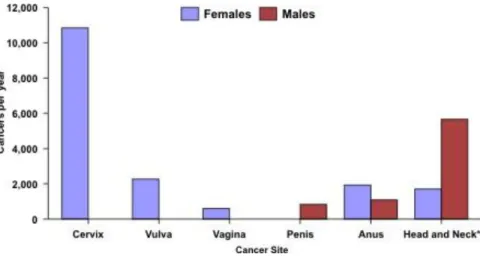
In terms of the various cancers, approximately 10,800 HPV-associated cervical
cancers, 2,300 HPV-associated vulvar cancers, 600 HPV-associated vaginal cancers,
800 HPV-associated penile cancers, 1,900 HPV-associated anal cancers in women and
1,100 in men, and 1,700 HPV-associated head and neck cancers in women and 5,700
in men occur in the United States each year per the CDC (CDC, 2009). Head and neck
cancers are not associated with genital HPV. The three bar charts below detail the total
number of HPV-associated cancers, anal cancers, and penile cancers from 1998 to
2003 per 1,000 individuals and are provided courtesy of the CDC website. As shown in
Figure D, women are more commonly affected with more cases of cervical, vulvar, and
vaginal cancer versus men with smaller numbers of HPV-associated cancer cases of
the penis and anus. Head and Neck cancers are included on the chart, but are not
discussed here due to the discussion being on genital HPV.
Figure D: Yearly counts of HPV-associated cancers in the US, 1998–2003
These figures from the CDC show how anal and penile cancers are broken down
by race and ethnicity within the United States.
Figure E: HPV-associated anal cancer rates by race and ethnicity, US,
1998–2003 (CDC, 2009)
Figure F: HPV-associated penile cancer rates by race and ethnicity, US,
Genital HPV: How to Get Information to Men
The challenges and concerns that HPV presents to men in the United States
have been summarized and an overview of the relevant information has been provided.
The challenge is, how does this type of information get into the hands of the individuals
who need it? What resources and opportunities are available to ensure that males of
varying ages have access to the HPV information they need? What challenges and
limitations are there to funding, proper planning, assessment and implementation of
such efforts? Is there an interest and an audience, whether professional or public, that
would be receptive to such information? These important questions cannot be
addressed in this setting alone; however, recommendations on which available
communication venues can be used to conduct outreach to males can be introduced. Some good news is that since the initial planning phases of this master’s paper, several
agencies have created male-specific educational materials geared to and about men.
The American Social Health Association and CDC for example, created dedicated web
pages tailored to the needs of men at: http://www.ashastd.org/hpv/hpv_learn_men.cfm
and http://www.cdc.gov/std/hpv/stdfact-hpv-and-men.htm. This is an excellent first step
in the right direction to having available HPV information that is of specific interest to
males.
Regarding comprehensive information on HPV, the creation of resources and
implementation of targeted efforts are key considerations for an effective approach.
Here, we will assume funding levels are limited and will not consider more expensive
efforts such as multi-media approaches, extensive outreach projects, and the like. We
opportunities for increasing HPV education and awareness, and thus making an impact
on the HPV situation. These cost effective venues include:
Web-based initiatives
Schools
Healthcare providers
Web-based initiatives
Communication options via the Internet have increased considerably as
technological advances have occurred. With the age of the internet and
at-your-fingertips information 24-hours-a-day, the appeal of offering information quickly and
efficiently has benefited many facets of our country. Education and outreach
opportunities are no different. There are many websites geared to public health, men’s
health, sexually transmitted infections, reproductive health, behavioral sciences,
adolescent health, and other topics that HPV could fall under. Resources with the goal
of providing health information to males, should consider offering basic information and
reliable links to additional HPV resources. The Internet provides options of downloading
material, sharing dialogue, asking questions, networking with professionals, and posting
materials; the opportunities are endless and also cost-effective. With just a few clicks,
detailed information can be posted and accessible to billions of Internet users across
the world, and sensitive health questions can be answered in an anonymous,
confidential manner. Considering this opportunity, entities can continue or even
Of special mention is the increased use of social networking sites and
advocacy/support group sites. These venues provide cost-effective options for reaching
specific populations. It is possible to target varying male demographics by specific
topics such as income, educational background, as well as by country or regions within
the United States. For example, an existing outreach program in North Carolina can
advertise or market to males who reside in North Carolina and are of a specific age range by utilizing networks such as Facebook™ or MySpace™.
Schools
Parents often find it difficult to discuss sex with their children and many may be
lacking in knowledge of topics including HPV and condom efficacy. This is important
considering that sex is common in the teenage years (Guttmacher Institute, 2002).
Even more importantly for adolescent males, studies suggest that young males have
sexual activity earlier and a higher number of partners than females; both are factors
associated with a higher risk of contracting an STI (Marcel, 2003). Educational
materials, resources, and referrals need to be made available to school-aged children
as part of a comprehensive sexual education program. Exactly at what age to
implement such programs will vary depending on various factors including acceptance,
political climate, parental concern, and funding. The average age of first sexual
intercourse for males and females is between 16 to 17 years of age (Kaiser, 2005).
Thus, it is the recommendation of this author to begin comprehensive STI education,
which includes basic HPV awareness, between the ages of 13 and 14. This also
Healthcare providers
Taking ownership with regard to providing both care and information on HPV
should be a high priority for healthcare professionals who deal with this indication.
Healthcare providers of men especially present an opportune venue for materials such
as brochures, flyers, posters, and tools for HPV education. Specialties and settings
where males may frequent can include but not be limited to urologists, dermatologists,
community clinics, proctologists, and health departments. The FDA should continue to
play a key role in not only setting standards for testing and treatment, but also in
providing resources and information to healthcare professionals who in turn can then
disseminate information to their patients. As Hamburg and Sharfstein point out in an article on the FDA, “Collaboration with sister public health agencies in the DHHS
(Department of Health and Human Services), industry, consumer and patient
organizations, and the public will lead to exciting opportunities for progress in public health.”
Conclusion
With the high prevalence of HPV, estimated millions of new cases each year, and
the identified health implications that affect women and men such as cervical or penile
cancer, the time for males to get updated, tailored information is now. As more
research findings provide additional important HPV information and more
communication venues are more easily accessible, opportunities exist for awareness at
various age levels and to different male audiences. Information on topics including HPV
issues, is available and should be sought by and offered to sexually active males.
Information dissemination via web-based efforts, schools and health care professionals
can play a key role in the successful implementation of HPV awareness campaigns and
prevention efforts. Vaccination programs are of special importance considering the
proven efficacy of the current HPV vaccines and their availability to both females and
males. Coupled with risk reduction measures, it is clear the call to action for the male
population in the United States is here. Ultimately, any perceived barriers, limitations
and challenges should be viewed as potential opportunities for education, awareness
References
Abbigail M, Tissot MA, et al. (2007). Effective strategies for HPV vaccine delivery: The views of pediatricians. Journal of Adolescent Health. August; 41 (2): 119-125
A.D.A.M. Images, Online source for medical images. Retrieved December 9, 2010 from www.adamimages.com
American Cancer Society Retrieved January 11, 2010 from http://www.cancer.org
American Cancer Society, Cancer facts for women. 2009
American Social Health Association, Retrieved March 28, 2010 from http://www.ashastd.org/hpv/hpv_vaccines.cfm
Benard VB, Johnson CJ, Thompson TD, Roland KB, Lai SM, Cokkinides V, Tangka F, Hawkins NA, Lawson H, and Weir HK. Examining the association between socioeconomic status and potential human papillomavirus-associated cancers.
Cancer 2008; 113 (S10):2910–2918.
Brewer NT, Fazekas KI. Predictors of HPV vaccine acceptability: A theory-informed, systematic review, Preventive Medicine 2007
Castellsague X, Bosch X, et. al. Male circumcision, penile human papillomavirus infection, and cervical cancer in female partners. New England Journal of Medicine 2002; 346:1105-12.)
Cates, Willard. (1999). Estimates of the incidence and prevalence of sexually
transmitted diseases in the United States. Sexually Transmitted Diseases, 26(4), s2-s7.
CDC. Number of HPV-Associated Cancer Cases per Year. Retrieved November 30, 2009 from www.cdc.gov/cancer/hpv/statistics/cases
CDC, Retrieved December 3, 2009 from http://www.cdc.gov/std/hpv/stdfact-hpv-and-men.html
CDC, Retrieved March 28, 2010 from
http://www.cdc.gov/vaccines/recs/provisional/downloads/hpv-vac-dec2009-508.pdf D’Souza G, Kreimer AR, Viscidi R, et al. Case–control study of human papillomavirus
and oropharyngeal cancer. New England Journal of Medicine 2007; 356:1944-56.
Giuliano A, et al. The human papillomavirus infection in men study: Human
papillomavirus and type distribution among men residing in Brazil, Mexico, and the United States. Cancer Epidemiology Biomarkers & Prevention. 2008; 17: 2036-43. Guttmacher Institute, Facts on American teens’ sexual and reproductive health, 2002,
The Alan Guttmacher Institute (AGI)
Hamburg M, and Sharfstein J. The FDA as a public health agency. The New England Journal of Medicine. 2009
IARC monographs on the evaluation of carcinogenic risks to humans. Vol. 64. Human papillomaviruses. Lyons, France: International Agency for Research on Cancer, 1995.
Koutsky L. (1997). Epidemiology of genital human papillomavirus infection. American
Journal of Medicine, 102(5A), 3-8.
Marcel Av, Raine T, and Eyre SL, Where does reproductive health fit into the lives of adolescent males?, Perspectives on Sexual and Reproductive Health, 2003
Merck & Co., Inc. Patient information about Gardasil. 2006
Parkin DM, Bray F. Chapter 2: The burden of HPV-related cancers. Vaccine 2006; 24(suppl 3):S11–S25.
Saslow Debbie, et al. American cancer society guideline for human Papillomavirus vaccine use to prevent cervical cancer and its precursors. A Cancer Journal for Clinicians, 2007
Sex, Etc., Rutgers, The State University of New Jersey, Issue 2, 2006
Steinbrook R. The potential of human papillomavirus vaccines. The New England Journal of Medicine, March 21, 2006.
Syrjänen S. Human papillomaviruses in head and neck carcinomas. New England Journal of Medicine 2007; 356:1993-5.
Turnock J. 2004. Public Health. What It Is and How It Works. Jones and Bartlett Publishing, Mass.
Watson M, Saraiya M, Benard V, Coughlin SS, Flowers LC, Cokkinides V, Schwenn M, Huang Y, Giuliano AR. Burden of cervical cancer in the United States, 1998– 2003. Cancer 2008; 113(S10):2855–2864.
Winer RL, Hughes JP, Feng Q, et al. Condom use and the risk of genital human papillomavirus infections in young women. New England Journal of Medicine 2006; 354:2645-54.