9HSTF
MG*age
bda+
ISBN 978-952-60-6413-0 (printed) ISBN 978-952-60-6414-7 (pdf) ISSN-L 1799-4934 ISSN 1799-4934 (printed) ISSN 1799-4942 (pdf) Aalto University School of Science Department of Computer Science www.aalto.fi BUSINESS + ECONOMY ART + DESIGN + ARCHITECTURE SCIENCE + TECHNOLOGY CROSSOVER DOCTORAL DISSERTATIONS A a lto -DD 14 9 /2 0 15Software product companies often face the diversity of customer needs. Instead of developing a single product as a compromise of such heterogeneous needs, many
companies have built a software product line, that is, a set of software products with slightly varying capabilities and a shared architecture. At the same time, quality attributes, such as performance and security, play a significant role in satisfying the stakeholders' needs. To complicate matters, different customers may have different needs and expectations about the product quality.
This dissertation studies why and how to vary quality attributes purposefully in a software product line. Why should a software company offer products with purposefully different quality attributes? How can the company communicate these quality differences to the customer? How can these quality differences be produced efficiently under the same product line architecture, and how to ensure the quality differences between the products?
Var van a My llär nie m i Q ua lit y At tribut e V aria bil it y in So ftw are P ro duc t L ine s A alt o U n iv er sit y
Quality Attribute Variability
in Software Product Lines
V
a
r
y
i
ng
P
e
r
f
o
r
ma
nc
e
a
nd
S
e
c
ur
i
t
y
P
ur
p
o
s
e
f
ul
l
y
V
a
r
v
a
na
M
y
l
l
är
ni
e
mi
DOCTORAL DISSERTATIONS
DOCTORAL DISSERTATIONS 149/2015
Quality Attribute Variability in
Software Product Lines
Varying Performance and Security Purposefully
Varvana Myllärniemi
A doctoral dissertation completed for the degree of Doctor of Science (Technology) to be defended, with the permission of the Aalto University School of Science, at a public examination held at the lecture hall T2 of the school on 6 November 2015 at 12.
Aalto University School of Science
Prof. Marjo Kauppinen
Thesis advisor
Prof. Tomi Männistö, University of Helsinki, Finland
Preliminary examiners
Prof. Eduardo Almeida, University of Bahia, Brazil
Prof. Emer. Kai Koskimies, Tampere University of Technology, Finland
Opponent
Prof. Ivica Crnkovic, Chalmers University of Technology, Sweden
Aalto University publication series DOCTORAL DISSERTATIONS 149/2015 © Varvana Myllärniemi ISBN 978-952-60-6413-0 (printed) ISBN 978-952-60-6414-7 (pdf) ISSN-L 1799-4934 ISSN 1799-4934 (printed) ISSN 1799-4942 (pdf) http://urn.fi/URN:ISBN:978-952-60-6414-7 Unigrafia Oy Helsinki 2015
Aalto University, P.O. Box 11000, FI-00076 Aalto www.aalto.fi
Author
Varvana Myllärniemi
Name of the doctoral dissertation
Quality Attribute Variability in Software Product Lines: Varying Performance and Security Purposefully
Publisher School of Science
Unit Department of Computer Science
Series Aalto University publication series DOCTORAL DISSERTATIONS 149/2015
Field of research Software Engineering
Manuscript submitted 12 June 2015 Date of the defence 6 November 2015
Permission to publish granted (date) 25 August 2015 Language English
Monograph Article dissertation (summary + original articles) Abstract
Software product line engineering is a plan-driven paradigm to produce varying software products. Software product lines typically differentiate the products by their functionality. However, customers may have different needs regarding performance, security, reliability, or other quality attributes. Building a software product line that is able to efficiently produce products with purposefully different quality attributes is a challenging task.
The aim in this dissertation was to study why and how to vary quality attributes purposefully in a software product line. The study focused on two quality attributes, performance and security. We conducted a systematic literature review on quality attribute variability, conducted two case studies on performance variability, and constructed a design theory and artifacts addressing security variability.
The results indicate that quality attributes can be purposefully varied to serve different customer needs, to conduct price differentiation, and to better balance product and design trade-offs. Additionally, quality attributes can be varied to adapt to varying operating environment constraints. The quality attribute differences can be communicated to the customers as observable product properties, as internal resources, or as the target operating environments. In particular, security can be distinguished as countermeasures. In the product line architecture, quality attribute differences can be designed through software or hardware design tactics or by relying on indirect variation. Just designing the differences may not be enough to ensure the product has given quality attributes, but the impact of other variability may need to be handled at the product-line or product level.
Our contributions are as follows. Instead of focusing on how to represent quality attribute variability, we focused on understanding the phenomenon of how specific quality attributes vary. We identified several differences between performance and security variability, for example, that security is more difficult to distinguish to the customers but more
straightforward to design and derive. We combined design and customer viewpoints: the reason to vary and the means to communicate to the customers should be analyzed both from the technical and non-technical viewpoints. Finally, we drew evidence-based generalizable knowledge from the industrial context.
Keywords software product lines, quality attributes, variability
ISBN (printed) 978-952-60-6413-0 ISBN (pdf) 978-952-60-6414-7
ISSN-L 1799-4934 ISSN (printed) 1799-4934 ISSN (pdf) 1799-4942
Aalto-yliopisto, PL 11000, 00076 Aalto www.aalto.fi
Tekijä
Varvana Myllärniemi
Väitöskirjan nimi
Laatuvarioituvuus ohjelmistotuoteperheissä: Suorituskyvyn ja tietoturvan tarkoituksellinen varioituvuus
Julkaisija Perustieteiden korkeakoulu
Yksikkö Tietotekniikan laitos
Sarja Aalto University publication series DOCTORAL DISSERTATIONS 149/2015
Tutkimusala Ohjelmistotuotanto
Käsikirjoituksen pvm 12.06.2015 Väitöspäivä 06.11.2015
Julkaisuluvan myöntämispäivä 25.08.2015 Kieli Englanti
Monografia Yhdistelmäväitöskirja (yhteenveto-osa + erillisartikkelit) Tiivistelmä
Ohjelmistotuoteperheet ovat tapa tuottaa suunnitelmallisesti toisistaan eroavia ohjelmistotuotteita. Tyypillisesti tuoteperheen tuotteita differentioidaan toisistaan
toiminnoilla. Asiakkailla voi kuitenkin olla erilaisia tarpeita liittyen tuotteiden suorituskykyyn, tietoturvaan, luotettavuuteen tai muihin laatuattribuutteihin. On haastavaa rakentaa tuoteperhe, jonka avulla pystytään tehokkaasti ja hallitusti tuottamaan laadullisesti toisistaan eroavia tuotteita.
Tämän väitöskirjan tavoitteena oli tutkia miksi ja miten laatuattribuutteja varioidaan tarkoituksellisesti tuoteperheissä. Tutkimus keskittyi kahteen laatuattribuuttiin, suorituskykyyn ja tietoturvaan. Teimme systemaattisen kirjallisuuskatsauksen laatuvarioituvuudesta, kaksi tapaustutkimusta suorituskykyvarioituvuudesta sekä rakensimme artefaktoja ja niitä koskevia teorioita tietoturvavarioituvuudesta.
Tulosten mukaan tarkoituksellisella laatuvarioituvuudella voidaan vastata asiakkaiden erilaisiin tarpeisiin, differentioida tuotteita hinnalla ja tasapainottaa suunnitteluun liittyviä ristiriitoja. Laatua voidaan varioida myös, jotta tuote mukautuisi paremmin
toimintaympäristöönsä. Erot laatuattribuuteissa voidaan kommunikoida asiakkaalle ulospäin näkyvinä tuoteominaisuuksina, sisäisinä tuoteresursseina tai tuotteiden
toimintaympäristöinä. Ennen kaikkea, tietoturvan erot voidaan kuvata tietoturvauhkien vastakeinoina. Laatuerot voidaan suunnitella tuoteperheen arkkitehtuuriin hyödyntäen ohjelmistoa, laitteistoa tai epäsuoraa laatuvarioituvuutta. Laatuerojen
arkkitehtuurisuunnittelu ei yksinään riitä takaamaan haluttuja laatutasoja tuotteisiin, vaan muun varioituvuuden vaikutus laatuun pitää huomioida joko tuoteperheen tai tuotteen tasolla. Tutkimuksen merkitys on seuraava. Emme keskittyneet laatuvarioituuden mallittamiseen, vaan yritimme ymmärtää itse ilmiötä, eli miten laadut varioituvat. Suorituskyky ja tietoturva varioituvat osittain eri tavoin. Esimerkkinä, voi olla vaikeampaa kuvata tietoturvan eroja asiakkaille, mutta tietoturvaerojen suunnittelu ja yksittäisten tuotteiden tuottaminen voi olla suoraviivaisempaa. Tutkimuksemme korosti sekä suunnittelun että asiakkaan ymmärtämistä: sekä tekniset että ei-tekniset näkökulmat tulisi ottaa huomioon tehtäessä päätöksiä siitä, varioidaanko laatua ja miten tästä kerrotaan asiakkaille. Lopuksi, tuotimme empiiriseen näyttöön perustuvaa yleistettävää tietoa teollisista tuoteperheistä.
Avainsanat ohjelmistotuoteperheet, laatuattribuutit, varioituvuus
ISBN (painettu) 978-952-60-6413-0 ISBN (pdf) 978-952-60-6414-7
ISSN-L 1799-4934 ISSN (painettu) 1799-4934 ISSN (pdf) 1799-4942
Preface
The path to this dissertation has been long and winding. At one point, I was ready to give up. However, what does not kill you makes you stronger and I survived. By making all the mistakes myself, I learned to become a real researcher. I have learned to follow and obey two masters: existing scientific knowledge and empirical data. Only they can set a researcher free.
I want to thank everybody who has supported me on this path.
First and foremost, I would like to thank both my supervisors. Professor Tomi Männistö started this path with me. He helped me to find my the-sis topic, and to understand how fundamental and challenging the idea of quality attribute variability is. Under his supervision, I learned all the tricks and trades of doing research. After Tomi joined University of Helsinki, he was appointed as my instructor. Nevertheless, Tomi’s input in the later stages of this thesis was similar to that of an official supervi-sor. Professor Marjo Kauppinen was appointed as my supervisupervi-sor. Marjo supported me when I was writing this dissertation. She excels in helping any author to distill the essential and to clarify the message. With her, I have really learned the necessity of well-defined research questions. In addition, her enthusiasm in all matters is very enlightening.
I would also like to thank all my co-authors in the publications. In par-ticular, Mikko Raatikainen has been my colleague through thick and thin, and I have learned many things through his comments and observations. Juha Savolainen has always provided valuable ideas and several possi-bilities of data collection. Behind the publications, the research involved collaboration with several people and companies. I am grateful for their support. When building the artifact, Timo Asikainen was there with me in the early stages of this research. I was also fortunate to do great col-laboration with Nokia Research Center. The data collection for the case
studies would not have been possible without two companies, Nokia and Fathammer. I sincerely thank all my interviewees, representatives of the companies, and fellow researchers that helped me throughout the way.
The preliminary examination of this dissertation was done by Profes-sor Emeritus Kai Koskimies and ProfesProfes-sor Eduardo Almeida. Their com-ments and valuable feedback enabled me to improve this dissertation and prepared me for the final defense.
This research was financially supported by TEKES (the Finnish Fund-ing Agency for Innovation), ITEA (a EUREKA Cluster programme in the area of Software-intensive Systems and Services), and DIGILE (one Strate-gic Center for Science, Technology and Innovation in Finland). I am grate-ful for this support.
Last but not least, I would not have succeeded without my family: my husband Ville and my daughters Vivia and Vellamo. When I thought there was no path forward, Ville talked me over, told me to keep pushing and not to give up.
Espoo, September 29, 2015,
Contents
Preface 1 Contents 3 List of Publications 5 Author’s Contribution 7 1. Introduction 9 1.1 Background . . . 9 1.2 Research Motivation . . . 111.3 Research Problem and Questions . . . 12
1.4 Research Scope . . . 14
1.5 Structure of the Dissertation . . . 16
2. Research Methods 17 2.1 Overview of the Methods . . . 17
2.2 Systematic Literature Review . . . 18
2.2.1 Research Design . . . 18 2.2.2 Research Process . . . 20 2.3 Case Studies . . . 22 2.3.1 Case Selection . . . 22 2.3.2 Data Collection . . . 24 2.3.3 Data Analysis . . . 24 2.4 Design Science . . . 26
2.4.1 Artifacts and Theory . . . 26
2.4.2 Evaluation . . . 27
2.4.3 Research Process . . . 28
3. Terminology 31
3.1 Quality Attributes and Software Architectures . . . 31
3.2 Performance . . . 32
3.3 Security . . . 33
4. Previous Work on Quality Attribute Variability 35 4.1 Explanation for Varying Quality Attributes (RQ1) . . . 36
4.2 Distinguishing Quality Variants (RQ2) . . . 38
4.3 Designing Variability and Deriving Variants (RQ3,RQ4) . . 40
5. Performance Variability 45 5.1 Explanation for Varying Performance (RQ1) . . . 45
5.2 Distinguishing Performance Variants (RQ2) . . . 47
5.3 Designing Performance Variability (RQ3) . . . 49
5.4 Deriving Performance Variants (RQ4) . . . 51
6. Security Variability 55 6.1 Artifacts and Theory . . . 55
6.2 Explanation for Varying Security (RQ1) . . . 58
6.3 Distinguishing Security Variants (RQ2) . . . 59
6.4 Designing Security Variability (RQ3) . . . 61
6.5 Deriving Security Variants (RQ4) . . . 62
6.6 Evaluation . . . 65
7. Discussion 67 7.1 Answers to the Research Questions . . . 67
7.2 Validity and Reliability . . . 77
8. Conclusions 83 8.1 Contributions . . . 83
8.2 Future Work . . . 85
Bibliography 87
List of Publications
This thesis consists of an overview and of the following publications which are referred to in the text by their Roman numerals.
IMyllärniemi, Raatikainen, Männistö. A Systematically Conducted
Lit-erature Review: Quality Attribute Variability in Software Product Lines.
InSoftware Product Line Conference (SPLC), Brazil, pp.41–45, August
2012.
II Myllärniemi, Savolainen, Raatikainen, Männistö. Performance
vari-ability in software product lines: proposing theories from a case study.
Accepted for publication inEmpirical Software Engineering, 47 pages,
Online February 2015.
III Myllärniemi, Raatikainen, Männistö. Inter-organisational Approach
in Rapid Software Product Family Development—A Case Study. In
In-ternational Conference on Software Reuse, ICSR, Italy, pp.73–86, June
2006.
IVMyllärniemi, Raatikainen, Männistö. Representing and Configuring
Security Variability in Software Product Lines. In Conference on the
Quality of Software Architectures (QoSA), Canada, pp.1–10, May 2015.
V Myllärniemi, Prehofer, Raatikainen, van Gurp, Männistö. Approach
for Dynamically Composing Decentralised Service Architectures with
Cross-Cutting Constraints. InEuropean Conference on Software
Author’s Contribution
Publication I: “A Systematically Conducted Literature Review: Quality Attribute Variability in Software Product Lines”
Myllärniemi acted as the first author. The second author commented on the manuscript and the third author commented on the review protocol. All other activities were conducted by the first author.
Publication II: “Performance variability in software product lines: proposing theories from a case study”
Myllärniemi acted as the first author. The second author participated in the case study data collection. The third and the fourth author com-mented on the manuscript. All other activities were conducted by the first author.
Publication III: “Inter-organisational Approach in Rapid Software Product Family Development—A Case Study”
Myllärniemi acted as the first author. The data collection and analysis were conducted in collaboration with all authors. The second author com-mented on the manuscript and wrote the methodology section. The third author commented on the manuscript. All other activities were conducted by the first author.
Publication IV: “Representing and Configuring Security Variability in Software Product Lines”
Myllärniemi acted as the first author. The author built the artifact based on the previous work within the research group. The second and the third author commented on the manuscript. All other activities were conducted by the first author.
Publication V: “Approach for Dynamically Composing Decentralised Service Architectures with Cross-Cutting Constraints”
Myllärniemi acted as the first author. The first author built the artifact and wrote the manuscript, but the evaluation was done in collaboration with the other authors. The artifact was based on the previous work within the research group. The third and the fifth author commented on the manuscript. All other activities were conducted by the first author.
1. Introduction
1.1 Background
Quality attributes, such as performance, security and availability, play a
significant role in satisfying the stakeholders’ needs. Quality attributes
can be defined as characteristics that affect an item’s quality (IEEE Std
610.12-1990, 1990).Software architecture, that is, the structures of a
soft-ware system that include softsoft-ware elements and their relations, is critical
to the realization of many quality attributes (Basset al., 2003).
At the same time, many software product companies face the diversity of customer needs. Instead of developing a single product as a compro-mise of these heterogeneous needs, companies may decide to offer sev-eral software products with slightly varying capabilities. Software prod-uct lines are an industrially relevant paradigm for efficiently developing
such varying products. Asoftware product line(Bosch, 2000; Clements
and Northrop, 2001), also known as a software product family, is a set of
products, orproduct variants, that share a managed set of features and
aproduct line architecture(Figure 1.1). The product variants are
devel-oped by reusing assets, such as software components and code. Instead of developing products independently or by opportunistically reusing the as-sets, the development of the product variants and the reuse of the assets take place in a prescribed, preplanned manner (Clements and Northrop,
2001). The act of planning and developing the reusable assets is called
do-main engineeringwhile the act of developing the product variants based
on the plans and assets is calledapplication engineering or derivation.
The product line architecture is an important part of software product lines (Clements and Northrop, 2001), since the architecture lays out the plan of how to reuse the assets to achieve the desired features.
Software product line with quality attribute variability Different customers and needs
Deriva tion of
a
product variant
Product line architecture
Product variants with different quality attributes
Design for quality attribute va
riability
Figure 1.1.The basic concepts of the research setting. Within this dissertation, quality attribute variability is defined as the ability to create product variants with different quality attributes.
A software product line must be able to handle commonality and vari-ability. Commonality represents those aspects that are shared among the product variants. Having commonality between the products enables reuse and development efficiency. In contrast, variability is the ability of a system to be efficiently extended, changed, customized or configured for
use in a particular context (Svahnberget al., 2005). Thus, variability
en-ables differentiation between the product variants and customization for different customer needs.
One of the key challenges in software product line engineering is the efficient management of variability. For this purpose, feature modeling
(Kanget al., 1990; Benavideset al., 2010) has become ade factostandard
in the research community. A feature can be seen as a system charac-teristic that is relevant to the users or other stakeholders and is used to capture commonalities or discriminate among product variants (Kang
et al., 1990; Czarneckiet al., 2005). In addition to managing features, the
product line architecture must be designed to support variability, that is, the ability to create different product variants from the reusable assets.
1.2 Research Motivation
Variability in software product lines has been a focus of intense research activity in recent years, encompassing all activities in variability man-agement (Chen and Babar, 2011). However, the research has mostly con-centrated on the variability of functional product characteristics, and the variability of quality attributes has received less attention. At least from the research point of view, and from the point of view of cases reported in the research, products in a software product line differentiate from each other mostly through their functional capabilities. Quality attributes are kept more or less similar, or at least their variability is not purposeful and explicitly managed.
Despite this, different customers and market segments may have dif-ferent needs regarding quality attributes (Figure 1.1). For example, a weather station targeting the general consumer market has less stringent data reliability requirements than a military weather station (Kuusela and Savolainen, 2000).
The differences in the customer quality needs can be resolved in a soft-ware product line in two ways. The first alternative is to produce product variants with a common quality level: the product line architecture may be designed to address a common, "the worst case" quality requirement
(Hallsteinsenet al., 2006a).
The second alternative is to build the software product line to produce products with purposefully different quality attributes (Figure 1.1). In the domain engineering phase, the product line architecture must be designed
to supportquality attribute variability. Based on the definition of
vari-ability by Svahnberget al.(2005), we define quality attribute variability
as the ability to create product variants with different quality attributes. In the application engineering phase, this ability is used to derive prod-uct variants that have the quality attributes that meet specific customer needs.
However, certain aspects of quality attribute variability make it more challenging than functional variability.
Firstly, many quality attributes are continuous (Regnellet al., 2008),
which means that different customer needs can be addressed with the same product. As a concrete example, if customer A requires that the response time of a function should be 500 ms, and customer B requires the response time to be 1000 ms, a product with 500 ms response time
will satisfy both customers. Since the customer value from the quality
attributes can also be continuous (Regnellet al., 2008), customer A might
be willing to accept a less valuable product with 750 ms or 1000 ms. This is in contrast to functionality, where variants often cannot be ordered or substituted with each other. To summarize, there has to be a good moti-vation to purposefully vary quality attributes in a software product line.
Secondly, quality attributes may be difficult to explicate in a way that the customer understands the differences between the products and is able to select a variant that matches her needs. In many domains, the product quality attributes are described in imprecise and vague terms. Even if there are metrics to characterize a quality attribute, such as up-time percentage for availability, the customer may not be able to under-stand or relate the measures to her needs. Some quality attributes, such as security, are notoriously difficult to be characterized with simple mea-sures, but their requirements need to be elaborated taking into account
several dimensions (Fabian et al., 2010). Therefore, it is worthwhile to
know how the quality attribute differences in the product variants can be distinguished to the customers.
Thirdly, the product line architecture must be designed to support qual-ity attribute variabilqual-ity (Figure 1.1). Because of the architectural nature
of quality attributes (Basset al., 2003), the design for quality attribute
variability may in the worst case affect many assets in the product line architecture. Designing and managing such widespread variability may make the cost of quality attribute variability prohibitive (Hallsteinsen
et al., 2006a). Thus, the strategies of designing quality attribute
variabil-ity in the product line architecture and deriving product variants using this designed ability need to be efficient enough.
1.3 Research Problem and Questions
The research problem in this dissertation can be stated as follows:
Research problem:Why and how to vary quality attributes purpose-fully in a software product line?
Thus, this dissertation studies purposeful quality attribute variability in software product lines. In more detail, the research questions are set as follows (Figure 1.2).
RQ1: Why to vary quality attributes purposefully in a software product line?
RQ2: How to distinguish the quality attributes of the product variants to
the customers?
RQ3: How to design the quality attribute differences in the product line
architecture?
RQ4: How to derive a product variant with given quality attributes using
the product line architecture?
RQ1is about understanding the reason to purposefully create the
prod-uct variants with different quality attributes. RQ2 is about
character-izing the quality attributes and their differences in a way that they can
be communicated to the customer. ThusRQ2 takes an external view to
the product variants. In comparison,RQ3studies the internal, designed
ability to create the externally visible quality attribute differences in the
product variants. RQ3focuses on the domain engineering activities and
on the product line architecture design. On the application engineering
side, RQ4is about deriving the product variants utilizing the designed
ability in the product line architecture. The derivation must ensure that
Software product line with quality attribute variability
Quality attribute variability = the ability to create product variants with different quality attributes
Different customers and needs
Derivation of a product varian
t
Product line architecture
Product variants with different quality attributes
Design for quality attribute variability
RQ2: How to distinguish? RQ1: Why to vary?
RQ3: How to design? RQ4: How to derive?
Table 1.1.How the publications address the research questions.
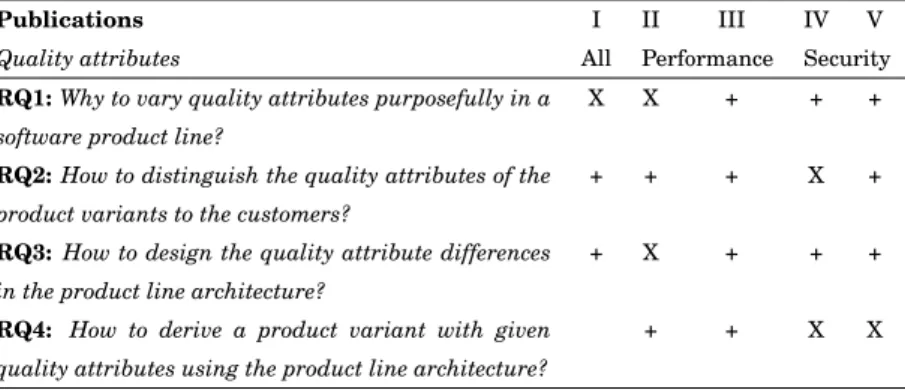
Publications I II III IV V
Quality attributes All Performance Security
RQ1:Why to vary quality attributes purposefully in a software product line?
X X + + +
RQ2:How to distinguish the quality attributes of the product variants to the customers?
+ + + X +
RQ3: How to design the quality attribute differences in the product line architecture?
+ X + + +
RQ4: How to derive a product variant with given quality attributes using the product line architecture?
+ + X X
Notation:
"X" = publication has been explicitly built to answer the particular research question. "+" = publication provides insight to the research question but as an additional find-ing to its original research goal.
the required quality attributes are met by the product variants.
The research questions are answered in the publications as follows (Ta-ble 1.1). All publications have been explicitly built to answer at least one of the research questions. Conversely, all research questions are explicitly answered in at least one publication. Additionally, all publications either directly answer or give some insight into most research questions.
1.4 Research Scope
The scope of this study is limited to software product lines. In a software product line, there has to be a way to tell whether a particular software system is a member of the product line (Weiss, 2008), the commonalities and variabilities that characterize the members of the product line are
known (McGregoret al., 2002; Weiss, 2008), there is an underlying
prod-uct line design that takes advantage of the commonality and variability
(Clements and Northrop, 2001; McGregoret al., 2002; Weiss, 2008), and
the organization makes a distinction between domain and application
en-gineering (Clements and Northrop, 2001; McGregoret al., 2002).
Moreover, this study focuses on purposeful quality attribute variability: the product line has been built to purposefully create product variants with different quality attributes. In general, it is possible that the prod-uct variants have different quality attributes but not on purpose. This is because any variability in the product line may cause indirect varia-tion in the quality attributes (Niemelä and Immonen, 2007): for example,
Table 1.2.How this dissertation is structured to answer the research questions.
Chapter in this dissertation Chapter 4 Chapter 5 Chapter 6
Quality attributes All Performance Security
Research approach Review Empirical Empirical
Publications I, II II, III IV, V
RQ1:Why to vary quality attributes purpose-fully in a software product line?
Section 4.1 Section 5.1 Section 6.2
RQ2:How distinguish the quality attributes of the product variants to customers?
Section 4.2 Section 5.2 Section 6.3
RQ3:How to design the quality attribute
dif-ferences in the product line architecture? Section 4.3
Section 5.3 Section 6.4
RQ4: How to derive a product variant with given quality attributes using the product line architecture?
Section 5.4 Section 6.5
selecting optional functionality may increase the memory footprint of an
application (Siegmundet al., 2013).
Due to the diversity of quality attributes, it is challenging to propose constructs that are applicable to all quality attributes similarly. There-fore, we decided to focus on two quality attributes: performance (includ-ing resource consumption, time behavior, and capacity (ISO/IEC 25010, 2011)) and security. The results of the empirical studies are stated to cover only performance and security, and the generalizability to other quality attributes is left as future work. There were several reasons for this decision. Performance and security are both properties of the product
(ISO/IEC 25010, 2011) and measurable at runtime (Basset al., 2003), but
they also have remarkable differences in the way they are specified and
improved in the design (Bass et al., 2003). For example, security has a
close relationship with functionality, whereas performance is more emer-gent in the software architecture. Performance also seems to be the most commonly varied quality attribute in the examples and cases presented in the literature (Publication I).
The focus on performance and security is also visible in the way the publications address the research questions. Publication I answers the research questions for all quality attributes, Publication II and Publica-tion III answer the research quesPublica-tions for performance, and PublicaPublica-tion IV and Publication V answer the research questions for security.
1.5 Structure of the Dissertation
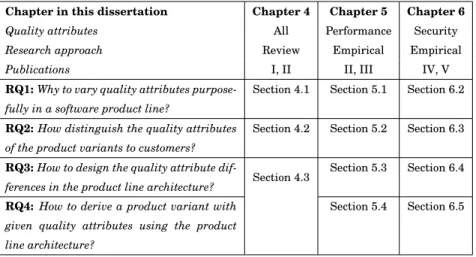
The rest of this dissertation is organized as follows (Table 1.2).
Chapter 2 outlines the research methods used in this dissertation and explains how these methods contribute to different kinds of results. Chap-ter 3 defines the central concepts needed to understand the research ques-tions and the results.
Thereafter, Chapters 4, 5 and 6 lay out the answers to the research ques-tions. Chapter 4 reviews the previous work on quality attribute variabil-ity in software product lines. Chapters 5 and 6 describe the results of the empirical studies, the former for performance variability, the latter for security variability. Each research question is addressed in a sepa-rate subsection. Chapters 4, 5 and 6 are organized along the research questions.
Chapter 7 synthesizes the answers to each research question based on the empirical studies (Chapters 5 and 6): this synthesis combines the re-sults for performance and security. Thereafter, the synthesis is compared with the previous work (Chapter 4). Additionally, Chapter 7 describes the validity and reliability of the results. Finally, Chapter 8 concludes and identifies areas of future work.
2. Research Methods
2.1 Overview of the Methods
This dissertation utilized three different research methods. Since dif-ferent research methods focus attention on difdif-ferent aspects of the phe-nomenon, a multiple-method research deals with the richness of the real world and helps in different phases of the research (Mingers, 2001). Paral-lel research design was used (Mingers, 2001): different quality attributes were treated with different methods and the methods were carried out in parallel with the results feeding into each other.
The three methods utilized were systematic literature reviews, case stud-ies, and design science (Figure 2.1). Firstly, a systematic literature review (Wohlin and Prikladnicki, 2013; Kitchenham, 2004) focused on all quality attributes (Publication I) and on performance (Publication II). Secondly, two descriptive and explanatory case studies (Yin, 1994; Patton, 1990; Runeson and Höst, 2009) focused on performance variability: Case Nokia (Publication II) and Case Fathammer (Publication III). Thirdly, design
science (Hevneret al., 2004; Pefferset al., 2007) focused on security
vari-ability (Publication IV, V).
We mostly did not utilize triangulation between these three methods, as has been suggested in order to improve validity (Jick, 1979). This was be-cause case studies and design science covered different quality attributes and produced different kinds of results. The only triangulation between different methods was to use data from the systematic literature review in the case study theory building (Figure 2.1).
Security Performance
All quality attributes
Design science Case study Systematic literature review Descriptive case study on performance variability (III) Descriptive and explanatory case study and theory building on
performance variability (II) Systematic literature
review with manual reading on quality attribute variability
(I)
A design theory and artifacts for representing and configuring security
variability (IV, V) Systematic literature
review with snowballing on quality attribute variability, analysis for performance variability (II)
Is extended to
Is combined with the case account of
Is used as a case account in
Figure 2.1.The overview of the research methods used in this dissertation and their focus on specific quality attributes.
2.2 Systematic Literature Review
Systematic literature reviews (SLRs) start by defining a review protocol, are based on a defined search strategy, document their search strategy so that readers can evaluate rigor and completeness, use explicit inclusion and exclusion criteria to select primary studies, and assess the quality of the primary studies (Kitchenham, 2004). Such practices aim at four ob-jectives (Kitchenham, 2004; Staples and Niazi, 2007). Firstly, one should aim at completeness, that is, all relevant primary studies should be in-cluded. The second goal is objectiveness, so that no researcher bias exits. Thirdly, the aim is replicability, so that the method can be repeated with similar results. Finally, validity should be assessable from the outside.
2.2.1 Research Design
At the core of the systematic literature review is thesearch strategy, that
is, the means of identifying a set of potentially relevant primary stud-ies. A search strategy can employ the following: searching publication databases with search strings, backward and forward snowballing, man-ually reading specific venues, personal contact, and previous knowledge of relevant studies (Kitchenham, 2004; Wohlin and Prikladnicki, 2013;
Jorgensen and Shepperd, 2007; Kitchenhamet al., 2009). Out of these,
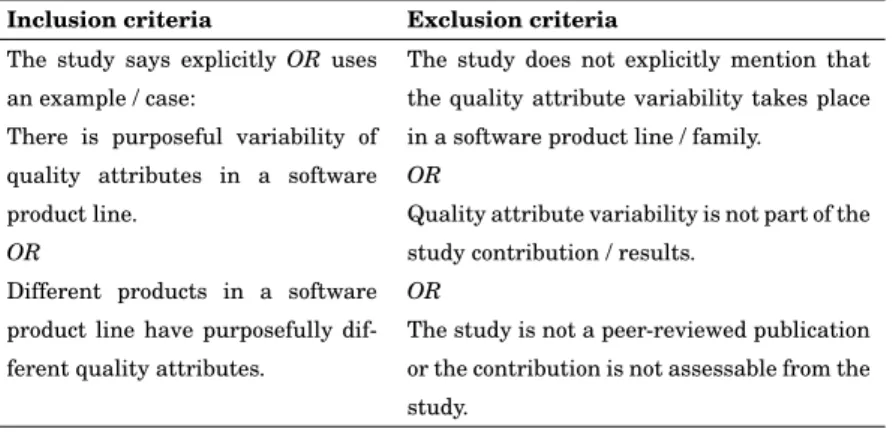
descrip-Table 2.1.The inclusion and exclusion criteria utilized in the selection strategy.
Inclusion criteria Exclusion criteria
The study says explicitlyOR uses
an example / case:
There is purposeful variability of quality attributes in a software product line.
OR
Different products in a software product line have purposefully dif-ferent quality attributes.
The study does not explicitly mention that the quality attribute variability takes place in a software product line / family.
OR
Quality attribute variability is not part of the study contribution / results.
OR
The study is not a peer-reviewed publication or the contribution is not assessable from the study.
tions of the search protocols. However, backward and forward snowballing (Wohlin and Prikladnicki, 2013) have been recommended as the primary method for finding relevant primary studies in software engineering.
The search strategy in this dissertation omitted database searches al-together and utilized manual reading and backward and forward snow-balling. It was very difficult to come up with a search string that would firstly yield known relevant primary studies and secondly return a man-ageable number of potential studies (Publication I). Quality attribute variability is discussed with very heterogeneous terms and is rarely the main focus in the study. Since we decided to use snowballing, the search protocol was not dependent on any specific terms or synonyms utilized to characterize quality attribute variability.
Another key element in the systematic literature review is theselection
strategy, that is, the means of selecting the relevant studies from the set
identified through the search strategy. This involves both the process of screening the studies as well as the inclusion and exclusion criteria ap-plied in screening. The inclusion and exclusion criteria explicate what is relevant within the study scope. The criteria are especially important for search strategies that utilize backward and forward snowballing, since the included studies drive the search process into new directions.
The selection strategy in this dissertation did not exclude any primary studies based on the title and abstract only. To increase completeness, all potentially relevant studies were retrieved and the full content was read through for all studies encountered in the search process. Thus, studies that did not mention quality attribute variability in the title or abstract but nevertheless contributed were not excluded. The inclusion and ex-clusion criteria (Table 2.1) were set to address all quality attributes and
Manual reading, inclusion and exclusion always based on full content
All full studies published in Software Product Line Conferences up to 2010
(221)
Relevant primary studies (29)
Analysis and synthesis of quality attribute variability; reported in
Publication I
Backward and forward snowballing, inclusion and exclusion always based
on full content
Relevant primary studies (139)
Analysis of performance variability, synthesis with the case account to build
theories; reported in Publication II Figure 2.2.The process of conducting the systematic literature review.
to include all studies that address quality attribute variability in their contribution.
2.2.2 Research Process
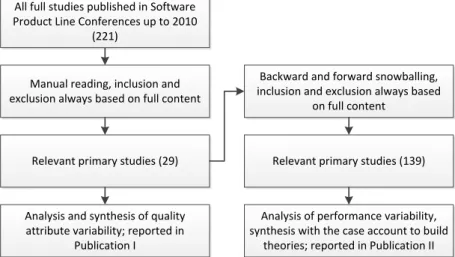
In the following, we outline how the research was conducted based on the search and selection strategies (Figure 2.2): we manually read conference proceedings and then extended the initial set by backward and forward snowballing.
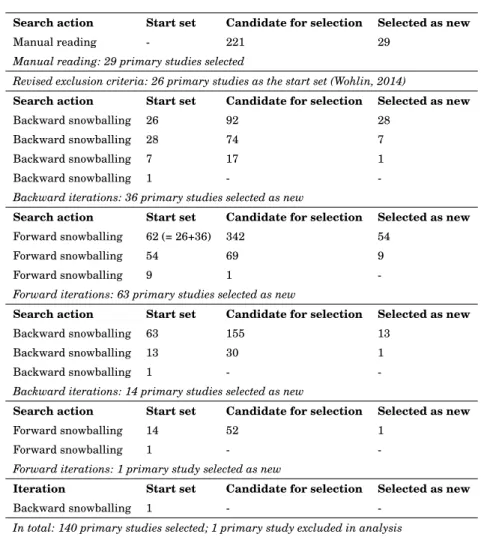
In the first phase, we manually read through 221 studies (Table 2.2), that is, all full studies in the Software Product Line Conference up until 2010. We chose only one venue, the leading conference on this topic, since we wanted to read all content and hence to find all relevant studies. The selection resulted in 29 primary studies; the analysis and synthesis from these primary studies were reported in Publication I.
In the second phase, we utilized snowballing to extend the set of rele-vant primary studies beyond what was published in the Software Prod-uct Line Conference. After applying the revised set of inclusion and ex-clusion criteria to the 29 studies identified through manual reading, 26 primary studies were selected as the initial start set (Wohlin, 2014) for snowballing. Thereafter, we conducted iterative and incremental back-ward and forback-ward snowballing as outlined in Table 2.2. The order of the iterations followed the guidelines by Wohlin (2014).
For backward snowballing, the primary studies in the start set were processed as follows. The reference list of each primary study was pruned
Table 2.2.The backward and forward snowballing iterations taken to select the 139 pri-mary studies.
Search action Start set Candidate for selection Selected as new
Manual reading - 221 29
Manual reading: 29 primary studies selected
Revised exclusion criteria: 26 primary studies as the start set (Wohlin, 2014)
Search action Start set Candidate for selection Selected as new
Backward snowballing 26 92 28
Backward snowballing 28 74 7
Backward snowballing 7 17 1
Backward snowballing 1 -
-Backward iterations: 36 primary studies selected as new
Search action Start set Candidate for selection Selected as new
Forward snowballing 62 (= 26+36) 342 54
Forward snowballing 54 69 9
Forward snowballing 9 1
-Forward iterations: 63 primary studies selected as new
Search action Start set Candidate for selection Selected as new
Backward snowballing 63 155 13
Backward snowballing 13 30 1
Backward snowballing 1 -
-Backward iterations: 14 primary studies selected as new
Search action Start set Candidate for selection Selected as new
Forward snowballing 14 52 1
Forward snowballing 1 -
-Forward iterations: 1 primary study selected as new
Iteration Start set Candidate for selection Selected as new
Backward snowballing 1 -
-In total: 140 primary studies selected; 1 primary study excluded in analysis
based on the recommendations by Wohlin (2014): by firstly looking at the publication type, and thereafter by looking at the context of the actual reference in the primary study. If an item in the reference list passed both criteria, it was deemed as a candidate for selection. After all reference lists in the start set had been examined, the candidates for selection were recorded, duplicates removed, and new, previously unprocessed studies retrieved. The inclusion and exclusion criteria were then applied, based on the full content, for all retrieved studies.
For forward snowballing, the primary studies in the start set were pro-cessed as follows. Two citation databases were used: ISI Web of Science and Scopus. The forward citations covered studies published up until February 2013. For each primary study in the start set, the studies that cited it in either database were recorded, duplicates removed, and new,
previously unprocessed studies retrieved. The inclusion and exclusion cri-teria were then applied, based on the full content, for all retrieved studies. As the result from snowballing, 140 primary studies were selected. How-ever, during the detailed analysis of one primary study, it was deemed not to contribute to quality attribute variability. This resulted in 139 selected primary studies.
The selected primary studies were analyzed in two stages, in Publica-tion I for all quality attributes and in PublicaPublica-tion II for performance. For this dissertation, the analysis from Publication I and Publication II was revised. Also a few important primary studies published after February 2013 were added manually.
2.3 Case Studies
Case studies have emerged as one form of empirical software engineering research (Runeson and Höst, 2009). A case study investigates a contem-porary, non-manipulable phenomenon in its real-life context and is char-acterized by the lack of clear boundaries between the phenomenon and its context (Yin, 1994). Consequently, case studies have more variables of interest than data points and have to rely on multiple sources of evidence (Yin, 1994). Further, case studies are suitable for "how" and "why" types of research questions, that is, for all research questions in this disserta-tion.
Theory plays an important role in the case study methodology (Yin,
1994; Urquhartet al., 2010). In empirical software engineering, two
dis-tinct research designs can be identified: theory building (observational path) and theory testing (hypothetical path) (Stol and Fitzgerald, 2013). This study took the theory building approach: we built theories from the empirical data and observations, and theory testing was left as future work.
2.3.1 Case Selection
Two cases were selected: Case Nokia and Case Fathammer (Table 2.3). The case selection combined criterion sampling and convenience sam-pling (Patton, 1990). For criterion samsam-pling, the case needed to exhibit purposeful quality attribute variability in a software product line. For convenience sampling, both Case Nokia and Case Fathammer were easily
Table 2.3.The characteristics of the selected case study cases.
Case Nokia Case Fathammer
Domain Telecommunication
infrastructure
Mobile games
Company More than 50.000 employees Less than 50 employees
Product line IP-BTS, a customizable and configurable base station in 3G mobile radio access networks.
X-Forge 3D game platform and several game titles built on top of it.
Customers Operators Operators, device
manufactur-ers and game portal usmanufactur-ers
Customer value in
Capacity, coverage, support for upgrades, reliability, guaran-teed quality
Playability, game
attractive-ness, gaming satisfaction
Main variability
Radio access standards, capac-ity, coverage, dimensioning
Target mobile device hardware and software, sales channel customizations
Product line characteristics
The product line contains both software and dedicated
hard-ware. Long-lived investment
products, variability manage-ment focusing on reconfigura-tion.
The capabilities of the target mobile devices vary drastically. No evolution of product vari-ants, light-weight variability handling.
Product line status
The product line was designed and evaluated, but was can-celed due to market reasons
before the production was
started; data collection took place approximately ten years from this.
At the time of data collec-tion: 80 licensees of X-Forge, 15 game titles shipped. Several years later, the case company was acquired and merged.
accessible due to existing personal connections and there were no confi-dentiality issues to collect the data and publish the results.
The units of analysis were set as follows. For Case Nokia, the unit of analysis was capacity variability in a software product line. For Case Fathammer, the unit of analysis was set to cover the software product line and its variability management practices.
The product line in Case Nokia was discontinued before it reached pro-duction (Table 2.3), but the reasons were not related to the unit of
anal-ysis. Thispost mortemnature decreased the study validity (Section 7.2),
but also enabled us to access confidential documentation. Hence, select-ing another case to improve validity would have decreased the amount of available data.
Table 2.4.The data collection in the cases.
Case Nokia Approximately 300 pages of internal documents, including the prod-uct line software architecture document, detailed subsystem archi-tecture document, and a product specification document
First-hand experience of the second author, informal discussions recorded through notes
Publicly available information about the domain, e.g., by Holma and Toskala (2000)
Two validation sessions, where the product line chief architects re-viewed the case account
Written clarifying questions exchanged with e-mail and answered by the chief architects
Case Fathammer
A 3-hour long joint interview with the process manager and deriva-tion manager; recorded and transcribed
Public and non-public documentation
One validation session with the interviewees, where clarifying ques-tions and uncertain issues were resolved
2.3.2 Data Collection
Several sources of data were used (Table 2.4).
For Case Nokia, there were two main data sources: internal technical documents about the product line and observational first-hand experience of one co-author who had participated in the product line architecture evaluation. These data sources were triangulated with two validation sessions and personal contact with the chief architects who had designed the case product line. The validation also enabled us to collect further data. In addition, publicly available information about the domain was used to augment the internal documents.
For Case Fathammer, the main data collection method was a 3-hour long interview with two product line managers. The interview questions were modified from an existing research framework. The interview re-sults were triangulated against public and internal documents about the product line: we compared that the findings were similar and added fur-ther information from the documents to the analysis. The results were later validated with the interviewees.
2.3.3 Data Analysis
For Case Nokia, we adopted some of the analysis principles from the
par-ticular, we built a theory from the data without any existing hypotheses, utilized data comparison to identify and saturate concepts and relations,
and used additional slices of data to guide the analysis (Urquhartet al.,
2010). However, the suggested practices of coding (Strauss and Corbin, 1998) were not adopted to the full extent. It was more appropriate for the data to use light-weight open coding and analyze the relations between the concepts separately. The threats to validity stemming from this are discussed in Section 7.2.
In the first phase, the analysis was carried out to describe capacity vari-ability in a base station product line, that is, to build a case account with-out generalization beyond the case domain. This analysis utilized light-weight coding, constant comparison between the data sources, and adding new data samples from the validation with the chief architects. The re-sulting concepts and relations were kept relatively low-level (Urquhart
et al., 2010), that is, describing only the case domain.
In the second phase, the analysis was carried out to describe perfor-mance variability in software product lines, that is, to generalize the re-sults beyond the case domain and to build theoretical models. For this purpose, 139 primary studies from the systematic literature review (Sec-tion 2.2) served as new data. This analysis involved identifying case ac-counts and examples of performance variability from the primary studies through light-weight coding. We also re-visited the studies to saturate emerging concepts and explanations in the theory building.
As the result, three theoretical models were proposed (Publication II): two theoretical models to explain (Gregor, 2006) and one theoretical model to describe (Gregor, 2006) the phenomenon. We proposed these models to describe the results using domain-independent, explicitly defined con-cepts and to enable analytical generalization from the case study.
For Case Fathammer, we followed the principles of the grounded theory approach using deductive coding of data (Strauss and Corbin, 1998) and utilized data comparison to identify and saturate concepts and relations
(Urquhart et al., 2010). However, the resulting descriptions were
rela-tively case-specific and low-level (Urquhartet al., 2010). Thus, the
the-ory building part of grounded thethe-ory was omitted (Urquhartet al., 2010).
Later on, Case Fathammer was used to identify new categories and satu-rate existing ones in the proposed theoretical models in Publication II.
Evaluation
Case Magento and Case Shopping Mall Descriptive evaluation
No stakeholders involved, not in the real environment
Knowledge Base
Kumbang: a modelling conceptualization and tool for functional variability
Answer set programming and its use on knowledge-based configuration
Characteristics and standards on software security
Environment
Configurable software product lines with functional and security variability Example industrial environment: Magento
Assess Refine
Business needs
Applicable knowledge
Application in the environment Additions to the knowledge base Design Theory
Modelling conceptualization and principles
Concrete Artifacts
Configurator tool, configuration models and tasks Instantiate Generalize
Figure 2.3.The research design within this dissertation, following the design science
framework (Hevneret al., 2004) and the distinction between theory and
arti-facts (Gregor and Jones, 2007).
2.4 Design Science
Design science as a research paradigm seeks to create artifacts that ex-tend the human and organizational capabilities in managing, using or
developing information systems (Hevneret al., 2004). The relevance in
design science is ensured by focusing on solving business needs that are either heretofore unsolved or solving them in a more effective way, and by evaluating the utility of the artifact against the needs of the application
environment (Hevneret al., 2004). The rigor in design science is ensured
by utilizing existing scientific knowledge when constructing and
evalu-ating the artifacts (Hevneret al., 2004) and by building design theories
about the artifacts (Gregor and Jones, 2007).
Design science was chosen since we wanted to both understand the phe-nomenon and build concrete solutions to the problem. In addition, we were able to build on and further develop existing artifacts and princi-ples, which enabled a wider scope of the results.
2.4.1 Artifacts and Theory
At the core of design science is the artifact: the artifact can be a con-struct, a model, a method, or an instantiation, such as a prototype tool
Table 2.5.The characteristics of the cases used for evaluating the theory and concrete artifacts.
Case Magento Case Shopping Mall
Product line Magento, a configurable and extensible web shop product line; is available as enterprise, hosted and open-source ver-sions
A customizable service portal within a shopping mall; in par-ticular, a service to search for offers and information
Market position
A commercially successful
framework and an ecosystem
Not an industrial product line, but an example envisioned by Nokia Research Center
Product line characteristics
Vast amount of varying web shop functionality, only small amount of security variability. The web shop owners and ad-ministrators can configure this variability through web-based Admin Panel.
Users have varying preferences on authentication. The number and capabilities of the partici-pating services may vary.
artifact and the theory about the artifact (Gregor and Jones, 2007): the design theory lays out the constructs, relations, and scope of the design knowledge codified in and needed to instantiate the concrete artifact.
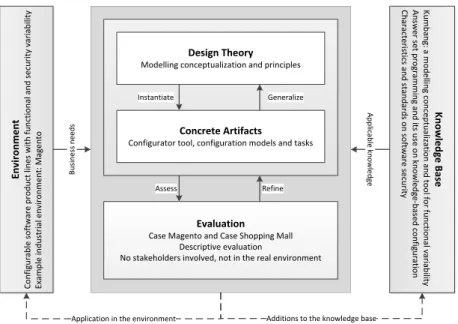
Within this study, a design theory and concrete artifacts were built to represent and configure software product lines with functional and secu-rity variability (Figure 2.3). To enable representation and configuration, several concrete artifacts were constructed: a configurator tool, and case-specific configuration models and configurations. The generalized knowl-edge to build these artifacts was captured in the design theory, in par-ticular, as a modeling conceptualization and as the principles of building and using a configurator operating on stable model semantics. Thus, the concrete artifacts acted as expository instantiations of the theory (Gregor and Jones, 2007).
2.4.2 Evaluation
The evaluation of the theory and artifacts utilized two cases, Case Ma-gento and Case Shopping Mall (Table 2.5). Case MaMa-gento was based on a commercially successful configurable web shop, Magento. Magento is a variability-rich, highly configurable product line and ecosystem. Most of the explicitly configurable variability is about functionality: only a small part of the web shop security can be varied. The data needed to instanti-ate the artifacts for Case Magento consisted of the following: the source
code, official documentation, and the demonstration version of the Ma-gento Admin Panel. In contrast, Case Shopping Mall was a case example, that is, it was not a real-life software product line. Case Shopping Mall originated from Nokia Research Center. The particular case example was
inspired by the search service described by van Gurpet al.(2008).
The criteria for the evaluation were set as three testable propositions (Gregor and Jones, 2007) that characterized the effect of the concrete ar-tifacts. The testable propositions followed the form "if you want to achieve Y in situation Z, the use of X helps" (Gregor and Jones, 2007).
With the testable propositions, the evaluation was conducted at two lev-els.
Firstly, thefeasibility of the instantiation was used. That is, the
de-sign theory was instantiated as concrete artifacts that included the Kum-bangSec configurator and the configuration models and tasks for Case Magento and Case Shopping Mall. A realistic instantiation tests the po-tential problems in the generalized design and tests that the artifact is worth considering (Gregor and Jones, 2007). Further, the instantiation for Case Magento represented a "slice of life", which as such "is most likely to be convincing" (Shaw, 2003).
Secondly, a descriptivecomparison to the current statewas used, in
par-ticular, by comparing with the current state of practice in Case Magento. That is, the design theory and artifacts were evaluated descriptively using
an informed argument (Hevneret al., 2004).
The feasibility of the instantiation and the comparison to the current state were both evaluated qualitatively. No quantitative evaluation was conducted, for example, in the form of systematic performance testing, mainly because it was deemed less suitable for assessing the testable propositions. In addition, the instantiation and the evaluation were con-ducted by the researchers: therefore, the concrete artifacts were not tried out in the real application environment nor evaluated with the real stake-holders.
2.4.3 Research Process
The research proceeded as suggested by Pefferset al.(2007).
Firstly,the problem and the motivation were identifiedin collaboration
with Nokia Research Center. This collaboration also served as a way to
define the objectives for a solution iteratively. In the design theory, the
Performance and security Synthesis and comparison
Chapter 7 Security Design Science Chapter 6 Performance Case studies Chapter 5 All quality attributes
SLR Chapter 4 RQ1 A synthesis of the literature A theoretical model to explain Explanations of Case Magento and Case
Shopping Mall A synthesized model to explain A comparison RQ2 A synthesis of the literature Descriptions of Case Nokia and Case
Fathammer
A description based on the artifacts and the design theory
A synthesized description A comparison RQ3 A synthesis of the literature A theoretical model to classify A description based on the artifacts and the design theory
A synthesized model to classify A comparison RQ4 A synthesis of the literature Descriptions of Case Nokia and Case
Fathammer
A description based on the artifacts and the design theory
A synthesized description A comparison
Figure 2.4.The overview of the research results in this dissertation.
Secondly, thedesign and developmenttook place iteratively. The initial
version of the modeling conceptualization and the configurator tool were constructed and applied to the initial case examples. Later on, the model-ing conceptualization was simplified and applied to Case Shoppmodel-ing Mall. Finally, the design theory was formulated and finalized while applying them to Case Magento.
Thedemonstration of the artifact took place by instantiating the
arti-facts for the case examples; this was iterated with the design and
devel-opment. Theevaluationutilized the testable propositions of the design
theory. Finally, thecommunication took place via a number of research
publications.
2.5 Overview of the Results
Given three different methods, there were three different types of results in this dissertation. The different results from the different methods are illustrated as the first three columns in Figure 2.4.
syn-thesis of the previous work (Chapter 4). The results were organized along the research questions and the answers were given to address all quality attributes in general.
Secondly, the case studies produced descriptions and explanations for
performance variability (Chapter 5). ForRQ1andRQ3, the results were
given as theoretical models for explaining and classifying the phenomenon
(Gregor, 2006). ForRQ2andRQ4, the results were given as descriptions
of the case accounts.
Thirdly, the design science produced a design theory and artifacts for
security variability (Chapter 6). For RQ2, RQ3 and RQ4, the results
were given as descriptions based on the design theory and the artifacts.
ForRQ1, the results were given as descriptions based on the cases, since
the artifacts did not explicitly address this research question.
Last, the results of the case studies and the design science were synthe-sized, that is, we synthesized the results over performance and security (last column in Figure 2.4). The synthesis was conducted qualitatively, by identifying dimensions that revealed the differences and similarities between the results, and by identifying hierarchies and relations between the concepts across the results. Thus, the synthesis was conducted as a form of cross-case analysis (Huberman and Miles, 1994). The results of the synthesis included one model to explain, one model to classify, and two synthesized descriptions given as tables. Finally, the synthesis was compared with the previous work (Chapter 7).
3. Terminology
The following defines the central concepts upon which the results are built.
3.1 Quality Attributes and Software Architectures
Quality attributesare defined as characteristics that affect an item’s
qual-ity (IEEE Std 610.12-1990, 1990). Qualqual-ity is the degree to which the sys-tem satisfies the stated and implied needs of its various stakeholders and thus provides value (ISO/IEC 25010, 2011). Quality attributes are often defined via attribute taxonomies (ISO/IEC 9126-1, 2001; ISO/IEC 25010,
2011; Boehmet al., 1978; McCallet al., 1977) and then defining the
con-stituent subattributes in more concrete terms or with concrete measures. To complicate matters, more or less a similar concept has been called with a multitude of terms: as quality attributes (ISO/IEC 9126-1, 2001; IEEE
Std 610.12-1990, 1990; Basset al., 2003), quality characteristics (ISO/IEC
25010, 2011; ISO/IEC 9126-1, 2001), quality factors (IEEE Std 1061-1998, 1998), and quality properties (ISO/IEC 25010, 2011; Rozanski and Woods, 2011). Within this dissertation, we use the term "quality attribute".
A closely related concept is aquality requirement, also known as a
non-functional requirement (Mylopouloset al., 1992; Berntsson Svenssonet al.,
2012). A quality requirement can be defined as a requirement that a qual-ity attribute is present in software (IEEE Std 1061-1998, 1998).
There are different kinds of quality attributes. Some quality attributes manifest themselves in the product, whereas some attributes manifest themselves in the interaction when the product is used (ISO/IEC 25010, 2011). Product quality attributes can be divided into those that are
ob-servable or measurable at runtime and to those that are not (Basset al.,
perfor-mance and security, whereas examples of the latter include modifiability and testability. Some consider business qualities, such as time to market
and cost (Basset al., 2003), to be part of quality attributes as well.
Software architecturehas been defined as the fundamental organization
of a system that is embodied in the system elements, relationships, and in the principles guiding the system design and evolution (ISO/IEC 42010, 2011). That is, software architecture is about different software system
structures (Basset al., 2003; Rozanski and Woods, 2011). Software
archi-tecture can also be seen as the set of early design decisions people perceive as hard to change (Fowler, 2003; Jansen and Bosch, 2005). Software ar-chitectures are created solely to meet the concerns of their stakeholders and to balance any conflicts in an acceptable way (Rozanski and Woods, 2011).
Many quality attributes are architectural, meaning that the software
architecture is critical to their realization (Basset al., 2003): a significant
part of the quality attributes are determined by the choices done during
the architecture design. To improve quality attributes,design tacticsand
patterns encapsulate reusable design strategies and solutions (Basset al.,
2003; Rozanski and Woods, 2011).
However, many design decisions improve one quality attribute at the
ex-pense of another: for example, most of the availability tactics (Basset al.,
2003) increase the overhead and complexity and thus may decrease
per-formance. Such situations are calledtrade-offsand they are usually
re-solved by finding a global, multi-attribute optimum (Barbacciet al., 1995).
3.2 Performance
Performance is considered as one of the most important quality attributes
in the industry (Berntsson Svensson et al., 2012). Performance is
de-fined as the degree to which a system or component accomplishes its designated functions within given constraints, such as speed, accuracy, or memory usage (IEEE Std 610.12-1990, 1990). Performance is rela-tive to the amount of hardware or software resources used to meet those constraints (ISO/IEC 25010, 2011). Performance is one of the quality at-tributes to which it is relatively straightforward to associate quantitative measures: examples include response time, throughput and jitter
(Bar-bacciet al., 1995).
uti-lization and capacity (ISO/IEC 25010, 2011). Time behavioris either the latency of responding to an event or the throughput of processing events
in a given time interval (Basset al., 2003; Barbacciet al., 1995).Resource
utilizationrefers to the amount of resources the system uses to perform its
functions (ISO/IEC 25010, 2011); typical resources include both static and
dynamic memory.Capacitymeans the degree to which the maximum
lim-its of a product or system parameter meet requirements (ISO/IEC 25010, 2011). As a concrete example, capacity can be defined as the maximum achievable throughput without violating the latency requirements
(Bar-bacciet al., 1995).
The software architecture is critical to the realization of performance
(Basset al., 2003; Smith and Williams, 2002). Performance is affected by
many aspects in the architecture: the type and amount of communica-tion among components, the funccommunica-tionality that has been allocated to the
components, and the allocation of the shared resources (Basset al., 2003).
Hence, performance is an architectural, emergent quality attribute. Sev-eral design tactics and patterns have been proposed to improve
perfor-mance (Basset al., 2003; Smith and Williams, 2002; Rozanski and Woods,
2011): they often involve decreasing resource demand or increasing or
parallelizing resources (Basset al., 2003).
3.3 Security
Security is the capability of the software system to protect information and data so that unauthorized persons or systems cannot read or modify them and authorized persons or systems are not denied access to them (ISO/IEC 9126-1, 2001). Security is the composite of confidentiality, tegrity and availability: confidentiality is the absence of unauthorized in-formation disclosure, integrity is the absence of unauthorized system al-ternations, and availability is the readiness for correct service for
autho-rized actions (Avizieniset al., 2004). Security can also be characterized
through assets, threats, countermeasures, and vulnerabilities (ISO/IEC 15408-1, 1999; Firesmith, 2004). The core of security is protecting as-sets from threats: asas-sets are sensitive information or resources (ISO/IEC 15408-1, 1999). A threat exploits vulnerabilities in the system and ma-terializes as an attack (ISO/IEC 15408-1, 1999). Countermeasures are introduced in the software to reduce vulnerabilities (ISO/IEC 15408-1, 1999). Countermeasures are also termed security mechanisms (Fi