This document is published in:
Rojas I., Joya G., Catala A. (eds) (2017).
Advances in
Computational Intelligence: 14th International
Work-Conference on Artificial Neural Networks, IWANN 2017
Cadiz, Spain, June 14–16, 2017, Proceedings
, Part I
(Lecture Notes in Computer Science, 10305) Springer,
339-350.
DOI:https://doi.org/10.1007/978-3-319-59153-7_30
Pre-emphasizing
Binarized
Ensembles
to
Improve
Classification
Performance
Lorena´Alvarez-P´erez(B),AnasAhachad,andAn´ıbalR.Figueiras-Vidal
GAMMA-L+/DepartmentSignalTheoryandCommunications, UniversityCarlosIIIofMadrid,Av.delaUniversidad30,
28911Legan´es,Madrid,Spain
{lalvarez,anas,arfv}@tsc.uc3m.es
Abstract. Machine ensembles are learning architectures that offer high expressive capacities and, consequently, remarkable performances. This is due to their high numberoftrainableparameters.
Inthispaper,weexploreanddiscusswhetherbinarizationtechniquesareeffectiveto improvestandarddiversificationmethodsandifasimpleadditionaltrick,consistingin weightingthetrainingexamples,allowstoobtainbetterresults.Experimentalresults, forthreeselectedclassi-ficationproblems,showthatbinarizationpermitsthatstandard directdiversificationmethods(bagging,inparticular)achievebetterresults,obtaining even more significantperformance improvementswhen pre-emphasizingthe training samples. Some research avenues that this find-ing opens are mentioned in the conclusions.
Keywords:Classification
·
Multi-LayerPerceptron·
Ensembleclassi-fiers·
Bagging·
ECOC1
Introduction
Although the expressive power –the capacity of a machine to establish gen-eralinput-outputcorrespondences–ofone-hiddenlayerMulti-LayerPerceptrons (MLPs) istheoreticallyunbounded ifanappropriatenumber ofhidden unitsis included[1, 2],thelimitednumberoflabeledtrainingexamplesthatareavailable in practicereduces it.
A way of overcoming this limitation is to build ensembles of MLPs –or other Learning Machines– by diversifying the training of each of them. An ensemble of classifiers is basically composed of a group of machines that try to solve the same problembut under differentconditions –diversity–and theiroutputs are combinedaimingatobtainingasystemthathopefullyismoreaccuratethanany of its members [3]. Toachieve this goal,the members of theensemble, usually known as baselearnersor simplylearners,mustbe diverse.Put itverysimple, two machinesarediversewhentheirerrorsarenotcoincident.
In this regard, there are two basic families of ensembles. The first, we are calledcommittees,consistsintrainingthebaselearnerswithdifferentexamples
and theiroutputsare aggregated,usually bysimpleprocedures (direct averag-ing or majority vote, for example). Among committees, we can mention two relevant techniques: Bagging [4], in which bootstrap resampling of the samples provides the training sets for the learners, and label switching [5], in which randomly switching examples’ labels serves to introduce diversity. The second family of ensembles, which we call consortia, simultaneously train the units and the aggregation. Among consortia, boosting, whose basic forms appeared in [6, 7], has proved tobevery effectiveforimproving theperformanceofsinglelearners.The key aspectis toiteratively design andaggregate classification units payingmore attention to the examples that present higher classification errors. Mix-ture of Experts [8], the second most relevant consortia designs, show moderate performance when designed for classification, and the existing modifications to increaseit,suchas[9],requireahugecomputationaleffort.
Adifferentkindofensembles arethoseresultingfromdecomposinga multi-class problem into a number of binary problems whose solutions indicate the classcorrespondingtoeachsample.Theyarecalledbinarizationtechniques.
Theideaofcombiningbinarizationmethodswithoneoftheabove-mentioned techniques (committees or consortia) for solving multi-class problems is not something novel. In [10], it was studied the performance of combining both bag-ging and binarization techniques over one dataset. The results obtained were not very satisfactory since the overall performance was the same as with only bag-ging. In [11], bagging and binarized ensembles were evaluated for nine datasets using a bias-variance framework and making comparisons with single neural networks basedclassifiers.Theresultsobtainedoutperformedbaggingandbina-rization in somecases,whileinothercasesgavesimilarresults.
Inthiswork,wetakea furtherstepand,wealsoexploreasimpleadditional alternativethatcouldbeapplied togetherwiththecombinationofbinarization techniques andstandard diversification methods, aimingat increasingthe per-formanceoftheoverallensemble.Thisalternativeispre-emphasis,i.e.,weighting thetrainingsamplesaccordingtoanauxiliaryclassifier,takingintoaccountthe criticalcharacterofeachsample,i.e.,itsproximitytotheclassificationbor-derand its classificationerror followingtheideas of [12, 13].In[14], we proposed flexible enough pre-emphasis approaches that allowed remarkable improvements, requiring a very modest computational cost in the design phase, but not in oper-ation, i.e., to classify unseen samples.
The rest of the paper is organized is follows. In Sect. 2, we present a brief review of ensembles that are produced by binarizing multi-class prob-lems. Section 3 presents the weighting function that is used for pre-emphasis in multi-class problems. Section 4 describes the experimental framework: theselected datasets and the MLP based machines, the ensemble architectures to be studied, the binarizationmethodtobeapplied,aswellasthetypeofauxiliaryclassifierthatis used to determinethe amount of pre-emphasis needed for the trainingsamples. Experimental results and their discussion are also included in this section. The mostimportant conclusions ofourwork and some openresearch lines close this contributioninSect.5.
2
Binarization
There are three popular techniques for reducing a multi-class problem into a series of binary classification problems, namely: One vs. One (OvO), One vs. Rest (OvR) (also known as One vs. All), and Error Correcting Output Codes (ECOC) [15]. ECOC methods come from the area of communications for correct-ing data errors during transmission. They are based on adding some redundant informationto theblock tobetransmitted,henceobtaining acodeword.Inthe context ofensembles,the useofECOC consistsin creating base classifiersand trainingthemaccordingtotheinformationobtainedfromapre-establishedcode matrix.ExperimentalworkhasshownthatECOCoffersimprovementoverOvO and OvRclassification methods[15, 16].Thisisbasicallythereasonwhyinthis workweexploretheapplicationofECOCforbinarizingensembles.
WecontinuewithashortreviewofECOCtechnique.Table1showsan exam-pleofanECOCmatrixfora4-classclassificationproblem[16].
Table 1.An exhaustiveECOC fora4-class decisionproblem [16].C0 to C3 are the classes, P0 toP6 arethe binaryproblems. Thecodeword(row)thatis nearesttothe vectorofunits’outputsindicatestheclasstobeselected.
Class Problem P0 P1 P2 P3 P4 P5 P6 C0 1 1 1 1 1 1 1 C1 0 0 0 0 1 1 1 C2 0 0 1 1 0 0 1 C3 0 1 0 1 0 1 1
In the example at hand, each class is assigned a unique binary string of length 7. The string is also called codeword. For example, Class 2 (C2) has the
codeword 0011001. During the training process, one binary problem is learned for each column. In this respect, for the first column, we build a binary classifier to separate {C0} from {C1,C2,C3}. Thus, it seems clear to notice that seven
classifiers are trained in this way. To classify a new sample,x(n), all seven binary
classifiers are evaluated to obtain a 7-bit string. Finally, the given sample is classified by computing the similarity between the obtained 7-bit string and the codeword for each class, by using the Hamming distance metric.
3
Proposed Pre-emphasis Function
As mentioned in the Introduction, we have considered in this work the training of machines using pre-emphasized samples where the amount of pre-emphasis is determined by an auxiliary classifier.
For binary classifiers, the pre-emphasis used on training samplex(n) can be
written as indicated in the following double-convex combination of three terms:
px(n)=α+ (1−α) βe(n) a 2 + (1−β) 1− o(n) a 2 (1)
wheree(n)a is the classification error for input samplex(n)ando(n)a is the output of
the auxiliary classifier for samplex(n). It seems clear to notice that the underlying
idea of the pre-emphasis function is that the training samples should be weighted based on two measures: How large the error is in the auxiliary classifier and how close its output is to the decision boundary.
The two pre-emphasis parameters,α and β, have values between zero and one (0 ≤α, β ≤1), and are determined by a process of Cross-Validation (CV) in our experiments.
Extending expression (1) to the case of multi-class formulations is not an easy task since the term
1− o(n) a 2
does not have a direct equivalent. However, if discriminative forms are considered, which are effective for training multi-class machines, it is possible to replace it for (1− |o(n)ac −o(n)ac|) or similar forms, where o(n)
ac is the softmax output of the auxiliary classifier for the true class ando(n)ac is
the output whose value is the nearest too(n)ac among the rest.
4
Experiments
and
Their
Discussion
4.1 Databases
Wewill limit ourpresentation ofresultsto a few appropriatelyselected multi-classdatabasesthatarefrequentlyusedasbenchmarksetsforthiskindof exper-iments: the synthetic dataset Firm-Teacher Clave-Direction Classification [17] andtworealproblems,Satimage[18]andVehicle [19].Allofthemareobtained fromtheUCIRepositoryofMachineLearningDatabases[20].Table2illustrates themaincharacteristicsoftheseproblems:numberofclasses,numberof dimen-sions and numbers of training and test samples. When the dataset had no pre-defined train/test partitions (that is, the case of Firm-Teacher Clave-Direction Classification and Vehicle datasets), a random partition has been created with 70/30% for training and test, respectively, keeping the relative proportions of theclassesin eachsubset.From nowon, wewill denotethedatabases bytheir threefirstletters.
4.2 Machines and TheirDesigns
ThearchitecturesunderstudyaswellasthesingleclassifieremployMLPswith one-hiddenlayerasbaselearnersbecausetheyareunstableandpowerfulenough machines.TheyaretrainedbytheBack-Propagationalgorithmtominimizethe meansquared errorbetweenthedesiredoutputandwhat thenetworkactually
Table 2.Characteristics of the benchmark problems.
Dataset Notation # Train
samples
# Test samples
Dimension # Classes
Firm-Teacher Clave-Direction Fir 10800* - 16 4
Satimage Sat 4435 2000 36 6
Vehicle Veh 946* - 18 4
*The total number of samples of the datasets without separate train and test sets (Fir and Veh) are listedunderthe numberof training samples.For these datasets,a random partitionhasbeencreatedwith70/30%fortrainingandtest,respectively,keepingtherelative proportionsoftheclassesineachsubset.
outputs,initializingalltheweightsatrandomvaluesfroma[−0.2,0.2]uniform distribution.Thelearningrateforbothlayers(hiddenandoutputlayers)isset to be 0.01, which has been experimentally proven to allow to reach convergence. Asmentioned,thearchitectureoftheMLPbasedclassifiers,exploredinthe experiments, consists of three layers (input, hidden and output layers). In this architecture,thenumberofinputneuronscorrespondstothatoftheattributes used tocharacterize theinputsamples(thatis, itisconsistentwith the dimen-sionofthedatasetsshowninTable2),thenumberofoutputneuronsisrelatedto the classes we are interested in (in a binary classification problem may be enough tohaveasingleoutputneuron)andthenumberofhiddenneurons(H)dependson the adjustmentofthecomplexity of theMLP.To achieveanoptimal ensemble behavior,thisappropriatenumberofhiddenneuronshastobefixed.Despiteeach ensemblecanneedadifferentHvalue,aimingatcarryingoutafaircomparisonin computational terms, we have preferred to fix the same H for all the bagging samplingrates.Then,thisparameterisestablishedbymeansofa20-run×5-fold CV.
However,whenusingthebinarizationtechnique, foreachbinaryproblem, a differentHhastobefixed.Inthiscase,foreachdichotomicproblem,thevalueof H isseparatelyobtained alsobymeansofa20-run×5-foldCV. Thisobviously increases the computational cost.
An 80/20 early stopping mode is applied to stop training.
4.3 Conventional Diversification
Bagging is carried out by means of conventional bootstrap (sampling with replacement) in our experiments, exploring different sizes B of the diversified training sets: 60, 80, 100, 120 and 140% the size of the original set of training examples. We also examine different number of ensemble units, M = 11, 21, 31, 41, 51, 101 and 201. We remark that these values serve to ensure that perfor-mances saturate, as we will see later.
We apply bagging in two different forms:
1. To construct ensembles of different, diversified MLPs;
2. Just at the classification layer, applying the diversification after getting the output values of a single MLP which is trained without diversity.
We will denote these designs by MLP-O (overall) and MLP-T (T-form) archi-tectures, respectively. With this in mind, when we apply bagging to multi-class problems, two different architectures are obtained:
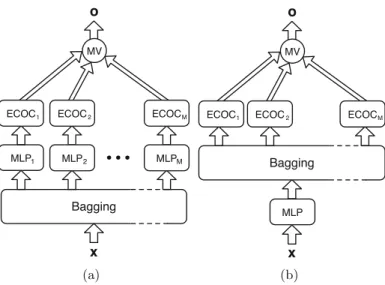
– MLP-BINARIZED-O: As shown in Fig. 1(a), bagging is applied to input data to construct M machines, and the final class is decided by a majority vote of their outputs that are obtained by means of ECOC ensembles that follow each diverseMLP;
– MLP-BINARIZED-T: In this scenario, as illustrated in Fig.1(b), there is onlyone MLPstructure andbaggingisbeing imposedto itsoutputsvalues toconstructMdiverse ECOCensembles,whoseoutputsarealsoaggregated byamajorityvoterule.
Fig.1. Illustrative architectures showing the ways of combining diversity and bina-rizationtechniquesinthisworkforsolvingmulti-classproblems:MLP-BINARIZED-O architecture (Fig.1(a)) and MLP-BINARIZED-T architecture (Fig.1(b)). MLP is a singleMulti-LayerPerceptron;ECOCn arethediverseECOCensembles.MV: major-ityvote;x:input;o:outputclassdecision.
It is clear to notice that Ostructures theoretically require a higher design effort,becauseMMLP machineshave to betrained.Toreduce ittoaffordable computationalcharges,weapplyafrequentlyusedsimplification:todesignmore thanM MLPbaggingunits (450, here) foreachvalueof B,and toselect Mof them at random. Average performances are obtained for 10 independent selec-tions.Ofcourse,thisreducesalittlebitthediversityadvantage,butweremark that ourgoalhere isjusttoverifyifdiversitycan improve singleshallow MLP performance.
4.4 Binarization
In our series of experiments, we will use the C-class exhaustive ECOCs of [16], for thecombinationbetween overallandT-formarchitecture andbaggingshownin Fig. 1. According to [16], for classification problems of 3 ≤ C ≤ 7 classes, we constructacode length2C-1−1as follows.Row1isallones.Row2consistsof
2C-2 zeros followed by2C-2−1 ones. Row 3 consists of 2C-3 zeros, followedby
2C-3ones, followedby2C-3zeros,followedby2C-3−1ones. Inrowi, thereare
alternating runsof2C-izeros andones.
4.5 Pre-emphasis
In the design of a single classifier, it seems clear that pre-emphasis weight-ing should be applied to the input trainingsamples. However, for both MLP-BINARIZED-O and MLP-BINARIZED-T architectures previously described, thequestionarisinghere is:Whatisthewaytoapplythepre-emphasis weight-ing? Inthe first scenario, MLP-BINARIZED-O structure, the pre-emphasis is applied to the inputs to each diverse MLP, and in the second situation, MLP-BINARIZED-T architecture, two options have been considered in our experi-ments:ThefirstistoweighttheinputstothesingleMLPandthesecondconsists of separatelypre-emphasizingeachbinaryproblemthat appearsafter applying bagging at the outputs values of the single MLP based classifier. Preliminary resultsshowedthatbestperformances wereobtained whenweightingtheinput data tothebinarizedproblems and,consequently,this istheway wehave cho-sen for pre-emphasizing samples in the MLP-BINARIZED-T architecture in our experiments.
Todeterminethevaluesforthepre-emphasisparameters,αandβ, we used 10-run×5-fold CV for the three datasets. As mentioned, the values for these parameters thatweconsideredwere intheinterval[0,1]atincrementsof0.1.
The auxiliary machine used in the experiments that provides the values to computepre-emphasis weightsaccording to expression (1)is anMLP with one-hiddenlayerof50neurons,becauseitwasexperimentallyshownthatthisnumber ofneuronsprovidedthebestresultsoveravalidationsetforthethreedatasets.
4.6 ExperimentalResults
The results of our experiments (% error rate averages ± standard deviations, averaged for 10 different selections of learners in the case of bagging and for 10 runs whenusing ECOC ensembles)are shown in Tables 3 (Fir), 4 (Sat), and 5 (Veh) for the test sets. Best results are indicated in boldface (even if statistical differences arenotsignificant). Additionally, we also include theperformance of the design which does not apply neither bagging diversity nor ECOC binarization (denotedas MLP),as wellasthedesignswhichonlyapplybagging(indicatedas MLPbagging)andthedesignswhichemployECOCwithoutbagging(markedas MLP-ECOC), aiming at appreciating what is the advantage which can be attributedtotheinclusionofthecombinationofdifferentformsofdiversity
exploredinthiswork.AsmentionedinSect.4.3,althoughdifferentsizesBofthe diversifiedtrainingsets(60,80,100,120and140%)havebeenexploredaswellas differentnumberofensembleunits(M=11,21,31,41,51,101and201),Tables3, 4 and 5 summarized the most remarkable results.
Having a look at the tree mentioned tables, the first thing to remark is that clear performance saturation effects appear when M or B increase. This indicates that extending the exploration margins is unnecessary. Furthermore, for the three databasesunder study,allkindsofdiversityexploredinthisworkappearto be effective,bothOandTbagging:asanexample,forVehdataset,errorreduction achieved is about 30%.Obviously, the T-form architecture must be preferred, because it requires lower computational training and operation efforts. Please notethatin general,nosignificantdifferencesappear betweenseparatebagging andECOC diversifications.
A detailed observation of the mentioned tables leads to the following conclusions:
– For Fir dataset: Directly applying bagging or ECOC achieved success in improving performance. Note that a simple ECOC reduces 18% the error rate, while the best scenario when applying bagging achieves a reduction of about 14%. Results are slightly better when applying jointly ECOC and bag-ging, M = 31 and B = 120% T-design being the best option in which error rate is approximately reduced up to 22%.
– For Sat dataset: Applying bagging or ECOC separately achieves reducing the error, ECOC ensembles being those which obtain the greater reduction (≈8%), as just happened for the previous dataset. However, when jointly applying ECOC and bagging, results are negative for small values of B, but moderate benefits appear when parameter B increases, M = 21 and B = 140% T-design achieving an error reduction of about 11%.
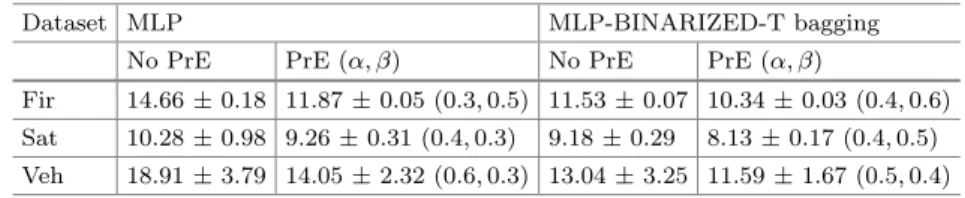
– For Veh dataset: Simple ECOC approximately reduces 25% the error rate, which is greater than the best error reduction obtained when applying bagging (≈22%). On the other hand, we can observe that jointly applying ECOC and bagging, results are better, especially when M and B parameters increase, M = 51 and B = 120% T-design reaching an error reduction of roughly 31%. Please note that if the number of training samples in the datasets is low, the results are more unstable and differences are statistically less significant. We have taken a further step and we have applied pre-emphasis techniques to thedesignsthatprovidedthebestperformances.Table 6shows theresults.For comparativepurposes,theresultsobtainedwhenthepre-emphasisisnotapplied (seeTables3,4and5forfurtherdetails)arealsopresented,aswellastheresults of thesingleMLP classifierwhen theinput samplesare pre-emphasized(MLP PrE) and when they are not pre-emphasized (MLP). For each problem, the valuesforα,β obtained byCVaregiveninparentheses.
It can be observed that the PrE MLP-BINARIZED-T performances are clearlyandsystematicallybetterthananyotherresults.Errorratesdecayaround 40%in somecases.
Table 3.Test (%) error rate averages±standard deviations for the diversified classi-fiers applied to problem Firm-Teacher Clave-Direction (Fir).
MLP 14.66±0.18 MLP-ECOC 12.03±0.13 MLP bagging B B M 120% 140% 11 12.87±0.11 12.75±0.15 21 12.73±0.10 12.66±0.14 31 12.83±0.09 12.71±0.12 MLP-BINARIZED-O B B B bagging M 100% 120% 140% 11 12.75 ±0.13 12.04±0.11 12.13±0.10 21 12.64±0.11 11.70±0.10 12.01±0.11 31 12.58±0.09 11.83±0.09 11.97±0.09 MLP-BINARIZED-T B B B bagging M 100% 120% 140% 21 12.47±0.07 11.65±0.08 11.97±0.08 31 12.35±0.07 11.53±0.07 11.86±0.07 51 12.33±0.07 11.60±0.07 11.75±0.08
Table 4.Test (%) error rate averages±standard deviations for the diversified classi-fiers applied to problem Satimage (Sat).
MLP 10.28±0.98 MLP-ECOC 9.44±0.40 MLP bagging B B B M 100% 120% 140% 11 10.58 ±0.84 10.04±0.63 10.14±0.60 21 10.39 ±0.71 9.88±0.55 10.19±0.62 31 10.43 ±0.69 9.94±0.57 10.21±0.55 MLP-BINARIZED-O B B B bagging M 100% 120% 140% 11 10.34 ±0.44 9.24±0.38 9.35 ±0.39 21 10.23 ±0.37 9.31±0.42 9.29 ±0.37 MLP-BINARIZED-T B B bagging M 120% 140% 11 9.31±0.39 9.23±0.34 21 9.29±0.36 9.18±0.29 31 9.25 ±0.31 9.22±0.28
Table 5.Test (%) error rate averages±standard deviations for the diversified classi-fiers applied to problem Vehicle (Veh).
MLP 18.91±3.79 MLP-ECOC 14.20±3.40 MLP bagging B B M 120% 140% 51 14.93±3.41 14.73±3.16 101 14.80±3.35 14.69±3.11 201 14.89±3.27 14.75±3.08 MLP-BINARIZED-O B B B bagging M 100% 120% 140% 31 14.72±3.24 13.59±3.33 13.82±3.20 51 14.68±3.19 13.51±3.29 13.85±3.21 101 14.51±3.20 13.63±3.26 13.80±3.18 MLP-BINARIZED-T B B B bagging M 100% 120% 140% 31 14.87±3.29 13.19±3.30 13.42±3.25 51 14.78±3.19 13.04±3.25 13.18±3.14 101 14.80±3.15 13.08±3.22 13.16±3.11
Table 6. Comparison of test (%) error rate averages ± standard deviations for the benchmark problems considered in our experiments when pre-emphasis is applied.
Dataset MLP MLP-BINARIZED-T bagging
No PrE PrE (α, β) No PrE PrE (α, β)
Fir 14.66±0.18 11.87±0.05 (0.3,0.5) 11.53±0.07 10.34±0.03 (0.4,0.6) Sat 10.28±0.98 9.26±0.31 (0.4,0.3) 9.18±0.29 8.13±0.17 (0.4,0.5) Veh 18.91±3.79 14.05±2.32 (0.6,0.3) 13.04±3.25 11.59±1.67 (0.5,0.4)
All these results seem to indicate that pre-emphasizing the samples of bina-rized ensembles is extremely useful to obtain high performance MLP-based clas-sifiers and that T-form diversity is fruitful if binarization is applied.
5
Conclusions
In this paper, we have not only checked that binarization is effective to improve standard diversification techniques –bagging, in particular–, but we have also seen how a simple technique consisting in weighting the training examples allows to obtain even more important performance improvements. In all the three datasets under study, experimental results show that to combine a flexible enough pre-emphasis function with ECOC binarized and diversified MLP based
classifiers, permits an error reduction bigger than their separate application, achieving until 40% error rate reductions in a dataset.
Between the two explored ensemble architectures –O form, corresponding to a full diversification and T-form, in which diversity is applied after designing the MLP based classifier, the second approach reaches lower error rates. Since it is also better from the perspective of the required training and operating compu-tational efforts, it must be preferred for MLP based classifiers. It is also worth mentioning that the saturation performance with respect to the diversification parameters make their selection an easy validation problem.
Needless to say, much more work –considering other problems, other clas-sifiers, and other sources of diversity– is needed to completely appreciate the potential of combining diversity and binarization techniques, including appro-priate pre-emphasis sample weighting schemes. Finally, we must remark that to combine this kind of designs with other auxiliary techniques that serve to improve the performance of MLPs classifiers is a promising way to get excellent, or even record performance practical implementations.
Acknowledgments. This work has been partly supported by research grants CASI-CAM-CM (S2013/ICE-2845, DGUI-CM and FEDER) and Macro-ADOBE (TEC2015-67719-P, MINECO).
References
1. Cybenko, G.: Approximation by superpositions of a sigmoidal function. Math. ControlSig.Syst.2,303–314(1989)
2. Hornik,K.,Stinchcombe,M.,White,H.:Multilayerfeedforwardnetworksare uni-versalapproximators.NeuralNetw.2,359–366(1989)
3. Dietterich,T.G.: Ensemblemethodsinmachinelearning. In:Kittler,J.,Roli,F. (eds.)MCS2000.LNCS,vol.1857,pp.1–15.Springer,Heidelberg(2000).doi:10. 1007/3-540-45014-9_1
4. Breiman,L.:Baggingpredictors.Mach.Learn.4,123–140(1996)
5. Hinton,G.E.,Osindero,S.,Teh,Y.:Afastlearningalgorithmfordeepbelief net-works.NeuralComput.18,1527–1554(2006)
6. Freund,Y.,Schapire,R.E.:Adecision-theoreticgeneralizationofon-linelearning andanapplicationtoboosting.J.Comput.Syst.Sci.55,119–139(1997)
7. Schapire,R.E.,Singer,Y.:Improvedboostingalgorithmsusingconfidence-rated predictions.Mach.Learn.37,297–336(1999)
8. Jacobs,R.A.,Jordan,M.I.,Nowlan,S.J.,Hinton,G.E.:Adaptivemixtureoflocal experts.NeuralComput.3,79–87(1991)
9. Omari,A.,Figueiras-Vidal,A.R.:Featurecombinerswithgate-generatedweights forclassification.IEEETrans.NeuralNetw.Learn.Syst.24,158–163(2013)
10. Leisch,F.,Hornik,K.:Combiningneuralnetworkvotingclassifiersanderror cor-rectingoutputcodes.In:MEASURMENT1997(1997)
11. Cemre,Z.,Windeatt,T.,Yanikogl,B.:Bias-varianceanalysisofECOCandbagging usingneuralnets.In:Okun,O.,Valentini,G.,Re,M.(eds.)EnsemblesinMachine LearningApplications.StudiesinComputationalIntelligence,vol.373,pp.59–73.
1. Cybenko, G.: Approximation by superpositions of a sigmoidal function. Math. ControlSig.Syst.2,303–314(1989)
2. Hornik,K.,Stinchcombe,M.,White,H.:Multilayerfeedforwardnetworksare uni-versalapproximators.NeuralNetw.2,359–366(1989)
3. Dietterich,T.G.: Ensemblemethodsinmachinelearning. In:Kittler,J.,Roli,F. (eds.)MCS2000.LNCS,vol.1857,pp.1–15.Springer,Heidelberg(2000).doi:10. 1007/3-540-45014-9_1
4. Breiman,L.:Baggingpredictors.Mach.Learn.4,123–140(1996)
5. Hinton,G.E.,Osindero,S.,Teh,Y.:Afastlearningalgorithmfordeepbelief net-works.NeuralComput.18,1527–1554(2006)
6. Freund,Y.,Schapire,R.E.:Adecision-theoreticgeneralizationofon-linelearning andanapplicationtoboosting.J.Comput.Syst.Sci.55,119–139(1997)
7. Schapire,R.E.,Singer,Y.:Improvedboostingalgorithmsusingconfidence-rated predictions.Mach.Learn.37,297–336(1999)
8. Jacobs,R.A.,Jordan,M.I.,Nowlan,S.J.,Hinton,G.E.:Adaptivemixtureoflocal experts.NeuralComput.3,79–87(1991)
9. Omari,A.,Figueiras-Vidal,A.R.:Featurecombinerswithgate-generatedweights forclassification.IEEETrans.NeuralNetw.Learn.Syst.24,158–163(2013)
10. Leisch,F.,Hornik,K.:Combiningneuralnetworkvotingclassifiersanderror cor-rectingoutputcodes.In:MEASURMENT1997(1997)
11. Cemre,Z.,Windeatt,T.,Yanikogl,B.:Bias-varianceanalysisofECOCandbagging usingneuralnets.In:Okun,O.,Valentini,G.,Re,M.(eds.)EnsemblesinMachine LearningApplications.StudiesinComputationalIntelligence,vol.373,pp.59–73.
12. G´omez-Verdejo, V., Ortega-Moral, M., Arenas-Garc´ıa, J., Figueiras-Vidal, A.R.: Boosting by weighting critical and erroneous samples. Neurocomput.69, 679–685 (2006)
13. G´omez-Verdejo, V., Arenas-Garc´ıa, J., Figueiras-Vidal, A.R.: A dynamically adjusted mixed emphasis method for building boosting ensembles. IEEE Trans. Neural Netw.19, 3–17 (2008)
14. Alvear-Sandoval, R.F., Figueiras-Vidal, A.R.: An experiment in pre-emphasizing diversified deep neural networks. In: 24th European Symposium on Artificial Neural Networks, Computational Intelligence and Machine Learning, pp. 527–532 (2016)
15. Rokach, L.: Pattern Classification Using Ensemble Methods. World Scientific, Sin-gapore (2010)
16. Dietterich, T.G., Bakiri, G.: Solving multi-class learning problems via error-correcting output codes. J. Artif. Intell. Res.2, 263–286 (1995)
17. Vurka¸c, M.: Clave-direction analysis: a new arena for educational and creative of music technology. J. Music Technol. Educ.4, 27–46 (2011)
18. Giannakopoulos, X., Karhunen, J., Oja, E.: An experimental comparison of neural algorithms for independent component analysis and blind separation. Int. J. Neural Syst.9, 99–114 (1999)
19. Siebert, J.P.: Vehicle Recognition Using Rule Based Methods. Turing Institute Research Memorandum TIRM-87-018, Glasgow, Scotland (1987)
20. Lichman, M.: UCI Machine Learning Repository. University of California, School of Information and Computer Science, Irvine, CA (2013)
![Table 1. An exhaustive ECOC for a 4-class decision problem [16]. C 0 to C 3 are the classes, P 0 to P 6 are the binary problems](https://thumb-us.123doks.com/thumbv2/123dok_us/11032354.2990494/4.659.233.449.446.571/table-exhaustive-ecoc-decision-problem-classes-binary-problems.webp)