M20 Cork-Limerick Motorway Scheme
Environmental Impact Statement Page A19.1.1 of A19.1.6 Appendix 19.1_Outline Project Construction and Demolition Plan
M20 Cork-Limerick Motorway Scheme
Environmental Impact Statement Page A19.1.2 of A19.1.6 Appendix 19.1_Outline Project Construction and Demolition Plan
OUTLINE PROJECT CONSTRUCTION AND DEMOLITION PLAN
1 Introduction
This outline Project Construction and Demolition plan has been prepared to ensure that all construction and demolition wastes arising from the project are dealt with from generation to disposal in a systematic way and in accordance with the governing legislation i.e. The Waste Management Act, 1996 and subsequent amendments. A more detailed quantitative Waste Management Plan for the Motorway scheme will be produced following appointment of the contractor and detailed design of the proposed road development.
This Project Construction and Demolition Plan (CDWMP) has been prepared for the provision of waste management for the construction phase of the proposed scheme taking account of the many guidance documents on the management and minimisation of construction and demolition waste including;
• Best Practice Guidelines on the Preparation of Waste Management Plans for Construction and Demolition Projects (Department of Environment Heritage and Local Government, July 2006)
• CIRIA document 133 Waste Minimisation in Construction
• NRA guidelines including Guidelines for the Management of Waste from National Road Construction Projects, 2008
A separate plan has been prepared for the operational phase of the proposed route and is enclosed in Appendix 19.2. All details presented in this report are based on the available preliminary design information at the date of production of this report. Any quantities presented are subject to detailed design and should not be taken as definitive. To date no discussions have been held with waste disposal sites with regard to acceptance of wastes arising from the project however final arrangements for the disposal of waste will be subject to commercial considerations and the possession of each such site/facility of the necessary regulatory permissions to accept that particular waste type.
2 Proposed Construction Methodology and likely Raw Material Usage
The construction of the proposed road scheme will require a variety of construction methodologies. As outlined in the description of the proposed development presented in Chapter 4, the proposed M20 Cork-Limerick Motorway Scheme will run above and below current ground level and as a result cutting and filling will be required along the length of the route. The anticipated phasing of construction will be as follows;
• Site preparation
• Establishing site offices, compounds and security • Utilities diversion
• Excavation and construction of carriageways (including demolition works)
• Construction of bridges and structures • Finishing to surfaces and soft landscaping
2.1 Demolition Works
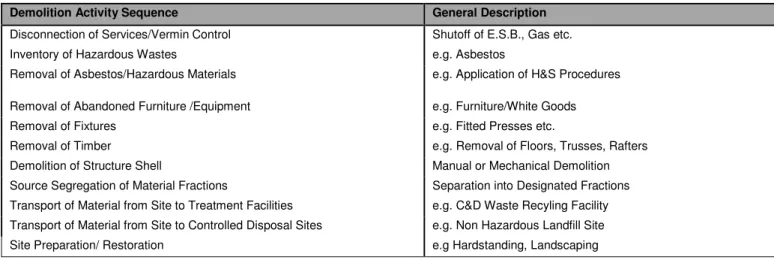
Mixed demolition wastes will arise on the project mainly from the demolition of a small number of properties/dwellings and bridges. It is estimated that approximately 41 structures comprising 25 shed/garage buildings, 10 houses, 2 bridges, 2 commercial warehousing units 1 shop and 1 railway bridge will be demolished during the construction works. Please refer to Chapter 18 - Material Assets – Non-Agriculture of the EIS for further details. The typical demolition sequence (for houses/buildings) is detailed in Table 2.1 below.
Table 2.1 Typical Demolition Sequence
Demolition Activity Sequence General Description
Disconnection of Services/Vermin Control Shutoff of E.S.B., Gas etc.
Inventory of Hazardous Wastes e.g. Asbestos
Removal of Asbestos/Hazardous Materials e.g. Application of H&S Procedures Removal of Abandoned Furniture /Equipment e.g. Furniture/White Goods
Removal of Fixtures e.g. Fitted Presses etc.
Removal of Timber e.g. Removal of Floors, Trusses, Rafters
Demolition of Structure Shell Manual or Mechanical Demolition
Source Segregation of Material Fractions Separation into Designated Fractions Transport of Material from Site to Treatment Facilities e.g. C&D Waste Recyling Facility Transport of Material from Site to Controlled Disposal Sites e.g. Non Hazardous Landfill Site
Site Preparation/ Restoration e.g Hardstanding, Landscaping
2.1.1 Construction Compounds
Construction compounds will be created for the storage of materials, plant and equipment and for site offices. It is proposed that in the order of 9 main construction compounds will be required during the construction of the proposed road scheme. A further 13 smaller construction compounds for storage purposes only will also be required. The final number of construction compounds is subject to detailed design. Any surface topsoil will be removed and temporarily stored and the compounds will consist of a crushed stone working platform, utilities, offices, welfare facilities and stores. Following completion of the work all the construction materials will be removed from the compounds and the removed topsoil will be reinstated. Construction materials will be stored at the compounds and delivered to the section of site as required.
2.2 Waste Arising
Given the nature of the project and the construction methodologies outlined above, it is anticipated that the main waste types generated during the construction phase of the project will be the volumes of excavation material arising from the cut works required along the main line of the route as well as clay, soil and concrete from other excavations such as in structural foundations at bridges, sliproads and side roads etc.
M20 Cork-Limerick Motorway Scheme
Environmental Impact Statement Page A19.1.3 of A19.1.6 Appendix 19.1_Outline Project Construction and Demolition Plan
2.2.1 Excavation Arisings (Clay, Soil and Rock Construction Waste)
A preliminary breakdown of the projected excavation arisings anticipated from the construction of the M20 route is outlined in Table 19.1 of the accompanying EIS chapter. It is proposed subject to the phasing of the proposed development, that the majority of material arising from the cut required along certain sections of the motorway will be used for filling within the project area. Material deemed unsuitable from an engineering perspective, i.e. geotechnically unsuitable material, will be used in landscaping and in the construction of noise berms. On the basis of the preliminary site investigations this will comprise approximately 15% of the total excavated material. Where practical, all peat encountered will be reused within the project area. Any excess peat arising from the scheme will be disposed off-site in accordance with the requirements of the Waste Management Act and subsequent amendments.
The project is likely to require importation of fill material to make up the projected shortfall of fill material recorded in the preliminary excavation balance.
Disposal of surplus material arising will be undertaken in accordance with the requirements of the relevant legislation. This material will be recovered or deposited at suitably licensed or permitted facilities. These may be existing facilities in the region or a purpose built facility may be designed near to the construction project. In this case an application will be made to the EPA for a waste licence. It is not possible to predict at this point potential impacts or significance effects on the environment of such a development. However it is sufficient to say that such a facility (temporary only) would be required to obtain and comply with an EPA waste licence and therefore could not impact on the local environment in any significant way.
2.2.2 General Construction and Demolition Waste
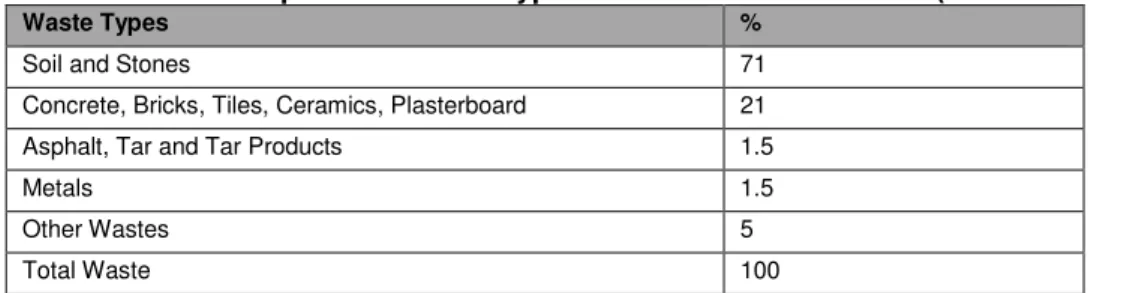
Quantities of general construction and demolition wastes such as wood, packaging, metals, plastics, bricks, blocks, canteen waste, some hazardous wastes (e.g. oils, paints, and adhesives), site clearance and residual wastes will be generated during the construction phase primarily from the construction of the Motorway Service Area as well as from demolition. While it is difficult at this stage to predict precise tonnages of these wastes expected by the proposed scheme, estimates of the composition of waste materials generated by a typical Irish Construction site from the EPA National Waste Database Report are presented on Table 2.2 below. A more detailed estimate of the anticipated quantities of these materials will be provided in the detailed waste management plan following appointment of the contractor and detailed design. Demolition audits will be required to evaluate the likely waste arising from demolition.
Table 2.2 C&D Composition from a typical Irish Construction site (Source EPA 2004)
Waste Types %
Soil and Stones 71
Concrete, Bricks, Tiles, Ceramics, Plasterboard 21
Asphalt, Tar and Tar Products 1.5
Metals 1.5
Other Wastes 5
Total Waste 100
3 Proposals for Minimisation, Reuse, Recycling and Management of C&D Waste
3.1 Waste Handling
The primary aim of this CWMP is to ensure that the wastes generated in the course of the project are managed in a systematic manner in accordance with the governing Waste Management Legislation and the principles of the Waste Hierarchy i.e. prevention, minimization, reuse, recovery and recycling.
Wastes generated on the construction site must be identified and segregated according to their category as described by the European Waste Catalogue (EWC). In order to effect this, designated Waste Storage Areas (WSA’s) will be created at each construction compound or other suitable location along the route for the storage of segregated wastes prior to transport for recovery/disposal at suitably licensed/permitted facilities. An outline of a typical WSA is presented on Figure 1.1. Suitably sized containers for each waste stream will be provided and will be supervised by a Waste Management Co-ordinator (WMC) who will be appointed by the contractor. This will be the person responsible for the management of wastes during the entire project. The number and sizing of containers will be agreed with Waste Contractors in advance of the commencement of the proposed road development. Source segregation of wastes will result in cost savings to the project as well as providing an environmentally sound route for the management of all C&D wastes.
Under the Waste Management (Collection Permit) Regulations 2007 a waste collection permit, for the appropriate EWC Code (s) and destinations, is required by a waste haulier to transport waste from one site to another. Compliance with the Waste Management (Movement of Hazardous Waste) Regulations, 1998 is also required for the transportation of hazardous waste by road. The export of waste from Ireland is subject to the requirements of the Waste Management (Shipment of Waste) Regulations, 2007. The Contractor will ensure that the transport and movement of all wastes are carried out in compliance with these requirements.
Waste may only be treated or disposed of at facilities that are licensed to carry out that specific activity, (e.g. chemical treatment, landfill, incineration etc) for a specific waste type. Records of all waste movements and associated documentation should also be held, on-site. Generally, operators of waste management sites will facilitate a site visit and inspection of documentation, if deemed necessary. Prior to any on-site recovery process, including the operation of mobile plant, an operator must apply to the governing local authority for a waste facility permit under the Waste Management (Facility Permit and Registration) Regulations 2007. It is planned that waste activities at the site will comprise of source segregation, storage and collection and therefore highly unlikely that any waste licensable or waste permittable activity will be undertaken.
In order to prevent and minimize the generation of wastes, the Contractor will be required to ensure that raw materials are ordered so that the timing of the delivery, the quantity delivered and the storage is not conducive to the creation of unnecessary waste. The Contractor will be required to develop a programme in conjunction with the material suppliers showing the estimated delivery dates and quantities for each specific material associated with each element
M20 Cork-Limerick Motorway Scheme
Environmental Impact Statement Page A19.1.4 of A19.1.6 Appendix 19.1_Outline Project Construction and Demolition Plan
of work. By following a “just in time” approach this improves cash flow, utilises storage space better, reduces potential losses to theft and accidental damage as well as making the site safer.
It is essential that the construction work planning is carried out closely with the waste management contractors, in order to determine the best techniques for managing waste and ensure a high level of recovery of materials for recycling. The Contractor will be required to continuously seek to improve the waste management process on site during all stages of construction and maximise opportunities for reuse or recycling where they exist. For example in relation to waste packaging, the contractor will seek to negotiate take back of as much packaging waste as possible at source to ensure maximum recycling. The CWMP should be included as an agenda item at the weekly construction meetings. In addition, the plan should be communicated to the whole team (including the client) at the monthly meetings. This should include any updates from earlier revisions to the document.
An overview of the methods to manage the primary waste streams expected is presented below. The main types of construction waste produced will be:
3.1.1 Excavated Clay, Soil, Peat and Stones
Excavated soils, clay, peat and rock will be loaded directly from the excavation face to vehicles for removal from site and use within the project area as appropriate (e.g. as fill material). Intermediate storage of material is not anticipated. Where short term temporary storage is unavoidable, the method of storage of such material will be key to its potential use as certain types of soils and clays are likely to degrade if left uncovered in wet weather due to its low plasticity and silty nature. Topsoil will be stored separately from other soil types and where possible clay mounds will not be more than two metres in height as this may damage the soil structure and limit its future use.
3.1.2 Concrete
Waste concrete is likely to arise during the construction phase of the M20 motorway most likely during bridge construction or in demolition works. It is proposed that where possible waste concrete generated will be returned to the supplier for reuse. Where this cannot be achieved the concrete may be crushed and screened and used within the project area where appropriate to do so, such as in sub base etc. The necessary permissions for any crushing and screening activities required will be discussed with the environment department of the local authority prior to any works being undertaken.
For every tonne of concrete waste that is recycled for aggregate in new concrete, significant savings are made in energy and carbon dioxide emissions. It also saves money by avoiding disposal costs which continue to increase. Residual concrete waste will be source segregated and stored in designated containers at the WSA for subsequent separation and recovery at a remote facility.
3.1.3 Metals
Metal waste has a significant scrap value. Although it is now common practice for sites to segregate metals for reuse and recycling, there are still sites where metal waste is thrown away with general rubbish. One of the primary sources of metal waste is rebar. Wastage of rebar will be reduced by ordering made to measure rebar from the manufacturer and detailed scheduling of all Reinforced Concrete (RC) structural elements.
Skip hire companies may provide free skips for the storage of scrap metal on site and this will be investigated prior to construction commencing. When the metal storage containers are full they will be removed by the waste storage contractor and sent to a metals recycling facility.
3.1.4 Timber
Timber waste will be stored separately as it is readily contaminated by other wastes and if it is allowed to rot will reduce the recyclability of other stored wastes. Any pallets will be returned to the supplier for reuse. Offcuts and trimmings will be used in formwork where at all possible. A container for waste wood, covered where possible, will be placed in the WSA. This waste wood will be collected by a waste contractor who will forward it to a wood recycling facility for chipping.
Treatment of timber with chemicals and the overuse of nails will be minimised and avoided as this will make it difficult to reuse/recycle the timber afterwards. The utilisation of reclaimed timber products will also be investigated.
3.1.5 Packaging and Plastic
Packaging waste can become a major problem on a construction site. Double handling will be avoided by segregating packaging wastes immediately after unwrapping. Many suppliers are now prepared to collect their own packaging for recycling, and this will also be investigated prior to works commencing. It is intended that where possible materials with recycled packaging may be purchased. Waste packaging will be segregated and stored in separate containers, preferably covered, in the WSA for collection by the contractor and distribution to packaging recycling facilities.
3.1.6 Blocks, Bricks and Tiles
The careful storage of these raw materials will significantly reduce the volume of these wastes arising on site. The most likely wastes produced will be offcuts, trimmings and wastes arising from breakages. Every effort will be made to use broken bricks and offcuts. Final quantities of these wastes generated will be stockpiled (possibly crushed and/or screened) and used at the site as sub base materials for roads, hardstand etc.
3.1.7 Hazardous Wastes
A preliminary programme of site investigation has been undertaken as part of the route selection process for the scheme and four historical landfills including the landfill identified at Velvetstown, have been identified in the project area to date. It is possible that, other unidentified unauthorised landfills which may contain hazardous wastes may be encountered during future investigations and excavations.
If hazardous waste is encountered appropriate handling, storage, transportation and disposal of waste must be undertaken. Prior to being removed from the site, waste should undergo a comprehensive waste assessment and classification, by a suitably qualified person, in accordance with the European Waste Catalogue (EWC) and Hazardous Waste List. It should be noted that if non-hazardous waste becomes contaminated with hazardous waste the entire load will be considered hazardous. It is therefore critical to ensure that waste segregation areas are provided and are used properly to separate out hazardous, non-hazardous and inert waste arisings. Hazardous wastes will be identified, removed and kept separate from other construction and demolition waste materials in order
M20 Cork-Limerick Motorway Scheme
Environmental Impact Statement Page A19.1.5 of A19.1.6 Appendix 19.1_Outline Project Construction and Demolition Plan
to avoid cross contamination. Specific method statements detailing the necessary mitigation measures required during the excavation, handling, transportation and disposal of hazardous wastes encountered on the site will be prepared as required.
The likely disposal/treatment options for any hazardous wastes arising available to the Contractor will depend on the nature of the hazardous material and the concentration of parameters of concern. The costs associated with treatment and disposal will equally vary depending on the concentrations of parameters of concern and on the tonnage involved. There are several operators/facilities in operation within Ireland that could potentially accept the contaminated material depending upon the results of the Waste Acceptance Criteria testing (WAC) or assist in the export of the material abroad for special treatment where required. Full details of the disposal routes for Hazardous Wastes will be provided in the detailed Waste Management Plan following the appointment of the contract and completion of the further investigations required.
3.1.8 Hazardous Liquids (Oils, Paints and Chemicals)
Hazardous liquid waste arisings from the construction process will require careful handling. Oils, paints, adhesives and chemicals will be kept in a separate contained storage area which will be locked when not in use. Lids will be kept on containers in order to avoid spillage or waste by evaporation. Waste oils, paints and chemicals will require careful handling and disposal. This includes the containers and will be stored in a containment tray. A small number of suitably licensed private contractors/facilities are present in the Republic of Ireland for the disposal of these wastes as they arise.
Fuels and chemicals will be stored in double skinned containers or within a bund i.e. an impervious structure, typically with impermeable concrete walls and floor, which must have capacity to contain 110% of the volume of the largest tank stored within it. All containers will be carefully labelled.
3.1.9 Canteen Waste
Staff canteens have the potential to generate food waste and packaging waste. Designated receptacles will be provided at the canteens to allow for the segregation and storage of individual waste streams. These will include receptacles for food waste (e.g., brown bin for waste foods, peelings etc.), dry recyclables (e.g. green bin for packaging, plastics, metals, wood, paper, cardboard, tetrapak etc.) and residual bin (e.g. black bin for mixed food and packaging wastes). Separate receptacles for the recyclable fractions may be provided such as plastics, metals, glass and this will be designed and detailed by the WMC in consultation with the selected waste management contractor.
3.1.10 Other Wastes (Residual)
Waste materials other than those outlined above can constitute a significant proportion of the total waste generated by a construction site. This waste is normally made up of residual non recyclable waste such as soiled paper, cloth, cardboard or plastics as well as canteen waste to include food as above. Other wastes which might be generated are fibreglass, polystyrene insulations and plasterboard. Given the heterogeneous nature of this material, it is most important that residual waste is kept separate from the other waste streams to avoid contamination. This material will be stored in a dedicated container in the WSA. Container size and collection frequency will be assessed with waste
management contractors as works proceed. All residual wastes will be dispatched to a suitably licensed facility for disposal. Other construction and demolition waste materials will be collected in receptacles with mixed construction and demolition waste materials, for subsequent separation and disposal at a remote segregation facility.
4 Assignment of Responsibilities
A Waste Management Co-ordinator (WMC) will be appointed who will have overall responsibility for waste management on the site. The NRA will receive summaries of any audit reports, which will be completed within three months of the end of each calendar year. The effectiveness and accuracy of the documentation may also be monitored on a regular basis via routine site visits. Following appointment of the preferred contractor the Waste Management Plan will be updated in accordance with the final design scheme and copies of the plan will be distributed to NRA, the Site Manager and each site subcontractor. The WMC appointed by the Contractor will be appropriately trained and experienced in all aspects of waste and materials management. In addition he/she and the site crew must be in a position to:
• Distinguish reusable materials from materials suitable for recycling • Ensure maximum segregation at source;
• Co-operate with site manager on best locations for stockpiling reusable materials; • Separate materials for recovery; and
• Identify and liaise with operators of recovery outlets.
The WMC will be responsible for educating all site staff, sub-contractors and suppliers about the available alternatives to conventional waste disposal. Training will also be given to all site staff in materials management on site. The WMC will continually identify waste minimisation actions on site and these will be updated in the plan.
5 Training
Copies of the Waste Management Plan will be made available to all personnel on site. All site personnel and subcontractors will be instructed about the objectives of the Waste Management Plan and informed of the responsibilities which fall upon them as a consequence of its provisions. This is traditionally carried out during the induction process for new staff members. Where source segregation and material reuse techniques apply, each member of staff will be given instructions on how to comply with the waste management plan. Site notices will be designed to reinforce the key messages within the Waste Management Plan and will be displayed prominently for the benefit of site staff.
6 Waste Records
When establishing the systems for managing the details of all arisings, movement and treatment of C&D waste in the Waste Management Plan, the use of electronic tools should be considered to provide for convenient recording of information in a useful format such as “Smart-waste”.
M20 Cork-Limerick Motorway Scheme
Environmental Impact Statement Page A19.1.6 of A19.1.6 Appendix 19.1_Outline Project Construction and Demolition Plan
The Contractor will be required to arrange for full details of all arisings, movements and construction and demolition waste discards to be recorded during all stages of the project. Each consignment of C&D waste removed from the site will be documented in the form of a Waste Movement Record form which will ensure full traceability of the material to its final destination. Separate record forms will be completed in respect of each waste transfer that takes place. The Contractor will also receive printed documents/records from waste disposal companies employed quantifying the exact amount of waste materials removed from site. This sheet from the disposal company also identifies how much material went to landfill and how much went for recycling. All such records will be retained in a designated location and made available for auditing of the waste management plan.
7 C&D Waste Plan Summary
Wastes will inevitably be generated during the construction and demolition phase of the proposed project. It is intended that all waste soils, rock and concrete will be used within the project area where possible for infilling, landscaping and in noise reduction berms. At this preliminary stage, it is anticipated that the bulk of surplus excavation arisings will be used on site. It is anticipated that a certain (relatively low) percentage of the surplus materials such as peats will not be suitable for use on site. These materials will be recovered or disposed at appropriately licensed facilities. Preliminary estimates indicate that there will be a net import in the order of 1.9M m3of fill to complete the project.
Other than spoil material from excavations, waste arisings during the construction phase will be minimised by the purchasing manager by timing the ordering of materials for the site in a manner which reduces the likelihood of over purchase or damage during storage. Furthermore several of the traditional waste streams arising maybe used at the site where appropriate. Where this is not possible, C & D waste fractions will be segregated and stored on site in designated bays or containers in the WSA prior to transport by licensed hauliers to facilities for segregation, recycling and disposal.
A WMC will be appointed to ensure the Waste Management Plan is followed. Training will be given to all staff so that they are aware of the Waste Management Plan and know their responsibilities.
Records will be kept to trace the inputs and outputs of the construction works at the site and this should allow the NRA to make informed decisions regarding waste management in the future. These records will be made available to the relevant local authorities and the Environmental Protection Agency should it be required.
The design and implementation of the detailed CWMP in conjunction with the Environmental Operating Plan for the scheme will provide for the optimum planning/management and handling of wastes generated by the project and will ensure that there will be will be no worse than a neutral imperceptible impact from waste management practices during construction.