University of Wollongong
University of Wollongong
Research Online
Research Online
Faculty of Engineering and Information
Sciences - Papers: Part B
Faculty of Engineering and Information
Sciences
2017
Automatic Affect Perception Based on Body Gait and Posture: A Survey
Automatic Affect Perception Based on Body Gait and Posture: A Survey
Benjamin Stephens-Fripp
University of Wollongong, [email protected]
Fazel Naghdy
University of Wollongong, [email protected]
David Stirling
University of Wollongong, [email protected]
Golshah Naghdy
University of Wollongong, [email protected]
Follow this and additional works at: https://ro.uow.edu.au/eispapers1
Part of the Engineering Commons, and the Science and Technology Studies Commons
Recommended Citation
Recommended Citation
Stephens-Fripp, Benjamin; Naghdy, Fazel; Stirling, David; and Naghdy, Golshah, "Automatic Affect Perception Based on Body Gait and Posture: A Survey" (2017). Faculty of Engineering and Information Sciences - Papers: Part B. 847.
https://ro.uow.edu.au/eispapers1/847
Research Online is the open access institutional repository for the University of Wollongong. For further information contact the UOW Library: [email protected]
Automatic Affect Perception Based on Body Gait and Posture: A Survey
Automatic Affect Perception Based on Body Gait and Posture: A Survey
Abstract
Abstract
There has been a growing interest in machine-based recognition of emotions from body gait and its combination with other modalities. In order to highlight the major trends and state of the art in this area, the literature dealing with machine-based human emotion perception through gait and posture is explored. Initially the effectiveness of human intellect and intuition in perceiving emotions in a range of cultures is examined. Subsequently, major studies in machine-based affect recognition are reviewed and their performance is compared. The survey concludes by critically analysing some of the issues raised in affect recognition using gait and posture, and identifying gaps in the current understanding in this area.
Disciplines
Disciplines
Engineering | Science and Technology Studies
Publication Details
Publication Details
B. Stephens-Fripp, F. Naghdy, D. Stirling & G. Naghdy, "Automatic Affect Perception Based on Body Gait and Posture: A Survey," International Journal of Social Robotics, vol. 9, (5) pp. 617-641, 2017.
Automatic Affect Perception Based on Body
Gait and Posture: A Survey
Abstract— There has been a growing interest in machine-based recognition of emotions from body gait and its combination with other modalities. In order to highlight the major trends and state of the art in this area, the literature dealing with machine-based human emotion perception through gait and posture is explored. Initially the effectiveness of human intellect and intuition in perceiving emotions in a range of cultures is examined. Subsequently, major studies in machine-based affect recognition are reviewed and their performance is compared. The survey concludes by critically analysing some of the issues raised in affect recognition using gait and posture, and identifying gaps in the current understanding in this area.
I.
I
NTRODUCTIONA significant amount of interest in the study of automatic affect perception in applications such as human computer interaction, social robotics, and security is now evident in the literature. In this paper, a range of approaches on automatic affect recognition reported in literature is critically reviewed. The emphasis is on machine-based human emotion perception through gait and posture.
In the past, a significant amount of research was conducted on the recognition of emotions through facial expressions. According to de Gelder [2] in 2009, 95% of the literature on emotion in humans were singularly focused on facial expressions. However, emotions are not only conveyed through facial expressions, but also through body expression. Currently, there is also a growing interest in gait analysis because of its potential wide range of applications, such as personal identification [3], deception recognition [4], and detection of illnesses such as multiple sclerosis [5]. Body posture can also be used to effectively decode emotions at a distance compared to facial expressions alone [6].
Kleinsmith and Bianchi-Berthouze’s survey paper [7] discusses the range of conflicting views arisen in the literature on the importance of facial expressions versus body expressions in communicating emotions. This is primarily based on the study by Ekman and Friesen [8] that identifies emotional deception in facial expressions and body movements. Ekman and Friesen use the term “non-verbal leakage” to describe clues towards deception that is unintentionally expressed.
Importantly, Ekman and Friesen conclude that facial expressions can easily conceal this leakage and therefore can be used to lie about emotions. Since facial expressions can easily hide real emotions, body expressions may potentially offer a better approach for emotion recognition. Kleinsmith and Bianchi-Berthouze also conclude that analysing body expressions can help in providing clues to understand facial expressions, leading to higher recognition accuracies.
The study reported in this paper presents an overview of the various approaches undertaken thus far in machine-based affect recognition from body language. Such focus allows us to deal with methods proposed in the reviewed studies in more depth than previous survey papers. Within each study, in addition to overall success, a variety of classification techniques utilised and the features deployed are examined. The paper concludes with a critical analysis of the reviewed papers and identifying the obstacles that prevent an effective comparison between the studies including variances in data collection methods, number and quality of subjects, number and type of emotions and the absence of common ground truth for comparison. The conclusion also highlights the high impact of the proposed methods and outlines several directions for future research.
It is generally challenging to conduct a comprehensive comparison between different methods deployed in the literature in this field due to wide variation in detection methods, data sets, emotion categories etc. Therefore, a more realistic approach is taken in this study to initially provide an introduction into the field of machine based affect perception based on body language and then review the approaches thus far developed and reported in the literature.
Although a number of articles [7], [9] and [40] suggest that affect recognition is best performed under a multimodal approach, the higher the accuracy achieved through body language, the better is the classification recognition. Results of the search were therefore refined to only include studies concerned with machine-based affective recognition from body language in human beings; as opposed to recognising emotions in robots. For the purpose of this research, body language is defined as visual cues other than facial recognition alone. Gestures from hands and arms were therefore included within the category of body
language. For projects using a multimodal approach, the review was limited to studies that deployed body gait, posture or gestures as one of the sources of information. As the intention of this paper was to provide an overview of different approaches deployed in connection with gait and posture, studies associated with multimodal methods were also included in the review but the focus was mainly kept on how the body language was deployed.
Five survey papers were included in the search results. In 2009, Zeng et al. [10] conducted a review of the literature on recognition of emotions based on visual and audio signals. The visual features were based predominately on facial expression, with a limited number of studies considering gait and posture.
Another review paper was published by Kleinsmith and Bianchi-Berthouze in 2013 [7]. The psychology of affective recognition and the importance of taking culture into account when expressing, labelling and detecting affect from body language was first examined. The last section of the paper cites 18 different studies on affective recognition including older less successful works, compared to 39 recent papers cited in this survey paper.
Another review paper was published by Karg et al. [11] in 2013, devoting only a small section of the paper to the review of the previous work. The major part of the paper explored affective notation systems, human recognition of emotion and systems that generate emotions.
Zacharatos et al. [12] also published a survey paper in 2014. This paper provides only a brief overview of the different methods used in affective recognition, multimodal systems, segmentation and different models of emotion and notation systems.
McColl et al. [13] developed a survey paper in 2016 on affect recognition in the context of Human Robot Interactions (HRI). Affect recognition using a variety of modalities including facial, voice, body and physiological was examined. Only a small section of the paper, however, was dedicated to studies on recognising affect from body language.
The remainder of the paper is structured as follows. In Section II, the cultural similarities in emotional recognition by people from different backgrounds, and the mechanism used by human beings to recognise emotions from gait, are explored. This is followed in Sections III and IV by a review of machine-based affective recognition methods using raw data and processed data, respectively. For each study, we investigate the classifier deployed and the outcomes produced. We also review different approaches that are currently used to improve classification rate. Section V
provides a critical discussion on common themes and trends within the literature, including research gaps in automatic affective recognition from gait that should be addressed through further investigations.
II. AFFECTIVE PERCEPTION IN HUMAN BEINGS A. Body Movements and Emotion
There is a long established and increasing collection of the literature suggesting that a large amount of information can be derived from body motion and posture. Kozlowski et al. [14] demonstrated that viewers could determine the sex of a subject using point light displays on major joints, as shown in Figure 1. Cutting and Kozlowski [15] also confirmed that participants could identify themselves and their friends using body mounted point light displays.
Figure 1 - Point Light Display of Posture [15]
The work reported in the literature indicates that body language can communicate emotions. Brownlow et al. [16] demonstrated that observers could distinguish between happy and sad dance movements using body mounted point light displays. De Meijer’s [17] showed 96 recordings of body movements to 85 adult subjects and asked them to classsify those movements in twelve emotional categories. They concluded that certain body movements indicated specific emotional states. This was not just for one particular movement such as raising the fist, but the motion of a specific combination of the body parts conveying emotional states to human observers.
Walbot [18] also studied the connection between patterns of body movements and postures and the emotion displayed. A coding schema was deployed to analyse the 224 video recordings of six actors. Walbot concluded that specific body movements
and postural characteristics were framed to represent certain emotions.
Other psychological studies [19-21] also confirm that human perception can recognise affective states communicated only through the body movements. There has also been work examining the activity of the brain when gait patterns were observed [22, 23].
B. Cross Cultural Similarities and Differences in Emotions
Ekman and Friesen studied whether emotions conveyed by facial expressions were culture specific [24]. Although only facial expressions were observed, an insight was obtained into whether emotion expression crossed cultural boundaries. Subjects selected for the study had limited contact with western culture. Hence, they were not influenced by media and did not know the meaning of various gestures in western culture. A number of emotions were explored including happiness, sadness, anger, surprise, disgust and fear. In order to overcome the language barrier and the fact that equivalent words for emotions might not exist in the subject’s culture, a story expressing an emotion was read to the subjects and they were asked to point to one of the three face pictures that best represented the emotions portrayed in the story. The results for adults and children, males and females confirmed the hypothesis that a specific set of facial behaviours were universally associated with particular emotions irrespective of culture.
Recently, however, a pair of studies [25] challenge this hypothesis, as the data used has conflicted with Ekman and Friesen’s results. Crivelli et al. tested 68 indigenous subjects from Papua New Guinea and Mozambique on their ability to recognise emotions through facial expressions. Although happiness achieved the highest result of 58% and 56% respectively, the other emotions only achieved a lower recognition rate, ranging from 7% to 53% for both studies.
Kleinsmith et al. [26] tested the cross-cultural similarities and differences of emotion perception through body postures of people from Japan, Sri Lanka and the United States of America. They used 13 actors; 11 Japanese, one Sri Lankan and one American; who adopted a posture to represent anger, fear, happiness and sadness. These postures were recorded using a motion capture system with 32 markers on the actor’s body using eight cameras. The captured motions were then used to create non-gender, non-culture specific computer avatars without facial expressions. The 108 affective postures were presented to observers in a different randomised order for each participant. The observers, consisting of 25 Japanese, 25 Sri Lankan and 20 Caucasian Americans, were asked
to rate the intensity of the emotions they perceived and to identify which emotion label best represented the posture. For each emotion, they had two nuances of the same emotion i.e. anger (angry, upset), fear (fearful and surprise), happiness (happy, joy) and sadness (sad, depressed). When the postures from all three cultures were combined, the observers were able to recognise the emotions at a moderately successful level of between 54% and 56% for each of the three different groups of observers. When they only observed members of their own culture, the Japanese had a success rate of 90%, the Sri Lankans 88% and the Americans 78%. This shows that there are differences in the way cultures express emotions in their body movement and there is only a moderate level of agreement between them. Other studies also confirm the thought that it is harder to identify emotions from facial and body expressions across cultures [27, 28]. One approach to addressing cross cultural issues is to apply different classification models to different cultures [29, 30].
C. Human Affective Recognition from Gait The work conducted by Atkinson et al. [31] is an early study of humans’ ability to recognise emotion from gait. Ten trained but unrehearsed actors were used to express certain emotions. The actors were covered in black with thirteen 2cm wide strips of white reflective tape placed on their bodies. They were given the workspace of two large paces around them and were free to walk in any direction, portraying each of the five emotions of happiness, sadness, fear, anger and disgust. Two filmed versions were created; one with the full video or full light (FL), and one with only the white strip information or Point Light (PL). It was easier to identify the emotions using only the PL information, but the observations made based on FL had higher recognition accuracy than PL observations. The authors also compared the effectiveness of moderate intensity of emotions against exaggerated and much exaggerated emotions in affect recognition. They concluded that the more exaggerated the emotion, the easier it could be identified.
Gross et al. [32] also studied human ability to recognise emotions, and investigated two factors that could be used to qualitatively detect emotions: effort-shape and body-limb movements. A motion capture system was deployed utilising 31 lightweight spherical markers taped over anatomical landmark points recorded by a high-speed camera. Sixteen actors’ front and side views were recorded, as they displayed sad, angry, joyous, content and neutral emotions whilst walking. A series of emotion memories were utilised to induce the emotional response in the
actors prior to walking. In stage one, untrained observers were able to identify the same emotional memories through gait observations with an accuracy of 76%. Stage two demonstrated that each emotion communicated a unique combination of the effort shape analysis features.
Kinematic analysis of the data obtained from the motion capture systems was deployed in the final section of the study to quantify both body and limb motions during the walk. Differences in the gait measurements and joint movement between different emotions were demonstrated in their results. For example, sad emotions typically resulted in slower movement and less movement of arms and elbow joints, and less trunk rotation. Angry walkers had an increased trunk flexion and shoulder elevation compared to joyful or content walkers even when they had a similar walking speed.
D. Context in Affective Recognition
Nayak et al. [33] defined a simple activity in recognition as one which involves a single person with minimal background noise. Currently, emotion detection studies are limited to recognising emotions as simple activities. That is, they are restricted to viewing one person, generally within a controlled environment/background. However, there is a growing body of literature suggesting that context provides important information in recognising human emotion.
Lankes et al. [34] examined the recognition of facial expressions from still, animated, and within game context. They found that within the game context provided the richest experience in perceiving emotions, followed by the animated. This demonstrated that context is helpful in understanding emotions as well as movement.
Body language is also highlighted as an important element in providing understanding for the context of facial expressions [35]. Similarly, the context of facial expressions helps to improve the recognition rate of emotions from body expressions [36].
By comparing emotion recognition with and without the scene context, Kret and deGelder [37] demonstrated that the surrounding social context aids in recognising emotion from body expressions. Similarly, Van den Stock et al. [38] also showed that background images can be helpful in recognising fear from body posture. Kret et al. also demonstrated that recognition of emotions of facial and body expressions were dependent upon their surrounding natural context [39]. The environment can even impact how humans walk with data suggesting that by changing the sound of footsteps subjects feel more positive, which impacts their gait [40].
Muller et al. examined [41] recognising emotions in a subject interacting with another person and the environment using body cues and audio recordings. However, they only achieved low accuracy recognition rates. Although the majority of current literature focuses on simple activities without taking into account context, a long-term goal is to recognise emotions within any environment and taking into account interactions with other people.
III. AFFECT RECOGNITION USING RAW DATA In recent years, there have been a growing number of studies exploring the effectiveness of local features (raw data points) in automatically detecting human emotions manifested in gait and body movement. The methods used can be broadly categorised into two groups of perceptive and responsive systems. The responsive systems use sensors such as motion capture suits to capture joint movements, whereas the perceptive systems do not require wearing of any specialised equipment. Examples of perceptive systems are image processing from video cameras, gait force measurement using plates and multiple sensor systems such as Kinect. Responsive systems capture as much data as possible, but since they require the subject to wear multiple sensors they are impractical in real world applications. Examples are security camera analysis and HRI situations. Perceptive systems are more suitable for real time applications but they generate less data than active systems.
A. Optical Motion Capture
In Optical Motion Capture Systems, a number of light markers are attached to the body and tracked through a set of infrared cameras, as shown in Figure 2. Such systems are not practical in real world scenarios such as security and HRI, but provide accurate data points that can be deployed in feature extraction and classification methods. Video Cameras alone often rely on crude methods of tracking, such as silhouette extraction, that do not provide data on individual joints. However, it is possible to track individual joints in the x, y and z axes using infrared cameras in Optical Motion Capture systems and obtain more detailed data on the body motion.
Figure 2 – Optical Motion Capture System [12]
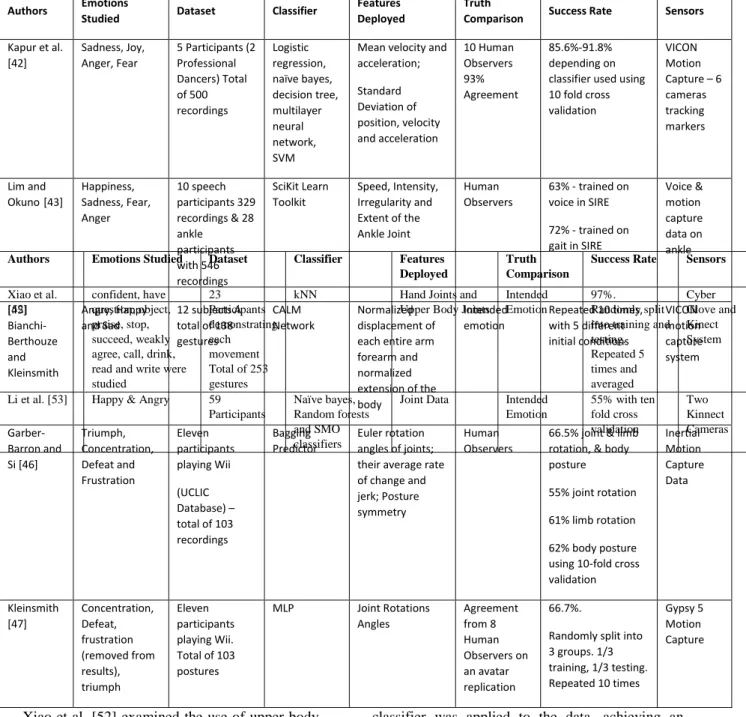
Kapur et al. [42] demonstrated the high potential of automatically detecting emotions through the use of body movements. A VICON Motion Capture System captured fourteen reference point markers placed on five different subjects. The participants interpreted and subsequently acted or represented four basic emotions (sadness, joy, anger and fear). Each actor repeated the emotion 25 times, resulting in 500 recordings. To serve as a comparison against cognitive recognition, point light display mounted on 14 reference points were recorded and showed to ten subjects. The subjects identified emotions from the markers with an accuracy of 93%. An automatic classification model was deployed based on the motion data of the various body markers, incorporating the mean velocity and acceleration, and the standard deviation of the position, velocity and acceleration of each marker. Five different classifiers were applied to the data: logic regression, naïve bayes, decision tree, artificial neural network, and a support vector machine. The classifiers identified each actor's intended emotions with success rates between 85.6% and 91.8% using ten-fold cross validation. Artificial neural network and the support vector machine both produced the most accurate recognition rate. These rates were comparable to that of the human observer judging emotion based on point light displays. However, the study was limited to detecting four acted emotions and the deployment of a motion system that utilised six cameras, not practical in real life scenarios.
Lim and Okuno [43] developed a robot to study multimodal emotional intelligence (MEI) and trained it to recognise emotions in voice, gesture and gait from voice training alone. A unified model for all three modalities was deployed by considering the four properties of speed, intensity, irregularity and extent (SIRE) so that the emotional recognition was no longer context specific. The authors assumed that human beings developed their recognition of affect displayed in body language by
matching it to the corresponding emotion conveyed in the subject’s voice. This principle was applied in training their MEI robot. They suggested that SIRE systems could be trained to recognise gait using the voice alone. Recognition of happiness, sadness, fear and anger was performed using the Scikit-Learn Toolkit [44] deploying a Gaussian Mixture Model. Only ankle joint data was used for the gait modality. A recognition rate of 63% was achieved using voice only training, compared to 72% when gait data was used in both the training and testing process. Potential errors were identified when actors whispered whilst expressing fear. This study demonstrates the potential of utilising high-level feature analysis instead of a low level feature analysis to detect emotions, particularly when body language data with high success rates are used.
Bianchi-Berthouze and Kleinsmith [45] explored the use of an associative neural network referred to as a Categorisation and Learning Model (CALM) to learn over time. Twelve subjects performed angry, happy and sad emotions freely whilst motion was recorded by a VICON motion capture system. A total of 138 gestures were collected. An avatar based on the motion capture data was shown to 114 Japanese observers to determine the emotion category labels, chosen as the most frequently used label between the observers for each gesture. Eighteen features were deployed, focusing on upper body gestures based upon the sphere of movement utilised in the dance. Normalized displacement of the entire arm, normalized displacement of the forearm, normalized extension of body and face orientation were examples of features deployed. The order of presentation was changed ten times, with each configuration repeated with 5 different sets of initial conditions. The average error was 0.043% with a standard deviation of 0.002.
B. Inertial Motion Capture System
Inertial Motion Capture Systems consist of a series of body mounted inertial sensors (Figure 3a) and do not require any emitters or external cameras. The sensors are placed onto the body segments surrounded by joints (Figure 3b). Sensors are able to record position, acceleration and velocity of the body parts, and via inference all the connecting joints. A summary of the studies deploying the Motion Capture is shown within Table 1 (raw data) and Table 3 (processed data).
A number of studies on affective recognition from body posture and movement rely on acted emotions. In contrast, Garber-Barron and Si [46] attempted to classify emotions in non-acted scenarios. They used the UCLIC Affective Body Posture and Motion database which contained information from eleven participants playing the Nintendo Wii sports game for a minimum of thirty minutes, containing a total of 103 recordings. This database contained the rotational angles of the joints along the x, y and z axes. The Euler angles were used as features alongside their average rate of change, jerk and posture symmetry. Triumph, concentration, defeat and frustration were recognised with an accuracy of 66.5% when ten-fold cross validation was applied. The success rate decreased by 7% and 4% when using only joint rotation data and only limb rotation data, respectively.
Kleinsmith et al. [47] also explored the feasibility of recognising affective states of players from non-acted scenarios while playing a video game. Participants played Nintendo Wii Tennis for 30 minutes while their body movements were recorded using a Gypsy 5 motion capture system. Three university students selected 103 usable affective body movements from the recording by viewing the movements as a simplistic avatar. Triumph, defeat, frustration and concentration were examined utilising a Multilayer Perceptron (MLP) for automatic classification on the joint rotation features. Recorded movements were converted into a faceless, non-gender specific computer avatar to remove any bias when evaluated by eight human observers. Each observer evaluated all of the postures five times. The observer’s views were divided into three subsets to compare human recognition of emotions against machine recognition. Subsets one and two were used to compare the agreement between the human observations, and subset three was used as the training data and subsequently tested against subset one. This process was repeated ten times. An agreement rate of 66.7% was found between the two subsets of views. There was difficulty with the recognition of frustration in the automatic classification; perhaps because of the small amount of training data available. With the frustration label
removed, the method achieved a recognition rate of 66.3%. It was noted, however, that since there was no neutral category, concentration was often used as a fall back emotion when the observers felt that there was no other appropriate category.
A summary of these studies deploying motion capture data for raw data is shown in Table 1.
C. Force Platform
A force platform can be used to measure the ground reaction forces from gait along a designated path. The force platform setup used by Janssen et al. [48] is shown in Figure 4. Data obtained from the force platform can be analysed both independently and in conjunction with kinematic analysis of the markers mounted on the subject’s body.
Figure 4 - Force Platform Setup [48]
Janssen et al. deployed neural networks to recognise emotions using gait data [48]. In the first experiment, the emotions of sadness, anger or happiness were prompted in their subjects by asking them to remember a time when they felt that emotion. The ground reaction force in x, y and z dimensions was recorded whilst the subjects walked through the test zone. This data was then fed into a three-layer neural network. The system was trained on two thirds of the data and tested on the remaining third. For each individual, they identified the emotion felt with an accuracy of 80%. In the second experiment, subjects listened to either calming or exciting music, or no music, and then walked through the test zone. The aim was to identify the emotion triggered by music. In this experiment, the same kinetic data was utilised as their first experiment, with the addition of kinematic data obtained from a vision system measuring the angles and angular velocities of the arm, hip, knee and ankle. Both the kinetic and kinematic data were fed into the same neural network. For a given individual, the proposed algorithm could recognise emotions at a rate of 77.8% for kinetic data and 73% for kinematic data, which they proposed were not significantly different. One of the recommendations made in this study was to combine the approach with features from either facial or vocal expressions to recognise emotions in an unknown subject.
Fawver et al. [49] concluded that there was a unique centre of pressure for different emotions in the preparation of walking phase, prior to forward movement. However, this has not been applied to automatic gait recognition. Initial work by Giraud et al. [50] showed the relationship between the changes in Centre of Gravity through video silhouettes, and the centre of gravity and centre of pressure on force plates to assess change in posture when reacting negatively and positively towards situations. Although this new method was not tested in automatic affect recognition, their data suggests it is a suitable alternative to required force pressure plates to analyse changes in pressure whilst walking.
D. Kinect
In addition to a video camera, the Kinect system utilises a depth sensor which provides greater
accuracy and ability to track joints compared to the video signal alone. Kinect can convert a depth camera shot into 3D locations of joints as shown in Figure 5 [51]. A summary of the studies deploying the Kinect system with Raw data is shown within Table 2.
Figure 5 - Screenshot of Kinect system [51]
Xiao et al. [52] examined the use of upper body gestures in the context of virtual reality. A wearable immersion Cyberglove II captured hand gesture data and a Microsoft Kinect captured data on the arm and head posture. The action and upper body gestures of confidence, having a question, objection, praise, asking to stop, success, lightly agreeing, calling, drinking, reading and writing were studied. Twenty three subjects, each expressing the eleven gestures, were deployed resulting in a total of 253 recordings. The data was split into training and testing set randomly, and repeated 5 times. The results were averaged and compared against the intended emotion. A kNN
classifier was applied to the data, achieving an accuracy of 97%.
Other studies have not produced as accurate results. Li et al. [53] deployed two Kinect cameras to automatically recognise either the happy emotion, or anger emotion of 59 participants. The authors applied the Naïve bayes, Random forests and SMO classifiers, with Random forest achieving the highest recognition rate of only of 55%. Since they only used raw joint data, they concluded that the angry and happy gait styles may have been too similar to effectively distinguish between the two emotions.
Authors Emotions
Studied Dataset Classifier
Features Deployed
Truth
Comparison Success Rate Sensors Kapur et al. [42] Sadness, Joy, Anger, Fear 5 Participants (2 Professional Dancers) Total of 500 recordings Logistic regression, naïve bayes, decision tree, multilayer neural network, SVM
Mean velocity and acceleration; Standard Deviation of position, velocity and acceleration 10 Human Observers 93% Agreement 85.6%-91.8% depending on classifier used using 10 fold cross validation VICON Motion Capture – 6 cameras tracking markers Lim and Okuno[43] Happiness, Sadness, Fear, Anger 10 speech participants 329 recordings & 28 ankle participants with 546 recordings SciKit Learn Toolkit Speed, Intensity, Irregularity and Extent of the Ankle Joint Human Observers 63% - trained on voice in SIRE 72% - trained on gait in SIRE Voice & motion capture data on ankle [45] Bianchi-Berthouze and Kleinsmith Angry, Happy and Sad 12 subjects A total of 138 gestures CALM Network Normalized displacement of each entire arm forearm and normalized extension of the body Intended emotion Repeated 10 times, with 5 different initial conditions VICON motion capture system Garber-Barron and Si [46] Triumph, Concentration, Defeat and Frustration Eleven participants playing Wii (UCLIC Database) – total of 103 recordings Bagging Predictor Euler rotation angles of joints; their average rate of change and jerk; Posture symmetry
Human Observers
66.5% joint & limb rotation, & body posture 55% joint rotation 61% limb rotation 62% body posture using 10-fold cross validation Inertial Motion Capture Data Kleinsmith [47] Concentration, Defeat, frustration (removed from results), triumph Eleven participants playing Wii. Total of 103 postures MLP Joint Rotations Angles Agreement from 8 Human Observers on an avatar replication 66.7%.
Randomly split into 3 groups. 1/3 training, 1/3 testing. Repeated 10 times Gypsy 5 Motion Capture
Authors Emotions Studied Dataset Classifier Features
Deployed
Truth Comparison
Success Rate Sensors
Xiao et al. [52] confident, have question, object, praise, stop, succeed, weakly agree, call, drink, read and write were studied 23 Participants demonstrating each movement Total of 253 gestures
kNN Hand Joints and Upper Body Joints
Intended Emotion
97%. Randomly split into training and testing. Repeated 5 times and averaged Cyber Glove and Kinect System
Li et al. [53] Happy & Angry 59 Participants
Naïve bayes, Random forests and SMO classifiers
Joint Data Intended Emotion 55% with ten fold cross validation Two Kinnect Cameras
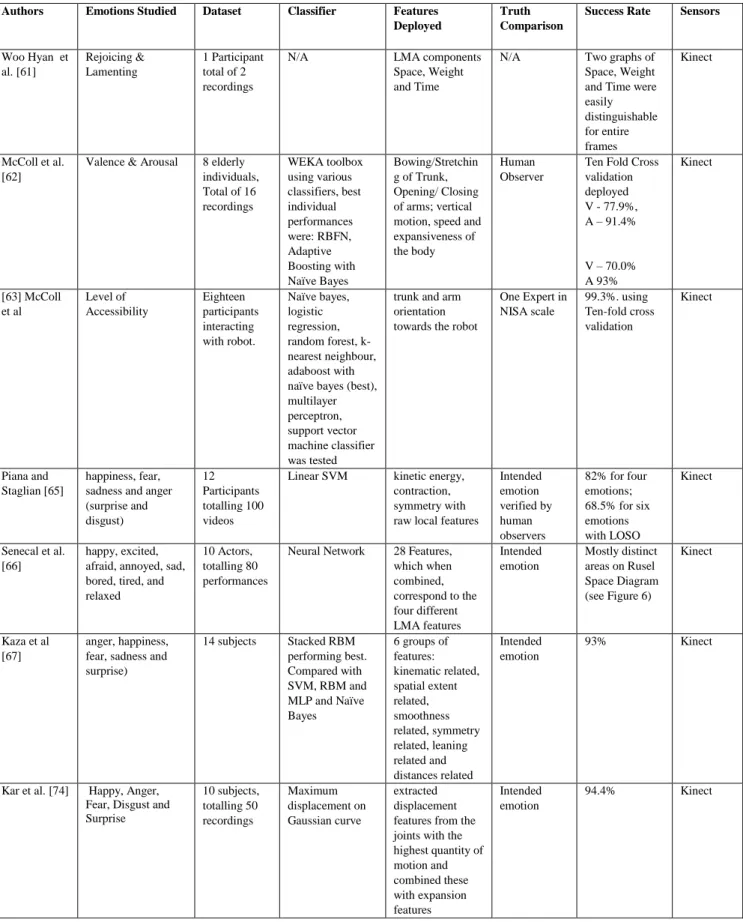
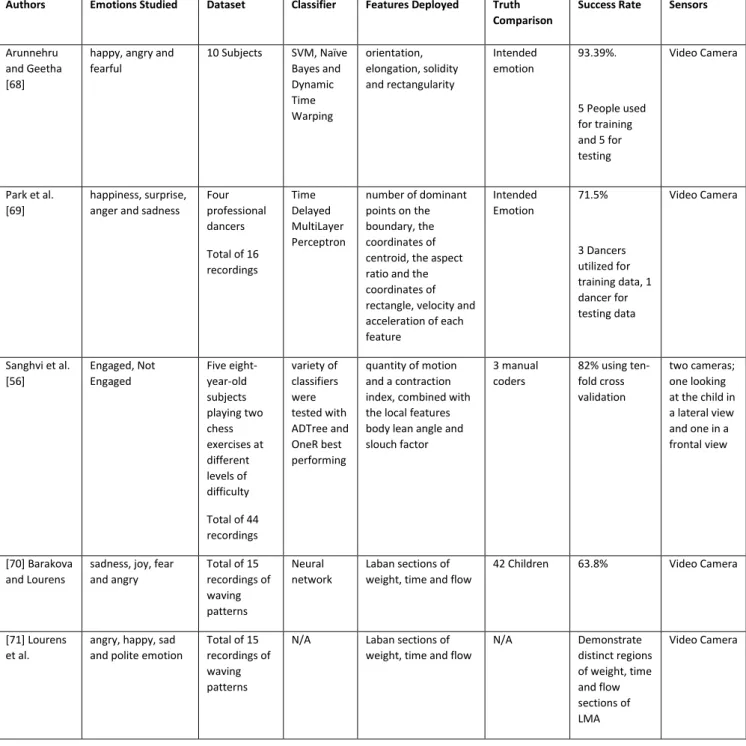
IV. RECOGNITION USING PROCESSED DATA To improve upon the accuracy obtained by automatic affect recognition system, several studies have moved beyond using raw joint and segment data obtained from the data collection methods, with some utilising global features, temporal segmentation and/or Dimensional reduction to improve their accuracy. A summary of the studies deploying processed data are presented in Tables 3-5 for those using Motion Capture, Kinect and Video Analysis respectively.
A. Temporal Segmentation
Motion time series can be broken down into stages, such as different stages of a knocking or walking. When analysing motion, not all stages of the motion equally contribute to the classification process. Both Xu and Sakazawa [54] and Bernhardt and Robinson [55] explored segmenting motion. In their studies, motion data was segmented into different stages, but then recombined with a different weighting given to the data associated with each segment. In both studies, a demanding Leave One Subject Out Cross Validation (LOSO– CV) test was conducted and the weighted segment approach achieved a higher accuracy classifying the motion as a whole action. Hence, some aspects of motion influenced the affect identification more strongly.
In analysing time series, such as gait data, the general assumption is that not all stages of walking equally contribute to the classification process. For example, raising the leg could provide more clues about the mood than lowering the leg. Accordingly, the data could be segmented into components representing different stages of gait and only the raising of the segment of the leg could be weighted more heavily in classification.
Xu and Sakazawa [54] assumed that body movements such as gestures had multiple phases and that none of these segments expressed an affective state equally. This meant that each segment must have its own weight. The method was developed and validated based on the University of Glasgow database. In this Temporal Lobe approach, the emotions associated with each segment were identified and were recombined together with a weighting given to each segment. Xu and Sakazawa achieved a 2.5% to 3.4% higher detection rate of gestures by deploying the temporal lobe approach compared to traditional deployment of motion data.
Bernhardt and Robinson [55] also showed the benefit of giving weightings to different segments of motion data in emotion recognition. They examined a collection of knocking performances by thirty individuals in neutral, happy, angry and sad
affective styles, contained within the University of Glasgow motion capture database. The motion energy was calculated by a weighted sum of the rotational limb speeds to detect the emotion of the individual. A set of accuracies ranging from 50% to 81% was achieved. This method, however, relied heavily on normalising the joint position data based on body size and using known properties for that specific subject. For an unknown candidate, however, an estimation of body size for normalisation was made; which potentially decreased the accuracy. Only right handed knocking was utilised but this method could be applied to gait and posture to identify emotions from walking styles.
B. Global Features
Global features represent the overall characteristics of an image rather than the properties of certain key points in the image. Sanghvi et al. [56] utilised the quantity of motion and contraction index as global features. Quantity of motion was obtained by subtracting the silhouette of the subject in the current frame from the previous frame. The difference in images showed how much movement had occurred. Contraction index was a measure of the expansiveness of the body and was determined by the area of a rectangular bounding box that surrounded the silhouette.
Another example is Laban Movement Analysis (LMA) [57] which is extensively used in activity recognition systems but has potential for more use in affect recognition.
LMA has four major components: body, effort, shape and space. Hachimura et al. [58] deployed the LMA method but considered only the Effort and Shape components. Effort was broken down even further into weight, time, space and flow factors and Shape was broken down into shaping and shape flow.
a) Motion Capture
Zacharatos et al. [59] applied Laban movement analysis to classify the emotions of candidates playing exergames. Thirteen players played sports games for 30 minutes on an Xbox with Kinect whilst being recorded through an eight-camera motion tracking system and a separate video camera. Ground-truth was determined by four observers labelling the video footage. Out of the 309 clips recorded, only 197 agreed with the observers and were consequently utilised. For the analysis, the study only considered the space and the time motion factors. Concentration, meditation, excitement and frustration were recognised with an overall classification accuracy of 85.27% deploying ten-fold cross validation. Motion clips were only
used if they felt the subjects exhibited one of the four emotions being classified and if the four observers agreed on the portrayed emotion. The study did not take into account a range of other emotions that could have been misclassified by the system.
Fourati et al. [60] deployed a combination of local, semi global and global features on 11 subjects who displayed eight emotions whilst walking and performing basic actions. The subjects were trained by an actor and their motion data was recorded using an XSens inertial motion capture suit. A Random forest classifier was applied to the data on various movements (including walking), achieving an average recognition accuracy of 84.8% whilst the subject was walking.
b) Kinect
In their study, Woo Hyun et al. [61] proposed using an LMA to distinguish between emotions. In their experiment, they used Microsoft Kinect to study twenty points on the body and considered space, weight and time. Flow always appears in a state of motion so it was not used. Rejoicing and lamenting were found to be easily distinguishable from each other in space, weight and time. These two emotions are largely different in their nature and more study is needed to see how this system works with less extreme emotions.
McColl et al. [62] set out to improve social robots for use at meal times in long term care facilities. They recognised the need for a caregiver to detect the emotions of their patient at meal times so that they could respond and interact appropriately. Body posture and movements in a seated position was examined to determine the emotion. 3D data from a Kinect system was deployed to detect different body language features (e.g. speed of the body, bowing/stretching of the trunk) to classify the valence and arousal values of the participants. Eight elderly individuals were recorded at two meal times resulting in 16 recordings. The authors utilised nine different learning techniques to compare their effectiveness, benchmarking them against the median value of twenty-one human observers with ten-fold cross validation. The highest accuracy for valence recognition obtained was 77.9% using a Radial Basis Function Network (RBFN) and 93.6% for the arousal recognition rate using adaptive boosting with Naïve Bayes.
McColl et al. [63] studied social robotics contexts to determine the level of accessibility based on the nonverbal interaction and states analysis (NISA) scale. One expert in the scale was used to code a comparison truth. They deployed a Kinect system to generate a 3D ellipsoid model of a person’s static pose to determine the trunk and arm
orientation towards the robot. WEKA [64] data mining software was utilised with tenfold cross validation. Naïve Bayes, Logistic Regression, Random Forest, k-Nearest Neighbour, Adaboost with Naïve Bayes, Multilayer Perceptron, Support Vector Machine classifiers were deployed on 300 static poses from eleven different individuals. Here, the Adaboost algorithm together with the Naïve Bayes base classifier achieved the highest accuracy of 99.3%.
Piana and Staglian [65] deployed a Kinect sensor to recognise six emotions. They extracted global features such as kinetic energy, contraction, symmetry as well as raw local features and ran it through a linear SVM classifier with a random split. The authors were able to obtain an accuracy of 68.5% compared to 62.3% obtained when utilising data from a Qualisys motion capture system.
Senecal et al. [66] deployed LMA for emotion recognition in theatre performances recorded by a Kinect camera. Ten actors performed eight different emotions, resulting in 80 performances. They extracted 28 Features, which when combined, correspond to the four different LMA features; and then fed them into a neural network. Each feature contained the minimum, maximum, standard deviation and average value. The neural network contained 86 inputs and two outputs, which corresponded to the (x,y) coordinates on a Russel’s emotion space, as shown in Figure 6. Since the authors used a continuity of emotion rather than discrete, their results are best displayed graphically in Figure 6.
Figure 6 - Results from Senecal et al. [66] on Russell's emotion diagram
recognise five emotions in a dataset recorded with Kinect sensor. The authors used a neural network with stacked Restricted Boltzmann Machines (RBM). They deployed a range of global features which were broken up into the six groups of. Each of these six feature sets were fed into a different RBM and the output was then fed into a seventh RBM. The stacked RBM outperformed the RBM, MLP, SVM and Naïve Bayes algorithms, achieving the highest accuracy of 93%.
c) Video Analysis
Arunnehru and Geetha [68] recognised the three emotions happy, angry and fearful, in a surveillance video against a static black background. By extracting the global features of orientation, elongation, solidity and rectangularity, they recognised the emotions of the subjects whilst walking, siting and jumping. The authors applied the following algorithms in their classification system: SVM, Naïve Bayes and Dynamic Time Warping (DTW), which compares two sequences that may vary in time. The DTW classification achieved an overall accuracy of 93.39%.
Park et al. [69] explored the application of Laban Movement Analysis to recognise emotions from dance image sequences. A camera captured four professional dancers freely performing various movements of dance portraying happiness, surprise, anger and sadness. They eliminated the background and extracted features such as the number of dominant points on the boundary, the coordinates of centroid, the aspect ratio and the coordinates of rectangle, as well as the velocity and acceleration of each feature. Singular value decomposition was applied to the features to distinguish those that were reliable. These features were then classified into the emotion categories using a time delayed multilayer perceptron. Recordings from three dancers were deployed as training and one dancer was utilised for testing data. They classified the emotions with an average accuracy of 73%.
Sanghvi et al. [56] also used global features in affective recognition in social robots. They analysed human postures and body motion to measure the level of engagement of children playing chess with their companion which was an icat robot using an electronic chessboard. The icat interacted with the child appropriately by making a sad facial expression when the child made a good move and a happy facial expression when the child made a bad move. Sanghvi et al. recorded the gameplay via two cameras; one looking at the child in a lateral view and one in a frontal view. Five eight-year-old subjects playing two chess exercises
at different levels of difficulty were recorded, with a total of 44 recordings being utilised. Because of their age, the participants were unable to accurately identify their own levels of engagement. Instead the study utilised three coders to manually label the different sections of video as either engaged, not engaged and unsure. The unsure segments were discarded in order to remove sections of the video that could easily confuse the machine. In order to measure the levels of engagement, Sanghvi et al. used global features quantity of motion and a contraction index, combined with the local features body lean angle and slouch factor. A variety of classifiers were tested with ADTree and OneR classifiers achieving the highest accuracy of 82% using ten-fold cross validation.
Barakova and Lourens [70] detected movements that expressed emotions. They examined the Laban sections of Weight, Time and Flow, then translated combinations of these into sadness, joy, fear and anger. Fifteen, twenty second recordings of waving patterns that demonstrated happiness, anger, sadness and nervousness were captured. A Neural Network classifier was deployed and 42 children were used to determine the ground truth in each case. Here, Barakova and Lourens achieved an overall accuracy of 63.8%.
Lourens et al. [71] studied subjects waving in an angry, happy, sad and polite emotion and discovered these states were associated with distinct acceleration profiles. A combination of skin colour tracking and motion analysis was deployed to view the movement of hand arm and head. It was shown that these emotions occupied distinct regions of weight, time and flow areas within the LMA.
A summary of the studies using video analysis is presented in Table 5.
C. Using Dimensional Reduction
Data obtained from motion capture technology can be particularly large. This is computationally difficult and may contain data that is irrelevant and potentially misleading for the classifier. Dimensional reduction techniques are usually applied to this type of data to simplify its structure. As stated by Samadani et al., Statistical dimensionality reduction (DR) techniques has the potential to reduce a high-dimensional data to a lower-dimensional subspace [72].
Venture et al. [73] proposed the use of vector analysis and Principal Component Analysis (PCA) decomposition to detect emotions from gait. Four professional actors displayed four basic emotions walking in a straight line, whilst being recorded via a VICON motion capture system. The affective
states of neutral, joy, anger, sadness and fear were repeated five times by each actor, totalling 100 movements. They examined the features of position, velocity and acceleration of the markers, as well as the angle, velocity and acceleration of the joints. To determine the accuracy, a comparison was made between the detected emotion and one identified by twenty human observers viewing animations. Vector analysis, as well the animations produced from the performed emotions, indicated that the lower torso, waist rotations and head movements were the most important features in affect perception as the leg and arm data could bias the recognition process.
The authors subsequently utilised a similarity index computation to test similarity between test data trial and the training data. Through the animation study they concluded that some movements better conveyed emotion than others. For this reason, they applied a weighting to the joints that had more impact in conveying emotions, resulting in overall improvement in their results. Weighting resulted in an improved detection rate for all emotions except for sadness, which had the lowest accuracy. For a given subject Venture et al. detected emotions with an average success of 78% when using ¾ of data for training and ¼ for testing. A global database was developed from a combination of data from all the participants and fed into their classifier. As a result, joy and anger had a decrease in performance, there was no effect on the neutral emotion and improvement was observed in the recognition rate of sadness. The global database, however, had an overall negative effect on inter-subject recognition of emotions with an average total recognition of 69%. In this study, only a relatively small number of subjects were used and it was a possibile that deployment of more subjects could produce a different result. Both male and female actors were used in the study with no difference in recognition rates. The false negative classification seemed to be for neutral states rather than other emotions.
Kar et al. [74] applied quantity of motion as a dimensionality reduction tool based on a hypothesis that most movement comes from the most relevant body parts. A Kinect system recorded ten subjects, each performing five emotions. They extracted displacement features from the joints with the highest quantity of motion and combined these with expansion features. The authors then constructed Gaussian curves, extracting the peaks and variances of each feature, with the classified emotion being determined by the maximum value. An accuracy of 94.4 % was obtained using this Fuzzy system.
Samadani et al. [75] proposed a method of
identifying emotions through low-level features. Data recorded by a motion capture system was used to both train and test the system. A Fisher Score (FS) Representation of each of the movements was calculated after the training through Hidden Markov Models (MMM). The FSs were then transformed to find a lower dimensional subspace by using Supervised Principle Component Analysis (SPCA). Affective states were then detected using the k-Nearest Neighbour algorithm. The algorithm was trained and tested on the emotional states of sadness, happiness, fear and anger and was applied to both the full body set, and a hand and arm model. The full body dataset was based on 13 demonstrators, recorded by an eight-camera motion capture system. The hand and arm dataset was collected independently from the full body data to prevent any confusion between them. When the subject was part of the training data, the system achieved a success rate of 77% for the full body set and 79% for the hand and arm model. In the leave-one-subject-out cross validation procedure, the result was dropped slightly to a success rate of 72% which was a high success rate with unseen candidates. In their studies, the authors did not combine the hand/arm model with the full body data set, and did not incorporate any high-level motion analysis.
Samadani et al. [72] investigated the use of statistical dimensionality reduction techniques in emotion recognition from body movement. A fixed length representation of the features was obtained from sequential observations using the Basis Function Expansion method. A variety of dimensionality reduction techniques such as PCA, Fischer Discriminate Analysis (FDA), Functional supervised PCA (FSPCA) (with both a linear kernel and Gaussian radial basis function (GRBF)), and Functional Isomap was then applied. Samadani et al. tested their algorithm against a hand movement dataset and full body movement dataset. The hand movement was a small dataset consisting of opening and closing hand movements displaying sad, happy and angry emotions with five trials on the left hand and five on the right hand. The full body motion data contained 183 movements from thirteen actors conveying sadness, happiness, fear and anger. Different techniques produced a large range of results with the Linear FSPCA producing the highest recognition rate of 96.7% on the hand movements. The algorithm did not perform as well on full body motion data with the highest recognition accuracy of 53.6% produced by FSPCA-GRBF with the leave-one-out cross validation method.
Karg et al. detected emotions using human gait and compared different component analysis
techniques and classifiers [9]. The Technische Universität München (TU München) gait database was utilised, which contained motion capture recordings of thirteen male non-professional actors demonstrating neutral, happy, sad and angry emotions. This contained a total of 520 strides. Initially, the motion capture data was applied to an animated puppet to determine the accuracy in determining human emotions purely from the gait, without any influence of facial expressions or physique. Human observers identified the emotions portrayed by the gait of the puppet with an average accuracy of 63%. Karg et al. used velocity, stride length and cadence, as well as the minimum, maximum and mean joint angles. The feature space was then transformed using three different methods: Principal Component Analysis (PCA), Kernel PCA (KPCA) and Linear Discriminant Analysis (LDA). Three different classifiers were applied to each transformation, Naïve Bayes, Nearest Neighbour and a Support Vector Machine, to categorise the emotion based on the data. PCA with a support vector machine classifier achieved the highest accuracy at 69% utilising leave one out cross validation. This was comparable to the accuracy of human recognition of emotions in the animated puppet. Taking into consideration the characteristics of the individual being observed, the emotion recognition had an accuracy of 95%. The authors concluded that it would be useful to use a multimodal system with face and/or voice recognition combined with gait to improve accuracy. Following the same approach, they also studied the ability to recognise pleasure, arousal and dominance (PAD) in the subjects as they expressed the emotions of displeasure, contentment, boredom, excitement and obedience. These emotions were chosen as they lied at the extremes of the PAD model. The same gait database was deployed which contained a total of 780 strides for the affective dimensions. Using the same SVM on data from all joint angles, the system produced an accuracy of 88% for pleasure, 97% for arousal and 96% for dominance. However, there was no reported attempt to use PAD recognition models for classifying data into different emotions.
Authors Emotions Studied
Dataset Classifier Features Deployed
Truth Comparison
Success Rate Sensors Xu and Sakazawa [54] Neutral, Happy, Angry, Sad 60 Demonstrators Total of 2500 recordings SVM with weighted segments Entropy of each segment of movement Actor’s Intended Emotion
77% using leave one subject out cross validation Motion Capture Bernhardt and Robinson [55] Neutral, Happy, Angry, Sad 30 Demonstrators hand knocking Total of 1200 recordings SVM with polynomial kernels with weighting of limb speeds
Max dist. hand from body; Avg hand speed, acceleration and jerk Actor’s Intended Emotion 50% without weighting 81% with weighting utilising leave one subject out cross validation Motion Capture Karg et al. [9] Neutral, Happy, Angry, Sad Displeased, Content, Bored, Excited and Obedient 13 Actors Total of 520 Recordings for discrete emotions Total of 780 Recordings for discrete emotions SVM velocity, stride length and cadence, as well as the minimum, maximum and mean joint angles
Intended emotion
using leave one out cross validation 69% (compared to human success of 63%)
95% if individual person is taken into account Pleasure – 88% Arousal – 97% Dominance – 96% Optical Tracking Zacharatos et al. [59] Concentration, Meditation, Excitement & Frustration 13 Actors Total of 197 recordings
WEKA – MLP LMA components
Space and Time
4 Human Observers 85.27% using Ten Fold Cross Validation Motion Capture Fourati et al. [60] Joy, Anger, Panic Fear, Anxiety, Sadness, Shame, Pride and Neutral 11 Subjects, total of 1025 recordings for Walking Random Forest Local features, semi-global (such as Feet arm and hands relationships, and symmetry), Global features (sagittal, vertical and horizontal directions of bounding box) Intended emotion 84.8% XSens Motion Capture Venture et al. [73] Neutral, Joy, Anger, Sadness, Fear 4 Professional Actors Total of 100 recordings Similarity index Coordinates of position, velocity and acceleration; Joint angle, velocity and acceleration 20 Human Observers 90% Agreement except Joy 78% for an individual, 69% for the group ¾ Training, ¼ test data VICON Motion Capture Samadani et al. [75] Sadness, Happiness, Fear and Anger 13 Demonstrators. Total of 183 movements HMM to calculate FS representatio ns, which are used in k-NN Multivariate Times series movement sequence vector Actor’s Intended Emotion
77% using leave one out cross validation
Motion Capture Samadani et al. [72] Sadness, Happiness, Fear and Anger 13 Demonstrators Total of 183 movements FSCPA-GRBF Multivariate Times series movement sequence vector Actor’s Intended Emotion 53.6% using leave one out cross validation
Motion Capture
Authors Emotions Studied Dataset Classifier Features Deployed
Truth Comparison
Success Rate Sensors
Woo Hyan et al. [61] Rejoicing & Lamenting 1 Participant total of 2 recordings
N/A LMA components Space, Weight and Time
N/A Two graphs of Space, Weight and Time were easily distinguishable for entire frames Kinect McColl et al. [62]
Valence & Arousal 8 elderly individuals, Total of 16 recordings WEKA toolbox using various classifiers, best individual performances were: RBFN, Adaptive Boosting with Naïve Bayes Bowing/Stretchin g of Trunk, Opening/ Closing of arms; vertical motion, speed and expansiveness of the body
Human Observer
Ten Fold Cross validation deployed V - 77.9%, A – 91.4% V – 70.0% A 93% Kinect [63] McColl et al Level of Accessibility Eighteen participants interacting with robot. Naïve bayes, logistic regression, random forest, k-nearest neighbour, adaboost with naïve bayes (best), multilayer perceptron, support vector machine classifier was tested
trunk and arm orientation towards the robot
One Expert in NISA scale 99.3%. using Ten-fold cross validation Kinect Piana and Staglian [65] happiness, fear, sadness and anger (surprise and disgust) 12 Participants totalling 100 videos
Linear SVM kinetic energy, contraction, symmetry with raw local features
Intended emotion verified by human observers 82% for four emotions; 68.5% for six emotions with LOSO Kinect Senecal et al. [66] happy, excited, afraid, annoyed, sad, bored, tired, and relaxed
10 Actors, totalling 80 performances
Neural Network 28 Features, which when combined, correspond to the four different LMA features Intended emotion Mostly distinct areas on Rusel Space Diagram (see Figure 6) Kinect Kaza et al [67] anger, happiness, fear, sadness and surprise) 14 subjects Stacked RBM performing best. Compared with SVM, RBM and MLP and Naïve Bayes 6 groups of features: kinematic related, spatial extent related, smoothness related, symmetry related, leaning related and distances related Intended emotion 93% Kinect
Kar et al. [74] Happy, Anger, Fear, Disgust and Surprise 10 subjects, totalling 50 recordings Maximum displacement on Gaussian curve extracted displacement features from the joints with the highest quantity of motion and combined these with expansion features Intended emotion 94.4% Kinect
D. Multiple Modality Fusion
D’mello and Kory [76] performed a meta-analysis of the studies undertaken between 2003 and 2013. The accuracy of 90 affect recognition studies was examined, including unimodal and multimodal approaches. The multimodal systems used information from the face, voice, text, physiology, and body, mostly using a combination of two or more modalities. D’mello and Kory found that a multimodal approach to affective recognition consistently performed better than a unimodal system by an average of 9.8%.
In their work, Gunes and Picardi [77] utilised
information from the upper body posture to improve the recognition rate of emotions from facial recognition alone. They assumed that the subject had a frontal view, with the upper body, face and two hands within full view and not obstructing each other. The emotions of disgust, happiness, surprise, anger, happy-surprise, fear, sadness and uncertainty were studied. For upper body information, body action units were utilised containing classes of emotions that a posture, or combination of postures, could correspond to. For example, extended body and/or two hands up could represent either anger or happiness.
The system would therefore give extra weighting Authors Emotions Studied Dataset Classifier Features Deployed Truth
Comparison
Success Rate Sensors
Arunnehru and Geetha [68]
happy, angry and fearful 10 Subjects SVM, Naïve Bayes and Dynamic Time Warping orientation, elongation, solidity and rectangularity Intended emotion 93.39%. 5 People used for training and 5 for testing Video Camera Park et al. [69] happiness, surprise, anger and sadness
Four professional dancers Total of 16 recordings Time Delayed MultiLayer Perceptron number of dominant points on the boundary, the coordinates of centroid, the aspect ratio and the coordinates of rectangle, velocity and acceleration of each feature Intended Emotion 71.5% 3 Dancers utilized for training data, 1 dancer for testing data Video Camera Sanghvi et al. [56] Engaged, Not Engaged Five eight-year-old subjects playing two chess exercises at different levels of difficulty Total of 44 recordings variety of classifiers were tested with ADTree and OneR best performing quantity of motion and a contraction index, combined with the local features body lean angle and slouch factor 3 manual coders 82% using ten-fold cross validation two cameras; one looking at the child in a lateral view and one in a frontal view [70] Barakova and Lourens
sadness, joy, fear and angry Total of 15 recordings of waving patterns Neural network Laban sections of weight, time and flow
42 Children 63.8% Video Camera
[71] Lourens et al.
angry, happy, sad and polite emotion
Total of 15 recordings of waving patterns
N/A Laban sections of
weight, time and flow
N/A Demonstrate distinct regions of weight, time and flow sections of LMA Video Camera
![Figure 1 - Point Light Display of Posture [15]](https://thumb-us.123doks.com/thumbv2/123dok_us/11088567.2995984/4.892.473.779.449.704/figure-point-light-display-posture.webp)
![Figure 2 – Optical Motion Capture System [12]](https://thumb-us.123doks.com/thumbv2/123dok_us/11088567.2995984/7.892.127.445.106.350/figure-optical-motion-capture.webp)
![Figure 4 - Force Platform Setup [48]](https://thumb-us.123doks.com/thumbv2/123dok_us/11088567.2995984/8.892.489.850.446.584/figure-force-platform-setup.webp)
![Figure 5 - Screenshot of Kinect system [51]](https://thumb-us.123doks.com/thumbv2/123dok_us/11088567.2995984/9.892.495.804.219.434/figure-screenshot-of-kinect-system.webp)
![Figure 6 - Results from Senecal et al. [66] on Russell's emotion diagram](https://thumb-us.123doks.com/thumbv2/123dok_us/11088567.2995984/12.892.501.787.732.1012/figure-results-from-senecal-al-russell-emotion-diagram.webp)