Distribution of Feedback among Teacher and Students in Online
Collaborative Learning in Small Groups
César Coll
Universitat de Barcelona, Spain
María José Rochera
[email protected] Universitat de Barcelona, Spain
Inés de Gispert
[email protected] Universitat de Barcelona, Spain
Frida Díaz-Barriga
Universidad Nacional Autónoma de México, México
Abstract
This study explores the characteristics and distribution of the feedback provided by the participants (a teacher and her students) in an activity organized inside a collaborative online learning environment. We analyse 853 submissions made by two groups of graduate students and their teacher (N1= 629 & N2=224) involved in the collaborative development of a rubric for evaluating teaching skills using the Knowledge Forum platform. The results show that the feedback is distributed among participants (a teacher and her students), although there are important differences in the way in which this distribution occurs. The results also show that both the teacher and some of the students are able to provide verification and elaboration feedback on the learning content, the academic task at hand, and social participation. This feedback is useful for processes of knowledge construction, though significant differences are observed in the ways in which it is provided. Finally, the results show the importance of the temporal dimension for understanding how, when and for what purpose the teacher and students provide feedback to the other participants.
Keywords
Distributed feedback; e-feedback; Elaboration feedback; Formative feedback; Online learning environment.
I. Introduction
Formative feedback is generally considered to be one of the key elements for supporting and promoting knowledge building in online learning environments. The characteristics of these environments, especially the possibility they offer participants to interact in multiple directions, increases the opportunities for giving and receiving feedback (Gikandi, Morrowa & Davis, 2011; JISC, 2010), which in turn can help to improve students’ learning. Recent research conducted from a situated and dialogic perspective considers feedback to be a joint and shared responsibility of both teacher and students (Dysthe, Lillejord, Vines & Wasson, 2010; Yang & Carless, 2012). However, little attention has so far been paid to the analysis of teacher and student feedback in the same online environment, despite the fact that some studies have shown that all participants, and not only teachers, may help to sustain and promote the social, cognitive and communicative processes involved in online learning (Anderson, Rourke, Garrison & Archer, 2001; Garrison, Anderson & Archer, 2000; Tallent-Runnels et al., 2006; Zhu, 2006; Coll, Engel & Bustos, 2009). This paper analyses the distribution among participants (i.e. teacher and students) of feedback given to support online collaborative learning in small groups.
II.Literature review and theoretical framework
Our interest in studying the feedback given by participants in the context of online collaborative learning derives from the results of several studies that have highlighted how difficult it can be in such settings to enable high-quality interactions among students and to ensure that they develop in-depth and meaningful knowledge (Akyol, Garrison & Ozden, 2009; Häkkinen, 2004; Kanuka & Garrison, 2004; Zhu, 2006). Continuous support of the learning process is essential in online contexts and may be facilitated by a sustained collaborative interaction between those involved, that is, the teacher and students (Ludwig-Hardman & Dunclap, 2003). This interaction can provide students with a systematic support structure through constant monitoring of their participation and learning, as well as through the offering of adequate feedback (Sorensen & Takle, 2005).
Formative feedback has traditionally been defined as the information that is communicated to students in order to appraise their learning situation and to guide them, according to where they are in their learning process, towards changing their current thinking or behaviour in the direction of established objectives (Narciss, 2008; Narciss & Huth, 2006; Nicol & Macfarlene-Dick, 2006; Shute, 2008). With the emergence of information and communication technologies the term
e-feedback has been used to refer to the feedback that is given through means such as e-mail or in
online learning environments (Dysthe et al., 2010).
Various studies on teacher feedback carried out in both classroom and online environments have pointed out that feedback needs to possess certain qualities if it is to be effective and influence learning: (a) it must be offered immediately, be able to be taken on board by students and be related to the learning objectives (Gaytan & McEwen, 2007; Wang et al., 2008; Wolsey, 2008); (b) it must be given continuously (Gibss & Simpson, 2004; Nicol & Macfarlane-Dick, 2006; Nicol, 2009); and (c) it has to focus on the process, not just on the product (Hattie & Timperly, 2007). Authors such as Hatziapostolou and Paraskakis (2010) argue that the more attributes of this kind that are shown by formative feedback the greater will be its potential to promote learning. For their part, Sorensen and Takle (2005) stated that in order to be able to help students through feedback the teacher must be sensitive to their diversity and differing needs, offering them support while they learn and gain the confidence required to make a significant contribution within asynchronous settings.
With the aim of understanding the characteristics and quality of feedback, authors such as Narciss and co-workers (Narciss, 2006, 2008; Narciss & Huth, 2006; Strijbos, Narciss & Dünnebier, 2010) proposed different objects of study, notably the content or focus of feedback and its timing, both of which are aspects relevant to the aims of the present study. With respect to the content of feedback, and building on a distinction made by Kulhavy and Stock (1989), Narciss et. al. (2010). distinguish between verification feedback, referring to information about results or the correctness of an answer, and elaboration feedback, which refers to knowledge related to concepts, task rules or requirements, mistakes, how to proceed or metacognition, etc.
Some recent studies have concluded that e-feedback seems to be more effective and better appreciated by students if it provides not only an assessment of performance but also specific pointers about how to improve one’s learning (Dexter, 2010). Similarly, the results of an exploratory study on the feedback given by a teacher in an online collaborative writing task (Alvarez, Guasch & Espasa, 2012) showed that if the feedback included suggestions and questions rather than just direct corrections, the students were able to improve the texts they were writing. A study by Wolsey (2008) also found that indirect feedback, such as providing references, making suggestions or formulating questions, fostered reflection, self-correction and learning among students. Although these research findings suggest that elaboration feedback helps to promote learning, a recent study of online peer tutoring, in this case in the context of primary education, found, paradoxically, that offering more elaborated information may benefit more the student who is giving it rather than the receiver; the converse was also found to be true, that is, less elaborated information seemed to be of more benefit to the recipient than to the student offering it (Topping, Dehkinet, Blanch, Corcelles & Duran, 2013). The authors of this study suggested that this paradox could be resolved by tailoring the support offered to students and by creating a context of interaction that favoured learning in all participants.
In general, studies which have analysed the type of feedback given (verification vs. elaboration) have focused primarily on the content of learning or the academic task, often without distinguishing between the two, and to a lesser extent on the degree of social participation. However, in order to develop collaborative knowledge in online environments, students need to understand the learning task and participate effectively in its execution, aspects with which they often require specific help. Given that online collaborative learning is a process involving the co-construction of meanings about the learning content (Hämäläinen, Manninen, Järvelä & Häkkinen, 2006), students must agree on a set of procedures and rules for group work so as to coordinate their interactions and tackle the learning task together (Häkkinen, 2004). Indeed, the construction of meanings about the learning content is achieved through the shared activity of participants, and this activity requires the establishment of two kinds of structure: one concerns social participation and defines rights and obligations regarding who can or should say or do what, when, how and with whom, while the other structure refers to the academic task and concerns the restrictions imposed on the behaviour of participants by the nature of the task(s) being carried out or by the learning content (Coll, Onrubia & Mauri, 2008). Consequently, educational support in online learning environments must take into account these three aspects or dimensions of the shared activity: social participation, the academic task and the learning content (Coll, Bustos & Engel, 2011).
One of the advantages reported in studies of e-feedback is that online learning environments based on synchronous and asynchronous written communication enable students to be more proactive when it comes to asking for help, such that they need not rely exclusively on the teacher’s initiative. Furthermore, they can read and re-read the contributions of the other participants prior to making their own, since these contributions are open and permanently available (Dysthe et al., 2010). Despite these advantages some studies have indicated that students may find it difficult to
give high-quality feedback, and also that they are more selective with and place less trust in feedback that comes from peers rather than from the teacher (Guardado & Shi, 2007). However, other studies have suggested that students find the choice between teacher and peer feedback to be a false one, since the two can easily complement one another (Dysthe et al., 2010).
In our view, e-feedback needs to be analysed within the framework of shared activity, since firstly, all participants, both the teacher and students, may offer help in the process of knowledge building, and secondly, feedback should be offered not only in relation to the learning content but must also give equal consideration to the other two dimensions, the academic task and social participation (Rochera, de Gispert & Coll, 2012). Furthermore, given that students’ needs change during the learning process, one can only determine whether feedback is formative and potentially helpful by also taking into account its timing. Consequently, the present study of feedback considers three distinct yet complementary aspects: (a) the focus, which refers to the learning content, the academic task and social participation; (b) the type of feedback, either verification or elaboration; and (c) the timing, the point in the learning process at which feedback is given.
III. Study aims and the questions addressed
The aim of this study was to examine the characteristics of feedback (focus and type) and its distribution among participants (teacher and students), specifically as regards the feedback given to support collaborative small-group work in a higher education context. The questions that the research sought to answer were:
(1) How is feedback distributed among the teacher and students during the process of online collaborative learning in small groups?
(2) What are the characteristics of the feedback (focus and type) given by the teacher and the students in this context?
(3) How does the feedback given by the teacher and the students change during the course of the task being carried out?
IV. Method
Given the exploratory nature of the study we opted to use a case study approach (Yin, 2003), this being particularly suitable for investigating phenomena in naturalistic settings (Schrire, 2006; Stahl, Koschmann & Suthers, 2006). To this end we selected two cases in which the same teacher interacted with two groups of students who were carrying out the same task over a period of time that was long enough to enable the distribution of feedback among participants to be analysed.
a. Subjects and setting
Subjects were two groups of students (Group 1: five students; Group 2: four students) and their teacher from a postgraduate teacher training course that was offered online by the National Autonomous University of Mexico. The two groups were followed up over a period of 28 days in four successive forums, their task being to use the Knowledge Forum platform to develop a rubric for assessing teacher competencies. The course content concerned the processes of teacher training and assessment used in both virtual and classroom environments. The specific tasks to be carried out by students in the four forums were: (i) to develop two conceptual maps, one about teacher competencies and the other about assessment rubrics; (ii) to define a specific teacher training scenario; (iii) to identify and define the teacher competencies to be assessed in this scenario; and (iv) to construct a rubric for assessing teacher competencies. The instructions given
by the teacher made it clear that students had to participate actively in the team work and make at least three substantial individual contributions each week. The students had access to the manual for use of the Knowledge Forum platform, and they could ask the teacher for help at any point.
b. Data collection
A total of 853 contributions made by the teacher and students were recorded across the two groups and four forums that made up the teaching sequence: 629 corresponded to Group 1 (75 for the teacher and 554 for the students) and 224 to Group 2 (69 for the teacher and 155 for the students).
c. Data analysis
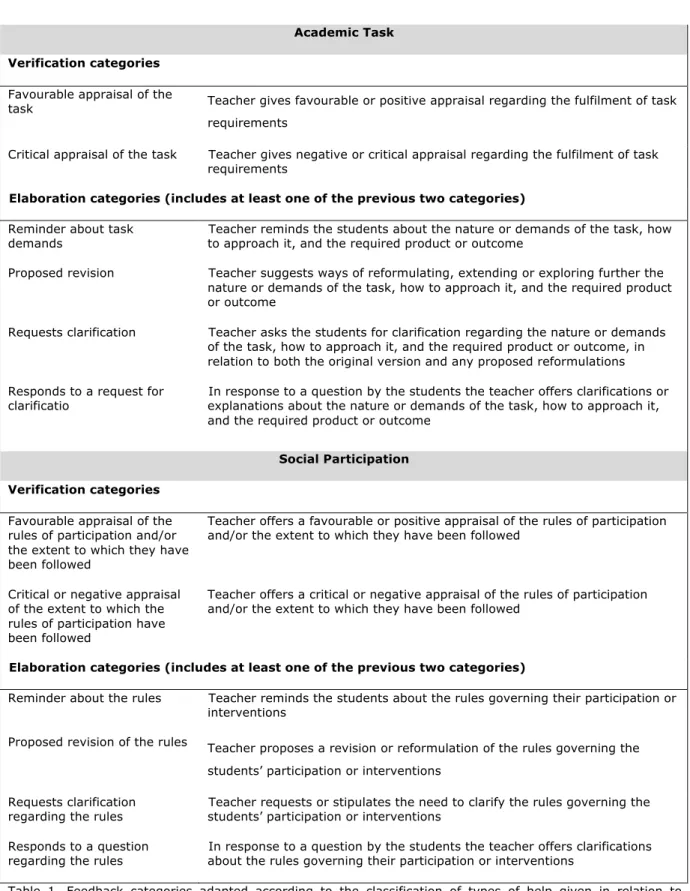
All the contributions made by the teacher and the students were subjected to a content analysis. The first step involved identifying the focus of feedback: learning content, academic task or social participation. Next, all the contributions or fragments of contributions identified as feedback were coded as examples of either verification or elaboration. Table 1 shows the categories used in coding the data according to the three foci or dimensions. These are based on the categories developed in previous studies of educational influence in online learning environments (Coll, Bustos, Engel, de Gispert & Rochera, 2008; Coll, Bustos & Engel, 2011). In the case of verification feedback the fragments involve an appraisal of the students’ previous work or identify errors in it, whereas in elaboration feedback these fragments are accompanied by others that include suggestions about how students might improve their learning of content, their task performance or their participation.
Learning Content Verification categories
Favourable appraisal of meanings
Expression of agreement and acceptance in relation to content presented previously by students
Critical appraisal of meanings Expression of disagreement or discrepancy in relation to content presented previously by students
Identification of errors of
meanings presented previously by students Identification of a lack of, or gaps in, understanding in relation to the content Elaboration categories (includes at least one of the previous two categories)
Provides own meanings Teacher offers extension, more detailed exploration, arguments,
explanations, personal opinions, comments Provides meanings through
external sources
Teacher offers extension, more detailed exploration, arguments, explanations, etc. through reference to external sources
Requirement Students are asked to offer new meanings
Requests clarification Students are asked to clarify previously presented meanings
Responds to a question about task requirements
Teacher offers clarifications or explanations about content in response to a question by the students
Responds to a request for
Academic Task Verification categories
Favourable appraisal of the
task Teacher gives favourable or positive appraisal regarding the fulfilment of task
requirements
Critical appraisal of the task Teacher gives negative or critical appraisal regarding the fulfilment of task requirements
Elaboration categories (includes at least one of the previous two categories) Reminder about task
demands to approach it, and the required product or outcome Teacher reminds the students about the nature or demands of the task, how
Proposed revision Teacher suggests ways of reformulating, extending or exploring further the
nature or demands of the task, how to approach it, and the required product or outcome
Requests clarification Teacher asks the students for clarification regarding the nature or demands
of the task, how to approach it, and the required product or outcome, in relation to both the original version and any proposed reformulations Responds to a request for
clarificatio explanations about the nature or demands of the task, how to approach it, In response to a question by the students the teacher offers clarifications or and the required product or outcome
Social Participation Verification categories
Favourable appraisal of the rules of participation and/or the extent to which they have been followed
Teacher offers a favourable or positive appraisal of the rules of participation and/or the extent to which they have been followed
Critical or negative appraisal of the extent to which the rules of participation have been followed
Teacher offers a critical or negative appraisal of the rules of participation and/or the extent to which they have been followed
Elaboration categories (includes at least one of the previous two categories)
Reminder about the rules Teacher reminds the students about the rules governing their participation or
interventions
Proposed revision of the rules Teacher proposes a revision or reformulation of the rules governing the students’ participation or interventions
Requests clarification
regarding the rules students’ participation or interventions Teacher requests or stipulates the need to clarify the rules governing the Responds to a question
regarding the rules about the rules governing their participation or interventions In response to a question by the students the teacher offers clarifications Table 1. Feedback categories adapted according to the classification of types of help given in relation to learning content, the task and social participation (Coll et. al., 2008; Coll, et al., 2011), and organized by type of feedback (Kulhavy & Stock, 1989).
The final step involved analysing how the characteristics (type and focus) and distribution of feedback changed during the course of the four forums (1, 2, 3 or 4). In order to meet the criteria of reliability and consistency required by the content analysis we examined the degree of agreement between two independent raters. The reliability calculation performed for all the identified fragments and their coding according to the three dimensions (content, task and participation) yielded in all cases a kappa index above 0.9.
V. Results
In this section we present the results obtained for groups 1 and 2 as regards the characteristics of the feedback given (type and focus) and its distribution among the teacher and students.
a. Distribution and characteristics of feedback in Group 1
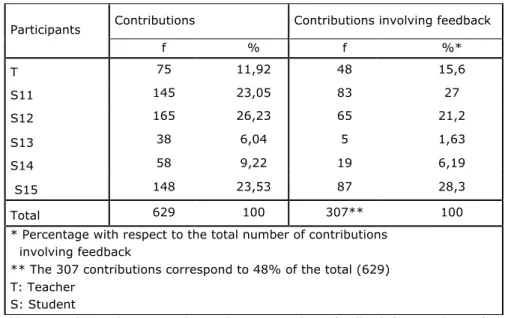
As can be seen in Table 2, the participants in Group 1 gave feedback in almost half of the contributions they made during the teaching sequence (48,8%). However, not all the participants contributed in the same way. Specifically, the greatest amount of feedback was offered by students S15 (28,3%), S11 (27%) and S12 21,2%), with the teacher (15,6%) giving somewhat less feedback and the remaining two students offering hardly any (S14: 6,19%; S13: 1,63%).
Participants Contributions Contributions involving feedback
f % f %* T 75 11,92 48 15,6 S11 145 23,05 83 27 S12 165 26,23 65 21,2 S13 38 6,04 5 1,63 S14 58 9,22 19 6,19 S15 148 23,53 87 28,3 Total 629 100 307** 100
* Percentage with respect to the total number of contributions involving feedback
** The 307 contributions correspond to 48% of the total (629) T: Teacher
S: Student
Table 2: Total contributions and contributions involving feedback for members of Group 1.
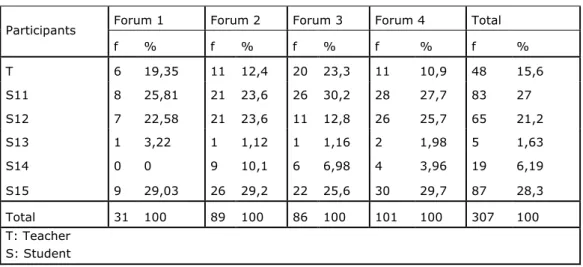
Similar results were obtained when examining the distribution of feedback given by members of Group 1 across the four forums (see Table 3). In Forum 1, S15 (29,03%), S11 (25,81%) and S12 (22,58%), in that order, were once again the participants who made the greatest number of contributions involving feedback, followed by the teacher (19,35%) and, some way behind, by S13 (3,22%). The other student (S14) gave no feedback. In Forum 2, S15 (29,2%), S12 and S11 (23,6%) again made the highest number of contributions involving feedback, followed by the teacher (12,4%) and student S14 (10,1%), who offered feedback for the first time. The other student (S13: 1,1%) gave almost no feedback in this forum. The results for Forum 3 contrast with those for the previous two forums in that here it was S11 (30,2%), who gave most feedback, followed by S15 (25,6%), the teacher (23,3%) and, some way behind, by S12 (12,8%), S14 (6,98%) and S13 (1,16%). Finally, in Forum 4 the highest number of contributions involving feedback corresponded to S15 (29,7%), S11 (27,7%) and S12 (25,7%), in that order, followed by the teacher (10,9%), who gave rather more feedback than did both S14 (3,96%) and, above all, S13 (1,98%).
In summary, the data show that all the participants gave feedback at some point and to some degree during the four forums that made up the teaching sequence. However, there were three students (S11, S12 and S15) who were most constant in offering help of this kind, while the teacher, albeit to a lesser extent, also gave feedback in each of the forums. Finally, student S14 gave somewhat less feedback and only in three forums, while student S13 did offer feedback in all the forums but only minimally.
Participants Forum 1 Forum 2 Forum 3 Forum 4 Total
f % f % f % f % f % T 6 19,35 11 12,4 20 23,3 11 10,9 48 15,6 S11 8 25,81 21 23,6 26 30,2 28 27,7 83 27 S12 7 22,58 21 23,6 11 12,8 26 25,7 65 21,2 S13 1 3,22 1 1,12 1 1,16 2 1,98 5 1,63 S14 0 0 9 10,1 6 6,98 4 3,96 19 6,19 S15 9 29,03 26 29,2 22 25,6 30 29,7 87 28,3 Total 31 100 89 100 86 100 101 100 307 100 T: Teacher S: Student
Table 3: Distribution of contributions involving feedback for members of Group 1 across the four forums.
Let us now examine the characteristics (focus and type) of the feedback given by the teacher and students during their online interaction. One of the most important findings in this regard is that the feedback offered by all the participants concerned not only the learning content but also the task and social participation. Table 4 shows that across the teaching sequence as a whole, most of the feedback referred to participation (43,2%), followed by that concerning the task (30,7%) and, finally, the learning content (26,1%). We believe that this finding can be explained by the fact that online environments, more than other learning contexts, require those involved to establish ways of interacting with one another and to be clear about the task and its demands.
Interesting data also emerge when analysing the contributions of participants in terms of the type of feedback offered. It can be seen in Table 4 that their feedback includes examples of both verification and elaboration with respect to the learning content, the academic task and social participation. Across the teaching sequence as a whole, verification feedback was the most common (66,4% vs. 33,6% for elaboration). However, if we examine the type of feedback given according to its focus, then the same pattern of results is obtained when the focus was participation (32,8% verification vs. 10,4% elaboration) or the task (21,9% verification vs. 8,8% elaboration), but not when the feedback referred to the learning content, since elaboration feedback (14,4%) was more common here.
As regards the distribution of feedback among participants across the four forums the data show that the students who gave the most verification feedback in relation to the three dimensions were S11 (participation: 10,7%; task: 6,1%; learning content: 1,9%), S15 (participation: 7,2%; task: 6,1%; content 3,7%) and S12 (participation: 7,2%; task: 3,7%; content: 2,9%). The teacher also gave this kind of feedback in all three dimensions (participation: 4%; task: 3,7%; content: 2,7%)., although to a somewhat lesser extent. Next came student S14 (participation: 3,2%; task: 1,6%; content: 0,5%), whose contributions of this kind were even less frequent, although they did
correspond to all three dimensions. Finally, S13 gave minimal feedback (participation: 0,5%; task: 0,5%; content: 0%), and only in relation to participation and the task. It can be seen that for the teaching sequence as a whole the verification feedback given by all the participants most frequently referred to participation, followed by that concerning the task and, finally, the learning content.
In terms of the distribution of elaboration feedback among participants across the four forums, this kind of contribution was made most often by S15 (11,7%) and in relation to all three dimensions (participation (2,9%), the tasks (3,2%) and the learning content (5,6%). The teacher also gave this kind of feedback (8%) in all three dimensions (participation: 2,7%; task: 2,4%; content 2,9%), although to a somewhat lesser extent. Next comes student S11 (7,2%), who also offered elaboration feedback in relation to the three dimensions (participation: 2,9%; task: 1,1%; content: 3,2%), followed by S12 (5,3%), who did likewise (participation 1,3%; task: 1,9%; content: 2,%). Finally, the two remaining students (S14: 1,1% and S13: 0,3%) made very few contributions of this kind. In our view, the most important finding here is that although elaboration feedback is given less often than verification, its focus is more likely to be the learning content than the task or participation. Furthermore, it is a student (S15), followed by the teacher, who makes the most contributions of this kind, and both give more elaboration feedback about the learning content than do the other three participants.
Participants Type of of feedback Participation Task Content Total
S11 F Fv 40 23 7 70 % Fv 10,7 6,1 1,9 18,7 F Fe 11 4 12 27 % Fe 2,9 1,1 3,2 7,2 S12 F Fv 27 14 11 52 % Fv 7,2 3,7 2,9 13,9 F Fe 5 7 8 20 % Fe 1,3 1,9 2,1 5,3 S13 F Fv 2 2 0 4 % Fv 0,5 0,5 0,0 1,1 F Fe 0 0 1 1 % Fe 0,0 0,0 0,3 0,3 S14 F Fv 12 6 2 20 % Fv 3,2 1,6 0,5 5,3 F Fe 2 1 1 4 % Fe 0,5 0,3 0,3 1,1
S15 F Fv 27 23 14 64 % Fv 7,2 6,1 3,7 17,1 F Fe 11 12 21 44 % Fe 2,9 3,2 5,6 11,7 T F Fv 15 14 10 39 % Fv 4,0 3,7 2,7 10,4 F Fe 10 9 11 30 % Fe 2,7 2,4 2,9 8,0 Total verification F Fv 123 82 44 249 % Fv 32,8 21,9 11,7 66,4 Total elaboration F Fe 39 33 54 126 % Fe 10,4 8,8 14,4 33,6 Total feedback F 162 115 98 375 % 43,2 30,7 26,1 100,0
Fv: Feedback of verification Fe: Feedback of elaboration T: Teacher
S: Student
Table 4. Frequencies and percentages for the type and focus of feedback given by members of Group 1
Let us now examine how the type and focus of feedback given by the teacher and students changed during the course of the teaching sequence. It can be seen in Table 5 that it was student S15 who offered, from the outset and continuously, the greatest amount of verification and elaboration feedback in relation to all three dimensions (participation, the task and the learning content) in all four forums. Indeed, across successive forums this student generally offered increasing amounts of both types of feedback: specifically, S15 made 8 contributions involving verification in Forum 1, rising to 22 in Forum 4, with the corresponding figures for elaboration feedback being 4 and 18, respectively. Next comes student S11, who by and large also gave continuous and increasing amounts of both verification and elaboration feedback in relation to the three dimensions: S11 made 6 contributions involving verification in Forum 1 and 30 in Forum 4, with the corresponding figures for elaboration being 2 and 9, respectively. A similar pattern is shown by student S12, who made 6 contributions involving verification feedback in Forum 1 and 17 in Forum 4, with the corresponding figures for elaboration being 1 and 10, respectively 4. Next, in fourth place, comes the teacher, who shows the same pattern but with lower frequencies. In her case there were 4 contributions involving verification feedback in Forum 1, rising to 9 in Forum 4, with the corresponding figures for elaboration being 4 and 8, respectively. Finally, participants S14 and, especially, S13 gave only sporadic feedback and almost always in the form of verification.
Participants Type of
feedback FORUM 1* P T C Total P FORUM 2** T C Total P FORUM 3*** T C Total P FORUM 4**** T C Total
S11 F Fv 4 2 0 6 6 5 1 12 12 6 4 22 18 10 2 30 % Fv 11,1 5,6 0 16,7 5,4 4,5 0,9 10,8 12,1 6,1 4,0 22,2 14,0 7,8 1,6 23,3 F Fe 2 0 0 2 7 2 3 12 1 0 3 4 1 2 6 9 % Fe 5,6 0 0 5,6 6,3 1,8 2,7 10,8 0,9 0,0 3,0 3,9 0,8 1,6 4,7 7,0 S12 F Fv 3 1 2 6 13 5 2 20 2 2 5 9 9 6 2 17 % Fv 8,3 2,8 5,6 16,7 11,7 4,5 1,8 18,0 1,8 2,0 5,1 8,9 7,0 4,7 1,6 13,2 F Fe 0 0 1 1 1 4 1 6 2 1 0 3 2 2 6 10 % Fe 0 0 2,8 2,8 0,9 3,6 0,9 5,4 2,0 1,0 0,0 3,0 1,6 1,6 4,7 7,8 S13 F Fv 1 0 0 1 0 1 0 1 0 0 0 0 1 1 0 2 % Fv 2,8 0 0 2,8 0 0,9 0 0,9 0 0 0 0 0,8 0,8 0 1,6 F Fe 0 0 0 0 0 0 0 0 0 0 1 1 0 0 0 0 % Fe 0 0 0 0 0 0 0 0 0 0 1,0 1,0 0 0 0 0 S14 F Fv 0 0 0 0 5 3 1 9 4 2 1 7 3 1 0 4 % Fv 0 0 0 0 4,5 2,7 0,9 8,1 4,0 2,0 1,0 7,1 2,3 0,8 0 3,1 F Fe 0 0 0 0 2 1 1 4 0 0 0 0 0 0 0 0 % Fe 0 0 0 0 1,8 0,9 0,9 3,6 0 0 0 0 0 0 0 0 S15 F Fv 2 3 3 8 4 9 4 17 9 4 4 17 12 7 3 22 Fv 5,6 8,3 8,3 22,2 3,6 8,1 3,6 15,3 9,1 4,0 4,0 17,2 9,3 5,4 2,3 17,1 F Fe 2 1 1 4 6 5 2 13 1 1 7 9 2 5 11 18 Fe 5,6 2,8 2,8 11,1 5,4 4,5 1,8 11,7 1,0 1,0 7,1 9,1 1,6 3,9 8,5 14,0 Teacher F Fv 1 1 2 4 4 4 3 11 7 4 4 15 3 5 1 9 Fv 2,8 2,8 5,6 11,1 3,6 3,6 2,7 9,9 7,1 4,0 4,0 15,2 2,3 3,9 0,8 7,0 F Fe 2 2 0 4 3 2 1 6 3 3 6 12 2 2 4 8 Fe 5,6 5,6 0 11,1 2,7 1,8 0,9 5,4 3,0 3,0 6,1 12,1 1,6 1,6 3,1 6,2 Total verification F Fv 11 7 7 25 32 27 11 70 34 18 18 70 46 30 8 84 % Fv 30,6 19,4 19,4 69,4 28,8 24,3 9,9 63,1 34,3 18,2 18,2 70,7 35,7 23,3 6,2 65,1 Total elaboration F Fe 6 3 2 11 19 14 8 41 7 5 17 29 7 11 27 45 % Fe 16,7 8,3 5,6 30,6 17,1 12,6 7,2 36,9 7,1 5,1 17,2 29,3 5,4 8,5 20,9 34,9
* Percentage calculated with respect to the total number of contributions involving feedback in Forum 1 (n=36) ** Percentage calculated with respect to the total number of contributions involving feedback in Forum 2 (n=111) *** Percentage calculated with respect to the total number of contributions involving feedback in Forum 3 (n=99) **** Percentage calculated with respect to the total number of contributions involving feedback in Forum 4 (n=129) Fv: Feedback of verification
Fe: Feedback of elaboration P: participation
T: task C: content
Table 5: Frequencies and percentages for the type and focus of feedback given by members of Group 1 in each of the four fórums
In our view, the key finding here is that from practically the start of the teaching sequence the source of feedback is concentrated in three of the five students (S15, S11 and S12), followed by the teacher. All these participants offer verification feedback more frequently than they do elaboration, although the latter is given constantly. Another notable result is that these three students and the teacher offer feedback throughout the whole of the teaching sequence, and in relation to all three dimensions (participation, the task and the learning content).
b. Distribution and characteristics of feedback in Group 2
As for the previous group we begin by presenting the overall results for the characteristics (focus and type) and distribution of feedback given by the teacher and the students during the course of the teaching sequence.
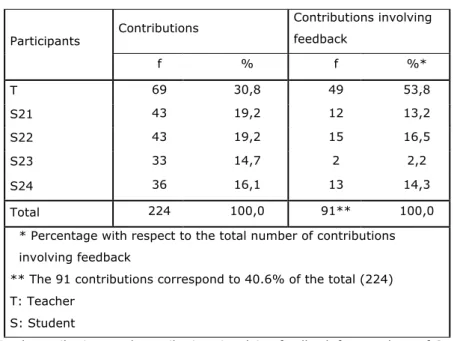
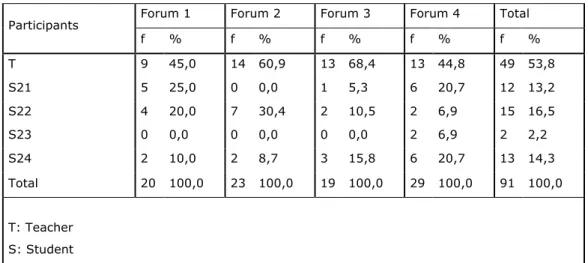
It can be seen in Table 6 that over a third of the contributions made by members of Group 2 involved feedback (40,6%), thereby highlighting the importance of this phenomenon during performance of the task. Across the teaching sequence as a whole, more than half the contributions involving feedback were made by the teacher (53,8%). Three of the students also gave a notable amount of feedback, although to a much lesser extent than did the teacher (S22: 16,5%; S24: 14,3%; S21: 13,2%), while the other student made almost no contributions of this kind (S23: 2,2%). The most striking finding here is that, in contrast to the other teaching sequence, it is the teacher who gives most feedback, even though the majority of the students also make a contribution in this regard.
Participants Contributions Contributions involving feedback f % f %* T 69 30,8 49 53,8 S21 43 19,2 12 13,2 S22 43 19,2 15 16,5 S23 33 14,7 2 2,2 S24 36 16,1 13 14,3 Total 224 100,0 91** 100,0
* Percentage with respect to the total number of contributions involving feedback
** The 91 contributions correspond to 40.6% of the total (224) T: Teacher
S: Student
Table 6: Total contributions and contributions involving feedback for members of Group 2
The distribution of feedback with respect to each of the four forums shows, with some small differences, a similar pattern to the overall results (see Table 7). In Forum 1 the most feedback was given, in descending order, by the teacher (45%), S21 (25%), S22 (20%) and S24 (10%), whereas no contributions of this kind were made by S23. In Forum 2 only three participants made contributions involving feedback: the teacher (60,9%), S22 (30,4%) and, to a much lesser extent, S24 (8,7%); in this forum, S21 and S23 offered no feedback. The teacher (68,4%), was again responsible for most of the feedback given in Forum 3, and she offered considerably more than did the student S24 (15,8%), who was most active in this regard; students S22 and S21 gave minimal feedback, and S23 offered none. Finally, Forum 4 showed a slightly broader distribution of feedback, although the pattern was the same as before: the greatest numbers of contributions
involving feedback were once again made by the teacher (44,8%), S21 and S24 (both 20,7%), with much less feedback being given by S22 and S23 (both 6,9%).
In summary, these data show that although all the participants give feedback to some extent and at some point during the teaching sequence, it is not evenly distributed. The teacher is far and away the most common source of feedback, followed by students S22, S24 and S21, although the latter only offered feedback in some of the forums; the remaining student (S23) only gave feedback in Forum 4, and minimally.
Participants Forum 1 Forum 2 Forum 3 Forum 4 Total
f % f % f % f % f % T 9 45,0 14 60,9 13 68,4 13 44,8 49 53,8 S21 5 25,0 0 0,0 1 5,3 6 20,7 12 13,2 S22 4 20,0 7 30,4 2 10,5 2 6,9 15 16,5 S23 0 0,0 0 0,0 0 0,0 2 6,9 2 2,2 S24 2 10,0 2 8,7 3 15,8 6 20,7 13 14,3 Total 20 100,0 23 100,0 19 100,0 29 100,0 91 100,0 T: Teacher S: Student
Table 7: Distribution of the contributions involving feedback for members of Group 2 across the four forums
As regards the focus of feedback (see Table 8), it was fairly evenly distributed across the teaching sequence between participation (35,5%), the learning (33,3%) content and the task (31,2%). In terms of its type, there were very similar amounts of verification and elaboration (50,4% and 49,6%, respectively). However, its distribution among participants was uneven. The participants who gave the most verification feedback in relation to the three dimensions were, in descending order, the teacher (participation: 8,5%; task: 10,6%; content: 6,4%), S21 (participation: 2,1%; task: 3,5 %; content: 2,8%), S22 (participation: 3,5%; task: 2,1%: content: 2,1%) and S24 (participation: 2,8%; task: 2,8%; content: 1,4%); the other student (S23) gave minimal feedback of this kind. A further point worth noting is that although the teacher was responsible for most of the verification feedback given during the course of the teaching sequence in relation to the three dimensions, she gave even more elaboration feedback. By contrast, the other participants offered more verification than elaboration feedback. Specifically, the results for the distribution of elaboration feedback among the participants show that the teacher made the highest number of contributions of this kind (34,8%), and she did so in relation to all three dimensions (participation, 12,1%; the task, 9,9%; and the learning content 12,8%). This kind of feedback was offered much less frequently across the three dimensions by students S22 (5,7%), S21 and S24 (both 4,3%), while S23 gave almost no feedback of this kind.
Participants Type of feedback Participation Task Content Total S21 F Fv 3 5 4 12 % Fv 2,1 3,5 2,8 8,5 F Fe 1 2 3 6 % Fe 0,7 1,4 2,1 4,3 S22 F Fv 5 3 3 11 % Fv 3,5 2,1 2,1 7,8 F Fe 3 0 5 8 % Fe 2,1 0,0 3,5 5,7 S23 F Fv 1 1 0 2 % Fv 0,7 0,7 0,0 1,4 F Fe 0 0 1 1 % Fe 0,0 0,0 0,7 0,7 S24 F Fv 4 4 2 10 % Fv 2,8 2,8 1,4 7,1 F Fe 4 0 2 6 % Fe 2,8 0,0 1,4 4,3 T F Fv 12 15 9 36 % Fv 8,5 10,6 6,4 25,5 F Fe 17 14 18 49 % Fe 12,1 9,9 12,8 34,8 Total verification F Fv 25 28 18 71 % Fv 17,7 19,9 12,8 50,4 Total elaboration F Fe 25 16 29 70 % Fe 17,7 11,3 20,6 49,6 Total feedback F 50 44 47 141 % 35,5 31,2 33,3 100,0
Fv: Feedback of verificationFe: Feedback of elaboration T: Teacher
S: Student
Table 8. Frequencies and percentages for the type and focus of feedback given by members of Group 2 To conclude this section, let us examine how the type and focus of feedback given by participants changed during the course of the teaching sequence (see Table 9). The most notable finding is that it was the teacher who gave the most verification and elaboration feedback in relation to all three dimensions (participation, the task and the learning content) in all four forums. The data show that the amount of verification feedback she gave increased across the first three forums, before decreasing in the fourth (6, 11, 14 and 5 occurrences, respectively). Although, overall, the focus of verification feedback was equally participation, the task and the learning content, there were differences between the forums. Thus, in Forum 1 the feedback given concerned the task and the learning content, but not participation. This was not the case in Forums 2 and 3, where feedback was offered in relation to all three dimensions and tended to increase in frequency from one to the other. In Forum 4, by contrast, its frequency decreased again and the focus was only on
participation and the task. As regards elaboration, the data show that the teacher offered more feedback of this kind than she did verification, this being the case from the outset and throughout the teaching sequence, with only some small oscillations (Forum 1:11; Forum 2: 7; Forum 3: 12; and Forum 4: 19). Elaboration feedback was focused on all three dimensions, although there was a tendency in Forum 4 for it to refer to the learning content and participation.
Participants Type of Feedback
FORUM 1 * FORUM 2 ** FORUM 3 *** FORUM 4 ****
P T C total P T C total P T C total P T C total
S21 F Fv 2 0 4 6 0 0 0 0 0 1 0 1 1 4 0 5 % Fv 6,5 0,0 12,9 19,4 0,0 0,0 0,0 0,0 0,0 2,9 0,0 2,9 2,1 8,5 0,0 10,6 F Fe 0 1 1 2 0 0 0 0 0 0 0 0 1 1 2 4 % Fe 0,0 3,2 5,0 8,2 0,0 0,0 0,0 0,0 0,0 0,0 0,0 0,0 2,1 2,1 4,3 8,5 S22 F Fv 0 0 0 0 2 1 3 6 2 1 0 3 1 1 0 2 % Fv 0,0 0,0 0,0 0,0 6,9 3,4 10,3 20,7 5,9 2,9 0,0 8,8 2,1 2,1 0,0 4,3 F Fe 1 0 3 4 2 0 1 3 0 0 1 1 0 0 0 0 % Fe 3,2 0,0 9,7 12,9 6,9 0,0 3,4 10,3 0,0 0,0 2,9 2,9 0,0 0,0 0,0 0,0 S23 F Fv 0 0 0 0 0 0 0 0 0 0 0 0 1 1 0 2 % Fv 0,0 0,0 0,0 0,0 0,0 0,0 0,0 0,0 0,0 0,0 0,0 0,0 2,1 2,1 0,0 4,3 F Fe 0 0 0 0 0 0 0 0 0 0 0 0 0 0 1 1 % Fe 0,0 0,0 0,0 0,0 0,0 0,0 0,0 0,0 0,0 0,0 0,0 0,0 0,0 0,0 2,1 2,1 S24 F Fv 1 1 0 2 1 0 1 2 0 1 0 1 2 2 1 5 % Fv 3,2 3,2 0,0 6,5 3,4 0,0 3,4 6,9 0,0 2,9 0,0 2,9 4,3 4,3 2,1 10,6 F Fe 0 0 0 0 0 0 0 0 2 0 0 2 2 0 2 4 % Fe 0,0 0,0 0,0 0,0 0,0 0,0 0,0 0,0 5,9 0,0 0,0 5,9 4,3 0,0 4,3 8,5 Teacher F Fv 0 3 3 6 2 4 5 11 7 6 1 14 3 2 0 5 % Fv 0,0 9,7 9,7 19,4 6,9 13,8 17,2 37,9 20,6 17,6 2,9 41,2 6,4 4,3 0,0 10,6 F Fe 3 4 4 11 2 3 2 7 4 3 5 12 8 4 7 19 Fe 9,7 12,9 12,9 35,5 6,9 10,3 6,9 24,1 11,8 8,8 14,7 35,3 17,0 8,5 14,9 40,4 Total verification F Fv 3 4 7 14 5 5 9 19 9 9 1 19 8 10 1 19 % Fv 9,7 12,9 22,6 45,2 17,2 17,2 31,0 65,5 26,5 26,5 2,9 55,9 17,0 21,3 2,1 40,4 Total elaboration F Fe 4 5 8 17 4 3 3 10 6 3 6 15 11 5 12 28 % Fe 12,9 16,1 25,8 54,8 13,8 10,3 10,3 34,5 17,6 8,8 17,6 44,1 23,4 10,6 25,5 59,6
* Percentage calculated with respect to the total number of contributions involving feedback in Forum 1 (n=31) ** Percentage calculated with respect to the total number of contributions involving feedback in Forum 2 (n=29) *** Percentage calculated with respect to the total number of contributions involving feedback in Forum 3 (n=34) **** Percentage calculated with respect to the total number of contributions involving feedback in Forum 4 (n=47) Fv: Feedback of verification
Fe: Feedback of elaboration P: participation
T: task C: content
Table 9: Frequencies and percentages for the type and focus of feedback given by members of Group 2 in each of the four forums
Taken together, these results on changes over the teaching sequence in the type and focus of feedback are consistent with the overall findings for this group. Thus, it is the teacher who gives most verification and elaboration feedback in relation to the three dimensions, and she does so constantly and continuously across all four forums. In summary, although the feedback given is, to some extent, distributed among the teacher and the students (S22, S21 and S24), there is a clear predominance of teacher feedback in this group.
VI. Discussion and conclusions
The aim of this study was to examine the distribution and characteristics (focus and type) of feedback given during online collaborative learning in small groups in a higher education context. The results show that while feedback is distributed among the teacher and students in both the groups studied, the amount and form of feedback given by participants is not the same in these two groups.
In Group 1 the source of feedback was highly concentrated in the teacher and three of the students (S15, S11 and S12), with the other two students (S14 and S13) making only a minimal contribution of this kind. Furthermore, the distribution of feedback in this group was very similar across the four forums, indicating that the teacher and the former three students gave constant and sustained feedback throughout the teaching sequence. In Group 2, by contrast, while the feedback was distributed to some extent among the teacher and the students (S21, S22 and S24), it was the teacher who made more than half the contributions of this kind. This pattern was more or less maintained across the four forums. Given that the two groups had the same teacher, were following the same teaching sequence and were working on the same task it seems reasonable to assume that these differences are due to the teacher tailoring her feedback according to the perceived needs and competences of the students in each group. Thus, in Group 2, where the students appear to take less responsibility for offering feedback to their peers, the teacher plays a more active role in this regard, whereas the greater initiative shown by the students in Group 1 means that less of the feedback comes from the teacher. The results of previous studies suggest that the effects of different types of feedback (i.e. with different degrees of elaboration) seem to be influenced by the competence of the students who receive it (for example, Gielen, Peeters, Dochy, Onghena & Struyven, 2010; Strijbos et al., 2010; Topping, 2010). It is possible, therefore, that different competences among the students in the two groups may, along with other factors, account for the observed differences in how feedback was distributed.
With respect to the characteristics of feedback, the results show that despite a few minor differences between the two groups, the feedback given in both targeted not only the learning content but also the task and the degree of social participation. This finding is likely related to the fact that online environments, more than other learning contexts, require students to establish ways of interacting with one another and to be clear about the task and its demands, rather than focusing exclusively on the learning content (Häkkinen, 2004). It is worth noting, however, that the analysis of how verification and elaboration feedback were given in relation to the learning content, the task and social participation revealed differences not only between the two groups but also within each group. In Group 1 the feedback given by the teacher and the three most active students (S15, S11 and S12) included examples of both verification and elaboration regarding the three dimensions, with the former kind of feedback being more frequent in all cases. Furthermore, both types of feedback were offered throughout the teaching sequence by these three students and the teacher in relation to participation, the task and the learning content. In Group 2 it was the teacher who gave most verification and elaboration feedback regarding the three dimensions, and she did so in sustained fashion throughout the teaching sequence. The feedback offered by the
most active students in Group 2 (S22, S21 and S24) involved more verification than elaboration, and in most cases it varied in terms of the focus (participation, the task or the learning content) to which it referred.
These results about the characteristics of the feedback given once again suggest that the teacher seeks to adapt her interventions to the needs she identifies among her students. In our view, the fact that there are more examples of verification than elaboration in Group 1 is likely to be because the teacher believes that these students are capable of building their knowledge without detailed guidance regarding the three dimensions (participation, the task and the learning content), and that therefore they will benefit from more verification in order to validate the knowledge they have gained. By contrast, the balance between the two types of feedback (verification and elaboration) given in Group 2 indicates that the teacher deems it necessary to offer more guidance and support to these students, a conclusion that is consistent with the fact that the feedback given in this group was less widely distributed than in Group 1.
These results support the findings of several studies which indicate that feedback should include both verification of the learning achieved and elaboration of the process involved so as to facilitate students’ learning (Álvarez et al., 2011; Kulhavy & Stock 1989; Van der Kleij et al, 2012). However, the present results also draw attention to two key aspects. Firstly, in both the groups studied, feedback was given in relation to all three dimensions: the task, participation and the learning content. Secondly, the feedback given is distributed, to varying degrees, among the participants, such that it is not only the teacher but also the students who contribute to validating and supporting the co-construction of knowledge by offering verification and elaboration feedback with respect to these three dimensions.
In our view, the characteristics of the feedback given by the teacher and the various students highlight the complexity and diversity of help that can be offered to support the co-construction of knowledge in small groups. This is of interest when one considers not only the difficulty of enabling high-quality and meaningful interactions in online environments (Akyol, Garrison & Ozdeyn, 2009; Kanuka & Garrison, 2004; Zhu, 2006), but also the importance of offering different kinds of support and feedback that are adapted to students’ needs (Sorensen & Takle, 2005; Tallent-Runnels et al., 2006). The results suggest that the extent to which feedback is distributed among participants, as well as the variations in its type (verification or elaboration) and focus (task, participation or learning content), depend on the point in the process at which it is offered, and also on the specific circumstances of each group. This idea is supported by previous research, which has pointed out that any attempt to understand the role of feedback in relation to the co-construction of knowledge in small online groups must take into account its timing (Guash et al., 2010; Rochera, de Gispert & Coll, 2012; Van der Kleij et al., 2012).
Finally, it should be noted that whereas research has traditionally examined teacher and student feedback separately, the present results highlight the value of studying the two together so as understand better the ways in which they may complement one another in the process of knowledge building in online learning environments (Dysthe et.al, 2010).
Obviously, when interpreting the results one needs to bear in mind the inherent limitations of the case study approach. Hence, further studies are now needed to determine whether the distributions of feedback observed among these participants, specifically as regards the two types (verification and elaboration) and the three dimensions (participation, task and learning content), also appear in other teaching sequences of different characteristics (i.e. with different teachers, when using other tasks or content, and at other educational levels). Similarly, future research should also examine the potential effect which students’ competence, with respect to the learning
task and content or in the use of ICT, may have on the feedback offered and, therefore, on its distribution among participants.
Despite these limitations we believe that the results provide some interesting pointers with respect to the design of online learning environments for small groups. Specifically, it would appear to be essential to ensure that teachers are able to offer different types of feedback and that these target the three dimensions considered here (participation, the task and the learning content). However, it is also necessary to facilitate student contributions in this regard, allowing them, within their capabilities, to give feedback that addresses the different dimensions and at different points in the collaborative process.
Acknowledgements
The work presented here has been undertaken as part of a research project funded by the Spanish Ministry of Education and Science (EDU2009-08891). More information about this project and about the research group can be found at http://www.psyed.edu.es/grintie
References
Akyol, Z., Garrison, D. R. & Ozden, Y. (2009). Online and blended communities of inquiry: exploring the developmental and perceptional differences. International Review of Research
in Open and Distance Learning, 10(6), 65–83.
Álvarez, I., Espasa, A. & Guasch, T. (2012). The value of feedback in improving collaborative writing assignments in an online learning environment. Studies in Higher Education, 37(3),
387-400.
Anderson, T., Rourke, L., Garrison, R. & Archer, W. (2001). Assessing teaching presence in a computer conferencing context. Journal of Asynchronous Learning Networks, 5(2), 1–18. Coll, C., Bustos, A., Engel, A., de Gispert, I. & Rochera, M.J. (2008). A multi-method approach for
the study of distributed teaching presence in asynchronous learning networks. Symposia Internet-mediated educational practice: Theory, methods, problems, and pedagogies.
ISCAR. San Diego, EEUU. Published in digital form at
http://www.psyed.edu.es/prodGrintie/conf/CC_AB_AE_IG_MR_ISCAR_08.pdf
Coll, C., Bustos, A. & Engel, A. (2011). Perfiles de participación y presencia docente distribuida en redes asíncronas de aprendizaje: la articulación del análisis estructural y de contenido.
Revista de Educación, 354, 657-688.
Coll, C., Engel, A. & Bustos, A. (2009). Distributed teaching presence and participants’ activity profiles: a theoretical approach to the structural analysis of asynchronous learning networks. European Journal of Education, 44 (4), 521–538
Coll, C., Onrubia, J. & Mauri, T. (2008). Ayudar a aprender en contextos educativos: el ejercicio de la influencia educativa y el análisis de la enseñanza. Revista de Educación, 346, 33–70. Dexter, S. (2010). E-feedback intersections and disconnections in the interests of designers and
users. International Journal of Enginnering Education and life-long leraning, 20(2), 169-188.
Dysthe, O., Lillejord, S., Vines, A. & Wasson, B. (2010) Productive E-feedback in higher education. Some critical issues. In S. Ludvigsen, A. Lund, I. Rasmussen & R. Säljö (Eds.). Learning
across sites: New tools, infrastructures and practices. Oxford, UK: Pergamon Press.
Garrison, R., Anderson, T. & Archer, W. (2000). Critical inquiry in a text-based environment: computer conferencing in higher education. Internet and Higher Education, 11(2), 1-14. Gaytan, J. & McEwen, B. C. (2007). Effective online instructional and assessment strategies.
American Journal of Distance Education, 21(3), 117–132.
Gibbs, G. & Simpson, C. (2004). Conditions under which assessment supports students’learning.
Learning and Teaching in Higher Education, 1, 3-31.
Gielen, S., Peeters, E., Dochy, F., Onghena, P., & Struyven, K. (2010). Improving the effectiveness of peer feedback for learning. Learning and Instruction, 20(4), 304–315.
Gikandi, J.W., Morrow , D. & Davis, N.E (2011). Online formative assessment in higher education: A review of the literature. Computers & Education, 57, 2333–2351.
Guardado, M. & Shi, L. (2007). ESL students' experiences of online peer feedback. Computer and
Composition, 24, 444-462.
Guasch, T., Espasa, A. & Álvarez, I. (2010). Formative e-feedback in collaborative writing assignments: the effect of the process and time. eLC Research Paper Series, 1, 49-59. Häkkinen, P. (2004). What Makes Learning and Understanding in Virtual Teams So Difficult?
Cyberpsychology & behaviour, 7 (2), 201-206.
Hämäläinen ,R., Manninen, T., Järvelä, S. & Häkkinen, P. (2006). Learning to collaborate: Designing collaborationin a 3-D game environment. Internet and Higher Education, 9, 47– 61.
Hattie, J. & Timperley, H. (2007). The Power of Feedback. Review of Educational Research, Vol. 77 (1), 81–112
Hatziapostolou, T & Paraskakis, I. (2010). Enhancing the impact of formative feedback on student learning through an online feedback System. Electronic Journal of e-Learning, 8(2), 111-122.
JISC. (2010). Effective Assessment in a Digital Age: A guide to technology-enhanced assessment
and feedback, Bristol, HEFC.
http://www.jisc.ac.uk/media/documents/programmes/elearning/digiassass_eada.pdf
(Retrieved 13 January 2013).
Kanuka, H. & Garrison, R. (2004). Cognitive presence in Online Learning. Journal of Computing in
Higher Education, 15(2), 30-49.
Kulhavy, R.W. & Stock, W.A. (1989). Feedback in written instruction: the place of response certitude. Educational Psychology Review, 1(4), 279-308.
Ludwig-Hardman, S. & Dunclap, J. C. (2003). Learner support services for online students: scaffolding for success. International Review of Research in Open & Distance Learning, 4(1), 1–15.
Narciss, S. (2008). Feedback strategies for interactive learning tasks. In J.M. Spector, M.D. Merrill, J.J.G. van Merrienboer, & M.P. Driscoll (Eds.), Handbook of Research on Educational
Communications and Technology (3rd ed., pp. 125-144). Mahwah, NJ: Lawrence Erlbaum
Associates.
Narciss, S. & Huth, K. (2006). Fostering achievement and motivation with bug-related tutoring feedback in a computer-based training on written subtraction. Learning and Instruction, 16, 310-322.
Nicol, D. & Macfarlane-Dick, D. (2006). Formative assessment and self-regulated learning: A model and seven principles of good feedback practice. Studies in Higher Education, 31(2) 199-218.
Nicol, D. (2009). Assessment for learner self-regulation: Enhancing achievement in the first year using learning technologies. Assessment & Evaluation in Higher Education 34, (3), 335–52. Rochera, M.J., De Gispert, I. & Coll, C. (2012). Feedback in an online collaborative learning
environment: feedback on learning content is not enough. Paper presented at SIG 6/7
EARLI, Bari, Italy, 11-13 September.
Schrire, S. (2006). Knowledge building in asynchronous discussion groups: Going beyond quantitative analysis. Computers & Education, 46, 49–70.
Sorensen, E. K., & Takle, E. S. (2005). Investigating knowledge building dialogues in networked communities of practice. A collaborative learning endeavor across cultures. Interactive Educational Multimedia, 10, 50–60.
Stahl, G., Koschmann, T. & Suthers, D. (2006). Computer-supported collaborative learning. En R.
K. Sawyer (Ed.), Handbook of the learning sciences (pp. 409-426). Cambridge: Cambridge
University Press.
Strijbos, J-W., Narciss S.,& Dünnebier, K. (2010). Peer feedback content and sender's competence level in academic writing revision tasks: Are they critical for feedback perceptions and efficiency? Learning and Instruction, 20, 291-303.
Shute, V.J. (2008). Focus on formative feedback. Review of Educational Research, 78(1), 153-189. Tallent-Runnels, M. K., Thomas, J. A., Lan, W. Y., Cooper, S., Ahern, T. C., Shaw, S. M., et al.
(2006). Teaching courses online: a Review of the research. Review of Educational
Research, 76(1), 93–135.
Topping, K. (2010). Methodological quandaries in studying process and outcomes in peer assessment. Learning and Instruction, 20(4), 339–343.
Topping, K.J., Dehkinet, R. Blanch, S. Corcelles, M. & Duran, D. (2013). Paradoxical effects of feedback in international online reciprocal peer tutoring. Computers & Education 61, 225– 231.
Van der Kleij, F., Eggen, F., Timmers, C., & Veldkamp B. (2012). Effects of feedback in a computer-based assessment for learning. Computers & Education, 58, 263–272.
Wang, T.-H., Wang, K.-H. & Huang, S.-C. (2008). Designing a web-based assessment environment for improving pre-service teacher assessment literacy. Computers & Education, 51(1),
448–462.
Wolsey, T. (2008). Efficacy of instructor feedback on written work in an online program.
International Journal on ELearning, 7(2), 311–329.
Yang, M. & Carless, D. (2012). The feedback triangle and the enhancement of dialogic feedback processes, Teaching in Higher Education, DOI:10.1080/13562517.2012.719154
Yin, R. K. (2003). Case study research: Design and methods (3rd ed.). Thousand Oaks, CA: Sage. Zhu, E. (2006). Interaction and cognitive engagement: An analysis of four asynchronous online
discussions. Instructional Science, 34, 451–480.
Recommended citation
Coll,C., Rochera,M.J., De Gispert, I. & Díaz-Barriga,F. (2013). Distribution of feedback among teacher and students in online collaborative learning in small groups. In: Digital Education Review,
23, 27-46. [Accessed: dd/mm/yyyy] http://greav.ub.edu/der
Copyright
The texts published in Digital Education Review are under a license Attribution-Noncommercial-No
Derivative Works 2,5 Spain, of Creative Commons. All the conditions of use in:
http://creativecommons.org/licenses/by-nc-nd/2.5/es/deed.en_US
In order to mention the works, you must give credit to the authors and to this Journal. Also, Digital Education Review does not accept any responsibility for the points of view and statements made by the authors in their work.
Subscribe & Contact DER