NON-COGNITIVE ATTRIBUTES: CORRELATIONS TO HIGH ABILITY STUDENTS’ACADEMIC ACHIEVEMENT
A DISSERTATION
SUBMITTED TO THE GRADUATE SCHOOL IN PARTIAL FULFILLMENT OF THE REQUIREMENTS
FOR THE DEGREE DOCTOR OF EDUCATION
BY
ALICIA J. CLEVENGER
DISSERTATION ADVISOR: DR. MARILYNN QUICK
BALL STATE UNIVERSITY MUNCIE, INDIANA
NON-COGNITIVE ATTRIBUTES: CORRELATIONS TO HIGH ABILITY STUDENTS’ACADEMIC ACHIEVEMENT
A DISSERTATION
SUBMITTED TO THE GRADUATE SCHOOL IN PARTIAL FULFILLMENT OF THE REQUIREMENTS
FOR THE DEGREE
DOCTOR OF EDUCATION IN EDUCATIONAL ADMINISTRATION AND SUPERVISION BY
ALICIA JEAN CLEVENGER
DISSERTATION ADVISOR: DR. MARILYNN QUICK APPROVED BY:
____________________________________ _________________
Committee Chairperson Date
____________________________________ _________________
Committee Member Date
____________________________________ _________________
Committee Member Date
____________________________________ _________________
Committee Member Date
____________________________________ _________________
Dean of Graduate School Date
BALL STATE UNIVERSITY MUNCIE, INDIANA
DEDICATION
To my friends and co-workers. Without your support and inspiration, I would not have been able to complete this project. Thank you for listening, letting me cry, and laughing with me. You truly do inspire me to be the best administrator I can be. Thank you for your friendship.
Mom and Dad. Thank you for always asking me how my school work was coming. Not even knowing it, you kept me going. You both have instilled in me the work ethic that you have. Without that work ethic, this process would have been impossible. I love you both very much!
Finally, my husband and my best friend, Jeff. I could not have done this without you. Your love and support throughout this process has meant the world to me. Thank you for your patience and sacrifices during these last three years of this project. I think I may owe you and dinner or two! I love you to the moon and back.
ACKNOWLEDGEMENTS
Dr. Nick Elam, Dr. Fen Walter English, and Dr. Kristi Speirs-Neumeister, thank you for serving on my committee. I realize this involves a great deal of time and effort from you. I truly appreciate your guidance and feedback you have given me. Without your expertise, I would not have been able to finish this journey.
Dr. Kendra Lowery, thank you for your support during this journey. I appreciate your insight, feedback, and all of the suggestions to make this a better research study. I am able to think more critically because you challenged me. I am forever grateful.
Dr. Kianre Eouanzoui, thank you for your statistical expertise and running so many different tests for this study. I appreciate your patience with me and all of your explanations.
Dr. Marilynn Quick, words cannot express how much I appreciate you. You work incredibly hard for all of your students and I appreciate the time and dedication you have given me during this process. If anyone has taught me about growth mindset and grit, it has been you. Your feedback, guidance, and words of encouragement have truly inspired me to finish this journey even though there were bumps in the road along the way. Thank you for being my chairperson, my mentor, and my friend. I am truly honored to have gone through this journey with you.
TABLE OF CONTENTS
LIST OF TABLES ... 8
LIST OF FIGURES ... 10
CHAPTER ONE ... 11
Statement of the Problem ... 14
Conceptual Framework ... 15
Purpose of the Study ... 15
Research Questions ... 16
Significance of the Study ... 16
Definition of Terms ... 19
Assumptions and Delimitations ... 21
Summary and Organization of the Study ... 22
CHAPTER TWO ... 23
Conceptual Framework ... 24
Social-Emotional Characteristics of High Ability Students ... 27
Underachievement of High Ability Students ... 29
Non-cognitive Attributes and Relationships to Academic Achievement... 33
Self-efficacy ... 36
Intrinsic Motivation ... 38
Grit ... 41
Growth Mindset ... 45
Quality Teacher Feedback ... 53
Student Self-regulation ... 58
Goal Orientation ... 60
Summary ... 64
CHAPTER THREE ... 66
Purpose of the Study ... 67
Research Questions ... 67
Research Design ... 68
Population and Sample ... 70
Sampling Procedures ... 70
Instrumentation... 71
Data Collection Procedures ... 75
Data Analysis ... 75
Limitations/Delimitations... 77
Summary ... 78
CHAPTER FOUR ... 80
Purpose of the Study ... 80
Research Questions ... 80
Results of Teacher Pilot Survey ... 81
Descriptive Statistics ... 82
Description of the Participants ... 83
Inferential Statistics ... 111
CHAPTER FIVE ... 122
Overview of the Problem ... 122
Purpose of the Study ... 123
Research Questions ... 123
Review of Methodology ... 124
Major Findings ... 125
Findings Related to the Literature ... 127
Practical Implications ... 137
Recommendations for Further Research ... 139
Concluding Remarks ... 141 References ... 143 Appendix A ... 150 Appendix B ... 151 Appendix C ... 152 Appendix D ... 154 Appendix E ... 155 Appendix F... 157 Appendix G ... 158 Appendix H ... 162 Appendix I ... 165
LIST OF TABLES
Table 1. Teacher Pilot Survey Reliability Statistics ... 82
Table 2. Teacher Experience Frequencies ... 84
Table 3. Whole Sample Students’ Growth Mindset Response Frequencies ... 85
Table 4. Whole Sample Students’ Growth Mindset Response Frequencies ... 86
Table 5. Fourth Grade Students’ Growth Mindset Response Frequencies. ... 87
Table 6. Fourth Grade Students’ Grit Response Frequencies ... 88
Table 7. Fifth Grade Students’ Growth Mindset Response Frequencies ... 89
Table 8. Fifth Grade Students’ Grit Response Frequencies ... 91
Table 9. Sixth Grade Students’ Growth Mindset Response Frequencies ... 92
Table 10. Sixth Grade Students’ Grit Response Frequencies ... 93
Table 11. Seventh Grade Students’ Growth Mindset Response Frequencies ... 94
Table 12. Seventh Grade Students’ Grit Response Frequencies ... 95
Table 13. Eighth Grade Students’ Growth Mindset Response Frequencies ... 97
Table 14. Eighth Grade Students’ Grit Response Frequencies ... 98
Table 15. Male Students’ Growth Mindset Response Frequencies ... 99
Table 16. Male Students’ Grit Response Frequencies ... 100
Table 17. Female Students’ Growth Mindset Response Frequencies... 101
Table 18. Female Students’ Grit Response Frequencies ... 102
Table 19. Rural School Setting Growth Mindset Response Frequencies ... 103
Table 20. Rural School Setting Grit Response Frequencies ... 104
Table 21. Suburban School Setting Growth Mindset Response Frequencies ... 106
Table 23. Urban School Setting Growth Mindset Response Frequencies ... 109 Table 24. Urban School Setting Grit Response Frequencies ... 110
LIST OF FIGURES
CHAPTER ONE INTRODUCTION
High ability education differs across the United States. The National Association for Gifted Children (n.d.) describes a child as “gifted when their ability is significantly above the norm for their age” (para. 1). Locally, the Indiana Department of Education utilizes Indiana Code 20-36-1 (Rund, 2017) to describe a high ability student as one who performs “at an outstanding level of accomplishment” (para. 3). In today’s education, high ability students are expected to academically achieve and reach their full potential. Some of those who teach high ability students are finding it more difficult to demonstrate their students’ academic achievement (Rubenstein, Siegle, Reis, McCoach, & Burton, 2012). Additionally, teachers of high ability students need to address the affective constructs of their students that impact academic achievement (National Association for Gifted Children, 2010). Self-efficacy, intrinsic motivation, grit, and growth mindset are non-cognitive attributes that may play a role in how high ability students academically achieve.
The topic of addressing non-cognitive attributes of self-efficacy, intrinsic motivation, grit, and growth mindset seems to be a trend in education today. Moreover, teachers are contending with how to instill these non-cognitive attributes in their students to promote
increased learning and academic achievement. Self-efficacy, the belief in one’s ability to begin and continue a task needed to achieve an expected result (Bandura, 1977), has been found to positively influence academic achievement and it can also influence underachievement (Phan, 2012; Usher, 2009). However, self-efficacy has been found to influence the effort students make and their perseverance when they encounter academic challenges (Pajares, 1996). A better
understanding of how self-efficacy affects students’ learning patterns is essential for educators to effectively implement instructional practices that promote academic achievement in high ability students. Intrinsic motivation is more directly correlated with classroom engagement and other non-cognitive attributes as opposed to having a direct relationship with academic achievement (Clinkenbeard, 1996; Froiland & Worrell, 2016; Mega, Ronconi, & De Beni, 2013). Grit has been connected to other non-cognitive attributes, such as self-efficacy (Dixson, Worrell,
Olszewski-Kubilius, & Subotnik, 2016) and growth mindset (Perkins-Gough, 2013; Dockterman & Blackwell, 2014). How grit correlates to these non-cognitive attributes may play an important role in high ability students’ academics. Growth mindset has been positively correlated with academic achievement. Research has indicated that high ability students see their ability
separately from their intelligence (Makel, Snyder, Thomas, Malone, & Putallaz, 2015). If this is the case, then growth mindset may play a vital role in high ability students’ approach to handling challenging academic tasks, effort, and thus, affect academic achievement. Grit, on the other hand, has not been directly correlated to academic achievement. These affirmations provide a foundation for obtaining further knowledge of what educators can do to cultivate classroom engagement and to nurture other non-cognitive attributes in high ability students so they can build or sustain intrinsic motivation. Not only is the topic of these non-cognitive attributes trending, but the need to address them is as well.
More and more teachers are finding that high ability students are lacking self-efficacy, intrinsic motivation, grit, and growth mindset. Because of this, high ability students may not be willing to take academic risks in order to learn more. Their response is to avoid challenging tasks so they do not experience failure (Dweck, 2012). Dockertman and Blackwell (2014) stated that students must have the ability to self-regulate and persevere in the face of challenge because
it is a vital factor in student academic achievement and life success. However, teachers that foster grit (passion and perseverance) may not be successful if students do not have the growth mindset or strategies they need to motivate and support their academic growth.
High ability students have the potential to make contributions to society by solving problems and making improvements in their chosen careers. It is unfortunate, however, when some high ability students do not reach their potential, which not only has ramifications for them, but also for our society. Ritchotte, Matthews, and Flowers (2014) acknowledged this when they stated “gifted underachievement represents a frustrating loss of potential for society” (p. 183). Underachievement and non-cognitive attributes have been identified as obstacles that contribute to academic disengagement and prevent high ability students from reaching their full academic potential (Esparza, Shumow, & Schmidt, 2014). When discussing general education students, Siegle and McCoach (2005) affirmed that students with growth mindset are less likely to manifest academic underachievement than those students who have a fixed mindset. Dweck’s studies (2007, 2010, 2012) have shown that teaching general education students about growth mindset can have positive effects on academic achievement. How do growth mindset and other non-cognitive attributes relate to identified high ability students? Landis and Reschly (2013) indicated that academic engagement is an intricate construct that encompasses characteristics of emotion, behavior, and cognition. Non-cognitive attributes may be the keys to unlock the doors of opportunity for high ability students to deeply engage in academics, grapple with academic challenges, and consequently, reach higher levels of academic achievement and contribute to society.
Statement of the Problem
The underachievement of identified high ability students is an increasingly perplexing circumstance. Van Tassel-Baska (2000) reported that 63% of high ability students are
underachieving. Additionally, Landis and Reschly (2013) conveyed the startling occurrence of underachieving high ability students’ disengagement in school and consequential dropout rates. Most recently, the Indiana Department of Education (IDOE) reported that identified high ability students in grades 3 through 8 earning Pass+ on the 2017 Indiana Statewide Testing for
Educational Progress-Plus (ISTEP+) examination was an average of 65.2% in English Language Arts and an average of 58.5% in math.
Researchers from NWEA completed a concordance study (2017) to connect the scales of ISTEP+ with those of the MAP Reading and Map Math assessments. In that 2017 report, readers are able to see the consistency of predictability of receiving Pass+ on ISTEP+. For reading, students with a MAP score in the range of 86th to 99th percentile are predicted to earn Pass+ on ISTEP+. The range for math is slightly larger; students scoring from 81st to 99th percentile are predicted to earn Pass+. Typically, Indiana school districts will use a NWEA benchmark average of the 90th percentile when identifying students for high ability
programming. It seems, then, that more identified high ability students should be scoring Pass+ on the state assessment. Additionally, the IDOE (2017) recommends that 90% of a school district’s high ability students earn Pass+ on ISTEP+ as indicated on a school district’s high ability report card. Why are high ability students not achieving to their potential? While high ability students vary in cognitive ability, they can also vary in the non-cognitive attributes they possess, which include self-efficacy, intrinsic motivation, grit, and growth mindset
Peterson, Matthews, & Kelly, 2007; Dweck, 2006, 2007, 2010; Pajares, 1996, 1997). If
educators promote these non-cognitive attributes while they teach high ability students, will that facilitate more learning and academic growth?
Conceptual Framework
The conceptual framework for this study integrates two theoretical frameworks based on studies conducted by researchers including Angela Duckworth (grit) and Carol Dweck (growth mindset). Grit and growth mindset have shown correlations to academic achievement
(Duckworth, 2016; Duckworth & Gross, 2014; Duckworth et al., 2007; Dweck, 2006, 2007, 2010). Furthermore, the interplay of these non-cognitive attributes has effects on academic achievement. How non-cognitive attributes may influence high ability student academic achievement can be complex; however, common themes and key concepts connect the two non-cognitive attributes in this conceptual framework. More development of the conceptual
framework can be found in Chapter Two.
Purpose of the Study
The purpose of this study was to determine what non-cognitive attributes correlate with academic achievement of identified high ability students in fourth through eighth grades while controlling for the intervening variables of teacher feedback, student self-regulation, and goal orientation. The independent variables were the non-cognitive attributes of grit and growth mindset. The dependent variables were the measurements from student and teacher responses obtained from a five-point Likert scale survey and the students’ Northwest Evaluation
Research Questions
Given the purpose of this study was to quantify which non-cognitive attributes correlate with high ability students’ academic achievement, the research had a central question with sub-questions that guided my investigation of data collection. The central, or overarching question, guiding this study was:
1. What amount of variance do growth mindset and grit have on high ability students’ academic achievement as measured by NWEA scores?
The following sub-questions guided research and data analysis for this study:
2. What amount of variance do growth mindset and grit have on high ability students’ academic achievement while controlling for teacher process feedback? 3. What amount of variance do growth mindset and grit have on high ability students’ academic achievement while controlling for time spent teaching student self-regulation?
4. What amount of variance do growth mindset and grit have on high ability students’ academic achievement while controlling for time spent with students on their
individual goal setting?
Significance of the Study
The significance of this research can be classified into two categories: scholarly research and instructional practice in the area of high ability education. The significance includes: (1) a contribution to needed research specifically regarding non-cognitive attributes of high ability students; (2) potential data for reducing underachievement in high ability students, which is of concern to high ability educators; and (3) implications for instructional practice that promote
non-cognitive attributes. Examining the non-cognitive attributes of high ability students will be beneficial in a number of ways.
With respect to the scholarly research, this quantitative study will provide information about high ability students’ academic achievement in relationship to their non-cognitive attributes. Even though significant research is available on general education students’ non-cognitive attributes and academic achievement (Blackwell, Trzesniewski, & Dweck, 2007; Cassidy, 2015; Claro, Paunesku, & Dweck, 2016; Dev, 1997; Dockterman & Blackwell, 2014; Duckworth et al., 2007; Dweck, 2012; Froiland & Worrell, 2016; Golden, 2015; Gottfried, 2008; McGeown, Putwain, St. Clair-Thompson, & Clough, 2016; Pajares, 2003; Phan, 2012; Rattan, Savani, Chugh, & Dweck, 2015; Ricci, 2013; Rimfeld, Kovas, Dale, & Plomin, 2016; Usher, 2009), many scholars believe more research is needed with particular regard to high ability students (McCoach & Siegle, 2003; Reis & McCoach, 2000; Rubenstein et al., 2012). Scholars cited research on high ability students’ non-cognitive attributes of self-efficacy (Pajares, 1996; Wang & Neihart, 2015), intrinsic motivation (Clinkenbeard, 1996; Gottfried, 2008; Gottfried & Gottfried, 1996), grit (Duckworth, et al., 2007), and growth mindset (Dweck, 2010, 2012; Esparza et al., 2014; Snyder, Barger, Wormington, Schwartz-Bloom, & Linnenbrink-Garcia, 2013), but have suggested additional research be conducted to discover the unknowns between research and instructional practice.
With regard to instructional practice, this study will contribute to the existing body of knowledge in education by examining how non-cognitive attributes correlate with high ability students’ academic achievement and how teacher feedback, student self-regulation, and goal orientation may influence those non-cognitive attributes. Quantitative data will demonstrate if non-cognitive attributes explain a significant amount of variance of high ability students’
academic achievement as measured by NWEA data. This study will serve as a prognostication for educators of high ability students to formulate grit and growth mindset, acknowledge the roles each plays in academic achievement, and implement best instructional practices that foster the non-cognitive attributes shown to correlate with academic achievement.
High self-efficacy is likely to promote better academic performance via students’ non-cognitive attributes. Further research will help educators have a better understanding of how self-efficacy correlates with academic achievement. Intrinsic motivation is more directly correlated with non-cognitive attributes such as students’ implicit beliefs, self-efficacy, and learning goals that play an essential part in intrinsic motivation and promote and sustain academic achievement (Mega et al., 2013). Although grit has been connected to other non-cognitive attributes, grit studies have included limited populations as Duckworth has examined the effects of grit on spelling bee participants and West Point cadets (Duckworth et al., 2007). Additional research is needed to identify if grit correlates with academic achievement in high ability students and to help our practice in supporting the development of grit in high ability students. Carol Dweck (2007, 2010, 2012) has led the way on the current interest surrounding the non-cognitive attribute of growth mindset. As educators are concerned about high ability students not meeting their academic potential, Dweck’s work regarding implicit beliefs about intelligence has relevance in terms of how to motivate high ability students to achieve their academic potential. Snyder et al. (2013) reported high ability students have a tendency to
believe their intelligence is malleable, suggesting the high ability label is not as maladaptive for a fixed mindset as has been proposed by theoretical perspectives. If teachers understand that high ability students have a tendency toward a growth mindset, this study can improve practice because it will provide data specific to high ability students that can be used to determine best
instructional practices to promote growth mindset in high ability students. These affirmations provide the groundwork for obtaining further knowledge from this study so educators will be able to apply interventions aimed at enabling high ability students to handle the demands of academic performance and achievement.
Definition of Terms
The terms below can be found frequently in this study and in the review of literature. Academic achievement: Academic achievement is success as measured by a student’s NWEA RIT score.
Full potential: In this study, full potential is the high ability student’s demonstration of growth and continuous academic progress, extending beyond current levels of proficiency or achievement (Gallagher & Gallagher, n.d.).
Goal orientation: Goal orientation represents the foundation of goal setting. Two goals that have extensive research with regard to their effects on academic achievement are
performance goals and learning goals. Performance goals, often called ability goals or ego-involved goals, validate a student’s ability or avoid demonstrating a lack of ability. Learning goals, also called mastery goals, on the other hand, are those where a student seeks to obtain new knowledge (Grant & Dweck, 2003; King, McInerney, & Nasser, 2017).
Grit: Angela Duckworth (2016) defined grit as the passion and perseverance for long-term goals. For the purpose of this study, that definition will be utilized; however, grit will also be considered as working persistently toward challenges, continuing effort despite failure and adversity in academic progress.
Growth mindset: Growth mindset is the belief that intelligence is malleable, that is, it can be developed over time (Dweck, 2012).
High ability student: The term high ability will refer to the Indiana Code 20-36-1 (Rund, 2017) definition pertaining to student performance or potential at an outstanding level of
accomplishment in at least one domain when compared to others of the same age, experience, or environment and is characterized by exceptional gifts, talents, motivation, or interests. In practice, this can be a student who performs at or above the 96th percentile (using local or national norms, whichever are more inclusive) in language arts, math, or general intellectual designation.
Intrinsic motivation: Intrinsic motivation is described as the enjoyment of the learning process without receiving external or extrinsic rewards or consequences. For example, students who participate in an activity purely for the sake of gaining more knowledge are intrinsically motivated (Dev, 1997; Gottfried, 2008).
Non-cognitive attributes: Non-cognitive attributes are sets of behaviors, skills, attitudes, and strategies that impact students’ academic performance (Nagaoka, Farrington, Roderick, Allensworth, Keyes, Johnson, & Beechum, 2013).
NWEA RIT Score: A RIT score isa student’s overall scale score on the test for a given subject.
Self-efficacy: Self-efficacy refers to a student’s belief in his or her capability to successfully perform academic tasks (Pajares, 1996).
Social emotional characteristics: Social emotional characteristics are the affective traits, which could include perfectionism and sensitivity (Blaas, 2014).
Student self-regulation: Self-regulation refers to the process by which students control their own behaviors, cognition, and motivation (Day & Connor, 2017).
Teacher feedback: Teacher feedback refers to the messages that students receive from teachers that may include intelligence praise or process praise.
Underachievement: Underachievement is described as a discrepancy between ability and performance (Blaas, 2014; McCoach & Siegle, 2003).
Assumptions and Delimitations
Assumptions were made by the researcher about the population and research design for the study. It is an assumption that non-cognitive attributes may manifest differently across grade levels and ethnic groups of the students. An assumption was made based on the research
questions for the study that the participants will have experiences and perceptions related to the instructional practices of teacher feedback, self-regulation, and goal setting. Although the teachers’ self-report is likely going to be different from what may be observed in the classroom, the researcher assumed all study participants would reply truthfully to all survey questions.
Factors that the researcher may impose on the study can narrow the scope. In this
particular study, the researcher limited the participants to students in grades 4 through 8 that have been identified as high ability in Indiana and their teachers. Not all of the public school
corporations in Indiana administer NWEA to their high ability students. Therefore, this limited the pool of participants as only identified high ability students who take the NWEA test were surveyed in this particular study. The researcher was confident that the student sample will generalize to the population of high ability students in Indiana. The focus of the student survey included the two non-cognitive attributes of growth mindset and grit and did not include self-efficacy and intrinsic motivation, nor encompassed all other factors that could potentially influence student academic achievement. Similarly, the focus of the teacher survey included
teacher feedback, time spent teaching student self-regulation and goal setting and did not include other instructional strategies that can be used with high ability students.
Summary and Organization of the Study
Chapter One has presented the necessity of analyzing what non-cognitive attributes may correlate with academic achievement in high ability students. Additionally, the need to analyze which non-cognitive attributes correlate with high ability students’ academic achievement while controlling for teacher feedback, student self-regulation, and goal orientation has been presented. This knowledge will allow educators to design appropriate interventions and teaching strategies that promote non-cognitive attributes and academic achievement in high ability students. Basic assumptions and limitations have been presented. Chapter Two will set forth the foundation of the literature review for this study.
The study is organized into five chapters, a bibliography, and appendices. Chapter Two presents the literature review providing a foundation and analysis of underachievement in high ability students, non-cognitive attributes, teacher feedback, and instructional practices. Chapter Three will outline the research design, population of the study, sampling procedures,
instrumentation, data collection, and analysis. Chapter Four will submit an analysis of the data and discussion of the findings. The summary, conclusion, implications for practice, and recommendations for further research will be presented in Chapter Five.
CHAPTER TWO LITERATURE REVIEW
Recently, educators have directed more attention to children’s non-cognitive attributes based on their connection to academic achievement (McGeown et al., 2016). Hareli and Weiner (2002) described non-cognitive attributes as self- and other-directed emotion and personality inferences. Non-cognitive attributes are considered the “real ingredients” (Dweck, 2006, p. 56) to academic achievement. They are why some students underachieve and why some students achieve more than expected. Because there is not one non-cognitive attribute that exclusively correlates with academic achievement, it is important for educators to consider non-cognitive attributes as an alternative pathway to better understand why some high ability students do not reach their full potential.
One definition of high ability does not exist as many researchers believe that being intellectually gifted entails more than having a high IQ or being identified as the top 20% to top 5% of a school population (Robinson & Clinkenbeard, 1998). Indiana Code 20-36-1 (Rund, 2017) defines a high ability student as one “who performs at, or shows the potential for
performing at, an outstanding level of accomplishment in at least one (1) domain when compared to other students of the same age, experience, or environment; and (2) is characterized by
exceptional gifts, talents, motivation, or interests” (para. 3). Although there is not one definition of high ability that experts agree upon, definitions of high ability include the constructs of intelligence and motivation, a non-cognitive attribute that will be discussed in this review.
This review will provide background on the social-emotional characteristics of high ability students and discuss the following: underachievement in high ability students and
non-cognitive attributes, including self-efficacy, intrinsic motivation, grit, and growth mindset. This study will particularly focus on grit and growth mindset and how those correlate with academic achievement. The researcher will also consider teachers’ feedback, student self-regulation, and goal orientation that may moderate the effects that non-cognitive attributes have on high ability students’ academic achievement.
Conceptual Framework
Researchers have provided a conceptual framework for this study. First, achievement goal theory encompasses the constructs of self-efficacy, intrinsic motivation, and grit. Wolters (2004) stated achievement goal theory suggests that students’ achievement-related behaviors can be understood by considering the reasons why students engage in academic work. Students may adopt performance or mastery goal orientations. Students who adopt performance goals focus on demonstrating their ability or proving their self-worth. If they adopt mastery goals, then students focus on learning as much as possible, overcoming challenges, and increasing their competence.
Dull, Schleifer and McMillan (2015) stated that achievement goal theory also explains how the learning process combines influences from the environment, the learning context, the qualities of the student, and how this process brings about learning. Qualities, such as grit, may help students determine what challenges to undertake, how much effort to exert, how long to persevere when faced with adversities and failures, and whether the failures are motivating or disheartening. Goal orientation theories explain achievement behavior and, thus, can help educators understand and improve learning and instruction for high ability students.
Second, individuals may hold different theories about their intelligence (Blackwell et al., 2007; Dweck & Leggett, 1988; Haimovitz & Dweck, 2017), known as implicit theories of intelligence. Some believe intelligence is a malleable trait that can be developed over time,
which is referred to as growth mindset. On the other hand, those who support an entity theory tend to orient toward measuring ability and give up if they expect an undesirable outcome. A fixed mindset increases students’ concerns about how smart they are, creates anxiety about challenges, and makes failures into a measure of intelligence that will result in defensive and vulnerable behaviors that worsen with performance (Ahmavaara & Houston, 2007).
Children with a fixed mindset believe they have a certain amount of intelligence and cannot do much to change it. On the contrary, those with a growth mindset believe they can develop their abilities through hard work, effective strategies, and instruction from others (Blackwell et al., 2007; Dweck & Leggett, 1988). These implicit beliefs are ways that children understand themselves, which create different pathways for learning.
Achievement goal theory and implicit theories of intelligence each create pathways for learning and achievement. Demonstrating and developing ability, however, are quite different. When children focus on demonstrating their ability and fail to do so, their ability is questioned. Conversely, when children focus on developing their ability, they can remain in a mastery-oriented mode even when they struggle (Dweck, 2017). After all, struggle is a part of the learning process. But why do children identified as high ability adopt different goals? Perhaps some children care a great deal about validating their abilities while others want to focus on the goal of increasing their abilities. The interplay of goal orientation and implicit beliefs influences student learning pathways to academic achievement.
The foundation for this study is based on the constructs self-efficacy, intrinsic motivation, grit, and growth mindset and the common themes and key concepts that connect them. However, self-efficacy and intrinsic motivation go beyond the scope of this study. The conceptual
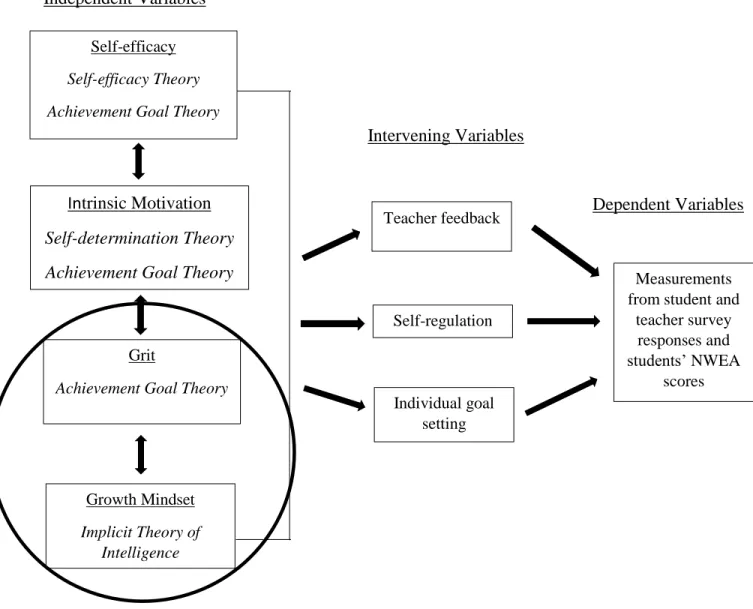
two is that growth mindset was confirmed to be an important factor in the development of grit, and the combination of growth mindset and grit in students has been associated with higher academic achievement (Cassidy, 2015). The constructs of grit and growth mindset mesh and influence student learning as supported by the aforementioned theories. These constructs play a role in student outcomes, that is, in this study, academic achievement. Figure 1 provides an overview of the conceptual framework for this study.
Figure 1. Conceptual Framework Independent Variables Intervening Variables Dependent Variables Grit
Achievement Goal Theory
Growth Mindset Implicit Theory of
Intelligence Self-efficacy Self-efficacy Theory Achievement Goal Theory
Intrinsic Motivation
Self-determination Theory Achievement Goal Theory
Self-regulation Teacher feedback
Measurements from student and
teacher survey responses and students’ NWEA scores Individual goal setting
Method
This literature review is primarily based on searches for journal articles using OneSearch Ball State University Library, Web of Science, ERIC (EBSCOhost), PsycINFO, and Google Scholar. Keywords such as non-cognitive attribute, gifted, high ability, academic achievement, grit, growth mindset, self-efficacy, intrinsic motivation, exceptional, high-achieving,
neuroplasticity, resilience, teacher praise, and self-regulation were used. Articles in peer-reviewed journals between 2007 and 2017 were searched, which led to many articles that were narrowed by reading abstracts to determine if the article met the following criteria: studies that examined the relation between non-cognitive attributes and high ability students’ achievement, studies that examined effort and ability in academic settings, studies that were primarily quantitative in nature, and studies that correlated the type of teacher feedback to student academic achievement. Finally, supplemental searches of reference lists were conducted to identify additional articles that were relevant to this review that may have been overlooked in the initial search.
Social-Emotional Characteristics of High Ability Students
There has always been an interest in the social and emotional characteristics of high ability students. Perhaps that is because anti-intellectuals want to find something wrong with high ability students. Robinson and Clinkenbeard (1998) indicated that the stereotypical view of a neurotic child with poor social skills is inaccurate. However, what has been noted from
research is students who are high ability may experience social isolation and are considered to be perfectionists and sensitive. High ability students can display depression, anxiety,
failure-avoidance behavior, and low self-esteem. Perfectionism and failure-failure-avoidance particularly contribute to underachievement (Blaas, 2014).
How do high ability students view their own non-cognitive attributes? Blaas (2014) reported that high ability students’ responses included respect from others, feeling a sense of social stress, and generally feeling satisfied with themselves. How others view high ability students and how high ability students view themselves are not far adrift regarding social situations. However, characteristics pertaining to academic outcomes, such as self-esteem and perfectionism, differ between what others think and what high ability students think of
themselves. With respect to academics, high ability students have positive views of their own self-esteem and report being highly motivated (Robinson & Clinkenbeard, 1998). On the other hand, high ability students typically do not see themselves as perfectionists.
Reports (Blaas, 2014; Fletcher & Speirs Neumeister, 2012; Robinson & Clinkenbeard, 1998; Wang, Fu, & Rice, 2012) have indicated that perfectionism in high ability students is one of the primary characteristics that influences social-emotional difficulties and academic
underachievement. High ability students who are perfectionists often set unrealistic goals that become precursors to failure. Fletcher and Speirs Neumeister (2012) and Wang et al. (2012) addressed variable types of perfectionism, differing in degrees and effects on academics. That is, the more severe the perfectionism, the more detrimental effect on academic outcomes that exists. High ability students with neurotic (Wang et al., 2012) perfectionism are afraid of failure, which leads to task avoidance, concerns about deficiencies, and anxiety. If a high ability student who displays perfectionism fails to solve an extremely difficult task, he may show extreme irrational beliefs, greater negative affect, and more physiological stress than students who are not
perfectionists (Robinson & Clinkenbeard, 1998). If a perfectionist high ability student sets unreachable goals, then he may alter other non-cognitive attributes, such as growth mindset and self-efficacy, that impact his willingness to take risks with challenging tasks.
Summary of social-emotional characteristics of high ability students.
Social-emotional characteristics, like non-cognitive attributes, interrelate with one
another (Blaas, 2014; Fletcher & Speirs Neumeister, 2012; Wang et al., 2012). As an example, if a student has low self-esteem and does not perform well on a given task, that student’s anxiety, sensitivity, and fail-avoidance behaviors may all increase. Perfectionism may lead to task avoidance behaviors and increased levels of other social-emotional traits. Understanding the social-emotional characteristics of high ability students provides a foundation for educators to facilitate a stronger sense of self-efficacy among high ability students who may not think they are as good as their high ability peers. Additionally, Dweck (2006) emphasized that standards should not be lowered to provide students successful experiences, but rather educators should create a classroom environment that focuses on strategies, effort, and choices. This will deter underachievement in high ability students and lead to higher academic achievement.
Underachievement of High Ability Students
Because ability and intelligence do not exclusively influence academic achievement, non-cognitive attributes also contribute to the achievement levels of identified high ability students. The underachievement of high ability students is a concern, and even frustration, for parents and educators. These students seem capable of exceptional performance, but do not recognize their potential. Van Tassel-Baska (2000) reported that 63% of high ability students are
underachieving. More recently, Landis and Reschly (2013) described the significance of underachieving high ability students’ disengagement and consequential dropout rates.
More specifically, research has shown achievement gaps between genders, particularly with math (Beilock, Gunderson, Ramirez, Levine, & Smith, 2010; Cheema & Galluzzo, 2013; Cvencek, Meltzoff, & Greenwald, 2011; Degol, Wang, Zhang, & Allerton, 2017). Females have
a tendency to underachieve when they are compared to their male counterparts. Else-Quest, Mineo, and Higgins (2013) indicated there are significant differences in how males and females cognitively assess their mathematical abilities. This can be connected to the research conducted by Beilock et al. (2010) when they found elementary female teachers’ math anxiety tends to elicit negative consequences for girls’ math achievement by influencing girls’ beliefs about who is strong at math. This coincides with having a fixed mindset. The research conducted on gender and its relationship with math achievement reinforces the claim that females are still greatly underrepresented in mathematically concentrated STEM careers (Degol et al., 2017).
These issues may have significant impacts on the students and their future, as
underachievement continues after high school. Underachievement is described as a discrepancy between ability and performance (Blaas, 2014; McCoach & Siegle, 2003). A strong factor that can trigger underachievement in high ability students may be the result of social-emotional characteristics, rather than a lack of ability and intelligence (Blaas, 2014; Fehrenbach, 1993; McCoach & Siegle, 2003; Obergriesser & Stoeger, 2015; Siegle & McCoach, 2005). Other factors that correlate with underachievement of high ability students include students’ attitudes toward school (McCoach & Siegle, 2003; Siegle & McCoach, 2005), lack of self-regulation (Blaas, 2014; McCoach & Siegle, 2003; Obergriesser & Stoeger, 2015; Siegle & McCoach, 2005), lack of motivation (McCoach & Siegle, 2003; Robinson & Clinkenbeard, 1998; Siegle & McCoach, 2005), and fear of failure (Fehrenbach, 1993; Obergriesser & Stoeger, 2015). On the contrary, Reis and McCoach (2000) emphasized that it is difficult to identify social-emotional factors that describe high ability underachievers. For each factor common to a high ability underachiever, there are other high ability underachievers who do not exhibit that factor. Perhaps there is a composite of factors that affect high ability underachievers. Although these
factors provide educators with convenient labels for various underachievers with whom they interact, the factors also illustrate the difficulty in teaching high ability underachievers.
Understanding why a particular student is underachieving may determine what type of feedback or instructional strategies should be used with an underachieving high ability student.
One factor that may lead to underachievement is self-regulation. Self-regulation refers to the ability to take control of one’s own behavior (Blaas, 2014; McCoach & Siegle, 2003). Students who can self-regulate have autonomy, confidence, diligence, and are responsible for their learning (Blaas, 2014). Typically, when students use self-regulatory strategies, they are able to academically achieve more. However, McCoach and Siegle (2003) contended that those strategies are not enough to academically achieve. Students must also be motivated to self- regulate their effort in learning. If these two constructs are interrelated, then one may assume that if a student possesses the self-regulatory skills, but does not have the motivation, then that student may underachieve. Other studies indicated that self-regulated learners also tend to have high levels of self-efficacy (Blaas, 2014). Based on the evidence, students with self-regulation skills and self-efficacy are more likely to experience higher levels of academic achievement than students who cannot self-regulate their learning or have low self-efficacy.
High ability students who have low self-efficacy often will not take risks due to a fear of failure. This fear of failure is another factor that correlates with academic underachievement. Obergriesser and Stoeger (2015) affirmed fear of failure is a positive predictor of
underachievement. The higher the level of fear of failure among high ability students, the more likely they are to be underachievers. Rimm (1997) believed there is an underlying issue to the fear of failure. High ability students do not function well in competition. This is not obvious in high ability students because they declare they are good students. It is their behaviors that tell
others that failing at a task makes high ability students feel like a failure. Those behaviors include task avoidance or choosing tasks they know will be easily accomplished. This notion is confirmed by Rubenstein et al. (2012) as the authors stated high ability students may believe they have the ability to perform well; however, if they do not believe their effort to the task will be successful, they will disengage or not engage at all.
McGeown et al. (2016) addressed a fear of failure when they stated the sense of control a student has over a task is crucial to the emotions experienced in relation to that task. If a task is not challenging, boredom results. If a task is too challenging, then fear or hopelessness may occur. Fear of trying and failing may be detrimental to high ability students as this may trigger a decrease in motivation. Underachievers remove themselves from failures; therefore, they do not manifest the grit to persevere with challenging tasks. High ability students may fear failure and may not function well in competition with their gifted peers. It is important for educators to promote individualized tasks that are challenging, but within realistic goals that can be achieved with student self-regulation and teacher process praise. This, consequently, could positively influence students’ grit and growth mindset.
Summary of underachievement of high ability students. Underachievement is a collection of symptoms. High ability students were found more likely to react negatively after experiencing failure in comparison to general education students (Wang et al., 2012). It is important to determine what correlation exists between self-efficacy, intrinsic motivation, grit, and growth mindset to high ability students’ willingness to face academic adversities.
Although it is difficult to identify factors that relate to underachievement in high ability students, research has shown that social-emotional factors correlate with underachievement. What remains unclear is the apparent cyclic nature of social-emotional factors and
underachievement. That is, does underachievement cause social-emotional issues in high ability students? Do social-emotional factors cause academic underachievement? It is important to determine the reciprocal effect that may occur. Moreover, it is imperative to understand those social-emotional factors contributing to underachievement so educators can implement
instructional strategies that encourage positive non-cognitive attributes and promote high academic achievement.
Non-cognitive Attributes and Relationships to Academic Achievement
Parents send their children to school to learn and be successful. What does it mean to learn and what makes an individual unable to learn? Dweck (2006) indicated that everyone is born with a drive to learn and it begins in infancy. Children learn to talk, walk, and ride a bike and never decide these are too difficult to accomplish. They do not worry about making mistakes. When they walk or learn to ride a bike, they fall, they get back up, and try again. What could negate this passion for learning? The non-cognitive attributes that children possess may be particularly important when facing adversity while learning. Self-efficacy is a non-cognitive attribute that relates to a person’s beliefs about their abilities to perform well in a variety of tasks, but especially in new or difficult tasks (Cassidy, 2015; McGeown et al., 2016). Dixson et al. (2016) noted that self-efficacy has a direct impact on student performance.
Students with similar academic abilities may perform differently if they differ in self-efficacy in a particular domain. A capable student with low self-efficacy may perform poorly, whereas a less-capable student may perform well if his or her self-efficacy is high. Moreover, self-efficacy is related to effort and grit; therefore, it is correlated with academic achievement (Wang & Neihart, 2015). Furthermore, Wang and Neihart acknowledged that self-efficacy helps students regulate their academic motivation.
Students who have high self-efficacy are more likely to be intrinsically motivated in regards to effort, grit, and behavior than students who believe they are less capable of success (Mega et al., 2013). If self-efficacy is positively correlated with motivation (Wang & Neihart, 2015), then can one consider intrinsic motivation is positively correlated with academic
achievement? Froiland and Worrell (2016) affirmed that intrinsic motivation has been associated with a range of constructs, including academic achievement. Moreover, students who are
intrinsically motivated not only achieve more, but also are more likely to be content and
emotionally healthy (Froiland & Worrell, 2016). Intrinsic motivation influences many aspects of a student’s education, including academic achievement and other non-cognitive attributes.
Like intrinsic motivation, grit is a non-cognitive attribute that McGeown et al. (2016) asserted is important for overcoming adversities as children mature and face more academic challenges. Duckworth (2016) defined grit as the “passion and perseverance for long-term goals” (p. 8). Ability alone does not bring academic success. Intelligence does not always translate into academic achievement. High achievers often have the zeal and fervor to
accomplish difficult tasks indicating that grit may play an essential role in academic achievement (Duckworth et al., 2007) rather than ability and intelligence solely influencing academic
achievement.
As intelligence does not always translate into academic achievement, a fixed mindset may also negatively impact learning. Young children do not conceptually differentiate between effort and ability as older children and adults do (Muenks & Miele, 2017). As children grow and develop, they are able to evaluate themselves and become capable of thinking about the
relationship between effort and ability (Dweck, 2006; Muenks & Miele, 2017). Children with a fixed mindset are those that believe that intelligence is established (Dweck, 2012; Esparza et al.,
2014; Ricci, 2013) and care first and foremost about how they will be judged (Dweck, 2007). They may make choices to avoid challenging tasks to ensure they succeed. Students with a growth mindset believe their intelligence is malleable and develops over time (Claro et al., 2016; Dweck, 2007, 2012, 2017; Esparza et al., 2014). Additionally, those students with a growth mindset will face academic challenges because they want to make sure they learn (Dockterman & Blackwell, 2014).
Unfortunately, many students’ non-cognitive attributes put them at risk of failing to reach their full potential. However, high ability students are not normally considered at risk for
underachievement. McCoach and Siegle (2003) described underachievement as a discrepancy between potential and performance, that is, a discrepancy between ability and achievement. The effect of low self-efficacy, lack of intrinsic motivation, lack of grit, and a fixed mindset may be factors that lead to underachievement in high ability students. Which non-cognitive attributes will best correlate with a high ability student highly achieving or underachieving? Literature regarding underachievement suggested that high ability underachievers have low self-efficacy (McCoach & Siegle, 2003), low motivation (Blaas, 2014), and are less gritty than their high ability peers (Duckworth et al., 2007). Other research showed that fostering a growth mindset may improve these three non-cognitive attributes (Rattan et al., 2015).
Growth mindsets positively influence academic achievement in children from elementary school to high school, particularly when facing challenging coursework (Rattan et al., 2015). Students with a growth mindset are more likely to respond to initial obstacles by remaining involved, trying new strategies, and using resources to learn (Dweck, 2010). Creating growth mindsets in the classroom may enhance other non-cognitive attributes, and as a result increase students’ academic achievement. Teachers can implement strategies in the classroom, creating
an environment that fosters students’ self-efficacy, intrinsic motivation, grit, and academic achievement (Dweck, 2010).
The outcome of student academic achievement is a priority in education. The
achievement goal theory (Dull et al., 2015) and the implicit theory of intelligence (Blackwell et al., 2007; Dweck & Leggett, 1988) provide the foundational framework throughout this study with regard to grit and growth mindset. These two non-cognitive attributes were the primary focus as they were examined for how they correlate with academic achievement. However, due to their interplay and relationships with self-efficacy and intrinsic motivation, one cannot fully understand grit and growth mindset without having the foundational knowledge of the
connections that they have with self-efficacy and intrinsic motivation. Self-efficacy
Bandura theorized that outcomes may be determined by non-cognitive constructs, namely self-efficacy. Bandura (1977, 1986, 1995, 1997) posited that outcome expectations are based largely on an individual’s self-efficacy expectations. That is, individuals anticipate outcomes based on their beliefs of how they will perform. Self-efficacy pertains to one’s own belief in her ability to perform a task and is correlated with learning and academic achievement (Cassidy, 2015; Dixson et al., 2016; Pajares, 1996; Phan, 2012; Usher, 2009). Pajares (1997)
acknowledged that self-efficacy differs from other non-cognitive attributes as these may determine students’ capabilities to carry out a task at certain quality levels. Self-efficacy, however, may determine how much effort students will exert on an activity, how they will persevere, and how resilient they will be when faced with academic adversity (Usher, 2009).
When faced with academic adversity, high ability students typically have high self-efficacy and do not associate academic failure with a lack of ability, which helps explain how
self-efficacy has been linked to grit (Dixson et al., 2016). Self-efficacy is positively correlated with self-regulation, which is a quality high ability students tend to display (Usher, 2009; Wang & Neihart, 2015). Self-regulated learning may lead to mastery experiences. When students feel they have mastered skills or when they have accomplished challenging tasks, their self-efficacy develops (Usher, 2009). High ability students, especially those who believe their abilities are inherent, not only need self-efficacy regarding their capability to achieve, but also need to
understand the importance that effort plays in improving their abilities (Rubenstein et al., 2012). As self-efficacy can positively influence academic achievement, it may influence
underachievement in high ability students as well. Previous studies have found low self-efficacy levels among high ability underachievers (Phan, 2012). Although Usher (2009) related students with high self-efficacy to the ability of facing challenging tasks, Cassidy (2015) indicated the responses of students with high efficacy to occurrences with academic adversity, when self-efficacy is especially important because of its connection with motivation and perseverance, are not clear. Obergriesser and Stoeger (2015) examined the effectiveness of self-regulation
learning intervention that focuses on predictors of underachievement in high ability students, namely self-efficacy and goal orientation. The results showed a positive effect on learning behaviors for high ability underachievers. However, there were only slight improvements in self-efficacy. The authors noted that self-efficacy may improve over time as students experience how learning behaviors lead to increased achievement. These results coincide with Usher’s study where she concluded that mastery experiences are powerful sources in the development of self-efficacy. It can be inferred that previous performance and achievement positively correlate with a student’s self-efficacy.
Where other studies (Obergriesser & Stoeger, 2015; Usher, 2009) concluded self-efficacy is influenced by previous performance, Pajares (1996), on the other hand, reported that high ability students’ self-efficacy is affected by their cognitive ability and previous achievement. Pajares indicated the effect of both cognitive ability and prior achievement on performance was mediated by students’ self-efficacy perceptions. It is possible that high ability students may use their perceptions of their cognitive abilities as sources of efficacy information more than
previous performance.
These contradictory results show that the correlation between self-efficacy and academic achievement is complex. Does self-efficacy influence academic achievement or does academic achievement influence self-efficacy? Phan (2012) contended that self-efficacy and academic achievement impact each other in a cyclic nature. Developing self-efficacy is wise given its positive influence on students’ capabilities to carry out tasks in the classroom. As an example, self-efficacy in learning positively contributes to goal orientation (Phan, 2012; Usher, 2009), and this influences successful academic achievement (Phan, 2012). Further research regarding grit and growth mindset in high ability students is needed so educators may better understand how these non-cognitive attributes affect students’ self-efficacy beliefs, which affect their effort, resilience, learning patterns, and thus, academic achievement.
Intrinsic Motivation
Cassidy (2015) connected self-efficacy with motivation. The topic of motivation and high abiltiy students has experienced extensive and constant attention. Motivation is defined as a set of interconnected beliefs and emotions that affect behavior (Martin & Dowson, 2009). Motivation is frequently separated into two groups: intrinsic and extrinsic. Individuals who are intrinsically motivated to learn are those who are curious, interested, seek out novelty and
challenges, and are focused on a task (Dev, 1997; Ryan & Deci, 2000), whereas those who are extrinsically motivated are more interested in the outcomes of learning than in the task itself (Clinkenbeard, 2012).
Ryan and Deci (2000; Deci & Ryan, 2008) related self-determination theory to intrinsic motivation. This theory is framed in terms of social and environmental factors that facilitate intrinsic motivation. The theory argues that social contextual events, such as feedback, enhance intrinsic motivation. Those individuals that are more intrinsically motivated tend to complete tasks and are willing to accept challenges for the sake of learning, therefore, enhancing
performance and outcomes. Olszewski-Kubilius, Kulieke, and Krasney (1988) found that high ability students are more intrinsically motivated than general education students. Olszewski-Kubilius et al.’s review of studies indicated high ability students score higher on measures of motivation that suggest intrinsic reasons for learning. High ability students who are intrinsically motivated will persist with assigned tasks and will not need any reward to initiate or complete tasks, which leads to academic achievement. Gottfried (2008) noted children who are
intrinsically motivated show higher achievement on standardized tests, a greater sense of academic competence, lower academic anxiety, and higher educational achievement as young adults. Intrinsic motivation positively correlates with academic achievement; however, it is perceived by some as an indirect correlation.
Intrinsic motivation associates with other attributes that relate to academic achievement, particularly with high ability students. Mega et al. (2013) considered student motivation as a “dynamic, multifaceted phenomenon” (p. 122) because it has been connected to implicit theory beliefs, such as growth mindset and self-efficacy. Students who believe they are able and will do well, are more likely to be intrinsically motivated in terms of effort and perseverance than
students who have a fixed mindset and low self-efficacy. These students are more likely to complete a task and show enthusiasm about the challenging quality of the activity (Dev, 1997; Ryan & Deci, 2000). Because high ability students are quick to understand concepts, the need for challenging curriculum is important. In classrooms where there is inadequate challenge, lack of depth, and the pace is too slow, boredom can occur and negatively affect their motivation (Phillips & Lindsay, 2006). Clinkenbeard (1994) defined intrinsically motivated students as those who are unafraid to admit they do not understand and choose suitably challenging tasks, which could indicate a willingness to take academic risks that develop learning and higher levels of academic achievement.
What role do educators play in the development of high ability students’ intrinsic motivation? Developing appropriate learning activities that promote grit and growth mindset may play a role in how high ability students approach learning. The association of intrinsic motivation with these non-cognitive attributes may influence academic achievement as Renzulli (1986) connected giftedness to these non-cognitive attributes. Clinkenbeard (1996) researched the relationship between giftedness and motivation attributes, which include task commitment, causal attributions, competition, perceived competence, and self-efficacy. Similar studies by Froiland and Worrell (2016) examined how intrinsic motivation is interrelated with learning goals and academic achievement. The authors reported that students who have learning goals are more likely to enjoy learning and obtain better grades. Intrinsic motivation to learn is
significantly related to student engagement. At the core of that study is the idea that having intrinsic motivation to learn leads to students deeply engaging in classroom subject matter. Therefore, if students are deeply engaged in content, then it is likely their academic performance will increase.
An indirect relationship between intrinsic motivation and academic achievement has been addressed in several studies (Clinkenbeard, 1996; Froiland & Worrell, 2016; Mega et al., 2013). Intrinsic motivation is more directly correlated with classroom engagement and other non-cognitive attributes. Students’ implicit beliefs, such as growth mindset, and learning goals play an essential part in intrinsic motivation and promote and sustain academic achievement (Mega et al., 2013). These affirmations provide a foundation for obtaining further knowledge of what educators can do to cultivate classroom engagement and to nurture grit and growth mindset in high ability students so they can build or sustain intrinsic motivation, and consequently, reach their full academic potential.
Grit
As intrinsic motivation has been connected with academic achievement, grit has emerged in the world of education and has been positively correlated with academic achievement
(Duckworth et al., 2007). Because grit has been identified as a non-cognitive attribute of high achievers, it is clear why it would be intriguing to educators who are anxious about raising academic achievement, and supporting children to persevere through challenges. How can grit affect students’ academics? It may be helpful to understand how other non-cognitive attributes are related to grit. Grit has been connected to self-control (Duckworth & Gross, 2014), which is the ability to delay gratification (Stokas, 2015). Grit has also been related to hope, self-efficacy (Dixson et al., 2016), commitment (McGeown et al., 2016), resilience (Perkins-Gough, 2013), and growth mindset (Perkins-Gough, 2013; Dockterman & Blackwell, 2014). How grit correlates with these non-cognitive attributes may play an important role in high ability students’ academics. For example, growth mindset is correlated with grit according to Angela Duckworth who is cited in Perkins-Gough’s (2013) article when Duckworth stated “children who have more
of a growth mind-set tend to be grittier” (p. 19). Perkins-Gough also indicated that grit and resilience are related even though people use the word resilience differently. Grit is related to resilience because part of what it means to have grit is to be resilient when confronted with adversity. Having a better understanding of how grit is related to other non-cognitive attributes will help educators better serve high ability students.
McCoach and Siegle (2003) suggested what separates high ability students who achieve more from high ability underachievers are the goals they set for themselves and the effort they exert to meet those goals. Given that grit is “the passion and perseverance for long-term goals” (Duckworth et al., 2007, p. 1087), it may appear that those high ability students who are grittier will achieve more. Students who have grit set long-term goals for themselves and do not deviate from them, with or without positive feedback from their teachers (Duckworth et al., 2007). Longitudinal studies have shown that grit predicts the completion of challenging goals despite adversities along the way (Duckworth & Gross, 2014). A study (Duckworth et al., 2007) that demonstrated this concept involved students who participated in the 2005 Scripps National Spelling Bee. The hypothesis predicted those with more grit would advance to higher rounds in the spelling bee correlating to the number of hours spent preparing for the bee. Findings
confirmed the hypothesis as spelling bee finalists with grit scores a standard deviation above the mean were 41% more likely to advance further in the spelling bee (Duckworth et al., 2007). This study established that gritty children who work harder and longer than those who are less gritty perform better. Extending this type of research with other student samples may provide data to formulate a more substantial conclusion for high ability students.
Perkins-Gough (2013) discussed how ability and IQ play a role in student academic achievement. Furthermore, she stated that educators may be concerned about identified high
ability students who do not know how to fail or do not know how to struggle because they do not have a great deal of practice with it. Being identified as high ability does not guarantee students will be hardworking or passionate about learning. Grit studies shed light on how grit relates to other non-cognitive attributes that are known to predict achievement (Duckworth et al., 2007). These attributes may have an effect on achievement because they are correlated to grit. As an example, the propensity to pursue long-term goals with grit may be determined by one’s own intrinsic beliefs, such as self-efficacy and growth mindset.
Implications from grit studies not only confirmed grit’s correlation with other non-cognitive attributes, but also indicated that as children pursue long-term goals, they should be supported by their teachers and with educational resources (McGeown et al., 2016). Yeager and Dweck (2012) addressed teacher support when students face academic challenges as they noted teachers who comforted students with process praise rather than commenting on ability put students in the mindset to persevere through the challenging task with resilience. It may be that grit predicts high academic achievement by persuading students to continuously work very hard, accept and overcome adversity, and utilize resources when pursuing long-term goals.
Some research has shown grit to have no impact on student academic achievement. Dixson et al. (2016) studied the three non-cognitive attributes of hope, self-efficacy, and grit and how those correlated to students’ perceived ability and achievement. Only self-efficacy and hope were statistically significant contributors to perceived ability, while self-efficacy was the only non-cognitive attribute to positively correlate to academic achievement. These results negated those that stated grit does positively affect academic achievement. Some researchers have claimed “grit is overblown” (Dixson et al., 2016, p. 73). Crede, Tynan, and Harms (2016) refuted grit’s positive impact on academic achievement. The authors concluded that there are