Hedge Fund Essays
Sergiy Gorovyy
Submitted in partial fulfillment of the
requirements for the degree of
Doctor of Philosophy
under the Executive Committee
of the Graduate School of Arts and Sciences
COLUMBIA UNIVERSITY
2012
© 2012
Sergiy Gorovyy
All rights reserved
Hedge Fund Essays
Sergiy Gorovyy
This dissertation analyzes hedge fund leverage and its determinants, investigates optimal hedge fund manager behavior induced by hedge fund contracts, and uncovers an evidence of a hedge fund transparency risk premium. The first essay investigates the leverage of hedge funds in the time series and cross-section. Hedge fund leverage is found to be counter-cyclical to the leverage of listed financial intermediaries. Changes in hedge fund leverage tend to be more predictable by economy-wide factors than by fund-specific characteristics. In particular, decreases in funding costs and increases in market values both forecast increases in hedge fund leverage. Decreases in fund return volatilities predict future increases in leverage. In the second essay, I investigate hedge fund compensation from an investor's point of view in a model with a risk neutral fund manager who can continuously rebalance the fund's holdings. I solve for the optimal leverage level in a fund that has a compensation contract with a high-water mark and hurdle rate provisions where management and performance fees are paid at discrete time moments. The compensation contract induces risk-loving behavior with managers often choosing the maximum leverage. Third essay investigates risk premia associated with hedge fund transparency, liquidity, complexity, and concentration over the period from April 2006 to March 2009. Consistent with factor models of risk, we find that during normal times low-transparency, low-liquidity, and high-concentration funds delivered a return premium, with economic magnitudes of 5% to 10% per year, while during bad states of the economy, these funds experienced significantly lower
premium by revealing that the risk premium is mostly prevalent among non-transparent funds where investors are unaware about the exact risks they are facing and hence cannot diversify them away.
i
Hedge Fund Leverage ... 1
1. Introduction ... 2
2. The Mechanics of Hedge Fund Leverage ... 4
2.1. Gross, Net, and Long-only Leverage ... 4
2.2. How do Hedge Funds Obtain Leverage? ... 6
2.3. Reported Hedge Fund Leverage ... 8
3. Data ... 9
3.1. Macro Data ... 10
3.2. Hedge Fund Data ... 11
3.2.1. Hedge Fund Leverage ... 12
3.2.2. Hedge Fund Returns, Volatilities, and Flows ... 12
3.3. Summary Statistics ... 14
4. Methodology ... 17
4.1. Predictive Model ... 17
4.2. Contemporaneous Model ... 18
5. Empirical Results ... 19
5.1. Time Series of Leverage ... 19
5.1.1. Gross Leverage ... 19
5.1.2. Dispersion of Gross Leverage ... 20
5.1.3. Gross vs. Net and Long-only Leverage ... 21
5.2. Macro Predictors of Hedge Fund Leverage ... 23
ii
5.5. Hedge Fund Leverage vs. Finance Sector Leverage ... 28
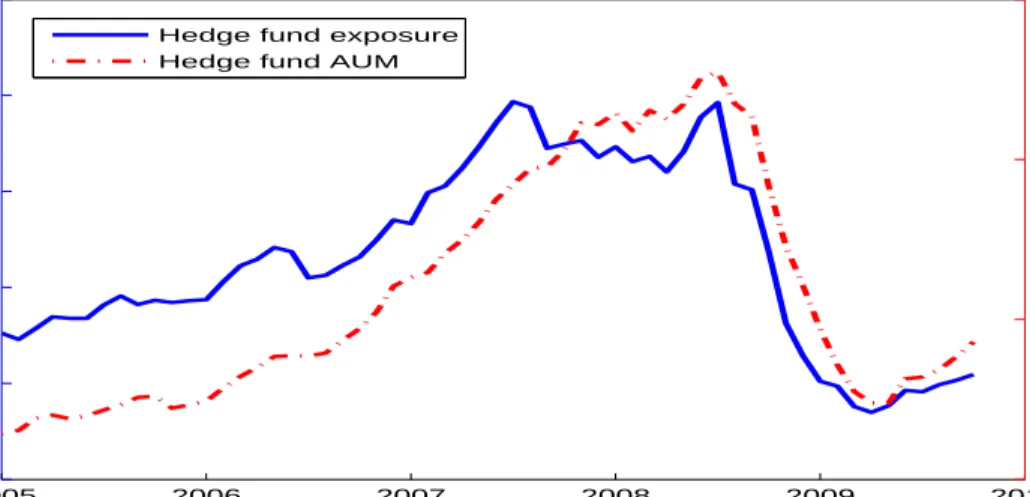
5.6. Hedge Fund vs. Finance Sector Exposure ... 30
6. Conclusions ... 31
Appendices ... 34
References ... 41
Tables ... 43
Figures ... 54
Hedge Fund Compensation ... 63
1. Introduction ... 64
2. Hedge Fund Fees ... 67
3. Model Setup ... 70
3.1. Model ... 70
3.2. Solution ... 73
3.3. Extension: Model Without Margins ... 75
3.4. Extension: Liquidation by the Investor ... 78
3.5. Extension: Liquidation by the Prime Broker ... 79
3.6. Extension: Multiple Margin States ... 80
3.7. Testable Implications ... 81
4. Costs of the High-water Mark and the Hurdle Rate Provisions ... 82
5. Conclusions ... 85
Appendices ... 87
iii
Figures ... 95
Hedge Fund Risk Premia: Transparency, Liquidity, Complexity, and Concentration ... 99
1. Introduction ... 100 2. Data ... 104 3. Empirical Strategy ... 108 4. Results ... 110 4.1. Univariate Results ... 110 4.2. Multivariate Results ... 112 4.3. Robustness Checks ... 114
4.4. Concentration and Transparency Interactions ... 115
4.5. Hedge Fund Volatility and Flows ... 116
5. Conclusions ... 117
References ... 119
iv Essay 1: Hedge Fund Leverage
LIST OF TABLES
Margin requirements by security type Summary statistics of data
Correlations of gross, net, and long-only leverage Cross-correlations of hedge fund leverage within sectors Macro predictors of hedge fund leverage
Fund-specific predictors of hedge fund leverage
Contemporaneous relations with gross hedge fund leverage Correlations of hedge fund and finance sector leverage A sample hedge fund risk exposure report
LIST OF FIGURES
VIX and CDS protection
Rolling 12-month hedge fund volatilities Hedge fund volatilities vs. HFR volatilities Hedge fund gross leverage
Cross-sectional dispersion of gross hedge fund leverage Gross, net, and long-only hedge fund leverage
v
Relative gross exposures of hedge funds to investment banks and the finance sector
Essay 2: Hedge Fund Compensation
LIST OF TABLES
Values of parameters used in estimations Fee payment example
Equivalent no-performance fee contracts
LIST OF FIGURES
Optimal portfolio with liquidation by the investor Optimal portfolio with liquidation by the prime broker CME margin requirements for S&P 500 futures contracts
Comparison of average hedge fund leverage and an inverse of the CME margin requirement
Essay 3: Hedge Fund Risk Premia: Transparency, Liquidity, Complexity, and
Concentration
LIST OF TABLES
Summary statistics of data
vi
Hedge fund performance: Balanced multivariate regression results
Hedge fund performance: Transparency and concentration interaction results Hedge fund return volatility: Multivariate regression results
vii
Though only my name appears on the cover of this dissertation, it became possible thanks to a number of people. I am extremely grateful to all of them.
My adviser, Prof. Andrew Ang, showed me an example of hard work and dedication to financial research. He also taught me how to write high quality academic papers that I followed to the best of my abilities. I’m thankful for the numerous times he was able to proofread this dissertation in order to make it better.
I’m also grateful to Prof. Suresh Sundaresan who always had time to discuss my papers. I thank him for the advice and information provided that made “Hedge Fund Compensation” possible.
I’d like to thank also to Prof. Robert Hodrick, Greg van Inwegen, James H. Scott, and Olga Kuzmina for their help.
Most importantly, none of this would be possible without continuous support of my family and my girlfriend.
viii
This dissertation is dedicated to my parents Nataliya and Oleg Gorovyy, who brought me to life and made all of this possible through their love, support, and hard work. Their contribution cannot be overestimated.
Hedge Fund Leverage
∗Andrew Ang† Sergiy Gorovyy‡ Gregory B. van Inwegen§
Abstract
We investigate the leverage of hedge funds in the time series and cross-section. Hedge fund leverage is counter-cyclical to the leverage of listed financial intermediaries and decreases prior to the start of the financial crisis in mid-2007. Hedge fund leverage is lowest in early 2009 when the market leverage of investment banks is highest. Changes in hedge fund leverage tend to be more predictable by economy-wide factors than by fund-specific char-acteristics. In particular, decreases in funding costs and increases in market values both forecast increases in hedge fund leverage. Decreases in fund return volatilities predict future increases in leverage.
JEL Classification: G11, G18, G23, G32
Keywords: Capital structure, long-short positions, alternative investments, exposure,
hedg-ing, systemic risk
∗We thank Viral Acharya, Tobias Adrian, Zhiguo He, Arvind Krishnamurthy, Stefan Nagel (the referee),
Tano Santos, Roberto Savona, Suresh Sundaresan, and seminar participants at Columbia University, Risk USA 2010, and 3rd Annual Conference on Hedge Funds for helpful comments.
†Columbia University and NBER; Email: [email protected] ‡Columbia University; Email: [email protected] §Citi Private Bank; Email: [email protected]
1. Introduction
The events of the financial crisis over 2007–2009 have made clear the importance of leverage of financial intermediaries to both asset prices and the overall economy. The ob-served “deleveraging” of many listed financial institutions during this period has been the focus of many regulators and the subject of much research.1 The role of hedge funds has
played a prominent role in these debates for several reasons. First, although in the recent financial turbulence no single hedge fund has caused a crisis, the issue of systemic risks inherent in hedge funds has been lurking since the failure of the hedge fund Long-Term Cap-ital Management L.P. (LTCM) in 1998.2 Second, within the asset management industry, the
hedge fund sector makes the most use of leverage. In fact, the relatively high and sophis-ticated use of leverage is a defining characteristic of the hedge fund industry. Third, hedge funds are large counterparties to the institutions directly overseen by regulatory authorities, especially commercial banks, investment banks, and other financial institutions which have received large infusions of capital from governments.
However, while we observe the leverage of listed financial intermediaries through peri-odic accounting statements and reports to regulatory authorities, little is known about hedge fund leverage despite the proposed regulations of hedge funds in the U.S. and Europe. This is because hedge funds are by their nature secretive, opaque, and have little regulatory over-sight. Leverage plays a central role in hedge fund management. Many hedge funds rely on leverage to enhance returns on assets which on an unlevered basis would not be sufficiently high to attract funding. Leverage amplifies or dampens market risk and allows funds to ob-tain notional exposure at levels greater than their capital base. Leverage is often employed by hedge funds to target a level of return volatility desired by investors. Hedge funds use lever-age to take advantlever-age of mispricing opportunities by simultaneously buying assets which are
1See, for example, Adrian and Shin (2009), Brunnermeier (2009), Brunnermeier and Pedersen (2009), and
He, Khang, and Krishnamurthy (2010), among many others.
2 Systemic risks of hedge funds are discussed by the President’s Working Group on Financial Markets
(1999), Chan et al. (2007), Kambhu, Schuermann, and Stiroh (2007), Financial Stability Forum (2007), and Banque de France (2007).
perceived to be underpriced and shorting assets which are perceived to be overpriced. Hedge funds also dynamically manipulate leverage to respond to changing investment opportunity sets.
We are the first paper, to our knowledge, to formally investigate hedge fund leverage us-ing actual leverage ratios with a unique data set from a fund-of-hedge-funds. We track hedge fund leverage in time series from December 2004 to October 2009, a period which includes the worst periods of the financial crisis from 2008 to early 2009. We characterize the cross-section of leverage: we examine the dispersion of leverage across funds and investigate the macro and fund-specific determinants of future leverage changes. We compare the leverage and exposure of hedge funds with the leverage and total assets of listed financial companies. As well as characterizing leverage at the aggregate level, we investigate the leverage of hedge fund sectors.
The prior works on hedge fund leverage are only estimates (see, e.g., Banque de France, 2007; Lo, 2008) or rely only on static leverage ratios reported by hedge funds to the main databases. For example, leverage at a point in time is used by Schneeweis et al. (2004) to investigate the relation between hedge fund leverage and returns. Indirect estimates of hedge fund leverage are computed by McGuire and Tsatsaronis (2008) using factor regressions with time-varying betas. Even without considering the sampling error in computing time-varying factor loadings, this approach requires that the complete set of factors be correctly specified, otherwise the implied leverage estimates suffer from omitted variable bias. Regressions can also not adequately capture abrupt changes in leverage. Other work by Brunnermeier and Pedersen (2009), Gorton and Metrick (2009), Adrian and Shin (2010), and others, cites margin requirements, or haircuts, as supporting evidence of time-varying leverage taken by proprietary trading desks at investment banks and hedge funds. These margin requirements give maximum implied leverage, not the actual leverage that traders are using. In contrast, we analyze actual leverage ratios of hedge funds.
Our work is related to several large literatures, some of which have risen to new promi-nence with the financial crisis. First, our work is related to optimal leverage management by hedge funds. Duffie, Wang, and Wang (2008) and Dai and Sundaresan (2010) derive
theo-retical models of optimal leverage in the presence of management fees, insolvency losses, and funding costs and restrictions at the fund level. At the finance sector level, Acharya and Viswanathan (2008) study optimal leverage in the presence of moral hazard and liquidity effects showing that due to deleveraging, bad shocks that happen in good times are more severe. A number of authors have built equilibrium models where leverage affects the entire economy. In Fostel and Geanakoplos (2008), economy-wide equilibrium leverage rises in times of low volatility and falls in periods where uncertainty is high and agents have very disperse beliefs. Leverage amplifies liquidity losses and leads to overvalued assets during normal times. Stein (2009) shows that leverage can be chosen optimally by individual hedge funds, but this can create a fire-sale externality causing systemic risk by hedge funds simul-taneously unwinding positions and reducing leverage. There are also many models where the funding available to financial intermediaries, and hence leverage, affects asset prices. In many of these models, deleveraging cycles are a key part of the propagating mechanism of shocks.3 Finally, a large literature in corporate finance examines how companies determine
optimal leverage. Recently, Welch (2004) studies the determinants of firm debt ratios and finds that approximately two-thirds of variation in corporate leverage ratios is due to net issuing activity.
The remainder of the paper is organized as follows. We begin in Section 2 by defining and describing several features of hedge fund leverage. Section 3 describes our data. Section 4 outlines the estimation methodology which allows us to take account of missing values. Section 5 presents the empirical results. Finally, Section 6 concludes.
2. The Mechanics of Hedge Fund Leverage
2.1. Gross, Net, and Long-only Leverage
A hedge fund holds risky assets in long and short positions together with cash. Leverage measures the extent of the relative size of the long and short positions in risky assets relative
3See, for example, Gromb and Vayanos (2002), He and Krishnamurthy (2009), Brunnermeier and Pedersen
to the size of the portfolio. Cash can be held in both a long position or a short position, where the former represents short-term lending and the latter represents short-term borrowing. The assets under management (AUM) of the fund is cash plus the difference between the fund’s long and short positions and is the value of the claim all investors have on the fund. The net asset value (NAV) per share is the value of the fund per share and is equal to AUM divided by the number of shares. We use the following three definitions of leverage, which are also widely used in industry:
Gross leverage is the sum of long and short exposure per share divided by NAV. This
defini-tion implicitly treats both the long and short posidefini-tions as separate sources of profits in their own right, as would be the case for many long-short equity funds. This leverage measure overstates risk if the short position is used for hedging and does not constitute a separate active bet. If the risk of the short position by itself is small, or the short position is usually taken together with a long position, a more appropriate definition of leverage can be:
Net leverage is the difference between long and short exposure per share expressed as a
proportion of NAV. The net leverage measure captures only the long positions representing active positions which are not perfectly offset by short hedges, assuming the short positions represent little risk by themselves. Finally, we consider,
Long-only leverage or Long leverage is defined as the long positions per share divided by
NAV. Naturally, by ignoring the short positions, long-only leverage could result in a large underestimate of leverage, but we examine this conservative measure because the report-ing requirements of hedge fund positions by the U.S. Securities and Exchange Commission (SEC) involve only long positions.4 We also investigate if long leverage behaves differently
from gross or net leverage, or put another way, if hedge funds actively manage their long and short leverage positions differently.
Only a fund 100% invested in cash has a leverage of zero for all three leverage defi-nitions. Furthermore, for a fund employing only levered long positions, all three leverage
4Regulation 13-F filings are required by any institutional investor managing more than $100 million. Using
these filings, Brunnermeier and Nagel (2004) examine long-only hedge fund positions in technology stocks during the late 1990s bull market.
measure coincide. Thus, active short positions induce differences between gross, net, and long-only leverage. Appendix A illustrates these definitions of leverage for various hedge fund portfolios.
2.2. How do Hedge Funds Obtain Leverage?
Hedge funds obtain leverage through a variety of means, which depend on the type of securities traded by the hedge fund, the creditworthiness of the fund, and the exchange, if any, on which the securities are traded. Often leverage is provided by a hedge fund’s prime broker, but not all hedge funds use prime brokers.5 By far the vast majority of leverage is obtained through short-term funding as there are very few hedge funds able to directly issue long-term debt or secure long-term borrowing.
In the U.S., regulations govern the maximum leverage permitted in many exchange-traded markets. The Federal Reserve Board’s Regulation T (Reg T) allows investors to borrow up to a maximum 50% of a position on margin (which leads to a maximum level of exposure equal to1/0.5 = 2). For a short position, Reg T requires that short-sale ac-counts hold collateral of 50% of the value of the short implying a maximum short exposure of two. By establishing offshore investment vehicles, hedge funds can obtain “enhanced leverage” higher than levels allowable by Reg T. Prime brokers have established facilities overseas in less restrictive jurisdictions to provide this service. Another way to obtain higher leverage than allowed by Reg T is “portfolio margining” which is another service provided by prime brokers. Portfolio margining was approved by the SEC in 2005 and allows margins to be calculated on a portfolio basis, rather than on a security-by-security basis.6
Table 1 reports typical margin requirements (“haircuts”) required by prime brokers or other counterparties. The last column of the Table 1 lists the typical levels of leverage able to
5In addition to providing financing for leverage, prime brokers provide hedge fund clients with risk
manage-ment services, execution, custody, daily account statemanage-ments, and short-sale inventory for stock borrowing. In some cases, prime brokers provide office space, computing and trading infrastructure, and can even contribute capital.
6Portfolio margining only applies to “hardwired” relations, such as calls and puts on a stock, and the
be obtained in each security market, that are the inverse of the margin requirements. These are obtained at March 2010 by collating information from prime brokers and derivatives exchanges.7 Note that some financial instruments, such as derivatives and options, have embedded leverage in addition to the leverage available from external financing. The highest leverage is available in Treasury, foreign exchange, and derivatives security markets such as interest rate and foreign exchange swaps. These swap transactions are over the counter and permit much higher levels of leverage than Reg T. These securities enable investors to have large notional exposure with little or no initial investment or collateral. Similarly, implied leverage is high in futures markets because the margin requirements there are much lower than in the equity markets.
Based on the dissimilar margin requirements of different securities reported in Table 1, it is not surprising that hedge fund leverage is heterogeneous and depends on the type of investment strategy employed by the fund. Our results below show that funds engaged in relative value strategies, which trade primarily fixed income, swaps, and other derivatives, have the highest average gross leverage of 4.8 through the sample. Some relative value funds in our sample have gross leverage greater than 30. Credit funds which primarily hold investment grade and high yield corporate bonds and credit derivatives have an average gross leverage of 2.4 in our sample. Hedge funds in the equity and event-driven strategies mainly invest in equity and distressed corporate debt and hence have lower leverage. In particular, equity and event-driven funds have average gross leverage of1.6and1.3, respectively, over our sample.
The cost of leverage to hedge funds depends on the method used to obtain leverage. Prime brokers typically charge a spread over London Interbank Offered Rate (LIBOR) to hedge fund clients who are borrowing to fund their long positions and brokers pay a spread below LIBOR for cash deposited by clients as collateral for short positions. These spreads are higher for less creditworthy funds and are also higher when securities being financed have high credit risk or are more volatile. The cost of leverage through prime brokers reflects the
7Brunnermeier and Pedersen (2009) and Gorton and Metrick (2009) show that margin requirements changed
costs of margin in traded derivatives markets. We include instruments capturing funding costs like LIBOR and interest rate spreads in our analysis.
In many cases, there are maximum leverage constraints imposed by the providers of leverage on hedge funds. Hedge fund managers make a decision on optimal leverage as a function of the type of the investment strategy, the perceived risk-return trade-off of the underlying trades, and the cost of obtaining leverage, all subject to exogenously imposed leverage limits. Financing risk is another consideration as funding provided by prime bro-kers can be subject to sudden change. In contrast, leverage obtained through derivatives generally has lower exposure to funding risk. Prime brokers have the ability to pull financ-ing in many circumstances, for example, when performance or NAV triggers are breached. Dai and Sundaresan (2010) show that this structure effectively leaves the hedge funds short an option vis-`a-vis their prime broker. Adding further risk to this arrangement is the fact that the hedge fund is also short an option vis-`a-vis another significant financing source, their client base, which also has the ability to pull financing following terms stipulated by the offering memorandum.8 We do not consider the implicit leverage in these funding options in our analysis as we are unable to obtain data on hedge fund prime broker agreements or the full set of investment memoranda of hedge fund clients; our analysis applies only to the leverage reported by hedge funds in their active strategies.9
2.3. Reported Hedge Fund Leverage
An important issue with hedge fund leverage is which securities are included in the firm-wide leverage calculation and how the contribution of each security to portfolio leverage is calculated. The most primitive form of leverage calculation is unadjusted balance sheet leverage, which is simply the value of investment assets, not including notional exposure
8In many cases, hedge funds have the ability to restrict outflows by invoking gates even after lockup periods
have expired (see, for example, Ang and Bollen, 2010).
9 Dudley and Nimalendran (2009) estimate funding costs and funding risks for hedge funds, which are
not directly observable, using historical data on margins from futures exchanges and Chicago Board Options Exchange Market Volatility Index (VIX). They do not consider hedge fund leverage.
in derivatives, divided by equity capital. Since derivative exposure for hedge funds can be large, this understates, in many cases dramatically, economic risk exposure.
To remedy this shortcoming, leverage is often adjusted for derivative exposure by taking delta-adjusted notional values of derivative contracts.10 For example, to account for the
different volatility and beta exposures of underlying investments, hedge funds often beta-adjust the exposures of (cash) equities by upward beta-adjusting leverage for high-beta stock holdings. Likewise, (cash) bond exposures are often adjusted to account for the different exposures to interest rate factors. In particular, the contribution of bond investments to the leverage calculation is often scaled up or down by calculating a 10-year equivalent bond position. Thus, an investment of $100 in a bond with twice the duration of a 10-year bond would have a position of $200 in the leverage calculation. The issues of accounting for leverage for swaps and futures affect fixed income hedge funds the most and long-short equity hedge funds the least. For this reason, we break down leverage statistics by hedge fund sectors.
Funds investing primarily in futures, especially commodities, report a margin-to-equity ratio, which is the amount of cash used to fund margin divided by the nominal trading level of the fund. This measure is proportional to the percentage of available capital dedicated to funding margin requirements. It is frequently used by commodity trading advisors as a gauge of their market exposure. Other funds investing heavily in other zero-cost derivative positions like swaps also employ similar measures based on ratios of nominal, or adjusted nominal, exposure to collateral cash values to compute leverage.
Thus, an important caveat with our analysis is that leverage is not measured in a consis-tent fashion across hedge funds and the hedge funds in our sample use different definitions of leverage. Our data are also self-reported by hedge funds. These effects are partially captured in our analysis through fund fixed effects. Our analysis focuses on the common behavior of
10 Many hedge funds account for the embedded leverage in derivatives positions through internal reporting
systems or external, third-party risk management systems like RiskMetrics. These risk system providers com-pute risk statistics like deltas, left-hand tail measures of risk like Value-at-Risk (VAR), and implied leverage at both the security level and the aggregate portfolio level. RiskMetrics allows hedge funds to “pass through” their risk statistics to investors who can aggregate positions across several funds.
leverage across hedge funds rather than explaining the movements in leverage of a specific hedge fund.
3. Data
3.1. Macro Data
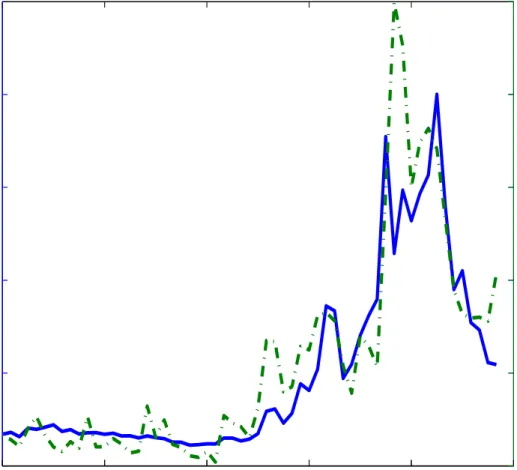
We capture the predictable components of hedge fund leverage by various aggregate market price variables, which we summarize in Appendix B. We graph two of these variables in Fig. 1.. We plot the average cost of protection from a default of major “investment banks” (Bear Stearns, Citibank, Credit Suisse, Goldman Sachs, HSBC, JP Morgan, Lehman Brothers, Merrill Lynch, and Morgan Stanley) computed using credit default swap (CDS) contracts in the solid line with the scale on the left-hand axis. This is the market-weighted cost of protection per year against default of each firm. Our selected firms are representative of broker/dealers and investment banking activity and we refer to them as investment banks even though many of them are commercial banks and some became commercial banks during the sample period.
In Fig. 1. we also plot the VIX volatility index in the dotted line with the scale on the right-hand axis. The correlation between VIX and investment bank CDS protection is 0.89. Both of these series are low at the beginning of the sample and then start to increase in mid-2007, which coincides with the initial losses in subprime mortgages and other certain securitized markets. In late 2008, CDS spreads and VIX increase dramatically after the bankruptcy of Lehman Brothers, with VIX reaching a peak of 60% at the end of October 2008 and the CDS spread reaching 3.55% per annum in September 2008. In 2009, both CDS and VIX decline after the global financial sector is stabilized.
Our other macro series are monthly returns on investment banks, monthly returns on the S&P 500, the three-month LIBOR rate, and the three-month Treasury over Eurodollar (TED) spread. The LIBOR and TED spreads are good proxies for the aggregate cost of short-term borrowing for large financial institutions. Prime brokers pass on at least the LIBOR and TED spread costs to their hedge fund clients plus a spread. Finally, we also include the term
spread, which is the difference between the 10-year Treasury bond yield and the yield on three-month T-bills. This captures the slope of the yield curve, which under the Expectations Hypothesis is a forward-looking measure of future short-term interest rates and thus provides a simple way of estimating future short-term borrowing costs.
3.2. Hedge Fund Data
Our hedge fund data are obtained from a large fund-of-hedge-funds (which we refer to as the “Fund”). The original data set from the Fund contains over 45,000 observations of 758 funds from February 1977 to December 2009. In addition to hedge fund leverage, our data include information on the strategy employed by the hedge funds, monthly returns, NAVs, and AUMs. The hedge funds are broadly representative of the industry and contain funds managed in a variety of different styles including global macro funds, fundamental stock-picking funds, credit funds, quantitative funds, and funds investing using technical indicators. The hedge funds invest both in specific asset classes, for example, fixed income or equities, and also across global asset classes. Our data include both U.S. and international hedge funds, but all returns, NAVs, and AUMs are in U.S. dollars.
An important issue is whether the hedge funds in the database exhibit a selection bias. In particular, do the hedge funds selected by the Fund have better performance and leverage management than a typical hedge fund? The Fund selects managers using both a “top down” and a “bottom up” approach. The former involves selecting funds in various sector alloca-tion bands for the Fund’s different fund-of-funds portfolios. The latter involves searching for funds, or reallocating money across existing funds, using a primarily qualitative, propri-etary approach. Leverage is a consideration in choosing funds, but it is only one of many factors among the usual suspects—Sharpe (1992) ratios and other performance criteria, due diligence considerations, network, manager quality, transparency, gates and restrictions, sec-tor composition, investment style, etc. The Fund did not add leverage to its products and only very rarely asked hedge funds to provide a customized volatility target or to provide leverage which differed from the hedge funds’ existing product offerings. There is no reason
to believe that the Fund’s selection procedure results in funds with leverage management practices that are significantly different to the typical hedge fund.
Our Fund database includes funds that are present in TASS, CISDM, Barclay Hedge, or other databases commonly used in research and also includes other funds which do not report to the public hedge fund databases. This mitigates the reporting bias of the TASS database (see Malkiel and Saha, 2005; Ang, Rhodes-Kropf, and Zhao, 2008; Agarwal, Fos, and Jiang, 2010). However, the composition by sector is similar to the overall sector weighting of the industry as reported by TASS and Barclay Hedge. Survival biases are mitigated by the fact that often hedge funds enter the database not when they receive funds from the Fund, but several months prior to the Fund’s investment and they often exit the database several months after disinvestment. Our database also includes hedge funds which terminate due to poor performance. The aggregate performance of the Fund is similar to the performance of the main hedge fund indexes.
3.2.1. Hedge Fund Leverage
Leverage is reported by different hedge funds at various frequencies and formats, which are standardized by the Fund. Appendix C discusses some of these formats. Most reporting is at the monthly frequency, but some leverage numbers are reported quarterly or even less frequently. For those funds reporting leverage at the quarterly or at lower frequencies, the Fund is often able to obtain leverage numbers directly from the hedge fund managers at other dates through a combination of analyst site visits and calls to hedge fund managers. The data are of high quality because the funds undergo thorough due diligence by the Fund. In addition, the performance and risk reports are audited, and the Fund conducts regular, intensive monitoring of the investments made in the individual hedge funds.
3.2.2. Hedge Fund Returns, Volatilities, and Flows
We have monthly returns on all the hedge funds. These returns are actual realized returns, rather than returns reported to the publicly available databases. In addition to examining
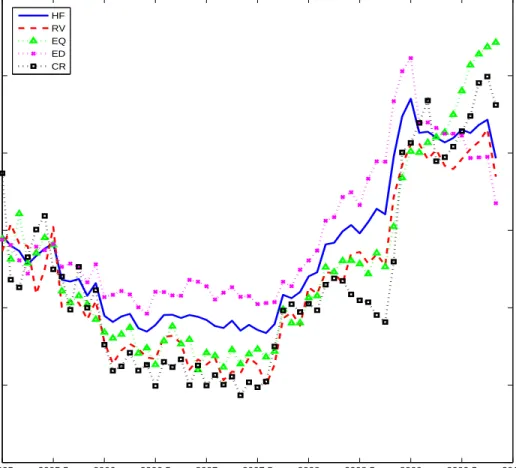
the relation between past returns and leverage, we construct volatilities from the returns. We construct monthly hedge fund volatility using the sample standard deviation of returns over the past 12 months. Fig. 2. plots the volatilities of all hedge funds and different hedge fund strategies over the sample. The volatilities follow the same broad trend and are approximately the same. This is consistent with hedge funds using leverage to scale returns to similar volatility levels.
Fig. 2. shows that at the beginning of the sample, hedge fund volatilities were around 3% per month and reach a low of around 2% per month in 2006. As subprime mortgages start to deteriorate in mid-2007, hedge fund return volatility starts to increase and reaches 4–5% per month by 2009. Volatility stays at this high level until the end of the sample in October 2009. This is because we use rolling 12-month sample volatilities which include the very volatile, worst periods of the financial crisis 12 months prior to October 2009.
Fig. 3. compares the rolling 12-month volatilities of hedge fund returns in the data sam-ple with the rolling 12-month volatilities of hedge fund returns in the Hedge Fund Research, Inc. (HFR) database for the December 2004 – October 2009 time period. We observe that the average volatilities of hedge funds in the data closely track the median hedge fund volatility in the HFR database. Thus, the Fund’s hedge funds have very similar return behavior as the typical hedge fund reported on the publicly available databases. Since hedge funds often use leverage to target particular levels of volatility, this partially alleviates concerns that the Fund’s hedge funds have atypical leverage policies.
In addition to hedge fund volatility, we also use hedge fund flows as a control variable. We construct hedge fund-level flows over the past three months using the return and AUM information from the following formula:
F lowt=
AUMt
AUMt−3
−(1 +Rt−2)(1 +Rt−1)(1 +Rt), (1) whereF lowt is the past three-month flow in the hedge fund, AUMt is assets under man-agement at timet,andRtis the hedge fund return fromt−1tot.The flow formula in Eq. (1) is used by Chevalier and Ellison (1997), Sirri and Tufano (1998), and Agarwal, Daniel, and Naik (2009), among others. We compute three-month flows, as the flows over the past
month tend to be very volatile. We also compute past three-month hedge fund flows for the aggregate hedge fund industry as measured by the Barclay Hedge database using Eq. (1).
3.3. Summary Statistics
We clean the raw data from the Fund and impose two filters. First, often investments are made by the Fund in several classes of shares of a given hedge fund. All of these share classes have almost identical returns and leverage ratios. We use the share class with the longest history or the share class representing the largest AUM. Our second filter is that we require funds to have at least two years of leverage observations. The final sample spans December 2004 to October 2009 and thus, our sample includes the poor returns of quantitative funds during Summer 2007 (see Khandani and Lo, 2007) and the financial crisis of 2008 and early 2009. There are at least 63 funds in our sample at any one time. The maximum number of funds at any given month is 163 over the sample period.
Panel A of Table 2 lists the number of observations and number of hedge funds broken down by strategy. The strategies are defined by the Fund and do not exactly correspond to the sector definitions employed by TASS, Barclay Hedge, CISDM, or other hedge fund databases (which themselves employ arbitrary sector definitions). The TASS categories of fixed income arbitrage and convertible arbitrage fall under the Fund’s relative value sector. In the relative value sector, hedge funds invest in both developed and emerging markets and can also invest in a variety of different asset classes. Most of the Fund’s investments have been in long-short equity funds in the equity category and this is also by far the largest hedge fund sector in TASS, as reported, for example, by Chan et al. (2007). At the last month of our sample, October 2009, the proportion of equity funds reported in Barclay Hedge, not including multi-strategy, other, and sector-specific categories, is also over 40%.
After our data filters, there are a total of 208 unique hedge funds in our sample with 8,136 monthly observations. Over half (114) of the funds in our sample run long-short equity strategies. The number of funds in the areas of credit and relative value are 21 and 36, respectively. The remaining 37 funds are in the event driven strategy, which are mainly
merger arbitrage and distressed debt. The number of funds reported in Panel A of Table 2 is large enough for reliable inference when averaged across strategies and across all hedge funds.11
In Panel B of Table 2, we report summary statistics of all the hedge fund variables ob-served in the sample. These statistics should be carefully interpreted because they do not sample all hedge funds at the same frequency and there are missing observations in the raw data. Panel B reports that the average gross leverage across all hedge funds is 2.13 with a volatility of 0.62. This volatility is computed using only observed data and the true volatility of leverage, after estimating the unobserved values, will be lower, as we show below. Nev-ertheless, it is clear that hedge fund leverage changes over time. Even without taking into account missing observations, this volatility is much lower than the volatility of leverage reported in the estimations of McGuire and Tsataronis (2008) using factor regressions. This discrepancy could possibly result from the large error in their procedure of inferring leverage from estimated factor coefficients in regressions on short samples. Individual gross hedge fund leverage is also persistent, with an average autocorrelation of 0.68 across all the hedge funds. Again because of unobserved leverage ratios, this persistence is biased downwards and we report more accurate measures of autocorrelation taking into account other predictive variables below.
Panel B of Table 2 also reports the summary statistics for the other two leverage mea-sures. The average net leverage of hedge funds is 0.59 and average long-only leverage is 1.36. The raw volatilities of net leverage and long-only leverage are 0.28 and 0.38, respectively, which are significantly lower than the volatility of gross leverage. Thus, in our analysis, we break out gross, net, and long-only leverage separately.
The other variables reported in Panel B of Table 2 are control variables used in our analysis. The average hedge fund return is 29 basis points per month. These returns are autocorrelated, with an average autocorrelation of 0.24 across funds, which indicates that out- or under-performing manager returns are persistent, as noted by Getmansky, Lo, and
11The sample also includes commodity trading funds and global macro funds, but we do not break out
Makarov (2004) and Jagannathan, Malakhov, and Novikov (2010). The returns are lower than those reported by previous literature because our sample includes the financial crisis during which many hedge funds did poorly.12 The average 12-month rolling volatility across hedge funds is 2.65% per month. The volatility is computed only when all fund returns in the previous 12 months are observed. This explains why only approximately 70% of fund volatilities are observed. Nevertheless, our volatility estimates are close to those reported in the literature by Ackermann, McEnally, and Ravenscraft (1999) and Chan et al. (2007), among others.
The last two fund-specific variables we include are past three-month hedge fund flows and log AUMs. Flows are on average positive, at 2.2% per month and exhibit a large av-erage autocorrelation of 0.62. The avav-erage fund size over our sample is $962 million. The median fund size is $430 million. The difference between mean and median of fund size is explained by the presence of some large funds, with the largest funds having AUMs well over $10 billion in just one share class. Our sample is slightly biased upwards in terms of size compared to recent estimates such as those by Chan et al. (2007) and the Banque de France (2007). This is due to the application of filters which tend to remove smaller funds which are effectively different share classes of larger funds. Our filters also remove funds which are in their infancy. These funds are likely to have lower levels of leverage, with more onerous financing conditions, than more established funds, making the levels of our leverage ratios conservatively biased upwards.
The last column in Panel B, Table 2 lists the proportion of months across all funds where the variables are observed. While we always observe returns, the leverage variables are observed approximately 80% of the time. We do not restrict our analysis to a special subset of data where all variables are observed. Instead, our algorithm permits us to use all the available data and to infer the leverage ratios when they are missing. We now discuss our estimation methodology.
12See, among many others, Fung and Hsieh (1997, 2001), Brown, Goetzmann, and Ibbotson (1999), and
4. Methodology
4.1. Predictive Model
We specify that leverage over at montht+ 1for fundi,Li,t+1, is predictable at timetby
both economy-wide variables,xt, and fund-specific variables, which we collect in the vector
yi,t, in the linear regression model:13
∆Li,t+1 =ci+γ·xt+ρ·yi,t+εi,t+1, (2)
where ∆Li,t+1 = Li,t+1 − Li,t is the change in fund i leverage from t to t+ 1, γ is the vector of predictive coefficients on economy-wide variables,ρ is the vector of coefficients on fund-specific variables, and the idiosyncratic errorεi,t+1 ∼ N(0, σ2)is independent and
identically distributed (i.i.d.) across funds and time. The set of firm-specific characteristics,
yi,t,includes lagged leverage,Li,t, which allows us to estimate the degree of mean reversion of the leverage employed by funds. We capture fund-fixed effects in the constantsci which differ across each fund.
We estimate the parametersθ = (ciγ ρ σ
2
)using a Bayesian algorithm which also per-mits estimates of non-observed leverage and other fund-specific variables. Appendix D contains details of this estimation. Briefly, the estimation method treats the non-reported variables as additional parameters to be inferred along withθ. As an important byproduct, the estimation supplies posterior means of leverage ratios where these are unobserved in the data. We use these estimates, combined with the observed leverage ratios, to obtain time-series estimates of aggregate hedge fund leverage and leverage for each sector. Since we use uninformative priors, the special case where both the regressors and regressands in Eq. (2) are all observed in the data is equivalent to running standard ordinary least squares (OLS) regression.
An advantage of our procedure is that we are able to use all observations after imposing the data filters. Using OLS would result in very few funds and observations because both
13 We also investigate the forecastability of proportional leverage changes,∆L
i,t+1/(1 +Li,t), in the same
the complete set of regressors and the regressand must be observed. Taking only observed leverage produces a severely biased sample as different types of funds report at quarterly or lower frequencies versus the monthly frequency. Sudden stops in leverage reporting corre-late with unexpected bad performance. Linearly interpolating unobserved leverage produces estimates that are too smooth because it relies on filling in points based on the mean rever-sion properties of leverage alone. We show below that other variables significantly predict leverage, both in the time series and cross-section.
4.2. Contemporaneous Model
The model in Eq. (2) is a predictive model where leverage over the next period is fore-castable by macro and fund-specific variables at the beginning of the period. We consider an alternative model where leverage is determined contemporaneously with instruments:
Li,t =ci+γ·xt+ρ·yi,t+ǫi,t, (3)
where we use the same set of macro variables inxt as in the predictive model (2), but we now assume that the fund-specific variables,yi,t,do not include lagged leverage.
In Eq. (3), the potential observable determinants of leverage like VIX, interest rate spreads, hedge fund flows, etc. inxt andyi,t are persistent. The unobserved determinants, which are in the error termǫi,t, are also likely to be persistent so we specify that the errors are serially correlated and follow
ǫt =φǫǫt−1+vt, (4)
where vt ∼ i.i.d. N(0, σ
2
). It can be shown that accounting for the persistence in the regressands in Eq. (3) through VAR or autoregressive specifications produces a reduced-form model of the same reduced-form as Eq. (2), except without a lagged leverage term. The relation between Eq. (2) and (3) involves the persistence of the regressands and the strength of the serial correlation, φǫ, of the error terms. Appendix D describes the estimation of the contemporaneous system and compares it with the predictive model.
The contemporaneous model (3) can be used to test various theories on the determinants of hedge fund leverage. It is important to note, however, that Eq (3) is not a structural model. Many of the fund-specific variables, and perhaps some of the macro variables, are jointly endogenously determined with hedge fund leverage. Put another way, while Eq. (3) can shed light on contemporaneous correlations between hedge fund leverage and various instruments, it is silent on causation. We can expect that some variables that are contemporaneously associated with hedge fund leverage in Eq. (3) can have the opposite sign when used as a predictor of hedge fund leverage in Eq. (2). Some of this can be due to the effect of the serially correlated errors in the contemporaneous specification or that the contemporaneous vs. predictive relations between certain variables and leverage are indeed different.
5. Empirical Results
5.1. Time Series of Leverage
5.1.1. Gross Leverage
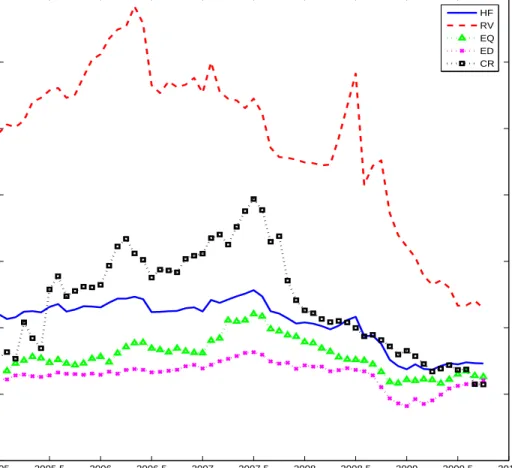
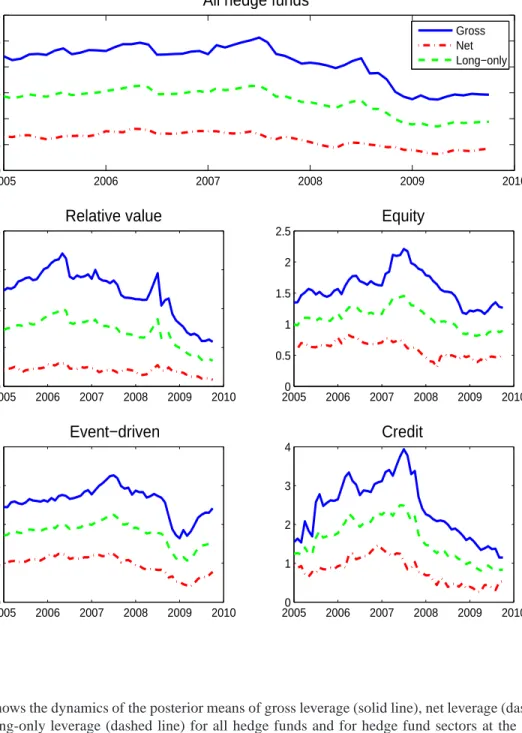
We begin our analysis by presenting the time series of gross leverage of hedge funds. This is obtained using the model in Eq. (2) with all macro and fund-specific variables and fund-fixed effects. We graph gross hedge fund leverage for all hedge funds and the hedge fund sectors in Fig. 4.. We report the posterior mean of gross leverage across all hedge funds in the solid line. Gross leverage is stable at approximately 2.3 until mid-2007 where it starts to decrease from 2.6 in June 2007 to a minimum of 1.4 in March 2009. At the end of our sample, October 2009, we estimate gross leverage across hedge funds to be 1.5. Over the whole sample, average gross leverage is 2.1. As expected from the fairly smooth transitions in Fig. 4., gross leverage is very persistent with an autocorrelation of 0.97.
The patterns of gross leverage for all hedge funds are broadly reflected in the dynamics of the leverage for hedge fund sectors, which are also highly persistent with correlations well above 0.95. Leverage for event-driven and equity funds is lower, on average, at 1.3 and 1.6, respectively, than for all hedge funds, which have an average gross leverage of 2.1 over the
sample. Both the event-driven and equity sectors reach their highest peaks of gross leverage in mid-2007 and gradually decrease their leverage over the financial crisis. Event-driven leverage falls below one and reaches a low of 0.8 in December 2008 before rebounding. Credit funds steadily increase their gross leverage from 1.5 at the beginning of 2005 to reach a peak of 3.9 at June 2007. This decreases to 1.1 at the end of the sample.
Fig. 4. shows that the most pronounced fall in leverage is seen in the relative value sector: relative value gross leverage reaches an early peak of 6.8 in April 2006 and starts to cut back in early 2006. This is well before the beginning of the deterioration in subprime mortgages in 2007. In December 2007, gross leverage in relative value funds falls to 4.5 and decreases slightly until a sharp increase over April to June 2008 to reach a local high of 5.8 in June 2008. These periods coincide with increasing turbulence in financial markets after the purchase of Bear Stearns by JP Morgan Chase in March 2008 and the illiquidity of many securitized asset markets.14 The increasing leverage in early 2008 in relative value is not due to any one fund; several large funds in the database exhibit this behavior and, in general, the leverage of all relative value funds over the financial crisis is volatile. From June 2008 gross leverage of the relative value sector decreases from 5.8 to 2.3 at October 2009. Over the whole sample, relative value gross leverage is 4.8.
5.1.2. Dispersion of Gross Leverage
While Fig. 4. shows the average hedge fund leverage, an open question is how the cross-section of leverage changes over time. We address this in Fig. 5. which plots the median and the cross-sectional interquartile range (25th and 75th percentiles) of gross leverage. The cross-sectional distribution of all leverage measures does change, but is fairly stable across
14 Relative value strategies (e.g., capital structure arbitrage and convertible bond arbitrage) tend to be more
sensitive to the relative relation between securities and asset classes than credit, equity, and event-driven strate-gies, which tend to be based more on single-security fundamentals. When markets showed signs of normalizing after the Bear Stearns takeover in March 2008, many relative value strategies were quick to reapply leverage to take advantage of the stabilized and converging valuations. This period of improved market conditions was brief as new financial sector shocks occurred during the Summer of 2008, at which time relative value managers quickly brought leverage down.
the sample. Since there are some funds with very large leverage in our sample, the median falls closer to the 25th percentile than to the 75th percentile for all the leverage ratios. During 2005 to early 2007, the interquartile range for gross hedge fund leverage stays in the range 1.0 to 1.3. During mid-2007, the interquartile cross-sectional dispersion increases to 1.6 in May 2007 and then falls together with the overall decrease in leverage during this period. Interestingly, the largest decline in leverage in 2008 during the financial crisis is not associ-ated with any significant change in the cross-section of hedge fund leverage. In summary, although hedge fund leverage is heterogeneous, the cross-sectional pattern of hedge fund leverage is fairly stable and in particular, does not significantly change in 2008 when the overall level of leverage is declining.
5.1.3. Gross vs. Net and Long-only Leverage
In Fig. 6. we plot gross, net, and long-only leverage across all hedge funds (top panel) and for hedge fund sectors (bottom four panels). The lines for gross leverage are the same as Fig. 4. and are drawn so we can compare net and long-only leverage. Fig. 6. shows that the three leverage measures, for all hedge funds and within the hedge fund sectors, are highly correlated and have the same broad trends. Table 3 reports correlations of the gross, net, and long-only leverage and they are all high. In particular, gross, net, and long-only leverage all have pairwise correlations above 0.92 in Panel A.
Panel B of Table 3 reports the correlations of gross, net, and long leverage for the hedge fund sectors. If there are no independent active short bets, then the correlations of all lever-age measures should be one. Thus, we can infer the extent of the separate manlever-agement of long and short positions by examining the correlations between gross and net leverage. The correlation of net and gross leverage is lowest for equity hedge funds, at 0.49, and above 0.80 for the other hedge fund sectors. This is consistent with funds in the equity sector most actively separately managing their long and short bets. In contrast, the highest correlation between net and gross leverage is 0.88 for relative value funds, which indicates these funds are most likely to take positions as long-short pairs.
One difference between the leverage measures in Fig. 6. is that the net and long-only leverage ratios are smoother than gross leverage. For all hedge funds the standard deviation of gross leverage is 0.36, whereas the standard deviations for net and long leverage are 0.14 and 0.25, respectively. Thus, hedge funds manage the leverage associated with active long and short positions in different ways. This pattern is also repeated in each of the hedge fund sectors. The largest difference in the volatility of gross leverage compared to net leverage is for relative value, where gross and net leverage standard deviations are 1.22 and 0.20, respectively. The mean of net leverage for relative value is also much lower, at 0.82, than the average level of gross leverage at 4.84. The low volatility of net leverage for relative value funds is consistent with these funds maintaining balanced long-short positions where a large number of their active bets consist of taking advantage of relative pricing differentials between assets. The stable and low net leverage for relative value funds could also imply that focusing on gross leverage overstates the market risk of this hedge fund sector.
An interesting episode for equity hedge funds is the temporary ban on shorting financial stocks which was imposed in September 2008 and repealed one month later (see Boehmer, Jones, and Zhang, 2009, for details). Equity hedge fund leverage was already trending down-wards prior to this period beginning in mid-2007 and there is no noticeable additional effect in September or October 2008 for gross leverage or long-only leverage. However, Fig. 6. shows there is a small downward dip in net leverage during these months with net leverage being 0.48, 0.44, and 0.50 during the months of July, September, and October 2008, respec-tively. Thus, this event seems to affect the short leverage positions of equity funds, but the overall effect is small. This could be because the ban affected only the financial sector or because these hedge funds were able to take offsetting trades in derivatives markets or other non-financial firms to maintain their short positions.
Finally, we observe a high level of covariation for net and long-only leverage in Fig. 6. across all hedge funds and within sectors. This is similar to the high degree of comovement of gross leverage across sectors in Fig. 4.. We report correlations for all hedge funds and across sectors for each leverage measure in Table 4. These cross correlations are high indicating that each leverage measure generally rises and falls in tandem for each hedge fund sector.
In particular, Panel A shows that although the relative value sector contains the smallest number of funds, the correlation of gross leverage of relative value with all hedge funds is 0.93. The lowest correlation is between relative value and event driven, at 0.65. Put another way, looking at gross leverage across all hedge funds is a good summary measure for what is happening to gross leverage in the various hedge fund sectors. Panels B and C also show that this is true for net and long-only leverage. Thus, sector-level variation in hedge fund leverage is similar to the aggregate-level behavior of leverage across all hedge funds.
5.2. Macro Predictors of Hedge Fund Leverage
In this section, we discuss the ability of various macro and fund-specific variables to predict hedge fund leverage. We first report estimates of the predictive model in Eq. (2) taking only economy-wide variables and report the results in Table 5. We consider gross leverage in Panel A, net leverage in Panel B, and long-only leverage in Panel C. In all re-gressions we include lagged leverage as an independent variable. Rere-gressions (1)–(8) add each macro variable one at a time together with lagged leverage, while all variables jointly enter regression (9). We use fund-level fixed effects in all regressions. In each panel, the coefficients on lagged leverage are negative with very high posterior t-statistics. The lagged leverage coefficients range from -0.20 to -0.31 indicating that hedge fund leverage is strongly mean-reverting.
Panel A, which reports results for gross leverage, shows that all the macro variables, with the exception of aggregate hedge fund flows, significantly predict changes in hedge fund leverage when used in conjunction with past leverage. The largest coefficient in magnitude is on investment bank CDS protection, where for a 1% increase in CDS spreads, next-month hedge fund leverage shrinks by 11.5%, on average. As investment banks perform well (re-gression (2)) or the S&P 500 posts higher returns (re(re-gression (3)), hedge fund leverage tends to increase next month. We observe that when volatility increases, as measured by VIX (regression (4)), or assets become riskier, as measured by the TED spread (regression (6)), hedge fund leverage tends to decrease over the next month. This is consistent with hedge
funds targeting a specific risk profile of their returns, where an increase in the riskiness of the assets leads to a reduction in their exposure. In particular, a 1% movement in VIX pre-dicts that gross leverage declines by 0.9% over the next month and a 1% increase in the TED spread predicts gross leverage will fall over the next month by 15.2%.
In regression (5), the sign on LIBOR is unexpectedly positive. We might expect increases in funding rates, of which LIBOR should be a large component, to decrease future leverage. Instead, the coefficient on LIBOR is positive at 4.35. This is surprising given that Fig. 4. shows that hedge fund leverage decreases before and during the financial crisis. However, in the joint regression (9), the coefficient on LIBOR flips sign and is now negative at -6.66. Thus, controlling for other variables, which are significantly correlated especially over the 2007–2009 period, produces the expected negative relation between LIBOR and future leverage changes. In fact, LIBOR, the TED spread, CDS spreads, and VIX are very highly correlated, all around 90%, and capture common effects associated with the financial crisis over the sample period. Thus, it is not surprising that the coefficient on VIX also becomes insignificant in the joint regression (9). In contrast, the term spread coefficients are consistently negative as expected, which implies that higher expected funding costs reduce leverage next period.
In regression (9), where we take all macro variables together, the predictors of hedge fund leverage which have posterior t-statistics greater than two in absolute value are investment bank CDS spreads, the lagged S&P 500 return, LIBOR, and the term spread. Increases in current funding costs, as measured by CDS spreads and LIBOR predict decreases in leverage, as do increases in future expected funding costs, as measured by the term spread.
In Panels B and C of Table 5, we report estimates of the same regressions for net and long-only leverage. In Panel B, all the coefficients on the macro variables are significant in the bivariate regressions (1)–(8), with the same signs as Panel A for gross leverage but with smaller magnitudes. However, there are no significant macro predictors of net leverage in the joint regression (9). Thus, overall net leverage is mostly determined only by its lagged value. Said differently, the only significant distinguishing feature of net leverage predictability is that it is highly mean-reverting. In Panel C, long-only leverage is significantly predicted by
each individual macro variable in regressions (1)–(8) with the same signs as gross leverage in Panel A. The last column in Panel C for regression (9) reports that increases in the cost of investment bank CDS protection and the term spread significantly lower future long leverage. This indicates that most of the predictability in gross leverage by macro determinants in Panel A is coming from the predictability of long-only leverage by macro variables.
5.3. Fund-specific Predictors of Hedge Fund Leverage
In Table 6 we examine the ability of fund-specific variables to predict hedge fund lever-age. All the regressions in Table 6 include the macro predictors used in Table 5 which are not reported as they have the same signs, same significance levels, and approximately the same magnitudes, as the coefficients reported in the macro-only regressions of Table 5.
The main surprising result of Table 6 is that, with one exception, all of the fund-specific variables have insignificant coefficients. This is for both the case of the bivariate regressions (1)–(4), where the fund-specific variables are used together with past leverage, and in the case of the joint regression (5). This occurs for all three measures of leverage in Panels A-C. Moreover, the adjusted R2
s of the macro-only specifications in Table 5 are almost identi-cal to their counterparts in the fund-specific variable specifications in Table 6. This finding suggests that hedge funds exhibit a high degree of similarity in their leverage exposures that depends largely only on the aggregate state of the economy. Said differently, predictable changes in hedge fund leverage are mostly systematic and there are few fund-level idiosyn-cratic effects.15
The only fund-specific variable that has a posterior t-statistic larger than two is hedge fund return volatility. In Panel A for gross leverage, this variable has a coefficient of -1.41 in the joint regression (5) with a posterior t-statistic of -2.11. The bivariate regression (2) also has a similar coefficient on fundspecific volatility of 1.34 with a posterior tstatistic of
-15 Our filters remove young hedge funds which tend to be smaller and tend to have higher funding costs.
Thus, our data filters could account for the lack of a relation between AUM and hedge fund leverage. The lack of a relation between past flows and leverage can be due to notice period, lockups, and gates restrictions (see, for example, Ang and Bollen, 2010), which give managers advance notice of flows before they actually occur.
1.93. In the deleveraging cycles of Brunnermeier and Pedersen (2009) and others, fund return volatility affects margins and since margins correspond to limits in leverage, increases in fund return volatility should lead to lower leverage levels of hedge funds. Thus, our findings confirm the prediction of Brunnemeier and Pedersen of a significantly negative coefficient on return volatility. This is essentially the only significant fund-specific effect and it occurs only for gross leverage.
5.4. Contemporaneous Relations with Hedge Fund Leverage
We now investigate the contemporaneous relations of gross leverage in the model in Eq. (3) with macro and fund-specific variables. Table 7 reports the regression coefficients of the contemporaneous model (3) and compares them with the predictive model (2), which are identical to regression (9) of Table 5 for the macro-only predictors and regression (5) of Table 6 for the fund-specific predictors.
The contemporaneous model has significantly lower adjusted R2
s than the predictive model, at 0.08 vs. 0.13 for the macro-only system and 0.09 vs. 0.13 for the fund-specific variable system. Thus, the fit of the contemporaneous model without lagged leverage is worse than the predictive system with lagged leverage. Hence, the lagged leverage coeffi-cient is an extremely important predictor. The contemporaneous model does have signifi-cantly autocorrelated error terms, with estimates ofφǫ of 0.25 and 0.55 for the macro-only and fund-specific variable cases, respectively. As a specification check, we compute the au-tocorrelation of error terms in the predictive specification. This turns out to be 0.03. Thus, absorbing the persistence of leverage by past leverage on the right-hand side (RHS) absorbs most of the serial correlation effects—when lagged leverage is included as a regressor, there seems to be little gained by making the error terms autocorrelated.
Table 7 shows two major differences in sign between the predictive model coefficients and the contemporaneous determinants of leverage in the macro-only specification. First, the coefficient on the S&P 500 return is positive at 0.67 in the predictive model and negative at -0.94 in the contemporaneous model. As the stock market increases, leverage
contempora-neously decreases—by definition, as asset values increase. But, higher stock returns in the past forecast that hedge fund leverage will increase in the future.
Second, the coefficient on LIBOR is contemporaneously positive, at 3.44, but insignifi-cant, in the contemporaneous model compared to a significantly negative coefficient of -6.66 in the predictive model. We expect the coefficient to be negative, which it is in the predictive regression. The unexpected positive sign in the contemporaneous model could be due to lack of power or the fact that true funding costs could have much shorter duration and be more variable than LIBOR. The LIBOR interest rate is, of course, a valid predictor even though it could be an inferior instrument to proxy for leverage costs in a contemporaneous model.
The coefficient on VIX and on aggregate hedge fund flows have the same sign in the predictive and contemporaneous systems, but while their effects are statistically insignificant in predicting hedge fund leverage, they are significantly contemporaneously correlated. In the contemporaneous model, VIX has a coefficient of 1.43 with a posterior tstatistic of -4.79. When VIX increases, it is well-known that asset prices fall (the leverage effect), which accounts for the negative contemporaneous coefficient. This finding is also consistent with the prediction of Fostel and Geanakoplos (2008), among others, where leverage decreases during times of high volatility. It is also consistent with hedge funds increasing (decreasing) leverage during less (more) volatile times to achieve a desired target level of volatility. As a predictor, the forecasting ability of VIX for future leverage is largely subsumed by lagged leverage as a regressor. The finding that aggregate hedge fund flows are contemporaneously correlated with hedge fund leverage goes against Stein (2009), who predicts that the entry of new capital should decrease the leverage of arbitrageurs.
The last two columns of Table 7 report coefficients for fund-specific variables for the predictive and contemporaneous systems, where both estimations control for the macro vari-ables. The results are similar. The only significant variable in both cases is the fund’s rolling 12-month volatility of returns. The effect, however, is much stronger contemporaneously (with a coefficient of -4.35 and a posterior t-statistic of -2.35) compared to the predictive model (with a coefficient of -1.41 with a posterior t-statistic of -2.11). While the negative forecasting ability of fund-specific volatility for future leverage is consistent with
delever-aging cycle models, the contemporaneous relation is even stronger. Like the effect of VIX, this can be a reflection of the leverage effect, but it is also consistent with hedge funds using leverage to target a desired level of volatility.
5.5. Hedge Fund Leverage vs. Finance Sector Leverage
In this section we compare hedge fund leverage to the leverage of listed financial com-panies. We focus on aggregate gross hedge fund leverage, but our previous results show that the net and long-only leverage ratios exhibit similar patterns both for all hedge funds and within hedge fund sectors. We define the leverage of listed firms as the value of total assets divided by market value, that is, we study market leverage. Other authors studying the leverage of financial institutions like Adrian and Shin (2009, 2010), among others, use book leverage rather than market leverage. We use market leverage because the market eq-uity value is closest to the NAV of a hedge fund (see Appendix A). We compare hedge fund leverage to the leverage of banks, investment banks, and the entire finance sector, which we describe in more detail in Appendix B.16
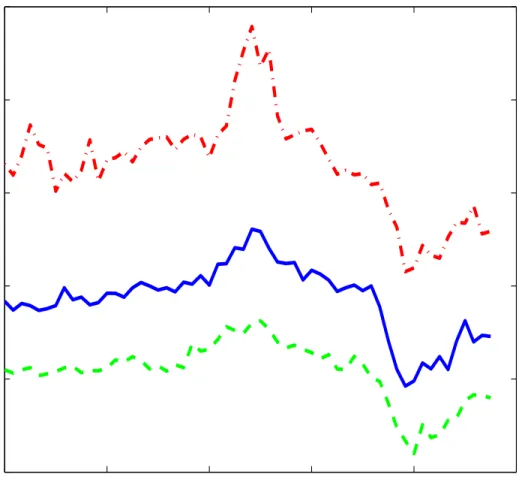
Fig. 7. plots the average level of gross hedge fund leverage in the solid line using the left-hand scale and plots the leverage of the financial sectors in various dashed lines on the right-hand scale. The level of gross hedge fund leverage is the same as in Fig. 4. and starts to decline in mid-2007. Gross hedge fund leverage is modest, between 1.5 and 2.5, compared to the leverage of listed financial firms: the average leverage of investment banks and the whole finance sector over our sample are 14.2 and 9.4, respectively. Fig. 7. shows that leverage in each of the banking and investment banking subsectors and the whole finance sector are highly correlated. Finance sector leverage starts to rise when hedge fund leverage starts to fall in 2007, continues to rise in 2008, and then shoots up in early 2009 before reverting back to more normal levels in late 2009. This counter-cyclical behavior of financial leverage,
16He, Khang, and Krishnamurthy (2010) contrast the behavior of commercial and investment bank leverage
and show they are different. However, many investment banks were either acquired or became commercial banks during the financial crisis. Since our focus is on hedge fund leverage, we choose to contrast hedge fund leverage with the leverage of all of these institutions.