SDN Workload Balancing and QoE Control in Next Generation
Network Infrastructures
Sapienza Università di Roma
Facoltà di Ingegneria dell’Informazione, Informatica e Statistica
Dipartimento di Ingegneria Informatica, Automatica e Gestionale Antonio Ruberti
Dottorato di Ricerca in Automatica, Bioingegneria e Ricerca Operativa
Curriculum in Automatica XXX Ciclo – Triennio 2014-2017 Candidato Federico Cimorelli Matricola 1245432 Tutor
Prof. Francesco Delli Priscoli
Coordinatore
2
PhD thesis, Sapienza University on RomeVersion: 10 January 2018
4
Abstract
The increasing demand of bandwidth, low latency and reliability, even in mobile scenarios, has pushed the evolution of the networking technologies to satisfy new requirements of innovative services. Flexible orchestration of network resources is increasingly being investigated by the research community and by the service operator companies as a mean to easily deploy new remunerative services while reducing capital expenditures and operating expenses. In this regard, the Future Internet initiatives are expected to improve state of the art technologies by developing new orchestrating platforms based on the most prominent enabling technologies, namely, Software Defined Network (SDN) orchestrated Network Function Virtualization (NFV) infrastructure. After introducing the fundamental of the Next Generation Network, formalized as the conceptual Future Internet Platform architecture, the reference scenarios and the proposed control frameworks are given. The thesis discusses the design of two resources management framework of such architecture, targeted, respectively, (i) at the balancing of SDN Control traffic at the network core and (ii) at the user Quality of Experience (QoE) evaluation and control at the network edge. Regarding the first framework, to address the issues related with the adoption of a logically centralized but physically distributed SDN control plane, a discrete-time, distributed, non-cooperative load balancing algorithm is proposed, based on game theory and converged to a specific equilibrium known as Wardrop equilibrium. Regarding the QoE framework, a cognitive approach is presented, aimed at controlling the Quality of Experience (QoE) of the end users by closing the loop between the provided QoS and the user experience feedbacks parameters. QoE Management functionalities are aimed at approaching the desired QoE level exploiting a mathematical model and methodology to identify a set of QoE profiles and an optimal and adaptive control strategy based on a Reinforcement Learning algorithm. For both the proposed solutions, simulation and proof-of-concept implementation results are presented and discussed, to highlight the correctness and the effectiveness of the proposed solutions.
Keywords- Software Defined Networks, Load balancing, Wardrop equilibrium, Quality of Experience (QoE); User profiling, Reinforcement Learning.
5
Acknowledgment
I gratefully acknowledge my supervisor Prof. Francesco Delli Priscoli, for the opportunity he gave me to research and work on the thesis topics during the last four years, and in particular for the opportunity to work in national and European projects taking advantage from the collaboration with expert from both industry and academic sectors. I further thank the coordinator of the PhD program Prof. Salvatore Monaco, Professors and PhD colleagues, in particular, Prof. Antonio Pietrabissa, Dr. Letterio Zuccaro and Dr. Raffaele Gambuti for all the fruitful discussions on the main topics reported in this thesis. I further thank all my colleagues at the Network Control Lab, Vincenzo, Silvia, Francesco, Martina, Federico, Alessandro and Lorenzo for their valuable support during these years.
Rome, December 2017 Federico Cimorelli
6
Contents
Abstract
... 4
Acknowledgment
... 5
List of Figure
... 8
List of Table
... 10
Chapter 1 ... 11
Introduction
... 11
1.1.
Motivation ... 11
1.2.
Objective and Contribution ... 12
1.3.
Outline of the Thesis ... 12
1.4.
Contributing Publications ... 13
Chapter 2 ... 14
Next Generation Computer Networks
... 14
2.1.
Future Internet Initiatives ... 14
2.2.
Future Internet Architecture Concept ... 16
2.3.
Enabling Technologies ... 19
2.3.1.
Software Defined Network (SDN) ... 19
2.3.2.
OpenFlow Protocol ... 22
2.3.3.
Network Function Virtualization (NFV) Infrastructure (NFVI) ... 24
Chapter 3 ... 27
Load Balancing a Distributed SDN Control Plane
... 27
3.1.
Introduction ... 27
3.2.
Distributed Control Plane... 30
3.2.1.
Benefit Evaluation ... 33
3.2.1.1.
Testbed Setup ... 35
3.2.1.2.
Evaluation Results... 36
3.3.
Load balancing SDN Control Plane Algorithm ... 38
3.3.1.
Reference Architecture ... 40
3.3.2.
State of the art and proposed innovation ... 41
3.3.3.
Preliminaries on Wardrop Equilibrium ... 43
3.3.4.
Proposed Load Balancing Control Rule and Convergence Proof ... 46
3.3.4.1.
Load Balancing Algorithm ... 46
3.3.4.2.
Convergence Proof ... 47
3.3.4.3.
Implementation Considerations ... 54
3.4.
Evaluation and Results ... 56
3.4.1.
Simulation Modelling and Results ... 56
3.4.2.
Numerical Simulation Results ... 59
3.4.3.
Load Balancer Proof of Concept Implementation ... 65
3.4.3.1.
Evaluation Results... 68
3.5.
Conclusion ... 71
Appendix A ... 72
Appendix B ... 73
Chapter 4 ... 75
User Quality of Experience Evaluation and Control
... 75
4.1.
Introduction ... 75
4.2.
QoE Management Framework Architecture ... 77
7
4.3.1.
Procedure ... 81
4.4.
QoE Controller ... 86
4.4.1.1.
Reinforcement Learning Based Control Rule ... 89
4.5.
Evaluation Results ... 91
4.5.1.
QoE Evaluator Validation and Results ... 91
4.5.2.
QoE Controller Validation and Results ... 96
4.6.
Conclusion ... 99
Chapter 5 ... 100
Conclusion and Future Works
... 100
Glossary of Main Terms
... 102
8
List of Figure
Figure 1 Future Internet Convergent Layers ... 16
Figure 2 Future Internet: Architecture Concept ... 17
Figure 3 Traditional Switch Architecture ... 19
Figure 4 Externally Controller Switch Architecture ... 20
Figure 5 Software Defined Network, High Level Architecture ... 21
Figure 6 OpenFlow Switch Architecture ... 23
Figure 7 NFVI High Level Architecture ... 25
Figure 8 ETSI MANO Architecture... 26
Figure 9 Distributed SDN Control Plane Architecture ... 30
Figure 10 Components of OpenFlow Switch with Multiple Controllers' Connections ... 32
Figure 11 Testbed Architecture ... 33
Figure 12 Single Connection Testing Scenario ... 34
Figure 13 All Connection Testing Scenario ... 34
Figure 14 Selective Connection Testing Scenario ... 35
Figure 15 95-percentile response time comparison between the Single, All and Selective
configurations ... 37
Figure 16 Throughput comparison between the Single, All and Selective configurations ... 37
Figure 17 SDN Control Plane Load Balancer, Reference Architecture ... 40
Figure 18 Load Balancing Splitting ... 60
Figure 19 Delays with Wardrop strategy and nearest controller strategy ... 62
Figure 20 Standard deviations with Wardrop strategy and nearest controller strategy ... 62
Figure 21 Controller loads ... 63
Figure 22 Latency values, i.e., controller response times ... 63
Figure 23 Switch-controller total delays ... 64
Figure 24 Wardrop Strategy for Switches Si ... 64
Figure 25 Load vs. response time curves of the two considered configurations for the SDN
Controller resources ... 66
Figure 26 Average throughput comparison among Wardrop, Least Latency and HAProxy
Round Robin load balancing algorithms. ... 69
Figure 27 Per SDN Controller throughput comparison among Wardrop, Least Latency and
HAProxy Round Robin load balancing algorithms. ... 69
Figure 28 Response time (latency) comparison among Wardrop, Least Latency and HAProxy
Round Robin load balancing algorithms. ... 70
Figure 29 Per SDN Controller response time (latency) comparison among Wardrop, Least
Latency and HAProxy Round Robin load balancing algorithms. ... 70
Figure 30 Geometrical considerations proving inequality ... 72
Figure 31 Geometrical considerations providing argume B1 in section 3.3.4.B ... 74
Figure 32 Proposed Future Internet Architecture... 77
Figure 33 Architecture of the Data Analytics and QoE Evaluation/Control Subsystem ... 78
Figure 34 QoE Evaluator Interaction ... 80
Figure 35 QoE Controller Interaction ... 86
Figure 37 Basic User Behaviors/Profile Identified ... 93
Figure 38 Identified Behavioural Profiles ... 94
Figure 39 Example of Target QoE ... 95
9
Figure 41 QoE Controller measures trends ... 98
Figure 42 Absolute averaged QoE Error ... 98
10
List of Table
Table 1 Load Balancer nomenclature ... 39
Table 2 Algorithm Implementation ... 55
Table 3 (α,β)-exploration-replication policy of switch Si ... 57
Table 4 Simulation Parameters ... 61
Table 5 Scenario and Algorithm Parameters ... 67
11
Chapter 1
Introduction
This document reports an overview on research activities carried out by the author within the doctoral program ABRO (Automatica, Bioengineering and Operative Research) undertaken at the University of Rome “La Sapienza”, Department of Computer, Control and Management Engineering “Antonio Ruberti”.
The thesis deals with the application of control algorithms for the transparent, efficient, fair and flexible control of network resources aiming at the fulfilment of the network and users’ requirements within Future Internet infrastructures, and within the Software Defined Network (SDN) enabled Network Function Virtualization infrastructures (SDN-NFV).
The results presented in this document include both personal and team research results of the author. A collaboration with industry experts has been exploited through the involvement in National research Project (PLATINO [1]) and EU funded H2020 Projects (FIWARE [2] and its follow-on FICORE [2], and T-NOVA [3]).
1.1.
Motivation
A process aimed at interconnecting everything by means of software interfaces has characterized the ICT evolution process. The widespread of interconnected devices with increasing capabilities of storage, processing and transmitting data, span off several novel research areas and related business opportunities. Internet of Things (IoT), Big Data, Future Internet, 5G Networks, etc. are the leaves of the same technology tree having internet as its root.
Enterprises and carriers have found themselves in need of evolving their network infrastructures to satisfy new requirements. Such requirements comprise, among others, an even higher demand of bandwidth and of responsiveness to new data patterns (including machine-to-machine intra-data centre and in-mobility traffic), the ability to scale IT resources and share the same infrastructure among different logically isolated networks, vendor-agnostic tools and applications, and the ability to apply network-wide policies. The lesson learnt in the last decades, is that any internet-related service succeeds if and only if the users are willing to need and desire to use it.
There is an urgent need to rethink the network architectures for rendering them more efficient and to provide carriers, operators and service providers with innovative mechanisms and tools to allow them to easily deploy their services while reducing both capital expenditures and operating costs.
In addition, network service providers are becoming increasingly aware of the importance of customer experience in a more and more competitive market, especially since service quality has started replacing tariffing as the key selling point.
Hence, resources management framework that help network service providers gain a comprehensive view of the end-user experience (together with means and methods for improving it) while adopting a fair exploitation of the network infrastructure resources are keys for their business.
12
1.2.
Objective and Contribution
The thesis objective deals with the design of transparent, efficient, fair and flexible mechanisms for controlling network resources within the context of the most prominent network paradigms and their enabling technologies, in particular, Software Defined Network (SDN) and Network Function Virtualization (NFV) infrastructure.
The scope of this thesis is twofold:
(i) at the network core, on the logical infrastructure orchestration layer, addresses the issues related with the adoption of a logically centralized but physically distributed SDN control plane by proposing a discrete-time, distributed, non-cooperative load balancing algorithm based on game theory and converged to a specific equilibrium known as Wardrop equilibrium;
(ii) on the other hand, at the network edge, a cognitive framework in proposed, aimed at controlling the Quality of Experience (QoE) of the end users by closing the loop between the provided QoS and the user experience feedbacks parameters. QoE Management functionalities are aimed at approaching the desired QoE level exploiting a mathematical model and methodology to identify a set of QoE profiles and an optimal and adaptive control strategy implemented by properly selected User Agents embedding a Reinforcement Learning based algorithm.
1.3.
Outline of the Thesis
The thesis is organized as follows.
The next document section reports the list of the contributing research publications produced by the author during the doctoral program.
Chapter 2 reports a concise overview on the context of the thesis. The current identified limitations, the research trends and initiative aiming at overcoming them along with the potential enabling technology were discussed in a concise way.
Chapter 3 presents a novel workload balancing algorithm based on mean-field game theory, proved to converge to a Wardrop equilibrium and aimed at dynamically balancing the control traffic coming from the OpenFlow switches among the SDN Controllers to avoid congestion while improving the plant performance. Both the results of an evaluation of the benefits of the distributed approach and of the balancing control algorithm is presented and discussed through a proof-of-concept implementation of a reference SDN scenario.
Chapter 4 presents a cognitive architecture supporting QoE management, within orchestration algorithms which take control decisions, aiming at the satisfaction of the user/application requirements, and mechanisms to transparently enforce such decisions into the underlying heterogeneous telecommunication networks and cloud infrastructures.
13
1.4.
Contributing Publications
The contents presented in Chapter 3 and Chapter 4 are the main results of the research work performed during the PhD program. Such contents were disseminated through the following publications:
▪ “An Approach Based on Reinforcement Learning for Quality of Experience (QoE) Control”.
F. Cimorelli, M. Panfili, S. Battilotti, F. Delli Priscoli, C. Gori Giorgi, S. Monaco”. Proceedings of the 18th International Conference on Computer (part of CSCC ‘14). Santorini Island, Greece, July 2014.
▪ “A Future Internet interface to control programmable networks”. S. Battilotti, F. Cimorelli, R. Cusani, F. Delli Priscoli, C. Gori, V. Suraci and L. Zuccaro. 23th Mediterranean Conference on Control and Automation (MED), 2015. IEEE.
▪ “Profiled QoE based network controller”. S. Canale, F. Cimorelli, F. Facchinei, R. Gambuti, L. Palagi, V. Suraci. 23th Mediterranean Conference on Control and Automation (MED), 2015. IEEE.
▪ “A Q-Learning based approach to Quality of Experience control in cognitive Future Internet networks”. L. Ricciardi Celsi, S. Battilotti, F. Cimorelli, C. Gori S. Monaco, M. Panfili, V. Suraci, F. Delli Priscoli. 23th Mediterranean Conference on Control and Automation (MED), 2015. IEEE.
▪ “Distributed control in virtualized networks”. L. Zuccaro, F. Cimorelli, F. Delli Priscoli, C.G. Giorgi, S. Monaco, V. Suraci. Procedia Computer Science 56, 276-283. Year 2015.
▪ “A distributed load balancing algorithm for the control plane in software defined network”.
Federico Cimorelli; Francesco Delli Priscoli; Antonio Pietrabissa; Lorenzo Ricciardi Celsi; Vincenzo Suraci; Letterio Zuccaro. 24th Mediterranean Conference on Control and Automation (MED), Year: 2016, Pages: 1033-1040, DOI:10.1109/MED.2016.7535946, IEEE Conference Publications.
▪ “Lyapunov-based design of a distributed Wardrop load balancing algorithm with application to Software Defined Networking”. A. Pietrabissa, L. Ricciardi Celsi, F. Cimorelli, V. Suraci, F. Delli Priscoli, A. Di Giorgio, and S. Monaco. IEEE Transactions on Control Systems Technology. Year 2018 [submitted, under review process].
In addition, thanks to the involvement into collaborative national and European research projects, many contribution flowed to project deliverables, of which some publicly accessible through the project's websites (MIUR PLATINO [1], FIWARE [2], T-NOVA [3]).
14
Chapter 2
Next Generation Computer Networks
This second chapter provides an overview on the context of application of the thesis. At the beginning the context of work is presented within the identified limitations; then the Future Internet architecture concept -in charge of overcome these limitation- is introduced and its main innovative approaches discussed. In the last the key enabling technologies are shortly reviewed.
2.1.
Future Internet Initiatives
The Future Internet [4] general terms indicate the research initiative on new architecture/platform of telecommunication network with the aims of overcomes the nowadays limitation and supports the development of new innovative services and application that will benefit our society.
As reported by the “H2020 EU Framework Programme for Research and Innovation” [5], such initiatives:
▪ address the limitations of an Internet not designed to support the very large set of requirements imposed by an ever more diversified usage;
▪ support the advent of more efficient computational and data management models responding to the challenges posed by increased device/object connectivity and data-intensive applications;
▪ leverage the Internet to foster innovative usages of social and economic value also benefiting from the geospatial capabilities of the Future Internet.
From a functional point of view, the aforementioned Future Internet platform is in charge of meeting two different entities, the actors and the resources, by means of dedicated applications. An actor represents the entity whom requirement fulfillment is the main goal of the Future Internet.
For example, an actor could be an individual user, a content prosumer, an app developer, a network operator, a service provider or a cloud owner. A resource represents any entity that can be exploited to satisfy the actors' needs.
Examples of resources include, but are not limited to, services, contents, terminals, devices, functionalities, storage, computation, connectivity or networking capabilities. An application is any means used by the actors to exploit the available resources with the aim of fulfilling their requirements. Social networking, context-aware services, on-line games, interactive multimedia services, cloud storage and processing, collaborative services or automation services are examples of applications.
The internet evolution will promote those solutions where applications transparently, efficiently and flexibly exploit the available resources while satisfying the expectations of the involved actors. To enable such Future Internet paradigm, a seamless access to control and manage the underlying technologies is crucial; However, the traditional approaches to model the internet architecture - layered and hierarchical - are all somehow limited, since they intrinsically tend to organize the internet infrastructure into rigid schemes. This slow down the evolution process towards a vendor independent and agnostic infrastructure.
15
The following limitation (among others) were identified:1. A first limitation is represented by the traditional multi-layered architecture which forces the network designer to keep algorithms and procedures, lying at different layers, independent of each other. This greatly simplifies the overall design of telecommunication networks, since the network control problem is consequently decoupled in a certain number of much simpler sub-problems. Nevertheless, an obvious limitation of this approach derives from the fact that algorithms and procedures are poorly coordinated, thus impairing the efficiency of the overall network control strategy. The issues above claim for stronger coordination between algorithms and procedures dealing with different tasks.
2. A second limitation derives from the large variety of heterogeneous users, as well as from the large variety of heterogeneous underlying networks and cloud infrastructures which have been developed according to heterogeneous technologies and therefore embed technology-dependent algorithms and procedures. In this respect, the requirement of virtualizing such networks and users so that they can be dealt with in a homogeneous way by the applications claims for the design of a technology-independent, virtualized framework.
3. A third limitation derives from the fact that, at present, most of the algorithms and procedures embedded in telecommunication networks and cloud infrastructures are open-loop, i.e., they are based on some off-line reasonable estimation of the network variables (such as the offered traffic), rather than on real-time measurements of such variables. This limitation is becoming a large obstacle, since the behaviour of telecommunication networks, due to the large variety of supported services and the rapid evolution of the service characteristics, is becoming more and more unpredictable. This claims for an evolution towards advanced closed-loop methodologies which can cope with the dynamic and unpredictable behaviour of the considered scenario and can exploit appropriate real-time network measurements. The current technology developments which offer cheap and powerful sensing capabilities favour this kind of evolution.
4. A fourth limitation derives from the inability to satisfy personalized QoE requirements. The International Telecommunication Union (ITU-T) defines QoE as: The overall acceptability of an application or service, as perceived subjectively by the end-user [6]. As a matter of fact, most of the current approaches are based on the presence of a limited number of Classes of Service. Each Class of Service (CoS) provides specific performance guarantees (e.g., in terms of QoS): then, each connection is statically mapped on the most appropriate CoS and can only avail itself of the guarantees relevant to the selected CoS. Nevertheless, the requirement to satisfy a larger and larger number of applications, as well as to meet (even for the same application) personalized user expectations, implies that CoS assignment and resource management be handled in a more dynamic and personalized way.
A first attempt to face these challenges has been done by the Future Internet Public Private Partnership initiatives (FI-PPP) [6] supported by the European Commission, and by related projects such as, among others, FIWARE [2] and its follow-on FICORE [2], and T-NOVA [3]. Also at national level, the Italian MIUR PLATINO [1] project initiative addresses these challenges. Those projects are the major actors which tried to address the issues raised by the design of the so-called Future Internet.
16
2.2.
Future Internet Architecture Concept
Shared objective of all the research initiative are the design of a transparent, efficient, fair and flexible convergent layer of network resource management by exploiting the virtualization of the resources while implementing a vendor independent and agnostic infrastructure. As shown in the previous sections, internet architecture has several limitations that slow down this evolution process. The traditional approaches to model the internet architecture (e.g. layered or hierarchical) are all somehow limited, since they intrinsically tend to organize the internet infrastructure into rigid schemes. There is the need to abstract from traditional architectural models, trying to be more agnostic as possible.
The virtualization of the underlying technologies will allow the Future Internet to boost its performance and to have a unique access to the available resources through an orchestration layer (see Figure 1). The proposed internet architectural concept can be easily mapped onto the domain of control of 5G network resources. In this respect, the requirement of virtualizing the resources, to ease their management, requires the introduction of a convergent-layer between the resources and the applications.
A valid solution to implement a convergence-layer is to use a virtualization framework. In the specific case of network and cloud resources, the join use of SDN and NFV represents the best candidate to implement the virtualization layer. SDN offers a feasible solution to virtualize the basic, per-flow, monitor and control network functionalities. NFV offers more complex network functionalities for the data management & analytics and for the resource configuration & control. The conjunct use of SDN and NFV allows to overcome all the aforementioned current internet limitations.
17
The architecture shown in Figure 2 evolved to clearly define how actors can exploit TLC and IT resources through proper applications, it consists of three layers:
a) The enabled NFV (Network Functions Virtualization) Layer, composed of both the SDN-enabled NFV Infrastructure Management Subsystem and the SDN-SDN-enabled NFV Infrastructure. This layer includes the underlying telecommunication networks (ranging from Wi-Fi to LTE and even 5G networks) as well as the underlying cloud infrastructures.
b) The Orchestration Layer, composed of the Context Engine and Knowledge Database, the Data Analytics and QoE Evaluation/Control Subsystems and the Resource Control and Notification Subsystem.
c) The Service Management Layer. From now on, whenever we use the word “service,” we will also mean “application” and vice versa.
The listed subsystems establish a double closed-loop feedback control system, thus ensuring a double degree of cognition. The functionalities exposed by each block can be implemented by means of distributed hardware or software agents embedded in network nodes such as: mobile terminals, base stations, backhaul nodes, core network devices, etc.
18
The first layer plays two fundamental roles, namely a monitoring role and an actuation one.
About the monitoring role, the SDN-NFV Layer must monitor the network resources of the underlying telecommunication networks, as well as the computing and store resources of the underlying infrastructures. The overall monitoring objective consists in the collection and preliminary processing of the available multi-layer, multi-network, heterogeneous and technology-dependent information (available in terms of network performance, measurements relevant to end-to-end service transactions, network tomography reports, etc.), as well as its translation into homogeneous and technology-independent metadata, namely the so-called Monitored Metadata, which should express the current network status, thus producing a key valuable feedback input for all of the control functionalities embedded in the Orchestrator.
About the actuation role, the SDN-NFV Layer has to put in place the Control Decisions, taken by the Orchestrator and related to the management of the network, computing and storage resources. This actuation role includes the conversion and adaptation of said technology-independent Control Decisions into technology-dependent Actuation Commands, which are enforced in the underlying telecommunication networks and cloud infrastructures. The Orchestration Layer includes the cognitive features of the overall architecture.
The Data Analytics and QoE Evaluation/Control consist of a set of cooperative, technology independent algorithms and procedures which oversee the formal description of the Monitored Metadata from the SDN-NFV Infrastructure as well as the metadata relevant to the Service Parameters and the Users’ Feedbacks from the Service Management Layer, as well as of the proper aggregation of these metadata to form a multi-layer, multi-network Present Context. In addition, this module is in charge of assessing the so-called Perceived QoE, i.e., the QoE that is currently being perceived by the user and at the satisfaction of the personalized QoE requirements, namely the Target QoE by the computation, in real-time, of proper QoE Driving Parameters, namely personalized performance target values, which will then be exploited in order to ensure the desired minimization of the QoE Error associated with each service.
Such inputs are exploited by the Resource Control and Notification Subsystem in order to provide technology-independent control functionalities in charge of making appropriate coordinated and technology-neutral Control Decisions which will then affect the underlying network infrastructures, as well as of producing automatic Service Notifications associated with the detection of network/service/computing anomalies due to security problems or faults.
Even the Service Management Layer includes monitoring and actuation functionalities. As for the monitoring role, it is in charge of identifying the characterizing parameters of each service, of translating them into proper metadata and of providing them to the Orchestration functionalities.
Furthermore, the Service Management Layer should put in place mechanisms for user feedback monitoring, as well as to convert such feedbacks into metadata to be provided to the Orchestrator. As for the actuation role, the Service Management Layer should dynamically manage the provision of each service to the requesting users and, driven by the Service Notifications provided by the Orchestrator, to ensure at service level the most suitable security and fault recovery provisions – e.g., by means of a Hybrid Intrusion Detection System (HIDS).
19
2.3.
Enabling Technologies
As explained in the previous sections, the virtualization of the storage, networking and computing resources represents nowadays the main approach to build a convergence-layer able to overcomes the heterogeneity of the access and transport networks.
With this respect, and in the area network and cloud resources management, a promising technology is the join use of Software Defined Network (SDN) (enabled by the OpenFlow protocol) and Network Function Virtualization (NFV). They represent the best candidate technologies.
In the next section, such new network paradigms will be shortly reviewed.
2.3.1.
Software Defined Network (SDN)
Traditional networks present a coupled control and data plane, i.e. a network comprises a set of elements – routers, switches – that exchange information to build a view of the visible network in each node. Each of these devices have its own Control Plane integrated for its functionalities like MAC learning of forwarding tables building and its own Data Plane in change of forwarding traffic according with its configuration (see Figure 3). This mean that there isn’t a single point a control access to the network, each network device has its own control plane and an operator has to push a configuration on a per-device basis through SSH, SNMP, etc.
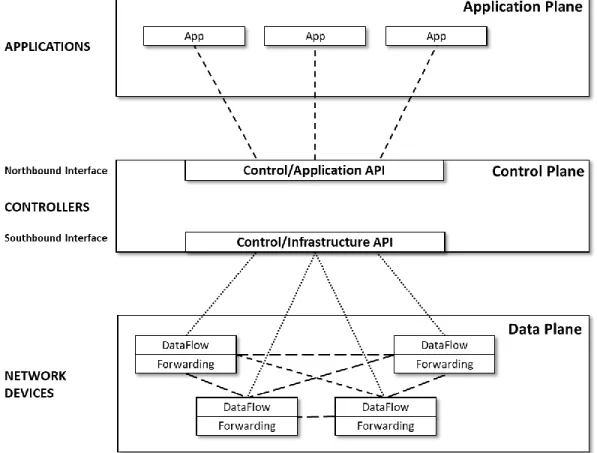
As defined by the Open Network Foundation (ONF), “Software Defined Network (SDN), is a network architecture where network control is decoupled from forwarding into the devices and is directly programmable” (see Figure 5) [7].
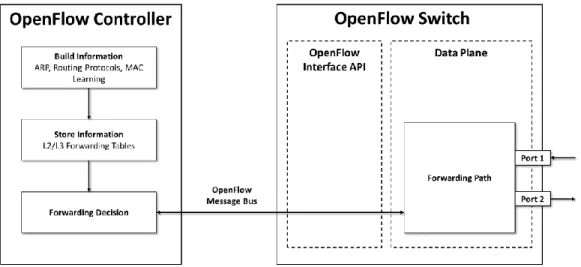
While the so-called forwarding plane (in charge of physically routing the data packets) resides in the network nodes, i.e., in the switches, all the intelligence related to network control is logically centralized into a single software entity called Software Defined Network (SDN) Controller, responsible for the network behaviour (see Figure 4).
In short, the SDN Controller is in charge of computing the routes of the packets and it is directly programmable from the upper layer (i.e., the application plane) through programmable interfaces.
20
Figure 4 Externally Controller Switch Architecture
The SDN Controller maintains a global view on the underlying forwarding plane and makes it directly programmable from the upper layer (i.e., the application plane) through programmable interfaces. The interfaces are then used by applications and services to manage the nodes’ forwarding behaviour while abstracting all the heterogeneity and the complexity of the network plant. SDN acts as a network operating system by implementing control software that interacts with compliant clients (i.e. switches devices) using well-defined interfaces in order to allow the development of innovative network management applications, such as traffic steering, QoS and QoE control algorithms, ACL, etc.
A key concept introduced by the SDN, in addition to the decoupled Control and Data Plane, is the abstraction of the network resources through an open interface for network abstraction layers. This abstraction is implemented by the control plane. From such plane, a flow table configuration can be enforced into the underlying devices without directly connect to them using API. Also, an application can use API to communicate with the controller, and this latter takes care of all the details to enforce configuration into the network.
While it is possible to implement single purpose controllers, e.g. for L2 forwarding or routing, available SDN controller implementations typically provide an extendable software platform on top of which SDN applications may be developed and deployed. Such a controller framework offers easy to use (northbound) APIs to the functionality provided by the SDN substrate. Further, it may include helper functions that provide, for example topology discovery or flow statistics collection. As a result, an SDN controller may be regarded as a layer between the SDN substrate and the SDN application layer, which implements the logic for concrete network services. Typically, SDN controllers are executed on commodity server hardware. While conceptually SDN controllers are centralised, in real world deployments the controller functionality may be distributed across multiple devices to ensure scalability and failure resilience.
21
OpenDayLight [8] is currently the newest and largest SDN controller platform. It is backed by the Linux Foundation and developed by an industrial consortium, which includes Cisco, Juniper and IBM, among many others. OpenDayLight includes numerous functional modules which are interconnected by a common service abstraction layer. Further, OpenDayLight provides a flexible northbound interface using Representation State Transfer APIs (REST APIs), and includes support for the OpenStack cloud platform.
As showed in the next figure, a set of switches in controlled by an SDN Controller. This latter has the role of building and storing network-information, and making forwarding decisions to be enforced into the underlying network.
22
2.3.2.
OpenFlow Protocol
The main SDN technology, provided by the ONF, is the OpenFlow standard [7]. OpenFlow is an open standard, defines an open protocol of communication among the forwarding plane (i.e., the compliant switches) and the control plane (i.e., the SDN Controller) enabling control and decoupling of the planes for higher functionalities and programmability. Since the OpenFlow protocol is an open standard supported and development by an open consortium within networking and services providers company Within SDN and OpenFlow, a network switch has only to store the forwarding rules coming from the SDN controller and taking forwarding decisions according to them when a packet is coming on a port. Since forwarding rule computation is demanded to the SDN Controller, the switches have to no longer maintain context information to make forwarding decisions with consequent minor specs requirements in terms of CPU and memory.
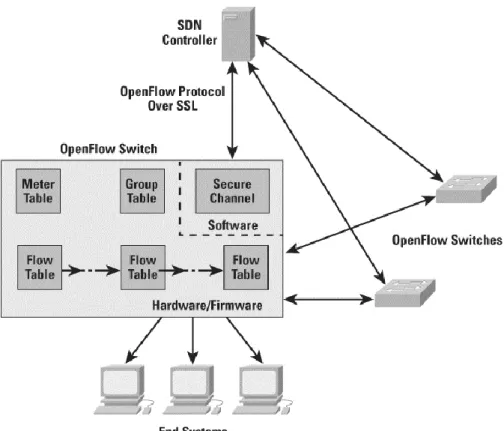
As detailed in the OpenFlow Switch Specification document [9] and showed in Figure 6: “An OpenFlow Logical Switch consists of one or more flow tables and a group table, which perform packet lookups and forwarding, and one or more OpenFlow channels to an external controller. The switch communicates with the controller and the controller manages the switch via the OpenFlow switch protocol.”
The main advantage of the OpenFlow protocol is that it is an open standard. It adoption enables the interoperability of switches produced by different vendors even in the case they are shipped with other proprietary function and interfaces.
OpenFlow allows to programmatically and remotely configure the forwarding rules and actions into the packets forwarding flow tables into the network elements. Such flow configuration is computed on-demand by the centralized SDN OpenFlow Controller and then enforced into the underlying network data plane (i.e. the network OpenFlow switches). The controller can then decide to modify existing flow configuration on one or more switches or to deploy new rules since it as an overall view on the network plant.
The OpenFlow protocol is based on the Transmission Control Protocol (TCP), and prescribes the use of Transport Layer Security (TLS) for security aspects. The common adopter TCP port by controllers for listening OpenFlow protocol messages is the port 6633.
23
24
2.3.3.
Network Function Virtualization (NFV) Infrastructure
(NFVI)
As highlighted by the ETSI ISG NFV in its first white paper [10], the scenario which defines the situation faced by most network operators nowadays, relates to the physical components of their networks, which are characterised using a wide range of proprietary hardware appliances. This problem of appliance and technology diversity continues to grow for operators as new equipment is added to previous generations of equipment in the network.
This leads to significant challenges related to the launch of new services, increasing energy costs and capital investments coupled with the difficulty of finding people with the most appropriate skills to handle the design, integration and operation of increasingly complex hardware-based appliances. In addition, the trend towards shorter operational lifespan of hardware also affects revenues, leading to situations where there is no return on investment or where there is no time for innovation.
Network Functions Virtualization (NFV) will address these challenges by leveraging standard Information Technology (IT) virtualization technology to consolidate various network equipment types onto industry standard high-volume servers, switches and storage located in Data Centers, Network Nodes and in the end user premises.
In this context, NFV refers to the virtualization of network functions carried out by specialized hardware devices and their migration to software-based appliances, which are deployed on top of commodity IT (including Cloud) infrastructures.
Virtualizing Network Functions potentially offers many benefits, including: ▪ Reduction in both equipment costs and power consumption, ▪ Reduced time to market,
▪ Availability of network appliances that support multiple-versions and multi-tenancy, with the ability to share resources across services,
▪ Targeted service introduction based on geography or customer type, where services can be quickly scaled up/down as required,
▪ Enabling a wide variety of eco-systems, ▪ Encouraging openness within the ecosystem.
Software applications must be specifically designed or rewritten to run optimally in virtualized telecom environments to meet carrier grade requirements. Otherwise, applications ported to virtualized environments may experience significant performance issues and may not scale appropriately to the required network load.
An additional challenge for virtualization in a telecom network environment is the requirement to deliver low latency to handle real-time applications such as voice and video traffic. In addition to performance, other operational characteristics that are crucial to successful deployments include: maturity of the hypervisor; Reliability, Availability, and Serviceability (RAS); scalability, security, management and automation; support and maintainability.
Deploying NFV also incurs other well-defined risks, e.g. scalability in order to handle carrier network demands; management of both IT and network resources in support of network connectivity services and Network Functions (NFs) deployment; handling of network fault and management operations; Operations Supporting System (OSS) / Business Supporting System (BSS) backwards compatibility in migration situations; interoperability required to achieve to-end services offerings, including end-to-end Quality of Service (QoS). In addition, essential software appliances should achieve performance comparable to their hardware counterparts which is currently not always possible due a variety of reasons such as the performance of the virtualization technologies.
25
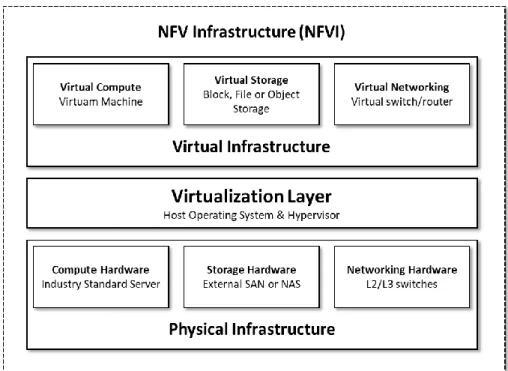
As explained in the previous sections: Cloud Manager technologies, Software Defined Network (SDN) and Network Function Virtualization (NFV) represent the most prominent innovative trend toward modernizing the IP Infrastructure. In particular:
▪ Cloud Manager technologies operate as cloud operating system in charge to virtualize and orchestrate a large pool of compute, storage and networking resources throughout a data center; ▪ SDN offers a centralization of the network orchestration and control; The SDN Controller relays information and orchestrates traffic on the network to switches and routers, and to the applications with so-called northbound Application APIs;
▪ NFV offers the virtualization of network service able to speed up the deployment of new network services to foster revenue and growth plans.
The integration of these technologies defines what the modern IP infrastructure looks like. Such components can be used to enable the transformation of the telecommunications network to simplify operations, administration, maintenance and provisioning and to lay the network foundation for new access technologies (e.g., 5G).
With a complementary approach to SDN, NFV provides innovation in services deployment and management. To exploit such technologies, several providers created the NFV ISG under the European Telecommunications Standards Institute (ETSI). The creation of ETSI NFV ISG resulted in the foundation of NFV’s basic requirements and architecture.
26
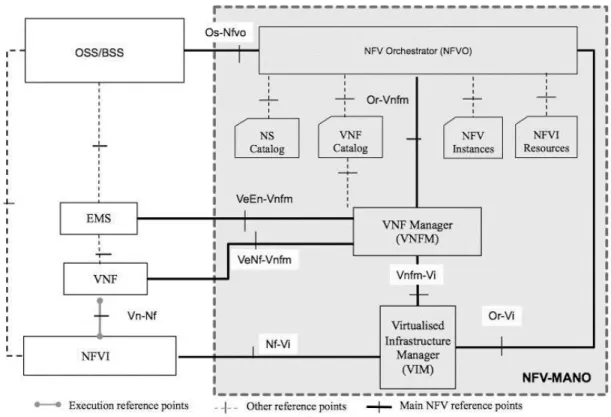
The ETSI Institute has defined the network functions virtualization management and orchestration (NFV-MANO) architecture, and its main blocks [11]:
▪ VIM manager, responsible for controlling and managing the NFV infrastructure (NFVI) compute, storage, and network resources;
▪ VNF manager, responsible for the lifecycle management of the NFV entities;
▪ NFV orchestrator. responsible for the management of new network services (NS) and virtual network function (VNF) packages; NS lifecycle management; global resource management; validation and authorization of network functions virtualization infrastructure (NFVI) resource requests.
These functional blocks help standardize the functions of virtual networking to increase interoperability of software-defined networking elements. Such SDN-NFV networking approach is a win-win strategy: from the manufacturers’ point of view, the benefit is that compliant devices seamlessly work with all the other compliant devices and controllers; from the network operators’ side, this reduces Capex and Opex costs by extending the life of the devices, by reducing the replacement costs and by speeding up the deployment of new services.
Anyway, such innovative architecture introduces some issues that must be properly addressed, mainly the pros and the constraints related to the adoption of a ‘logically centralized but physically distributed’ control plane.
27
Chapter 3
Load Balancing a Distributed SDN Control
Plane
With reference to the Infrastructure layer of the Future Internet architecture presented in the previous section, this chapter addresses the limitation of the SDN infrastructure. An analysis of the issues is presented, then the scalability and reliability issues are addressed by proposing a distributed SDN Control Plane and applying on it a novel workload balancing algorithm. Such algorithm is an original discrete-time, distributed, non-cooperative load balancing algorithm, based on mean-field game theory, which does not require explicit communications. The algorithm is proved to converge to an arbitrarily small neighbourhood of a specific equilibrium among the loads of the providers, known as Wardrop equilibrium. Thanks to its characteristics, the algorithm is suitable for the Software Defined Networking (SDN) scenario, where service requests coming from the network nodes, i.e., the switches, are managed by the so-called SDN Controllers, playing the role of providers. The proposed approach is aimed at dynamically balancing the requests of the switches among the SDN Controllers to avoid congestion. Both the results of an evaluation of the benefits of the distributed approach and of the balancing control algorithm is presented and discussed through an implementation of the algorithm in a proof-of-concept SDN scenario.
3.1.
Introduction
As defined by the Open Network Foundation (ONF), “SDN is a network architecture where network control is decoupled from forwarding and is directly programmable.” While the so-called forwarding plane (in charge of physically routing the data packets) resides in the network nodes, i.e., in the switches, all the intelligence related to network control is logically centralized into a single software entity called SDN Controller, responsible for the control of the network behaviour. In short, the SDN Controller is in charge of managing all network information, thus making, and enforcing into the underlying nodes, suitable forwarding decisions.
Taking advantage of the whole view of the network, a SDN network controller is capable for building and maintaining network information, and thus making forwarding decisions. Anyway, the adoption of the SDN-OpenFlow approach to massively scalable data centres need to be supported by a resilient and scalable architecture. When the network size grows, controller performances, with particular attention to throughput and latency metrics, are topics that must be carefully addressed in order to prevent the SDN Controller from becoming the performance bottleneck of the plant.
28
The issues related with the adoption of the SDN paradigm that must be addressed should be grouped in the following points below:
▪ Scalability: Since the network intelligence is shifted from the switches to the SDN Controller, any forwarding decision consists of a unit of workload for the controller machine and the management network. Since an OpenFlow switch not maintains enough network information to take forwarding decisions it sends request for per-packets-related decision to the SDN OpenFlow Controller and waits for a forwarding flow; this potentially produces millions of requests per second forwarded immediately by each switch without delay. For instance, according to [12], in highly dynamic scenarios (e.g., in a server cluster of 1.5k machines) the SDN workload has a median flow arrival rate of 100k flows per second. Handigol et al. [13] provides benchmark results of controllers’ performance resulting in 30k flows per second supported with 10ms of install time. This raises scalability concerns since the performance of the controller could become the performance bottleneck of the plant.
▪ Controller Placement: the mapping between the forwarding plane and the control plane, i.e., the association of each switch to a given SDN Controller, could be static or dynamic. In the literature, the problem of associating switches and SDN Controllers is known as “SDN Controller placement problem,” and the proposed algorithms are mostly based on the location of the SDN Controllers with respect to the switches – see, e.g., [14] presenting a comparison between brute-force and greedy algorithm solutions, [15] presenting a heuristic approach, and [16] solving the problem by adopting operational research theory. Heller et al. [17] presents a comparison of various placement metrics. Since, in real networks, the network workload varies in time, the main drawback of static mapping is the necessity to find a new solution to the controller placement problem whenever some SDN Controller workload exceeds its processing power (congestion occurrence).
▪ Reliability: The SDN architecture introduces the issue of a single-point of failure in the plant since in the SDN architecture the network intelligence is physically centralized in a single point (ie the SDN Controller machine). The SDN Controller acts as Network Operation System by programming the switches behavioural through open API exploiting L2 and L3 topologies and hosts information learnt from the OF switches. It is then subject to overload or failure issues, in addition the vertical scaling of the computational and memory capacity may not be enough in very large networks. The centralized design offers better performance in terms of throughput and latency [18], anyway it should evolve in order to form a cluster of machine following the concept of a "distributed, but logically centralized" SDN control plane [19] [20].
Since the network intelligence is shifted from the switches to the SDN Controller, each switch sends to the SDN Controller requests for forwarding decisions, each of which constitutes a unit of workload, or job. Although the SDN Controller can be vertically scaled, it can still saturate, thus becoming a relevant bottleneck for the network plant in terms of throughput and latency.
To overcome the scalability and reliability issues, the solution proposed in this thesis provides the adoption of a distributed SDN Control Plane against a single instance scenario. A pool of SDN Controllers can be arranged in a cluster to form a physically distributed but logically centralized Control Plane sharing the overall network information, workload and control effort. A drawback of such an approach resides in the fact that, in the currently adopted proximity-based approaches, each switch (and, consequently, its workload) is statically associated with the closest SDN Controller. However, this static approach is not effective, especially when the workload is not evenly spatially distributed and/or is dynamic (which is always true in communication networks).
29
Therefore, load balancing mechanisms and algorithms are required to dynamically allocate the workload among all the available SDN Controller instances with the overall aim of optimizing the network performances. In [21], a switch migration protocol was devised for this purpose, yet such an approach requires an advanced load estimation mechanism for both SDN Controllers and switches, and an intra-controller protocol to guarantee liveness and safety features.
Anyway, the limitation of the distributed Control Plane is that the mapping between the data plane (i.e. the network devices) and each instance belonging to the cluster, are static among the operation time. To address this problem, a novel balancing algorithm for the OpenFlow traffic and its reference design is proposed. It was designed to shift the workload across the cluster in order to improve the performance of the overall system.
30
3.2.
Distributed Control Plane
To overcomes the scalability limitation presented in the above section multiple controllers can be arranged to form a synchronized cluster of SDN Controllers, thus providing high availability and replication [21]. In this way, the controller virtualization may help in overcoming scalability and centralization issues, which affect the SDN controller performances in large data centres.
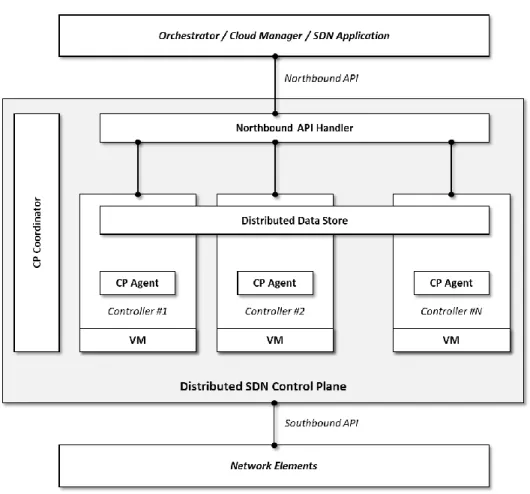
Therefore, even if the SDN Controller is logically a single centralized entity, it is realized through multiple software and hardware entities distributed across a cluster of multiple controllers, sharing the overall network information and control capabilities through a distributed data-store across all the cluster and providing a single point of access through APIs to the so-called “northbound” applications (i.e., the network applications as depicted in Figure 9).
With reference to the conceptual Future Internet architecture presented in Section 2.1, the following figure focuses on the high-level architecture of the SDN Control Plane designed to support deployments in a distributed scenario by exploiting the virtualization of the controller machine. In this regard, new functional elements have been identified. Their scope is to extend the well-known centralized SDN architecture, where each Control Plane (CP) block corresponds to a single instance of the control plane.
31
Within the above figure, we can address the following components:
▪ Distributed Data Store: This component is responsible for consistently maintaining a global view of the network across the control plane instances belonging to the cluster. The collected information includes the topology and the state of the network, including switch, port, link, and host status. Northbound applications/internal CP components can take advantage of the global network view in making forwarding and policy decisions. It is a fact that relying on distributed data store may incur in delays for exchanging messages to maintain a consistent view of the whole network between all the instances of controller. In this respect, the innovation introduced by the virtualized SDN Control Plane is the capability to split, distribute and store the global network view into multiple caches. Each cache is responsible for maintaining the status of a portion of the network, through which the traffic of a set of NFV appliances is routed.
▪ Northbound Request Handler: Mainly responsible for distributing northbound requests among the available controller instances. It is essential to make the network control plane accessible by the northbound API as a unique single instance.
▪ CP Coordinator: The Control Plane Coordinator supervises and coordinates the operation in the cluster. Specifically, it has to (i) properly instruct the Northbound Requests Handler in spreading the northbound requests; (ii) dynamically configure the controller-to-switch mapping by connecting each switch to one or more controller instances; (iii) decide whether to add or remove a controller instance to the cluster depending on the network needs; (iv) monitor the workload on the cluster; (v) assign data caches to a subset of controller instances depending on the deployed NFV applications. The role of coordinator can be carried out by one of the CP instances available in the cluster, by means of a procedure of leader election.
▪ CP Agent: The CP Agent is in charge of collecting information about the current resource utilization (CPU load, memory usage, control messages arrival rate, etc.) at each CP instance and enforcing the switch-to-controller instance connection rules as established by the Coordinator. These rules are used by each switch to identify the controller instance/s to which the southbound requests must be forwarded.
From a technological point of view, the OpenFlow protocol, since version 1.3, has regulated its architectural model by defining the concept of SDN Controller role (equal/master/slave) for a switch. Each OF switch could maintain multiple OpenFlow channel with multiple OpenFlow controllers, each of them marked with a role that defines its behaviour. This enabled two modes of operation when multiple SDN Controllers exist in a network: master/slave interaction and equal interaction. In the master/slave interaction each switch can be associated with all the SDN Controllers but managed by only one (the master), responsible for all the events corresponding to that switch, whereas the others (slaves) are used as backup controllers. On the contrary, in equal interaction, each switch can be associated with multiple SDN Controllers and have more than one master association, that is, several equal associations.
On the SDN Controller side, Onix [19] was the first SDN Controller to implement a distributed SDN controller model. It originally targeted network virtualization in datacenters and remained closed-source. More recently, OpenDaylight [8], an open-source project sponsored by a large consortium of networking companies, has introduced a cluster-based high-availability model to increase reliability and fault tolerance. Similarly, to OpenDaylight, ONOS [20] was designed to run on a cluster of servers for high availability, using a distributed data store to maintain the global view of the network.
32
33
3.2.1.
Benefit Evaluation
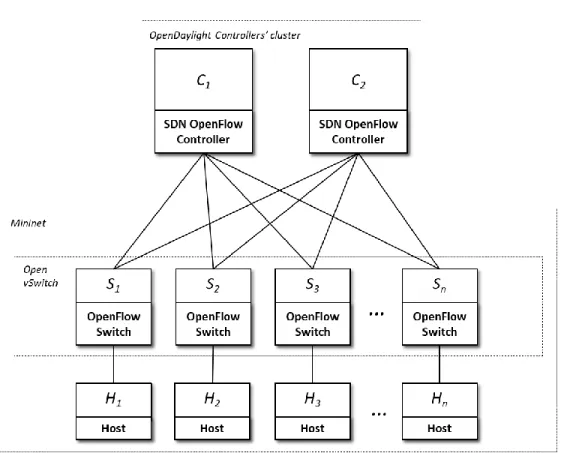
To evaluate the benefits of having a Distributed Control Plane across a cluster of SDN controllers, a testbed was deployed, and experimental tests performed in order to benchmark the proposed solution. In the following text, the testbed is briefly described, and the performance evaluation results presented and discussed, for more details please refers to the contributing author publication “Distributed control in virtualized networks”.
Figure 11 Testbed Architecture
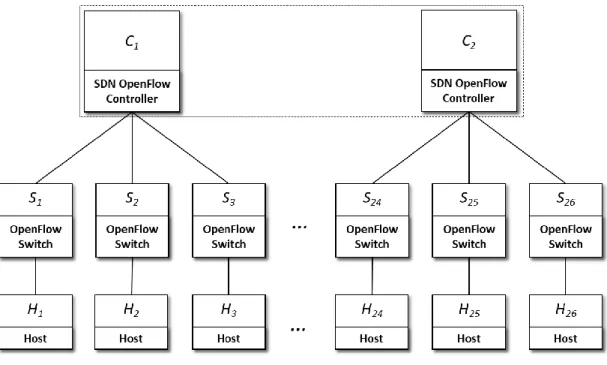
To evaluate different distributed Control Plane scenario’s performances, different configurations are deployed. A first test is performed to evaluate the benefit from adopting a Distributed Control Plane with a cluster of 2 controller instances against a single Controller scenario.
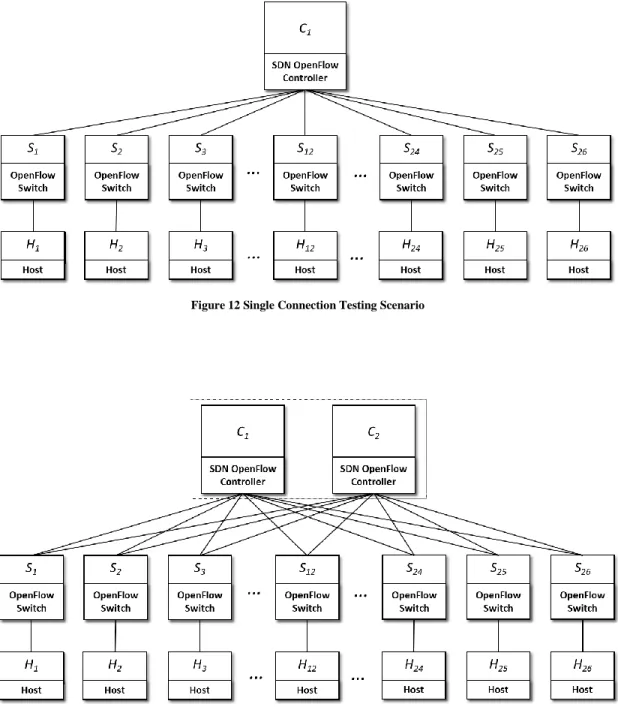
When multiple controllers are available a switch may connect to all. For example, a cluster with two controllers can be arranged in the following testing scenarios:
▪ Single Connection: all the switches are connected to one instance of Controller (see Figure 12); ▪ All Connection: all the switches are connected to all the instances of Controller (see Figure 13); ▪ Selective Connection: there are two Controllers and the first 13 switches are connected to the
34
The second scenario is the more interesting from a control point of view. Using the default implementation of the distributed control plane provided by the OpenDaylight we are evaluating the behaviour when every switch sends the packet-in control message to more than one controllers; just one controller should answer to the request while the other one should ignore it.
Figure 12 Single Connection Testing Scenario
35
Figure 14 Selective Connection Testing Scenario
3.2.1.1.
Testbed Setup
The following software components are integrated into such testbed:
▪ OpenDayLight [8], the SDN controller most adopted and supported by the industry and Open Source community;
▪ Mininet [22] a networking testing suite that provides Python APIs able to virtualize custom networks;
▪ Open Virtual Switch (ovs) [23], "a production quality, multi-layer virtual switch licensed under the open source Apache 2.0 license".
▪ Open vSwitch Database Management Protocol (OVSDB) [24] for the operation management of the virtual switches.
The testing environment (see Figure 11) is composed by a SDN controller cluster of 2 instances and 26 virtual switches. Every switch Si is connected to the Si+1 switch and to the host Hi that incorporates a data traffic generator. To stimulate the switches to generator control traffic, each host generates ARP requests.
The control traffic is generated by the switch when there is no flow entry for an incoming data packet (the ARP request) that the host wants to send. Hence, the switch encapsulates the data packet in a control packet (Packet-In message) and sends it to its controllers. Then, exactly one controller should send a message containing the flow entry (the Flow-Mod message) that the switch will install in its table. The performance is then evaluated by counting the packet-in and flow-mod messages exchanged between the switched and the SDN Controllers.
36
3.2.1.2.
Evaluation Results
Figure 15 depicts the 95-percentile response time of the 3 cases described above. As expected, the difference between a cluster with one controller and one with two is noticeable as the number of packet-in packet-increases. The difference between the All connection and the Selective connection case becomes relevant when the number of packet-in/s is greater than 40,000. From 50,000 the last connection scheme clearly outperforms the first.
Similar results are reported in Figure 16. When the network load is high the throughput of the Selective test is the highest one, being 66% greater than the one in the All test scenario and 100% greater than the one in the Single test scenario.
The results clearly highlight the benefits of the multi-controller configuration, and particularly of the selective connection configuration. In the case of single connection, the unique controller instance saturates at approx. 20.000 pin/s. When adopting the all connection configuration, the two controller instances receive the requests from all the switches, which causes a performance saturation at approx. 30.000 pin/s, that is a +50% performances against the single connection configuration. It is worth to note that adopting the selective connection configuration, the performance saturation goes beyond the 40.000 pin/s, that is a +100% performance against the single connection configuration and a +33% performance against the all connection configuration).
We can explain these results considering that in single connection configuration we have half of the computation power, since just one instance of the controller is operative. Increasing the number of operative controllers, influences the performance, but the switch-to-controller association strategy makes the real difference in performance. Indeed, with an all connection configuration, even if there are two controllers operating at the same time, each controller receives requests from all the switches. In the selective connection configuration, each controller receives requests only from a subset of the switches, so each controller can handle a higher number of requests.
On the light of the above results, we can make some considerations:
▪ increasing the cluster size may improve the performance but this has relevant results only in congested situations, when the load of control plane requests saturates the single controller processing capabilities. The drawback of increasing the number of CP instances is the need of more computation power and related increased operational cost;
▪ the load of control plane is variable and often unpredictable, being strongly related to the amount of control messages exchanged between switches and controllers. Therefore, a dynamic mechanism able to keep balanced the traffic across the whole control plane is needed.
37
Figure 15 95-percentile response time comparison between the Single, All and Selective configurations
38
3.3.
Load balancing SDN Control Plane Algorithm
Even if adopting a distributed control plane produce benefit (as depicted in the previous section), a drawback of current SDN distributed Control Plane approaches resides in the fact that the mapping between the forwarding plane and the overall control plane (i.e. the association of each switch to a given SDN Controller into the cluster), is statically regulated, currently adopting a proximity-based approaches, each switch (and, consequently, its workload) is statically associated with the closest SDN Controller. However, this static approach is not effective, especially when the workload is not evenly spatially distributed and/or is dynamic (which is always true in communication networks). Since, in real networks, the network workload varies in time, the main drawback of static mapping is the scenario where some SDN Controller workload exceeds its processing power (congestion occurrence); with an impact on the control plane reactiveness, and consequently having degradation of network latencies. Based on real measurements from production data centers, we estimate that the peak-to-median ratio of flow arrival rates is almost 1-2 orders of magnitude1 (more details in Section 2. There are also some other traffic variations in spatial and temporal terms, depending on where are generating flows. Some switches could observe a larger number of flows generation which could results in overloading the corresponding (static over the time) controller.
Therefore, load balancing mechanisms and algorithms are required to dynamically allocate the workload among all the available SDN Controller instances with the overall aim of optimizing the network performances.
With respect to the problem of dynamically balance the SDN Control Plane traffic, in [25] the authors propose a Switch-Migration based algorithm, were at each switch is associated a load measure; the algorithm then uses defined thresholds to compute the load of every controller and migrate the control of a switch from an instance to another. Anyway, such approach poses some issues to be addressed in terms of liveness and safety during the migration policy and requires an advanced load estimation mechanism for both SDN Controllers and switches. In addition, this approach isn’t transparent to the actual Control Plane (i.e. the SDN Controller software support).
To address those issues, the solution presented in this chapter consist of an original discrete-time, distributed, non-cooperative load balancing algorithm, based on mean-field game theory, which does not require explicit communications. The algorithm is proved to converge to an arbitrarily small neighborhood of a specific equilibrium among the loads of the providers, known as Wardrop equilibrium.
Thanks to its characteristics, the algorithm is suitable for the Software Defined Networking (SDN) scenario, where service requests coming from the network nodes, i.e., the switches, are managed by the so-called SDN Controllers, playing the role of providers. The proposed approach is aimed at dynamically balancing the requests of the switches among the SDN Controllers to avoid congestion. Such balancing is implemented in a new software entity named SDN-Proxy (refer to section 3.3.1) to be placed on the Control plane to act in a transparent way for the adjacent software interfaces.
39
Below, for the sake of clarity, a table containing the notations adopted with regards to the Load Balancer algorithm.
𝐶 = {1,2, … , 𝑐} Set of commodities
𝜆𝑖, 𝑖 = 1, … , 𝑐 Per-commodity flow demand
(𝑠𝑖, 𝑑𝑖), 𝑖 = 1, … , 𝑐 Commodity (source, destination) nodes 𝑉 Set of providers
𝑥𝑝𝑖, 𝑖 ∈ 𝐶, 𝑝 ∈ 𝑉 Load of commodity 𝑖 relying on provider 𝑝
𝒙 = (𝑥𝑝𝑖), 𝑖 ∈ 𝐶, 𝑝 ∈ 𝑉 Flow vector
𝒳 Feasible state space
𝑙𝑝(𝑥𝑝) Latency of provider 𝑝 with load 𝑥𝑝
𝒳𝒲,𝜀 𝜀-Wardrop equilibrium set
Φ(𝒙 Beckmann, McGuire, and Winsten potential
ℒ(𝒙) Candidate Lyapunov function