TaintHLS: High-Level Synthesis For Dynamic
Information Flow Tracking
Christian Pilato,
Member, IEEE,
Kaijie Wu,
Member, IEEE,
Siddharth Garg,
Member, IEEE,
Ramesh Karri,
Senior Member, IEEE,
and Francesco Regazzoni,
Member, IEEE
Abstract—Dynamic Information Flow Tracking (DIFT) is a technique to track potential security vulnerabilities in software and hardware systems at run time. Untrusted data are marked with tags (tainted), which are propagated through the system and their potential for unsafe use is analyzed to prevent them. DIFT is not supported in heterogeneous systems especially hardware accelerators. Currently, DIFT is manually generated and integrated into the accelerators. This process is error-prone, potentially hurting the process of identifying security violations in heterogeneous systems.
We present TAINTHLS, to automatically generate a micro-architecture to support baseline operations and a shadow microar-chitecture for intrinsic DIFT support in hardware accelerators while providing variable granularity of taint tags. TaintHLS offers a companion high-level synthesis (HLS) methodology to automatically generate such DIFT-enabled accelerators from a high-level specification. We extended a state-of-the-art HLS tool to generate DIFT-enhanced accelerators and demonstrated the approach on numerous benchmarks. The DIFT-enabled accel-erators have negligible performance and no more than 30% hardware overhead.
Index Terms—Dynamic Information Flow Tracking, High-Level Synthesis, Hardware Security.
I. INTRODUCTION
T
HE increasing demand of high-performance systems ispushing towards heterogeneous architectures that include an increasing number of application-specific accelerators [1].
These accelerators are up to 100× energy-efficient relative
to the corresponding software implementations [2], [3], [4]. Advances in high-level synthesis (HLS) and reconfigurable platforms are allowing creation of accelerators at low cost [5]. Applications are leveraging such accelerators by interleaving hardware and software execution. Mobile devices with custom hardware and FPGA-based cloud systems are running third-party applications (e.g., Apple App Store and Google Play). Such applications can leak personal information without au-thorization [6] or can be compromised using software attacks (e.g., code injection [7] and return-to-libc [8]). This requires Manuscript received August 1, 2017; revised November 29, 2017 and February 23, 2018; accepted April 10, 2018. This paper was recommended by Associate Editor J. Xu. R. Karri is supported in part by NSF (A#: 1526405) and CCS-AD. S. Garg is supported in part by an NSF CAREER Award (A#: 1553419). S. Garg and R. Karri are both with the NYU Center for Cybersecurity (cyber.nyu.edu) and supported in part by Boeing Corp.
C. Pilato and F. Regazzoni are with the Advanced Learning and Research Institute (ALaRI), Faculty of Informatics, Universit`a della Svizzera italiana (USI), Lugano, Switzerland (Contact email: [email protected]).
K. Wu, S. Garg, and R. Karri are with the NYU center for cybersecurity (htt://cyber.nyu.edu), New York University (NYU), New York, NY, USA.
methods for identification of malicious uses. Dynamic
Infor-mation Flow Tracking (DIFT) measures the influence of
po-tentially untrustworthy external data by understanding how the information is propagated by an application [9]. Untrusted data
is taintedand propagated through the application to monitor
and prevent its unsafe use. DIFT can monitor the control flow of an application and prohibit execution of malicious code when selected jump conditions become tainted [7].
Solutions have been proposed to implement DIFT in user applications. They range from custom virtualization environ-ments [6] to the integration of hardware support through dedicated DIFT co-processors [10]. An attacker may exploit the weaknesses in the accelerators or the heterogeneous
com-putation to compromise the system. BAMBU [11] and other
HLS tools generate accelerators with a memory architecture that allows dynamic pointer resolution [12]. This enables the acceleration of irregular applications [13]. Tampering with the pointers passed to the accelerator can offer access to specific memory locations (either within or outside the accelerator). Accelerators without DIFT support may compromise the tag propagation and identification of anomalies. Hence, solutions have been proposed to study how the taint tags are exchanged at the system level (e.g, between the processor and the ac-celerators and with the memory components). WHISK allows designers to evaluate the impact of DIFT in such heteroge-neous systems [14]. However, the DIFT-enhanced accelerators are not already available. DIFT support can be generated by augmenting the Boolean gates with logic for information flow tracking [15]. But this solution does not exploit high-level information to reduce the hardware overhead.
Since DIFT support is expensive, understanding how to efficiently implement DIFT inside accelerators is necessary to offer security when executing applications on heterogeneous architectures. Analyzing the flow of information must be precise regardless of where the computation is performed (the processor cores or the hardware accelerators). This paper is the first one to address this issue by exploring the automatic generation of DIFT-enhanced accelerators.
A. Contributions
TAINTHLS is a HLS-based solution enabling DIFT in
hard-ware accelerators. TAINTHLS automatically generates
DIFT-enhanced accelerators that can be integrated into heteroge-neous architectures, while achieving the same DIFT as the corresponding software solutions. Automated DIFT generation can be configured to operate on taint tags at different granular-ity (from variables to bits) to trade off resource overhead and
Heterogeneous SoC Hardware Module local memory local memory Controller + Datapath Hardware Module local memory Memory Interface DRAM Contr oller CPU System Inter connect DRAM Configuration Registers Memory Interface (a) Datapath
reg_0 reg_1 reg_2
+
-reg_3
mux Controller input_a input_b
return
local memory
(b)
Fig. 1. Organization of a classical heterogeneous architecture with hardware accelerators (a) and microarchitecture of the each hardware module (b).
accuracy of taint analysis. After introducing the basic concepts
and the motivation for this work (SectionII), we present three
contributions:
• an accelerator architecture that includes efficient
hard-ware support for taint propagation (Section III);
• an HLS-based methodology to automatically generate
accelerators with DIFT support starting from high-level
descriptions in C (Section IV);
• a comprehensive analysis of the DIFT-enhanced
accel-erators in terms of performance and resource overheads
(SectionV).
We implemented TAINTHLS in BAMBU [11], a
state-of-the-art open-source HLS tool.
II. BACKGROUND
This section summarizes the background of the research
fields addressed by this paper. First, we describe themodel of
the target architecture, focusing onhardware acceleratorsand
the challenges encountered designing them. Then, we present
the attack modelthat is considered and, finally, introduce
Dy-namic Information Flow Tracking, explaining how it secures
a computation.
A. Target Architecture Model
Fig.1(a)shows an example heterogeneous architecture with
an accelerator and a processor core (CPU). Hardware acceler-ators offload computation-intensive kernels of the application, while the rest is executed by the CPU. The CPU prepares the data for the accelerator and configures it by writing the proper
parameters into configuration registers. This configuration is
performed with memory-mapped operations, like the ones performed by an OS device driver, on the interconnection system (e.g., a bus or a network-on-chip). The DRAM is accessed through a memory controller by both components. The memory space is thus used to share data between the pro-cessor and the accelerator. A hardware accelerator is tailored to execute a specific functionality. It improves performance (up to
10-100×) and lowers energy consumption (up to 100-1,000×)
relative to the corresponding software implementation [16]. However, this comes at the cost of flexibility: the designer must determine the accelerator microarchitecture at design
time to maximize performance. Similarly, executing an extra function (e.g., DIFT) requires extra logic.
Complex accelerators are organized as submodules to man-age the design complexity. Each module is based on the classical Finite State Machine with Data (FSMD) model [17]
and includes three components as shown in Fig. 1(b):
• acontroller, which determines the operations to execute
in each clock cycle. The control flow is represented by a Finite State Machine (FSM) that sends control signals to the datapath.
• adatapath, which is composed of functional units to
ex-ecute the computation and the registers to hold temporary values during the computation. Multiplexers are used to drive the values based on the control flow;
• memory elements, such asscratchpad memories(SPMs)
to locally store data and thememory interfaceto access
external data (e.g., in DRAM).
Functional units in the datapath exchange information through registers, local SPMs, and the DRAM. Input data values are provided in the configuration registers or stored in the DRAM and accessed through the memory controller. Local SPMs are heterogeneous and distributed memories, tailored on the data structures to be stored. These memories enable multiple memory operations in parallel on different data with fixed latency, increasing hardware parallelism [5], [12], [18], [19]. These memory blocks impose constraints on the synthesis process. For example, they have a limited number of input and output ports; the operation schedule and the microarchi-tecture to access the data must be accordingly created [12], [18]. Memory architectures have been proposed to support a wide range of memory operations, enabling computation even on memory addresses (e.g., pointer arithmetic) [12]. Such memory architectures create a daisy chain of all memory components, including local memories and controllers for the external memory. An accelerator can automatically identify the memory location accessed by a memory request based on
the value of the address given at runtime (dynamic pointer
resolution). This allows the implementation of software code
without any semantic changes, enabling the possibility of dy-namically migrating the execution of a task between software and hardware.
void preprocess (int v){ struct results ret;
if (v > 0) ret.x = 1; else ret.x = 4; ret.y = 10; ret.z = 5; return ret; } struct results { int x; int y; int z; }; ... get_IO(&v); ... ret = preprocess(v); ... compute(ret); get_IO compute preprocess ATTACK z y x v (a) get_IO compute preprocess ATTACK z y x v (b) get_IO compute preprocess DoS z y x v (c) get_IO compute preprocess Attack prevented z y x v (d)
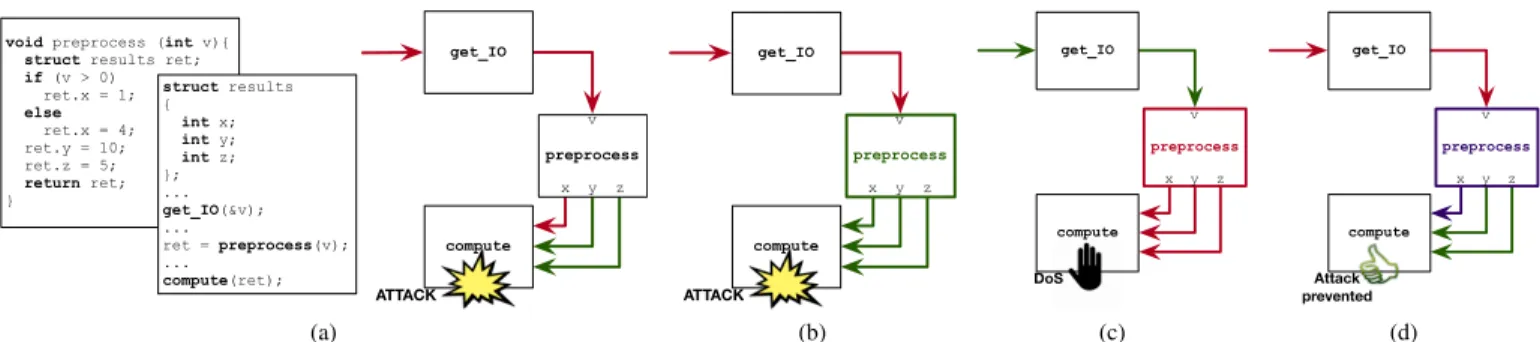
Fig. 2. Motivating example for implementing DIFT inside accelerators. Green links represent trusted data, red links represent malicious data, pink links represent tainted data. (a) Original code with unprotected execution can potentially lead to a security violation; (b) Permissive execution. Accelerators that are always considered trustable may invalidate taint tags and lead to security violations; (c) Untrusted execution. Services can be blocked when accelerators are always considered untrusted and taint all data; (d) Execution with DIFT. Correct DIFT allows the system to behave correctly.
B. Attack Model
We consider a heterogeneous system (see Fig. 1(a)),
com-posed of a processor core (CPU) and one or more hardware accelerators. The CPU executes software applications. Part of the computation is offloaded to the accelerators. Assuming that the design tool chain (i.e., the hardware and software com-pilers) is trusted, the applications are vulnerable to software-based attacks. Even though accelerators implement a fixed functionality, an attacker can tamper with the system. Acceler-ators receive the input parameters through their configuration registers, perform the computation, and return the results in the same way as software routines. The flow of information as it transits through the accelerators is exposed to the same security problems as software applications. Knowing a vulner-ability in a privileged program, attackers generate malicious inputs that allow them to exploit the vulnerability.
We consider systems with different protection mechanisms. First, we consider legacy systems (i.e., without support for non-executable memory). In this case, buffer overflow and format string bugs can be exploited for code injection by executing malicious code in the address space. We also consider systems that support non-executable memory, where the attacker can leverage existing code to compromise the system (e.g., return-to-libc attacks). In these cases, attacks exploit the flow of information (buffer overflow, format string bugs, etc.) to take control of a vulnerable program, jump to a target address, and execute a malicious routine [8], [7]. When implementing security protections for these systems, one needs to guarantee that offloading the computation to an accelerator does not compromise the security. In accelerators, the malicious inputs that corrupt the program execution can be: 1) provided by the user and simply go through the accelerators; 2) generated by the accelerator based on specific set of inputs given to the component; or 3) generated by unauthorized interactions between the system and the accelerator (e.g., unexpected interrupt requests). First, one has to guarantee that security protections for software applications can be executed on heterogeneous systems without losing security information. Second, one must prevent accelerators from tampering with the data in the shared memory (i.e., DRAM). Such data could be changed by compromised accelerator in such a way that the software routine receiving it would become a suitable spot for
hijacking. Finally, one must verify the interactions between the accelerators and the system.
C. Dynamic Information Flow Tracking
Fig 2(a) is a simple example in C code, composed of a
functionpreprocess, which returns three values through a
structconstruct. The value of variableret.xdepends on
a user-input data, while the values of variables ret.y and
ret.z are not. An attacker may tamper with the input data
to force a malicious behavior in the function compute.
Dynamic Information Flow Tracking (DIFT) allows one to determine whether there is a dependency between an untrusted value and a variable that is used in a specific location of the code (e.g., in the control condition of a jump instruction). If
so, the variable is tainted, i.e., it cannot be trusted. Specific
operations on tainted variables can be forbidden to avoid exploits such as buffer overflow or unauthorized access to memory locations. DIFT includes three steps:
• Tag Initialization: a tag is associated with each variable
to be tracked. In our example, tags are associated with each field of the structure.
• Tag Propagation: based on the operations on the data,
the taint tags are propagated from input to output. Precise tag propagation can be obtained by instrumenting the code in software [20], by modifying the processor mi-croarchitecture [15], or by offloading the tag propagation to an external module [10].
• Tag Check: taint tags are regularly analyzed based on
the given security policy to determine unsafe uses. However, if the component executing the given code has no support for DIFT, the function is a black box from a DIFT viewpoint and the user must rely on simplistic assumptions to mark the data. One possibility is to consider all data prop-agated by the function (e.g., output values or memory data) as untainted regardless of its input values and the performed
computation. This is represented in Fig2(b), where the return
values of the function preprocessare considered trusted.
We lose information on the taint tags and the analysis may
lead to afalse negative, i.e., a computation that is considered
secured when it is not, leading to an attack exploitation. The designer can take a conservative approach, marking all data
Hardware Module
local
memory memorytaint memorylocal memorytaint
data1 data2 taint1 taint2 Controller + Datapath Hardware Module local memory memorytaint
Memory Interface Memory Interface DRAM Contr oller … DRAM Serializer (a) Datapath
reg_0 reg_1 reg_2
+
-reg_3
reg_0 reg_1 reg_2
PM(+) PM(-)
reg_3
mux mux
Controller input_a input_b input_a input_b
return return
(b)
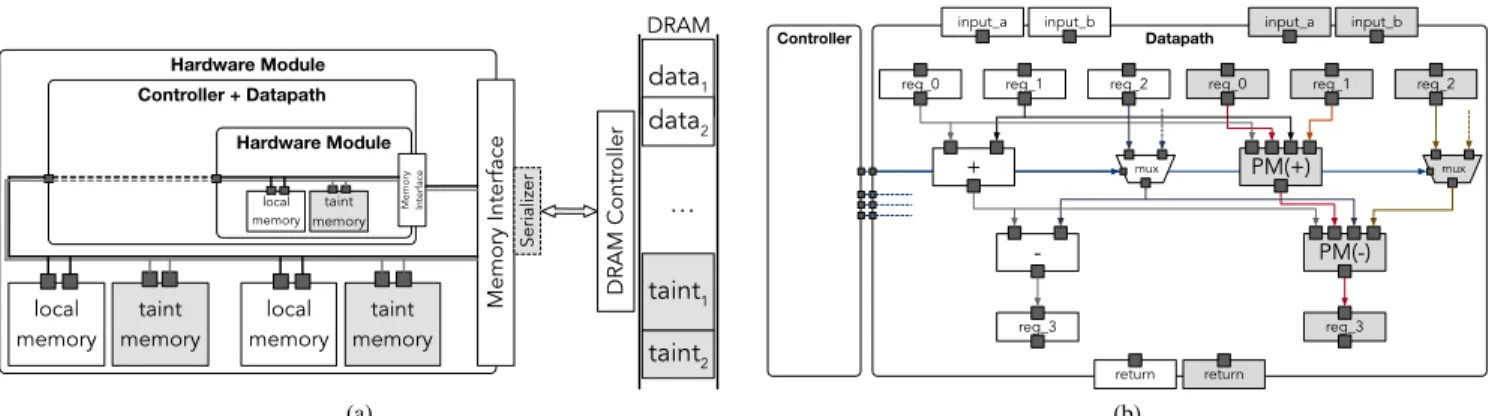
Fig. 3. (a) Microarchitecture of an accelerator with DIFT support. (b) Connections of shadow logic inside the datapath: grey elements support taint propagation, while PM modules represent the taint propagation modules associated with the respective datapath functional units.
variables within the structare marked as untrusted for the
function propagate. Over-tainting could cause false
posi-tives, avoiding correct execution of an application. Resources
that are otherwise available may be blocked due to excessive tainting.
In both cases, simple assumptions do not capture the flow of information inside the function, limiting the legitimate use of the accelerator or opening the system to potential attacks. It is important to perform precise DIFT, marking only the variables that are untrusted and correctly propagating the taint tags through the accelerator and without tainting other variables.
The use of taint propagation is shown in 2(d), where DIFT
is implemented in function preprocess and so only the
data related to ret.x is tainted for the function compute,
enabling the designer to identify the attack.
Precise DIFT is critical in accelerators. Without taint
propa-gationinsidethe accelerators, it is impossible to obtain correct
results in most cases. However, intrinsic support for DIFT requires modifications to the accelerator microarchitecture and, in some cases, a wholesale re-design. HLS tools can help designers to automatically create accelerators with DIFT support so as to correctly propagate the taint tags within the accelerator and achieve the same taint propagation results as obtained in software.
III. ACCELERATORS WITHDIFT SUPPORT
This section describes how we extend the baseline acceler-ator microarchitecture to obtain a DIFT-enhanced acceleracceler-ator that can support DIFT with different taint granularity. One can assign a taint tag to each variable, to each byte, or to each bit of data. The corresponding microarchitecture is accordingly generated. We describe the solutions to limit the DIFT overheads. The different parts of an accelerator
(SectionII) are modified as follows:
• the controllerrequires only a few modifications,
corre-sponding to the implementation of taint checks according
to the security policy (see Section III-A);
• the datapath includes additional logic to generate the
taint tags associated with temporary values, and to com-pute and propagate their values according to and
concur-rent with the accelerator execution (see SectionIII-B);
• thememory elementsare extended to store taint tags and
to support an efficient exchange of the taint tags
associ-ated with the data stored in DRAM (see SectionIII-C).
TAINTHLS generates a DIFT-enhanced accelerator once the
baseline accelerator microarchitecture is available. A. Controller
The controller specifies the operations to be executed in each clock cycle and generates the control signals to drive the multiplexers, to enable writing into registers and to exe-cute memory operations using the memory interface. When implementing DIFT, the controller is also responsible for
detecting and managing security exceptions, sending proper
signals to the rest of the system [7]. This is implemented with an additional output pin, connected to a dedicated interrupt line. When a security violation occurs, the accelerator is halted, a security interrupt is raised, and the corresponding security exception routine is executed by the processor. The
designer can configure security policies to specify what is
allowed (or disallowed) when executing on tainted data. While the detection of security violations is distributed across the different FSM transitions, such exceptions are managed by
a central security manager. We consider two cases: FSM
transitions based on potentially-tainted values coming from the datapath and memory operations that use potentially-tainted addresses affecting the DRAM data.
First, based on the outcome of the datapath operations, (e.g., the result of arithmetic comparisons or the flags set by arith-metic operations), the FSM can perform unsafe transitions. Inputs to the datapath may be malicious external data and so are the results of the operations. The tainted data may change the result of a condition and a branch taken. The data and the associated taint tag are sent to the controller, while the detection of violations is implemented according to the security policy. For instance, according to a security policy, a security violation is raised for all tainted transitions or only for critical ones determined by the designer.
Second, the accelerator may access external memory using a tainted address. The attacker may have tampered with the address to read from or write to an unauthorized memory location. Even though systems are protected against memory
Datapath reg_0 Controller
reg_0
resources shadow logic WE (a) Datapath + -PM(+) PM(-) (b) Datapath - PM(-) mux mux Controller mux mux (c)
Fig. 4. Microarchitectural solutions to ensuredata flow consistency. (a) Enabling concurrent operations on both data and tag registers. (b) Direct connections between datapath operators (i.e.,chaining). (c) Connections of shadow logic with a multiplexer tree.
accesses outside of the memory space allocated to the ac-celerator, it is not guaranteed that the accelerator is always used in a safe way. The accelerator may access sensitive data within the memory space of the accelerator and leak private information. The accelerator should be configured to raise exceptions when addresses are tainted on a case-by-case basis. The accelerator can be configured either to prevent operations when any part of the address used for the operation
is tainted (enforcing strict memory protection) or only when
specific bits are altered. For example, the controller can be configured to notify a security violation only when the most significant bits are tainted, specifying that the accelerator is stopped only when the memory location is significantly
changed (permissive memory protection). This configuration is
based on the application developer input on the pointers and its knowledge of the application code. One can mark specific pointers as critical or some memory operations as benign even when one of the elements is tainted.
B. Datapath
As shown in Fig. 3(a), the microarchitecture is
supple-mented with a shadow microarchitecture [15]. The shadow
microarchitecture implements DIFT and includes:
• taint registers to store the taint tags associated with
the data values propagated by the functional units in the baseline microarchitecture;
• propagation modules to combine the taint tags and the
data to compute the taint tags associated with the output of any operations.
We discuss these extensions of the shadow microarchitecture and their interconnection.
Taint Registers. We associate one taint tag for each variable that goes through the accelerator, including temporary values generated during the computation. These variables are stored in datapath registers and the corresponding tags represent the level of security/trust associated with the data. Data variables and taint tags have identical lifetimes during the accelerator execution. Hence, register allocation on the taint tags yields the same results as that for the corresponding data variables. Hence, we create a taint register for each register of the datapath. Then, when two variables share the same datapath register, we assign the corresponding taint tags to share the same tag register. When one variable is written into a register, the associated taint tag is written into the corresponding taint register. We use the same write-enable signal to control these
two registers, as shown in Fig.4(a)so that the values and the
taint tags are written at the same time.
The size of each taint register depends on the selected granularity. We support three levels of granularity: bit, byte and variable. In bit-level taint propagation, a taint register has as many bits as the corresponding variable [15]. For byte-level taint propagation, we have a taint bit for every byte of the variable [10]. For variable-level taint propagation, we have one taint bit per variable [6].
Taint Propagation Modules and Logic Interconnection.We add extra ports to the interface of each hardware component to propagate the taint tags associated with the input parameters and the return value with the code executing on the CPU. Taint propagation modules determine a taint tag associated with the output of a functional unit, i.e., how much the input values are tainting the output. For example, when adding two values, the associated propagation modules determines the taint tag corresponding to the result of the addition. To this end, we add a taint propagation module for each functional unit.
Given an operation to be performed, the corresponding taint propagation module combines the input values and the
associated taint tags (see Fig. 3(b)) to determine the taint
tag associated with its result. We associate a different taint
propagation rulewith each operation type. Each propagation
module depends on: 1) the operation to perform; and 2) the granularity of the taint propagation. For example, in bit-level taint propagation, every change at the input of a module must be precisely tracked at the output [15]. Precise analysis requires more logic than taint propagation performed on variable-level tags, where simple Boolean operations (e.g., OR gates) suffice to propagate the taint values.
We create the shadow microarchitecture so that it has the same topology as the baseline microarchitecture, as shown in
Figs. 4(b) and 4(c). For example, when two functional units
are directly connected by chaining them, the two
propaga-tion modules are also chained in the same way (Fig. 4(b)).
Similarly, when a multiplexer tree is used to connect some registers to a functional unit, the respective taint registers are connected with a similar multiplexer tree controlled by the
same select signals (Fig.4(c)). In this way, TAINTHLS ensures
data flow consistency between the baseline and the shadow
microarchitectures, allowing the concurrent propagation of the data values and the associated taint tags.
local
memory memorytaint
address data tags
memory interface
Fig. 5. Operations on taint memories are performed in parallel to the ones on the data by the additional bus carrying the taint tags.
C. Memory Elements
Hardware accelerators store part of the data locally in
heterogeneous and distributed memories (scratchpad
memo-ries [21], [22] or private local memories [18]), while the
rest of the data is stored in DRAM and accessed via a memory interface [12], [22], [18]. Since local memories can be connected in a daisy chain for dynamic address resolution [12], tampering with the memory address may result in memory accesses to unauthorized memory locations. So, one must keep track of memory operations with taint tags associated with
both the addresses and the data values. TAINTHLS extends
the daisy-chain memory architecture as follows:
• Addresses are handled like other variables stored in
registers. So, the corresponding taint tag is generated and propagated when needed.
• Each local memory is supplemented with an additional
taint memory to hold the taint tags. An additional taint
buscarries the taint tags associated with the data values so
that the memory accesses to the data and the tags can be performed using the same memory address. This is shown
in Fig. 5, where operations on the internal memories are
performed with the same latency assumed for execution without DIFT.
• Accesses to the external memory may be constrained by
the architecture. When it is not possible to introduce a
dedicated taint bus to the external interface, TAINTHLS
serializes the memory accesses to data and associated tags.
This shadow memory architecture has no impact on the scheduling of the memory operations. Operations on the external memory require a latency-insensitive protocol so that the computation is resumed when the transfers are complete. As a result, the shadow logic is created with no information about the external architecture and modifications are required only to the top module to serialize the external accesses. This
is shown in Fig. 3(b)as theSerializercomponent. The layout
of the memory tags, especially in DRAM, is important to understand how to translate the memory addresses provided to the memory controller. For example, when the data and tags are interleaved, the memory address is shifted by one bit and the less significant bit is used to address the data or the tags. Memory readdressing is performed by simple logic that
is connected to the input ports of the memory elements1.
1It is also possible to use a dedicated memory space for the tags, eventually with specific optimizations to reduce the memory footprint.
Taint Library C-based specification DIFT Support DIFT Configuration Architecture Information Accelerator (Verilog) Generate Taint Registers Generate Propagation Modules Interconnect Shadow Logic Technology Library Constraints HLS Scheduling Resource Binding Controller Synthesis Testbench (Verilog)
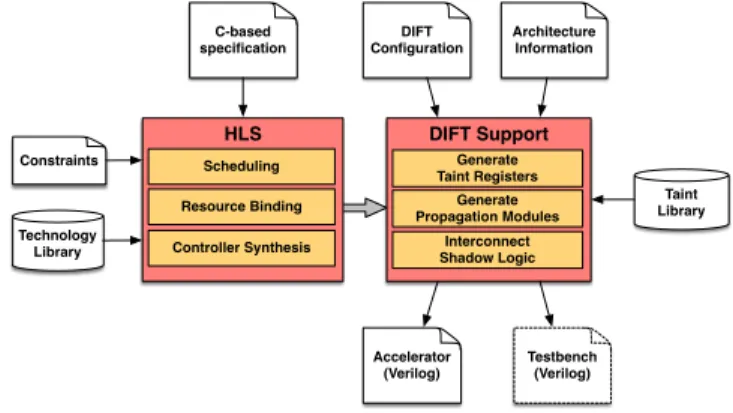
Fig. 6. Overview of TAINTHLS methodology.
IV. DESIGNMETHODOLOGY
This section presents the TAINTHLS methodology to
auto-matically generate hardware accelerators with intrinsic DIFT
support outlined in SectionIII. As shown in Fig.6, TAINTHLS
uses high-level synthesis (HLS) and receives as input a C specification, along with synthesis constraints (e.g., the clock period) and the target technology (e.g., the description and the timing of the functional units). This information is used to generate the controller, the datapath, the local memories and the memory interface [5]. To generate the shadow
microar-chitecture, one must provide a Taint Library, containing the
description of the taint propagation modules associated with each functional unit (e.g., adder, multiplier, or shifter) In this way, one can evaluate different taint propagation rules and alternative shadow microarchitectures with no changes to the datapath functionality. One can also evaluate the effects on the resources and the critical path. Possible optimizations (e.g., merging functionally equivalent nodes) will be performed
during logic synthesis. As output, TAINTHLS produces a
Verilog RTL description of the DIFT-enhanced accelerator, along with a testbench for simulation.
Besides the traditional HLS steps (e.g., scheduling, resource
binding, and controller synthesis), TAINTHLS includes three
additional steps to synthesize DIFT support: generation of the taint values, generation of the taint propagation modules, and interconnection of the shadow microarchitecture components.
A. High-Level Synthesis
A traditional HLS flow interfaces with compilers (e.g., GCC or LLVM) to parse the input C code, apply compiler optimiza-tions, and extract the intermediate representation [5]. Most modern HLS tools exploit the Single Static Assignment (SSA) form, which is composed of simple instructions that can be easily manipulated and translated into hardware [23]. The SSA form generates a unique identifier for each assignment to the same variable, increasing the number of temporary values but simplifying the subsequent HLS steps. After the assignment
of resources and memories (called allocation), scheduling is
performed to determine the operations to be executed in each clock cycle. Operations scheduled in different clock cycles can potentially reuse the same resources. Temporary values crossing the clock boundary are assigned to registers to be
stored. Different algorithms can be used to solve the module
bindingandregister binding problems. For example, liveness
analysis followed by register coloring guarantees the minimum number of registers with no conflicts [24]. The penultimate
step in the accelerator creation is the interconnection
bind-ing, where the different resources (e.g., functional units and
registers) are interconnected with multiplexers. Finally, the
controller is generated (controller synthesis), where the control
flow of the accelerator is implemented with an FSM. The FSM generates, for each clock cycle, the proper signals that control the datapath resources and drive the data values based on the operations to be executed and the datapath microarchitecture. The synthesis of each accelerator is performed hierarchically, starting from the innermost C functions. In this way, when generating a module, all submodules have been already gen-erated and they can be interconnected as any other datapath resource.
B. Generation of Taint Values
In the first step, we generate all components that are necessary to store the taint tags (either taint registers or taint
memories). As discussed in Section III, we associate a taint
register with each datapath register, whose bitwidth depends on the chosen granularity. This information is specified in
the DIFT Configuration file. We then generate an additional
tag for each input parameter (to be specified with additional memory-mapped write operations on the input interface) and one for the return value, if any (to be specified with one additional memory-mapped read operation). These operations are performed only once when the accelerator is configured (for the input parameters) or during the interrupt routine (for the return value). The performance overhead is thus negligible compared to the execution time of the accelerator. In addition, such registers are initialized to 1 after resetting the circuit in
order to identify the values as taintedby default. In this way,
any misuse of the accelerator will assume that the provided data cannot be trusted.
Next, we generate the taint memories that will be used to store the taint tags associated with the data stored in the local
SPMs. Given a data structure, which has N words ofM bits,
we use a dual-port embedded memory to store the data [12], [18]. If the HLS scheduling guarantees that there is only one memory operation per clock cycle and the size of the data structure plus the size of the corresponding taint tags can fit into the same embedded memory, we can use the second port to perform the taint-related operation in parallel. Additional logic is generated to convert the memory address on the second port to properly address the taint area. In this way, we can store the data and the corresponding tags in the same embedded memory, reducing the memory occupation. Otherwise, we must instantiate an additional embedded memory for storing the taint tags, where the same address is used to address both
memories (see Fig. 5)
C. Generation of Propagation Modules
Based on the results of module binding, we add the modules to propagate the taint tags. First, we select the proper prop-agation modules based on the functional units, the selected
granularity, and the input Taint Library. In our Taint Library,
we support modules designed with any existing techniques, like gate-level information flow tracking [15] and precise approaches [25]. We assume that the modules are available in the library since the definition of the propagation rules and the optimization of the corresponding propagation modules is out of the scope of this work. Our approach can be used to evaluate the trade-off between complexity and precision of such modules [26]. Different from gate-level tracking that creates shadow microarchitecture for all hardware resources, we exploit additional HLS information to reduce the resource overhead. For example, the accelerator is considered in a
correct state if it has passed all security checks imposed
on the FSM transitions (see Section III-A). In this case, the
operations executed in the clock cycle are legitimate and the corresponding control signals are generated to propagate the data values and the taint tags through the datapath resources and the propagation modules, respectively. So, the intercon-nection multiplexers do not require to be implemented with DIFT support. So, for each functional unit, we determine the available propagation modules in the taint library (e.g., the ones associated with the same operation) and we select the instance corresponding to the level of granularity selected for the accelerator. Given the finite set of operations that may be generated by the HLS frontend, the definition of the
corresponding complete Taint Libraryguarantees that any C
function is correctly synthesized with TAINTHLS.
When the complexity of these modules is simpler than the corresponding datapath operators (e.g., in case of variable- and byte-level tracking), the critical path is not affected. In all other cases, the HLS engine can be configured to have a larger slack
in each clock cycle after the scheduling to reduce operation
chaining [5]. Operation chaining may increase the latency of
the circuit, but it guarantees to generate enough margin for the shadow logic. As a result, the shadow microarchitecture can be safely created after all steps for generating the datapath have
been completed. This makes the TAINTHLS methodology
modular and easy to implement.
D. Interconnections in the Shadow Microarchitecture Finally, we interconnect all these components, along with the memory interfaces, to create the shadow microarchitecture. In particular, the propagation modules are connected not only to the taint registers, but also to the functional units and registers providing the actual values of the computation to generate the final description of each hardware module. For system-level integration, we provide the characteristics of the target architecture to determine how to interface the generated accelerator with the system (e.g., if the accelerator is tightly or loosely coupled with the processor). In the architectural con-figuration, we specify if we can instantiate the additional taint bus to carry the taint tags to the DRAM. If not, we introduce
theSerializer(see Fig.3(b)) between the memory interface and
the bus connection. We provide information on the memory layout to determine where to read/write the memory tags. Such information is provided to the methodology and used to configure and customize the proper components (memory
TABLE I
CHARACTERISTICS OF THE BENCHMARKS USED TO EVALUATE TAINTHLS. LOCIS THE LINES OFCCODE.
BENCHMARK LOC FUNCTIONS ARRAYS EXTERNAL MEMORY
ICRC 76 1 1 3
AES 326 7 3 3
BFS 221 1 5 3
Viterbi 146 1 5 3
interfaces andSerializer) as described in SectionIII-C. Finally,
additional registers are added in the top-level interface to store the taint tags for input/output ports.
V. EXPERIMENTALEVALUATION
This sections evaluates the DIFT-enhanced accelerators
gen-erated by TAINTHLS.
A. Experimental Setup
We extended BAMBUver. 0.9.4 [27], a modular and
open-source framework for research in high-level synthesis [5],
[11]. BAMBU receives as input C-based specifications to be
synthesized for FPGA targets, leveraging the GCC compiler to perform many compiler-related optimizations (e.g., loop
trans-formations or alias analysis). We implemented the TAINTHLS
methodology presented in SectionIVas an additional pass on
the top of the HLS results generated by BAMBU. To evaluate
the overhead introduced by DIFT support, we targeted a Xilinx Virtex-7 FPGA (xc7vx485t) at the frequency of 100 MHz and local memories implemented with BRAMs. We performed logic synthesis using Xilinx Vivado 2016.3 and RTL simula-tion with Mentor ModelSim SE 10.3 for area and performance results. We evaluated the hardware resources necessary to
implement the shadow microarchitecture (SectionV-B) and the
overhead in terms of clock cycles to perform the tag operations
(Section V-C). We validated the DIFT-enhanced accelerators
against full-software execution (Section V-D).
We applied TAINTHLS to generate accelerators for four
benchmarks:
• Invariant Cyclic Redundancy Check (ICRC) is a popular
error detection code [28];
• Advanced Encryption Standard (AES) is an iterated block
cipher (encryption algorithm) [29];
• Breadth-First Search (BFS) is a queue-based algorithm
for graph traversal [29];
• Viterbi is a dynamic programming method to compute
the most likely hidden Markov chain [29].
These kernels are likely implemented as accelerators and used in different applications. The kernels are in C code and their
characteristics are reported in TableI. In this table, we include
the size of the code, the number of functions, the number of
local memories, and the presence of memory interface. TableII
reports the the characteristics of the baseline accelerators
obtained using BAMBU without DIFT.
TABLE II
IMPLEMENTATION CHARACTERISTICS OF THEBaselineACCELERATORS (XILINXVIRTEX-7 FPGA VX485, 100 MHZ). LUT: LOOK-UPTABLES;
FF: FLIP-FLOPS; DSP: DIGITALSIGNALPROCESSOR CORES; BRAM: BLOCKRANDOMACCESSMEMORIES.
BENCHMARK LUT FF DSP BRAM CCLOCK
YCLES
ICRC 3,459 323 0 2 1,957
AES 10,641 4,571 0 2 2,266
BFS 650 570 0 2 23,265
Viterbi 1,087 974 2 0 1,594,464
Baseline (no DIFT) Variable-level DIFT Word-level DIFT Bit-level DIFT +31% LUT Overhead (Normalized) 0 0.2 0.4 0.6 0.8 1.0 1.2 1.4
ICRC AES BFS Viterbi
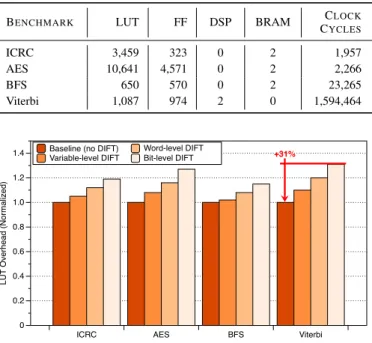
Fig. 7. Look-up table overhead in terms of LUT for DIFT support in accelerators.
B. Resource Overhead
We evaluate the overhead of the propagation modules, which
have been implemented asprecise modules [25], described in
Verilog, and provided as input to BAMBUin theTaint Library.
We compare the resources for implementing the accelerators without and with DIFT support at different levels of
gran-ularity. Fig. 7 shows the overhead in terms of LUTs when
introducing taint propagation in accelerators. As expected, the number of LUTs increases with the granularity of the taint propagation. We need complex rules to achieve the same results obtained when the DIFT is performed in software (see
SectionV-D). BFS benchmark has the minimal overhead (up
to 15%) since its logic is simple and we need simple modules for the operations of this application. On the contrary, Viterbi benchmark requires up to 31% of additional logic. However, this overhead is small compared to gate-level tracking [15]. The low overhead is because multiplexers do not require additional select logic and the memory interfaces are mini-mally affected as they only forward one additional memory operation. Additional flip-flops are used to store the taint tags and their number is proportional to the number of variables and depends on the chosen granularity. In the worst case, for bit-level taint propagation, we simply double the number of flip-flops used by the accelerator. Similarly, BRAMs are doubled in all cases since we do not use any compression on
the taint tags. So, TAINTHLS doubles the memory footprint
of the accelerator. Similar overhead is obtained for the taint tags stored in the external memory. On one hand, the memory footprint of the entire application doubles. On the other, this simplifies the memory interfaces. DSPs are never affected by
DIFT support since the propagation rules are simple and do not require such components.
When increasing the granularity to the bit-level, propagation modules become complex. For complex arithmetic operations (e.g., multiplication and integer division), the delay starts
becoming significant (∼30% longer than the critical path of the
corresponding functional units). However, none of the shadow microarchitectures violated the clock period of 10 ns, allowing the accelerators to effectively run at 100 MHz.
Even though BAMBUdoes not fully support ASIC
technolo-gies, we performed tests on micro-benchmarks to evaluate the impact for these targets. These micro-benchmarks are simple functions with no memory accesses. We created the baseline and DIFT-enhanced versions of these micro-benchmarks, tar-geting ASIC (Synopsys 32 nm SAED library at 500 MHz) and FPGA (Xilinx Virtex-7 xc7vx485t) and compared the overheads of the taint logic. In ASIC implementations, the shadow microarchitecture introduces an area overhead that is
slightly larger (∼6%) than the one introduced when targeting
FPGAs. FPGA synthesis tools jointly optimize the DIFT logic and the functional units better, using a lower number of LUTs. C. Performance Overhead
The Serializer in Fig. 3(b) is the only element that can
introduce performance overhead. All other taint operations are performed in parallel to the corresponding baseline microar-chitecture counterparts. We simulated the accelerators with
and without the Serializer, exploring the cases with a single
shared data bus or with an extra taint bus to the external memory. ICRC benchmark requires 1,957 clock cycles for the baseline case and when taint propagation uses a dedicated bus. In this architecture all memory operations on data and tags
are performed in parallel. When the Serializer is introduced,
every memory operation doubles its latency and the ICRC now takes 2,039 cycles (+4.20%). Since we do not optimize when exchanging the taint tags with the external memory, there is no difference when using different taint granularity. Other benchmarks have a lower overhead (less than 1%). So, one can achieve the same performance results even without the dedicated bus.
D. Validation of DIFT Results
To verify the correctness of the DIFT logic generated by
TAINTHLS, we compared the results of the taint propagation
against those for the corresponding software obtained by instrumenting the initial C code using a taint propagation library [20]. We generated 100 combinations of data and taint values as input and compared the taint tags after the execution of the accelerator (i.e., the returned tag and taint tags in the external memory) with the ones obtained in software. We carried out these experiments for all levels of granularity and, in all cases, the results matched (i.e., the same values for the tags and the same number of false positive/negative executions). Propagation rules were designed to achieve the
same results. This demonstrates that TAINTHLS generates
DIFT-enhanced accelerators with the same level of security as the corresponding DIFT-enhanced software.
VI. RELATEDWORK
Information flow tracking has been studied for processors to identify malicious uses. It can be performed statically (by analyzing the code) or dynamically (by tracking the data during the execution). Static methods allow for a thorough analysis of the application, but the set of problems that can be identified is limited [30]. Dynamic tracking allows detection and prevention, but may incur large overheads [7]. DIFT solutions can be implemented by modifying the software [6],
[20] or the underlying hardware [10], [15]. libdft is a
software library that can be used with unmodified binaries
to perform information tracking [20]. TaintDroid is a
modified virtualization environment to perform information flow tracking in Android-based applications [6]. A dedicated DIFT coprocessor that operates on 4-bit tags on the execution trace of the processor is presented in [10]. This solution is general and partially executes in parallel to the processor, but it is not efficient for fixed-function components. Gate-level information flow tracking (GLIFT) has been reported in [15]. Processors built on the top of these GLIFT-enabled gates can track information. However, this solution does not apply to already-fabricated processors. GLIFT methods have been extended to trade off precision and cost. However, the overhead of GLIFT may be large since no information on the specialized microarchitecture is included in the DIFT logic generation [25], [26].
None of these solutions support tracking information in heterogeneous architectures. WHISK discusses the require-ments for information flow tracking in heterogeneous architec-tures [14]. WHISK is complementary to this paper; it focuses on how the taint tags should be exchanged in the system but does not discuss generation of the shadow logic and taint propagation inside the accelerators. Raksha implements DIFT in the processor pipeline but does not support tightly-coupled accelerators [8]. DIFT support at the RTL level was proposed in [25], but it has not been fully integrated into a high-level design methodology for complex accelerators with memory accesses. However, heterogeneous architectures are popular in high-performance, energy-efficient systems [1]. They feature a large number of accelerators that are tightly [21], [31] or
loosely [3], [22] coupled with the processors. TAINTHLS can
generate DIFT for both types of accelerators.
HLS is used to generate accelerators [5]. On one hand, security aspects like information flow tracking have not been considered during accelerator generation. On the other hand, HLS reduces the effort required in designing security-enhanced accelerators [32].
VII. CONCLUDINGREMARKS
TAINTHLS is a methodology based on high-level
syn-thesis to automate the design of accelerators with intrinsic
support for dynamic information flow tracking. TAINTHLS
adopts a modular microarchitecture shadowing the baseline microarchitecture to ensure consistency of the data-flow of the accelerator data and the taint tags. One can configure the tags with distinct rules for propagation through each module. We test the approach using a state-of-the-art HLS tool to
confirm that it produces the same results as software-based DIFT. While variable-level taint propagation yields a low resource overhead (less than 10%), bit-level taint propagation requires up to 30% of additional logic to implement more complex propagation rules. Researchers can use the framework to secure heterogeneous SoCs in terms of tag propagation rules, memory architectures, and system-level integration. HLS
for security is an important research field and TAINTHLS
should be complemented with other HLS-based methods for trustworthy system design.
REFERENCES
[1] H. Esmaeilzadeh, E. Blem, R. St. Amant, K. Sankaralingam, and D. Burger, “Dark silicon and the end of multicore scaling,” in Proceed-ings of the Annual International Symposium on Computer Architecture (ISCA), Jun. 2011, pp. 365–376.
[2] J. Cong, M. A. Ghodrat, M. Gill, B. Grigorian, and G. Reinman, “Architecture support for accelerator-rich CMPs,” inProceedings of the Design Automation Conference (DAC), Jun. 2012, pp. 843–849. [3] E. G. Cota, P. Mantovani, G. Di Guglielmo, and L. P. Carloni, “An
analysis of accelerator coupling in heterogeneous architectures,” in
Proceedings of the Design Automation Conference (DAC), Jun. 2015, pp. 202:1–202:6.
[4] M. J. Lyons, M. Hempstead, G.-Y. Wei, and D. Brooks, “The Accelerator Store: A shared memory framework for accelerator-based systems,”
ACM Transactions on Architecture and Code Optimization, vol. 8, no. 4, pp. 48:1–48:22, Jan. 2012.
[5] R. Nane, V.-M. Sima, C. Pilato, J. Choi, B. Fort, A. Canis, Y. T. Chen, H. Hsiao, S. Brown, F. Ferrandi, J. Anderson, and K. Bertels, “A survey and evaluation of FPGA High-Level Synthesis tools,”IEEE Transactions on Computer-Aided Design of Integrated Circuits and Systems, vol. 35, no. 10, pp. 1591–1604, Oct. 2016.
[6] W. Enck, P. Gilbert, B.-G. Chun, L. P. Cox, J. Jung, P. McDaniel, and A. N. Sheth, “TaintDroid: An information-flow tracking system for realtime privacy monitoring on smartphones,” inProceedings of the Conference on Operating Systems Design and Implementation (OSDI), Oct. 2010, pp. 393–407.
[7] G. E. Suh, J. W. Lee, D. Zhang, and S. Devadas, “Secure program execution via dynamic information flow tracking,” in Proceedings of the international conference on Architectural Support for Programming Languages and Operating Systems (ASPLOS), Oct. 2004, pp. 85–96. [8] M. Dalton, H. Kannan, and C. Kozyrakis, “Raksha: A flexible
infor-mation flow architecture for software security,” inProceedings of the Annual International Symposium on Computer Architecture (ISCA), Jun. 2007, pp. 482–493.
[9] D. E. Denning and P. J. Denning, “Certification of programs for secure information flow,”Communications of the ACM, vol. 20, no. 7, pp. 504– 513, Jul. 1977.
[10] H. Kannan, M. Dalton, and C. Kozyrakis, “Decoupling dynamic in-formation flow tracking with a dedicated coprocessor,” inProceedings of the International Conference on Dependable Systems & Networks (DSN), Jun. 2009, pp. 105–114.
[11] C. Pilato and F. Ferrandi, “Bambu: A modular framework for the high level synthesis of memory-intensive applications,” inProceedings of the International Conference on Field Programmable Logic and Applications (FPL), Sep. 2013, pp. 1–4.
[12] C. Pilato, F. Ferrandi, and D. Sciuto, “A design methodology to implement memory accesses in high-level synthesis,” in Proceedings of the International Conference on Hardware/Software Codesign and System Synthesis (CODES+ISSS), Oct. 2011, pp. 49–58.
[13] M. Minutoli, V. G. Castellana, A. Tumeo, M. Lattuada, and F. Ferrandi, “Enabling the high level synthesis of data analytics accelerators,” in
Proceedings of the International Conference on Hardware/Software Codesign and System Synthesis (CODES+ISSS), Oct. 2016, pp. 1–15. [14] J. Porquet and S. Sethumadhavan, “WHISK: An uncore architecture for
dynamic information flow tracking in heterogeneous embedded SoCs,” inProceedings of the International Conference on Hardware/Software Codesign and System Synthesis (CODES+ISSS), Sep. 2013, pp. 1–9. [15] W. Hu, J. Oberg, A. Irturk, M. Tiwari, T. Sherwood, D. Mu, and
R. Kastner, “Theoretical fundamentals of gate level information flow tracking,”IEEE Transactions on Computer-Aided Design of Integrated Circuits and Systems, vol. 30, no. 8, pp. 1128–1140, Aug. 2011.
[16] M. Horowitz, “Computing’s energy problem (and what we can do about it),” inISSCC Digest of Technical Papers, Feb. 2014, pp. 10–14. [17] J. Zhu and D. D. Gajski, “A unified formal model of ISA and FSMD,”
in Proceedings of the International Workshop on Hardware/Software Codesign (CODES), Mar. 1999, pp. 121–125.
[18] C. Pilato, P. Mantovani, G. D. Guglielmo, and L. P. Carloni, “System-level optimization of accelerator local memory for heterogeneous Systems-on-Chip,” IEEE Transactions on Computer-Aided Design of Integrated Circuits and Systems, vol. 36, no. 3, pp. 435–448, Mar. 2017. [19] Y. Wang, P. Li, and J. Cong, “Theory and algorithm for generalized memory partitioning in high-level synthesis,” in Proceedings of the International Symposium on Field-Programmable Gate Arrays (FPGA), Feb. 2014, pp. 199–208.
[20] V. P. Kemerlis et al., “Libdft: Practical dynamic data flow tracking for commodity systems,” in Proceedings of the Conference on Virtual Execution Environments (VEE), Mar. 2012, pp. 121–132.
[21] F. Conti, A. Marongiu, and L. Benini, “Synthesis-friendly techniques for tightly-coupled integration of hardware accelerators into shared-memory multi-core clusters,” in Proceedings of the International Conference on Hardware/Software Codesign and System Synthesis (CODES+ISSS), Sep. 2013, pp. 1–10.
[22] J. Cong, M. A. Ghodrat, M. Gill, B. Grigorian, K. Gururaj, and G. Rein-man, “Accelerator-rich architectures: Opportunities and progresses,” in
Proceedings of the Design Automation Conference (DAC), Jun. 2014, pp. 1–6.
[23] D. Novillo, “Design and implementation of Tree SSA,” inGCC Devel-opers’ Summit, 2004, pp. 119–130.
[24] L. Stok, “Data path synthesis,”Integration, the VLSI Journal, vol. 18, no. 1, pp. 1–71, Dec. 1994.
[25] A. Ardeshiricham, W. Hu, J. Marxen, and R. Kastner, “Register transfer level information flow tracking for provably secure hardware design,” inProceedings of the Design, Automation & Test in Europe Conference (DATE), Mar. 2017, pp. 1691–1696.
[26] A. Becker, W. Hu, Y. Tai, P. Brisk, R. Kastner, and P. Ienne, “Arbitrary precision and complexity tradeoffs for gate-level information flow track-ing,” inProceedings of the Design Automation Conference (DAC), Jun. 2017, pp. 1–6.
[27] Politecnico di Milano, “Bambu 0.9.4,” Available at http://panda.dei. polimi.it, 2016.
[28] J. Scott, L. H. Lee, J. Arends, and B. Moyer, “Designing the low-power MCORE architecture,” in Proceedings of the Power Driven Microarchitecture Workshop, Jul. 1998, pp. 145–150.
[29] B. Reagen, R. Adolf, Y. S. Shao, G. Y. Wei, and D. Brooks, “MachSuite: Benchmarks for accelerator design and customized architectures,” in
Proceedings on the International Symposium on Workload Characteri-zation (IISWC), Oct. 2014, pp. 110–119.
[30] Y. Liu and A. Milanova, “Static information flow analysis with handling of implicit flows and a study on effects of implicit flows vs explicit flows,” inProceedings of the European Conference on Software Main-tenance and Reengineering (CSMR), Mar. 2010, pp. 146–155. [31] N. Goulding-Hotta, J. Sampson, Q. Zheng, V. Bhatt, J. Auricchio,
S. Swanson, and M. B. Taylor, “GreenDroid: An architecture for the Dark Silicon Age,” inProceedings of the Asia and South Pacific Design Automation Conference (ASP-DAC), Jan. 2012, pp. 100–105. [32] C. Pilato, S. Garg, K. Wu, R. Karri, and F. Regazzoni, “Securing
hardware accelerators: a new challenge for High-Level Synthesis,”IEEE Embedded Systems Letters, pp. 1–4, First online: Nov. 2017.
Christian Pilato received the Laurea degree in Computer Engineering and the Ph.D. degree in Infor-mation Technology from the Politecnico di Milano, Italy, in 2007 and 2011, respectively. From 2013 to 2016, he was a Post-doc Research Scientist with the Department of Computer Science, Columbia University, New York, NY, USA. He is currently a Post-doc at the University of Lugano, Switzerland. His research interests include high-level synthesis, reconfigurable systems and system-on-chip architec-tures, with emphasis on memory aspects. In 2014 Dr. Pilato served as program chair of the Embedded and Ubiquitous Conference (EUC) and he is currently involved in the program committees of many conferences on embedded systems, CAD, and reconfigurable architectures (e.g., FPL, DATE, CASES). He is a member of the Association for Computing Machinery.
Kaijie Wu received the BE degree from Xidian University, Xi’an, China, in 1996, the MS degree from the University of Science and Technology of China, Hefei, China, in 1999, and the Ph.D. degree in electrical engineering from Polytechnic University (Now Polytechnic Institute of New York University), Brooklyn , New York, in 2004. He then joined University of Illinois, Chicago, USA as an Assistant Professor. From 2014 to 2016, he was a professor at the College of Computer Science, Chongqing University, China. His research is on the big area of trustworthy computing with special interest on dependable computing and hardware security. He is the recipient of the 2004 EDAA Outstanding Dissertation Award for “new directions in circuit and system test.”, and the “Most Significant Paper” award from the International Test Conference, 2014. He is a member of the IEEE.
Siddharth Gargreceived his Ph.D. degree in Elec-trical and Computer Engineering from Carnegie Mellon University in 2009, and a B.Tech. degree in Electrical Engineering from the Indian Institute of Technology Madras. He joined NYU in Fall 2014 as an Assistant Professor, and prior to that, was an Assistant Professor at the University of Waterloo from 2010-2014. His general research interests are in computer engineering, and more particularly in secure, reliable and energy-efficient computing. In 2016, Siddharth was listed in Popular Science Mag-azine’s annual list of ”Brilliant 10” researchers. Siddharth has received the NSF CAREER Award (2015), and paper awards at the IEEE Symposium on Security and Privacy (S&P) 2016, USENIX Security Symposium 2013, at the Semiconductor Research Consortium TECHCON in 2010, and the International Symposium on Quality in Electronic Design (ISQED) in 2009. Siddharth also received the Angel G. Jordan Award from ECE department of Carnegie Mellon University for outstanding thesis contributions and service to the community. He serves on the technical program committee of several top conferences in the area of computer engineering and computer hardware, and has served as a reviewer for several IEEE and ACM journals.
Ramesh Karri is a Professor of ECE at New York University. He co-directs the NYU Center for Cyber Security (http://cyber.nyu.edu). He also leads the Cyber Security thrust of the NY State Center for Advanced Telecommunications Technologies at NYU. He co-founded the Trust-Hub (http://trust-hub.org) and organizes the Embedded Systems Chal-lenge (https://csaw.engineering.nyu.edu/esc), the an-nual red team blue team event. Ramesh Karri has a Ph.D. in Computer Science and Engineering, from the UC San Diego and a B.E in ECE from Andhra University. His research and education activities in hardware cybersecurity include trustworthy ICs; processors and cyber-physical systems; security-aware computer-aided design, test, verification, validation, and reliability; nano meets security; hardware security competitions, benchmarks and metrics; biochip security; additive manufacturing security. He has published over 240 articles in leading journals and conference proceedings. Karri’s work on hardware cybersecurity received best paper nominations (ICCD 2015 and DFTS 2015) and awards (ACM TODAES 2018, ITC 2014, CCS 2013, DFTS 2013 and VLSI Design 2012). He received the Humboldt Fellowship and the National Science Foundation CAREER Award. He serves on the editorial boards of several IEEE and ACM Transactions (TIFS, TCAD, TODAES, ESL, D&T, JETC). He served as an IEEE Computer Society Distinguished Visitor (2013-2015). He served on the Executive Committee of the IEEE/ACM Design Automation Conference leading the SecurityDAC initiative (2014-2017). He delivers invited keynotes, talks, and tutorials on Hardware Security and Trust Trust (ESRF, DAC, DATE, VTS, ITC, ICCD, NATW, LATW, CROSSING, etc.). He co-founded the IEEE/ACM NANOARCH Symposium and served as program/general chair of conferences (IEEE ICCD, IEEE HOST, IEEE DFTS, NANOARCH, RFIDSEC and WISEC). He serves on several program committees (DAC, ICCAD, HOST, ITC, VTS, ETS, ICCD, DTIS, WIFS).
Francesco Regazzoni is a senior researcher at the ALaRI Institute of University of Lugano (Lugano, Switzerland). He received his Master of Science degree from Politecnico di Milano and his PhD de-gree at the ALaRI Institute of University of Lugano. He has been assistant researcher at the Universit´e Catholique de Louvain and at Technical University of Delft, and visiting researcher at several institu-tions, including NEC Labs America, Ruhr University of Bochum, EPFL, and NTU. His research interests are mainly focused on cyber-physical and embedded systems security, covering in particular side channel attacks, cryptographic hardware, and electronic design automation for security.