Analytical review
Virtual Ligand Screening for Structure-based Drug
Design: Approaches and Progress
Maria A. Miteva*, Olivier Sperandio, Bruno O. Villoutreix
INSERM U648; University Paris Descartes 45 rue des Sts Peres, 75006 Paris, France E-mail: [email protected]
*
Corresponding author
Received: July 30, 2007 Accepted: September 27, 2007
Published: October 24, 2007
Abstract: Recent progress in human genomics and proteomics has significantly increased
the number of macromolecular targets potentially involved in drug discovery campaigns. Today technologies like combinatorial chemistry and high-throughput screening (HTS) authorize biological assays of a large number of small molecules against the therapeutically relevant targets. However the escalating costs highlight the need of developing novel approaches while still allowing one to explore larger chemical diversity. In this respect, virtual ligand screening (VLS) is established as an attractive approach to handle large sets of compounds and to improve the “hit-rate” of drug discovery programs. Here, we review the main VLS techniques applied for structure-based drug design and we focus on key concepts in the molecular docking–scoring methodology.
Keywords: Virtual screening, Structure-based drug design, Review.
Introduction
Recent progress in human genomics and proteomics has significantly increased the number of macromolecular targets potentially involved in the health and disease states and thus the number of drug discovery campaigns. It is commonly accepted that there are seven main steps in the drug discovery process: disease selection, target validation, identification of lead compound (screening), optimization of the lead compounds, pre-clinical trial, clinical trial and pharmacogenomic optimization. Traditionally, these steps are performed out sequentially, and if one of the steps is slow, the entire process is delayed. Because it is not possible to speed-up clinical trials, it seems that the only way to increase the effectiveness of the process is to optimize the preclinical steps. Today technologies like combinatorial chemistry and high-throughput screening (HTS) authorize biological assays of a large number of small
molecules (over 10 million chemical compounds can be purchased) against the therapeutically
relevant targets. However the escalating costs highlight the need of developing novel
approaches while still allowing one to explore larger chemical diversity. In this respect, virtual ligand screening (VLS), or in silico screening, is established as an attractive approach to handle large sets of compounds and to improve the “hit-rate” of drug discovery programs
[89, 99]. In fact, VLS has become a method of choice for hit identification not to replace HTS and NMR-based screens but rather to complement them, such that experiments to be only
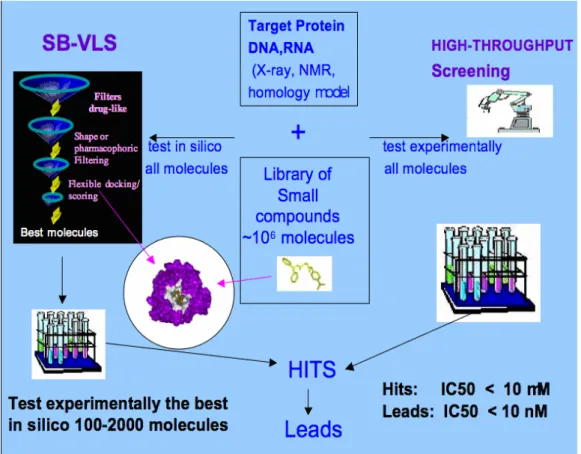
carried out on a small list of compounds pre-selected via computer methods [55, 67, 68, 95]. Among the various VLS methods directly used for hit identification, we can usually distinguish two families: ligand-based screening and structure-based screening [21]. For ligand-based methods, the strategy is to use information provided by compounds that are known to bind to the desired target and to use these data to identify other molecules in the databases with similar properties [5, 62, 100]. This can be done by a similarity and substructure search, clustering, QSAR, pharmacophore matching or three-dimensional (3D) shape matching (“lead-hopping”). Virtual ligand screening based on the 3D structure of macromolecular targets (structure-based SB-VLS) is widely applied to identify chemical entities that have a high likelihood of binding to a target molecule to elicit desired biological responses [19, 93, 97, 118]. For SB-VLS methods (Fig. 1), it is assumed that the 3D structure of the target is known either by X-ray crystallography or NMR experiments, or predicted by homology modeling [24, 47, 79, 88]. The principle here is to dock all the ligands present in a database into the binding pocket of the selected target and evaluate the fit between the molecules [68].
Fig. 1 Flowchart of Structure-based Virtual Ligand Screening (SB-VLS) versus High-Throughput Screening (HTS) for hit identification.
For a successful application of VLS methods for structure-based drug design several points have to be considered: availability of databases, sufficient computational resources, as well as specific knowledge and expertise [74]. While SB-VLS is known to give valuable information for selection of new hits among chemical libraries of millions of compounds by using
common docking-scoring algorithms [54, 60], it is also costly in terms of computational time.
The extensive treatment of ligand (and in some cases receptor) flexibility in the docking process is critical for docking accuracy but increase significantly the time of the docking simulations. SB-VLS using fully flexible docking is impractical for the screening of millions
of molecules. Therefore developing new, faster and more efficient docking methods to decrease biocomputing cost has become a priority for many research groups [63, 85, 90, 91, 107].
Several recent reviews about computer aided drug design/VLS methods have been published [3, 14, 30, 41, 54, 60, 93, 111]. In the present review we will focus on the main VLS techniques applied for structure-based drug design and molecular docking-scoring methodology. Various docking-scoring methods have been reported in the literature. The complexity of molecular docking implies several approximations, from rigid body docking, to (pseudo)-flexible ligand docking (where the receptor is held rigid and the ligand is partially flexible) to flexible docking (where both receptor and ligand flexibility are considered). Algorithms dealing with flexibility can be divided in three types, namely systematic, stochastic and deterministic searches (e.g., energy minimization and molecular dynamics) (see explanations about these simulation methods in [10, 103]. Some VLS packages use more than one of these approaches.
Binding free energy and scoring in VLS
The molecular recognition problem, which is the basis for protein-protein/ligand docking– scoring modeling, is discussed in details in [10]. It is well known that molecular complexes (protein-protein or protein-ligand) are stabilized by interactions such as: van der Waals, hydrophobic, ionic, hydrogen bonds. Upon receptor-ligand binding significant solvation and entropic changes occur due to rearrangement of water molecules surrounding the unbound ligand and receptor. The stability of a complex (or the binding free energy ∆Gbind) can be measured by determining the equilibrium binding constant, Keq. (Eq. 1):
∆Gbind = - RT ln Keq (1)
The binding free energy involving both enthalpic (∆H) and entropic (∆S) contributions can be presented as a difference between the free energy of the complexe (Gcomplex) and the free energies of the receptor (Greceptor) and the ligand (Gligand) in unbound state (Eq. 2):
∆Gbind = ∆H - T∆S = Gcomplex - (Greceptor + Gligand) (2) Rigorous and accurate computation of the binding free energy can be done through time consuming methods: free energy perturbation (FEP) and thermodynamic integration (TI) [36]. In such approaches the free energy difference between bound and unbound ligand and receptor is determined by slow intermediate changes from one state to the other. By now, these are the most precise theoretical methods but they are very time-consuming and as such, these approaches are not appropriate for screening large compound collections. Along the same line and still too computationally expensive, the linear interaction energy (LIE) approximation [4, 71] can also be used to obtain binding free energies for a small number of compounds.
More approximate models have been proposed to evaluate relative binding affinities so called scoring functions. They can be applied in docking-scoring steps in VLS projects. Accurate prediction of relative binding affinities firstly depends on finding the correct binding poses. However, the accurate binding modes are necessary but not sufficient for correct ligand scoring and ranking. It is well known [10, 51] that the scoring of the ligands is a crucial step in a VLS project. Scoring functions are used (1) to evaluate different bound poses for a single ligand proposed by the docking algorithm in order to select the energetically preferred pose;
(2) to rank different docked ligands in order to discriminate the active compounds. Scoring functions can be classified into three categories: force field-based, knowledge-based and empirical.
Docking algorithms
Multiple conformation rigid body docking
Among the numerous docking programs several rigid body docking programs have been reported to dock rigidly previously generated conformers by matching interaction points from the receptor site with ligand atoms. In the rigid body docking methods, an orientational search of the ligand in the protein binding pocket is carried out while the receptor and the ligand remain rigid. Thus only the six translational and rotational degrees of freedom are explored. One of the first molecular docking program for protein-small molecule interaction involving rigid body docking was the DOCK developed by Kuntz and co-workers [58]. The program DOCK generates a negative image of the receptor - spheres that fill the binding pocket represent potential interaction sites. The DOCK algorithm attempts to superimpose the ligand atoms onto the centers of the spheres. Another rigid-body docking program FRED (http://www.eyesopen.com) [72] applies a Gaussian shape fitting function to optimize the contact surface between the ligand and the protein which allows extremely fast rigid docking procedure. FRED filters the pose ensemble by rejecting the ones that clash with the protein using a negative image of the active site. The refined poses can then be scored using various scoring functions [110]. The programs FLOG [76] and CLIX [59] apply grids with pre-calculated potential energies of interaction with putative ligand atoms. The physical properties of the ligand atoms are divided into several atom types (neutral hydrogen-bond donors, neutral hydrogen-bond acceptors, polar, hydrophobic…). An alternative approach of continuum calculation of the binding energy is used in EUDOC [84] to score the docking poses via the three different force-fields (TRIPOS, AMBER, CHARMM), while cation-pi interaction between the ligand and the target can be taken into account.
Despite obvious limitations, rigid body docking methods are interesting because they are much faster than the flexible docking algorithms. Software such as FRED can dock up to 10 compounds per second on a standard mono-processor Linux workstation [72]. The speed and the relative accuracy of mutli-conformation rigid body docking methods make them attractive [81] especially as an initial filter of a hierarchical structure-based VLS project to remove from the docking library compounds that could not fit into the binding pocket or that have low surface complementarity with the receptor [77, 112]. One way to improve rigid-body docking accuracy is to dock pre-generated multiple conformers of a ligand. In a modified version of DOCK [65] multiple conformations of ligands in the same frame of reference are docked as an ensemble, into a receptor binding site allowing extremely fast docking. Moreover, each ensemble of pregenerated ligand conformations can be processed into a hierarchical data structure such that atom connectivity is implicitly represented across all conformations of the ensemble [66]. Multiple ligand conformers required for the rigid-body docking can be generated with the well established commercial packages as Corina (Molecular Networks GmbH. http://www.mol-net.de.), OMEGA (Openeye Scientific Software. http://www.eyesopen.com) or Catalyst [9, 50] as well as with free online tools. Recently FROG, a tool to generate multiple 3D conformations of compounds has been reported [61] (http://bioserv.rpbs.jussieu.fr/Frog.html). In addition web-databases with chemical compounds for VLS like Zinc [39] or FAF-drugs [78] propose pre-calculated collections of compounds in 3D.
Flexible ligand: Systematic search
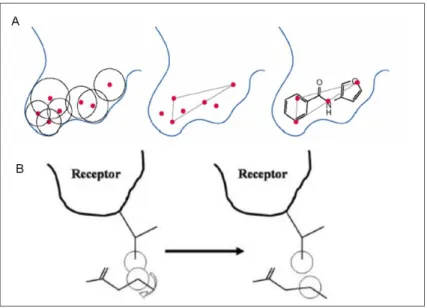
Systematic search algorithms try to explore all degrees of freedom. To reduce the number of evaluations to be performed, termination criteria is defined to prevent the algorithm from facing combinatorial explosion. Fragmentation/reconstruction algorithms (incremental construction methods) generally divide a ligand into small rigid cores and flexible linking parts (see Fig. 2). The rigid core fragments are docked first into the binding site and the flexible parts are added incrementally to reconstruct the complete ligand.
Fig. 2 A) Binding site definition in DOCK. B) Torsion angle variation in DOCK
The general approach in the program DOCK (http://dock.compbio.ucsf.edu/) for treatment of ligand flexibility [57, 70] (anchor-and-grow method) is divided into three main steps. First, the determination of a set of overlapping spheres in contact with the surface of the receptor site. These spheres fill the molecular surface of the binding site and represent a negative image of the target site. Second, the center of these spheres is matched with the ligand atoms via the use of a graph-matching algorithm. Third, a scoring function is used to evaluate the pertinence of the docking poses by approximating the protein/ligand binding energy. The evaluation of the ligand orientation uses a grid-based procedure in which steric and electrostatic interactions between the putative ligand and the receptor are pre-computed at each grid point. In order to score generated binding modes, as well to rank a number of ligands, several scoring functions can be used in DOCK 3.5 and DOCK4.0: contact score, chemical score, energy score (Lennard-Jones van der Waals potential and Coulombic electrostatics with a distance-dependent dielectric constant). In the new versions of DOCK additional scoring functions have been developed taking into account the contribution of the solvation energy for molecular recognition: the Generalized Born/Surface Area (GB/SA) score (implemented in DOCK5) [37, 119] and Poisson-Boltzmann/Surface Area (PB/SA) scoring function [32] (in DOCK6).
Several approaches based on the DOCK methodology have been developed. TARGETED_DOCK [20] is a modified version of DOCK 1.0 that is able to target user-specified atom types to selected positions in the receptor site. The list of pairs between ligand atoms and receptor spheres can be obtained from analysis of the receptor site, for example, a
specific hydrogen-bond or a tightly bound water molecule. The match algorithm of DOCK then focuses on this specific list of pairs of target sphere and ligand atom. The program PhDOCK [45] is based on the pharmacophore representations of small molecules that are stored in a database. This pharmacophoric-point representation is compared to predefined DOCK site points in the binding region in order to orient the complex (ligand + protein). An iterative procedure is applied which consists of associating each molecule to a pharmacophore. The pharmacophore representation is first used to overlay molecules based on their widest 3D pharmacophore. The basic objects of this representation are simply hydrogen-bond donors, hydrogen-bond acceptors, and ring centroids. For each orientation that provides a good match with the receptor points, the ensemble of conformers is docked into the binding site, and all members of the ensembles are scored. The methods SG-DOCK and SP-DOCK [28] apply two distinctive algorithms, SPDOCK (similarity penalizing docking) and SG-DOCK (similarity guided docking). SG-DOCK uses similarity criteria along the incremental construction process. This algorithm promotes target-ligand orientation having the binding mode observed in the reference structures and penalizes those diverging from them. On the contrary, SP-DOCK exclusively uses similarity criteria to penalize the docking pose after the docking process, thus having only an effect on the final ranking. PostDOCK [98] performs a postprocessing filtering to select true binding ligand-protein complexes generated by DOCK4. PostDOCK is a pattern recognition system that relies on a database of complexes, biochemical descriptors of those complexes, and machine learning tools. For the biochemical descriptors, PostDOCK considers terms from the DOCK score, empirical scoring, and buried solvent accessible surface area.
The program Surflex (www.biopharmics.com) [40, 42] is based on a previously developed program named Hammerhead [113]. It uses the same concept of pocket finder and binding site-probing definition (protomols) but it is characterized by an innovative incremental construction of the ligand and recently refined scoring function. The program first creates an idealized binding site a protomol that serves as a target to which putative ligands or ligand fragments are aligned on the basis of molecular similarity. Each putative ligand is fragmented, resulting in 1-10 molecular fragments, each of which may have some rotatable bonds. Each fragment is then conformationally searched and each conformation of each fragment is aligned to the protomol to yield poses that maximize molecular similarity to the protomol. The scoring function terms involve,in rough order of significance, hydrophobic complementarity, polar complementarity, entropic terms, and solvation terms.
The software FlexX (http://www.biosolveit.de/) (http://www.tripos.com/) [87] docks flexible ligands into rigid receptors using an incremental approach and some concepts present in the LUDI program [8]. The approach can be divided into three areas: conformational flexibility, protein-ligand interactions and scoring. The conformational flexibility of the ligand is modeled by a discrete set of preferred torsion angles at acyclic single bonds [52] and multiple conformations for ring systems. With regard to the interaction scheme, FlexX relies on the detection of geometrically restrictive interactions such as hydrogen-bonds, specific hydrophobic interactions such as phenyl-methyl doublets, or spherical surfaces that are derived from favored interaction distances. The docking algorithm is divided into three phases: base fragment selection, base fragment placement, and complex construction, where the ligand is built incrementally from the base fragment. The ranking of the ligands is performed with the modified empirical Bohm scoring function. This scoring function includes several (weighted) terms: a fixed ground term, a term taking into account the loss of entropy during ligand binding due to the hindrance of rotatable bonds in the ligand, hydrogen-bond, ionic interaction, aromatic interaction and lipophilic interaction.
Flexible ligand: Stochastic search
Stochastic (or random) search algorithms involve random changes to modify the position of the ligand (translation and rotation) as well as torsion angles in order to generate different conformations. The main stochastic search methods are Monte Carlo (MC), Genetic Algorithms (GA) and Tabu search.
Monte Carlo methods
MC can generate an ensemble of conformations which are statistically consistent at a given temperature. Random perturbations of the atomic positions are applied in order to explore the conformational space of the molecular system. An energy function evaluates whether the energy of the newly generated conformation is either lower than the one from the previous step or, if higher, is within an energy range defined by the so-called Boltzmann factor (Metropolis criteria).
The package LigandFit (www.accelrys.com) [108] has utilities to predict/define the binding site based upon the protein shape (flood-filling algorithm). A Monte Carlo method is employed for the conformational search of the ligand. During this search, bond lengths/bond angles are untouched while torsion angles are randomized. Multiple structural changes may thus occur at the same time during this step. Once a new conformation for the ligand is generated, the fitting of the compound in the binding pocket is carried out (shape similarity search procedure), eventually followed by rigid body minimization. If the shape is similar then the ligand is docked into the binding site and its binding energy is evaluated via an energy function called DockScore [108] involving a soft 9-6 van der Waals term and an electrostatic term with a distance-dependent dielectric constant and, eventually, the internal energy of the ligand. Several scoring functions are available including, for instance, Ludi [8], LigScore [53] or PLP [109]. The Dreiding and CFF force-fields are available.
The method MCDOCK [64] is a three-stage strategy using a Monte Carlo algorithm. The three successive stages of the protocol consists of increasingly refining the level at which the ligand is placed within the receptor site. This first stage (geometry-based docking) consists of placing the ligand inside the receptor site without major clashes by using a binary grid. A MC routine is in charge of positioning the rigid ligand into the binding site. The second stage uses another MC protocol (energy-based docking). The nonbonded terms of the energy function are the classical Lennard-Jones and Coulombic terms. Concerning the internal energy of the ligand, only the nonbonded components are treated, while the torsional components are ignored. After a global sampling that allows the eviction of bad contacts between the ligand and the receptor, a simulated annealing protocol is applied using Metropolis criteria. The position of the center of mass, the three overall Euler angles, and internal torsion angles of the ligand are sampled. Finally, a MC protocol is used to prevent the system to be trapped in a local minimum. Other MC methods for VLS are Dockvision [34], QXP [73], or QUASI [105].
Genetic algorithms
GA are loosely modeled on concepts borrowed from Darwinian evolution. Different ligand conformations and positions are generated, forming a population of solutions. This initial state of population is evolved as the lowest energy positions. This population is submitted to crossing over and random or biased mutations in order to form the next population. The algorithm maintains a selective pressure towards an optimal solution, with a randomized information exchange permitting exploration of the search space. After successive steps of evolution, the best ligand positions and conformations are kept resulting into the lowest energy ligand pose. These algorithms are used in many docking programs such as GOLD [43], AutoDock [31], DARWIN [102], FFLD [11, 15]. For example, in GOLD, the mechanism for ligand placement is based on fitting points. The program adds fitting points to hydrogen-bonding groups on protein and ligand, and maps acceptor points in the ligand on donor points in the protein and vice versa. The genetic algorithm optimizes flexible ligand dihedrals, ligand ring geometries, dihedrals of protein OH and NH groups, and the mappings of the fitting points.
The program AutoDock 3(http://www.scripps.edu/mb/olson/doc/autodock) [23, 80]: employs a Lamarkian genetic algorithm (LGA) that incorporates a local minimization for a given fraction of the population. The LGA mixes a global search for ligand conformation and orientation, handled by a genetic algorithm switching between “genotypic space” and “phenotypic space, with an adaptive local search to perform energy minimization. The scoring function of AutoDock3.0 is modeled after the AMBER force-field, and uses a pairwise sum of energetic terms with parameters for van der Waals, hydrogen bonding and distance-dependent dielectric electrostatics, as well as conformational torsional restriction entropy and empirical solvation terms.
Tabu search
Tabu search combines a minimization procedure with restrictions on the search path, such that the solution is forced into previously unexplored regions of the search space. It proceeds stepwise from an initial solution, while maintaining a list of previous solutions. The list of previous solutions provides both a ranking of solutions and a partial record of explored regions of the search space. The Tabu algorithm generates a set of N new solutions from the previous solution, and one of the N solutions is kept. A solution is added to the list if it is the best solution so far, or the solution explores a new region of the search space. A Tabu search algorithm is for example implemented in the PRO_LEADS package [7, 114].
Flexible ligand: Deterministic search
In the deterministic search, the initial state determines the change that can be made to generate the next state, which generally has to be energetically preferred as compared with the initial state. One problem with these approaches is that they can be trapped in local minima. Deterministic methods for VLS are energy minimization and molecular dynamics (MD) methods allowing a flexibility of the receptor binding site [3, 22, 96]. Molecular dynamics as compared to MC simulations, cannot cross easily high-energy barriers within reasonable simulation time and at room temperature [10, 51]. Some simulation methods that could be useful for VLS have been developed to overcome more rapidly the energy barriers, for example using simulated annealing molecular dynamics (SDOCKER [115]). Some authors propose to carry out time-consuming MD simulations at the final steps of the VLS process on a smaller pre-selected compound library in order to sample different conformations of the protein-ligand complex and to predict the binding affinities [56, 112]. Approaches that
combine several methods are emerging, like for instance, docking with FlexX and applying molecular dynamics and quantum mechanics and molecular mechanics methods [49] or molecular dynamics with Quantum-Refined Force-Field [25].
Flexible receptor
One of the main challenges for the VLS methodology today is to take into account conformational changes of the receptor upon ligand binding [104]. Often the receptor flexibility is neglected during VLS experiments [51]. However, in many receptor-ligand interactions, significant conformational changes can occur upon binding, for instance the induced-fit of protein kinases upon inhibitor binding [12] or at protein-protein interfaces[17, 106]. On the other hand an explicit incorrect inclusion of the receptor flexibility can lead to worse discrimination of the real active compounds as compared to calculations performed on a rigid receptor [2].
Various strategies are proposed in the literature to take into consideration the receptor flexibility. The most relevant, but apparently the most time consuming way is to apply deterministic methods like a MD simulations (see above). One promising manner to account for the receptor flexibility in VLS projects is to perform the docking simulations on ensemble of different modeled or experimental protein structures. Different protein structures can be generated by MD or MC simulations [35]. The normal-mode-based methodology was also shown to incorporate receptor flexibility in ligand docking [26] and virtual screening [13]. In addition, multiple experimental structures can be used to screen one target protein allowing investigation of the influence of different structures on ligand binding [6].
Cavasotto and Abagyan [12] proposed the ICM-flexible (www.molsoft.com) [1] receptor docking algorithm (IFREDA) to account for protein flexibility during virtual screening. The ICM program is based on Monte Carlo simulation that relies on global optimization of the energy function of the flexible ligand in the receptor field (flexible ligand/grid receptor approach) (receptor side chains/main chain flexibility). A Monte Carlo minimization procedure in the internal coordinate space is employed to search for the global minimum of the energy function. Each step of the algorithm consists of a random change of two types, torsional or positional, followed by a local minimization. Torsional changes of amino-acid side chains at the interface can also be applied using a biased probability methodology. The VLS scoring function used in ICM consists of the internal forcefield energy of the ligand and the ligand/receptor interaction energy with eventually a term to account for the size of the binding site/ligand. The ligand/receptor interaction energy includes several weighted terms: van der Waals, a hydrophobicity term based on the solvent accessible surface buried upon binding, an electrostatic solvation term calculated using a boundary-element solution of the Poisson equation, hydrogen-bond interactions and an entropic term proportional to the number of flexible torsions in the ligand.
The program SLIDE (http://www.bch.msu.edu/labs/kuhn/web/index.html) [92, 117] docks flexible ligands into a partially flexible protein. The core of the approach relies on an iterative matching procedure between interaction centers within the receptor and interaction points within the ligand. The receptor site is analyzed in term of interactions points: hydrogen-bond donor, hydrogen-bond acceptor and hydrophobic. A multilevel hashing procedure exhaustively detects matches between triplets of interaction points and triplets of ligand atoms such that vertices and edges are, compatible and within a threshold distance, respectively. Steric hindrance between the protein and the ligand anchor fragment is resolved by using
rigid body translations. Once the anchor fragment is determined and no collision is observed, the rest of the ligand atoms are flexibly added and optimized by rotating all single bonds. This includes some side chain flexibility. The generated poses are evaluated with an empirical scoring based on evaluation of hydrogen bonds and hydrophobic contacts. The number of water displacements and protein intramolecular hydrogen bonds disruption can be taken into account. Hydrophobicity is evaluated with a knowledge-based criterion.
Hierarchical docking methods
Various concepts have been proposed to speed up the time-consuming procedures docking-scoring of SB-VLS. Recently multistep VLS protocols with funnel strategy for docking,
consisting of different levels of filtering have been developed [27, 29, 77, 112]. It was
demonstrated that such hierarchical procedures for docking-scoring methodology
significantly improves the speed and the quality of SB-VLS procedures [18, 48, 94]. Several
of these approaches start with pharmacophoric constrains or a geometrical matching of the target and the ligands which could be the fastest filtering step based on the 3D target structure. The following filtering steps usually involve flexible ligand docking and eventually partial receptor flexibility and/or different level of precision in the estimation of binding energies with final free energy calculations involving estimation of van der Waals, Coulombic
interations, and changes in solvation and enthropy due to the ligand binding [16, 75].
Recently hierarchical database screenings using a pharmacophore model, rigid-body docking, solvation docking, and molecular mechanics-Poisson-Boltzmann/surface area (MM/PBSA) have been shown to be useful in order to predict more precisely the binding energies [112]. The MM/PBSA methodology predicts the binding free energy ∆Gbind of a ligand (see Eqs. 1-2) by combining molecular mechanics energy, solvation free energies with Poisson Boltzmann (or generalized Born) calculations, and entropy estimates from normal mode calculations; [75, 101, 112]. Studies combining FLOG and ICM-dock [69] or FRED-Surflex methods [94] have been reported to be successfully applied for identification of new potent inhibitors [18].
HierVLS (hierarchical virtual ligand screeing) [27] is a fast hierarchical docking approach that starts with a coarse grain conformational search over a large number of configurations filtered with a fast but crude energy function, followed by a succession of finer grain levels, using more and more accurate but more expensive descriptions of the ligand-protein-solvent interactions. The final step of this procedure optimizes one configuration of the ligand in the protein site using an accurate energy expression and description of the solvent, which would be impractical for all conformations and sites sampled in the coarse level. The method MPSim-Dock [16] combines elements of DOCK with molecular dynamics methods available in the software, MPSim.
The program GLIDE (http://www.schrodinger.com/) [29, 33] uses hierarchical filters to explore plausible docking poses for a given ligand within the receptor site. The shape and properties of the receptor are represented on a grid by several different sets of fields and calculations become progressively more accurate as the docking proceed. A set of initial ligand conformations is generated through exhaustive search of the torsional minima, and the conformers are clustered in a combinatorial fashion. The search begins with a rough positioning and scoring phase that significantly narrows the search space and reduces the number of poses to be further considered. The selected conformations are subjected to standard minimization with the OPLS-AA force-field in the receptor binding site. Then, the 10 lowest-energy poses go through a MC procedure in which nearby torsional minima are
examined, and orientation of peripheral groups of the ligand is then refined. The minimized poses are rescored using the GlideScore function, which is a more sophisticated version of ChemScore with force-field–based components and additional term accounting for solvation. The choice of the best pose is made using a model energy score (Emodel) that combines the energy grid score, GlideScore, and the internal strain of the ligand.
Target specific compound libraries
One important condition for a successful VLS application is the selection of an appropriate
chemical library [38, 44, 83]. A rational reduction of the size of the initial compound
collections can be a crucial step to achieve higher speed and performance when using SB-VLS methodologies. One possibility is for instance generation of initial focused molecules
libraries for a specific target using pharmacophoric filters like in [48]. Reducing the size of
chemical libraries is also suggested in [86] where the authors proposed an approach aiming at reducing the number of compounds to be tested against the given target on the basis of available information about active molecules by prediction of the biological activity of
chemical compounds based on only the atom pairs (AP) and two dimensional topological
descriptors. However in many cases an initial set of active compounds for a selected protein target at the beginning of an HTS-campaign is missing. In such cases the problem can be resolved by creating the “focused” libraries based exclusively on the receptor structure. Fast
shape complementarity search between the receptors and ligands can be applied to generate
“focused” libraries of smaller size. Furthermore a screening on such “focused“ libraries
should help to achieve higher final enrichment [77] since all compounds screened by flexible docking will show at least a good shape complementaritry with the receptor which is one of the conditions for high affinity binding [46, 74].
Various methods for a rapid shape complementarity search between the ligand and the receptor have been developed that can be applied as filters to create “focused” libraries based on the 3D receptor structure. Recently a fast surface-matching procedure for protein-ligand docking [116] has been published that exploits a fingerprint concept for translating the 3D-information into a 2D-map able to describe the whole 3D-patterns using spherical harmonics ligand fingerprint comparison. Oloff et al. [82] have developed a novel structure-based chemoinformatics approach to search for Complimentary Ligands Based on Receptor Information (CoLiBRI) which allows a rapid prefiltering of a large chemical database to eliminate compounds that have little chance of binding to a receptor active site.
Conclusion
VLS methods based on the 3D structure of the receptor provide a real opportunity for identification of new active compounds, without bias towards known hits or leads. With regard to docking/scoring methodology, further progress will be required. Tools to better design chemical libraries are also needed. Related key problems acting both during docking and scoring are the appropriate treatment of ionization and tautomerization states in the input chemical compounds. Docking the correct ligand tautomer would require dynamic protein pKa prediction, since tautomers are influenced by environment but addressing this problem during VLS computations is challenging. Further, many methods are able to produce reliable models of bound ligands (correct poses are generated) but it is still difficult to distinguish ‘true’ ligands from false-positives. Thus, algorithms that can handle better receptor flexibility, induced-fit motions and binding affinities are needed.
Acknowledgements
We thank the French Institute of Health and Medical Research (Inserm) and the University of Paris “Descartes”.
References
1. Abagyan R., M. Totrov (1994). Biased Probability Monte Carlo Conformational Searches and Electrostatic Calculations for Peptides and Proteins, J Mol Biol, 235, 983-1002.
2. Abagyan R., M. Totrov (2001). High-Throughput Docking for Lead Generation, Curr Opin Chem Biol, 5, 375-382.
3. Alonso H., A.A. Bliznyuk, J.E. Gready (2006). Combining Docking and Molecular Dynamic Simulations in Drug Design, Med Res Rev, 26, 531-568.
4. Aqvist J., C. Medina, J.E. Samuelsson (1994). A New Method for Predicting Binding Affinity in Computer-aided Drug Design, Protein Eng, 7, 385-391.
5. Bajorath J. (2002). Integration of Virtual and High-Throughput Screening, Nat Rev Drug Discov, 1, 882-894.
6. Barril X., S.D. Morley (2005). Unveiling the Full Potential of Flexible Receptor Docking Using Multiple Crystallographic Structures, J Med Chem, 48, 4432-4443.
7. Baxter C.A., C.W. Murray, D.E. Clark, D.R. Westhead, M.D. Eldridge (1998). Flexible Docking Using Tabu Search and an Empirical Estimate of Binding Affinity, Proteins, 33, 367-382.
8. Bohm H.J. (1992). The Computer Program Ludi: A New Method for the De Novo Design of Enzyme Inhibitors, J Comput Aided Mol Des, 6, 61-78.
9. Bostrom J. (2001). Reproducing the Conformations of Protein-Bound Ligands: A Critical Evaluation of Several Popular Conformational Searching Tools, J Comput Aided Mol Des, 15, 1137-1152.
10. Brooijmans N., I.D. Kuntz (2003). Molecular Recognition and Docking Algorithms, Annu Rev Biophys Biomol Struct, 32, 335-373.
11. Budin N., N. Majeux, A. Caflisch (2001). Fragment-Based Flexible Ligand Docking by Evolutionary Optimization, Biol Chem, 382, 1365-1372.
12. Cavasotto C.N., R.A. Abagyan (2004). Protein Flexibility in Ligand Docking and Virtual Screening to Protein Kinases, J Mol Biol, 337, 209-225.
13. Cavasotto C.N., J.A. Kovacs, R.A. Abagyan (2005). Representing Receptor Flexibility in Ligand Docking through Relevant Normal Modes, J Am Chem Soc, 127, 9632-9640. 14. Cavasotto C.N., A.J. Orry (2007). Ligand Docking and Structure-Based Virtual
Screening in Drug Discovery, Curr Top Med Chem, 7, 1015-1023.
15. Cecchini M., P. Kolb, N. Majeux, A. Caflisch (2004). Automated Docking of Highly Flexible Ligands by Genetic Algorithms: A Critical Assessment (J Comput Chem, 25, 412-422.
16. Cho A.E., J.A. Wendel, N. Vaidehi, P.M. Kekenes-Huskey, W.B. Floriano, P.K. Maiti, W.A. Goddard, 3rd (2005). The Mpsim-Dock Hierarchical Docking Algorithm: Application to the Eight Trypsin Inhibitor Cocrystals, J Comput Chem, 26, 48-71.
17. Cochran A.G. (2001). Protein-Protein Interfaces: Mimics and Inhibitors, Curr Opin Chem Biol, 5, 654-659.
18. Cozza G., P. Bonvini, E. Zorzi, G. Poletto, M.A. Pagano, S. Sarno, A. Donella-Deana, G. Zagotto, A. Rosolen, L.A. Pinna, F. Meggio, S. Moro (2006). Identification of Ellagic Acid as Potent Inhibitor of Protein Kinase Ck2: A Successful Example of a Virtual Screening Application, J Med Chem, 49, 2363-2366.
19. Cummings M.D., R.L. DesJarlais, A.C. Gibbs, V. Mohan, E.P. Jaeger (2005). Comparison of Automated Docking Programs as Virtual Screening Tools, J Med Chem, 48, 962-976.
20. DesJarlais R.L., J.S. Dixon (1994). A Shape- and Chemistry-Based Docking Method and Its Use in the Design of Hiv-1 Protease Inhibitors, J Comput Aided Mol Des, 8, 231-242. 21. Dror O., A. Shulman-Peleg, R. Nussinov, H.J. Wolfson (2004). Predicting Molecular
Interactions in Silico: I. A Guide to Pharmacophore Identification and Its Applications to Drug Design, Curr Med Chem, 11, 71-90.
22. Erickson J.A., M. Jalaie, D.H. Robertson, R.A. Lewis, M. Vieth (2004). Lessons in Molecular Recognition: The Effects of Ligand and Protein Flexibility on Molecular Docking Accuracy, J Med Chem, 47, 45-55.
23. Evans D.A., S. Neidle (2006). Virtual Screening of DNA Minor Groove Binders, J Med Chem, 49, 4232-4238.
24. Evers A., G. Klebe (2004). Successful Virtual Screening for a Submicromolar Antagonist of the Neurokinin-1 Receptor Based on a Ligand-Supported Homology Model, J Med Chem, 47, 5381-5392.
25. Ferrara P., A. Curioni, E. Vangrevelinghe, T. Meyer, T. Mordasini, W. Andreoni, P. Acklin, E. Jacoby (2006). New Scoring Functions for Virtual Screening from Molecular Dynamics Simulations with a Quantum-Refined Force-Field (Qrff-Md). Application to Cyclin-Dependent Kinase 2, J Chem Inf Model, 46, 254-263.
26. Floquet N., J.D. Marechal, M.A. Badet-Denisot, C.H. Robert, M. Dauchez, D. Perahia (2006). Normal Mode Analysis as a Prerequisite for Drug Design: Application to Matrix Metalloproteinases Inhibitors, FEBS Lett, 580, 5130-5136.
27. Floriano W.B., N. Vaidehi, G. Zamanakos, W.A. Goddard (2004). Hiervls Hierarchical Docking Protocol for Virtual Ligand Screening of Large-Molecule Databases, J Med Chem, 47, 56-71.
28. Fradera X., R.M. Knegtel, J. Mestres (2000). Similarity-Driven Flexible Ligand Docking, Proteins, 40, 623-636.
29. Friesner R.A., J.L. Banks, R.B. Murphy, T.A. Halgren, J.J. Klicic, D.T. Mainz, M.P. Repasky, E.H. Knoll, M. Shelley, J.K. Perry, D.E. Shaw, P. Francis, P.S. Shenkin (2004). Glide: A New Approach for Rapid, Accurate Docking and Scoring. 1. Method and Assessment of Docking Accuracy, J Med Chem, 47, 1739-1749.
30. Geldenhuys W.J., K.E. Gaasch, M. Watson, D.D. Allen, C.J. Van der Schyf (2006). Optimizing the use of Open-Source Software Applications in Drug Discovery, Drug Discov Today, 11, 127-132.
31. Goodsell D.S., A.J. Olson (1990). Automated Docking of Substrates to Proteins by Simulated Annealing, Proteins, 8, 195-202.
32. Grant J.A., B.T. Pickup, A. Nicholls (2001). A Smooth Permittivity Function for Poisson-Boltzmann Solvation Methods, J Comp Chem, 22, 608-640.
33. Halgren T.A., R.B. Murphy, R.A. Friesner, H.S. Beard, L.L. Frye, W.T. Pollard, J.L. Banks (2004). Glide: A New Approach for Rapid, Accurate Docking and Scoring. 2. Enrichment Factors in Database Screening, J Med Chem, 47, 1750-1759.
34. Hart T.N., S.R. Ness, R.J. Read (1997). Critical Evaluation of the Research Docking Program for the Casp2 Challenge, Proteins, Suppl 1, 205-209.
35. Hart T.N., R.J. Read (1992). A Multiple-Start Monte Carlo Docking Method, Proteins, 13, 206-222.
36. Helms V., R.C. Wade (1998). Hydration Energy Landscape of the Active Site Cavity in Cytochrome P450cam, Proteins, 32, 381-396.
37. Huang N., C. Kalyanaraman, J.J. Irwin, M.P. Jacobson (2006). Physics-Based Scoring of Protein-Ligand Complexes: Enrichment of Known Inhibitors in Large-Scale Virtual Screening, J Chem Inf Model, 46, 243-253.
38. Huang N., B.K. Shoichet, J.J. Irwin (2006). Benchmarking Sets for Molecular Docking, J Med Chem, 49, 6789-6801.
39. Irwin J.J., B.K. Shoichet (2005). Zinc - a Free Database of Commercially Available Compounds for Virtual Screening, J Chem Inf Model, 45, 177-182.
40. Jain A.N. (2003). Surflex: Fully Automatic Flexible Molecular Docking Using a Molecular Similarity-Based Search Engine, J Med Chem, 46, 499-511.
41. Jain A.N. (2006). Scoring Functions for Protein-Ligand Docking, Curr Protein Pept Sci, 7, 407-420.
42. Jain A.N. (2007). Surflex-Dock 2.1: Robust Performance from Ligand Energetic Modeling, Ring Flexibility, and Knowledge-based Search, J Comput Aided Mol Des, 21, 281-306.
43. Jones G., P. Willett, R.C. Glen, A.R. Leach, R. Taylor (1997). Development and Validation of a Genetic Algorithm for Flexible Docking, J Mol Biol, 267, 727-748.
44. Jonsdottir S.O., F.S. Jorgensen, S. Brunak (2005). Prediction Methods and Databases within Chemoinformatics: Emphasis on Drugs and Drug Candidates, Bioinformatics, 21, 2145-2160.
45. Joseph-McCarthy D., B.E.t. Thomas, M. Belmarsh, D. Moustakas, J.C. Alvarez (2003). Pharmacophore-based Molecular Docking to Account for Ligand Flexibility, Proteins, 51, 172-188.
46. Kahraman A., R.J. Morris, R.A. Laskowski, J.M. Thornton (2007). Shape Variation in Protein Binding Pockets and Their Ligands, J Mol Biol, 368, 283-301.
47. Kairys V., M.X. Fernandes, M.K. Gilson (2006). Screening Drug-Like Compounds by Docking to Homology Models: A Systematic Study, J Chem Inf Model, 46, 365-379. 48. Kellenberger E., J.Y. Springael, M. Parmentier, M. Hachet-Haas, J.L. Galzi, D. Rognan
(2007). Identification of Nonpeptide Ccr5 Receptor Agonists by Structure-based Virtual Screening, J Med Chem, 50, 1294-1303.
49. Khandelwal A., V. Lukacova, D. Comez, D.M. Kroll, S. Raha, S. Balaz (2005). A Combination of Docking, Qm/Mm Methods, and Md Simulation for Binding Affinity Estimation of Metalloprotein Ligands, J Med Chem, 48, 5437-5447.
50. Kirchmair J., G. Wolber, C. Laggner, T. Langer (2006). Comparative Performance Assessment of the Conformational Model Generators Omega and Catalyst: A Large-Scale Survey on the Retrieval of Protein-Bound Ligand Conformations, J Chem Inf Model, 46, 1848-1861.
51. Kitchen D.B., H. Decornez, J.R. Furr, J. Bajorath (2004). Docking and Scoring in Virtual Screening for Drug Discovery: Methods and Applications, Nat Rev Drug Discov, 3, 935-949.
52. Klebe G., T. Mietzner (1994). A Fast and Efficient Method to Generate Biologically Relevant Conformations, J Comput Aided Mol Des, 8, 583-606.
53. Krammer A., P.D. Kirchhoff, X. Jiang, C.M. Venkatachalam, M. Waldman (2005). Ligscore: A Novel Scoring Function for Predicting Binding Affinities, J Mol Graph Model, 23, 395-407.
54. Krovat E.M., T. Steindl, T. Langer (2005). Recent Advances in Docking and Scoring Current Computer-Aided Drug Design, 1, 93-102.
55. Kubinyi H. (2003). Drug Research: Myths, Hype and Reality, Nat Rev Drug Discov, 2, 665-668.
56. Kuhn B., P. Gerber, T. Schulz-Gasch, M. Stahl (2005). Validation and Use of the Mm-Pbsa Approach for Drug Discovery, J Med Chem, 48, 4040-4048.
57. Kuntz I.D. (1992). Structure-based Strategies for Drug Design and Discovery, Science, 257, 1078-1082.
58. Kuntz I.D., J.M. Blaney, S.J. Oatley, R. Langridge, T.E. Ferrin (1982). A Geometric Approach to Macromolecule-Ligand Interactions, J Mol Biol, 161, 269-288.
59. Lawrence M.C., P.C. Davis (1992). Clix: A Search Algorithm for Finding Novel Ligands Capable of Binding Proteins of Known Three-Dimensional Structure, Proteins, 12, 31-41.
60. Leach A.R., B.K. Shoichet, C.E. Peishoff (2006). Prediction of Protein-ligand Interactions. Docking and Scoring: Successes and Gaps, J Med Chem, 49, 5851-5855. 61. Leite T.B., D. Gomes, M.A. Miteva, J. Chomilier, B.O. Villoutreix, P. Tuffery (2007).
Frog: A Free Online Drug 3d Conformation Generator, Nucleic Acids Res,
62. Lengauer T., C. Lemmen, M. Rarey, M. Zimmermann (2004). Novel Technologies for Virtual Screening, Drug Discov Today, 9, 27-34.
63. Li H., C. Li, C. Gui, X. Luo, K. Chen, J. Shen, X. Wang, H. Jiang (2004). Gasdock: A New Approach for Rapid Flexible Docking Based on an Improved Multi-population Genetic Algorithm, Bioorg Med Chem Lett, 14, 4671-4676.
64. Liu M., S. Wang (1999). Mcdock: A Monte Carlo Simulation Approach to the Molecular Docking Problem, J Comput Aided Mol Des, 13, 435-451.
65. Lorber D.M., B.K. Shoichet (1998). Flexible Ligand Docking Using Conformational Ensembles, Protein Sci, 7, 938-950.
66. Lorber D.M., B.K. Shoichet (2005). Hierarchical Docking of Databases of Multiple Ligand Conformations, Curr Top Med Chem, 5, 739-749.
67. Lundqvist T. (2005). The Devil Is Still in the Details-driving Early Drug Discovery Forward with Biophysical Experimental Methods, Curr Opin Drug Discov Devel, 8, 513-519.
68. Lyne P.D. (2002). Structure-based Virtual Screening: An Overview, Drug Discov Today, 7, 1047-1055.
69. Maiorov V., R.P. Sheridan (2005). Enhanced Virtual Screening by Combined Use of Two Docking Methods: Getting the Most on a Limited Budget, J Chem Inf Model, 45, 1017-1023.
70. Makino S., I.D. Kuntz (1997). Automated Flexible Ligand Docking Method and Its Application for Database Search, J Comput Chem, 18, 1812-1825.
71. Marelius J., K.B. Ljungberg, J. Aqvist (2001). Sensitivity of an Empirical Affinity Scoring Function to Changes in Receptor-ligand Complex Conformations, Eur J Pharm Sci, 14, 87-95.
72. McGann M.R., H.R. Almond, A. Nicholls, J.A. Grant, F.K. Brown (2003). Gaussian Docking Functions, Biopolymers, 68, 76-90.
73. McMartin C., R.S. Bohacek (1997). Qxp: Powerful, Rapid Computer Algorithms for Structure-based Drug Design, J Comput Aided Mol Des, 11, 333-344.
74. Meek P.J., Z. Liu, L. Tian, C.Y. Wang, W.J. Welsh, R.J. Zauhar (2006). Shape Signatures: Speeding up Computer Aided Drug Discovery, Drug Discov Today, 11, 895-904.
75. Michel J., M.L. Verdonk, J.W. Essex (2006). Protein-ligand Binding Affinity Predictions by Implicit Solvent Simulations: A Tool for Lead Optimization?, J Med Chem, 49, 7427-7439.
76. Miller M.D., S.K. Kearsley, D.J. Underwood, R.P. Sheridan (1994). Flog: A System to Select 'Quasi-Flexible' Ligands Complementary to a Receptor of Known Three-Dimensional Structure, J Comput Aided Mol Des, 8, 153-174.
77. Miteva M.A., W.H. Lee, M.O. Montes, B.O. Villoutreix (2005). Fast Structure-based Virtual Ligand Screening Combining Fred, Dock, and Surflex, J Med Chem, 48, 6012-6022.
78. Miteva M.A., S. Violas, M. Montes, D. Gomez, P. Tuffery, B.O. Villoutreix (2006). Faf-drugs: Free Adme/Tox Filtering of Compound Collections, Nucleic Acids Res, 34, W738-744.
79. Mohan V., A.C. Gibbs, M.D. Cummings, E.P. Jaeger, R.L. DesJarlais (2005). Docking: Successes and Challenges, Curr Pharm Des, 11, 323-333.
80. Morris G., D.S. Goodsell, R.S. Halliday, R. Huey, W.E. Hart, R.K. Belew, A.J. Olson (1999). Automated Docking Using a Lamarckian Genetic Algorithm and an Empirical Binding Free Energy Function, J Comput Chem, 19, 1639-1662.
81. Mozziconacci J.C., E. Arnoult, P. Bernard, Q.T. Do, C. Marot, L. Morin-Allory (2005). Optimization and Validation of a Docking-scoring Protocol; Application to Virtual Screening for Cox-2 Inhibitors, J Med Chem, 48, 1055-1068.
82. Oloff S., S. Zhang, N. Sukumar, C. Breneman, A. Tropsha (2006). Chemometric Analysis of Ligand Receptor Complementarity: Identifying Complementary Ligands Based on Receptor Information (Colibri), J Chem Inf Model, 46, 844-851.
83. Pan Y., N. Huang, S. Cho, A.D. MacKerell, Jr. (2003). Consideration of Molecular Weight during Compound Selection in Virtual Target-based Database Screening, J Chem Inf Comput Sci, 43, 267-272.
84. Pang Y.P., E. Perola, K. Xu, F.G. Prendergast (2001). Eudoc: A Computer Program for Identification of Drug Interaction Sites in Macromolecules and Drug Leads from Chemical Databases, J Comput Chem, 22, 1750-1771.
85. Park H., J. Lee, S. Lee (2006). Critical Assessment of the Automated Autodock as a New Docking Tool for Virtual Screening, Proteins, 65, 549-554.
86. Plewczynski D., M. von Grotthuss, S.A. Spieser, L. Rychlewski, L.S. Wyrwicz, K. Ginalski, U. Koch (2007). Target Specific Compound Identification Using a Support Vector Machine, Comb Chem High Throughput Screen, 10, 189-196.
87. Rarey M., B. Kramer, T. Lengauer, G. Klebe (1996). A Fast Flexible Docking Method Using an Incremental Construction Algorithm, J Mol Biol, 261, 470-489.
88. Rockey W.M., A.H. Elcock (2002). Progress toward Virtual Screening for Drug Side Effects, Proteins, 48, 664-671.
89. Rupasinghe C.N., M.R. Spaller (2006). The Interplay between Structure-based Design and Combinatorial Chemistry, Curr Opin Chem Biol, 10, 188-193.
90. Schellhammer I., M. Rarey (2004). Flexx-Scan: Fast, Structure-based Virtual Screening, Proteins, 57, 504-517.
91. Schellhammer I., M. Rarey (2007). Trixx: Structure-based Molecule Indexing for Large-Scale Virtual Screening in Sublinear Time, J Comput Aided Mol Des, 21, 223-238. 92. Schnecke V., C.A. Swanson, E.D. Getzoff, J.A. Tainer, L.A. Kuhn (1998). Screening a
Peptidyl Database for Potential Ligands to Proteins with Side-chain Flexibility, Proteins, 33, 74-87.
93. Schneidman-Duhovny D., R. Nussinov, H.J. Wolfson (2004). Predicting Molecular Interactions in Silico: Ii. Protein-protein and Protein-drug Docking, Curr Med Chem, 11, 91-107.
94. Segers K., O. Sperandio, M. Sack, R. Fischer, M.A. Miteva, J. Rosing, G.A. Nicolaes, B.O. Villoutreix (2007). Design of Protein-membrane Interaction Inhibitors by Virtual Ligand Screening, Proof of Concept with the C2 Domain of Factor V, Proc Natl Acad Sci USA, 104, 12697-12702.
96. Sivanesan D., R.V. Rajnarayanan, J. Doherty, N. Pattabiraman (2005). In-silico Screening Using Flexible Ligand Binding Pockets: A Molecular Dynamics-based Approach, J Comput Aided Mol Des, 19, 213-228.
97. Sperandio O., M.A. Miteva, F. Delfaud, B.O. Villoutreix (2006). Receptor-based Computational Screening of Compound Databases: The Main Docking-scoring Engines, Curr Protein Pept Sci, 7, 369-393.
98. Springer C., H. Adalsteinsson, M.M. Young, P.W. Kegelmeyer, D.C. Roe (2005). Postdock: A Structural, Empirical Approach to Scoring Protein Ligand Complexes, J Med Chem, 48, 6821-6831.
99. Stahura F.L., J. Bajorath (2004). Virtual Screening Methods That Complement Hts, Comb Chem High Throughput Screen, 7, 259-269.
100. Stahura F.L., J. Bajorath (2005). New Methodologies for Ligand-based Virtual Screening, Curr Pharm Des, 11, 1189-1202.
101. Steinbrecher T., D.A. Case, A. Labahn (2006). A Multistep Approach to Structure-based Drug Design: Studying Ligand Binding at the Human Neutrophil Elastase, J Med Chem, 49, 1837-1844.
102. Taylor J.S., R.M. Burnett (2000). Darwin: A Program for Docking Flexible Molecules, Proteins, 41, 173-191.
103. Taylor R.D., P.J. Jewsbury, J.W. Essex (2002). A Review of Protein-small Molecule Docking Methods, J Comput Aided Mol Des, 16, 151-166.
104. Teague S.J. (2003). Implications of Protein Flexibility for Drug Discovery Nat Rev Drug Discov, 2, 527-541.
105. Todorov N.P., I.L. Alberts, I.J. Esch, P.M. Dean (2007). Quasi: A Novel Method for Simultaneous Superposition of Multiple Flexible Ligands and Virtual Screening Using Partial Similarity, J Chem Inf Model, 47, 1007-1020.
106. Toogood P.L. (2002). Inhibition of Protein-protein Association by Small Molecules: Approaches and Progress, J Med Chem, 45, 1543-1558.
107. Vaque M., A. Arola, C. Aliagas, G. Pujadas (2006). Bdt: An Easy-to-use Front-end Application for Automation of Massive Docking Tasks and Complex Docking Strategies with Autodock, Bioinformatics, 22, 1803-1804.
108. Venkatachalam C.M., X. Jiang, T. Oldfield, M. Waldman (2003). Ligandfit: A Novel Method for the Shape-directed Rapid Docking of Ligands to Protein Active Sites, J Mol Graph Model, 21, 289-307.
109. Verkhivker G.M., P.A. Rejto, D. Bouzida, S. Arthurs, A.B. Colson, S.T. Freer, D.K. Gehlhaar, V. Larson, B.A. Luty, T. Marrone, P.W. Rose (1999). Towards Understanding the Mechanisms of Molecular Recognition by Computer Simulations of Ligand-protein Interactions, J Mol Recognit, 12, 371-389.
110. Vigers G.P., J.P. Rizzi (2004). Multiple Active Site Corrections for Docking and Virtual Screening, J Med Chem, 47, 80-89.
111. Villoutreix B.O., N. Renault, D. Lagorce, O. Sperandio, M. Montes, M. Miteva (2007). Free Resources to Assist Structure-based Virtual Ligand Screening Experiments, Curr Protein Pept Sci, 8, 381-411.
112. Wang J., X. Kang, I.D. Kuntz, P.A. Kollman (2005). Hierarchical Database Screenings for Hiv-1 Reverse Transcriptase Using a Pharmacophore Model, Rigid Docking, Solvation Docking, and Mm-Pb/Sa, J Med Chem, 48, 2432-2444.
113. Welch W., J. Ruppert, A.N. Jain (1996). Hammerhead: Fast, Fully Automated Docking of Flexible Ligands to Protein Binding Sites, Chem Biol, 3, 449-462.
114. Westhead D.R., D.E. Clark, C.W. Murray (1997). A Comparison of Heuristic Search Algorithms for Molecular Docking, J Comput Aided Mol Des, 11, 209-228.
115. Wu G., M. Vieth (2004). Sdocker: A Method Utilizing Existing X-Ray Structures to Improve Docking Accuracy, J Med Chem, 47, 3142-3148.
116. Yamagishi M.E., N.F. Martins, G. Neshich, W. Cai, X. Shao, A. Beautrait, B. Maigret (2006). A Fast Surface-matching Procedure for Protein-ligand Docking, J Mol Model, 12, 965-972.
117. Zavodszky M.I., L.A. Kuhn (2005). Side-chain Flexibility in Protein-ligand Binding: The Minimal Rotation Hypothesis, Protein Sci, 14, 1104-1114.
118. Zhou Z., A.K. Felts, R.A. Friesner, R.M. Levy (2007). Comparative Performance of Several Flexible Docking Programs and Scoring Functions: Enrichment Studies for a Diverse Set of Pharmaceutically Relevant Targets, J Chem Inf Model, 47, 1599-1608. 119. Zou X., Y. Sun, I.D. Kuntz (1999). Inclusion of Solvation in Ligand Binding Free
Energy Calculations Using the Generalized-Born Model, J. Am Chem Soc, 121, 8033-8043.