Copyright2001 by the Genetics Society of America
The Evolutionary Analysis of “Orphans” From the Drosophila Genome Identifies
Rapidly Diverging and Incorrectly Annotated Genes
Karl J. Schmid and Charles F. Aquadro
Department of Molecular Biology and Genetics, Cornell University, Ithaca, New York 14853 Manuscript received November 14, 2000
Accepted for publication July 6, 2001
ABSTRACT
In genome projects of eukaryotic model organisms, a large number of novel genes of unknown function and evolutionary history (“orphans”) are being identified. Since many orphans have no known homologs in distant species, it is unclear whether they are restricted to certain taxa or evolve rapidly, either because of a lack of constraints or positive Darwinian selection. Here we use three criteria for the selection of putatively rapidly evolving genes from a single sequence ofDrosophila melanogaster. Thirteen candidate genes were chosen from theAdhregion on the second chromosome and 1 from the tip of the X chromosome. We succeeded in obtaining sequence from 6 of these in the closely related speciesD. simulansandD. yakuba. Only 1 of the 6 genes showed a large number of amino acid replacements and in-frame insertions/ deletions. A population survey of this gene suggests that its rapid evolution is due to the fixation of many neutral or nearly neutral mutations. Two other genes showed “normal” levels of divergence between species. Four genes had insertions/deletions that destroy the putative reading frame within exons, suggesting that these exons have been incorrectly annotated. The evolutionary analysis of orphan genes in closely related species is useful for the identification of both rapidly evolving and incorrectly annotated genes.
G
ENOME projects aim at correctly identifying all their structure and function might be conserved even genes encoded by a genome (e.g.,BorkandKoo- between distantly related organisms. Such a hypothesis nin1998;Brenner1999;Adamset al.2000) and under- is supported by estimates of only a few thousand natu-standing their genetic, biochemical, and cellular func- rally occurring protein superfamilies (Chothia 1992; tions (Hieter and Boguski 1997; Bork et al. 1998). Brenneret al.1997). Orphans might therefore consist Achieving these goals is a considerable challenge be- of highly divergent, rapidly evolving members of this cause all genomes studied so far harbor many proteins limited set of superfamilies.with no or little similarity to proteins of known function. Evolutionary comparisons of closely related genomes A comparison of publications describing partial or com- will help to differentiate between the two hypotheses. plete genome sequences from eukaroytic model organ- For example, by a hybridization and sequencing approach isms over the past 5 years reveals that about one-third it was estimated that about one-third of all expressed of all predicted protein-coding genes fall into this class, Drosophila genes diverge rapidly within the genus Dro-despite the exponential growth of sequence databases. sophila (SchmidandTautz1997). These data support Such genes have been called “orphans” and their func- the rapid evolution hypothesis for a large number of tion needs to be determined by genetic or biochemical orphan genes. Surveys of nucleotide polymorphism of
approaches (Oliver1996). some of these rapidly diverging orphan genes in
popula-There are two major explanations for the large num- tions ofD. melanogasterandD. simulansrevealed that a ber of orphans. Both need to take into account that lack of constraints may be responsible for their evolution most model organisms whose genomes are currently because the majority of the numerous amino acid substi-being sequenced are separated by large evolutionary tutions are neutral or nearly neutral (
Schmid et al.
distances. First, many orphans might consist of genes
1999). whose phylogenetic distribution is restricted to certain
There appears to be a relationship between the func-evolutionary lineages;e.g., they are specific to plants or
tion and evolutionary conservation of genes. For exam-vertebrates. Second, orphan genes may diverge rapidly
ple, the genetic and sequence analysis of 3 Mb of the between closely related species because the proteins
Adhregion ofD.melanogasterrevealed strong functional they encode are unconstrained in their sequence
evolu-differences between conserved and nonconserved genes tion or subjected to directed Darwinian selection, whereas
(Ashburner et al. 1999). Sequence analysis predicted
220 protein-coding genes, of which only 79 had a detect-able phenotype (lethality, sterility, or morphological
de-Corresponding author:Karl Schmid, Department of Genetics and
formations). The lack of sequence conservation was very Evolution, Max Planck Institute for Chemical Ecology, Carl Zeiss
Promenade 10, D-07745 Jena, Germany. E-mail: [email protected] different between the two classes of genes: About
DNA was isolated fromⵑ50 flies each using
phenol/chloro-thirds of the 79 genes with a phenotype had a homolog in
form extraction and phenol precipitation.
distantly related species (yeast, vertebrates,C. elegans, and
Sequence analysis:The values ofdnand dswere estimated
prokaryotes) in contrast to only 14% of the genes without with the maximum-likelihood method ofYangandNielsen a phenotype. Clearly, the latter class is less conserved and (1998) using theF3⫻ 4 model (Yang1999). Homologous
sequences fromD. melanogaster andD. simulans were
down-both its function and evolution remain largely obscure.
loaded from GenBank, and the coding sequences were
ex-Additionally, genes with a mutant phenotype are more
tracted and semiautomatically aligned, using ClustalW ( Thomp-highly expressed as evaluated by comparisons to⬎80,000
sonet al.1994) and Perl scripts. DnaSP3.0 (RozasandRozas
expressed sequence tags (ESTs) from Drosophila (Ash- 1999) was used to calculate two estimates of nucleotide
diver-burneret al.1999). sity, the average number of pairwise differences,(Nei1987),
and an estimate of the mutation parameter 4Ne,( Watter-The goals of this study were to test whether rapidly
son1975), and to perform tests of neutrality. The following
evolving candidate genes can be reliably identified in
tests were used: Tajima’sD(Tajima1989), Fu and Li’sDwith
single genomic sequences, to verify by comparative
se-an outgroup (FuandLi1993), the HKA test (Hudsonet al. quencing that candidate genes evolve rapidly, and to 1987), and the MK test (McDonald and Kreitman 1991). distinguish between low constraint and positive Darwin- Further details about the tests can be found in the references.
Supplementary information:Sequences were submitted to
ian selection as causes for the sequence divergence of
GenBank under accession nos. AF264913–AF 264947. Further
the proteins encoded by such genes. By combining data
information is available from our website at http://www.mbg.
on the long-term evolutionary conservation in distant
cornell.edu/aquadro/sequences.html.
species and matches to Drosophila ESTs with sequence features like codon usage, we found 13 rapidly evolving
candidate genes from the Adh region on the second RESULTS
chromosome (Ashburner et al. 1999) and the tip of
Identification of candidate genes:We analyzed genes
the X chromosome (Benos et al. 2000). Homologs of
from the annotated genome sequences located on the 6 genes were sequenced from the closely related species
tip of the X chromosome from the EDGP (Benoset al. D. simulansandD. yakuba. We discovered 1 very rapidly
2000) and the annotated 3-MbAdhregion on the second evolving and several incorrectly annotated genes.
chromosome (Ashburneret al.1999). The three crite-ria for the selection of putative rapidly evolving genes were (i) no or little (⬍25%) sequence identity to genes
MATERIALS AND METHODS
from distant organisms, (ii) no or few matches to ESTs,
Analysis of annotated Drosophila sequences: Sequences
and (iii) a low codon bias. The use of codon bias as an
from the European Drosophila Genome Project (EDGP) were
indicator of rapid amino acid sequence evolution was
downloaded from the EGDP FTP site (ftp.ebi.ac.uk) and
cod-ing sequences were extracted uscod-ing the annotation in the based on the following rationale: An analysis of codon
GenBank format. The 3-Mb region of the Adhregion and a usage patterns in Drosophila genes revealed that amino gff-formatted file containing the annotation information were acids encoded by unpreferred codons tend to be less downloaded from the Berkeley Drosophila Genome Project
conserved (Akashi1996). This is probably due to a lack
(BDGP) website (http://www.fruitfly.org) and the coding
se-of selection se-of translational accuracy on functionally less
quences were extracted. The coding sequences were searched
against the collection of 86,000 Drosophila ESTs and the non- important amino acid residues. Thus, proteins encoded
redundant GenBank database at the National Center for by a large number of unpreferred codons should have Biotechnology Information using BLAST with standard set- many unconstrained amino acids and evolve rapidly. tings (Altschulet al.1997). The effective number of codons
This hypothesis is confirmed by the codon usage
pat-(ENC) and the GC content at silent sites were calculated
terns in rapidly evolving Drosophila genes (Schmidet according toWright(1990). Sequence extractions, database
searches, and analyses were performed with Perl scripts written al.1999). Additionally, a comparison of proteins from
by K. J. Schmid. several species known to evolve under strong Darwinian
PCR and sequencing: Primers were designed with the selection also revealed that many of them show little Primer3 program (RozenandSkaletsky1998). Polymerase
codon bias (K. J.Schmid, unpublished observation). It
chain reactions were carried out using standard conditions
is important to note that codon usage is influenced by
(e.g.,Schmidet al.1999). The primer sequences can be found
in the supplementary information on our website (address several factors (e.g., expression level and length of
cod-below). PCR products were sequenced on an ABI377 auto- ing sequence) and may not be strongly correlated with mated sequencer using BIG-DYE Terminator chemistry and rapid evolution of the amino acid sequence. Finally, both the PCR and internal primers. Base-calling, sequence
nucleotide composition and patterns of codon usage
assembly, and sequence alignment were performed withPhred
are important criteria for gene prediction algorithms
(Ewinget al.1998),Phrap(P.Green, unpublished data), and
Consed(Gordonet al.1998). like GENEFINDER and GENSCAN (Green1995;Burge
Lines:The lines fromD. melanogasterandD. simulansused andKarlin1997). Genes with unusual patterns of co-for the population survey were collected in Harare, Zimbabwe don usage should have, on average, lower scores in the and established as inbred isofemale lines. The DNA from these
prediction and might be incorrectly annotated genes.
lines was prepared by standard protocols and purified with
To identify genes with a low codon usage bias, the
CsCl centrifugation.D. yakubaandD. erectalines were obtained
591 Evolution of Drosophila Orphans
has an ENC value of 60.6 and is the most divergent member in pairwise comparisons of the six paralogs
(Ashburneret al.1999). The codon usage ofBACR44L22.3
is more biased (ENC⫽51.3) and it is the most conserved paralog in the cluster. Two additional “controls” were the highly biased genesDS01068.5(ENC ⫽ 35.6) and DS00810.3(ENC⫽27.0), which are not conserved out-side insects.
Sequence comparisons:To obtain homologs fromD.
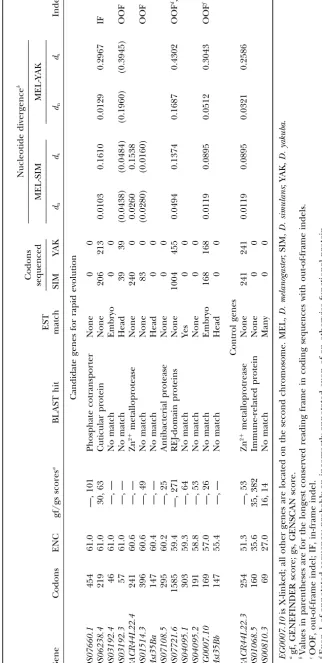
simulansandD. yakuba, primers were designed from the D. melanogaster sequence using GC-rich regions in or around exons. Among 16 primer pairs tested, 10 re-sulted in a PCR product inD. simulansand 6 inD. yakuba (Table 1). We expected that only a subset of primers would work in the other species, because the average divergence at silent sites isⵑ11% betweenD. melanogas-terandD. simulans(BauerandAquadro1997;Powell
andMoriyama1997) and 23% betweenD. melanogaster
and D. yakuba (Schmid and Tautz 1997). Out of 10 PCR products obtained from D. simulans, 7 could be sequenced successfully, and 5 could be sequenced from D. yakuba. Only one of the three high codon bias control genes could be amplified and sequenced successfully (BACR44L22.3) in bothD. simulansandD.yakuba.
An alignment of the sequences revealed many nucleo-tide substitutions and insertions/deletions (indels). Among the six genes with low codon bias, the putative coding region of four genes showed out-of-frame indels in a comparison betweenD. melanogasterandD.simulans,D. yakuba, or D. erecta. These genes include DS01514.3, Figure 1.—Relationship between GC content at synony- DS03192.3, and exon 1 ofDS07721.6, which are probably mous sites and the effective number of codons (ENC;Wright
incorrectly annotated exons. In two genes, we observed
1990) for all genes of theAdhregion (A) and the tip of the
several in-frame indels (DS06283.4 and exon 3 of
X chromosome ofD. melanogaster(B). Solid circles represent
candidates for rapidly evolving genes. The⫻ symbol shows DS07721.6). In the comparison betweenD.melanogaster the three “control” genes (seeresults). The line gives the andD. erecta homologs of EG0007.10, an out-of-frame expected relationship of GC content at synonymous sites and
indel in the 3⬘region of the coding sequence leads to
ENC of random sequences (Wright1990). ENC values of 61
a longer protein inD. erecta. It is unclear whether this
indicate indiscriminate use of synonymous codons.
gene encodes a functional protein. Estimates ofdnand dsare given in Table 1. OnlyDS07721.6can be consid-ered to be a rapidly evolving protein (dn ⫽ 0.0494) at synonymous codon positions (GC3) for the 220 genes
of theAdhregion and 236 genes from the tip of the X between D. melanogaster and D. simulans, whereas all other genes are more conserved and exhibitdn values chromosome (Figure 1). We also compared the codon
usage of predicted genes with their GENEFINDER and that are not significantly different from the control gene (BACR44L22.3).
GENSCAN scores as obtained fromAshburner et al.
(1999), but they did not reveal a simple relationship DS07721.6is predicted to encode a large protein of 1585 amino acids of unknown function (Ashburneret (results not shown). Genes with very low and very high
ENC values tend to have lower GENEFINDER or GEN- al.1999). Secondary structure analysis of the protein sequence suggests that it is a transmembrane protein SCAN scores. Preferred codons inD. melanogaster end
in C or G (Akashi 1995), and genes under selection (data not shown). Because of its length, we focused our sequencing on the extracellular domain (Figure 2). The for optimal codon usage should have aGC3⬎0.5. We
selected genes with ENC⬎55 and/or GC3⬍0.5 and nonsynonymous divergence ofDS07721.6 is similar to anon1G5, the most rapidly evolving gene from an earlier no or weak similarity to genes from distant species
(Ta-ble 1). Our sample also included several biased and screen for rapidly evolving genes (SchmidandTautz 1997), which also exhibits in-frame indels in compari-conserved genes as controls. For example, to evaluate
the relationship between codon usage and amino acid sons betweenD. melanogaster,D. simulans, andD. yakuba. Although the first exon ofDS07721.6contains two out-evolution, two members of a gene cluster encoding
593 Evolution of Drosophila Orphans
Figure 2.—(A) Schematic structure of gene DS07721.6. Shaded boxes designate exons, solid arrowheads show in-frame indels (multiples of three), and open arrowheads show out-of-frame indels (no multiples of three). Numbers above the ar-rowheads are the lengths of in-sertions in base pairs. Bars show the regions sequenced inD.
sim-ulansorD. yakuba. (B) Schematic
structure of the predicted pro-tein sequence ofDS07721.6.The locations of the moderately con-served REJ module and the sin-gle transmembrane helix (TM) are shown as shaded boxes. The graph shows a sliding window analysis of the dn and ds values in theD. melanogaster-D. simulans comparison using a window size of 90 codons and a step size of one. The sliding window analysis ofdnanddswas performed with the program wina(Endo et al. 1996). The bar shows the region surveyed in populations of D.
melanogasterandD. simulans.
because the numerous indels in exon 3 are in frame nogaster( ⫽ 0.0018; Table 2). Only 6 polymorphisms were discovered; 3 of them are synonymous and 3 non-and there is a weak but significant sequence similarity
to REJ-domain-containing proteins from other animal synonymous. InD. simulans, 27 polymorphisms are seg-regating in the sample ( ⫽0.0124), of which 10 are phyla (data not shown). The rapid evolution of parts
ofDS07721.6raises the question of whether this is due synonymous and 17 nonsynonymous. The level of DNA diversity () is about seven times higher than in D. to a high rate of neutral evolution or positive Darwinian
selection. A sliding window analysis of the dn and ds melanogaster, which is within the range observed for other genes that were surveyed in both species ( Mori-values along the coding sequence of exons 3–6 shows
that the nonsynonymous sequence divergence is rela- yamaandPowell1996). The large number of replace-ment polymorphisms is consistent with the rapid evolu-tively constant whereas the synonymous sequence
diver-gence is highly variable between different regions of tion of this region of DS07721.6. Most other surveyed genes have much smaller numbers of nonsynonymous the coding sequence (Figure 2B). Interestingly, in the
fragment encoding the region C-terminal of the REJ polymorphisms (MoriyamaandPowell1996). Several tests of neutrality were applied to the data and none of module, dn drops to zero and ds increases up to 0.4,
which is much higher than the expected neutral se- them rejected the null hypothesis of neutral evolution (Tables 2 and 3). The HKA test was not significant in quence divergence. This fragment may consist of a
mu-tational hotspot combined with strong constraints on comparisons ofDS07721.6to various neutrally evolving reference loci (anon1A3, anon1E9, and anon1G5; nonsynonymous substitutions.
DNA polymorphism in DS07721.6: Because of the Schmidet al.1999), although it was marginally
signifi-cant inD. melanogasterwhen theAdh-5⬘region of Kreit-high rate of amino acid evolution and silent divergence,
we obtained sequences of exons 3 and 4 from 10 lines manandHudson(1991) was used for comparison (2⫽ 3.824,P ⫽0.0505).
each of African populations of D. melanogaster and D.
simulans. A comparison of intraspecific polymorphism We also looked at lineage-specific substitutions to ana-lyze the effect of different species-level effective popula-and interspecific divergence can be used to discriminate
between neutral evolution and positive Darwinian selec- tion sizes on the evolution and polymorphism of this region (seeSchmidet al.1999 for a more detailed discus-tion as the causes for the rapid evoludiscus-tion of these genes.
We chose the African lines because they represent ances- sion). Using D. yakuba as an outgroup, 37 out of 41 fixed differences could be assigned to either the D. tral populations of both species and are probably close
to a mutation-selection-drift equilibrium (Begun and melanogasterorD. simulanslineages. Thirteen nonsynon-ymous and 6 synonnonsynon-ymous substitutions occurred in the
Aquadro1993).
TABLE 3
McDonald-Kreitman test forDS07721.6
Substitutions
Class Replacement Synonymous G-value
Fixed between 38 19 0.326
species
Polymorphic 20 13
within species
TheG-value is not significant (P⬎0.05).
synonymous substitutions in theD. simulanslineage. The numbers for the two types of substitutions differ little between the two lineages. This suggests that the nonsyn-onymous substitutions are either completely neutral or have been fixed by relatively strong positive selection that occurred in both lineages.
DISCUSSION
Identifying rapidly evolving genes:Our motivation for
this study was to test whether orphans in the Drosophila genome are rapidly evolving genes and, if so, whether they evolve neutrally because of relaxed constraints or positive selection. Rapidly evolving genes have recently attracted considerable interest, because they might play a role in the adaptive evolution of phenotypic traits (e.g.,
Murphy 1993;SwansonandVacquier 1995;Pamilo
andO’Neill1997;CivettaandSingh1998;
Michael-more and Meyers 1998; Duda and Palumbi 1999;
Yokoyamaet al.1999;Wyckoffet al.2000). An
under-standing of the evolution and function of such “adaptive trait loci” may be highly relevant to the study of species differences (TautzandSchmid1998). Thus, after rap-idly evolving genes have been identified, it is of interest to test whether they diverge neutrally or are responding to positive Darwinian selection.
Since no extensive genomic sequence from a closely related species ofD. melanogasteris available, we identi-fied candidate genes by a synopsis of data on sequence features, function, and evolutionary conservation in dis-tantly related organisms. The genes of theAdh region and the tip of the X chromosome region are good candi-dates for testing such an approach because they are among the best-characterized regions of the Drosophila genome and much information on sequence conserva-tion, expression, and genetic function is available. Our criteria for selecting putative rapidly evolving genes were codon usage, a low level of expression, and no or weak similarity to distant organisms. Among four surveyed genes without codon bias that retained an in-tact reading frame inD. simulansorD. yakuba, only one (DS07721.6) was rapidly evolving at the amino acid level, suggesting that a lack of codon usage alone may not be
TABLE
2
Nucleotide
d
iversity
in
exon
4
o
f
DS07721.6
in
D.
melanogaster
and
D.
simulans
Lineage-specific
Polymorphic
sites
fixed
differences
Species
Sites
Total
Replacement
S
ilent
Tajima’s
D
Fu
and
L
i’s
D
HKA
(
2)
a
Replacement
S
ilent
D.
melanogaster
858
6
3
3
0.0018
0.0025
⫺
1.15
⫺
1.27
1.47
13
6
D.
simulans
858
2
7
1
7
1
0
0.0124
0.0112
0.48
0.31
0.15
14
4
None
of
the
tests
for
n
eutrality
is
significant
(
P
⬍
0.05).
aThe
anon1A3
gene
(
Schmid
et
al.
1999)
was
u
sed
as
a
reference
locus.
595 Evolution of Drosophila Orphans
and simulations suggested that such a relationship rep-resents different assumptions in the estimation of nucle-otide divergence (Dunn et al. 2001). Using the same maximum-likelihood method for estimating nucleotide divergence asDunnet al.(2001) and with a larger num-ber of genes, we also do not find a significant correlation between ENC and synonymous divergence in compari-sons between D. melanogaster and D. simulans (Figure 3B). One explanation for the absence of such a correla-tion may be variable mutacorrela-tional pressures in different evolutionary lineages, which can lead to a negative cor-relation between ENC and ds (Bielawski et al. 2000). In addition, our data do not show a positive correlation betweendn and ds (R2 ⫽ 0.02, P ⫽ 0.25), which is in contrast to earlier studies (Akashi1994;Comeronand
Kreitman1998;Dunnet al.2001). However, since we
are mainly interested in the relationship between ENC and dn, the lack of such a relationship has no conse-quences for our study. In conclusion, it can be stated that, although there is a positive correlation betweendn and ENC, the use of codon bias alone is not sufficient for a reliable identification of rapidly evolving genes.
Therefore, additional information about gene func-tion needs to be taken into account for generating bet-ter predictions of rapidly evolving genes from single genome sequences. Such information can be the type and strength of mutant phenotypes (Ashburneret al. 1999), the tissue where genes are expressed (Hurst
andSmith1999), or the type of protein that is encoded
Figure 3.—Correlation between the effective number of by a gene (e.g., subcellular location). For example, codons, ENC (calculated from theD.melanogastersequences), DS06238.4is probably identical to thepupalgene, which the number of nonsynonymous,dn(A), and synonymous,ds
has a lethal phenotype. Under the assumption that
func-(B), substitutions calculated from alignments of homologous
tionally important genes should be more conserved
sequences fromD.melanogasterandD. simulans(n⫽85) that
were retrieved from GenBank or sequenced in this study. (Wilsonet al.1977), rapid sequence divergence is not expected in this gene. In fact, its sequence is highly conserved in distant insects but not in other phyla, sug-genes. This notion is further supported by a comparison gesting that its occurrence is restricted to insects, where of ENC withdnfor genes (including those of this study) it may have acquired an essential function. The lack of where partial or complete coding sequences were avail- codon bias in this gene could be related to its repetitive able from D. melanogaster and D. simulans (n ⫽ 85). amino acid sequence.
Although we find a highly significant negative correla- Causes of rapid evolution:Only one of the candidate tion between codon usage bias and nonsynonymous genes we examined was apparently both functional and divergence (Figure 3A), it is not very strong. This sug- rapidly evolving. Neither the sequence comparisons be-gests that, although there is evidence for selection on tween Drosophila species nor the population variation translational accuracy, additional factors such as gene analysis of the rapidly evolving geneDS07721.6revealed length (Comeronet al.1999), expression level (Shields evidence for positive selection being important for its et al.1988; Powelland Moriyama 1997; Duret and evolution. The levels of nonsynonymous divergence and
Mouchiroud1999), mutation bias (Kliman andHey replacement polymorphisms are very similar to other
evolving under positive Darwinian selection. However, of ESTs from tissue-specific libraries (Andrews et al. 2000), or, as described in this study, sequencing of ho-one can expect that many genes evolving under positive
selection have specialized functions with a restricted mologous genes from closely related species. It should be noted that our small sample of genes does not allow expression (Tautz and Schmid 1998) and therefore
may not be represented in current EST collections. This an estimation of how many predicted genes contain annotation errors. However, we expect that a substantial notion is supported by a recent EST sequencing study
of genes expressed in the testis ofD. melanogaster, which proportion of nonconserved genes may be overpre-dicted and that many genes not recognized by predic-found that about one-half of 1560 cDNA sets fail to align
with existing Drosophila ESTs (Andrews et al. 2000). tion algorithms may consist of rapidly evolving genes.
Comparative sequencing of related species:The fact
This suggests that many tissue-specific genes have not
yet been discovered, although they may be expressed that only one of six candidate genes evolves rapidly suggests that the identification of such genes in single at a high level within a tissue. As EST collections grow in
size, information about the number of tissues in which genomic sequences is difficult, in particular because of the requirement of a correctly annotated sequence. In genes are expressed can be used to identify rapidly
evolv-ing genes. There is little theoretical support for the addition, the PCR approach used in this pilot study is not practical for analyzing a large number of candidate notion that genes evolving under positive selection can
be expected to have low codon bias, but one can assume genes because about one-half of the primer pairs de-signed using theD. melanogastersequence did not work that translational accuracy may not be very strong in
such genes. This hypothesis is consistent with the obser- inD. simulansorD. yakuba. However, because numerous rapidly evolving genes can be expected in the genome vation of several genes encoding male accessory gland
proteins that evolve under positive Darwinian selection ofD. melanogasterand other model organisms (Schmid
and Tautz 1997), alternative approaches might be
and are characterized by low codon bias (Begunet al.
2000). taken to identify such genes on a large scale. Possible
approaches include the sequencing of the complete It should be noted that most tests employed for
de-tecting positive selection are not very powerful in de- genome (at low coverage) or of ESTs from cDNA librar-ies of closely related “satellite” speclibrar-ies. Suitable speclibrar-ies tecting weak or episodic selection (for a more detailed
discussion, seeSchmidet al.1999). More powerful tests for comparisons toD. melanogasterareD. simulansorD. yakuba. Values ofdsrange from 0.05 to 0.18 betweenD. need to be developed for detecting these types of
adap-tive molecular evolution. Generation of data for such melanogasterandD. simulans(BauerandAquadro1997;
Powell and Moriyama 1997) and from 0.11 to 0.35
genes from additional species may allow codon-specific
models to be used such as those developed by Z. Yang between D. melanogaster and D. yakuba (Schmid and
Tautz1997). dnanddsvalues from such comparisons
and R. Nielsen (e.g.,Yang et al.2000). Such a study of
DS07721.6may reveal that positive selection at a subset give good estimates of sequence divergence and facili-tate the genome-wide identification of rapidly evolving of the amino acids, coupled with selective constraint at
others, may account for its rapid evolution shown here. genes likeDS07721.6that are candidates for positively selected genes. In addition, comparisons between D.
Improving the annotation:A surprising result of our
melanogasterandD. simulansorD. yakubaare sufficiently survey is the large proportion of incorrectly annotated
divergent to detect incorrectly annotated exons because genes. In four out of six candidate genes, the putative
of the large number of point and indel mutations that open reading frame contained out-of-frame indels in
are being fixed by chance in noncoding sequences. Such eitherD. simulans,D. yakuba, or D. erecta. Two of these
approaches would not only lead to the identification sequences may not be protein-coding genes at all.
Fur-of rapidly evolving genes with potential roles in the thermore, there are at least two additional paralogs of
phenotypic divergence of species and enhance our un-gene DS07721.6 in the Drosophila genome that were
derstanding of genome-wide patterns of protein evolu-not recognized and anevolu-notated by the gene prediction
tion but also assist in the correct annotation of “difficult” algorithms used for the annotation (data not shown).
genes for which currently available gene prediction These observations confirm the conclusions of the
Dro-methods are not reliable. sophila Genome Annotation Assessment Project (GASP;
Reese et al.2000) that, even in the relatively compact We are grateful to B. Haubold, W. Swanson, T. Wiehe, M. Aguade´,
and two anonymous reviewers for helpful comments on the manu-Drosophila genome, purely computer-based gene
anno-script. This work was funded by a postdoctoral fellowship of the Ger-tations (ab initiopredictions) both over- and
underpre-man Academic Exchange Service (DAAD) to K.J.S. and a National dict genes. Many predictions contain errors (e.g., the
Institutes of Health (NIH) grant to C.F.A. incorrect identification of the 5⬘ end of open reading
frames), particularly for genes with a lack of sequence
conservation or with unusual patterns of codon usage LITERATURE CITED
like the candidate genes of this study (Guigo´et al.2000).
Adams, M., S. Celniker, R. Holt, C. Evans, J. Gocayneet al., 2000 Gene predictions need additional experimental verifi- The genome sequence ofDrosophila melanogaster. Science287:
597 Evolution of Drosophila Orphans
Akashi, H., 1994 Synonymous codon usage inDrosophila melanogas- Fu, Y.-X., and W.-H.Li, 1993 Statistical tests of neutrality of muta-tions. Genetics133:693–709.
ter: Natural selection and translational accuracy. Genetics136:
Gordon, D., C. AbajianandP. Green, 1998 Consed: a graphical 927–935.
tool for sequence finishing. Genome Res.8:195–202.
Akashi, H., 1995 Inferring weak selection from patterns of
polymor-Green, P., 1995 GENEFINDER Documentation(http://genetics.mgh. phism and divergence at “silent” sites in Drosophila DNA.
Genet-harvard.edu/doc/genefinder.doc.html). ics139:1067–1076.
Guigo´, R., P.Agarwal, J.Abril, M.Bursetand J.Fickett, 2000
Akashi, H., 1996 Molecular evolution betweenDrosophila
melanogas-An assessment of gene prediction accuracy in large DNA
se-ter andD. simulans: reduced codon bias, faster rates of amino
quences. Genome Res.10:1631–1642. substitution, and larger proteins inD. melanogaster. Genetics144:
Hieter, P., andM. Boguski, 1997 Functional genomics: its all how 1297–1307.
you read it. Science278:601–602.
Altschul, S., T.Madden, A.Scha¨ffer, J.Zhang, Z.Zhanget al.,
Hudson, R. R., M.Kreitmanand M.Aguade´, 1987 A test of neutral 1997 Gapped BLAST and PSI-BLAST: a new generation of
pro-molecular evolution based on nucleotide data. Genetics 116:
tein database search programs. Nucleic Acids Res.25:3389–3402.
153–159.
Andrews, J., G.Bouffard, C.Cheadle, J.Lu¨, K.Beckeret al., 2000
Hurst, L., andN. Smith, 1999 Do essential genes evolve slowly? Gene discovery using computational and microarray analysis of
Curr. Biol.9:747–750. transcription in theDrosophila melanogastertestis. Genome Res.
Kliman, R., andJ. Hey, 1993 Reduced natural selection associated
10:2030–2043.
with low recombination inDrosophila melanogaster.Mol. Biol. Evol.
Ashburner, M., S. Misra, J. Roote, S. Lewis, R. Blazejet al., 1999
10:1239–1258. An exploration of the sequence of a 2.9-Mb region of the genome
Kliman, R., andJ. Hey, 1994 The effects of mutation and natural ofDrosophila melanogaster—TheAdhregion. Genetics153:179–
selection on codon bias in the genes of Drosophila. Genetics 219.
137:1049–1056.
Bauer, V., andC. Aquadro, 1997 Rates of DNA sequence evolution
Kreitman, M., andR. Hudson, 1991 Inferring the evolutionary are not sex-biased inDrosophila melanogasterandDrosophila
sim-histories of theAdhandAdh-duploci inDrosophila melanogaster ulans. Mol. Biol. Evol.14:1252–1257.
from patterns of polymorphism and divergence. Genetics127:
Begun, D., and C. Aquadro, 1993 African and North American
565–582. populations ofDrosophila melanogasterare very different at the
McDonald, J., andM. Kreitman, 1991 Adaptive evolution at the DNA level. Nature365:548–550.
Adhlocus in Drosophila. Nature351:652–654.
Begun, D., P. Whitley, B. Todd, H. Waldrip-DailandA. Clark,
Michaelmore, R. W., andB. C. Meyers, 1998 Clusters of resistance 2000 Molecular population genetics of male accessory gland
genes in plants evolve by divergent selection and a birth-and-proteins in Drosophila. Genetics156:1879–1888.
death process. Genome Res.8:1113–1130.
Benos, P., M. Gatt, M. Ashburner, L. Murphy, D. Harriset al.,
Moriyama, E. N., andJ. R. Powell, 1996 Intraspecific nuclear DNA 2000 From sequence to chromosome: the tip of the X
chromo-variation in Drosophila. Mol. Biol. Evol.13:261–277. some ofD. melanogaster. Science287:2220–2222.
Murphy, P. M., 1993 Molecular mimicry and the generation of host
Bielawski, J., K. DunnandZ. Yang, 2000 Rates of nucleotide
substi-defense protein diversity. Cell42:823–826. tution and mammalian nuclear gene evolution: approximate and
Nei, M., 1987 Molecular Evolutionary Genetics. Columbia University maximum-likelihood methods lead to different conclusions.
Ge-Press, New York. netics156:1299–1308.
Oliver, S., 1996 From DNA sequence to biological function. Nature
Bork, P., andE. Koonin, 1998 Predicting functions from protein
379:597–600. sequences: where are the bottlenecks? Nat. Genet.18:313–318.
Pamilo, P., andR. J. W. O’Neill, 1997 Evolution of theSrygenes.
Bork, P., T. Dandekar, Y. Diaz-Lazcoz, F. Eisenhaber, M. Huynen
Mol. Biol. Evol.14:49–55.
et al., 1998 Predicting function: from genes to genomes and
Powell, J., andE. Moriyama, 1997 Evolution of codon usage bias back. J. Mol. Biol.283:707–725.
in Drosophila. Proc. Natl. Acad. Sci. USA94:7784–7790.
Brenner, S., 1999 Errors in genome annotation. Trends Genet.15:
Reese, M., G. Hartzell, N. Harris, U. Ohler, J. Abrilet al., 2000 132–133.
Genome annotation assessment in Drosophila melanogaster.
Ge-Brenner, S., C. ChothiaandT. Hubbard, 1997 Population
statis-nome Res.10:483–501. tics of protein structures: lessons from structural classifications.
Rozas, J., andR. Rozas, 1999 DnaSP version 3: an integrated pro-Curr. Opin. Struct. Biol.7:369–376.
gram for molecular population genetics and molecular evolution
Burge, C., andS. Karlin, 1997 Prediction of complete gene struc- analysis. Bioinformatics
15:174–175.
tures in human genomic DNA. J. Mol. Biol.268:78–94. Rozen, S., andH. Skaletsky, 1998 Primer3 (code available at http://
Chothia, C., 1992 One thousand families for the molecular biolo- www-genome.wi.mit.edu).
gist. Nature357:543–544. Schmid, K. J., andD. Tautz, 1997 A screen for fast evolving genes
Civetta, A., andR. S. Singh, 1998 Sex-related genes, directional from Drosophila. Proc. Natl. Acad. Sci. USA94:9746–9750. sexual selection, and speciation. Mol. Biol. Evol.15:901–909. Schmid, K. J., L. Nigro, C. F. AquadroandD. Tautz, 1999 Large
Comeron, J., andM. Kreitman, 1998 The correlation between syn- number of replacement polymorphisms in rapidly evolving genes onymous and nonsynonymous substitution in Drosophila: muta- of Drosophila: implications for genome-wide surveys of DNA poly-tion, selecpoly-tion, or relaxed constraints? Genetics150:767–775. morphism. Genetics153:1717–1729.
Comeron, J., M.Kreitmanand M.Aguade´, 1999 Natural selection Sharp, P., and W.-H.Li, 1989 On the rate of DNA sequence evolu-on synevolu-onymous sites is correlated with gene length and recombi- tion in Drosophila. J. Mol. Evol.28:398–402.
nation in Drosophila. Genetics151:239–249. Shields, D., P. Sharp, D. HigginsandF. Wright, 1988 “Silent”
Duda, T. F., andS. R. Palumbi, 1999 Molecular genetics of evolu- sites in Drosophila genes are not neutral: evidence of selection tionary diversification: duplication and rapid evolution of toxin among synonymous codons. Mol. Biol. Evol.5:704–716. genes of the venomous gastropodConus. Proc. Natl. Acad. Sci. Swanson, W. J., andV. D. Vacquier, 1995 Extraordinary divergence
USA96:6820–6823. and positive Darwinian selection in a fusagenic protein coating
Dunn, K., J. Bielawskiand Z. Yang, 2001 Substitution rates in the acrosomal process of abalone spermatozoa. Proc. Natl. Acad. Drosophila nuclear genes: implications for translational selec- Sci. USA92:4957–4961.
tion. Genetics157:295–305. Tajima, F., 1989 Statistical method for testing the neutral mutation
Duret, L., andD. Mouchiroud, 1999 Expression pattern and, sur- hypothesis by DNA polymorphism. Genetics123:585–595. prisingly, gene length shape codon usage inCaenorhabditis,Dro- Tautz, D., andK. J. Schmid, 1998 From genes to individuals—
sophilaandArabidopsis. Proc. Natl. Acad. Sci. USA96:4482–4487. developmental genes and the generation of the phenotype. Proc.
Endo, T., K. IkeoandT. Gojobori, 1996 Large-scale search for R. Soc. London Ser. B353:231–240.
genes on which positive selection may operate. Mol. Biol. Evol. Thompson, J. D., D. G. HigginsandT. J. Gibson, 1994 CLUSTALW:
13:685–690. improving the sensitivity of progressive multiple sequence
align-Ewing, B., L. Hillier, M. WendlandP. Green, 1998 Base-calling of ment through sequence weighting, position-specific gap penalties automated sequencer traces using phred. I. Accuracy assessment. and weight matrix choice. Nucleic Acids Res.22:4673–4680.
genetical models without recombination. Theor. Popul. Biol.7: rate variation in nuclear genes of mammals. J. Mol. Evol. 46:
256–276. 409–418.
Wilson, A., S. CarlsonandT. White, 1977 Biochemical evolution. Yang, Z., R. Nielsen, N. GoldmanandA. Pedersen, 2000 Codon-Annu. Rev. Biochem.46:573–639. substitution models for heterogeneous selection pressure at
Wright, F., 1990 The ‘effective number of codons’ used in a gene. amino acid sites. Genetics155:431–449.
Gene87:23–29. Yokoyama, S., H. Zhang, F. B. RadlwimmerandN. S. Blow, 1999
Wyckoff, G., W.Wangand C.Wu, 2000 Rapid evolution of male Adaptive evolution of color vision of the Comoron coelacanth reproductive genes in the descent of man. Nature403:304–309. (Latimeria chalumnae). Proc. Natl. Acad. Sci. USA96:6279–6284.
Yang, Z., 1999 Phylogenetic Analysis Using Maximum Likelihood (PAML), Version 2. University College, London.